Review

Meat-Borne Bacterial Pathogen Detection: Conventional, Molecular and Emerging AI-Based Strategies


1
School of Food and Agricultural Sciences (SFAS), University of Management and Technology (UMT), Lahore 54000, Pakistan
2
Genomics and Informatics Lab (GIL), Ltd., Lahore 54000, Pakistan
3
Department of Life Sciences, School of Sciences (SSC), University of Management and Technology (UMT), Lahore 54000, Pakistan
4
Seoul St. Mary’s Hospital, Catholic University of Korea, 222 Banpo-daero, Seocho-gu, Seoul 06591, Republic of Korea
*
Author to whom correspondence should be addressed.
Diagnostics 2026, 16(9), 1360; https://doi.org/10.3390/diagnostics16091360

Submission received: 6 March 2026 / Revised: 19 April 2026 / Accepted: 22 April 2026 / Published: 30 April 2026

Abstract

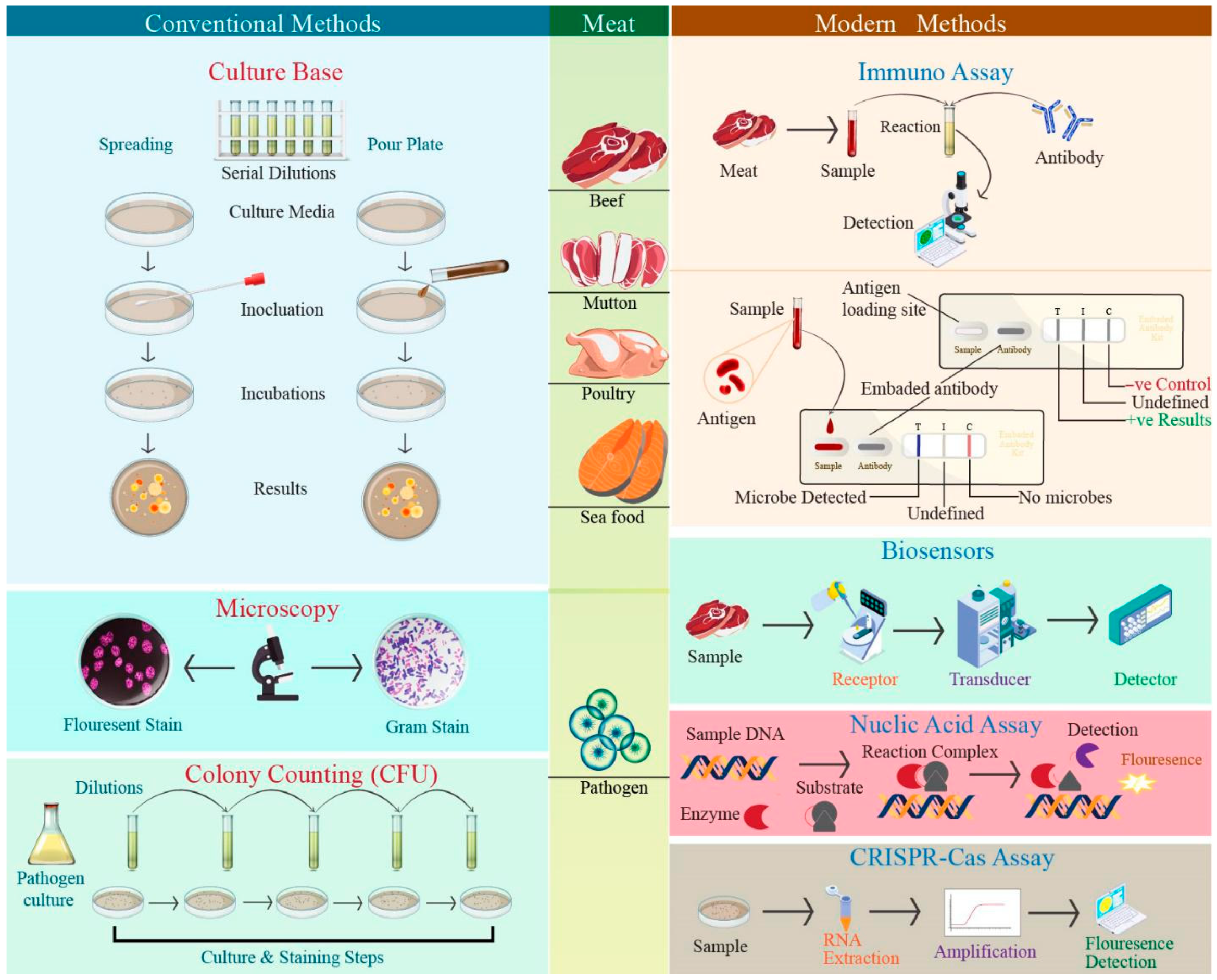
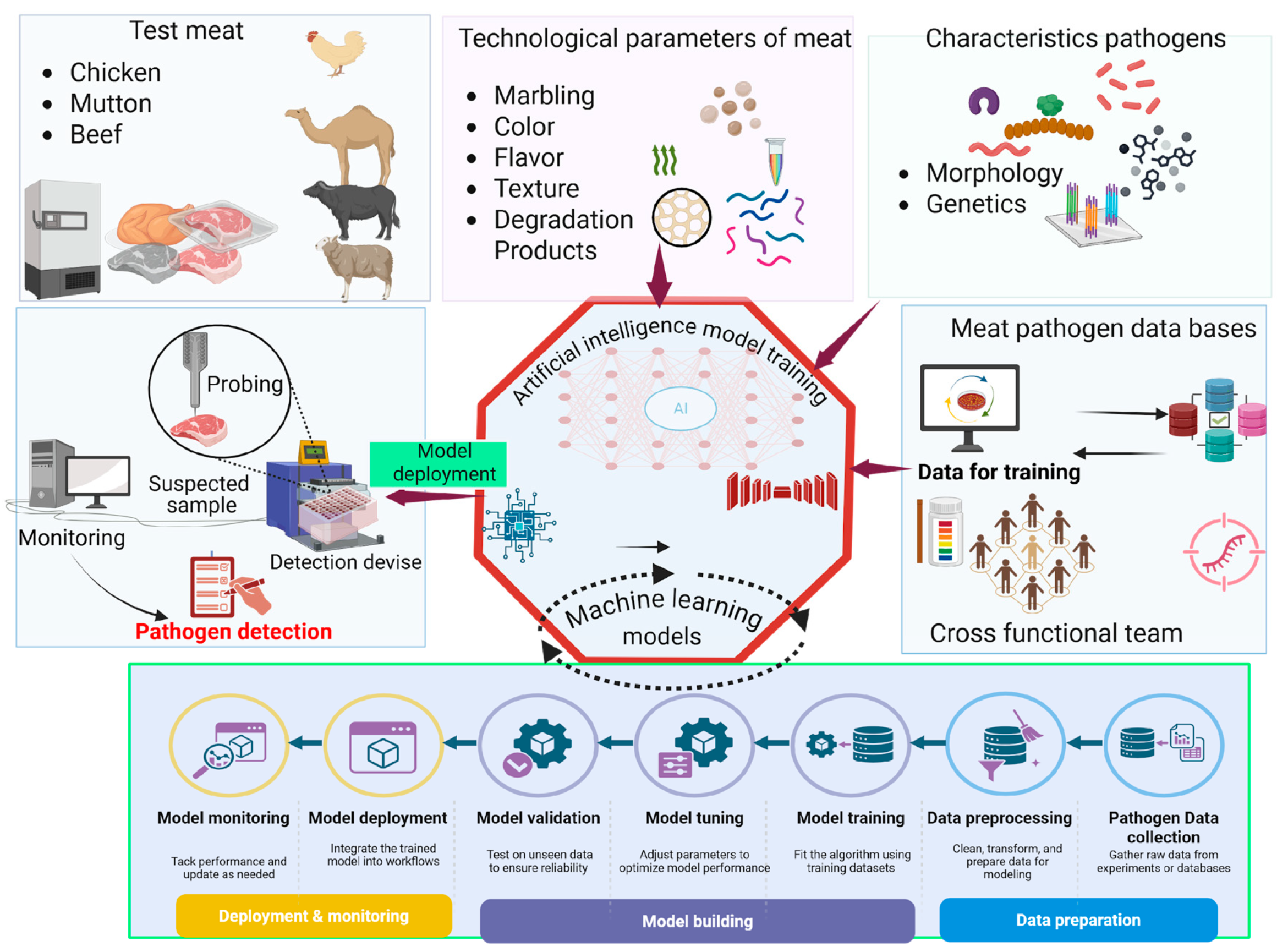
Meat serves as a prime medium for the growth of foodborne pathogens due to its rich protein content and high water activity, contributing significantly to the global burden of foodborne illnesses. This review synthesizes current advances in meat-borne bacterial pathogen detection with particular emphasis on emerging artificial intelligence (AI)-enabled applications. Major pathogens of concern, including Salmonella, Listeria monocytogenes, Escherichia coli, Campylobacter, Clostridium, and Staphylococcus aureus, are examined in relation to their relevance across the meat supply chain. Recent progress in biosensors (clustered regularly interspaced short palindromic repeats), CRISPR-based assays, isothermal amplification, and metagenomics is evaluated alongside the growing role of AI in automating signal interpretation, enhancing image-based diagnostics, and supporting early contamination prediction. AI-based systems have proved 96.4–104% recovery and 100% bacterial capture ability. Embedding AI methods in a wet lab demands technical and logical modeling, as well as learning and calibration decorum. Nonetheless, AI readiness and full-scale application for meat-borne pathogens surveillance are on the way. Furthermore, additional focus is aligned on meat-borne bacterial pathogen genomic databases, i.e., (NCBI Pathogen Detection, EnteroBase, VFDB, ComBase, and GenBank), which serve as critical training resources for AI models for outbreak tracking, virulence profiling, and antimicrobial resistance (AMR) prediction. By integrating molecular methods, genomic surveillance, and AI-driven analytics, this review presents a framework for strengthening meat safety systems. This will improve early detection capabilities and support data-driven public health interventions in the future.
Keywords: artificial intelligence; meat-borne pathogens; antimicrobial resistance; genomic surveillance; phage therapy; biosensors; pathogen detection artificial intelligence; meat-borne pathogens; antimicrobial resistance; genomic surveillance; phage therapy; biosensors; pathogen detection
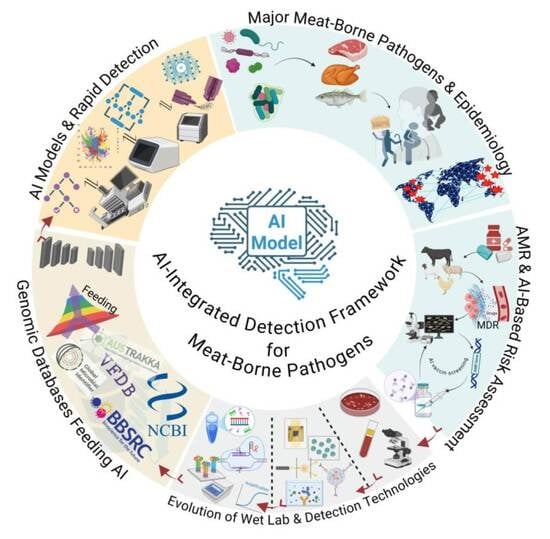
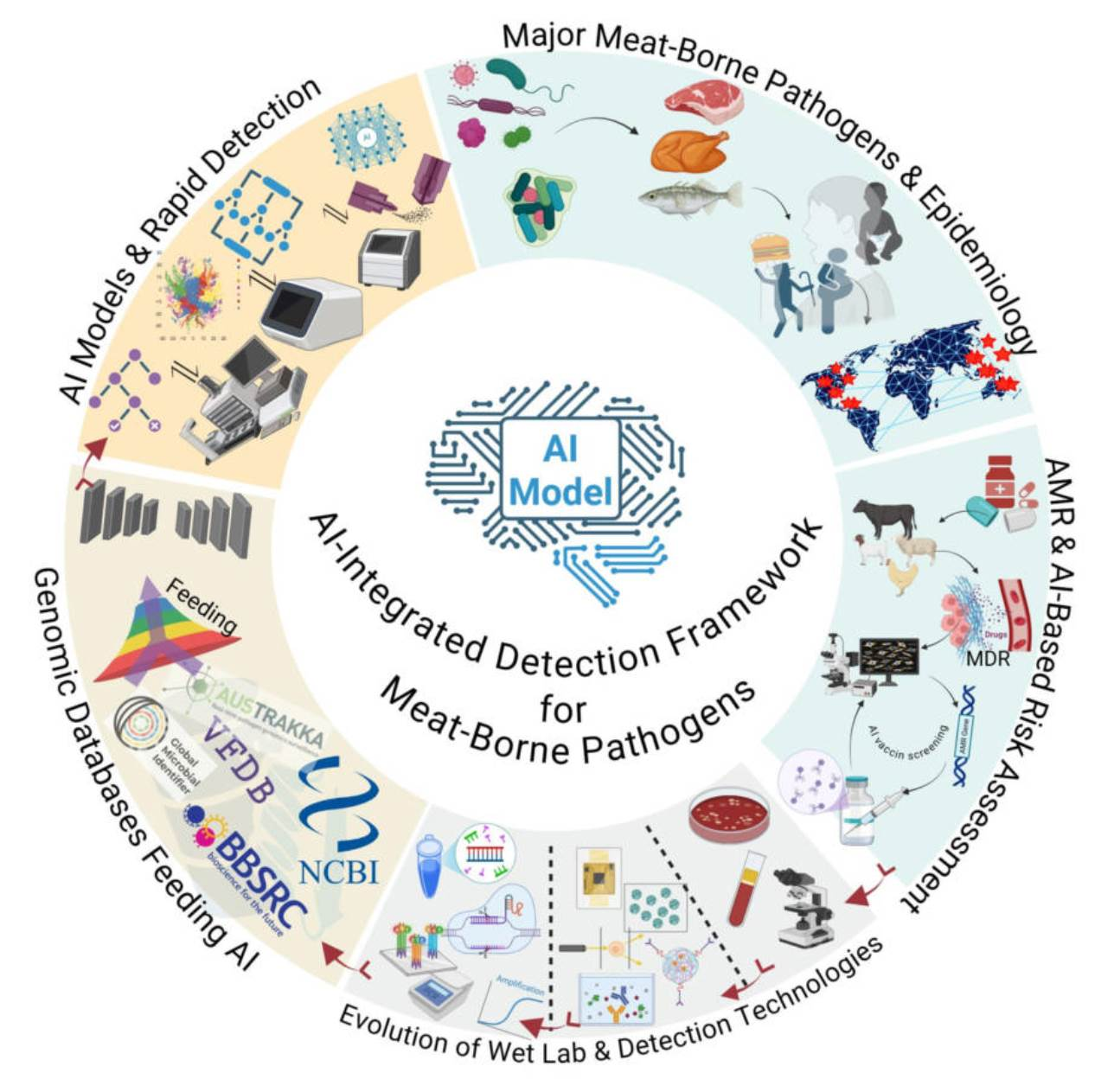
Graphical Abstract