Serum Mammalian Target of Rapamycin (mTOR) Levels in Patients with Post-COVID-19 Fibrotic-like Lung Changes: A Cross-Sectional Study


Abstract
1. Introduction
2. Materials and Methods
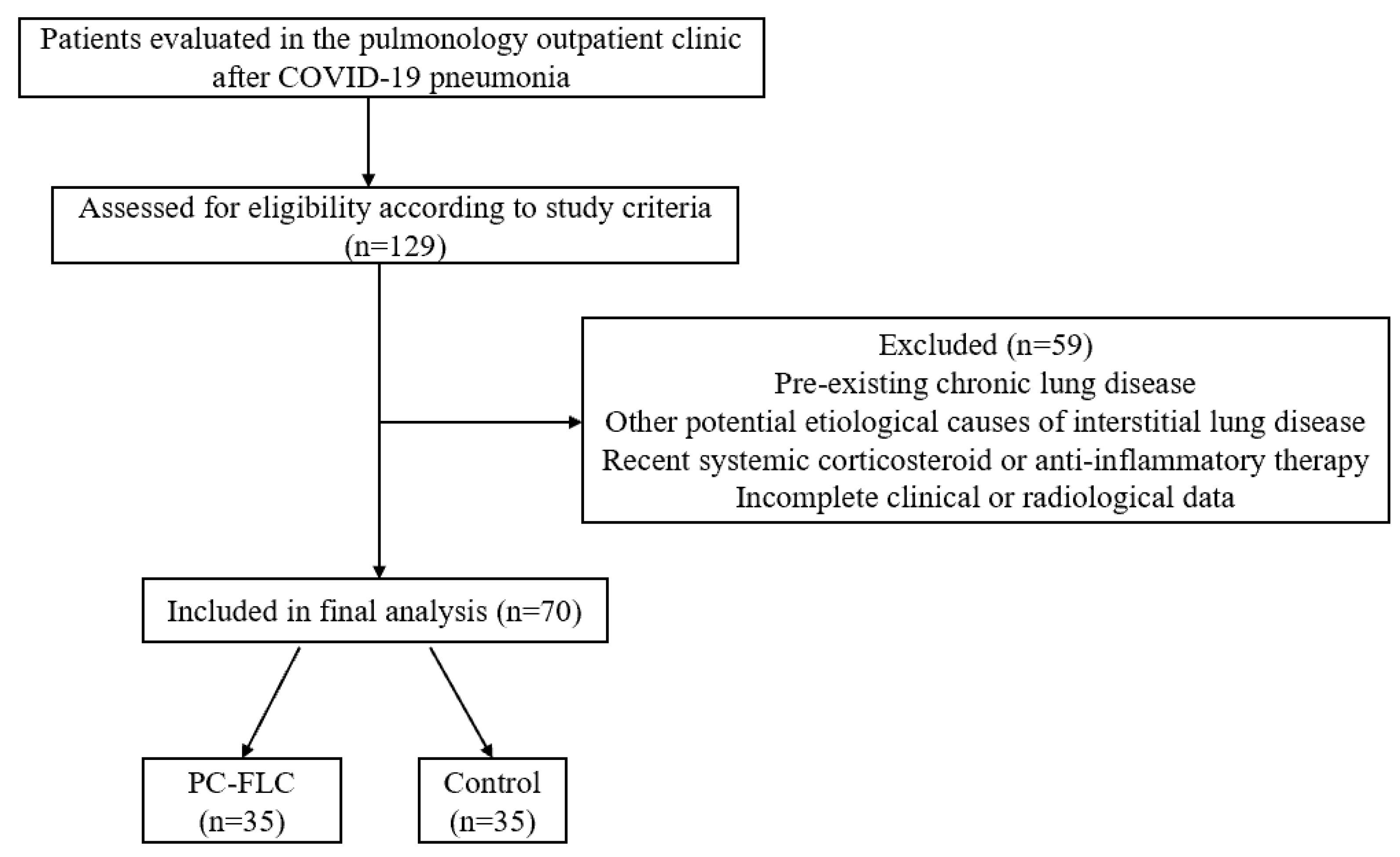
2.1. Patient Selection and Study Design
2.2. Laboratory Analysis
2.3. Radiological Evaluation
2.4. Statistical Analysis
3. Results
4. Discussion
5. Conclusions
Author Contributions
Funding
Institutional Review Board Statement
Informed Consent Statement
Data Availability Statement
Acknowledgments
Conflicts of Interest
References
- de-las-Peñas, C.F.; Palacios-Ceña, D.; Gómez-Mayordomo, V.; Cuadrado, M.L.; Florencio, L.L. Defining post-covid symptoms (post-acute covid, long covid, persistent post-covid): An integrative classification. Int. J. Environ. Res. Public Health 2021, 18, 2621. [Google Scholar] [CrossRef]
- Soriano, J.B.; Murthy, S.; Marshall, J.C.; Relan, P.; Diaz, J.V.; WHO Clinical Case Definition Working Group on Post-COVID-19 Condition. A clinical case definition of post-COVID-19 condition by a Delphi consensus. Lancet Infect. Dis. 2022, 22, e102–e107. [Google Scholar] [CrossRef]
- Liu, J.; Zheng, X.; Tong, Q.; Li, W.; Wang, B.; Sutter, K.; Trilling, M.; Lu, M.; Dittmer, U.; Yang, D. Overlapping and discrete aspects of the pathology and pathogenesis of the emerging human pathogenic coronaviruses SARS-CoV, MERS-CoV, and 2019-nCoV. J. Med. Virol. 2020, 92, 491–494. [Google Scholar] [CrossRef]
- Cruces, P.; Retamal, J.; Hurtado, D.E.; Erranz, B.; Iturrieta, P.; González, C.; Díaz, F. A physiological approach to understand the role of respiratory effort in the progression of lung injury in SARS-CoV-2 infection. Crit. Care 2020, 24, 494. [Google Scholar] [CrossRef]
- Duong-Quy, S.; Vo-Pham-Minh, T.; Tran-Xuan, Q.; Huynh-Anh, T.; Vo-Van, T.; Vu-Tran-Thien, Q.; Nguyen-Nhu, V. Post-COVID-19 Pulmonary Fibrosis: Facts-Challenges and Futures: A Narrative Review. Pulm. Ther. 2023, 9, 295–307. [Google Scholar] [CrossRef] [PubMed]
- Rai, D.K.; Sharma, P.; Kumar, R. Post covid 19 pulmonary fibrosis. Is it real threat? Indian J. Tuberc. 2021, 68, 330–333. [Google Scholar]
- Alrajhi, N.N. Post-COVID-19 pulmonary fibrosis: An ongoing concern. Ann. Thorac. Med. 2023, 18, 173–181. [Google Scholar] [CrossRef] [PubMed]
- Lawrence, J.; Nho, R. The Role of the Mammalian Target of Rapamycin (mTOR) in Pulmonary Fibrosis. Int. J. Mol. Sci. 2018, 19, 778. [Google Scholar] [CrossRef]
- Wu, C.; Chen, X.; Cai, Y. Risk factors associated with acute respiratory distress syndrome and death in patients with coronavirus disease 2019 pneumonia in Wuhan, China. JAMA Intern Med. 2020, 180, 934–943. [Google Scholar] [CrossRef]
- Liu, X.; Zhou, H.; Zhou, Y. Risk factors associated with disease severity and length of hospital stay in COVID-19 patients. J. Infect. 2020, 81, e95–e97. [Google Scholar] [CrossRef]
- Xu, J.; Xu, X.; Jiang, L.; Dua, K.; Hansbro, P.M.; Liu, G. SARS-CoV-2 induces transcriptional signatures in human lung epithelial cells that promote lung fibrosis. Respir. Res. 2020, 21, 182. [Google Scholar] [CrossRef] [PubMed]
- Tang, Y.W.; Johnson, J.E.; Browning, P.J.; Cruz-Gervis, R.A.; Davis, A.; Graham, B.S.; Brigham, K.L.; Oates, J.A., Jr.; Loyd, J.E.; Stecenko, A.A. Herpes virus DNA is consistently detected in lungs of patients with idiopathic pulmonary fibrosis. J. Clin. Microbiol. 2003, 41, 2633–2640. [Google Scholar] [CrossRef]
- Chung, E.J.; Sowers, A.; Thetford, A.; McKay-Corkum, G.; Chung, S.I.; Mitchell, J.B.; Citrin, D.E. Mammalian Target of Rapamycin Inhibition With Rapamycin Mitigates Radiation-Induced Pulmonary Fibrosis in a Murine Model. Int. J. Radiat. Oncol. Biol. Phys. 2016, 96, 857–866. [Google Scholar]
- RECOVERY Collaborative Group; Horby, P.; Lim, W.S.; Emberson, J.R.; Mafham, M.; Bell, J.L.; Linsell, L.; Staplin, N.; Brightling, C.; Ustianowski, A.; et al. Dexamethasone in Hospitalized Patients with COVID-19. N. Engl. J. Med. 2021, 384, 693–704. [Google Scholar]
- Pittet, J.F.; Griffiths, M.J.; Geiser, T.; Kaminski, N.; Dalton, S.L.; Huang, X.; Brown, L.A.S.; Gotwals, P.J.; Koteliansky, V.E.; Matthay, M.A.; et al. TGF-beta is a critical mediator of acute lung injury. J. Clin. Invest. 2001, 107, 1537–1544. [Google Scholar] [CrossRef]
- Wynn, T.A. Integrating mechanisms of pulmonary fibrosis. J. Exp. Med. 2011, 208, 1339–1350. [Google Scholar] [CrossRef] [PubMed]
- Rübe, C.E.; Uthe, D.; Schmid, K.W.; Richter, K.D.; Wessel, J.; Schuck, A.; Willich, N.; Rübe, C. Dose-dependent induction of transforming growth factor beta (TGF-beta) in the lung tissue of fibrosis-prone mice after thoracic irradiation. Int. J. Radiat. Oncol. Biol. Phys. 2000, 47, 1033–1042. [Google Scholar] [CrossRef] [PubMed]
- Chun, H.J.; Coutavas, E.; Pine, A.B.; Lee, A.I.; Yu, V.L.; Shallow, M.K.; Giovacchini, C.X.; Mathews, A.M.; Stephenson, B.; Que, L.G.; et al. Immunofibrotic drivers of impaired lung function in postacute sequelae of SARS-CoV-2 infection. JCI Insight 2021, 6, e148476. [Google Scholar] [CrossRef] [PubMed]
- Lama, V.N.; Martinez, F.J. Resting and exercise physiology in interstitial lung diseases. Clin. Chest Med. 2004, 25, 435–453. [Google Scholar] [CrossRef]
- Nathan, S.D.; Albera, C.; Bradford, W.Z.; Costabel, U.; du Bois, R.M.; Fagan, E.A.; Fishman, R.S.; Glaspole, I.; Glassberg, M.K.; Glasscock, K.F.; et al. Effect of continued treatmentwith pirfenidone following clinically meaningful declines in forcedvital capacity: Analysis of data from three phase 3 trials in patientswith idiopathic pulmonary fibrosis. Thorax 2016, 71, 429–435. [Google Scholar] [CrossRef]
- Wu, X.; Liu, X.; Zhou, Y.; Yu, H.; Li, R.; Zhan, Q.; Ni, F.; Fang, S.; Lu, Y.; Ding, X.; et al. 3-month, 6-month, 9-month, and 12-month respiratory outcomes in patients following COVID-19-related hospitalisation: A prospective study. Lancet Respir. Med. 2021, 9, 747–754. [Google Scholar] [CrossRef]
- Takei, R.; Yamano, Y.; Kataoka, K.; Yokoyama, T.; Matsuda, T.; Kimura, T.; Furukawa, T.; Takahashi, O.; Chiba, H.; Takahashi, H.; et al. Pulse oximetry saturation can predict prognosis of idiopathic pulmonary fibrosis. Respir. Investig. 2020, 58, 190–195. [Google Scholar] [CrossRef]
- Posso, M.; Comas, M.; Román, M.; Domingo, L.; Louro, J.; González, C.; Sala, M.; Anglès, A.; Cirera, I.; Cots, F.; et al. Comorbidities and Mortality in PatientsWith COVID-19 Aged 60 Years and Older in a University Hospital in Spain. Arch. Bronconeumol. 2020, 56, 756–758. [Google Scholar] [CrossRef]
- Ojo, A.S.; Balogun, S.A.; Williams, O.T.; Ojo, O.S. Pulmonary fibrosis in COVID-19 survivors: Predictive factors and risk reduction strategies. Pulm. Med. 2020, 2020, 6175964. [Google Scholar] [CrossRef]
- Cheong, J.G.; Ravishankar, A.; Sharma, S.; Parkhurst, C.N.; Grassmann, S.A.; Wingert, C.K.; Laurent, P.; Ma, S.; Paddock, L.; Miranda, I.C.; et al. Epigenetic memory of coronavirus infection in innate immune cells and their progenitors. Cell 2023, 186, 3882–3902. [Google Scholar] [CrossRef]
- Peluso, M.J.; Deeks, S.G. Mechanisms of long COVID and the path toward therapeutics. Cell 2024, 187, 5500–5529. [Google Scholar] [CrossRef]
- Morioka, S.; Tsuzuki, S.; Suzuki, M.; Terada, M.; Akashi, M.; Osanai, Y.; Kuge, C.; Sanada, M.; Tanaka, K.; Maruki, T.; et al. Post COVID-19 condition of the Omicron variant of SARS-CoV-2. J. Infect. Chemother. 2022, 28, 1546–1551. [Google Scholar] [CrossRef]
- Zhou, F.; Tao, M.; Shang, L.; Liu, Y.; Pan, G.; Jin, Y.; Wang, L.; Hu, S.; Li, J.; Zhang, M.; et al. Assessment of Sequelae of COVID-19 nearly 1 year after diagnosis. Front. Med. 2021, 8, 717194. [Google Scholar] [CrossRef] [PubMed]
- van Raaij, B.F.M.; Stöger, J.L.; Hinnen, C.; Penfornis, K.M.; de Jong, C.M.M.; Klok, F.A.; Roukens, A.H.E.; Veldhuijzen, D.S.; Arbous, M.S.; Noordam, R.; et al. Fibrotic-like abnormalities notably prevalent one year after hospitalization with COVID-19. Respir. Med. Res. 2022, 82, 100973. [Google Scholar] [CrossRef]
- Yu, M.; Liu, Y.; Xu, D.; Zhang, R.; Lan, L.; Xu, H. Prediction of the development of pulmonary fibrosis using serial thin-section CT and clinical features in patients discharged after treatment for COVID-19 pneumonia. Korean J. Radiol. 2020, 21, 746–755. [Google Scholar] [CrossRef]
- Kızılırmak, D.; Sarı, S.; Can, F.; Havlucu, Y. Radiological findings based comparison of functional status in patients who have post-covid lung injury or idiopathic pulmonary fibrosis. BMC Pulm. Med. 2023, 23, 234. [Google Scholar] [CrossRef]
- Aguilar, D.; Bosacoma, A.; Blanco, I.; Tura-Ceide, O.; Serrano-Mollar, A.; Barberà, J.A.; Peinado, V.I. Differences and similarities between the lung transcriptomic profiles of COVID-19, COPD, and IPF Patients: A Meta-analysis study of Pathophysiological Signaling Pathways. Life 2022, 12, 887. [Google Scholar] [CrossRef]


| PC19-FLC (n = 35) | Control (n = 35) | p Value | |
|---|---|---|---|
| Age, mean ± SD | 64 ± 12 | 56 ± 15 | 0.023 * |
| Sex, n (%) | 0.621 ᵞ | ||
| Male | 21 (60) | 23 (65) | |
| Smoking status, n (%) | |||
| Current smoker | 14 (40) | 14 (40) | 0.946 ᵞ |
| Former smoker | 7 (20) | 6 (17) | |
| Never smoker | 14 (40) | 15 (43) | |
| CCI, median (IQR) | 2 (0–6) | 1 (0–6) | 0.004 ᶲ |
| Hospitalization during acute COVID-19, n (%) | 23 (66) | 5 (14) | <0.001 ᵞ |
| ICU admission, n (%) | 11 (31) | 4 (11) | 0.041 ᵞ |
| Length of hospital stay, days, median (IQR) | 8 (0–42) | 0 (0–18) | <0.001 ᶲ |
| Duration of mechanical ventilation, days, median (IQR) | 0 (0–21) | 0 (0–7) | 0.023 ᶲ |
| PC19-FLC (n = 35) | Control (n = 35) | p Value | |
|---|---|---|---|
| Serum mTOR, median (IQR) | 7.35 (6.50–9.26) | 4.92 (4.39–5.48) | <0.001 ᶲ |
| FVC, % predicted (mean ± SD) | 82 ± 15 | 94 ± 14 | 0.001 * |
| FEV1, % predicted (mean ± SD) | 77 ± 18 | 87 ± 13 | 0.011 * |
| SpO2 (%), median (IQR) | 95 (93–96) | 98 (96–98) | <0.001 ᶲ |
| mMRC dyspnea scale, median (IQR) | 1 (0–2) | 1 (0–1) | 0.013 ᶲ |
| Variable | OR | 95% CI | p Value |
|---|---|---|---|
| Age | 1.02 | 0.88–1.18 | 0.793 |
| CCI | 0.80 | 0.20–3.17 | 0.751 |
| Duration of mechanical ventilation | 0.77 | 0.49–1.20 | 0.247 |
| Hospital length of stay | 1.27 | 0.99–1.63 | 0.065 |
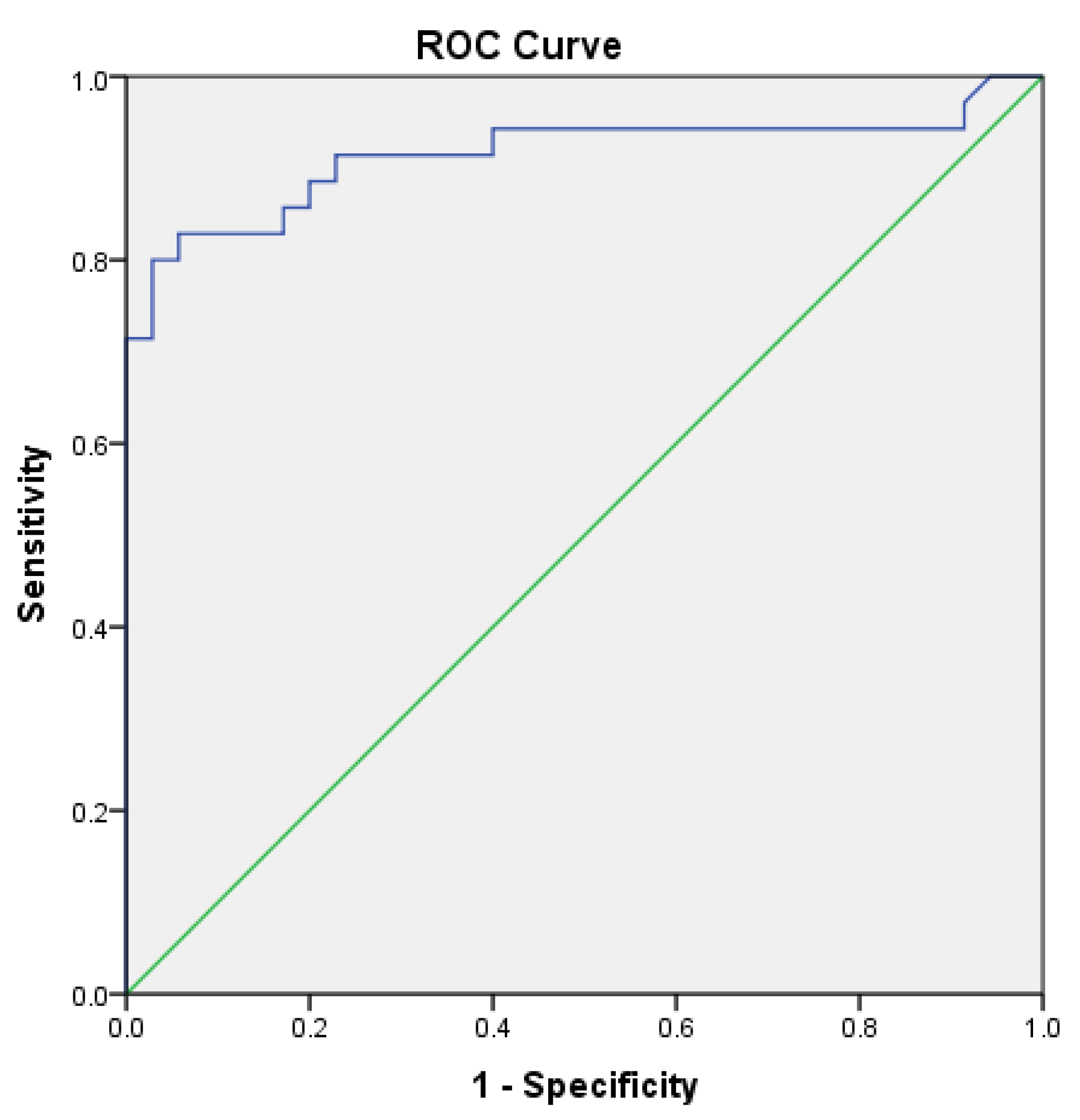
| mTOR | 3.91 | 1.84–8.34 | <0.001 |
Disclaimer/Publisher’s Note: The statements, opinions and data contained in all publications are solely those of the individual author(s) and contributor(s) and not of MDPI and/or the editor(s). MDPI and/or the editor(s) disclaim responsibility for any injury to people or property resulting from any ideas, methods, instructions or products referred to in the content. |
© 2026 by the authors. Licensee MDPI, Basel, Switzerland. This article is an open access article distributed under the terms and conditions of the Creative Commons Attribution (CC BY) license.
Share and Cite
Gebes, M.; Oral Tapan, O.; Edgunlu, T.; Dogan, E. Serum Mammalian Target of Rapamycin (mTOR) Levels in Patients with Post-COVID-19 Fibrotic-like Lung Changes: A Cross-Sectional Study. Diagnostics 2026, 16, 958. https://doi.org/10.3390/diagnostics16060958
Gebes M, Oral Tapan O, Edgunlu T, Dogan E. Serum Mammalian Target of Rapamycin (mTOR) Levels in Patients with Post-COVID-19 Fibrotic-like Lung Changes: A Cross-Sectional Study. Diagnostics. 2026; 16(6):958. https://doi.org/10.3390/diagnostics16060958
Chicago/Turabian StyleGebes, Mert, Ozge Oral Tapan, Tuba Edgunlu, and Emrah Dogan. 2026. "Serum Mammalian Target of Rapamycin (mTOR) Levels in Patients with Post-COVID-19 Fibrotic-like Lung Changes: A Cross-Sectional Study" Diagnostics 16, no. 6: 958. https://doi.org/10.3390/diagnostics16060958
APA StyleGebes, M., Oral Tapan, O., Edgunlu, T., & Dogan, E. (2026). Serum Mammalian Target of Rapamycin (mTOR) Levels in Patients with Post-COVID-19 Fibrotic-like Lung Changes: A Cross-Sectional Study. Diagnostics, 16(6), 958. https://doi.org/10.3390/diagnostics16060958