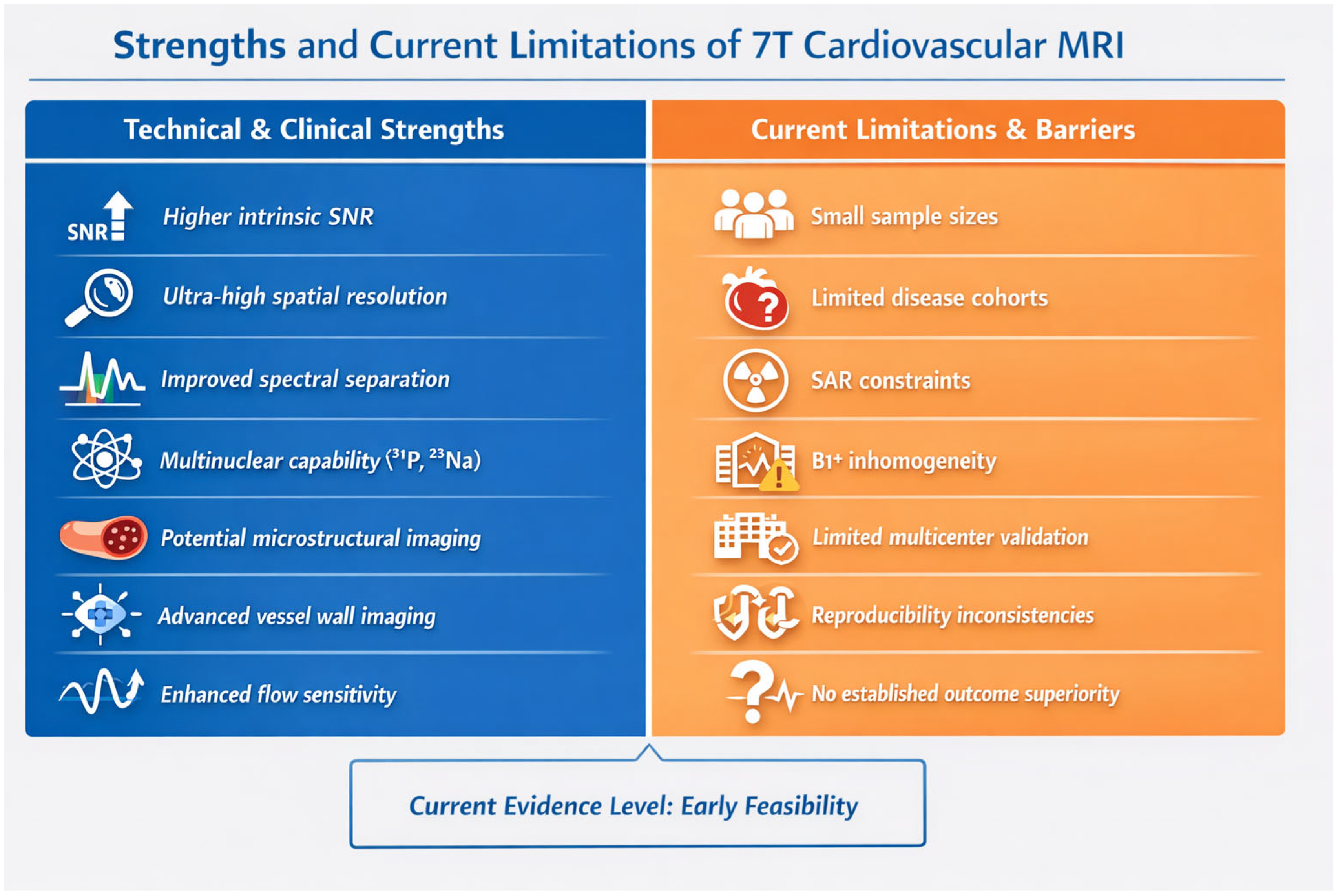
Human In Vivo Cardiac Magnetic Resonance Imaging at 7 T: Feasibility, Applications, and Current Limitations—A Systematic Review
 , , , and
Abstract
1. Introduction
2. Methods
2.1. Research Question (PIRD Framework)
- Population (P): Human participants undergoing cardiovascular magnetic resonance imaging.
- Index Test (I): 7-Tesla cardiovascular MRI across any application (e.g., cine imaging, coronary MRA, myocardial tissue characterization, perfusion, flow imaging, spectroscopy).
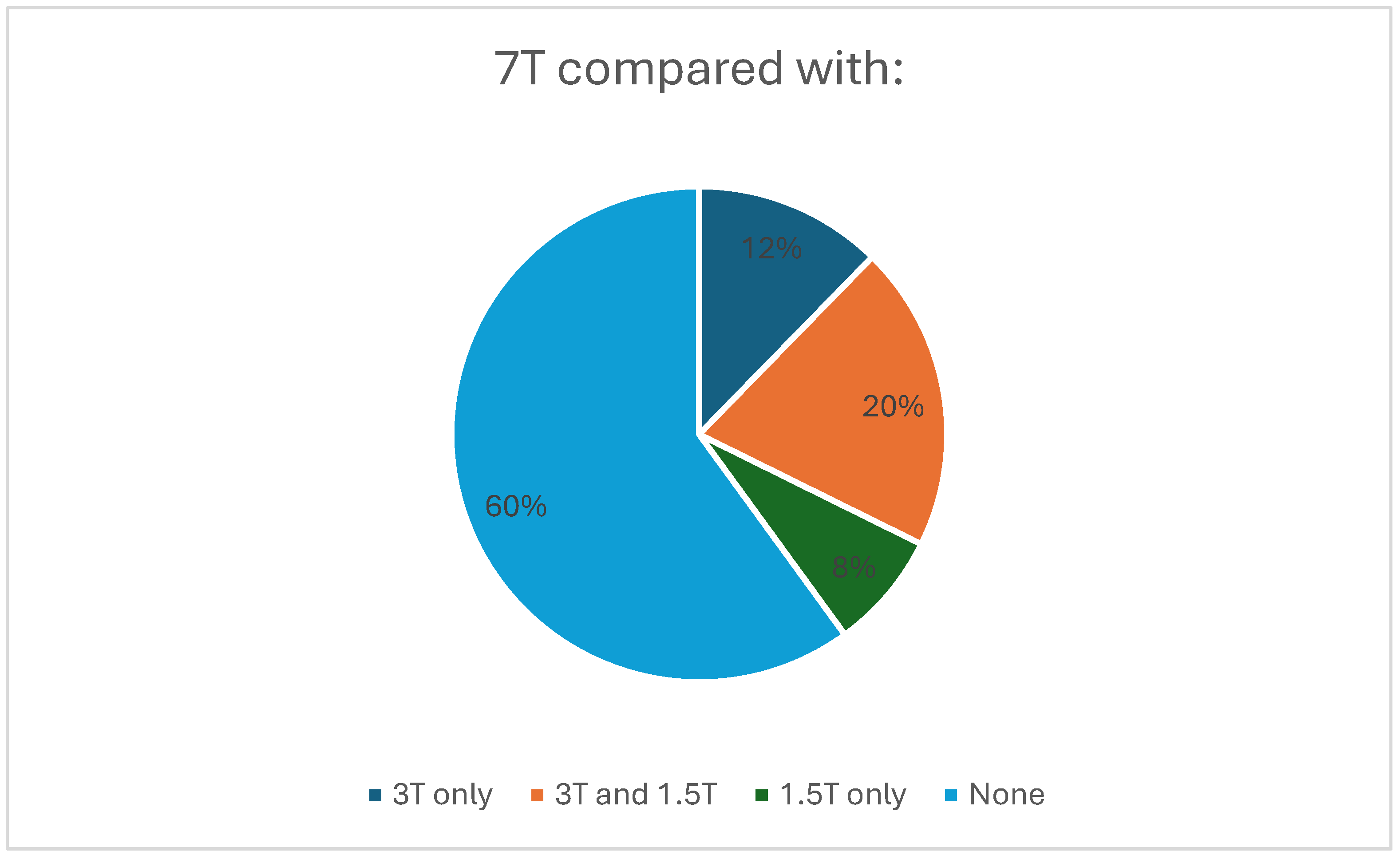
- Reference Standard (R): When available, comparator imaging included 1.5 T or 3 T MRI; several feasibility studies reported no comparator.
- Domain (D): Feasibility, image quality, diagnostic accuracy, quantitative performance, technical implementation, and safety of 7 T cardiovascular MRI.
2.2. Protocol and Registration
2.3. Search Strategy
2.4. Eligibility Criteria
2.5. Study Selection and Data Extraction
2.6. Risk of Bias and Methodological Quality
2.7. Data Synthesis
3. Results
4. Study Characteristics
5. Methodological Quality Appraisal
6. Imaging Applications Evaluated
7. Main Findings Across Studies
7.1. Coronary and Vascular Imaging at 7 T
7.2. Cardiac Function and Volumetry
7.3. Flow and Hemodynamics
7.4. Myocardial Tissue Characterization
7.5. Cardiac Metabolism and X-Nuclei Imaging
8. Technical Parameters Reported
9. Safety and Tolerability
10. Discussion
11. Conclusions
Supplementary Materials
Author Contributions
Funding
Institutional Review Board Statement
Informed Consent Statement
Data Availability Statement
Conflicts of Interest
References
- Niendorf, T.; Sodickson, D.K.; Krombach, G.A.; Schulz-Menger, J. Toward cardiovascular MRI at 7 T: Clinical needs, technical solutions and research promises. Eur. Radiol. 2010, 20, 2806–2816. [Google Scholar] [CrossRef] [PubMed] [PubMed Central]
- Xu, R.; Dai, L.; Wang, J.; Zhang, L.; Wang, Y. SADiff: Coronary Artery Segmentation in CT Angiography Using Spatial Attention and Diffusion Model. J. Imaging 2025, 11, 192. [Google Scholar] [CrossRef]
- Guo, Y.; Lin, L.; Zhao, S.; Sun, G.; Chen, Y.; Xue, K.; Yang, Y.; Chen, S.; Zhang, Y.; Li, G.; et al. Myocardial Fibrosis Assessment at 3-T versus 5-T Myocardial Late Gadolinium Enhancement MRI: Early Results. Radiology 2024, 313, e233424. [Google Scholar] [CrossRef]
- Guo, Y.; Lin, L.; Xu, K.; Zhao, S.; Sun, G.; Chen, Y.; Xue, K.; Yang, Y.; Chen, S.; Zhang, Y.; et al. Myocardial native T1 and extracellular volume measurements at 5T: Feasibility study and initial experience. J. Cardiovasc. Magn. Reson. Off. J. Soc. Cardiovasc. Magn. Reson. 2025, 27, 101896. [Google Scholar] [CrossRef]
- Lin, L.; Liu, P.; Sun, G.; Wang, J.; Liang, D.; Zheng, H.; Jin, Z.; Wang, Y. Bi-ventricular assessment with cardiovascular magnetic resonance at 5 Tesla: A pilot study. Front. Cardiovasc. Med. 2022, 9, 913707. [Google Scholar] [CrossRef]
- Hoff, M.N.; McKinney, A., 4th; Shellock, F.G.; Rassner, U.; Gilk, T.; Watson, R.E., Jr.; Greenberg, T.D.; Froelich, J.; Kanal, E. Safety Considerations of 7-T MRI in Clinical Practice. Radiology 2019, 292, 509–518. [Google Scholar] [CrossRef] [PubMed]
- Perera Molligoda Arachchige, A.S.; Teixeira de Castro Gonçalves Ortega, A.C.; Catapano, F.; Politi, L.S.; Hoff, M.N. From strength to precision: A systematic review exploring the clinical utility of 7-Tesla magnetic resonance imaging in abdominal imaging. World J. Radiol. 2024, 16, 20–31. [Google Scholar] [CrossRef] [PubMed] [PubMed Central]
- Kraff, O.; Quick, H.H. 7T: Physics, safety, and potential clinical applications. J. Magn. Reson. Imaging 2017, 46, 1573–1589. [Google Scholar] [CrossRef] [PubMed]
- Niendorf, T.; Schulz-Menger, J.; Paul, K.; Huelnhagen, T.; Ferrari, V.A.; Hodge, R. High Field Cardiac Magnetic Resonance Imaging: A Case for Ultrahigh Field Cardiac Magnetic Resonance. Circ. Cardiovasc. Imaging 2017, 10, e005460. [Google Scholar] [CrossRef] [PubMed]
- Page, M.J.; McKenzie, J.E.; Bossuyt, P.M.; Boutron, I.; Hoffmann, T.C.; Mulrow, C.D.; Shamseer, L.; Tetzlaff, J.M.; Akl, E.A.; Brennan, S.E.; et al. The PRISMA 2020 statement: An updated guideline for reporting systematic reviews. BMJ 2021, 372, n71. [Google Scholar] [CrossRef] [PubMed] [PubMed Central]
- Takats, S.; Stillman, D.; Cheslack-Postava, F.; Bagdonas, M.; Jellinek, A.; Najdek, T.; Petrov, D.; Rentka, M.; Venčkauskas, A. Zotero, (6.0.26) [Windows 10]; Corporation for Digital Scholarship: Vienna, VA, USA, 2023. Available online: https://www.zotero.org/ (accessed on 12 February 2026).
- Microsoft Excel, 2018; Microsoft Corporation: Redmond, WA, USA, 2018. Available online: https://office.microsoft.com/excel (accessed on 13 February 2026).
- Whiting, P.F.; Rutjes, A.W.; Westwood, M.E.; Mallett, S.; Deeks, J.J.; Reitsma, J.B.; Leeflang, M.M.; Sterne, J.A.; Bossuyt, P.M.; QUADAS-2 Group. QUADAS-2: A revised tool for the quality assessment of diagnostic accuracy studies. Ann. Intern. Med. 2011, 155, 529–536. [Google Scholar] [CrossRef]
- Bossuyt, P.M.; Reitsma, J.B.; Bruns, D.E.; Gatsonis, C.A.; Glasziou, P.P.; Irwig, L.; Lijmer, J.G.; Moher, D.; Rennie, D.; de Vet, H.C.; et al. STARD 2015: An updated list of essential items for reporting diagnostic accuracy studies. BMJ 2015, 351, h5527. [Google Scholar] [CrossRef] [PubMed]
- Fryback, D.G.; Thornbury, J.R. The efficacy of diagnostic imaging. Med. Decis. Mak. Int. J. Soc. Med. Decis. Mak. 1991, 11, 88–94. [Google Scholar] [CrossRef] [PubMed]
- Lijmer, J.G.; Mol, B.W.; Heisterkamp, S.; Bonsel, G.J.; Prins, M.H.; van der Meulen, J.H.; Bossuyt, P.M. Empirical evidence of design-related bias in studies of diagnostic tests. JAMA 1999, 282, 1061–1066. [Google Scholar] [CrossRef]
- Huelnhagen, T.; Ku, M.C.; Reimann, H.M.; Serradas Duarte, T.; Pohlmann, A.; Flemming, B.; Seeliger, E.; Eichhorn, C.; AFerrari, V.; Prothmann, M.; et al. Myocardial Effective Transverse Relaxation Time T 2* is Elevated in Hypertrophic Cardiomyopathy: A 7.0 T Magnetic Resonance Imaging Study. Sci. Rep. 2018, 8, 3974. [Google Scholar] [CrossRef]
- den Hartog, A.G.; Bovens, S.M.; Koning, W.; Hendrikse, J.; Pasterkamp, G.; Moll, F.L.; de Borst, G.J. PLACD-7T Study: Atherosclerotic Carotid Plaque Components Correlated with Cerebral Damage at 7 Tesla Magnetic Resonance Imaging. Curr. Cardiol. Rev. 2011, 7, 28–34. [Google Scholar] [CrossRef] [PubMed] [PubMed Central][Green Version]
- Fischer, A.; Maderwald, S.; Johst, S.; Orzada, S.; Ladd, M.; Umutlu, L.; Lauenstein, T.; Kniemeyer, H.; Nassenstein, K. Initial Evaluation of Non–Contrast-Enhanced Magnetic Resonance Angiography in Patients With Peripheral Arterial Occlusive Disease at 7 T. Investig. Radiol. 2014, 49, 331–338. [Google Scholar] [CrossRef]
- Prothmann, M.; von Knobelsdorff-Brenkenhoff, F.; Töpper, A.; Dieringer, M.A.; Shahid, E.; Graessl, A.; Rieger, J.; Lysiak, D.; Thalhammer, C.; Huelnhagen, T.; et al. High Spatial Resolution Cardiovascular Magnetic Resonance at 7.0 Tesla in Patients with Hypertrophic Cardiomyopathy—First Experiences: Lesson Learned from 7.0 Tesla. PLoS ONE 2016, 11, e0148066. [Google Scholar] [CrossRef]
- van Elderen, S.G.C.; Versluis, M.J.; Westenberg, J.J.M.; Agarwal, H.; Smith, N.B.; Stuber, M.; de Roos, A.; Webb, A.G. Right coronary MR angiography at 7 T: A direct quantitative and qualitative comparison with 3 T in young healthy volunteers. Radiology 2010, 257, 254–259. [Google Scholar] [CrossRef]
- Priest, A.N.; Joubert, I.; Winterbottom, A.P.; See, T.C.; Graves, M.J.; Lomas, D.J. Initial clinical evaluation of a non-contrast-enhanced MR angiography method in the distal lower extremities. Magn. Reson. Med. 2013, 70, 1644–1652. [Google Scholar] [CrossRef] [PubMed]
- Pruzan, A.N.; Kaufman, A.E.; Calcagno, C.; Zhou, Y.; Fayad, Z.A.; Mani, V. Feasibility of imaging superficial palmar arch using micro-ultrasound, 7T and 3T magnetic resonance imaging. World J. Radiol. 2017, 9, 79–84. [Google Scholar] [CrossRef] [PubMed]
- Kröner, E.S.; van Schinkel, L.D.; Versluis, M.J.; Brouwer, N.J.; van den Boogaard, P.J.; van der Wall, E.E.; de Roos, A.; Webb, A.G.; Siebelink, H.M.; Lamb, H.J. Ultrahigh-field 7-T magnetic resonance carotid vessel wall imaging: Initial experience in comparison with 3-T field strength. Investig. Radiol. 2012, 47, 697–704. [Google Scholar] [CrossRef]
- Suttie, J.J.; Delabarre, L.; Pitcher, A.; van de Moortele, P.F.; Dass, S.; Snyder, C.J.; Francis, J.M.; Metzger, G.J.; Weale, P.; Ugurbil, K.; et al. 7 Tesla (T) human cardiovascular magnetic resonance imaging using FLASH and SSFP to assess cardiac function: Validation against 1.5 T and 3 T. NMR Biomed. 2012, 25, 27–34. [Google Scholar] [CrossRef]
- Brandts, A.; Westenberg, J.J.; Versluis, M.J.; Kroft, L.J.; Smith, N.B.; Webb, A.G.; de Roos, A. Quantitative assessment of left ventricular function in humans at 7 T. Magn. Reson. Med. 2010, 64, 1471–1477. [Google Scholar] [CrossRef]
- von Knobelsdorff-Brenkenhoff, F.; Tkachenko, V.; Winter, L.; Rieger, J.; Thalhammer, C.; Hezel, F.; Graessl, A.; A Dieringer, M.; Niendorf, T.; Schulz-Menger, J. Assessment of the right ventricle with cardiovascular magnetic resonance at 7 Tesla. J. Cardiovasc. Magn. Reson. 2013, 15, 23. [Google Scholar] [CrossRef]
- Rapacchi, S.; Troalen, T.; Bentatou, Z.; Quemeneur, M.; Guye, M.; Bernard, M.; Jacquier, A.; Kober, F. Simultaneous multi-slice cardiac cine with Fourier-encoded self-calibration at 7 Tesla. Magn. Reson. Med. 2019, 81, 2576–2587. [Google Scholar] [CrossRef] [PubMed]
- Schmitter, S.; Schnell, S.; Uğurbil, K.; Markl, M.; Van de Moortele, P.F. Towards high-resolution 4D flow MRI in the human aorta using kt-GRAPPA and B1+ shimming at 7T. J. Magn. Reson. Imaging 2016, 44, 486–499. [Google Scholar] [CrossRef]
- Hess, A.T.; Bissell, M.M.; Ntusi, N.A.; Lewis, A.J.; Tunnicliffe, E.M.; Greiser, A.; Stalder, A.F.; Francis, J.M.; Myerson, S.G.; Neubauer, S.; et al. Aortic 4D flow: Quantification of signal-to-noise ratio as a function of field strength and contrast enhancement for 1.5T, 3T, and 7T. Magn. Reson. Med. 2015, 73, 1864–1871. [Google Scholar] [CrossRef] [PubMed]
- Wiesemann, S.; Schmitter, S.; Demir, A.; Prothmann, M.; Schwenke, C.; Chawla, A.; von Knobelsdorff-Brenkenhoff, F.; Greiser, A.; Jin, N.; Bollache, E.; et al. Impact of sequence type and field strength (1.5, 3, and 7T) on 4D flow MRI hemodynamic aortic parameters in healthy volunteers. Magn. Reson. Med. 2021, 85, 721–733. [Google Scholar] [CrossRef]
- Hamilton-Craig, C.; Stäeb, D.; Al Najjar, A.; O’Brien, K.; Crawford, W.; Fletcher, S.; Barth, M.; Galloway, G. 7-Tesla Functional Cardiovascular MR Using Vectorcardiographic Triggering-Overcoming the Magnetohydrodynamic Effect. Tomography 2021, 7, 323–332. [Google Scholar] [CrossRef]
- Rodgers, C.T.; Piechnik, S.K.; Delabarre, L.J.; Van de Moortele, P.F.; Snyder, C.J.; Neubauer, S.; Robson, M.D.; Vaughan, J.T. Inversion recovery at 7 T in the human myocardium: Measurement of T(1), inversion efficiency and B(1) (+). Magn. Reson. Med. 2013, 70, 1038–1046. [Google Scholar] [CrossRef]
- Hezel, F.; Thalhammer, C.; Waiczies, S.; Schulz-Menger, J.; Niendorf, T. High spatial resolution and temporally resolved T2* mapping of normal human myocardium at 7.0 Tesla: An ultrahigh field magnetic resonance feasibility study. PLoS ONE 2012, 7, e52324. [Google Scholar] [CrossRef]
- Dietrich, S.; Aigner, C.S.; Mayer, J.; Kolbitsch, C.; Schulz-Menger, J.; Schaeffter, T.; Schmitter, S. Motion-compensated fat-water imaging for 3D cardiac MRI at ultra-high fields. Magn. Reson. Med. 2022, 87, 2621–2636. [Google Scholar] [CrossRef]
- Rodgers, C.T.; Clarke, W.T.; Snyder, C.; Vaughan, J.T.; Neubauer, S.; Robson, M.D. Human cardiac 31P magnetic resonance spectroscopy at 7 Tesla. Magn. Reson. Med. 2014, 72, 304–315. [Google Scholar] [CrossRef]
- Clarke, W.T.; Robson, M.D.; Neubauer, S.; Rodgers, C.T. Creatine kinase rate constant in the human heart measured with 3D-localization at 7 tesla. Magn. Reson. Med. 2017, 78, 20–32. [Google Scholar] [CrossRef]
- Bashir, A.; Zhang, J.; Denney, T.S. Creatine kinase rate constant in the human heart at 7T with 1D-ISIS/2D CSI localization. PLoS ONE 2020, 15, e0229933. [Google Scholar] [CrossRef] [PubMed]
- Lott, J.; Platt, T.; Niesporek, S.C.; Paech, D.; GRBehl, N.; Niendorf, T.; Bachert, P.; Ladd, M.E.; Nagel, A.M. Corrections of myocardial tissue sodium concentration measurements in human cardiac 23 Na MRI at 7 Tesla. Magn. Reson. Med. 2019, 82, 159–173. [Google Scholar] [CrossRef]
- Wenz, D.; Nagel, A.M.; Lott, J.; Kuehne, A.; Niesporek, S.C.; Niendorf, T. In vivo potassium MRI of the human heart. Magn. Reson. Med. 2020, 83, 203–213. [Google Scholar] [CrossRef]
- Reiter, T.; Lohr, D.; Hock, M.; Ankenbrand, M.J.; Stefanescu, M.R.; Kosmala, A.; Kaspar, M.; Juchem, C.; Terekhov, M.; Schreiber, L.M. On the way to routine cardiac MRI at 7 Tesla—A pilot study on consecutive 84 examinations. PLoS ONE 2021, 16, e0252797. [Google Scholar] [CrossRef] [PubMed]
- Goebel, J.; Nensa, F.; Schemuth, H.P.; Maderwald, S.; Schlosser, T.; Orzada, S.; Rietsch, S.; Quick, H.H.; Nassenstein, K. Feasibility of aortic valve planimetry at 7 T ultrahigh field MRI: Comparison to aortic valve MRI at 3 T and 1.5 T. Eur. J. Radiol. Open. 2018, 5, 159–164. [Google Scholar] [CrossRef] [PubMed] [PubMed Central]
- Snyder, C.J.; DelaBarre, L.; Metzger, G.J.; van de Moortele, P.F.; Akgun, C.; Ugurbil, K.; Vaughan, J.T. Initial results of cardiac imaging at 7 Tesla. Magn. Reson. Med. 2009, 61, 517–524. [Google Scholar] [CrossRef] [PubMed] [PubMed Central]
- Sang, Y.; Li, S.; Wang, H.; Zhang, H.; Zhuang, B.; Xu, L. Noninvasive coronary imaging: Technological breakthroughs and the integrated application of coronary magnetic resonance angiography. Int. J. Cardiol. Cardiovasc. Risk Prev. 2025, 27, 200542. [Google Scholar] [CrossRef]
- Rahsepar, A.A.; Kim, D. Advancing Cardiovascular Imaging: The Promise of High-Field-Strength MRI in Coronary Artery Disease Assessment. Radiology 2024, 313, e242499. [Google Scholar] [CrossRef] [PubMed]
- Arachchige, A.S.P.M.; Catapano, F.; Lisi, C.; El Choueiri, J.; Pellicanò, F.; Figliozzi, S.; Politi, L.S.; Francone, M. Trends in Clinical Cardiac Photon-Counting Detector CT Research: A Comprehensive Bibliometric Analysis. Diagnostics 2025, 15, 504. [Google Scholar] [CrossRef] [PubMed]





| First Author | Count | Lab |
|---|---|---|
| Sebastian Schmitter | 4 | Center for Magnetic Resonance Research, Department of Radiology, University of Minnesota, USA |
| Christoph Stefan Aigner | 3 | Physikalisch-Technische Bundesanstalt (PTB), Braunschweig and Berlin, Germany |
| Andreas Graessl | 3 | Berlin Ultrahigh Field Facility, Max-Delbrück-Center for Molecular Medicine, Germany |
| William T. Clarke | 3 | Wellcome Centre for Integrative Neuroimaging, FMRIB, Nuffield Department of Clinical Neurosciences, University of Oxford, UK |
| Till Huelnhagen | 2 | Berlin Ultrahigh Field Facility, Max Delbrück Center for Molecular Medicine, Germany |
| Florian von Knobelsdorff-Brenkenhoff | 2 | Berlin Ultrahigh Field Facility, Max-Delbrück-Center for Molecular Medicine, Germany |
| Christopher T. Rodgers | 2 | Oxford Centre for Clinical Magnetic Resonance Research (OCMR), University of Oxford, UK |
| Anja Fischer | 2 | University Hospital Essen, Germany |
| Tobias Frauenrath | 2 | Berlin Ultrahigh Field Facility, Max-Delbrück-Center for Molecular Medicine, Germany |
| Saskia G. C. van Elderens | 2 | Leiden University Medical Centre, Netherlands |
| Journal | Count |
|---|---|
| Magnetic Resonance in Medicine | 33 |
| PLOS ONE | 5 |
| Investigative Radiology | 4 |
| Journal of Magnetic Resonance Imaging | 3 |
| Journal of Cardiovascular Magnetic Resonance | 3 |
| NMR in Biomedicine | 2 |
| World Journal of Radiology | 2 |
| European Journal of Radiology | 2 |
| European Radiology | 2 |
| Radiology | 1 |
| Frontiers in Cardiovascular Medicine | 1 |
| Journal of Magnetic Resonance | 1 |
| Magnetic Resonance Imaging | 1 |
| Current Cardiology Reviews | 1 |
| Journal of Visualized Medicine | 1 |
| Tomography | 1 |
| Scientific Reports | 1 |
Disclaimer/Publisher’s Note: The statements, opinions and data contained in all publications are solely those of the individual author(s) and contributor(s) and not of MDPI and/or the editor(s). MDPI and/or the editor(s) disclaim responsibility for any injury to people or property resulting from any ideas, methods, instructions or products referred to in the content. |
© 2026 by the authors. Licensee MDPI, Basel, Switzerland. This article is an open access article distributed under the terms and conditions of the Creative Commons Attribution (CC BY) license.
Share and Cite
Perera Molligoda Arachchige, A.S.; Amorim Moreira Alves, G.; Zal, A.; D’Acunto, G.; Węglarz, M.; Voicu, O.-G.; Maffei, E.; Cademartiri, F. Human In Vivo Cardiac Magnetic Resonance Imaging at 7 T: Feasibility, Applications, and Current Limitations—A Systematic Review. Diagnostics 2026, 16, 937. https://doi.org/10.3390/diagnostics16060937
Perera Molligoda Arachchige AS, Amorim Moreira Alves G, Zal A, D’Acunto G, Węglarz M, Voicu O-G, Maffei E, Cademartiri F. Human In Vivo Cardiac Magnetic Resonance Imaging at 7 T: Feasibility, Applications, and Current Limitations—A Systematic Review. Diagnostics. 2026; 16(6):937. https://doi.org/10.3390/diagnostics16060937
Chicago/Turabian StylePerera Molligoda Arachchige, Arosh S., Gabriel Amorim Moreira Alves, Ayça Zal, Giulia D’Acunto, Maciej Węglarz, Oana-Georgiana Voicu, Erica Maffei, and Filippo Cademartiri. 2026. "Human In Vivo Cardiac Magnetic Resonance Imaging at 7 T: Feasibility, Applications, and Current Limitations—A Systematic Review" Diagnostics 16, no. 6: 937. https://doi.org/10.3390/diagnostics16060937
APA StylePerera Molligoda Arachchige, A. S., Amorim Moreira Alves, G., Zal, A., D’Acunto, G., Węglarz, M., Voicu, O.-G., Maffei, E., & Cademartiri, F. (2026). Human In Vivo Cardiac Magnetic Resonance Imaging at 7 T: Feasibility, Applications, and Current Limitations—A Systematic Review. Diagnostics, 16(6), 937. https://doi.org/10.3390/diagnostics16060937