Interesting Images

Pretherapeutic 18F-PSMA PET/CT Reveals Incidental Tracheal Epithelial–Myoepithelial Carcinoma
by
Farid Gossili
1,2,*,
Nelson Fuentes-Martinez
3 and
Christian Høyer
1
1
Department of Clinical Physiology, Viborg Regional Hospital, 8800 Viborg, Denmark
2
Department of Clinical Medicine, Aalborg University, 9220 Aalborg, Denmark
3
Department of Pathology, Aarhus University Hospital, 8200 Arhus, Denmark
*
Author to whom correspondence should be addressed.
Diagnostics 2026, 16(6), 883; https://doi.org/10.3390/diagnostics16060883

Submission received: 5 February 2026 / Revised: 9 March 2026 / Accepted: 14 March 2026 / Published: 16 March 2026

Abstract

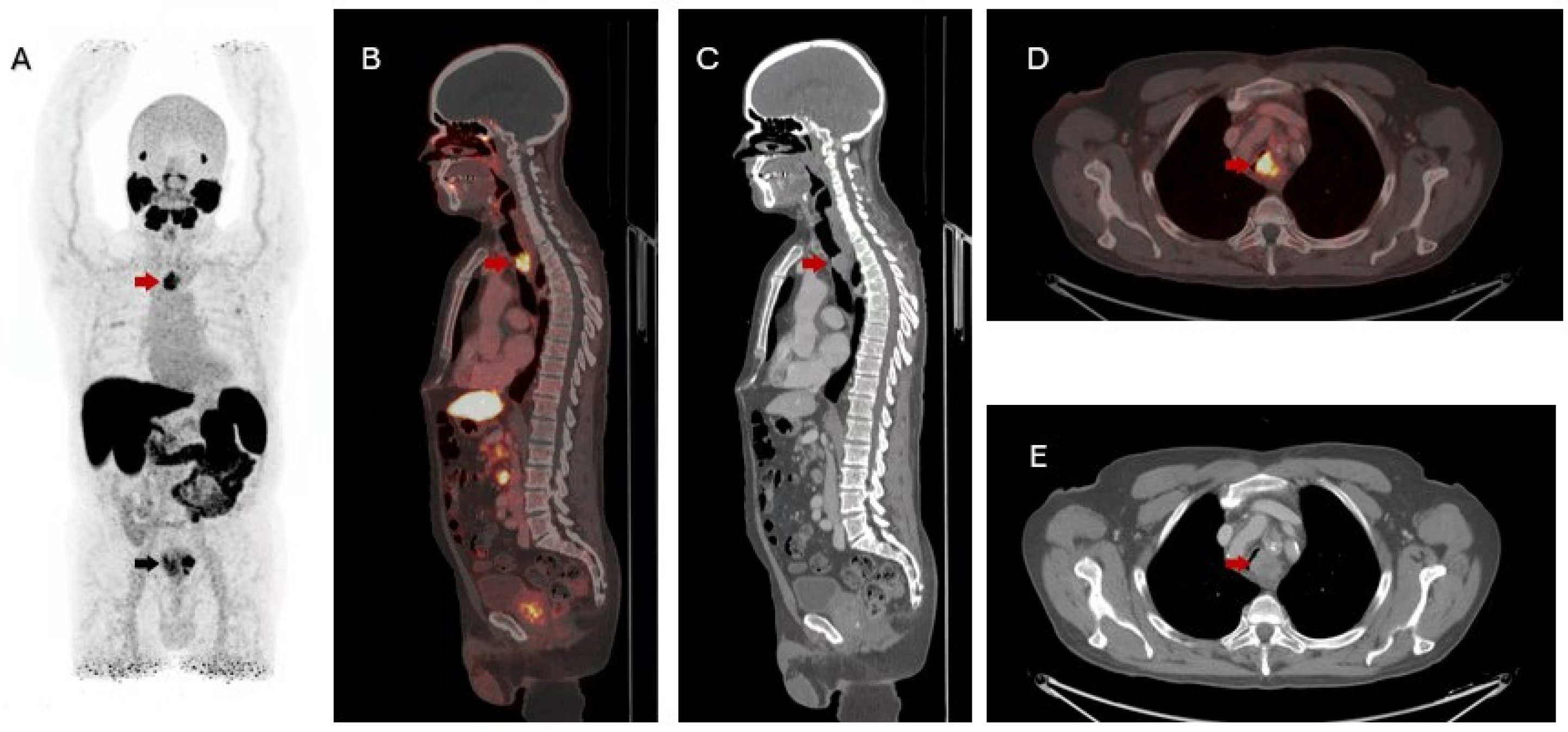
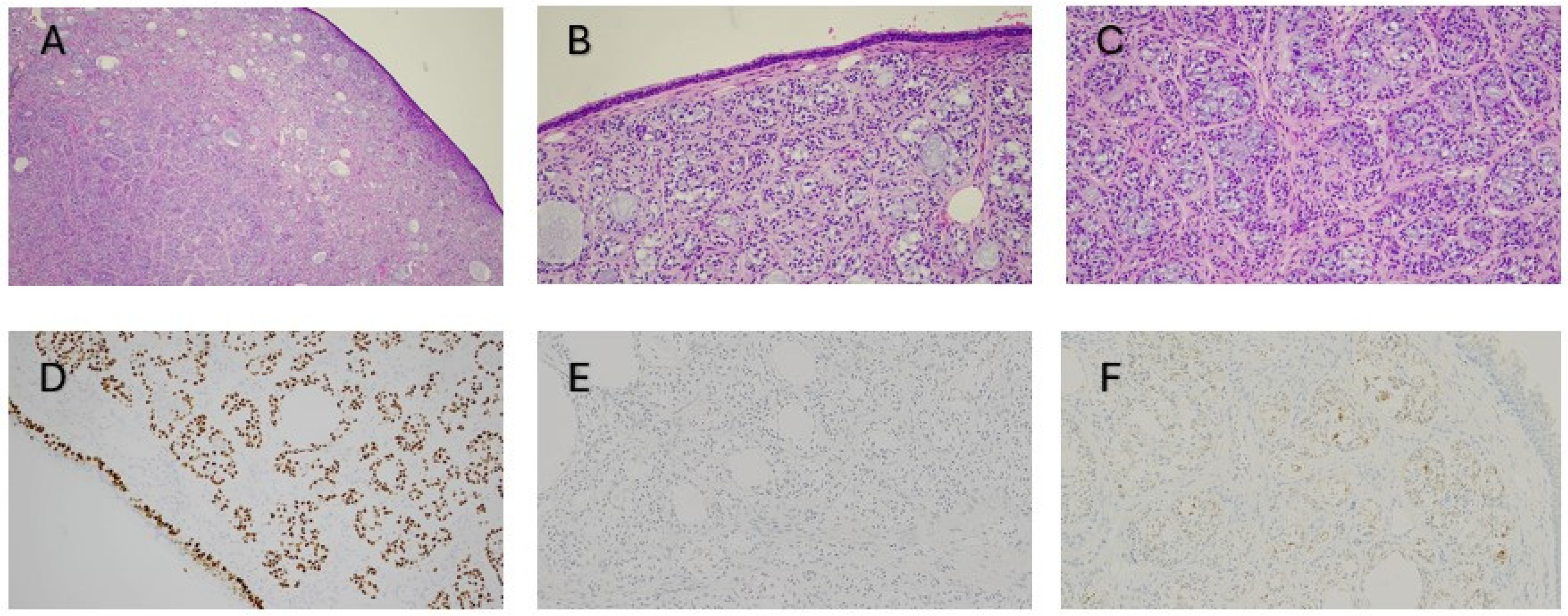
A 75-year-old man with newly diagnosed high-risk prostate cancer (cT3bN0M0) underwent 18F-PSMA PET/CT, which demonstrated intense tracer uptake in a left tracheal mass causing near-complete luminal obstruction, raising suspicion of a primary lung malignancy or metastatic disease. Endoscopic debulking was performed due to progressive respiratory symptoms with dyspnea. Histopathology and immunohistochemistry (p63, SMA, CK5/6 positive; PSA, NKX3.1, and AR negative, with downregulated PSMA-expression) established the diagnosis of low-grade epithelial–myoepithelial carcinoma of the trachea. Following debulking, the patient’s symptoms resolved, and a watchful-waiting strategy was adopted for the tracheal tumor, while curative-intent therapy for prostate cancer continued. This case highlights that 18F-PSMA PET/CT may reveal rare, intensely PSMA-avid non-prostatic neoplasms and underscores the importance of recognizing atypical uptake patterns to avoid misinterpretation during prostate cancer staging.

Figure 1. Pretherapeutic 18F-PSMA PET/CT of a 75-year-old man with high-risk prostate cancer (biopsy confirmed typical adenocarcinoma, Gleason 9 [4+5], cT3bN0M0 and PSA 26.1 ng/mL) in maximum intensity projection (A) shows intense uptake in the prostate (SUVmax 29, black arrow) and a focal tracheal lesion (SUVmax 9.1, red arrow), corresponding to a miPSMA score of 2 based on PROMISE criteria. Clinically, the patient had progressive respiratory symptoms, including dyspnea and reduced exercise tolerance. Sagittal fused PET/CT (B) and contrast-enhanced CT (C) demonstrate a 2.9 × 2.2 cm left lateral tracheal mass at Th2–3. Axial fused PET/CT (D) and CT (E) reveal near-complete luminal obstruction and possible mediastinal and esophageal involvement. The findings raised suspicion for a primary lung malignancy versus metastasis; due to the lack of nodal or osseous metastases, a non-prostatic pathology was suspected, and a biopsy was recommended.
Diagnostics 16 00883 g001
Figure 2. Histopathology of the tracheal mass after endoscopic debulking utilizing hematoxylin and eosin (H&E) staining shows a well-circumscribed tumor respecting the normal respiratory epithelium, with cystic dilatations and islands of vacuolated cells (×4: (A); ×10: (B) and (C)). Immunohistochemistry revealed a biphasic tumor with myoepithelial predominance. P63 (×10: (D)), S100, SMA, and CK5/6 were positive in the myoepithelial component, while CD117 and CK7 were positive in the epithelial component. PSA (×10: (E)), NKX3.1, AR, and TTF-1 were negative. PSMA staining (×10; (F)) showed weak, granular cytoplasmic positivity in the tumor cells, consistent with downregulation of PSMA expression. The Ki-67 index was ~4%, with no necrosis or mitoses. Next-generation sequencing showed no pathogenic variants or gene fusions, confirming a low-grade epithelial–myoepithelial carcinoma. Post-debulking, symptoms resolved; surveillance was chosen for the tracheal tumor while curative-intent radiotherapy was chosen for the prostate cancer. 18F-PSMA PET/CT may reveal incidental, intensely PSMA-avid non-prostatic neoplasms due to PSMA expression in the tumor neovasculature [1]. Furthermore, PSMA expression has been demonstrated in human salivary gland tissue by cytoplasmic immunohistochemical staining of the epithelium of acinar glandular cells [2], which explains the physiological uptake seen on PSMA PET scans. Therefore, PSMA uptake can also be expected in tumors originating from epithelial cells, as previously described in adenoid cystic carcinoma in case reports [3,4] and preliminary analyses exploring the use of PSMA PET in the management of these tumors [5]. However, other very rare epithelial-derived salivary gland tumors, such as epithelial–myoepithelial carcinoma, have not yet been described to the best of our knowledge. Because PSMA-expression may be either down- or upregulated in different tumor types [5], this report may be relevant for future consideration of potential PSMA PET applications in such tumors. Our case demonstrated pathological downregulation of PSMA-expression in tumor cells compared with normal epithelial cells, yet it showed intense uptake in PSMA PET. In addition, awareness of atypical PSMA uptake patterns is crucial to prevent misinterpretation, especially during primary staging of prostate cancer. This case further highlights a rare tracheal epithelial–myoepithelial carcinoma mimicking metastatic prostate cancer in PSMA imaging, emphasizing the potential role of PSMA PET in detecting epithelial cell–derived tumors.
Diagnostics 16 00883 g002

Author Contributions

Conceptualization, F.G. and C.H.; investigation, F.G. and N.F.-M.; writing—original draft preparation, F.G.; writing—review and editing, F.G., N.F.-M., and C.H. All authors have read and agreed to the published version of the manuscript.

Funding

This research received no external funding.

Institutional Review Board Statement

Ethical review and approval were waived for this study as it is a single case report describing routine clinical practice and does not constitute research involving human participants requiring institutional ethical committee review under applicable guidelines.

Informed Consent Statement

Written informed consent has been obtained from the patient to publish this paper.

Data Availability Statement

The original contributions presented in this study are included in the article. Further inquiries can be directed to the corresponding author.

Conflicts of Interest

The authors declare no conflicts of interest.

References

  1. Kiess, A.P.; Banerjee, S.R.; Mease, R.C.; Rowe, S.P.; Rao, A.; Foss, C.A.; Chen, Y.; Yang, X.; Cho, S.Y.; Nimmagadda, S.; et al. Prostate-specific membrane antigen as a target for cancer imaging and therapy. Q. J. Nucl. Med. Mol. Imaging 2015, 59, 241–268. [Google Scholar] [PubMed]
  2. Wolf, P.; Freudenberg, N.; Bühler, P.; Alt, K.; Schultze-Seemann, W.; Wetterauer, U.; Elsässer-Beile, U. Three conformational antibodies specific for different PSMA epitopes are promising diagnostic and therapeutic tools for prostate cancer. Prostate 2010, 70, 562–569. [Google Scholar] [CrossRef] [PubMed]
  3. de Keizer, B.; Krijger, G.C.; Ververs, F.T.; van Es, R.J.J.; de Bree, R.; Willems, S. 68Ga-PSMA PET-CT Imaging of Metastatic Adenoid Cystic Carcinoma. Nucl. Med. Mol. Imaging 2017, 51, 360–361. [Google Scholar] [CrossRef] [PubMed][Green Version]
  4. Lutje, S.; Sauerwein, W.; Lauenstein, T.; Bockisch, A.; Poeppel, T.D. In Vivo Visualization of Prostate-Specific Membrane Antigen in Adenoid Cystic Carcinoma of the Salivary Gland. Clin. Nucl. Med. 2016, 41, 476–477. [Google Scholar] [CrossRef] [PubMed]
  5. Klein Nulent, T.J.W.; van Es, R.J.J.; Krijger, G.C.; de Bree, R.; Willems, S.M.; de Keizer, B. Prostate-specific membrane antigen PET imaging and immunohistochemistry in adenoid cystic carcinoma-a preliminary analysis. Eur. J. Nucl. Med. Mol. Imaging 2017, 44, 1614–1621. [Google Scholar] [CrossRef] [PubMed]
Disclaimer/Publisher’s Note: The statements, opinions and data contained in all publications are solely those of the individual author(s) and contributor(s) and not of MDPI and/or the editor(s). MDPI and/or the editor(s) disclaim responsibility for any injury to people or property resulting from any ideas, methods, instructions or products referred to in the content.