Incomplete TNM Documentation in Gastric Cancer: Frequency, Phenotype, and Treatment Allocation

 ,
,  , ,
, ,
Abstract
1. Introduction
2. Materials and Methods
2.1. Study Design and Setting
2.2. Study Population and Operational Definitions
2.2.1. Eligibility Criteria
2.2.2. Data Sources and Variables
- •
- Demographics: Age at diagnosis and sex.
- •
- Disease parameters: TNM components (T, N, M) according to the AJCC/UICC 8th edition framework, as recorded in clinical documentation; M status was used to define metastatic disease at diagnosis.
- •
- Treatment allocation: Surgery (any surgical intervention recorded during the initial management course) and non-surgical management.
- •
- Laboratory markers (when available): Serum tumor markers (CEA, CA19-9), where marker values were treated as continuous covariates without defining clinical cut-offs.
2.2.3. Primary Endpoint and Sensitivity Endpoint
2.2.4. Staging Completeness and Phenotypes
- •
- M0–non-LAM (non-metastatic and not locally advanced),
- •
- M0–LAM (non-metastatic but locally advanced per LAM definition),
- •
- M1 (metastatic disease).
2.2.5. Handling of Missing Data
- •
- M1 analyses were restricted to M-defined cases (M0/M1).
- •
- LAM sensitivity analyses were restricted to TNM-complete cases.
2.3. Statistical Analysis
- •
- Logistic regression for metastatic disease (M1): Outcome M1 (yes/no) among M-defined cases, with covariates including age, sex, and tumor markers when available. Tumor markers were entered as continuous variables using the transformation log10 (marker + 1) to mitigate skewness and preserve rank information without imposing cut-offs.
- •
- Logistic regression for surgery (treatment allocation): Surgery (yes/no) modeled against metastatic status (M1) and/or LAM in the relevant subsets, adjusting for age and sex as core covariates.
2.4. Ethics
3. Results
3.1. Cohort Characteristics and Completeness of Staging
3.2. Distribution of T, N, and M Categories at Diagnosis
3.3. Complete Versus Incomplete Staging at Diagnosis
3.4. Metastatic Versus Non-Metastatic Disease at Presentation
3.5. Clinical Phenotypes of Advanced Gastric Cancer
3.6. Patterns and Clinical Correlates of Incomplete Staging
3.7. Multivariable Associations with Metastatic Disease and Incomplete Staging
3.8. Determinants of Surgical Treatment Allocation
3.9. Sensitivity Analyses Using the LAM Composite Endpoint

4. Discussion
4.1. Summary of Principal Findings
4.2. Incomplete Staging as a Signal of the Diagnostic Pathway
4.3. Advanced Disease Phenotypes and Treatment Selection
4.4. CEA and CA19-9 as Supportive, Not Determinative, Signals
4.5. Strengths, Limitations, and Implications
5. Conclusions
Author Contributions
Funding
Institutional Review Board Statement
Informed Consent Statement
Data Availability Statement
Acknowledgments
Conflicts of Interest
References
- Sung, H.; Ferlay, J.; Siegel, R.L.; Laversanne, M.; Soerjomataram, I.; Jemal, A.; Bray, F. Global Cancer Statistics 2020: GLOBOCAN Estimates of Incidence and Mortality Worldwide for 36 Cancers in 185 Countries. CA Cancer J. Clin. 2021, 71, 209–249. [Google Scholar] [CrossRef]
- Thrift, A.; Wenker, T.; El-Serag, H. Global burden of gastric cancer: Epidemiological trends, risk factors, screening and prevention. Nat. Rev. Clin. Oncol. 2023, 20, 338–349. [Google Scholar] [CrossRef]
- Wong, M.; Huang, J.; Chan, P.; Choi, P.; Lao, X.; Chan, S.; Teoh, A.; Liang, P. Global Incidence and Mortality of Gastric Cancer, 1980–2018. JAMA Netw. Open 2021, 4, e2118457. [Google Scholar] [CrossRef] [PubMed]
- Qin, N.; Fan, Y.; Yang, T.; Yang, Z.; Fan, D. The burden of Gastric Cancer and possible risk factors from 1990 to 2021, and projections until 2035: Findings from the Global Burden of Disease Study 2021. Biomark. Res. 2025, 13, 5. [Google Scholar] [CrossRef] [PubMed]
- Jiang, Y.; Wang, P.; Wang, H.; Chen, J.; Jiang, D.; Liang, J.; Tian, Y. The global and regional burden of early-onset gastric cancer (15–49 years, 1990–2021): Incidence and mortality with projections to 2030. Oncologist 2025, 30, oyaf244. [Google Scholar] [CrossRef]
- Smyth, E.C.; Nilsson, M.; Grabsch, H.I.; van Grieken, N.C.; Lordick, F. Gastric cancer. Lancet 2020, 396, 635–648. [Google Scholar] [CrossRef] [PubMed]
- Guan, W.-L.; He, Y.; Xu, R.-H. Gastric cancer treatment: Recent progress and future perspectives. J. Hematol. Oncol. 2023, 16, 57. [Google Scholar] [CrossRef]
- Jeri-Yabar, A.; Vittini-Hernandez, L.; Aller-Rojas, R.; Arias-Reyes, F.; Dharmapuri, S. Disparities in Stage at Diagnosis among Hispanic Patients with Gastric Cancer in the United States. Cancers 2024, 16, 3308. [Google Scholar] [CrossRef]
- Liu, G.; Gu, J.; Wang, J.; Li, F.; Shen, Y.; Wang, Z.; Tian, X. Prognostic implications of organ-specific metastases in advanced gastric cancer: A retrospective observational analysis of the SEER database. Medicine 2025, 104, e45570. [Google Scholar] [CrossRef]
- Lordick, F.; Carneiro, F.; Cascinu, S.; Fleitas, T.; Haustermans, K.; Piessen, G.; Vogel, A.; Smyth, E. Gastric cancer: ESMO Clinical Practice Guideline for diagnosis, treatment and follow-up. Ann. Oncol. 2022, 33, 1005–1020. [Google Scholar] [CrossRef]
- Ajani, J.A.; D’Amico, T.A.; Bentrem, D.J.; Chao, J.; Cooke, D.; Corvera, C.; Das, P.; Enzinger, P.C.; Enzler, T.; Fanta, P.; et al. Gastric Cancer, Version 2.2022, NCCN Clinical Practice Guidelines in Oncology. J. Natl. Compr. Canc. Netw. 2022, 20, 167–192. [Google Scholar] [CrossRef] [PubMed]
- Bando, E.; Makuuchi, R.; Irino, T.; Tanizawa, Y.; Kawamura, T.; Terashima, M. Validation of the prognostic impact of the new tumor-node-metastasis clinical staging in patients with gastric cancer. Gastric Cancer 2019, 22, 123–129. [Google Scholar] [CrossRef] [PubMed]
- Sano, T.; Coit, D.G.; Kim, H.-H.; Roviello, F.; Kassab, P.; Wittekind, C.; Yamamoto, Y.; Ohashi, Y. Proposal of a new stage grouping of gastric cancer for TNM classification: International Gastric Cancer Association staging project. Gastric Cancer 2017, 20, 217–225. [Google Scholar] [CrossRef] [PubMed]
- Warneke, V.S.; Behrens, H.-M.; Hartmann, J.T.; Held, H.; Becker, T.; Schwarz, N.; Röcken, C. Cohort study based on the seventh edition of the TNM classification for gastric cancer: Proposal of a new staging system. J. Clin. Oncol. Off. J. Am. Soc. Clin. Oncol. 2011, 29, 2364–2371. [Google Scholar] [CrossRef]
- Engholm, G.; Lundberg, F.E.; Kønig, S.M.; Ólafsdóttir, E.; Johannesen, T.B.; Pettersson, D.; Mørch, L.S.; Johansson, A.L.V.; Friis, S. Influence of various assumptions for the individual TNM components on the TNM stage using Nordic cancer registry data. Acta Oncol. 2023, 62, 215–222. [Google Scholar] [CrossRef]
- Pinheiro, P.S.; Medina, H.N.; Callahan, K.E.; Koru-Sengul, T.; Sharma, J.; Kobetz, E.N.; Penedo, F.J. Kidney cancer mortality disparities among Hispanics in the US. Cancer Epidemiol. 2021, 72, 101938. [Google Scholar] [CrossRef]
- Shah, S.; Wang, A.; Wallace, M.; Hwang, J. AGA Clinical Practice Update on Screening and Surveillance in Individuals at Increased Risk for Gastric Cancer in the United States: Expert Review. Gastroenterology 2024, 168, 405–416.e1. [Google Scholar] [CrossRef]
- Engholm, G.; Lundberg, F.E.; Kønig, S.M.; Ólafsdóttir, E.; Johannesen, T.B.; Pettersson, D.; Malila, N.; Mørch, L.S.; Andersson, A.L.; Friis, S. TNM stage in the Nordic Cancer Registries 2004–2016: Registration and availability. Acta Oncol. 2024, 63, 303–312. [Google Scholar] [CrossRef]
- Luna, J.; Picker, N.; Wilke, T.; Lutz, M.; Hess, J.; Mörtl, B.; Xiong, Y.; Götze, T.O. Real-world evidence of treatment patterns and survival of metastatic gastric cancer patients in Germany. BMC Cancer 2024, 24, 462. [Google Scholar] [CrossRef]
- van Schooten, T.S.; Derks, S.; Jiménez-Martí, E.; Carneiro, F.; Figueiredo, C.; Ruiz, E.; Alsina, M.; Molero, C.; Garrido, M.; Riquelme, A.; et al. The LEGACy study: A European and Latin American consortium to identify risk factors and molecular phenotypes in gastric cancer to improve prevention strategies and personalized clinical decision making globally. BMC Cancer 2022, 22, 646. [Google Scholar] [CrossRef]
- Shibata, C.; Nakano, T.; Yasumoto, A.; Mitamura, A.; Sawada, K.; Ogawa, H.; Miura, T.; Ise, I.; Takami, K.; Yamamoto, K.; et al. Comparison of CEA and CA19-9 as a predictive factor for recurrence after curative gastrectomy in gastric cancer. BMC Surg. 2022, 22, 213. [Google Scholar] [CrossRef] [PubMed]
- Boicean, A.; Boeras, I.; Birsan, S.; Ichim, C.; Todor, S.B.; Onisor, D.; Brusnic, O.; Bacila, C.; Dura, H.; Roman-Filip, C.; et al. In Pursuit of Novel Markers: Unraveling the Potential of miR-106, CEA and CA 19-9 in Gastric Adenocarcinoma Diagnosis and Staging. Int. J. Mol. Sci. 2024, 25, 7898. [Google Scholar] [CrossRef]
- Guo, J.; Chen, S.; Li, S.; Sun, X.; Li, W.; Zhou, Z.; Chen, Y.; Xu, D. A novel classifier based on three preoperative tumor markers predicting the cancer-specific survival of gastric cancer (CEA, CA19-9 and CA72-4). Oncotarget 2017, 9, 4814–4822. [Google Scholar] [CrossRef] [PubMed]
- Liang, Y.; Wang, W.; Fang, C.; Raj, S.S.; Hu, W.-M.; Li, Q.-W.; Zhou, Z.-W. Clinical significance and diagnostic value of serum CEA, CA19-9 and CA72-4 in patients with gastric cancer. Oncotarget 2016, 7, 49565–49573. [Google Scholar] [CrossRef] [PubMed]
- Tang, X.-H.; Wu, X.-L.; Gan, X.-J.; Wang, Y.-D.; Jia, F.-Z.; Wang, Y.-X.; Zhang, Y.; Gao, X.-Y.; Li, Z.-Y. Using Normalized Carcinoembryonic Antigen and Carbohydrate Antigen 19 to Predict and Monitor the Efficacy of Neoadjuvant Chemotherapy in Locally Advanced Gastric Cancer. Int. J. Mol. Sci. 2023, 24, 12192. [Google Scholar] [CrossRef]
- Kumari, S.; Srilatha, M.; Nagaraju, G.P. Effect of Gut Dysbiosis on Onset of GI Cancers. Cancers 2025, 17, 90. [Google Scholar] [CrossRef]
- Minicozzi, P.; Innos, K.; Sánchez, M.-J.; Trama, A.; Walsh, P.M.; Marcos-Gragera, R.; Dimitrova, N.; Botta, L.; Visser, O.; Rossi, S.; et al. Quality analysis of population-based information on cancer stage at diagnosis across Europe, with presentation of stage-specific cancer survival estimates: A EUROCARE-5 study. Eur. J. Cancer 2017, 84, 335–353. [Google Scholar] [CrossRef]
- Mahar, A.L.; Jeong, Y.; Zagorski, B.; Coburn, N. Validating an algorithm to identify metastatic gastric cancer in the absence of routinely collected TNM staging data. BMC Health Serv. Res. 2018, 18, 309. [Google Scholar] [CrossRef]
- Wu, J.; Wang, H.; Yin, X.; Wang, Y.; Lu, Z.; Zhang, J.; Zhang, Y.; Xue, Y.M. Normalization weighted combination scores re-evaluate TNM staging of gastric cancer: A retrospective cohort study based on a multicenter database. Int. J. Surg. 2023, 110, 11–22. [Google Scholar] [CrossRef]
- Yu, J.; Yao, R.; Han, N.; Lu, L.; Chen, L.; Reyila, A.; Wang, X.; Yan, J.; Wang, S.; Guo, Y.; et al. Evaluating the prognostic significance of tumor deposits in gastric cancer and strategies for their integration into the TNM staging system: A single-center retrospective study. Cell. Oncol. 2025, 48, 761–773. [Google Scholar] [CrossRef]
- Lu, J.; Zheng, Z.-F.; Wang, W.; Xie, J.-W.; Wang, J.-B.; Lin, J.-X.; Chen, Q.-Y.; Cao, L.-L.; Lin, M.; Tu, R.-H.; et al. A novel TNM staging system for gastric cancer based on the metro-ticket paradigm: A comparative study with the AJCC-TNM staging system. Gastric Cancer 2019, 22, 759–768. [Google Scholar] [CrossRef]
- Zhu, Z.; Gong, Y.; Xu, H. Clinical and pathological staging of gastric cancer: Current perspectives and implications. Eur. J. Surg. Oncol. 2020, 46, e14–e19. [Google Scholar] [CrossRef] [PubMed]
- Zhan, P.; Canavan, M.; Ermer, T.; Pichert, M.; Li, A.; Maduka, R.; Nussbaum, D.P.; Blazer, D.G.; D’Amico, T.A. Association Between Metastatic Pattern and Prognosis in Stage IV Gastric Cancer: Potential for Stage Classification Reform. Ann. Surg. Oncol. 2023, 30, 4180–4191. [Google Scholar] [CrossRef] [PubMed]
- Zubarayev, M.; Min, E.; Son, T. Clinical and molecular prognostic markers of survival after surgery for gastric cancer: Tumor-node-metastasis staging system and beyond. Transl. Gastroenterol. Hepatol. 2019, 4, 59. [Google Scholar] [CrossRef] [PubMed]
- Søgaard, M.; Olsen, M. Quality of cancer registry data: Completeness of TNM staging and potential implications. Clin. Epidemiol. 2012, 4, 1–3. [Google Scholar] [CrossRef]
- Pung, L.; Moorin, R.; Trevithick, R.; Taylor, K.; Chai, K.; Gewerc, C.G.; Ha, N.; Smith, S. Determining cancer stage at diagnosis in population-based cancer registries: A rapid scoping review. Front. Health Serv. 2023, 3, 1039266. [Google Scholar] [CrossRef]
- McPhail, S.; Johnson, S.; Greenberg, D.; Peake, M.; Rous, B. Stage at diagnosis and early mortality from cancer in England. Br. J. Cancer 2015, 112, S108–S115. [Google Scholar] [CrossRef]
- Freile, B.; van Schooten, T.; Derks, S.; Carneiro, F.; Figueiredo, C.; Barros, R.; Gauna, C.; Pereira, R.; Romero, M.; Riquelme, A.; et al. Gastric cancer hospital-based registry: Real-world gastric cancer data from Latin America and Europe. ESMO Gastrointest. Oncol. 2024, 6, 100088. [Google Scholar] [CrossRef]
- Zhang, Y.; Lin, Y.; Duan, J.; Xu, K.; Mao, M.; Wang, X. A Population-Based Analysis of Distant Metastasis in Stage IV Gastric Cancer. Med. Sci. Monit. 2020, 26, e923867. [Google Scholar] [CrossRef]
- Malla, R.R.; Nellipudi, H.R.; Srilatha, M.; Nagaraju, G.P. HER-2 Positive Gastric Cancer: Current Targeted Treatments. Int. J. Biol. Macromol. 2024, 274, 133247. [Google Scholar] [CrossRef]
- Liu, X.; Qiu, H.; Liu, J.; Chen, S.; Xu, D.; Li, W.; Zhan, Y.; Li, Y.; Chen, Y.; Zhou, Z.; et al. Combined preoperative concentrations of CEA, CA 19-9, and 72-4 for predicting outcomes in patients with gastric cancer after curative resection. Oncotarget 2016, 7, 35446–35453. [Google Scholar] [CrossRef]


| Characteristic | Value |
|---|---|
| Patients, n | 419 |
| Age, years (mean ± SD) | 66.9 ± 12.0 |
| Age, years (median [IQR]) | 69 [59–76] |
| Sex, male, n (%) | 261 (62.3%) |
| Sex, female, n (%) | 158 (37.7%) |
| Surgery (any), yes, n (%) | 218 (52.0%) |
| Surgery (any), no, n (%) | 201 (48.0%) |
| Incomplete staging (Tx and/or Nx and/or Mx), n (%) | 154 (36.8%) |
| M status defined (M0/M1), n (%) | 375 (89.5%) |
| Metastatic disease among M-defined (M1), n (%) | 195 (52.0%) |
| Domain | Level | n | % |
|---|---|---|---|
| T-stage | T3 | 139 | 33.2 |
| TX | 132 | 31.5 | |
| T4 | 115 | 27.4 | |
| T2 | 27 | 6.4 | |
| T1 | 4 | 1.0 | |
| LIMF | 1 | 0.2 | |
| TIS | 1 | 0.2 | |
| N-stage | NX | 123 | 29.4 |
| N0 | 83 | 19.8 | |
| N3 | 75 | 17.9 | |
| N1 | 74 | 17.7 | |
| N2 | 63 | 15.0 | |
| LIMF | 1 | 0.2 | |
| M category | M1 | 195 | 46.5 |
| M0 | 180 | 43.0 | |
| MX | 33 | 7.9 | |
| GIST | 7 | 1.7 | |
| LIMF | 4 | 1.0 |
| Variable | Staging | p-Value | |
|---|---|---|---|
| Complete | Incomplete | ||
| Age, years (median [IQR]) | 68 [60–76] | 69 [58–77] | 0.786 * |
| Male sex, n (%) | 161 (60.8%) | 100 (64.9%) | 0.455 ** |
| Surgery (any), n (%) | 178 (67.2%) | 40 (26.0%) | <0.001 ** |
| Variable | M0 | M1 | p-Value |
|---|---|---|---|
| Age, years (median [IQR]) | 70 [61–77] | 68 [58–76] | 0.158 * |
| Male sex, n (%) | 116 (64.4%) | 115 (59.0%) | 0.326 ** |
| Surgery (any), n (%) | 132 (73.3%) | 67 (34.4%) | <0.001 ** |
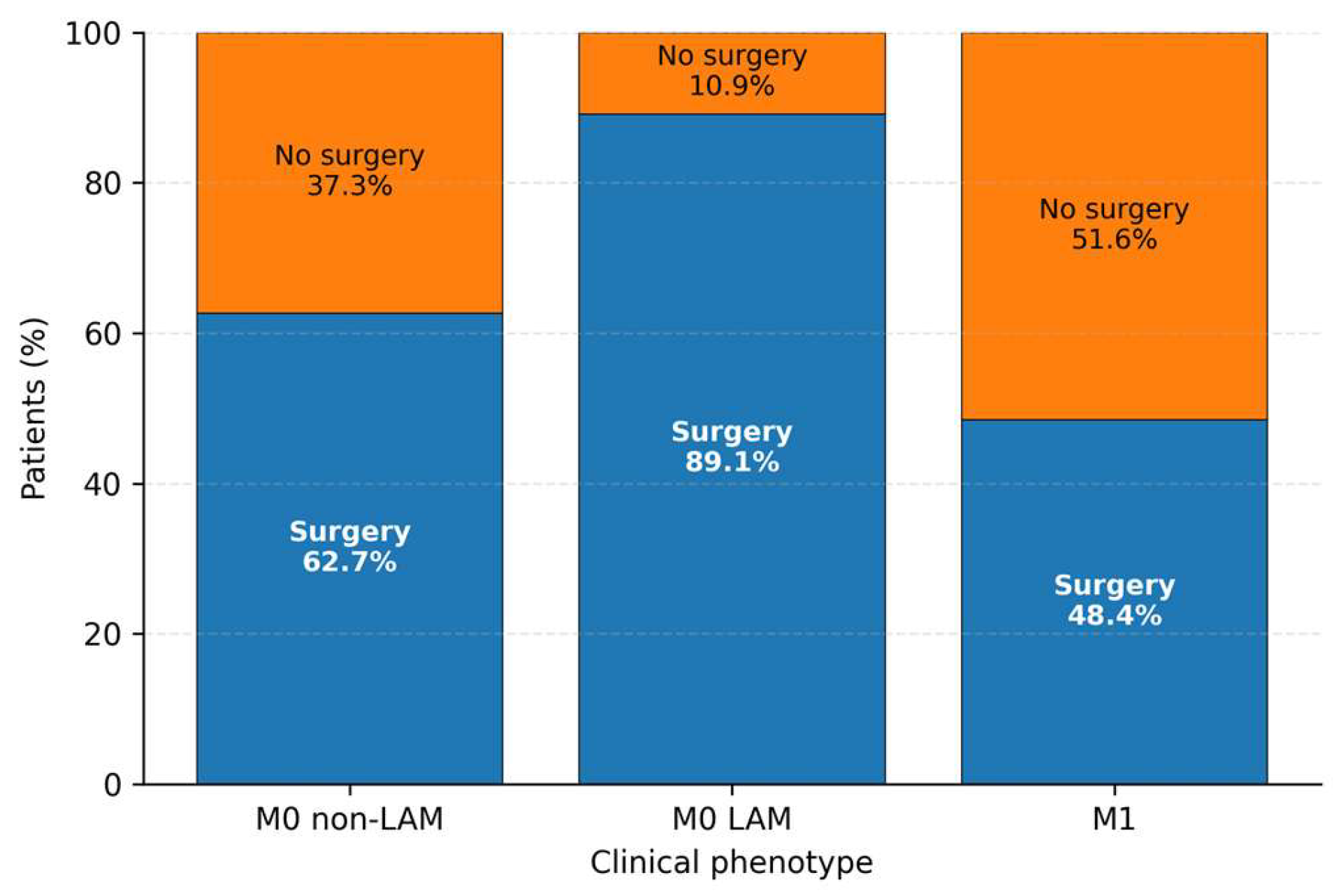
| Phenotype | n (%) | Surgery Performed, n (%) | Median Age (Years) |
|---|---|---|---|
| M0 non-LAM | 75 (28.6) | 47 (62.7) | 72 |
| M0 LAM | 92 (35.1) | 82 (89.1) | 67 |
| M1 | 95 (36.3) | 46 (48.4) | 68 |
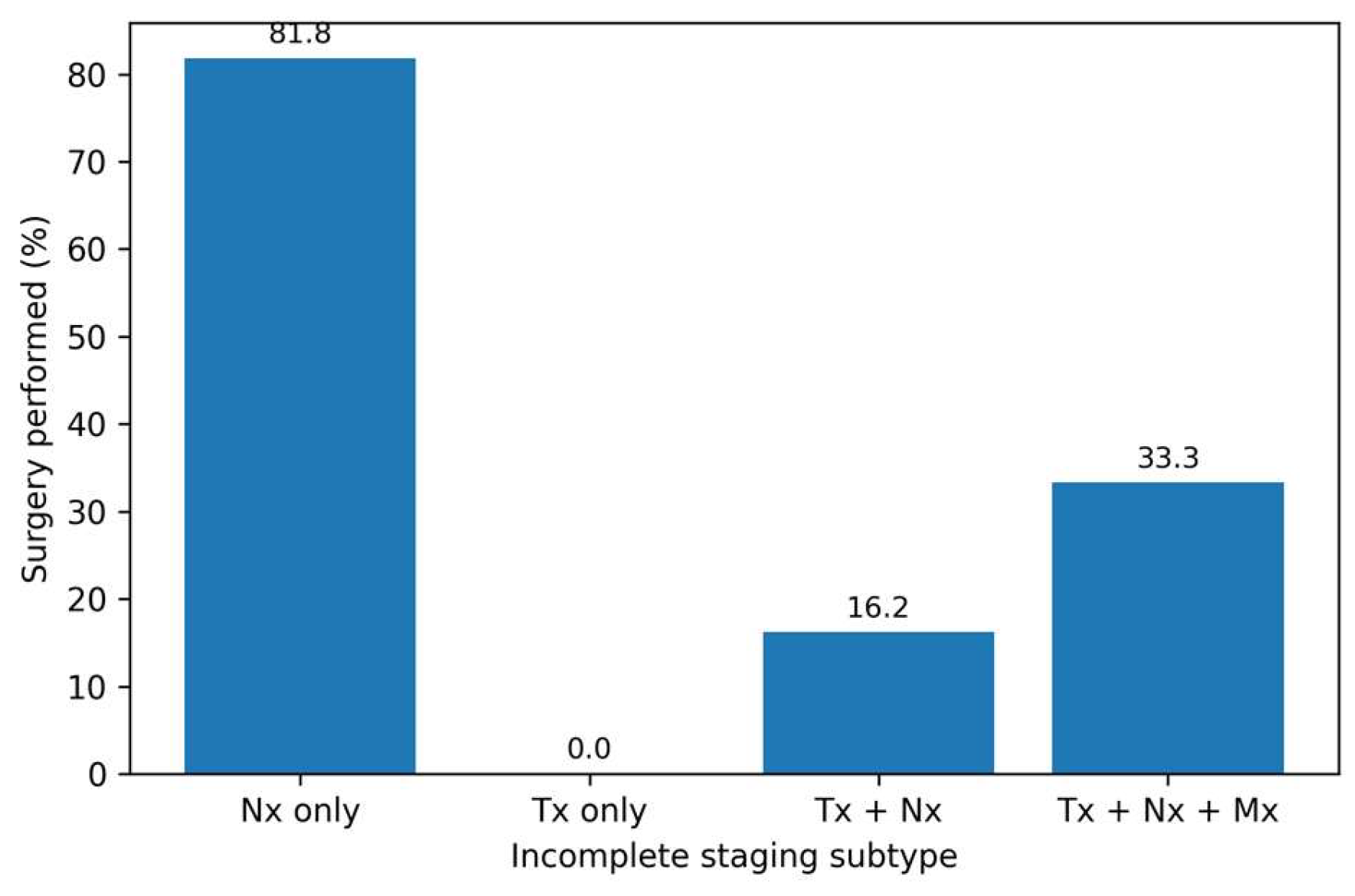
| Type of Incomplete Staging | n (%) | M1 Present, n (%) | Surgery Performed, n (%) |
|---|---|---|---|
| Nx only | 22 (14.3) | 20 (90.9) | 18 (81.8) |
| Tx only | 31 (20.1) | 29 (93.5) | 0 (0.0) |
| Tx + Nx | 68 (44.2) | 51 (75.0) | 11 (16.2) |
| Tx + Nx + Mx | 33 (21.4) | — | 11 (33.3) |
| Total incomplete staging | 154 (100) | — | — |
| Predictor | Adjusted OR | 95% CI | p-Value |
|---|---|---|---|
| Intercept | 2.96 | 0.88–9.93 | 0.079 |
| Age (per 10 years) | 1.00 | 0.82–1.34 | 0.823 |
| Sex (male vs. female) | 0.66 | 0.33–1.30 | 0.225 |
| log10 (CEA + 1) | 1.35 | 0.79–2.32 | 0.270 |
| log10 (CA19-9 + 1) | 1.44 | 0.97–2.14 | 0.074 |
| Predictor | Adjusted OR | 95% CI | p-Value | |
|---|---|---|---|---|
| Low | High | |||
| Intercept | 0.03 | 0.01 | 0.15 | <0.001 |
| M1 | 15.41 | 8.00 | 29.65 | <0.001 |
| Age (per 10 years) | 1.10 | 0.89 | 1.36 | 0.365 |
| Sex (male vs. female) | 1.34 | 0.80 | 2.27 | 0.269 |
| Predictor | Adjusted OR | 95% CI | p-Value | |
|---|---|---|---|---|
| Low | High | |||
| Intercept | 6.68 | 1.72 | 25.99 | 0.006 |
| M1 | 0.18 | 0.12 | 0.29 | <0.001 |
| Age (per 10 years) | 0.87 | 0.72 | 1.05 | 0.137 |
| Sex (male vs. female) | 1.13 | 0.72 | 1.77 | 0.609 |
| Predictor | Adjusted OR | 95% CI | p-Value | |
|---|---|---|---|---|
| Low | High | |||
| Intercept | 23.16 | 3.58 | 149.68 | 0.006 |
| Age (per 10 years) | 0.77 | 0.60 | 1.00 | 0.047 |
| Sex (male vs. female) | 0.47 | 0.26 | 0.85 | 0.012 |
| Predictor | Adjusted OR | 95% CI | p-Value | |
|---|---|---|---|---|
| Low | High | |||
| Intercept | 7.44 | 1.24 | 44.53 | 0.028 |
| LAM | 1.24 | 0.70 | 2.21 | 0.457 |
| Age (per 10 years) | 0.80 | 0.63 | 1.01 | 0.057 |
| Sex (male vs. female) | 1.13 | 0.66 | 1.94 | 0.662 |
Disclaimer/Publisher’s Note: The statements, opinions and data contained in all publications are solely those of the individual author(s) and contributor(s) and not of MDPI and/or the editor(s). MDPI and/or the editor(s) disclaim responsibility for any injury to people or property resulting from any ideas, methods, instructions or products referred to in the content. |
© 2026 by the authors. Licensee MDPI, Basel, Switzerland. This article is an open access article distributed under the terms and conditions of the Creative Commons Attribution (CC BY) license.
Share and Cite
Vieru, A.-M.; Mustață, M.-L.; Rădulescu, V.-M.; Trașcă, E.; Cazacu, S.-M.; Popa, P.; Ciurea, T. Incomplete TNM Documentation in Gastric Cancer: Frequency, Phenotype, and Treatment Allocation. Diagnostics 2026, 16, 870. https://doi.org/10.3390/diagnostics16060870
Vieru A-M, Mustață M-L, Rădulescu V-M, Trașcă E, Cazacu S-M, Popa P, Ciurea T. Incomplete TNM Documentation in Gastric Cancer: Frequency, Phenotype, and Treatment Allocation. Diagnostics. 2026; 16(6):870. https://doi.org/10.3390/diagnostics16060870
Chicago/Turabian StyleVieru, Alexandru-Marian, Maria-Lorena Mustață, Virginia-Maria Rădulescu, Emil Trașcă, Sergiu-Marian Cazacu, Petrică Popa, and Tudorel Ciurea. 2026. "Incomplete TNM Documentation in Gastric Cancer: Frequency, Phenotype, and Treatment Allocation" Diagnostics 16, no. 6: 870. https://doi.org/10.3390/diagnostics16060870
APA StyleVieru, A.-M., Mustață, M.-L., Rădulescu, V.-M., Trașcă, E., Cazacu, S.-M., Popa, P., & Ciurea, T. (2026). Incomplete TNM Documentation in Gastric Cancer: Frequency, Phenotype, and Treatment Allocation. Diagnostics, 16(6), 870. https://doi.org/10.3390/diagnostics16060870