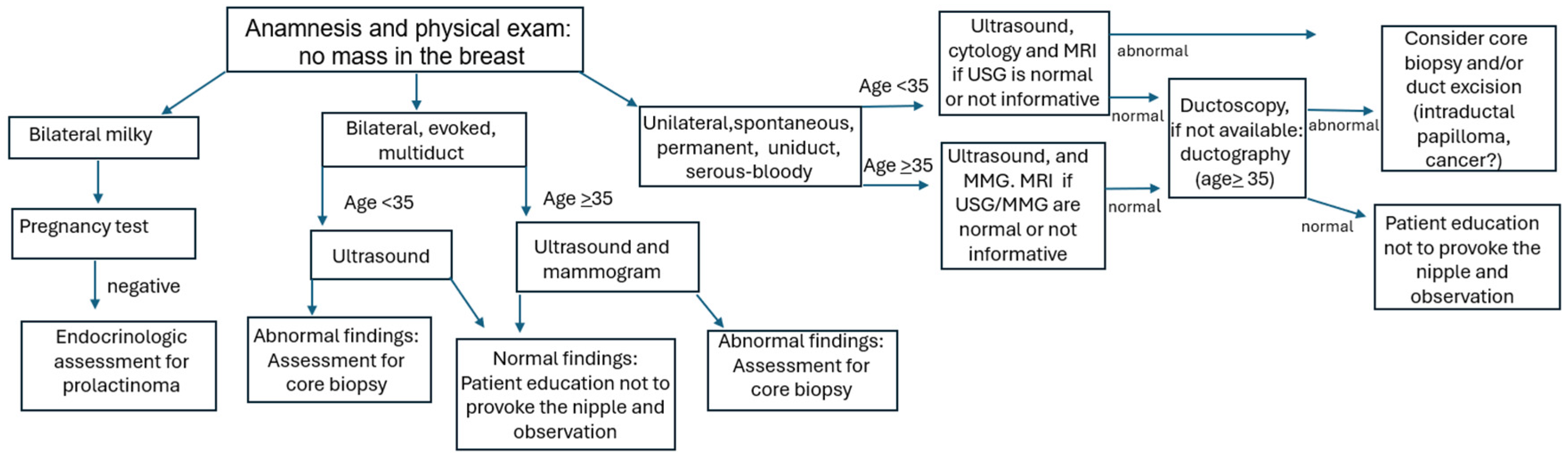
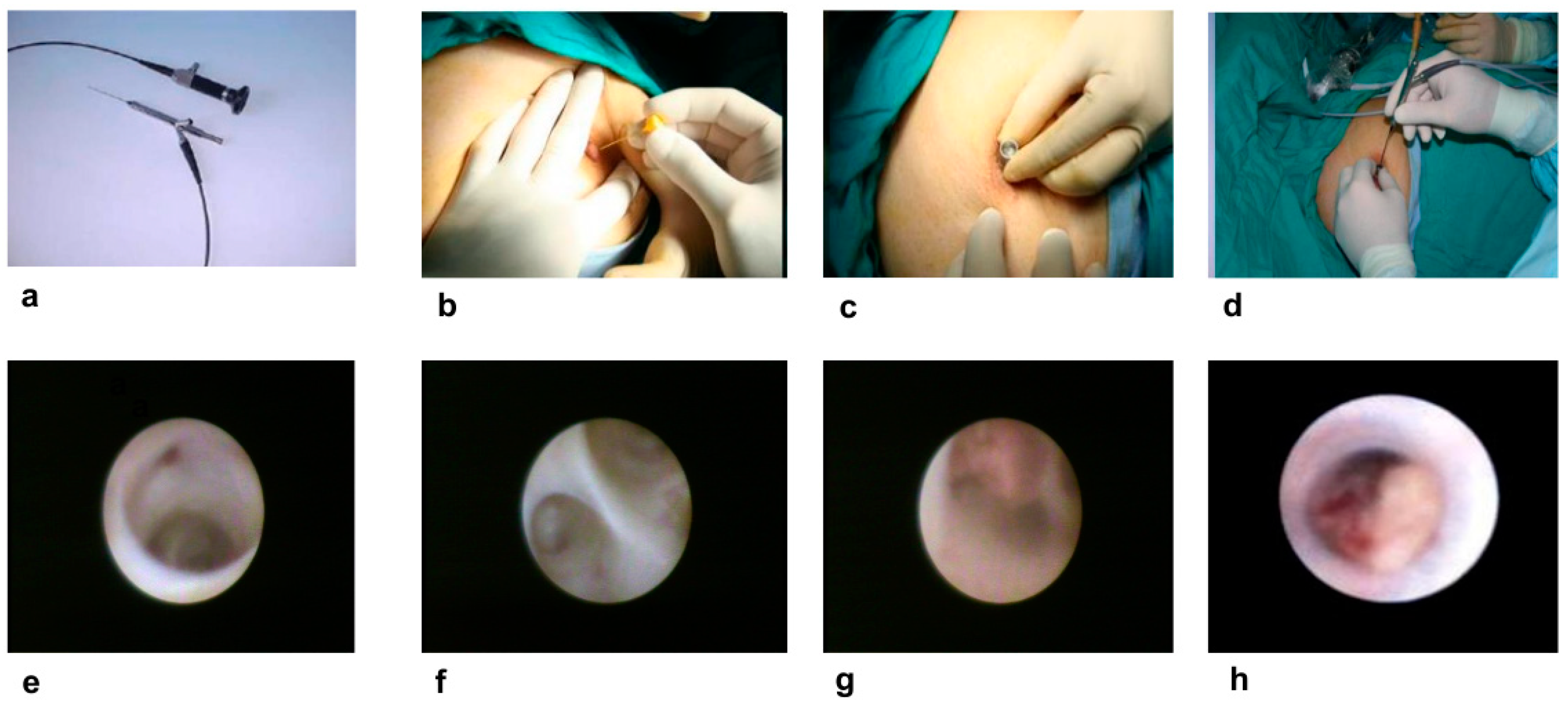
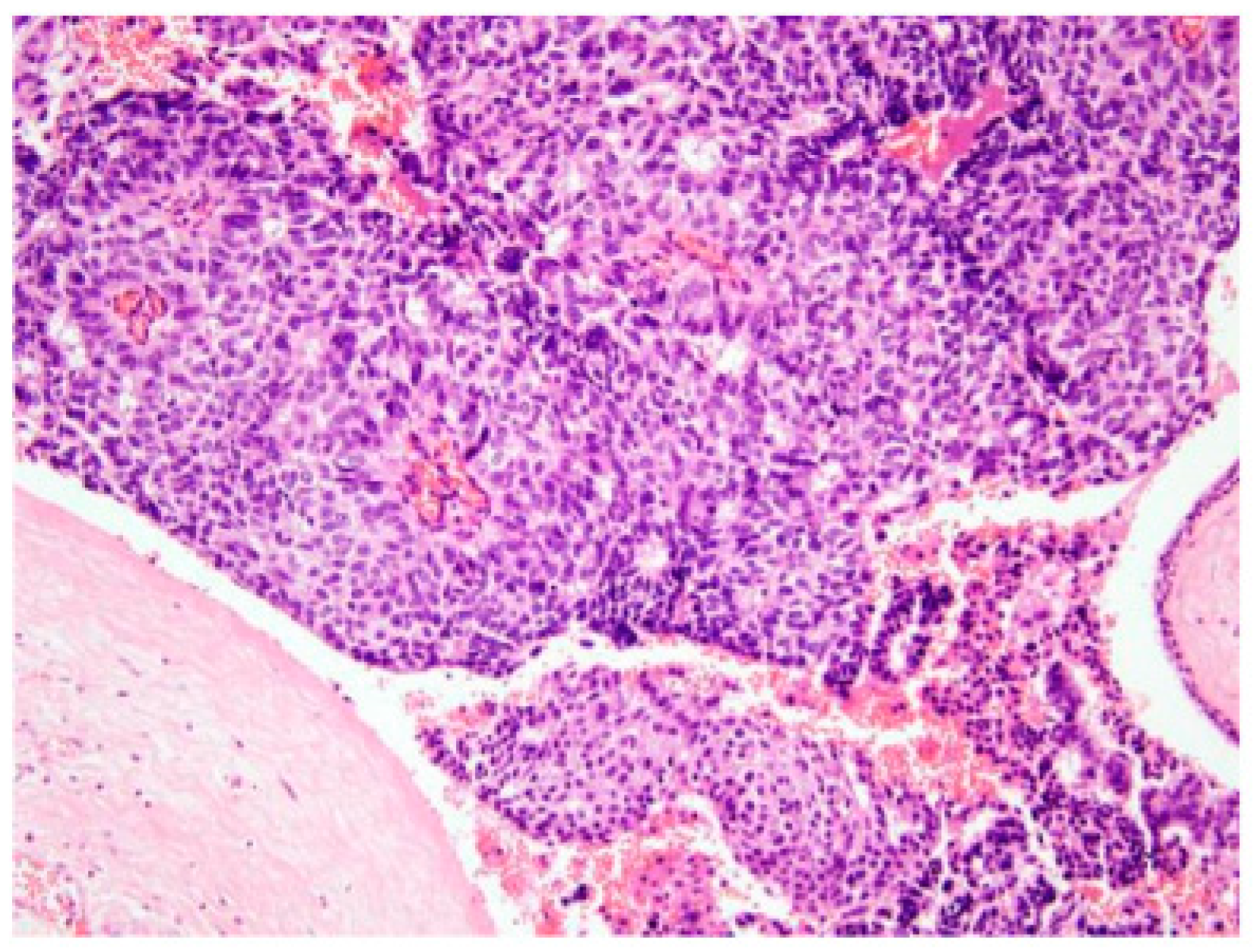
Ductoscopy Facilitates Surgical Decision-Making in Management of Patients with Pathological Nipple Discharge †

 , , , ,
Abstract
1. Introduction
2. Methods
2.1. Patient Selection
2.2. Device and Technique
2.3. Radiological Methods
2.4. Cytological Examinations
2.5. Statistical Analysis
3. Results
4. Discussion
5. Conclusions
Author Contributions
Funding
Institutional Review Board Statement
Informed Consent Statement
Data Availability Statement
Acknowledgments
Conflicts of Interest
References
- Kamali, S.; Bender, O.; Aydin, M.T.; Yuney, E.; Kamalı, G. Ductoscopy in the evaluation and management of nipple discharge. Ann. Surg. Oncol. 2010, 17, 778–783. [Google Scholar] [CrossRef] [PubMed]
- Patel, B.K.; Falcon, S.; Drukteinis, J. Management of nipple discharge and the associated imaging findings. Am. J. Med. 2015, 128, 353–360. [Google Scholar] [CrossRef]
- Gray, R.J.; Pockaj, B.A.; Karstaedt, P.J. Navigating murky waters: A modern treatment algorithm for nipple discharge. Am. J. Surg. 2007, 194, 850–854; discussion, 854–855. [Google Scholar] [CrossRef]
- Cabioglu, N.; Hunt, K.K.; Singletary, S.E.; Stephens, T.W.; Marcy, S.; Meric, F.; I Ross, M.; Babiera, G.V.; Ames, F.C.; Kuerer, H.M. Surgical decision making and factors determining a diagnosis of breast carcinoma in women presenting with nipple discharge. J. Am. Coll. Surg. 2003, 196, 354–364. [Google Scholar] [CrossRef]
- Vargas, H.I.; Vargas, M.P.; Eldrageely, K.; Gonzalez, K.D.; Khalkhali, I. Outcomes of clinical and surgical assessment of women with pathological nipple discharge. Am. Surg. 2006, 72, 124–128. [Google Scholar] [CrossRef]
- Bahl, M.; Baker, J.A.; Greenup, R.A.; Ghate, S.V. Diagnostic value of ultrasound in female patients with nipple discharge. AJR Am. J. Roentgenol. 2015, 205, 203–208. [Google Scholar] [CrossRef]
- Montroni, I.; Santini, D.; Zucchini, G.; Fiacchi, M.; Zanotti, S.; Ugolini, G.; Manaresi, A.; Taffurelli, M. Nipple discharge: Is its significance as a risk factor for breast cancer fully understood? Observational study including 915 consecutive patients who underwent selective duct excision. Breast Cancer Res. Treat. 2010, 123, 895–900. [Google Scholar] [CrossRef]
- Morrogh, M.; Morris, E.A.; Liberman, L.; Borgen, P.I.; King, T.A. The predictive value of ductography and magnetic resonance imaging in the management of nipple discharge. Ann. Surg. Oncol. 2007, 14, 3369–3377. [Google Scholar] [CrossRef]
- Zervoudis, S.; Economides, P.; Iatrakis, G.; Polyzos, D.; Lykeridou, K.; Navrozoglou, I. Nipple discharge: Evaluation and management. Gineco Mastol. 2008, 4, 230–237. [Google Scholar]
- Cabioglu, N.; Krishnamurthy, S.; Kuerer, H.M.; Hunt, K.K.; Singletary, S.E.; Meric-Bernstam, F.; Ross, M.I.; Feig, B.W.; Ames, F.C.; Babiera, G.V. Feasibility of breast-conserving surgery for patients with breast carcinoma associated with nipple discharge. Cancer 2004, 101, 508–517. [Google Scholar] [CrossRef] [PubMed]
- Lorenzon, M.; Zuiani, C.; Linda, A.; Londero, V.; Girometti, R.; Bazzocchi, M. Magnetic resonance imaging in patients with nipple discharge: Should we recommend it? Eur. Radiol. 2011, 21, 899–907. [Google Scholar] [CrossRef]
- Gupta, D.; Mendelson, E.B.; Karst, I. Nipple Discharge: Current Clinical and Imaging Evaluation. Am. J. Roentgenol. 2021, 216, 330–339. [Google Scholar] [CrossRef]
- Kaphenhas-Valdes, E.; Feldman, S.M.; Boolbol, S.K. The role of mammary ductoscopy in breast cancer: Review of literature. Ann. Surg. Oncol. 2008, 15, 3350–3360. [Google Scholar] [CrossRef]
- Waaijer, L.; Simons, J.M.; Borel Rinkes, I.H.M.; van Diest, P.J.; Verkooijen, H.M.; Witkamp, A.J. Systematic review and meta-analysis of the diagnostic accuracy of ductoscopy in patients with pathological nipple discharge. Br. J. Surg. 2016, 103, 632–643. [Google Scholar] [CrossRef]
- Bender, O.; Balci, F.L.; Yuney, E.; Akbulut, H. Scarless endoscopic papillomectomy of the breast. Onkologie 2009, 32, 94–98. [Google Scholar] [CrossRef]
- Kamali, S.; Bender, O.; Kamali, G.H.; Aydin, M.T.; Karatepe, O.; Yuney, E. Diagnostic and therapeutic value of ductoscopy in nipple discharge and intraductal proliferations compared with standard methods. Breast Cancer 2014, 21, 154–161. [Google Scholar] [CrossRef]
- Escobar, P.F.; Baynes, D.; Crowe, J.P. Ductoscopy-assisted microdochectomy. Int. J. Fertil. Womens Med. 2004, 49, 222–224. [Google Scholar]
- von Elm, E.; Altman, D.G.; Egger, M.; Pocock, S.J.; Gøtzsche, P.C.; Vandenbroucke, J.P. The Strengthening the Reporting of Observational Studies in Epidemiology (STROBE) statement: Guidelines for reporting observational studies. J. Clin. Epidemiol. 2008, 61, 344–349. [Google Scholar] [CrossRef] [PubMed]
- Sabel, M.S.; Helvie, M.A.; Breslin, T.; Curry, A.; Diehl, K.M.; Cimmino, V.M.; Chang, A.E.; Newman, L.A. Is duct excision still necessary for all cases of suspicious nipple discharge? Breast J. 2012, 18, 157–162. [Google Scholar] [CrossRef] [PubMed]
- Sarica, O.; Zeybek, E.; Ozturk, E. Evaluation of nipple-areola complex with ultrasonography and magnetic resonance imaging. J. Comput. Assist. Tomogr. 2010, 34, 575–586. [Google Scholar] [CrossRef]
- Yoon, H.; Yoon, J.H.; Kim, E.K.; Moon, H.J.; Park, B.-W.; Kim, M.J. Adding ultrasound to the evaluation of patients with pathologic nipple discharge to diagnose additional breast cancers: Preliminary data. Ultrasound Med. Biol. 2015, 41, 2099–2107. [Google Scholar] [CrossRef]
- Blum, K.S.; Rubbert, C.; Antoch, G.; Mohrmann, S.; Obenauer, S. Diagnostic accuracy of abnormal galactographic and sonographic findings in the diagnosis of intraductal pathology in patients with abnormal nipple discharge. Clin. Imaging 2015, 39, 587–591. [Google Scholar] [CrossRef]
- Kooistra, B.W.; Wauters, C.; van de Ven, S.; Strobbe, L. The diagnostic value of nipple discharge cytology in 618 consecutive patients. Eur. J. Surg. Oncol. 2009, 35, 573–577. [Google Scholar] [CrossRef]
- Al Sarakbi, W.; Salhab, M.; Mokbel, K. Does mammary ductoscopy have a role in clinical practice? Int. Semin. Surg. Oncol. 2006, 3, 16. [Google Scholar] [CrossRef][Green Version]
- Yamamoto, D.; Senzaki, H.; Nakagawa, H.; Okugawa, H.; Gondo, H.; Tanaka, K. Detection of chromosomal aneusomy by fluorescence in situ hybridization for patients with nipple discharge. Cancer 2003, 97, 690–694. [Google Scholar] [CrossRef]
- Sauter, E.R.; Klein-Szanto, A.; Ehya, H.E.; MacGibbon, B. Ductoscopic cytology and image analysis to detect breast carcinoma. Cancer 2004, 101, 1283–1292. [Google Scholar] [CrossRef] [PubMed]
- Fackler, M.J.; Rivers, A.; Teo, W.W.; Mangat, A.; Taylor, E.; Zhang, Z.; Goodman, S.; Argani, P.; Nayar, R.; Susnik, B.; et al. Hypermethylated genes as biomarkers of cancer in women with pathologic nipple discharge. Clin. Cancer Res. 2009, 15, 3802–3811. [Google Scholar] [CrossRef]
- Simmons, R.; Adamovich, T.; Brennan, M.; Christos, P.; Schultz, M.; Eisen, C.; Osborne, M. Nonsurgical Evaluation of Pathologic Nipple Discharge. Ann. Surg. Oncol. 2003, 10, 113–116. [Google Scholar] [CrossRef]
- van Gelder, L.; Bisschops, R.H.; Menke-Pluymers, M.B.E.; Westenend, P.J.; Plaisier, P.W. Magnetic resonance imaging in patients with unilateral bloody nipple discharge; useful when conventional diagnostics are negative? World J. Surg. 2015, 39, 184–186. [Google Scholar] [CrossRef]
- Berger, N.; Luparia, A.; Di Leo, G.; Carbonaro, L.A.; Trimboli, R.M.; Ambrogi, F.; Sardanelli, F. Diagnostic Performance of MRI Versus Galactography in Women with Pathologic Nipple Discharge: A Systematic Review and Meta-Analysis. Am. J. Roentgenol. 2017, 209, 465–471. [Google Scholar] [CrossRef]
- Lubina, N.; Schedelbeck, U.; Roth, A.; Weng, A.M.; Geissinger, E.; Hönig, A.; Hahn, D.; Bley, T.A. 3.0 Tesla breast magnetic resonance imaging in patients with nipple discharge when mammography and ultrasound fail. Eur. Radiol. 2015, 25, 1285–1293. [Google Scholar] [CrossRef]
- Okazaki, A.; Okazaki, M.; Kazuaki, A.; Satoh, H.; Watanabe, Y.; Mikami, T.; Toda, K.; Okazaki, Y.; Nabeta, K.; Hirata, K.; et al. Fiberoptic Ductoscopy of the Breast: A New Diagnostic Procedure for Nipple Discharge. Jpn. J. Clin. Oncol. 1991, 21, 188–193. [Google Scholar] [CrossRef]
- Mokbel, K.; Escobar, P.F.; Matsunaga, T. Mammary Ductoscopy: Current Status and Future Prospects. Eur. J. Sur Oncol. 2005, 31, 3–8. [Google Scholar] [CrossRef]
- Fisher, C.S.; Margenthaler, J.A. A look into the ductoscope: Its role in pathologic nipple discharge. Ann. Surg. Oncol. 2011, 18, 3187–3191. [Google Scholar] [CrossRef]
- Dietz, J.R.; Crowe, J.P.; Grundfest, S.; Arrigain, S.; Kim, J.A. Directed duct excision by using mammary ductoscopy in patients with pathologic nipple discharge. Surgery 2002, 132, 582–588. [Google Scholar] [CrossRef] [PubMed]
- Dooley, W.C. Routine Operative Breast Endoscopy During Lumpectomy. Ann. Surg. Oncol. 2003, 10, 38–42. [Google Scholar] [CrossRef] [PubMed]
- Yılmaz, R.; Bender, O.; Yabul, F.Ç.; Dursun, M.; Tunacı, M.; Acunas, G. Diagnosis of Nipple Discharge: Value of Magnetic Resonance Imaging and Ultrasonography in Comparison with Ductoscopy. Balkan Med. J. 2017, 34, 119–126. [Google Scholar] [CrossRef] [PubMed]
- Khan, S.A.; Mangat, A.; Rivers, A.; Revesz, E.; Susnik, B.; Hansen, N. Office ductoscopy for surgical selection in women with pathologic nipple discharge. Ann. Surg. Oncol. 2011, 18, 3785–3790. [Google Scholar] [CrossRef]
- Pitarch, M.; Alcantara, R.; Comerma, L.; Vázquez de Las Heras, I.; Azcona, J.; Wiedemann, A.; Prutki, M.; Fallenberg, E.M. An update on multimodal imaging strategies for nipple discharge: From detection to decision. Insights Into Imaging 2025, 16, 70. [Google Scholar] [CrossRef]
- Expert Panel on Breast Imaging; Sanford, M.F.; Slanetz, P.J.; Lewin, A.A.; Baskies, A.M.; Bozzuto, L.; Branton, S.A.; Hayward, J.H.; Le-Petross, H.T.; Newell, M.S.; et al. ACR Appropriateness Criteria® Evaluation of Nipple Discharge: 2022 Update. J. Am. Coll. Radiol. 2022, 19, S304–S318. [Google Scholar] [CrossRef] [PubMed]
- Filipe, M.D.; Patuleia, S.I.S.; Vriens, M.R.; van Diest, P.J.; Witkamp, A.J. Meta-analysis and cost-effectiveness of ductoscopy, duct excision surgery and MRI for the diagnosis and treatment of patients with pathological nipple discharge. Breast Cancer Res. Treat. 2021, 186, 285–293. [Google Scholar] [CrossRef] [PubMed]
- Filipe, M.D.; Waaijer, L.; van der Pol, C.; van Diest, P.J.; Witkamp, A.J. Interventional Ductoscopy as an Alternative for Major Duct Excision or Microdochectomy in Women Suffering Pathologic Nipple Discharge: A Single-center Experience. Clin. Breast Cancer 2020, 20, e334–e343. [Google Scholar] [CrossRef]
- Cabioglu, N.; Aliyev, V.; Ozkurt, E.; Ozkan Gurdal, S.; Ozcinar, B.; Durmus Kurt, M.; Tukenmez, M.; Igci, A.; Muslumanoglu, M.; Ozmen, V.; et al. Feasibility of Mammary Ductoscopy in Management of Pathologic Nipple Discharge. In Proceedings of the 16th Annual Meeting of the American Society of Breast Surgeons, Orlando, FL, USA, 29 April–3 May 2015; Volume 22, pp. 40–41. [Google Scholar]



| Characteristic | Number |
|---|---|
| Consecutive patients with pathological nipple discharge | 54 |
| Breasts with attempted ductoscopy | 57 |
| Successful ductoscopy | 55 |
| Unsuccessful ductoscopy due to the cannulation failure or duct rupture | 2 |
| Surgical intervention with histopathological confirmation | 30 |
| Follow-up without surgery | 27 |
| Median follow-up duration | 58 months (IQR, 39–77). |
| Cancer detected during follow-up | 2 |
| Characteristic | N = 54 |
|---|---|
| Median age (range, min–max) | 46 (12–76) |
| Median nipple discharge duration, months | 4 (1–120) |
| Female, n (%) | 52 (96.3%) |
| Male, n (%) | 2 (3.7%) |
| Menopausal status: Premenopausal Postmenopausal | 34 (63%) 18 (33.3%) |
| History of breast cancer: Yes No | 2 (3.7%) 52 (96.3%) |
| History of previous birth: Yes No | 46 (85.2%) 6 (11.1%) |
| Median number of births: | 3 (1–11) |
| Breastfeeding: (n = 46) Yes No | 39 (84.8%) 7 (15.2%) |
| Nipple discharge side: Bilateral Unilateral | 3 (5.6%) 51 (94.4%) |
| Nipple discharge color: Bloody Serous Other | 23 (42.6%) 18 (33.3%) 13 (24.1%) |
| Characteristic of the nipple discharge: Spontaneous Evoked (induced) | 53 (93%) 4 (7%) |
| N (%) | |
|---|---|
| Mammography (n = 44) Normal Fibrocystic change Ductal prominence Duct wall thickening Retroareolar tubular opacity Intraductal papilloma Asymmetric density | 28 (63.6) 3 (6.8) 6 (13.6) 1 (2.3) 1 (2.3) 3 (6.8) 2 (4.5) |
| Ultrasonography (n = 53) Normal Cyst Ductal ectasia Intense content and ductal ectasia Ductal ectasia and solid component Intraductal papilloma and papillomatosis | 11 (20.8) 8 (15.1) 14 (26.4) 5 (9.4) 3 (5.7) 12 (22.6) |
| Ductography (n = 3) Normal Tubular contrast enhancement Filling defect | 1 (33.3) 1 (33.3) 1 (33.3) |
| Magnetic resonance imaging (n = 18) Normal Ductal ectasia Intraductal papilloma Diffusion restriction | 7 (38.9) 3 (16.7) 7 (38.9) 1 (5.6) |
| Ductoscopic Findings | N = 57 (%) | Pathology Findings After Surgery (n = 30) |
|---|---|---|
| Normal | 12 (21.1) | Fibrocystic changes (n = 1), ductal ectasia (n = 3), no surgery (n = 8) |
| Debris | 11 (19.3) | Intraductal papilloma (n = 1), ductal ectasia (n = 2), periductal mastitis (n = 1), no surgery (n = 7) |
| Ductal irregularity (with duct ectasia, n = 2, with duct narrowing, n = 2) | 9 (15.8%) | Intraductal papilloma (n = 1), columnar changes (n = 1), ductal ectasia (n = 1), no surgery (n = 6) |
| Intraductal papilloma | 15 (26.3) | Intraductal papilloma (n = 10), intraductal papilloma with atypical hyperplasia (n = 1), papillomatosis (n = 1), ductal ectasia (n = 2), adenosis (n = 1) |
| Patchy erythematous duct irregularities | 2 (3.5) | Ductal carcinoma in situ (n = 2) |
| Malignancy | 1 (1.8) | Papillomatosis (n = 1) |
| Ductal narrowing (with erythema, n = 1) | 2 (3.5) | Ductal ectasia (n = 1), no surgery (n = 1) |
| Ductal ectasia | 2 (3.5) | No surgery (n = 2) |
| Periductal mastitis | 1 (1.8) | No surgery (n = 1) |
| Rupture | 1 (1.8) | No surgery (n = 1) |
| Could not be cannulated | 1 (1.8) | No surgery (n = 1) |
| Observation, n = 27 (%) | Surgery, n = 30 (%) | p | |
|---|---|---|---|
| Age | 0.025 | ||
| ≤40 | 10/27 (37) | 3/30 (10) | |
| >40 | 17/27 (63) | 27/30 (90) | |
| Discharge color | 0.280 | ||
| Bloody/serous | 21/27 (78) | 27/30 (90) | |
| Others (green, yellow, milk, etc.) | 6/27 (22) | 3/30 (10) | |
| Physical examination | 0.239 | ||
| Mass (−) | 27/27 (100) | 27/30 (90) | |
| Mass (+) | 0/27 (0) | 3/30 (10) | |
| Ductoscopy (n = 55 *) | 0.007 | ||
| Pathological (ductal irregularity, intraductal papilloma, etc.) | 8/25 (32) | 21/30 (70) | |
| Benign (normal, heavy content, ductal ectasia) | 17/25 (68) | 9/30 (30) | |
| Ultrasonography | 0.005 | ||
| Pathological (intraductal papilloma, etc.) | 2/24 (8) | 13/29 (45) | |
| Benign (cyst, ductal ectasia, etc.) | 22/24 (92) | 16/29 (55) | |
| Magnetic resonance imaging | 0.066 | ||
| Pathologic | 1/8 (12.5) | 6/10 (60) | |
| Benign | 7/8 (87.5) | 4/10 (40) | |
| Mammography | 0.507 | ||
| Pathologic | 4/18 (22) | 9/26 (35) | |
| Benign | 14/18 (78) | 17/26 (65) | |
| Cytology (n = 30) | 0.999 | ||
| Pathologic | 2/15 (13) | 2/15 (13) | |
| Benign | 13/15 (87) | 13/15 (87) |
| Surgical Type | N = 30 (%) |
|---|---|
| Central duct excision * | 15 (50) |
| Duct excision with wire localization * | 11 (37) |
| Mass excision with wire localization * | 3 (10) |
| Central duct excision (DCIS and microinvasion) followed by mastectomy and sentinel lymph node biopsy | 1 (3) |
| Pathological Findings | n (%) |
|---|---|
| Specific lesion for pathological nipple discharge: | 18 (60) |
| Intraductal papilloma and papillomatosis | 14 |
| Intraductal papilloma and atypical ductal hyperplasia | 1 |
| Papillary carcinoma and DCIS (low grade) | 1 |
| DCIS and microinvasion | 1 |
| Periductal mastitis | 1 |
| Benign lesions not specific to pathological nipple discharge: | 12 (40) |
| Ductal ectasia | 9 |
| Periductal mastitis with columnar changes and ductal ectasia | 1 |
| Fibrocystic changes | 1 |
| Adenosis | 1 |
Disclaimer/Publisher’s Note: The statements, opinions and data contained in all publications are solely those of the individual author(s) and contributor(s) and not of MDPI and/or the editor(s). MDPI and/or the editor(s) disclaim responsibility for any injury to people or property resulting from any ideas, methods, instructions or products referred to in the content. |
© 2026 by the authors. Licensee MDPI, Basel, Switzerland. This article is an open access article distributed under the terms and conditions of the Creative Commons Attribution (CC BY) license.
Share and Cite
Aliyev, V.; Turkyılmaz, Z.; Özkurt, E.; Kurt, M.D.; Tukenmez, M.; Emiroglu, S.; Gurdal, S.O.; Ozcinar, B.; Balci, F.L.; Bender, O.; et al. Ductoscopy Facilitates Surgical Decision-Making in Management of Patients with Pathological Nipple Discharge. Diagnostics 2026, 16, 856. https://doi.org/10.3390/diagnostics16060856
Aliyev V, Turkyılmaz Z, Özkurt E, Kurt MD, Tukenmez M, Emiroglu S, Gurdal SO, Ozcinar B, Balci FL, Bender O, et al. Ductoscopy Facilitates Surgical Decision-Making in Management of Patients with Pathological Nipple Discharge. Diagnostics. 2026; 16(6):856. https://doi.org/10.3390/diagnostics16060856
Chicago/Turabian StyleAliyev, Vusal, Zeliha Turkyılmaz, Enver Özkurt, Mehmet Durmus Kurt, Mustafa Tukenmez, Selman Emiroglu, Sibel Ozkan Gurdal, Beyza Ozcinar, Fatih Levent Balci, Omer Bender, and et al. 2026. "Ductoscopy Facilitates Surgical Decision-Making in Management of Patients with Pathological Nipple Discharge" Diagnostics 16, no. 6: 856. https://doi.org/10.3390/diagnostics16060856
APA StyleAliyev, V., Turkyılmaz, Z., Özkurt, E., Kurt, M. D., Tukenmez, M., Emiroglu, S., Gurdal, S. O., Ozcinar, B., Balci, F. L., Bender, O., Muslumanoglu, M., & Cabioglu, N. (2026). Ductoscopy Facilitates Surgical Decision-Making in Management of Patients with Pathological Nipple Discharge. Diagnostics, 16(6), 856. https://doi.org/10.3390/diagnostics16060856