


Inflammatory Prognostic Index: A Novel Predictor of In-Stent Restenosis Following Drug-Eluting Stent–Percutaneous Coronary Intervention


Abstract
1. Introduction
2. Materials and Methods
2.1. Study Design and Study Population
- Age ≥18 years;
- History of successful PCI performed for ACS;
- At least one control CAG performed 12–24 months after DES implantation;
- The initial DES implantation having been performed in the setting of ACS;
- Availability of complete clinical, laboratory, and angiographic data.
- Presentation with stent thrombosis;
- Previous history of coronary artery bypass grafting (CABG);
- Presence of active infection, known malignancy, or hematologic disease;
- End-stage liver or renal failure;
- History of chronic inflammatory or autoimmune disease;
- Suboptimal stent implantation during the index PCI procedure;
- Balloon angioplasty alone or bare-metal stent (BMS) implantation for the culprit lesion;
- Incomplete or insufficient clinical, laboratory, or angiographic data.
2.2. Data Collection
2.3. Laboratory Analyses and Index Calculations
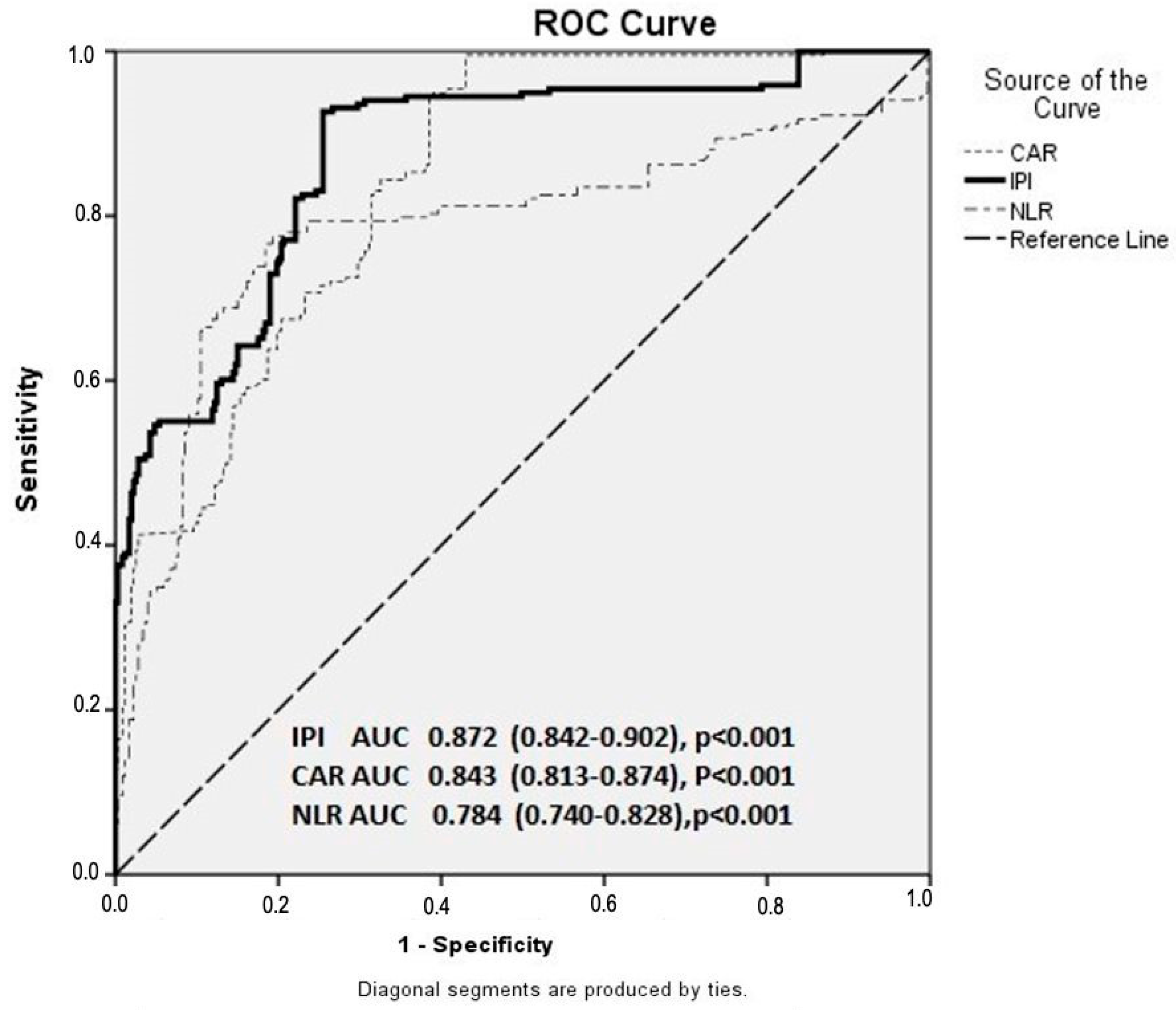
- NLR (Neutrophil-to-Lymphocyte Ratio) = Neutrophil count/Lymphocyte count;
- CAR (CRP-to-Albumin Ratio) = CRP (mg/L)/Albumin (g/L);
- IPI (Inflammatory Prognostic Index) = (CRP × NLR)/Albumin.
2.4. Angiographic Analysis and Stent Implantation
2.5. Statistical Analysis
- The independent samples t-test was used for normally distributed continuous variables;
- The Mann–Whitney U test for non-normally distributed continuous variables;
- The chi-square (χ2) test for categorical variables.
3. Results
4. Discussion
5. Conclusions
Study Limitations
Author Contributions
Funding
Institutional Review Board Statement
Informed Consent Statement
Data Availability Statement
Conflicts of Interest
References
- Mensah, G.A.; Fuster, V.; Murray, C.J.; Roth, G.A.; Abate, Y.H.; Abbasian, M.; Abd-Allah, F.; Abdollahi, A.; Abdollahi, M.; Abdulah, D.M.; et al. Global burden of cardiovascular diseases and risks, 1990–2022. J. Am. Coll. Cardiol. 2023, 82, 2350–2473. [Google Scholar] [CrossRef]
- Harta, I.K.A.P.; Pertiwi, P.F.K.; Arta, I.G.J.; Yasa, K.P. Effectiveness of the various revascularization techniques in multivessel coronary artery disease: A systematic review with network meta-analysis. Ann. Med. 2025, 57, 2566878. [Google Scholar] [CrossRef]
- Lawton, J.S.; Tamis-Holland, J.E.; Bangalore, S.; Bates, E.R.; Beckie, T.M.; Bischoff, J.M.; Bittl, J.A.; Cohen, M.G.; DiMaio, J.M.; Don, C.W.; et al. 2021 ACC/AHA/SCAI guideline for coronary artery revascularization: Executive summary: A report of the American College of Cardiology/American Heart Association Joint Committee on Clinical Practice Guidelines. Circulation 2022, 145, e4–e17. [Google Scholar] [CrossRef] [PubMed]
- Luengo-Fernandez, R.; Walli-Attaei, M.; Gray, A.; Torbica, A.; Maggioni, A.P.; Huculeci, R.; Bairami, F.; Aboyans, V.; Timmis, A.D.; Vardas, P.; et al. Economic burden of cardiovascular diseases in the European Union: A population-based cost study. Eur. Heart J. 2023, 44, 4752–4767. [Google Scholar] [CrossRef] [PubMed]
- Neumann, F.-J.; Sousa-Uva, M.; Ahlsson, A.; Alfonso, F.; Banning, A.P.; Benedetto, U.; Byrne, R.A.; Collet, J.-P.; Falk, V.; Head, S.J.; et al. 2018 ESC/EACTS Guidelines on myocardial revascularization. Eur. Heart J. 2019, 40, 87–165. [Google Scholar] [CrossRef]
- Movahed, M.; Ramaraj, R.; Jamal, M.; Hashemzadeh, M. Nationwide trends in the utilisation of percutaneous coronary intervention (PCI) in the United States of America based on gender and ethnicities. EuroIntervention 2009, 5, 343–348. [Google Scholar] [CrossRef]
- Byrne, R.A.; Rossello, X.; Coughlan, J.J.; Barbato, E.; Berry, C.; Chieffo, A.; Claeys, M.J.; Dan, G.-A.; Dweck, M.R.; Galbraith, M.; et al. 2023 ESC guidelines for the management of acute coronary syndromes: Developed by the task force on the management of acute coronary syndromes of the European Society of Cardiology (ESC). Eur. Heart J. Acute Cardiovasc. Care 2024, 13, 55–161. [Google Scholar]
- Moussa, I.D.; Mohananey, D.; Saucedo, J.; Stone, G.W.; Yeh, R.W.; Kennedy, K.F.; Waksman, R.; Teirstein, P.; Moses, J.W.; Simonton, C. Trends and outcomes of restenosis after coronary stent implantation in the United States. J. Am. Coll. Cardiol. 2020, 76, 1521–1531. [Google Scholar] [CrossRef]
- Wilson, T.M.; Sarris-Michopoulos, P.M.; Siddiqui, R.; Ahmed, A.; Riaz, I.; Licitra, G.; Ossi, J.; Khawaja, M.; Fanaroff, A.C.; Maehara, A.; et al. Precision Management of Coronary In-Stent Restenosis. Trends Cardiovasc. Med. 2025, 36, 44–55. [Google Scholar] [CrossRef]
- Alfonso, F.; Byrne, R.A.; Rivero, F.; Kastrati, A. Current treatment of in-stent restenosis. J. Am. Coll. Cardiol. 2014, 63, 2659–2673. [Google Scholar] [CrossRef] [PubMed]
- Kokkinidis, D.G.; Waldo, S.W.; Armstrong, E.J. Treatment of coronary artery in-stent restenosis. Expert Rev. Cardiovasc. Ther. 2017, 15, 191–202. [Google Scholar] [CrossRef] [PubMed]
- van Zandvoort, L.J.C.; Tomaniak, M.; Forero, M.N.T.; Masdjedi, K.; Visseren, L.; Witberg, K.; Ligthart, J.; Kardys, I.; Lemmert, M.E.; Diletti, R.; et al. Predictors for clinical outcome of untreated stent edge dissections as detected by optical coherence tomography. Circ. Cardiovasc. Interv. 2020, 13, e008685. [Google Scholar] [CrossRef]
- Ng, J.; Bourantas, C.V.; Torii, R.; Ang, H.Y.; Tenekecioglu, E.; Serruys, P.W.; Foin, N. Local hemodynamic forces after stenting: Implications on restenosis and thrombosis. Arterioscler. Thromb. Vasc. Biol. 2017, 37, 2231–2242. [Google Scholar] [CrossRef]
- Adriaenssens, T.; Joner, M.; Godschalk, T.C.; Malik, N.; Alfonso, F.; Xhepa, E.; De Cock, D.; Komukai, K.; Tada, T.; Cuesta, J.; et al. Optical coherence tomography findings in patients with coronary stent thrombosis: A report of the PRESTIGE Consortium (Prevention of Late Stent Thrombosis by an Interdisciplinary Global European Effort). Circulation 2017, 136, 1007–1021. [Google Scholar] [CrossRef]
- Alfonso, F.; Pérez-Vizcayno, M.J.; Cuesta, J.; Del Blanco, B.G.; García-Touchard, A.; López-Mínguez, J.R.; Masotti, M.; Zueco, J.; Cequier, A.; Velázquez, M.; et al. 3-year clinical follow-up of the RIBS IV clinical trial: A prospective randomized study of drug-eluting balloons versus everolimus-eluting stents in patients with in-stent restenosis in coronary arteries previously treated with drug-eluting stents. JACC Cardiovasc. Interv. 2018, 11, 981–991. [Google Scholar] [CrossRef] [PubMed]
- Jakubiak, G.K.; Pawlas, N.; Cieślar, G.; Stanek, A. Pathogenesis and clinical significance of in-stent restenosis in patients with diabetes. Int. J. Environ. Res. Public Health 2021, 18, 11970. [Google Scholar] [CrossRef]
- Jayedi, A.; Rahimi, K.; Bautista, L.E.; Nazarzadeh, M.; Zargar, M.S.; Shab-Bidar, S. Inflammation markers and risk of developing hypertension: A meta-analysis of cohort studies. Heart 2019, 105, 686–692. [Google Scholar] [CrossRef]
- Banahene, N.O.; Sinha, T.; Shaikh, S.; Zin, A.K.; Khreis, K.; Chaudhari, S.S.; Wei, C.R.; Palleti, S.K. Effect of elevated neutrophil-to-lymphocyte ratio on adverse outcomes in patients with myocardial infarction: A systematic review and meta-analysis. Cureus 2024, 16, e61647. [Google Scholar] [CrossRef]
- Dziedzic, E.A.; Gąsior, J.S.; Tuzimek, A.; Paleczny, J.; Junka, A.; Dąbrowski, M.; Jankowski, P. Investigation of the associations of novel inflammatory biomarkers—Systemic inflammatory index (SII) and systemic inflammatory response index (SIRI)—With the severity of coronary artery disease and acute coronary syndrome occurrence. Int. J. Mol. Sci. 2022, 23, 9553. [Google Scholar] [CrossRef]
- Zhang, Z.; Chen, Z. Higher systemic immune-inflammation index is associated with higher likelihood of peripheral arterial disease. Ann. Vasc. Surg. 2022, 84, 322–326. [Google Scholar] [CrossRef] [PubMed]
- Dehghani, T.; Panitch, A. Endothelial cells, neutrophils and platelets: Getting to the bottom of an inflammatory triangle. Open Biol. 2020, 10, 200161. [Google Scholar] [CrossRef]
- Niccoli, G.; Montone, R.A.; Sabato, V.; Crea, F. Role of allergic inflammatory cells in coronary artery disease. Circulation 2018, 138, 1736–1748. [Google Scholar] [CrossRef]
- Hu, B.; Yang, X.-R.; Xu, Y.; Sun, Y.-F.; Sun, C.; Guo, W.; Zhang, X.; Wang, W.-M.; Qiu, S.-J.; Zhou, J.; et al. Systemic immune-inflammation index predicts prognosis of patients after curative resection for hepatocellular carcinoma. Clin. Cancer Res. 2014, 20, 6212–6222. [Google Scholar] [CrossRef]
- Deng, X.; Deng, Q.; Zhang, Q.; Hou, J. Association of systemic immune-inflammatory index with in-stent restenosis in patients with and without diabetes mellitus. Front. Cardiovasc. Med. 2025, 12, 1419314. [Google Scholar] [CrossRef] [PubMed]
- Wang, Z.; Liu, C.; Fang, H. Blood cell parameters and predicting coronary in-stent restenosis. Angiology 2019, 70, 711–718. [Google Scholar] [CrossRef]
- Karadeniz, F.; Karadeniz, Y.; Altuntaş, E. Systemic immune–inflammation index, and neutrophil-to-lymphocyte and platelet-to-lymphocyte ratios can predict clinical outcomes in patients with acute coronary syndrome. Cardiovasc. J. Afr. 2024, 35, 82–88. [Google Scholar] [CrossRef] [PubMed]
- Nanchen, D.; Klingenberg, R.; Gencer, B.; Räber, L.; Carballo, D.; von Eckardstein, A.; Windecker, S.; Rodondi, N.; Lüscher, T.F.; Mach, F.; et al. Inflammation during acute coronary syndromes—Risk of cardiovascular events and bleeding. Int. J. Cardiol. 2019, 287, 13–18. [Google Scholar] [CrossRef]
- Şaylık, F.; Çınar, T.; Tanboğa, İ.H. The predictive value of the inflammatory prognostic index for detecting no-reflow in ST-elevation myocardial infarction patients. Arq. Bras. Cardiol. 2024, 121, e20230644. [Google Scholar] [CrossRef] [PubMed]
- Knuuti, J.; Wijns, W.; Saraste, A.; Capodanno, D.; Barbato, E.; Funck-Brentano, C.; Prescott, E.; Storey, R.F.; Deaton, C.; Cuisset, T.; et al. 2019 ESC Guidelines for the diagnosis and management of chronic coronary syndromes: The Task Force for the diagnosis and management of chronic coronary syndromes of the European Society of Cardiology (ESC). Eur. Heart J. 2020, 41, 407–477. [Google Scholar] [CrossRef]
- Visseren, F.L.; Mach, F.; Smulders, Y.M.; Carballo, D.; Koskinas, K.C.; Bäck, M.; Benetos, A.; Biffi, A.; Boavida, J.-M.; Capodanno, D.; et al. 2021 ESC Guidelines on cardiovascular disease prevention in clinical practice: Developed by the Task Force for cardiovascular disease prevention in clinical practice with representatives of the European Society of Cardiology and 12 medical societies With the special contribution of the European Association of Preventive Cardiology (EAPC). Eur. Heart J. 2021, 42, 3227–3337. [Google Scholar]
- Levine, G.N.; Bates, E.R.; Bittl, J.A.; Brindis, R.G.; Fihn, S.D.; Fleisher, L.A.; Granger, C.B.; Lange, R.A.; Mack, M.J.; Mauri, L.; et al. 2016 ACC/AHA guideline focused update on duration of dual antiplatelet therapy in patients with coronary artery disease: A report of the American College of Cardiology/American Heart Association Task Force on Clinical Practice Guidelines. J. Am. Coll. Cardiol. 2016, 68, 1082–1115. [Google Scholar] [CrossRef]
- Chen, H.Y.; Dina, C.; Small, A.M.; Shaffer, C.M.; Levinson, R.T.; Helgadóttir, A.; Capoulade, R.; Munter, H.M.; Martinsson, A.; Cairns, B.J.; et al. Dyslipidemia, inflammation, calcification, and adiposity in aortic stenosis: A genome-wide study. Eur. Heart J. 2023, 44, 1927–1939. [Google Scholar] [CrossRef]
- Runjic, F.; Martinovic-Kaliterna, D.; Salamunic, I.; Kristic, I.; Ljubkovic, M.; Marinovic, J. Association of anticardiolipin antibodies, complement and leptin with the severity of coronary artery disease expressed as syntax score. J. Physiol. Pharmacol. 2020, 71. [Google Scholar]
- Huh, J.Y.; Ross, G.W.; Chen, R.; Abbott, R.D.; Bell, C.; Willcox, B.; Launer, L.; Petrovitch, H.; Kaya, B.; Masaki, K. Total and Differential White Blood Cell Counts in Late Life Predict 8-Year Incident Stroke: The Honolulu Heart Program. J. Am. Geriatr. Soc. 2015, 63, 439–446. [Google Scholar] [CrossRef] [PubMed]
- Giustino, G.; Colombo, A.; Camaj, A.; Yasumura, K.; Mehran, R.; Stone, G.W.; Kini, A.; Sharma, S.K. Coronary in-stent restenosis: JACC state-of-the-art review. J. Am. Coll. Cardiol. 2022, 80, 348–372. [Google Scholar] [CrossRef] [PubMed]
- Bai, H.; Zhang, B.; Sun, Y.; Wang, X.; Luan, B.; Zhang, X. Research advances in the etiology of in-stent restenosis of coronary arteries. Front. Cardiovasc. Med. 2025, 12, 1585102. [Google Scholar] [CrossRef]
- Pelliccia, F.; Zimarino, M.; Niccoli, G.; Morrone, D.; De Luca, G.; Miraldi, F.; De Caterina, R. In-stent restenosis after percutaneous coronary intervention: Emerging knowledge on biological pathways. Eur. Heart J. Open 2023, 3, oead083. [Google Scholar] [CrossRef]
- Shen, J.; Song, J.-B.; Fan, J.; Zhang, Z.; Yi, Z.-J.; Bai, S.; Mu, X.-L.; Yang, Y.-B.; Xiao, L. Distribution and dynamic changes in matrix metalloproteinase (MMP)-2, MMP-9, and collagen in an in stent restenosis process. Eur. J. Vasc. Endovasc. Surg. 2021, 61, 648–655. [Google Scholar] [CrossRef]
- Gori, T. Restenosis after coronary stent implantation: Cellular mechanisms and potential of endothelial progenitor cells (a short guide for the interventional cardiologist). Cells 2022, 11, 2094. [Google Scholar] [CrossRef]
- Angkananard, T.; Anothaisintawee, T.; McEvoy, M.; Attia, J.; Thakkinstian, A. Neutrophil lymphocyte ratio and cardiovascular disease risk: A systematic review and meta-analysis. BioMed Res. Int. 2018, 2018, 2703518. [Google Scholar] [CrossRef]
- Siahaan, P.P.; Widiarti, W.; Saputra, P.B.T.; Putra, R.M.; D’oRia, M. Neutrophil-to-lymphocyte ratio as a potential biomarker in predicting in-stent restenosis: A systematic review and meta-analysis. PLoS ONE 2025, 20, e0322461. [Google Scholar] [CrossRef]
- Serhatlioglu, F.; Cetinkaya, Z.; Yilmaz, Y. The Role of Glucose–Lymphocyte Ratio in Evaluating the Severity of Coronary Artery Disease. J. Clin. Med. 2024, 13, 6711. [Google Scholar] [CrossRef] [PubMed]
- Karabağ, Y.; Çağdaş, M.; Rencuzogullari, I.; Karakoyun, S.; Artaç, İ.; İliş, D.; Atalay, E.; Yesin, M.; Gürsoy, M.O.; Tanboğa, I.H. Relationship between C-reactive protein/albumin ratio and coronary artery disease severity in patients with stable angina pectoris. J. Clin. Lab. Anal. 2018, 32, e22457. [Google Scholar] [CrossRef]
- Çağdaş, M.; Rencüzoğullari, I.; Karakoyun, S.; Karabağ, Y.; Yesin, M.; Artaç, I.; Iliş, D.; Çağdaş, Ö.S.; Tezcan, A.H.; Tanboğa, H.I. Assessment of relationship between C-reactive protein to albumin ratio and coronary artery disease severity in patients with acute coronary syndrome. Angiology 2019, 70, 361–368. [Google Scholar] [CrossRef]
- Li, J.-J.; Ren, Y.; Chen, K.-J.; Yeung, A.C.; Xu, B.; Ruan, X.-M.; Yang, Y.-J.; Chen, J.-L.; Gao, R.-L. Impact of C-reactive protein on in-stent restenosis: A meta-analysis. Tex. Heart Inst. J. 2010, 37, 49. [Google Scholar]
- Celik, I.E.; Yarlioglues, M.; Kurtul, A.; Duran, M.; Koseoglu, C.; Oksuz, F.; Aksoy, O.; Murat, S.N. Preprocedural albumin levels and risk of in-stent restenosis after coronary stenting with bare-metal stent. Angiology 2016, 67, 478–483. [Google Scholar] [CrossRef]
- Kalyoncuoglu, M.; Durmus, G. Relationship between C-reactive protein-to-albumin ratio and the extent of coronary artery disease in patients with non-ST-elevated myocardial infarction. Coron. Artery Dis. 2020, 31, 130–136. [Google Scholar] [CrossRef]
- Aksu, U.; Gulcu, O.; Aksakal, E.; Kalkan, K.; Öztürk, M.; Korkmaz, A.F.; Uslu, A.; Demirelli, S. The association between CRP/Albumin ratio and in-stent restenosis development in patients with ST-segment elevation myocardial infarction. J. Clin. Lab. Anal. 2019, 33, e22848. [Google Scholar] [CrossRef]
- Li, J.; Zhu, P.; Li, Y.; Yan, K.; Tang, X.; Xu, J.; Yang, W.; Qiao, S.; Yang, Y.; Gao, R.; et al. A novel inflammatory biomarker, high-sensitivity C-reactive protein-to-albumin ratio, is associated with 5-year outcomes in patients with type 2 diabetes who undergo percutaneous coronary intervention. Diabetol. Metab. Syndr. 2023, 15, 14. [Google Scholar] [CrossRef] [PubMed]
- Menekşe, T.S.; Kaçer, I.; Hacımustafaoğlu, M.; Gül, M.; Ateş, C. C-reactive protein to albumin ratio may predict in-hospital mortality in non-ST elevation myocardial infarction. Biomark. Med. 2024, 18, 103–113. [Google Scholar] [CrossRef] [PubMed]
- Xie, F.; Yu, Z.; Xiong, Y.; Wu, Z.; Wu, Y. Systemic immune-inflammation index and in-stent restenosis in patients with acute coronary syndrome: A single-center retrospective study. Eur. J. Med. Res. 2024, 29, 145. [Google Scholar] [CrossRef]
- Xu, P.; Cao, Y.; Ren, R.; Zhang, S.; Zhang, C.; Hao, P.; Zhang, M. Usefulness of the systemic inflammation response index and the systemic immune inflammation index in predicting restenosis after stent implantation. J. Inflamm. Res. 2024, 17, 4941–4955. [Google Scholar] [CrossRef]
- Candemir, M.; Kiziltunç, E.; Nurkoç, S.; Şahinarslan, A. Relationship between systemic immune-inflammation index (SII) and the severity of stable coronary artery disease. Angiology 2021, 72, 575–581. [Google Scholar] [CrossRef] [PubMed]
- Karaca, M.; Kalyoncuoğlu, M.; Zengin, A.; Eren, S.; Keskin, K.; Oflar, E.; Karataş, M.B.; Çalık, A.N. The Prognostic Value of the Advanced Lung Cancer Inflammation Index for Major Cardiovascular and Cerebrovascular Events in Patients with Non-ST Elevation Myocardial Infarction Undergoing Percutaneous Coronary Intervention. J. Clin. Med. 2025, 14, 1403. [Google Scholar] [CrossRef]
- Ozveren, A.; Erdogan, A.P.; Ekinci, F. The inflammatory prognostic index as a potential predictor of prognosis in metastatic gastric cancer. Sci. Rep. 2023, 13, 7755. [Google Scholar] [CrossRef] [PubMed]
- Jiang, Y.; Luo, B.; Chen, Y.; Peng, Y.; Lu, W.; Chen, L.; Lin, Y. Predictive value of inflammatory prognostic index for contrast-induced nephropathy in patients undergoing coronary angiography and/or percutaneous coronary intervention. Sci. Rep. 2024, 14, 15861. [Google Scholar] [CrossRef] [PubMed]
- Yang, X.; Tao, N.; Wang, T.; Zhang, Z.; Wu, Q. The relationship between composite inflammatory indicators and short-term outcomes in patients with heart failure. Int. J. Cardiol. 2025, 420, 132755. [Google Scholar] [CrossRef]
- Oflar, E.; Kalyoncuoğlu, M.; Koyuncu, A.; Erbaş, C.Y.; Sinoplu, H.A.; Katkat, F.; Durmuş, G. The Role of the Inflammatory Prognostic Index in Patients with Non-ST Elevation Myocardial Infarction Undergoing Percutaneous Coronary Intervention. J. Clin. Med. 2025, 14, 4491. [Google Scholar] [CrossRef]
- Eckart, A.; Struja, T.; Kutz, A.; Baumgartner, A.; Baumgartner, T.; Zurfluh, S.; Neeser, O.; Huber, A.; Stanga, Z.; Mueller, B.; et al. Relationship of nutritional status, inflammation, and serum albumin levels during acute illness: A prospective study. Am. J. Med. 2020, 133, 713–722.e7. [Google Scholar] [CrossRef]
- Gabbasov, Z.; Kozlov, S.; Melnikov, I.; Byazrova, S.; Saburova, O.; Prokofieva, L.; Caprnda, M.; Curilla, E.; Gaspar, L.; Rodrigo, L.; et al. Novel biomarkers for coronary restenosis occurrence after drug-eluting stent implantation in patients with diabetes having stable coronary artery disease. Clin. Appl. Thromb./Hemost. 2018, 24, 1308–1314. [Google Scholar] [CrossRef]
- Yilmaz, Y.; Kelesoglu, S.; Elcik, D.; Ozmen, R.; Kalay, N. Predictive values of systemic immune-inflammation index in new-onset atrial fibrillation following coronary artery bypass grafting. Braz. J. Cardiovasc. Surg. 2022, 38, 96–103. [Google Scholar]
- Guclu, K.; Celik, M. Prognostic value of inflammation parameters in patients with non-ST elevation acute coronary syndromes. Angiology 2020, 71, 825–830. [Google Scholar] [CrossRef] [PubMed]
- Zhang, J.; Gao, X.; Kan, J.; Ge, Z.; Han, L.; Lu, S.; Tian, N.; Lin, S.; Lu, Q.; Wu, X.; et al. Intravascular Ultrasound Versus Angiography-Guided Drug-Eluting Stent Implantation: The ULTIMATE Trial. J. Am. Coll. Cardiol. 2018, 72, 3126–3137. [Google Scholar] [CrossRef]
- Hong, S.-J.; Kim, B.-K.; Shin, D.-H.; Nam, C.-M.; Kim, J.-S.; Ko, Y.-G.; Choi, D.; Kang, T.-S.; Kang, W.-C.; Her, A.-Y.; et al. Effect of Intravascular Ultrasound-Guided vs Angiography-Guided Everolimus-Eluting Stent Implantation: The IVUS-XPL Randomized Clinical Trial. JAMA 2015, 314, 2155–2163. [Google Scholar] [CrossRef] [PubMed]
- Stone, G.W.; Rizvi, A.; Newman, W.; Mastali, K.; Wang, J.C.; Caputo, R.; Doostzadeh, J.; Cao, S.; Simonton, C.A.; Sudhir, K.; et al. Everolimus-eluting versus paclitaxel-eluting stents in coronary artery disease. N. Engl. J. Med. 2010, 362, 1663–1674. [Google Scholar] [CrossRef] [PubMed]
- Palmerini, T.; Biondi-Zoccai, G.; Della Riva, D.; Stettler, C.; Sangiorgi, D.; D’Ascenzo, F.; Kimura, T.; Briguori, C.; Sabatè, M.; Kim, H.-S.; et al. Stent thrombosis with drug-eluting and bare-metal stents: Evidence from a comprehensive network meta-analysis. Lancet 2012, 379, 1393–1402. [Google Scholar] [CrossRef]
- Mach, F.; Koskinas, K.C.; van Lennep, J.E.R.; Tokgözoğlu, L.; Badimon, L.; Baigent, C.; Benn, M.; Binder, C.J.; Catapano, A.L.; De Backer, G.G.; et al. 2025 Focused Update of the 2019 ESC/EAS Guidelines for the management of dyslipidaemias. Eur. Heart J. 2025, 46, 4359–4378. [Google Scholar] [CrossRef]
- Habara, S.; Iwabuchi, M.; Inoue, N.; Nakamura, S.; Asano, R.; Nanto, S.; Hayashi, Y.; Shiode, N.; Saito, S.; Ikari, Y.; et al. A multicenter randomized comparison of paclitaxel-coated balloon catheter with conventional balloon angioplasty in patients with bare-metal stent restenosis and drug-eluting stent restenosis. Am. Heart J. 2013, 166, 527–533. [Google Scholar] [CrossRef]

| Variables | ISR (−) (n = 353) | ISR (+) (n = 218) | p Value |
|---|---|---|---|
| Age, years | 62 (55–68) | 61 (52–68) | 0.55 |
| Male sex, n (%) | 272 (77.1%) | 165 (75.7%) | 0.708 |
| BMİ (kg/m2) | 29.06 ± 2.56 | 28.9 ± 2.66 | 0.59 |
| Hypertension, n (%) | 178 (50.4%) | 130 (59.6%) | 0.032 |
| Diabetes mellitus, n (%) | 111 (34.7%) | 81 (37.2%) | 0.16 |
| Heart failure, n (%) | 45 (12.7%) | 37 (17%) | 0.162 |
| Atrial fibrillation, n (%) | 11 (3.1%) | 6 (2.8%) | 0.804 |
| Cerebrovascular event, n (%) | 4 (1.1%) | 7 (3.2%) | 0.08 |
| COPD/Asthma, n (%) | 10 (2.8%) | 10 (4.6%) | 0.271 |
| Active smoking, n (%) | 57 (16.1%) | 52 (23.9%) | 0.023 |
| LAD lesion, n (%) | 171 (58.4%) | 107 (49.1%) | 0.882 |
| LCx lesion, n (%) | 52 (14.7%) | 23 (10.6%) | 0.151 |
| RCA lesion, n (%) | 87 (24.6%) | 70 (32.1%) | 0.052 |
| Bifurcation lesion | 31 (8.8%) | 16 (7.3%) | 0.54 |
| Multivessel Disease | 127 (35%) | 91 (42%) | 0.085 |
| Stent diameter (mm) | 2.98 ± 0.61 | 3.1 ± 0.29 | 0.621 |
| Stent length (mm) | 23.5 ± 11.5 | 28.6 ± 14.3 | 0.061 |
| LMCA lesion, n (%) | 4 (1.1%) | 5 (2.3%) | 0.276 |
| Beta-blocker use, n (%) | 220 (62.3%) | 141 (64.7%) | 0.571 |
| Calcium channel blocker use, n (%) | 65 (18.4%) | 47 (21.6%) | 0.358 |
| ACEI/ARB use, n (%) | 177 (50.1%) | 117 (53.7%) | 0.412 |
| Statin use, n (%) | 242 (68.6%) | 153 (70.2%) | 0.682 |
| Aspirin use, n (%) | 282 (79.9%) | 174 (79.8%) | 0.984 |
| P2Y12 inhibitor use, n (%) | 113 (37.2%) | 87 (39.9%) | 0.055 |
| Variables | ISR (−) (n = 353) | ISR (+) (n = 218) | p-Value |
|---|---|---|---|
| Glucose (mg/dL) | 119.3 ± 36 | 128.78 ± 18.4 | <0.001 |
| Creatinine (mg/dL) | 1 ± 0.43 | 1.01 ± 0.35 | 0.678 |
| GFR (mL/min/1.73 m2) | 78.84 ± 19.83 | 77.81 ± 21.4 | 0.587 |
| Calcium (mg/dL) | 9.4 (9.05–9.7) | 9.32 (9.1–9.6) | 0.767 |
| Potassium (mmol/L) | 4.5 (4.2–4.78) | 4.52 (4.12–4.9) | 0.706 |
| Sodium (mmol/L) | 138.67 ± 3.54 | 138.37 ± 3.16 | 0.3 |
| Albumin (g/dL) | 4.42 ± 0.2 | 4.09 ± 0.5 | 0.02 |
| AST (U/L) | 25.02 ± 15.7 | 27.35 ± 11.2 | 0.058 |
| ALT (U/L) | 23.62 ± 14.14 | 25.68 ± 13.97 | 0.09 |
| WBC (×109/L) | 8.71 ± 1.6 | 8.96 ± 2.5 | 0.157 |
| Monocyte (×109/L) | 0.64 ± 0.23 | 0.71 ± 0.31 | 0.007 |
| Neutrophil (×109/L) | 4.48 ± 1.09 | 6.39 ± 2.96 | <0.001 |
| Lymphocyte (×109/L) | 2.79 ± 0.8 | 2.59 ± 1.05 | 0.01 |
| Platelet (×109/L) | 246.83 ± 75.9 | 258.63 ± 64.35 | 0.057 |
| Eosinophil (×109/L) | 0.172 ± 0.124 | 0.168 ± 0.121 | 0.67 |
| LDL-C (mg/dL) | 103.99 ± 28.24 | 111.04 ± 66.78 | 0.081 |
| HDL-C (mg/dL) | 42.42 ± 10.79 | 41.63 ± 10.59 | 0.395 |
| Total cholesterol (mg/dL) | 175.6 ± 43.23 | 179.068 ± 41.68 | 0.346 |
| Triglycerides (mg/dL) | 177.09 ± 92.7 | 183.67 ± 100.71 | 0.426 |
| CRP (mg/L) | 4.07 ± 3.83 | 6.1 ± 4.18 | <0.001 |
| CAR (CRP/Albumin ratio) | 0.41 (0.24–0.81) | 1.26 (0.71–2.13) | <0.001 |
| NLR | 1.62 (1.38–1.86) | 2.5 (2.04–3.1) | <0.001 |
| IPI | 0.71 (0.38–1.37) | 3.13 (1.67–6.5) | <0.001 |
| Univariate Analysis | Multivariate Analysis | |||||
|---|---|---|---|---|---|---|
| Odds Ratio | 95%CI | p Value | Odds Ratio | 95%CI | p Value | |
| Glucose | 1.01 | 1.004–1.016 | 0.001 | 1.007 | 1.001–1.014 | 0.032 |
| Hypertension | 0.639 | 0.489–0.969 | 0.032 | 0.72 | 0.454–1.142 | 0.163 |
| Active smoking | 1.627 | 1.068–2.479 | 0.024 | 2.135 | 1.236–3.687 | 0.007 |
| Albumin * | 0.313 | 0.21–0.467 | <0.001 | 0.465 | 0.299–0.724 | 0.001 |
| CRP * | 1.137 | 1.086–1.19 | <0.001 | 1.087 | 1.031–1.145 | 0.002 |
| Neutrophil * | 1.694 | 1.497–1.916 | <0.001 | 1.878 | 1.593–2.213 | <0.001 |
| Lymphocyte * | 0.782 | 0.647–0.944 | 0.011 | 0.593 | 0.437–0.803 | 0.001 |
| Monocyte | 2.36 | 1.248–4.465 | 0.008 | 0.375 | 0.146–0.967 | 0.042 |
| CAR * | 6.81 | 4.745–9.774 | <0.001 | 6.429 | 4.176–9.899 | <0.001 |
| NLR * | 3.81 | 2.85–5.09 | <0.001 | 3.392 | 2.516–4.574 | <0.001 |
| IPI * | 2.741 | 2.55–3.331 | <0.001 | 2.898 | 2.351–3.573 | <0.001 |
Disclaimer/Publisher’s Note: The statements, opinions and data contained in all publications are solely those of the individual author(s) and contributor(s) and not of MDPI and/or the editor(s). MDPI and/or the editor(s) disclaim responsibility for any injury to people or property resulting from any ideas, methods, instructions or products referred to in the content. |
© 2026 by the authors. Licensee MDPI, Basel, Switzerland. This article is an open access article distributed under the terms and conditions of the Creative Commons Attribution (CC BY) license.
Share and Cite
Turgul, C.; Kelesoglu, S. Inflammatory Prognostic Index: A Novel Predictor of In-Stent Restenosis Following Drug-Eluting Stent–Percutaneous Coronary Intervention. Diagnostics 2026, 16, 647. https://doi.org/10.3390/diagnostics16050647
Turgul C, Kelesoglu S. Inflammatory Prognostic Index: A Novel Predictor of In-Stent Restenosis Following Drug-Eluting Stent–Percutaneous Coronary Intervention. Diagnostics. 2026; 16(5):647. https://doi.org/10.3390/diagnostics16050647
Chicago/Turabian StyleTurgul, Cemre, and Saban Kelesoglu. 2026. "Inflammatory Prognostic Index: A Novel Predictor of In-Stent Restenosis Following Drug-Eluting Stent–Percutaneous Coronary Intervention" Diagnostics 16, no. 5: 647. https://doi.org/10.3390/diagnostics16050647
APA StyleTurgul, C., & Kelesoglu, S. (2026). Inflammatory Prognostic Index: A Novel Predictor of In-Stent Restenosis Following Drug-Eluting Stent–Percutaneous Coronary Intervention. Diagnostics, 16(5), 647. https://doi.org/10.3390/diagnostics16050647

