Endoscopic Ultrasound-Lavage Technique for Pancreatic Cancer: An In Vivo Pilot Study

 , ,
, ,
Abstract
1. Introduction
2. Materials and Methods
2.1. Study Design
2.2. Animal Preparation
2.3. Procedure
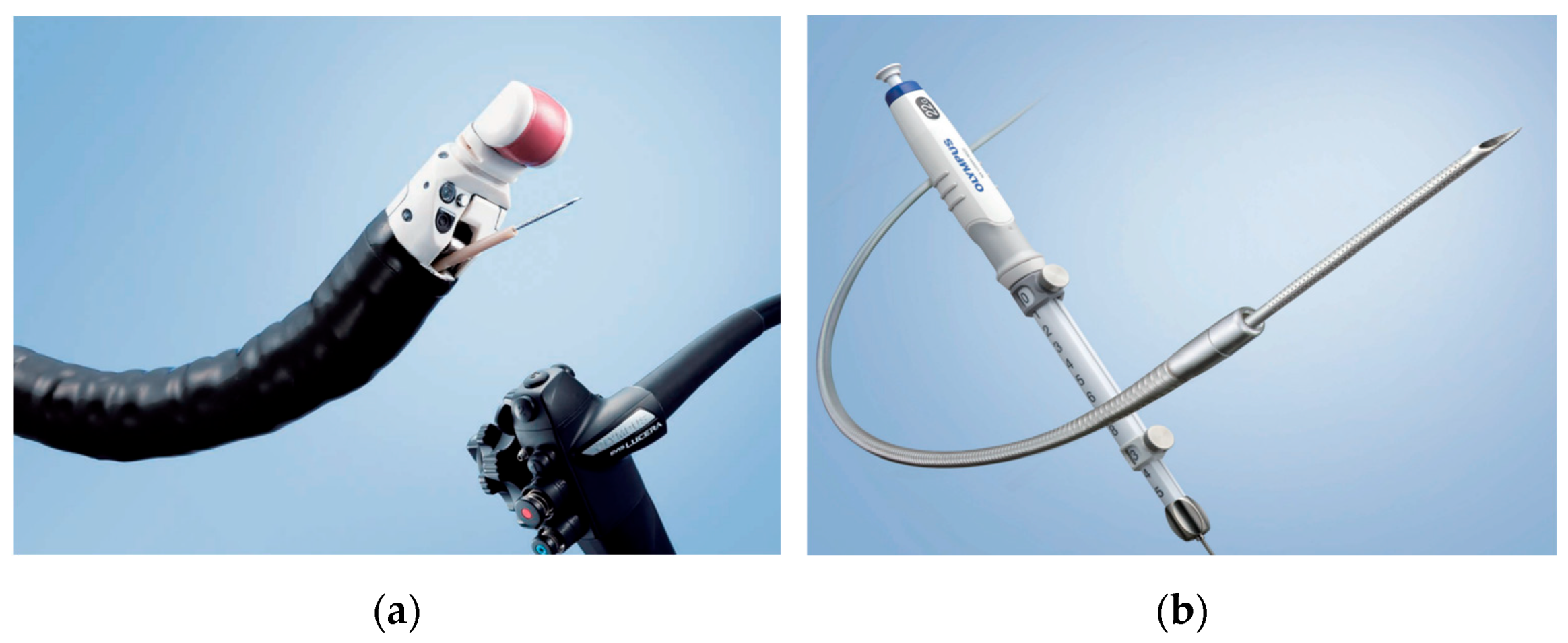
- Passage through the pig’s pharynx (piriform recess) was anatomically challenging for the EUS scope (UCT-260). Therefore, a standard upper endoscope was used to advance and place an overtube (TOP, Tokyo, Japan) into the esophagus, and the EUS scope was then inserted through the positioned overtube (Figure 1).
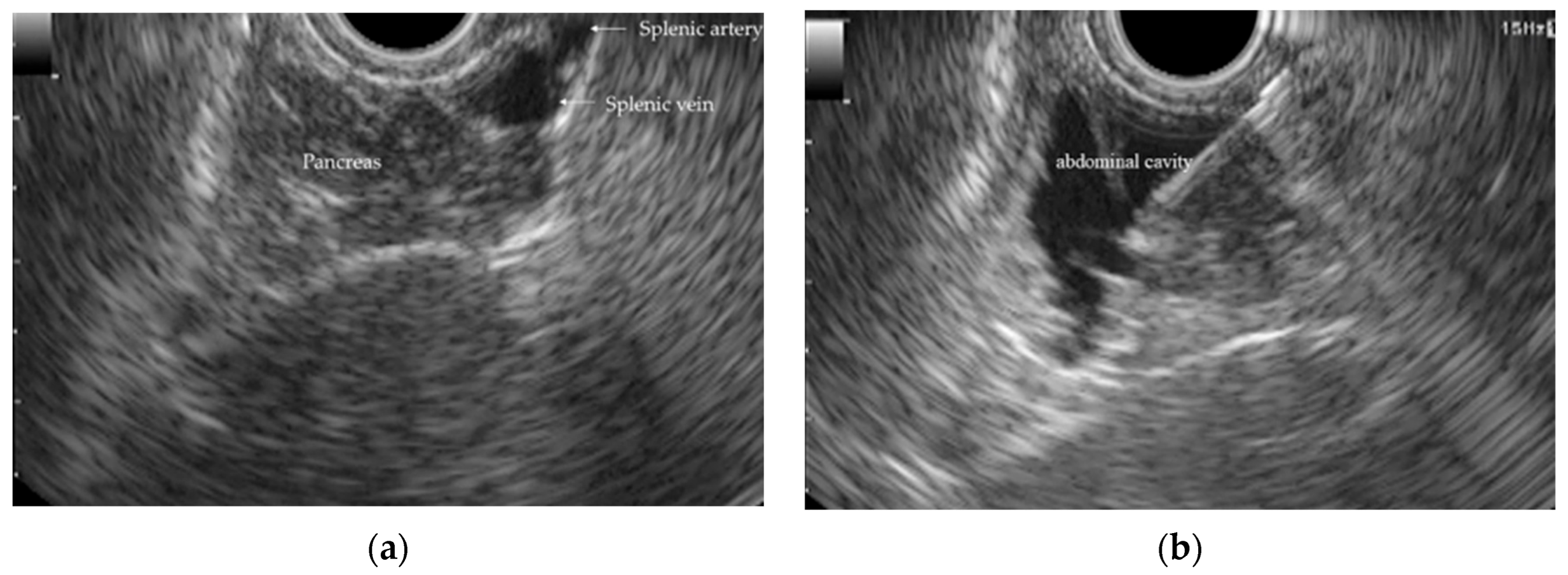
- After inserting the endoscope into the stomach, the pancreas was first visualized in the ultrasound mode. Although the porcine pancreas is thinner and more technically difficult to visualize compared with that of humans, placing the probe against the posterior gastric wall allowed for the identification of the aorta and the celiac artery, as well as the splenic artery and splenic vein. Because, as in humans, the porcine pancreas lies along the course of the splenic artery and vein, these vessels served as useful landmarks for its visualization. The omental bursa is located between the stomach and the pancreas (Figure 2).
- The abdominal cavity of the porcine model was punctured from the stomach wall with a 19G FNA needle (EZShot3 Plus, Olympus Medical Systems, Tokyo, Japan) attached to a syringe filled with normal saline solution to insert An Olympus EUS endoscope (GF-UCT260 with ultrasound processor EU-ME 2, Olympus Medical Systems, Tokyo, Japan) (Figure 1). Fluoroscopic guidance was not used during the procedures.
- Immediately after detecting the omental bursa located between the stomach and pancreas from the EUS image, under negative pressure, the normal saline solution in the syringe was drawn into the abdominal cavity (Figure 2a).
- Approximately 100 mL of normal saline solution was injected into the peritoneal cavity to insert the guide wire in the abdominal cavity (Figure 2b).
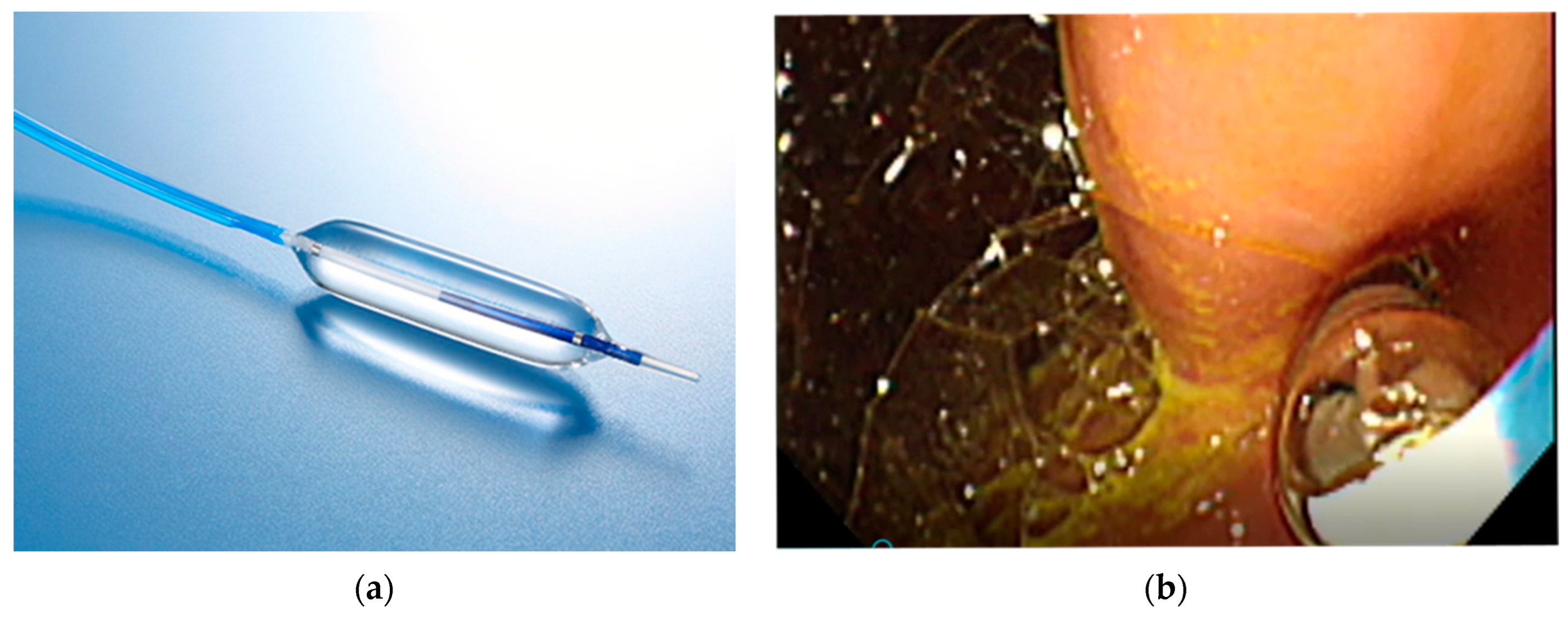
- Case 1–6: The FNA needle was removed and the puncture site was dilated using a 6 mm balloon catheter (REN biliary balloon catheter, KANEKA, Osaka, Japan) inserted through the guide wire (Figure 3a,b). Cases 7–10: Balloon dilation was not performed.
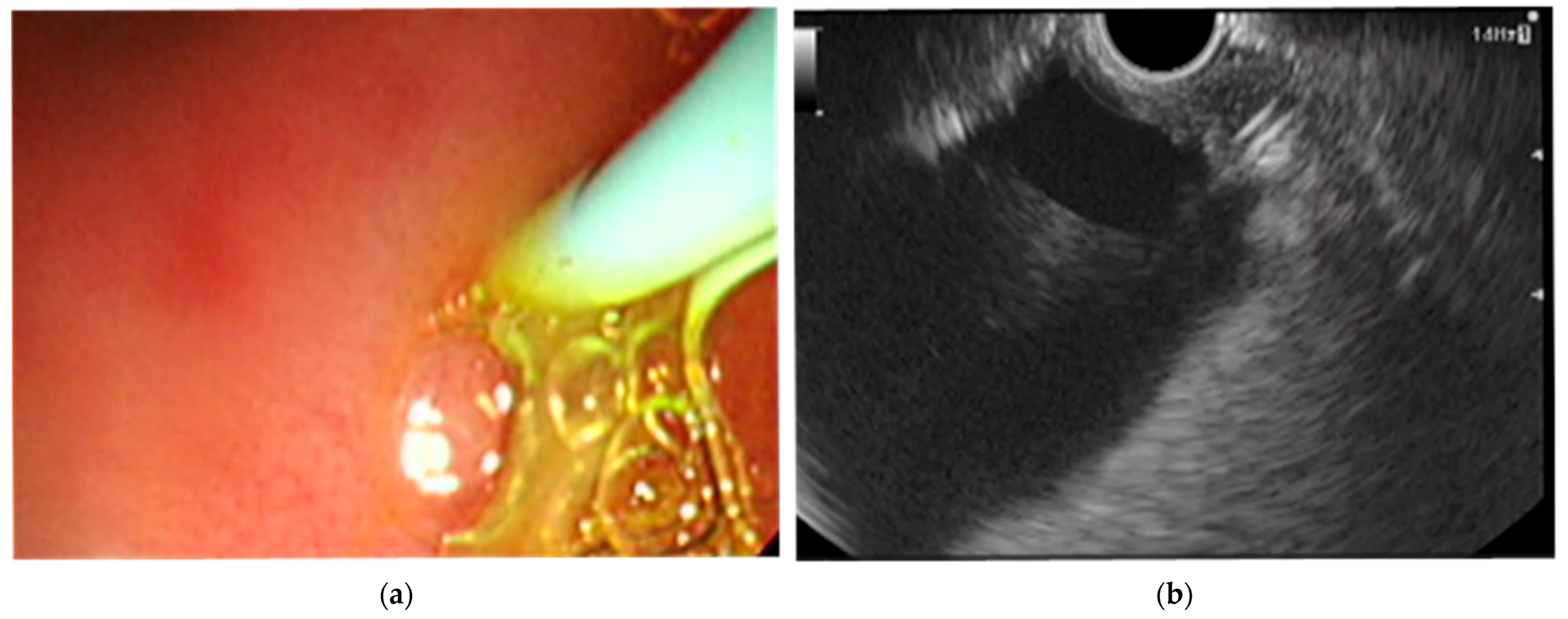
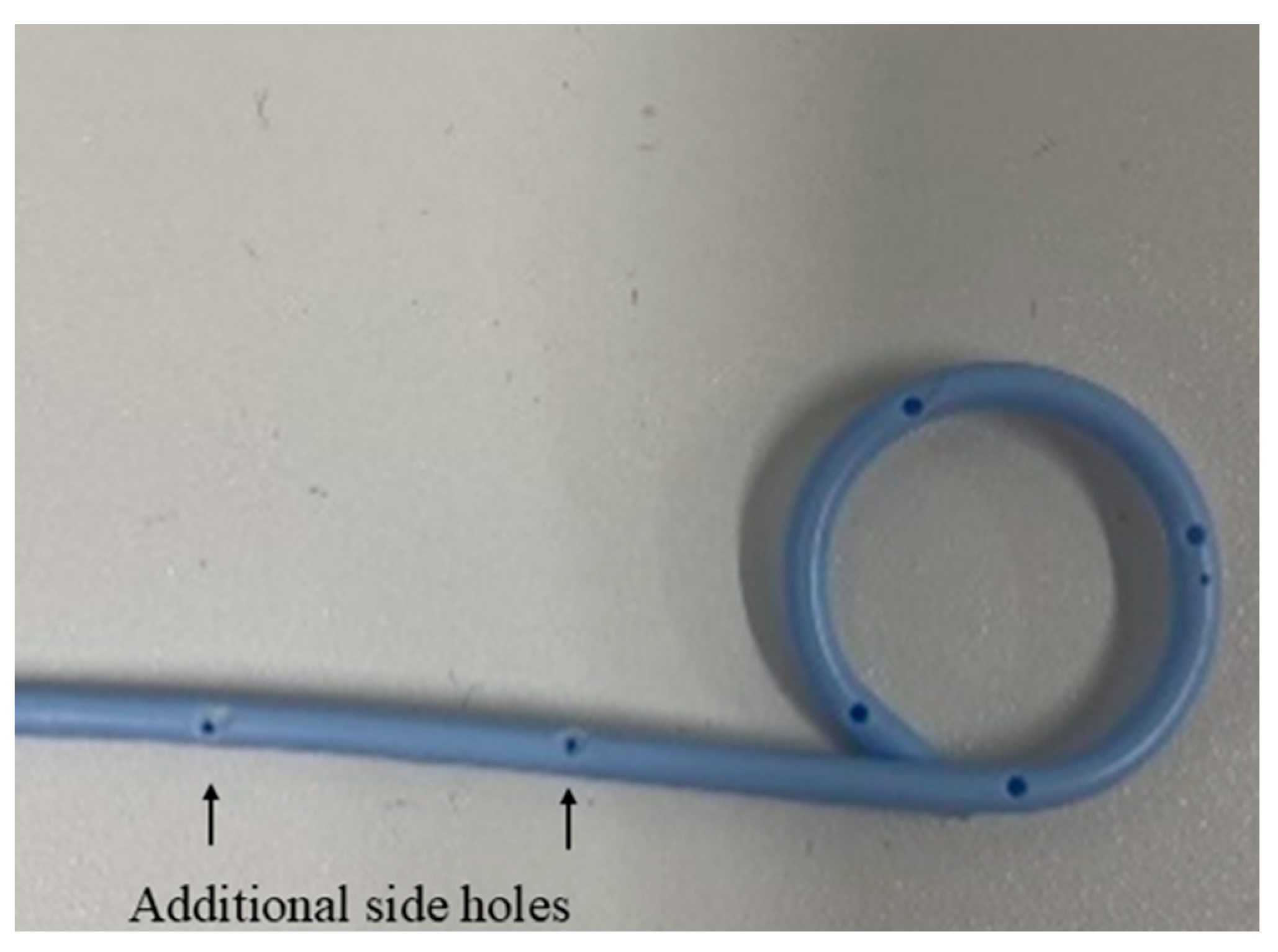
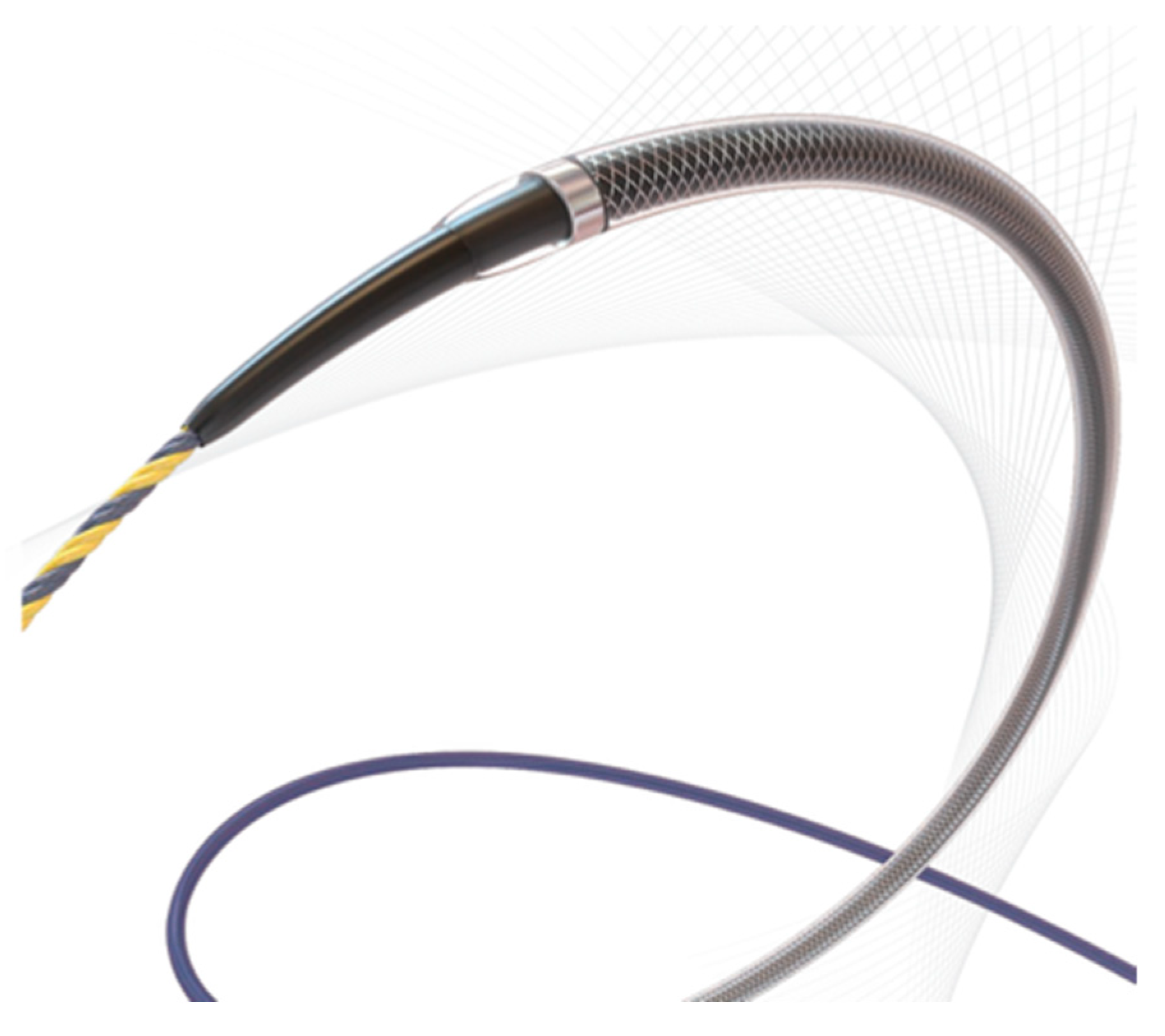
- In cases 1–6, a 6-Fr ENBD tube was advanced into the abdominal cavity (Figure 4a,b), followed by the instillation of approximately 800 mL of warm normal saline. The irrigation saline was recovered as much as possible and the volume recovered was measured. In cases 3-6, additional holes were created in the ENBD tube (Figure 5). In cases 7–10, an EndoSheather (PIOLAX, Yokohama, Japan) was inserted instead of the ENBD tube, and normal saline was injected and subsequently aspirated through it (Figure 6).
- After removal of the ENBD tube or EndoSheather, the puncture site in the stomach was closed using an endoscopic reopenable clip (SureClip; Micro-Tech, Nanjing, China).
- Water intake was initiated on the day of the procedure, and feeding was resumed the following day. All experimental pigs were monitored for any decrease in appetite and other signs of clinical deterioration.
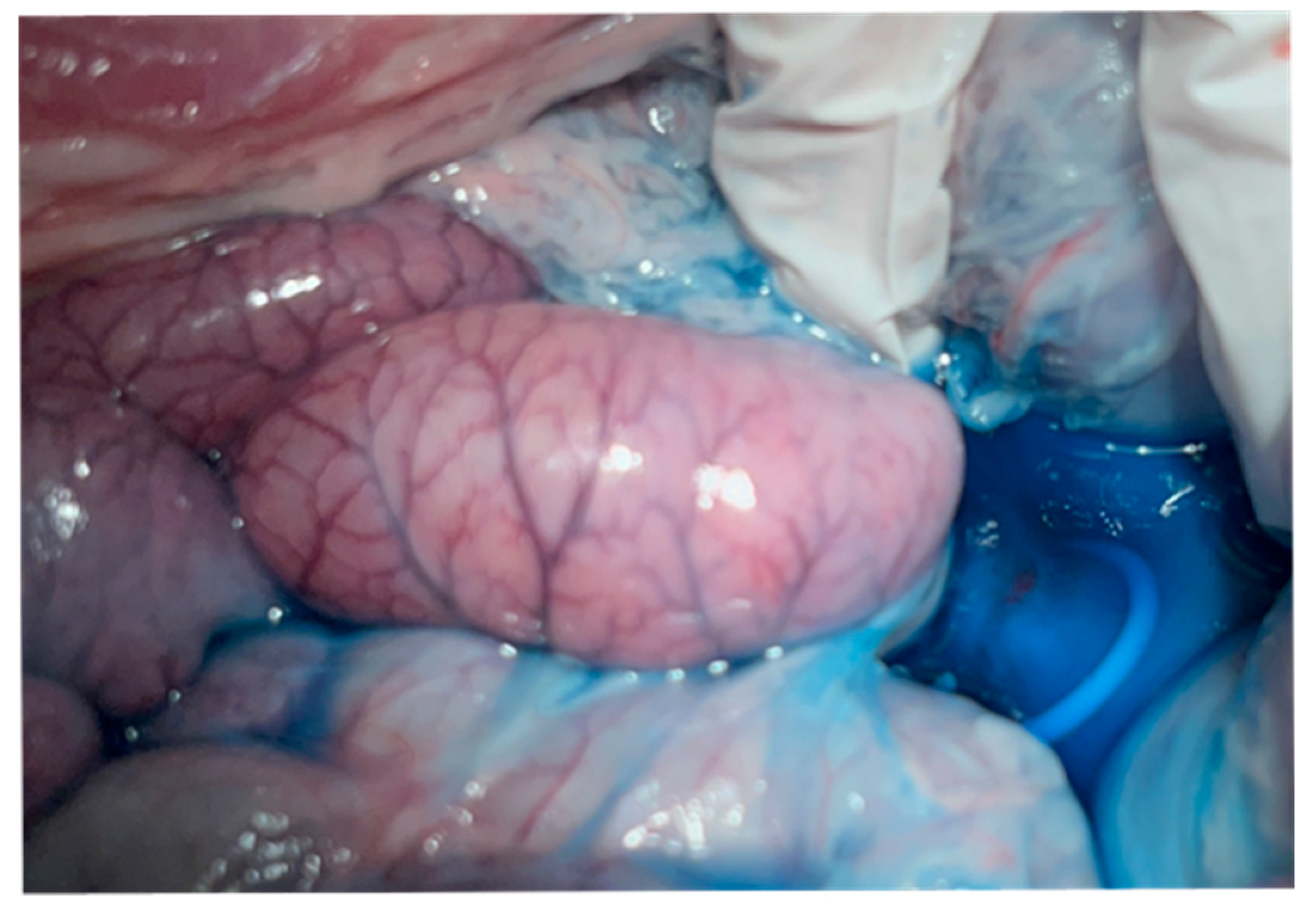
- Necropsy was performed one week following the procedure. The ENBD tube was inserted under the guidance of the clip in the stomach and its position within the abdominal cavity was checked to ensure that it was correctly placed. The accumulation of lavage water was reconfirmed using indigo carmine (Figure 7).
2.4. Study Endpoints
3. Results
4. Discussion
5. Conclusions
Author Contributions
Funding
Institutional Review Board Statement
Informed Consent Statement
Data Availability Statement
Acknowledgments
Conflicts of Interest
References
- Siegel, R.L.; Giaquinto, A.N.; Jemal, A. Cancer statistics, 2024. CA Cancer J. Clin. 2024, 74, 12–49. [Google Scholar] [CrossRef]
- McGuigan, A.; Kelly, P.; Turkington, R.C.; Jones, C.; Coleman, H.G.; McCain, R.S. Pancreatic cancer: A review of clinical diagnosis, epidemiology, treatment and outcomes. World J. Gastroenterol. 2018, 24, 4846–4861. [Google Scholar] [CrossRef]
- Kamisawa, T.; Wood, L.D.; Itoi, T.; Takaori, K. Pancreatic cancer. Lancet 2016, 388, 73–85. [Google Scholar] [CrossRef]
- Lee, E.S.; Lee, J.M. Imaging diagnosis of pancreatic cancer: A state-of-the-art review. World J. Gastroenterol. 2014, 20, 7864–7877. [Google Scholar] [CrossRef] [PubMed]
- Kanazawa, K.; Chiba, M.; Kato, M.; Kinoshita, Y.; Akasu, T.; Matsui, H.; Shimamoto, N.; Tomita, Y.; Abe, T.; Tsukinaga, S.; et al. Diagnostic Dilemma of Biliopancreatic Contrast-Enhanced Harmonic Endoscopic Ultrasonography. Diagnostics 2022, 12, 1983. [Google Scholar] [CrossRef] [PubMed]
- Elbanna, K.Y.; Jang, H.J.; Kim, T.K. Imaging diagnosis and staging of pancreatic ductal adenocarcinoma: A comprehensive review. Insights Imaging 2020, 11, 58. [Google Scholar] [CrossRef]
- Yoshida, T.; Yamashita, Y.; Kitano, M. Endoscopic Ultrasound for Early Diagnosis of Pancreatic Cancer. Diagnostics 2019, 9, 81. [Google Scholar] [CrossRef] [PubMed]
- Rahman, M.I.O.; Chan, B.P.H.; Far, P.M.; Mbuagbaw, L.; Thabane, L.; Yaghoobi, M. Endoscopic ultrasound versus computed tomography in determining the resectability of pancreatic cancer: A diagnostic test accuracy meta-analysis. Saudi J. Gastroenterol. 2020, 26, 113–119. [Google Scholar] [CrossRef]
- Ta, R.; O’Connor, D.B.; Sulistijo, A.; Chung, B.; Conlon, K.C. The Role of Staging Laparoscopy in Resectable and Borderline Resectable Pancreatic Cancer: A Systematic Review and Meta-Analysis. Dig. Surg. 2019, 36, 251–260. [Google Scholar] [CrossRef]
- Allen, V.B.; Gurusamy, K.S.; Takwoingi, Y.; Kalia, A.; Davidson, B.R. Diagnostic accuracy of laparoscopy following computed tomography (CT) scanning for assessing the resectability with curative intent in pancreatic and periampullary cancer. Cochrane Database Syst. Rev. 2016, 7, Cd009323. [Google Scholar] [CrossRef]
- Gudmundsdottir, H.; Yonkus, J.A.; Alva-Ruiz, R.; Kendrick, M.L.; Smoot, R.L.; Warner, S.G.; Starlinger, P.; Thiels, C.A.; Nagorney, D.M.; Cleary, S.P.; et al. Yield of Staging Laparoscopy for Pancreatic Cancer in the Modern Era: Analysis of More than 1,000 Consecutive Patients. J. Am. Coll. Surg. 2023, 237, 49–57. [Google Scholar] [CrossRef]
- Jambor, M.A.; Ashrafizadeh, A.; Nahm, C.B.; Clarke, S.J.; Pavlakis, N.; Kneebone, A.; Hruby, G.; Gill, A.J.; Mittal, A.; Samra, J.S. The role of staging laparoscopy in pancreatic adenocarcinoma and its effect on patients’ survival. World J. Surg. Oncol. 2022, 20, 337. [Google Scholar] [CrossRef] [PubMed]
- Takadate, T.; Morikawa, T.; Ishida, M.; Aoki, S.; Hata, T.; Iseki, M.; Miura, T.; Ariake, K.; Maeda, S.; Kawaguchi, K.; et al. Staging laparoscopy is mandatory for the treatment of pancreatic cancer to avoid missing radiologically negative metastases. Surg. Today 2021, 51, 686–694. [Google Scholar] [CrossRef]
- Shindo, Y.; Tokumitsu, Y.; Matsui, H.; Nakajima, M.; Kimura, Y.; Iida, M.; Suzuki, N.; Takeda, S.; Ioka, T.; Nagano, H. Efficacy of Staging Laparoscopy in Patients With Pancreatic Cancer: A Single Center Prospective Cohort Study. In Vivo 2023, 37, 2704–2709. [Google Scholar] [CrossRef]
- Pak, L.M.; Coit, D.G.; Eaton, A.A.; Allen, P.J.; D’Angelica, M.I.; DeMatteo, R.P.; Jarnagin, W.R.; Strong, V.E.; Kingham, T.P. Percutaneous Peritoneal Lavage for the Rapid Staging of Gastric and Pancreatic Cancer. Ann. Surg. Oncol. 2017, 24, 1174–1179. [Google Scholar] [CrossRef]
- Chen, G.; Liu, S.; Zhao, Y.; Dai, M.; Zhang, T. Diagnostic accuracy of endoscopic ultrasound-guided fine-needle aspiration for pancreatic cancer: A meta-analysis. Pancreatology 2013, 13, 298–304. [Google Scholar] [CrossRef]
- Ishii, Y.; Serikawa, M.; Tsuboi, T.; Kawamura, R.; Tsushima, K.; Nakamura, S.; Hirano, T.; Fukiage, A.; Mori, T.; Ikemoto, J.; et al. Role of Endoscopic Ultrasonography and Endoscopic Retrograde Cholangiopancreatography in the Diagnosis of Pancreatic Cancer. Diagnostics 2021, 11, 238. [Google Scholar] [CrossRef]
- Sato, K.; Shigekawa, M.; Yamamoto, S.; Matsumae, T.; Sato, Y.; Yoshioka, T.; Kodama, T.; Hikita, H.; Tatsumi, T.; Takehara, T. Utility and clinical significance of endoscopic ultrasound-guided tissue acquisition for diagnosing lymphadenopathies in biliary tract cancer. Sci. Rep. 2025, 15, 3363. [Google Scholar] [CrossRef]
- De Moura, D.T.H.; Moura, E.G.H.; Bernardo, W.M.; De Moura, E.T.H.; Baraca, F.I.; Kondo, A.; Matuguma, S.E.; Almeida Artifon, E.L. Endoscopic retrograde cholangiopancreatography versus endoscopic ultrasound for tissue diagnosis of malignant biliary stricture: Systematic review and meta-analysis. Endosc. Ultrasound 2018, 7, 10–19. [Google Scholar] [CrossRef] [PubMed]
- Vilmann, P.; Jacobsen, G.K.; Henriksen, F.W.; Hancke, S. Endoscopic ultrasonography with guided fine needle aspiration biopsy in pancreatic disease. Gastrointest. Endosc. 1992, 38, 172–173. [Google Scholar] [CrossRef] [PubMed]
- Pouw, R.E.; Barret, M.; Biermann, K.; Bisschops, R.; Czakó, L.; Gecse, K.B.; de Hertogh, G.; Hucl, T.; Iacucci, M.; Jansen, M.; et al. Endoscopic tissue sampling—Part 1: Upper gastrointestinal and hepatopancreatobiliary tracts. European Society of Gastrointestinal Endoscopy (ESGE) Guideline. Endoscopy 2021, 53, 1174–1188. [Google Scholar] [CrossRef]
- Grimm, H.; Binmoeller, K.F.; Soehendra, N. Endosonography-guided drainage of a pancreatic pseudocyst. Gastrointest. Endosc. 1992, 38, 170–171. [Google Scholar] [CrossRef]
- Giovannini, M.; Moutardier, V.; Pesenti, C.; Bories, E.; Lelong, B.; Delpero, J.R. Endoscopic ultrasound-guided bilioduodenal anastomosis: A new technique for biliary drainage. Endoscopy 2001, 33, 898–900. [Google Scholar] [CrossRef]
- Kwan, V.; Eisendrath, P.; Antaki, F.; Le Moine, O.; Devière, J. EUS-guided cholecystenterostomy: A new technique (with videos). Gastrointest. Endosc. 2007, 66, 582–586. [Google Scholar] [CrossRef]
- DeWitt, J.; LeBlanc, J.; McHenry, L.; McGreevy, K.; Sherman, S. Endoscopic ultrasound-guided fine-needle aspiration of ascites. Clin. Gastroenterol. Hepatol. 2007, 5, 609–615. [Google Scholar] [CrossRef]
- Kaushik, N.; Khalid, A.; Brody, D.; McGrath, K. EUS-guided paracentesis for the diagnosis of malignant ascites. Gastrointest. Endosc. 2006, 64, 908–913. [Google Scholar] [CrossRef]
- Nguyen, P.T.; Chang, K.J. EUS in the detection of ascites and EUS-guided paracentesis. Gastrointest. Endosc. 2001, 54, 336–339. [Google Scholar] [CrossRef] [PubMed]
- Suzuki, R.; Irisawa, A.; Bhutani, M.S.; Hikichi, T.; Takagi, T.; Shibukawa, G.; Sato, A.; Sato, M.; Ikeda, T.; Watanabe, K.; et al. An automated spring-loaded needle for endoscopic ultrasound-guided abdominal paracentesis in cancer patients. World J. Gastrointest. Endosc. 2014, 6, 55–59. [Google Scholar] [CrossRef]
- Gordts, S.; Puttemans, P.; Gordts, S.; Brosens, I.; Campo, R. Transvaginal laparoscopy. Best. Pract. Res. Clin. Obstet. Gynaecol. 2005, 19, 757–767. [Google Scholar] [CrossRef] [PubMed]
- Brugel, M.; Bouché, O.; Kianmanesh, R.; Teuma, L.; Tashkandi, A.; Regimbeau, J.M.; Pessaux, P.; Royer, B.; Rhaiem, R.; Perrenot, C.; et al. Time from first seen in specialist care to surgery does not influence survival outcome in patients with upfront resected pancreatic adenocarcinoma. BMC Surg. 2021, 21, 413. [Google Scholar] [CrossRef] [PubMed]
- Facciorusso, A.; Di Maso, M.; Serviddio, G.; Larghi, A.; Costamagna, G.; Muscatiello, N. Echoedoscopic ethanol ablation of tumor combined with celiac plexus neurolysis in patients with pancreatic adenocarcinoma. J. Gastroenterol. Hepatol. 2017, 32, 439–445. [Google Scholar] [CrossRef] [PubMed]
- Liu, D.S.; Allan, Z.; Tie, J.; Hall, K.; Lee, M.M.; Wong, D.J.; Wong, S.Q.; Tebbutt, N.C.; Watson, D.I.; Trochsler, M.; et al. Multi-omics evaluation of peritoneal fluid in gastroesophageal cancer (OMEGCA): Protocol for a prospective multicentre cohort study to detect occult peritoneal metastases in patients undergoing curative-intent treatment. PLoS ONE 2025, 20, e0318615. [Google Scholar] [CrossRef] [PubMed]
- Tokuhisa, M.; Ichikawa, Y.; Kosaka, N.; Ochiya, T.; Yashiro, M.; Hirakawa, K.; Kosaka, T.; Makino, H.; Akiyama, H.; Kunisaki, C.; et al. Exosomal miRNAs from Peritoneum Lavage Fluid as Potential Prognostic Biomarkers of Peritoneal Metastasis in Gastric Cancer. PLoS ONE 2015, 10, e0130472. [Google Scholar] [CrossRef]
- Yokoi, A.; Yoshida, K.; Koga, H.; Kitagawa, M.; Nagao, Y.; Iida, M.; Kawaguchi, S.; Zhang, M.; Nakayama, J.; Yamamoto, Y.; et al. Spatial exosome analysis using cellulose nanofiber sheets reveals the location heterogeneity of extracellular vesicles. Nat. Commun. 2023, 14, 6915. [Google Scholar] [CrossRef] [PubMed]



| Case 1 | Case 2 | Case 3 | Case 4 | Case 5 | Case 6 | Case 7 | Case 8 | Case 9 | Case 10 | |
|---|---|---|---|---|---|---|---|---|---|---|
| Body weight (kg) | 43 | 45 | 42 | 40.4 | 40.5 | 37.1 | 39.8 | 39.7 | 36.4 | 38.4 |
| Procedure success | yes | yes | yes | yes | yes | yes | yes | yes | yes | yes |
| Intraoperative complications | None | Yes * | None | None | None | None | None | None | None | None |
| Postoperative Complications | None | None | None | None | None | None | None | None | None | None |
| Procedure time (minutes) | 48 | 55 | 25 | 25 | 40 | 45 | 16 | 15 | 23 | 19 |
| Infusion time (minutes) | 25 | 33 | 15 | 5 | 8 | 10 | 5 | 4 | 8 | 7 |
| Injection volume (mL) | 800 | 800 | 800 | 800 | 800 | 800 | 800 | 800 | 800 | 800 |
| Amount of recovery (mL) | 8 | 10 | 170 | 64 | 13.5 | 8 | 185 | 110 | 50 | 45 |
| G1 | G2 | G3 | p-Value | Significant Pairwise Differences (Holm-Adjusted) | |
|---|---|---|---|---|---|
| Body weight (kg) | 44.0 (43.5–44.5) | 40.5 (39.0–41.0) | 39.1 (37.5–39.6) | 0.094 | none |
| Procedure time (min) | 51.5 (49.8–53.3) | 32.5 (25.0–42.5) | 17.5 (15.5–21.0) | 0.018 | G1 > G2, G1 > G3 |
| Infusion time (min) | 29.0 (27.0–31.0) | 9.0 (6.5–11.3) | 6.5 (5.0–7.5) | 0.022 | G1 > G2, G1 > G3 |
| Amount of recovery (mL) | 9.0 (8.5–9.5) | 13.8 (10.8–92.3) | 77.5 (47.5–122.5) | 0.031 | G1 < G2, G1 < G3 (G2 vs. G3: n.s.) |
Disclaimer/Publisher’s Note: The statements, opinions and data contained in all publications are solely those of the individual author(s) and contributor(s) and not of MDPI and/or the editor(s). MDPI and/or the editor(s) disclaim responsibility for any injury to people or property resulting from any ideas, methods, instructions or products referred to in the content. |
© 2026 by the authors. Licensee MDPI, Basel, Switzerland. This article is an open access article distributed under the terms and conditions of the Creative Commons Attribution (CC BY) license.
Share and Cite
Abe, T.; Kato, M.; Shimamoto, N.; Komori, T.; Matsumoto, N.; Akasu, T.; Chiba, M.; Nakano, M.; Isshi, K.; Torisu, Y.; et al. Endoscopic Ultrasound-Lavage Technique for Pancreatic Cancer: An In Vivo Pilot Study. Diagnostics 2026, 16, 230. https://doi.org/10.3390/diagnostics16020230
Abe T, Kato M, Shimamoto N, Komori T, Matsumoto N, Akasu T, Chiba M, Nakano M, Isshi K, Torisu Y, et al. Endoscopic Ultrasound-Lavage Technique for Pancreatic Cancer: An In Vivo Pilot Study. Diagnostics. 2026; 16(2):230. https://doi.org/10.3390/diagnostics16020230
Chicago/Turabian StyleAbe, Takahiro, Masayuki Kato, Nana Shimamoto, Tomotaro Komori, Naoki Matsumoto, Takafumi Akasu, Masafumi Chiba, Masanori Nakano, Kimio Isshi, Yuichi Torisu, and et al. 2026. "Endoscopic Ultrasound-Lavage Technique for Pancreatic Cancer: An In Vivo Pilot Study" Diagnostics 16, no. 2: 230. https://doi.org/10.3390/diagnostics16020230
APA StyleAbe, T., Kato, M., Shimamoto, N., Komori, T., Matsumoto, N., Akasu, T., Chiba, M., Nakano, M., Isshi, K., Torisu, Y., & Sumiyama, K. (2026). Endoscopic Ultrasound-Lavage Technique for Pancreatic Cancer: An In Vivo Pilot Study. Diagnostics, 16(2), 230. https://doi.org/10.3390/diagnostics16020230