
Unifying Serum Creatinine and Urine Output in a Single On-Time AKI Severity Criterion: Is It All About the Rate of Creatinine Being Excreted by the Kidneys?


Abstract
1. Introduction
2. Considerations About sCr and UO as Renal Function Surrogates
2.1. Are Both Increased sCr and Decreased UO Only Markers of Impaired Creatinine Excretion?
2.2. Can Urine Creatinine Concentration Stratify Oliguria-Related Prognosis in Critically Ill Patients?
2.3. Urine Creatinine Concentration: A Key Element in the Evaluation of Oliguria and the Subsequent Behavior of sCr
- (1)
- The independent prognostic relevance of oliguria is directly and solely related to decreases in CrUexc.Decreases in CrUexc due to reduced UO but not affecting sCr raise two possibilities:
- (1.1)
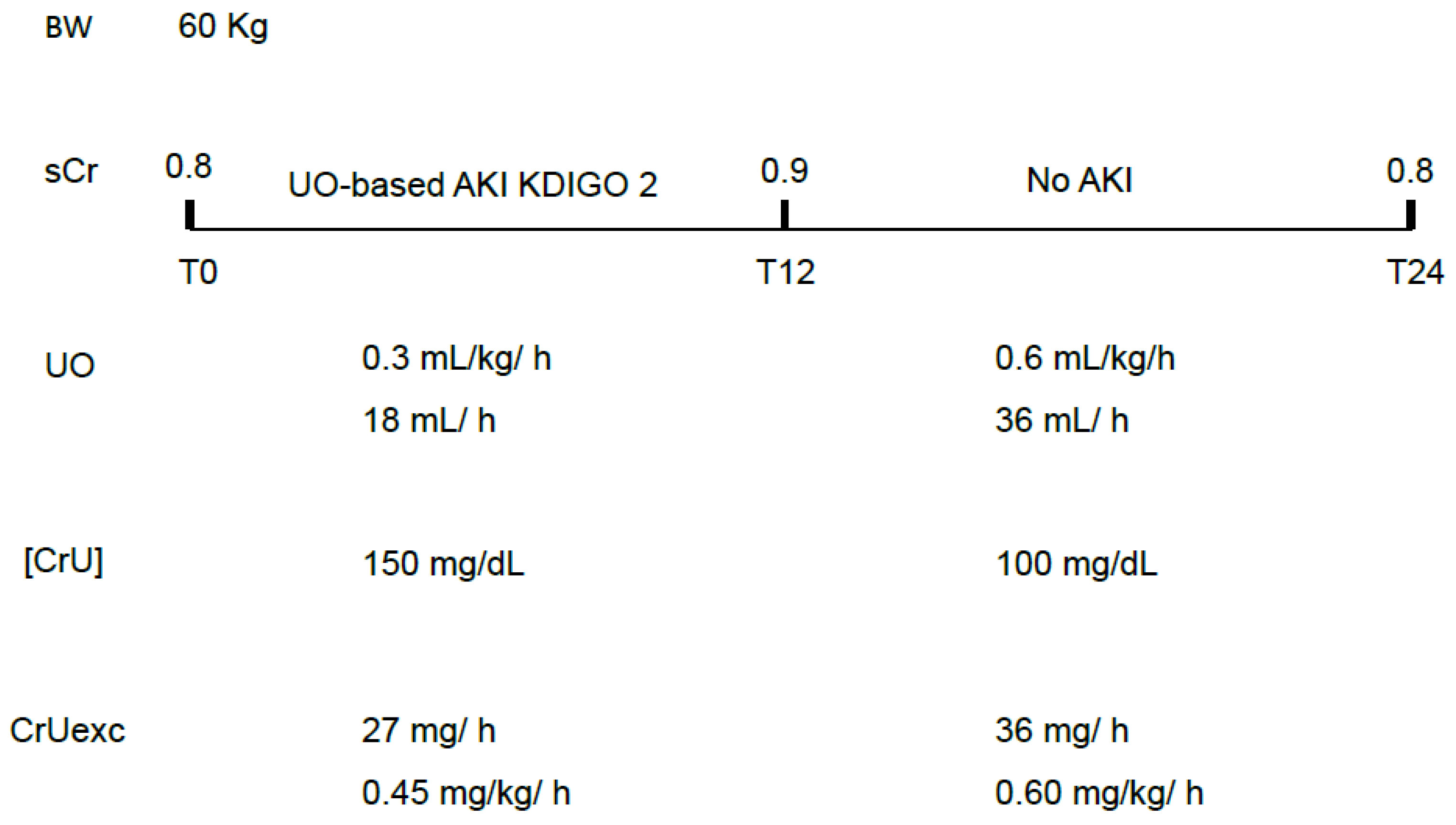
- Oliguria may be transient, compromising CrUexc and leading to UO-based AKI diagnosis but not being severe and long enough to allow sCr to increase 0.3 mg/dL in 2 days or 50% in 7 days (transient and short-lasting decreases in CrUexc). In this case, the magnitude and/or duration of the CrUexc decrease are expected to be lower than that which leads to a rise in sCr (Figure 1).
- (1.2)
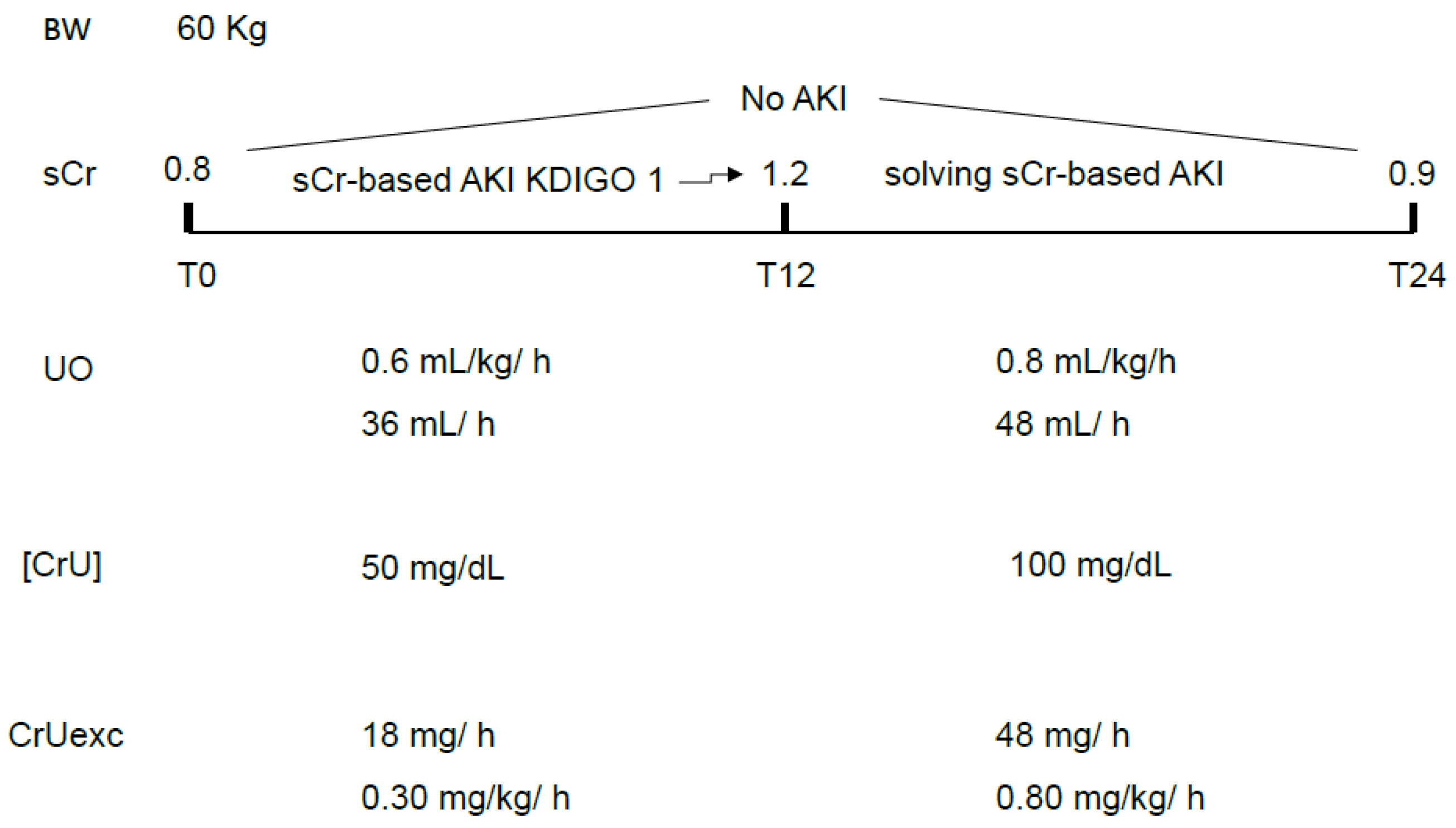
- UO-based criteria are measured in hours, and sCr-based criteria are measured in days. Depending on the duration of the observation period and severity of CrUexc decrement, it is possible that the observation period was not long enough to diagnose significant increases in sCr compatible with AKI (long-lasting decreased CrUexc but short observation period). Conversely, having most of the intensivists the practice of measuring sCr only once a day also leads to undiagnosed, very transient sCr-based AKI [18], which is characterized by increases and subsequent decreases in sCr greater than 0.3 mg/dL over 24 h (Figure 2). This situation is particularly common postoperatively, with an abrupt decrease in CrUexc (whether with or without simultaneous oliguria) being of sufficient magnitude to significantly increase sCr (rapid body creatinine accumulation) but lasting only a few hours.
- (2)
- The independent prognostic relevance of oliguria is not only related to decreases in CrUexc.If this is the case, the prognostic role of oliguria must be divided in
- (2.1)
- with simultaneous decrement in CrUexc
- (2.2)
- with no simultaneous decrement in CrUexc
2.4. Can the Estimated (or Measured) Creatinine Clearance Solve This Prognostic Issue by Combining UO and sCr?
2.5. Excreted Mass of Creatinine per Hour: An Alternative to Evaluate Changes in GFR Without the Need of sCr Assessment?
3. Relevant Limitations of the Excreted Mass of Creatinine as a Renal Function Marker
4. Conclusions
Funding
Institutional Review Board Statement
Informed Consent Statement
Data Availability Statement
Conflicts of Interest
References
- Pickkers, P.; Darmon, M.; Hoste, E.; Joannidis, M.; Legrand, M.; Ostermann, M.; Prowle, J.R.; Schneider, A.; Schetz, M. Acute kidney injury in the critically ill: An updated review on pathophysiology and management. Intensive Care Med. 2021, 47, 835–850. [Google Scholar] [CrossRef] [PubMed]
- Kellum, J.A.; Lameire, N.; Aspelin, P.; Barsoum, R.S.; Burdmann, E.A.; Goldstein, S.L.; Herzog, C.A.; Joannidis, M.; Kribben, A.; Levey, A.S.; et al. Kidney disease: Improving global outcomes (KDIGO) acute kidney injury work group. KDIGO clinical practice guideline for acute kidney injury. Kidney Int. Suppl. 2012, 2, 2. [Google Scholar]
- Mehta, R.L.; Kellum, J.A.; Shah, S.V.; Molitoris, B.A.; Ronco, C.; Warnock, D.G.; Levin, A. Acute Kidney Injury Network. Acute Kidney Injury Network: Report of an initiative to improve outcomes in acute kidney injury. Crit. Care 2007, 11, R31. [Google Scholar] [CrossRef] [PubMed]
- Venkataraman, R.; Kellum, J.A. Defining acute renal failure: The RIFLE criteria. J. Intensive Care Med. 2007, 22, 187–193. [Google Scholar] [CrossRef]
- Ostermann, M.; Legrand, M.; Meersch, M.; Srisawat, N.; Zarbock, A.; Kellum, J.A. Biomarkers in acute kidney injury. Ann. Intensive Care 2024, 14, 145. [Google Scholar] [CrossRef]
- Wen, Y.; Parikh, C.R. Current concepts and advances in biomarkers of acute kidney injury. Crit. Rev. Clin. Lab. Sci. 2021, 58, 354–368. [Google Scholar] [CrossRef]
- Quan, S.; Pannu, N.; Wilson, T.; Ball, C.; Tan, Z.; Tonelli, M.; Hemmelgarn, B.R.; Dixon, E.; James, M.T. Prognostic implications of adding urine output to serum creatinine measurements for staging of acute kidney injury after major surgery: A cohort study. Nephrol. Dial. Transplant. 2016, 31, 2049–2056. [Google Scholar] [CrossRef]
- Wu, L.; Li, Y.; Zhang, X.; Chen, X.; Li, D.; Nie, S.; Li, X.; Bellou, A. Prediction differences and implications of acute kidney injury with and without urine output criteria in adult critically ill patients. Nephrol. Dial. Transplant. 2023, 38, 2368–2378. [Google Scholar] [CrossRef]
- Machado, G.D.; Santos, L.L.; Libório, A.B. Redefining urine output thresholds for acute kidney injury criteria in critically Ill patients: A derivation and validation study. Crit. Care 2024, 28, 272. [Google Scholar] [CrossRef]
- Mizota, T.; Yamamoto, Y.; Hamada, M.; Matsukawa, S.; Shimizu, S.; Kai, S. Intraoperative oliguria predicts acute kidney injury after major abdominal surgery. Br. J. Anaesth. 2017, 119, 1127–1134. [Google Scholar] [CrossRef]
- Maciel, A.T. Back to Basics: Is There a Good Reason to Not Systematically Measure Urine Creatinine in Acute Kidney Injury Monitoring? Nephron 2016, 133, 111–115. [Google Scholar] [CrossRef] [PubMed]
- Maciel, A.T. Giving urine biochemistry a second chance in acute kidney injury monitoring. World J. Crit. Care Med. 2025, 14, 109194. [Google Scholar] [CrossRef] [PubMed]
- Malbrain, M.L.N.G.; Tantakoun, K.; Zara, A.T.; Ferko, N.C.; Kelly, T.; Dabrowski, W. Urine output is an early and strong predictor of acute kidney injury and associated mortality: A systematic literature review of 50 clinical studies. Ann. Intensive Care 2024, 14, 110. [Google Scholar] [CrossRef] [PubMed]
- Macedo, E. Urine output assessment as a clinical quality measure. Nephron 2016, 131, 252–254. [Google Scholar] [CrossRef]
- Vaara, S.T.; Parviainen, I.; Pettilä, V.; Nisula, S.; Inkinen, O.; Uusaro, A.; Laru-Sompa, R.; Pulkkinen, A.; Saarelainen, M.; Reilama, M.; et al. Association of oliguria with the development of acute kidney injury in the critically ill. Kidney Int. 2016, 89, 200–208. [Google Scholar] [CrossRef]
- Bianchi, N.A.; Stavart, L.L.; Altarelli, M.; Kelevina, T.; Faouzi, M.; Schneider, A.G. Association of Oliguria with Acute Kidney Injury Diagnosis, Severity Assessment, and Mortality among Patients with Critical Illness. JAMA Netw. Open 2021, 4, e2133094. [Google Scholar] [CrossRef]
- Macedo, E.; Malhotra, R.; Bouchard, J.; Wynn, S.K.; Mehta, R.L. Oliguria is an early predictor of higher mortality in critically ill patients. Kidney Int. 2011, 80, 760–767. [Google Scholar] [CrossRef]
- Maciel, A.T.; Nassar, A.P.; Vitorio, D. Very Transient Cases of Acute Kidney Injury in the Early Postoperative Period after Cardiac Surgery: The Relevance of More Frequent Serum Creatinine Assessment and Concomitant Urinary Biochemistry Evaluation. J. Cardiothorac. Vasc. Anesth. 2016, 30, 56–63. [Google Scholar] [CrossRef]
- Levey, A.S.; Bosch, J.P.; Lewis, J.B.; Greene, T.; Rogers, N.; Roth, D. A more accurate method to estimate glomerular filtration rate from serum creatinine: A new prediction equation. Modification of Diet in Renal Disease Study Group. Ann. Intern. Med. 1999, 130, 461–470. [Google Scholar] [CrossRef]
- Hessels, L.; Koopmans, N.; Gomes Neto, A.W.; Volbeda, M.; Koeze, J.; Lansink-Hartgring, A.O.; Bakker, S.J.; Straaten, H.M.O.-V.; Nijsten, M.W. Urinary creatinine excretion is related to short-term and long-term mortality in critically ill patients. Intensive Care Med. 2018, 44, 1699–1708. [Google Scholar] [CrossRef]
- Hsu, C.Y.; Wu, Y.L.; Cheng, C.Y.; Lee, J.D.; Huang, Y.C.; Lee, M.H.; Wu, C.Y.; Hsu, H.L.; Lin, Y.H.; Huang, Y.C.; et al. Low Baseline Urine Creatinine Excretion Rate Predicts Poor Outcomes among Critically Ill Acute Stroke Patients. Curr. Neurovasc. Res. 2015, 12, 47–52. [Google Scholar] [CrossRef]
- Fazzini, B.; Märkl, T.; Costas, C.; Blobner, M.; Schaller, S.J.; Prowle, J.; Puthucheary, Z.; Wackerhage, H. The rate and assessment of muscle wasting during critical illness: A systematic review and meta-analysis. Crit. Care 2023, 27, 2. [Google Scholar] [CrossRef]
- Yamamoto, N.; Tojo, K.; Mihara, T.; Maeda, R.; Sugiura, Y.; Goto, T. Creatinine production rate is an integrative indicator to monitor muscle status in critically ill patients. Crit. Care 2025, 29, 23. [Google Scholar] [CrossRef]
- Maciel, A.T. Introducing the “urine biochemical approach”: An alternative tool for improving acute kidney injury monitoring in critically ill patients. Front. Nephrol. 2025, 5, 1525551. [Google Scholar] [CrossRef]


Disclaimer/Publisher’s Note: The statements, opinions and data contained in all publications are solely those of the individual author(s) and contributor(s) and not of MDPI and/or the editor(s). MDPI and/or the editor(s) disclaim responsibility for any injury to people or property resulting from any ideas, methods, instructions or products referred to in the content. |
© 2026 by the author. Licensee MDPI, Basel, Switzerland. This article is an open access article distributed under the terms and conditions of the Creative Commons Attribution (CC BY) license.
Share and Cite
Maciel, A.T. Unifying Serum Creatinine and Urine Output in a Single On-Time AKI Severity Criterion: Is It All About the Rate of Creatinine Being Excreted by the Kidneys? Diagnostics 2026, 16, 181. https://doi.org/10.3390/diagnostics16020181
Maciel AT. Unifying Serum Creatinine and Urine Output in a Single On-Time AKI Severity Criterion: Is It All About the Rate of Creatinine Being Excreted by the Kidneys? Diagnostics. 2026; 16(2):181. https://doi.org/10.3390/diagnostics16020181
Chicago/Turabian StyleMaciel, Alexandre Toledo. 2026. "Unifying Serum Creatinine and Urine Output in a Single On-Time AKI Severity Criterion: Is It All About the Rate of Creatinine Being Excreted by the Kidneys?" Diagnostics 16, no. 2: 181. https://doi.org/10.3390/diagnostics16020181
APA StyleMaciel, A. T. (2026). Unifying Serum Creatinine and Urine Output in a Single On-Time AKI Severity Criterion: Is It All About the Rate of Creatinine Being Excreted by the Kidneys? Diagnostics, 16(2), 181. https://doi.org/10.3390/diagnostics16020181