Correlations in Full-Body Postural Morphology: A Cross-Sectional Exploratory Pilot Study Using a Dual-Camera Structured Light System

 , ,
, ,  ,
,  ,
,  ,
,  ,
,
Abstract
1. Introduction
2. Materials and Methods
2.1. Study Design and Sample
2.2. Inclusion and Exclusion Criteria
- Positive history of traumatic events affecting the musculoskeletal system in the last 6 months.
- Current use of orthodontic appliances, bites, or other intra-oral devices.
- Use of hearing aids.
2.3. Instrumentation: Dual-Camera System
- Upper Camera: Positioned at 1365 mm from the ground, dedicated to acquiring the upper trunk and head.
- Lower Camera: Positioned at 600 mm from the ground, dedicated to acquiring the pelvis and lower limbs.
2.4. Landmark Identification and Biomechanical Parameters
- Advanced Cervical Spine Analysis: Calculation of the Cranio-Vertebral Angle (estimation of head protrusion), Lateral Head Tilt, and Head Rotation on the transverse plane.
- Lower Limb Analysis: Measurement of pelvic discrepancy and tilt, knee valgus/varus and flexion/extension angles (coronal and sagittal planes), and morphometric length of femur and tibia.
2.5. Acquisition Protocol
2.6. Statistical Analysis
3. Results
3.1. Descriptive Statistics
3.2. Correlation Analysis
3.2.1. Correlation Between Cervical Lordosis and Craniovertebral Angle
3.2.2. Global Correlation Matrix and Clinically Relevant Relationships
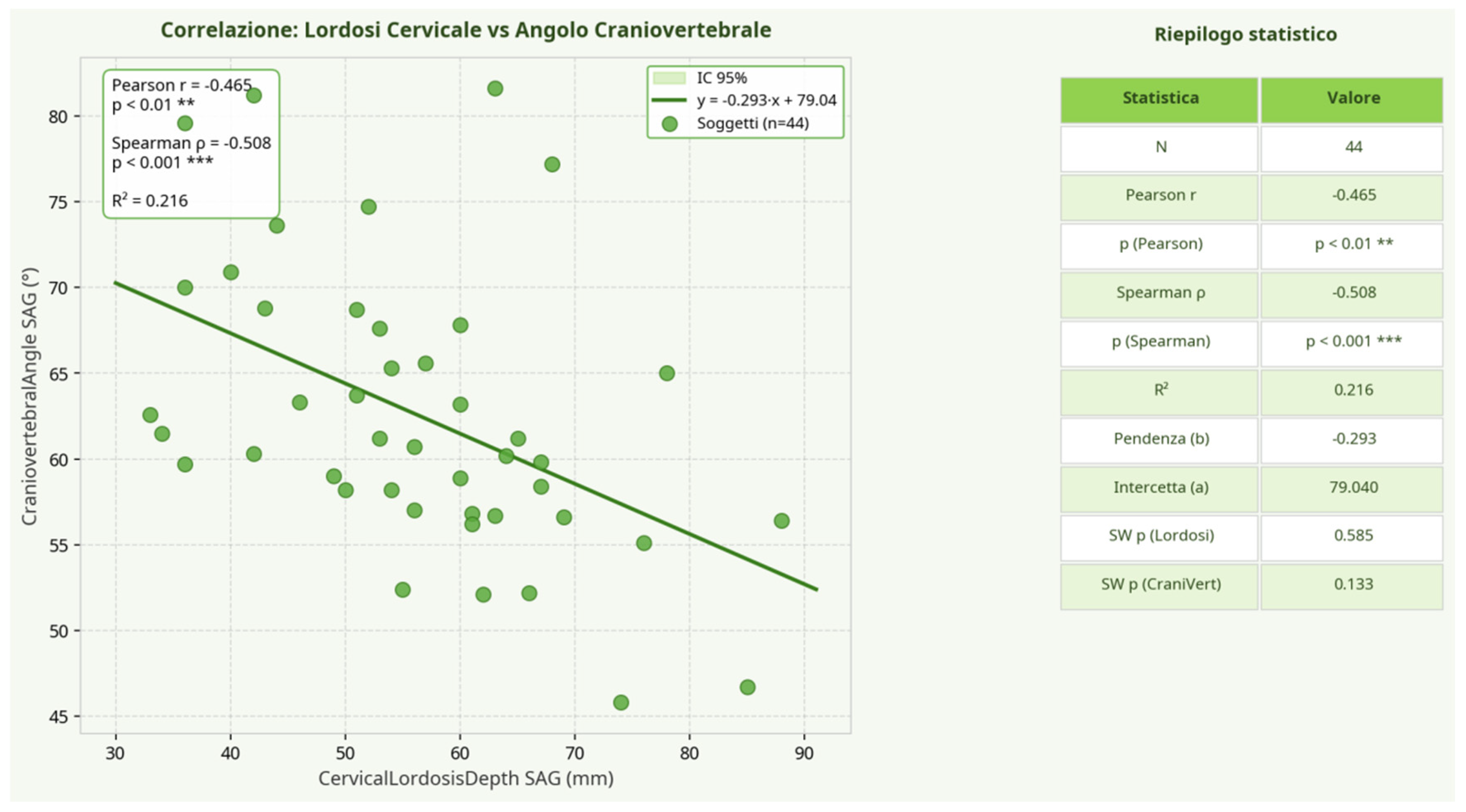
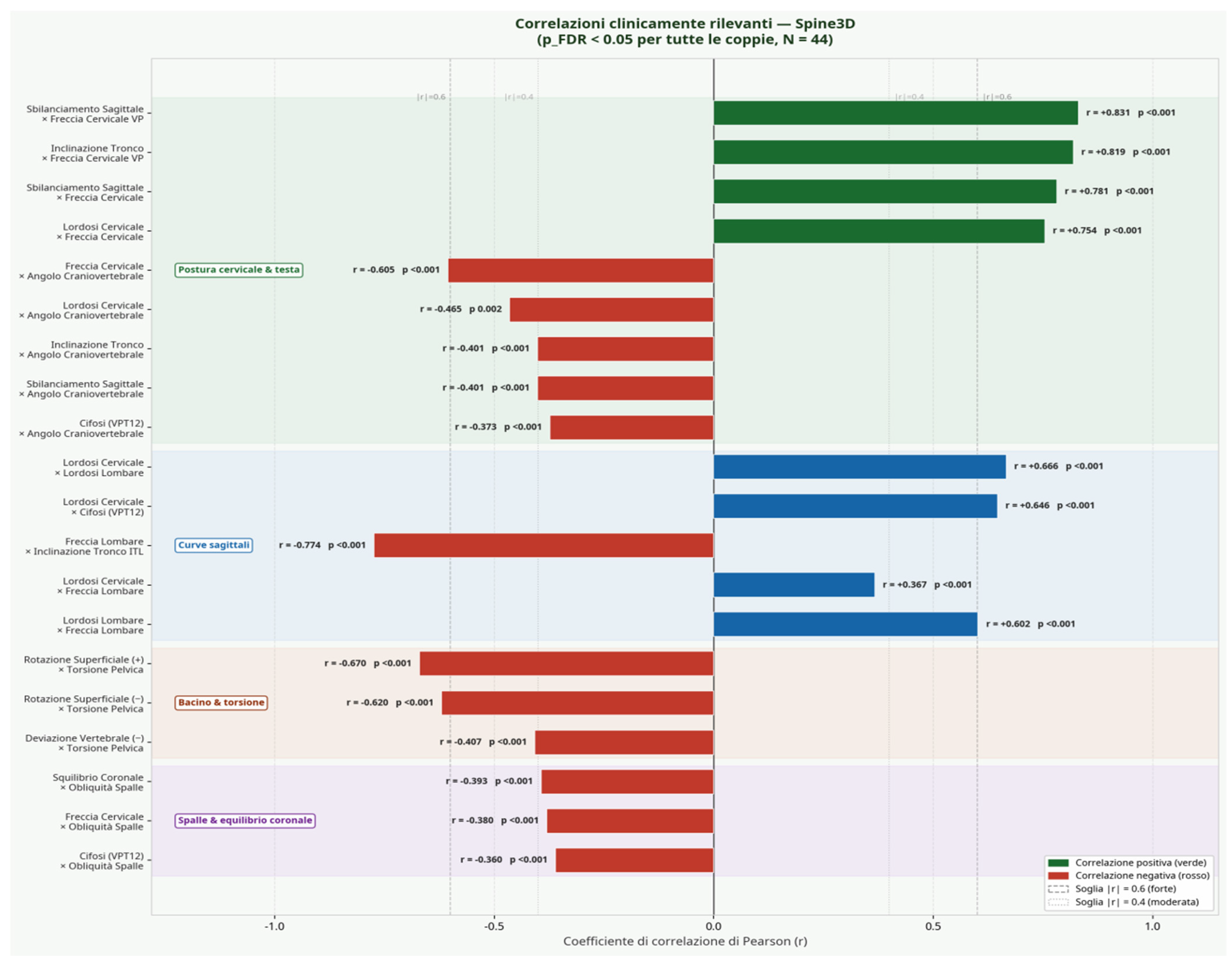
- Cervical Posture and Head Domain: A strong positive correlation is observed between the sagittal imbalance of the trunk and head protrusion (measured as CervicalArrow_VP, r = +0.831). The craniovertebral angle, as already seen, is negatively correlated not only with cervical lordosis (r = −0.465) but also with the cervical arrow (r = −0.605), confirming that head posture is closely linked to the morphology of the entire cervical and thoracic spine.
- Sagittal Curves Domain: A strong positive co-variation emerges between cervical and lumbar lordosis (r = +0.666), supporting the hypothesis of a functional coupling between the two curves. A positive correlation is also noted between cervical lordosis and the angle of thoracic kyphosis (r = +0.646).
- Pelvis and Torsion Domain: The surface rotation of the trunk was found to be negatively correlated with pelvic torsion (r up to −0.670), suggesting a possible compensatory mechanism between the two body districts on the transverse plane.
4. Discussion
5. Conclusions
Author Contributions
Funding
Institutional Review Board Statement
Informed Consent Statement
Data Availability Statement
Conflicts of Interest
References
- Salai, M.; Brosh, T.; Blankstein, A.; Oran, A.; Chechik, A. Effect of changing the saddle angle on the incidence of low back pain in recreational bicyclists. Br. J. Sports Med. 1999, 33, 398–400. [Google Scholar] [CrossRef] [Scilit] [PubMed]
- Wilder, D.G.; Pope, M.H.; Frymoyer, J.W. The biomechanics of lumbar disc herniation and the effect of overload and instability. J. Spinal Disord. 1988, 1, 16–32. [Google Scholar] [CrossRef] [Scilit] [PubMed]
- Brusa, J.; Giustino, V.; Messina, G.; Dominguez, L.J.; Kostrzewa-Nowak, D.; Barbagallo, M.; Nowak, R.; Leale, I.; Patti, A.; Bianco, A.; et al. Differences in the aging of the spine according to physical activity levels in older women. Front. Med. 2026, 12, 1730935. [Google Scholar] [CrossRef] [Scilit]
- Borg-Stein, J.; Elson, L.; Brand, E. The aging spine in sports. Clin. Sports Med. 2012, 31, 473–486. [Google Scholar] [CrossRef] [Scilit] [PubMed]
- Abelin-Genevois, K. Sagittal balance of the spine. Orthop. Traumatol. Surg. Res. 2021, 107, 102769. [Google Scholar] [CrossRef] [Scilit] [PubMed]
- Raso, V.J.; Lou, E.; Hill, D.L.; Mahood, J.K.; Moreau, M.J.; Durdle, N.G. Trunk distortion in adolescent idiopathic scoliosis. J. Pediatr. Orthop. 1998, 18, 222–226. [Google Scholar] [CrossRef] [Scilit] [PubMed]
- Nash, C.L., Jr.; Gregg, E.C.; Brown, R.H.; Pillai, K. Risks of exposure to X-rays in patients undergoing long-term treatment for scoliosis. J. Bone Jt. Surg. Am. 1979, 61, 371–374. [Google Scholar] [CrossRef] [Scilit]
- Betsch, M.; Wild, M.; Rath, B.; Tingart, M.; Schulze, A.; Quack, V. Radiation-free diagnosis of scoliosis: An overview of the surface and spine topography. Orthopade 2015, 44, 845–851. [Google Scholar] [CrossRef] [Scilit] [PubMed]
- Marin, L.; Lovecchio, N.; Pedrotti, L.; Manzoni, F.; Febbi, M.; Albanese, I.; Patanè, P.; Pellino, V.C.; Vandoni, M. Acute effects of self-correction on spine deviation and balance in adolescent girls with idiopathic scoliosis. Sensors 2022, 22, 1883. [Google Scholar] [CrossRef] [Scilit] [PubMed]
- Schwab, F.; Farcy, J.-P.; Bridwell, K.; Berven, S.; Glassman, S.; Harrast, J.; Horton, W. A clinical impact classification of scoliosis in the adult. Spine 2006, 31, 2109–2114. [Google Scholar] [CrossRef] [Scilit] [PubMed]
- Schwab, F.J.; Blondel, B.; Bess, S.; Hostin, R.; Shaffrey, C.I.; Smith, J.S.; Boachie-Adjei, O.; Burton, D.C.; Akbarnia, B.A.; Mundis, G.M.; et al. Radiographical spinopelvic parameters and disability in the setting of adult spinal deformity: A prospective multicenter analysis. Spine 2013, 38, E803–E812. [Google Scholar] [CrossRef] [Scilit] [PubMed]
- Mohokum, M.; Schülein, S.; Skwara, A. The validity of rasterstereography: A systematic review. Orthop. Rev. 2015, 7, 5899. [Google Scholar] [CrossRef] [Scilit]
- Roggio, F.; Petrigna, L.; Trovato, B.; Zanghì, M.; Sortino, M.; Vitale, E.; Rapisarda, L.; Testa, G.; Pavone, V.; Pavone, P.; et al. Thermography and rasterstereography as a combined infrared method to assess the posture of healthy individuals. Sci. Rep. 2023, 13, 4263. [Google Scholar] [CrossRef] [Scilit] [PubMed]
- Guidetti, L.; Bonavolontà, V.; Tito, A.; Reis, V.M.; Gallotta, M.C.; Baldari, C. Intra- and interday reliability of spine rasterstereography. BioMed Res. Int. 2013, 2013, 745480. [Google Scholar] [CrossRef] [Scilit] [PubMed]
- Schroeder, J.; Reer, R.; Braumann, K.M. Video raster stereography back shape reconstruction: A reliability study for sagittal, frontal, and transversal plane parameters. Eur. Spine J. 2015, 24, 262–269. [Google Scholar] [CrossRef] [Scilit] [PubMed]
- Mohokum, M.; Mendoza, S.; Udo, W.; Sitter, H.; Paletta, J.R.; Skwara, A. Reproducibility of rasterstereography for kyphotic and lordotic angles, trunk length, and trunk inclination: A reliability study. Spine 2010, 35, 1353–1358. [Google Scholar] [CrossRef] [Scilit] [PubMed]
- Muyor, J.M.; Alacid, F.; López-Miñarro, P.Á.; Casimiro, A.J. Evolution of spinal morphology and pelvic tilt in cyclists of different ages. A cross sectional study. Int. J. Morphol. 2012, 30, 199–204. [Google Scholar]
- Patti, A.; Giustino, V.; Messina, G.; Figlioli, F.; Cataldi, S.; Poli, L.; Belmonte, G.; Valenza, A.; Amato, A.; Thomas, E.; et al. Effects of Cycling on Spine: A Case–Control Study Using a 3D Scanning Method. Sports 2023, 11, 227. [Google Scholar] [CrossRef] [Scilit] [PubMed]
- Taborri, J.; Molinaro, L.; Faperdue, E.; Donati, M.; Rossi, S. Measuring the Accuracy of Artificial Intelligence Algorithms in the Identification of Anatomical Landmarks Through the Rastereography SPINE3D. In 2024 IEEE International Conference on Metrology for eXtended Reality, Artificial Intelligence and Neural Engineering (MetroXRAINE); IEEE: Piscataway, NJ, USA, 2024; pp. 523–528. [Google Scholar]
- Molinaro, L.; Russo, L.; Cubelli, F.; Taborri, J.; Rossi, S. Reliability analysis of an innovative technology for the assessment of spinal abnormalities. In 2022 IEEE International Symposium on Medical Measurements and Applications (MeMeA); IEEE: Piscataway, NJ, USA, 2022; pp. 1–6. [Google Scholar]
- Potts, M. LiDAR and X-ray: A Retrospective Comparison of Spinal Alignment. Med. Res. Arch. 2024, 12. [Google Scholar] [CrossRef] [Scilit]
- Muyor, J.M.; Zabala, M. Road cycling and mountain biking produces adaptations on the spine and hamstring extensibility. Int. J. Sports Med. 2016, 37, 43–49. [Google Scholar] [PubMed]
- Burnett, A.F.; Cornelius, M.W.; Dankaerts, W.; O’sullivan, P.B. Spinal kinematics and trunk muscle activity in cyclists: A comparison between healthy controls and non-specific chronic low back pain subjects—A pilot investigation. Man. Ther. 2004, 9, 211–219. [Google Scholar] [CrossRef] [Scilit] [PubMed]
- Imagama, S.; Ito, Z.; Wakao, N.; Seki, T.; Hirano, K.; Muramoto, A.; Sakai, Y.; Matsuyama, Y.; Hamajima, N.; Ishiguro, N.; et al. Influence of spinal sagittal alignment, body balance, muscle strength, and physical ability on falling of middle-aged and elderly males. Eur. Spine J. 2013, 22, 1346–1353. [Google Scholar] [CrossRef] [Scilit] [PubMed]
- Yukawa, Y.; Kato, F.; Suda, K.; Yamagata, M.; Ueta, T.; Yoshida, M. Normative data for parameters of sagittal spinal alignment in healthy subjects: An analysis of gender specific differences and changes with aging in 626 asymptomatic individuals. Eur. Spine J. 2018, 27, 426–432. [Google Scholar] [PubMed]
- Tan, L.A.; Riew, K.D.; Traynelis, V.C. Cervical spine deformity—Part 1: Biomechanics, radiographic parameters, and classification. Neurosurgery 2017, 81, 197–203. [Google Scholar] [CrossRef] [Scilit] [PubMed]
- Giustino, V.; Messina, G.; Patti, A.; Padua, E.; Zangla, D.; Drid, P.; Battaglia, G.; Palma, A.; Bianco, A. Effects of a postural exercise program on vertical jump height in young female volleyball players with knee valgus. Int. J. Environ. Res. Public Health 2022, 19, 3953. [Google Scholar] [CrossRef] [Scilit] [PubMed]
- Patti, A.; Thornton, J.S.; Giustino, V.; Drid, P.; Paoli, A.; Schulz, J.M.; Palma, A.; Bianco, A. Effectiveness of Pilates exercise on low back pain: A systematic review with meta-analysis. Disabil. Rehabil. 2024, 46, 3535–3548. [Google Scholar] [PubMed]
- Gurau, T.V.; Coman, M.G.; Iordan, D.A.; Onu, I.; Raileanu, C.R.; Adam, A.M.; Gurau, G.; Voinescu, D.C.; Badau, A.; Musat, C.L. Static Baropodometric Assessment for Musculoskeletal Rehabilitation: Plantar Pressure and Postural Load Distribution in Young Adults. Life 2025, 15, 1354. [Google Scholar] [CrossRef] [Scilit] [PubMed]



| Technical Feature | System Specifications (VZense DS86) |
|---|---|
| RGB Camera Resolution | 1600 × 1200 pixels @ 30 fps |
| ToF Camera Resolution | 640 × 480 pixels @ 15 fps |
| Operating Range | 0.15–5 m |
| Accuracy Error | <1% at 1 m distance |
| Data Connection | Gigabit Ethernet |
| Parameter | Unit | Mean | Std. Dev. | Min | Max |
|---|---|---|---|---|---|
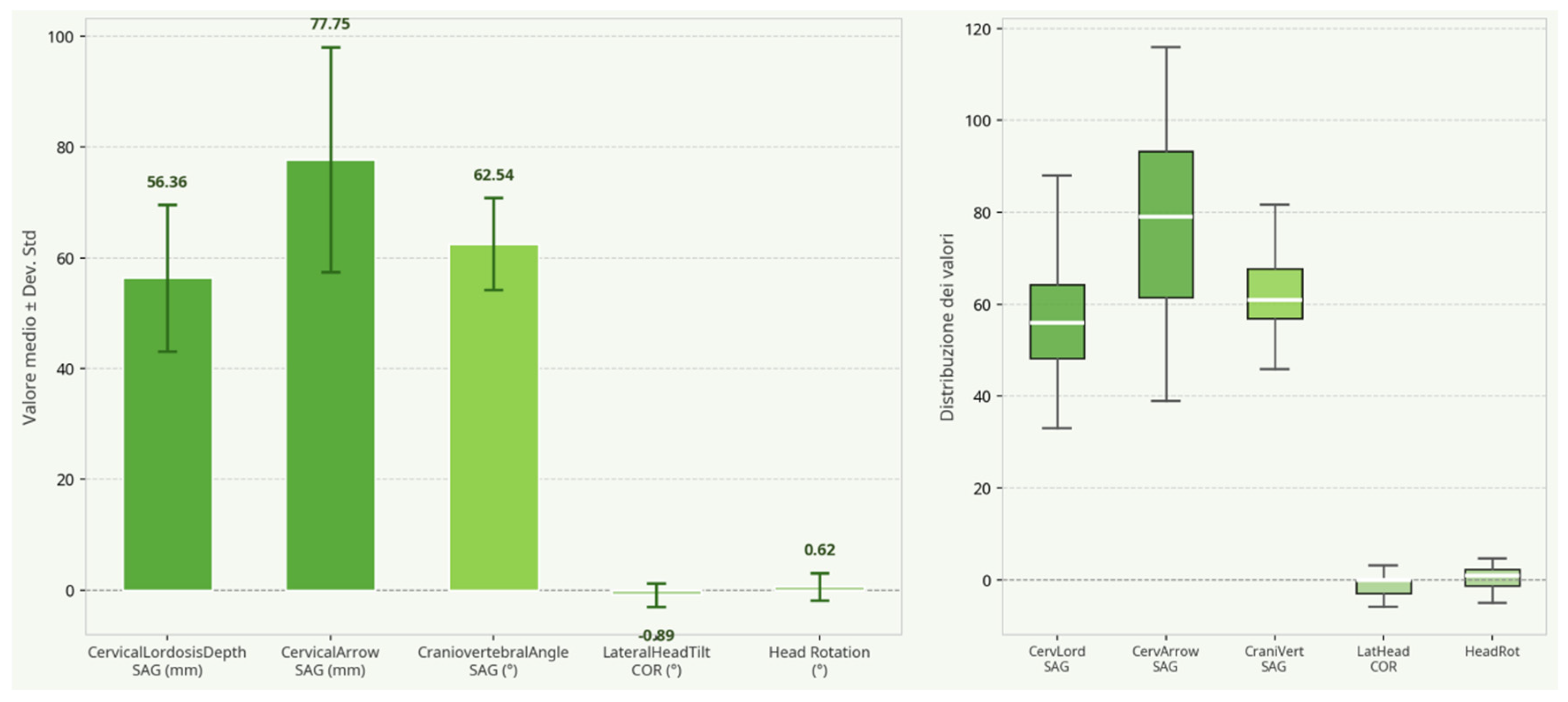
| CervicalLordosisDepth_SAG | mm | 56.36 | 13.25 | 33.0 | 88.0 |
| CervicalArrow_SAG | mm | 77.75 | 20.36 | 39.0 | 116.0 |
| CraniovertebralAngle_SAG | ° | 62.54 | 8.35 | 45.8 | 81.6 |
| LateralHeadTilt_COR | ° | −0.89 | 2.12 | −5.8 | 3.2 |
| Head Rotation | ° | 0.62 | 2.47 | −5.0 | 4.7 |
Disclaimer/Publisher’s Note: The statements, opinions and data contained in all publications are solely those of the individual author(s) and contributor(s) and not of MDPI and/or the editor(s). MDPI and/or the editor(s) disclaim responsibility for any injury to people or property resulting from any ideas, methods, instructions or products referred to in the content. |
© 2026 by the authors. Licensee MDPI, Basel, Switzerland. This article is an open access article distributed under the terms and conditions of the Creative Commons Attribution (CC BY) license.
Share and Cite
Messina, G.; Campoli, F.; Mingrino, O.G.M.; Drid, P.; Brusa, J.; Kostrzewa-Nowak, D.; Di Corrado, D.; Padua, E.; Iovane, A.; Francavilla, V.C. Correlations in Full-Body Postural Morphology: A Cross-Sectional Exploratory Pilot Study Using a Dual-Camera Structured Light System. Diagnostics 2026, 16, 2352. https://doi.org/10.3390/diagnostics16152352
Messina G, Campoli F, Mingrino OGM, Drid P, Brusa J, Kostrzewa-Nowak D, Di Corrado D, Padua E, Iovane A, Francavilla VC. Correlations in Full-Body Postural Morphology: A Cross-Sectional Exploratory Pilot Study Using a Dual-Camera Structured Light System. Diagnostics. 2026; 16(15):2352. https://doi.org/10.3390/diagnostics16152352
Chicago/Turabian StyleMessina, Giuseppe, Francesca Campoli, Omar Gaetano Maria Mingrino, Patrik Drid, Jessica Brusa, Dorota Kostrzewa-Nowak, Donatella Di Corrado, Elvira Padua, Angelo Iovane, and Vincenzo Cristian Francavilla. 2026. "Correlations in Full-Body Postural Morphology: A Cross-Sectional Exploratory Pilot Study Using a Dual-Camera Structured Light System" Diagnostics 16, no. 15: 2352. https://doi.org/10.3390/diagnostics16152352
APA StyleMessina, G., Campoli, F., Mingrino, O. G. M., Drid, P., Brusa, J., Kostrzewa-Nowak, D., Di Corrado, D., Padua, E., Iovane, A., & Francavilla, V. C. (2026). Correlations in Full-Body Postural Morphology: A Cross-Sectional Exploratory Pilot Study Using a Dual-Camera Structured Light System. Diagnostics, 16(15), 2352. https://doi.org/10.3390/diagnostics16152352