


Abstract
Atlantoaxial dislocation (AAD) or subluxation (AAS) is a potentially life-threatening disorder caused by instability between the atlas and axis. Typical symptoms include neck pain, torticollis, and neurological deficits, but dizziness has rarely been reported in association with AAD/AAS. We describe an adolescent girl who presented with non-spinning dizziness, neck pain, and torticollis after prolonged head flexion and extension. Neurological examination showed rightward torticollis without nystagmus. Cervical spine imaging revealed atlantoaxial rotatory dislocation and fixation, while CT angiography confirmed patency of both vertebral arteries. Conservative management with cervical traction was ineffective, and surgical reduction with C1–C2 fixation and fusion was performed. The patient experienced complete resolution of dizziness and torticollis postoperatively without complications. This image-based report describes a rare case of AAD in which dizziness was the main presenting symptom. This case highlights that cervical instability should be considered in the differential diagnosis of dizziness.
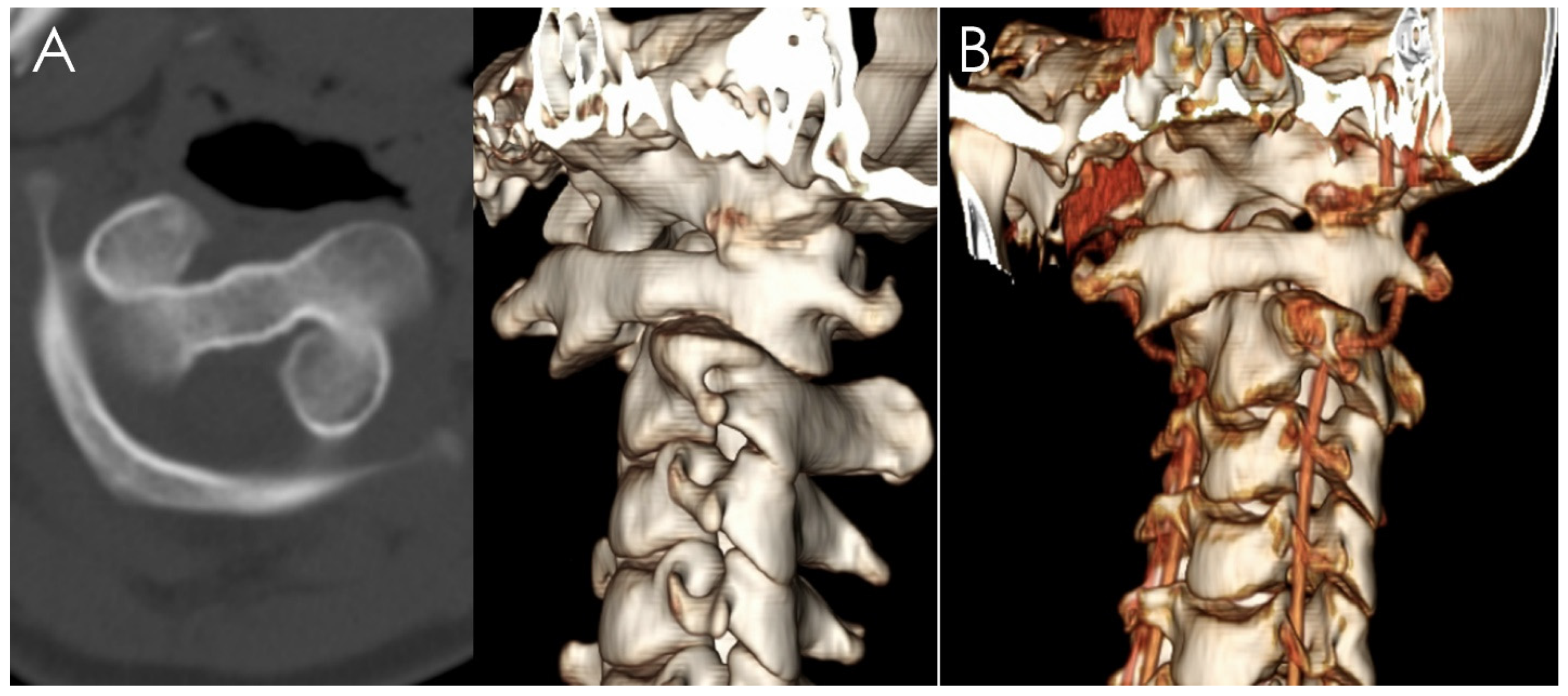
Figure 1.
Atlantoaxial rotatory dislocation presenting with dizziness in an adolescent girl. (A) Axial and three-dimensional reconstructed cervical spine CT images show C1–C2 rotatory fixation with bilaterally locked facets; the lateral mass of the atlas is rotated relative to the odontoid process, and the normal anatomical alignment between C1 and C2 is lost. (B) Cervical CT angiography demonstrates patent vertebral arteries in the presence of atlantoaxial dislocation. A previously healthy adolescent girl presented with dizziness, neck pain, and torticollis for two months. Just after a prolonged head-flexed posture for a nap during a long bus trip, and a subsequent head-extended posture while seated, she began to suffer from non-spinning dizziness and neck pain that worsened with neck extension. She denied any family history of dystonia or other movement disorders. General physical and neurological examinations were unremarkable except for rightward torticollis. On examination, there was no spontaneous, gaze-evoked, vibration-induced, or head-shaking nystagmus. Head rotation and extension while seated provoked no nystagmus. Video-oculography documented normal saccades and smooth pursuit. Ocular alignment was normal without skew deviation. Romberg test and tandem gait were intact. Caloric testing and vestibular-evoked myogenic potentials were not performed, and the video head impulse test could not be obtained because of neck pain. Review of the cervical MRIs obtained at an outside hospital had disclosed a suspicious malalignment between the atlas and axis along with torticollis. Additional cervical spine radiographs and CT scan showed an atlantoaxial rotatory dislocation and fixation (Figure 1A). Cervical spine CT angiography documented patent vertebral arteries on both sides (Figure 1B). Because conservative management with 16-pound Gardner–Wells tong traction for seven days was ineffective, she underwent open reduction in the rotatory dislocation with C1–C2 fixation using bilateral C1 posterior-arch and C2 pedicle screws and fusion. The operation resulted in complete resolution of both dizziness and torticollis without any complications, and the patient remained symptom-free until the last follow-up, 42 months after the surgery. Although there have been considerable debates on the concept of ‘cervical or cervicogenic dizziness’, dizziness is occasionally reported in association with cervical pain, whiplash injury, degenerative cervical spondylosis and other cervical disorders [1]. The cervical afferents provide inputs to the secondary vestibular neurons in the vestibular nuclear complex, and proprioceptive signals from the neck are an integral component of the vestibular system [2]. Thus, abnormal sensory information from deranged joint receptors or muscle proprioceptors in the upper cervical regions, among many others, has been proposed as a mechanism of cervical dizziness [3,4]. However, the pathogenesis of cervical dizziness still requires further elucidation with high quality data from well-designed studies [5]. Even with these controversies, the consistent features of cervical dizziness include (1) neck stiffness and pain aggravated during neck movements, (2) transient imbalance, light-headedness, or illusory self-motion triggered by neck movements, and (3) improvement of neck pain, neck stiffness and dizziness by neck-directed therapy [5]. All these features were also observed in our patient. Vestibular migraine, a common cause of dizziness in adolescent girls, was considered unlikely given the absence of any history of headache and the mechanically reproducible nature of the symptoms. Given that the dizziness in our patient was aggravated with head extension, compression of the vertebral artery may be considered a mechanism of dizziness during neck motion [6], also known as bow hunter’s syndrome, a rare type of symptomatic vertebrobasilar ischemia resulting from compression of the vertebral artery during head motion [7]. Patients with this condition may show nystagmus along with vertigo during the attacks triggered by head rotation [8]. Because of its anatomic susceptibility and winding pathway, mechanical compression of the vertebral artery may occur when the head is rotated [9]. Indeed, patients with AAD may develop posterior circulation stroke as a complication [10]. However, most patients with vertebral artery compression syndrome show a stenosis or anomaly of the vertebral artery on one side and compression of the dominant vertebral artery during contralateral head rotation even though compression of both vertebral arteries has rarely been documented [11]. In contrast, our patient showed the patency of both vertebral arteries on CT angiography without any nystagmus during head rotation or extension while sitting. Since the patient did not have dynamic angiography to exclude compression of the vertebral arteries during head rotation, vertebral artery compression syndrome was only partially excluded, which remains a limitation of this report. Importantly, this case underscores that dizziness accompanied by neck pain and torticollis should prompt careful evaluation of the upper cervical spine.
Author Contributions
Conceptualization, H.-J.K.; data acquisition and analysis, S.K., J.-S.K., J.S.Y., Q.N.N. and B.J.; writing—original draft preparation, S.K.; writing—review and editing, H.-J.K., J.S.Y., Q.N.N., B.J. and J.-S.K. All authors have read and agreed to the published version of the manuscript.
Funding
This study was supported by a grant no. 06-2024-0391 from SLMED Research Fund, awarded to H.-J.K. (corresponding author).
Institutional Review Board Statement
The study was conducted in accordance with the Declaration of Helsinki and was approved by the Institutional Review Board of Seoul National University Bundang Hospital (B-2408-921-702, 14 October 2024).
Informed Consent Statement
The requirement for informed consent was waived by the Institutional Review Board of Seoul National University Bundang Hospital (B-2408-921-702, 14 October 2024) due to the retrospective nature of the study, the use of anonymized data, and the inability to contact the patient at the time of the study.
Data Availability Statement
Anonymized data supporting the findings of this case will be shared by the corresponding author upon reasonable request from any qualified investigator.
Conflicts of Interest
S. Kim, H.J. Kim, J.S. Yeom, N.Q. Nguyen, and B. Jeon report no disclosures relevant to this manuscript. J.-S. Kim holds the position of Chief Technology Officer at SLMED and DZMED.
References
- Hain, T.C. Cervicogenic causes of vertigo. Curr. Opin. Neurol. 2015, 28, 69–73. [Google Scholar] [CrossRef] [Scilit] [PubMed]
- Bankoul, S.; Neuhuber, W.L. A cervical primary afferent input to vestibular nuclei as demonstrated by retrograde transport of wheat germ agglutinin-horseradish peroxidase in the rat. Exp. Brain Res. 1990, 79, 405–411. [Google Scholar] [CrossRef] [Scilit] [PubMed]
- Peng, B. Cervical Vertigo: Historical Reviews and Advances. World Neurosurg. 2018, 109, 347–350. [Google Scholar] [CrossRef] [Scilit] [PubMed]
- Ryan, G.M.; Cope, S. Cervical vertigo. Lancet 1955, 269, 1355–1358. [Google Scholar] [CrossRef] [Scilit] [PubMed]
- Seemungal, B.M.; Agrawal, Y.; Bisdorff, A.; Bronstein, A.; Cullen, K.E.; Goadsby, P.J.; Lempert, T.; Kothari, S.; Lim, P.B.; Magnusson, M.; et al. The Barany Society position on ‘Cervical Dizziness’. J. Vestib. Res. 2022, 32, 487–499. [Google Scholar] [CrossRef] [Scilit] [PubMed]
- Kim, J.S.; Newman-Toker, D.E.; Kerber, K.A.; Jahn, K.; Bertholon, P.; Waterston, J.; Lee, H.; Bisdorff, A.; Strupp, M. Vascular vertigo and dizziness: Diagnostic criteria. J. Vestib. Res. 2022, 32, 205–222. [Google Scholar] [CrossRef] [Scilit] [PubMed]
- Schulz, R.; Donoso, R.; Weissman, K. Rotational vertebral artery occlusion (“bow hunter syndrome”). Eur. Spine J. 2021, 30, 1440–1450. [Google Scholar] [CrossRef] [Scilit] [PubMed]
- Choi, K.D.; Shin, H.Y.; Kim, J.S.; Kim, S.H.; Kwon, O.K.; Koo, J.W.; Park, S.H.; Yoon, B.W.; Roh, J.K. Rotational vertebral artery syndrome: Oculographic analysis of nystagmus. Neurology 2005, 65, 1287–1290. [Google Scholar] [CrossRef] [Scilit] [PubMed]
- Kuether, T.A.; Nesbit, G.M.; Clark, W.M.; Barnwell, S.L. Rotational vertebral artery occlusion: A mechanism of vertebrobasilar insufficiency. Neurosurgery 1997, 41, 427–432; discussion 432–433. [Google Scholar] [CrossRef] [Scilit] [PubMed]
- Kulkarni, G.B.; Mustare, V.; Pruthi, N.; Pendharkar, H.; Modi, S.; Kulkarni, A. Profile of patients with craniovertebral junction anomalies with posterior circulation strokes. J. Stroke Cerebrovasc. Dis. 2014, 23, 2819–2826. [Google Scholar] [CrossRef] [Scilit] [PubMed]
- Choi, K.D.; Choi, J.H.; Kim, J.S.; Kim, H.J.; Kim, M.J.; Lee, T.H.; Lee, H.; Moon, I.S.; Oh, H.J.; Kim, J.I. Rotational vertebral artery occlusion: Mechanisms and long-term outcome. Stroke 2013, 44, 1817–1824. [Google Scholar] [CrossRef] [Scilit] [PubMed]
Disclaimer/Publisher’s Note: The statements, opinions and data contained in all publications are solely those of the individual author(s) and contributor(s) and not of MDPI and/or the editor(s). MDPI and/or the editor(s) disclaim responsibility for any injury to people or property resulting from any ideas, methods, instructions or products referred to in the content. |
© 2026 by the authors. Licensee MDPI, Basel, Switzerland. This article is an open access article distributed under the terms and conditions of the Creative Commons Attribution (CC BY) license.