Novel Diagnostic Algorithm for Azoospermia: The Role of 17-Hydroxyprogesterone and Round Spermatids in Normogonadotropic Azoospermia



Abstract
1. Introduction
2. Background and Theoretical Foundations
2.1. Normogonadotropic Azoospermia: Definition and Pathophysiology
2.2. The Intratesticular Testosterone Hypothesis
3. Diagnostic Markers in Normogonadotropic Azoospermia
3.1. 17-Hydroxyprogesterone as a Biomarker
3.2. Round Spermatids in Ejaculate: Detection and Significance
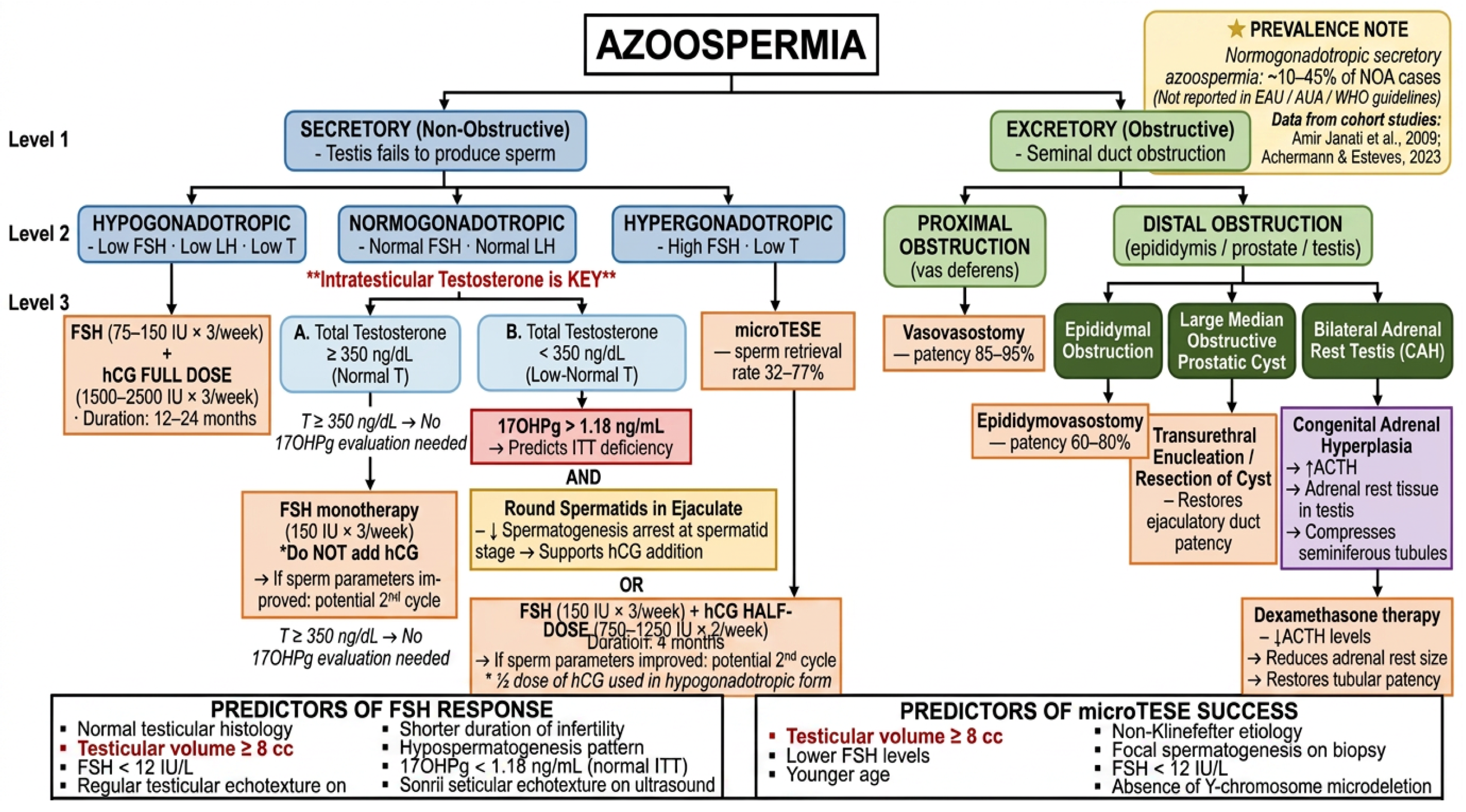
3.3. The Proposed Hypothesis-Generating Diagnostic Framework
4. Pathophysiological Mechanisms
4.1. 17OHP Elevation and Reduced Intratesticular Testosterone
4.2. Steroidogenic Enzyme Dysfunction
5. Treatment Strategies
5.1. Rationale for Hormonal Therapy in Normogonadotropic Azoospermia
5.2. Combined hCG and FSH Therapy
5.3. Alternative Therapeutic Approaches
- FSH Monotherapy: Zhang et al. (2022) demonstrated in a systematic review and meta-analysis that FSH therapy can improve semen parameters in patients with idiopathic oligoasthenoteratozoospermia, suggesting FSH monotherapy as a viable alternative in selected patients [26].
- Non-Hormonal Pharmacological Treatments: Al Wattar et al. (2024) conducted a systematic review and network meta-analysis of non-hormonal pharmacological options for male infertility, including clomiphene citrate, tamoxifen, aromatase inhibitors, and antioxidants [27]. Clomiphene showed the highest likelihood of improving sperm concentration, though evidence quality was low and no treatment showed clear superiority over placebo for live birth rates [27].
5.4. Dosing Protocols: Half-Dose Strategy
5.5. Treatment Algorithm Based on 17OHP and Round Spermatids
6. Clinical Outcomes and Evidence
6.1. Effects on Intratesticular Testosterone
6.2. Sperm Retrieval and Spermatogenesis Outcomes
6.3. Pregnancy and Live Birth Rates
7. Discussion
7.1. Clinical Implications
7.2. Limitations and Gaps in Current Evidence
- The proposed diagnostic algorithm is hypothesis-generating and has not been prospectively validated in NOAN-specific cohorts.
- The 17OHP cutoff of 1.18 ng/mL was derived from limited, heterogeneous datasets and has not been validated to predict hard clinical outcomes (sperm retrieval, live birth).
- Supporting evidence relies heavily on indirect measures of ITT and small retrospective cohorts.
- No prospective randomized controlled trial has tested the 17OHP-guided treatment algorithm in NOAN with pre-defined primary endpoints.
- The FSH cut-off of 12 IU/L for normogonadotropic classification is not universally recognized across international guidelines.
- The testosterone threshold of 350 ng/dL may be functionally low in patients with elevated SHBG; free testosterone assessment is recommended in borderline cases.
- Many cited studies were conducted over a decade ago; more recent high-quality evidence is needed to confirm or refute the proposed approach.
- Alternative therapeutic approaches (FSH monotherapy, clomiphene, non-hormonal treatments) have not been systematically compared to the proposed algorithm.
- Technical variability in 17OHP assay methods across laboratories may affect the reproducibility of the proposed cutoff.
- Long-term outcomes, safety data, and cost-effectiveness of the proposed treatment strategy have not been evaluated.
8. Future Directions and Recommendations
- Prospective multicenter RCTs in well-defined NOAN cohorts comparing 17OHP-guided hCG/FSH therapy versus FSH monotherapy versus watchful waiting, with primary endpoints of sperm return to ejaculate and live birth rates.
- Standardization of 17OHP assay methodology and establishment of laboratory-specific reference ranges to ensure reproducibility of the proposed cutoff.
- Direct ITT measurement studies to validate 17OHP as a reliable proxy for ITT deficiency in NOAN patients.
- Head-to-head comparison of the proposed algorithm with alternative approaches (FSH monotherapy, clomiphene citrate, non-hormonal treatments) to establish relative efficacy.
- Development of composite predictive models incorporating 17OHP, testosterone, SHBG, testicular volume, and genetic factors to improve patient stratification.
9. Conclusions
Author Contributions
Funding
Data Availability Statement
Conflicts of Interest
References
- Tharakan, T.; Luo, R.; Jayasena, C.N.; Minhas, S. Non-obstructive azoospermia: Current and future perspectives. Fac. Rev. 2021, 10, 7. [Google Scholar] [CrossRef]
- Alkandari, F.; Zini, A. Medical management of non-obstructive azoospermia: A systematic review. Arab. J. Urol. 2021, 19, 231–239. [Google Scholar] [CrossRef]
- Schaison, G.; Couzinet, B.; Lahlou, N. ITT and spermatogenesis. J. Clin. Endocrinol. Metab. 1993, 76, 1221–1228. [Google Scholar]
- La Vignera, S.; Condorelli, R.A. Novel diagnostic algorithm for azoospermia. Preliminary data. In Internal Report; University of Catania: Catania, Italy, 2024. [Google Scholar]
- Esteves, S.C. Clinical management of infertile men with nonobstructive azoospermia. Asian J. Androl. 2015, 17, 459–470. [Google Scholar] [CrossRef] [PubMed]
- Hopps, C.V.; Mielnik, A.; Goldstein, M.; Palermo, G.D.; Rosenwaks, Z.; Schlegel, P.N. Detection of sperm in men with Y chromosome microdeletions of the AZFa, AZFb and AZFc regions. Hum. Reprod. 2003, 18, 1660–1665. [Google Scholar] [CrossRef] [PubMed]
- Dabaja, A.A.; Schlegel, P.N. Microdissection testicular sperm extraction: An update. Asian J. Androl. 2013, 15, 35–39. [Google Scholar] [CrossRef]
- Shiraishi, K.; Ohmi, C.; Shimabukuro, T.; Matsuyama, H. Human chorionic gonadotrophin treatment prior to microdissection testicular sperm extraction. Hum. Reprod. 2012, 27, 331–339. [Google Scholar] [CrossRef]
- Weinbauer, G.F.; Behre, H.M.; Fingscheidt, U.; Nieschlag, E. Human FSH stimulatory effect on spermatogenesis. Endocrinology 2010, 151, 4462–4472. [Google Scholar]
- Gialouris, I.; Vlahos, N.; Dalamaga, M.; Kokkinos, A. Efficacy of gonadotropin therapy to induce spermatogenesis in men with pathologic gonadotropin deficiency. J. Clin. Endocrinol. Metab. 2025, 110, e123–e134. [Google Scholar] [CrossRef]
- Enafaa, M.; Hammami, W.; Sraieb, S.; Khanchel, F.; Ayed, H.; Smaoui, W.; Zouari, S.; Kourda, N.; Chebil, M.; El Younsi, M. Predictors of micro-TESE outcomes. Nephrol. Ther. 2016, 12, 312–317. [Google Scholar]
- Abbaticchio, G.; Giagulli, V.A.; Caragnano, F.; Loverro, G.; Selvaggi, L.; Giorgino, R. 17-α-OH-Progesterone to testosterone plasma ratios and their modification after HCG in normal men and in patients with idiopathic infertility. Andrologia 1988, 20, 429–434. [Google Scholar] [CrossRef]
- Lima, T.F.N.; Frech, F.S.; Patel, P.; Blachman-Braun, R.; Ramasamy, R.; Kavoussi, P. Evaluation of serum 17-hydroxyprogesterone as predictor of semen parameter improvement. Can. Urol. Assoc. J. 2020, 14, E620–E624. [Google Scholar] [CrossRef]
- Fu, W.; Cui, J.; Tang, S. Testicular echotexture as predictor of NOA outcomes. Quant. Imaging Med. Surg. 2024, 14, 23–31. [Google Scholar] [CrossRef]
- Collet, P.; Pralang, J. Testosterone and dexamethasone in congenital adrenal hyperplasia. J. Clin. Endocrinol. Metab. 2010, 95, 2691–2700. [Google Scholar] [CrossRef]
- Amer, M.; El-Haggar, S.; Moustafa, T.; El-Naser, T.A.; Zohdy, W. May–Grünwald–Giemsa stain for detection of spermatogenic cells. Hum. Reprod. 2001, 16, 1427–1432. [Google Scholar] [CrossRef] [PubMed]
- Achermann, J.C.; Eareves, M. NOA: Prevalence and hypospermatogenesis. F&S Rev. 2023, 4, 113–122. [Google Scholar] [CrossRef]
- Peng, Z.; Zhang, Y.; Zhang, C.; Zhou, H.; Ruan, J.; Lin, J.; Mao, X.; Yang, D. hCG+FSH pre-microTESE in NOA. Reprod. Biol. Endocrinol. 2022, 20, 93–101. [Google Scholar]
- Amir Janati, N.; Behzad, G.; Akhoundi, M.M.; Sadeghi, M.R.; Jedi Tehrani, M.; Soltan Ghoraei, H. Sexual and hormonal profiles of infertile subjects with non-obstructive azoospermia. J. Reprod. Infertil. 2009, 10, 42–50. [Google Scholar]
- Shiraishi, K.; Matsuyama, H. Gonadotropin actions on spermatogenesis and hormonal therapies for spermatogenic disorders. Endocr. J. 2017, 64, 123–131. [Google Scholar] [CrossRef]
- Ley, S.B.; Leonard, J.M.; Paulsen, C.A.; Bremner, W.J. Male hypogonadotropic hypogonadism: Factors influencing response to hCG and hMG. J. Clin. Endocrinol. Metab. 1985, 61, 746–752. [Google Scholar] [CrossRef]
- Burgués, S.; Calderon, M.D. Subcutaneous self-administration of highly purified FSH and hCG for male hypogonadotrophic hypogonadism. Hum. Reprod. 1997, 12, 980–986. [Google Scholar] [CrossRef]
- Hussein, A.; Ozgok, Y.; Ross, L.; Rao, P. Recombinant gonadotropin therapy in nonobstructive azoospermic patients—Proof of concept. Int. Braz. J. Urol. 2022, 48, 512–520. [Google Scholar] [CrossRef]
- Andrabi, S.W.; Saini, P.; Joshi, M.; Mehta, P.; Makker, G.C.; Mishra, G.; Rajender, S. HCG therapy in azoospermic men with lower/borderline testosterone. Andrologia 2021, 53, e14251. [Google Scholar] [CrossRef]
- Yeung, C.H.; Beiglböck-Karau, L.; Tüttelmann, F.; Nieschlag, E. Germ cells in semen of azoospermic patients. Clin. Endocrinol. 2007, 67, 764–771. [Google Scholar]
- Zhang, X.; Chen, J.; Cui, Y.; Jin, Y.; Wang, X. FSH can improve semen parameters in idiopathic oligoasthenoteratozoospermia: A systematic review and meta-analysis. Andrologia 2022, 54, e14596. [Google Scholar] [CrossRef] [PubMed]
- Al Wattar, B.H.; Rimmer, M.P.; Teh, J.J.; Mackenzie, S.C.; Ammar, O.F.; Croucher, C.; Anastasiadis, E.; Gordon, P.; Pacey, A.; McEleny, K.; et al. Pharmacological non-hormonal treatment options for male infertility. BMC Urol. 2024, 24, 158. [Google Scholar] [CrossRef]
- Shapiro, E.; Sherins, R.J. Endocrine Stimulatory Therapy for Testis Sperm Extraction, 4th ed.; Academic Press: Cambridge, MA, USA, 2014. [Google Scholar]
- Esteves, S.C. Male infertility due to spermatogenic failure. Anim. Reprod. 2015, 12, 10–24. [Google Scholar]
- Cocci, A.; Cito, G.; Russo, G.I.; Falcone, M.; Capece, M.; Timpano, M.; Della Camera, P.A.; Morselli, S.; Tasso, G.; Morelli, G.; et al. Highly purified urofollitropin in idiopathic azoospermia. Riv. Urol. 2018, 85, 74–79. [Google Scholar] [CrossRef]
- Kobori, Y.; Suzuki, K.; Iwahata, T.; Shin, T.; Sato, R.; Nishio, K.; Yagi, H.; Arai, G.; Soh, S.; Okada, H. Induction of spermatogenesis by rhFSH in azoospermia. Syst. Biol. Reprod. Med. 2015, 61, 365–370. [Google Scholar] [CrossRef] [PubMed]

Disclaimer/Publisher’s Note: The statements, opinions and data contained in all publications are solely those of the individual author(s) and contributor(s) and not of MDPI and/or the editor(s). MDPI and/or the editor(s) disclaim responsibility for any injury to people or property resulting from any ideas, methods, instructions or products referred to in the content. |
© 2026 by the authors. Licensee MDPI, Basel, Switzerland. This article is an open access article distributed under the terms and conditions of the Creative Commons Attribution (CC BY) license.
Share and Cite
La Vignera, S.; Condorelli, R.A. Novel Diagnostic Algorithm for Azoospermia: The Role of 17-Hydroxyprogesterone and Round Spermatids in Normogonadotropic Azoospermia. Diagnostics 2026, 16, 1830. https://doi.org/10.3390/diagnostics16121830
La Vignera S, Condorelli RA. Novel Diagnostic Algorithm for Azoospermia: The Role of 17-Hydroxyprogesterone and Round Spermatids in Normogonadotropic Azoospermia. Diagnostics. 2026; 16(12):1830. https://doi.org/10.3390/diagnostics16121830
Chicago/Turabian StyleLa Vignera, Sandro, and Rosita A. Condorelli. 2026. "Novel Diagnostic Algorithm for Azoospermia: The Role of 17-Hydroxyprogesterone and Round Spermatids in Normogonadotropic Azoospermia" Diagnostics 16, no. 12: 1830. https://doi.org/10.3390/diagnostics16121830
APA StyleLa Vignera, S., & Condorelli, R. A. (2026). Novel Diagnostic Algorithm for Azoospermia: The Role of 17-Hydroxyprogesterone and Round Spermatids in Normogonadotropic Azoospermia. Diagnostics, 16(12), 1830. https://doi.org/10.3390/diagnostics16121830