Validation of Two Diagnostic Tools for the Screening of Temporomandibular Disorder

 ,
,
Abstract
1. Introduction
2. Materials and Methods
2.1. Fonseca and TMD-7 Questionnaires
2.2. Translation Phase
2.3. Surface Validation Phase (Cognitive Debriefing)
2.4. Reliability Phase (Pilot Study)
Research Design
2.5. Statistical Analysis
3. Results
3.1. Analysis of the Pilot Study Group
3.2. Reliability Check
3.3. Fonseca Questionnaire Analysis
3.4. TMD-7 Questionnaire Analysis
3.5. Definition of a Rating Scale for the TMD-7 Questionnaire
4. Discussion
5. Conclusions
Author Contributions
Funding
Institutional Review Board Statement
Informed Consent Statement
Data Availability Statement
Conflicts of Interest
Abbreviations
| DMS | Dento-maxillary system |
| TMD | Temporomandibular disorders |
| TMJ | Temporomandibular joints |
| DC/TMD | Diagnostic Criteria Protocol |
| WHO | World Health Organization |
| DRC/TMD | Diagnostic Research Criteria |
| MRI | Magnetic resonance imaging |
| CT | Computed tomography |
| FAI | Fonseca Anamnestic Index |
References
- Yost, O.; Liverman, C.T.; English, R.; Mackey, S.; Bond, E.C. Temporomandibular Disorders: Priorities for Research and Care; National Academies of Sciences, Engineering, and Medicine, Health and Medicine Division, Board on Health Care Services, Board on Health Sciences Policy, Committee on Temporomandibular Disorders (TMDs): From Research Discoveries to Clinical Treatment, Eds.; National Academies Press (US): Washington, DC, USA, 2020. [Google Scholar]
- Manfredini, D.; Häggman-Henrikson, B.; Al Jaghsi, A.; Baad-Hansen, L.; Beecroft, E.; Bijelic, T.; Bracci, A. Temporomandibular Disorders: INFORM/IADR Key Points for Good Clinical Practice Based on Standard of Care. Cranio 2024, 43, 1–5. [Google Scholar] [CrossRef] [PubMed]
- Okeson, J. Management of Temporomandibular Disorder and Occlusion, 8th ed.; Elsevier: Amsterdam, The Netherlands, 2020. [Google Scholar]
- Lövgren, A.; Parvaneh, H.; Lobbezoo, F.; Häggman-Henrikson, B.; Wänman, A.; Visscher, C.M. Diagnostic accuracy of three screening questions (3Q/TMD) in relation to the DC/TMD in a specialized orofacial pain clinic. Acta Odontol. Scand. 2018, 76, 380–386. [Google Scholar] [CrossRef]
- Januzzi, M.S.; Neto, C.M.; Moreno, A.; Dos Santos, E.G.; de Caxias, F.P.; da Silva, E.V. Relationship between self-reported pain, pain threshold, pain catastrophization and quality of life in patients with TMD. J. Clin. Exp. Dent. 2023, 15, e23–e31. [Google Scholar] [CrossRef]
- Ohrbach, R.; Sharma, S. Temporomandibular disorders: Definition and etiology. Semin. Orthod. 2024, 30, 237–242. [Google Scholar] [CrossRef]
- Klasser, G.D.; Goulet, J.P.; Moreno-Hay, I. Classification and diagnosis of temporomandibular disorders and temporomandibular disorder pain. Dent. Clin. N. Am. 2023, 67, 211–225. [Google Scholar] [CrossRef]
- Mirmortazavi, A.; Aghasizadeh, D.; Nazerzadeh, F.; Shiezadeh, I. Oral healthrelated quality of life in temporomandibular disorder patients treated with stabilization splint. J. Craniomaxillofacial Res. 2024, 11, 42–48. [Google Scholar]
- Shueb, S.S.; Nixdorf, D.R.; John, M.T. What is the impact of acute and chronic orofacial pain on quality of life? J. Dent. 2015, 43, 1203–1210. [Google Scholar] [CrossRef]
- Dahlstrom, L.; Carlsson, G.E. Temporomandibular disorders and oral health-related quality of life. A systematic review. Acta Odontol. Scand. 2010, 68, 80–85. [Google Scholar] [CrossRef] [PubMed]
- Durham, J.; Shen, J.; Breckons, M. Healthcare Cost and Impact of Persistent Orofacial Pain: The DEEP Study Cohort. J. Dent. Res. 2016, 95, 1147–1154. [Google Scholar] [CrossRef] [PubMed]
- Slade, G.D.; Fillingim, R.B.; Sanders, A.E. Summary of findings from the OPPERA prospective cohort study of incidence of first-onset temporomandibular disorder: Implications and future directions. J. Pain 2013, 14, T116–T124. [Google Scholar] [CrossRef]
- Suvinen, T.I.; Reade, P.C.; Kemppainen, P. Review of etiological concepts of temporomandibular pain disorders: Towards a biopsychosocial model for integration of physical disorder factors with psychological and psychosocial illness impact factors. Eur. J. Pain 2005, 9, 613–633. [Google Scholar] [CrossRef]
- Alqutaibi, A.Y.; Alhammadi, M.S.; Hamadallah, H.H.; Altarjami, A.A.; Malosh, O.T.; Aloufi, A.M.; Alkahtani, L.M.; Alharbi, F.S.; Halboub, E.; Almashraqi, A.A. Global prevalence of temporomandibular disorders: A systematic review and meta-analysis. J. Oral Facial Pain Headache 2025, 39, 48–65. [Google Scholar] [CrossRef]
- Schiffman, E.; Ohrbach, R.; Truelove, E.; Look, J.; Anderson, G.; Goulet, J.P.; List, T.; Svensson, P.; Gonzalez, Y.; Lobbezoo, F. International RDC/TMD Consortium Network, International Association for Dental Research; Orofacial Pain Special Interest Group, International Association for the Study of Pain. Diagnostic Criteria for Temporomandibular Disorders (DC/TMD) for Clinical and Research Applications: Recommendations of the International RDC/TMD Consortium Network and Orofacial Pain Special Interest Group. J. Oral Fac. Pain Headache 2014, 28, 6–27. [Google Scholar]
- Sánchez-Torrelo, C.M.; Zagalaz-Anula, N.; Alonso-Royo, R.; Ibáñez-Vera, A.J.; López Collantes, J.; Rodríguez-Almagro, D.; Obrero-Gaitán, E.; Lomas-Vega, R. Transcultural Adaptation and Validation of the Fonseca Anamnestic Index in a Spanish Population with Temporomandibular Disorders. J. Clin. Med. 2020, 9, 3230. [Google Scholar] [CrossRef]
- Kutschke, A.; Schierz, O.; Lövgren, A.; Peck, C.; Durham, J.; Häggman-Henrikson, B. Screening Instruments for Temporomandibular Disorders: A Systematic Review and Meta-Analysis. J. Evid.-Based Dent. Pract. 2025, 26, 102204. [Google Scholar] [CrossRef] [PubMed]
- World Health Organization. Screening Programmes: A Short Guide. Increase Effectiveness, Maximize Benefits and Minimize Harm; World Health Organization: Geneva, Switzerland, 2020. [Google Scholar]
- Ilgunas, A.; Lovgren, A.; Fjellman-Wiklund, A. Conceptualizing the clinical decision-making process in managing temporomandibular disorders: A qualitative study. Eur. J. Oral Sci. 2021, 129, e12811. [Google Scholar] [CrossRef] [PubMed]
- Lovette, B.C.; Bannon, S.M.; Spyropoulos, D.C.; Vranceanu, A.M.; Greenberg, J. I Still Suffer Every Second of Every Day: A Qualitative Analysis of the Challenges of Living with Chronic Orofacial Pain. J. Pain Res. 2022, 15, 2139–2148. [Google Scholar] [CrossRef]
- Gatchel, R.J.; Stowell, A.W.; Wildenstein, L.; Riggs, R.; Ellis, E., 3rd. Efficacy of an early intervention for patients with acute temporomandibular disorder-related pain: A one-year outcome study. J. Am. Dent. Assoc. 2006, 137, 339–347. [Google Scholar] [CrossRef] [PubMed]
- Aithal, A.; Aithal, S. Development and Validation of Survey Questionnaire and Experimental Data—A Systematical Review-based Statistical Approach. Int. J. Manag. Technol. Soc. Sci. 2020, 5, 233–251. [Google Scholar]
- Kishore, K.; Jaswal, V.; Kulkarni, V.; De, D. Practical Guidelines to Develop and Evaluate a Questionnaire. Indian Dermatol. Online J. 2021, 12, 266–275. [Google Scholar] [CrossRef]
- Bujang, M.A. A Step-By-Step Guide to Questionnaire Validation Research; CERN European Organization for Nuclear Research: Geneva, Switzerland, 2022. [Google Scholar]
- Koufos, E.B.; Avila, H.C.; Eckert, G.; Stewart, K.T.; Kroenke, K.; Turkkahraman, H. The TMD-7 as a Brief Measure for Assessing Temporomandibular Disorder. Eur. J. Dent. 2023, 17, 456–463. [Google Scholar]
- Manfredini, D.; Ahlberg, J.; Aarab, G. Standardised Tool for the Assessment of Bruxism. J. Oral Rehabil. 2024, 51, 29–58. [Google Scholar] [CrossRef]
- Fonseca, D.M.; Bonfante, G.; Valle, A.L.; Freitas, S.F.T. Diagnostico pela anamnese da disfuncao craniomandibular/Diagnosis of the craniomandibular disfunction through anamnesis. Rev. Gauch. Odontol. 1994, 42, 23–28. [Google Scholar]
- Pires, P.F.; de Castro, E.M.; Pelai, E.B.; de Arruda, A.B.C.; Rodrigues-Bigaton, D. Analysis of the accuracy and reliability of the Short-Form Fonseca Anamnestic Index in the diagnosis of myogenous temporomandibular disorder in women. Braz. J. Phys. Ther. 2018, 22, 276–282. [Google Scholar] [CrossRef]
- Rodrigues-Bigaton, D.; de Castro, E.M.; Pires, P.F. Factor and Rasch analysis of the Fonseca anamnestic index for the diagnosis of myogenous temporomandibular disorder. Braz. J. Phys. Ther. 2017, 21, 120–126. [Google Scholar] [CrossRef] [PubMed]
- Lovgren, A.; Haggman-Henrikson, B.; Visscher, C.M.; Lobbezoo, F.; Marklund, S.; Wanman, A. Temporomandibular pain and jaw dysfunction at different ages covering the lifespan—A population based study. Eur. J. Pain 2016, 20, 32–40. [Google Scholar] [CrossRef] [PubMed]
- Gary, D.; Klasser, M.R.R. Orofacial Pain Guidelines for Assessment, Diagnosis, and Management, 7th ed.; International Quintessence Publishing Group: Berlin, Germany, 2023. [Google Scholar]
- Gonzalez, Y.M.; Schiffman, E.; Gordon, S.M.; Seago, B.; Truelove, E.L.; Slade, G.; Ohrbach, R. Development of a brief and effective temporomandibular disorder pain screening questionnaire: Reliability and validity. J. Am. Dent. Assoc. 2011, 142, 1183–1191. [Google Scholar] [CrossRef] [PubMed]
- Lobbezoo, F.; Ahlberg, J.; Verhoeff, M.C.; Aarab, G.; Bracci, A.; Koutris, M.; Nykänen, L.; Thymi, M.; Wetselaar, P.; Manfredini, D. The bruxism screener (BruxScreen): Development, pilot testing and face validity. J. Oral Rehabil. 2024, 51, 59–66. [Google Scholar] [CrossRef]
- Colonna, A.; Lobbezoo, F.; Ahlberg, J.; Bracci, A.; Pollis, M.; Val, M.; Nykänen, L.; Manfredini, D. Standardised Tool for the Assessment of Bruxism: Translation, Cultural Adaptation and Pilot Testing in Italy. J. Oral Rehabil. 2025, 52, 144–150. [Google Scholar] [CrossRef] [PubMed]
- Anbari, F.; Taghavi, F.; Khalighi, H.R.; Tavakolizadeh, S.; Khosousi Sani, M.; Ahmadi, S. Clinical Features of Temporomandibular Disorders: Validity and Reliability of the FonsecaAnamnestic Index in Persian. J. Iran. Med. Counc. 2025, 8, 50–58. [Google Scholar] [CrossRef]
- Mitro, V.; Caso, A.R.; Sacchi, F.; Gilli, M.; Lombardo, G.; Monarchi, G.; Pagano, S.; Tullio, A. Fonseca’s Questionnaire Is a Useful Tool for Carrying Out the Initial Evaluation of Temporomandibular Disorders in Dental Students. Clin. Pract. 2024, 14, 1650–1668. [Google Scholar] [CrossRef]
- Nomura, K.; Vitti, M.; Oliveira, A.S.; Chaves, T.C.; Semprini, M.; Siéssere, S.; Hallak, J.E.; Regalo, S.C. Use of the Fonseca’s questionnaire to assess the prevalence and severity of temporomandibular disorders in Brazilian dental undergraduates. Braz. Dent. J. 2007, 18, 163–167. [Google Scholar] [CrossRef] [PubMed]
- Epstein, J.; Santo, R.M.; Guillemin, F. A review of guidelines for cross-cultural adaptation of questionnaires could not bring out a consensus. J. Clin. Epidemiol. 2015, 68, 435–441. [Google Scholar] [CrossRef]
- Gjersing, L.; Caplehorn, J.R.; Clausen, T. Cross-cultural adaptation of research instruments: Language, setting, time and statistical considerations. BMC Med. Res. Methodol. 2010, 10, 13. [Google Scholar] [CrossRef] [PubMed]
- Costen, J.B. A syndrome of ear and sinus symptoms dependent upon disturbed function of the temporomandibular joint. Ann. Otol. Rhinol. Laryngol. 1934, 106, 805–819. [Google Scholar] [CrossRef]
- Ramfjord, S.P. Diagnosis of traumatic temporomandibular joint arthritis. J. Calif. Dent. Assoc. Nev. Dent. Soc. 1956, 32, 300. [Google Scholar]
- Perry, H.T.; Harris, S.C. Role of the neuromuscular system in functional activity of the mandible. J. Am. Dent. Assoc. 1954, 48, 665–673. [Google Scholar] [CrossRef]
- Schwartz, L. Disorders of the Temporomandibular Joint; WB Saunders Co.: Philadelphia, PA, USA, 1959. [Google Scholar]
- Farrar, W.B.; McCarty, W.L., Jr. The TMJ dilemma. J. Ala. Dent. Assoc. 1979, 63, 19–26. [Google Scholar]
- Bell, W.E. Clinical Management of Temporomandibular Disorders; Book Medical Publishers: Chicago, IL, USA, 1982. [Google Scholar]
- Okeson, J.P. Bell’s Orofacial Pains, 6th ed.; Quintessence Publishing Co, Inc.: Chicago, IL, USA, 2005. [Google Scholar]
- Dworkin, S.F.; LeResche, L. Research diagnostic criteria for temporomandibular disorders: Review, criteria, examinations and specifications, critique. J. Craniomandib. Disord. 1992, 6, 301–355. [Google Scholar] [PubMed]
- Ohrbach, R.; Stohler, C. Diagnosis of temporomandibular disorders: A critical review of current diagnostic systems. J. Cranio Disord. Fac. Oral Pain 1992, 6, 307–317. [Google Scholar]
- Ludlow, J.B.; Davies, K.L.; Tyndall, D.A. Temporomandibular joint imaging: A comparative study of diagnostic accuracy for the detection of bone change with biplanar multidirectional tomography and panoramic images. Oral Surg. Oral Med. Oral Pathol. Oral Radiol. Endod. 1995, 80, 735. [Google Scholar] [PubMed]
- Ahmad, M.; Hollender, L.; Anderson, Q.; Kartha, K.; Ohrbach, R.; Truelove, E.L.; John, M.T.; Schiffman, E.L. Research diagnostic criteria for temporomandibular disorders (RDC/TMD): Development of image analysis criteria and examiner reliability for image analysis. Oral Surg. Oral Med. Oral Pathol. Oral Radiol. Endod. 2009, 107, 844–860. [Google Scholar] [CrossRef] [PubMed]
- Steenks, M.H.; de Wijer, A. Validity of the research diagnostic criteria for temporomandibular disorders axis I in clinical and research settings. J. Orofac. Pain 2009, 23, 9–16. [Google Scholar] [PubMed]
- Turk, D.C.; Flor, H. Pain behaviors: The utility and limitations of the pain behavior construct. Pain 1987, 31, 277–298. [Google Scholar] [CrossRef]
- John, M.T.; Dworkin, S.F.; Mancl, L.A. Reliability of clinical temporomandibular disorder diagnoses. Pain 2005, 118, 61–69. [Google Scholar] [CrossRef]
- Anderson, G.C.; Gonzalez, Y.M.; Ohrbach, R.; Truelove, E.L.; Sommers, E.; Look, J.O.; Schiffman, E.L. The research diagnostic criteria for temporomandibular disorders. VI: Future directions. J. Orofac. Pain 2010, 24, 79–88. [Google Scholar]
- Okeson, J.P. Orofacial Pain: Guidelines for Assessment, Diagnosis, and Management; Quintessence: Chicago, IL, USA, 1996. [Google Scholar]
- McNeill, C. Temporomandibular Disorders: Guidelines for Classification, Assessement, and Management; Quintessence: Chicago, IL, USA, 1993. [Google Scholar]
- McNeill, C.; Mohl, N.; Rugh, J.; Tanaka, T. Temporomandibular disorders: Diagnosis management, education, and research. J. Am. Dent. Assoc. 1990, 120, 254. [Google Scholar] [CrossRef]
- Peck, C.C.; Goulet, J.P.; Lobbezoo, F.; Schiffman, E.L.; Alstergren, P.; Anderson, G.C.; de Leeuw, R.; Jensen, R.; Ohrbach, R.; Petersson, A. Expanding the taxonomy of the diagnostic criteria for temporomandibular disorders. J. Oral Rehab. 2014, 41, 2–23. [Google Scholar] [CrossRef]
- de Leeuw, R.; Klasser, G.D. Orofacial Pain: Guidelines for Assessment, Diagnosis, and Management, 5th, ed.; Quintessence Publishing: Hanover Park, IL, USA, 2013. [Google Scholar]
- Schiffman, E.; Ohrbach, R. Executive summary of the Diagnostic Criteria for Temporomandibular Disorders for clinical and research applications. J. Am. Dent. Assoc. 2016, 147, 438–445. [Google Scholar] [CrossRef]
- Borges, G.L.; Corpa Tardelli, J.D.; Botelho, A.L.; dos Reis, A.C. Diagnostic accuracy of questionnaires for temporomandibular disorders when compared to the gold standard: A systematic review. Heliyon 2026, 12, e44288. [Google Scholar] [CrossRef]
- Bird, R.; Beecroft, E.V. TMD diagnosis−What should general dentists and orthodontists know? Semin. Orthod. 2024, 30, 243−249. [Google Scholar] [CrossRef]
- Durham, J.; Steele, J.G.; Wassell, R.W.; Exley, C. Living with uncertainty: Temporomandibular disorders. J. Dent. Res. 2010, 89, 827–830. [Google Scholar] [CrossRef]
- Beecroft, E.; Durham, J.; Thomson, P. Retrospective examination of the healthcare ‘journey’ of chronic orofacial pain patients referred to oral and maxillofacial surgery. Br. Dent. J. 2013, 214, E12. [Google Scholar] [CrossRef] [PubMed]
- Bevilaqua-Grossi, D.; Chaves, T.C.; de Oliveira, A.S.; Monteiro-Pedro, V. Anamnestic Index Severity and Signs and Symptoms of TMD. Cranio 2006, 24, 112–118. [Google Scholar] [CrossRef]
- Helkimo, M. Studies on function and dysfunction of the masticatory system. II. Index for anamnestic and clinical dysfunction and occlusal state. Sven. Tandlak. Tidskr. 1974, 67, 101–121. [Google Scholar]
- Campos, J.; Gonçalves, D.A.G.; Camparis, C.M.; Speciali, J.G. Reliability of a questionnaire for diagnosing the severity of temporomandibular disorder. Braz. J. Phys. Ther. 2009, 13, 38–43. [Google Scholar] [CrossRef]
- Berni, K.C.; Dibai-Filho, A.V.; Rodrigues-Bigaton, D. Accuracy of the Fonseca anamnestic index in the identification of myogenous temporomandibular disorder in female community cases. J. Bodyw. Mov. Ther. 2015, 19, 404–409. [Google Scholar] [CrossRef]
- Kaynak, B.A.; Taş, S.; Salkın, Y. The accuracy and reliability of the Turkish version of the Fonseca anamnestic index in temporomandibular disorders. Cranio 2023, 41, 78–83. [Google Scholar] [CrossRef]
- Gałczyńska-Rusin, M.; Pobudek-Radzikowska, M.; Czajka-Jakubowska, A. Polish language adaptation and validation of the Fonseca Anamnestic Index for individuals with temporomandibular disorders. Dent. Med. Probl. 2024, 61, 705–711. [Google Scholar] [CrossRef]
- Quan, N.M.; Sinh, N.C.; Ngan, N.G.K. Evaluating the accuracy and reliability of fonseca anamnestic index (FAI) in screening temporomandibular disorders. Hue J. Med. Pharm. 2024, 14. [Google Scholar] [CrossRef]
- Stasiak, G.; Maracci, L.M.; de Oliveira, C.V. TMD diagnosis: Sensitivity and specificity of the Fonseca Anamnestic Index. Cranio 2023, 41, 199–203. [Google Scholar] [CrossRef] [PubMed]
- Yap, A.U.; Gunardi, I.; Zong, R.; Lee, D.; Marpaung, C. Dimensionality of the Fonseca Anamnestic Index and validation of its short-form derivative. Acta Odontol. Scand. 2025, 18, 137–144. [Google Scholar] [CrossRef]
- Campos, J.A.; Carrascosa, A.C.; Bonafe, F.S.; Maroco, J. Severity of temporomandibular disorders in women: Validity and reliability of the Fonseca Anamnestic Index. Braz. Oral Res. 2014, 28, 16–21. [Google Scholar] [CrossRef] [PubMed]




| Q * | English Version | Romanian Version |
|---|---|---|
| Q1 | Do you have difficulty opening your mouth wide? | Deschizi gura cu dificultate? |
| Q2 | Do you have difficulty moving your jaw to the sides? | Iți este greu să miști mandibula dintr-o parte în alta? |
| Q3 | Do you feel fatigue or muscle pain when you chew? | Ai dureri ale mușchilor masticatori în timpul masticației? |
| Q4 | Do you have frequent headaches? | Ai des dureri de cap? |
| Q5 | Do you have neck pain or stiff neck? | Ai dureri în zona gâtului sau o stare de contractură a gâtului? |
| Q6 | Do you have earaches or pain in your temporomandibular joint? | Ai dureri în zona auriculară? |
| Q7 | Have you ever noticed any noise in your temporomandibular joint while chewing or opening your mouth? | Ai auzit zgomote în articulație atunci când mesteci sau deschizi gura? |
| Q8 | Do you have any habits such as clenching or grinding your teeth? | Ai obiceiul de a încleșta sau scrâșni dinții? |
| Q9 | Do you feel that your teeth do not come together well? | Simți ca dinții nu se potrivesc atunci cand închizi gura? |
| Q10 | Do you consider yourself a tense (nervous) person? | Te consideri o persoană anxioasă sau stresată? |
| Q * | English Version | Romanian Version |
|---|---|---|
| How Often Are You Bothered by Any of the Following Problems… | Cât de Des te Simți Deranjat de Oricare dintre Următoarele Tulburări? | |
| Q1 | Headache | Durere de cap |
| Q2 | Pain in your jaw or ears | Durere în zona maxilarelor sau în zona urechilor |
| Q3 | Pain in your neck or shoulders | Durere la nivelul gâtului sau umerilor |
| Q4 | Pain in your forehead or temples | Durere la nivelul frunții sau tâmplelor |
| Q5 | Difficulty opening your mouth all the way | Dificultăți la deschiderea largă a gurii |
| Q6 | Noise when opening or closing your mouth | Zgomote în deschiderea/închiderea gurii |
| Q7 | Difficulty when eating or chewing your food | Dificultăți în timpul masticației |
| Question | Corrected Item–Total Correlation | Cronbach’s Alpha If Item Deleted | ICC | ||
|---|---|---|---|---|---|
| Romanian | English | Romanian | English | ||
| FONSECA questionnaire | |||||
| Q1 | 0.735 | 0.802 | 0.811 | 0.867 | 0.929 |
| Q2 | 0.653 | 0.716 | 0.818 | 0.872 | 0.695 |
| Q3 | 0.714 | 0.881 | 0.812 | 0.858 | 0.944 |
| Q4 | 0.650 | 0.675 | 0.813 | 0.873 | 0.672 |
| Q5 | 0.440 | 0.449 | 0.835 | 0.889 | 0.654 |
| Q6 | 0.758 | 0.819 | 0.802 | 0.864 | 0.642 |
| Q7 | 0.500 | 0.571 | 0.829 | 0.881 | 0.855 |
| Q8 | 0.292 | 0.446 | 0.852 | 0.891 | 0.701 |
| Q9 | 0.290 | 0.726 | 0.853 | 0.869 | 0.639 |
| Q10 | 0.653 | 0.262 | 0.822 | 0.898 | 0.560 |
| TMD-7 questionnaire | |||||
| Q1 | 0.571 | 0.418 | 0.850 | 0.788 | 0.927 |
| Q2 | 0.871 | 0.784 | 0.805 | 0.726 | 0.727 |
| Q3 | 0.422 | 0.321 | 0.879 | 0.811 | 0.767 |
| Q4 | 0.523 | 0.483 | 0.856 | 0.781 | 0.504 |
| Q5 | 0.681 | 0.737 | 0.839 | 0.741 | 0.953 |
| Q6 | 0.614 | 0.414 | 0.846 | 0.822 | 0.659 |
| Q7 | 0.855 | 0.840 | 0.813 | 0.716 | 1.000 |
| Parameter | Category | Questionnaire (25 Participants) | p * | |
|---|---|---|---|---|
| Romanian | English | |||
| Fonseca score (median value) | - | 25.00 | 20.00 | 0.473 |
| Fonseca Categories | No | 8 (32.00%) | 12 (48.00%) | 0.484 |
| Mild | 13 (52.00%) | 10 (40.00%) | ||
| Moderate | 2 (8.00%) | 1 (4.00%) | ||
| Severe | 2 (8.00%) | 2 (8.00%) | ||
| Question | Romanian | English | K * | ||||
|---|---|---|---|---|---|---|---|
| No | Sometimes | Yes | No | Sometimes | Yes | ||
| Q1 | 19 | 5 | 1 | 20 | 4 | 1 | 0.904 |
| Q2 | 20 | 4 | 1 | 20 | 4 | 1 | 0.596 |
| Q3 | 18 | 6 | 1 | 18 | 5 | 2 | 0.922 |
| Q4 | 13 | 8 | 4 | 13 | 10 | 2 | 0.663 |
| Q5 | 9 | 11 | 5 | 11 | 12 | 2 | 0.507 |
| Q6 | 18 | 4 | 3 | 21 | 2 | 2 | 0.548 |
| Q7 | 17 | 4 | 4 | 14 | 8 | 3 | 0.777 |
| Q8 | 12 | 8 | 5 | 16 | 6 | 3 | 0.485 |
| Q9 | 18 | 2 | 5 | 18 | 3 | 4 | 0.599 |
| Q10 | 3 | 16 | 6 | 6 | 17 | 2 | 0.383 |
| Parameter | Category | Questionnaire (25 Participants) | p * | |
|---|---|---|---|---|
| Romanian | English | |||
| TMD score | - | 3.00 | 3.00 | 0.648 |
| Question | Romanian | English | K * | ||||||
|---|---|---|---|---|---|---|---|---|---|
| 0 | 1 | 2 | 3 | 0 | 1 | 2 | 3 | ||
| Q1 | 9 | 10 | 6 | 0 | 8 | 12 | 5 | 0 | 0.899 |
| Q2 | 18 | 5 | 0 | 2 | 20 | 3 | 1 | 1 | 0.427 |
| Q3 | 5 | 12 | 4 | 4 | 6 | 14 | 2 | 3 | 0.713 |
| Q4 | 10 | 12 | 3 | 0 | 16 | 8 | 1 | 0 | 0.410 |
| Q5 | 22 | 2 | 0 | 1 | 21 | 3 | 0 | 1 | 0.898 |
| Q6 | 17 | 5 | 1 | 2 | 18 | 4 | 0 | 2 | 0.678 |
| Q7 | 21 | 2 | 1 | 1 | 21 | 2 | 1 | 1 | 1.000 |
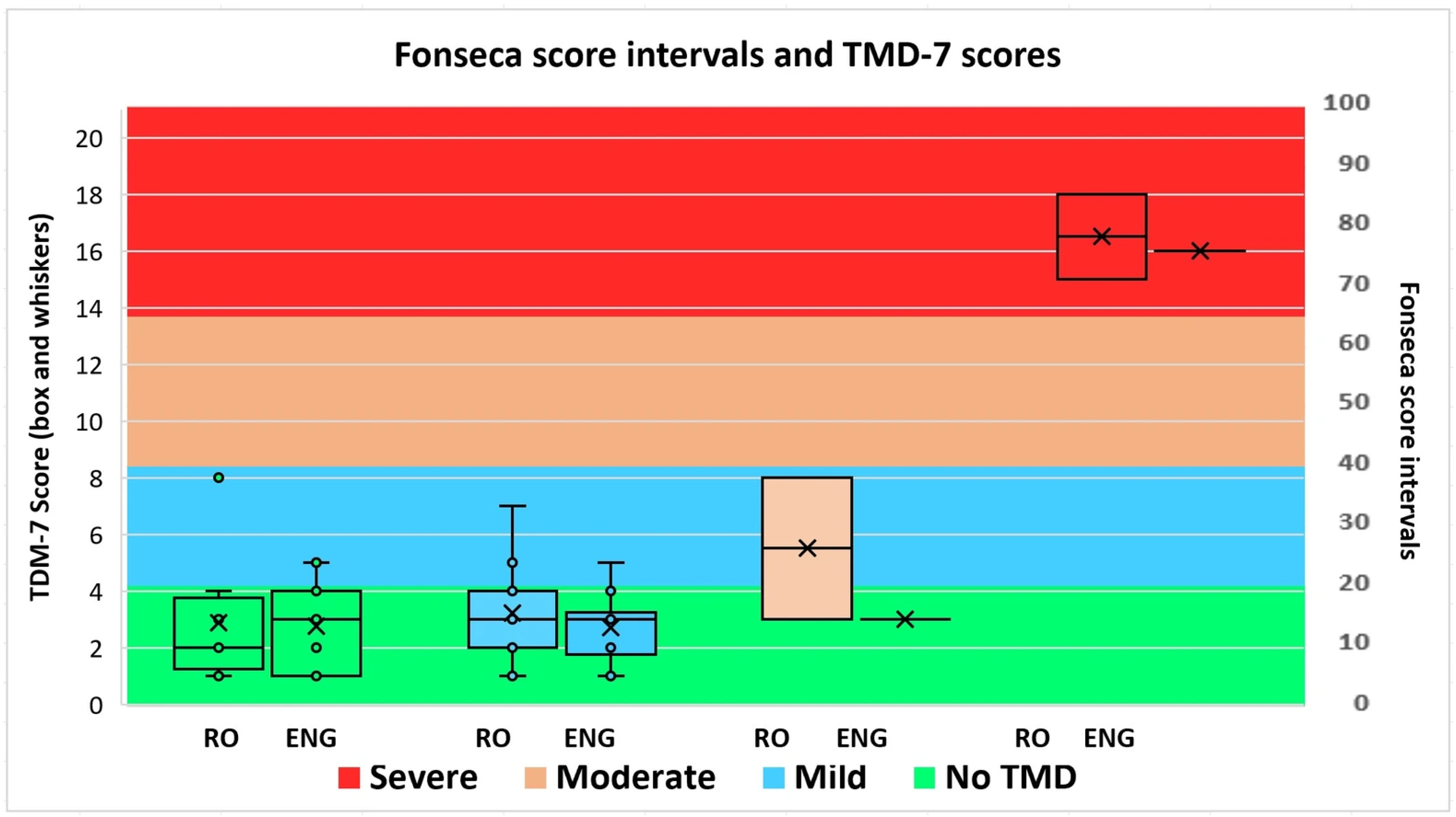
| Fonseca | Category | TMD-7 |
|---|---|---|
| 0–15 | No TMD | 0–4 |
| 20–40 | Mild TMD | 5–9 |
| 45–65 | Moderate TMD | 10–13 |
| 70–100 | Severe TMD | 14–21 |
Disclaimer/Publisher’s Note: The statements, opinions and data contained in all publications are solely those of the individual author(s) and contributor(s) and not of MDPI and/or the editor(s). MDPI and/or the editor(s) disclaim responsibility for any injury to people or property resulting from any ideas, methods, instructions or products referred to in the content. |
© 2026 by the authors. Licensee MDPI, Basel, Switzerland. This article is an open access article distributed under the terms and conditions of the Creative Commons Attribution (CC BY) license.
Share and Cite
Sofoulis, E.; Vlăduțu, D.E.; Mercuț, V.; Ionescu, M.; Brătoiu, M.R.; Rădoi, A.M.; Dică, Ș.; Mercuț, R. Validation of Two Diagnostic Tools for the Screening of Temporomandibular Disorder. Diagnostics 2026, 16, 1815. https://doi.org/10.3390/diagnostics16121815
Sofoulis E, Vlăduțu DE, Mercuț V, Ionescu M, Brătoiu MR, Rădoi AM, Dică Ș, Mercuț R. Validation of Two Diagnostic Tools for the Screening of Temporomandibular Disorder. Diagnostics. 2026; 16(12):1815. https://doi.org/10.3390/diagnostics16121815
Chicago/Turabian StyleSofoulis, Emmanouil, Diana Elena Vlăduțu, Veronica Mercuț, Mihaela Ionescu, Mihaela Roxana Brătoiu, Alexandra Maria Rădoi, Ștefana Dică, and Răzvan Mercuț. 2026. "Validation of Two Diagnostic Tools for the Screening of Temporomandibular Disorder" Diagnostics 16, no. 12: 1815. https://doi.org/10.3390/diagnostics16121815
APA StyleSofoulis, E., Vlăduțu, D. E., Mercuț, V., Ionescu, M., Brătoiu, M. R., Rădoi, A. M., Dică, Ș., & Mercuț, R. (2026). Validation of Two Diagnostic Tools for the Screening of Temporomandibular Disorder. Diagnostics, 16(12), 1815. https://doi.org/10.3390/diagnostics16121815