Article

SMAD4 Protein Alterations in Early-Onset Colorectal Cancer: Implications as a Potential Marker for Aggressive Disease and Prognosis—A Clinicopathological and Molecular Analysis of 18 Cases in Patients < 40 Years of Age


1
Department of Pathology, University of South Alabama, Mobile, AL 36617, USA
2
Department of Pathology, Yale University School of Medicine, New Haven, CT 06520, USA
3
GoPath Diagnostics, Buffalo Grove, IL 60089, USA
4
Weill Cornell Medical College, Cornell University, Huston, TX 14850, USA
*
Author to whom correspondence should be addressed.
Diagnostics 2026, 16(12), 1804; https://doi.org/10.3390/diagnostics16121804
Submission received: 14 April 2026 / Revised: 31 May 2026 / Accepted: 4 June 2026 / Published: 11 June 2026
(This article belongs to the Special Issue Innovations in Colorectal Cancer Detection and Diagnosis)

Abstract

Background/Objectives: Colorectal cancer (CRC) is relatively uncommon in individuals under 40 years of age; however, its rising incidence is a growing concern. This study aimed to investigate clinicopathologic features, genetic alterations, and protein expression patterns in early-onset colorectal cancer (EOCRC) to better understand the underlying mechanisms and prognostic factors. Methods: We retrospectively analyzed 18 patients diagnosed with EOCRC (<40 years) at our institution between 2018 and 2023. Next-generation sequencing (NGS) and immunohistochemistry (IHC) were used to assess genomic alterations and protein expression profiles. Clinicopathologic data were correlated with molecular findings and outcomes. Results: The cohort included ten females and eight males (mean age, 32.7 years; range, 17–38 years). Tumors most frequently arose in the rectum (56%) and were predominantly high stage (T3–T4, 67%) and moderately differentiated (78%). Lymphovascular invasion occurred in 50% of cases, and lymph node metastasis in 39%. Most tumors were microsatellite stable (MSS, 89%) and mismatch repair–proficient; two cases (11%) were MSI-high with germline MMR mutations. Among 17 patients who underwent NGS, the most frequent mutations involved KRAS (35%), APC (24%), TP53 (18%), and SMAD4 (18%). Notably, SMAD4 protein downregulation by IHC was observed in 67% of cases, including 60% of SMAD4 wild-type tumors. Loss of SMAD4 expression was significantly associated with lymph node metastasis (p = 0.037) and poor survival (p = 0.045). Conclusions: SMAD4 alteration—on both the genetic and protein levels—is common in EOCRC and is significantly correlated with aggressive clinicopathologic features and worse prognosis.

1. Introduction

Colorectal cancer (CRC) is the third most diagnosed malignancy worldwide and the second leading cause of cancer-related mortality [1], affecting individuals over the age of 50. The incidence of CRC in individuals under the age of 50, known as early-onset colorectal cancer (EOCRC), has been on the rise [2], drawing attention to its unique clinicopathologic and molecular characteristics. Unlike older patients, EOCRC patients, especially those under 40 years, are less likely to undergo routine colonoscopy screening, leading to delays in diagnosis and potentially more aggressive disease at presentation [3,4]. Lifestyle factors, environmental exposures, and genetic predispositions are thought to contribute to this trend [5].
While mutational and transcriptional profiles in EOCRC have been previously investigated [6,7,8], limited attention has been given to changes at the protein level. Of particular interest is the SMAD4 gene, a crucial component of the TGF-β signaling pathway, which has garnered attention due to its established role in juvenile polyposis syndrome (JPS), CRC, and other hereditary tumors in young patients [9]. Juvenile polyposis syndromes with mutations in the SMAD4 and BMPR1A genes confer a 10–38% lifetime risk of CRC [10,11]. Alterations in SMAD4, such as genomic mutations and loss of protein expression, have been associated with advanced disease, metastasis, and poor prognosis in late-onset CRC patients [12,13]. SMAD4 mutations were detected in 14.3 to 19% EOCRC in some studies [6,14]; however, the status of SMAD4 protein expression in EOCRC remains to be elucidated.
In this study, we retrospectively examined clinicopathologic features, genetic alterations, and protein expression in 18 patients diagnosed with EOCRC under the age of 40 at our institution from 2018 to 2023. Although EOCRC is generally defined as colorectal cancer diagnosed before the age of 50 years, we selected a cutoff of <40 years to enrich for a very young EOCRC population, in whom hereditary predisposition and unique disease characteristics are more prevalent than in the broader EOCRC population defined by age < 50 years. Utilizing next-generation sequencing (NGS) and immunohistochemistry (IHC), we particularly focused on SMAD4 genomic mutations and the patterns of protein expression, aiming to uncover their clinical significance and association with disease prognosis in this unique population. Our findings reveal a profound alteration in SMAD4 protein level, which may serve as a potential marker for aggressive disease phenotypes and poor clinical outcomes in young CRC patients, thereby providing insights into the biological behavior of EOCRC and suggesting novel avenues for therapeutic intervention.

2. Materials and Methods

2.1. Case Selection and Data Collection

This study was approved by the Institutional Review Board of the University of South Alabama, Whiddon College of Medicine. A HIPAA waiver was granted, as the research involved a discarded tissue and chart review study with no collection or storage of patient-identifiable data post-screening. A computer search of the surgical pathology files of the University of South Alabama, Whiddon College of Medicine, was carried out (encompassing the years 2018 to 2023) for colon adenocarcinoma in individuals under 40 years old; eighteen cases were identified, and they were all surgical resections.
All specimens were formalin-fixed and paraffin-embedded tissue sections. Hematoxylin and eosin-stained slides were reviewed for confirmation. Detailed clinicopathological data, including tumor diagnosis, TNM classification, tumor location, mismatch repair (MMR) status, Microsatellite Instability (MSI) test, NGS, and patient follow-up status, were extracted from the pathology and clinical records. Survival times were obtained and correlated with medical record charts for data analysis (Table 1). All patients underwent surgical resection as primary treatment. Adjuvant chemotherapy was administered based on tumor stage and institutional clinical guidelines; however, detailed treatment regimens were not uniformly available due to the retrospective nature of the study.

2.2. Next-Generation Sequencing (NGS)

Formalin-fixed paraffin-embedded (FFPE) samples underwent next-generation sequencing (NGS) to assess genetic alterations. To ensure quality, an independent pathologist reviewed hematoxylin and eosin (H&E) stained sections to confirm a >50% tumor content in each sample. All sample preparation, NGS, and bioinformatics analyses were conducted in a CLIA/CAP-accredited laboratory (Caris Life Sciences, Phoenix, AZ, USA), which interrogates coding regions of cancer-related genes. The assay covers single-nucleotide variants, insertions/deletions, and selected copy number alterations. Sequencing was performed with an average coverage depth of >500×, ensuring high sensitivity for mutation detection. The panel includes key oncogenes and tumor suppressor genes relevant to colorectal cancer. Orthogonal validation using Sanger sequencing was not performed due to the retrospective design and limited availability of residual tumor material. However, all NGS analyses were conducted in a CLIA/CAP-accredited laboratory with validated pipelines, ensuring high analytical accuracy. Data from 17 patients were further analyzed, and one patient did not undergo NGS due to the anticipated out-of-pocket cost, as documented in the clinical record.

2.3. Immunohistochemistry Staining of SMAD4

Sections (4 μm) were cut from paraffin blocks and deparaffinized using standard methods. Slides were treated with sodium citrate and steamed for 30 min at 80 °C. After cooling for 5 min, the slides were labeled with a monoclonal antibody specific to Smad4 (Clone D3R4N, Cell Signaling Technology, Inc. Danvers, MA, USA) at a dilution of 1:400. The antibody was detected using a biotinylated secondary antibody and 3,3′-diaminobenzidine as the chromogen. Then, the slides were counterstained with hematoxylin.
All SMAD4 immunohistochemical evaluations were performed independently by pathologists who were blinded to clinical, molecular, and outcome data to minimize potential bias. SMAD4 expression was evaluated semi-quantitatively using both staining intensity and distribution. Expression patterns were categorized as follows: (1) retained/standard expression (comparable to adjacent normal mucosa), (2) strong expression (>95% tumor cells with strong intensity), (3) weak expression (reduced intensity compared to normal mucosa), and (4) loss of expression. Loss was defined as the complete absence of staining in ≥5% of tumor cells. Clonal loss was defined as the complete loss of SMAD4 staining in cohesive groups of tumor glands or clusters, while surrounding tumor cells retained expression, indicating intratumoral heterogeneity [12].

2.4. SMAD4 Protein Alterations and Clinicopathological Characteristics

To investigate the association between SMAD4 protein alteration and clinicopathological characteristics, 10 variables were examined across all 18 patients based on pathological reports and clinical records (Table 2).

2.5. Statistics Analysis

Associations between SMAD4 alterations and clinicopathological variables were assessed using Fisher’s exact test. Survival curves were generated using the Kaplan–Meier method and compared with the log-rank test. p-values < 0.05 were considered statistically significant.

3. Results

3.1. Clinical Features of the EOCRC < 40 Years Old Cases

The clinicopathologic findings for the 18 cases are detailed in Table 1. A comprehensive review of the clinical features revealed a balanced distribution between males (8/18) and females (10/18). The age range of the patients spanned from 17 to 38 years, with a mean age of 32.7 years and a median age of 34 years. The primary tumor sites exhibited a predominant presence in the rectum (10/18, 56%), followed by tumors located in the sigmoid colon (3/18, 17%) and the descending colon (3/18, 17%). Singular cases were found in the transverse and ascending colon, respectively.
The diagnosis was typically made at an advanced stage (T3 or T4) in 12 out of 18 cases (67%), with most tumors being moderately differentiated (G2) in 14 out of 18 cases (78%). Case #1, involving the youngest patient in this cohort at 17 years old, exhibited high-grade features with signet-ring cells (G3). Lymph vascular invasion was observed in 50% of cases (9/18), with 89% of these cases showing small vessel invasion (8/9). Lymph node metastasis was detected in 39% of cases (7/18). Perineural invasion was identified in 50% of cases (9/18), underscoring the invasive nature of the tumors. Most cases were identified as microsatellite stable (MSS) and proficient in mismatch repair (MMR) protein, accounting for 16 out of 18 cases (89%). Small vessel invasion is associated with lymph node metastasis and has been shown to be an independent indicator of adverse outcomes in some studies [15,16,17]. Microsatellite instability-high (MSI-H) was detected in two cases, both of which involved germline mutations in MMR genes. No sporadic MMR-deficient cases were detected in this cohort.

3.2. Genomic Alterations Detected in the EOCRC < 40 Years Old Cases

The most common mutant genes in this study include KRAS (35%, 6/17), APC (24%, 4/17), TP53 (17.6%, 3/17), and SMAD4 (17.6%, 3/17). Genomic alterations of SMAD4 were focused on in this study. These SMAD4 alterations consisted of one missense mutation and two nonsense mutations. Notably, one of the identified nonsense mutations, c.1162C>T (p.Q388*, case #7), and the missense mutation 1082G>A (p.R361H, case #10), have been previously characterized as pathogenic mutations linked to JPS and CRC [9,18,19,20,21], and especially, the missense mutation p.R361H is a relative hotspot mutation of SMAD4 in CRC [22,23].
A novel nonsense mutation, p.E33* (case #4), was identified in this research, resulting in premature termination of transcription at the 33rd amino acid within the N-terminal domain of the SMAD4 protein. Normally, the structural integrity of the SMAD4 protein is governed by a highly conserved arrangement of two functional domains: the N-terminal MH1 domain responsible for DNA binding, and the C-terminal MH2 domain crucial for transcriptional activation, as elucidated by Qin B. et al. [24]. The truncation caused by this newly identified mutation likely renders the protein completely inactive, as it leads to the loss of essential MH1 and MH2 functional domains, compromising its biological function in the TGF-β signaling pathway.
It is noteworthy that all three SMAD4 genetic alterations we detected occurred exclusively in the subset of EOCRC cases harboring mutated KRAS genes, indicating a significant association (p = 0.0245). In contrast, no SMAD4 alterations were observed in the KRAS wild-type EOCRC cases (Supplement Table S1).

3.3. Protein Expression Alterations of SMAD4 in Early-Onset Patients Are More Significant than Genomic Mutations

Immunohistochemistry staining of SMAD4 revealed a higher prevalence of downregulated protein compared to its genomic mutation rate, affecting 67% of cases (12 out of 18) (Figure 1). Among the SMAD4 wild-type cases, 60% showed downregulation at the protein level (9 out of 15).
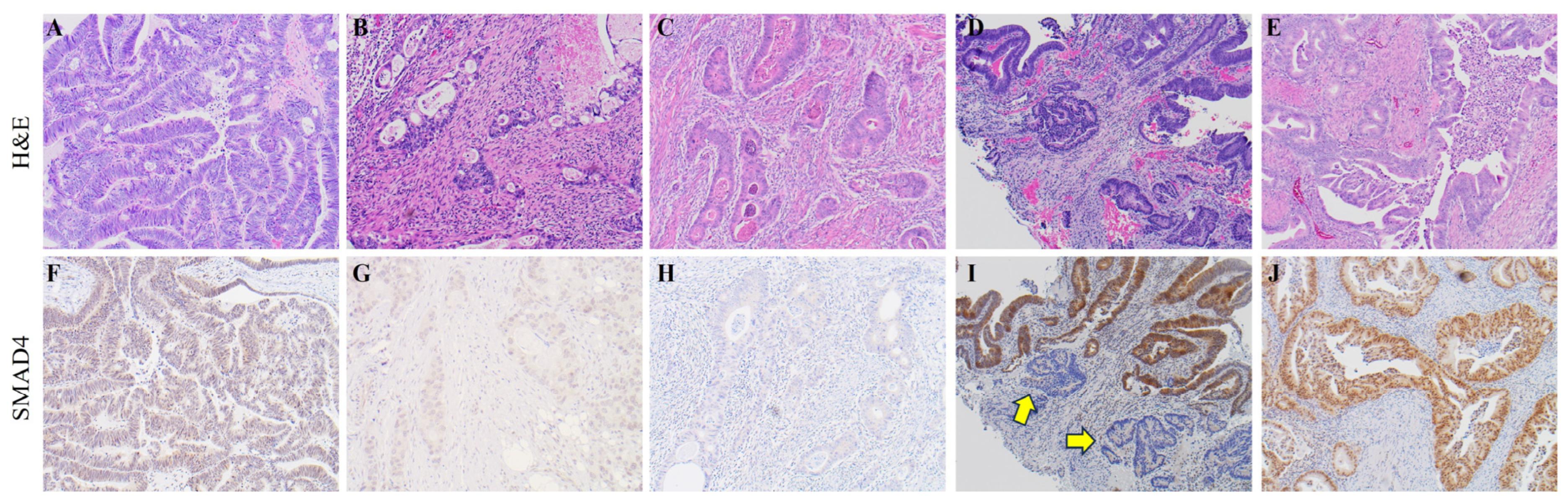
Five different SMAD4 expression patterns were identified in the 18 young CRC patients, including standard expression, weak expression, complete loss, heterogeneous loss (clonal loss), and strong nuclear expression by IHC staining (Figure 2).
Six patients showed standard expression (6/18), in which SMAD4 is typically located in both the cytoplasm and the nucleus, similar to normal mucosa; nine patients showed loss of SMAD4 expression, including complete (5/18) or clonal loss (4/18), whereas one patient showed strong, and two patients showed weak expression, respectively (Figure 2). The two patients with SMAD4 nonsense mutation (case #4 and case #7) showed SMAD4 protein loss, and the missense mutation case (case #10) showed strong nuclear staining (Table 1). Interestingly, 60% of patients with wild-type SMAD4 (9/15) showed loss or weakness of SMAD4 protein expression. These results suggest that post-translational mechanisms or epigenetic modifications might play a crucial role in SMAD4 protein dysregulation in EOCRC patients. In case #10, a p.R361H mutation was detected, which was reported as a high-prevalence mutation in CRC, and the mutant protein disrupted Smad2/3-Smad4 heteromeric complex formation and abolished canonical TGF-β signaling. In that, they were similar to SMAD4 loss [20], although IHC showed a strong positive.

3.4. Loss of SMAD 4 Protein Is Related to Lymph Node Metastasis

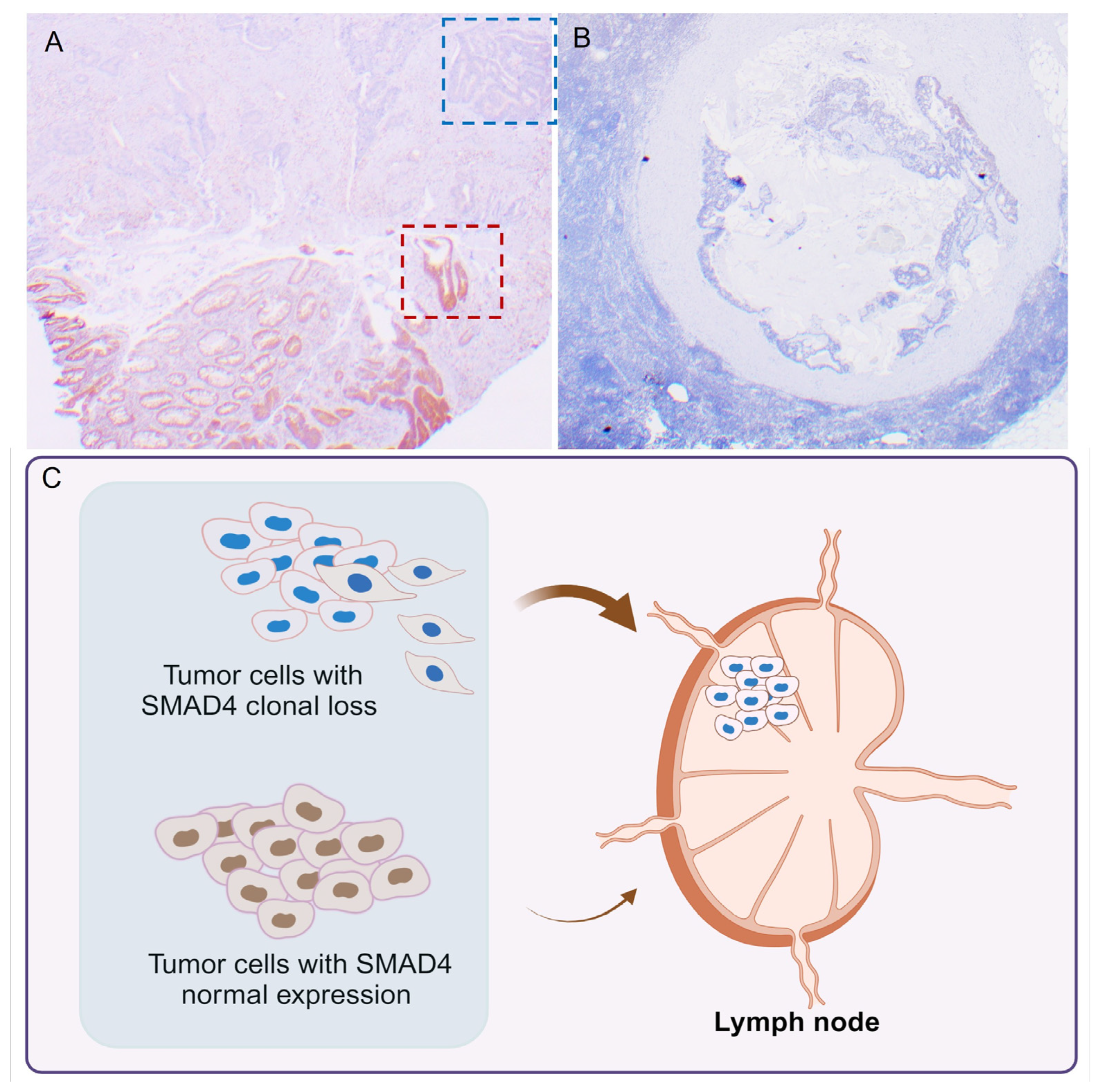
In this study, lymph node metastasis was more common in the group with downregulated SMAD4 protein (7/12) than in the standard SMAD4 group (0/6) (p = 0.0377). All cases with lymph node metastasis exhibited downregulated SMAD4 protein expression (Table 1 and Table 2). Interestingly, among the four cases with SMAD4 protein clonal loss, 50% had lymph node metastasis (2/4), and in those metastatic lymph nodes, only tumor cells negative for SMAD4 were detected (Figure 3A,B). This suggests that in patients with SMAD4 clonal loss, tumor cells lacking SMAD4 were more prone to metastasize to lymph nodes compared to cells with normal SMAD4 expression (Figure 3C).

3.5. Follow-Up

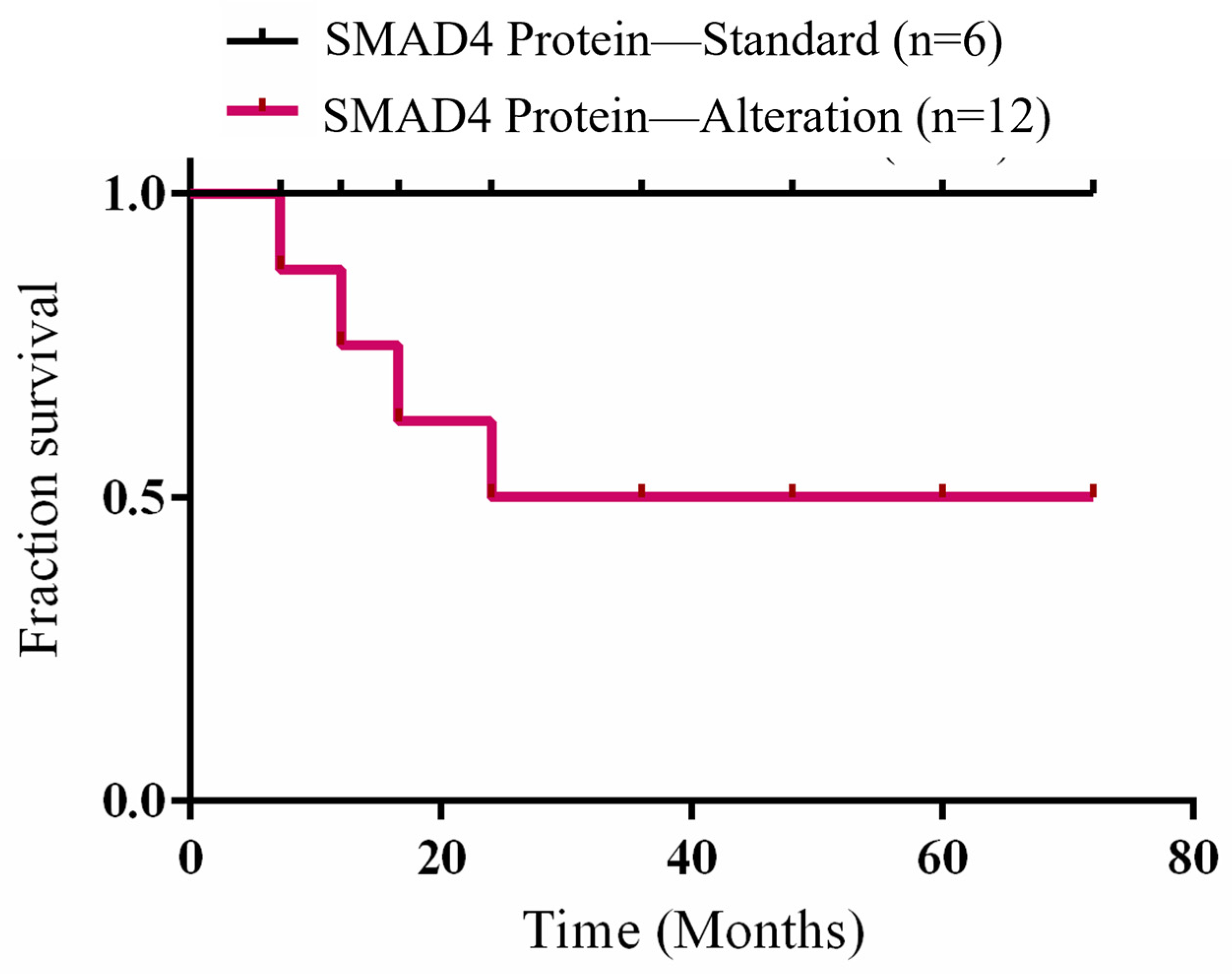
Further clinical follow-up data were obtained for 18 patients (median: 24 months; range 6.2–72.7 months). Excluding the two cases with pre-resection metastasis, 31% (5/16) developed post-resection metastases at intervals ranging from 5.7 to 32.6 months (median, 9.6 months), commonly to the lung (4/5, 80%), liver (2/5, 40%), and lymph nodes (2/5, 40%). Patient #7 experienced recurrence at 2.4 months, with an NGS test revealing new mutations in APC, B2M, TCF7L2, TERT, and TP53 in addition to the initially detected KRAS mutation. Currently, eight patients are alive with no evidence of disease, while four patients succumbed to the disease within 7.2 to 24 months (mean: 16.8 months) of diagnosis, all showing alterations in SMAD4 protein expression (p = 0.045, Figure 4). This result suggested that patients with SMAD4 protein alterations may be associated with poor survival, especially when in the proximal colon (ascending and transverse), resulting in a 100% (2/2) mortality rate within 18 months (16.6 months and 7.2 months). While a SMAD4 protein alteration was associated with poorer survival, these findings are preliminary rather than definitive. Larger studies with a longer follow-up are required to validate the prognostic significance of SMAD4 alterations in EOCRC.

4. Discussion

This study provides insights into the clinical and molecular characteristics of early-onset colorectal cancer (EOCRC) in a cohort of patients under 40 years old. The predominant tumor localization is in the rectum (56%). The advanced stage at diagnosis (67% at T3 or T4) emphasizes the aggressive nature of EOCRC compared to traditional late-onset colorectal cancer. These findings are consistent with existing literature that suggests EOCRC often presents with advanced disease [18,25].
In previous studies, it was found that in patients with EOCRC, MSI-H tumors were more commonly attributed to germline mutations in MMR genes [26,27,28] rather than to epigenetic inactivation of the MLH1 MMR gene, which is more common in the sporadic MSI-H tumors observed in patients with later-onset colorectal cancers [25,29]. These findings align with the results of our study, too.
The SMAD4 tumor suppressor gene product is important in intestinal carcinogenesis. Germline mutations in SMAD4 cause juvenile polyposis syndrome (JPS) with a dominantly autosomal inherited predisposition to multiple gastrointestinal polyps and cancer [9]. SMAD4 mutations have recently been reported in 5–20% of sporadic colorectal carcinomas (CRC), where they were associated with distant metastases and/or poor prognosis in some studies but not in others [22,30,31,32,33,34]. The SMAD4 gene is located on chromosome 18q21.1 and spans 55,000 base pairs across 11 exons, encoding a 551-amino acid protein. It contains functional domains, including the MH1 domain responsible for DNA binding, a domain that connects the two MH domains, and the MH2 domain crucial for homodimerization, heterodimerization, transcriptional activation, and the nuclear localization of SMAD4 [24]. SMAD4 genomic alterations were detected in 17.6% of cases in our study, including previously characterized pathogenic mutations linked to juvenile polyposis syndrome, and we also identified a novel nonsense mutation, p.E33*, to the spectrum of SMAD4 mutations, which likely results in complete functional loss of the protein due to the truncation of essential domains. The SMAD4 genomic mutation rate is consistent with previous studies, which show that there were no significant differences in genomic tumor profiles between patients with early-onset and those with later-onset colorectal cancer [35].
Furthermore, the strong association between SMAD4 mutations and KRAS mutations suggests a potential synergistic role in EOCRC pathogenesis, which is consistent with previous findings that highlight the interplay between these genes in colorectal cancer [9,30]. In normal cells, SMAD4 is typically located in both the cytoplasm and the nucleus, with its localization changing upon activation by TGF-β signaling. Loss of SMAD4 expression has been observed in 37% of primary CRC cases in individuals over 40 years old [15]. Another study reported a 19% rate of SMAD4 protein alterations in late-onset CRC patients, which is generally interpreted as a sign of a poorer prognosis due to the loss of tumor-suppressive activities associated with TGF-β signal transduction [13]. The diverse expression patterns of SMAD4 in EOCRC, including complete loss, clonal loss, weak expression, and strong nuclear expression, highlight the complex regulatory mechanisms governing this protein. In our EOCRC under 40 years old cohort, the higher frequency of SMAD4 protein downregulation compared to genomic mutations (67% vs. 17.6%) suggests additional regulatory mechanisms. Potential explanations include epigenetic silencing, such as promoter methylation, microRNA-mediated suppression, and post-translational modifications leading to altered protein stability or degradation. Furthermore, disruptions in TGF-β signaling components may affect SMAD4 nuclear localization and function without altering protein expression levels detectable by sequencing. These mechanisms may together contribute to SMAD4 dysregulation in EOCRC. This finding indicates that SMAD4 immunohistochemistry (IHC) may be more critical to perform than genomic mutation analysis in EOCRC patients In addition, SMAD4 p.R361H was reported as a functional loss and a hotspot mutation in CRC that shows diffuse strong nuclear positive in our immunohistochemistry staining, like the IHC pattern of some of the P53 mutation; therefore, we looked at it as “SMAD4 loss” [20].
Recent large-scale genomic and multi-omics studies, including TCGA-based and multi-institutional analyses, have demonstrated that EOCRC shares many molecular features with later-onset CRC while also exhibiting distinct clinicopathological characteristics [6,7,8,35]. Consistent with these reports, our study found no marked difference in the overall mutation frequency of key driver genes such as KRAS, APC, and TP53. However, our findings highlight a disproportionately higher rate of SMAD4 protein downregulation relative to genomic alterations, suggesting that post-genomic regulatory mechanisms may play a more prominent role in EOCRC. This observation complements prior multi-omics studies by emphasizing the importance of protein-level evaluation in understanding tumor biology.
The correlation between SMAD4 protein alterations and lymph node metastasis (58% in cases with downregulated SMAD4 vs. 0% in cases with standard expression) supports the hypothesis that SMAD4 plays a critical role in tumor invasiveness and metastasis. This is further supported by the observation that clonal loss of SMAD4 protein is associated with a higher propensity for lymph node metastasis, indicating that SMAD4-deficient tumor cells have an enhanced metastatic potential as reported in previous studies [13,15].
Follow-up data reveal that post-resection metastases occurred in 31% of patients, predominantly affecting the lungs, liver, and lymph nodes, with a median time to metastasis of 9.6 months. This high rate of metastasis underscores the aggressive nature of EOCRC. The particularly poor prognosis for EOCRC cases in the proximal colon aligns with previous studies indicating a worse outcome for right-sided colorectal cancers [19].
Our study has several limitations. Firstly, the relatively small sample size may compromise the generalizability of the findings to a larger population. This study should be interpreted as an exploratory analysis given the relatively small cohort size, which reflects the rarity of colorectal cancer in patients under 40 years of age. Although all eligible cases within the study period were included to minimize selection bias, the limited sample size restricts the statistical power and generalizability of the findings. Larger, multi-institutional studies are needed to validate these observations. Secondly, as the study was conducted at a single center, there is a risk that the lack of diversity in the patient population could introduce bias into the results. Thirdly, this study did not compare early-onset colorectal cancer cases to later-onset cases, which hinders the ability to make direct comparisons and understand the unique characteristics of early-onset colorectal cancer, although comparisons were made with previously published later-onset cases. Fourthly, the follow-up period was relatively short, potentially overlooking long-term outcomes and recurrence patterns in early-onset colorectal cancer patients. Additionally, given the limited sample size and number of outcome events, multivariate analysis was not performed due to the risk of model overfitting and unreliable estimates. Future studies with larger cohorts are needed to determine whether SMAD4 protein alterations are independently associated with metastatic behavior.

5. Conclusions

This study highlights the unique clinical and molecular landscape of EOCRC < 40 years old, emphasizing the aggressive nature of the disease and the significant role of SMAD4 protein expression alterations. The findings suggest that SMAD4 protein downregulation, more prevalent than genomic mutations, is a critical factor in tumor progression, metastasis, and poor prognosis. The association between SMAD4 and KRAS mutations provides a potential pathway for targeted therapies. The poor prognosis associated with SMAD4 protein alterations and proximal colon tumors underscores the need for early detection and aggressive treatment strategies in EOCRC < 40 years.
Future research should focus on elucidating the mechanisms underlying SMAD4 protein downregulation and its interaction with other oncogenic pathways. Additionally, exploring targeted therapies that address the SMAD4 and KRAS pathways may offer new hope for improving outcomes in EOCRC patients.

Supplementary Materials

The following supporting information can be downloaded at: https://www.mdpi.com/article/10.3390/diagnostics16121804/s1, Table S1: SMAD4 genetic mutation occurred exclusively in the subset of EOCRC cases harboring mutated KRAS genes.

Author Contributions

L.X.: data collection, analysis, methodology development, and original draft preparation. J.L.: methodology development and validation. L.Z.: Conceptualization, manuscript revision, and editing. W.X.: Conceptualization and design, data review, and writing and revision of the manuscript. All authors have read and agreed to the published version of the manuscript.

Funding

The first author received resident research funding from the University of South Alabama, Pathology department, Grant number #112000-730910-4100. This study was also partially supported by NIH NCI grant 5RO1 CA294584.

Institutional Review Board Statement

This study was approved by the Institutional Review Board of University of South Alabama Whiddon College of Medicine (45 CFR 46.102, 13 June 2023).

Informed Consent Statement

A HIPAA waiver was granted, as the research involved a discarded tissue and chart review study, with no collection or storage of patient-identifiable data post-screening.

Data Availability Statement

The original contributions presented in this study are included in the article/Supplementary Materials. Further inquiries can be directed to the corresponding author.

Acknowledgments

The authors acknowledge Terry W. Pierce (Histology Technician) and the resources and services provided by the USA Health Biobank and Histology Core Facility, a shared facility in the College of Medicine at the University of South Alabama.

Conflicts of Interest

The authors declare no conflicts of interest.

Abbreviations

The following abbreviations are used in this manuscript:
FFemale
MMale
AAAfrican American
WWhite
NANot available
NINot identified
NDNo pathologic mutation detected
SSmall vein
LLarge vein
PPresent
LV invLymphovascular invasion
PN invPerineural invasion
WTWild type
MUTMutant
DODDied of disease
AWMAlive with metastasis
AWODAlive without disease

References

  1. Siegel, R.L.; Wagle, N.S.; Cercek, A.; Smith, R.A.; Jemal, A. Colorectal cancer statistics. CA Cancer J. Clin. 2023, 73, 233–254. [Google Scholar] [PubMed]
  2. Sinicrope, F.A. Increasing incidence of early-onset colorectal cancer. N. Engl. J. Med. 2022, 386, 1547–1558. [Google Scholar] [CrossRef] [PubMed]
  3. Burnett-Hartman, A.N.; Powers, J.D.; Chubak, J.; Corley, D.A.; Ghai, N.R.; McMullen, C.K.; Pawloski, P.A.; Sterrett, A.T.; Feigelson, H.S. Treatment patterns and survival differ between early-onset and late-onset colorectal cancer patients: The patient outcomes to advance learning network. Cancer Causes Control 2019, 30, 747–755. [Google Scholar] [CrossRef]
  4. Chen, F.W.; Sundaram, V.; Chew, T.A.; Ladabaum, U. Advanced-stage colorectal cancer in persons younger than 50 years not associated with longer duration of symptoms or time to diagnosis. Clin. Gastroenterol. Hepatol. 2017, 15, 728–737.e3. [Google Scholar] [CrossRef]
  5. Akimoto, N.; Ugai, T.; Zhong, R.; Hamada, T.; Fujiyoshi, K.; Giannakis, M.; Wu, K.; Cao, Y.; Ng, K.; Ogino, S. Rising incidence of early-onset colorectal cancer: A call to action. Nat. Rev. Clin. Oncol. 2021, 18, 230–243. [Google Scholar] [CrossRef] [PubMed]
  6. Xu, T.; Zhang, Y.; Zhang, J.; Qi, C.; Liu, D.; Wang, Z.; Li, Y.; Ji, C.; Li, J.; Lin, X.; et al. Germline profiling and molecular characterization of early-onset metastatic colorectal cancer. Front. Oncol. 2020, 10, 568911. [Google Scholar] [CrossRef]
  7. Yan, H.H.N.; Siu, H.C.; Ho, S.L.; Yue, S.S.K.; Gao, Y.; Tsui, W.Y.; Chan, D.; Chan, A.S.; Wong, J.W.H.; Man, A.H.Y.; et al. Organoid cultures of early-onset colorectal cancers reveal distinct and rare genetic profiles. Gut 2020, 69, 2165–2177. [Google Scholar] [CrossRef]
  8. Du, M.; Gu, D.; Xin, J.; Peters, U.; Song, M.; Cai, G.; Li, S.; Ben, S.; Meng, Y.; Chu, H.; et al. Integrated multi-omics approach to distinct molecular characterization and classification of early-onset colorectal cancer. Cell Rep. Med. 2023, 4, 100974. [Google Scholar] [CrossRef]
  9. Cao, K.; Plazzer, J.P.; Macrae, F. SMAD4 variants and genotype–phenotype correlations in juvenile polyposis syndrome. Hered. Cancer Clin. Pract. 2023, 21, 27. [Google Scholar] [CrossRef]
  10. Jasperson, K.W.; Tuohy, T.M.; Neklason, D.W.; Burt, R.W. Hereditary and familial colon cancer. Gastroenterology 2010, 138, 2044–2058. [Google Scholar] [CrossRef]
  11. Brosens, L.A.; van Hattem, A.; Hylind, L.M.; Iacobuzio-Donahue, C.; Romans, K.E.; Axilbund, J.; Cruz-Correa, M.; Tersmette, A.C.; A Offerhaus, G.J.; Giardiello, F.M. Risk of colorectal cancer in juvenile polyposis. Gut 2007, 56, 965–967. [Google Scholar] [CrossRef]
  12. Yan, P.; Klingbiel, D.; Saridaki, Z.; Ceppa, P.; Curto, M.; McKee, T.A.; Roth, A.; Tejpar, S.; Delorenzi, M.; Bosman, F.T.; et al. Reduced expression of SMAD4 is associated with poor survival in colon cancer. Clin. Cancer Res. 2016, 22, 3037–3047. [Google Scholar] [CrossRef]
  13. Oyanagi, H.; Shimada, Y.; Nagahashi, M.; Ichikawa, H.; Tajima, Y.; Abe, K.; Nakano, M.; Kameyama, H.; Takii, Y.; Kawasaki, T.; et al. SMAD4 alteration associates with invasive-front pathological markers and poor prognosis in colorectal cancer. Histopathology 2019, 74, 873–882. [Google Scholar] [CrossRef] [PubMed]
  14. Puccini, A.; Lenz, H.-J.; Marshall, J.L.; Arguello, D.; Raghavan, D.; Korn, W.M.; Weinberg, B.A.; Poorman, K.; Heeke, A.L.; Philip, P.A.; et al. Impact of patient age on molecular alterations of left-sided colorectal tumors. Oncologist 2019, 24, 319–326. [Google Scholar] [CrossRef]
  15. Losi, L.; Bouzourene, H.; Benhattar, J. Loss of SMAD4 expression predicts liver metastasis in human colorectal cancer. Oncol. Rep. 2007, 17, 1095–1099. [Google Scholar] [CrossRef][Green Version]
  16. Ueno, H.; Mochizuki, H.; Hashiguchi, Y.; Shimazaki, H.; Aida, S.; Hase, K.; Matsukuma, S.; Kanai, T.; Kurihara, H.; Ozawa, K.; et al. Risk factors for an adverse outcome in early invasive colorectal carcinoma. Gastroenterology 2004, 127, 385–394. [Google Scholar] [CrossRef] [PubMed]
  17. Choi, D.H.; Sohn, D.K.; Chang, H.J.; Lim, S.B.; Choi, H.S.; Jeong, S.Y. Indications for subsequent surgery after endoscopic resection of submucosally invasive colorectal carcinomas: A prospective cohort study. Dis. Colon Rectum 2009, 52, 438–445. [Google Scholar] [CrossRef]
  18. Carr, J.C.; Dahdaleh, F.S.; Wang, D.; Howe, J.R. Germline mutations in SMAD4 disrupt bone morphogenetic protein signaling. J. Surg. Res. 2012, 174, 211–214. [Google Scholar] [CrossRef]
  19. Handra-Luca, A.; Condroyer, C.; de Moncuit, C.; Tepper, M.; Fléjou, J.F.; Thomas, G.; Olschwang, S. Vessels’ morphology in SMAD4- and BMPR1A-related juvenile polyposis. Am. J. Med. Genet. A 2005, 138, 113–117. [Google Scholar] [CrossRef] [PubMed]
  20. Lanauze, C.B.; Sehgal, P.; Hayer, K.; Torres-Diz, M.; Pippin, J.A.; Grant, S.F.A.; Thomas-Tikhonenko, A. Colorectal cancer–associated SMAD4 R361 hotspot mutations boost Wnt/β-catenin signaling through enhanced SMAD4–LEF1 binding. Mol. Cancer Res. 2021, 19, 823–833. [Google Scholar] [CrossRef]
  21. Fleming, N.I.; Jorissen, R.N.; Mouradov, D.; Christie, M.; Sakthianandeswaren, A.; Palmieri, M.; Day, F.; Li, S.; Tsui, C.; Lipton, L.; et al. SMAD2, SMAD3, and SMAD4 mutations in colorectal cancer. Cancer Res. 2013, 73, 725–735. [Google Scholar] [CrossRef] [PubMed]
  22. Mehrvarz Sarshekeh, A.; Advani, S.; Overman, M.J.; Manyam, G.; Kee, B.K.; Fogelman, D.R.; Dasari, A.; Raghav, K.; Vilar, E.; Manuel, S.; et al. Association of SMAD4 mutation with patient demographics, tumor characteristics, and clinical outcomes in colorectal cancer. PLoS ONE 2017, 12, e0173345. [Google Scholar]
  23. Brannon, A.R.; Vakiani, E.; Sylvester, B.E.; Scott, S.N.; McDermott, G.; Shah, R.H.; Kania, K.; Viale, A.; Oschwald, D.M.; Vacic, V.; et al. Comparative sequencing analysis reveals high genomic concordance between matched primary and metastatic colorectal cancer lesions. Genome Biol. 2014, 15, 454. [Google Scholar] [CrossRef] [PubMed]
  24. Qin, B.; Lam, S.S.; Lin, K. Crystal structure of a transcriptionally active SMAD4 fragment. Structure 1999, 7, 1493–1503. [Google Scholar] [CrossRef]
  25. Sinicrope, F.A. Lynch syndrome–associated colorectal cancer. N. Engl. J. Med. 2018, 379, 764–773. [Google Scholar] [CrossRef]
  26. Mork, M.E.; You, Y.N.; Ying, J.; Bannon, S.A.; Lynch, P.M.; Rodriguez-Bigas, M.A.; Vilar, E. High prevalence of hereditary cancer syndromes in adolescents and young adults with colorectal cancer. J. Clin. Oncol. 2015, 33, 3544–3549. [Google Scholar] [CrossRef]
  27. Pearlman, R.; Frankel, W.L.; Swanson, B.; Zhao, W.; Yilmaz, A.; Miller, K.; Bacher, J.; Bigley, C.; Nelsen, L.; Goodfellow, P.J.; et al. Prevalence and spectrum of germline cancer susceptibility gene mutations among patients with early-onset colorectal cancer. JAMA Oncol. 2017, 3, 464–471. [Google Scholar] [CrossRef]
  28. Stoffel, E.M.; Koeppe, E.; Everett, J.; Ulintz, P.; Kiel, M.; Osborne, J.; Williams, L.; Hanson, K.; Gruber, S.B.; Rozek, L.S. Germline genetic features of young individuals with colorectal cancer. Gastroenterology 2018, 154, 897–905. [Google Scholar] [CrossRef]
  29. Poynter, J.N.; Siegmund, K.D.; Weisenberger, D.J.; Long, T.I.; Thibodeau, S.N.; Lindor, N.; Young, J.; Jenkins, M.A.; Hopper, J.L.; Baron, J.A.; et al. Molecular characterization of MSI-H colorectal cancer by MLH1 promoter methylation, immunohistochemistry, and mismatch repair germline mutation screening. Cancer Epidemiol. Biomark. Prev. 2008, 17, 3208–3215. [Google Scholar] [CrossRef] [PubMed]
  30. Liao, X.; Hao, Y.; Zhang, X.; Ward, S.; Houldsworth, J.; Polydorides, A.D.; Harpaz, N. Clinicopathological characterization of SMAD4-mutated intestinal adenocarcinomas: A case–control study. PLoS ONE 2019, 14, e0212142. [Google Scholar] [CrossRef]
  31. Miyaki, M.; Iijima, T.; Konishi, M.; Sakai, K.; Ishii, A.; Yasuno, M.; Hishima, T.; Koike, M.; Shitara, N.; Iwama, T.; et al. Higher frequency of SMAD4 gene mutation in human colorectal cancer with distant metastasis. Oncogene 1999, 18, 3098–3103. [Google Scholar] [CrossRef]
  32. Alazzouzi, H.; Alhopuro, P.; Salovaara, R.; Sammalkorpi, H.; Järvinen, H.; Mecklin, J.P.; Hemminki, A.; Schwartz, S.; Aaltonen, L.A.; Arango, D. SMAD4 as a prognostic marker in colorectal cancer. Clin. Cancer Res. 2005, 11, 2606–2611. [Google Scholar] [CrossRef] [PubMed]
  33. Mizuno, T.; Cloyd, J.M.; Vicente, D.; Omichi, K.; Chun, Y.S.; Kopetz, S.E.; Maru, D.; Conrad, C.; Tzeng, C.-W.D.; Wei, S.H.; et al. SMAD4 gene mutation predicts poor prognosis in patients undergoing resection for colorectal liver metastases. Eur. J. Surg. Oncol. 2018, 44, 684–692. [Google Scholar] [CrossRef] [PubMed]
  34. Goswami, R.S.; Patel, K.P.; Singh, R.R.; Meric-Bernstam, F.; Kopetz, E.S.; Subbiah, V.; Alvarez, R.H.; Davies, M.A.; Jabbar, K.J.; Roy-Chowdhuri, S.; et al. Hotspot mutation panel testing reveals clonal evolution in a study of 265 paired primary and metastatic tumors. Clin. Cancer Res. 2015, 21, 2644–2651. [Google Scholar] [CrossRef] [PubMed]
  35. Cercek, A.; Chatila, W.K.; Yaeger, R.; Walch, H.; Fernandes, G.D.S.; Krishnan, A.; Palmaira, L.; Maio, A.; Kemel, Y.; Srinivasan, P.; et al. A comprehensive comparison of early-onset and average-onset colorectal cancers. J. Natl. Cancer Inst. 2021, 113, 1683–1692. [Google Scholar] [CrossRef] [PubMed]
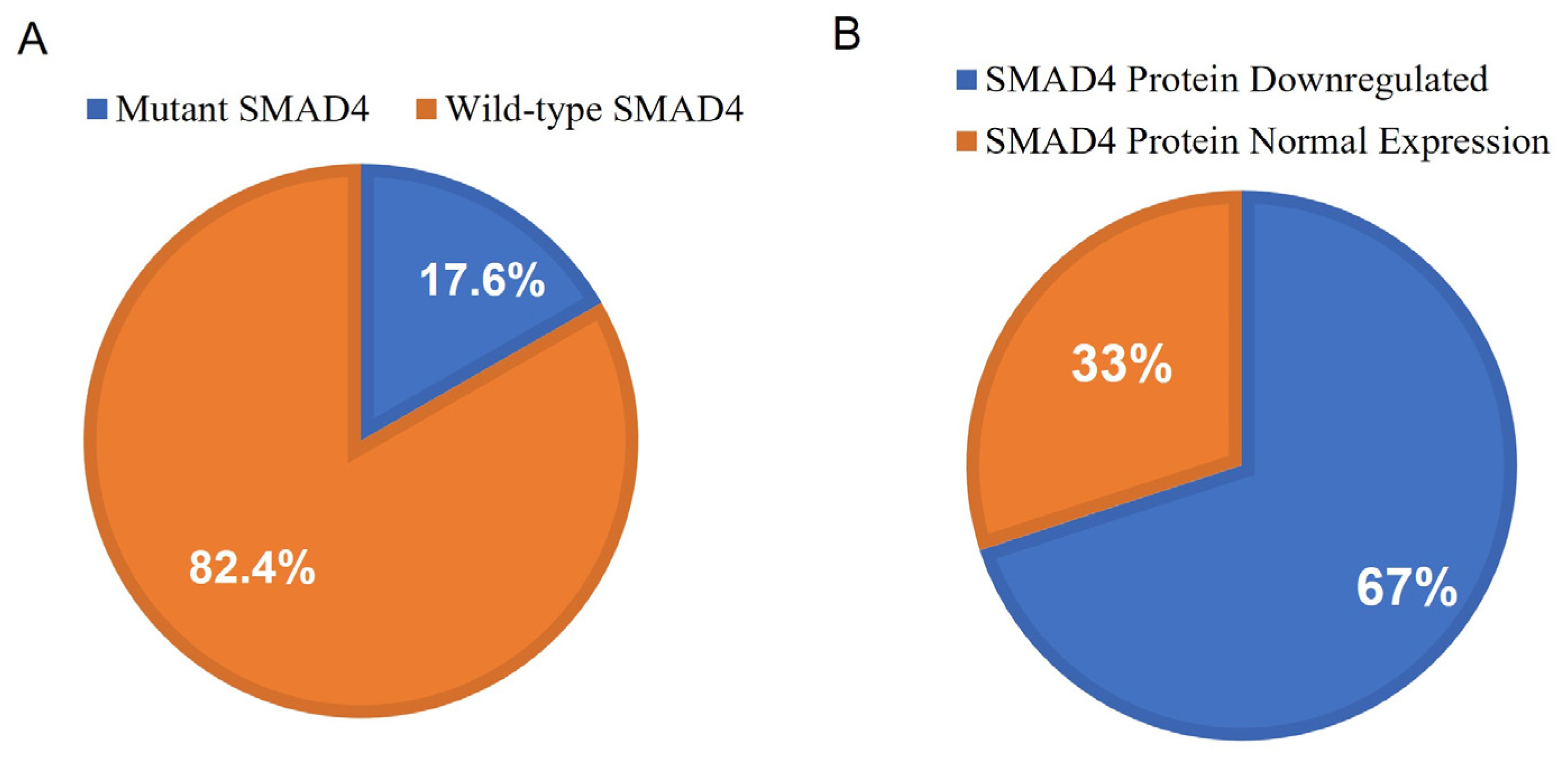
Figure 1. SMAD 4 protein expression downregulation is more significant than genomic mutation: (A) SMAD4 gene mutation and (B) SMAD4 protein expression status.
Diagnostics 16 01804 g001
Figure 2. Morphology and SMAD 4 express patterns of EOCRC: (AE) Representative images of hematoxylin and eosin staining (E,H); (FJ) immunohistochemistry of SMAD4; (A,F) standard SMAD4 expression, (B,G) weak expression, (C,H) complete loss, (D,I) clonal loss, and (E,J) strong nuclear expression. 20× Magnification. Yellow arrows indicate the tumor with SMAD4 clonal loss.
Diagnostics 16 01804 g002
Figure 3. Loss of SMAD 4 expression is related to lymph node metastasis: (A) tumor section with SMAD4 protein intact (red box) and clonal loss of tumor cells (blue box); (B) lymph node with tumor metastasis from the same patient, showing negative for SMAD4. (C) Cartoon model illustrating that a subclone of tumor cells with SMAD4 loss preferentially metastasizes to the lymph node, whereas tumor cells retaining SMAD4 expression remain predominant in the primary tumor.
Diagnostics 16 01804 g003
Figure 4. Survival curve of SMAD4 standard expression and downregulated EOCRC patients.
Diagnostics 16 01804 g004
Table 1. Clinicopathologic and molecular features of 18 patients with EOCRC < 40 years old.
Case #AgeGenderEthnicMMR StatusMSITNMGradeLocationLV InvPN InvCurrent StatusSMAD4 Gene SMAD4 Protein Other Pathogenic Mutations
117MAAIntactMSST4N2aM0G3AscendingP (S)PresentDOD (16.6 mo)WTComplete lossTP53, FGFR2
224FWIntactMSST4bN1bM1G2DescendingP (S)PresentAWMWTWeakKRAS
334FAAIntactMSST1N1aM0G1SigmoidP (S)PresentAWODWTClonal lossKRAS
437FWIntactMSST4bN0M0G1RectumNIPresentAWMMUT (p.E33*)Clonal lossKRAS, APC, B2M, TCF7L2, TERT, TP53
534FAAIntactMSST2N0M0G2DescendingP (S)NIAWODWTClonal lossNBN
636MWIntactMSST3N0M0G2RectumP (S)PresentAWODWTStandard ND
737MWIntactMSST4bN0M0G2DescendingP (S)NIAWMMUT (p.Q388*)Complete lossAPC, KRAS
830MWIntactMSST2N1bM0G2RectumP (S)PresentAWODWTClonal lossND
930MWIntactMSST2N0M0G2RectumNINIAWODWTStandard APC, ERBB2, TP53
1035FAAIntactMSST3N0M0G2TransverseP (S and L)PresentDOD (7.2 mo)MUT (p.R361H)StrongBCOR, BRAF, KRAS, PI3K, RSPO3
1131FWIntactMSST1N0M0G2RectumNINIAWODWTStandard ND
1229MWIntactMSST4bN1M1aG2SigmoidNINIDOD (24 mo)WTComplete lossAPC, FBXW7, KRAS, PIK3CA, RET
1332FWIntactMSST2N1aM0G2RectumNINIAWMWTComplete lossND
1438FAAIntactMSST3N0M0G2RectumNIPresentAWODWTStandard ND
1537MWIntactMSST3N0M0G1RectumP (L)NIAWODWTStandard BRCA2
1634MOtherintactMSST3N0M0G2RectumNINIDOD (11.9 mo)NAComplete lossNA
1736FAAMHL1, PMS2 LossMSI-HT3N1aM0G2RectumNIPresentAWODWTweakPMS2
1838FWMSH2 LossMSI-HT3N0M0G2SigmoidNINIAWODWTStandard MSH2
* Denotes a premature stop codon.
Table 2. SMAD 4 gene and protein status and other clinicopathologic features.
SMAD4 Expression
Standard n (%)Altered n (%)p Value
SMAD4 Gene
WT6 (35.4)8 (47)0.272
Mutant0 (0)3 (17.6)
Gender
M2 (11.1)6 (33.3)0.638
F4 (22.2)6 (33.3)
Location
Right0 (0)2 (11.1)0.529
Left6 (33.3)10 (55.6)
T stage
T1, T22 (11.1)4 (22.2)1.000
T3, T44 (22.2)8 (44.4)
N stage
N06 (33.3)5 (27.8)* 0.0377
N1, N207 (38.9)
M stage
M06 (33.3)10 (55.6)0.529
M1, M202 (11.1)
Histology grade
G1, G26 (33.3)11 (61.1)1.000
G301 (5.6)
Lymphovascular invasion (S)
Absence5 (27.8)5 (27.8)0.152
Presence1 (5.6)7 (38.9)
Lymphovascular invasion (L)
Absence5 (27.8)11 (61.1)1.000
Presence1 (5.6)1 (5.6)
Perineural invasion
Absence4 (22.2)5 (27.8)0.619
Presence2 (11.1)7 (38.9)
Microsatellite instability
Stable5 (27.8)11 (61.1)1.000
High1 (5.6)1 (5.6)
* Indicates statistical significance (p < 0.05).
Disclaimer/Publisher’s Note: The statements, opinions and data contained in all publications are solely those of the individual author(s) and contributor(s) and not of MDPI and/or the editor(s). MDPI and/or the editor(s) disclaim responsibility for any injury to people or property resulting from any ideas, methods, instructions or products referred to in the content.