Procedural Optimization in CT-Guided Lung Biopsy: Impact of Needle Angle and Patient Positioning on Complication Rates

 , , , and
Abstract
1. Introduction
2. Materials and Methods
2.1. Study Design and Population
2.2. Inclusion Criteria
- Underwent CT-guided transthoracic lung biopsy for suspected pulmonary lesions.
- Had complete imaging and clinical records available, including pre-procedural chest CT, procedural details, and post-procedural follow-up imaging.
- Met the required coagulation profile criteria (platelet count ≥ 50,000/mm3, prothrombin time > 60%, and international normalized ratio (INR) ≤ 1.5).
- Were ≥18 years of age at the time of the procedure.
2.3. Exclusion Criteria
- Incomplete medical records or missing procedural or post-procedural imaging.
- Uncorrectable coagulopathy (platelet count < 50,000/mm3 or INR > 1.5).
- Presence of an unbiopsiable lesion due to proximity to critical structures such as major blood vessels, mediastinum, or diaphragm.
- Patients with severe respiratory failure or an inability to tolerate the biopsy procedure.
- Non-cooperative patients leading to procedure cancellation.
- Patients with a prior biopsy of the same lesion within one month before the study period.
- Patients undergoing CT-guided transthoracic lung biopsy between February 2023 and October 2024
- ↓
- Patients meeting inclusion criteria and having complete clinical and imaging data
- ↓
- Final study cohort included in analysis (n = 309)
2.4. Biopsy Procedure
2.5. Data Collection and Outcome Measures
- Patient factors: Age, gender, comorbidities, presence of emphysema.
- Lesion characteristics: Size, location, histopathology, distance from pleura, presence of perilesional emphysema or pleural effusion.
- Procedure-related factors: Biopsy position (supine/prone), needle angle, number of pleural passes, and duration of the procedure.
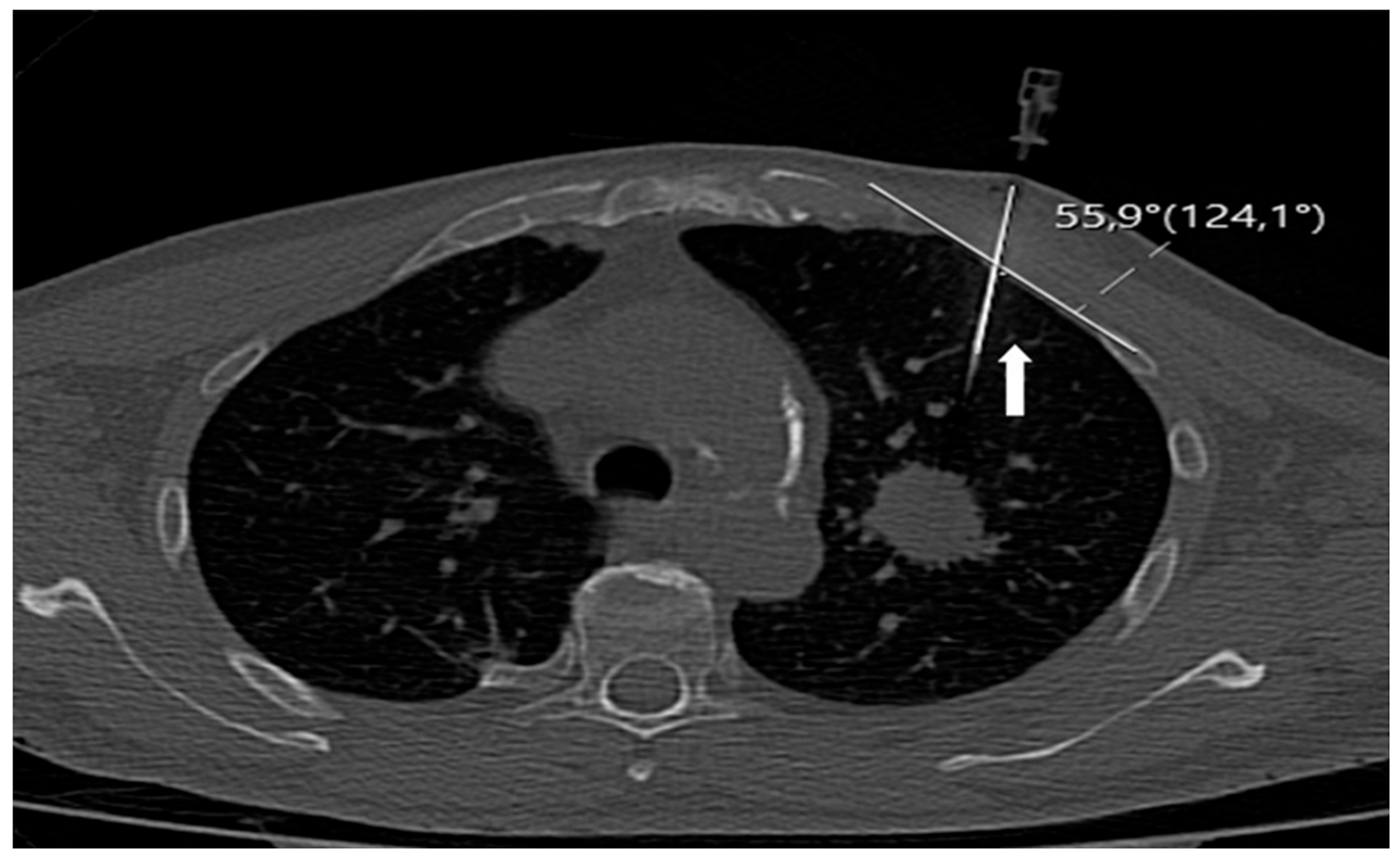
- The needle–pleura angle was defined as the angle formed between the biopsy needle trajectory and the pleural surface at the puncture site on CT images. Angles closer to 90° represented a more perpendicular needle approach to the pleura, whereas smaller angles indicated a more tangential trajectory (Figure 1).
- Complications: Pneumothorax, hemorrhage, and need for intervention (chest tube placement or blood transfusion).
2.6. Statistical Analysis
3. Results
3.1. Patient and Lesion Characteristics
3.2. Complications and Severity Classification
- SIR 1 (minor, no intervention required): 49 (15.9%) patients.
- SIR 2 (minor, requiring short-term observation): 4 (1.3%) patients.
- SIR 3–4 (major, requiring intervention): 10 (3.2%) patients.
3.3. Univariate Analysis of Risk Factors for Complications
3.3.1. SIR Complication Severity
- Older age (F = 3.719, p = 0.025);
- Larger lesion size (F = 5.325, p = 0.005);
- Increased lesion-to-pleura distance (F = 4.750, p = 0.009);
- Decreased skin-to-pleura distance (F = 8.607, p < 0.001);
- Presence of high-grade emphysema (χ2 = 38.299, p < 0.001);
- Presence of perilesional emphysema (χ2 = 26.733, p < 0.001);
- Presence of pleural effusion (χ2 = 22.568, p < 0.001);
- Needle angle ≤ 65° (χ2 = 9.995, p = 0.007).

| Continuous Variables | SIR0 (n = 246) | SIR1 (n = 49) | SIR2–4 (n = 14) | F | p-Value |
|---|---|---|---|---|---|
| Age (years), mean (±SD) | 63.6 (12.1) | 67.6 (8.7) | 69.1 (9.4) | 3.719 a | 0.025 *** |
| Lesion diameter (mm), mean (±SD) | 28.7 (15.0) | 24.3 (14.2) | 39.0 (17.5) | 5.325 a | 0.005 ** |
| Skin–pleura distance (mm), mean (±SD) | 41.4 (10.5) | 39.3 (11.6) | 29.4 (11.4) | 8.607 a | <0.001 * |
| Lesion–pleura distance (mm), mean (±SD) | 31.6 (19.1) | 39.2 (25.6) | 44.6 (34.3) | 4.750 a | 0.009 ** |
| Ordinal and Nominal Variables | SIR0 (n = 246) | SIR1 (n = 49) | SIR2–4 (n = 14) | χ2 | p-Value |
| Gender, n (%) | 4.168 b | 0.124 | |||
| Male | 141 (75.8) | 35 (18.8) | 10 (5.4) | ||
| Female | 105 (85.4) | 14 (11.4) | 4 (3.3) | ||
| Lesion location, n (%) | 9.015 c | 0.466 | |||
| Right upper | 62 (84.9) | 8 (11) | 3 (4.1) | ||
| Right lower | 37 (78.7) | 10 (21.3) | 0 (0) | ||
| Right middle | 10 (66.7) | 4 (26.7) | 1 (6.7) | ||
| Left upper | 71 (78) | 16 (17.6) | 4 (4.4) | ||
| Left lower | 60 (78.9) | 10 (13.2) | 6 (7.9) | ||
| Left lingular | 6 (85.7) | 1 (14.3) | 0 (0) | ||
| Lesion histopathology, n (%) | 3.704 b | 0.157 | |||
| Malign | 174 (77) | 41 (18.1) | 11 (4.9) | ||
| Benign | 72 (86.7) | 8 (9.6) | 3 (3.6) | ||
| Emphysema grade, n (%) | 38.299 b | <0.001 * | |||
| 1–2 | 216 (85) | 34 (13.4) | 4 (1.6) | ||
| 3–4 | 30 (54.5) | 15 (27.3) | 10 (18.2) | ||
| Perilesional emphysema, n (%) | 26.733 c | <0.001 * | |||
| Yes | 8 (36.4) | 8 (36.4) | 6 (27.3) | ||
| No | 238 (82.9) | 41 (14.3) | 8 (2.8) | ||
| Position, n (%) | 0.086 b | 0.958 | |||
| Prone | 79 (79.8) | 16 (16.2) | 4 (4) | ||
| Supine | 167 (79.5) | 33 (15.7) | 10 (4.8) | ||
| Lesion morphological characteristics, n (%) | 6.598 c | 0.112 | |||
| Solid | 221 (80.4) | 43 (15.6) | 11 (4) | ||
| Ground-glass opacity | 8 (66.7) | 4 (33.3) | 0 (0) | ||
| Cavitary | 17 (77.3) | 2 (9.1) | 3 (13.6) | ||
| Pleural effusion, n (%) | 22.568 c | <0.001 * | |||
| Yes | 7 (41.2) | 4 (23.5) | 6 (35.3) | ||
| No | 239 (81.8) | 45 (15.4) | 8 (2.7) | ||
| Fissure involvement, n (%) | 0.683 c | >0.999 | |||
| Yes | 3 (100) | 0 (0) | 0 (0) | ||
| No | 243 (79.4) | 49 (16) | 14 (4.6) | ||
| Angle, n (%) | 9.995 b | 0.007 ** | |||
| ≤65 | 117 (72.7) | 34 (21.1) | 10 (6.2) | ||
| >65 | 129 (87.2) | 15 (10.1) | 4 (2.7) |
3.3.2. Post-Biopsy Hemorrhage
- Older age (t = 2.102, p = 0.036);
- Smaller lesion diameter (t = 2.084, p = 0.038);
- Longer lesion-to-pleura distance (t = 5.804, p < 0.001);
- Shorter skin-to-pleura distance (t = 2.738, p = 0.007);
- Supine biopsy position (8.6% vs. 1%, p = 0.009).
3.4. Multivariate Analysis of Risk Factors for Complications
3.4.1. SIR Score Regression Analysis
- SIR1 complications were significantly associated with:
- ○
- Smaller lesion diameter (OR = 0.971, 95% CI = 0.946–0.997, p = 0.028);
- ○
- Presence of pleural effusion (OR = 5.481, 95% CI = 1.278–23.517, p = 0.022);
- ○
- Needle angle ≤ 65° (OR = 2.585, 95% CI = 1.251–5.343, p = 0.010).
- SIR2–4 complications were associated with:
- ○
- Decreased skin-to-pleura distance (OR = 0.899, 95% CI = 0.830–0.974, p = 0.009);
- ○
- Presence of perilesional emphysema (OR = 19.378, 95% CI = 2.626–142.997, p = 0.004);
- ○
- Presence of pleural effusion (OR = 30.727, 95% CI = 3.962–238.329, p = 0.001);
- ○
- Needle angle ≤ 65° (OR = 8.125, 95% CI = 1.299–50.814, p = 0.025).
| SIR (Reference Group = SIR0) | ||||||||
|---|---|---|---|---|---|---|---|---|
| Category | Variables | β | SE | Wald | p-Value | OR (95% CI) | ||
| SIR1 | Intercept | −4.642 | 1.469 | 9.981 | 0.002 | |||
| Age | 0.033 | 0.017 | 3.833 | 0.050 | 1.034 (1.000–1.069) | |||
| Lesion diameter | −0.029 | 0.013 | 4.836 | 0.028 ** | 0.971 (0.946–0.997) | |||
| Skin–pleura distance | −0.016 | 0.017 | 0.908 | 0.341 | 0.984 (0.952–1.017) | |||
| Lesion–pleura distance | 0.014 | 0.008 | 2.984 | 0.084 | 1.014 (0.998–1.030) | |||
| Emphysema high grade | 0.859 | 0.507 | 2.870 | 0.090 | 2.362 (0.874–6.383) | |||
| Perilesional emphysema | 1.149 | 0.685 | 2.815 | 0.093 | 3.155 (0.824–12.074) | |||
| Pleural effusion | 1.701 | 0.743 | 5.242 | 0.022 ** | 5.481 (1.278–23.517) | |||
| Angle ≤ 65° | 0.950 | 0.370 | 6.574 | 0.010 ** | 2.585 (1.251–5.343) | |||
| SIR2–4 | Intercept | −7.171 | 3.181 | 5.083 | 0.024 | |||
| Age | 0.020 | 0.035 | 0.325 | 0.569 | 1.020 (0.952–1.093) | |||
| Lesion diameter | 0.036 | 0.022 | 2.586 | 0.108 | 1.036 (0.992–1.083) | |||
| Skin–pleura distance | −0.107 | 0.041 | 6.844 | 0.009 * | 0.899 (0.830–0.974) | |||
| Lesion–pleura distance | 0.024 | 0.016 | 2.394 | 0.122 | 1.024 (0.994–1.056) | |||
| Emphysema high grade | 1.571 | 0.938 | 2.808 | 0.094 | 4.813 (0.766–30.239) | |||
| Perilesional emphysema | 2.964 | 1.020 | 8.449 | 0.004 * | 19.378 (2.626–142.997) | |||
| Pleural effusion | 3.425 | 1.045 | 10.740 | 0.001 * | 30.727 (3.962–238.329) | |||
| Angle ≤65° | 2.095 | 0.935 | 5.016 | 0.025 ** | 8.125 (1.299–50.814) | |||
| SIR (Reference Group = SIR1) | ||||||||
| Category | Variables | β | SE | Wald | p-value | OR (95% CI) | ||
| SIR2–4 | Intercept | −2.530 | 3.306 | 0.586 | 0.444 | |||
| Age | −0.013 | 0.037 | 0.132 | 0.717 | 0.987 (0.919–1.060) | |||
| Lesion diameter | 0.065 | 0.024 | 7.141 | 0.008 * | 1.067 (1.017–1.119) | |||
| Skin–pleura distance | −0.091 | 0.041 | 4.802 | 0.028 ** | 0.913 (0.842–0.990) | |||
| Lesion–pleura distance | 0.010 | 0.015 | 0.440 | 0.507 | 1.010 (0.980–1.041) | |||
| Emphysema high grade | 0.712 | 0.961 | 0.548 | 0.459 | 2.038 (0.310–13.405) | |||
| Perilesional emphysema | 1.815 | 1.008 | 3.240 | 0.072 | 6.142 (0.851–44.335) | |||
| Pleural effusion | 1.724 | 1.042 | 2.735 | 0.098 | 5.606 (0.727–43.243) | |||
| Angle ≤65° | 1.145 | 0.950 | 1.455 | 0.228 | 3.143 (0.489–20.210) | |||
3.4.2. Binary Logistic Regression for Hemorrhage Risk
- Smaller lesion diameter (OR = 0.952, 95% CI = 0.908–0.997, p = 0.037);
- Increased lesion-to-pleura distance (OR = 1.048, 95% CI = 1.025–1.071, p < 0.001);
- Supine patient positioning (OR = 9.031, 95% CI = 1.073–76.029, p = 0.043).
| Variables | β | SE | Wald | p-Value | OR (95% CI) |
|---|---|---|---|---|---|
| Age | 0.047 | 0.030 | 2.485 | 0.115 | 1.048 (0.989–1.111) |
| Lesion diameter | −0.050 | 0.024 | 4.371 | 0.037 *** | 0.952 (0.908–0.997) |
| Skin–pleura distance | −0.051 | 0.029 | 3.156 | 0.076 | 0.950 (0.898–1.005) |
| Lesion–pleura distance | 0.047 | 0.011 | 16.916 | <0.001 * | 1.048 (1.025–1.071) |
| Supine position | 2.201 | 1.087 | 4.099 | 0.043 *** | 9.031 (1.073–76.029) |
| Constant | −8.906 | 3.076 | 8.381 | 0.004 | 0.000 |
4. Discussion
4.1. Pneumothorax and Its Predictors
4.2. Hemorrhage and Its Risk Factors
4.3. Clinical Implications
4.4. Comparison with Previous Studies and Future Directions
5. Limitations
6. Conclusions
Supplementary Materials
Author Contributions
Funding
Institutional Review Board Statement
Informed Consent Statement
Data Availability Statement
Acknowledgments
Conflicts of Interest
References
- Herth, F.J.; Eberhardt, R.; Ernst, A. The future of bronchoscopy in diagnosing, staging and treatment of lung cancer. Respiration 2006, 73, 399–409. [Google Scholar] [CrossRef] [PubMed]
- Wu, C.C.; Maher, M.M.; Shepard, J.A. Complications of CT-guided percutaneous needle biopsy of the chest: Prevention and management. Am. J. Roentgenol. 2011, 196, W678–W682. [Google Scholar] [CrossRef] [PubMed]
- Gupta, S.; Wallace, M.J.; Cardella, J.F.; Kundu, S.; Miller, D.L.; Rose, S.C. Quality improvement guidelines for percutaneous needle biopsy. J. Vasc. Interv. Radiol. 2010, 21, 969–975. [Google Scholar] [CrossRef] [PubMed]
- Chassagnon, G.; Gregory, J.; Al Ahmar, M.; Magdeleinat, P.; Legmann, P.; Coste, J.; Revel, M.P. Risk factors for hemoptysis complicating CT-guided transthoracic needle biopsy. Diagn. Interv. Radiol. 2017, 23, 347–353. [Google Scholar] [CrossRef] [PubMed]
- Tai, R.; Dunne, R.M.; Trotman-Dickenson, B.; Jacobson, F.L.; Madan, R.; Kumamaru, K.K.; Hunsaker, A.R. Frequency and severity of pulmonary hemorrhage in CT-guided lung biopsy. Radiology 2016, 279, 287–296. [Google Scholar] [CrossRef] [PubMed]
- Hiraki, T.; Mimura, H.; Gobara, H.; Shibamoto, K.; Inoue, D.; Matsui, Y.; Kanazawa, S. Risk factors for pneumothorax after CT-guided lung biopsy. Am. J. Roentgenol. 2010, 194, 809–814. [Google Scholar] [CrossRef] [PubMed]
- Yeow, K.-M.; Su, I.-H.; Pan, K.-T.; Tsay, P.-K.; Lui, K.-W.; Cheung, Y.-C.; Chou, A.S.-B. Risk factors of pneumothorax and bleeding. Chest 2004, 126, 748–754. [Google Scholar] [CrossRef] [PubMed]
- Lee, D.S.; Bak, S.H.; Jeon, Y.H.; Kwon, S.O.; Kim, W.J. Perilesional emphysema as a predictor of complications. Jpn. J. Radiol. 2019, 37, 808–816. [Google Scholar] [CrossRef] [PubMed]
- Heerink, W.J.; de Bock, G.H.; de Jonge, G.J.; Groen, H.J.M.; Vliegenthart, R.; Oudkerk, M. Complication rates of CT-guided lung biopsy: Meta-analysis. Eur. Radiol. 2017, 27, 138–148. [Google Scholar] [CrossRef] [PubMed]
- Saji, H.; Nakamura, H.; Tsuchida, T.; Tsuboi, M.; Kawate, N.; Konaka, C.; Kato, H. Needle trajectory angle as predictor. Chest 2002, 121, 1521–1526. [Google Scholar] [CrossRef] [PubMed]
- Ko, J.P.; Shepard, J.-A.O.; Drucker, E.A.; Aquino, S.L.; Sharma, A.; Sabloff, B.; Halpern, E.; McLoud, T.C. Factors influencing pneumothorax rate. Radiology 2001, 218, 491–496. [Google Scholar] [CrossRef] [PubMed]
- Takeshita, J.; Masago, K.; Kato, R.; Hata, A.; Kaji, R.; Fujita, S.; Katakami, N. CT-guided lung biopsies: Single-center experience. Am. J. Roentgenol. 2015, 204, 29–34. [Google Scholar] [CrossRef] [PubMed]
- Saggiante, L.; Biondetti, P.; Lanza, C.; Carriero, S.; Ascenti, V.; Piacentino, F.; Shehab, A.; Ierardi, A.M.; Venturini, M.; Carrafiello, G. CT-guided lung biopsy: Techniques and principles. Diagnostics 2024, 14, 1089. [Google Scholar] [CrossRef]
- Lee, S.M.; Park, C.M.; Lee, K.H.; Bahn, Y.E.; Kim, J.I.; Goo, J.M. Cone-beam CT-guided lung biopsy. Radiology 2014, 271, 291–300. [Google Scholar] [CrossRef] [PubMed]
- Roman, A.; Brozba, A.; Necula, A.; Muntean, D.D.; Kubelac, P.; Fekete, Z.; Tomuleasa, C.; Csutak, C.; Feier, D.; Pintican, R.; et al. Usefulness of saline sealing in preventing pneumothorax after CT-guided biopsies of the lung. Diagnostics 2023, 13, 3546. [Google Scholar] [CrossRef] [PubMed]
- Khan, M.F.; Straub, R.; Moghaddam, S.R.; Maataoui, A.; Gurung, J.; Wagner, T.O.F.; Ackermann, H.; Thalhammer, A.; Vogl, T.J.; Jacobi, V. Risk of pneumothorax and hemorrhage. Eur. Radiol. 2008, 18, 1356–1363. [Google Scholar] [CrossRef]
- Zhu, J.; Qu, Y.; Wang, X.; Jiang, C.; Mo, J.; Xi, J.; Wen, Z. Risk factors for pulmonary hemorrhage. Quant. Imaging Med. Surg. 2020, 10, 1008–1020. [Google Scholar] [CrossRef] [PubMed]
- Huang, Z.-G.; Sun, H.-L.; Wang, C.-L.; Gao, B.-X.; Chen, H.; Yang, M.-X.; Chen, X.-L. Cutting vs aspiration needle biopsy. Br. J. Radiol. 2021, 94, 20190930. [Google Scholar] [CrossRef] [PubMed]
- Elsakka, A.; Petre, E.N.; Ridouani, F.; Ghosn, M.; Bott, M.J.; Husta, B.C.; Arcila, M.E.; Alexander, E.; Solomon, S.B.; Ziv, E. Image-guided biopsy for sequencing. JTO Clin. Res. Rep. 2022, 3, 100342. [Google Scholar] [CrossRef]
- Chen, C.; Xu, L.; Sun, X.; Liu, X.; Han, Z.; Li, W. CT-guided biopsy of small lung nodules. Diagn. Interv. Radiol. 2021, 27, 94–101. [Google Scholar] [CrossRef] [PubMed]

| Variables (N = 309) | Descriptive |
|---|---|
| Age (years), mean (±SD) | 64.5 (11.6) |
| Lesion diameter (mm), mean (±SD) | 28.4 (15.2) |
| Skin–pleura distance (mm), mean (±SD) | 40.5 (11.0) |
| Lesion–pleura distance (mm), mean (±SD) | 33.4 (21.3) |
| Angle, mean (±SD) | 65.2 (14.6) |
| Gender, n (%) | |
| Male | 186 (60.2) |
| Female | 123 (39.8) |
| Lesion location, n (%) | |
| Right upper | 73 (23.6) |
| Right lower | 47 (15.2) |
| Right middle | 15 (4.9) |
| Left upper | 91 (29.4) |
| Left lower | 76 (24.6) |
| Left lingular | 7 (2.3) |
| Lesion histopathology, n (%) | |
| Malign | 226 (73.1) |
| Benign | 83 (26.9) |
| Emphysema grade, n (%) | |
| 1–2 | 254 (82.2) |
| 3–4 | 55 (17.8) |
| Perilesional emphysema, n (%) | 22 (7.1) |
| Position, n (%) | |
| Prone | 99 (32) |
| Supine | 210 (68) |
| Lesion morphological characteristics, n (%) | |
| Solid | 275 (89) |
| Ground-glass opacity | 12 (3.9) |
| Cavitary | 22 (7.1) |
| Pleural effusion, n (%) | 17 (5.5) |
| Fissure involvement, n (%) | 3 (1) |
| Complications, n (%) | 63 (20.4) |
| Pneumothorax, n (%) | 44 (14.2) |
| Hemorrhage, n (%) | 15 (4.9) |
| Pneumothorax + hemorrhage, n (%) | 4 (1.3) |
| Continuous Variables | Hemorrhage (+) (n = 19) | Hemorrhage (−) (n = 290) | t | p-Value |
|---|---|---|---|---|
| Age (years), mean (±SD) | 69.8 (7.4) | 64.1 (11.7) | 2.102 a | 0.036 *** |
| Lesion diameter (mm), mean (±SD) | 21.4 (13.5) | 28.9 (15.2) | 2.084 a | 0.038 *** |
| Skin–pleura distance (mm), mean (±SD) | 33.9 (11.3) | 41.0 (10.9) | 2.738 a | 0.007 ** |
| Lesion–pleura distance (mm), mean (±SD) | 59.6 (24.8) | 31.7 (20.0) | 5.804 a | <0.001 * |
| Angle, mean (±SD) | 67.8 (12.2) | 65.0 (14.8) | 0.796 a | 0.427 |
| Ordinal and Nominal Variables | Hemorrhage (+) (n = 19) | Hemorrhage (−) (n = 290) | χ2 | p-Value |
| Gender, n (%) | 0.572 b | 0.450 | ||
| Male | 13 (7) | 173 (93) | ||
| Female | 6 (4.9) | 117 (95.1) | ||
| Lesion histopathology, n (%) | NA | 0.114 | ||
| Malign | 17 (7.5) | 209 (92.5) | ||
| Benign | 2 (2.4) | 81 (97.6) | ||
| Position, n (%) | NA | 0.009 ** | ||
| Prone | 1 (1) | 98 (99) | ||
| Supine | 18 (8.6) | 192 (91.4) | ||
| Lesion morphological characteristics, n (%) | 0.792 c | >0.999 | ||
| Solid | 17 (6.2) | 258 (93.8) | ||
| Ground-glass opacity | 0 (0) | 12 (100) | ||
| Cavitary | 2 (9.1) | 20 (90.9) |
Disclaimer/Publisher’s Note: The statements, opinions and data contained in all publications are solely those of the individual author(s) and contributor(s) and not of MDPI and/or the editor(s). MDPI and/or the editor(s) disclaim responsibility for any injury to people or property resulting from any ideas, methods, instructions or products referred to in the content. |
© 2026 by the authors. Licensee MDPI, Basel, Switzerland. This article is an open access article distributed under the terms and conditions of the Creative Commons Attribution (CC BY) license.
Share and Cite
Bilgin, E.; Bayrak, A.; İmamoğlu, Ç.; Yaltırık Bilgin, E.; Coşkun Bilge, A.; Aktaş, E.; Çakmak, H.; İnce Alkan, B. Procedural Optimization in CT-Guided Lung Biopsy: Impact of Needle Angle and Patient Positioning on Complication Rates. Diagnostics 2026, 16, 1792. https://doi.org/10.3390/diagnostics16121792
Bilgin E, Bayrak A, İmamoğlu Ç, Yaltırık Bilgin E, Coşkun Bilge A, Aktaş E, Çakmak H, İnce Alkan B. Procedural Optimization in CT-Guided Lung Biopsy: Impact of Needle Angle and Patient Positioning on Complication Rates. Diagnostics. 2026; 16(12):1792. https://doi.org/10.3390/diagnostics16121792
Chicago/Turabian StyleBilgin, Erkan, Ahmet Bayrak, Çetin İmamoğlu, Ezel Yaltırık Bilgin, Almıla Coşkun Bilge, Elif Aktaş, Hüseyin Çakmak, and Banu İnce Alkan. 2026. "Procedural Optimization in CT-Guided Lung Biopsy: Impact of Needle Angle and Patient Positioning on Complication Rates" Diagnostics 16, no. 12: 1792. https://doi.org/10.3390/diagnostics16121792
APA StyleBilgin, E., Bayrak, A., İmamoğlu, Ç., Yaltırık Bilgin, E., Coşkun Bilge, A., Aktaş, E., Çakmak, H., & İnce Alkan, B. (2026). Procedural Optimization in CT-Guided Lung Biopsy: Impact of Needle Angle and Patient Positioning on Complication Rates. Diagnostics, 16(12), 1792. https://doi.org/10.3390/diagnostics16121792