PD-L1+ CTCs Are Associated with Adverse Pathological Features and Unfavorable Prognosis in Bladder Cancer

 ,
,
Abstract
1. Introduction
2. Materials and Methods
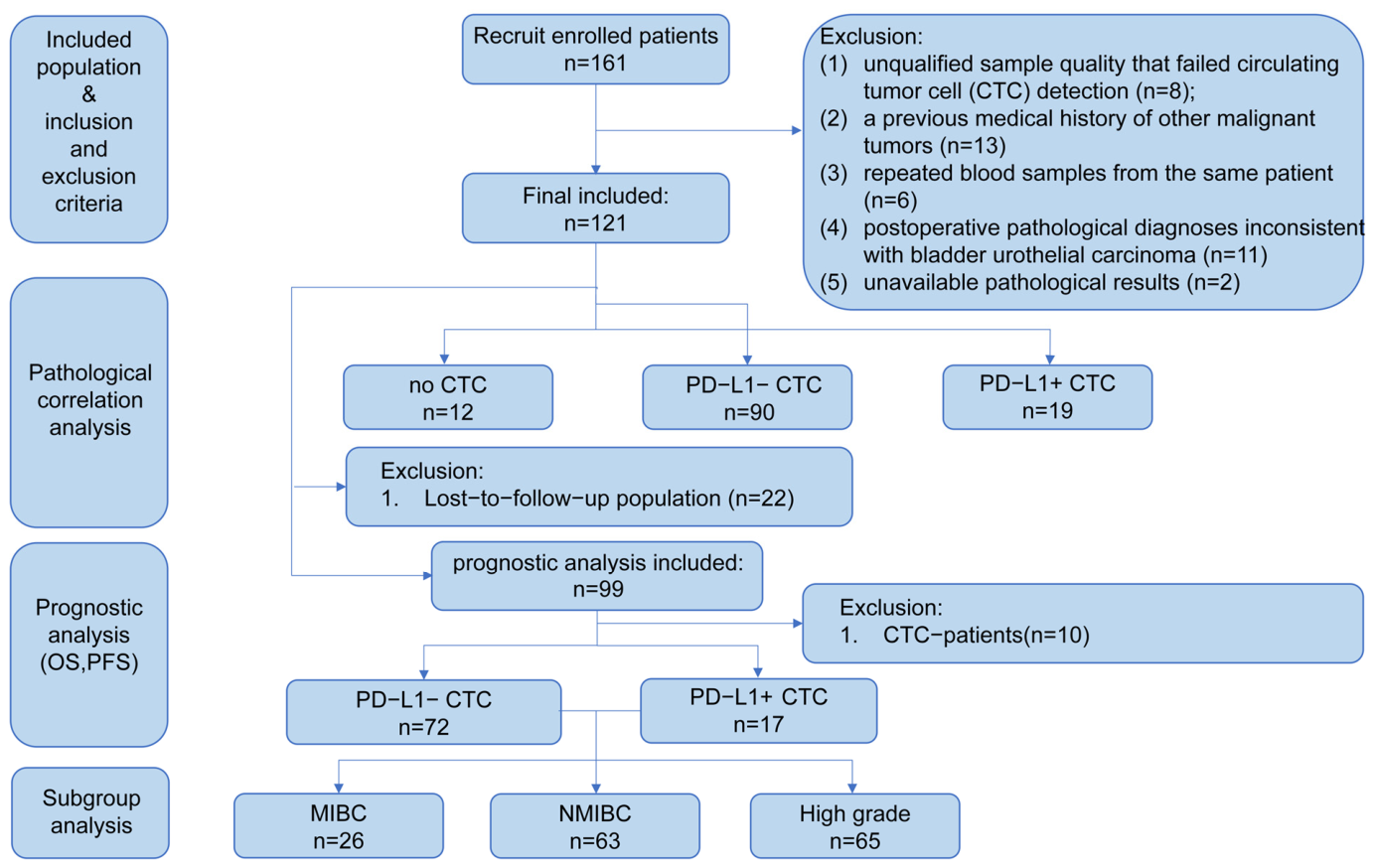
2.1. Study Design
2.2. CTC Enrichment, Identification, and Classification
2.3. Follow up
2.4. Statistical Analysis
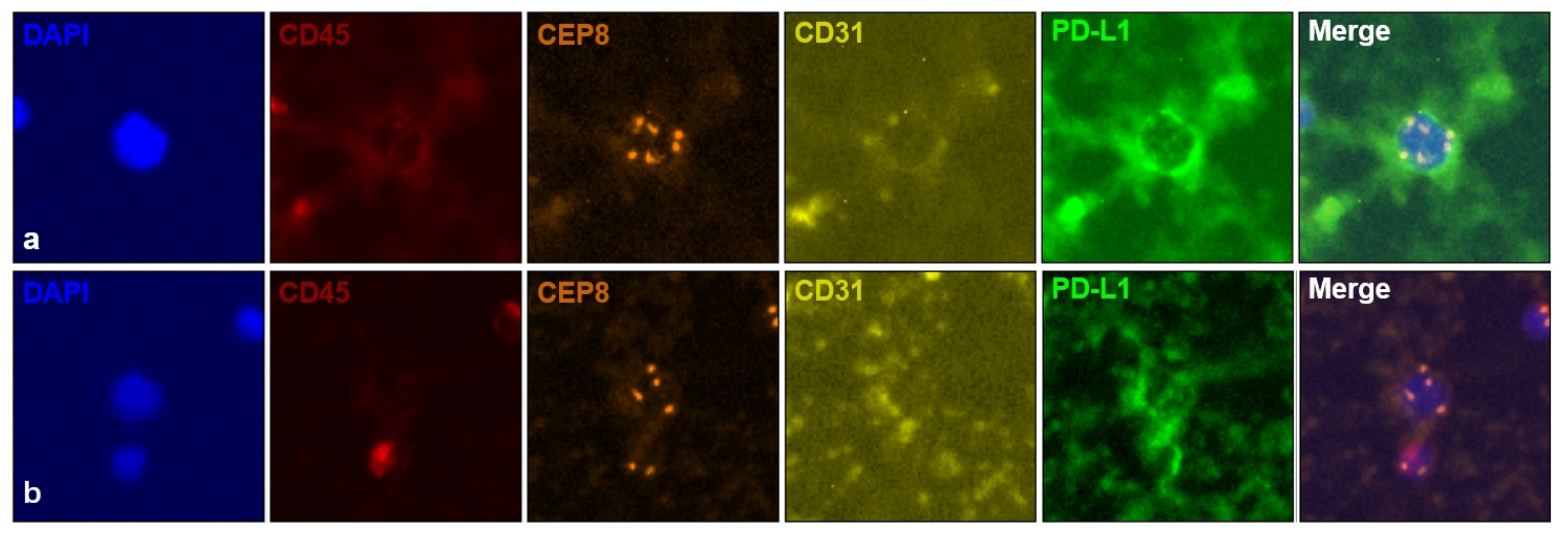
2.5. Quantitative Distribution and Grouping Criteria of CTCs and CTC Surface PD-L1 Expression
3. Results
3.1. Clinical and Pathological Characteristics of Patients
3.2. PD-L1+ CTCs Correlate with High Pathological Grade in Bladder Cancer
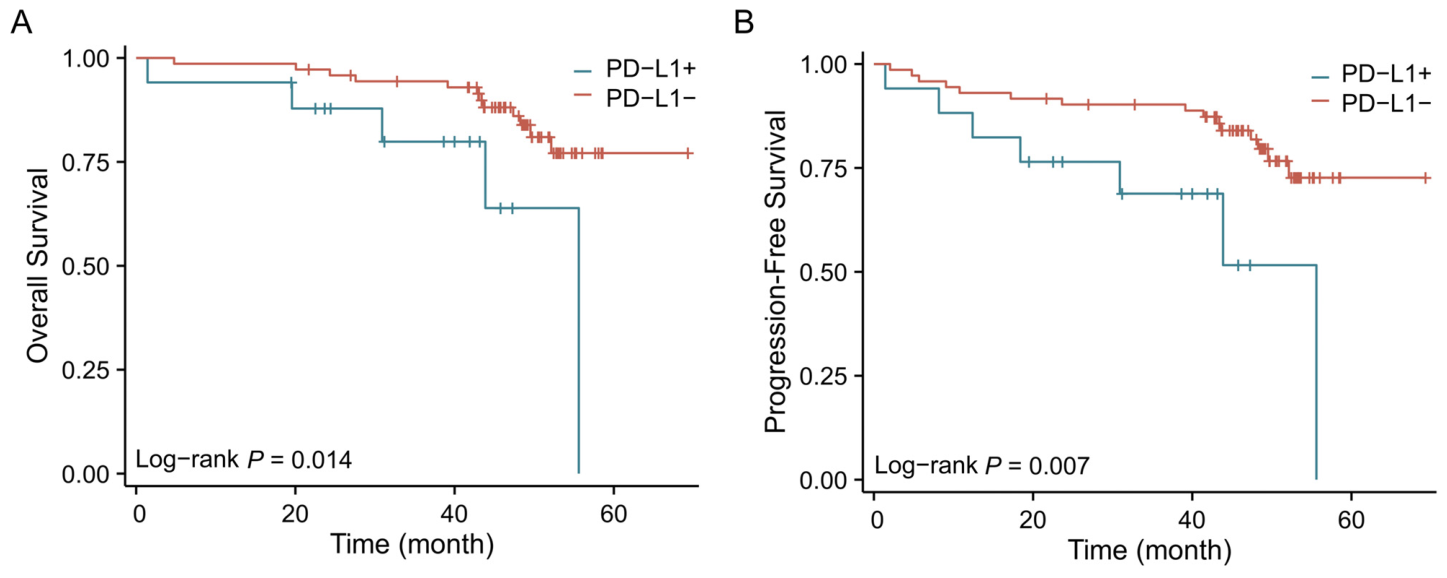
3.3. Survival Prognosis
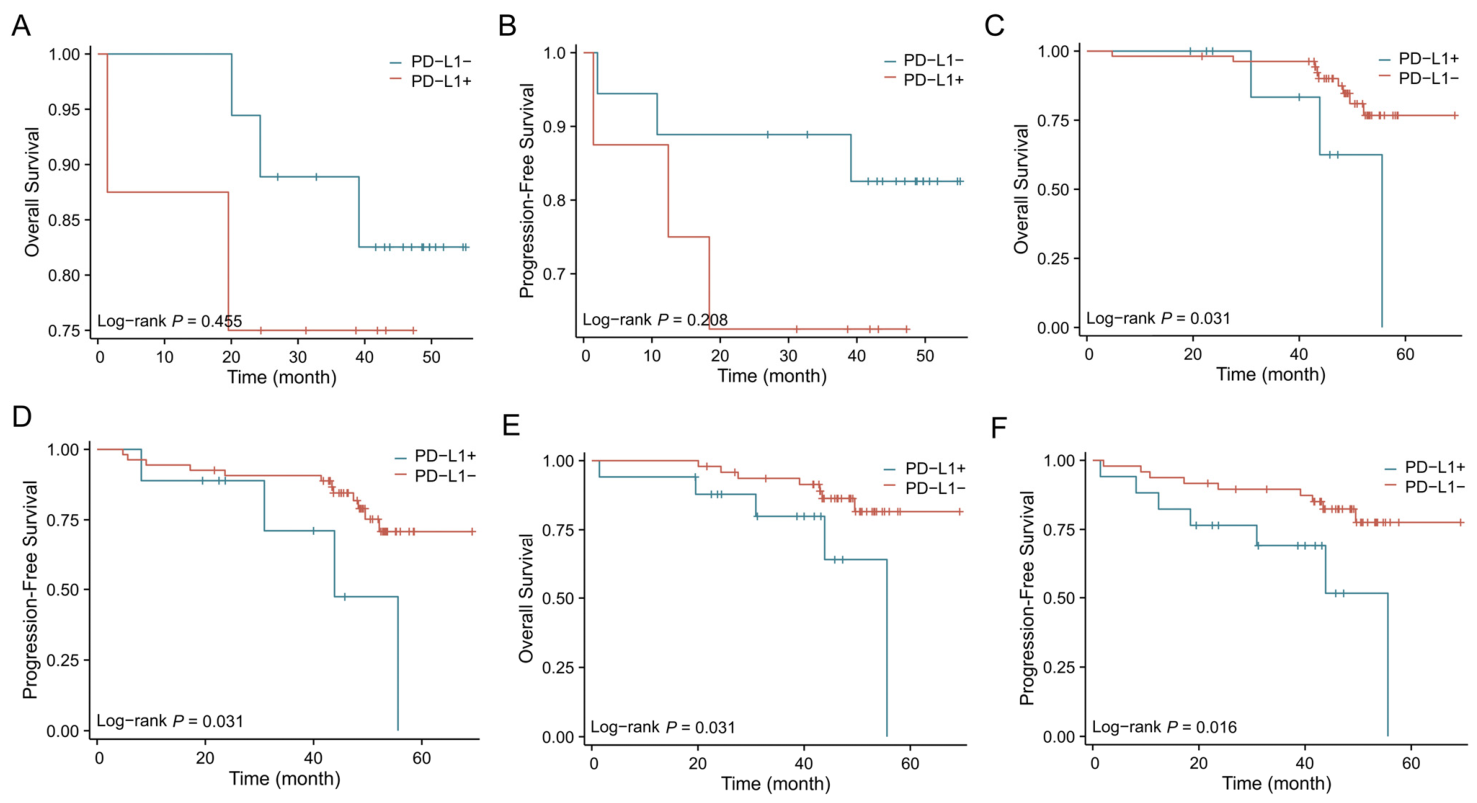
3.4. Subgroup Analysis
4. Discussion
5. Conclusions
Supplementary Materials
Author Contributions
Funding
Institutional Review Board Statement
Informed Consent Statement
Data Availability Statement
Conflicts of Interest
References
- Siegel, R.L.; Kratzer, T.B.; Giaquinto, A.N.; Sung, H.; Jemal, A. Cancer statistics, 2025. CA A Cancer J. Clin. 2025, 75, 10–45. [Google Scholar] [CrossRef]
- Lopez-Beltran, A.; Cookson, M.S.; Guercio, B.J.; Cheng, L. Advances in diagnosis and treatment of bladder cancer. BMJ 2024, 384, e076743. [Google Scholar] [CrossRef]
- Kamat, A.M.; Hahn, N.M.; Efstathiou, J.A.; Lerner, S.P.; Malmström, P.U.; Choi, W.; Guo, C.C.; Lotan, Y.; Kassouf, W. Bladder cancer. Lancet 2016, 388, 2796–2810. [Google Scholar] [CrossRef]
- Babjuk, M.; Burger, M.; Capoun, O.; Cohen, D.; Compérat, E.M.; Dominguez Escrig, J.L.; Gontero, P.; Liedberg, F.; Masson-Lecomte, A.; Mostafid, A.H.; et al. European association of urology guidelines on non–muscle-invasive bladder cancer (ta, T1, and carcinoma in situ). Eur. Urol. 2022, 81, 75–94. [Google Scholar] [CrossRef]
- Alfred Witjes, J.; Max Bruins, H.; Carrión, A.; Cathomas, R.; Compérat, E.; Efstathiou, J.A.; Fietkau, R.; Gakis, G.; Lorch, A.; Martini, A.; et al. European association of urology guidelines on muscle-invasive and metastatic bladder cancer: Summary of the 2023 guidelines. Eur. Urol. 2024, 85, 17–31. [Google Scholar] [CrossRef]
- Vergara, M.; Seguel, S. Adverse reactions to contrast media in CT: Effects of temperature and ionic property. Radiology 1996, 199, 363–366. [Google Scholar] [CrossRef] [PubMed]
- Wen, L.; Miyagi, H.; Spiess, P.E.; Yu, A.; Mendelsohn, C.L.; Tan, W.S.; Psutka, S.P.; Lerner, S.P.; Cheng, L.; Dyrskjøt, L.; et al. Low-grade non-muscle-invasive bladder cancer: Molecular landscape, treatment strategies and emerging therapies. Nat. Rev. Urol. 2025, 22, 846–861. [Google Scholar] [CrossRef]
- Landon, B.V.; Annapragada, A.V.; Niknafs, N.; Velculescu, V.E.; Anagnostou, V. Liquid biopsies across the cancer care continuum. Nat. Med. 2025, 31, 4006–4021. [Google Scholar] [CrossRef] [PubMed]
- Stoecklein, N.H.; Fluegen, G.; Guglielmi, R.; Neves, R.P.L.; Hackert, T.; Birgin, E.; Cieslik, S.A.; Sudarsanam, M.; Driemel, C.; van Dalum, G.; et al. Ultra-sensitive CTC-based liquid biopsy for pancreatic cancer enabled by large blood volume analysis. Mol. Cancer 2023, 22, 181. [Google Scholar] [CrossRef] [PubMed]
- Lin, D.; Shen, L.; Luo, M.; Zhang, K.; Li, J.; Yang, Q.; Zhu, F.; Zhou, D.; Zheng, S.; Chen, Y.; et al. Circulating tumor cells: Biology and clinical significance. Signal Transduct. Target. Ther. 2021, 6, 404. [Google Scholar] [CrossRef]
- Suvilesh, K.N.; Manjunath, Y.; Pantel, K.; Kaifi, J.T. Preclinical models to study patient-derived circulating tumor cells and metastasis. Trends Cancer 2023, 9, 355–371. [Google Scholar] [CrossRef] [PubMed]
- Tang, R.; Luo, S.; Liu, H.; Sun, Y.; Liu, M.; Li, L.; Ren, H.; Angele, M.K.; Börner, N.; Yu, K.; et al. Circulating tumor microenvironment in metastasis. Cancer Res. 2025, 85, 1354–1367. [Google Scholar] [CrossRef]
- Lindskrog, S.V.; Strandgaard, T.; Nordentoft, I.; Galsky, M.D.; Powles, T.; Agerbæk, M.; Jensen, J.B.; Alix-Panabières, C.; Dyrskjøt, L. Circulating tumour DNA and circulating tumour cells in bladder cancer—From discovery to clinical implementation. Nat. Rev. Urol. 2025, 22, 590–608. [Google Scholar]
- Jin, D.; Qian, L.; Xia, J.; Zhang, R.; Yang, G.; Zhang, L.; Xue, W.; Cao, M.; Dong, L.; Chen, H. In vivo detection of circulating tumor cells predicts high-risk features in patients with bladder cancer. Med. Oncol. 2023, 40, 113. [Google Scholar] [CrossRef] [PubMed]
- Nicolazzo, C.; Busetto, G.M.; Gradilone, A.; Sperduti, I.; Del Giudice, F.; Loreni, F.; Cortesi, E.; de Berardinis, E.; Gazzaniga, P.; Raimondi, C. Circulating tumor cells identify patients with super-high-risk non-muscle-invasive bladder cancer: Updated outcome analysis of a prospective single-center trial. Oncologist 2019, 24, 612–616. [Google Scholar] [CrossRef]
- Soave, A.; Riethdorf, S.; Dahlem, R.; Von Amsberg, G.; Minner, S.; Weisbach, L.; Engel, O.; Fisch, M.; Pantel, K.; Rink, M. A nonrandomized, prospective, clinical study on the impact of circulating tumor cells on outcomes of urothelial carcinoma of the bladder patients treated with radical cystectomy with or without adjuvant chemotherapy. Int. J. Cancer 2017, 140, 381–389. [Google Scholar] [CrossRef]
- Yang, X.; Lv, J.; Zhou, Z.; Feng, D.; Zhou, R.; Yuan, B.; Wu, Q.; Yu, H.; Han, J.; Cao, Q.; et al. Clinical Application of Circulating Tumor Cells and Circulating Endothelial Cells in Predicting Bladder Cancer Prognosis and Neoadjuvant Chemosensitivity. Front. Oncol. 2022, 11, 802188. [Google Scholar] [CrossRef]
- Tufail, M.; Jiang, C.H.; Li, N. Immune evasion in cancer: Mechanisms and cutting-edge therapeutic approaches. Signal Transduct. Target. Ther. 2025, 10, 227. [Google Scholar] [CrossRef] [PubMed]
- Li, K.; Zhong, W.; Fan, J.; Wang, S.; Yu, D.; Xu, T.; Lyu, J.; Wu, S.; Qin, T.; Wu, Z.; et al. Neoadjuvant gemcitabine–cisplatin plus tislelizumab in persons with resectable muscle-invasive bladder cancer: A multicenter, single-arm, phase 2 trial. Nat. Cancer 2024, 5, 1465–1478. [Google Scholar]
- Kong, D.; Zhang, W.; Yang, Z.; Li, G.; Cheng, S.; Zhang, K.; Feng, L. Correlation between PD-L1 expression ON CTCs and prognosis of patients with cancer: A systematic review and meta-analysis. Oncoimmunology 2021, 10, 1938476. [Google Scholar]
- Gies, S.; Melchior, P.; Molnar, I.; Olmes, G.; Stroeder, R.; Tänzer, T.; Pohlers, M.; Schäfer, M.; Theobald, L.; Sester, M.; et al. PD-L1+ CD49f+ CD133+ circulating tumor cells predict outcome of patients with vulvar or cervical cancer after radio- and chemoradiotherapy. J. Transl. Med. 2025, 23, 321. [Google Scholar]
- Nicolazzo, C.; De Berardinis, E.; Gazzaniga, P. Liquid biopsy for predicting bacillus calmette-guérin unresponsiveness in non–muscle-invasive bladder cancer. Eur. Urol. Oncol. 2021, 4, 124–125. [Google Scholar]
- Noman, M.Z.; Messai, Y.; Muret, J.; Hasmim, M.; Chouaib, S. Crosstalk between CTC, immune system and hypoxic tumor microenvironment. Cancer Microenviron. 2014, 7, 153–160. [Google Scholar] [CrossRef]
- Lawrence, R.; Watters, M.; Davies, C.R.; Pantel, K.; Lu, Y.J. Circulating tumour cells for early detection of clinically relevant cancer. Nat. Rev. Clin. Oncol. 2023, 20, 487–500. [Google Scholar] [CrossRef]
- Gu, X.; Wei, S.; Lv, X. Circulating tumor cells: From new biological insights to clinical practice. Signal Transduct. Target. Ther. 2024, 9, 226. [Google Scholar] [CrossRef]
- Zhang, T.; Agarwal, A.; Almquist, R.G.; Runyambo, D.; Park, S.; Bronson, E.; Boominathan, R.; Rao, C.; Anand, M.; Oyekunle, T.; et al. Expression of immune checkpoints on circulating tumor cells in men with metastatic prostate cancer. Biomark. Res. 2021, 9, 14. [Google Scholar] [CrossRef]
- Jain, E.; Sharma, S.; Aggarwal, A.; Bhardwaj, N.; Dewan, A.; Kumar, A.; Jain, D.; Bhattacharya, M.; Saurav, G.K.; Kini, L.; et al. PD-L1 expression and its clinicopathologic and genomic correlation in the non-small cell lung carcinoma patients: An Indian perspective. Pathol.-Res. Pract. 2021, 228, 153497. [Google Scholar]
- Topalian, S.L.; Taube, J.M.; Anders, R.A.; Pardoll, D.M. Mechanism-driven biomarkers to guide immune checkpoint blockade in cancer therapy. Nat. Rev. Cancer 2016, 16, 275–287. [Google Scholar] [CrossRef]
- Morelli, M.B.; Amantini, C.; Rossi De Vermandois, J.A.; Gubbiotti, M.; Giannantoni, A.; Mearini, E.; Maggi, F.; Nabissi, M.; Marinelli, O.; Santoni, M.; et al. Correlation between high PD-L1 and EMT/invasive genes expression and reduced recurrence-free survival in blood-circulating tumor cells from patients with non-muscle-invasive bladder cancer. Cancers 2021, 13, 5989. [Google Scholar]
- Strati, A.; Koutsodontis, G.; Papaxoinis, G.; Angelidis, I.; Zavridou, M.; Economopoulou, P.; Kotsantis, I.; Avgeris, M.; Mazel, M.; Perisanidis, C.; et al. Prognostic significance of PD-L1 expression on circulating tumor cells in patients with head and neck squamous cell carcinoma. Ann. Oncol. 2017, 28, 1923–1933. [Google Scholar] [CrossRef]
- Wang, X.; Wang, L.; Lin, H.; Zhu, Y.; Huang, D.; Lai, M.; Xi, X.; Huang, J.; Zhang, W.; Zhong, T. Research progress of CTC, ctDNA, and EVs in cancer liquid biopsy. Front. Oncol. 2024, 14, 1303335. [Google Scholar] [CrossRef]



| Characteristics n (%) | PD-L1− CTCs (n = 90) | PD-L1+ CTCs (n = 19) | p Value |
|---|---|---|---|
| Age | |||
| <60 years | 23 (82.1) | 67 (82.7) | >0.9 |
| ≥60 years | 5 (17.9) | 14 (17.3) | |
| Gender | |||
| Male | 77 (82.8) | 13 (81.3) | >0.9 |
| Female | 16 (17.2) | 3 (18.8) | |
| Muscularis propria invasion, | |||
| Absence | 63 (86.3) | 10 (13.7) | 0.144 |
| Presence | 27 (75) | 9 (25) | |
| Lymph Node Metastasis | |||
| Absence | 84 (84) | 16 (16) | 0.189 |
| Presence | 6 (66.7) | 3 (33.3) | |
| Histological Grade | |||
| Low-grade | 28 (100) | 0 (0) | 0.003 |
| High-grade | 62 (76.5) | 19 (23.5) | |
| Special Histological Subtype | |||
| Absence | 78 (83) | 16 (17) | 0.723 |
| Presence | 12 (80) | 3 (20) | |
| Lymphovascular Invasion (LVI) | |||
| Absence | 81 (81.8) | 18 (18.2) | 0.489 |
| Presence | 9 (90) | 1 (10) | |
| Tumor Size | |||
| Maximum diameter < 3 cm | 68 (85) | 12 (15) | 0.266 |
| Maximum diameter ≥ 3 cm | 22 (75.9) | 7 (24.1) | |
| Tumor Multifocality | |||
| Single | 58 (86.6) | 9 (13.4) | 0.165 |
| Multiple | 32 (76.2) | 10 (23.8) | |
| Surgical modality | |||
| TURBT | 61 (83.6) | 12 (16.4) | 0.697 |
| RC | 29 (80.6) | 7 (19.4) | |
| Pathological staging | |||
| Low stage | 62 (86.1) | 10 (13.9) | 0.174 |
| High stage | 28 (75.7) | 9 (24.3) |
| Variable | OS (n = 89) | |||
|---|---|---|---|---|
| Univariate Analysis | Multivariate Analysis | |||
| HR (95%CI) | p Value | HR (95%CI) | p Value | |
| Age (≥60 y versus <60 y) | 5.531 (0.733–41.753) | 0.097 | ||
| Gender (Male versus Female) | 0.511 (0.117–2.242) | 0.374 | ||
| Tumor size (<3 cm versus ≥3 cm) | 1.446 (0.465–4.503) | 0.524 | ||
| Tumor number (Solitary versus Multiple) | 1.896 (0.825–4.355) | 0.132 | ||
| Neoadjuvant therapy (No versus Yes) | 2.632 (0.728–9.511) | 0.14 | ||
| Maintenance intravesical instillation (Yes versus No) | 0.488 (0.17–1.406) | 0.184 | ||
| Adjuvant systemic treatment (No versus Yes) | 1.022 (0.291–3.591) | 0.973 | ||
| PD-L1 in CTCs (PD-L1+ versus PD-L1−) | 3.602 (1.217–10.656) | 0.021 | 4.696 (1.477–13.596) | 0.011 |
| Muscularis propria invasion (Positive versus Negative) | 1.545 (0.531–4.494) | 0.425 | ||
| Lymph node metastasis (Positive versus Negative) | 3.326 (0.751–14.733) | 0.113 | ||
| Histological Grade (High versus Low) | 1.164 (0.408–3.322) | 0.776 | ||
| Special Subtype (Positive versus Negative) | 2.565 (0.728–9.039) | 0.143 | ||
| Lymph vascular Invasion (Positive versus Negative) | 4.072 (1.143–14.502) | 0.03 | 6.166 (1.522–19.776) | 0.014 |
| surgical modality | 2.357 (0.874–6.357) | 0.09 | ||
| pathological staging | 1.392 (0.48–4.034) | 0.542 | ||
| Variable | PFS (n = 89) | |||
|---|---|---|---|---|
| Univariate Analysis | Multivariate Analysis | |||
| HR (95%CI) | p Value | HR (95%CI) | p Value | |
| Age (≥60 y versus <60 y) | 7.853 (1.055–58.435) | 0.044 | 7.481 (1.760–74.382) | 0.003 |
| Gender (Male versus Female) | 0.631 (0.186–2.142) | 0.46 | ||
| Tumor size (<3 cm versus ≥3 cm) | 0.934 (0.314–2.781) | >0.9 | ||
| Tumor number (Solitary versus Multiple) | 1.161 (0.53–2.541) | 0.709 | ||
| Neoadjuvant therapy (No versus Yes) | 3.483 (1.247–9.733) | 0.017 | 1.718 (0.440–5.261) | 0.401 |
| Maintenance intravesical instillation (Yes versus No) | 0.324 (0.116–0.902) | 0.031 | 0.444 (0.147–1.174) | 0.103 |
| Adjuvant systemic treatment (No versus Yes) | 1.368 (0.501–3.739) | 0.541 | ||
| PD-L1 in CTCs (PD-L1+ versus PD-L1−) | 3.385 (1.332–8.604) | 0.01 | 2.074 (0.681–5.500) | 0.186 |
| Muscularis propria invasion (Positive versus Negative) | 1.213 (0.468–3.146) | 0.691 | ||
| Lymph node metastasis (Positive versus Negative) | 4.053 (1.187–13.834) | 0.025 | 5.584 (1.143–26.558) | 0.035 |
| Histological Grade (High versus Low) | 1.226 (0.477–3.149) | 0.672 | ||
| Special Subtype (Positive versus Negative) | 2.344 (0.787–6.986) | 0.126 | ||
| Lymph vascular Invasion (Positive versus Negative) | 2.643 (0.773–9.039) | 0.121 | ||
| surgical modality | 2.113 (0.888–5.03) | 0.091 | ||
| pathological staging | 1.105 (0.427–2.859) | 0.836 | ||
Disclaimer/Publisher’s Note: The statements, opinions and data contained in all publications are solely those of the individual author(s) and contributor(s) and not of MDPI and/or the editor(s). MDPI and/or the editor(s) disclaim responsibility for any injury to people or property resulting from any ideas, methods, instructions or products referred to in the content. |
© 2026 by the authors. Licensee MDPI, Basel, Switzerland. This article is an open access article distributed under the terms and conditions of the Creative Commons Attribution (CC BY) license.
Share and Cite
Feng, T.; Jiang, L.; Zhuang, J.; Cai, L.; Yang, X.; Yu, H.; Yang, H.; Lu, Q. PD-L1+ CTCs Are Associated with Adverse Pathological Features and Unfavorable Prognosis in Bladder Cancer. Diagnostics 2026, 16, 1776. https://doi.org/10.3390/diagnostics16121776
Feng T, Jiang L, Zhuang J, Cai L, Yang X, Yu H, Yang H, Lu Q. PD-L1+ CTCs Are Associated with Adverse Pathological Features and Unfavorable Prognosis in Bladder Cancer. Diagnostics. 2026; 16(12):1776. https://doi.org/10.3390/diagnostics16121776
Chicago/Turabian StyleFeng, Tianshuo, Linjing Jiang, Juntao Zhuang, Lingkai Cai, Xiao Yang, Hao Yu, Haiwei Yang, and Qiang Lu. 2026. "PD-L1+ CTCs Are Associated with Adverse Pathological Features and Unfavorable Prognosis in Bladder Cancer" Diagnostics 16, no. 12: 1776. https://doi.org/10.3390/diagnostics16121776
APA StyleFeng, T., Jiang, L., Zhuang, J., Cai, L., Yang, X., Yu, H., Yang, H., & Lu, Q. (2026). PD-L1+ CTCs Are Associated with Adverse Pathological Features and Unfavorable Prognosis in Bladder Cancer. Diagnostics, 16(12), 1776. https://doi.org/10.3390/diagnostics16121776