Machine Learning-Driven Probability of Permanent Pacemaker Implantation After Transcatheter Aortic Valve Replacement

 ,
,
Abstract
1. Introduction
2. Materials and Methods
2.1. Study Overview
2.2. Statistical Analysis
3. Results
3.1. General Characteristics of the Study Population
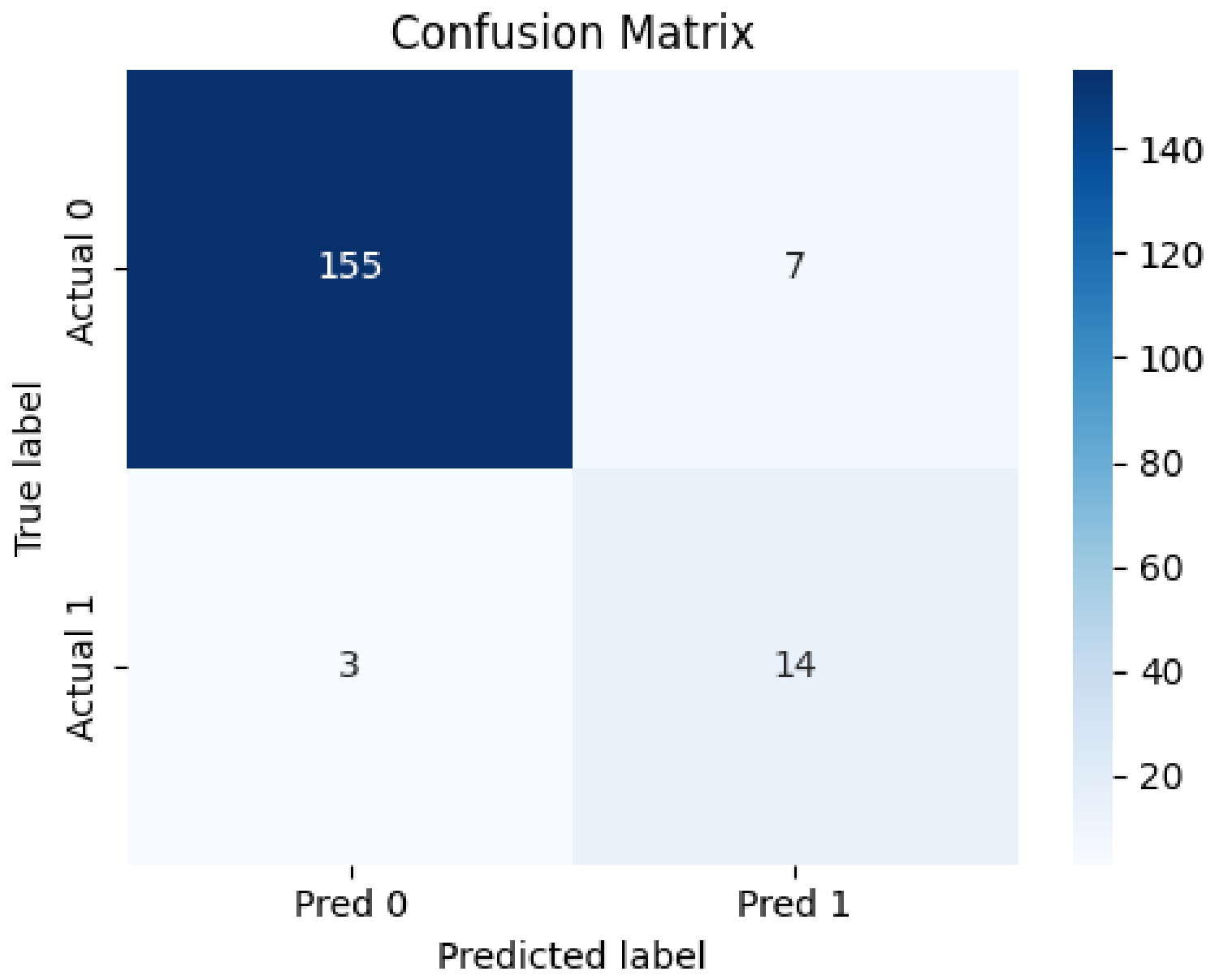
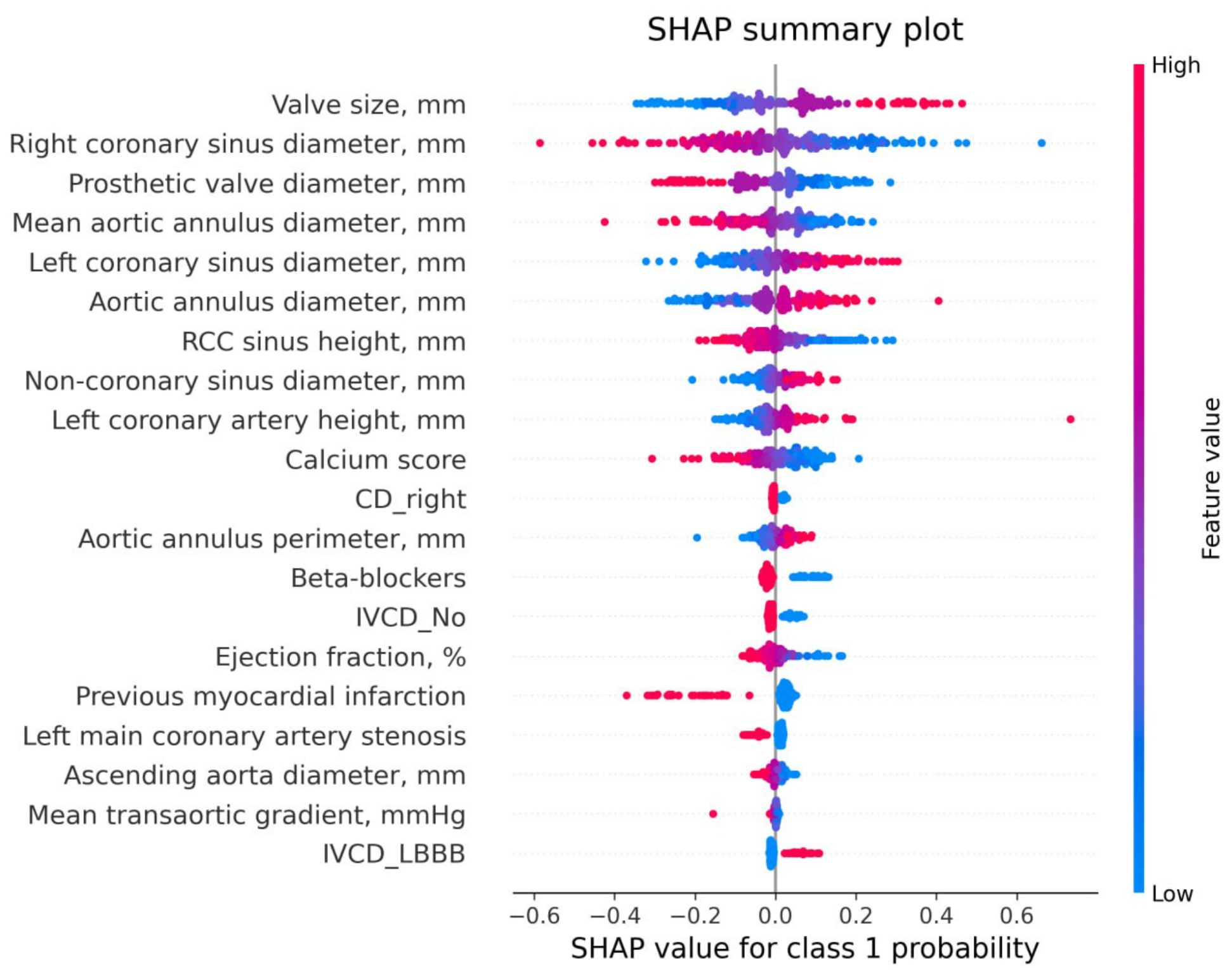
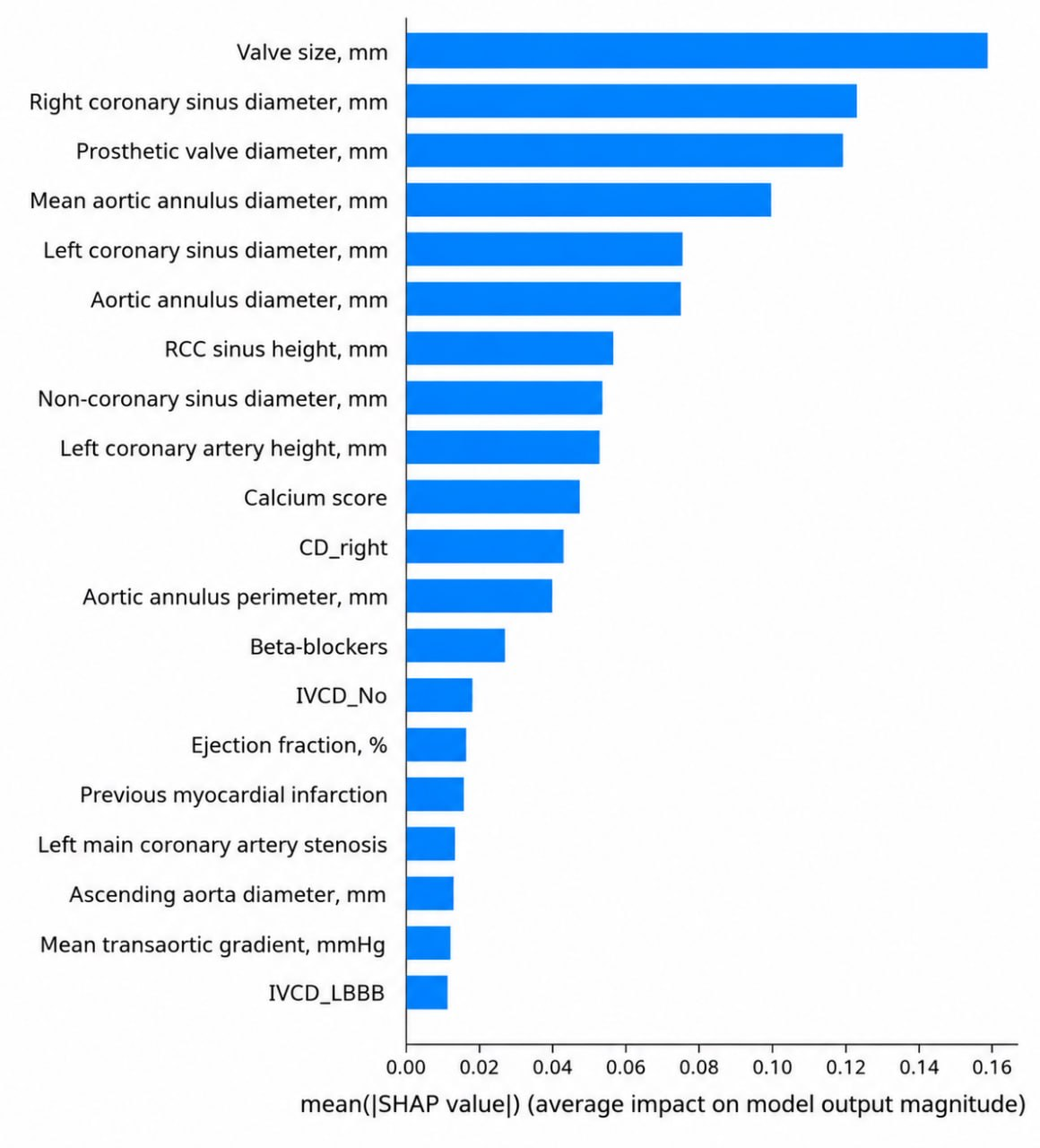
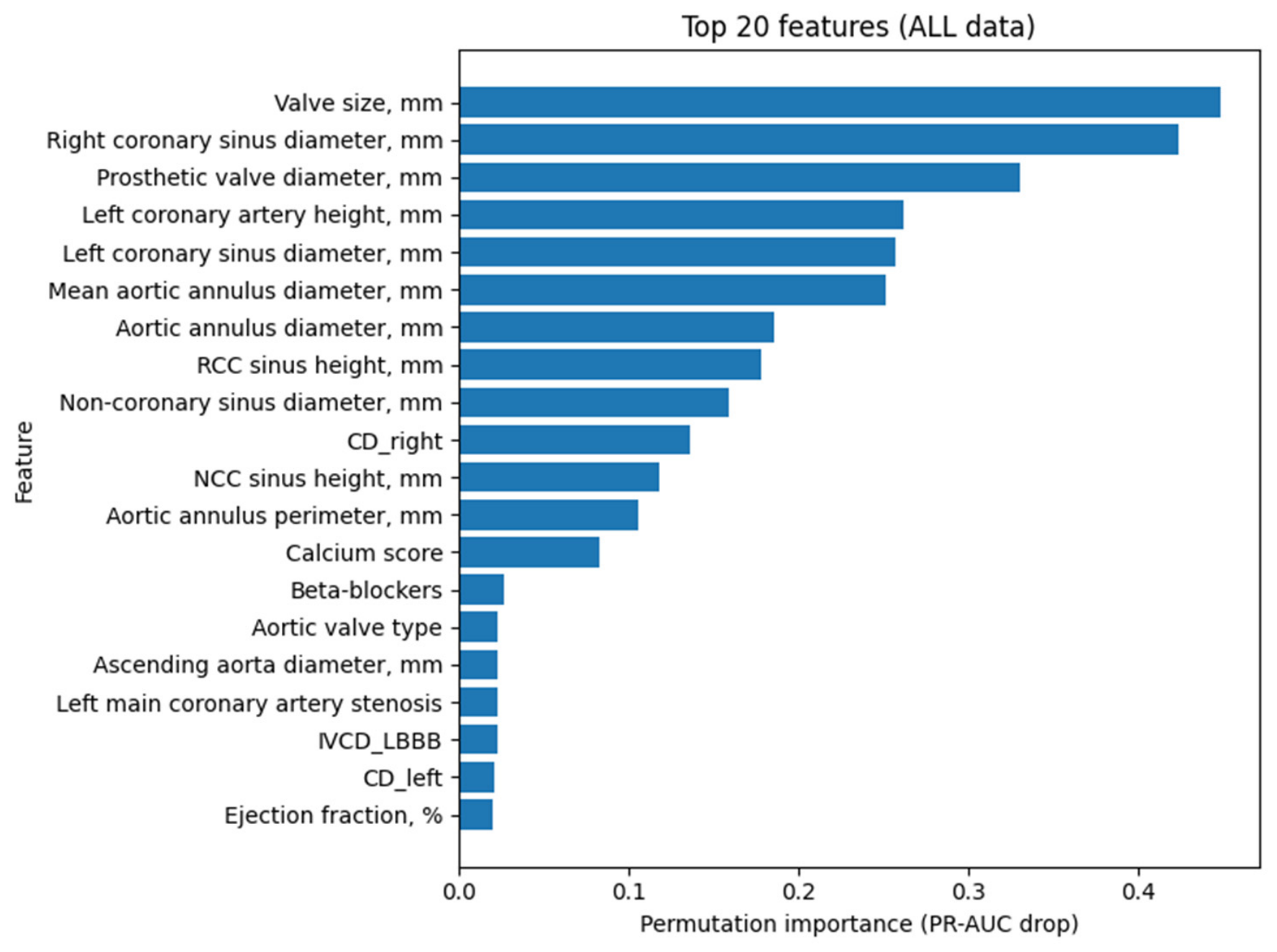
3.2. Development of a Machine Learning Model for Predicting Permanent Pacemaker Implantation
4. Discussion
5. Conclusions
6. Limitations
Author Contributions
Funding
Institutional Review Board Statement
Informed Consent Statement
Data Availability Statement
Acknowledgments
Conflicts of Interest
Abbreviations
| LVEF | Left ventricular ejection fraction |
| PPI | Permanent pacemaker implantation |
| SHAP | SHapley Additive exPlanations |
| TAVR | Transcatheter aortic valve replacement |
References
- Rosseel, L.; Mylotte, D.; Cosyns, B.; Vanhaverbeke, M.; Zweiker, D.; Teles, R.C.; Angerås, O.; Neylon, A.; Rudolph, T.K.; Wykrzykowska, J.J.; et al. Contemporary European practice in transcatheter aortic valve implantation: Results from the 2022 European TAVI Pathway Registry. Front. Cardiovasc. Med. 2023, 10, 1227217. [Google Scholar] [CrossRef]
- Abras, M.; Surev, A.; Vasa-Nicotera, M.; Moscalu, V.; Grib, A.; Popovici, I.; Beiu, C. Transcatheter aortic valve implantation. First experience of minimally invasive treatment in the Republic of Moldova. Mold. Med. J. 2020, 63, 58–65. [Google Scholar]
- Unger, P.; Powers, A.; Le Nezet, E.; Lacasse-Rioux, E.; Galloo, X.; Clavel, M.A. Prevalence and Outcomes of Patients with Discordant High-Gradient Aortic Stenosis. J. Am. Coll. Cardiol. 2024, 83, 1109–1119. [Google Scholar] [CrossRef] [PubMed]
- Abras, M.; Pasat, E.; Surev, A.; Gutan, I.; Moscalu, V.; Bursacovschi, D.; Vicol, M.-M.; Goian, D. The efficacy of transcatheter treatment of aortic valve stenosis based on the type of implanted valve. Bull. Acad. Sci. Mold. Med. Sci. 2025, 81, 7–15. [Google Scholar] [CrossRef]
- Faroux, L.; Chen, S.; Muntané-Carol, G.; Regueiro, A.; Philippon, F.; Sondergaard, L.; Jørgensen, T.H.; Lopez-Aguilera, J.; Kodali, S.; Leon, M.; et al. Clinical impact of conduction disturbances in transcatheter aortic valve replacement recipients: A systematic review and meta-analysis. Eur. Heart J. 2020, 41, 2771–2781. [Google Scholar] [CrossRef]
- Fadahunsi, O.O.; Olowoyeye, A.; Ukaigwe, A.; Li, Z.; Vora, A.N.; Vemulapalli, S.; Elgin, E.; Donato, A. Incidence, Predictors, and Outcomes of Permanent Pacemaker Implantation Following Transcatheter Aortic Valve Replacement. JACC Cardiovasc. Interv. 2016, 9, 2189–2199. [Google Scholar] [CrossRef] [PubMed]
- Muntané-Carol, G.; Philippon, F.; Nault, I.; Faroux, L.; Alperi, A.; Mittal, S.; Rodés-Cabau, J. Ambulatory Electrocardiogram Monitoring in Patients Undergoing Transcatheter Aortic Valve Replacement: JACC State-of-the-Art Review. J. Am. Coll. Cardiol. 2021, 77, 1344–1356. [Google Scholar] [CrossRef]
- Siontis, G.C.M.; Jüni, P.; Pilgrim, T.; Stortecky, S.; Büllesfeld, L.; Meier, B.; Wenaweser, P.; Windecker, S. Predictors of permanent pacemaker implantation in patients with severe aortic stenosis undergoing TAVR: A meta-analysis. J. Am. Coll. Cardiol. 2014, 64, 129–140. [Google Scholar] [CrossRef]
- Nazif, T.M.; Chen, S.; George, I.; Dizon, J.M.; Hahn, R.T.; Crowley, A.; Alu, M.C.; Babaliaros, V.; Thourani, V.H.; Herrmann, H.C.; et al. New-onset left bundle branch block after transcatheter aortic valve replacement is associated with adverse long-term clinical outcomes in intermediate-risk patients: An analysis from the PARTNER II trial. Eur. Heart J. 2019, 40, 2218–2227. [Google Scholar] [CrossRef]
- Gada, H.; Vora, A.N.; Tang, G.H.L.; Mumtaz, M.; Forrest, J.K.; Laham, R.J.; Yakubov, S.J.; Deeb, G.M.; Rammohan, C.; Huang, J.; et al. Site-Level Variation and Predictors of Permanent Pacemaker Implantation Following TAVR in the Evolut Low-Risk Trial. Cardiovasc. Revascularization Med. 2023, 47, 48–54. [Google Scholar] [CrossRef]
- Kazemian, S.; Fallahtafti, P.; Sharifi, M.; Mohammadi, N.S.H.; Soleimani, H.; Moghadam, A.S.; Karimi, E.; Sattar, Y.; Jenab, Y.; Mehrani, M.; et al. Trends in Transcatheter Versus Surgical Aortic Valve Replacement Outcomes in Patients with Low-Surgical Risk: A Systematic Review and Meta-Analysis of Randomized Trials. J. Am. Heart Assoc. 2024, 13, e036179. [Google Scholar] [CrossRef]
- Pagnesi, M.; Kim, W.-K.; Baggio, S.; Scotti, A.; Barbanti, M.; De Marco, F.; Adamo, M.; Eitan, A.; Estévez-Loureiro, R.; Conradi, L.; et al. Incidence, Predictors, and Prognostic Impact of New Permanent Pacemaker Implantation After TAVR with Self-Expanding Valves. JACC Cardiovasc. Interv. 2023, 16, 2004–2017. [Google Scholar] [CrossRef]
- Lee, Y.T.; Tsao, T.P.; Lee, K.C.; Lin, H.C.; Liu, C.T.; Hsiung, M.C.; Yin, W.H.; Wei, J. Predictors of permanent pacemaker requirement in aortic stenosis patients undergoing self-expanding valve transcatheter aortic valve replacement using the cusp overlap technique. Front. Cardiovasc. Med. 2025, 12, 1486375. [Google Scholar] [CrossRef]
- Høydahl, M.P.; Kjønås, D.; Rösner, A.; Trones Antonsen, B.; Forsdahl, S.H.; Busund, R. Predictors of permanent pacemaker implantation after transcatheter aortic valve implantation. Scand. Cardiovasc. J. 2025, 59, 2481175. [Google Scholar] [CrossRef]
- Baraka, M.; Kamal, D.; Mostafa, A.E. Depth of implantation in relation to membranous septum as a predictor of conduction disturbances after transcatheter aortic valve implantation. Indian Pacing Electrophysiol. J. 2024, 24, 133–139. [Google Scholar] [CrossRef] [PubMed]
- Abras, M.; Pasat, E.; Vicol, M.-M.; Ciorici, C.; Bursacovschi, D. Diastolic dysfunction and myocardial ischemia in TAVI patients. Mold. J. Health Sci. 2025, 12, 27–33. [Google Scholar] [CrossRef]
- Mendiz, O.A.; Fava, C.; Müller, L.I.; Lev, G.A.; Heredia, G.; Gómez, S.E.; Cedeño, J.; Pérez, J.M.; Lamelas, P. Predictors of permanent pacemaker implantation for transcatheter self-expandable aortic valve implant in the cusp overlap era. Catheter. Cardiovasc. Interv. 2024, 104, 1071–1078. [Google Scholar] [CrossRef]
- Jung, S.; Kondruweit, M.; Marwan, M.; Achenbach, S. Anatomical and Functional Predictors of Permanent Pacemaker Implantation After Transcatheter Aortic Valve Implantation. J. Am. Heart Assoc. 2025, 14, e039020. [Google Scholar] [CrossRef] [PubMed]
- Abras, M.; Surev, A.; Moscalu, V.; Ciobanu, N.; Pasat, E.; Beiu, C. Transcatheter aortic valve implantation with self-expandable prosthesis in the Republic of Moldova. The one year follow-up of the first ten patients. Bull. Acad. Sci. Mold. Med. Sci. 2022, 72, 18–22. [Google Scholar] [CrossRef]
- Lin, S.I.; Miura, M.; Tagliari, A.P.; Lee, Y.H.; Shirai, S.; Puri, R.; Maisano, F.; Taramasso, M. Intraventricular conduction disturbances after transcatheter aortic valve implantation. Interv. Cardiol. Rev. Res. Resour. 2020, 15, e11. [Google Scholar] [CrossRef]
- Miyashita, H.; Moriyama, N.; Sugiyama, Y.; Jalanko, M.; Dahlbacka, S.; Vähäsilta, T.; Vainikka, T.; Viikilä, J.; Laine, M. Conduction Disturbance After Transcatheter Aortic Valve Implantation with Self- or Balloon-Expandable Valve According to the Implantation Depth. Am. J. Cardiol. 2023, 203, 17–22. [Google Scholar] [CrossRef]
- Aslan, S.; Türkvatan, A.; Topel, Ç.; Güner, A.; Demir, A.R.; Kahraman, S.; Çelik, Ö.; Ertürk, M. Structural Changes of the Right Fibrous Trigone as a Risk Factor for Conduction Disturbance After Transcatheter Aortic Valve Implantation. Anatol. J. Cardiol. 2022, 26, 532–542. [Google Scholar] [CrossRef]
- Glikson, M.; Nielsen, J.C.; Leclercq, C.; Kronborg, M.B.; Michowitz, Y.; Auricchio, A.; Barbash, I.M.; Barrabés, J.A.; Boriani, G.; Braunschweig, F.; et al. 2021 ESC Guidelines on cardiac pacing and cardiac resynchronization therapy. Eur. Heart J. 2021, 42, 3427–3520. [Google Scholar] [CrossRef]
- Agasthi, P.; Ashraf, H.; Pujari, S.H.; Girardo, M.; Tseng, A.; Mookadam, F.; Venepally, N.; Buras, M.R.; Abraham, B.; Khetarpal, B.K.; et al. Prediction of permanent pacemaker implantation after transcatheter aortic valve replacement: The role of machine learning. World J. Cardiol. 2023, 15, 95–105. [Google Scholar] [CrossRef]
- El Ouahidi, A.; El Ouahidi, Y.; Nicol, P.P.; Hannachi, S.; Benic, C.; Mansourati, J.; Pasdeloup, B.; Didier, R. Machine learning for pacemaker implantation prediction after TAVI using multimodal imaging data. Sci. Rep. 2024, 14, 25008. [Google Scholar] [CrossRef] [PubMed]
- Barrett, C.D.; Nickel, A.; Rosenberg, M.A.; Ream, K.; Tzou, W.S.; Aleong, R.; Tumolo, A.; Garg, L.; Zipse, M.; West, J.J.; et al. PRIME score for prediction of permanent pacemaker implantation after transcatheter aortic valve replacement. Catheter. Cardiovasc. Interv. 2023, 102, 1357–1363. [Google Scholar] [CrossRef]
- Tretter, J.T.; Eleid, M.F.; Bedogni, F.; Rodés-Cabau, J.; Regueiro, A.; Testa, L.; Chen, S.; Galhardo, A.; Ellenbogen, K.A.; Leon, M.B.; et al. Preprocedural CT and ECG Markers for Predicting Post-TAVR Pacemaker Requirement in High-Risk Patients. Struct. Heart 2025, 9, 100726. [Google Scholar] [CrossRef] [PubMed]
- Qi, Y.; Lin, X.; Pan, W.; Zhang, X.; Ding, Y.; Chen, S.; Zhang, L.; Zhou, D.; Ge, J. A prediction model for permanent pacemaker implantation after transcatheter aortic valve replacement. Eur. J. Med. Res. 2023, 28, 262. [Google Scholar] [CrossRef]
- Dell’aquila, M.; Rossi, C.S.; Caldonazo, T.; Rahouma, M.; Harik, L.; Cancelli, G.; Ibrahim, M.; Eynde, J.V.D.; Soletti, G.J.; Leith, J.; et al. Machine learning versus logistic regression for permanent pacemaker implantation prediction after transcatheter aortic valve replacement—A systematic review and meta-analysis. J. Med. Artif. Intell. 2024, 7, 32. [Google Scholar] [CrossRef]
- Vejpongsa, P.; Zhang, X.; Bhise, V.; Kitkungvan, D.; Shivamurthy, P.; Anderson, H.V.; Balan, P.; Nguyen, T.C.; Estrera, A.L.; Dougherty, A.H.; et al. Risk Prediction Model for Permanent Pacemaker Implantation after Transcatheter Aortic Valve Replacement. Struct. Heart 2018, 2, 328–335. [Google Scholar] [CrossRef]
- Tsushima, T.; Al-Kindi, S.; Nadeem, F.; Attizzani, G.F.; Elgudin, Y.; Markowitz, A.; Costa, M.A.; Simon, D.I.; Arruda, M.S.; Mackall, J.A.; et al. Machine Learning Algorithms for Prediction of Permanent Pacemaker Implantation After Transcatheter Aortic Valve Replacement. Circ. Arrhythmia Electrophysiol. 2021, 14, 370–372. [Google Scholar] [CrossRef] [PubMed]



| No PPI n = 162 1 | 95% CI 2 | PPI n = 17 1 | 95% CI 2 | Statistic Test 3 | p-Value 3 | |
|---|---|---|---|---|---|---|
| Age | 76.2 (4.7) 75.0 (6.0) 70.0 89.0 | 75, 77 | 77.6 (5.5) 76.0 (9.0) 70.0 88.0 | 75, 80 | 1183 | 0.3 |
| Sex | 0.03 | >0.9 | ||||
| Feminine | 99 (61.1%) | 54%, 69% | 10 (58.8%) | 35%, 82% | ||
| Masculine | 63 (38.9%) | 31%, 46% | 7 (41.2%) | 18%, 65% | ||
| Previous myocardial infarction | 29 (17.9%) | 12%, 24% | 1 (5.9%) | 0.00%, 17% | 1.6 | 0.3 |
| Atrial fibrillation | 37 (22.8%) | 16%, 29% | 5 (29.4%) | 7.8%, 51% | 0.37 | 0.6 |
| Body mass index | 29.1 (4.8) 29.3 (6.2) 19.5 41.8 | 28, 30 | 31.9 (5.6) 31.3 (5.5) 23.8 46.9 | 29, 35 | 999 | 0.063 |
| Renal dysfunction | 25 (15.4%) | 9.9%, 21% | 3 (17.6%) | 0.00%, 36% | 0.06 | >0.9 |
| Beta-blockers | 129 (79.6%) | 73%, 86% | 14 (82.4%) | 64%, 100% | 0.07 | >0.9 |
| Cardiac glycosides (digitalis) | 8 (4.9%) | 1.6%, 8.3% | 0 (0.0%) | 0.00%, 0.00% | 0.88 | 0.6 |
| Cardiac rhythm | 2.9 | 0.4 | ||||
| atrial fibrillation | 23 (14.2%) | 8.8%, 20% | 5 (29.4%) | 7.8%, 51% | ||
| PPI | 2 (1.2%) | 0.00%, 2.9% | 0 (0.0%) | 0.00%, 0.00% | ||
| sinus rhythm | 136 (84.0%) | 78%, 90% | 12 (70.6%) | 49%, 92% | ||
| Heart rate | 72.1 (12.6) 70.0 (18.0) 50.0 118.0 | 70, 74 | 67.5 (8.5) 65.0 (12.0) 59.0 85.0 | 63, 72 | 1682 | 0.13 |
| Signs of left ventricular hypertrophy | 95 (58.6%) | 51%, 66% | 8 (47.1%) | 23%, 71% | 0.84 | 0.4 |
| Atrioventricular block | 0.27 | >0.9 | ||||
| No | 148 (91.4%) | 87%, 96% | 16 (94.1%) | 83%, 100% | ||
| Yes, gr. I | 12 (7.4%) | 3.4%, 11% | 1 (5.9%) | 0.00%, 17% | ||
| Yes, gr. II | 1 (0.6%) | 0.00%, 1.8% | 0 (0.0%) | 0.00%, 0.00% | ||
| Yes, gr. III | 1 (0.6%) | 0.00%, 1.8% | 0 (0.0%) | 0.00%, 0.00% | ||
| Intraventricular conduction disturbances | 3.8 | 0.14 | ||||
| LBBB | 26 (16.0%) | 10%, 22% | 3 (17.6%) | 0.00%, 36% | ||
| No | 127 (78.4%) | 72%, 85% | 11 (64.7%) | 42%, 87% | ||
| RBBB | 9 (5.6%) | 2.0%, 9.1% | 3 (17.6%) | 0.00%, 36% | ||
| Ascending aorta diameter, mm | 37.0 (3.4) 37.0 (5.0) 28.0 49.0 | 36, 38 | 36.8 (3.5) 38.0 (3.0) 31.0 45.0 | 35, 39 | 1401 | >0.9 |
| Aortic annulus diameter, mm | 22.3 (2.0) 22.0 (3.0) 17.0 28.0 | 22, 23 | 23.1 (1.2) 23.0 (2.0) 21.0 25.0 | 23, 24 | 1031 | 0.085 |
| Left atrium diameter, mm | 47.4 (5.8) 46.0 (7.0) 16.0 68.0 | 47, 48 | 46.8 (5.9) 46.0 (7.0) 37.0 58.0 | 44, 50 | 1463 | 0.7 |
| Left atrial volume, ml | 94.9 (34.6) 82.7 (40.3) 34.8 267.3 | 89, 100 | 90.9 (34.7) 82.7 (40.3) 43.1 165.8 | 73, 109 | 1462 | 0.7 |
| Left atrial volume index, ml/m2 | 51.0 (18.9) 46.6 (18.6) 19.8 130.5 | 48, 54 | 47.2 (16.7) 44.1 (22.2) 24.6 81.4 | 39, 56 | 1540 | 0.4 |
| LV end-diastolic diameter | 50.9 (5.7) 50.0 (7.0) 39.0 71.0 | 50, 52 | 50.4 (4.3) 49.0 (5.0) 44.0 60.0 | 48, 53 | 1450 | 0.7 |
| LV end-diastolic volume | 132.3 (32.3) 132.0 (47.0) 70.0 227.0 | 127, 137 | 124.2 (25.5) 118.0 (37.0) 90.0 185.0 | 111, 137 | 1573 | 0.3 |
| LV end-systolic diameter | 34.8 (6.9) 34.0 (8.0) 21.0 64.0 | 34, 36 | 36.1 (7.6) 35.0 (10.0) 27.0 56.0 | 32, 40 | 1265 | 0.6 |
| LV end-systolic volume | 56.1 (24.9) 53.0 (30.8) 24.0 168.0 | 52, 60 | 54.1 (21.5) 51.0 (18.0) 27.0 115.0 | 43, 65 | 1408 | 0.9 |
| Interventricular septum thickness, mm | 14.6 (2.1) 14.0 (3.0) 11.0 22.0 | 14, 15 | 14.5 (1.6) 15.0 (3.0) 12.0 17.0 | 14, 15 | 1366 | >0.9 |
| LV mass, g | 289.8 (63.1) 281.2 (91.5) 169.4 461.8 | 280, 300 | 276.5 (38.2) 275.8 (40.3) 206.4 365.4 | 257, 296 | 1495 | 0.6 |
| LV mass index, g/m2 | 155.7 (35.0) 148.6 (49.1) 91.7 254.0 | 150, 161 | 144.9 (20.9) 143.7 (24.5) 111.5 189.9 | 134, 156 | 1572 | 0.3 |
| Relative wall thickness | 0.5 (0.1) 0.5 (0.1) 0.3 0.9 | 0.49, 0.51 | 0.5 (0.1) 0.5 (0.1) 0.4 0.6 | 0.45, 0.53 | 1394 | >0.9 |
| Ejection fraction, % | 57.4 (7.8) 58.0 (7.0) 25.0 69.7 | 56, 59 | 57.0 (7.5) 60.0 (6.0) 37.0 70.0 | 53, 61 | 1431 | 0.8 |
| Right ventricle diameter, mm | 29.5 (4.5) 29.0 (6.0) 20.0 48.0 | 29, 30 | 29.2 (2.7) 30.0 (5.0) 25.0 34.0 | 28, 31 | 1322 | 0.8 |
| Right atrium diameter, mm | 45.6 (4.5) 45.0 (5.0) 32.0 60.0 | 45, 46 | 45.4 (4.2) 46.0 (4.0) 38.0 56.0 | 43, 48 | 1340 | 0.9 |
| E/e′ ratio | 11.9 (4.4) 10.6 (6.4) 4.9 32.0 | 11, 13 | 12.9 (4.7) 12.4 (7.4) 7.5 23.4 | 10, 15 | 1225 | 0.5 |
| Peak transaortic gradient, mmHg | 82.7 (20.5) 79.7 (25.8) 16.5 160.0 | 80, 86 | 88.4 (22.7) 86.5 (27.6) 58.1 139.6 | 77, 100 | 1198 | 0.4 |
| Mean transaortic gradient, mmHg | 56.0 (35.8) 51.8 (19.8) 11.1 473.0 | 50, 62 | 53.9 (13.7) 49.2 (12.6) 37.0 87.1 | 47, 61 | 1368 | >0.9 |
| Peak velocity, m/s | 4.5 (0.6) 4.5 (0.7) 2.0 7.2 | 4.4, 4.6 | 4.7 (0.6) 4.6 (0.8) 3.8 5.9 | 4.4, 5.0 | 1205 | 0.4 |
| Stroke volume, mL | 75.1 (15.8) 75.0 (22.0) 42.0 148.0 | 73, 78 | 68.7 (7.9) 68.0 (8.0) 55.0 83.0 | 65, 73 | 1762 | 0.058 |
| Cardiac output | 5.4 (1.4) 5.3 (1.6) 2.2 11.1 | 5.2, 5.6 | 4.8 (0.9) 4.8 (1.2) 3.2 7.1 | 4.4, 5.3 | 1737 | 0.077 |
| Cardiac index | 2.8 (0.7) 2.8 (0.8) 1.4 6.1 | 2.7, 2.9 | 2.5 (0.5) 2.6 (0.6) 1.8 3.6 | 2.3, 2.8 | 1781 | 0.047 |
| Coronary dominance | 4.5 | 0.11 | ||||
| balanced | 18 (11.1%) | 6.3%, 16% | 4 (23.5%) | 3.4%, 44% | ||
| left | 13 (8.0%) | 3.8%, 12% | 3 (17.6%) | 0.00%, 36% | ||
| right | 131 (80.9%) | 75%, 87% | 10 (58.8%) | 35%, 82% | ||
| Atherosclerotic lesions | 2.5 | 0.5 | ||||
| normal coronary arteries | 67 (41.4%) | 34%, 49% | 8 (47.1%) | 23%, 71% | ||
| single-vessel disease | 13 (8.0%) | 3.8%, 12% | 3 (17.6%) | 0.00%, 36% | ||
| three-vessel disease | 65 (40.1%) | 33%, 48% | 5 (29.4%) | 7.8%, 51% | ||
| two-vessel disease | 17 (10.5%) | 5.8%, 15% | 1 (5.9%) | 0.00%, 17% | ||
| History of bypass surgery | 6 (3.7%) | 0.80%, 6.6% | 0 (0.0%) | 0.00%, 0.00% | 0.65 | 0.6 |
| Left main coronary artery stenosis | 35 (21.6%) | 15%, 28% | 1 (5.9%) | 0.00%, 17% | 2.4 | 0.2 |
| Circumflex artery stenosis | 70 (43.2%) | 36%, 51% | 6 (35.3%) | 13%, 58% | 0.39 | 0.6 |
| Aortic valve type | 1.1 | 0.6 | ||||
| Bicuspid | 10 (6.2%) | 2.5%, 9.9% | 0 (0.0%) | 0.00%, 0.00% | ||
| Tricuspid | 152 (93.8%) | 90%, 98% | 17 (100.0%) | 100%, 100% | ||
| Aortic annulus perimeter, mm | 77.3 (7.8) 76.5 (10.6) 25.4 94.0 | 76, 79 | 77.9 (5.8) 77.9 (6.8) 67.3 88.6 | 75, 81 | 1283 | 0.6 |
| Aortic annulus area, mm2 | 461.2 (87.6) 450.0 (120.2) 23.6 683.9 | 448, 475 | 465.6 (71.6) 451.5 (99.5) 344.7 615.0 | 429, 502 | 1303 | 0.7 |
| Right coronary artery height, mm | 16.8 (2.7) 16.7 (3.2) 10.9 26.4 | 16, 17 | 17.0 (2.3) 16.8 (2.0) 13.6 22.7 | 16, 18 | 1341 | 0.9 |
| Left coronary artery height, mm | 13.6 (3.2) 13.0 (3.9) 7.1 26.2 | 13, 14 | 18.8 (20.3) 14.3 (4.9) 9.6 97.0 | 8.3, 29 | 1195 | 0.4 |
| Left coronary sinus diameter, mm | 32.0 (3.6) 31.7 (4.6) 23.4 43.0 | 31, 33 | 32.2 (2.0) 32.0 (2.4) 29.6 37.0 | 31, 33 | 1227 | 0.5 |
| Right coronary sinus diameter, mm | 30.9 (3.4) 30.8 (4.2) 22.7 42.2 | 30, 31 | 29.2 (3.9) 29.3 (4.3) 17.1 33.0 | 27, 31 | 1687 | 0.13 |
| Non-coronary sinus diameter, mm | 31.5 (3.5) 31.0 (4.5) 19.7 40.5 | 31, 32 | 30.8 (4.8) 30.8 (4.0) 15.8 37.2 | 28, 33 | 1387 | >0.9 |
| LCC sinus height, mm | 20.9 (3.9) 21.0 (4.2) 9.2 35.0 | 20, 21 | 19.6 (4.6) 21.0 (4.0) 11.0 26.9 | 17, 22 | 1536 | 0.4 |
| RCC sinus height, mm | 21.1 (3.7) 21.7 (4.4) 10.8 32.2 | 21, 22 | 19.9 (3.9) 21.0 (4.4) 12.0 26.8 | 18, 22 | 1595 | 0.3 |
| NCC sinus height, mm | 21.4 (3.2) 21.0 (3.6) 15.0 36.0 | 21, 22 | 132.5 (460.1) 21.0 (2.7) 18.0 1918.0 | -104, 369 | 1378 | >0.9 |
| Sinotubular junction diameter | 28.7 (3.8) 28.2 (4.6) 21.3 47.0 | 28, 29 | 28.5 (2.9) 28.0 (2.6) 23.0 34.1 | 27, 30 | 1343 | 0.9 |
| Calcification grade | 1.7 | 0.5 | ||||
| High | 104 (64.2%) | 57%, 72% | 9 (52.9%) | 29%, 77% | ||
| Moderate | 44 (27.2%) | 20%, 34% | 5 (29.4%) | 7.8%, 51% | ||
| Reduced | 14 (8.6%) | 4.3%, 13% | 3 (17.6%) | 0.00%, 36% | ||
| Calcium score | 3168.6 (1918.8) 2700.0 (2464.3) 795.4 12,006.0 | 2871, 3466 | 2456.3 (1257.4) 2116.0 (1811.0) 518.0 4678.0 | 1810, 3103 | 1640 | 0.2 |
| Mean LVOT diameter, mm | 24.2 (2.5) 24.0 (3.4) 18.9 31.0 | 24, 25 | 23.8 (2.1) 23.9 (3.2) 20.9 28.0 | 23, 25 | 1505 | 0.5 |
| Unknown | 1 | 0 | ||||
| Minimum aortic annulus diameter, mm | 21.5 (2.5) 21.4 (2.9) 15.5 33.7 | 21, 22 | 21.6 (3.4) 21.3 (2.8) 17.8 31.6 | 20, 23 | 1522 | 0.5 |
| Maximum aortic annulus diameter, mm | 27.6 (2.6) 27.3 (3.6) 22.0 35.2 | 27, 28 | 27.4 (2.1) 27.1 (2.5) 24.0 30.8 | 26, 28 | 1382 | >0.9 |
| Mean aortic annulus diameter, mm | 24.5 (2.3) 24.2 (3.3) 19.8 34.4 | 24, 25 | 24.5 (1.9) 24.5 (1.5) 21.0 28.2 | 24, 25 | 1336 | 0.8 |
| Porcelain aorta | 5 (3.1%) | 0.42%, 5.7% | 0 (0.0%) | 0.00%, 0.00% | 0.54 | >0.9 |
| Prosthetic valve diameter, mm | 27.6 (3.4) 27.0 (4.0) 20.0 34.0 | 27, 28 | 27.0 (2.8) 26.0 (4.0) 24.0 35.0 | 26, 28 | 1527 | 0.5 |
| Valve type | 5.3 | 0.024 | ||||
| balloon-expandable | 53 (32.7%) | 25%, 40% | 1 (5.9%) | 0.00%, 17% | ||
| self-expanding | 109 (67.3%) | 60%, 75% | 16 (94.1%) | 83%, 100% | ||
| Valve size, mm | 27.6 (3.4) 27.0 (4.0) 20.0 34.0 | 27, 28 | 28.3 (2.6) 29.0 (2.0) 25.0 34.0 | 27, 30 | 1155 | 0.3 |
| Balloon predilatation | 94 (58.0%) | 50%, 66% | 13 (76.5%) | 56%, 97% | 2.2 | 0.2 |
| Post-dilatation | 59 (36.4%) | 29%, 44% | 7 (41.2%) | 18%, 65% | 0.15 | 0.8 |
| Repositioning | 11 | 0.14 | ||||
| 0 | 123 (75.9%) | 69%, 83% | 11 (64.7%) | 42%, 87% | ||
| 1 | 22 (13.6%) | 8.3%, 19% | 3 (17.6%) | 0.00%, 36% | ||
| 2 | 10 (6.2%) | 2.5%, 9.9% | 2 (11.8%) | 0.00%, 27% | ||
| 3 | 6 (3.7%) | 0.80%, 6.6% | 0 (0.0%) | 0.00%, 0.00% | ||
| 4 | 1 (0.6%) | 0.00%, 1.8% | 0 (0.0%) | 0.00%, 0.00% | ||
| 5 and more | 0 (0.0%) | 0.00%, 0.00% | 1 (5.9%) | 0.00%, 17% |
Disclaimer/Publisher’s Note: The statements, opinions and data contained in all publications are solely those of the individual author(s) and contributor(s) and not of MDPI and/or the editor(s). MDPI and/or the editor(s) disclaim responsibility for any injury to people or property resulting from any ideas, methods, instructions or products referred to in the content. |
© 2026 by the authors. Licensee MDPI, Basel, Switzerland. This article is an open access article distributed under the terms and conditions of the Creative Commons Attribution (CC BY) license.
Share and Cite
Abras, M.; Bursacovschi, D.; Pasat, E.; Vicol, M.-M.; Abras, T.; Mazur-Nicorici, L.; Arnaut, O. Machine Learning-Driven Probability of Permanent Pacemaker Implantation After Transcatheter Aortic Valve Replacement. Diagnostics 2026, 16, 1720. https://doi.org/10.3390/diagnostics16111720
Abras M, Bursacovschi D, Pasat E, Vicol M-M, Abras T, Mazur-Nicorici L, Arnaut O. Machine Learning-Driven Probability of Permanent Pacemaker Implantation After Transcatheter Aortic Valve Replacement. Diagnostics. 2026; 16(11):1720. https://doi.org/10.3390/diagnostics16111720
Chicago/Turabian StyleAbras, Marcel, Daniela Bursacovschi, Ecaterina Pasat, Maria-Magdalena Vicol, Tatiana Abras, Lucia Mazur-Nicorici, and Oleg Arnaut. 2026. "Machine Learning-Driven Probability of Permanent Pacemaker Implantation After Transcatheter Aortic Valve Replacement" Diagnostics 16, no. 11: 1720. https://doi.org/10.3390/diagnostics16111720
APA StyleAbras, M., Bursacovschi, D., Pasat, E., Vicol, M.-M., Abras, T., Mazur-Nicorici, L., & Arnaut, O. (2026). Machine Learning-Driven Probability of Permanent Pacemaker Implantation After Transcatheter Aortic Valve Replacement. Diagnostics, 16(11), 1720. https://doi.org/10.3390/diagnostics16111720