Implementation of an AI-Based Clinical Decision Support System Predicting In-Hospital Cardiac Arrest in General Wards: A Multicenter Staggered-Implementation Study in Secondary Hospitals in Korea
 , , , and
Abstract
1. Introduction
2. Materials and Methods
2.1. Study Design, Reporting, and Ethics
2.2. Study Setting and Population
2.3. Intervention
2.4. Pre-Implementation and Post-Implementation Periods
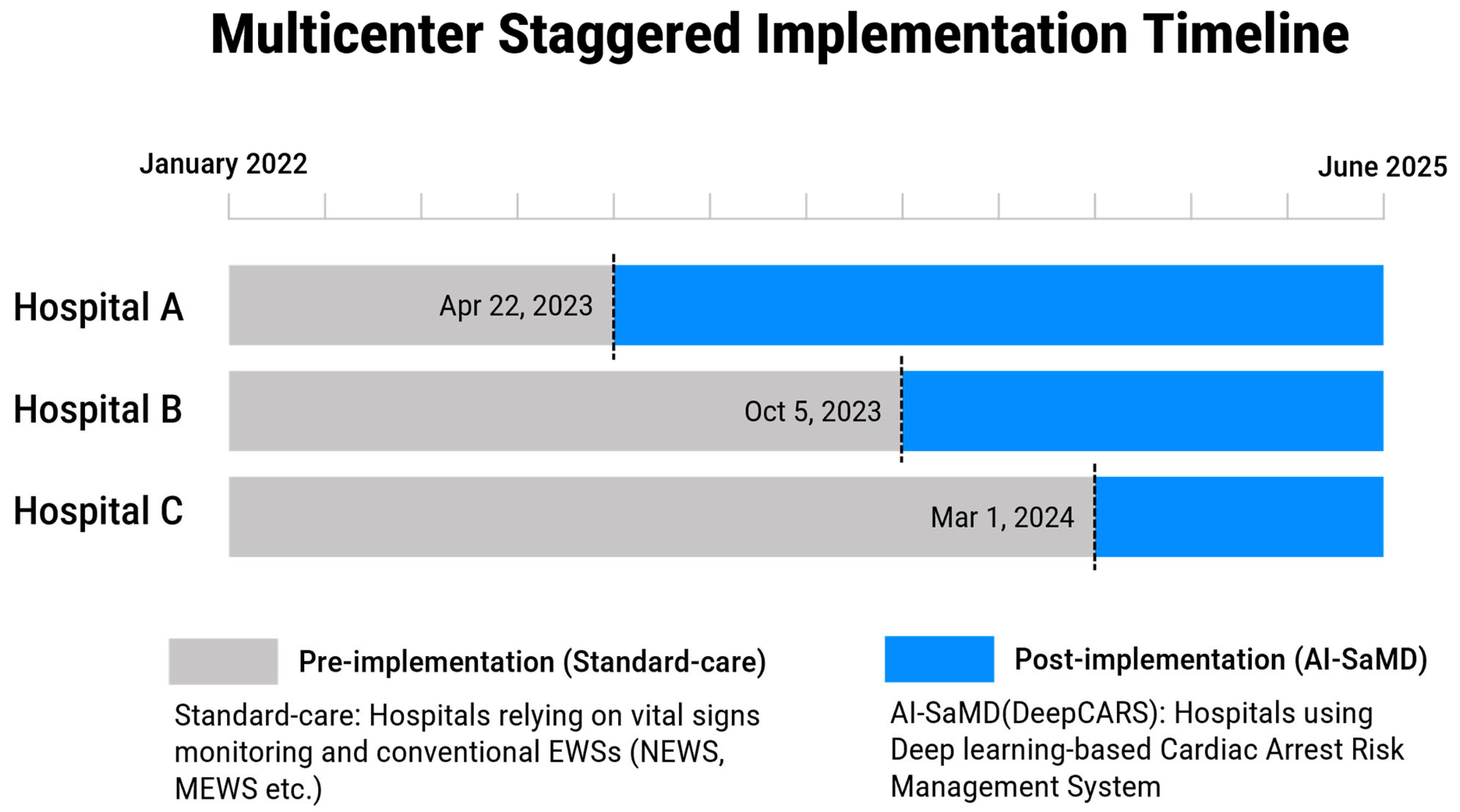
2.5. Study Period and Staggered Implementation
2.6. Study Outcomes
2.7. Data Collection and Preprocessing
2.8. Statistical Analysis
2.9. Secondary Analysis
2.10. Sensitivity Analysis
3. Results
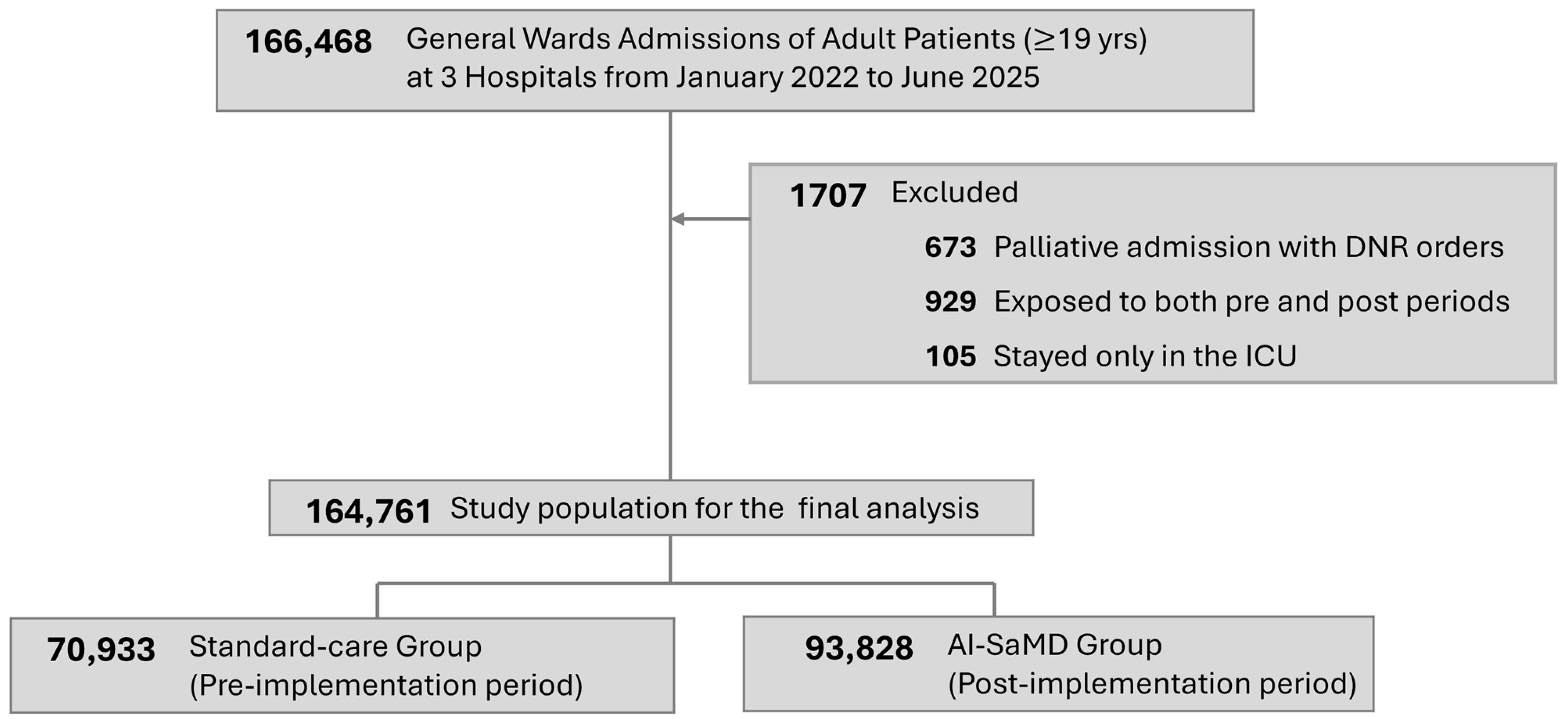
3.1. Study Population
3.2. Baseline Characteristics
3.3. Primary and Secondary Outcomes
3.4. Sepsis Subgroup Analysis
3.5. Lead-Time to Clinical Response
3.6. Department-Stratified and Care Directive Analyses
3.7. Sensitivity Analysis
4. Discussion
4.1. Novelty in the Context of Previous Studies
4.2. Exploratory Analysis of Outcome Results
4.3. Lead-Time Findings and Their Implications
4.4. Findings in Patients with Sepsis
4.5. Care Directives and DNR Changes
4.6. Neurological Outcomes After IHCA
4.7. Department-Level Heterogeneity
4.8. Findings from Sensitivity Analysis
4.9. Limitations
4.10. Future Directions
5. Conclusions
Supplementary Materials
Author Contributions
Funding
Institutional Review Board Statement
Informed Consent Statement
Data Availability Statement
Conflicts of Interest
Abbreviations
| AHA | American Heart Association |
| AI | artificial intelligence |
| AI-SaMD | artificial intelligence software as a medical device |
| AUROC | area under the receiver operating characteristic curve |
| CCI | Charlson Comorbidity Index |
| CDC | Centers for Disease Control and Prevention |
| CPC | Cerebral Performance Category |
| CPR | cardiopulmonary resuscitation |
| DECIDE-AI | Developmental and Exploratory Clinical Investigation of Decision Support Systems Driven by Artificial Intelligence |
| DNR | do-not-resuscitate |
| EMR | electronic medical record |
| EWS | early warning system |
| GLMM | generalized linear mixed model |
| HCP | healthcare professional |
| ICD-10 | International Classification of Diseases, Tenth Revision |
| ICU | intensive care unit |
| IHCA | in-hospital cardiac arrest |
| IPCW | inverse probability of censoring weighting |
| IRB | institutional review board |
| LOS | length of stay |
| MET | medical emergency team |
| MEWS | Modified Early Warning Score |
| NEWS | National Early Warning Score |
| NEWS2 | National Early Warning Score 2 |
| POLST | Physician Orders for Life-Sustaining Treatment |
| PSM | propensity score matching |
| RRS | rapid response system |
| SCCM | Society of Critical Care Medicine |
| SOFA | Sequential Organ Failure Assessment |
| SPTTS | single-parameter track-and-trigger system |
| STROBE | Strengthening the Reporting of Observational Studies in Epidemiology |
References
- Andersen, L.W.; Holmberg, M.J.; Berg, K.M.; Donnino, M.W.; Granfeldt, A. In-Hospital Cardiac Arrest: A Review. JAMA 2019, 321, 1200–1210. [Google Scholar] [CrossRef]
- Penketh, J.; Nolan, J.P. In-hospital cardiac arrest: The state of the art. Crit. Care 2022, 26, 376. [Google Scholar] [CrossRef]
- Schluep, M.; Gravesteijn, B.Y.; Stolker, R.J.; Endeman, H.; Hoeks, S.E. One-year survival after in-hospital cardiac arrest: A systematic review and meta-analysis. Resuscitation 2018, 132, 90–100. [Google Scholar] [CrossRef]
- DeVita, M.A. (Ed.) Textbook of Rapid Response Systems: Concept and Implementation, 3rd ed.; Springer Nature: Cham, Switzerland, 2025. [Google Scholar] [CrossRef]
- McGaughey, J.; Fergusson, D.A.; Van Bogaert, P.; Rose, L. Early warning systems and rapid response systems for the prevention of patient deterioration on acute adult hospital wards. Cochrane Database Syst. Rev. 2021, 11, CD005529. [Google Scholar] [CrossRef]
- Dezfulian, C.; Cabañas, J.G.; Buckley, J.R.; Cash, R.E.; Crowe, R.P.; Drennan, I.R.; Mahgoub, M.; Mannarino, C.N.; May, T.; Salcido, D.D.; et al. Part 4: Systems of Care: 2025 American Heart Association Guidelines for Cardiopulmonary Resuscitation and Emergency Cardiovascular Care. Circulation 2025, 152, S353–S384. [Google Scholar] [CrossRef] [PubMed]
- Honarmand, K.; Wax, R.S.; Penoyer, D.; Lighthall, G.; Danesh, V.; Rochwerg, B.; Cheatham, M.L.; Davis, D.P.; DeVita, M.; Downar, J.; et al. Society of Critical Care Medicine Guidelines on Recognizing and Responding to Clinical Deterioration Outside the ICU: 2023. Crit. Care Med. 2024, 52, 314–337. [Google Scholar] [CrossRef] [PubMed]
- Edelson, D.P.; Churpek, M.M.; Carey, K.A.; Lin, Z.; Huang, C.; Siner, J.M.; Johnson, J.; Krumholz, H.M.; Rhodes, D.J. Early Warning Scores With and Without Artificial Intelligence. JAMA Netw. Open 2024, 7, e2438986. [Google Scholar] [CrossRef] [PubMed]
- Bedoya, A.D.; Clement, M.E.; Phelan, M.; Steorts, R.C.; O’bRien, C.; Goldstein, B.A. Minimal Impact of Implemented Early Warning Score and Best Practice Alert for Patient Deterioration. Crit. Care Med. 2019, 47, 49–55. [Google Scholar] [CrossRef]
- van der Vegt, A.H.; Campbell, V.; Mitchell, I.; Malycha, J.; Simpson, J.; Flenady, T.; Flabouris, A.; Lane, P.J.; Mehta, N.; Kalke, V.R.; et al. Systematic review and longitudinal analysis of implementing Artificial Intelligence to predict clinical deterioration in adult hospitals: What is known and what remains uncertain. J. Am. Med. Inform. Assoc. 2024, 31, 509–524. [Google Scholar] [CrossRef]
- Vasey, B.; Nagendran, M.; Campbell, B.; Clifton, D.A.; Collins, G.S.; Denaxas, S.; Denniston, A.K.; Faes, L.; Geerts, B.; Ibrahim, M.; et al. Reporting guideline for the early-stage clinical evaluation of decision support systems driven by artificial intelligence: DECIDE-AI. Nat. Med. 2022, 28, 924–933. [Google Scholar] [CrossRef]
- Mazor, T.; Farhat, K.S.; Trukhanov, P.; Lindsay, J.; Galvin, M.; Mallaber, E.; Paul, M.A.; Hassett, M.J.; Schrag, D.; Cerami, E.; et al. Clinical Trial Notifications Triggered by Artificial Intelligence–Detected Cancer Progression: A Randomized Trial. JAMA Netw. Open 2025, 8, e252013. [Google Scholar] [CrossRef]
- Liu, T.Y.A.; Hswen, Y.; Bonow, R.O.; Carroll, A.E.; Gross, C.P.; Guterman, E.L.; Khera, R.; Kibbe, M.R.; Öngür, D.; Pirracchio, R.; et al. Artificial Intelligence Across the JAMA Network: A Call for Submissions. JAMA 2025, 334, 1626–1627. [Google Scholar] [CrossRef] [PubMed]
- Armoundas, A.A.; Narayan, S.M.; Arnett, D.K.; Spector-Bagdady, K.; Bennett, D.A.; Celi, L.A.; Friedman, P.A.; Gollob, M.H.; Hall, J.L.; Kwitek, A.E.; et al. Use of Artificial Intelligence in Improving Outcomes in Heart Disease: A Scientific Statement From the American Heart Association. Circulation 2024, 149, e1028–e1050. [Google Scholar] [CrossRef] [PubMed]
- Escobar, G.J.; Liu, V.X.; Schuler, A.; Lawson, B.; Greene, J.D.; Kipnis, P. Automated Identification of Adults at Risk for In-Hospital Clinical Deterioration. N. Engl. J. Med. 2020, 383, 1951–1960. [Google Scholar] [CrossRef] [PubMed]
- Winslow, C.J.; Edelson, D.P.; Churpek, M.M.; Taneja, M.; Shah, N.S.; Datta, A.; Wang, C.-H.; Ravichandran, U.; McNulty, P.B.; Kharasch, M.; et al. The Impact of a Machine Learning Early Warning Score on Hospital Mortality: A Multicenter Clinical Intervention Trial. Crit. Care Med. 2022, 50, 1339–1347. [Google Scholar] [CrossRef]
- Park, M.H.; Kim, M.; Lee, M.J.; Kim, A.J.; Cho, K.J.; Jang, J.; Jung, J.; Chang, M.; Yoo, D.; Kim, J.S. Clinical Effectiveness of an Artificial Intelligence-Based Prediction Model for Cardiac Arrest in General Ward-Admitted Patients: A Non-Randomized Controlled Trial. Diagnostics 2026, 16, 335. [Google Scholar] [CrossRef]
- Dukes, K.; Bunch, J.L.; Chan, P.S.; Guetterman, T.C.; Lehrich, J.L.; Trumpower, B.; Harrod, M.; Krein, S.L.; Kellenberg, J.E.; Reisinger, H.S.; et al. Assessment of Rapid Response Teams at Top-Performing Hospitals for In-Hospital Cardiac Arrest. JAMA Intern. Med. 2019, 179, 1398–1405. [Google Scholar] [CrossRef]
- Hosokawa, K.; Kamada, H.; Ota, K.; Yamaga, S.; Ishii, J.; Shime, N. Prevalence of rapid response systems in small hospitals: A questionnaire survey. Medicine 2021, 100, e26111. [Google Scholar] [CrossRef]
- Ministry of Health and Welfare (Republic of Korea). Rapid Response System (Phase 3) Pilot Project: Call for Participating Institutions. 2025. Available online: https://www.mohw.go.kr/board.es?act=view&bid=0003&list_no=1484851&mid=a10501010100&tag= (accessed on 2 March 2026).
- National Institute for Health and Care Excellence. Emergency and Acute Medical Care in over 16s: Service Delivery and Organisation; NICE: London, UK, 2018; Available online: https://www.nice.org.uk/guidance/ng94 (accessed on 2 March 2026).
- Lee, B.Y.; Hong, S.B. Rapid response systems in Korea. Acute Crit. Care 2019, 34, 108–116. [Google Scholar] [CrossRef]
- Moon, S.H.; Jeong, H.; Jeong, D. Exploring the Facilitators and Barriers of Rapid Response Teams in Korea: A Qualitative Study from the Nursing Perspective. Korean J. Adult Nurs. 2025, 37, 1–12. [Google Scholar] [CrossRef]
- Jang, H.; Yoo, W.; Hwang, S.; Lee, K. DeepCARS-Identified High-Risk Patients: Clinical Interventions and Outcomes During the Korean Healthcare Crisis. Medicina 2025, 61, 1896. [Google Scholar] [CrossRef]
- von Elm, E.; Altman, D.G.; Egger, M.; Pocock, S.J.; Gøtzsche, P.C.; Vandenbroucke, J.P. The Strengthening the Reporting of Observational Studies in Epidemiology (STROBE) statement: Guidelines for reporting observational studies. Lancet 2007, 370, 1453–1457. [Google Scholar] [CrossRef]
- World Medical Association. World Medical Association Declaration of Helsinki: Ethical principles for medical research involving human subjects. JAMA 2013, 310, 2191–2194. [Google Scholar] [CrossRef] [PubMed]
- Republic of Korea. Act on Hospice and Palliative Care and Decisions on Life-Sustaining Treatment for Patients at the End of Life. Act No. 14013. 2016 Feb. Available online: https://elaw.klri.re.kr/eng_service/lawView.do?hseq=49372&lang=ENG (accessed on 2 March 2026).
- Kwon, J.; Lee, Y.; Lee, Y.; Lee, S.; Park, J. An Algorithm Based on Deep Learning for Predicting In-Hospital Cardiac Arrest. J. Am. Heart Assoc. 2018, 7, e008678. [Google Scholar] [CrossRef] [PubMed]
- Cho, K.J.; Kwon, O.; Kwon, J.M.; Lee, Y.; Park, H.; Jeon, K.H.; Kim, K.H.; Park, J.; Oh, B.H. Detecting Patient Deterioration Using Artificial Intelligence in a Rapid Response System. Crit. Care Med. 2020, 48, e285–e289. [Google Scholar] [CrossRef]
- Lee, Y.J.; Cho, K.J.; Kwon, O.; Park, H.; Lee, Y.; Kwon, J.M.; Park, J.; Kim, J.S.; Lee, M.J.; Kim, A.J.; et al. A multicentre validation study of the deep learning-based early warning score for predicting in-hospital cardiac arrest in patients admitted to general wards. Resuscitation 2021, 163, 78–85. [Google Scholar] [CrossRef] [PubMed]
- Cho, K.J.; Kim, J.S.; Lee, D.H.; Lee, S.; Song, M.J.; Lim, S.Y.; Cho, Y.J.; Jo, Y.H.; Shin, Y.; Lee, Y.J. Prospective, multicenter validation of the deep learning-based cardiac arrest risk management system for predicting in-hospital cardiac arrest or unplanned intensive care unit transfer in patients admitted to general wards. Crit. Care 2023, 27, 346. [Google Scholar] [CrossRef]
- Cho, K.J.; Kim, K.H.; Choi, J.; Yoo, D.; Kim, J. External Validation of Deep Learning-Based Cardiac Arrest Risk Management System for Predicting In-Hospital Cardiac Arrest in Patients Admitted to General Wards Based on Rapid Response System Operating and Nonoperating Periods: A Single-Center Study. Crit. Care Med. 2024, 52, e110–e120. [Google Scholar] [CrossRef]
- Royal College of Physicians. National Early Warning Score (NEWS) 2: Standardising the Assessment of Acute-Illness Severity in the NHS; RCP: London, UK, 2017; Available online: https://www.rcp.ac.uk/media/a4ibkkbf/news2-final-report_0_0.pdf (accessed on 2 March 2026).
- Smith, G.B.; Prytherch, D.R.; Meredith, P.; Schmidt, P.E.; Featherstone, P.I. The ability of the National Early Warning Score (NEWS) to discriminate patients at risk of early cardiac arrest, unanticipated intensive care unit admission, and death. Resuscitation 2013, 84, 465–470. [Google Scholar] [CrossRef]
- Becker, L.B.; Aufderheide, T.P.; Geocadin, R.G.; Callaway, C.W.; Lazar, R.M.; Donnino, M.W.; Nadkarni, V.M.; Abella, B.S.; Adrie, C.; Berg, R.A.; et al. Primary Outcomes for Resuscitation Science Studies. Circulation 2011, 124, 2158–2177. [Google Scholar] [CrossRef]
- Singer, M.; Deutschman, C.S.; Seymour, C.W.; Shankar-Hari, M.; Annane, D.; Bauer, M.; Bellomo, R.; Bernard, G.R.; Chiche, J.D.; Coopersmith, C.M.; et al. The Third International Consensus Definitions for Sepsis and Septic Shock (Sepsis-3). JAMA 2016, 315, 801–810. [Google Scholar] [CrossRef] [PubMed]
- Raymond, N.J.; Nguyen, M.; Allmark, S.; Woods, L.; Peckler, B. Modified Sequential Organ Failure Assessment sepsis score in an emergency department setting: Retrospective assessment of prognostic value. Emerg. Med. Australas. 2019, 31, 339–346. [Google Scholar] [CrossRef]
- Lamperti, M.; Romero, C.S.; Guarracino, F.; Cammarota, G.; Vetrugno, L.; Tufegdzic, B.; Lozsan, F.; Macias Frias, J.J.; Duma, A.; Bock, M.; et al. Preoperative assessment of adults undergoing elective noncardiac surgery: Updated guidelines from the European Society of Anaesthesiology and Intensive Care. Eur. J. Anaesthesiol. 2025, 42, 1–35. [Google Scholar] [CrossRef] [PubMed]
- Seymour, C.W.; Liu, V.X.; Iwashyna, T.J.; Brunkhorst, F.M.; Rea, T.D.; Scherag, A.; Rubenfeld, G.; Kahn, J.M.; Shankar-Hari, M.; Singer, M.; et al. Assessment of Clinical Criteria for Sepsis: For the Third International Consensus Definitions for Sepsis and Septic Shock (Sepsis-3). JAMA 2016, 315, 762–774. [Google Scholar] [CrossRef]
- Ranzani, O.T.; Singer, M.; Salluh, J.I.F.; Shankar-Hari, M.; Pilcher, D.; Berger-Estilita, J.; Coopersmith, C.M.; Juffermans, N.P.; Laffey, J.; Reinikainen, M.; et al. Development and Validation of the Sequential Organ Failure Assessment (SOFA)-2 Score. JAMA 2025, 334, 2090–2103. [Google Scholar] [CrossRef]
- Quan, H.; Sundararajan, V.; Halfon, P.; Fong, A.; Burnand, B.; Luthi, J.C.; Saunders, L.D.; Beck, C.A.; Feasby, T.E.; Ghali, W.A. Coding Algorithms for Defining Comorbidities in ICD-9-CM and ICD-10 Administrative Data. Med. Care 2005, 43, 1130–1139. [Google Scholar] [CrossRef] [PubMed]
- Chesnaye, N.C.; Stel, V.S.; Tripepi, G.; Dekker, F.W.; Fu, E.L.; Zoccali, C.; Jager, K.J. An introduction to inverse probability of treatment weighting in observational research. Clin. Kidney J. 2021, 15, 14–20. [Google Scholar] [CrossRef]
- Mao, H.; Li, L.; Yang, W.; Shen, Y. On the propensity score weighting analysis with survival outcome: Estimands, estimation, and inference. Stat. Med. 2018, 37, 3745–3763. [Google Scholar] [CrossRef]
- Centers for Disease Control and Prevention. Hospital Toolkit for Adult Sepsis Surveillance. Centers for Disease Control and Prevention: Atlanta, GA, USA, 2018. Available online: https://www.cdc.gov/sepsis/media/pdfs/sepsis-surveillance-toolkit-aug-2018-508.pdf (accessed on 2 March 2026).
- Meara, J.G.; Leather, A.J.M.; Hagander, L.; Alkire, B.C.; Alonso, N.; Ameh, E.A.; Bickler, S.W.; Conteh, L.; Dare, A.J.; Davies, J.; et al. Global Surgery 2030: Evidence and solutions for achieving health, welfare, and economic development. Lancet 2015, 386, 569–624. [Google Scholar] [CrossRef]
- VanderWeele, T.J.; Ding, P. Sensitivity Analysis in Observational Research: Introducing the E-Value. Ann. Intern. Med. 2017, 167, 268–274. [Google Scholar] [CrossRef]
- Keim-Malpass, J.; Ratcliffe, S.J.; Clark, M.T.; Krahn, K.N.; Monfredi, O.J.; Hamil, S.; Yousefvand, G.; Jones, M.K.; Nelson, A.; Moorman, L.P.; et al. A randomized controlled trial of artificial intelligence-based analytics for clinical deterioration. Sci. Rep. 2026, 16, 7345. [Google Scholar] [CrossRef]
- Moss, T.J.; Clark, M.T.; Calland, J.F.; Enfield, K.B.; Voss, J.D.; Lake, D.E.; Moorman, J.R. Cardiorespiratory dynamics measured from continuous ECG monitoring improves detection of deterioration in acute care patients: A retrospective cohort study. PLoS ONE 2017, 12, e0181448. [Google Scholar] [CrossRef] [PubMed]
- Ghassemi, M.; Oakden-Rayner, L.; Beam, A.L. The false hope of current approaches to explainable artificial intelligence in health care. Lancet Digit. Health 2021, 3, e745–e750. [Google Scholar] [CrossRef]
- Hur, S.; Lee, Y.; Park, J.; Jeon, Y.J.; Cho, J.H.; Cho, D.; Lim, D.; Hwang, W.; Cha, W.C.; Yoo, J. Comparison of SHAP and clinician friendly explanations reveals effects on clinical decision behaviour. npj Digit. Med. 2025, 8, 578. [Google Scholar] [CrossRef] [PubMed]
- Bienefeld, N.; Boss, J.M.; Lüthy, R.; Brodbeck, D.; Azzati, J.; Blaser, M.; Willms, J.; Keller, E. Solving the explainable AI conundrum by bridging clinicians’ needs and developers’ goals. npj Digit. Med. 2023, 6, 94. [Google Scholar] [CrossRef] [PubMed]
- Evans, L.; Rhodes, A.; Alhazzani, W.; Antonelli, M.; Coopersmith, C.M.; French, C.; Machado, F.R.; Mcintyre, L.; Ostermann, M.; Prescott, H.C.; et al. Surviving Sepsis Campaign: International Guidelines for Management of Sepsis and Septic Shock 2021. Crit. Care Med. 2021, 49, e1063–e1143. [Google Scholar] [CrossRef]
- Park, C.; Ku, N.S.; Park, D.W.; Park, J.H.; Ha, T.S.; Kim, D.W.; Park, S.Y.; Chang, Y.; Jo, K.W.; Baek, M.S.; et al. Early management of adult sepsis and septic shock: Korean clinical practice guidelines. Acute Crit. Care 2024, 39, 445–472. [Google Scholar] [CrossRef]
- Lee, A.Y.; Yanagihara, R.T.; Lee, C.S.; Blazes, M.; Jung, H.C.; Chee, Y.E.; Gencarella, M.D.; Gee, H.; Maa, A.Y.; Cockerham, G.C.; et al. Multicenter, Head-to-Head, Real-World Validation Study of Seven Automated Artificial Intelligence Diabetic Retinopathy Screening Systems. Diabetes Care 2021, 44, 1168–1175. [Google Scholar] [CrossRef]
- Qin, Z.Z.; Van der Walt, M.; Moyo, S.; Ismail, F.; Maribe, P.; Denkinger, C.M.; Zaidi, S.; Barrett, R.; Mvusi, L.; Mkhondo, N.; et al. Computer-aided detection of tuberculosis from chest radiographs in a tuberculosis prevalence survey in South Africa: External validation and modelled impacts of commercially available artificial intelligence software. Lancet Digit. Health 2024, 6, e605–e613. [Google Scholar] [CrossRef]
- Wu, E.; Wu, K.; Daneshjou, R.; Ouyang, D.; Ho, D.E.; Zou, J. How medical AI devices are evaluated: Limitations and recommendations from an analysis of FDA approvals. Nat. Med. 2021, 27, 582–584. [Google Scholar] [CrossRef]
- Arabi, Y.M.; Alsaawi, A.; Alzahrani, M.; Al Khathaami, A.M.; AlHazme, R.H.; Al Mutrafy, A.; Al Qarni, A.; Vishwakarma, R.K.; Al Anazi, R.; Al Qasim, E.; et al. Electronic Sepsis Screening Among Patients Admitted to Hospital Wards: A Stepped-Wedge Cluster Randomized Trial. JAMA 2025, 333, 763. [Google Scholar] [CrossRef]


| Characteristic | Total (N = 164,761) | AI-SaMD (n = 93,828) | Standard-Care (n = 70,933) | |
|---|---|---|---|---|
| Sex | ||||
| Male | 81,580 (49.5) | 46,327 (49.4) | 35,253 (49.7) | |
| Female | 83,181 (50.5) | 47,501 (50.6) | 35,680 (50.3) | |
| Age, y | ||||
| 60.6 ± 17.1 | 60.7 ± 16.9 | 60.4 ± 17.3 | ||
| Hypertension | ||||
| Yes | 66,060 (40.1) | 38,317 (40.8) | 27,743 (39.1) | |
| No | 98,701 (59.9) | 55,511 (59.2) | 43,190 (60.9) | |
| SOFA score at admission | ||||
| 0.82 ± 1.30 | 0.87 ± 1.32 | 0.76 ± 1.27 | ||
| CCI | ||||
| 1.18 ± 1.70 | 1.25 ± 1.75 | 1.10 ± 1.64 | ||
| Department type | ||||
| Surgical | 80,405 (48.8) | 44,105 (47.0) | 36,300 (51.2) | |
| Non-surgical | 84,356 (51.2) | 49,723 (53.0) | 34,633 (48.8) | |
| Admission department | ||||
| Essential surgery | 50,221 (30.5) | 27,125 (28.9) | 23,096 (32.6) | |
| Pulmonology | 25,943 (15.7) | 15,054 (16.0) | 10,889 (15.4) | |
| Cardiology | 24,255 (14.7) | 14,512 (15.5) | 9743 (13.7) | |
| Neurology | 21,394 (13.0) | 11,782 (12.6) | 9612 (13.6) | |
| Gastroenterology | 13,878 (8.4) | 9023 (9.6) | 4855 (6.8) | |
| Nephrology | 13,745 (8.3) | 7535 (8.0) | 6210 (8.8) | |
| Oncology | 8121 (4.9) | 4938 (5.3) | 3183 (4.5) | |
| Other | 4455 (2.7) | 2428 (2.6) | 2027 (2.9) | |
| Minor surgery | 2749 (1.7) | 1431 (1.5) | 1318 (1.9) | |
| Hospital | ||||
| A | 63,473 (38.5) | 32,374 (34.5) | 31,099 (43.8) | |
| B | 39,201 (23.8) | 20,374 (21.7) | 18,827 (26.5) | |
| C | 62,087 (37.7) | 41,080 (43.8) | 21,007 (29.6) | |
| Season of admission | ||||
| Spring | 46,956 (28.5) | 26,596 (28.4) | 20,360 (28.7) | |
| Summer | 41,438 (25.1) | 21,851 (23.3) | 19,587 (27.6) | |
| Autumn | 34,076 (20.7) | 20,975 (22.4) | 13,101 (18.5) | |
| Winter | 42,291 (25.7) | 24,406 (26.0) | 17,885 (25.2) | |
| Sepsis | ||||
| Yes | 8336 (5.1) | 5270 (5.6) | 3066 (4.3) | |
| No | 156,425 (94.9) | 88,558 (94.4) | 67,867 (95.7) | |
| AI-SaMD Alarm | ||||
| Yes | 2579 (1.6) | 1240 (1.3) | 1339 (1.9) | |
| No | 162,182 (98.4) | 92,588 (98.7) | 69,594 (98.1) |
| AI-SaMD Group | Standard-Care Group | Adjusted Estimate (95% CI) | p Value | ||
|---|---|---|---|---|---|
| All included | n= 93,828 | n= 70,933 | |||
| Ward IHCA, no. (%) | 108 (0.12%) | 102 (0.14%) | 0.79 (0.65, 0.96) | 0.016 | |
| In-hospital mortality, no. (%) | 983 (1.05%) | 897 (1.26%) | 0.85 (0.79, 0.90) | <0.001 | |
| Length of stay, days † | 3.90 (6.19) | 3.95 (6.15) | −0.51 (−0.61, −0.42) | <0.001 | |
| ICU length of stay, days † | 3.29 (8.81) | 3.67 (8.34) | −1.32 (−1.84, −0.80) | <0.001 | |
| Poor neurological outcome at discharge, no. (%) * | 85 (78.70%) | 63 (61.76%) | 1.13 (0.99, 1.33) | 0.058 | |
| Sepsis cohort | n= 5270 | n= 3066 | |||
| Ward IHCA, no. (%) | 56 (1.06%) | 51 (1.66%) | 0.71 (0.54, 0.93) | 0.013 | |
| In-hospital mortality, no. (%) | 351 (6.66%) | 301 (9.82%) | 0.78 (0.69, 0.87) | <0.001 | |
| AI-SaMD alertcohort | n= 1240 | n= 1339 | |||
| Alert to critical care intervention, days † | 0.69 (3.40) | 0.77 (3.80) | −0.68 (−1.39, 0.04) | 0.066 | |
| Alert to antibiotic escalation, days † | 1.82 (4.86) | 1.90 (5.24) | −0.11 (−0.44, 0.22) | 0.523 | |
Disclaimer/Publisher’s Note: The statements, opinions and data contained in all publications are solely those of the individual author(s) and contributor(s) and not of MDPI and/or the editor(s). MDPI and/or the editor(s) disclaim responsibility for any injury to people or property resulting from any ideas, methods, instructions or products referred to in the content. |
© 2026 by the authors. Licensee MDPI, Basel, Switzerland. This article is an open access article distributed under the terms and conditions of the Creative Commons Attribution (CC BY) license.
Share and Cite
Kim, M.; Yoo, D.; Noh, E.; Jeong, Y.; Kim, M.; Cho, K.-J.; Kim, M.; Sohn, Y.D.; Cho, G.C. Implementation of an AI-Based Clinical Decision Support System Predicting In-Hospital Cardiac Arrest in General Wards: A Multicenter Staggered-Implementation Study in Secondary Hospitals in Korea. Diagnostics 2026, 16, 1682. https://doi.org/10.3390/diagnostics16111682
Kim M, Yoo D, Noh E, Jeong Y, Kim M, Cho K-J, Kim M, Sohn YD, Cho GC. Implementation of an AI-Based Clinical Decision Support System Predicting In-Hospital Cardiac Arrest in General Wards: A Multicenter Staggered-Implementation Study in Secondary Hospitals in Korea. Diagnostics. 2026; 16(11):1682. https://doi.org/10.3390/diagnostics16111682
Chicago/Turabian StyleKim, Minjeong, Dongjoon Yoo, Eunbi Noh, Yongwook Jeong, Minsoo Kim, Kyung-Jae Cho, Mincheol Kim, You Dong Sohn, and Gyu Chong Cho. 2026. "Implementation of an AI-Based Clinical Decision Support System Predicting In-Hospital Cardiac Arrest in General Wards: A Multicenter Staggered-Implementation Study in Secondary Hospitals in Korea" Diagnostics 16, no. 11: 1682. https://doi.org/10.3390/diagnostics16111682
APA StyleKim, M., Yoo, D., Noh, E., Jeong, Y., Kim, M., Cho, K.-J., Kim, M., Sohn, Y. D., & Cho, G. C. (2026). Implementation of an AI-Based Clinical Decision Support System Predicting In-Hospital Cardiac Arrest in General Wards: A Multicenter Staggered-Implementation Study in Secondary Hospitals in Korea. Diagnostics, 16(11), 1682. https://doi.org/10.3390/diagnostics16111682