1. Introduction
Focal nodular hyperplasia (FNH) and hepatic adenoma (HA) are the most common benign solid liver tumors. Despite their benign classification, they present a diagnostic challenge with significant management implications. FNH is typically asymptomatic with no recognized risk of malignant transformation [
1,
2]. In contrast, HA is associated with hemorrhage and a risk of malignant transformation to hepatocellular carcinoma (HCC), particularly in lesions larger than 5 cm or in specific molecular subtypes, such as
-catenin-activated HCA. Consequently, management strategies diverge, from conservative surveillance for FNH to surgical intervention for HA [
3].
While liver biopsy is considered the definitive standard for resolving diagnostic ambiguities, it is an invasive procedure with inherent limitations, including sampling error, inter-observer variability, and a risk of complications [
4]. Non-invasive assessment relies on multiparametric magnetic resonance imaging (MRI) with hepatobiliary contrast agents [
3,
5]. However, FNH and HA frequently overlap in imaging features; for instance, specific subtypes, such as inflammatory hepatocellular adenoma (IHCA), may mimic FNH by appearing isointense in the hepatobiliary phase, leading to equivocal results in a clinically significant subset of cases [
3,
5].
Elastography offers a fundamentally different approach to tissue characterization by assessing biomechanical properties rather than contrast-uptake dynamics. Several prior studies have explored this concept for focal liver lesions. Venkatesh et al. provided early evidence that MR elastography (MRE) can quantify the stiffness of various liver tumors, though sample sizes for FNH and HA were limited [
6]. Shahryari et al. subsequently demonstrated that multifrequency MRE-based tomoelastography can distinguish benign from malignant liver lesions with high accuracy based on tissue stiffness and fluidity [
7]. Using ultrasound-based shear wave elastography (SWE), Brunel et al. reported that FNH was significantly stiffer than HA (mean 47.0 vs. 12.1 kPa;
p < 0.001), supporting the diagnostic potential of biomechanical assessment [
8]. However, Taimr et al. found that point SWE (pSWE) could not reliably differentiate FNH from HA due to significant variability and overlap in stiffness values, likely attributable to the limitations of single-point sampling [
9]. These conflicting findings highlight the need for an elastographic approach with three-dimensional wave field acquisition, which may reduce sampling error compared with single-point measurements. Importantly, the clinical translation of quantitative elastography depends not only on diagnostic separation but equally on measurement reproducibility and acquisition standardization. Structured frameworks for assessing the repeatability and reproducibility of quantitative elastographic measurements, including intra-observer, inter-observer, intra-session, and inter-session agreement, have been established in ultrasound-based elastography [
10,
11,
12,
13], and such frameworks underscore the need for rigorous assessment of measurement reliability in any new elastographic technique.
MRE provides a larger sampling volume and greater tissue penetration than ultrasound elastography [
14]. The fundamental principle involves an external active driver generating low-frequency mechanical shear waves (typically 60 Hz), which are imaged by a motion-sensitive MRI sequence [
15]. From the resulting wave fields, quantitative stiffness maps can be generated [
16]. Recent developments in this field include a novel gravitational transducer that uses an eccentrically rotating mass to generate mechanical vibrations. This technology may enhance the quality and accuracy of viscoelastic reconstructions compared to conventional acoustic driver systems, thereby facilitating more advanced tissue characterization; subsequent technical validation has confirmed superior signal-to-noise ratios and wave penetration for hepatic imaging [
17,
18].
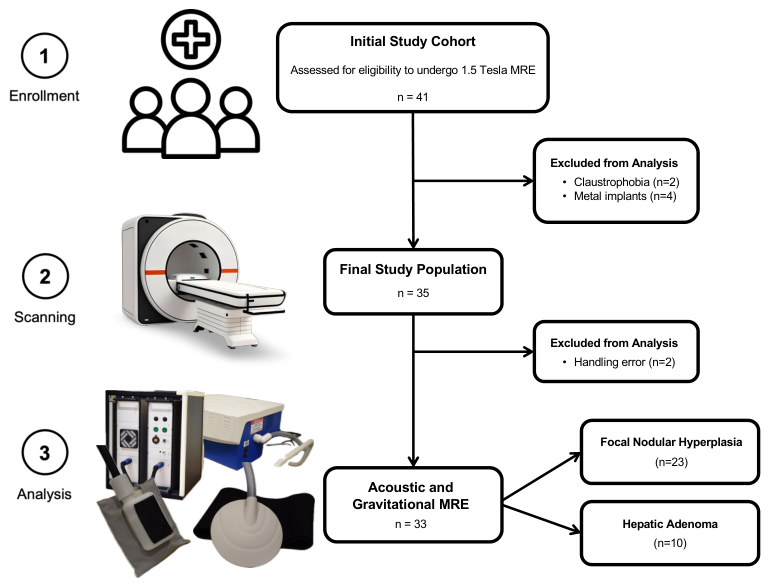
We hypothesized that the distinct pathophysiological and histological features of FNH and HA result in measurably different biomechanical properties. The primary objective of this single-center pilot study was to evaluate the feasibility and preliminary diagnostic performance of three-dimensional MRE for the non-invasive differentiation of FNH from HA. The gravitational transducer served as the enabling hardware, whose technical validation and comparison with conventional acoustic drivers have been reported separately [
17,
18].
4. Discussion
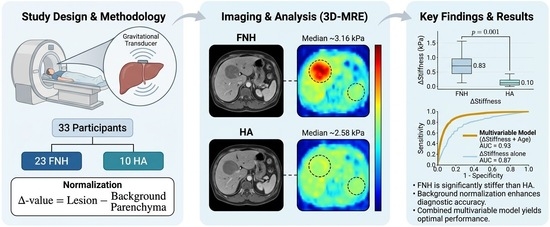
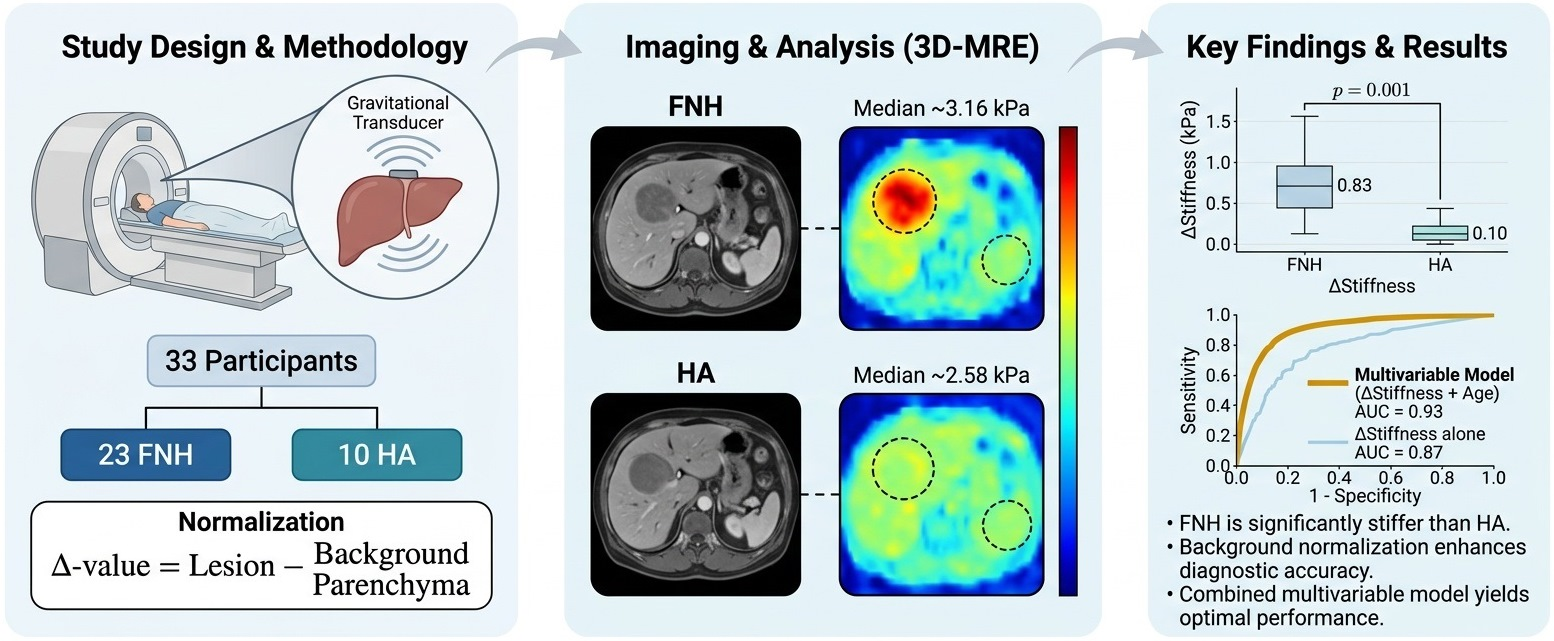
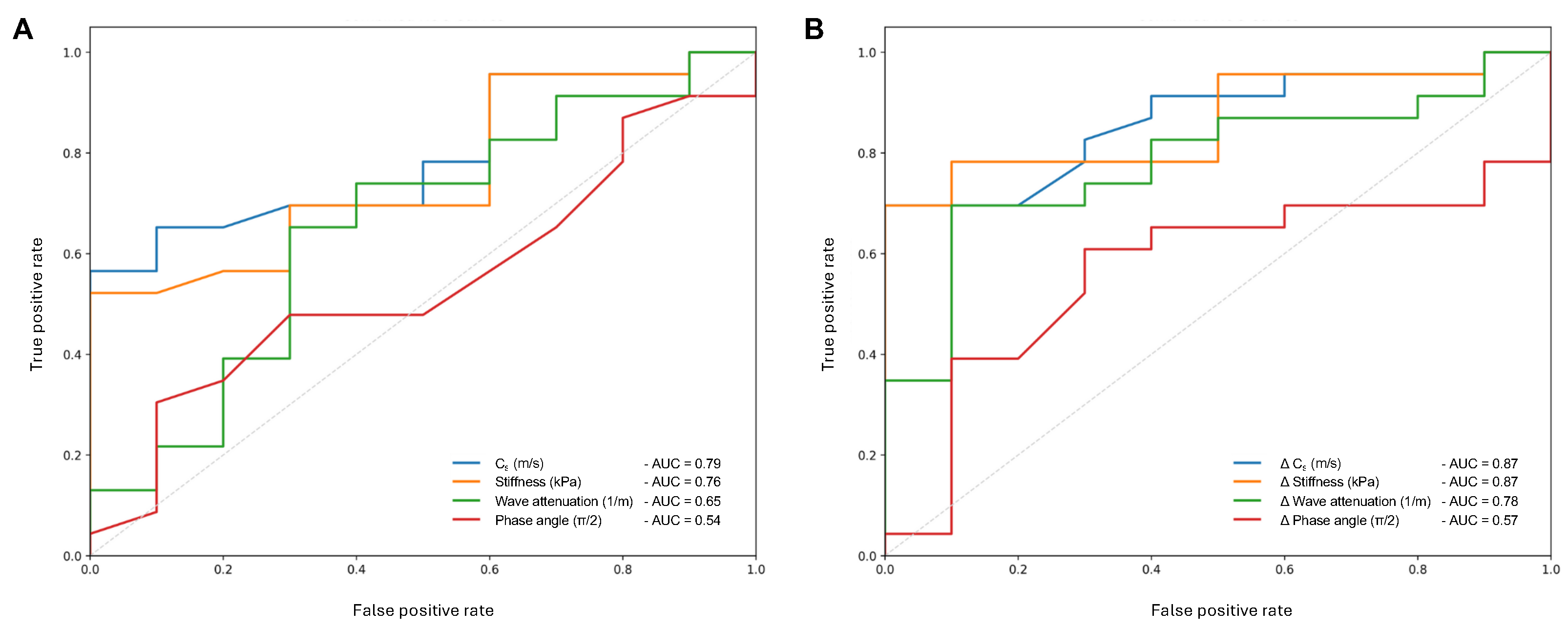
In this prospective single-center pilot study, we evaluated the feasibility of 3D-MRE using a gravitational transducer for differentiating FNH from HA. Our two main findings concern single-parameter behavior: first, FNH lesions are biomechanically stiffer and propagate shear waves faster than HA; second, background normalization (“” measurements) improves per-parameter discrimination, with stiffness and Cs each achieving an AUC of 0.87. An exploratory multivariable combination of stiffness with patient age produced an apparent AUC of 0.93, but with wide odds-ratio confidence intervals (for example, stiffness OR 24.61, 95% CI 1.92–315.58; Cs OR 16.91, 95% CI 1.58–181.35) that reflect the limited sample size and reinforce that this combination is hypothesis-generating rather than a candidate clinical prediction model.
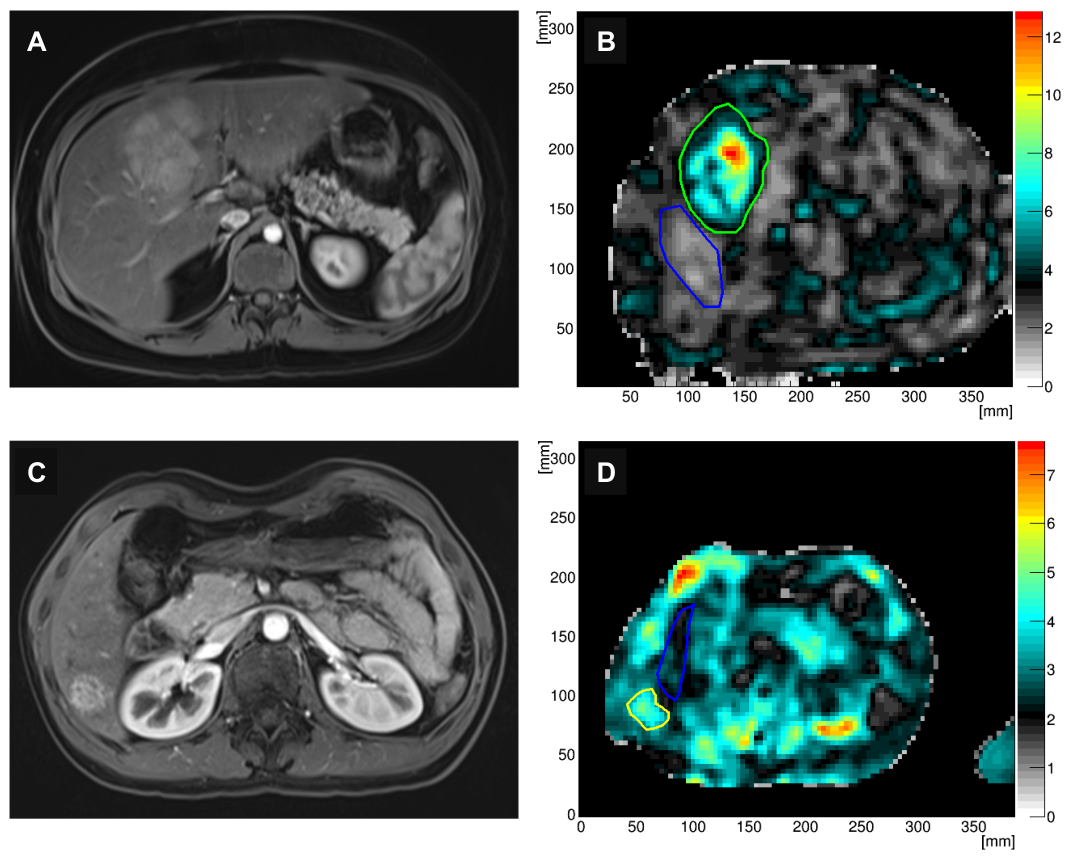
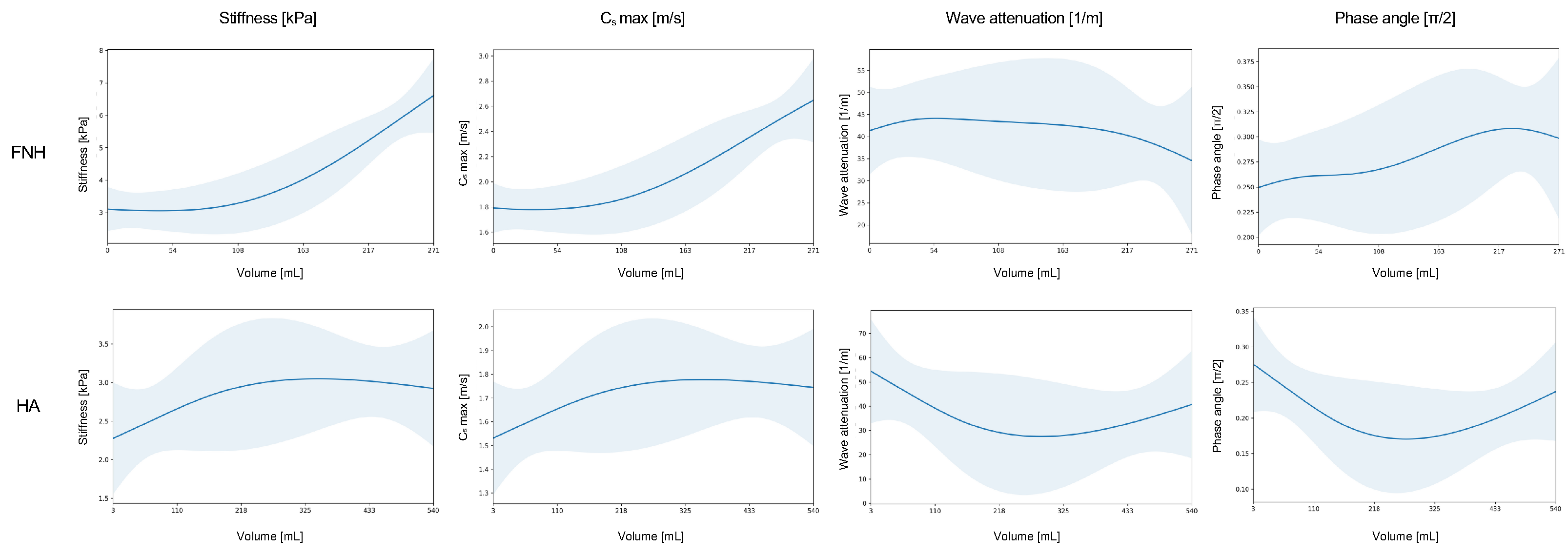
Our finding that FNH is stiffer than HA aligns with the known histopathology of these lesions. FNH is characterized by a central scar with radiating fibrotic septa and an abnormal arterial supply, creating a mechanically integrated fibrous framework that facilitates shear wave propagation; thus shear waves propagate faster. This confers increased stiffness scaling with lesion volume [
24]. In contrast, HA consists predominantly of homogeneous hepatocyte plates with preserved sinusoidal architecture and minimal fibrotic reinforcement, leading to lower stiffness values and a plateauing stiffness–volume relationship [
9,
19]. This divergent volume-dependent behavior—monotonically increasing stiffness in FNH versus a plateau in HA—likely reflects the progressive accumulation of fibrotic scaffolding unique to the FNH architecture.
Our AUC of 0.87 for normalized stiffness exceeds the 0.67–0.69 reported by Taimr et al. using pSWE [
9]. Several factors may contribute to this difference, including the three-dimensional wave field acquisition and curl-based reconstruction of 3D-MRE, which reduce sampling bias compared with single-point ultrasound measurements; the use of background normalization as an internal patient-specific control; and the inherently lower operator dependence of MRE [
25]. The directional finding, FNH being stiffer than HA, is consistent across MRE [
6,
7] and SWE [
8] modalities. Because both lesion types yield absolute stiffness values within the F0–F2 range of MRE-derived liver stiffness [
26], normalization to background parenchyma is essential, and lesion-to-liver stiffness ratios have been shown to outperform absolute values for focal lesion differentiation [
27]. We chose subtraction-based normalization (
values) because it preserves the original measurement units; ratio-based normalization yielded comparable performance in a post hoc analysis. Because the background liver was not formally characterized by fibrosis staging, proton density fat fraction, or R2* mapping, the interpretation of
values requires caution: subclinical differences in hepatic fibrosis, steatosis, or iron content between patients could influence baseline parenchymal stiffness and therefore the magnitude of
-based measurements.
The diagnostic performance observed here may be partly attributable to the three-dimensional wave field acquisition and reconstruction inherent to 3D-MRE. Compared with conventional 2D-MRE, the 3D approach offers three conceptual advantages for focal lesion characterization: (1) the curl operator isolates shear wave motion from compressional wave artifacts, which is not feasible in single-slice 2D acquisitions; (2) three-dimensional wave field coverage reduces partial-volume effects and sampling bias inherent to single-slice wave acquisition; and (3) multidirectional displacement encoding captures the full wave propagation field, yielding more robust estimates of the complex shear modulus. The gravitational transducer’s omnidirectional wave fields further support homogeneous coverage across hepatic segments [
17,
18]. It should be emphasized, however, that lesion ROIs in the present study were placed on a single representative slice for standardization and clinical feasibility; the measurements reported here therefore benefit from the three-dimensional wave field but do not constitute fully volumetric lesion characterization. A direct head-to-head comparison with 2D-MRE in the same cohort was not performed, so the incremental diagnostic value of the 3D approach over 2D-MRE cannot be quantified from our data.
Because MRE probes intrinsic mechanical tissue properties independent of hepatocyte transporter function, it provides a diagnostic axis that is conceptually orthogonal to hepatobiliary-phase MRI. The brief acquisition time (approximately four breath-holds totaling ∼56 s) would, in principle, allow integration into existing contrast-enhanced liver MRI protocols. Whether MRE-derived stiffness can ultimately strengthen diagnostic confidence for hypervascular lesions, or reduce the need for percutaneous biopsy, cannot be inferred from the present pilot cohort and must be addressed in dedicated prospective studies.
If confirmed in larger cohorts, 3D-MRE could conceivably serve as a second-line adjunct following conventional multiparametric MRI with hepatobiliary contrast agents, in particular for cases in which hepatobiliary-phase imaging yields equivocal findings, such as inflammatory or
-catenin-activated HA subtypes that mimic FNH. In our post hoc analysis restricted to the 10 cases with equivocal or overlapping imaging features, ROC analysis suggested that background-normalized parameters retained the diagnostic signal, with
Cs achieving an AUC of 0.90 and
wave attenuation yielding the highest balanced accuracy in this subgroup (90%; sensitivity 100%, specificity 83%). Because the ROC-derived thresholds were optimized within the same
n = 10 cases, these figures represent resubstitution performance in a very small internally optimized subset and are highly vulnerable to chance; we therefore present them as a hypothesis-generating signal and not as evidence of diagnostic utility in equivocal imaging, which can only be assessed in an independent prospective cohort of diagnostically challenging lesions. The thresholds derived in this study (for example,
stiffness ≥ 0.54 kPa) were optimized within the present dataset and cannot be recommended for clinical use at this stage; their validity and potential role in treatment decisions, including any effect on biopsy indications, can only be assessed after external validation in independent cohorts. Before integration into clinical algorithms, several steps are required: (1) external validation in multicenter cohorts including diverse scanner platforms and HA molecular subtypes; (2) establishment of standardized acquisition and postprocessing protocols; (3) dedicated reproducibility studies assessing intra-observer, inter-observer, test–retest, inter-session, inter-scanner, and transducer-positioning variability, following established methodological frameworks for quantitative elastography [
10,
11]; (4) direct head-to-head comparison with 2D-MRE; and (5) evaluation of cost-effectiveness relative to established diagnostic pathways.
This study has several limitations. First, this single-center pilot study included a small cohort (
n = 33), with only 10 HA cases, which limits statistical power and precision of the reported estimates, including those derived from internal validation. Although the modest optimism (∼1%) and stable LOOCV performance (AUC 0.87 for both models) suggest limited overfitting, the internally validated estimates cannot substitute for external validation, and the reported AUCs should therefore be considered apparent performance estimates rather than evidence of clinical readiness. Second, the reference standard was not uniformly histopathological: only 14 of 33 lesions (42%) were confirmed by biopsy, while 19 (58%) were diagnosed based on definitive hepatobiliary-phase MRI criteria using gadoxetic acid, which was specifically employed when prior imaging with conventional gadolinium-based contrast agents yielded equivocal results. Although hepatobiliary-phase imaging represents the current non-invasive reference standard for FNH versus HA differentiation, the partial reliance on imaging as a reference cannot be fully resolved retrospectively and introduces the risk of verification and classification bias, particularly for atypical HA subtypes that can mimic FNH on the hepatobiliary phase. Future prospective studies should aim for uniform histopathological confirmation of all included lesions. Third, lesion measurements were obtained from a single representative axial slice rather than from a full three-dimensional ROI; while this was deliberately chosen to standardize measurements and ensure clinical feasibility, it means that our results should not be interpreted as fully volumetric lesion characterization. Fourth, our reproducibility assessment was limited to inter-reader agreement on ROI placement (ICC = 0.92). Comprehensive reproducibility assessment of quantitative elastography, as established in ultrasound-based elastography, additionally requires intra-observer repeatability, within-session test–retest variability, between-session repeatability, inter-scanner variability, and an evaluation of the effect of transducer positioning on measurement consistency [
10,
11]. None of these were formally evaluated in the present study, and dedicated reproducibility studies will therefore be essential before gravitational 3D-MRE can be considered standardized for clinical use. Fifth, the background liver was not formally characterized: formal fibrosis staging was not performed, and proton density fat fraction and R2* maps were not acquired, so the interpretation of
parameters, which are central to our best-performing estimates, requires cautious reading. Sixth, from a biological and translational standpoint, we did not perform molecular subtyping of the HA cohort. HA is a heterogeneous entity whose subtypes may exhibit distinct stiffness profiles: steatotic HA may be softer due to fat content, whereas inflammatory subtypes may be stiffer [
19,
21,
28]. Correlating viscoelastic signatures with molecular subtypes is a necessary next step, given that management is increasingly driven by genotype-specific risk stratification [
29]. Seventh, a direct comparison with conventional 2D-MRE was not performed, limiting conclusions about the incremental value of the 3D approach. Finally, the exploratory nature of this study, with multiple comparisons across eight viscoelastic parameters, increases the risk of type I error inflation; the reported
p-values should be interpreted accordingly, and the identified thresholds require prospective validation.




 ,
,