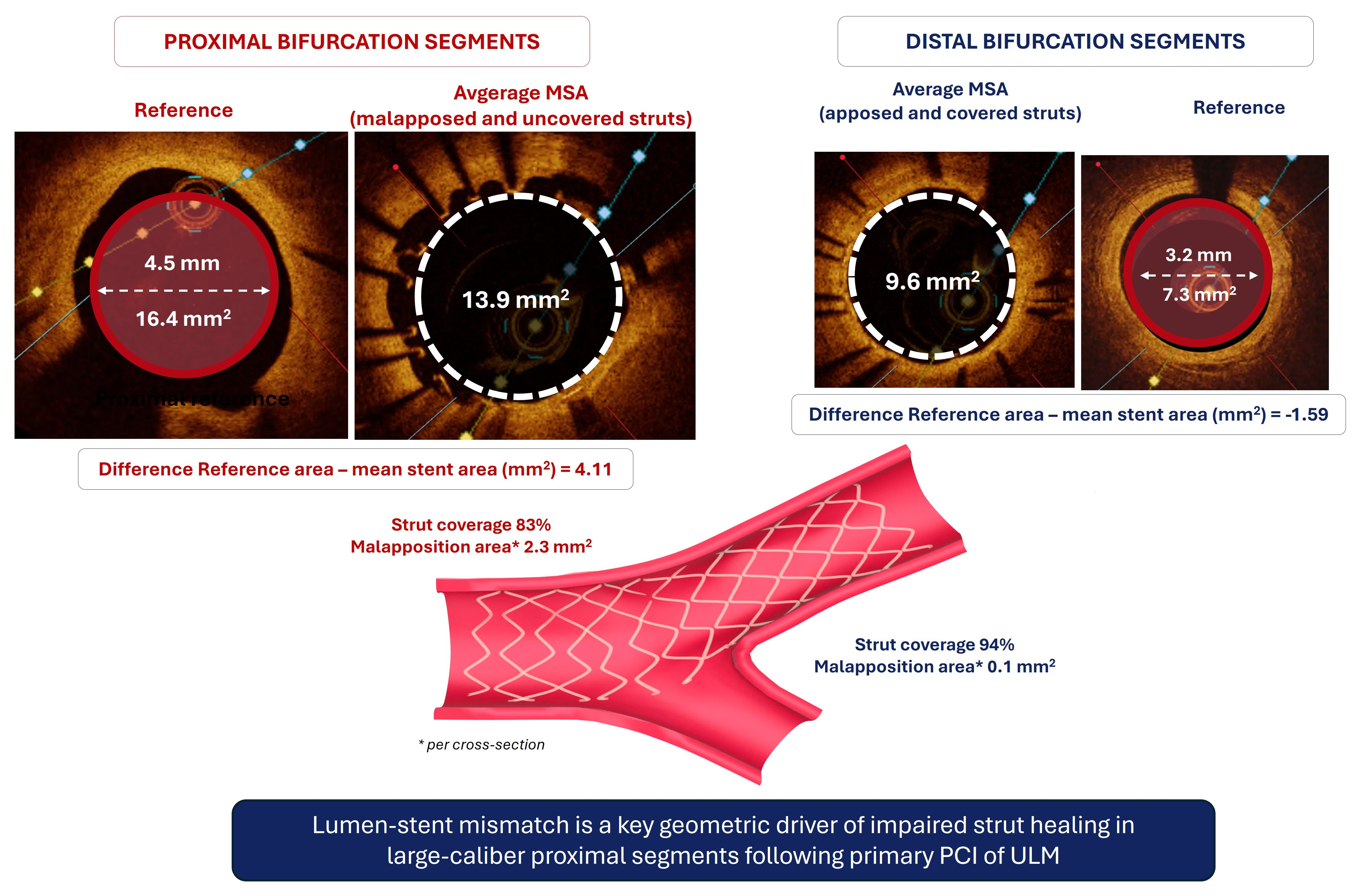
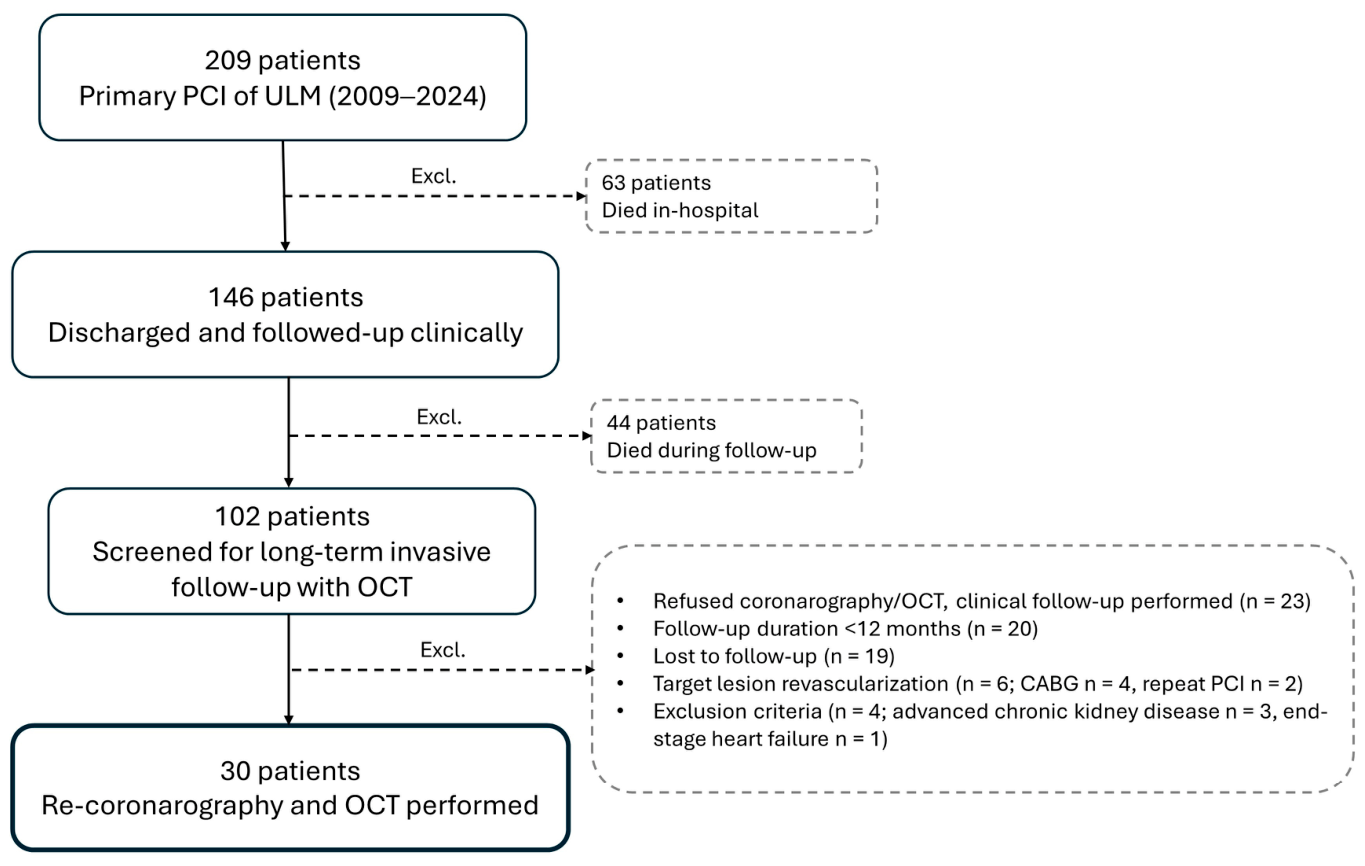
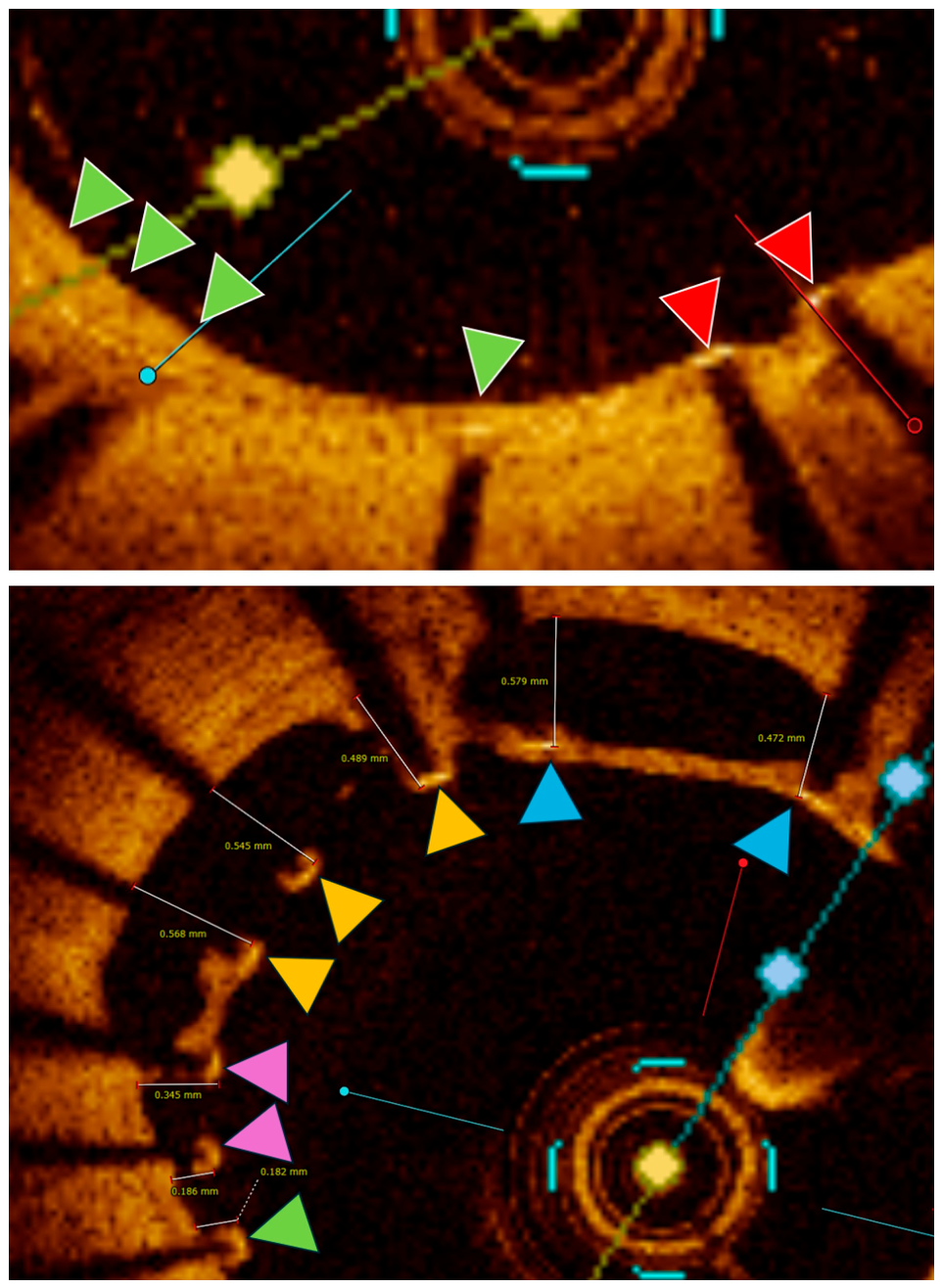
Lumen–Stent Mismatch Affects Long-Term Strut Healing After Primary PCI of Left Main Lesions: An Exploratory Follow-Up OCT Study
 , , , , , , , , and add
Show full author list
, , , , , , , , and add
Show full author list
Abstract
1. Introduction
2. Materials and Methods
2.1. Study Population and Design
2.2. PCI Procedure and OCT Acquisition
2.3. OCT Analysis and Measurements
2.4. Exploratory OCT-Derived Parameter of Lumen–Stent Mismatch
2.5. Study Endpoints
- percentage of covered struts;
- percentage of malapposed struts;
- percentage of malapposed and uncovered struts;
- percentage of significantly malapposed struts (>400 μm);
- percentage of significantly malapposed and uncovered struts.
2.6. Statistical Analysis
3. Results
3.1. Study Population
3.2. OCT Dataset and Strut-Level Analysis
3.3. Regression Analyses of OCT-Derived Parameters for Prediction of Strut-Level Healing Outcomes
3.4. Composite Variable Analysis Across Strut-Level Outcomes
4. Discussion
Study Limitations
5. Conclusions
Author Contributions
Funding
Institutional Review Board Statement
Informed Consent Statement
Data Availability Statement
Acknowledgments
Conflicts of Interest
Abbreviations
| ACS | Acute coronary syndrome |
| CABG | Coronary artery bypass grafting |
| CI | Confidence interval |
| CKD | Chronic kidney disease |
| dMB | Distal main branch |
| DES | Drug-eluting stent |
| DK-crush | Double-kissing crush |
| DM | Diabetes mellitus |
| eGFR | Estimated glomerular filtration rate |
| FKBI | Final kissing balloon inflation |
| FU | Follow-up |
| IQR | Interquartile range |
| IVUS | Intravascular ultrasound |
| LAD | Left anterior descending coronary artery |
| LM | Left main |
| LVEF | Left ventricular ejection fraction |
| MB | Main branch |
| MLA | Minimal lumen area |
| MSA | Minimal stent area |
| NIH | Neointimal hyperplasia |
| NS | Not significant |
| OCT | Optical coherence tomography |
| PCI | Percutaneous coronary intervention |
| POBA | Plain old balloon angioplasty |
| POC | Polygon of confluence |
| POT | Proximal optimization technique |
| QCA | Quantitative coronary angiography |
| R2 | Coefficient of determination |
| SB | Side branch |
| SD | Standard deviation |
| STEMI | ST-segment elevation myocardial infarction |
| TAP | T and protrusion technique |
| TIMI | Thrombolysis in Myocardial Infarction |
| TLR | Target lesion revascularization |
| ULM | Unprotected left main |
| ULMCA | Unprotected left main coronary artery |
Appendix A
Appendix A.1. Optical Coherence Tomography
Appendix A.1.1. Imaging and Analysis
Appendix A.1.2. OCT Definitions and Variables

| n/N of Patients (%) | Angiographic and OCT Follow-Up | Refused Angiographic and OCT Follow-Up | p |
|---|---|---|---|
| 30/209 (14.4) | 27/209 (12.9) | ||
| Age, years (mean ± SD) | 57.8 ± 9.1 | 71.2 ± 11.2 | <0.001 |
| Male sex, n (%) | 22 (73.3) | 20 (74.1) | 0.595 |
| History of DM, n (%) | 7 (23.3) | 5 (18.5) | 0.454 |
| Cardiogenic shock at admission, n (%) | 2 (6.7) | 3 (11.1) | 0.449 |
| Anemia at admission, n (%) | 2 (6.7) | 7 (25.9) | 0.070 |
| eGFR < 60 mL/min/1.73 m2, n (%) | 4 (13.3) | 11 (40.7) | 0.033 |
| In-hospital cardiogenic shock, n (%) | 4 (13.3) | 4 (14.8) | 0.585 |
| Bifurcation success, n (%) | 30 (100) | 20 (74.1) | 0.003 |
| POT performed, n (%) | 24 (80.0) | 20 (76.9) | 1.000 |
| Main branch stent diameter, mm (mean ± SD) | 3.5 ± 0.4 | 3.5 ± 0.5 | 0.692 |
| Characteristic | Value |
|---|---|
| Number of patients, n (%) | 30 (100.0) |
| Age, years (mean ± SD) | 57.8 ± 9.1 |
| Male sex, n (%) | 22 (73) |
| STEMI, n (%) | 20 (67) |
| Killip class at admission, n (%) | |
| 1–2 | 28 (94) |
| 3–4 | 2 (6) |
| Number of diseased vessels, n (%) | |
| Isolated ULMCA disease | 12 (39) |
| ULMCA + three-vessel disease | 4 (13) |
| “MEDINA” classification, n (%) | |
| True bifurcation | 6 (20) |
| Trifurcation | 2 (7) |
| Pre-primary PCI TIMI flow 0–1, n (%) | |
| LM | 3 (10) |
| dMB | 9 (30) |
| SB | 4 (13) |
| Characteristic | Value |
|---|---|
| Number of patients, n (%) | 30 (100.0) |
| IVUS during primary PCI, n (%) | 1 (3) |
| Mechanical circulatory support, n (%) | 0 (0.0) |
| PCI technique with single-stent implantation, n (%) | 27 (90) |
| PCI technique with two-stent implantation, n (%) | 3 (10) |
| TAP technique, n (%) | 2 (7) |
| DK-crush technique, n (%) | 1 (3) |
| Stent type | |
| Everolimus, n (%) | 16 (53) |
| Zotarolimus, n (%) | 7 (23) |
| Sirolimus, n (%) | 6 (20) |
| Biolimus, n (%) | 1 (3) |
| Optimization techniques | |
| POT only, n (%) | 13 (42) |
| FKBI only, n (%) | 0 (0.0) |
| POT + FKBI, n (%) | 11 (37) |
| No further optimization, n (%) | 6 (20) |
| Final TIMI 3 flow, n (%) | |
| LM | 30 (100) |
| dMB | 30 (100) |
| SB | 30 (100) |
| Bifurcation lesion treatment success | |
| Overall, n (%) | 29 (97) |
| MB success, n (%) | 30 (100.0) |
| SB success, n (%) | 29 (97) |
| Post-PCI LVEF (mean ± SD) | 49.0 ± 12.5 |
| Discharge therapy | |
| P2Y12 inhibitor at discharge | |
| Clopidogrel, n (%) | 6 (20) |
| Ticagrelor, n (%) | 21 (70) |
| Prasugrel, n (%) | 3 (10) |
| Statin therapy at discharge, n (%) | 30 (100) |
| Rosuvastatin, n (%) | 12 (40) |
| Simvastatin, n (%) | 12 (40) |
| Atorvastatin, n (%) | 6 (20) |
| Characteristic | Value |
|---|---|
| Number of patients, n (%) | 30 (100) |
| OCT image quality, n (%) | |
| Good | 29 (96.7) |
| Moderate | 1 (3.3) |
| Poor | 0 (0.0) |
| Difficulty with selective guide catheter engagement (due to stent protrusion into the ULMCA), n (%) | 4 (13.2) |
| OCT catheter/coronary guidewire positioned beneath the stent, n (%) | 6 (20.0) |
| Adequate visualization of the ULMCA ostium, n (%) | 16 (53.3) |
| Stent protrusion into the aorta, n (%) | 8 (26.7) |
| Degree of protrusion, n (%) | |
| Significant | 4 (13.3) |
| Non-significant | 4 (13.3) |
| Stent malapposition in the ostial ULMCA segment, n (%) | 11 (36.7) |
| Location of ULMCA segment with poor visualization, n (%) | |
| Ostial | 9 (30.0) |
| Mid | 0 (0.0) |
| Distal | 0 (0.0) |
| Length of ULMCA segment with poor visualization, mm (mean ± SD) | 1.83 ± 0.7 |
| Location of stented segment with poor visualization, n (%) | |
| Ostial | 9 (30.0) |
| Mid | 0 (0.0) |
| Distal | 0 (0.0) |
| Length of stented segment with poor visualization, mm (mean ± SD) | 1.68 ± 0.6 |
| Characteristic | Value |
|---|---|
| Number of patients, n (%) | 30 (100.0) |
| Stent deformation, n (%) | 3 (10.0) |
| Location of stent deformation, n (%) | |
| Ostial | 2 (6.7) |
| Mid | 1 (3.3) |
| Distal | 0 (0.0) |
| Type of stent deformation, n (%) | |
| Longitudinal compression | 2 (6.7) |
| Abluminal deformation | 1 (3.3) |
| Presence of “floating” stent struts across the side-branch ostium, n (%) | 25 (83.3) |
| Neointimal proliferation over “floating” struts, n (%) | 18 (60.0) |
| Percentage of side-branch ostial obstruction by proliferation, % (mean ± SD) | 58.6 ± 21.4 |
| Thrombus, n (%) | 4 (13.3) |
| Thrombus location, n (%) | |
| Neocarina | 2 (6.7) |
| Floating struts | 1 (3.3) |
| LAD ostium | 1 (3.3) |
| Type of thrombus, n (%) | |
| Organized | 3 (10.0) |
| White | 1 (3.3) |
| Red | 0 (0.0) |
| In-stent neoatherosclerosis, n (%) | 10 (33.3) |
| Presence of calcium deposits within the stent, n (%) | 3 (10.0) |
| Unhealed dissection, n (%) | 0 (0.0) |
| Characteristic | Value |
|---|---|
| Number of patients, n (%) | 30 (100.0) |
| Repeat PCI, n (%) | 17 (56.7) |
| TLR only | 8 (26.7) |
| Non-TLR only | 5 (16.5) |
| TLR + non-TLR | 4 (13.3) |
| Reason for TLR | |
| MB restenosis | 1 (3.3) |
| SB restenosis | 3 (10.0) |
| Malapposition | 4 (13.3) |
| MB restenosis + malapposition | 2 (6.7) |
| MB restenosis + SB restenosis | 2 (6.7) |
| POBA only, n (%) | 9 (30.0) |
| New stent implantation, n (%) | 4 (13.3) |
| POBA only in the ULMCA, n (%) | 6 (20.0) |
| New stent implantation in the ULMCA, n (%) | 2 (6.7) |
| Procedural success of repeat PCI | 16 (94.1%) overall; 11 (91.7%) in the ULMCA |
| All Segments (N = 30) | LM (N = 28) | POC (N = 29) | dMB (N = 29) | p | |
|---|---|---|---|---|---|
| Total length of analysed segment, mm (mean ± SD) | 21.9 ± 6.4 | 6.7 ± 4.4 | 2.4 ± 0.9 | 13.8 ± 6.7 | # < 0.001; $ < 0.001; £ 0.002; € < 0.001 |
| Total number of analyzed struts, n (mean ± SD) | 1056.8 ± 570.3 | 274.8 ± 227.1 | 94.4 ± 43.2 | 733.9 ± 543.4 | # < 0.001; $ < 0.001; £ 0.003; € < 0.001 |
| Number of analyzed struts per cross-section, n (mean ± SD) | 9.8 ± 2.1 | 8.7 ± 2.6 | 9.3 ± 2.2 | 10.8 ± 2.6 | # 0.460 |
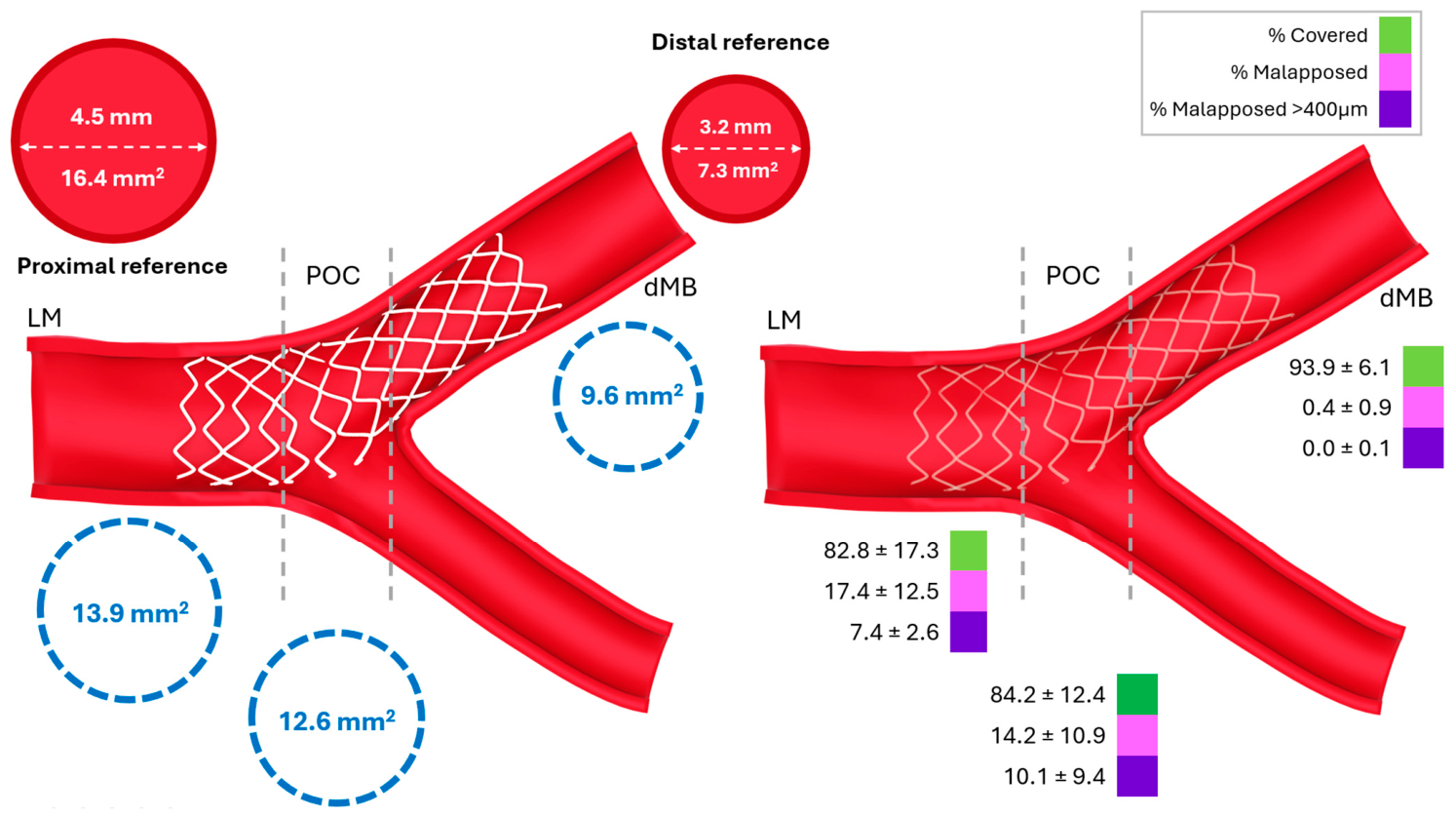
| Total covered struts (covered + malapposed but covered), % (mean ± SD) | 90.7 ± 6.6 | 82.8 ± 17.3 | 84.2 ± 12.4 | 93.9 ± 6.1 | # 0.003; $ 0.876; £ 0.009; € 0.001 |
| Total uncovered struts (uncovered + malapposed and uncovered), % (mean ± SD) | 9.3 ± 6.6 | 17.2 ± 17.3 | 15.8 ± 12.4 | 6.0 ± 6.0 | # 0.003; $ 0.876; £ 0.009; € 0.001 |
| All malapposed struts, % (mean ± SD) | 4.2 ± 3.9 | 17.4 ± 12.5 | 14.2 ± 10.9 | 0.4 ± 0.9 | # < 0.001; $ 0.130; £ < 0.001; € < 0.001 |
| Malapposed and uncovered struts (all), % (mean ± SD) | 2.8 ± 2.7 | 8.9 ± 14.2 | 9.2 ± 8.4 | 0.2 ± 0.7 | # 0.003; $ 0.277; £ < 0.001; € < 0.001 |
| Malapposed struts ≤ 400 μm, % (mean ± SD) | 1.8 ± 2.1 | 4.7 ± 6.4 | 4.1 ± 3.9 | 0.3 ± 0.8 | # < 0.001; $ 0.881; £ 0.003; € < 0.001 |
| Malapposed struts ≤ 400 μm and uncovered, % (mean ± SD) | 1.1 ± 1.6 | 8.7 ± 25.8 | 2.9 ± 4.9 | 1.4 ± 3.6 | # 0.007; $ 0.782; £ 0.003; € 0.011 |
| Malapposed struts > 400 μm, % (mean ± SD) | 2.4 ± 2.4 | 7.4 ± 2.6 | 10.1 ± 9.4 | 0.0 ± 0.1 | # < 0.001; $ 0.031; £ < 0.001; € < 0.001 |
| Malapposed struts > 400 μm and uncovered, % (mean ± SD) | 1.7 ± 1.8 | 5.6 ± 9.7 | 6.7 ± 6.8 | 0.0 ± 0.1 | # < 0.001; $ 0.137; £ < 0.001; € < 0.001 |
| Percentage of cross-sections with >30% malapposed struts, % (mean ± SD) | 6.7 ± 6.5 | 20.6 ± 30.9 | 20.4 ± 19.1 | 0.2 ± 1.3 | # < 0.001; $ 0.321; £ < 0.001; € < 0.001 |
| Percentage of cross-sections with at least one malapposed strut, % (mean ± SD) | 13.2 ± 8.7 | 28.8 ± 36.4 | 48.8 ± 30.9 | 2.6 ± 4.9 | # < 0.001; $ 0.028; £ 0.001; € < 0.001 |
| Maximum consecutive length with at least one malapposed strut, % (mean ± SD) | 1.9 ± 1.8 | 1.3 ± 1.6 | 0.9 ± 0.9 | 0.2 ± 0.4 | # < 0.001; $ 0.723; £ 0.003; € < 0.001 |
| Segments with consecutive malapposition length > 1 mm, n/N (%) | 18/30 (60) | 11/28 (39.3) | 11/29 (37.9) | 1/29 (3.4) | # < 0.001; $ 1.000; £ 0.001; € 0.001 |
| Parameter | Malapposition ≤ 400 µm | Malapposition > 400 µm |
|---|---|---|
| Total number of struts, n | 660 | 541 |
| Mean number per patient, n (mean ± SD) | 24.9 ± 22.4 | 20.8 ± 29.2 |
| Minimum number per patient, n | 1 | 1 |
| Maximum number per patient, n | 86 | 149 |
| Interquartile range (IQR) | 25.0 | 21.5 |
| Median, n | 18.0 | 12.5 |
| Total number of uncovered struts, n | 369 | 475 |
| Mean number of uncovered struts per patient, n (mean ± SD) | 17.9 ± 16.1 | 14.2 ± 27.3 |
| Percentage of uncovered struts, % (mean ± SD) | 57.7 ± 39.6 | 73.4 ± 29.2 |
| All Segments (N = 30) | LM (N = 28) | POC (N = 29) | dMB (N = 29) | p | |
|---|---|---|---|---|---|
| Number of analyzed cross-sections, n (mean ± SD) | 109.4 ± 32.0 | 33.4 ± 21.9 | 11.8 ± 4.4 | 68.8 ± 33.3 | #& < 0.001 |
| Length of analyzed stented segment, cm (mean ± SD) | 21.8 ± 6.4 | 6.6 ± 4.4 | 2.4 ± 0.9 | 13.7 ± 6.7 | #& < 0.001 |
| Reference lumen area, mm2 (mean ± SD) | NA | 16.4 ± 4.9 | 7.3 ± 2.0 | #£€ < 0.001 | |
| Minimum lumen diameter at reference area, mm (mean ± SD) | NA | 4.1 ± 0.8 | 2.9 ± 0.4 | # < 0.001 | |
| Maximum lumen diameter at reference area, mm (mean ± SD) | NA | 5.1 ± 0.9 | 3.4 ± 0.2 | # < 0.001 | |
| Lumen eccentricity at reference area, n | 0.2 ± 0.1 | 0.2 ± 0.1 | 0.2 ± 0.1 | #£€ NS | |
| MLA, mm2 (mean ± SD) | 5.8 ± 2.1 | 11.0 ± 4.9 | 10.9 ± 3.6 | 6.1 ± 2.0 | #£€ < 0.001; $ 0.774 |
| Minimum lumen diameter at MLA, mm (mean ± SD) | 2.4 ± 0.5 | 3.1 ± 0.8 | 2.9 ± 0.5 | 2.5 ± 0.5 | # 0.001; $ 0.486; £ 0.002; € 0.001 |
| Maximum lumen diameter at MLA, mm (mean ± SD) | 2.9 ± 0.6 | 4.2 ± 0.9 | 4.5 ± 1.1 | 3.0 ± 0.5 | # 0.001; $ 0.651; £ < 0.001; € < 0.001 |
| Lumen eccentricity at MLA, n | 0.2 ± 0.1 | 0.2 ± 0.1 | 0.3 ± 0.2 | 0.2 ± 0.1 | #& NS |
| Mean lumen area (all), mm2 (mean ± SD) | 9.8 ± 2.1 | 13.5 ± 4.9 | 14.0 ± 3.9 | 7.9 ± 1.7 | # 0.001; $ 0.394; £ < 0.001; € < 0.001 |
| Mean minimum lumen diameter (all), mm (mean ± SD) | 3.1 ± 0.4 | 3.6 ± 0.7 | 3.0 ± 0.5 | 2.9 ± 0.4 | # 0.001; $ 0.001; £ < 0.001; € 0.355 |
| Mean maximum lumen diameter (all), mm (mean ± SD) | 3.9 ± 0.4 | 4.6 ± 0.9 | 5.4 ± 0.9 | 3.4 ± 0.4 | #& < 0.001 |
| Lumen area eccentricity (all), n | 0.2 ± 0.1 | 0.2 ± 0.1 | 0.4 ± 0.1 | 0.2 ± 0.1 | # <0.001; $ < 0.001; £ 0.015; € < 0.001 |
| Minimum lumen diameter, mm (mean ± SD) | 2.1 ± 0.5 | 3.1 ± 0.7 | 2.5 ± 0.5 | 2.4 ± 0.5 | # < 0.001; $ 0.002; £ 0.002; € 0.994 |
| Lumen stenosis, % (mean ± SD) | NA | 17.6 ± 20.4 | 9.9 ± 14.9 | 38.3 ± 22.7 | # < 0.001; $ 0.125; £ 0.001; € < 0.001 |
| Total in-stent lumen volume, mm3 (mean ± SD) | 213.5 ± 75.6 | 80.7 ± 45.8 | 33.5 ± 17.1 | 109.9 ± 61.2 | # <0.001; $ < 0.001; £ 0.064; € < 0.001 |
| Total stent volume, mm3 (mean ± SD) | 232.7 ± 75.9 | 84.1 ± 48.1 | 28.1 ± 13.4 | 131.0 ± 72.3 | # < 0.001; $ < 0.001; £ 0.013; € < 0.001 |
| Total NIH volume, mm3 (mean ± SD) | 39.4 ± 17.7 | 12.5 ± 11.5 | 3.6 ± 1.9 | 24.9 ± 17.3 | # < 0.001; $ < 0.001; £ 0.003; € < 0.001 |
| NIH area at MLA cross-section, mm2 (mean ± SD) | 2.8 ± 1.8 | 2.1 ± 1.2 | 1.7 ± 0.9 | 2.5 ± 1.7 | # < 0.001; $ < 0.001; £ 0.003; € < 0.001 |
| Mean NIH area, mm2 (mean ± SD) | 1.8 ± 0.7 | 1.8 ± 1.0 | 1.7 ± 0.7 | 1.8 ± 0.8 | # 0.958; |
| Total malapposition volume, mm3 (mean ± SD) | 12.9 ± 12.1 | 5.7 ± 8.9 | 7.3 ± 7.0 | 0.8 ± 1.0 | # < 0.001; $ 0.065; £ 0.004; € < 0.001 |
| Malapposition area per cross-section, mm2 (mean ± SD) | 0.6 ± 0.5 | 1.7 ± 2.8 | 2.9 ± 2.6 | 0.3 ± 0.4 | # < 0.001; $ 0.010; £ 0.001; € < 0.001 |
| Mean stent area, mm2 (mean ± SD) | 11.0 ± 1.9 | 13.9 ± 3.5 | 12.6 ± 3.3 | 9.6 ± 1.8 | # < 0.001; $ 0.095; £ < 0.001; € < 0.001 |
| Stent area at MLA cross-section, mm2 (mean ± SD) | 8.8 ± 2.0 | 12.3 ± 3.5 | 11.8 ± 2.9 | 8.7 ± 1.9 | # < 0.001; $ 1.000; £ < 0.001; € < 0.001 |
| Minimum stent area (MSA), mm2 (mean ± SD) | 7.9 ± 1.9 | 11.5 ± 3.3 | 9.8 ± 2.5 | 7.9 ± 1.7 | # < 0.001; $ 0.058; £ < 0.001; € 0.016 |
| Minimum stent expansion, % (mean ± SD) | NA | 72.4 ± 33.2 | 59.7 ± 16.6 | 100.5 ± 18.6 | # < 0.001; $ 0.150; £ < 0.001; € < 0.001 |
| Mean stent expansion, % (mean ± SD) | NA | 87.5 ± 35.7 | 75.8 ± 19.1 | 123.9 ± 28.3 | # < 0.001; $ 0.245; £ < 0.001; € < 0.001 |
| Difference between reference lumen area and mean stent area, mm2 (mean ± SD) | NA | 3.46 ± 5.4 | 4.8 ± 4.2 | −1.6 ± 1.7 | # < 0.001; $ 0.207; £ < 0.001; € < 0.001 |
Appendix A.2. Regression Analysis
Appendix A.2.1. Strut Coverage
| Univariable Regression | Multivariable Regression | |||||
|---|---|---|---|---|---|---|
| R | R2 | B (95% CI) | p | B (95% CI) | p | |
| Reference diameter (mm) | 0.526 | 0.277 | −7.45 (−10.1, −4.82) | 0.000 | 11.729 (−2.566, 26.024) | 0.106 |
| Reference area (mm2) | 0.549 | 0.302 | −1.19 (−1.58, −0.79) | 0.000 | −2.277 (−4.123, −0.43) | 0.016 |
| Minimal lumen area (mm2) | 0.591 | 0.349 | −1.85 (−2.41, −1.30) | 0.000 | −1.441 (−3.056, 0.174) | 0.079 |
| Mean lumen area (mm2) | 0.624 | 0.389 | −1.81 (−2.31, −1.32) | 0.000 | −1.608 (−3.453, 0.237) | 0.087 |
| Percent lumen stenosis (%) | 0.300 | 0.090 | 0.178 (0.05, 0.30) | 0.005 | −0.102 (−0.25, 0.047) | 0.178 |
| Minimal stent area (mm2) | 0.240 | 0.058 | −1.20 (−2.07, −0.13) | 0.027 | 1.038 (−1.32, 3.395) | 0.383 |
| Mean stent area (mm2) | 0.332 | 0.110 | −1.31 (−2.12, −0.49) | 0.002 | 1.734 (−0.579, 4.048) | 0.139 |
| Minimal stent expansion (%) | 0.387 | 0.150 | 0.18 (0.09, 0.27) | 0.000 | −0.087 (−0.421, 0.248) | 0.607 |
| Mean stent expansion (%) | 0.379 | 0.143 | 0.15 (0.07, 0.23) | 0.000 | 0.053 (−0.198, 0.303) | 0.677 |
| Lumen volume (mm3) | 0.081 | 0.007 | 0.02 (−0.03, 0.07) | 0.459 | ||
| Stent volume (mm3) | 0.223 | 0.050 | 0.05 (0.002, 0.09) | 0.040 | −0.081 (−0.139, −0.022) | 0.007 |
| NIH volume (mm3) | 0.423 | 0.179 | 0.38 (0.205, 0.565) | 0.000 | 0.412 (0.117, 0.707) | 0.007 |
| Malapposition volume (mm3) | 0.573 | 0.328 | −1.09 (−1.44, −0.75) | 0.000 | −0.232 (−0.683, 0.22) | 0.310 |
Appendix A.2.2. Strut Malapposition
| Univariable Regression | Multivariable Regression | |||||
|---|---|---|---|---|---|---|
| R | R2 | B (95% CI) | p | B (95% CI) | p | |
| Reference diameter (mm) | 0.588 | 0.346 | 8.22 (5.75, 10.68) | 0.000 | −2.005 (−13.457, 9.447) | 0.728 |
| Reference area (mm2) | 0.584 | 0.341 | 1.25 (0.87, 1.63) | 0.000 | 1.003 (−0.477, 2.482) | 0.181 |
| Minimal lumen area (mm2) | 0.632 | 0.399 | 1.96 (1.43, 2.48) | 0.000 | 1.696 (0.402, 2.989) | 0.011 |
| Mean lumen area (mm2) | 0.689 | 0.475 | 1.98 (1.52, 2.43) | 0.000 | 2.062 (0.584, 3.54) | 0.007 |
| Percent lumen stenosis (%) | 0.302 | 0.091 | −0.18 (−0.29, −0.56) | 0.005 | 0.082 (−0.037, 0.201) | 0.175 |
| Minimal stent area (mm2) | 0.257 | 0.091 | 1.16 (0.21, 2.11) | 0.018 | 0.099 (−1.789, 1.988) | 0.917 |
| Mean stent area (mm2) | 0.326 | 0.106 | 1.27 (0.46, 2.01) | 0.002 | −3.46 (−5.313, −1.606) | 0.000 |
| Minimal stent expansion (%) | 0.435 | 0.189 | −0.19 (−0.29, −0.11) | 0.000 | −0.083 (−0.351, 0.185) | 0.538 |
| Mean stent expansion (%) | 0.426 | 0.182 | −0.16 (−0.24, −0.09) | 0.000 | 0.104 (−0.097, 0.304) | 0.307 |
| Lumen volume (mm3) | 0.199 | 0.040 | −0.05 (−0.10, 0.04) | 0.067 | ||
| Stent volume (mm3) | 0.317 | 0.101 | −0.06 (−0.11, −0.02) | 0.003 | −0.024 (−0.07, 0.023) | 0.320 |
| NIH volume (mm3) | 0.367 | 0.134 | −0.33 (−0.51, −0.15) | 0.001 | 0.152 (−0.085, 0.388) | 0.205 |
| Malapposition volume (mm3) | 0.715 | 0.511 | 1.35 (1.06, 1.64) | 0.000 | 0.349 (−0.013, 0.71) | 0.059 |
Appendix A.2.3. Composite Outcome of Malapposed and Uncovered Struts
| Univariable Regression | Multivariable Regression | |||||
|---|---|---|---|---|---|---|
| R | R2 | B (95% CI) | p | B (95% CI) | p | |
| Reference diameter (mm) | 0.580 | 0.336 | 6.22 (4.313, 8.13) | <0.001 | −5.544 (−15.37, 4.288) | 0.265 |
| Reference area (mm2) | 0.593 | 0.351 | 0.971 (0.683, 1.259) | <0.001 | 1.771 (0.501, 3.041) | 0.007 |
| Minimal lumen area (mm2) | 0.609 | 0.371 | 1.448 (1.037, 1.860) | <0.001 | 1.296 (0.186, 2.407) | 0.023 |
| Mean lumen area (mm2) | 0.654 | 0.428 | 1.440 (1.077, 1.804) | <0.001 | 1.754 (0.485, 3.024) | 0.007 |
| Percent lumen stenosis (%) | 0.279 | 0.078 | −0.247 (−0.22, −0.031) | 0.010 | 0.071 (−0.031, 0.174) | 0.169 |
| Minimal stent area (mm2) | 0.244 | 0.06 | 0.848 (0.113, 1.584) | 0.024 | −0.529 (−2.15, 1.093) | 0.518 |
| Mean stent area (mm2) | 0.319 | 0.102 | 0.954 (0.336, 1.573) | 0.003 | −2.687 (−4.279, −1.096) | 0.001 |
| Minimal stent expansion (%) | 0.423 | 0.179 | −0.148 (−0.22, −0.079) | <0.001 | 0.039 (−0.191, 0.269) | 0.735 |
| Mean stent expansion (%) | 0.417 | 0.174 | −0.122 (−0.18, −0.064) | <0.001 | 0.036 (−0.136, 0.209) | 0.676 |
| Lumen volume (mm3) | 0.173 | 0.03 | −0.032 (−0.072, 0.008) | 0.114 | ||
| Stent volume (mm3) | 0.285 | 0.081 | −0.044 (−0.07, −0.012) | 0.008 | −0.009 (−0.05, 0.031) | 0.640 |
| NIH volume (mm3) | 0.357 | 0.127 | −0.246 (−0.39, −0.105) | <0.001 | 0.093 (−0.11, 0.296) | 0.364 |
| Malapposition volume (mm3) | 0.640 | 0.409 | 0.927 (0.684, 1.171) | <0.001 | 0.053 (−0.257, 0.364) | 0.734 |
Appendix A.2.4. Significant Strut Malapposition
| Univariable Regression | Multivariable Regression | |||||
|---|---|---|---|---|---|---|
| R | R2 | B (95% CI) | p | B (95% CI) | p | |
| Reference diameter (mm) | 0.560 | 0.313 | 5.818 (3.94, 7.70) | 0.001 | 2.201 (−5.903, 10.305) | 0.590 |
| Reference area (mm2) | 0.543 | 0.295 | 0.862 (0.57, 1.15) | 0.001 | 0.269 (−0.778, 1.316) | 0.610 |
| Minimal lumen area (mm2) | 0.646 | 0.417 | 1.488 (1.10, 1.87) | 0.001 | 1.314 (0.398, 2.229) | 0.006 |
| Mean lumen area (mm2) | 0.704 | 0.495 | 1.502 (1.171, 1.833) | 0.001 | 1.674 (0.628, 2.721) | 0.002 |
| Percent lumen stenosis (%) | 0.302 | 0.091 | −0.131 (−0.22, −0.04) | 0.005 | 0.071 (−0.013, 0.156) | 0.097 |
| Minimal stent area (mm2) | 0.288 | 0.083 | 0.970 (0.27, 1.67) | 0.008 | 0.363 (−0.974, 1.699) | 0.590 |
| Mean stent area (mm2) | 0.335 | 0.112 | 0.970 (0.37, 1.7) | 0.002 | −2.983 (−4.295, −1.671) | 0.000 |
| Minimal stent expansion (%) | 0.366 | 0.134 | −0.125 (−0.19, −0.06) | 0.001 | −0.076 (−0.265, 0.114) | 0.429 |
| Mean stent expansion (%) | 0.365 | 0.134 | −0.104 (−0.16, −0.05) | 0.001 | 0.122 (−0.02, 0.264) | 0.091 |
| Lumen volume (mm3) | 0.205 | 0.042 | −0.037 (−0.08, 0.00) | 0.06 | ||
| Stent volume (mm3) | 0.315 | 0.099 | −0.047 (−0.08, −0.02) | 0.003 | −0.031 (−0.064, 0.002) | 0.066 |
| NIH volume (mm3) | 0.339 | 0.115 | −0.226 (−0.36, −0.09) | 0.002 | 0.18 (0.013, 0.347) | 0.035 |
| Malapposition volume (mm3) | 0.715 | 0.511 | 1.004 (0.79, 1.22) | 0.001 | 0.259 (0.003, 0.515) | 0.047 |
Appendix A.2.5. Composite Outcome of Significant Malapposition and Uncovered Struts
| Univariable Regression | Multivariable Regression | |||||
|---|---|---|---|---|---|---|
| R | R2 | B (95% CI) | p | B (95% CI) | p | |
| Reference diameter (mm) | 0.565 | 0.319 | 4.354 (2.965, 5.743) | 0.000 | −1.131 (−7.658, 5.397) | 0.731 |
| Reference area (mm2) | 0.560 | 0.313 | 0.661 (0.447, 0.874) | 0.000 | 0.795 (−0.049, 1.638) | 0.064 |
| Minimal lumen area (mm2) | 0.623 | 0.388 | 1.065 (0.773, 1.358) | 0.000 | 0.85 (0.112, 1.587) | 0.025 |
| Mean lumen area (mm2) | 0.679 | 0.461 | 1.076 (0.822, 1.330) | 0.000 | 1.426 (0.584, 2.269) | 0.001 |
| Percent lumen stenosis (%) | 0.282 | 0.080 | −0.091 (−0.159, −0.023) | 0.009 | 0.058 (−0.01, 0.126) | 0.091 |
| Minimal stent area (mm2) | 0.292 | 0.085 | 0.729 (0.207, 1.252) | 0.007 | 0.294 (−0.783, 1.37) | 0.588 |
| Mean stent area (mm2) | 0.320 | 0.103 | 0.689 (0.244, 1.134) | 0.003 | −2.455 (−3.512, −1.399) | 0.000 |
| Minimal stent expansion (%) | 0.365 | 0.134 | −0.092 (−0.144, −0.041) | 0.001 | −0.031 (−0.184, 0.121) | 0.683 |
| Mean stent expansion (%) | 0.376 | 0.141 | −0.079 (−0.122, −0.037) | 0.000 | 0.087 (−0.028, 0.201) | 0.135 |
| Lumen volume (mm3) | 0.192 | 0.037 | −0.026 (−0.054, 0.003) | 0.078 | ||
| Stent volume (mm3) | 0.300 | 0.090 | −0.034 (−0.057, −0.010) | 0.005 | −0.02 (−0.046, 0.007) | 0.148 |
| NIH volume (mm3) | 0.339 | 0.115 | −0.168 (−0.270, −0.066) | 0.002 | 0.117 (−0.017, 0.252) | 0.087 |
| Malapposition volume (mm3) | 0.685 | 0.469 | 0.715 (0.549, 0.881) | 0.000 | 0.101 (−0.105, 0.307) | 0.334 |
Appendix A.2.6. Regression Analysis with Composite Variable
| Univariate Regression | Multivariable Regression | |||||
|---|---|---|---|---|---|---|
| Variable | R | R2 | B (95% CI) | p | B (95% CI) | p |
| Reference diameter (mm) | 0.496 | 0.246 | −7.02 (−9.68, −4.33) | 0.000 | 10.117 (−1.372, 21.605) | 0.083 |
| Minimal lumen area (mm2) | 0.591 | 0.349 | −1.85 (−2.41, −1.30) | 0.000 | −1.505 (−3.077, 0.067) | 0.060 |
| Mean lumen area (mm2) | 0.624 | 0.389 | −1.81 (−2.31, −1.32) | 0.000 | −1.616 (−3.45, 0.217) | 0.083 |
| Lumen stenosis, % | 0.300 | 0.090 | 0.178 (0.05, 0.30) | 0.005 | −0.099 (−0.247, 0.048) | 0.184 |
| Minimal stent area (mm2) | 0.240 | 0.058 | −1.20 (−2.07, −0.13) | 0.027 | 0.782 (−1.184, 2.748) | 0.430 |
| Minimum stent expansion, % | 0.387 | 0.150 | 0.18 (0.09, 0.27) | 0.000 | −0.049 (−0.324, 0.226) | 0.723 |
| Mean stent expansion, % | 0.379 | 0.143 | 0.15 (0.07, 0.23) | 0.000 | 0.02 (−0.165, 0.204) | 0.832 |
| Lumen volume (mm3) | 0.081 | 0.007 | 0.02 (−0.03, 0.07) | 0.459 | ||
| Stent volume (mm3) | 0.223 | 0.050 | 0.05 (0.002, 0.09) | 0.040 | −0.083 (−0.14, −0.026) | 0.005 |
| NIH volume (mm3) | 0.423 | 0.179 | 0.38 (0.205, 0.565) | 0.000 | 0.41 (0.117, 0.703) | 0.007 |
| Malapposition volume (mm3) | 0.573 | 0.328 | −1.09 (−1.44, −0.75) | 0.000 | −0.215 (−0.655, 0.225) | 0.334 |
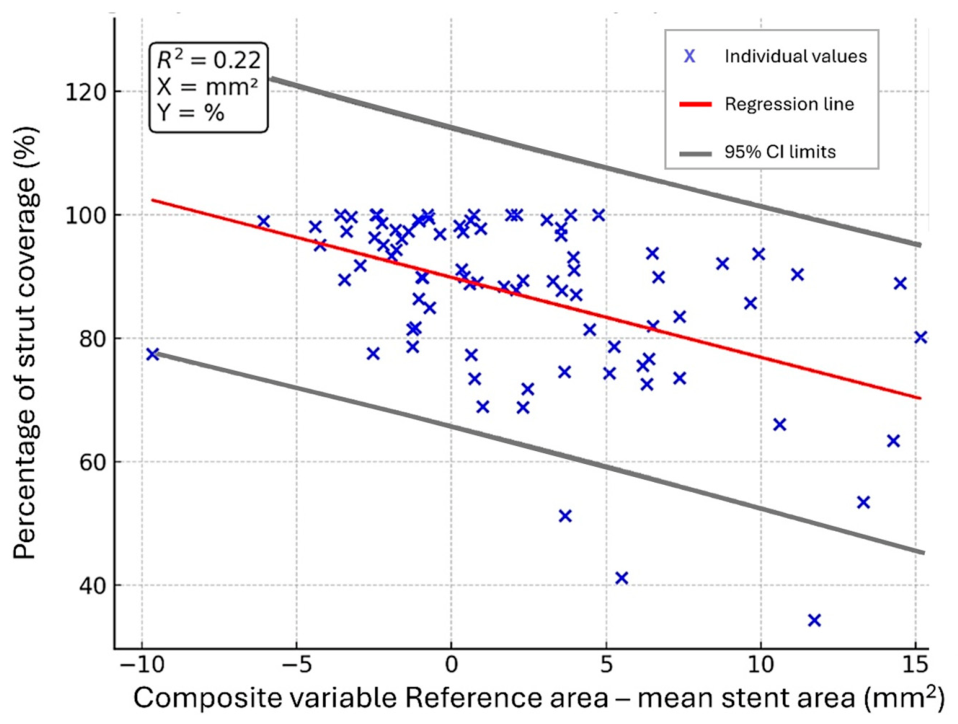
| Difference between reference lumen area and mean stent area (mm2) | 0.489 | 0.220 | −0.170 (−0.240, −0.100) | <0.000 | −2.074 (−3.595, −0.554) | 0.008 |
| Univariate Regression | Multivariate Regression | |||||
|---|---|---|---|---|---|---|
| Variable | R | R2 | B (95% CI) | p | B (95% CI) | p |
| Reference diameter (mm) | 0.578 | 0.334 | 8.06 (5.58, 10.55) | 0.000 | −9.463 (−18.961, 0.035) | 0.051 |
| Minimal lumen area (mm2) | 0.632 | 0.399 | 1.96 (1.43, 2.48) | 0.000 | 1.407 (0.107, 2.707) | 0.034 |
| Mean lumen area (mm2) | 0.689 | 0.475 | 1.98 (1.52, 2.43) | 0.000 | 2.026 (0.51, 3.542) | 0.010 |
| Lumen stenosis, % | 0.302 | 0.091 | −0.18 (−0.29, −0.56) | 0.005 | 0.092 (−0.03, 0.214) | 0.136 |
| Minimal stent area (mm2) | 0.257 | 0.091 | 1.16 (0.21, 2.11) | 0.018 | −1.034 (−2.659, 0.591) | 0.209 |
| Minimum stent expansion, % | 0.435 | 0.189 | −0.19 (−0.29, −0.11) | 0.000 | 0.084 (−0.143, 0.311) | 0.465 |
| Mean stent expansion, % | 0.426 | 0.182 | −0.16 (−0.24, −0.09) | 0.000 | −0.045 (−0.198, 0.107) | 0.555 |
| Lumen volume (mm3) | 0.199 | 0.040 | −0.05 (−0.10, 0.04) | 0.067 | ||
| Stent volume (mm3) | 0.317 | 0.101 | −0.06 (−0.11, −0.02) | 0.003 | −0.033 (−0.08, 0.014) | 0.163 |
| NIH volume (mm3) | 0.367 | 0.134 | −0.33 (−0.51, −0.15) | 0.001 | 0.143 (−0.099, 0.386) | 0.242 |
| Malapposition volume (mm3) | 0.715 | 0.511 | 1.35 (1.06, 1.64) | 0.000 | 0.425 (0.061, 0.789) | 0.023 |
| Difference between reference lumen area and mean stent area (mm2) | 0.518 | 0.268 | 0.190 (0.122, 0.259) | 0.518 | 1.923 (0.666, 3.18) | 0.003 |
| Univariate Regression | Multivariable Regression | |||||
|---|---|---|---|---|---|---|
| Variable | R | R2 | B (95% CI) | p | B (95% CI) | p |
| Reference diameter (mm) | 0.565 | 0.319 | 6.054 (4.125, 7.982) | <0.001 | −8.342 (−16.285, −0.399) | 0.040 |
| Minimal lumen area (mm2) | 0.609 | 0.371 | 1.448 (1.037, 1.860) | <0.001 | 1.189 (0.102, 2.276) | 0.033 |
| Mean lumen area (mm2) | 0.654 | 0.428 | 1.440 (1.077, 1.804) | <0.001 | 1.742 (0.474, 3.01) | 0.008 |
| Lumen stenosis, % | 0.279 | 0.078 | −0.247 (−0.219, −0.031) | 0.010 | 0.075 (−0.027, 0.177) | 0.146 |
| Minimal stent area (mm2) | 0.244 | 0.06 | 0.848 (0.113, 1.584) | 0.024 | −0.949 (−2.308, 0.41) | 0.168 |
| Minimum stent expansion, % | 0.423 | 0.179 | −0.148 (−0.218, −0.079) | <0.001 | 0.101 (−0.089, 0.291) | 0.291 |
| Mean stent expansion, % | 0.417 | 0.174 | −0.122 (−0.180, −0.064) | <0.001 | −0.019 (−0.147, 0.108) | 0.766 |
| Lumen volume (mm3) | 0.173 | 0.03 | −0.032 (−0.072, 0.008) | 0.114 | ||
| Stent volume (mm3) | 0.285 | 0.081 | −0.044 (−0.077, −0.012) | 0.008 | −0.013 (−0.053, 0.026) | 0.510 |
| NIH volume (mm3) | 0.357 | 0.127 | −0.246 (−0.386, −0.105) | <0.001 | 0.09 (−0.113, 0.292) | 0.380 |
| Malapposition volume (mm3) | 0.64 | 0.409 | 0.927 (0.684, 1.171) | <0.001 | 0.081 (−0.223, 0.386) | 0.595 |
| Difference between reference lumen area and mean stent area (mm2) | 0.533 | 0.284 | 0.255 (0.166, 0.343) | 0.533 | 2.117 (1.065, 3.168) | 0.000 |
| Univariate Regression | Multivariable Regression | |||||
|---|---|---|---|---|---|---|
| Variable | R | R2 | B (95% CI) | p | B (95% CI) | p |
| Reference diameter (mm) | 0.562 | 0.316 | 5.835 (3.96, 7.71) | 0.001 | −6.023 (−13.041, 0.996) | 0.091 |
| Minimal lumen area (mm2) | 0.646 | 0.417 | 1.488 (1.10, 1.87) | 0.001 | 0.995 (0.034, 1.955) | 0.043 |
| Mean lumen area (mm2) | 0.704 | 0.495 | 1.502 (1.171, 1.833) | 0.001 | 1.635 (0.515, 2.755) | 0.005 |
| Lumen stenosis, % | 0.302 | 0.091 | −0.131 (−0.22, −0.04) | 0.005 | 0.083 (−0.007, 0.173) | 0.071 |
| Minimal stent area (mm2) | 0.288 | 0.083 | 0.970 (0.27, 1.67) | 0.008 | −0.891 (−2.092, 0.31) | 0.144 |
| Minimum stent expansion, % | 0.366 | 0.134 | −0.125 (−0.19, −0.06) | 0.001 | 0.109 (−0.059, 0.277) | 0.2 |
| Mean stent expansion, % | 0.365 | 0.134 | −0.104 (−0.16, −0.05) | 0.001 | −0.043 (−0.155, 0.07) | 0.455 |
| Lumen volume (mm3) | 0.205 | 0.042 | −0.037 (−0.08, 0.00) | 0.06 | ||
| Stent volume (mm3) | 0.315 | 0.099 | −0.047 (−0.08, −0.02) | 0.003 | −0.042 (−0.077, −0.007) | 0.019 |
| NIH volume (mm3) | 0.339 | 0.115 | −0.226 (−0.36, −0.09) | 0.002 | 0.171 (−0.008, 0.35) | 0.061 |
| Malapposition volume (mm3) | 0.715 | 0.511 | 1.004 (0.79, 1.22) | 0.001 | 0.343 (0.074, 0.612) | 0.013 |
| Difference between reference lumen area and mean stent area (mm2) | 0.459 | 0.210 | 0.226 (0.131, 0.322) | 0.459 | 1.286 (0.357, 2.214) | 0.007 |
| Univariate Regression | Multivariable Regression | |||||
|---|---|---|---|---|---|---|
| Variable | R | R2 | B (95% CI) | p | B (95% CI) | p |
| Reference diameter (mm) | 0.565 | 0.319 | 4.354 (2.965, 5.743) | 0.000 | −6.167 (−11.648, −0.685) | 0.028 |
| Minimal lumen area (mm2) | 0.623 | 0.388 | 1.065 (0.773, 1.358) | 0.000 | 0.654 (−0.096, 1.405) | 0.086 |
| Mean lumen area (mm2) | 0.679 | 0.461 | 1.076 (0.822, 1.330) | 0.000 | 1.402 (0.528, 2.277) | 0.002 |
| Lumen stenosis, % | 0.282 | 0.080 | −0.091 (−0.159, −0.023) | 0.009 | 0.065 (−0.005, 0.136) | 0.068 |
| Minimal stent area (mm2) | 0.292 | 0.085 | 0.729 (0.207, 1.252) | 0.007 | −0.473 (−1.411, 0.465) | 0.318 |
| Minimum stent expansion, % | 0.365 | 0.134 | −0.092 (−0.144, −0.041) | 0.001 | 0.082 (−0.049, 0.213) | 0.218 |
| Mean stent expansion, % | 0.376 | 0.141 | −0.079 (−0.122, −0.037) | 0.000 | −0.014 (−0.102, 0.074) | 0.753 |
| Lumen volume (mm3) | 0.192 | 0.037 | −0.026 (−0.054, 0.003) | 0.078 | ||
| Stent volume (mm3) | 0.300 | 0.090 | −0.034 (−0.057, −0.010) | 0.005 | −0.026 (−0.053, 0.001) | 0.059 |
| NIH volume (mm3) | 0.339 | 0.115 | −0.168 (−0.270, −0.066) | 0.002 | 0.112 (−0.028, 0.252) | 0.116 |
| Malapposition volume (mm3) | 0.685 | 0.469 | 0.715 (0.549, 0.881) | 0.000 | 0.152 (−0.058, 0.362) | 0.154 |
| Difference between reference lumen area and mean stent area (mm2) | 0.491 | 0.241 | 0.326 (0.199, 0.452) | 0.491 | 1.418 (0.693, 2.143) | 0.000 |

References
- Yap, J.; Singh, G.D.; Kim, J.S.; Soni, K.; Chua, K.; Neo, A.; Koh, C.H.; Armstrong, E.J.; Waldo, S.W.; Shunk, K.A.; et al. Outcomes of primary percutaneous coronary intervention in acute myocardial infarction due to unprotected left main thrombosis: The Asia-Pacific Left Main ST-Elevation Registry (ASTER). J. Interv. Cardiol. 2018, 31, 129–135. [Google Scholar] [CrossRef] [PubMed]
- Liu, H.W.; Han, Y.L.; Jin, Q.M.; Wang, X.Z.; Ma, Y.Y.; Wang, G.; Wang, B.; Xu, K.; Li, Y.; Chen, S.L. One-year Outcomes in Patients with ST-segment Elevation Myocardial Infarction Caused by Unprotected Left Main Coronary Artery Occlusion Treated by Primary Percutaneous Coronary Intervention. Chin. Med. J. (Engl.) 2018, 131, 1412–1419. [Google Scholar] [CrossRef] [PubMed]
- Chevalier, B.; Smits, P.C.; Carrié, D.; Mehilli, J.; Van Boven, A.J.; Regar, E.; Sawaya, F.J.; Chamié, D.; Kraaijeveld, A.O.; Hovasse, T.; et al. Serial Assessment of Strut Coverage of Biodegradable Polymer Drug-Eluting Stent at 1, 2, and 3 Months After Stent Implantation by Optical Frequency Domain Imaging: The DISCOVERY 1TO3 Study (Evaluation With OFDI of Strut Coverage of Terumo New Drug Eluting Stent With Biodegradable Polymer at 1, 2, and 3 Months). Circ. Cardiovasc. Interv. 2017, 10, e004801. [Google Scholar] [CrossRef] [PubMed]
- Mori, H.; Torii, S.; Harari, E.; Jinnouchi, H.; Brauman, R.; Smith, S.; Kutys, R.; Fowler, D.; Romero, M.; Virmani, R.; et al. Pathological mechanisms of left main stent failure. Int. J. Cardiol. 2018, 263, 9–16. [Google Scholar] [CrossRef]
- Fujino, Y.; Attizzani, G.F.; Bezerra, H.G.; Wang, W.; Tahara, S.; Yamamoto, H.; Chamie, D.; Kanaya, T.; Mehanna, E.; Takagi, K.; et al. Serial assessment of vessel interactions after drug-eluting stent implantation in unprotected distal left main coronary artery disease using frequency-domain optical coherence tomography. JACC Cardiovasc. Interv. 2013, 6, 1035–1045. [Google Scholar] [CrossRef]
- Mehmedbegovic, Z.; Vukcevic, V.; Stojkovic, S.; Beleslin, B.; Orlic, D.; Tomasevic, M.; Dikic, M.; Tesic, M.; Milasinovic, D.; Aleksandric, S.; et al. Long-term Follow-up Optical Coherence Tomography Assessment of Primary Percutaneous Coronary Intervention for Unprotected Left Main. Rev. Cardiovasc. Med. 2024, 25, 445. [Google Scholar] [CrossRef]
- Tearney, G.J.; Regar, E.; Akasaka, T.; Adriaenssens, T.; Barlis, P.; Bezerra, H.G.; Bouma, B.; Bruining, N.; Cho, J.M.; Chowdhary, S.; et al. Consensus standards for acquisition, measurement, and reporting of intravascular optical coherence tomography studies: A report from the International Working Group for Intravascular Optical Coherence Tomography Standardization and Validation. J. Am. Coll. Cardiol. 2012, 59, 1058–1072. [Google Scholar] [CrossRef]
- Onuma, Y.; Katagiri, Y.; Burzotta, F.; Holm, N.R.; Amabile, N.; Okamura, T.; Mintz, G.S.; Darremont, O.; Lassen, J.F.; Lefèvre, T.; et al. Joint consensus on the use of OCT in coronary bifurcation lesions by the European and Japanese bifurcation clubs. EuroIntervention 2019, 14, e1568–e1577. [Google Scholar] [CrossRef]
- Johnson, T.W.; Räber, L.; di Mario, C.; Bourantas, C.; Jia, H.; Mattesini, A.; Gonzalo, N.; de la Torre Hernandez, J.M.; Prati, F.; Koskinas, K.; et al. Clinical use of intracoronary imaging. Part 2: Acute coronary syndromes, ambiguous coronary angiography findings, and guiding interventional decision-making: An expert consensus document of the European Association of Percutaneous Cardiovascular Interventions. Eur. Heart J. 2019, 40, 2566–2584. [Google Scholar] [CrossRef]
- Räber, L.; Mintz, G.S.; Koskinas, K.C.; Johnson, T.W.; Holm, N.R.; Onuma, Y.; Radu, M.D.; Joner, M.; Yu, B.; Jia, H.; et al. Clinical use of intracoronary imaging. Part 1: Guidance and optimization of coronary interventions. An expert consensus document of the European Association of Percutaneous Cardiovascular Interventions. Eur. Heart J. 2018, 39, 3281–3300. [Google Scholar] [CrossRef]
- Higashino, N.; Ishihara, T.; Iida, O.; Tsujimura, T.; Hata, Y.; Toyoshima, T.; Nakao, S.; Kurata, N.; Mano, T. Identification of post-procedural optical coherence tomography findings associated with the 1-year vascular response evaluated by coronary angioscopy. Cardiovasc. Interv. Ther. 2023, 38, 86–95. [Google Scholar] [CrossRef]
- Hong, S.J.; Park, K.H.; Ahn, C.M.; Kim, J.S.; Kim, B.K.; Ko, Y.G.; Choi, D.; Jang, Y.; Hong, M.K. Severe acute stent malapposition follow-up: 3-month and 12-month serial quantitative analyses by optical coherence tomography. Int. J. Cardiol. 2020, 299, 81–86. [Google Scholar] [CrossRef] [PubMed]
- Taniwaki, M.; Radu, M.D.; Zaugg, S.; Amabile, N.; Garcia-Garcia, H.M.; Yamaji, K.; Jørgensen, E.; Kelbæk, H.; Pilgrim, T.; Caussin, C.; et al. Mechanisms of Very Late Drug-Eluting Stent Thrombosis Assessed by Optical Coherence Tomography. Circulation 2016, 133, 650–660. [Google Scholar] [CrossRef] [PubMed]
- Bouki, K.P.; Chatzopoulos, D.N.; Katsafados, M.G.; Elaiopoulos, D.A.; Psychari, S.N.; Apostolou, T.S. Late acquired stent malapposition detected by optical coherence tomography examination. Int. J. Cardiol. 2009, 137, e77–e78. [Google Scholar] [CrossRef]
- Kuramitsu, S.; Kazuno, Y.; Sonoda, S.; Domei, T.; Jinnouchi, H.; Yamaji, K.; Soga, Y.; Shirai, S.; Ando, K.; Saito, S. Vascular response to bioresorbable polymer sirolimus-eluting stent vs. permanent polymer everolimus-eluting stent at 9-month follow-up: An optical coherence tomography sub-study from the CENTURY II trial. Eur. Heart J. Cardiovasc. Imaging 2016, 17, 34–40. [Google Scholar] [CrossRef]
- Kyono, H.; Guagliumi, G.; Sirbu, V.; Rosenthal, N.; Tahara, S.; Musumeci, G.; Trivisonno, A.; Bezerra, H.G.; Costa, M.A. Optical coherence tomography (OCT) strut-level analysis of drug-eluting stents (DES) in human coronary bifurcations. EuroIntervention 2010, 6, 69–77. [Google Scholar] [CrossRef]
- Cornelissen, A.; Guo, L.; Sakamoto, A.; Jinnouchi, H.; Sato, Y.; Kuntz, S.; Kawakami, R.; Mori, M.; Fernandez, R.; Fuller, D.; et al. Histopathologic and physiologic effect of bifurcation stenting: Current status and future prospects. Expert Rev. Med. Devices 2020, 17, 189–200. [Google Scholar] [CrossRef]
- Chiastra, C.; Wu, W.; Dickerhoff, B.; Aleiou, A.; Dubini, G.; Otake, H.; Migliavacca, F.; LaDisa, J.F. Computational replication of the patient-specific stenting procedure for coronary artery bifurcations: From OCT and CT imaging to structural and hemodynamics analyses. J. Biomech. 2016, 49, 2102–2111. [Google Scholar] [CrossRef]
- Agrawal, M.; Hakeem, A.; Ahmed, Z.; Uretsky, B.F. Classification of mechanisms of strut malapposition after angiographically optimized stent implantation: An optical coherence tomography study. Catheter. Cardiovasc. Interv. 2017, 90, 225–232. [Google Scholar] [CrossRef]
- Nakazawa, G.; Yazdani, S.K.; Finn, A.V.; Vorpahl, M.; Kolodgie, F.D.; Virmani, R. Pathological findings at bifurcation lesions: The impact of flow distribution on atherosclerosis and arterial healing after stent implantation. J. Am. Coll. Cardiol. 2010, 55, 1679–1687. [Google Scholar] [CrossRef] [PubMed]
- Wakabayashi, H.; Ando, H.; Nakano, Y.; Takashima, H.; Waseda, K.; Shimoda, M.; Ohashi, H.; Suzuki, A.; Sakurai, S.; Amano, T. Temporal changes of incomplete stent apposition during early phase after everolimus-eluting stent implantation: Serial optical coherence tomography analyses at 2-week and 4-month. Int. J. Cardiovasc. Imaging 2021, 37, 411–417. [Google Scholar] [CrossRef] [PubMed]
- Lee, S.Y.; Mintz, G.S.; Kim, J.S.; Kim, B.K.; Jang, Y.; Hong, M.K. Long-term Clinical Outcomes of Drug-Eluting Stent Malapposition. Korean Circ. J. 2020, 50, 880–889. [Google Scholar] [CrossRef]
- Im, E.; Lee, S.Y.; Hong, S.J.; Ahn, C.M.; Kim, J.S.; Kim, B.K.; Ko, Y.G.; Choi, D.; Jang, Y.; Hong, M.K. Impact of late stent malapposition after drug-eluting stent implantation on long-term clinical outcomes. Atherosclerosis 2019, 288, 118–123. [Google Scholar] [CrossRef]
- Wu, X.; Wu, M.; Huang, H.; Wang, L.; Liu, Z.; Cai, J.; Huang, H. Clinical Implications of Acute Stent Mal-Apposition in the Left Main Coronary Artery. Rev. Cardiovasc. Med. 2024, 25, 196. [Google Scholar] [CrossRef] [PubMed]
- Lee, P.H.; Hong, S.J.; Kim, H.S.; Yoon, Y.W.; Lee, J.Y.; Oh, S.J.; Lee, J.S.; Kang, S.J.; Kim, Y.H.; Park, S.W.; et al. Quantitative Coronary Angiography vs Intravascular Ultrasonography to Guide Drug-Eluting Stent Implantation: A Randomized Clinical Trial. JAMA Cardiol. 2024, 9, 428–435. [Google Scholar] [CrossRef]
- Kim, B.G.; Kachel, M.; Kim, J.S.; Guagliumi, G.; Kim, C.; Kim, I.S.; Lee, Y.J.; Lee, O.H.; Byun, Y.S.; Kim, B.O.; et al. Clinical Implications of Poststent Optical Coherence Tomographic Findings: Severe Malapposition and Cardiac Events. JACC Cardiovasc. Imaging 2022, 15, 126–137. [Google Scholar] [CrossRef]
- Adriaenssens, T.; Joner, M.; Godschalk, T.C.; Malik, N.; Alfonso, F.; Xhepa, E.; De Cock, D.; Komukai, K.; Tada, T.; Cuesta, J.; et al. Optical Coherence Tomography Findings in Patients With Coronary Stent Thrombosis: A Report of the PRESTIGE Consortium (Prevention of Late Stent Thrombosis by an Interdisciplinary Global European Effort). Circulation 2017, 136, 1007–1021. [Google Scholar] [CrossRef]
- Souteyrand, G.; Amabile, N.; Mangin, L.; Chabin, X.; Meneveau, N.; Cayla, G.; Vanzetto, G.; Barnay, P.; Trouillet, C.; Rioufol, G.; et al. Mechanisms of stent thrombosis analysed by optical coherence tomography: Insights from the national PESTO French registry. Eur. Heart J. 2016, 37, 1208–1216. [Google Scholar] [CrossRef]
- Kang, S.J.; Lee, C.W.; Song, H.; Ahn, J.M.; Kim, W.J.; Lee, J.Y.; Park, D.W.; Lee, S.W.; Kim, Y.H.; Mintz, G.S.; et al. OCT analysis in patients with very late stent thrombosis. JACC Cardiovasc. Imaging 2013, 6, 695–703. [Google Scholar] [CrossRef] [PubMed]
- Cuesta, J.; Rivero, F.; Bastante, T.; García-Guimaraes, M.; Antuña, P.; Alvarado, T.; Navarrete, G.; Benedicto, A.; Alfonso, F. Optical Coherence Tomography Findings in Patients With Stent Thrombosis. Rev. Esp. Cardiol. (Engl. Ed.) 2017, 70, 1050–1058. [Google Scholar] [CrossRef]
- Siqueira, D.A.; Abizaid, A.A.; Costa, J.e.R.; Feres, F.; Mattos, L.A.; Staico, R.; Tanajura, L.F.; Chaves, A.; Centemero, M.; Sousa, A.G.; et al. Late incomplete apposition after drug-eluting stent implantation: Incidence and potential for adverse clinical outcomes. Eur. Heart J. 2007, 28, 1304–1309. [Google Scholar] [CrossRef][Green Version]
- Lombardi, M.; Chiabrando, J.G.; Romagnoli, E.; D’Amario, D.; Leone, A.M.; Aurigemma, C.; Montone, R.A.; Ricchiuto, A.; Biondi-Zoccai, G.; Burzotta, F.; et al. Impact of acute and persistent stent malapposition after percutaneous coronary intervention on adverse cardiovascular outcomes. Minerva Cardiol. Angiol. 2023, 71, 525–534. [Google Scholar] [CrossRef]


| Patients, n (%) | 30 (100) |
| Age, years (mean ± SD) | 57.8 ± 9.1 |
| Male sex, n (%) | 22 (73) |
| STEMI presentation, n (%) | 20 (67) |
| Killip class 3–4 at admission, n (%) | 2 (6) |
| Isolated ULMCA disease, n (%) | 12 (39) |
| True bifurcation/trifurcation, n (%) | 6 (20)/2 (7) |
| Pre-PCI TIMI 0–1 flow MB, n (%) | 12 (40) |
| One-stent/two-stent technique, n (%) | 27 (90)/3 (10) |
| Proximal stent optimization (POT), n (%) | 24 (79) |
| Final TIMI 3 flow (all branches), n (%) | 30 (100) |
| Angiographic success, n (%) | 29 (97) |
| Post-PCI LVEF, % (mean ± SD) | 49.0 ± 12.5 |
| LM (N = 28) | POC (N = 29) | dMB (N = 29) | |
|---|---|---|---|
| Total length of analysed segment, mm (mean ± SD) | 6.7 ± 4.4 | 2.4 ± 0.9 | 13.8 ± 6.7 |
| Total number of analysed struts, n (mean ± SD) | 274.8 ± 227.1 | 94.4 ± 43.2 | 733.9 ± 543.4 |
| Total covered struts, % (mean ± SD) | 82.8 ± 17.3 | 84.2 ± 12.4 | 93.9 ± 6.1 |
| All malapposed struts, % (mean ± SD) | 17.4 ± 12.5 | 14.2 ± 10.9 | 0.4 ± 0.9 |
| Malapposed and uncovered struts, % (mean ± SD) | 8.9 ± 14.2 | 9.2 ± 8.4 | 0.2 ± 0.7 |
| Malapposed struts > 400 μm, % (mean ± SD) | 7.4 ± 2.6 | 10.1 ± 9.4 | 0.0 ± 0.1 |
| Malapposed struts > 400 μm and uncovered, % (mean ± SD) | 5.6 ± 9.7 | 6.7 ± 6.8 | 0.0 ± 0.1 |
| LM (N = 28) | POC (N = 29) | dMB (N = 29) | p | |
|---|---|---|---|---|
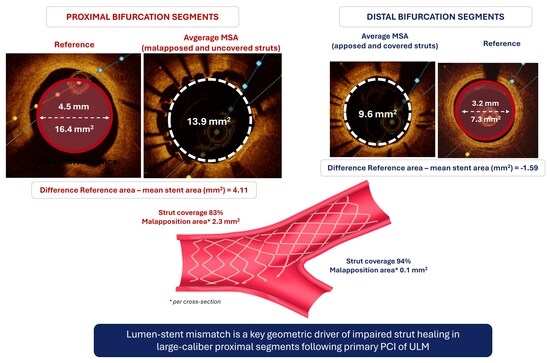
| Reference lumen diameter, mm (mean ± SD) | 4.5 ± 0.8 | 3.2 ± 0.3 | <0.001 | |
| Reference lumen area, mm2 (mean ± SD) | 16.4 ± 4.9 | 7.3 ± 2.0 | <0.001 | |
| Minimal lumen area (MLA), mm2 (mean ± SD) | 11.0 ± 4.9 | 10.9 ± 3.6 | 6.1 ± 2.0 | <0.001 |
| Mean lumen area (overall), mm2 (mean ± SD) | 13.5 ± 4.9 | 14.0 ± 3.9 | 7.9 ± 1.7 | 0.001 |
| Percent lumen stenosis, % (mean ± SD) | 17.6 ± 20.4 | 9.9 ± 14.9 | 38.3 ± 22.7 | <0.001 |
| Minimal stent area (MSA), mm2 (mean ± SD) | 11.5 ± 3.3 | 9.8 ± 2.5 | 7.9 ± 1.7 | <0.001 |
| Mean stent area, mm2 (mean ± SD) | 13.9 ± 3.5 | 12.6 ± 3.3 | 9.6 ± 1.8 | <0.001 |
| Minimal stent expansion, % (mean ± SD) | 72.4 ± 33.2 | 59.7 ± 16.6 | 100.5 ± 18.6 | <0.001 |
| Mean stent expansion, % (mean ± SD) | 87.5 ± 35.7 | 75.8 ± 19.1 | 123.9 ± 28.3 | <0.001 |
| Total in-stent lumen volume, mm3 (mean ± SD) | 80.7 ± 45.8 | 33.5 ± 17.1 | 109.9 ± 61.2 | <0.001 |
| Total stent volume, mm3 (mean ± SD) | 84.1 ± 48.1 | 28.1 ± 13.4 | 131.0 ± 72.3 | <0.001 |
| Total NIH volume, mm3 (mean ± SD) | 12.5 ± 11.5 | 3.6 ± 1.9 | 24.9 ± 17.3 | <0.001 |
| Total malapposition volume, mm3 (mean ± SD) | 5.7 ± 8.9 | 7.3 ± 7.0 | 0.8 ± 1.0 | <0.001 |
| Univariable Regression | Multivariable Regression | |||||
|---|---|---|---|---|---|---|
| OCT Parameter | R | R2 | B (95% CI) | p | B (95% CI) | p |
| Percentage of covered struts | ||||||
| Reference area (mm2) | 0.549 | 0.302 | −1.19 (−1.58, −0.79) | 0.000 | −2.277 (−4.123, −0.43) | 0.016 |
| Stent volume (mm3) | 0.223 | 0.050 | 0.05 (0.002, 0.09) | 0.040 | −0.081 (−0.139, −0.022) | 0.007 |
| NIH volume (mm3) | 0.423 | 0.179 | 0.38 (0.205, 0.565) | 0.000 | 0.412 (0.117, 0.707) | 0.007 |
| Percentage of malapposed struts | ||||||
| Minimal lumen area (mm2) | 0.632 | 0.399 | 1.96 (1.43, 2.48) | 0.000 | 1.696 (0.402, 2.989) | 0.011 |
| Mean lumen area (mm2) | 0.689 | 0.475 | 1.98 (1.52, 2.43) | 0.000 | 2.062 (0.584, 3.54) | 0.007 |
| Mean stent area (mm2) | 0.326 | 0.106 | 1.27 (0.46, 2.01) | 0.002 | −3.46 (−5.313, −1.606) | 0.000 |
| Percentage of malapposed and uncovered struts | ||||||
| Mean lumen area (mm2) | 0.704 | 0.495 | 1.502 (1.171, 1.833) | 0.001 | 1.674 (0.628, 2.721) | 0.002 |
| Mean stent area (mm2) | 0.335 | 0.112 | 0.970 (0.37, 1.7) | 0.002 | −2.983 (−4.295, −1.671) | 0.000 |
| NIH volume (mm3) | 0.339 | 0.115 | −0.226 (−0.360, −0.09) | 0.002 | 0.18 (0.013, 0.347) | 0.035 |
| Malapposition volume (mm3) | 0.715 | 0.511 | 1.004 (0.79, 1.22) | 0.001 | 0.259 (0.003, 0.515) | 0.047 |
| Percentage of malapposed struts > 400 μm | ||||||
| Minimal lumen area (mm2) | 0.623 | 0.388 | 1.065 (0.773, 1.358) | 0.000 | 0.85 (0.112, 1.587) | 0.025 |
| Mean lumen area (mm2) | 0.679 | 0.461 | 1.076 (0.822, 1.330) | 0.000 | 1.426 (0.584, 2.269) | 0.001 |
| Mean stent area (mm2) | 0.320 | 0.103 | 0.689 (0.244, 1.134) | 0.003 | −2.455 (−3.512, −1.399) | 0.000 |
| Percentage of malapposed (>400 μm) and uncovered struts | ||||||
| Minimal lumen area (mm2) | 0.623 | 0.388 | 1.065 (0.773, 1.358) | 0.000 | 0.85 (0.112, 1.587) | 0.025 |
| Mean lumen area (mm2) | 0.679 | 0.461 | 1.076 (0.822, 1.330) | 0.000 | 1.426 (0.584, 2.269) | 0.001 |
| Mean stent area (mm2) | 0.320 | 0.103 | 0.689 (0.244, 1.134) | 0.003 | −2.455 (−3.512, −1.399) | 0.000 |
| Univariable Regression | Multivariable Regression | |||||
|---|---|---|---|---|---|---|
| Strut-Healing Outcomes | R | R2 | B (95% CI) | p | B (95% CI) | p |
| Percentage of covered struts | 0.489 | 0.220 | −0.170 (−0.240, −0.100) | <0.000 | −2.074 (−3.595, −0.554) | 0.008 |
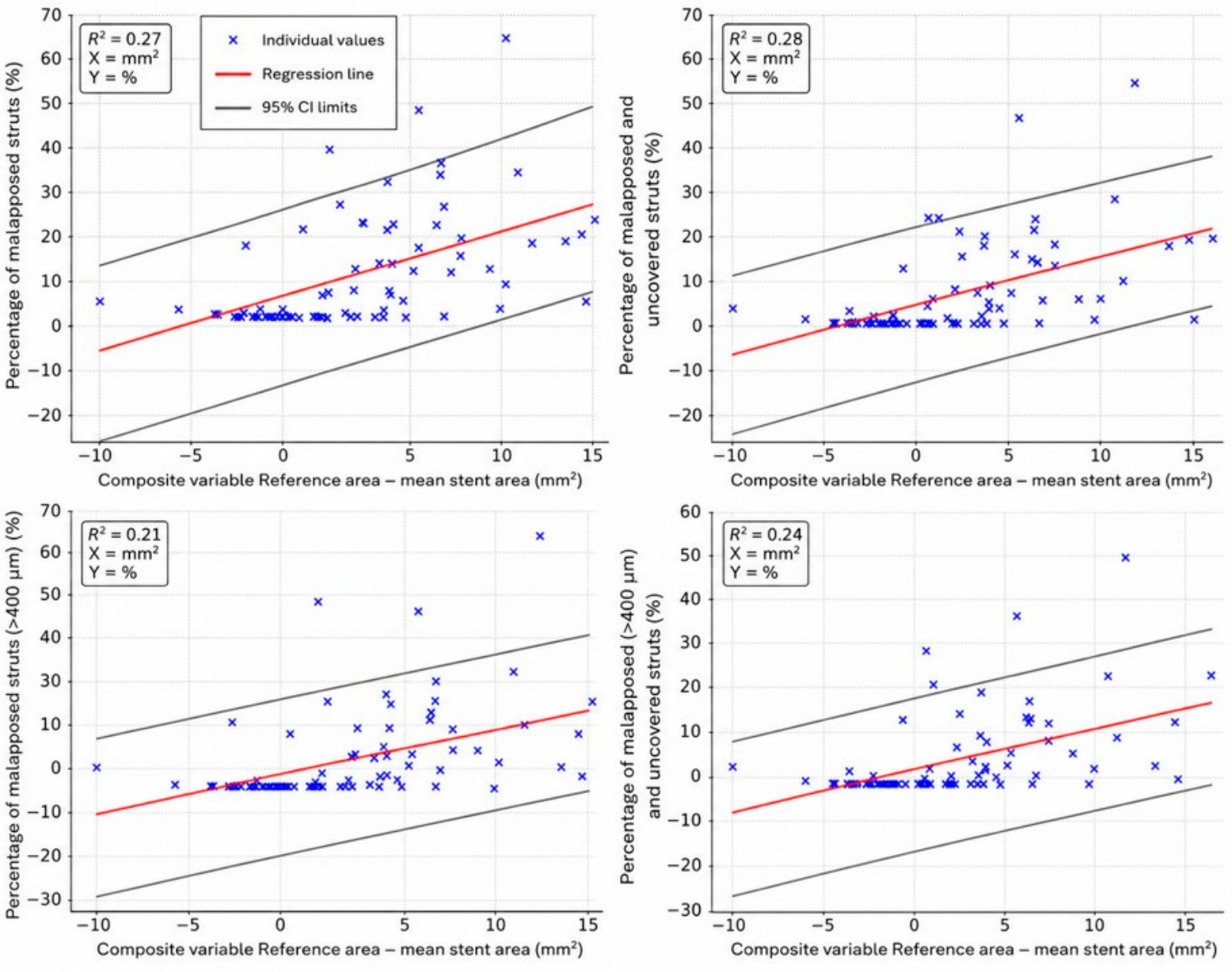
| Percentage of all malapposed struts | 0.518 | 0.268 | 0.190 (0.122, 0.259) | <0.000 | 1.923 (0.666, 3.18) | 0.003 |
| Percentage of malapposed and uncovered struts | 0.533 | 0.284 | 0.255 (0.166, 0.343) | <0.000 | 2.117 (1.065, 3.168) | 0.000 |
| Percentage of malapposed struts > 400 μm | 0.459 | 0.210 | 0.226 (0.131, 0.322) | <0.000 | 1.286 (0.357, 2.214) | 0.007 |
| Percentage of malapposed (>400 μm) and uncovered struts | 0.491 | 0.241 | 0.326 (0.199, 0.452) | <0.000 | 1.418 (0.693, 2.143) | 0.000 |
Disclaimer/Publisher’s Note: The statements, opinions and data contained in all publications are solely those of the individual author(s) and contributor(s) and not of MDPI and/or the editor(s). MDPI and/or the editor(s) disclaim responsibility for any injury to people or property resulting from any ideas, methods, instructions or products referred to in the content. |
© 2026 by the authors. Licensee MDPI, Basel, Switzerland. This article is an open access article distributed under the terms and conditions of the Creative Commons Attribution (CC BY) license.
Share and Cite
Mehmedbegovic, Z.; Vukcevic, V.; Stojkovic, S.; Beleslin, B.; Orlic, D.; Dikic, M.; Milasinovic, D.; Tesic, M.; Aleksandric, S.; Dedovic, V.; et al. Lumen–Stent Mismatch Affects Long-Term Strut Healing After Primary PCI of Left Main Lesions: An Exploratory Follow-Up OCT Study. Diagnostics 2026, 16, 1519. https://doi.org/10.3390/diagnostics16101519
Mehmedbegovic Z, Vukcevic V, Stojkovic S, Beleslin B, Orlic D, Dikic M, Milasinovic D, Tesic M, Aleksandric S, Dedovic V, et al. Lumen–Stent Mismatch Affects Long-Term Strut Healing After Primary PCI of Left Main Lesions: An Exploratory Follow-Up OCT Study. Diagnostics. 2026; 16(10):1519. https://doi.org/10.3390/diagnostics16101519
Chicago/Turabian StyleMehmedbegovic, Zlatko, Vladan Vukcevic, Sinisa Stojkovic, Branko Beleslin, Dejan Orlic, Miodrag Dikic, Dejan Milasinovic, Milorad Tesic, Srdjan Aleksandric, Vladimir Dedovic, and et al. 2026. "Lumen–Stent Mismatch Affects Long-Term Strut Healing After Primary PCI of Left Main Lesions: An Exploratory Follow-Up OCT Study" Diagnostics 16, no. 10: 1519. https://doi.org/10.3390/diagnostics16101519
APA StyleMehmedbegovic, Z., Vukcevic, V., Stojkovic, S., Beleslin, B., Orlic, D., Dikic, M., Milasinovic, D., Tesic, M., Aleksandric, S., Dedovic, V., Zivkovic, M., Juricic, S., Jelic, D., Mladenovic, D., Travica, L., Simic, D., Dukic, D., Sarenac, D., Ristic, M., ... Stankovic, G. (2026). Lumen–Stent Mismatch Affects Long-Term Strut Healing After Primary PCI of Left Main Lesions: An Exploratory Follow-Up OCT Study. Diagnostics, 16(10), 1519. https://doi.org/10.3390/diagnostics16101519