Residual Safety Margin-Based Risk Stratification for Hospital-Wide POCT Glucose Meters Anchored to ISO 15197: Moving Beyond Pass-Fail


Abstract
1. Introduction
2. Materials and Methods
2.1. Design and Setting
2.2. Hospital-Wide POCT Comparison Quality Assurance
2.3. Endpoints and Calculations
2.4. Statistical Analysis
3. Results
3.1. Overall Agreement and Accuracy Assessment
3.2. Performance and Agreement Across Glucose Concentration Levels
3.3. Department-Level Risk Stratification by ISO-Anchored r with TEa-Referenced Bands
4. Discussion
Supplementary Materials
Author Contributions
Funding
Institutional Review Board Statement
Informed Consent Statement
Data Availability Statement
Acknowledgments
Conflicts of Interest
Abbreviations
| BA | Bland–Altman |
| BV | Biological variation |
| CI | Confidence interval |
| CV | Coefficient of variation |
| EFLM | European Federation of Clinical Chemistry and Laboratory Medicine |
| EQA | External quality assessment |
| FAD | Flavin adenine dinucleotide |
| GDH-FAD | FAD-dependent glucose dehydrogenase |
| GOD | Glucose oxidase |
| IFU | Instructions for use |
| IQC | Internal quality control |
| ISO | International Organization for Standardization |
| LoA | Limits of agreement |
| MARD | Mean absolute relative difference |
| Mut. Q-GDH | Mutant quinoprotein glucose dehydrogenase |
| POCT | Point-of-care testing |
| QC | Quality control |
| QA | Quality assurance |
| RMSE | Root mean square error |
| SD | Standard deviation |
| TEa | Total allowable error |
References
- Luan, X.; Ke, L.; Feng, M.; Peng, W.; Luo, H.; Xue, H.; Xia, Y. Risk management in POCT blood glucose monitoring: FMEA approach aligned with ISO 15189:2022. PLoS ONE 2025, 20, e0319817. [Google Scholar] [CrossRef] [PubMed]
- Rebel, A.; Rice, M.A.; Fahy, B.G. Accuracy of point-of-care glucose measurements. J. Diabetes Sci. Technol. 2012, 6, 396–411. [Google Scholar] [CrossRef] [PubMed]
- Huysal, K.; Budak, Y.U.; Demirci, H.; Önelge, M.A. Evaluation of CareSens POCT Devices for Glucose Testing in the Routine Hospital Setting. J. Clin. Diagn. Res. 2015, 9, Bc04-7. [Google Scholar] [CrossRef] [PubMed]
- ISO 15197:2013; In Vitro Diagnostic Test Systems—Requirements for Blood-Glucose Monitoring Systems for Self-Testing in Managing Diabetes Mellitus. International Organization for Standardization: Geneva, Switzerland, 2013.
- Pleus, S.; Baumstark, A.; Jendrike, N.; Mende, J.; Link, M.; Zschornack, E.; Haug, C.; Freckmann, G. System accuracy evaluation of 18 CE-marked current-generation blood glucose monitoring systems based on EN ISO 15197:2015. BMJ Open Diabetes Res. Care 2020, 8, e001067. [Google Scholar] [CrossRef]
- Giavarina, D. Understanding Bland Altman analysis. Biochem. Med. 2015, 25, 141–151. [Google Scholar] [CrossRef]
- Bland, J.M.; Altman, D.G. Statistical methods for assessing agreement between two methods of clinical measurement. Lancet 1986, 1, 307–310. [Google Scholar] [CrossRef]
- Freckmann, G.; Mende, J.; Pleus, S.; Waldenmaier, D.; Baumstark, A.; Jendrike, N.; Haug, C. Mean Absolute Relative Difference of Blood Glucose Monitoring Systems and Relationship to ISO 15197. J. Diabetes Sci. Technol. 2022, 16, 1089–1095. [Google Scholar] [CrossRef]
- Bilić-Zulle, L. Comparison of methods: Passing and Bablok regression. Biochem. Med. 2011, 21, 49–52. [Google Scholar] [CrossRef]
- De la Villa Porras, I. Novelties in the ISO 15189:2023 standard. Adv. Lab. Med. 2023, 4, 337–338. [Google Scholar] [CrossRef]
- Linko, S.; Boursier, G.; Bernabeu-Andreu, F.A.; Dzneladze, N.; Vanstapel, F.; Brguljan, P.M.; Tosheska-Trajkovska, K.; Mehay, H.; Panteghini, M.; Brugnoni, D.; et al. EN ISO 15189 revision: EFLM Committee Accreditation and ISO/CEN standards (C: A/ISO) analysis and general remarks on the changes. Clin. Chem. Lab. Med. 2025, 63, 1084–1098. [Google Scholar] [CrossRef]
- Plebani, M.; Sciacovelli, L.; Aita, A. Quality Indicators for the Total Testing Process. Clin. Lab. Med. 2017, 37, 187–205. [Google Scholar] [CrossRef]
- Bayat, H.; Westgard, S.A.; Westgard, J.O. The value of Sigma-metrics in laboratory medicine. Clin. Chem. Lab. Med. 2024, 62, 2401–2404. [Google Scholar] [CrossRef]
- WS/T 403—2024; Analytical Performance Standard for Routine Analytes in Clinical Chemistry. National Health Commission of the People’s Republic of China: Beijing, China, 2024. Available online: https://www.nhc.gov.cn/fzs/c100048/202407/758b8a012f4748c9b23ee48d22d0a79a/files/1733821991150_35767.pdf (accessed on 9 May 2024).
- Carpenter, J.; Bithell, J. Bootstrap confidence intervals: When, which, what? A practical guide for medical statisticians. Stat. Med. 2000, 19, 1141–1164. [Google Scholar] [CrossRef]
- Jendrike, N.; Baumstark, A.; Kamecke, U.; Haug, C.; Freckmann, G. ISO 15197: 2013 Evaluation of a Blood Glucose Monitoring System’s Measurement Accuracy. J. Diabetes Sci. Technol. 2017, 11, 1275–1276. [Google Scholar] [CrossRef] [PubMed]
- Oliver, P.; Fernandez-Calle, P.; Buno, A. POCT Accreditation ISO 15189 and ISO 22870: Making the Point. Ejifcc 2021, 32, 131–139. [Google Scholar] [PubMed]
- Khan, A.I.; Pratumvinit, B.; Jacobs, E.; Kost, G.J.; Kary, H.; Balla, J.; Shaw, J.; Milevoj Kopcinovic, L.; Vaubourdolle, M.; Oliver, P.; et al. Point-of-care testing performed by healthcare professionals outside the hospital setting: Consensus based recommendations from the IFCC Committee on Point-of-Care Testing (IFCC C-POCT). Clin. Chem. Lab. Med. 2023, 61, 1572–1579. [Google Scholar] [CrossRef]
- Krouwer, J.S. The Danger of Using Total Error Models to Compare Glucose Meter Performance. J. Diabetes Sci. Technol. 2014, 8, 419–421. [Google Scholar] [CrossRef]
- Bowman, C.F.; Nichols, J.H. Comparison of Accuracy Guidelines for Hospital Glucose Meters. J. Diabetes Sci. Technol. 2020, 14, 546–552. [Google Scholar] [CrossRef]
- Tonyushkina, K.; Nichols, J.H. Glucose meters: A review of technical challenges to obtaining accurate results. J. Diabetes Sci. Technol. 2009, 3, 971–980. [Google Scholar] [CrossRef]
- Lam, M.; Louie, R.F.; Curtis, C.M.; Ferguson, W.J.; Vy, J.H.; Truong, A.T.; Sumner, S.L.; Kost, G.J. Short-Term Thermal-Humidity Shock Affects Point-of-Care Glucose Testing: Implications for Health Professionals and Patients. J. Diabetes Sci. Technol. 2014, 8, 83–88. [Google Scholar] [CrossRef]
- Lee, S. Agreement Evaluation in Statistical Analyses: Misconceptions and Key Features. Ann. Lab. Med. 2025, 45, 276–278. [Google Scholar] [CrossRef]
- Shaw, J.L.V.; Arnoldo, S.; Beach, L.; Bouhtiauy, I.; Brinc, D.; Brun, M.; Collier, C.; Kostantin, E.; Fung, A.W.S.; Füzéry, A.K.; et al. Establishing quality indicators for point of care glucose testing: Recommendations from the Canadian Society for Clinical Chemists Point of Care Testing and Quality Indicators Special Interest Groups. Clin. Chem. Lab. Med. 2023, 61, 1280–1287. [Google Scholar] [CrossRef]
- Shaw, J.L.V.; Arnoldo, S.; Bouhtiany, I.; Brinc, D.; Brun, M.; Collier, C.; Fuezery, A.; Fung, A.W.S.; Huang, Y.; Kaur, S.; et al. Recommendations for the integration of standardized quality indicators for glucose point-of-care testing. Clin. Chem. Lab. Med. 2025, 63, 1965–1973. [Google Scholar] [CrossRef]



| Brand (Manufacturer, Country) | Departments (n) | Assay Chemistry (Strip/Enzyme) | Measurement Range (mg/dL) | Hematocrit Range (%) | Operating Temperature (°C) | Operating Humidity (%) | Strip/ Reagent Lot | Method Type |
|---|---|---|---|---|---|---|---|---|
| LifeScan OneTouch Verio (LifeScan, Malvern, PA, USA) | 21 | FAD-dependent glucose dehydrogenase (GDH-FAD) | 20–600 | 20–60 | 15–40 | 10–90 | 5869580 | POCT |
| Roche Accu-Chek Inform II (Roche Diagnostics, Mannheim, Germany) | 12 | Mutant quinoprotein glucose Dehydrogenase (Mut. Q-GDH; maltose-independent) | 11–600 | 10–65 | 8–44 | 10–90 | 671596 | POCT |
| Ascensia CONTOUR TS (Ascensia Diabetes Care, Basel, Switzerland) | 2 | FAD-dependent glucose dehydrogenase (GDH-FAD) | 20–600 | 15–65 | 5–45 | 10–93 | DP4HM3F31E | POCT |
| Beckman Coulter AU5800 (Beckman Coulter Diagnostics, Brea, CA, USA) | 1 | Glucose oxidase (GOD) | 10–600 | N/A | 18–32 | 30–80 | 25030502 | Reference analyzer |
| Pairs (n) | ISO 15197, % [95% CI] | BA Mean Bias, mg/dL (95% LoA) | MARD, % [95% CI] | RMSE, mg/dL [95% CI] |
|---|---|---|---|---|
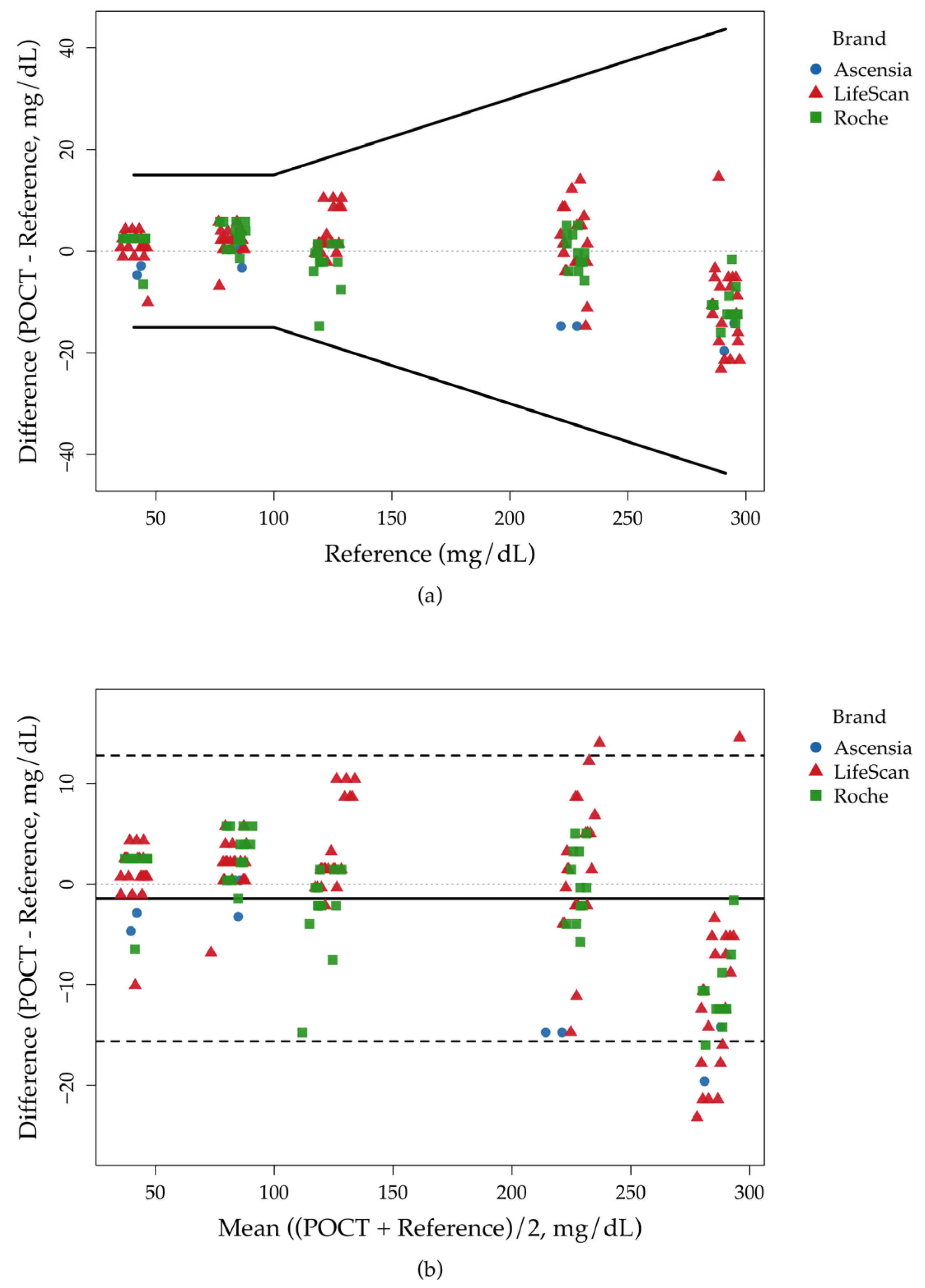
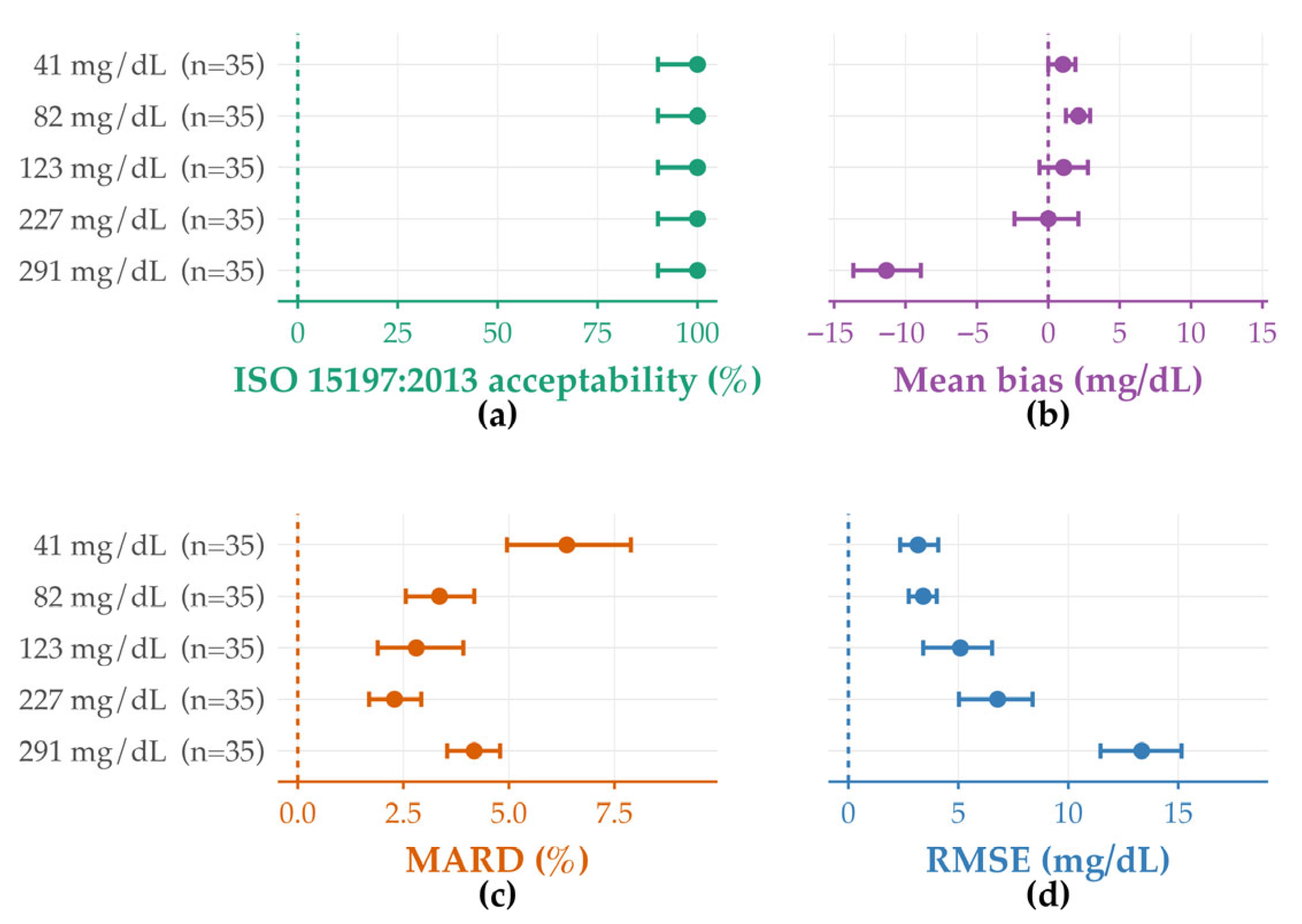
| 175 | 100.0 [97.9, 100.0] | −1.43 (−15.6, 12.8) | 3.8 [3.4, 4.3] | 7.4 [6.6, 8.2] |
Disclaimer/Publisher’s Note: The statements, opinions and data contained in all publications are solely those of the individual author(s) and contributor(s) and not of MDPI and/or the editor(s). MDPI and/or the editor(s) disclaim responsibility for any injury to people or property resulting from any ideas, methods, instructions or products referred to in the content. |
© 2025 by the authors. Licensee MDPI, Basel, Switzerland. This article is an open access article distributed under the terms and conditions of the Creative Commons Attribution (CC BY) license (https://creativecommons.org/licenses/by/4.0/).
Share and Cite
Bi, H.; Chen, Y.; Wu, Y.; Shi, Z.; Xia, J.; Yan, Q. Residual Safety Margin-Based Risk Stratification for Hospital-Wide POCT Glucose Meters Anchored to ISO 15197: Moving Beyond Pass-Fail. Diagnostics 2025, 15, 3220. https://doi.org/10.3390/diagnostics15243220
Bi H, Chen Y, Wu Y, Shi Z, Xia J, Yan Q. Residual Safety Margin-Based Risk Stratification for Hospital-Wide POCT Glucose Meters Anchored to ISO 15197: Moving Beyond Pass-Fail. Diagnostics. 2025; 15(24):3220. https://doi.org/10.3390/diagnostics15243220
Chicago/Turabian StyleBi, Hao, Yuting Chen, Yihan Wu, Zuliang Shi, Jianbo Xia, and Qiuyue Yan. 2025. "Residual Safety Margin-Based Risk Stratification for Hospital-Wide POCT Glucose Meters Anchored to ISO 15197: Moving Beyond Pass-Fail" Diagnostics 15, no. 24: 3220. https://doi.org/10.3390/diagnostics15243220
APA StyleBi, H., Chen, Y., Wu, Y., Shi, Z., Xia, J., & Yan, Q. (2025). Residual Safety Margin-Based Risk Stratification for Hospital-Wide POCT Glucose Meters Anchored to ISO 15197: Moving Beyond Pass-Fail. Diagnostics, 15(24), 3220. https://doi.org/10.3390/diagnostics15243220