Ultrasound Evaluation of Fontan-Associated Liver Disease: A State-of-the-Art Review
 ,
,  , and
, and
Abstract
1. Introduction
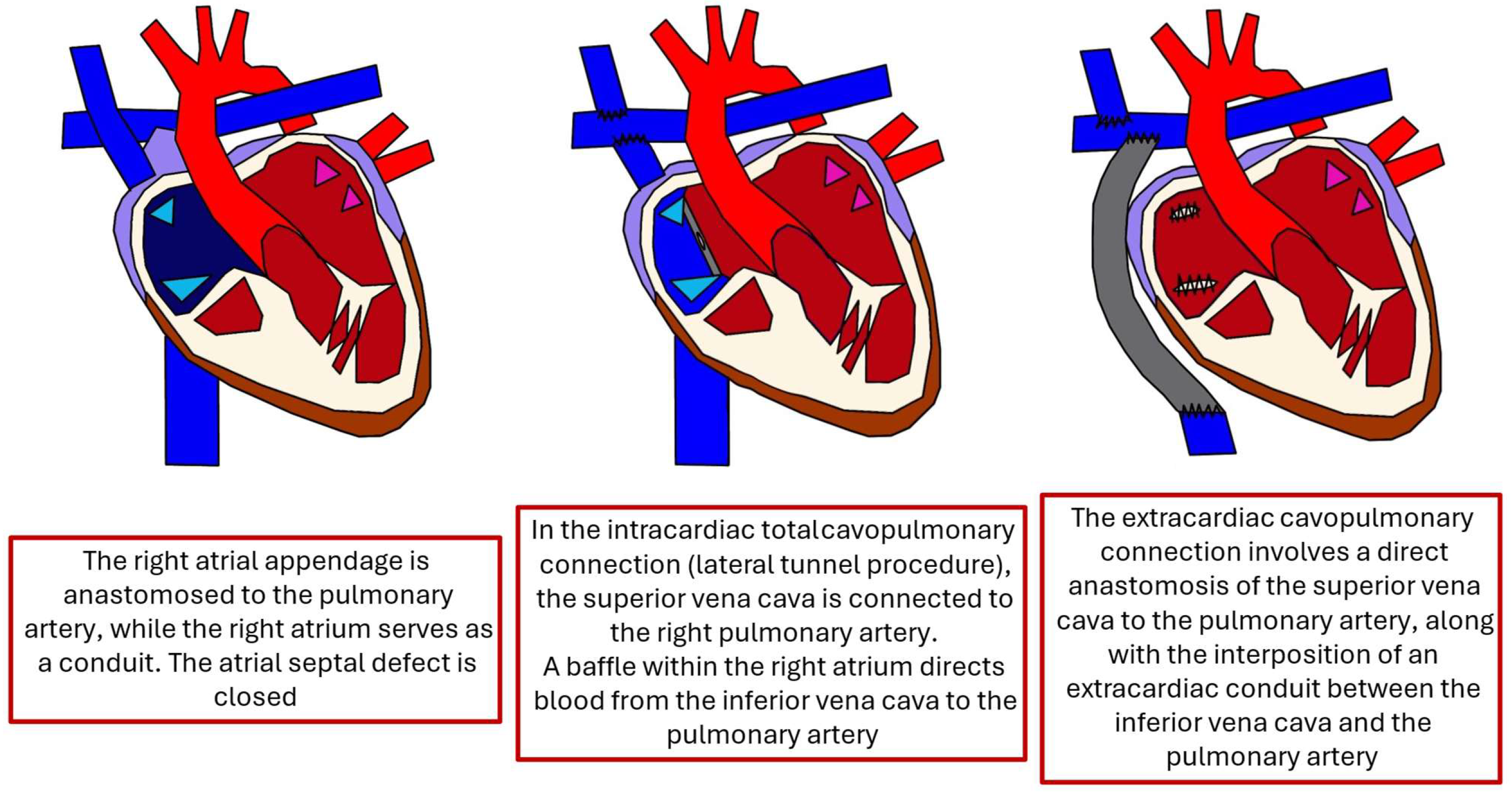
- The suction effect generated by left atrial relaxation during diastole.
- The action of the respiratory and muscular pumps, driven by the negative intrathoracic pressure during inspiration, which enhance inferior vena cava return and promotes pulmonary vessel recruitment.
- The maintenance of low pulmonary vascular resistance, provided there is no mechanical obstruction within the Fontan conduit, the main pulmonary arteries, or the pulmonary veins.
- Systolic Failure Phenotype (SFP): The single ventricle’s pumping ability deteriorates, leading to a reduced ejection fraction. Clinically, patients may experience fatigue, ascites and exercise intolerance. Hemodynamically, this group is characterized by a low cardiac index, often less than 2.2 L/min/m2, and variable Fontan pressures. These patients are typically the most ill and often require early evaluation for transplant due to poor outcomes with medical therapy alone.
- Preserved Systolic Function with Elevated Pressure (PFP): In this phenotype, the ventricle itself is functioning normally in terms of contractility, but the Fontan circuit develops resistance. Elevated pressures within the Fontan pathway—often due to increased pulmonary vascular resistance, conduit stenosis, or lack of compliance—lead to systemic venous congestion. Patients may present with peripheral edema, liver congestion, and ascites. Despite a preserved cardiac output, end-organ dysfunction progresses, and clinical management often focuses on relieving congestion or improving Fontan flow dynamics.
- Lymphatic Failure Phenotype (LFP): Some patients with Fontan circulation develop complications related to abnormal lymphatic flow, even in the absence of severe hemodynamic derangements. These patients may present with protein-losing enteropathy, plastic bronchitis, or chylous effusions. This phenotype is increasingly recognized because of chronic central venous hypertension impairing lymphatic drainage, especially from the gut and lungs. Management often requires targeted lymphatic interventions, such as lymphangiography-guided embolization or specialized dietary and pharmacologic therapies.
- Normal Hemodynamics Phenotype (NHP): A subset of patients may exhibit clinical symptoms of Fontan failure despite having normal cardiac function and pressures. These cases can be particularly challenging to diagnose and manage, as standard hemodynamic evaluations appear normal. The underlying mechanisms are not fully understood but may involve diastolic dysfunction, subtle microvascular issues, or autonomic imbalance. Despite “normal” measurements, these patients may have reduced exercise tolerance or quality of life and require a multidisciplinary approach to evaluation.
2. FALD Epidemiology
3. Pathophysiology
4. Clinical Presentation
5. Diagnosis
6. Imaging
7. B-Mode & Color-Doppler Findings
8. Contrast-Enhanced Ultrasound (CEUS) in FALD
9. Ultrasound Differentiation of Liver Nodules
10. Hepatocellular Carcinoma (HCC) in FALD
11. Liver & Spleen Stiffness

| Study | Sample Size | Modality | Comparator | Main Findings |
|---|---|---|---|---|
| Sakae et al. (2025) [109] | 37 | TE (FibroScan®) | Serum markers (FIB-4, GGT), clinical parameters | FIB-4, GGT, and age at Fontan were independently associated with elevated LSM; TE correlated with liver fibrosis risk. |
| Imoto et al. (2025) [108] | 46 | SWE, Platelet count, LFI | Liver biopsy results | Platelet <185k + LFI> 2.21 predicted aFALD with high sensitivity; proposed a 2-step algorithm for screening. |
| Lo Yau et al. (2025) [111] | 29 | US elastography, Liver biopsy | METAVIR vs. congestive hepatic fibrosis score | Weak correlation between US elastography and histologic fibrosis. 86% had METAVIR > F2; median shear wave 1.97 m/s. |
| Yau et al. (2025) [112] | 56 | SWE, Hemodynamic assessment | Cardiac catheterization, Echocardiography parameters | No significant correlation between SWE and pre-/post-Fontan hemodynamics. No association with systolic function or AV valve regurgitation on echo. Liver stiffness measurements appear independent of cardiac output parameters. |
| Cuadros et al. (2025) [107] | 91 | TE (FibroScan®) | Clinical outcomes, fibrosis markers | Elevated LSM predicted major events and mortality in Fontan patients; validated prognostic value of TE. |
| Téllez et al. (2025) [106] | 217 | TE, Biopsy, FonLiver score | Other non-invasive tests (APRI, FIB-4, MELD) | FonLiver score outperformed traditional markers; strong diagnostic tool combining TE and platelet count. |
| Bolia et al. (2024) [105] | 48 | SWE | Liver stiffness, biomarkers | SWE showed weak correlation with established FALD markers; limited predictive utility. |
| Jarasvaraparn et al. (2024) [11] | 66 | APRI, FIB-4, TE | Histologic and imaging findings | APRI and FIB-4 were moderately predictive in adults but not effective in children. |
| Gill et al. (2023) [104] | 25 | 2D SWE, TE | Liver stiffness measurements | Poor concordance between SWE and TE; questioned reliability of elastography. |
| Nagasawa et al. (2022) [103] | 27 | SWD, 2D SWE | Fibrosis stage (biopsy) | SWD more accurate than SWE for detecting significant fibrosis. |
| Chemello et al. (2021) [102] | 52 | TE | Portal hypertension and clinical stage | LS and LSPS effectively staged FALD and identified portal hypertension risk. |
| Schleiger et al. (2020) [101] | 145 | TE, FibroTest®, US | Fontan duration, clinical severity | Fibrosis scores strongly associated with Fontan duration and clinical severity. |
| Munsterman et al. (2019) [100] | 49 | US, TE, MRI/CT, Biopsy | Histology and imaging findings | Universal fibrosis found; varices and nodules inconsistently reflected severity. |
| Egbe et al. (2018) [99] | 22 | MRE | MELD score, outcomes | Annual MRE-LS progression correlated with worsening MELD and clinical outcomes. |
12. Liver Ultrasound-Guided Biopsy
13. FALD Follow-Up
14. Future Directions
15. Conclusions
Author Contributions
Funding
Institutional Review Board Statement
Informed Consent Statement
Data Availability Statement
Conflicts of Interest
References
- Kreutzer, G.; Galíndez, E.; Bono, H.; De Palma, C.; Laura, J.P. An operation for the correction of tricuspid atresia. J. Thorac. Cardiovasc. Surg. 1973, 66, 613–621. [Google Scholar] [CrossRef]
- Björk, V.O.; Olin, C.L.; Bjarke, B.B.; Thorén, C.A. Right atrial-right ventricular anastomosis for correction of tricuspid atresia. J. Thorac. Cardiovasc. Surg. 1979, 77, 452–458. [Google Scholar] [CrossRef]
- Wang , H.; Rubadeux, D.; Trout, A.T.; Morin , C.E.; Opotowsky, A.R.; Glenn , A.; Palermo , J.J.; Bari , K.; Dillman, J.R. Ultrasound-MRI Agreement in Individuals Undergoing Surveillance of Fontan-associated Liver Disease. J Comput Assist Tomogr. 2025, 49, 705–713. [Google Scholar] [CrossRef]
- Cao, J.Y.; Wales, K.M.; d’Udekem, Y.; Celermajer, D.S.; Cordina, R.; Majumdar, A. Prevalence, Risk Factors, and Prognosis for Fontan-Associated Liver Disease: A Systematic Review and Exploratory Meta-Analysis. JACC Adv. 2025, 4, 101694. [Google Scholar] [CrossRef]
- Gordon-Walker, T.T.; Bove, K.; Veldtman, G. Fontan-associated liver disease: A review. J. Cardiol. 2019, 74, 223–232. [Google Scholar] [CrossRef] [PubMed]
- Emamaullee, J.; Martin, S.; Goldbeck, C.; Rocque, B.; Barbetta, A.; Kohli, R.; Starnes, V. Evaluation of Fontan-associated Liver Disease and Ethnic Disparities in Long-term Survivors of the Fontan Procedure: A Population-based Study. Ann. Surg. 2022, 276, 482–490. [Google Scholar] [CrossRef] [PubMed]
- Hilscher, M.B.; Johnson, J.N. Fontan-Associated Liver Disease. Semin. Liver Dis. 2025, 45, 114–128. [Google Scholar] [CrossRef]
- D’Ardes, D.; Pontolillo, M.; Esposito, L.; Masciarelli, M.; Boccatonda, A.; Rossi, I.; Bucci, M.; Guagnano, M.T.; Ucciferri, C.; Santilli, F.; et al. Duration of COVID-19: Data from an Italian Cohort and Potential Role for Steroids. Microorganisms 2020, 8, 1327. [Google Scholar] [CrossRef] [PubMed]
- Mahendran, A.; Fahnhorst, S.; Alexander, C.; Brown, N.; Cnota, J.F.; Divanovic, A.; Heydarian, H.; Hirsch, R.; Opotowsky, A.R.; Palermo, J.J.; et al. The impact of the COVID-19 pandemic on individuals with Fontan circulation: Focus on gaps in care. Int. J. Cardiol. Congenit. Heart Dis. 2023, 11, 100439. [Google Scholar] [CrossRef]
- Boccatonda, A.; Cocco, G.; Ianniello, E.; Montanari, M.; D’Ardes, D.; Borghi, C.; Giostra, F.; Copetti, R.; Schiavone, C. One year of SARS-CoV-2 and lung ultrasound: What has been learned and future perspectives. J. Ultrasound 2021, 24, 115–123. [Google Scholar] [CrossRef]
- Jarasvaraparn, C.; Thoe, J.; Rodenbarger, A.; Masuoka, H.; Payne, R.M.; Markham, L.W.; Molleston, J.P. Biomarkers of fibrosis and portal hypertension in Fontan-associated liver disease in children and adults. Dig. Liver Dis. 2024, 56, 1335–1342. [Google Scholar] [CrossRef] [PubMed]
- Jarasvaraparn, C.; Rodenbarger, A.; Thoe, J.; Vuppalanchi, R.; Payne, R.M.; Markham, L.W.; Molleston, J.P. Platelet slope and long-term clinical outcomes in children and adults with Fontan-associated liver disease. Hepatol. Int. 2025. [Google Scholar] [CrossRef]
- Boccatonda, A.; Del Cane, L.; Marola, L.; D’Ardes, D.; Lessiani, G.; di Gregorio, N.; Ferri, C.; Cipollone, F.; Serra, C.; Santilli, F.; et al. Platelet, Antiplatelet Therapy and Metabolic Dysfunction-Associated Steatotic Liver Disease: A Narrative Review. Life 2024, 14, 473. [Google Scholar] [CrossRef]
- Ignee, A.; Gebel, M.; Caspary, W.F.; Dietrich, C.F. Doppler imaging of hepatic vessels—Review. Z. Gastroenterol. 2002, 40, 21–32. [Google Scholar] [CrossRef]
- Dietrich, C.F.; Lee, J.H.; Gottschalk, R.; Herrmann, G.; Sarrazin, C.; Caspary, W.F.; Zeuzem, S. Hepatic and portal vein flow pattern in correlation with intrahepatic fat deposition and liver histology in patients with chronic hepatitis C. AJR Am. J. Roentgenol. 1998, 171, 437–443. [Google Scholar] [CrossRef]
- Simonetto, D.A.; Yang, H.Y.; Yin, M.; de Assuncao, T.M.; Kwon, J.H.; Hilscher, M.; Pan, S.; Yang, L.; Bi, Y.; Beyder, A.; et al. Chronic passive venous congestion drives hepatic fibrogenesis via sinusoidal thrombosis and mechanical forces. Hepatology 2015, 61, 648–659. [Google Scholar] [CrossRef]
- Hilscher, M.B.; Sehrawat, T.; Arab, J.P.; Zeng, Z.; Gao, J.; Liu, M.; Kostallari, E.; Gao, Y.; Simonetto, D.A.; Yaqoob, U.; et al. Mechanical Stretch Increases Expression of CXCL1 in Liver Sinusoidal Endothelial Cells to Recruit Neutrophils, Generate Sinusoidal Microthombi, and Promote Portal Hypertension. Gastroenterology 2019, 157, 193–209.e199. [Google Scholar] [CrossRef]
- Thomas, H. LSEC stretch promotes fibrosis during hepatic vascular congestion. Nat. Rev. Gastroenterol. Hepatol. 2019, 16, 262–263. [Google Scholar] [CrossRef]
- Dietrich, C.F.; Trenker, C.; Fontanilla, T.; Görg, C.; Hausmann, A.; Klein, S.; Lassau, N.; Miquel, R.; Schreiber-Dietrich, D.; Dong, Y. New Ultrasound Techniques Challenge the Diagnosis of Sinusoidal Obstruction Syndrome. Ultrasound Med. Biol. 2018, 44, 2171–2182. [Google Scholar] [CrossRef] [PubMed]
- Dijkstra, H.; Wolff, D.; van Melle, J.P.; Bartelds, B.; Willems, T.P.; Oudkerk, M.; Hillege, H.; van den Berg, A.P.; Ebels, T.; Berger, R.M.; et al. Diminished liver microperfusion in Fontan patients: A biexponential DWI study. PLoS ONE 2017, 12, e0173149. [Google Scholar] [CrossRef] [PubMed]
- Durongpisitkul, K.; Driscoll, D.J.; Mahoney, D.W.; Wollan, P.C.; Mottram, C.D.; Puga, F.J.; Danielson, G.K. Cardiorespiratory response to exercise after modified Fontan operation: Determinants of performance. J. Am. Coll. Cardiol. 1997, 29, 785–790. [Google Scholar] [CrossRef]
- Ohuchi, H.; Mori, A.; Nakai, M.; Fujimoto, K.; Iwasa, T.; Sakaguchi, H.; Kurosaki, K.; Shiraishi, I. Pulmonary Arteriovenous Fistulae After Fontan Operation: Incidence, Clinical Characteristics, and Impact on All-Cause Mortality. Front. Pediatr. 2022, 10, 713219. [Google Scholar] [CrossRef]
- Daems, J.J.N.; Attard, C.; Van Den Helm, S.; Breur, J.; D’Udekem, Y.; du Plessis, K.; Wilson, T.G.; Winlaw, D.; Gentles, T.L.; Monagle, P.; et al. Cross-sectional assessment of haemostatic profile and hepatic dysfunction in Fontan patients. Open Heart 2021, 8, e001460. [Google Scholar] [CrossRef]
- Skubera, M.; Gołąb, A.; Plicner, D.; Natorska, J.; Ząbczyk, M.; Trojnarska, O.; Mazurek-Kula, A.; Smaś-Suska, M.; Bartczak-Rutkowska, A.; Podolec, P.; et al. Properties of Plasma Clots in Adult Patients Following Fontan Procedure: Relation to Clot Permeability and Lysis Time-Multicenter Study. J. Clin. Med. 2021, 10, 5976. [Google Scholar] [CrossRef] [PubMed]
- McCrindle, B.W.; Michelson, A.D.; Van Bergen, A.H.; Suzana Horowitz, E.; Pablo Sandoval, J.; Justino, H.; Harris, K.C.; Jefferies, J.L.; Miriam Pina, L.; Peluso, C.; et al. Thromboprophylaxis for Children Post-Fontan Procedure: Insights From the UNIVERSE Study. J. Am. Heart Assoc. 2021, 10, e021765. [Google Scholar] [CrossRef] [PubMed]
- Jeong, J.; Tanaka, M.; Iwakiri, Y. Hepatic lymphatic vascular system in health and disease. J. Hepatol. 2022, 77, 206–218. [Google Scholar] [CrossRef]
- Tanaka, M.; Iwakiri, Y. Lymphatics in the liver. Curr. Opin. Immunol. 2018, 53, 137–142. [Google Scholar] [CrossRef]
- Cox, D.A.; Ginde, S.; Tweddell, J.S.; Earing, M.G. Outcomes of a hepatitis C screening protocol in at-risk adults with prior cardiac surgery. World J. Pediatr. Congenit. Heart Surg. 2014, 5, 503–506. [Google Scholar] [CrossRef]
- de Lange, C.; Möller, T.; Hebelka, H. Fontan-associated liver disease: Diagnosis, surveillance, and management. Front. Pediatr. 2023, 11, 1100514. [Google Scholar] [CrossRef]
- Kiesewetter, C.H.; Sheron, N.; Vettukattill, J.J.; Hacking, N.; Stedman, B.; Millward-Sadler, H.; Haw, M.; Cope, R.; Salmon, A.P.; Sivaprakasam, M.C.; et al. Hepatic changes in the failing Fontan circulation. Heart 2007, 93, 579–584. [Google Scholar] [CrossRef] [PubMed]
- Agnoletti, G.; Ferraro, G.; Bordese, R.; Marini, D.; Gala, S.; Bergamasco, L.; Ferroni, F.; Calvo, P.L.; Barletti, C.; Cisarò, F.; et al. Fontan circulation causes early, severe liver damage. Should we offer patients a tailored strategy? Int. J. Cardiol. 2016, 209, 60–65. [Google Scholar] [CrossRef] [PubMed]
- D’Amico, G.; De Franchis, R. Upper digestive bleeding in cirrhosis. Post-therapeutic outcome and prognostic indicators. Hepatology 2003, 38, 599–612. [Google Scholar] [CrossRef]
- Ohuchi, H. What are the mechanisms for FALD and how can we prevent the progression? Int. J. Cardiol. 2018, 273, 121–122. [Google Scholar] [CrossRef] [PubMed]
- Hansen, J.H.; Khodami, J.K.; Moritz, J.D.; Rinne, K.; Voges, I.; Scheewe, J.; Kramer, H.H.; Uebing, A. Surveillance of Fontan Associated Liver Disease in Childhood and Adolescence. Semin. Thorac. Cardiovasc. Surg. 2022, 34, 642–650. [Google Scholar] [CrossRef]
- Dillman, J.R.; Trout, A.T.; Alsaied, T.; Gupta, A.; Lubert, A.M. Imaging of Fontan-associated liver disease. Pediatr. Radiol. 2020, 50, 1528–1541. [Google Scholar] [CrossRef]
- Bae, J.M.; Jeon, T.Y.; Kim, J.S.; Kim, S.; Hwang, S.M.; Yoo, S.Y.; Kim, J.H. Fontan-associated liver disease: Spectrum of US findings. Eur. J. Radiol. 2016, 85, 850–856. [Google Scholar] [CrossRef]
- Koizumi, Y.; Hirooka, M.; Tanaka, T.; Watanabe, T.; Yoshida, O.; Tokumoto, Y.; Higaki, T.; Eguchi, M.; Abe, M.; Hiasa, Y. Noninvasive ultrasound technique for assessment of liver fibrosis and cardiac function in Fontan-associated liver disease: Diagnosis based on elastography and hepatic vein waveform type. J. Med. Ultrason. (2001) 2021, 48, 235–244. [Google Scholar] [CrossRef]
- Brown, M.J.; Kolbe, A.B.; Hull, N.C.; Hilscher, M.; Kamath, P.S.; Yalon, M.; Gu, C.N.; Amawi, A.D.T.; Venkatesh, S.K.; Wells, M.L. Imaging of Fontan-Associated Liver Disease. J. Comput. Assist. Tomogr. 2024, 48, 1–11. [Google Scholar] [CrossRef]
- Griffiths, E.R.; Lambert, L.M.; Ou, Z.; Shaaban, A.; Rezvani, M.; Carlo, W.F.; Schumacher, K.R.; DiPaola, F.; O’Connor, M.J.; Nandi, D.; et al. Fontan-associated liver disease after heart transplant. Pediatr. Transpl. Transplant. 2023, 27, e14435. [Google Scholar] [CrossRef]
- Shahid, M.U.; Frenkel, Y.; Kuc, N.; Golowa, Y.; Cynamon, J. Transfemoral-Transcaval Liver Biopsy (TFTC) and Transjugular Liver Biopsy (TJLB) in Patients with Fontan-Associated Liver Disease (FALD). Cardiovasc. Interv. Radiol. 2024, 47, 875–882. [Google Scholar] [CrossRef] [PubMed]
- Borquez, A.A.; Silva-Sepulveda, J.; Lee, J.W.; Vavinskaya, V.; Vodkin, I.; El-Sabrout, H.; Towbin, R.; Perry, J.C.; Moore, J.W.; El-Said, H.G. Transjugular liver biopsy for Fontan associated liver disease surveillance: Technique, outcomes and hemodynamic correlation. Int. J. Cardiol. 2021, 328, 83–88. [Google Scholar] [CrossRef]
- Francalanci, P.; Giovannoni, I.; Tancredi, C.; Gagliardi, M.G.; Palmieri, R.; Brancaccio, G.; Spada, M.; Maggiore, G.; Pietrobattista, A.; Monti, L.; et al. Histopathological Spectrum and Molecular Characterization of Liver Tumors in the Setting of Fontan-Associated Liver Disease. Cancers 2024, 16, 307. [Google Scholar] [CrossRef]
- Emamaullee, J.; Khan, S.; Weaver, C.; Goldbeck, C.; Yanni, G.; Kohli, R.; Genyk, Y.; Zhou, S.; Shillingford, N.; Sullivan, P.M.; et al. Non-invasive biomarkers of Fontan-associated liver disease. JHEP Rep. 2021, 3, 100362. [Google Scholar] [CrossRef] [PubMed]
- Feeley, M.; Hopkins, K.; Grinspan, L.T.; Schiano, T.; Love, B.; Chan, A.; Lewis, S.; Zaidi, A.N. Challenges in Accurate Diagnosis of HCC in FALD: A Case Series. Pediatr. Cardiol. 2023, 44, 1447–1453. [Google Scholar] [CrossRef]
- D’Amato, J.; Bianco, E.Z.; Camilleri, J.; Debattista, E.; Ellul, P. Hepatocellular carcinoma in Fontan-associated liver disease. Ann. Gastroenterol. 2025, 38, 133–142. [Google Scholar] [CrossRef]
- Dietrich, C.F.; Shi, L.; Löwe, A.; Dong, Y.; Potthoff, A.; Sparchez, Z.; Teufel, A.; Guth, S.; Koch, J.; Barr, R.G.; et al. Conventional ultrasound for diagnosis of hepatic steatosis is better than believed. Z. Gastroenterol. 2022, 60, 1235–1248. [Google Scholar] [CrossRef] [PubMed]
- Salvatore, V.; Borghi, A.; Peri, E.; Colecchia, A.; Li Bassi, S.; Montrone, L.; Di Donato, R.; Conti, F.; Crespi, C.; Festi, D.; et al. Relationship between hepatic haemodynamics assessed by Doppler ultrasound and liver stiffness. Dig. Liver Dis. 2012, 44, 154–159. [Google Scholar] [CrossRef] [PubMed]
- Zheng, R.Q.; Wang, Q.H.; Lu, M.D.; Xie, S.B.; Ren, J.; Su, Z.Z.; Cai, Y.K.; Yao, J.L. Liver fibrosis in chronic viral hepatitis: An ultrasonographic study. World J. Gastroenterol. 2003, 9, 2484–2489. [Google Scholar] [CrossRef]
- Seol, J.H.; Song, J.; Kim, S.J.; Ko, H.; Na, J.Y.; Cho, M.J.; Choi, H.J.; Lee, J.S.; Oh, K.J.; Jung, J.W.; et al. Clinical predictors and noninvasive imaging in Fontan-associated liver disease: A systematic review and meta-analysis. Hepatol. Commun. 2024, 8, e0580. [Google Scholar] [CrossRef]
- Garagiola, M.L.; Tan, S.B.; Alonso-Gonzalez, R.; O’Brien, C.M. Liver Imaging in Fontan Patients: How Does Ultrasound Compare to Cross-Sectional Imaging? JACC Adv. 2024, 3, 101357. [Google Scholar] [CrossRef]
- Thrane, K.J.; Müller, L.S.O.; Suther, K.R.; Thomassen, K.S.; Holmström, H.; Thaulow, E.; Almaas, R.; Möller, T.; de Lange, C. Spectrum of Fontan-associated liver disease assessed by MRI and US in young adolescents. Abdom. Radiol. 2021, 46, 3205–3216. [Google Scholar] [CrossRef]
- Liu, X.; Han, L.; Zhou, Z.; Tu, J.; Ma, J.; Chen, J. Effect of liver abnormalities on mortality in Fontan patients: A systematic review and meta-analysis. BMC Cardiovasc. Disord. 2024, 24, 385. [Google Scholar] [CrossRef]
- Heering, G.; Lebovics, N.; Agarwal, R.; Frishman, W.H.; Lebovics, E. Fontan-Associated Liver Disease: A Review. Cardiol. Rev. 2024. [Google Scholar] [CrossRef]
- Wells, M.L.; Fenstad, E.R.; Poterucha, J.T.; Hough, D.M.; Young, P.M.; Araoz, P.A.; Ehman, R.L.; Venkatesh, S.K. Imaging Findings of Congestive Hepatopathy. Radiographics 2016, 36, 1024–1037. [Google Scholar] [CrossRef]
- Becciolini, M.; Brighenti, A.; Tiraferri, V.; Corvino, A.; Boccatonda, A.; Serra, C. B-flow imaging in abdominal ultrasound: A pictorial essay. J. Ultrasound 2025, 28, 1017–1030. [Google Scholar] [CrossRef]
- Nakatsuka, T.; Soroida, Y.; Nakagawa, H.; Shindo, T.; Sato, M.; Soma, K.; Nakagomi, R.; Kobayashi, T.; Endo, M.; Hikita, H.; et al. Identification of liver fibrosis using the hepatic vein waveform in patients with Fontan circulation. Hepatol. Res. 2019, 49, 304–313. [Google Scholar] [CrossRef] [PubMed]
- Giannini, E.; Botta, F.; Borro, P.; Risso, D.; Romagnoli, P.; Fasoli, A.; Mele, M.R.; Testa, E.; Mansi, C.; Savarino, V.; et al. Platelet count/spleen diameter ratio: Proposal and validation of a non-invasive parameter to predict the presence of oesophageal varices in patients with liver cirrhosis. Gut 2003, 52, 1200–1205. [Google Scholar] [CrossRef] [PubMed]
- Hsia, T.Y.; Khambadkone, S.; Deanfield, J.E.; Taylor, J.F.; Migliavacca, F.; De Leval, M.R. Subdiaphragmatic venous hemodynamics in the Fontan circulation. J. Thorac. Cardiovasc. Surg. 2001, 121, 436–447. [Google Scholar] [CrossRef] [PubMed]
- Hsia, T.Y.; Khambadkone, S.; Redington, A.N.; De Leval, M.R. Instantaneous pressure-flow velocity relations of systemic venous return in patients with univentricular circulation. Heart 2000, 83, 583. [Google Scholar] [CrossRef]
- Hsia, T.Y.; Khambadkone, S.; Redington, A.N.; de Leval, M.R. Effect of fenestration on the sub-diaphragmatic venous hemodynamics in the total-cavopulmonary connection. Eur. J. Cardiothorac. Surg. 2001, 19, 785–792. [Google Scholar] [CrossRef]
- McNaughton, D.A.; Abu-Yousef, M.M. Doppler US of the liver made simple. Radiographics 2011, 31, 161–188. [Google Scholar] [CrossRef]
- Moreno, F.L.; Hagan, A.D.; Holmen, J.R.; Pryor, T.A.; Strickland, R.D.; Castle, C.H. Evaluation of size and dynamics of the inferior vena cava as an index of right-sided cardiac function. Am. J. Cardiol. 1984, 53, 579–585. [Google Scholar] [CrossRef] [PubMed]
- Camposilvan, S.; Milanesi, O.; Stellin, G.; Pettenazzo, A.; Zancan, L.; D’Antiga, L. Liver and cardiac function in the long term after Fontan operation. Ann. Thorac. Surg. 2008, 86, 177–182. [Google Scholar] [CrossRef]
- Kutty, S.S.; Peng, Q.; Danford, D.A.; Fletcher, S.E.; Perry, D.; Talmon, G.A.; Scott, C.; Kugler, J.D.; Duncan, K.F.; Quiros-Tejeira, R.E.; et al. Increased hepatic stiffness as consequence of high hepatic afterload in the Fontan circulation: A vascular Doppler and elastography study. Hepatology 2014, 59, 251–260. [Google Scholar] [CrossRef] [PubMed]
- Cura, M.; Haskal, Z.; Lopera, J. Diagnostic and interventional radiology for Budd-Chiari syndrome. Radiographics 2009, 29, 669–681. [Google Scholar] [CrossRef]
- Téllez, L.; Rodríguez de Santiago, E.; Minguez, B.; Payance, A.; Clemente, A.; Baiges, A.; Morales-Arraez, D.; La Mura, V.; Llop, E.; Garrido, E.; et al. Prevalence, features and predictive factors of liver nodules in Fontan surgery patients: The VALDIG Fonliver prospective cohort. J. Hepatol. 2020, 72, 702–710. [Google Scholar] [CrossRef]
- Wallihan, D.B.; Podberesky, D.J. Hepatic pathology after Fontan palliation: Spectrum of imaging findings. Pediatr. Radiol. 2013, 43, 330–338. [Google Scholar] [CrossRef] [PubMed]
- Zander, T.; Zadeh, E.S.; Möller, K.; Goerg, C.; Correas, J.M.; Chaubal, N.; Dirks, K.; Hollerweger, A.; Jenssen, C.; Klinger, C.; et al. Comments and illustrations of the WFUMB CEUS liver guidelines: Rare focal liver lesion—infectious parasitic, fungus. Med. Ultrason. 2023, 25, 423–434. [Google Scholar] [CrossRef]
- Dong, Y.; Wang, W.P.; Zadeh, E.S.; Möller, K.; Görg, C.; Berzigotti, A.; Chaubal, N.; Cui, X.W.; De Molo, C.; Dirks, K.; et al. Comments and illustrations of the WFUMB CEUS liver guidelines: Rare benign focal liver lesion, part I. Med. Ultrason. 2024, 26, 50–62. [Google Scholar] [CrossRef]
- Dong, Y.; Guggisberg, E.; Wang, W.P.; Zadeh, E.S.; Görg, C.; Möller, K.; Berzigotti, A.; Chaubal, N.; Cui, X.W.; De Molo, C.; et al. Comments and illustrations of the WFUMB CEUS liver guidelines: Rare benign focal liver lesion, part II. Med. Ultrason. 2024, 26, 168–177. [Google Scholar] [CrossRef]
- Loiacono, R.; Boccatonda, A.; Brighenti, A.; Tiraferri, V.; Agostinelli, D.; Masi, L.; Venturoli, N.; Bakken, S.M.; Serra, C. The role of ceus in the characterization of indeterminate focal liver lesions at second-level imaging methods (INFOLIL STUDY). Intern. Emerg. Med. 2025. [Google Scholar] [CrossRef]
- Boccatonda, A.; Brighenti, A.; Tiraferri, V.; Loiacono, R.; Serra, C. Bedside CEUS: A feasible option to consider. Eur. J. Intern. Med. 2025, 136, 146–147. [Google Scholar] [CrossRef]
- Bulut, O.P.; Romero, R.; Mahle, W.T.; McConnell, M.; Braithwaite, K.; Shehata, B.M.; Gupta, N.A.; Vos, M.; Alazraki, A. Magnetic resonance imaging identifies unsuspected liver abnormalities in patients after the Fontan procedure. J. Pediatr. 2013, 163, 201–206. [Google Scholar] [CrossRef]
- Van Wettere, M.; Purcell, Y.; Bruno, O.; Payancé, A.; Plessier, A.; Rautou, P.E.; Cazals-Hatem, D.; Valla, D.; Vilgrain, V.; Ronot, M. Low specificity of washout to diagnose hepatocellular carcinoma in nodules showing arterial hyperenhancement in patients with Budd-Chiari syndrome. J. Hepatol. 2019, 70, 1123–1132. [Google Scholar] [CrossRef] [PubMed]
- Tang, A.; Abukasm, K.; Moura Cunha, G.; Song, B.; Wang, J.; Wagner, M.; Dietrich, C.F.; Brancatelli, G.; Ueda, K.; Choi, J.Y.; et al. Imaging of hepatocellular carcinoma: A pilot international survey. Abdom. Radiol. 2021, 46, 205–215. [Google Scholar] [CrossRef] [PubMed]
- Dietrich, C.F.; Dong, Y.; Kono, Y.; Caraiani, C.; Sirlin, C.B.; Cui, X.W.; Tang, A. LI-RADS ancillary features on contrast-enhanced ultrasonography. Ultrasonography 2020, 39, 221–228. [Google Scholar] [CrossRef] [PubMed]
- Çolaklar, A.; Lehnert, S.J.; Tirkes, T. Benign Hepatic Nodules Mimicking Hepatocellular Carcinoma in the Setting of Fontan-associated Liver Disease: A Case Report. Euroasian J. Hepatogastroenterol 2020, 10, 42–44. [Google Scholar] [CrossRef]
- Kogiso, T.; Tokushige, K. Fontan-associated liver disease and hepatocellular carcinoma in adults. Sci. Rep. 2020, 10, 21742. [Google Scholar] [CrossRef]
- Shiina, Y.; Inai, K.; Sakai, R.; Tokushige, K.; Nagao, M. Hepatocellular carcinoma and focal nodular hyperplasia in patients with Fontan-associated liver disease: Characterisation using dynamic gadolinium ethoxybenzyl diethylenetriamine pentaacetic acid-enhanced MRI. Clin. Radiol. 2023, 78, e197–e203. [Google Scholar] [CrossRef]
- Nandwana, S.B.; Olaiya, B.; Cox, K.; Sahu, A.; Mittal, P. Abdominal Imaging Surveillance in Adult Patients After Fontan Procedure: Risk of Chronic Liver Disease and Hepatocellular Carcinoma. Curr. Probl. Diagn. Radiol. 2018, 47, 19–22. [Google Scholar] [CrossRef]
- Josephus Jitta, D.; Wagenaar, L.J.; Mulder, B.J.; Guichelaar, M.; Bouman, D.; van Melle, J.P. Three cases of hepatocellular carcinoma in Fontan patients: Review of the literature and suggestions for hepatic screening. Int. J. Cardiol. 2016, 206, 21–26. [Google Scholar] [CrossRef]
- Rosenbaum, J.; Vrazas, J.; Lane, G.K.; Hardikar, W. Cardiac cirrhosis and hepatocellular carcinoma in a 13-year-old treated with doxorubicin microbead transarterial chemoembolization. J. Paediatr. Child. Health 2012, 48, E140–E143. [Google Scholar] [CrossRef]
- Möller, T.; Klungerbo, V.; Diab, S.; Holmstrøm, H.; Edvardsen, E.; Grindheim, G.; Brun, H.; Thaulow, E.; Köhn-Luque, A.; Rösner, A.; et al. Circulatory Response to Rapid Volume Expansion and Cardiorespiratory Fitness in Fontan Circulation. Pediatr. Cardiol. 2022, 43, 903–913. [Google Scholar] [CrossRef] [PubMed]
- Grosch, I.B.; Andresen, B.; Diep, L.M.; Diseth, T.H.; Möller, T. Quality of life and emotional vulnerability in a national cohort of adolescents living with Fontan circulation. Cardiol. Young 2022, 32, 874–882. [Google Scholar] [CrossRef] [PubMed]
- Kim, T.H.; Yang, H.K.; Jang, H.J.; Yoo, S.J.; Khalili, K.; Kim, T.K. Abdominal imaging findings in adult patients with Fontan circulation. Insights Imaging 2018, 9, 357–367. [Google Scholar] [CrossRef] [PubMed]
- Wells, M.L.; Hough, D.M.; Fidler, J.L.; Kamath, P.S.; Poterucha, J.T.; Venkatesh, S.K. Benign nodules in post-Fontan livers can show imaging features considered diagnostic for hepatocellular carcinoma. Abdom. Radiol. 2017, 42, 2623–2631. [Google Scholar] [CrossRef]
- Rychik, J.; Veldtman, G.; Rand, E.; Russo, P.; Rome, J.J.; Krok, K.; Goldberg, D.J.; Cahill, A.M.; Wells, R.G. The precarious state of the liver after a Fontan operation: Summary of a multidisciplinary symposium. Pediatr. Cardiol. 2012, 33, 1001–1012. [Google Scholar] [CrossRef]
- Wu, F.M.; Kogon, B.; Earing, M.G.; Aboulhosn, J.A.; Broberg, C.S.; John, A.S.; Harmon, A.; Sainani, N.I.; Hill, A.J.; Odze, R.D.; et al. Liver health in adults with Fontan circulation: A multicenter cross-sectional study. J. Thorac. Cardiovasc. Surg. 2017, 153, 656–664. [Google Scholar] [CrossRef]
- Reig, M.; Forner, A.; Ávila, M.A.; Ayuso, C.; Mínguez, B.; Varela, M.; Bilbao, I.; Bilbao, J.I.; Burrel, M.; Bustamante, J.; et al. Diagnosis and treatment of hepatocellular carcinoma. Update of the consensus document of the AEEH, AEC, SEOM, SERAM, SERVEI, and SETH. Med. Clin. 2021, 156, 463.e461–463.e430. [Google Scholar] [CrossRef]
- Ferraioli, G.; Barr, R.G.; Berzigotti, A.; Sporea, I.; Wong, V.W.; Reiberger, T.; Karlas, T.; Thiele, M.; Cardoso, A.C.; Ayonrinde, O.T.; et al. WFUMB Guideline/Guidance on Liver Multiparametric Ultrasound: Part 1. Update to 2018 Guidelines on Liver Ultrasound Elastography. Ultrasound Med. Biol. 2024, 50, 1071–1087. [Google Scholar] [CrossRef]
- Ferraioli, G.; Barr, R.G.; Farrokh, A.; Radzina, M.; Cui, X.W.; Dong, Y.; Rocher, L.; Cantisani, V.; Polito, E.; D’Onofrio, M.; et al. How to perform shear wave elastography. Part I. Med. Ultrason. 2022, 24, 95–106. [Google Scholar] [CrossRef] [PubMed]
- Ferraioli, G.; Barr, R.G.; Farrokh, A.; Radzina, M.; Cui, X.W.; Dong, Y.; Rocher, L.; Cantisani, V.; Polito, E.; D’Onofrio, M.; et al. How to perform shear wave elastography. Part II. Med. Ultrason. 2022, 24, 196–210. [Google Scholar] [CrossRef]
- Dietrich, C.F.; Shi, L.; Wei, Q.; Dong, Y.; Cui, X.W.; Löwe, A.; Worni, M.; Ferraioli, G. What does liver elastography measure? Technical aspects and methodology. Minerva Gastroenterol. 2021, 67, 129–140. [Google Scholar] [CrossRef]
- Dietrich, C.F.; Ferraioli, G.; Sirli, R.; Popescu, A.; Sporea, I.; Pienar, C.; Kunze, C.; Taut, H.; Schrading, S.; Bota, S.; et al. General advice in ultrasound based elastography of pediatric patients. Med. Ultrason. 2019, 21, 315–326. [Google Scholar] [CrossRef]
- Ferraioli, G.; Wong, V.W.; Castera, L.; Berzigotti, A.; Sporea, I.; Dietrich, C.F.; Choi, B.I.; Wilson, S.R.; Kudo, M.; Barr, R.G. Liver Ultrasound Elastography: An Update to the World Federation for Ultrasound in Medicine and Biology Guidelines and Recommendations. Ultrasound Med. Biol. 2018, 44, 2419–2440. [Google Scholar] [CrossRef]
- Dietrich, C.F.; Bamber, J.; Berzigotti, A.; Bota, S.; Cantisani, V.; Castera, L.; Cosgrove, D.; Ferraioli, G.; Friedrich-Rust, M.; Gilja, O.H.; et al. EFSUMB Guidelines and Recommendations on the Clinical Use of Liver Ultrasound Elastography, Update 2017 (Long Version). Ultraschall Med. 2017, 38, e16–e47. [Google Scholar] [CrossRef]
- Bakken, S.M.; Serenari, M.; Fiorini, G.; Ruiz-Rodríguez, J.; Boccatonda, A.; Serra, C. Discovering the Current Landscape of Liver Assessment through Viscosity and Shear Wave Elastography: State-of-the-Art Review. Ultraschall Med. 2025. [Google Scholar] [CrossRef]
- Deorsola, L.; Aidala, E.; Cascarano, M.T.; Valori, A.; Agnoletti, G.; Pace Napoleone, C. Liver stiffness modifications shortly after total cavopulmonary connection. Interact. Cardiovasc. Thorac. Surg. 2016, 23, 513–518. [Google Scholar] [CrossRef] [PubMed]
- Egbe, A.; Miranda, W.R.; Connolly, H.M.; Khan, A.R.; Al-Otaibi, M.; Venkatesh, S.K.; Simonetto, D.; Kamath, P.; Warnes, C. Temporal changes in liver stiffness after Fontan operation: Results of serial magnetic resonance elastography. Int. J. Cardiol. 2018, 258, 299–304. [Google Scholar] [CrossRef]
- Munsterman, I.D.; Duijnhouwer, A.L.; Kendall, T.J.; Bronkhorst, C.M.; Ronot, M.; van Wettere, M.; van Dijk, A.P.J.; Drenth, J.P.H.; Tjwa, E. The clinical spectrum of Fontan-associated liver disease: Results from a prospective multimodality screening cohort. Eur. Heart J. 2019, 40, 1057–1068. [Google Scholar] [CrossRef] [PubMed]
- Schleiger, A.; Salzmann, M.; Kramer, P.; Danne, F.; Schubert, S.; Bassir, C.; Müller, T.; Müller, H.P.; Berger, F.; Ovroutski, S. Severity of Fontan-Associated Liver Disease Correlates with Fontan Hemodynamics. Pediatr. Cardiol. 2020, 41, 736–746. [Google Scholar] [CrossRef]
- Chemello, L.; Padalino, M.; Zanon, C.; Benvegnu, L.; Biffanti, R.; Mancuso, D.; Cavalletto, L. Role of Transient Elastography to Stage Fontan-Associated Liver Disease (FALD) in Adults with Single Ventricle Congenital Heart Disease Correction. J. Cardiovasc. Dev. Dis. 2021, 8, 117. [Google Scholar] [CrossRef]
- Nagasawa, T.; Kuroda, H.; Abe, T.; Saiki, H.; Takikawa, Y. Shear wave dispersion to assess liver disease progression in Fontan-associated liver disease. PLoS ONE 2022, 17, e0271223. [Google Scholar] [CrossRef]
- Gill, M.; Mudaliar, S.; Prince, D.; Than, N.N.; Cordina, R.; Majumdar, A. Poor correlation of 2D shear wave elastography and transient elastography in Fontan-associated liver disease: A head-to-head comparison. JGH Open 2023, 7, 690–697. [Google Scholar] [CrossRef] [PubMed]
- Bolia, R.; Alremawi, S.; Noble, C.; Justo, R.; Ward, C.; Lewindon, P.J. Shear-wave elastography for monitoring Fontan-associated liver disease: A prospective cohort study. J. Pediatr. Gastroenterol. Nutr. 2024, 79, 126–130. [Google Scholar] [CrossRef] [PubMed]
- Téllez, L.; Rincón, D.; Payancé, A.; Jaillais, A.; Lebray, P.; Rodríguez de Santiago, E.; Clemente, A.; Paradis, V.; Lefort, B.; Garrido-Lestache, E.; et al. Non-invasive assessment of severe liver fibrosis in patients with Fontan-associated liver disease: The VALDIG-EASL FONLIVER cohort. J. Hepatol. 2025, 82, 480–489. [Google Scholar] [CrossRef]
- Cuadros, M.; Abadía, M.; Castillo, P.; Martín-Arranz, M.D.; Gonzalo, N.; Romero, M.; García-Sánchez, A.; García-Samaniego, J.; Olveira, A.; Ruiz-Cantador, J.; et al. Role of transient elastography in the diagnosis and prognosis of Fontan-associated liver disease. World J. Gastroenterol. 2025, 31, 103178. [Google Scholar] [CrossRef]
- Imoto, K.; Goya, T.; Azuma, Y.; Hioki, T.; Aoyagi, T.; Nagata, H.; Nishizaki, A.; Kakino, T.; Ishikita, A.; Yamamura, K.; et al. Strain elastography for detecting advanced Fontan-associated liver disease: A retrospective study. BMC Gastroenterol. 2025, 25, 341. [Google Scholar] [CrossRef]
- Sakae, H.; Tanoue, S.; Mawatari, S.; Oda, K.; Taniyama, O.; Toyodome, A.; Ijuin, S.; Tabu, K.; Kumagai, K.; Ido, A. Fontan-Associated Liver Disease: Predictors of Elevated Liver Stiffness and the Role of Transient Elastography in Long-Term Follow-Up. Cureus 2025, 17, e85336. [Google Scholar] [CrossRef]
- Abadeer, M.; Greer, J.; Reddy, S.; Divekar, A.; Schooler, G.R.; Fares, M.; Dillenbeck, J.; Philip, S.; Zabala, L.; Sharma, B.; et al. The Importance of Hepatic Surveillance After Single-Ventricle Palliation: An Interventional Study Validating Liver Elastography. Pediatr. Cardiol. 2025. [Google Scholar] [CrossRef] [PubMed]
- Lo Yau, Y.; Coppola, J.A.; Lopez-Colon, D.; Purlee, M.; Vyas, H.; Saulino, D.M.; Gupta, D. Correlation of Liver Fibrosis on Ultrasound Elastography and Liver Biopsy After Fontan Operation: Is Non-invasive Always Better? Pediatr. Cardiol. 2025. [Google Scholar] [CrossRef]
- Yau, Y.L.; Purlee, M.S.; Brinkley, L.M.; Gupta, D.; Saulino, D.M.; Lopez-Colon, D.; Coppola, J.A.; Rajderkar, D.; Vyas, H. A Tense Race: Correlation of Liver Stiffness with Ultrasound Elastography and Hemodynamics in Fontan Patients. Congenit. Heart Dis. 2025, 20, 265–272. [Google Scholar] [CrossRef]
- Serai, S.D.; Elsingergy, M.M.; Hartung, E.A.; Otero, H.J. Liver and spleen volume and stiffness in patients post-Fontan procedure and patients with ARPKD compared to normal controls. Clin. Imaging 2022, 89, 147–154. [Google Scholar] [CrossRef]
- Padalino, M.A.; Chemello, L.; Cavalletto, L.; Angelini, A.; Fedrigo, M. Prognostic Value of Liver and Spleen Stiffness in Patients with Fontan Associated Liver Disease (FALD): A Case Series with Histopathologic Comparison. J. Cardiovasc. Dev. Dis. 2021, 8, 30. [Google Scholar] [CrossRef]
- Venkatakrishna, S.S.B.; Ghosh, A.; Gonzalez, I.A.; Wilkins, B.J.; Serai, S.D.; Rand, E.B.; Anupindi, S.A.; Acord, M.R. Spleen shear wave elastography measurements do not correlate with histological grading of liver fibrosis in Fontan physiology: A preliminary investigation. Pediatr. Radiol. 2024, 54, 1998–2005. [Google Scholar] [CrossRef] [PubMed]
- Aliyev, B.; Bayramoglu, Z.; Nişli, K.; Omeroğlu, R.E.; Dindar, A. Quantification of Hepatic and Splenic Stiffness After Fontan Procedure in Children and Clinical Implications. Ultrasound Q. 2020, 36, 350–356. [Google Scholar] [CrossRef]
- Jenssen, C.; Hocke, M.; Fusaroli, P.; Gilja, O.H.; Buscarini, E.; Havre, R.F.; Ignee, A.; Saftoiu, A.; Vilmann, P.; Burmester, E.; et al. EFSUMB Guidelines on Interventional Ultrasound (INVUS), Part IV—EUS-guided Interventions: General aspects and EUS-guided sampling (Long Version). Ultraschall Med. 2016, 37, E33–E76. [Google Scholar] [CrossRef] [PubMed]
- Dietrich, C.F.; Lorentzen, T.; Appelbaum, L.; Buscarini, E.; Cantisani, V.; Correas, J.M.; Cui, X.W.; D’Onofrio, M.; Gilja, O.H.; Hocke, M.; et al. EFSUMB Guidelines on Interventional Ultrasound (INVUS), Part III—Abdominal Treatment Procedures (Long Version). Ultraschall Med. 2016, 37, E1–E32. [Google Scholar] [CrossRef]
- Kendall, T.J.; Stedman, B.; Hacking, N.; Haw, M.; Vettukattill, J.J.; Salmon, A.P.; Cope, R.; Sheron, N.; Millward-Sadler, H.; Veldtman, G.R.; et al. Hepatic fibrosis and cirrhosis in the Fontan circulation: A detailed morphological study. J. Clin. Pathol. 2008, 61, 504–508. [Google Scholar] [CrossRef]
- Goldberg, D.J.; Surrey, L.F.; Glatz, A.C.; Dodds, K.; O’Byrne, M.L.; Lin, H.C.; Fogel, M.; Rome, J.J.; Rand, E.B.; Russo, P.; et al. Hepatic Fibrosis Is Universal Following Fontan Operation, and Severity is Associated With Time From Surgery: A Liver Biopsy and Hemodynamic Study. J. Am. Heart Assoc. 2017, 6, e004809. [Google Scholar] [CrossRef] [PubMed]
- Castéra, L.; Foucher, J.; Bernard, P.H.; Carvalho, F.; Allaix, D.; Merrouche, W.; Couzigou, P.; de Lédinghen, V. Pitfalls of liver stiffness measurement: A 5-year prospective study of 13,369 examinations. Hepatology 2010, 51, 828–835. [Google Scholar] [CrossRef] [PubMed]
- D’Souza, B.A.; Fuller, S.; Gleason, L.P.; Hornsby, N.; Wald, J.; Krok, K.; Shaked, A.; Goldberg, L.R.; Pochettino, A.; Olthoff, K.M.; et al. Single-center outcomes of combined heart and liver transplantation in the failing Fontan. Clin. Transpl. Transplant. 2017, 31, e12892. [Google Scholar] [CrossRef] [PubMed]
- Rychik, J.; Atz, A.M.; Celermajer, D.S.; Deal, B.J.; Gatzoulis, M.A.; Gewillig, M.H.; Hsia, T.Y.; Hsu, D.T.; Kovacs, A.H.; McCrindle, B.W.; et al. Evaluation and Management of the Child and Adult With Fontan Circulation: A Scientific Statement From the American Heart Association. Circulation 2019, 140, e234–e284. [Google Scholar] [CrossRef] [PubMed]
- Yoon, J.S.; Lee, D.H.; Cho, E.J.; Song, M.K.; Choi, Y.H.; Kim, G.B.; Lee, Y.B.; Lee, J.H.; Yu, S.J.; Kim, H.; et al. Risk of Liver Cirrhosis and Hepatocellular Carcinoma after Fontan Operation: A Need for Surveillance. Cancers 2020, 12, 1805. [Google Scholar] [CrossRef]
- Pundi, K.; Pundi, K.N.; Kamath, P.S.; Cetta, F.; Li, Z.; Poterucha, J.T.; Driscoll, D.J.; Johnson, J.N. Liver Disease in Patients After the Fontan Operation. Am. J. Cardiol. 2016, 117, 456–460. [Google Scholar] [CrossRef]
- Kumar, P.; Bhatia, M. Computed Tomography in the Evaluation of Fontan Circulation. J. Cardiovasc. Imaging 2021, 29, 108–122. [Google Scholar] [CrossRef]
- Possner, M.; Gordon-Walker, T.; Egbe, A.C.; Poterucha, J.T.; Warnes, C.A.; Connolly, H.M.; Ginde, S.; Clift, P.; Kogon, B.; Book, W.M.; et al. Hepatocellular carcinoma and the Fontan circulation: Clinical presentation and outcomes. Int. J. Cardiol. 2021, 322, 142–148. [Google Scholar] [CrossRef]
- Téllez, L.; Payancé, A.; Tjwa, E.; del Cerro, M.J.; Idorn, L.; Ovroutski, S.; De Bruyne, R.; Verkade, H.J.; De Rita, F.; de Lange, C.; et al. EASL-ERN position paper on liver involvement in patients with Fontan-type circulation. J. Hepatol. 2023, 79, 1270–1301. [Google Scholar] [CrossRef]
- Kogiso, T.; Sagawa, T.; Taniai, M.; Shimada, E.; Inai, K.; Shinohara, T.; Tokushige, K. Risk factors for Fontan-associated hepatocellular carcinoma. PLoS ONE 2022, 17, e0270230. [Google Scholar] [CrossRef]
- Sagawa, T.; Kogiso, T.; Sugiyama, H.; Hashimoto, E.; Yamamoto, M.; Tokushige, K. Characteristics of hepatocellular carcinoma arising from Fontan-associated liver disease. Hepatol. Res. 2020, 50, 853–862. [Google Scholar] [CrossRef] [PubMed]


| Phenotype | Ventricular Function | Fontan Pressure | Cardiac Index | Key Clinical Features | Prognosis |
|---|---|---|---|---|---|
| Systolic Fontan Phenotype | Reduced | Variable | Low | Heart failure symptoms | Poor, high transplant risk |
| Preserved Fontan Phenotype | Normal | Elevated | Normal or mildly low | Systemic congestion | Intermediate |
| Lymphatic Fontan Phenotype | Variable | Normal or low | Variable | Protein-losing enteropathy, plastic bronchitis | High morbidity |
| Normal Hemodynamics Phenotype | Normal | Normal | Normal | Nonspecific symptoms | Variable, challenging diagnosis |
| FEATURE | FALD | VIRAL/AUTOIMMUNE CIRRHOSIS (PORTAL-BASED) | ALCOHOL-RELATED CIRRHOSIS | MASLD/MASH-RELATED CIRRHOSIS |
|---|---|---|---|---|
| PRIMARY DRIVER | Chronic hepatic venous congestion due to elevated CVP | Chronic inflammation starting in portal tracts | Toxic/metabolic injury from alcohol; oxidative stress | Lipotoxicity, metabolic inflammation |
| INITIAL FIBROSIS PATTERN | Predominantly centrilobular/perisinusoidal | Periportal → bridging → cirrhosis | Initially zone 3 (centrilobular) fibrosis | Perisinusoidal (especially zone 3) |
| DISTRIBUTION OF FIBROSIS | Patchy, heterogeneous; may spare portal tracts | Portal-based bands with nodular transformation | Centrilobular early; later bridging & micronodules | Variable; diffuse in advanced disease |
| LIVER SIZE | Early enlargement → later right-lobe atrophy | Often small, shrunken | Often shrunken, nodular | Often enlarged early; may shrink late |
| PORTAL HYPERTENSION | Late, often partly reversible with hemodynamic optimization | Early and progressive | Common in advanced disease | Present and progressive |
| FEATURE | FALD | VIRAL/AUTOIMMUNE | ALCOHOL-RELATED | MASLD/MASH |
|---|---|---|---|---|
| HEMODYNAMICS | Elevated CVP; low cardiac output | Normal CVP; sinusoidal resistance-driven | Normal CVP | Normal CVP |
| TYPICAL AGE AT ONSET | Childhood/adolescence | Adulthood | Adulthood | Adulthood |
| ENZYMES | Mild AST/ALT ↑; cholestasis variable | Higher AST/ALT; inflammation | AST>ALT typical | Mild ALT>AST |
| SYNTHETIC FUNCTION | Often preserved until late | Declines with disease progression | Variable; may decline early | Usually preserved until advanced |
| PLATELETS | Variable; may be normal early | Often reduced | Often reduced | Reduced with portal hypertension |
| COURSE | Heterogeneous; tied to Fontan hemodynamics | Progressive without treatment | Progressive with heavy use | Slow–mod/severe progression |
| POTENTIAL CELLULAR FACTORS | PERIOPERATIVE/PRENATAL FACTORS | POSTOPERATIVE HEMODYNAMIC VASCULAR FACTORS | ADDITIONAL FACTORS |
|---|---|---|---|
| ACTIVATION OF MECHANOSENSITIVE RECEPTORS | -Systemic hypotension | Increased CVP (non-pulsatile) | -Hepatotoxins |
| -LIVER SINUSOIDAL ENDOTHELIAL CELLS (LSEC) | -Increased CVP | -Congestion | -Alcohol, obesity |
| -HEPATIC STELLATE CELLS (HSC) | -Hypoxia | -Portal hypertension | -Virus |
| -Decreased arterial flow | -Metabolic factors | ||
| CYTOKINE ACTIVATION | |||
| -CXCL1, IL6, TNF | Decreased cardiac output | ||
| -Hypoxia | |||
| MICROVASCULAR THROMBOSIS | |||
| Increased lymphatic angiogenesis | |||
| NEUROHORMONAL ACTIVATION | |||
| -RENIN, ANGIOTENSIN, ALDOSTERONE | Visceral congestion-ischemia | ||
| -Intestinal microbiome | |||
| Abnormal hepatic venous circulation | |||
| -Venovenous shunts |
| SCORING SYSTEM | VARIABLES | PREDICTION OF FIBROSIS IN FALD |
|---|---|---|
| AST/ALT RATIO | AST, ALT. | Difficult to evaluate early fibrosis since a mild increase in these serum markers is common due to congestion. |
| APRI | AST, platelet count. | Dedicated to scoring hepatitis C, not validated in FALD. Decrease in platelet count is associated with advanced disease. |
| FIB-4 | AST, ALT, platelet count, age. | Performs less well for FALD patients since the majority are < 40 years. |
| MELD | Bilirubin, creatinine, INR, sodium. | Not appropriate in FALD patients with anticoagulant therapy. |
| MELD-XI | Bilirubin, creatinine. | Correlates to biopsy-proven FALD fibrosis. Potential role in predicting outcome for transplantation heart vs. heart– liver. |
| FORNS INDEX | GGT, cholesterol, platelet count, age. | Takes into account GGT which is also commonly increased in congestive hepatopathy. |
| POHL SCORE | AST, ALT, platelet count. | Dedicated to scoring hepatitis C, not validated in FALD. Decrease in platelet count is associated with advanced disease. |
| CIRRHOSIS DISCRIMINANT SCORE | GGT, AST, ALT, INR, upper limit of AST, platelet count, age. | Dedicated to scoring for hepatitis C, not validated in FALD. |
| Imaging | Imaging Modality | FNH-Like Nodules Features | Differential Clues from HCC |
|---|---|---|---|
| Ultrasound | B-mode | Small, hyperechoic, sometimes multiple lesions | HCC may be iso- or hypoechoic, larger, with irregular margins |
| CEUS (Contrast-Enhanced Ultrasound) | Hyperenhancement in arterial phase; centrifugal enhancement; central stellate vasculature; no washout | HCC often shows rapid washout in portal/late phase and lacks central stellate pattern | |
| CT | Arterial Phase | Hyper-enhancing compared to liver parenchyma | HCC may also be hyper-enhancing but more likely to show irregular margins or washout later |
| Portal/Delayed Phase | Generally, iso- or hyperattenuating; occasional mild washout due to parenchymal congestion | HCC often shows true washout, distinguishing it from regenerative nodules | |
| MRI | T1-weighted | Iso- or mildly hypointense; central scar hypointense | HCC is often more heterogeneous and may have intense arterial enhancement |
| T2-weighted | Iso- or mildly hyperintense; central scar hyperintense | HCC may be more heterogeneous, with areas of necrosis or hemorrhage | |
| Hepatobiliary Phase | Hyperintense due to hepatobiliary contrast retention (differentiates from HCC) | HCC typically appears hypointense due to lack of contrast uptake | |
| DWI | No diffusion restriction (helps distinguish from HCC) | HCC typically restricts diffusion (appears hyperintense on DWI) |
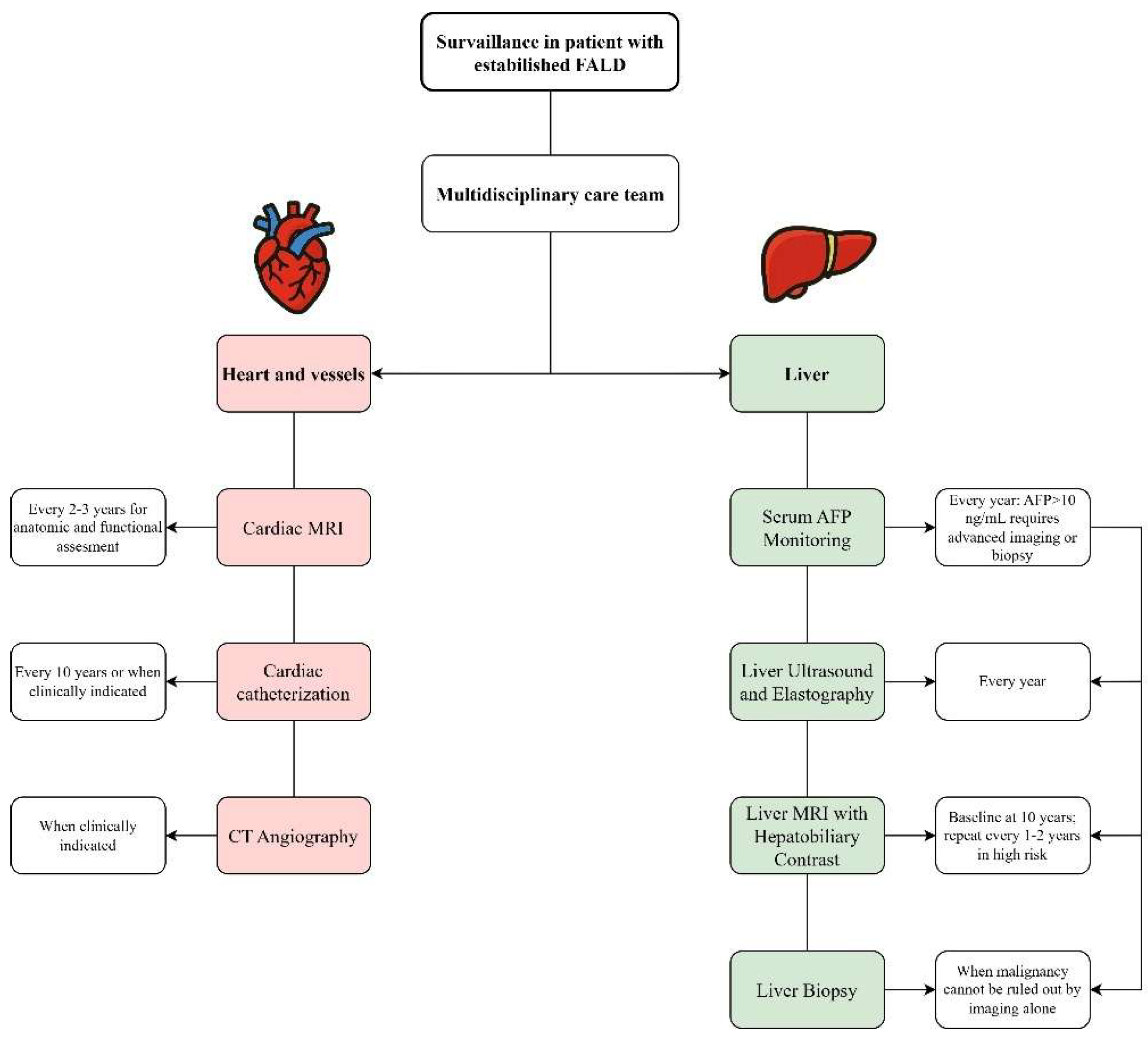
| Surveillance Component | AHA Recommendations (2019) | EASL-ERN Recommendations (2023) |
|---|---|---|
| Multidisciplinary Care Team | Fontan/single-ventricle clinics with experienced personnel | Specialized clinics with hepatologist, cardiologist, and radiologist |
| Cardiac MRI | Every 2–3 years for anatomic and functional assessment | Every 2–3 years to evaluate Fontan flow and anatomy |
| CT Angiography | When clinically indicated | Not specifically emphasized unless MRI is contraindicated |
| Cardiac Catheterization | Every 10 years or when clinically indicated | When MRI contraindicated or invasive data needed |
| Liver Ultrasound + Elastography | Annual ultrasound with elastography | Annual surveillance as first-line imaging tool |
| Liver MRI with Hepatobiliary Contrast | Annual MRI from adolescence; use hepatobiliary contrast if biopsy is considered | Baseline at 10 years; repeat every 1–2 years in high-risk |
| Liver Biopsy | If imaging is inconclusive and LI-RADS fails to differentiate | Mandatory when malignancy cannot be ruled out by imaging alone |
| Serum AFP Monitoring | Use AFP > 7 ng/dL as alert threshold; >10 ng/dL = high risk | AFP > 10 ng/mL requires advanced imaging or biopsy |
| Timing of HCC Surveillance | Start 10 years after Fontan; consider earlier in high-risk patients | Begin at 10 years post-Fontan; earlier if MELD > 19, APRI/FIB-4 elevated |
Disclaimer/Publisher’s Note: The statements, opinions and data contained in all publications are solely those of the individual author(s) and contributor(s) and not of MDPI and/or the editor(s). MDPI and/or the editor(s) disclaim responsibility for any injury to people or property resulting from any ideas, methods, instructions or products referred to in the content. |
© 2025 by the authors. Licensee MDPI, Basel, Switzerland. This article is an open access article distributed under the terms and conditions of the Creative Commons Attribution (CC BY) license (https://creativecommons.org/licenses/by/4.0/).
Share and Cite
Di Natale, F.; Boccatonda, A.; Musmeci, M.; Brighenti, A.; Potena, L.; Dietrich, C.F.; Serra, C. Ultrasound Evaluation of Fontan-Associated Liver Disease: A State-of-the-Art Review. Diagnostics 2025, 15, 3171. https://doi.org/10.3390/diagnostics15243171
Di Natale F, Boccatonda A, Musmeci M, Brighenti A, Potena L, Dietrich CF, Serra C. Ultrasound Evaluation of Fontan-Associated Liver Disease: A State-of-the-Art Review. Diagnostics. 2025; 15(24):3171. https://doi.org/10.3390/diagnostics15243171
Chicago/Turabian StyleDi Natale, Federica, Andrea Boccatonda, Marco Musmeci, Alice Brighenti, Luciano Potena, Christoph Frank Dietrich, and Carla Serra. 2025. "Ultrasound Evaluation of Fontan-Associated Liver Disease: A State-of-the-Art Review" Diagnostics 15, no. 24: 3171. https://doi.org/10.3390/diagnostics15243171
APA StyleDi Natale, F., Boccatonda, A., Musmeci, M., Brighenti, A., Potena, L., Dietrich, C. F., & Serra, C. (2025). Ultrasound Evaluation of Fontan-Associated Liver Disease: A State-of-the-Art Review. Diagnostics, 15(24), 3171. https://doi.org/10.3390/diagnostics15243171