Skip to Content
DiagnosticsDiagnostics
  • Interesting Images
  • Open Access

15 April 2023

Endoscopic Ultrasound View of Pneumatosis Cystoides Intestinalis

,
,
,
,
,
,
and
Serviço de Endoscopia Gastrointestinal do Hospital das Clínicas HCFMUSP, Departamento de Gastroenterologia, Faculdade de Medicina, Universidade de Sao Paulo, Sao Paulo 05403-010, SP, Brazil
*
Author to whom correspondence should be addressed.

Abstract

Pneumatosis cystoid intestinalis (PCI) is a rare condition, with a worldwide incidence of 0.3–1.2%. PCI is classified into primary (idiopathic) and secondary forms, with 15% and 85% of presentations, respectively. This pathology was associated with a wide variety of underlining etiologies to explain the abnormal accumulation of gas within the submucosa (69.9%), subserosa (25.5%), or both layers (4.6%). Many patients endure misdiagnosis, mistreatment, or even inadequate surgical exploration. In this case, a patient presented acute diverticulitis, after treatment, a control colonoscopy was performed that found multiple rounds and elevated lesions. To further study the subepithelial lesion (SEL), a colorectal endoscopic ultrasound (EUS) was performed with an overtube in the same procedure. For safe insertion of the curvilinear array EUS, an overtube with colonoscopy was positioned through the sigmoid as described by Cheng et al. The EUS evaluation evidenced air reverberation in the submucosal layer. The pathological analysis was consistent with PCI’s diagnosis. The diagnosis of PCI is usually made by colonoscopy (51.9%), surgery (40.6%), and radiological findings (10.9%). Although the diagnosis can be made by radiological studies, a colorectal EUS and colonoscopy can be made in the same section without radiation and with high precision. As it is a rare disease, there are not enough studies to define the best approach, although colorectal EUS should be preferred for a reliable diagnosis.
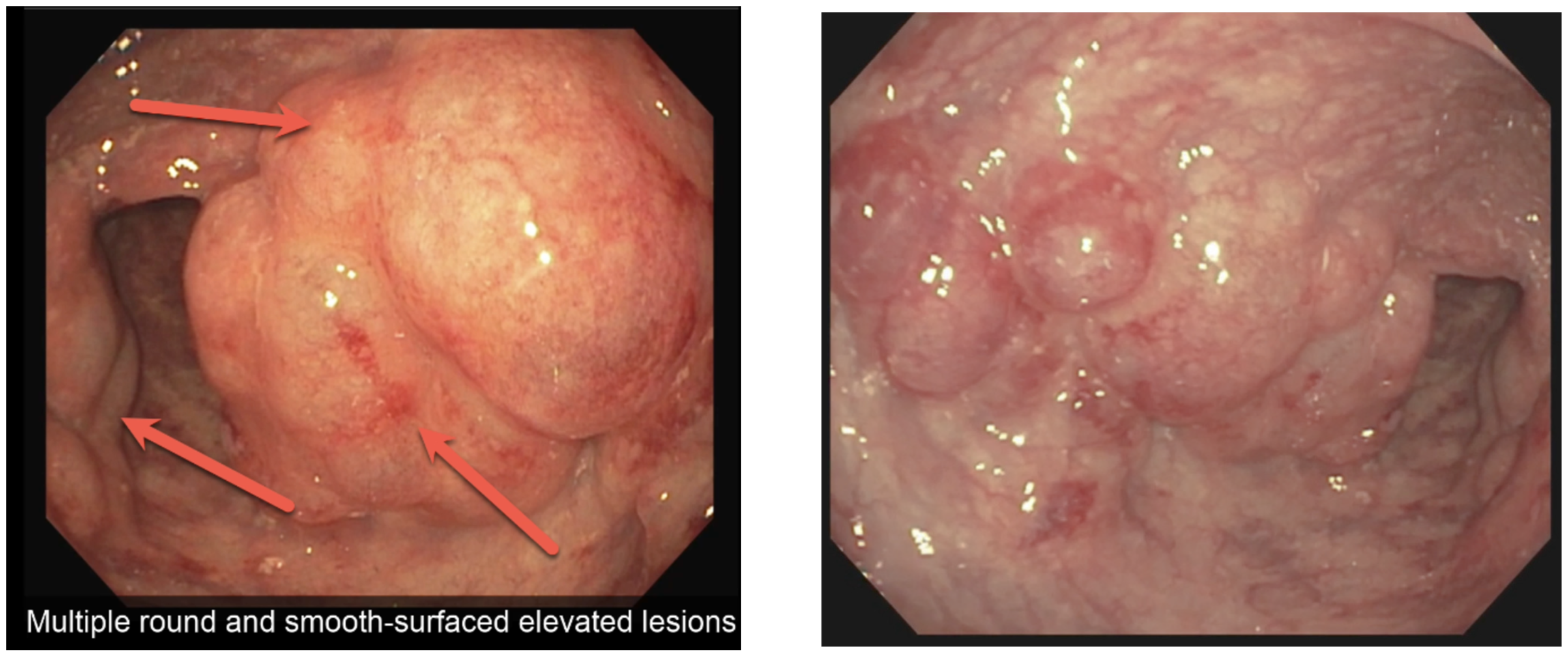
Figure 1. A 45-year-old female patient with a medical history of constipation and recurrent diverticulitis presented herself for an elective colonoscopy eight weeks after her last episode. In the descending colon the red arrows point to multiple rounded and elevated, softened smooth-surfaced, mucosal lesions with foci of enanthem were found without loss of mucosal contiguity. These lesions were homogeneously distributed over the entire circumference of this intestinal segment. PCI is classified into primary (idiopathic) and secondary forms, with 15% and 85% of presentations, respectively [1,2].
Diagnostics 13 01424 g001
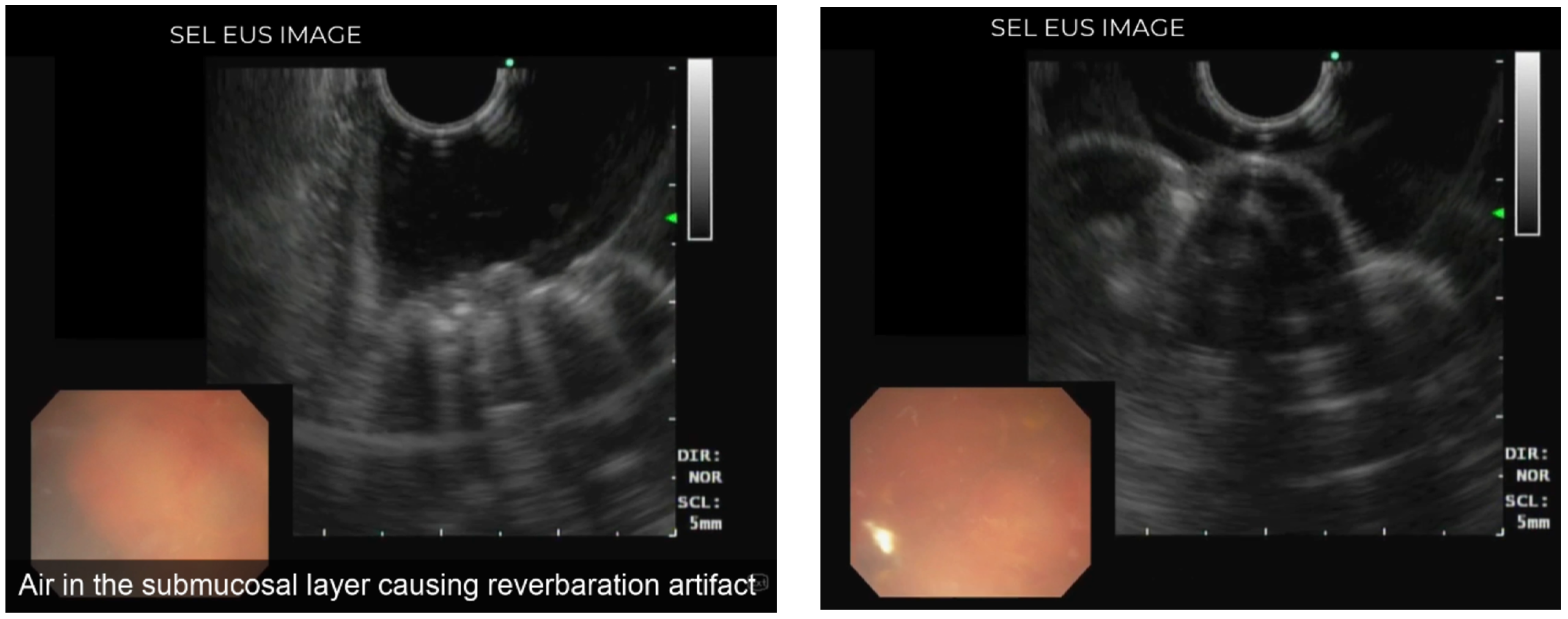
Figure 2. Although the diagnosis can be made by radiological studies [3,4,5,6], a colorectal EUS and colonoscopy can be made in the same section without radiation and with high precision [4,5,6]. An Endoscopic Ultrasound (EUS) (Video S1) was performed for lesion evaluation. The ultrasound images showed irregular hyperechoic structures, “dirty shadow”, A-lines, and decreased visualization of deeper structures, air reverberation compatible with gas in the submucosal layer, with no nodules or fluid inside.
Diagnostics 13 01424 g002
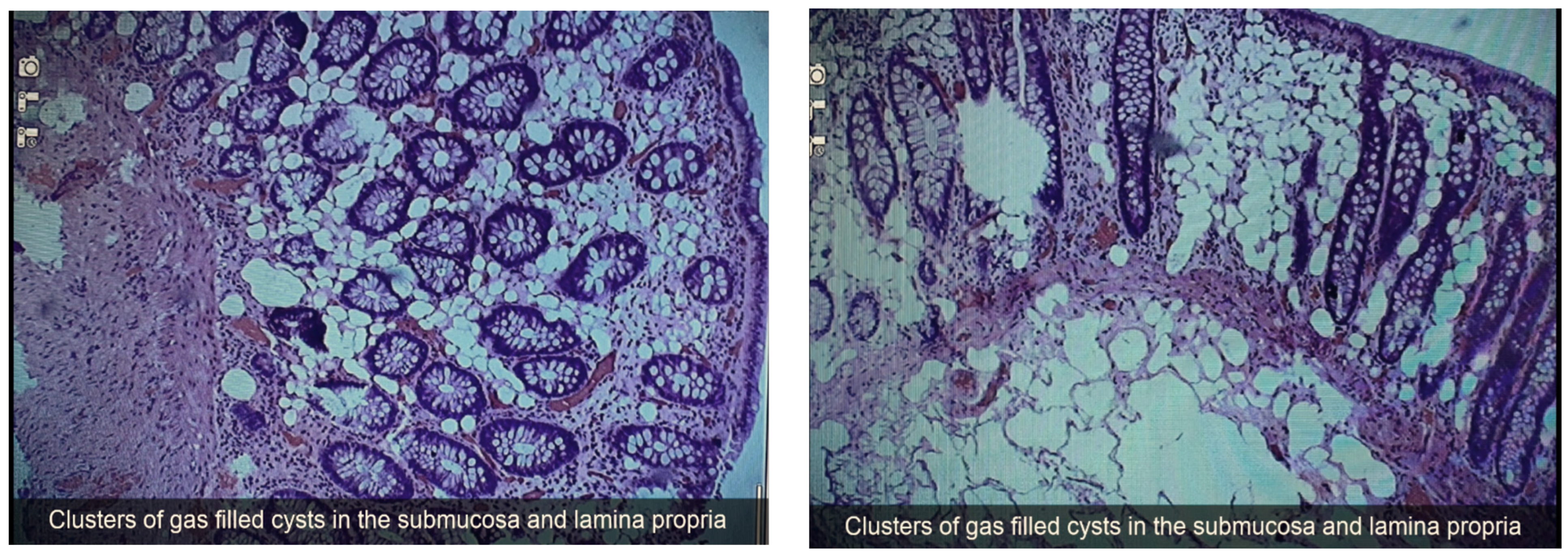
Figure 3. Biopsies of the subepithelial lesions were taken. Pathological analysis, found clusters of gas-filled cysts (as white balls) in the submucosa, and lamina propria were consistent with PCI’s diagnosis. The diverticulitis was the suspected reliable cause.
Diagnostics 13 01424 g003

Supplementary Materials

The following supporting information can be downloaded at: https://www.mdpi.com/article/10.3390/diagnostics13081424/s1, Video S1: Endoscopic Ultrasound View of Pneumatosis Cystoides Intestinalis.

Author Contributions

Conceptualization: E.Y.Y., S.C., G.H.P.d.O., J.G.R.J.S. and E.G.H.d.M.; methodology: G.H.P.d.O. and J.G.R.J.S.; software: E.Y.Y., S.C., G.H.P.d.O., J.G.R.J.S. and I.B.R.; validation: E.Y.Y., S.C., G.H.P.d.O., J.G.R.J.S., M.B.B., M.K.M., I.B.R. and E.G.H.d.M.; formal analysis: E.Y.Y., S.C., G.H.P.d.O., J.G.R.J.S., M.B.B., M.K.M., I.B.R. and E.G.H.d.M.; investigation: E.Y.Y., S.C., G.H.P.d.O., J.G.R.J.S., M.B.B., M.K.M., I.B.R. and E.G.H.d.M.; resources: E.Y.Y., S.C., J.G.R.J.S., I.B.R. and E.G.H.d.M.; data curation: E.Y.Y., S.C., J.G.R.J.S. and I.B.R.; writing—original draft preparation: E.Y.Y., S.C. and J.G.R.J.S.; writing—review and editing: E.Y.Y., S.C., G.H.P.d.O., J.G.R.J.S., M.B.B., M.K.M., I.B.R. and E.G.H.d.M.; visualization, S.C.; supervision, S.C., I.B.R. and E.G.H.d.M.; project administration, S.C. and J.G.R.J.S.; funding acquisition: none. All authors have read and agreed to the published version of the manuscript.

Funding

This research received no external funding.

Institutional Review Board Statement

The study was conducted in accordance with the Declaration of Helsinki. Ethical review and approval were waived for this study by Ethics Committee of Universidade Sao Paulo. due to the reason of “Retrospectively performed scan image without research intervention. The patient signed an informed consent form prior to the examination”.

Data Availability Statement

No new data were created or analyzed in this study. Data sharing is not applicable to this article.

Conflicts of Interest

Eduardo Guimarães Hourneaux de Moura reports personal fees from Boston Scientific and Olympus, but these were not relevant to this manuscript. The other authors declare no conflict of interest.

References

  1. Piltcher-da-Silva, R.; Sasaki, V.L.; Zangari, M.A.C.; Gallotti, F.M.; Saenger, B.F.; Piltcher-Recuero, M.; de Melo Rocha, G.; da Costa, M.R.; Coelho, J.C.U. Pneumatosis cystoides intestinalis with pneumoperitoneum in an 87-years-old male patient: A case report. J. Surg. Case Rep. 2022, 2022, rjac103. [Google Scholar] [CrossRef] [PubMed]
  2. Wu, L.L.; Yang, Y.S.; Dou, Y.; Liu, Q.S. A systematic analysis of pneumatosis cystoids intestinalis. World J. Gastroenterol. 2013, 19, 4973–4978. [Google Scholar] [CrossRef] [PubMed]
  3. Cheng, S.P.; Matuguma, S.E.M.; de Oliveira, G.H.P.M.; Silva, G.L.M.; Cheng, H.P.; Sánchez-Luna, S.A.M.; Minata, M.K.M. Colonoscopic Ultrasound-Guided Fine-Needle Aspiration Using a Curvilinear Array Transducer: A Single-Center Retrospective Cohort Study. Dis. Colon. Rectum. 2022, 65, e80–e84. [Google Scholar] [CrossRef] [PubMed]
  4. Castro-Poças, F.; Araújo, T.; Pedroto, I. Endoscopic ultrasound of pneumatosis cystoides intestinalis. Endoscopy 2015, 47 (Suppl 1), E274. [Google Scholar] [CrossRef] [PubMed]
  5. Ling, F.; Guo, D.; Zhu, L. Pneumatosis cystoides intestinalis: A case report and literature review. BMC Gastroenterol. 2019, 19, 176. [Google Scholar] [CrossRef] [PubMed]
  6. Shimada, M.; Ina, K.; Takahashi, H.; Horiuchi, Y.; Imada, A.; Nishio, Y.; Ando, T.; Kusugami, K. Pneumatosis cystoides intestinalis treated with hyperbaric oxygen therapy: Usefulness of an endoscopic ultrasonic catheter probe for diagnosis. Intern Med. 2001, 40, 896–900. [Google Scholar] [CrossRef] [PubMed]
Disclaimer/Publisher’s Note: The statements, opinions and data contained in all publications are solely those of the individual author(s) and contributor(s) and not of MDPI and/or the editor(s). MDPI and/or the editor(s) disclaim responsibility for any injury to people or property resulting from any ideas, methods, instructions or products referred to in the content.

Article Metrics

Citations

Article Access Statistics

Multiple requests from the same IP address are counted as one view.