Improving Visual-Patient-Avatar Design Prior to Its Clinical Release: A Mixed Qualitative and Quantitative Study

 ,
,  and
and
Abstract
:1. Introduction
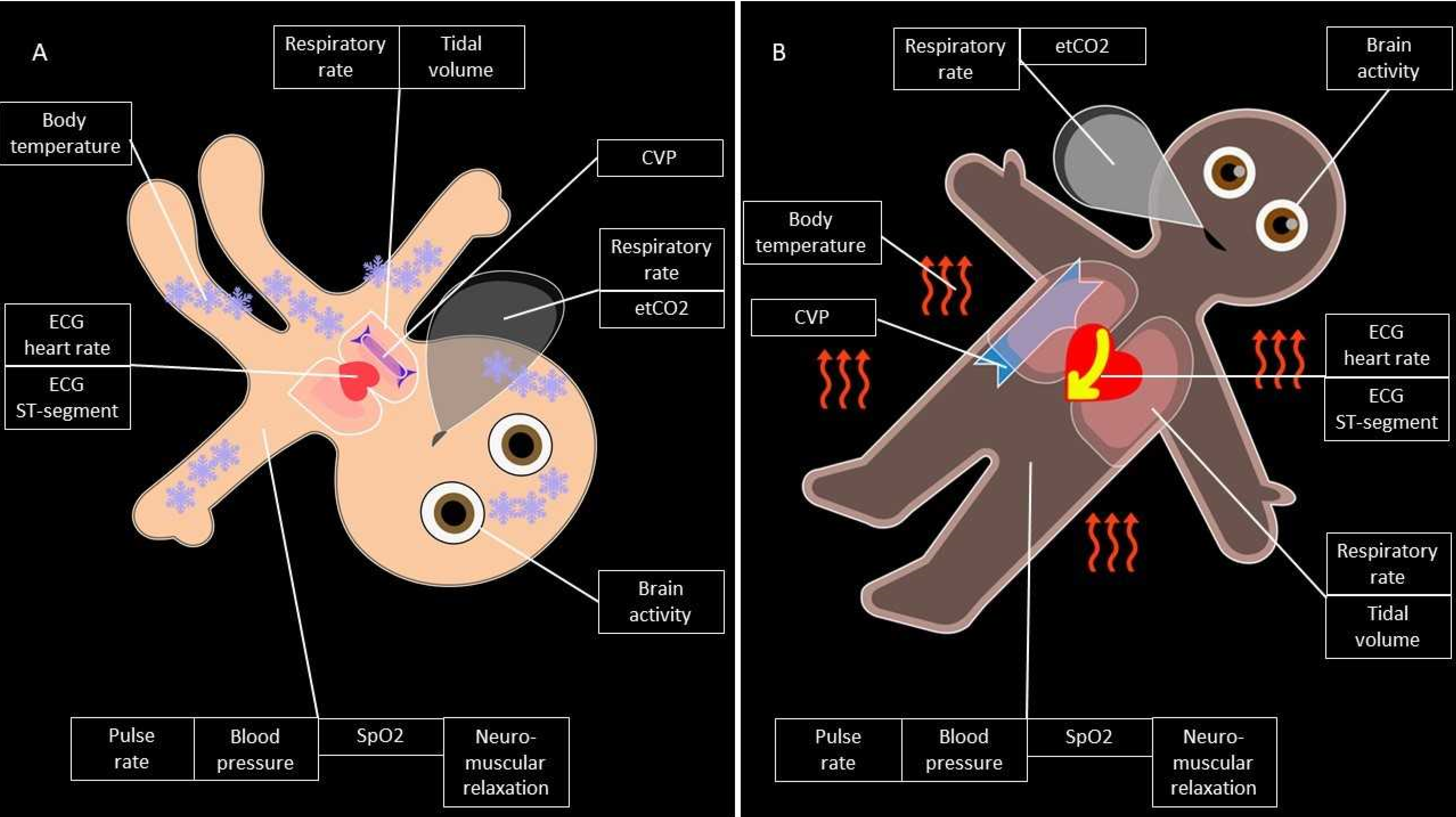
Visual-Patient-Avatar
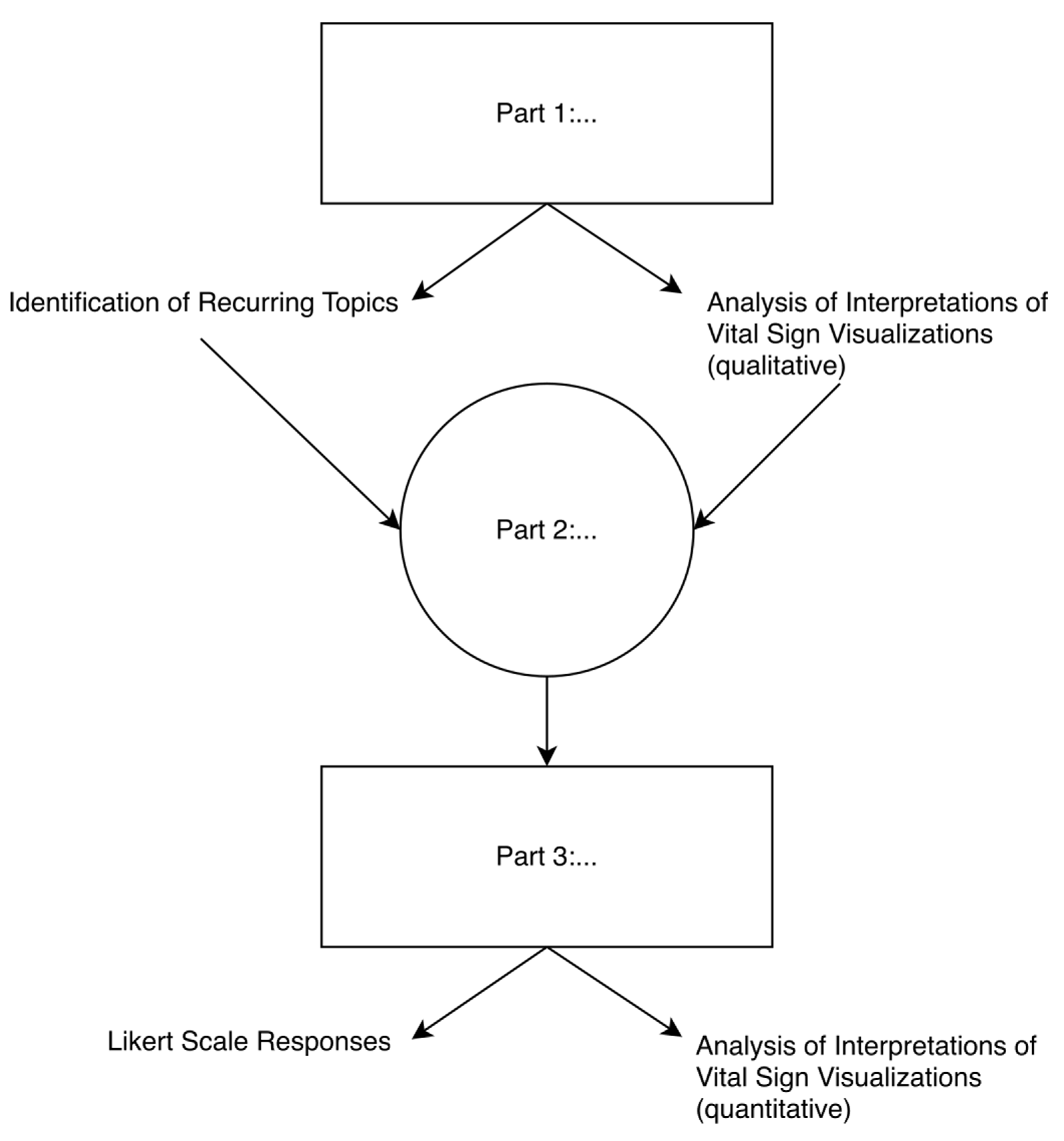
2. Methods
2.1. Study Design and Participants
2.2. The First, Qualitative Study Part
2.2.1. Description Qualitative Interview
2.2.2. Analysis of Vital Sign Visualisations
2.3. The Second, Redesign Study Part
2.4. The Third, Quantitative Study Part
2.4.1. Description of Quantitative Assessment
2.4.2. Analysis of the Vital Sign Visualisations
3. Results
3.1. Study and Participant Characteristics
3.2. The First, Qualitative Study Part
3.2.1. Interview Analysis
3.2.2. Vital Sign Visualisation Analysis
3.3. The Second, Redesign Study Part
3.4. The Third, Quantitative Study Part
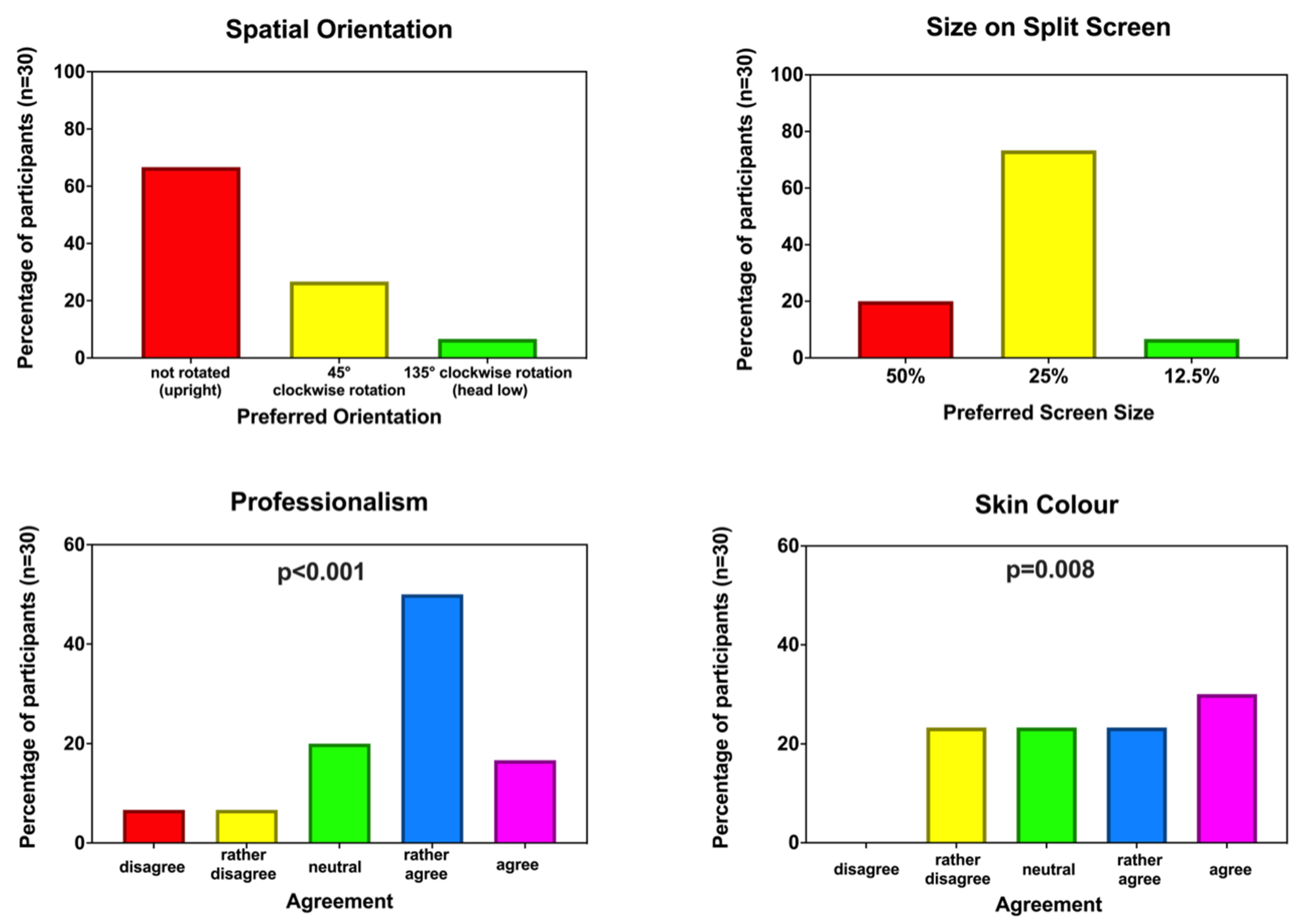
3.4.1. Survey Analysis
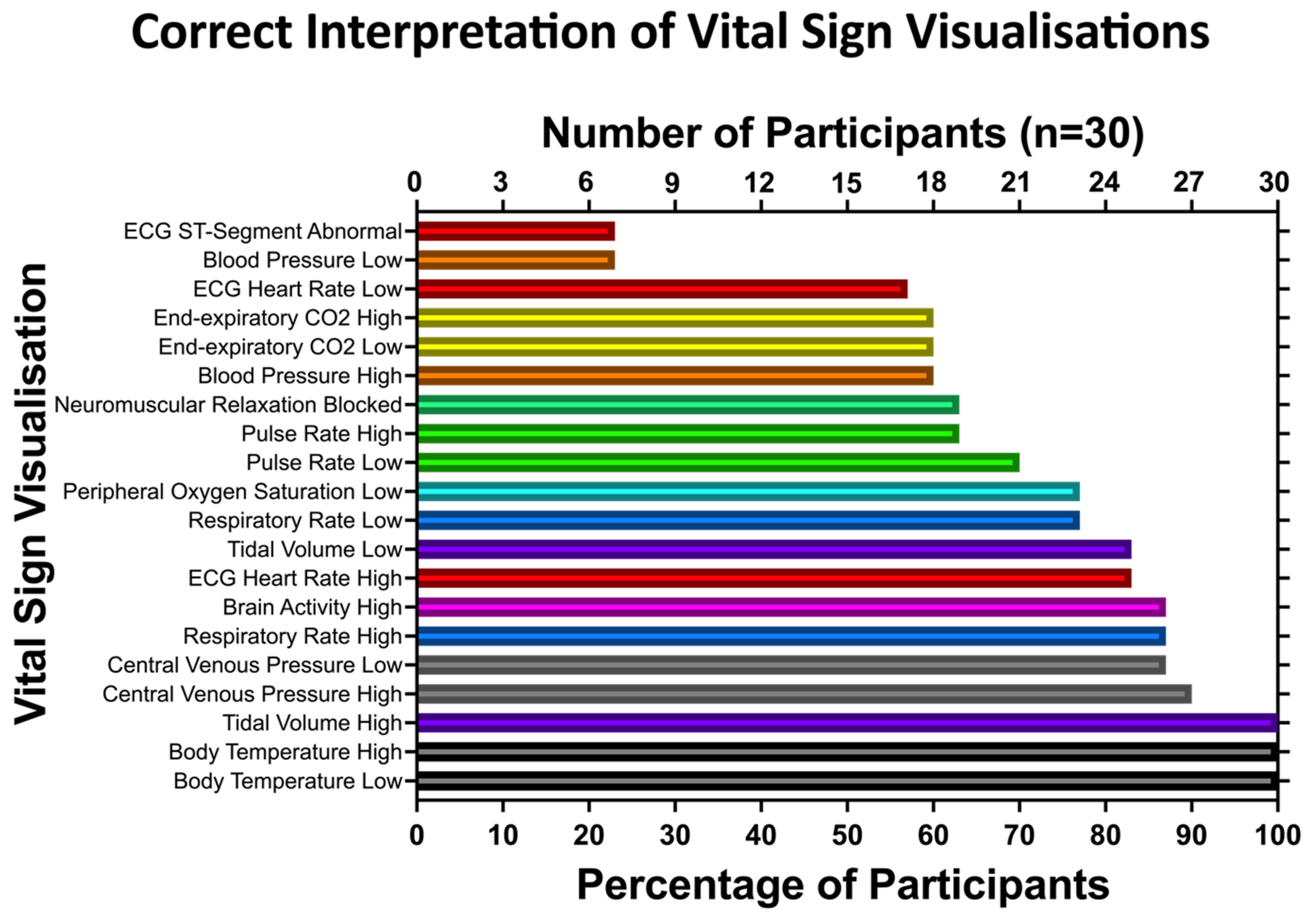
3.4.2. Vital Signs Visualisation Analysis
4. Discussion
Limitations and Strengths
5. Conclusions
Supplementary Materials
Author Contributions
Funding
Institutional Review Board Statement
Informed Consent Statement
Data Availability Statement
Acknowledgments
Conflicts of Interest
References
- World Health Organization. Guidelines for Safe Surgery 2009: Safe Surgery Saves Lives; WHO: Geneva, Switzerland, 2009. [Google Scholar]
- Endsley, M.R.; Jones, D.G. Designing for Situation Awareness: An Approach to User-Centered Design, 2nd ed.; CRC Press: Boca Raton, FL, USA, 2011. [Google Scholar]
- Schulz, C.M.; Endsley, M.R.; Kochs, E.F.; Gelb, A.W.; Wagner, K.J. Situation awareness in anesthesia: Concept and research. Anesthesiology 2013, 118, 729–742. [Google Scholar] [CrossRef] [PubMed] [Green Version]
- Fioratou, E.; Flin, R.; Glavin, R.; Patey, R. Beyond monitoring: Distributed situation awareness in anaesthesia. Br. J. Anaesth. 2010, 105, 83–90. [Google Scholar] [CrossRef] [PubMed] [Green Version]
- Schulz, C.M.; Burden, A.; Posner, K.L.; Mincer, S.L.; Steadman, R.; Wagner, K.J.; Domino, K.B. Frequency and Type of Situational Awareness Errors Contributing to Death and Brain Damage: A Closed Claims Analysis. Anesthesiology 2017, 127, 326–337. [Google Scholar] [CrossRef] [PubMed]
- Schulz, C.M.; Krautheim, V.; Hackemann, A.; Kreuzer, M.; Kochs, E.F.; Wagner, K.J. Situation awareness errors in anesthesia and critical care in 200 cases of a critical incident reporting system. BMC Anesthesiol. 2016, 16, 4. [Google Scholar] [CrossRef] [Green Version]
- Drews, F.A.; Westenskow, D.R. The right picture is worth a thousand numbers: Data displays in anesthesia. Hum. Factors 2006, 48, 59–71. [Google Scholar] [CrossRef]
- Drews, F.A. Patient monitors in critical care: Lessons for improvement. In Advances in Patient Safety: New Directions and Alternative Approaches (Vol. 3: Performance and Tools); Agency for Healthcare Research and Quality (US): Rockville, MD, USA, 2008. [Google Scholar]
- Rayner, K. Eye movements in reading and information processing: 20 Years of research. Psychol. Bull. 1998, 124, 372–422. [Google Scholar] [CrossRef]
- Wachter, S.B.; Agutter, J.; Syroid, N.; Drews, F.; Weinger, M.B.; Westenskow, D. The employment of an iterative design process to develop a pulmonary graphical display. J. Am. Med. Inform. Assoc. 2003, 10, 363–372. [Google Scholar] [CrossRef] [Green Version]
- Wittgenstein, L. Tractatus Logico-Philosophicus; Routledge & Kegan Paul: London, UK, 1922. [Google Scholar]
- Degani, A.; Jorgensen, C.; Iverson, D.; Shafto, M.; Olson, L. On Organization of Information: Approach and Early Work; NASA Ames Research Center: Moffett Field, CA, USA, 2009. [Google Scholar]
- Tscholl, D.W.; Rossler, J.; Handschin, L.; Seifert, B.; Spahn, D.R.; Nothiger, C.B. The Mechanisms Responsible for Improved Information Transfer in Avatar-Based Patient Monitoring: Multicenter Comparative Eye-Tracking Study. J. Med. Internet Res. 2020, 22, e15070. [Google Scholar] [CrossRef]
- Tscholl, D.W.; Handschin, L.; Neubauer, P.; Weiss, M.; Seifert, B.; Spahn, D.R.; Noethiger, C.B. Using an animated patient avatar to improve perception of vital sign information by anaesthesia professionals. Br. J. Anaesth. 2018, 121, 662–671. [Google Scholar] [CrossRef] [Green Version]
- Tscholl, D.W.; Rössler, J.; Said, S.; Kaserer, A.; Spahn, D.R.; Nöthiger, C.B. Situation Awareness-Oriented Patient Monitoring with Visual Patient Technology: A Qualitative Review of the Primary Research. Sensors 2020, 20, 2112. [Google Scholar] [CrossRef] [Green Version]
- Pfarr, J.; Ganter, M.T.; Spahn, D.R.; Noethiger, C.B.; Tscholl, D.W. Effects of a standardized distraction on caregivers’ perceptive performance with avatar-based and conventional patient monitoring: A multicenter comparative study. J. Clin. Monit. Comput. 2020, 34, 1369–1378. [Google Scholar] [CrossRef] [PubMed]
- Said, S.; Gozdzik, M.; Roche, T.R.; Braun, J.; Rössler, J.; Kaserer, A.; Spahn, D.R.; Nöthiger, C.B.; Tscholl, D.W. Validation of the Raw National Aeronautics and Space Administration Task Load Index (NASA-TLX) Questionnaire to Assess Perceived Workload in Patient Monitoring Tasks: Pooled Analysis Study Using Mixed Models. J. Med. Internet Res. 2020, 22, e19472. [Google Scholar] [CrossRef] [PubMed]
- Garot, O.; Rössler, J.; Pfarr, J.; Ganter, M.T.; Spahn, D.R.; Nöthiger, C.B.; Tscholl, D.W. Avatar-based versus conventional vital sign display in a central monitor for monitoring multiple patients: A multicenter computer-based laboratory study. BMC Med. Inform. Decis. Mak. 2020, 20, 26. [Google Scholar] [CrossRef] [PubMed] [Green Version]
- Rössler, J.; Kaserer, A.; Albiez, B.; Braun, J.; Breckwoldt, J.; Spahn, D.R.; Nöthiger, C.B.; Tscholl, D.W. Comparing Classroom Instruction to Individual Instruction as an Approach to Teach Avatar-Based Patient Monitoring With Visual Patient: Simulation Study. JMIR Med. Educ. 2020, 6, e17922. [Google Scholar] [CrossRef]
- Tscholl, D.W.; Weiss, M.; Handschin, L.; Spahn, D.R.; Nöthiger, C.B. User perceptions of avatar-based patient monitoring: A mixed qualitative and quantitative study. BMC Anesthesiol. 2018, 18, 188. [Google Scholar] [CrossRef]
- Akbas, S.; Said, S.; Roche, T.R.; Nöthiger, C.B.; Spahn, D.R.; Tscholl, D.W.; Bergauer, L. User perceptions of different monitor modalities during high-fidelity simulation: Visual-Patient-avatar; Split Screen and Conventional—A semiquantitative analysis. JMIR Hum. Factors 2022. [Google Scholar] [CrossRef]
- Roche, T.R.; Said, S.; Braun, J.; Maas, E.J.C.; Machado, C.; Grande, B.; Kolbe, M.; Spahn, D.R.; Nöthiger, C.B.; Tscholl, D.W. Avatar-based patient monitoring in critical anaesthesia events: A randomised high-fidelity simulation study. Br. J. Anaesth. 2021, 126, 1046–1054. [Google Scholar] [CrossRef]
- Tractinsky, N.; Katz, A.S.; Ikar, D. What is beautiful is usable. Interact. Comput. 2000, 13, 127–145. [Google Scholar] [CrossRef] [Green Version]
- Brooks, J.; McCluskey, S.; Turley, E.; King, N. The utility of template analysis in qualitative psychology research. Qual. Res. Psychol. 2015, 12, 202–222. [Google Scholar] [CrossRef] [Green Version]
- Tong, A.; Sainsbury, P.; Craig, J. Consolidated criteria for reporting qualitative research (COREQ): A 32-item checklist for interviews and focus groups. Int. J. Qual. Health Care 2007, 19, 349–357. [Google Scholar] [CrossRef] [Green Version]
- O’Brien, B.C.; Harris, I.B.; Beckman, T.J.; Reed, D.A.; Cook, D.A. Standards for reporting qualitative research: A synthesis of recommendations. Acad. Med. 2014, 89, 1245–1251. [Google Scholar] [CrossRef] [PubMed]
- Branson, R.D.; Johannigman, J.A. Innovations in mechanical ventilation. Respir. Care 2009, 54, 933–947. [Google Scholar] [CrossRef] [PubMed]
- Ventilation Cockpit User Interface; Hamilton Medical AG: Bonaduz, Switzerland. 2021. Available online: https://www.hamilton-medical.com/ja/Solutions/Ventilation-Cockpit-user-interface.html (accessed on 21 August 2021).
- Hildebrand, P.W.; Rose, A.S.; Tiemann, J.K.S. Bringing Molecular Dynamics Simulation Data into View. Trends Biochem. Sci. 2019, 44, 902–913. [Google Scholar] [CrossRef] [PubMed] [Green Version]
- Poncette, A.S.; Spies, C.; Mosch, L.; Schieler, M.; Weber-Carstens, S.; Krampe, H.; Balzer, F. Clinical Requirements of Future Patient Monitoring in the Intensive Care Unit: Qualitative Study. JMIR Med. Inform. 2019, 7, e13064. [Google Scholar] [CrossRef] [PubMed] [Green Version]
- Blackler, A.; Popovic, V.; Mahar, D. Investigating users’ intuitive interaction with complex artefacts. Appl. Ergon. 2010, 41, 72–92. [Google Scholar] [CrossRef] [PubMed] [Green Version]
- Pfarr, J.; Ganter, M.T.; Spahn, D.R.; Noethiger, C.B.; Tscholl, D.W. Avatar-Based Patient Monitoring With Peripheral Vision: A Multicenter Comparative Eye-Tracking Study. J. Med. Internet Res. 2019, 21, e13041. [Google Scholar] [CrossRef] [PubMed]



| First, Qualitative Study Part | Third, Quantitative Study Part | |
|---|---|---|
| Study Design | Interview-Based Assessment | Computer-Based Survey |
| Number of participants; N1 and N2, respectively. | 51 | 30 |
| Gender of participants; n female of N1 (%) and n female of N2 (%), respectively | 31 of 51 (61%) | 18 of 30 (60%) |
| Number of physicians; n of N1 (%) and n of N2 (%), respectively. | 28 of 51 (55%) | 24 of 30 (80%) |
| Nurse anaesthetists; n of N1 (%) and n of N2 (%), respectively. | 23 of 51 (45%) | 6 of 30 (20%) |
| Anaesthesia experience in years; median (IQR [range]) | 5.5 (2.0–7.5 [1.0–36.0]) | 2.0 (1.0–3.0 [1.0–30.0]) |
| Main Theme | Subtheme | Examples |
|---|---|---|
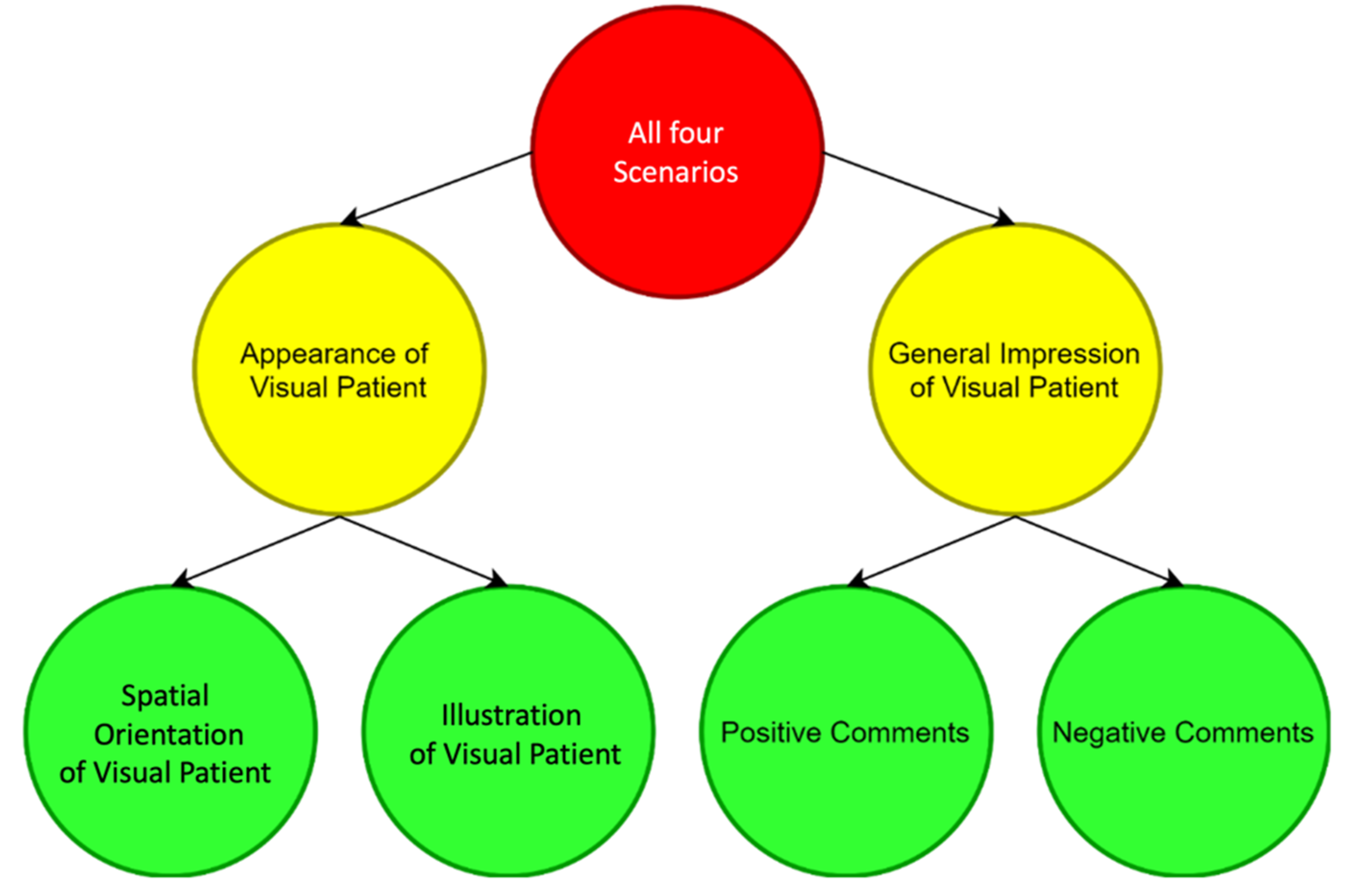
| Appearance of Visual- Patient-avatar (33 statements made by 28 of 51 [55%] participants) | Illustration of Visual-Patient-avatar (22 statements made by 21 of 51 [43%] participants) | Participant #3: Looks a bit childish, very simple design. Participant #6: Still seems somewhat artificial. Participant #10: I feel like I’m in kindergarten at the moment when I see the figure. Participant #14: It has a very big head in contrast to the rest of the body. Participant #16: Is not very truthfully portrayed. Participant #21: A bit bare, dull. |
| Spatial orientation of Visual-Patient-avatar (11 statements made by 11 of 51 [22%] participants) | Participant #17: It’s a bit unusual to see it like that. Um especially because it’s upside down. Participant #28: The position confuses me a bit. Participant #30: A patient who is lying upside down. Participant #32: I honestly have trouble with him lying with his head down. | |
| General impression of Visual-Patient-avatar (26 statements made by 23 of 51 [45%] participants) | Positive comments (14 statements made by 14 of 51 [28%] participants) | Participant #4: Yes, looks fun. Participant #6: Really funny. Something positive. Participant #7: Quite funny, yes. Participant #14: Okay, it is cute. Participant #33: At first glance, probably rather a funny figure. |
| Negative comments (12 statements made by 12 of 51 [24%] participants) | Participant #21: So, I find the picture quite unclear. I do not know what it wants to tell me. Participant #27: At the moment, I could still imagine having trouble with that, if that’s all I see. Participant #32: I am a bit irritated by the presentation. Participant #36: No idea. I do not know what to do with it. |
Publisher’s Note: MDPI stays neutral with regard to jurisdictional claims in published maps and institutional affiliations. |
© 2022 by the authors. Licensee MDPI, Basel, Switzerland. This article is an open access article distributed under the terms and conditions of the Creative Commons Attribution (CC BY) license (https://creativecommons.org/licenses/by/4.0/).
Share and Cite
Wetli, D.J.; Bergauer, L.; Nöthiger, C.B.; Roche, T.R.; Spahn, D.R.; Tscholl, D.W.; Said, S. Improving Visual-Patient-Avatar Design Prior to Its Clinical Release: A Mixed Qualitative and Quantitative Study. Diagnostics 2022, 12, 555. https://doi.org/10.3390/diagnostics12020555
Wetli DJ, Bergauer L, Nöthiger CB, Roche TR, Spahn DR, Tscholl DW, Said S. Improving Visual-Patient-Avatar Design Prior to Its Clinical Release: A Mixed Qualitative and Quantitative Study. Diagnostics. 2022; 12(2):555. https://doi.org/10.3390/diagnostics12020555
Chicago/Turabian StyleWetli, Doreen J., Lisa Bergauer, Christoph B. Nöthiger, Tadzio R. Roche, Donat R. Spahn, David W. Tscholl, and Sadiq Said. 2022. "Improving Visual-Patient-Avatar Design Prior to Its Clinical Release: A Mixed Qualitative and Quantitative Study" Diagnostics 12, no. 2: 555. https://doi.org/10.3390/diagnostics12020555
APA StyleWetli, D. J., Bergauer, L., Nöthiger, C. B., Roche, T. R., Spahn, D. R., Tscholl, D. W., & Said, S. (2022). Improving Visual-Patient-Avatar Design Prior to Its Clinical Release: A Mixed Qualitative and Quantitative Study. Diagnostics, 12(2), 555. https://doi.org/10.3390/diagnostics12020555