Rejection-Focused Precision Medicine in Kidney Transplantation: Biology, Biomarkers, and Artificial Intelligence
 ,
,  ,
,  ,
,  ,
,  and
and
Abstract
1. Introduction
2. Methods of Literature Review
3. Immunopathogenesis and Contemporary Classification of Kidney Allograft Rejection
3.1. Overview of Alloimmune Responses in Kidney Transplantation
3.2. T Cell–Mediated Rejection (TCMR): Acute and Chronic
3.3. Antibody-Mediated Rejection (ABMR): Acute and Chronic Active
3.4. Mixed Rejection and DSA-Negative Phenotypes
3.5. Banff 2019 and 2022: Where Are We Now?
4. Epidemiology and Clinical Impact of Rejection in the Modern Era
4.1. Incidence of Acute and Chronic Rejection in Contemporary Cohorts
4.2. Risk Factors and Vulnerable Populations
4.3. Donor and Organ Quality as Modifiers of Rejection Risk
5. Conventional Diagnostic Framework for Kidney Allograft Rejection
5.1. Functional Markers: Creatinine, eGFR, Proteinuria
5.2. Donor-Specific Antibodies (DSAs) and Complement-Binding Assays
5.3. The Allograft Biopsy: Strengths and Limitations
5.4. Surveillance vs. For-Cause Biopsy Strategies
6. Emerging Biomarkers and Molecular Diagnostics of Rejection
6.1. Donor-Derived Cell-Free DNA (dd-cfDNA)
6.2. Urinary Chemokines CXCL9 and CXCL10
6.3. Other Urine- and Blood-Based Biomarkers
6.4. Molecular Microscope and Gene Expression Profiling of Biopsies
7. Artificial Intelligence and Machine Learning in Kidney Allograft Rejection
7.1. Risk Prediction and Longitudinal Prognostication
7.2. Digital Pathology and Automated Lesion Assessment
7.3. Multimodal Integration: Biomarkers, Histology, and Clinical Data
7.4. Interpretability, Validation, and Clinical Implementation
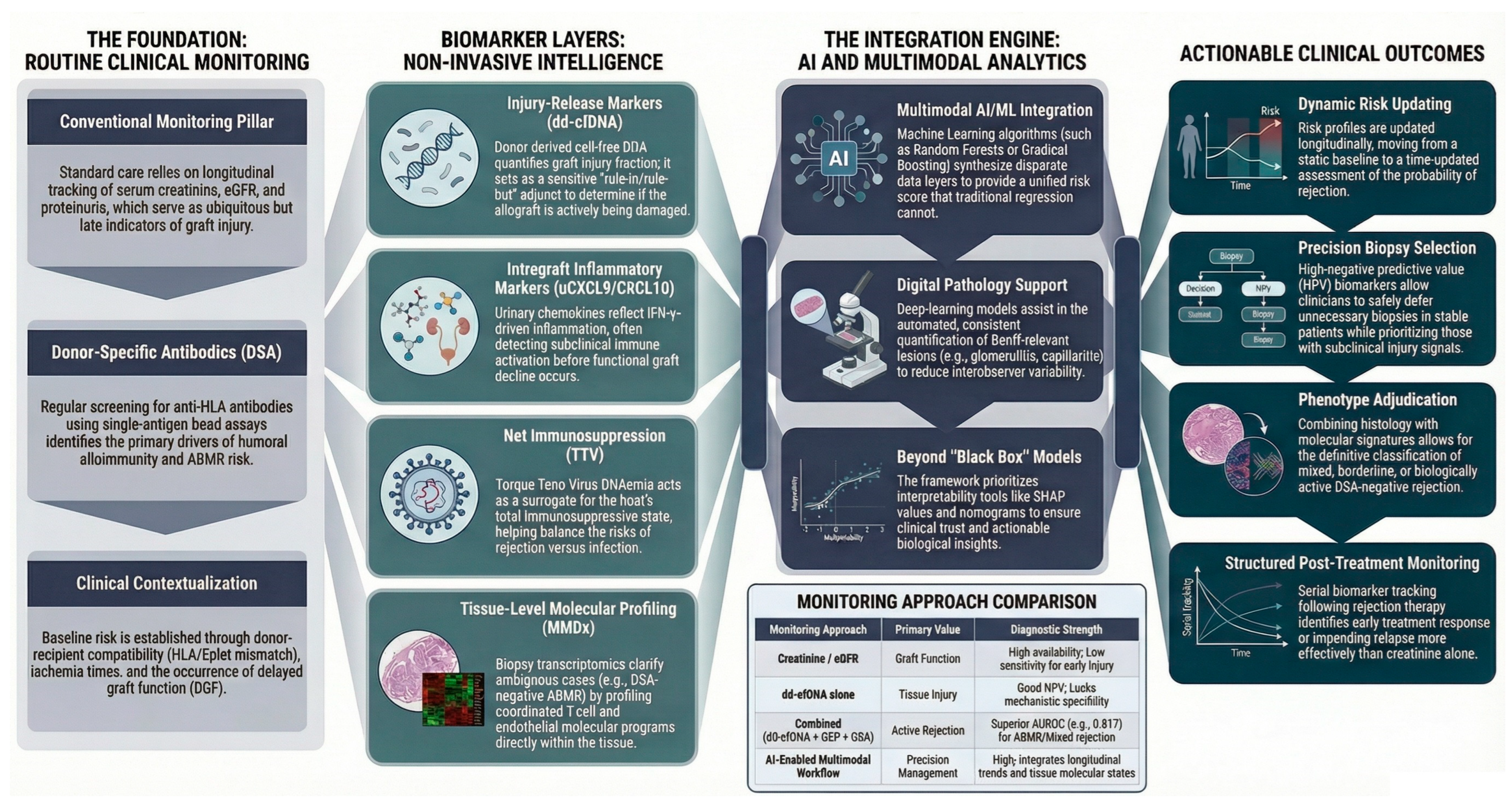
8. Toward an Integrated, Rejection-Focused, Precision-Medicine Pathway
9. Conclusions
Author Contributions
Funding
Institutional Review Board Statement
Informed Consent Statement
Data Availability Statement
Conflicts of Interest
Abbreviations
| caABMR | Chronic active antibody-mediated rejection |
| DSAs | Donor-specific antibodies |
| HLA | Human leucocyte antigens |
| ABMR | Antibody-mediated rejection |
| KT | Kidney transplantation |
| TCMR | T-cell–mediated rejection |
| eGFR | Estimated glomerular filtration rate |
| dd-cfDNA | Donor-derived cell-free DNA |
| AI | Artificial intelligence |
| ML | Machine learning |
| MVI | Microvascular inflammation |
| Ptc | Peritubular capillaritis |
| BPAR | Biopsy-proven acute rejection |
| dnDSAs | de novo DSAs |
| EV | Extracellular vesicles |
| DGF | Delayed graft function |
| KDPI | Kidney Donor Profile Index |
| KDRI | Kidney Donor Risk Index |
| IRI | Ischemia–reperfusion injury |
| FTIR | Fourier-transform infrared spectroscopy |
| SAB | Single-antigen bead |
| SOC | Standard of care |
| GEP | Gene expression profiling |
| TTV | Torque teno virus |
References
- GBD Chronic Kidney Disease Collaboration. Global, Regional, and National Burden of Chronic Kidney Disease, 1990-2017: A Systematic Analysis for the Global Burden of Disease Study 2017. Lancet 2020, 395, 709–733. [Google Scholar] [CrossRef] [Scilit]
- Mark, P.B.; Stafford, L.K.; Grams, M.E.; Aalruz, H.; Abd ElHafeez, S.; Abdelgalil, A.A.; Abdulkader, R.S.; Abeywickrama, H.M.; Abiodun, O.O.; Abramov, D.; et al. Global, Regional, and National Burden of Chronic Kidney Disease in Adults, 1990–2023, and Its Attributable Risk Factors: A Systematic Analysis for the Global Burden of Disease Study 2023. Lancet 2025, 406, 2461–2482. [Google Scholar] [CrossRef] [Scilit]
- Poggio, E.D.; Augustine, J.J.; Arrigain, S.; Brennan, D.C.; Schold, J.D. Long-Term Kidney Transplant Graft Survival—Making Progress When Most Needed. Am. J. Transplant. 2021, 21, 2824–2832. [Google Scholar] [CrossRef] [Scilit]
- Huml, A.M.; Wakam, G.K.; Schold, J.D. Does the Transplant System Fail Patients Following Kidney Allograft Loss? Am. J. Kidney Dis. 2025, 85, 267–269. [Google Scholar] [CrossRef] [Scilit]
- Toapanta, N.; Comas, J.; Revuelta, I.; Manonelles, A.; Facundo, C.; Pérez-Saez, M.J.; Vila, A.; Arcos, E.; Tort, J.; Giral, M.; et al. Benefits of Living Over Deceased Donor Kidney Transplantation in Elderly Recipients. A Propensity Score Matched Analysis of a Large European Registry Cohort. Transpl. Int. 2024, 37, 13452. [Google Scholar] [CrossRef] [Scilit]
- Patel, K.; Brotherton, A.; Chaudhry, D.; Evison, F.; Nieto, T.; Dabare, D.; Sharif, A. Survival Advantage Comparing Older Living Donor Versus Standard Criteria Donor Kidney Transplants. Transpl. Int. 2024, 37, 12559. [Google Scholar] [CrossRef] [Scilit] [PubMed]
- Mulley, W.R.; Hughes, P.D.; Collins, M.G.; Pilmore, H.L.; Clayton, P.A.; Wyld, M.L.; Lee, D.; van der Jeugd, J.; Fernando, S.C.; Kuo, S.F.; et al. Defining Causes of Death-censored Kidney Allograft Failure: A 5-year Multicentre ANZDATA and Clinical Cross-sectional Study. Nephrology 2024, 29, 930–940. [Google Scholar] [CrossRef] [Scilit] [PubMed]
- Diebold, M.; Mayer, K.A.; Hidalgo, L.; Kozakowski, N.; Budde, K.; Böhmig, G.A. Chronic Rejection After Kidney Transplantation. Transplantation 2025, 109, 610–621. [Google Scholar] [CrossRef] [Scilit] [PubMed]
- Berger, M.; Baliker, M.; Van Gelder, T.; Böhmig, G.A.; Mannon, R.B.; Kumar, D.; Chadban, S.; Nickerson, P.; Lee, L.A.; Djamali, A. Chronic Active Antibody-Mediated Rejection: Opportunity to Determine the Role of Interleukin-6 Blockade. Transplantation 2024, 108, 1109–1114. [Google Scholar] [CrossRef] [Scilit]
- Trailin, A.; Mrazova, P.; Hruba, P.; Voska, L.; Sticova, E.; Slavcev, A.; Novotny, M.; Kocik, M.; Viklicky, O. Chronic Active Antibody-Mediated Rejection Is Associated With the Upregulation of Interstitial But Not Glomerular Transcripts. Front. Immunol. 2021, 12, 729558. [Google Scholar] [CrossRef] [Scilit]
- Wu, K.; Schmidt, D.; López del Moral, C.; Osmanodja, B.; Lachmann, N.; Zhang, Q.; Halleck, F.; Choi, M.; Bachmann, F.; Ronicke, S.; et al. Poor Long-Term Renal Allograft Survival in Patients with Chronic Antibody-Mediated Rejection, Irrespective of Treatment—A Single Center Retrospective Study. J. Clin. Med. 2021, 11, 199. [Google Scholar] [CrossRef] [Scilit]
- Sangermano, M.; Soncin, V.; Auciello, M.; Ciabattoni, F.; Negrisolo, S.; Marinelli, E.; Bertazza Partigiani, N.; Benetti, E. The Impact of Non-Donor-Specific HLA Antibodies on Antibody-Mediated Rejection in Pediatric Kidney Transplant Recipients. Int. J. Mol. Sci. 2025, 26, 5870. [Google Scholar] [CrossRef] [Scilit]
- Surdi, L.M.; Dagher, M.; Merhej, T.; Choi, J.; Azzi, J.R. Antibody-Mediated Rejection in Kidney Transplantation: Immunopathogenesis, Innate–Adaptive Crosstalk, and Therapeutic Advances. OBM Transplant. 2025, 9, 258. [Google Scholar] [CrossRef] [Scilit]
- Schinstock, C.A.; Mannon, R.B.; Budde, K.; Chong, A.S.; Haas, M.; Knechtle, S.; Lefaucheur, C.; Montgomery, R.A.; Nickerson, P.; Tullius, S.G.; et al. Recommended Treatment for Antibody-Mediated Rejection After Kidney Transplantation: The 2019 Expert Consensus From the Transplantion Society Working Group. Transplantation 2020, 104, 911–922. [Google Scholar] [CrossRef] [Scilit] [PubMed]
- Matignon, M.; Grimbert, P.; Moktefi, A.; Pilon, C. Anti-CD38 and Regression of Chronic Active Antibody-Mediated Rejection After Kidney Transplantation—Myth or Reality? Kidney Int. Rep. 2025, 10, 3305–3307. [Google Scholar] [CrossRef] [Scilit]
- Loupy, A.; Haas, M.; Roufosse, C.; Naesens, M.; Adam, B.; Afrouzian, M.; Akalin, E.; Alachkar, N.; Bagnasco, S.; Becker, J.U.; et al. The Banff 2019 Kidney Meeting Report (I): Updates on and Clarification of Criteria for T Cell– and Antibody-Mediated Rejection. Am. J. Transplant. 2020, 20, 2318–2331. [Google Scholar] [CrossRef] [Scilit]
- Naesens, M.; Roufosse, C.; Haas, M.; Lefaucheur, C.; Mannon, R.B.; Adam, B.A.; Aubert, O.; Böhmig, G.A.; Callemeyn, J.; Clahsen-van Groningen, M.; et al. The Banff 2022 Kidney Meeting Report: Reappraisal of Microvascular Inflammation and the Role of Biopsy-Based Transcript Diagnostics. Am. J. Transplant. 2024, 24, 338–349. [Google Scholar] [CrossRef] [Scilit]
- Loupy, A.; Mengel, M.; Haas, M. Thirty Years of the International Banff Classification for Allograft Pathology: The Past, Present, and Future of Kidney Transplant Diagnostics. Kidney Int. 2022, 101, 678–691. [Google Scholar] [CrossRef] [Scilit] [PubMed]
- van Vugt, L.K.; Schagen, M.R.; de Weerd, A.; Reinders, M.E.; de Winter, B.C.; Hesselink, D.A. Investigational Drugs for the Treatment of Kidney Transplant Rejection. Expert Opin. Investig. Drugs 2022, 31, 1087–1100. [Google Scholar] [CrossRef] [Scilit]
- Weidmann, L.; Harmacek, D.; Gaspert, A.; Helmchen, B.M.; George, B.; Hübel, K.; von Moos, S.; Rho, E.; Schachtner, T. Biopsy-Based Transcriptomics Support Rejection Monitoring Through Repeated Kidney Allograft Biopsies. Kidney Int. Rep. 2025, 10, 2357–2368. [Google Scholar] [CrossRef] [Scilit]
- Tsai, C.-Y.; Lee, C.-Y.; Chen, J.-H.; Chiang, C.-K. Chronic Antibody-Mediated Rejection and Plasma Cell ER Stress: Opportunities and Challenges with Calcineurin Inhibitors. Int. J. Mol. Sci. 2025, 26, 2711. [Google Scholar] [CrossRef] [Scilit]
- Park, S.; Sellares, J.; Tinel, C.; Anglicheau, D.; Bestard, O.; Friedewald, J.J. European Society of Organ Transplantation Consensus Statement on Testing for Non-Invasive Diagnosis of Kidney Allograft Rejection. Transpl. Int. 2024, 36, 12115. [Google Scholar] [CrossRef] [Scilit]
- Oellerich, M.; Sherwood, K.; Keown, P.; Schütz, E.; Beck, J.; Stegbauer, J.; Rump, L.C.; Walson, P.D. Liquid Biopsies: Donor-Derived Cell-Free DNA for the Detection of Kidney Allograft Injury. Nat. Rev. Nephrol. 2021, 17, 591–603. [Google Scholar] [CrossRef] [Scilit]
- Westphal, S.G.; Mannon, R.B. Biomarkers of Rejection in Kidney Transplantation. Am. J. Kidney Dis. 2025, 85, 364–374. [Google Scholar] [CrossRef] [Scilit] [PubMed]
- Fernández-González, M.; Llorente, S.; Botella, C.; Galián, J.A.; González-López, R.; Alegría-Marcos, M.J.; Hita, A.; Moya-Quiles, R.; Martínez-Banaclocha, H.; Muro-Pérez, M.; et al. Donor-Derived Cell-Free DNA in Allograft Transplantation: Exaggerated Hope or Cautious Reality? Biomedicines 2025, 13, 2325. [Google Scholar] [CrossRef] [Scilit] [PubMed]
- Tinel, C.; Sauvaget, V.; Aouni, L.; Lamarthée, B.; Terzi, F.; Legendre, C.; Rabant, M.; Anglicheau, D. Transforming Kidney Transplant Monitoring with Urine CXCL9 and CXCL10: Practical Clinical Implementation. Sci. Rep. 2024, 14, 20357. [Google Scholar] [CrossRef] [Scilit]
- Mačionienė, E.; Simanavičius, M.; Vitkauskaitė, M.; Vickienė, A.; Staučė, R.; Vinikovas, A.; Miglinas, M. Urinary Chemokines CXCL9 and CXCL10 Are Non-Invasive Biomarkers of Kidney Transplant Rejection. Ann. Transplant. 2024, 29, e944762. [Google Scholar] [CrossRef] [Scilit]
- Hirt-Minkowski, P.; Schaub, S. Urine CXCL10 as a Biomarker in Kidney Transplantation. Curr. Opin. Organ Transplant. 2024, 29, 138–143. [Google Scholar] [CrossRef] [Scilit]
- Janfeshan, S.; Afshari, A.; Yaghobi, R.; Roozbeh, J. Urinary CXCL-10, a Prognostic Biomarker for Kidney Graft Injuries: A Systematic Review and Meta-Analysis. BMC Nephrol. 2024, 25, 292. [Google Scholar] [CrossRef] [Scilit]
- Xing, Y.; Guo, Q.; Wang, C.; Shi, H.; Zheng, J.; Jia, Y.; Li, C.; Hao, C. Donor-Derived Cell-Free DNA as a Diagnostic Marker for Kidney-Allograft Rejection: A Systematic Review and Meta-Analysis. Biomol. Biomed. 2024, 24, 731–740. [Google Scholar] [CrossRef] [Scilit] [PubMed]
- Yang, H.; Wang, D.; Sun, X.; Wang, H.; Lan, Y.; Wei, L. Diagnostic Performance of GcfDNA in Kidney Allograft Rejection: A Meta-Analysis. Front. Physiol. 2024, 14, 1293402. [Google Scholar] [CrossRef] [Scilit]
- Aubert, O.; Ursule-Dufait, C.; Brousse, R.; Gueguen, J.; Racapé, M.; Raynaud, M.; Van Loon, E.; Pagliazzi, A.; Huang, E.; Jordan, S.C.; et al. Cell-Free DNA for the Detection of Kidney Allograft Rejection. Nat. Med. 2024, 30, 2320–2327. [Google Scholar] [CrossRef] [Scilit]
- Kang, H.; Cho, S.-I.; Oh, E.-J. Donor-Derived Cell-Free DNA in Solid Organ Transplantation: Analytical Considerations, Diagnostic Performance, and Clinical Interpretation. Clin. Transplant. Res. 2025, 39, 200–213. [Google Scholar] [CrossRef] [Scilit]
- Olawade, D.B.; Marinze, S.; Qureshi, N.; Weerasinghe, K.; Teke, J. The Impact of Artificial Intelligence and Machine Learning in Organ Retrieval and Transplantation: A Comprehensive Review. Curr. Res. Transl. Med. 2025, 73, 103493. [Google Scholar] [CrossRef] [Scilit]
- Schwantes, I.R.; Axelrod, D.A. Technology-Enabled Care and Artificial Intelligence in Kidney Transplantation. Curr. Transplant. Rep. 2021, 8, 235–240. [Google Scholar] [CrossRef] [Scilit]
- Vivek, K.; Papalois, V. AI and Machine Learning in Transplantation. Transplantology 2025, 6, 23. [Google Scholar] [CrossRef] [Scilit]
- Ramalhete, L.; Almeida, P.; Ferreira, R.; Abade, O.; Teixeira, C.; Araújo, R. Revolutionizing Kidney Transplantation: Connecting Machine Learning and Artificial Intelligence with Next-Generation Healthcare—From Algorithms to Allografts. BioMedInformatics 2024, 4, 673–689. [Google Scholar] [CrossRef] [Scilit]
- Kers, J.; Bülow, R.D.; Klinkhammer, B.M.; Breimer, G.E.; Fontana, F.; Abiola, A.A.; Hofstraat, R.; Corthals, G.L.; Peters-Sengers, H.; Djudjaj, S.; et al. Deep Learning-Based Classification of Kidney Transplant Pathology: A Retrospective, Multicentre, Proof-of-Concept Study. Lancet Digit. Health 2022, 4, e18–e26. [Google Scholar] [CrossRef] [Scilit]
- Farris, A.B.; van der Laak, J.; van Midden, D. Artificial Intelligence-Enhanced Interpretation of Kidney Transplant Biopsy: Focus on Rejection. Curr. Opin. Organ Transplant. 2025, 30, 201–207. [Google Scholar] [CrossRef] [Scilit] [PubMed]
- Senanayake, S.; White, N.; Graves, N.; Healy, H.; Baboolal, K.; Kularatna, S. Machine Learning in Predicting Graft Failure Following Kidney Transplantation: A Systematic Review of Published Predictive Models. Int. J. Med. Inform. 2019, 130, 103957. [Google Scholar] [CrossRef] [Scilit] [PubMed]
- Tamargo, C.L.; Kant, S. Pathophysiology of Rejection in Kidney Transplantation. J. Clin. Med. 2023, 12, 4130. [Google Scholar] [CrossRef] [Scilit]
- Troise, D.; Infante, B.; Mercuri, S.; Lindholm, B.; Kublickiene, K.; Stallone, G. Exploring the Immunological Landscape of Ischemia/Reperfusion Injury and Graft Rejection in Kidney Transplantation: Shared Mechanisms and Insights. Cells 2025, 14, 1443. [Google Scholar] [CrossRef] [Scilit]
- Bestard, O.; Thaunat, O.; Bellini, M.I.; Böhmig, G.A.; Budde, K.; Claas, F.; Couzi, L.; Furian, L.; Heemann, U.; Mamode, N.; et al. Alloimmune Risk Stratification for Kidney Transplant Rejection. Transpl. Int. 2022, 35, 10138. [Google Scholar] [CrossRef] [Scilit] [PubMed]
- Charmetant, X.; Pettigrew, G.J.; Thaunat, O. Allorecognition Unveiled: Integrating Recent Breakthroughs Into the Current Paradigm. Transpl. Int. 2024, 37, 13523. [Google Scholar] [CrossRef] [Scilit]
- Nickerson, P.W. What Have We Learned about How to Prevent and Treat Antibody-Mediated Rejection in Kidney Transplantation? Am. J. Transplant. 2020, 20, 12–22. [Google Scholar] [CrossRef] [Scilit]
- Zheng, B.; Dou, M.; Deng, G.; Wei, T.; Niu, Z.; Ding, C.; Xue, W.; Tian, P. Immune Cell Infiltration Is Discriminative for ABMR and TCMR. Res. Sq. 2023, 1–20. [Google Scholar] [CrossRef] [Scilit]
- Hart, A.; Singh, D.; Brown, S.J.; Wang, J.H.; Kasiske, B.L. Incidence, Risk Factors, Treatment, and Consequences of Antibody-Mediated Kidney Transplant Rejection: A Systematic Review. Clin. Transplant. 2021, 35, e14320. [Google Scholar] [CrossRef] [Scilit]
- Mas, V.R.; Archer, K.J.; Scian, M.; Maluf, D.G. Molecular Pathways Involved in Loss of Graft Function in Kidney Transplant Recipients. Expert Rev. Mol. Diagn. 2010, 10, 269–284. [Google Scholar] [CrossRef] [Scilit] [PubMed]
- Ramalhete, L.; Araújo, R.; Ferreira, A.; Calado, C.R.C. Label-Free Discrimination of T and B Lymphocyte Activation Based on Vibrational Spectroscopy—A Machine Learning Approach. Vib. Spectrosc. 2023, 126, 103529. [Google Scholar] [CrossRef] [Scilit]
- Johnson, A.C.; Silva, J.A.F.F.; Kim, S.C.; Larsen, C.P. Progress in Kidney Transplantation: The Role for Systems Immunology. Front. Med. 2022, 9, 1070385. [Google Scholar] [CrossRef] [Scilit]
- Thomas, K.A.; Valenzuela, N.M.; Reed, E.F. The Perfect Storm: HLA Antibodies, Complement, FcγRs, and Endothelium in Transplant Rejection. Trends Mol. Med. 2015, 21, 319–329. [Google Scholar] [CrossRef] [Scilit]
- Nankivell, B.J.; Alexander, S.I. Rejection of the Kidney Allograft. N. Engl. J. Med. 2010, 363, 1451–1462. [Google Scholar] [CrossRef] [Scilit] [PubMed]
- Mattoo, A.; Jaffe, I.S.; Keating, B.; Montgomery, R.A.; Mangiola, M. Improving Long-Term Kidney Allograft Survival by Rethinking HLA Compatibility: From Molecular Matching to Non-HLA Genes. Front. Genet. 2024, 15, 1442018. [Google Scholar] [CrossRef] [Scilit]
- Duneton, C.; Winterberg, P.D.; Ford, M.L. Activation and Regulation of Alloreactive T Cell Immunity in Solid Organ Transplantation. Nat. Rev. Nephrol. 2022, 18, 663–676. [Google Scholar] [CrossRef] [Scilit] [PubMed]
- Carnel, N.; Lancia, H.H.; Guinier, C.; Benichou, G. Pathways of Antigen Recognition by T Cells in Allograft Rejection. Transplantation 2023, 107, 827–837. [Google Scholar] [CrossRef] [Scilit]
- Tambur, A.R.; Campbell, P.; Chong, A.S.; Feng, S.; Ford, M.L.; Gebel, H.; Gill, R.G.; Kelsoe, G.; Kosmoliaptsis, V.; Mannon, R.B.; et al. Sensitization in Transplantation: Assessment of Risk (STAR) 2019 Working Group Meeting Report. Am. J. Transplant. 2020, 20, 2652–2668. [Google Scholar] [CrossRef] [Scilit]
- Lebraud, E.; Eloudzeri, M.; Rabant, M.; Lamarthée, B.; Anglicheau, D. Microvascular Inflammation of the Renal Allograft: A Reappraisal of the Underlying Mechanisms. Front. Immunol. 2022, 13, 864730. [Google Scholar] [CrossRef] [Scilit]
- Moreau, A.; Varey, E.; Anegon, I.; Cuturi, M.-C. Effector Mechanisms of Rejection. Cold Spring Harb. Perspect. Med. 2013, 3, a015461. [Google Scholar] [CrossRef] [Scilit] [PubMed]
- Dwyer, G.K.; Turnquist, H.R. Untangling Local Pro-Inflammatory, Reparative, and Regulatory Damage-Associated Molecular-Patterns (DAMPs) Pathways to Improve Transplant Outcomes. Front. Immunol. 2021, 12, 611910. [Google Scholar] [CrossRef] [Scilit]
- Li, Q.; Lan, P. Activation of Immune Signals during Organ Transplantation. Signal Transduct. Target. Ther. 2023, 8, 110. [Google Scholar] [CrossRef] [Scilit]
- Süsal, C.; Slavcev, A.; Pham, L.; Zeier, M.; Morath, C. The Possible Critical Role of T-Cell Help in DSA-Mediated Graft Loss. Transpl. Int. 2018, 31, 577–584. [Google Scholar] [CrossRef] [Scilit]
- González-Molina, M.; Ruiz-Esteban, P.; Caballero, A.; Burgos, D.; Cabello, M.; Leon, M.; Fuentes, L.; Hernandez, D. Immune Response and Histology of Humoral Rejection in Kidney Transplantation. Nefrología 2016, 36, 354–367. [Google Scholar] [CrossRef] [Scilit]
- Qasim, H.; Abuuqteish, H.; Khattab, K.; Leoni, M.L.G.; Varrassi, G. Renal Allograft Pathology Classifications: Contemporary Updates and Diagnostic Utility. Cureus 2025, 17, e93134. [Google Scholar] [CrossRef] [Scilit]
- Jeong, H.J. Diagnosis of Renal Transplant Rejection: Banff Classification and Beyond. Kidney Res. Clin. Pract. 2020, 39, 17–31. [Google Scholar] [CrossRef] [Scilit] [PubMed]
- Filippone, E.J.; Farber, J.L. The Histological Spectrum and Clinical Significance of T Cell–Mediated Rejection of Kidney Allografts. Transplantation 2023, 107, 1042–1055. [Google Scholar] [CrossRef] [Scilit] [PubMed]
- Linke, A.; Tiegs, G.; Neumann, K. Pathogenic T-Cell Responses in Immune-Mediated Glomerulonephritis. Cells 2022, 11, 1625. [Google Scholar] [CrossRef] [Scilit]
- Hao, X.M.; Liu, Y.; Hailaiti, D.; Gong, Y.; Zhang, X.D.; Yue, B.N.; Liu, J.P.; Wu, X.L.; Yang, K.Z.; Wang, J.; et al. Mechanisms of Inflammation Modulation by Different Immune Cells in Hypertensive Nephropathy. Front. Immunol. 2024, 15, 1333170. [Google Scholar] [CrossRef] [Scilit]
- Hubbi, S.; Hao, S.; Epps, J.; Ferreri, N.R. Tumour Necrosis Factor-Alpha at the Intersection of Renal Epithelial and Immune Cell Function. J. Physiol. 2025, 603, 2915–2936. [Google Scholar] [CrossRef] [Scilit]
- Hall, B.M. T Cells Soldiers and Spies—The Surveillance and Control of Effector T Cells by Regulatory T Cells. Clin. J. Am. Soc. Nephrol. 2015, 10, 2050–2064. [Google Scholar] [CrossRef] [Scilit]
- Townamchai, N.; Safa, K.; Chandraker, A. Immunologic Monitoring in Kidney Transplant Recipients. Kidney Res. Clin. Pract. 2013, 32, 52–61. [Google Scholar] [CrossRef] [Scilit] [PubMed]
- Dellepiane, S.; Leventhal, J.S.; Cravedi, P. T Cells and Acute Kidney Injury: A Two-Way Relationship. Front. Immunol. 2020, 11, 1546. [Google Scholar] [CrossRef] [Scilit] [PubMed]
- Famulski, K.S.; Einecke, G.; Sis, B.; Mengel, M.; Hidalgo, L.G.; Kaplan, B.; Halloran, P.F. Defining the Canonical Form of T-Cell-Mediated Rejection in Human Kidney Transplants. Am. J. Transplant. 2010, 10, 810–820. [Google Scholar] [CrossRef] [Scilit]
- Sellarés, J.; de Freitas, D.G.; Mengel, M.; Sis, B.; Hidalgo, L.G.; Matas, A.J.; Kaplan, B.; Halloran, P.F. Inflammation Lesions in Kidney Transplant Biopsies: Association with Survival Is Due to the Underlying Diseases. Am. J. Transplant. 2011, 11, 489–499. [Google Scholar] [CrossRef] [Scilit]
- Aziz, F.; Parajuli, S.; Garg, N.; Mohamed, M.; Zhong, W.; Djamali, A.; Mandelbrot, D. How Should Acute T-Cell Mediated Rejection of Kidney Transplants Be Treated: Importance of Follow-up Biopsy. Transplant. Direct 2022, 8, e1305. [Google Scholar] [CrossRef] [Scilit]
- Rampersad, C.; Balshaw, R.; Gibson, I.W.; Ho, J.; Shaw, J.; Karpinski, M.; Goldberg, A.; Birk, P.; Rush, D.N.; Nickerson, P.W.; et al. The Negative Impact of T Cell–Mediated Rejection on Renal Allograft Survival in the Modern Era. Am. J. Transplant. 2022, 22, 761–771. [Google Scholar] [CrossRef] [Scilit] [PubMed]
- Fleiner, F.; Budde, K.; Dragun, D.; Hartmann, M.; Neumayer, H.H.; Fritsche, L. Differences in Reporting of Acute Rejections between American and European Publications of Large Immunosuppressive Trials Impair Comparability of Study Results. Transplant. Proc. 2005, 37, 2048–2050. [Google Scholar] [CrossRef] [Scilit] [PubMed]
- Nankivell, B.J.; Agrawal, N.; Sharma, A.; Taverniti, A.; P’Ng, C.H.; Shingde, M.; Wong, G.; Chapman, J.R. The Clinical and Pathological Significance of Borderline T Cell–Mediated Rejection. Am. J. Transplant. 2019, 19, 1452–1463. [Google Scholar] [CrossRef] [Scilit]
- Ramalhete, L.; Araújo, R.; Vieira, M.B.; Vigia, E.; Aires, I.; Ferreira, A.; Calado, C.R.C. Integration of FTIR Spectroscopy and Machine Learning for Kidney Allograft Rejection: A Complementary Diagnostic Tool. J. Clin. Med. 2025, 14, 846. [Google Scholar] [CrossRef] [Scilit]
- Roberts, I.S.D.; Reddy, S.; Russell, C.; Davies, D.R.; Friend, P.J.; Handa, A.I.; Morris, P.J. Subclinical rejection and borderline changes in early protocol biopsy specimens after renal transplantation. Transplantation 2004, 77, 1194–1198. [Google Scholar] [CrossRef] [Scilit]
- Mizera, J.; Pilch, J.; Kamińska, D.; Krajewska, M.; Donizy, P.; Banasik, M. Chronic Active T-Cell Mediated Kidney Rejection as a Clinically Significant Type of Allograft Loss? Diagnostics 2022, 12, 3220. [Google Scholar] [CrossRef] [Scilit]
- Lefaucheur, C.; Gosset, C.; Rabant, M.; Viglietti, D.; Verine, J.; Aubert, O.; Louis, K.; Glotz, D.; Legendre, C.; Duong Van Huyen, J.-P.; et al. T Cell–Mediated Rejection Is a Major Determinant of Inflammation in Scarred Areas in Kidney Allografts. Am. J. Transplant. 2018, 18, 377–390. [Google Scholar] [CrossRef] [Scilit] [PubMed]
- Noguchi, H.; Matsukuma, Y.; Ueki, K.; Tsuchimoto, A.; Nishiyama, K.; Nakano, T.; Kubo, S.; Sato, Y.; Kaku, K.; Okabe, Y.; et al. Persistent Chronic Active T-Cell-Mediated Rejection After Kidney Transplantation Is Associated With Poor Allograft Survival. Clin. Transplant. 2024, 38, e70011. [Google Scholar] [CrossRef] [Scilit]
- de Freitas, D.G.; Sellarés, J.; Mengel, M.; Chang, J.; Hidalgo, L.G.; Famulski, K.S.; Sis, B.; Einecke, G.; Halloran, P.F. The Nature of Biopsies with “Borderline Rejection” and Prospects for Eliminating This Category. Am. J. Transplant. 2012, 12, 191–201. [Google Scholar] [CrossRef] [Scilit] [PubMed]
- Schachtner, T.; von Moos, S.; Kokkonen, S.M.; Helmchen, B.; Gaspert, A.; Mackova, M.; Halloran, P.F.; Mueller, T.F. The Molecular Diagnosis Might Be Clinically Useful in Discrepant Kidney Allograft Biopsy Findings: An Analysis of Clinical Outcomes. Transplantation 2023, 107, 485–494. [Google Scholar] [CrossRef] [Scilit]
- Suo, L.; Murillo, M.C.; Gallay, B.; Hod-Dvorai, R. Discrepancy Analysis between Histology and Molecular Diagnoses in Kidney Allograft Biopsies: A Single-Center Experience. Int. J. Mol. Sci. 2023, 24, 13817. [Google Scholar] [CrossRef] [Scilit]
- Kania, D.; Fochtman, D.; Skoczylas, Ł.; Gawin, M.; Marczak, Ł.; Kurczyk, A.; Fidyk, K.; Perkowska-Ptasińska, A.; Chmielik, E.; Dębska-Ślizień, A.; et al. Biopsy Proteome-Based Classification of T Cell-Mediated Kidney Allograft Rejection. J. Transl. Med. 2025, 23, 1139. [Google Scholar] [CrossRef] [Scilit]
- Ramalhete, L.M.; Araújo, R.; Ferreira, A.; Calado, C.R.C. Proteomics For Biomarker Discovery for Diagnosis and Prognosis of Kidney Transplantation Rejection. Proteomes 2022, 10, 24. [Google Scholar] [CrossRef] [Scilit]
- Halloran, P.F.; Chang, J.; Famulski, K.; Hidalgo, L.G.; Salazar, I.D.R.; Merino Lopez, M.; Matas, A.; Picton, M.; de Freitas, D.; Bromberg, J.; et al. Disappearance of T Cell-Mediated Rejection Despite Continued Antibody-Mediated Rejection in Late Kidney Transplant Recipients. J. Am. Soc. Nephrol. 2015, 26, 1711–1720. [Google Scholar] [CrossRef] [Scilit] [PubMed]
- Mishra, V.C.; Chandra, D.; Raina, V. Non-HLA Antibodies in Kidney Transplantation: Pathogenesis, Clinical Impact, and Management Approaches. Transplantology 2025, 6, 9. [Google Scholar] [CrossRef] [Scilit]
- Valenzuela, N.M.; Reed, E.F. Antibody-Mediated Rejection across Solid Organ Transplants: Manifestations, Mechanisms, and Therapies. J. Clin. Investig. 2017, 127, 2492–2504. [Google Scholar] [CrossRef] [Scilit]
- Cho, H.; Baek, C.H.; Park, S.-K.; Kim, H.; Go, H. Significance of C4d Expression in Peritubular Capillaries Concurrent with Microvascular Inflammation in For-Cause Biopsies of ABO-Incompatible Renal Allografts. Kidney Res. Clin. Pract. 2024, 43, 82–92. [Google Scholar] [CrossRef] [Scilit]
- Cornell, L.D. Histopathologic Features of Antibody Mediated Rejection: The Banff Classification and Beyond. Front. Immunol. 2021, 12, 718122. [Google Scholar] [CrossRef] [Scilit] [PubMed]
- Hidalgo, L.G.; Madill-Thomsen, K.S.; Reeve, J.; Mackova, M.; Gauthier, P.; Demko, Z.; Prewett, A.; Lee, M.; Alhamad, T.; Anand, S.; et al. Improving the Histologic Detection of Donor-Specific Antibody-Negative Antibody-Mediated Rejection in Kidney Transplants. Am. J. Transplant. 2025, 26, 117–130. [Google Scholar] [CrossRef] [Scilit] [PubMed]
- Betjes, M.G.H.; Kal-van Gestel, J.; Roodnat, J.I.; de Weerd, A.E. The Incidence of Antibody-Mediated Rejection Is Age-Related, Plateaus Late After Kidney Transplantation, and Contributes Little to Graft Loss in the Older Recipients. Transpl. Int. 2023, 36, 11751. [Google Scholar] [CrossRef] [Scilit]
- Chiu, H.-F.; Wen, M.-C.; Wu, M.-J.; Chen, C.-H.; Yu, T.-M.; Chuang, Y.-W.; Huang, S.-T.; Tsai, S.-F.; Lo, Y.-C.; Ho, H.-C.; et al. Treatment of Chronic Active Antibody-Mediated Rejection in Renal Transplant Recipients—A Single Center Retrospective Study. BMC Nephrol. 2020, 21, 6. [Google Scholar] [CrossRef] [Scilit] [PubMed]
- Senev, A.; Coemans, M.; Lerut, E.; Van Sandt, V.; Daniëls, L.; Kuypers, D.; Sprangers, B.; Emonds, M.-P.; Naesens, M. Histological Picture of Antibody-Mediated Rejection without Donor-Specific Anti-HLA Antibodies: Clinical Presentation and Implications for Outcome. Am. J. Transplant. 2019, 19, 763–780. [Google Scholar] [CrossRef] [Scilit] [PubMed]
- Zhang, X.; Reinsmoen, N.L. Impact and Production of Non-HLA-specific Antibodies in Solid Organ Transplantation. Int. J. Immunogenet. 2020, 47, 235–242. [Google Scholar] [CrossRef] [Scilit]
- Kardol-Hoefnagel, T.; Otten, H.G. A Comprehensive Overview of the Clinical Relevance and Treatment Options for Antibody-Mediated Rejection Associated With Non-HLA Antibodies. Transplantation 2021, 105, 1459–1470. [Google Scholar] [CrossRef] [Scilit]
- Ramalhete, L.; Araújo, R.; Teixeira, C.; Teixeira, A.; Almeida, P.; Silva, I.; Lima, A. Evaluation of Rapid Optimized Flow Cytometry Crossmatch (Halifaster) in Living Donor Kidney Transplantation. HLA 2024, 103, e15391. [Google Scholar] [CrossRef] [Scilit]
- Valenzuela, N.M.; Reed, E.F. Antibodies to HLA Molecules Mimic Agonistic Stimulation to Trigger Vascular Cell Changes and Induce Allograft Injury. Curr. Transplant. Rep. 2015, 2, 222–232. [Google Scholar] [CrossRef] [Scilit]
- Valenzuela, N.M.; McNamara, J.T.; Reed, E.F. Antibody-Mediated Graft Injury. Curr. Opin. Organ Transplant. 2014, 19, 33–40. [Google Scholar] [CrossRef] [Scilit] [PubMed]
- Buxeda, A.; Llinàs-Mallol, L.; Gimeno, J.; Redondo-Pachón, D.; Arias-Cabrales, C.; Burballa, C.; Puche, A.; López-Botet, M.; Yélamos, J.; Vilches, C.; et al. Microvascular Inflammation in the Absence of Human Leukocyte Antigen-Donor-Specific Antibody and C4d: An Orphan Category in Banff Classification with Cytotoxic T and Natural Killer Cell Infiltration. Am. J. Transplant. 2023, 23, 464–474. [Google Scholar] [CrossRef] [Scilit] [PubMed]
- Van Loon, E.; Lamarthée, B.; Barba, T.; Claes, S.; Coemans, M.; de Loor, H.; Emonds, M.P.; Koshy, P.; Kuypers, D.; Proost, P.; et al. Circulating Donor-Specific Anti-HLA Antibodies Associate With Immune Activation Independent of Kidney Transplant Histopathological Findings. Front. Immunol. 2022, 13, 818569. [Google Scholar] [CrossRef] [Scilit]
- Sablik, K.A.; Clahsen-van Groningen, M.C.; Looman, C.W.N.; Damman, J.; Roelen, D.L.; van Agteren, M.; Betjes, M.G.H. Chronic-Active Antibody-Mediated Rejection with or without Donor-Specific Antibodies Has Similar Histomorphology and Clinical Outcome—A Retrospective Study. Transpl. Int. 2018, 31, 900–908. [Google Scholar] [CrossRef] [Scilit]
- Randhawa, P. The MMDx® Diagnostic System: A Critical Re-appraisal of Its Knowledge Gaps and a Call for Rigorous Validation Studies. Clin. Transplant. 2022, 36, e14747. [Google Scholar] [CrossRef] [Scilit]
- Perkins, D.L. Molecular Phenotyping of T Cell-Mediated Rejection. Nat. Rev. Nephrol. 2015, 10, 678–680. [Google Scholar] [CrossRef] [Scilit]
- Mayrdorfer, M.; Liefeldt, L.; Wu, K.; Rudolph, B.; Zhang, Q.; Friedersdorff, F.; Lachmann, N.; Schmidt, D.; Osmanodja, B.; Naik, M.G.; et al. Exploring the Complexity of Death-Censored Kidney Allograft Failure. J. Am. Soc. Nephrol. 2021, 32, 1513–1526. [Google Scholar] [CrossRef] [Scilit]
- Wellekens, K.; Koshy, P.; Roufosse, C.; Naesens, M. From Banff 1991 to Today: The Changing Landscape of the v-Lesion in Kidney Transplant Rejection. Transpl. Int. 2025, 38, 14818. [Google Scholar] [CrossRef] [Scilit]
- Benning, L.; Bestard, O. Shedding Light on Microvascular Inflammation: Understanding Outcomes, But What Sparks the Flame? Transpl. Int. 2024, 37, 14032. [Google Scholar] [CrossRef] [Scilit] [PubMed]
- Böhmig, G.A.; Naesens, M.; Viklicky, O.; Thaunat, O.; Diebold, M.; Rostaing, L.; Budde, K. Antibody-Mediated Rejection—Treatment Standard. Nephrol. Dial. Transplant. 2025, 40, 1615–1627. [Google Scholar] [CrossRef] [Scilit]
- Dharia, A.A.; Huang, M.; Nash, M.M.; Dacouris, N.; Zaltzman, J.S.; Prasad, G.V.R. Post-Transplant Outcomes in Recipients of Living Donor Kidneys and Intended Recipients of Living Donor Kidneys. BMC Nephrol. 2022, 23, 97. [Google Scholar] [CrossRef] [Scilit]
- Balakrishnan, S.; Alexander, M.P.; Schinstock, C. Challenges and Opportunities for Designing Clinical Trials for Antibody Mediated Rejection. Front. Transplant. 2024, 3, 1389005. [Google Scholar] [CrossRef] [Scilit]
- Mayer, K.A.; Schrezenmeier, E.; Diebold, M.; Halloran, P.F.; Schatzl, M.; Schranz, S.; Haindl, S.; Kasbohm, S.; Kainz, A.; Eskandary, F.; et al. A Randomized Phase 2 Trial of Felzartamab in Antibody-Mediated Rejection. N. Engl. J. Med. 2024, 391, 122–132. [Google Scholar] [CrossRef] [Scilit]
- Lentine, K.L.; Smith, J.M.; Lyden, G.R.; Miller, J.M.; Booker, S.E.; Dolan, T.G.; Temple, K.R.; Weiss, S.; Handarova, D.; Israni, A.K.; et al. OPTN/SRTR 2023 Annual Data Report: Kidney. Am. J. Transplant. 2025, 25, S22–S137. [Google Scholar] [CrossRef] [Scilit] [PubMed]
- Klein, A.; Kosinski, L.; Loupy, A.; Frey, E.; Stegall, M.; Helanterä, I.; Newell, K.; Meier-Kriesche, H.-U.; Mannon, R.B.; Fitzsimmons, W.E. Comparing the Prognostic Performance of IBOX and Biopsy-Proven Acute Rejection for Long-Term Kidney Graft Survival. Am. J. Transplant. 2024, 24, 1784–1793. [Google Scholar] [CrossRef] [Scilit]
- Akhil, R.; Mathew, E.; Prasannan, B.; Urs, V.D.; Unni, V.N. Incidence, Risk Factors, and Treatment Outcome of Acute Renal Allograft Rejection. Indian J. Transplant. 2024, 18, 419–424. [Google Scholar] [CrossRef] [Scilit]
- Lazarou, C.; Moysidou, E.; Christodoulou, M.; Stai, S.; Lioulios, G.; Kasimatis, E.; Fylaktou, A.; Stangou, M. Protocol Biopsies in Kidney Transplant Recipients: Current Practice After Much Discussion. Biomedicines 2025, 13, 1660. [Google Scholar] [CrossRef] [Scilit]
- Fichtner, A.; Gauché, L.; Süsal, C.; Tran, T.H.; Waldherr, R.; Krupka, K.; Guzzo, I.; Carraro, A.; Oh, J.; Zirngibl, M.; et al. Incidence, Risk Factors, Management Strategies, and Outcomes of Antibody-Mediated Rejection in Pediatric Kidney Transplant Recipients—A Multicenter Analysis of the Cooperative European Paediatric Renal Transplant Initiative (CERTAIN). Pediatr. Nephrol. 2025, 40, 491–503. [Google Scholar] [CrossRef] [Scilit] [PubMed]
- Betjes, M.G.H.; Roelen, D.L.; van Agteren, M.; Kal-van Gestel, J. Causes of Kidney Graft Failure in a Cohort of Recipients With a Very Long-Time Follow-Up After Transplantation. Front. Med. 2022, 9, 842419. [Google Scholar] [CrossRef] [Scilit]
- Mulley, W.R.; Tharmaraj, D.; Polkinghorne, K.R.; Tesch, G.H.; Dayan, S.K.; Kwan, E.; Olshansky, M.; Mark, T.; Lee, D.; Mount, P.F.; et al. A Randomized Controlled Trial of Intravenous Immunoglobulin vs Standard of Care for the Treatment of Chronic Active Antibody-Mediated Rejection in Kidney Transplant Recipients. Kidney Int. 2025, 108, 470–480. [Google Scholar] [CrossRef] [Scilit]
- Thaunat, O.; Lakkis, F.G.; Kosmoliaptsis, V.; Schinstock, C.; Tambur, A.; Heidt, S.; Naesens, M. Sensitization in Transplantation Assessment of Risk 2025 Innate Working Group: The Potential Role of Innate Allorecognition in Kidney Allograft Damage. Am. J. Transplant. 2025, 25, 2038–2047. [Google Scholar] [CrossRef] [Scilit]
- Wong, E.T.Y.; Pochinco, D.; Vathsala, A.; Koh, W.K.; Lim, A.; Sran, H.K.; D’Costa, M.R.; Chang, Z.Y.; Nickerson, P.W.; Wiebe, C. HLA-DR/DQ Eplet Mismatch Predicts de Novo Donor-Specific Antibody Development in Multi-Ethnic Southeast Asian Kidney Transplant Recipients on Different Immunosuppression Regimens. Front. Genet. 2024, 15, 1447141. [Google Scholar] [CrossRef] [Scilit] [PubMed]
- Das, R.; Greenspan, N.S. Understanding HLA-DQ in Renal Transplantation: A Mini-Review. Front. Immunol. 2025, 16, 1525306. [Google Scholar] [CrossRef] [Scilit]
- Ziemann, M.; Lindemann, M.; Hallensleben, M.; Altermann, W.; Althaus, K.; Budde, K.; Einecke, G.; Eisenberger, U.; Ender, A.; Feldkamp, T.; et al. Risk Stratification Before Living Donor Kidney Transplantation in Patients With Preformed Donor-Specific Antibodies by Different Crossmatch Methods. Transplant. Direct 2024, 10, e1680. [Google Scholar] [CrossRef] [Scilit]
- del Moral, C.L.; Segundo, D.S.; Ortega, M.J.; Martínez-Belotto, M.; Valero, R.; Belmar, L.; Valentín, M.d.l.O.; Rodrigo, E.; López-Hoyos, M.; Ruiz, J.C. Early Donor-Specific HLA Antibodies Detected by Screening in the First Month Posttransplant and Kidney Graft Outcomes. Transpl. Int. 2025, 38, 14424. [Google Scholar] [CrossRef] [Scilit] [PubMed]
- Thammathiwat, T.; Udomkarnjananun, S.; Wuttiputhanun, T.; Banjongjit, A.; Wattanaburanon, C.; Sainont, G.; Kaewkungwal, J.; Wattanatorn, S.; Tungsanga, K.; Praditpornsilpa, K.; et al. Persistent versus Resolved Donor-Specific Antibodies Predict 10-Year Antibody-Mediated Rejection and Kidney Transplant Outcomes in Thailand. Sci. Rep. 2025, 15, 21538. [Google Scholar] [CrossRef] [Scilit] [PubMed]
- Furian, L.; Bestard, O.; Budde, K.; Cozzi, E.; Diekmann, F.; Mamode, N.; Naesens, M.; Pengel, L.H.M.; Schwartz Sorensen, S.; Vistoli, F.; et al. European Consensus on the Management of Sensitized Kidney Transplant Recipients: A Delphi Study. Transpl. Int. 2024, 37, 12475. [Google Scholar] [CrossRef] [Scilit]
- Xie, W.; Fan, S.; Liu, R.; Yan, W.; Su, C.; Zheng, K.; Wang, X.; Wang, Z. Tacrolimus Intra-Patient Variability Measures and Its Associations with Allograft Clinical Outcomes in Kidney Transplantation. Transplant. Rev. 2024, 38, 100842. [Google Scholar] [CrossRef] [Scilit]
- Schönfelder, K.; Möhlendick, B.; Eisenberger, U.; Kribben, A.; Siffert, W.; Heinemann, F.M.; Gäckler, A.; Wilde, B.; Friebus-Kardash, J. Early CYP3A5 Genotype-Based Adjustment of Tacrolimus Dosage Reduces Risk of De Novo Donor-Specific HLA Antibodies and Rejection among CYP3A5-Expressing Renal Transplant Patients. Diagnostics 2024, 14, 2202. [Google Scholar] [CrossRef] [Scilit]
- Schagen, M.R.; Assis de Souza, A.; Boer, K.; Krijthe, J.H.; Bouamar, R.; Stubbs, A.P.; Hesselink, D.A.; de Winter, B.C.M. Tacrolimus Exposure Is Associated with Acute Rejection in the Early Phase After Kidney Transplantation: A Joint Modeling Approach. Ther. Drug Monit. 2025, 47, e82–e89. [Google Scholar] [CrossRef] [Scilit]
- Pasternak, A.L.; Zimmerman, C.; Park, J.M. Establishing a CYP3A5 Genotype–Guided Tacrolimus Dosing Protocol in Adult Kidney Transplant Recipients. Am. J. Health-Syst. Pharm. 2025, 83, e134–e141. [Google Scholar] [CrossRef] [Scilit]
- Pasari, A.S.; Malde, S.; Tolani, P.; Ramteke, V.; Gupta, S.; Pawar, T.; Jeyachandran, V.; Sejpal, K.; Kurundwadkar, M.; Gurjar, P.; et al. Impact of Cytochrome P450 3A5 Expression on Clinical Outcomes in Renal Transplant Recipients Receiving Tacrolimus-Based Immunosuppression. World J. Transplant. 2025, 15, 10–14. [Google Scholar] [CrossRef] [Scilit]
- Yao, Z.; Kuang, M.; Li, Z. Risk Factors for Delayed Graft Function in Patients with Kidney Transplantation: A Systematic Review and Meta-Analysis. BMJ Open 2025, 15, e087128. [Google Scholar] [CrossRef] [Scilit]
- Baghai Arassi, M.; Feißt, M.; Krupka, K.; Awan, A.; Benetti, E.; Düzova, A.; Guzzo, I.; Kim, J.J.; Kranz, B.; Litwin, M.; et al. Age-Related Differences in Rejection Rates, Infections, and Tacrolimus Exposure in Pediatric Kidney Transplant Recipients in the CERTAIN Registry. Kidney Int. Rep. 2024, 9, 3265–3277. [Google Scholar] [CrossRef] [Scilit]
- Hakeem, A.R.; Asthana, S.; Johnson, R.; Brown, C.; Ahmad, N. Impact of Asian and Black Donor and Recipient Ethnicity on the Outcomes After Deceased Donor Kidney Transplantation in the United Kingdom. Transpl. Int. 2024, 37, 12605. [Google Scholar] [CrossRef] [Scilit] [PubMed]
- Solà-Porta, E.; Redondo-Pachón, D.; Eguía-Núñez, J.; Buxeda, A.; Caro, J.L.; Gimeno, J.; Campuzano, L.; Burballa, C.; Chamoun, B.; Sanz-Ureña, S.; et al. Risk Assessment of Antibody-Mediated Damage Based on the Detection of HLA and Non-HLA Antibodies toward Extracellular Antigens before Kidney Transplantation. Front. Immunol. 2025, 16, 1614408. [Google Scholar] [CrossRef] [Scilit] [PubMed]
- Li, M.T.; Ramakrishnan, A.; Yu, M.; Daniel, E.; Sandra, V.; Sanichar, N.; King, K.L.; Stevens, J.S.; Husain, S.A.; Mohan, S. Effects of Delayed Graft Function on Transplant Outcomes: A Meta-Analysis. Transplant. Direct 2023, 9, e1433. [Google Scholar] [CrossRef] [Scilit]
- Ramalhete, L.; Araújo, R.; Vieira, M.B.; Vigia, E.; Pena, A.; Carrelha, S.; Teixeira, C.; Ferreira, A.; Calado, C.R.C. Machine Learning-Assisted FTIR Spectroscopy Analysis of Kidney Preservation Fluids for Delayed Graft Function Risk Stratification. J. Clin. Med. 2026, 15, 2762. [Google Scholar] [CrossRef] [Scilit]
- Zhao, H.; Alam, A.; Soo, A.P.; George, A.J.T.; Ma, D. Ischemia-Reperfusion Injury Reduces Long Term Renal Graft Survival: Mechanism and Beyond. eBioMedicine 2018, 28, 31–42. [Google Scholar] [CrossRef] [Scilit] [PubMed]
- Ramalhete, L.; Araújo, R.; Vieira, M.B.; Vigia, E.; Pena, A.; Carrelha, S.; Ferreira, A.; Calado, C.R.C. Rapid FTIR Spectral Fingerprinting of Kidney Allograft Perfusion Fluids Distinguishes DCD from DBD Donors: A Pilot Machine Learning Study. Metabolites 2025, 15, 702. [Google Scholar] [CrossRef] [Scilit]
- Cucchiari, D.; Mancebo-Sierra, E.; Caro, J.L.; Meneghini, M.; Pérez-Saez, M.J.; López, B.R.; Redondo-Pachón, D.; Arana, C.; Bestard, O.; Andrés, A.; et al. A Multicenter Prospective Cohort Study Evaluating Impact of an Active Delisting Strategy to Enable Kidney Transplantation in Wait-Listed Candidates with Calculated Panel Reactive Antibody ≥99.9%. Kidney Int. 2025, 108, 927–937. [Google Scholar] [CrossRef] [Scilit]
- Shui, K.; Zhang, H.; Li, T.; Hou, J.; Lan, G.; Peng, F.; Yu, S.; Xie, X.; Dai, H.; Peng, L. Clinical Outcomes of Kidney Transplantation from Expanded-Criteria Donors and KDPI>85% Kidneys in Deceased Chinese Donors. BMC Nephrol. 2025, 26, 377. [Google Scholar] [CrossRef] [Scilit]
- Foresto, R.D.; Hazin, M.A.A.; Cassão, B.C.; de Morais, A.P.A.; Felipe, C.R.; Requião-Moura, L.R.; Medina Pestana, J.; Tedesco-Silva, H. The Association Between Kidney Donor Profile Index and 1-y Graft Function. Transplant. Direct 2023, 9, e1476. [Google Scholar] [CrossRef] [Scilit] [PubMed]
- Ko, K.J.; Kim, Y.H.; Kim, M.H.; Jun, K.W.; Kwon, K.H.; Kim, H.S.; Kim, S.D.; Park, S.C.; Kim, J.I.; Yun, S.S.; et al. Kidney Transplantation Using Expanded Criteria Deceased Donors with Terminal Acute Kidney Injury: A Single Center Experience in Korea. Ann. Surg. Treat. Res. 2018, 95, 278–285. [Google Scholar] [CrossRef] [Scilit]
- Ahlmark, A.; Sallinen, V.; Eerola, V.; Lempinen, M.; Helanterä, I. Characteristics of Delayed Graft Function and Long-Term Outcomes After Kidney Transplantation From Brain-Dead Donors: A Single-Center and Multicenter Registry-Based Retrospective Study. Transpl. Int. 2024, 37, 12309. [Google Scholar] [CrossRef] [Scilit]
- Ditonno, P.; Impedovo, S.V.; Palazzo, S.; Bettocchi, C.; Gesualdo, L.; Grandaliano, G.; Selvaggi, F.P.; Battaglia, M. Effects of Ischemia-Reperfusion Injury in Kidney Transplantation: Risk Factors and Early and Long-Term Outcomes in a Single Center. Transplant. Proc. 2013, 45, 2641–2644. [Google Scholar] [CrossRef] [Scilit]
- Salguero, J.; Chamorro, L.; Gómez-Gómez, E.; de Benito, P.; Robles, J.E.; Campos, J.P. Kidney Survival Impact of Delayed Graft Function Depends on Kidney Donor Risk Index: A Single-Center Cohort Study. J. Clin. Med. 2023, 12, 6397. [Google Scholar] [CrossRef] [Scilit]
- Warmuzińska, N.; Łuczykowski, K.; Stryjak, I.; Wojtal, E.; Woderska-Jasińska, A.; Masztalerz, M.; Włodarczyk, Z.; Bojko, B. Metabolomic and Lipidomic Profiling for Pre-Transplant Assessment of Delayed Graft Function Risk Using Chemical Biopsy with Microextraction Probes. Int. J. Mol. Sci. 2024, 25, 13502. [Google Scholar] [CrossRef] [Scilit] [PubMed]
- Băluţă, C.V.; Voroneanu, L.; Nistor, I.; Siriteanu, L.; Covic, A.S.; Irimie-Băluţă, R.E.; Kanbay, M.; Miron, A.V.; Covic, A.C. Exploring the Role of Metabolomics in Kidney Transplantation: A Systematic Review of the Literature. Front. Immunol. 2025, 16, 1534875. [Google Scholar] [CrossRef] [Scilit] [PubMed]
- Bassi, R.; Niewczas, M.A.; Biancone, L.; Bussolino, S.; Merugumala, S.; Tezza, S.; D’Addio, F.; Nasr, M.B.; Valderrama-Vasquez, A.; Usuelli, V.; et al. Metabolomic Profiling in Individuals with a Failing Kidney Allograft. PLoS ONE 2017, 12, e0169077. [Google Scholar] [CrossRef] [Scilit]
- Goutaudier, V.; Danger, R.; Catar, R.A.; Racapé, M.; Philippe, A.; Elias, M.; Raynaud, M.; Aubert, O.; Bouton, D.; Girardin, F.; et al. Evaluation of Non-Invasive Biomarkers of Kidney Allograft Rejection in a Prospective Multicenter Unselected Cohort Study (EU-TRAIN). Kidney Int. 2024, 106, 943–960. [Google Scholar] [CrossRef] [Scilit] [PubMed]
- De Rosa, S.; Greco, M.; Rauseo, M.; Annetta, M.G. The Good, the Bad, and the Serum Creatinine: Exploring the Effect of Muscle Mass and Nutrition. Blood Purif. 2023, 52, 775–785. [Google Scholar] [CrossRef] [Scilit]
- Longhitano, E.; Calabrese, V.; Casuscelli, C.; Di Carlo, S.; Maltese, S.; Romeo, A.; Calanna, M.; Conti, G.; Santoro, D. Proteinuria and Progression of Renal Damage: The Main Pathogenetic Mechanisms and Pharmacological Approach. Medicina 2024, 60, 1821. [Google Scholar] [CrossRef] [Scilit]
- Gebel, H.M.; Bray, R.A. HLA Antibody Detection With Solid Phase Assays: Great Expectations or Expectations Too Great? Am. J. Transplant. 2014, 14, 1964–1975. [Google Scholar] [CrossRef] [Scilit]
- McCaughan, J.; Xu, Q.; Tinckam, K. Detecting Donor-Specific Antibodies: The Importance of Sorting the Wheat from the Chaff. Hepatobiliary Surg. Nutr. 2019, 8, 37–52. [Google Scholar] [CrossRef] [Scilit] [PubMed]
- Wang, J.; Wang, P.; Wang, S.; Tan, J. Donor-Specific HLA Antibodies in Solid Organ Transplantation: Clinical Relevance and Debates. Explor. Res. Hypothesis Med. 2019, 4, 76–86. [Google Scholar] [CrossRef] [Scilit]
- Novotny, M.; Kment, M.; Viklicky, O. Antibody-Mediated Rejection of Renal Allografts: Diagnostic Pitfalls and Challenges. Physiol. Res. 2021, 70, 551–565. [Google Scholar] [CrossRef] [Scilit]
- Morath, C.; Opelz, G.; Zeier, M.; Süsal, C. Clinical Relevance of HLA Antibody Monitoring after Kidney Transplantation. J. Immunol. Res. 2014, 2014, 845040. [Google Scholar] [CrossRef] [Scilit]
- López del Moral, C.; Wu, K.; Naik, M.; Osmanodja, B.; Akifova, A.; Lachmann, N.; Stauch, D.; Hergovits, S.; Choi, M.; Bachmann, F.; et al. The Natural History of de Novo Donor-Specific HLA Antibodies after Kidney Transplantation. Front. Med. 2022, 9, 943502. [Google Scholar] [CrossRef] [Scilit] [PubMed]
- Kim, H.S.; Choi, A.R.; Yang, M.; Oh, E.J. EDTA Treatment for Overcoming the Prozone Effect and for Predicting C1q Binding in HLA Antibody Testing. Ann. Lab. Med. 2019, 39, 572–576. [Google Scholar] [CrossRef] [Scilit]
- Guidicelli, G.; Anies, G.; Bachelet, T.; Dubois, V.; Moreau, J.; Merville, P.; Couzi, L.; Taupin, J. The Complement Interference Phenomenon as a Cause for Sharp Fl Uctuations of Serum Anti-HLA Antibody Strength in Kidney Transplant Patients. Transpl. Immunol. 2013, 29, 17–21. [Google Scholar] [CrossRef] [Scilit]
- Piazza, A.; Rombolà, G.; Maggiore, U.; Ciappi, D.; Cozzi, E.; de Stefano, M.C.; Crocchiolo, R.; Ricci, A.; Cardillo, M.; Miotti, V.; et al. A Comprehensive Comparative Assessment of Mean Fluorescence Intensity of Luminex Single Antigen Bead Tests between Laboratories and Commercial Platforms: A Report from the Italian Histocompatibility Network. Hum. Immunol. 2025, 86, 111611. [Google Scholar] [CrossRef] [Scilit] [PubMed]
- Al-Awadhi, S.; Raynaud, M.; Louis, K.; Bouquegneau, A.; Taupin, J.-L.; Aubert, O.; Loupy, A.; Lefaucheur, C. Complement-Activating Donor-Specific Anti-HLA Antibodies in Solid Organ Transplantation: Systematic Review, Meta-Analysis, and Critical Appraisal. Front. Immunol. 2023, 14, 1265796. [Google Scholar] [CrossRef] [Scilit] [PubMed]
- Marinaki, S.; Vittoraki, A.; Tsiakas, S.; Kofotolios, I.; Darema, M.; Ioannou, S.; Vallianou, K.; Boletis, J. Clinical Outcome of Kidney Transplant Recipients with C1q-Binding De Novo Donor Specific Antibodies: A Single-Center Experience. J. Clin. Med. 2023, 12, 4475. [Google Scholar] [CrossRef] [Scilit]
- Hruba, P.; Girmanova, E.; Novotny, M.; Reischig, T.; Gala, I.; Kubisova, M.M.; Lys, Z.; Zieg, J.; Zilinska, Z.; Dedinska, I.; et al. Intercenter Variability in the Application of Biopsy-Based Transcriptomics in Kidney Transplantation. Transplant. Direct 2025, 11, e1848. [Google Scholar] [CrossRef] [Scilit]
- Dang, S.; Francis, R.S. Should Protocol Kidney Biopsies Be a Part of Routine Post-Transplant Care? CON. Kidney360 2025, 6, 504–506. [Google Scholar] [CrossRef] [Scilit] [PubMed]
- Ramalhete, L.; Vieira, M.B.; Araújo, R.; Vigia, E.; Aires, I.; Ferreira, A.; Calado, C.R.C. Predicting Cellular Rejection of Renal Allograft Based on the Serum Proteomic Fingerprint. Int. J. Mol. Sci. 2024, 25, 3844. [Google Scholar] [CrossRef] [Scilit]
- Ramalhete, L.; Araújo, R.; Ferreira, A.; Calado, C.R.C. Exosomes and Microvesicles in Kidney Transplantation: The Long Road from Trash to Gold. Pathology 2024, 56, 1–10. [Google Scholar] [CrossRef] [Scilit]
- Weidmann, L.; Harmacek, D.; Castrezana Lopez, K.; Helmchen, B.M.; Gaspert, A.; Korach, R.; Bortel, N.; Schmid, N.; von Moos, S.; Rho, E.; et al. Limitations of Biopsy-Based Transcript Diagnostics to Detect T-Cell-Mediated Allograft Rejection. Nephrol. Dial. Transplant. 2025, 40, 294–307. [Google Scholar] [CrossRef] [Scilit]
- Henderson, L.K.; Nankivell, B.J.; Chapman, J.R. Surveillance Protocol Kidney Transplant Biopsies: Their Evolving Role in Clinical Practice. Am. J. Transplant. 2011, 11, 1570–1575. [Google Scholar] [CrossRef] [Scilit]
- Mehta, R.B.; Melgarejo, I.; Viswanathan, V.; Zhang, X.; Pittappilly, M.; Randhawa, P.; Puttarajappa, C.; Sood, P.; Wu, C.; Sharma, A.; et al. Long-Term Immunological Outcomes of Early Subclinical Inflammation on Surveillance Kidney Allograft Biopsies. Kidney Int. 2022, 102, 1371–1381. [Google Scholar] [CrossRef] [Scilit]
- Song, Y.; Wang, Y.; Wang, W.; Xie, Y.; Zhang, J.; Liu, J.; Jin, Q.; Wu, W.; Li, H.; Wang, J.; et al. Advancements in Noninvasive Techniques for Transplant Rejection: From Biomarker Detection to Molecular Imaging. J. Transl. Med. 2025, 23, 147. [Google Scholar] [CrossRef] [Scilit]
- Bromberg, J.S.; Brennan, D.C.; Taber, D.J.; Cooper, M.; Anand, S.; Akalin, E.; Huang, E.; Klein, J.A.; Glehn-Ponsirenas, R.; Rogers, J.; et al. Donor-Derived Cell-Free DNA Significantly Improves Rejection Yield in Kidney Transplant Biopsies. Am. J. Transplant. 2025, 25, 2529–2542. [Google Scholar] [CrossRef] [Scilit]
- Querido, S.; Ramalhete, L.; Gomes, P.; Weigert, A. Torque Teno Virus as a Biomarker for Infection Risk in Kidney Transplant Recipients: A Machine Learning-Enabled Cohort Study. Infect. Dis. Rep. 2025, 17, 107. [Google Scholar] [CrossRef] [Scilit] [PubMed]
- Park, S.; Guo, K.; Heilman, R.L.; Poggio, E.D.; Taber, D.J.; Marsh, C.L.; Kurian, S.M.; Kleiboeker, S.; Weems, J.; Holman, J.; et al. Combining Blood Gene Expression and Cellfree DNA to Diagnose Subclinical Rejection in Kidney Transplant Recipients. Clin. J. Am. Soc. Nephrol. 2021, 16, 1539–1551. [Google Scholar] [CrossRef] [Scilit] [PubMed]
- Hirai, T.; Banno, T.; Omoto, K.; Shimizu, T.; Hidaka, S.; Kijima, Y.; Furusawa, M.; Saitoh, A.; Unagami, K.; Inui, M.; et al. Donor-Derived Cell-Free DNA for Diagnosing Subclinical Rejection: A Pilot Multicenter Study in Japanese Living-Donor Kidney Transplantation. Clin. Transplant. 2025, 39, e70221. [Google Scholar] [CrossRef] [Scilit] [PubMed]
- Graver, A.S.; Power, D.A.; Whitlam, J.B.; Sher, L. Plasma Total and Donor-Derived Cell-Free DNA Predict Survival in Kidney Transplant Recipients. Front. Transplant. 2025, 4, 1624291. [Google Scholar] [CrossRef] [Scilit]
- Goutaudier, V.; Aubert, O.; Racape, M.; Truchot, A.; Sablik, M.; Divard, G.; Danger, R.; Gourraud, P.; Giral, M.; Le Quintrec, M.; et al. Urinary Chemokines for the Non-Invasive Detection of Kidney Allograft Rejection. Am. J. Transplant. 2025, 25, S924. [Google Scholar] [CrossRef] [Scilit]
- Goutaudier, V.; Aubert, O.; Racapé, M.; Truchot, A.; Sablik, M.; Raynaud, M.; Vicaut, É.; Rousseau, O.; Elias, M.; Divard, G.; et al. Detection of Kidney Allograft Rejection Using Urinary Chemokines. J. Am. Soc. Nephrol. 2025, 36, 2228–2240. [Google Scholar] [CrossRef] [Scilit]
- Van Loon, E.; Tinel, C.; de Loor, H.; Bossuyt, X.; Callemeyn, J.; Coemans, M.; De Vusser, K.; Sauvaget, V.; Olivre, J.; Koshy, P.; et al. Automated Urinary Chemokine Assays for Noninvasive Detection of Kidney Transplant Rejection: A Prospective Cohort Study. Am. J. Kidney Dis. 2024, 83, 467–476. [Google Scholar] [CrossRef] [Scilit]
- Sellarés, J.; Casanova, F.; Perez-Saez, M.J.; Cucchiari, D.; Coloma, A.; Vila, A.; Facundo, C.; Kervella, D.; Molina, M.; Moreso, F.; et al. Blood Gene Expression Profiling and Donor-Derived Cell-Free DNA to Noninvasively Diagnose Clinical and Subclinical Kidney Transplant Rejection: A Real-Life Appraisal Study. Transplantation 2025, 109, 1026–1037. [Google Scholar] [CrossRef] [Scilit]
- Zeng, J.; Tang, Y.; Lin, T.; Song, T. Torque-Teno Virus for the Prediction of Graft Rejection and Infection Disease after Kidney Transplantation: A Systematic Review and Meta-Analysis. J. Med. Virol. 2023, 95, e28677. [Google Scholar] [CrossRef] [Scilit]
- Reineke, M.; Speer, C.; Bundschuh, C.; Klein, J.A.F.; Loi, L.; Sommerer, C.; Zeier, M.; Schnitzler, P.; Morath, C.; Benning, L. Impact of Induction Agents and Maintenance Immunosuppression on Torque Teno Virus Loads and Year-One Complications after Kidney Transplantation. Front. Immunol. 2024, 15, 1492611. [Google Scholar] [CrossRef] [Scilit] [PubMed]
- Cañamero, L.; Benito-Hernández, A.; González, E.; Escagedo, C.; Rodríguez-Vidriales, M.; García-Saiz, M.D.M.; Valero, R.; Belmar, L.; de Cos, M.A.; Francia, M.V.; et al. Torque Teno Virus Load Predicts Opportunistic Infections after Kidney Transplantation but Is Not Associated with Maintenance Immunosuppression Exposure. Biomedicines 2023, 11, 1410. [Google Scholar] [CrossRef] [Scilit]
- Haupenthal, F.; Rahn, J.; Maggi, F.; Gelas, F.; Bourgeois, P.; Hugo, C.; Jilma, B.; Böhmig, G.A.; Herkner, H.; Wolzt, M.; et al. A Multicentre, Patient- and Assessor-Blinded, Non-Inferiority, Randomised and Controlled Phase II Trial to Compare Standard and Torque Teno Virus-Guided Immunosuppression in Kidney Transplant Recipients in the First Year after Transplantation: TTVguideIT. Trials 2023, 24, 213. [Google Scholar] [CrossRef] [Scilit] [PubMed]
- Wang, C.; Feng, G.; Zhao, J.; Xu, Y.; Li, Y.; Wang, L.; Wang, M.; Liu, M.; Wang, Y.; Mu, H.; et al. Screening of Novel Biomarkers for Acute Kidney Transplant Rejection Using DIA-MS Based Proteomics. Proteom. Clin. Appl. 2024, 18, e2300047. [Google Scholar] [CrossRef] [Scilit] [PubMed]
- Sauvage, F.-L.; Labriffe, M.; Anglicheau, D.; Gwinner, W.; Naesens, M.; Marquet, P. Urinary Proteomics in Kidney Transplant Recipients and Influence of Demographics and Treatments as Potential Confounders of Graft Lesions. J. Pharm. Biomed. Anal. 2025, 264, 116947. [Google Scholar] [CrossRef] [Scilit]
- Rainey, A.; McKay, G.J.; English, J.; Thakkinstian, A.; Maxwell, A.P.; Corr, M. Proteomic Analysis Investigating Kidney Transplantation Outcomes- a Scoping Review. BMC Nephrol. 2023, 24, 346. [Google Scholar] [CrossRef] [Scilit]
- Ashcroft, J.; Leighton, P.; Elliott, T.R.; Hosgood, S.A.; Nicholson, M.L.; Kosmoliaptsis, V. Extracellular Vesicles in Kidney Transplantation: A State-of-the-Art Review. Kidney Int. 2022, 101, 485–497. [Google Scholar] [CrossRef] [Scilit]
- Cuadrado-Payán, E.; Ramírez-Bajo, M.J.; Bañón-Maneus, E.; Rovira, J.; Diekmann, F.; Revuelta, I.; Cucchiari, D. Physiopathological Role of Extracellular Vesicles in Alloimmunity and Kidney Transplantation and Their Use as Biomarkers. Front. Immunol. 2023, 14, 1154650. [Google Scholar] [CrossRef] [Scilit]
- El Fekih, R.; Hurley, J.; Tadigotla, V.; Alghamdi, A.; Srivastava, A.; Coticchia, C.; Choi, J.; Allos, H.; Yatim, K.; Alhaddad, J.; et al. Discovery and Validation of a Urinary Exosome MRNA Signature for the Diagnosis of Human Kidney Transplant Rejection. J. Am. Soc. Nephrol. 2021, 32, 994–1004. [Google Scholar] [CrossRef] [Scilit]
- Seo, J.W.; Lee, Y.H.; Tae, D.H.; Kim, Y.G.; Moon, J.Y.; Jung, S.W.; Kim, J.S.; Hwang, H.S.; Jeong, K.H.; Jeong, H.Y.; et al. Development and Validation of Urinary Exosomal MicroRNA Biomarkers for the Diagnosis of Acute Rejection in Kidney Transplant Recipients. Front. Immunol. 2023, 14, 1190576. [Google Scholar] [CrossRef] [Scilit] [PubMed]
- Cunha, B.R.; Ramalhete, L.; Fonseca, L.P.; Calado, C.R.C. Fourier-Transform Mid-Infrared (FT-MIR) Spectroscopy in Biomedicine. In Essential Techniques for Medical and Life Scientists: A Guide to Contemporary Methods and Current Applications-Part II; Tutar, Y., Ed.; Bentham Science Publishers: Sharjah, United Arab Emirates, 2020; ISBN 9789811464867. [Google Scholar]
- Doberer, K.; Kapps, S.; Haupenthal, F.; Bond, G. Immune Monitoring Goes Viral—Torque Teno Virus for Immunologic Risk Stratification After Kidney Transplantation. Transpl. Int. 2025, 38, 15074. [Google Scholar] [CrossRef] [Scilit]
- Madill-Thomsen, K.S.; Halloran, P.F. Precision Diagnostics in Transplanted Organs Using Microarray-Assessed Gene Expression: Concepts and Technical Methods of the Molecular Microscope® Diagnostic System (MMDx). Clin. Sci. 2024, 138, 663–685. [Google Scholar] [CrossRef] [Scilit]
- Madill-Thomsen, K.S.; Hidalgo, L.G.; Demko, Z.P.; Gauthier, P.M.; Prewett, A.; Lowe, D.; Chang, J.J.; Mackova, M.; Budde, K.; Bromberg, J.S.; et al. Defining Relationships Among Tests for Kidney Transplant Antibody-Mediated Rejection. Kidney Int. Rep. 2025, 10, 3225–3238. [Google Scholar] [CrossRef] [Scilit]
- Gauthier, P.T.; Madill-Thomsen, K.S.; Demko, Z.; Prewett, A.; Gauthier, P.; Halloran, P.F.; Fryc, J.; Naumnik, B.; Bromberg, J.; Weir, M.; et al. Distinct Molecular Processes Mediate Donor-Derived Cell-Free DNA Release from Kidney Transplants in Different Disease States. Transplantation 2024, 108, 898–910. [Google Scholar] [CrossRef] [Scilit] [PubMed]
- Diebold, M.; Gauthier, P.T.; Mayer, K.A.; Mackova, M.; Hinze, C.; Chang, J.; Patel, U.D.; Schütz, E.; Jilma, B.; Schrezenmeier, E.; et al. Effect of Felzartamab on the Molecular Phenotype of Antibody-Mediated Rejection in Kidney Transplant Biopsies. Nat. Med. 2025, 31, 1668–1676. [Google Scholar] [CrossRef] [Scilit] [PubMed]
- Beliančinová, M.; Kleinová, P.; Blichová, T.; Vnučák, M.; Graňák, K.; Kajová Macháleková, K.; Dedinská, I. Molecular Microscope Diagnostic System in Patients after Kidney Transplantation—First Experience. Biomedicines 2024, 12, 548. [Google Scholar] [CrossRef] [Scilit]
- Mizera, J.; Pondel, M.; Kepinska, M.; Jerzak, P.; Banasik, M. Advancements in Artificial Intelligence for Kidney Transplantology: A Comprehensive Review of Current Applications and Predictive Models. J. Clin. Med. 2025, 14, 975. [Google Scholar] [CrossRef] [Scilit] [PubMed]
- Kotsifa, E. Present and Future Applications of Artificial Intelligence in Kidney Transplantation. J. Clin. Med. 2024, 13, 5939. [Google Scholar] [CrossRef] [Scilit] [PubMed]
- He, Y.J.; Liu, P.L.; Wei, T.; Liu, T.; Li, Y.F.; Yang, J.; Fan, W.X. Artificial Intelligence in Kidney Transplantation: A 30-Year Bibliometric Analysis of Research Trends, Innovations, and Future Directions. Ren. Fail. 2025, 47, 2458754. [Google Scholar] [CrossRef] [Scilit]
- Minato, A.C.d.S.; Hannun, P.G.C.; Barbosa, A.M.P.; da Rocha, N.C.; Machado-Rugolo, J.; Cardoso, M.M.d.A.; de Andrade, L.G.M. Machine Learning Model to Predict Graft Rejection After Kidney Transplantation. Transplant. Proc. 2023, 55, 2058–2062. [Google Scholar] [CrossRef] [Scilit]
- He, J.; Liu, P.; Cao, L.; Su, F.; Li, Y.; Liu, T.; Fan, W. A Machine Learning-Based Nomogram for Predicting Graft Survival in Allograft Kidney Transplant Recipients: A 20-Year Follow-up Study. Front. Med. 2025, 12, 1556374. [Google Scholar] [CrossRef] [Scilit]
- Zhang, Y.; Deng, D.; Muller, S.; Wong, G.; Yang, J.Y.H. A Multi-Step Precision Pathway for Predicting Allograft Survival in Heterogeneous Cohorts of Kidney Transplant Recipients. Transpl. Int. 2023, 36, 11338. [Google Scholar] [CrossRef] [Scilit]
- Ye, Y.; Xia, L.; Yang, S.; Luo, Y.; Tang, Z.; Li, Y.; Han, L.; Xie, H.; Ren, Y.; Na, N. Deep Learning-Enabled Classification of Kidney Allograft Rejection on Whole Slide Histopathologic Images. Front. Immunol. 2024, 15, 1438247. [Google Scholar] [CrossRef] [Scilit]
- Fayzullin, A.; Ivanova, E.; Grinin, V.; Ermilov, D.; Solovyeva, S.; Balyasin, M.; Bakulina, A.; Nikitin, P.; Valieva, Y.; Kalinichenko, A.; et al. Towards Accurate and Efficient Diagnoses in Nephropathology: An AI-Based Approach for Assessing Kidney Transplant Rejection. Comput. Struct. Biotechnol. J. 2024, 24, 571–582. [Google Scholar] [CrossRef] [Scilit]
- Belčič Mikič, T.; Arnol, M. The Use of Machine Learning in the Diagnosis of Kidney Allograft Rejection: Current Knowledge and Applications. Diagnostics 2024, 14, 2482. [Google Scholar] [CrossRef] [Scilit]
- Nie, W.; Wang, Y.; Fu, Q.; Wu, C.; Deng, R.; Yu, X.; Ye, C.; Liu, X.; Xu, B.; Sun, P.; et al. Integrating Donor Derived Cell-Free DNA Fraction and Absolute Quantification for Enhanced Rejection Diagnosis in Kidney Transplant Recipients. Diagnostics 2025, 15, 237. [Google Scholar] [CrossRef] [Scilit] [PubMed]
- Bunnapradist, S.; Leca, N.; Zaky, Z.S.; Stratta, R.J.; Khamash, H.A.; Shihab, F.; Ekwenna, O.; Aldana-Campos, M.; Kahwaji, J.; Biancone, L.; et al. Associations between Donor-Derived Cell-Free DNA Dynamics and Clinical Outcomes after Kidney Allograft Rejection: A Prospective, Multicenter Study. Am. J. Transplant. 2025, 25, 2543–2553. [Google Scholar] [CrossRef] [Scilit]
- Firuzpour, F.; Pasha, A.A.; Oliaei, F.; Nasirimehr, K.; Khosravi, M.; Rostami, G.; Saeidnia, H.R. Artificial Intelligence–Driven Kidney Organ Allocation: Systematic Review of Clinical Outcome Prediction, Ethical Frameworks, and Decision-Making Algorithms. BMC Nephrol. 2025, 26, 639. [Google Scholar] [CrossRef] [Scilit] [PubMed]
- Kumar, S. Artificial Intelligence in Organ Transplantation: A Systematic Review of Current Advances, Challenges, and Future Directions. Pak. J. Life Soc. Sci. (PJLSS) 2024, 22, 23115–23128. [Google Scholar] [CrossRef] [Scilit]
- Patil, S.V.; Myers, C.G.; Lu-Myers, Y. Calibrating AI Reliance—A Physician’s Superhuman Dilemma. JAMA Health Forum 2025, 6, e250106. [Google Scholar] [CrossRef] [Scilit] [PubMed]
- Pham, T. Ethical and Legal Considerations in Healthcare AI: Innovation and Policy for Safe and Fair Use. R. Soc. Open Sci. 2025, 12, 241873. [Google Scholar] [CrossRef] [Scilit]
- Chan, M.M.Y.; Sadeghi-Alavijeh, O.; Evans, R.D.R.; Davenport, A.; Nitsch, D. The Future of Nephrology in 2050. Future Healthc. J. 2025, 12, 100236. [Google Scholar] [CrossRef] [Scilit]
- Camps, J.; Fort-Gallifa, I.; Gabaldó-Barrios, X. The Transformative Role of Molecular, Cellular, and Blood Biomarkers in Precision Medicine. Biomolecules 2025, 15, 1680. [Google Scholar] [CrossRef] [Scilit] [PubMed] [PubMed Central]
- Lopes, M.B.; Coletti, R.; Duranton, F.; Glorieux, G.; Jaimes Campos, M.A.; Klein, J.; Ley, M.; Perco, P.; Sampri, A.; Tur-Sinai, A. The Omics-Driven Machine Learning Path to Cost-Effective Precision Medicine in Chronic Kidney Disease. Proteomics 2025, 25, e202400108. [Google Scholar] [CrossRef] [Scilit]
- Sazonov, V.; Zhailauova, A.; Altynova, S.; Bayanova, M.; Daniyarova, G.; Bolatov, A.; Pya, Y. Metabolomics in Search of Noninvasive Biomarkers for Allograft Rejection in Pediatric Kidney Transplantation. J. Clin. Med. Kazakhstan 2024, 21, 11–17. [Google Scholar] [CrossRef] [Scilit]
- Batko, K.; Małyszko, J.; Sączek, A.; Sobczyńska, K.; Małyszko, J.A.; Krzanowski, M.; Cantarovich, M.; Krzanowska, K. Predicting Long-Term Kidney Graft Failure Using Novel Multi-Omic Blood-Based Biomarkers and Artificial Intelligence Tools. Kidney Blood Press. Res. 2025, 50, 597–609. [Google Scholar] [CrossRef] [Scilit]
- Fernando, J.J.; Biswas, R.; Biswas, L. Non-Invasive Molecular Biomarkers for Monitoring Solid Organ Transplantation: A Comprehensive Overview. Int. J. Immunogenet. 2024, 51, 47–62. [Google Scholar] [CrossRef] [Scilit]


| Feature | TCMR | ABMR | Mixed Rejection |
|---|---|---|---|
| Dominant immune pathway | T-cell-mediated (direct, indirect, semidirect allorecognition) | Humoral alloimmunity driven by DSAs | Combination of cellular and humoral pathways |
| Histological hallmarks | Interstitial inflammation, tubulitis, ±intimal arteritis | Microvascular inflammation (g + ptc), C4d, transplant glomerulopathy | Coexistence of TCMR and ABMR lesions |
| DSA requirement | Not required | Usually present, but may be absent | Common, but not universal |
| Clinical behavior | May respond well to steroids (early episodes) | Often indolent, progressive | Worse prognosis than isolated TCMR or ABMR |
| Long-term impact | Risk of fibrosis and IF/TA if recurrent | Leading cause of death-censored graft loss | High risk of eGFR decline and transplant glomerulopathy |
| Measure | Contemporary Estimate | Clinical Relevance |
|---|---|---|
| 1-year biopsy-proven acute rejection | 5–12% | Higher in sensitized and other high-risk recipients |
| Subclinical rejection | 2.6–25% | Strongly dependent on surveillance biopsy protocols |
| ABMR cumulative incidence | 1–21% | Increases overtime and contributes disproportionately to late graft injury |
| Predominant cause of death-censored graft loss | caABMR | Reflects the shift from early cellular rejection to chronic humoral injury |
| Rejection-attributed death-censored graft loss | 47.5% overall; chronic ABMR 37.4% | Highlights the central contribution of late alloimmune injury |
| Predictors of dnDSAs/late alloimmune risk | DQ mismatch, tacrolimus intrapatient variability | Useful for risk-adapted surveillance |
| Tool | Strengths | Limitations |
|---|---|---|
| Creatinine/eGFR | Widely available; longitudinal follow-up | Late marker; poor specificity; limited early detection |
| Proteinuria | Correlates with chronic injury | Nonspecific; affected by multiple conditions |
| DSAs (IgG SAB assays) | Predicts ABMR and graft loss | Prozone effect; interlaboratory variability; DSA-negative ABMR |
| Complement-binding assays | Adds risk stratification | Not diagnostic alone; assay variability |
| Biopsy | Gold standard; defines phenotype and Banff category | Sampling error; interobserver variability; invasive |
| C4d staining | Evidence of complement activation | May be negative in biologically active ABMR |
| Standard histology | Required for Banff classification | Subjective thresholds: patchy lesions, limited longitudinal integration |
| Biomarker | Biofluid | What It Measures | Strengths | Limitations | Evidence Base |
|---|---|---|---|---|---|
| dd-cfDNA | Plasma | Donor-derived fraction reflecting graft injury | Good rule-in/rule-out performance; multicenter evidence | Affected by infection, biopsy, timing; platform variability | A |
| CXCL9/CXCL10 | Urine | IFN-γ–inducible chemokines | High NPV; reflects intragraft inflammation | Influenced by UTI, BK virus, proteinuria | B |
| Gene-expression profiling | Blood | T-cell and IFN-γ–related signals | Complements dd-cfDNA; improves triage | Limited availability; cost | B |
| Proteomic panels | Serum/urine | Protein biomarkers | Mechanistic depth | Early phase; need multicenter validation | C |
| FTIR spectroscopy | Serum | Global biochemical fingerprint | High accuracy; low cost; rapid | Needs standardization and external validation | C |
| Biofluid Type | Analyte/Assay (Technique) | Population & Dimensions | No. of Centers/ Studies | Prediction Models Features | References |
|---|---|---|---|---|---|
| Plasma | dd-cfDNA (% donor fraction; targeted NGS) | Observational, population-based; Europe + US; enrolled 2882, primary analysis n = 1134; external, transatlantic | 14 centers | Threshold bands; incremental value over SOC (DSAs, labs) to detect active rejection | [32] |
| Whole blood + plasma | Blood GEP (qPCR panel) plus dd-cfDNA (Viracor-TRAC) | Prospective, “real-life” (for-cause + protocol biopsies); n = 230; Spain; blinded central lab; embedded validation | 6 centers | Combined context-of-use: high TRAC + DSAs predict ABMR/mixed or MVI (AUROC 0.817); single tests underperform | [175] |
| Plasma | dd-cfDNA (NGS) | Pilot multicenter Japanese living-donor cohort; subclinical detection; feasibility | Multicenter pilot | Rule-in adjunct for surveillance; supports population-specific thresholds | [176] |
| Plasma | Total cfDNA, fractional dd-cfDNA, absolute dd-cfDNA (NGS/qPCR) | 49 adult kidney transplant recipients (prognostic allograft dysfunction) | 1 center | Models comparing total cfDNA vs. fractional/absolute dd-cfDNA to predict events | [177] |
| Meta-analysis | dd-cfDNA Several platforms | Systematic review post-2017 to 2023/24; n = 1248 patients | 11 studies | Pooled accuracy for rejection (TCMR/ABMR); discusses cut-offs and heterogeneity | [31] |
| Biofluid Type | Analyte/Assay (Technique) | Population & Dimensions | No. of Centers/ Studies | Prediction Models Features | References |
|---|---|---|---|---|---|
| Urine | CXCL9, CXCL10 (automated immunoassays/ELISA; creatinine-indexed) | 559 biopsy-paired urinary samples from 622 kidney transplants. Implementation paper defining context-of-use, pre-analytics, normalization; diagnostic accuracy for BPAR with clinical integration | Multi-lab, implementation | High NPV to rule out active rejection; emphasizes algorithmic use | [180] |
| Urine | CXCL9, CXCL10 (ELISA, with clinical covariates) | 1082 samples collected at the time of a for-cause (71%) or a surveillance (29%) biopsy. Pragmatic model to guide biopsy decisions; includes validation and an open-access calculator | Multicenter cohort | Multivariable model (uCXCL9/10 + covariates) outperforms single thresholds | [26] |
| Urine | CXCL10 (ELISA; absolute vs. creatinine ratio) | Review paper; prognosis for dysfunction/rejection | Review paper | Absolute uCXCL10 is associated with subsequent injuries; supports serial trends | [29] |
| Urine | CXCL9/cre, CXCL10/cre (ELISA; linked to Banff scores) | 117 urine samples. Cross-sectional + survival analysis; association with MVI, tubulitis, and graft survival | Single-center | Higher chemokines with higher i/ptc; elevated levels predict worse survival | [27] |
| Urine | CXCL9/CXCL10 (assorted platforms) | 733 kidney transplants. Evaluation of incremental value beyond standard of care (labs + DSAs) for noninvasive detection | Prospective | Formal test of added value beyond SOC in real-world settings | [178] |
| Biofluid Type | Analyte/Assay (Technique) | Population and Dimension (Validation?) | Prediction Models (Features) | Evidence Base | Reference |
|---|---|---|---|---|---|
| Whole blood | GEP (qPCR panel), often paired with dd-cfDNA | “Real-life” mixed clinical + subclinical cohorts; multi-site; embedded validation | Combined GEP + dd-cfDNA improves noninvasive triage to biopsy vs. a single test | B | [181] |
| Plasma | TTV DNAemia (qPCR) | Systematic review/meta-analysis of transplant studies (kidney subset) | Risk-stratification for immunosuppression; modest AR discrimination; use trajectories | A | [182] |
| Plasma | TTV DNAemia (qPCR) | Contemporary transplant perspective; practice-oriented | Trajectory-based guidance for over/under-immunosuppression | C | [194] |
| Urine | Proteomics/peptidomics (micro-LC–TOF-MS) | 4 European centers; n ≈ 311; discovery with confounder analysis | Multipeptide signatures for injury states; emphasis on standardization and external validation | B | [187] |
| Serum | Targeted proteomics panel (SAA1, AHSG, IGFBP2; DIA-MS → targeted) | KT recipients; discovery + internal validation | 3-protein panel classifies acute rejection; requires multi-center external validation | C | [186] |
| Serum | FTIR spectral fingerprint (label-free) | n = 28 sera matched to biopsy; LOOCV; discovery | Naïve Bayes; AUC > 0.984 (cellular rejection vs. no rejection); key wavenumbers | C | [167] |
| Serum | FTIR + ML (label-free) | 41 recipients/81 sera matched to biopsies; retrospective; expanded phenotyping | Naïve Bayes; AUC 0.945 (rej vs. no-rej) and 0.989 (TCMR vs. ABMR); feature-selected bands | C | [78] |
| Biofluid Type | Analyte/Assay (Technique) | Population & Dimensions | No. of Centers/ Studies | Prediction Models Features | References |
|---|---|---|---|---|---|
| Biopsy tissue | Molecular microscope transcriptomics (microarray/RNA-seq classifiers) | Contemporary methods + evidence overview with kidney focus; summarizes classifier training/validation and clinical alignment with outcomes | Review (research-focused) | Clarifies how molecular archetypes map to rejection phenotypes and prognosis; use cases when histology is equivocal | [195] |
| Biopsy tissue | Molecular microscope longitudinal activity scores | Prospective/real-world evaluation with serial biopsies; activity tracking beyond morphology | Multi-site program | Continuous molecular scores reveal sub-threshold activity and track treatment response/relapse | [20] |
| Biopsy tissue (multi-center) | Molecular readouts alongside Banff histology (real-world implementation audit) | 474 biopsies, August 2022–May 2024; implementation variability study | 10 centers | Shows intercenter variability in indications, pipelines, and reconciliation of molecular vs. histology; calls for SOP harmonization | [165] |
| Biopsy tissue + plasma | Integrated tissue profiling linked to plasma dd-cfDNA | Cohort analysis mapping circulating injury signal to tissue molecular states | Cohort study | Elevated dd-cfDNA corresponds to three distinct molecular states (ABMR, recent parenchymal injury, TCMR); supports pairing blood and tissue signals | [197] |
| Biopsy tissue | Molecular microscope vs. histology in challenging patterns | 326 consecutive biopsies; single-center study of discordance/limits | 1 center | Highlights limits of molecular calls in isolated tubulitis/arteritis; reinforces clinicopathologic correlation | [169] |
| Biopsy tissue + blood | “Test relationships” framework (molecular, histology, DSAs, dd-cfDNA) | Contemporary integrated analysis | Multi-site (analysis) | Shows informative disagreements; dd-cfDNA/DSAs often align with molecular calls; proposes practical weighting rules | [196] |
| Biopsy tissue | Molecular endpoints within treated ABMR (trial-linked analysis) | Open-access biopsy transcriptomics captured during/after therapy | Multicenter trial context | Pathway-level profiles map response and relapse; supports molecular endpoints as complements to histology | [198] |
| Application Domain | Main Input Data | Main Clinical Objective | Potential Strengths | Main Limitations | Current Readiness |
|---|---|---|---|---|---|
| Risk prediction for rejection and graft failure | Clinical, laboratory, and longitudinal follow-up data | Predict rejection, graft loss, and long-term outcomes | Handles complex interactions; supports individualized risk stratification | Mostly retrospective; limited external validation; center-specific bias | Early translational |
| Prediction of delayed graft function | Perioperative variables, donor/recipient data, biopsy features | Identify early post-transplant risk | Relevant early application; may support tailored monitoring | Not rejection-specific; validation remains limited | Early translational |
| Digital pathology and lesion quantification | Whole-slide images and annotated biopsy data | Support rejection detection and lesion scoring | May reduce interobserver variability; useful as second-reader support | Dependent on annotation quality; limited standardization; black-box concerns | Adjunctive only |
| Automated Banff-aligned lesion assessment | Whole-slide images with lesion-level annotations | Quantify Banff-relevant lesions more consistently | Closer to pathology workflow; potentially more interpretable | Requires high-quality labels; intercenter variability persists | Promising, not standardized |
| Multimodal biomarker integration | dd-cfDNA, urinary chemokines, GEP, DSAs, biopsy, clinical data | Improve triage and dynamic risk stratification | Combines orthogonal signals; aligns well with precision medicine | Data harmonization and validation remain limited | Promising, not routine |
| Allocation and donor–recipient matching support | Donor, recipient, immunologic, and outcome datasets | Improve matching and allocation efficiency | Integrates many variables simultaneously | Fairness, transparency, and governance concerns | Experimental |
| Clinical decision support in follow-up | EHR, drug exposure, biomarkers, biopsy history | Guide monitoring and biopsy decisions | May improve workflow and structured follow-up | Requires interoperability, explainability, and clinician trust | Immature |
Disclaimer/Publisher’s Note: The statements, opinions and data contained in all publications are solely those of the individual author(s) and contributor(s) and not of MDPI and/or the editor(s). MDPI and/or the editor(s) disclaim responsibility for any injury to people or property resulting from any ideas, methods, instructions or products referred to in the content. |
© 2026 by the authors. Licensee MDPI, Basel, Switzerland. This article is an open access article distributed under the terms and conditions of the Creative Commons Attribution (CC BY) license.
Share and Cite
Ramalhete, L.; Araújo, R.; Vieira, M.B.; Vigia, E.; Calado, C.R.C.; Ferreira, A. Rejection-Focused Precision Medicine in Kidney Transplantation: Biology, Biomarkers, and Artificial Intelligence. Life 2026, 16, 674. https://doi.org/10.3390/life16040674
Ramalhete L, Araújo R, Vieira MB, Vigia E, Calado CRC, Ferreira A. Rejection-Focused Precision Medicine in Kidney Transplantation: Biology, Biomarkers, and Artificial Intelligence. Life. 2026; 16(4):674. https://doi.org/10.3390/life16040674
Chicago/Turabian StyleRamalhete, Luis, Rúben Araújo, Miguel Bigotte Vieira, Emanuel Vigia, Cecília R. C. Calado, and Anibal Ferreira. 2026. "Rejection-Focused Precision Medicine in Kidney Transplantation: Biology, Biomarkers, and Artificial Intelligence" Life 16, no. 4: 674. https://doi.org/10.3390/life16040674
APA StyleRamalhete, L., Araújo, R., Vieira, M. B., Vigia, E., Calado, C. R. C., & Ferreira, A. (2026). Rejection-Focused Precision Medicine in Kidney Transplantation: Biology, Biomarkers, and Artificial Intelligence. Life, 16(4), 674. https://doi.org/10.3390/life16040674