Next Article in Journal
Musculotendinous Anatomy in Congenital Split Foot: Anatomical Description of a Rare Case and Literature Review
Next Article in Special Issue
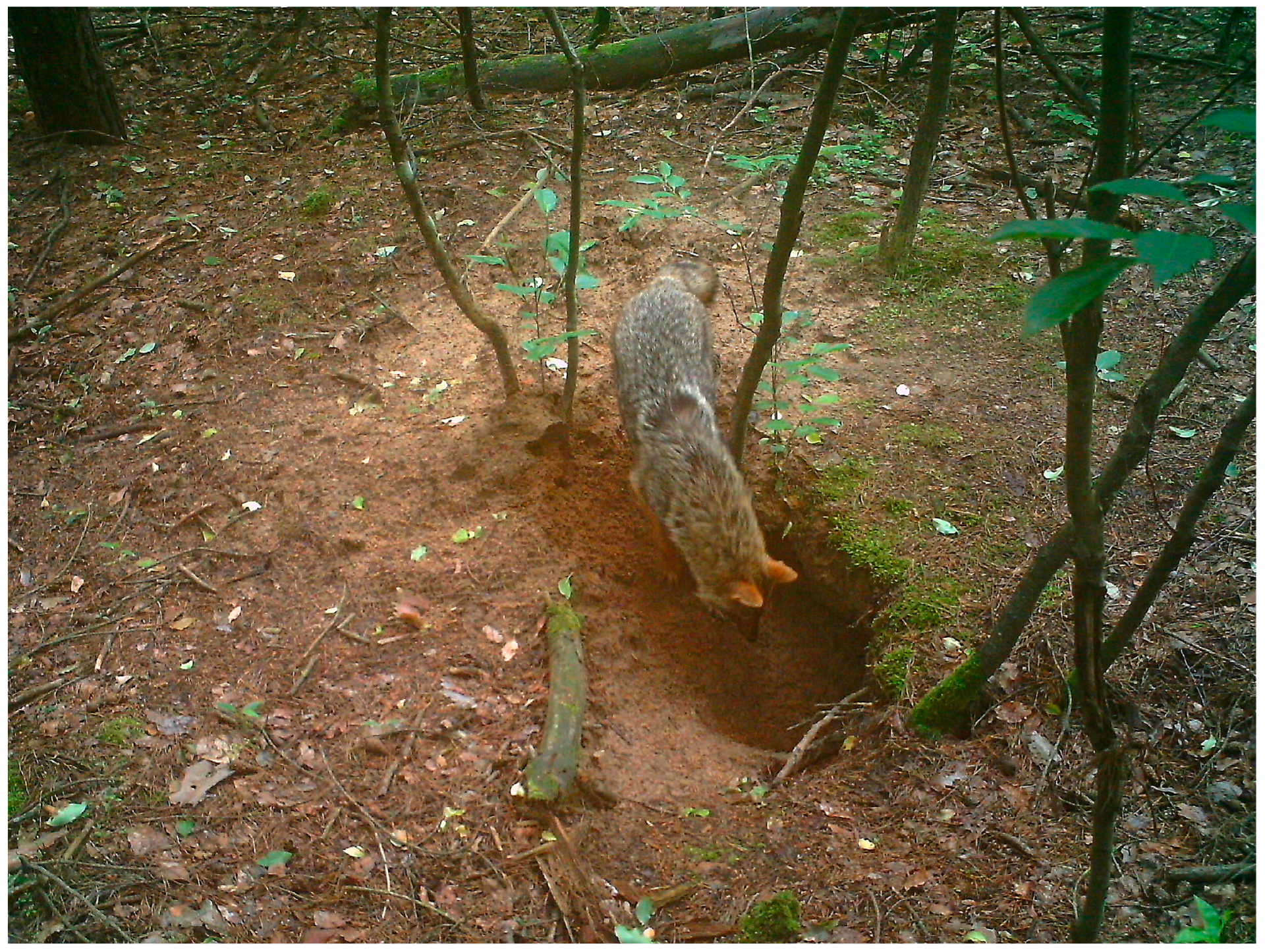
Spatiotemporal Population Growth Patterns and Interactions Among Sympatric Central European Mesocarnivores
Previous Article in Journal
Messy Chemistry and the Emergence of Life
 
 
Due to scheduled maintenance work on our servers, there may be short service disruptions on this website between 11:00 and 12:00 CEST on March 28th.
Article

The Number and Habitat Use of Mesopredators Based on the Camera Trapping and Location of Burrows in Hungary

Department of Wildlife Biology and Management, Institute for Wildlife Management and Nature Conservation, Hungarian University of Agriculture and Life Sciences, Páter Károly Str. 1, H-2100 Gödöllő, Hungary
*
Author to whom correspondence should be addressed.
Life 2026, 16(2), 187; https://doi.org/10.3390/life16020187
Submission received: 23 December 2025 / Revised: 10 January 2026 / Accepted: 21 January 2026 / Published: 23 January 2026
(This article belongs to the Special Issue Conservation Ecology and Management of Mammalian Predators)

Abstract

The increasing population of mesopredators in Central Europe necessitates precise monitoring for effective game management. This study aimed to estimate the minimum population and reproduction of the European badger (Meles meles), red fox (Vulpes vulpes), and golden jackal (Canis aureus) in two hunting grounds in southwestern Hungary (Drávaszentes and Darány). Methods included a total burrow count conducted in early 2025, followed by the deployment of wildlife cameras at inhabited setts to record adults and cubs. Results indicated an inhabited burrow density of 1.05/100 ha for badgers and 0.38/100 ha for foxes in Drávaszentes, with average litter sizes of 1.13 and 2.33 cubs, respectively. In Darány, badger density was 1.43/100 ha, while jackals were present at 0.2/100 ha. Additionally, habitat composition preference was analysed using QGIS by comparing Corine Land Cover categories within 400 m buffers around burrows against random points. Habitat analysis suggested local preferences for non-irrigated arable land and mixed forests. These findings provide essential baseline data on predator population dynamics to support conscious management decisions.

1. Introduction

In habitats where apex predators have been suppressed, mesopredators are receiving increasing attention. In such cases, food chains are shortened and mesopredators often move up to higher levels of the food chain [1,2]. Therefore, the study of mesopredators becomes important for understanding ecological processes [3]. According to the mesopredator release theory, as the population of medium-sized predators increases, so does the predation pressure on prey species. This top-down effect can also cause changes in biodiversity [1]. From the perspective of certain economic sectors (nature conservation, game management), mesopredators also have an economic impact, which manifests itself in several ways. One example is the direct destruction of individuals of species under nature conservation protection as well as small game species. In addition, predator control can also entail significant costs (trapping, firearms, time).
In a significant part of Central Europe, including Hungary, the red fox (Vulpes vulpes Linnaeus, 1758), Eurasian badger (Meles meles Linnaeus, 1758), and golden jackal (Canis aureus Linnaeus, 1758) are considered widespread species of mesopredators. The red fox was the predator with the largest number of individuals in Hungary in the 2000s and 2010s [4]. In addition, the European badger was added to the list of huntable species in 2001 due to its nationwide distribution [5,6]. In the 1980s, Hungary was one of the first countries where the golden jackal reappeared in Europe [7,8]. As no breeding individuals of jackals were recorded between 1940 and 1990, the species was declared extinct in 1989 [9]. In the early 1990s, jackals began to return, and their population grew so rapidly that it became a huntable species in 1994, as a species that could be hunted throughout the year until 1999 and again from 2012 onwards. In between this period, the hunting season was from 1st of July to the end of February [10,11]. In addition to the above-mentioned effects of mesopredators (predation, competition), foxes and badgers are known to spread diseases that pose a risk to animal and human health [12]. Overall, these factors make it important to manage predators in a conscious manner based on measured data. For this reason, understanding the population dynamics and habitat selection of predators is necessary [13,14]. Foxes and badgers use burrows. Therefore, it is useful to know the location of these underground shelters. The results of population estimations based on burrows can be biased by several behavioral factors. For example, badgers can live either alone or in clans [15]. On the other hand, foxes may use several burrows during a given period, which can lead to an overestimation of population size [16]. It is also possible that foxes and badgers share the same burrows or that certain entrances are only used seasonally [17]. The golden jackal can use burrows as well, but in most cases, it has shelter on the ground surface [18]. In this regard, proportional regional differences are noted for different geoecological habitats of these species of mesopredators [19,20]. Due to these factors, it is important to observe the burrows found and integrate the data collected into predator management.

Hypotheses

We conducted our studies in two differently managed (nature conservation, wildlife management) hunting areas in southwestern Hungary. At a nature conservation area, the main goal is the biodiversity conservation and the maintenance of natural ecological processes, and the hunting is strictly regulated. Any intervention must be minimal and carried out with a lot of precautions. In an area that focuses on wildlife management, the main goal is to obtain sustainable use, and hunting is the core management tool to achieve it.
Based on the above, our study has two main objectives: (1) estimating the minimum number of foxes, badgers and jackals per burrow using wildlife cameras; (2) characterizing the habitat composition in the surrounding areas of the inhabited burrows. Taking into account the aims, our hypotheses were as follows:
  • Most of the inhabited burrows are used by red foxes.
  • The observed litter size of the studied predator species is approximately the same as that reported in the previously published national (Hungary) data.
  • Habitat composition significantly influences burrow use, differing between burrows inhabited with cubs, inhabited burrows without cubs, and random points.

2. Materials and Methods

2.1. The Study Areas

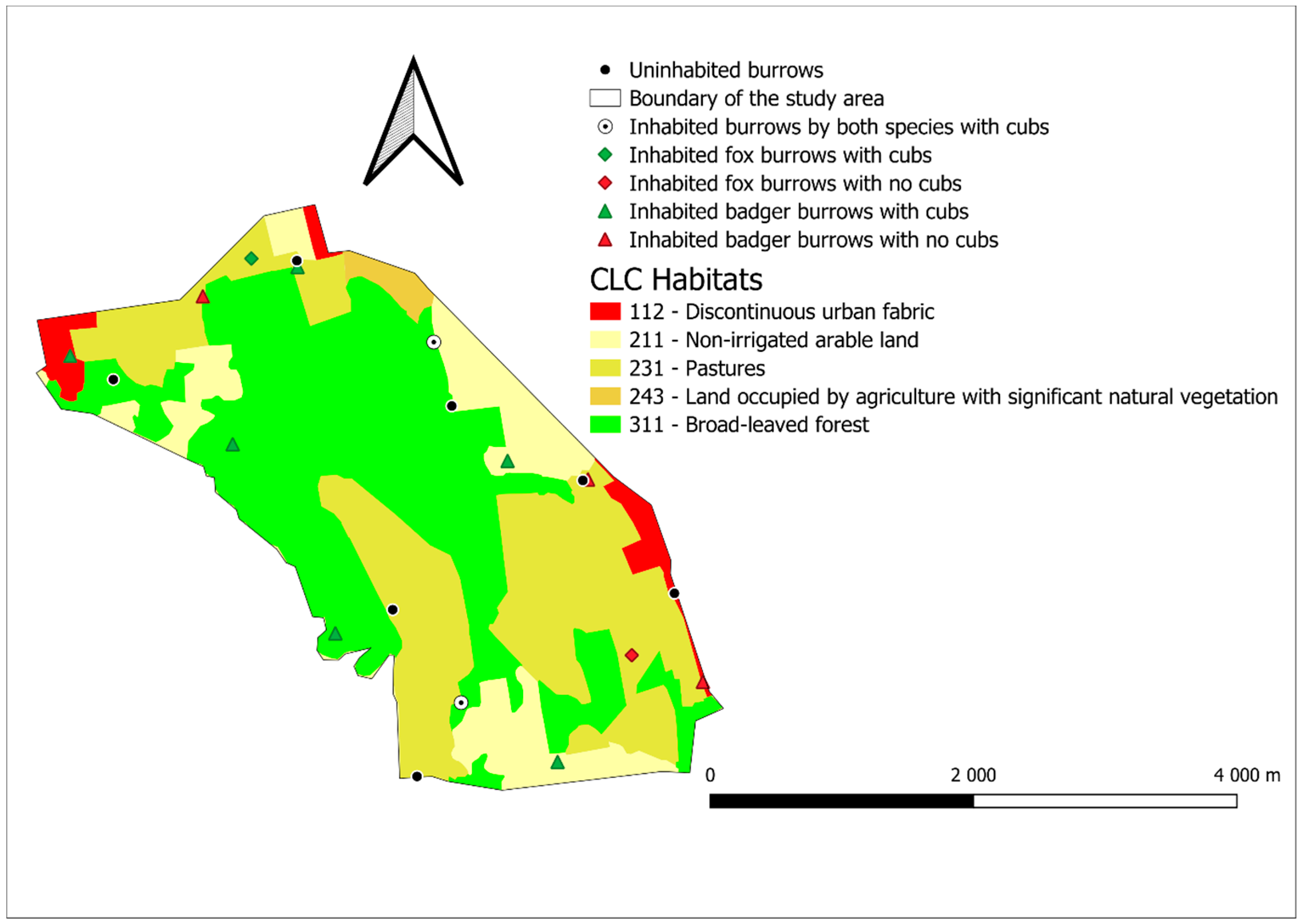
The study area in Drávaszentes is located in the southern part of Somogy County, between the towns of Barcs, Komlósd and Péterhida (coordinates: 45.997562561, 17.396221579). The area is a special game management unit managed by the Danube-Drava National Park Directorate. It covers an area of 1138 hectares, of which the hunting area is 1042 hectares. The study area is in the Middle Drava Valley micro-region, on a high floodplain, and lying in the former riverbed of Drava; thus, its located 10–20 m lower than the neighboring areas, and only the eastern side of the area is hilly. The area is mostly plain with only a few meters of elevation difference (lowest: 94 m above sea level, highest: 130 m above sea level). The area has a moderately humid climate, with an average annual temperature of 10.0–10.2 °C and the average annual precipitation is around 780–800 mm. Two small watercourse runs in the study are Györgyös stream and the Komlósdi-Rinya, and they also converge in the area, but both dry up in the drier years. The groundwater is high; it can be found everywhere at around 2–4 m [21]. We calculated the habitats of the area with QGIS (3.30.1) from the Corine Land Cover layer. The habitat with the biggest area is the Broad-leaved forest (CLC 311) covering 46% of the area. Pastures (CLC 231) are also very prominent in the area (34.2%). These are followed by non-irrigated arable lands (CLC 211) with 14,9% coverage, discontinuous urban fabric (CLC 112) with 3.6% and land occupied by agriculture with significant natural vegetation (CLC 243) with 1.3% (Figure 1).
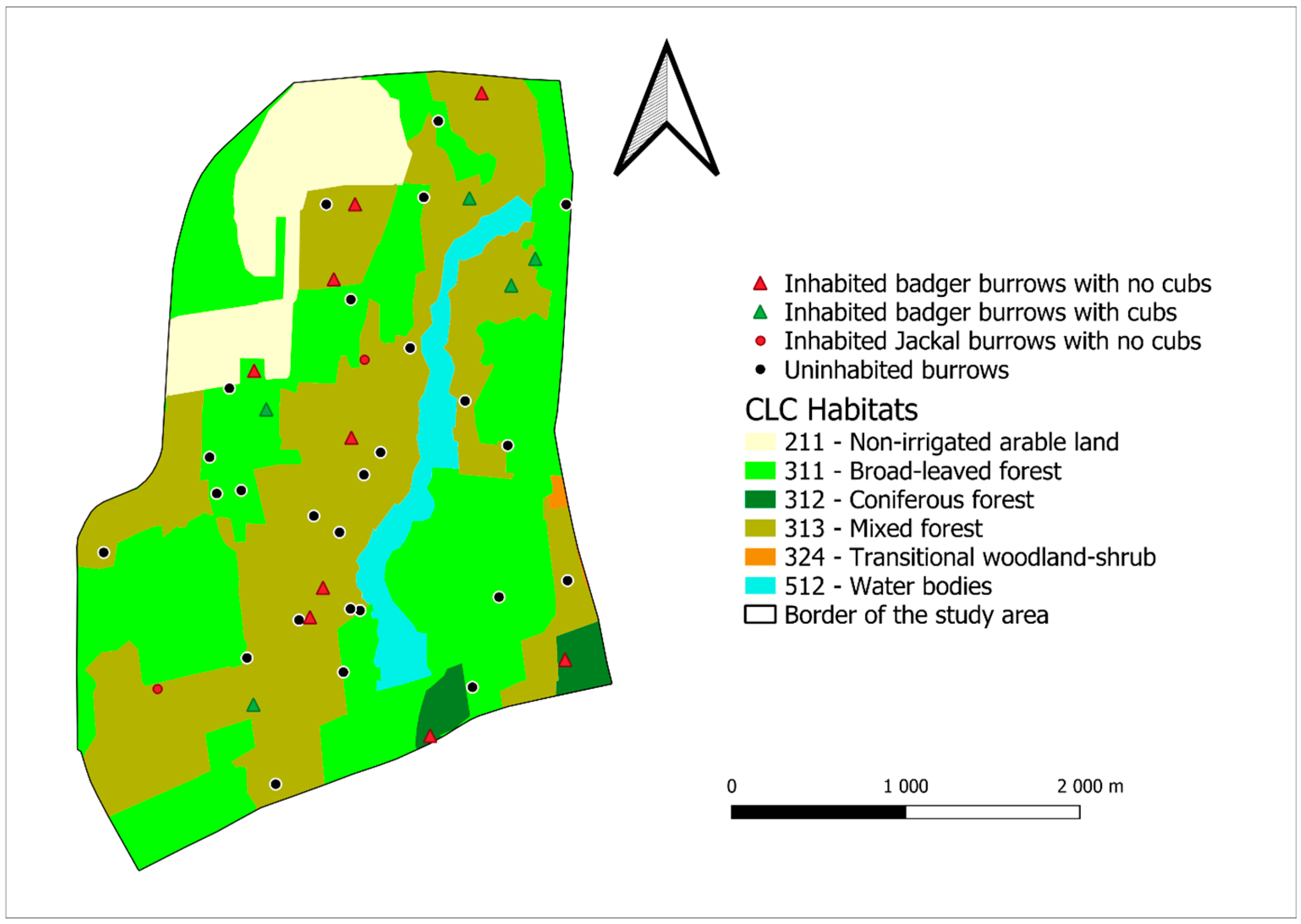
The study area in Darány is also located in the southern part of Somogy County, between the towns of Barcs and Darány (coordinates: 45.986786021, 17.533621622). It covers an area of 980.8 ha. The study area is in the Eastern-Inner Somogy micro-region. The area is flat, with the lowest point at 125 m above sea level and the highest point at 145 m above sea level. The climate of the area is moderately humid, with the average annual temperature between 10.0 and 10.3 °C. The annual precipitation exceeds 800 mm. Rigóc stream runs through the area, but it dries out in the drier years. The area also has 9 fishponds, only 5 of which contain water, and in the dry period all of them dries out except 2. The remaining ones are reedy-bushy areas. The groundwater can be found between 2 and 4 m [21]. With the same method as the previous study area, we calculated the following habitat covering. The habitat with the biggest coverage is the broad-leaved forest (CLC 311), with 42.4%, followed by the mixed forest (CLC 313) with 40.6%. The remaining area was covered by non-irrigated arable land (CLC 211) with 9.8%, water bodies (CLC 512) with 5.1%, Coniferous forests (CLC 312) with 1.9% and transitional woodland shrubs (CLC 324) with 0.2% (Figure 2).

2.2. Data Collection

2.2.1. Field Survey

To locate the burrow systems, a total count survey was carried out on both study sites to collect the most reliable data possible. The surveys were carried out in 2025 from February to April. Early spring offers optimal visibility of the burrows, because the vegetation has not yet grown dense enough to obscure them. Throughout the fieldwork, maps and a Garmin GPSmap 62s GPS device (Olathe, KS, USA) were used to document every burrow we found. In addition, the coordinate system used was the Unified National Projection System (EOV). The definition of a burrow includes a cavity deeper than one meter, with dimensions appropriate to the body size of the studied species [22]. The entrance generally measured between 15- and 60 cm in width providing a suitable shelter for the badger and red fox [23] (Figure A1, Figure A2 and Figure A3). Where the nearest entrances were more than 50 m apart, we treated them as separate burrow [22]. A field log was maintained to hold the coordinates of each burrow recorded via GPS. This log also contained the serial number, occupancy status and which species were using the given burrow. Species using burrows were identified by using tracks, footprints, scent marks, droppings and latrines [22]. We considered a burrow to be occupied if the entrances appeared to be clean and showed signs of recent activity. As for the badger, there were characteristic indicators that helped to distinguish their burrows from those of other species [24,25,26,27,28].

2.2.2. Survey of Minimum Population and Litter Size Using Wildlife Cameras

Where possible, motion-activated wildlife cameras were installed at burrows identified as inhabited to record the minimum number of adults and juveniles inhabiting them. Camera trapping can provide valuable information on species that are nocturnal or elusive and are difficult to observe [29]. Based on the images captured by wildlife cameras, we determined the largest number of cubs and adults seen at once for each burrow. During the study, we used 6 cameras with image transmission capability and 15 cameras without image transmission capability. The cameras were set to photo mode with a delay of 3 s, and the burst mode was turned off. The quality of the pictures was set to 5 MP and the Passive Infrared Motion sensor (PIR) set to normal. The cameras were put on a nearby tree with a ladder in about 2.5 m height and about 5 m from the active entrance. They were secured to the tree with Python (QGIS Desktop 3.30.1) cables. The burrows at the Drávaszentes study area were surveyed between 18 April 2025 and 6 May 2025 (16 days); at the Darány study area, they were surveyed from 20 May 2025 to 8 June 2025 (19 days). There were also multi-entrance burrow systems, where we installed multiple cameras at different entrances. The models of cameras include Bushnell (Nature View), Reconyx (HC500), Uovison (Easy Mail, Select 30, 565), and Minox (DTC 400, DTC 650).
In the case of large burrows with several entrances, it was not always feasible to position a camera at the specific entrance used by the predators. This presumably meant that it was not always possible to accurately determine the number of adults and juveniles. In open grassland habitats, the risk of illegal appropriation by unauthorized persons was higher, which limited the use of cameras in these areas. In such cases, we determined the minimum number of individuals based on the tracks observed. In total, 31 burrows were monitored with cameras, 15 at the Drávaszentes study area, and 16 at the Darány study area.

2.2.3. Badger Habitat Composition Estimation

To estimate the habitat composition in the surrounding (400 m radius buffer) of inhabited burrows, we used Quantum GIS 3.31.1 software and Corine Land Cover 100 (version: 2018) layer [30]. When creating the database, we first intersected the CLC100 overlay with the buffer areas. As a result, we obtained the overlay of the buffers based on CLC categories [31]. In the next step, random points were placed (repeated five times) on the study areas. The number of random points were equal to the number of inhabited burrows found in the given study. In case of random points, the habitat composition was estimated using the buffer (400 m radius) method. The sample size (number of inhabited burrows) was enough only in the case of badgers for this estimation.

2.3. Data Analysis

2.3.1. Analysing the Wildlife Camera Results

All camera recordings were analysed and organized into separate folders according to burrows. The analysis of the images enabled us to identify the number of adult individuals occupying each burrow from which we were able to determine the size of the annual population. Furthermore, we also observed the number of cubs and we were able to calculate the average number of cubs in the burrows, as well as the number of cubs in all inhabited burrows. The minimum number of individuals living in the area can be calculated from the sum of the number of adult individuals and cubs.

2.3.2. Analysing the Badger Habitat Composition Results

For statistical analysis, the inhabited burrows were divided into two groups, which are the burrows with cubs and the burrows without cubs. Using the Mann–Whitney U-test, the size of each CLC category found in the surrounding of burrows with cubs was compared to the categories found in the surrounding of burrows without cubs and random points. For statistical analysis, we used Microsoft Excel and the GraphPad Instat 3 statistical program.

3. Results

3.1. Burrow Density

3.1.1. Drávaszentes

We surveyed 23 burrows in the study area in Drávaszentes, 15 of which belonged to badgers and 7 to foxes (Figure 1). Of the 15 badger burrows, 11 were inhabited, while of the 7 fox burrows, 4 were inhabited. Out of these, 2 burrows were occupied by both species. Based on these data, it can be calculated that the number of inhabited burrows was 1.05 burrows/100 hectares for badgers and 0.38 burrows/100 hectares for foxes. The minimum distance of badger burrows from each other was 627 m and the maximum distance was 5407 m, while the average distance was 2524 m. The minimum distance between two fox burrows was 1346 m and the maximum distance was 4173 v meters, while the average distance was 2722 m. The distance between the nearest fox burrow and badger burrow was 303 m.

3.1.2. Darány

In the study area in Darány, we surveyed 42 burrows, of which 24 belonged to badgers and 18 belonged to Cannidae species (Figure 2). Of the 24 badger burrows, 14 were inhabited and 0 of the 16 fox burrows were inhabited, while both of the 2 golden jackal burrows were inhabited. From these figures, it can be calculated that the number of inhabited burrows per 100 hectares is 1.43 for badger, 0 for fox, and 0.2 for golden jackal. The minimum distance of badger burrows from each other was 186 m and the maximum distance was 3757 m, while the average distance was 1722 m. For Jackal, the two burrows that we found were 2231 m away. The distance between the nearest jackal burrow and badger burrow was 407 m.

3.2. The Estimated Number of Individuals per Burrow by Wildlife Cameras

3.2.1. Drávaszentes

Based on wildlife camera recordings, the following minimum numbers of individuals were observed in the 11 badger setts examined. Cubs were observed in eight cases (one cub in seven cases, two cubs in one case). Based on these data, it was possible to calculate the average number of cubs per burrow, which was 1.13 cubs/burrow, resulting in 0.82 cubs/burrow when projected onto all inhabited burrows. The data obtained show that no litters larger than two cubs were observed during the study. In total, we counted nine cubs. The number of adult individuals observed in inhabited burrows was 15, which means that there were 1.36 adult individuals/burrow. Adding the number of adult individuals and cubs together gives a value of 2.18 individuals/burrow. Thus, our estimated minimum population is 24 individuals, of which 15 are the core population.
Based on data provided by wildlife cameras, the following minimum numbers of individuals were observed in the four fox burrows studied. We observed fox cubs in three cases using wildlife cameras (one cub in one case, three cubs in two cases). Thus, it was possible to calculate that the average number of cubs per burrow with cubs was 2.33 cubs/burrow, while the number of cubs per burrow was 1.75 cubs/burrow for all occupied burrows. The number of adults observed in the burrows was 1.25 adults/burrow. We recorded a total of seven cubs. Adding the number of adults (5) and cubs together gives a result of three individuals per burrow. Thus, our estimated minimum population is 13 individuals and our core population is 5 individuals.

3.2.2. Darány

Based on wildlife camera recordings, the following minimum numbers of individuals were observed in the 14 badger setts studied. In this area, we observed cubs on five occasions (one cub in two cases, two cubs in three cases). From the data, it was calculated that the average number of cubs per burrow was 1.6 cubs/burrow, which, broken down for all inhabited burrows, gave a value of 0.58 cubs/burrow. No litters larger than two cubs were observed in this study area. We recorded a total of eight cubs. In terms of adult individuals, the value per burrow was 1.57 individuals. After adding up the number of adult individuals and cubs, we obtained a value of 2.15 individuals/burrow. Thus, our estimated minimum population is 30 individuals, of which 22 are the core population.
Based on wildlife camera recordings, the following minimum numbers of individuals were observed at the two jackal burrows studied. In the case of golden jackals, only adults were observed in the area (2 cases). Thus, the number of adult individuals observed is 1 adults/burrow. Therefore, our minimum estimated number of individuals is two, of which two are part of our core population.

3.3. Habitat Composition Results for Badger Burrows

3.3.1. Drávaszentes

At the Drávaszentes study site, a statistically significant difference was found in one case (out of six) among the five examined habitat types between burrows with cubs and the “random 5” points. The difference can be seen in the case of non-irrigated arable land (CLC 211) (Table A1). Descriptive statistics also show that the median value for this habitat type in the surrounding of the burrows with cubs (18.42 hectare) was much higher than that measured for “random 5” points (0.64 hectare) (Table A3). This might indicate that in this area, badger breeding burrows are more freqently located in enviroments where proportions of CLC 211 are high within the immediate 400 m vicinity. In other cases (Broad-leaved forest—CLC 311, Discontinious urban fabric—CLC 112, Pastures—CLC 231, Land occupied by agriculture with significant natural vegetation—CLC 243), no significant difference was detectable (p > 0.05), or the test could not be performed due to lack of data.

3.3.2. Darány

In the Darány area, a significant pattern was obseved regarding forest habitats among the six examined habitat types. Mixed forest (CLC 313) habitats were found in significantly higher proportions in the environment of burrows with cubs compared to random points in multiple cases. Compared to “random 1”, the difference was significant (Table A2) where the median value for burrows with cubs (23.61 hectare) exceeded the random points (9.53 hectare). Similary, a significant difference was found for the “random 2” group, again favoring burrows with cubs (median: 23.61 to 8.49 hectare) (Table A4). These result suggest that in Darány, mixed forest (CLC 313) might be considered an important habitat for burrows with cubs. For other habitat types (Non-irrigated arable land—CLC 211, Broad-leaved forest—CLC 311, Coniferous—CLC 312, Mixed forest—CLC 313, Transitional woodland-shrub CLC 324, Water bodies—CLC 512), the examined comparison did not show statistically verifiable differences.

4. Discussion

4.1. Burrow

Our study shows that the total burrow count was a good method to analyse European badger distribution, but it is insufficient for accurate golden jackal and red fox monitoring because they do not always use burrows for raising cubs and the foxes can use more burrows simultaneously to rear cubs [15,16]. The recorded badger burrow densities (1.05–1.43 inhabited burrows/100 hectares) align with the species behaviour of using burrows for social interactions between different members of a badger group, breeding and sheltering over winter [25,32,33]. This supports the observation that foxes and jackals have high plasticity in using burrows and can utilize surface covers or structures (abandoned cellars) that can evade standard burrow surveys.
If we compare our results of badger burrow density, we can see that our recorded densities of 1.05 burrows/100 ha in Drávaszentes and 1.43 burrows/100 hectares in Darány exceed the values of previous studies for the Darány study area [34] and exceed the values of a study from the Drávaszentes study area [35]. Our result is higher than what was estimated at East Hungary [36].
For red foxes, our observed burrow density of 0.38 burrows in Drávaszentes compared to previous studies at the same location gave a similar result [35]. At Darány study area, we recorded 0 burrows, but a previous study reported an amount of 0.4 burrow/100 hectares [34]. If compare the results we obtained with that from South-Eastern Hungary, we obtain values between 0.23 and 0.47 which on average is roughly the same as our results [15].
For the golden jackal, if we compare the results we obtained in the Darány study area with the result obtained at the same area (0.3 burrow/100 hectare), we achieve a similar result. In East Hungary, two other studies have been performed on jackals (0.32–0.34 family/100 hectares) with a higher result [15].

4.2. Minimum Population and Litter Size Recorded by Wildlife Cameras

We need to clarify that our results of litter sizes only show the cubs that left the burrows and that the cameras have the following flaws: the camera cannot see the whole area of the burrow, only the entrance; it can only detect movement up to a certain distance and does not always turn on for movement; sometimes when it detects movement, the whole animal is not on the picture.
The badger litter sizes we obtained (1.13–1.6) can be compared with the results of a previous study in the Drávaszentes study area (1.29 cub/burrow) which is an average of our two study areas [37]. For the red fox, our result (2.33) can be compared with a study carried out at the Drávaszentes study area (4 cub/burrow), which is a much higher number.
For jackal, we did not record any cubs but this may be because jackals can move their cubs to another burrow if they feel disturbance [34].

4.3. Habitat Composition at Badger

The habitat analysis showed attraction toward specific habitat features, although these varied by study sites. In Drávaszentes, badger breeding setts were associated with non-irrigated arable land (CLC 211) (p = 0.007 compared to random points). This likely references the “edge effect” where badgers utilize the area between cover that gives security and arable foraging grounds where they can feed.
Conversely, in Darány, we observed an attraction towards mixed forests (CLC 313) (p = 0.032 and p = 0.016 against random points). This aligns with other studies where the badger finds soil stability in these areas.
The divergence between the two study sites suggest that the badger shows behavioural plasticity and can select the most suitable habitats.

4.4. Jackal Effect

The fact we only found red fox burrows and litters at one of our locations and none at the other where jackals were identified suggests that the larger golden jackal population can suppress the smaller red fox population. On the other hand, badger populations are resilient to the jackal.

5. Conclusions

Based on the results of our study, the first hypothesis was disproved by the data. The highest number of burrows was observed for badgers. According to this result, badgers have the highest population size in the study areas. Although in Hungary, the estimated population size of red fox is two times higher than badger [4], locally, the fox population could be lower. It is possible that badgers may have a competitive advantage (larger body size and social behavior) [38]. The second hypothesis was rejected. The observed badger litter size was between 1 and 2 cubs, which is in line with the previously published data [7]. In contrast, the observed red fox litter size was between 1 and 3 cubs. These numbers are smaller than the results of previous studies [38]. The small or decreasing litter size could be an indicator of poor habitat quality, especially the lack of food sources [39]. In the case of golden jackal, the sample size (inhabited burrows) was too low (n = 2) to draw any conclusions. The third hypothesis related to habitat composition was disproved by the data as well. Comparing the area size of the given habitat types between burrows with cubs and random points, we found few differences. In the rest of the cases, the habitat composition was the same. Further studies should focus on small-scale [39] microhabitat composition of burrows using greater sample sizes and detailed analysis.

Author Contributions

Conceptualization, Z.H. and M.M.; methodology, Z.H. and M.M.; software, Z.H. and M.M.; validation, M.M. and A.V.; formal analysis, M.M. and A.V.; investigation, Z.H. and M.M.; resources, Z.H. and M.M.; data curation, Z.H. and M.M.; writing—original draft preparation, Z.H. and M.M. and A.V.; writing—review and editing, Z.H., M.M. and A.V.; visualization, Z.H. and M.M.; supervision, M.M.; project administration, Z.H. and M.M.; funding acquisition, All authors have read and agreed to the published version of the manuscript.

Funding

This research received no external funding.

Institutional Review Board Statement

Not applicable.

Informed Consent Statement

Not applicable.

Data Availability Statement

The data presented in this study are available on request from the corresponding author.

Acknowledgments

We would like to thank the staff of the Duna-Dráva National Park Directorate, Zoltán Horváth and Csanád Sipter, for lending us trail cameras and for their assistance at the Drávaszentes study area. We would also like to thank Zoltán Puskás, Director of the Barcs Forestry of SEFAG Zrt. for granting permission to enter the Darány study area.

Conflicts of Interest

The authors declare no conflicts of interest.

Appendix A

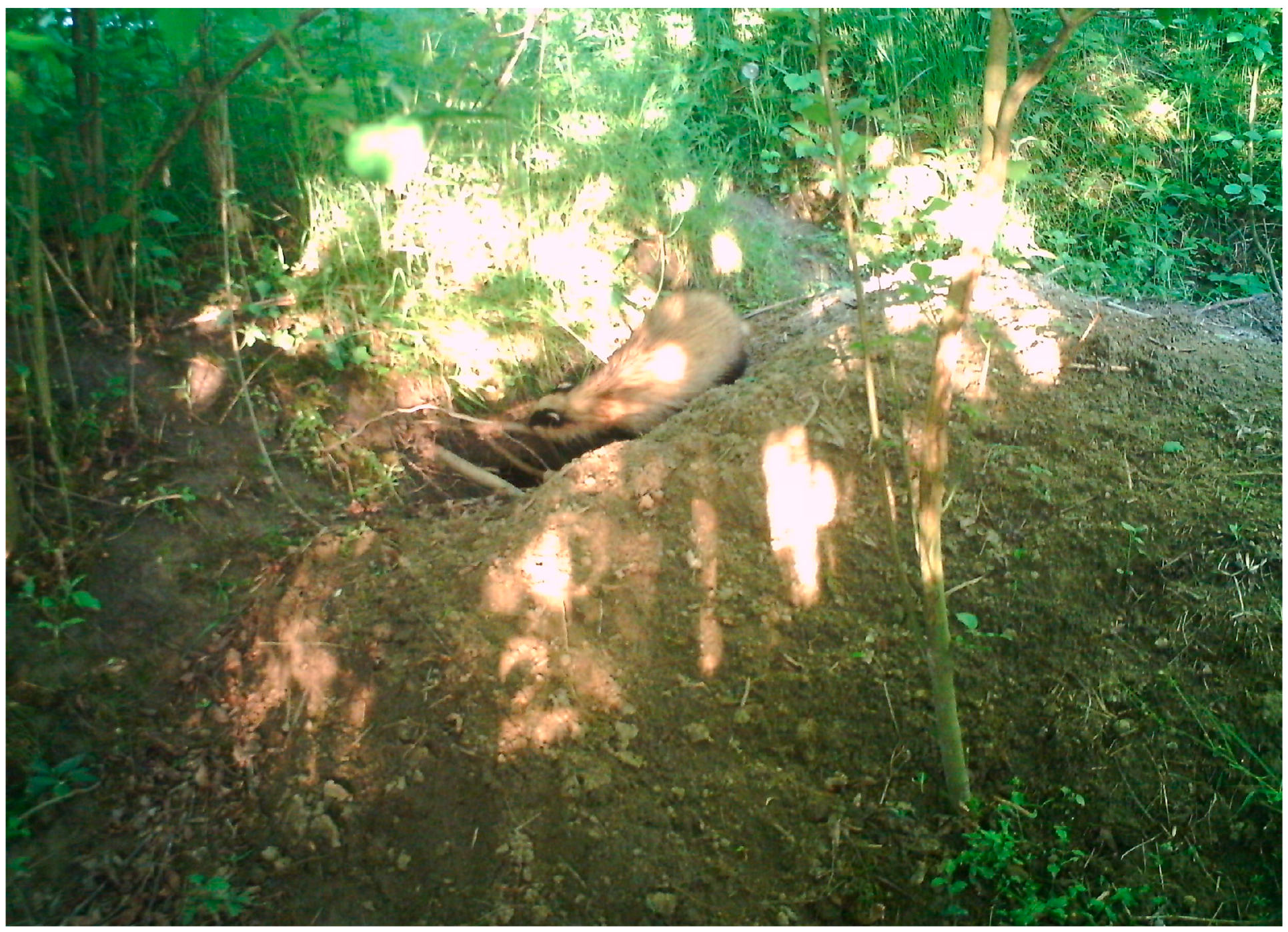
Figure A1. Badger burrow.
Life 16 00187 g0a1
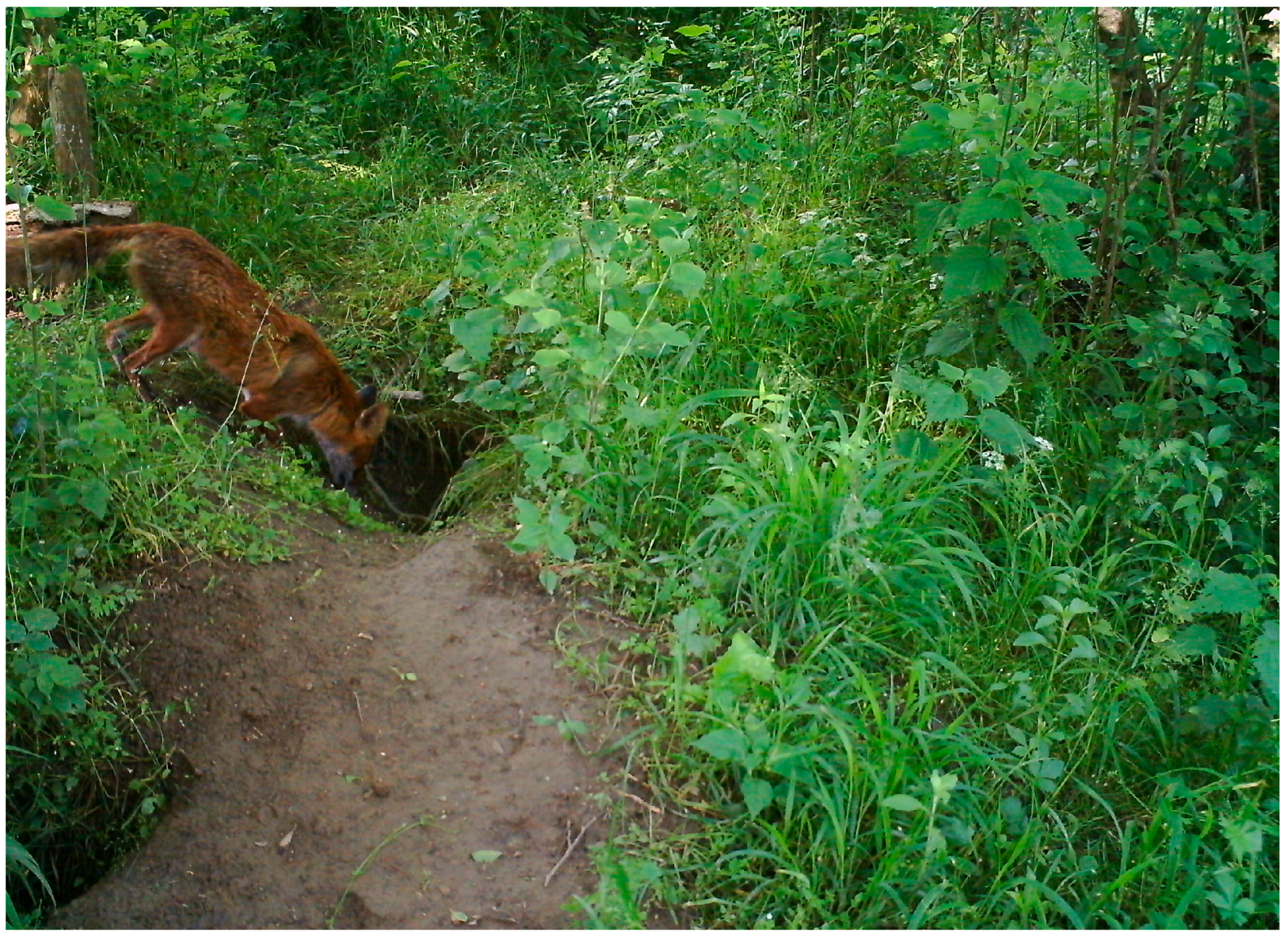
Figure A2. Red fox burrow.
Life 16 00187 g0a2
Figure A3. Golden jackal burrow.
Life 16 00187 g0a3
Table A1. The results of Mann–Whitney U-test in the case of Drávaszentes study area. Legend: 112-Discontinuous urban fabric, 211-Non-irrigated arable land, 231-Pastures, 243-Land principally occupied by agriculture, with significant areas of natural vegetation and 311-Broad-leaved forest.
Habitat TypeComparisonU StatU’ Statp Valuen
112Burrows with cubs—Burrows with no cubs7.00017.0000.35511
Burrows with cubs—random 131.00033.0000.95716
Burrows with cubs—random 232.00032.0000.95716
Burrows with cubs—random 324.00040.0000.42316
Burrows with cubs—random 428.00036.0000.70016
Burrows with cubs—random 531.00033.0000.95716
211Burrows with cubs—Burrows with no cubs11.00013.0000.92111
Burrows with cubs—random 123.00041.0000.38216
Burrows with cubs—random 221.00043.0000.27916
Burrows with cubs—random 321.00043.0000.27916
Burrows with cubs—random 424.00040.0000.44216
Burrows with cubs—random 57.00057.0000.00716
231Burrows with cubs—Burrows with no cubs6.00018.0000.27911
Burrows with cubs—random 123.50040.5000.40016
Burrows with cubs—random 226.50037.5000.59816
Burrows with cubs—random 329.50034.5000.83316
Burrows with cubs—random 429.50034.5000.83316
Burrows with cubs—random 523.00041.0000.37116
243Burrows with cubs—Burrows with no cubs0.0000.0000.00011
Burrows with cubs—random 129.00035.0000.78316
Burrows with cubs—random 20.0000.0000.00016
Burrows with cubs—random 30.0000.0000.00016
Burrows with cubs—random 40.0000.0000.00016
Burrows with cubs—random 529.00035.0000.78316
311Burrows with cubs—Burrows with no cubs6.00018.0000.27911
Burrows with cubs—random 132.00032.0001.00016
Burrows with cubs—random 229.00035.0000.79816
Burrows with cubs—random 330.00034.0000.87916
Burrows with cubs—random 432.00032.0001.00016
Burrows with cubs—random 530.00034.0000.87916
Table A2. The results of Mann–Whitney U-test in case of Darány study area. Legend: 211-Non-irrigated arable land, 231-Pastures, 311-Broad-leaved forest, 312-Coniferous forest, 313-Mixed forest, 324-Transitional woodland-shrub and 512-Water bodies.
Habitat TypeComparisonU StatU’ Statp Valuen
211Burrows with cubs—Burrows with no cubs24.50025.5001.00015
Burrows with cubs—random 14.50020.5000.11610
Burrows with cubs—random 211.00014.0000.82810
Burrows with cubs—random 311.00014.0000.82810
Burrows with cubs—random 411.00014.0000.82810
Burrows with cubs—random 511.00014.0000.82810
231Burrows with cubs—Burrows with no cubs0.0000.0000.00015
Burrows with cubs—random 10.0000.0000.00010
Burrows with cubs—random 20.0000.0000.00010
Burrows with cubs—random 30.0000.0000.00010
Burrows with cubs—random 40.0000.0000.00010
Burrows with cubs—random 50.0000.0000.00010
311Burrows with cubs—Burrows with no cubs18.00032.0000.44015
Burrows with cubs—random 15.00020.0000.15110
Burrows with cubs—random 23.00022.0000.05610
Burrows with cubs—random 312.00013.0001.00010
Burrows with cubs—random 412.00013.0001.00010
Burrows with cubs—random 59.00016.0000.54810
312Burrows with cubs—Burrows with no cubs0.0000.0000.00015
Burrows with cubs—random 10.0000.0000.00010
Burrows with cubs—random 20.0000.0000.00010
Burrows with cubs—random 30.0000.0000.00010
Burrows with cubs—random 40.0000.0000.00010
Burrows with cubs—random 50.0000.0000.00010
313Burrows with cubs—Burrows with no cubs25.00025.0001.00015
Burrows with cubs—random 12.00023.0000.03210
Burrows with cubs—random 21.00024.0000.01610
Burrows with cubs—random 311.00014.0000.84110
Burrows with cubs—random 48.00017.0000.42110
Burrows with cubs—random 58.00017.0000.42110
324Burrows with cubs—Burrows with no cubs0.0000.0000.00015
Burrows with cubs—random 10.0000.0000.00010
Burrows with cubs—random 20.0000.0000.00010
Burrows with cubs—random 30.0000.0000.00010
Burrows with cubs—random 40.0000.0000.00010
Burrows with cubs—random 50.0000.0000.00010
512Burrows with cubs—Burrows with no cubs9.00016.0000.52115
Burrows with cubs—random 19.00016.0000.52110
Burrows with cubs—random 27.00018.0000.28410
Burrows with cubs—random 36.00019.0000.19910
Burrows with cubs—random 49.00016.0000.52110
Burrows with cubs—random 510.00015.0000.67410
Table A3. The results of descriptive statistics in hectares in the case of Drávaszentes study area. Legend: 112-Discontinuous urban fabric, 211-Non-irrigated arable land, 231-Pastures, 243-Land principally occupied by agriculture, with significant areas of natural vegetation and 311-Broad-leaved forest.
CategoryHabitat TypeMINQ1MEDQ3MAX
Burrows with cubs1120.000.000.001.5622.11
2115.558.8718.4221.4437.77
2310.000.004.6212.9423.82
2430.000.000.000.273.76
3117.5811.3618.4326.0042.06
Burrows with no cubs1120.003.166.326.656.98
21114.7816.9119.0319.5620.09
23113.7916.1918.5818.9719.35
2430.000.000.000.000.00
3113.797.4411.0913.9816.87
random 11120.000.000.000.002.57
2110.000.008.708.9711.64
2310.000.004.0715.6620.12
2430.000.000.000.000.00
3114.094.0914.9517.2521.51
random21120.000.000.002.0511.92
2110.002.549.1921.9630.28
2310.000.0010.3618.0136.74
2430.000.000.000.000.00
3111.3916.8721.0031.5645.53
random 31120.000.003.848.3213.51
2110.000.329.7217.9143.72
2310.000.004.9914.1118.51
2430.000.000.000.000.00
3110.0010.1819.8029.2550.22
random 41120.000.000.000.0014.78
2110.000.9012.9220.1248.92
2310.000.008.2018.6228.89
2430.000.000.000.000.00
3111.307.8620.3539.8549.04
random 51120.000.000.000.9217.63
2110.000.000.643.1227.23
2310.000.8615.3936.7546.52
2430.000.000.000.004.89
3110.048.3916.1444.9949.47
Table A4. The results of descriptive statistics in hectares in the case of Darány study area. Legend: 211-Non-irrigated arable land, 231-Pastures, 311-Broad-leaved forest, 312-Coniferous forest, 313-Mixed forest, 324-Transitional woodland-shrub and 512-Water bodies.
CategoryHabitat TypeMINQ1MEDQ3MAX
Burrows with cubs2110.000.000.000.098.12
3119.5610.0219.5825.3827.70
3120.000.000.000.000.00
31314.3918.8823.6132.4540.66
5120.000.005.977.047.66
Burrows with no cubs2110.000.000.004.7823.10
3111.546.7515.0323.4030.15
3120.000.000.000.0025.37
3130.0016.3524.3336.7448.46
5120.000.000.111.696.21
random 12110.000.4917.3420.1023.80
2310.000.000.000.000.23
31116.6524.4528.4528.7730.11
3120.000.000.000.000.00
3130.008.439.5311.9520.96
5120.000.000.000.009.82
random22110.000.000.000.0032.57
2310.000.000.000.007.30
31110.3629.1031.2434.9441.73
3120.000.000.003.5112.19
3130.000.008.499.1715.84
3240.000.000.001.776.12
5120.000.000.000.006.80
random 32110.000.000.000.0029.80
2310.000.000.000.001.66
3117.3810.3814.0927.3343.76
3120.000.000.000.000.11
3134.676.3522.8939.1142.83
3240.000.000.000.000.00
5120.000.000.000.000.73
random 42110.000.000.000.0011.23
2310.000.000.000.000.00
3111.3511.6021.6224.5335.37
3120.000.000.000.0036.81
31312.0414.4614.8427.2927.29
3240.000.000.000.000.01
5120.000.000.000.0011.33
random 52110.000.000.000.0012.38
2310.000.000.000.000.00
31111.4616.6023.9525.4343.31
3120.000.000.000.000.46
3130.0013.8914.9526.9833.62
3240.000.000.000.000.00
5120.000.006.919.3811.79

References

  1. Prugh, L.R.; Stoner, C.J.; Epps, C.W.; Bean, W.T.; Ripple, W.J.; Laliberte, A.S.; Brashares, J.S. The Rise of the Mesopredator. Aspen Bibliogr. 2009, 59, 779–791. [Google Scholar] [CrossRef]
  2. Roemer, G.W.; Gompper, M.E.; Van Valkenburgh, B. The Ecological Role of the Mammalian Mesocarnivore. BioScience 2009, 59, 165–173. [Google Scholar] [CrossRef]
  3. Ritchie, E.G.; Johnson, C.N. Predator interactions, mesopredator release and biodiversity conservation. Ecol. Lett. 2009, 12, 982–998. [Google Scholar] [CrossRef] [PubMed]
  4. Csányi, S.; Márton, M.; Bőti, S.Z.; Schally, G. Vadgazdálkodási Adattár—2024/2025; vadászati év. MATE VTI; Országos Vadgazdálkodási Adattár: Gödöllő, Hungary, 2025; p. 70. [Google Scholar]
  5. On the amendment of Decree No. 30/1997 (IV. 30.) FM on the rules for the implementation of Act LV of 1996 on the protection of game, game management and hunting. Available online: https://jogkodex.hu/jsz/2001_90_fvm_rendelet_9682074 (accessed on 20 December 2025).
  6. Lanszki, J.; Heltai, M. Eurázsiai borz (Meles meles Linnaeus, 1758). In Emlős Ragadozók Magyarországon; Heltai, M., Ed.; Mezőgazda Kiadó: Budapest, Hungary, 2010; pp. 67–72. [Google Scholar]
  7. Heltai, M.; Torbó, L.T.; Lanszki, J.; Szabó, L. Az aranysakál (Canis aureus L. 1758) állománynagyságának vizsgálata közvetlen megfigyelések alapján. Tájökológiai Lapok 2012, 10, 405–411. [Google Scholar] [CrossRef]
  8. Bijl, H.; Schally, G.; Márton, M.; Heltai, M.; Csányi, S. From invaders to residents: The golden jackal (Canis aureus) expansion in Hungary since the mid-1990s. PLoS ONE 2024, 19, e0306489. [Google Scholar] [CrossRef] [PubMed]
  9. Rakonczay, Z. Vörös Könyv; Akadémiai Kiadó: Budapest, Hungary, 1989. [Google Scholar]
  10. Szabo, L.; Heltai, M.; Szűcs, E.; Lanszki, J.; Lehoczki, R. Expansion range of golden jackal in Hungary between 1997 and 2006. Mammalia 2009, 73, 307–311. [Google Scholar] [CrossRef]
  11. Heltai, M.; Bíró, Z.; Szemethy, L. A borz terjeszkedése Magyarországon 1988 és 2000 között. Vadbiológia 2001, 8, 43–48. [Google Scholar]
  12. Takács, A.; Szemethy, L.; Takács, A.A.; Takács, P.T.; Heltai, M. Adatok az eurázsiai borz (Meles meles) parazitákkal való fertőzöttségéről Magyarországon. Magy. Állatorvosok Lapja 2012, 134, 106–110. [Google Scholar]
  13. Csányi, S. Vadbiológia; Mezőgazda Kiadó: Budapest, Hungary, 2007; 135p. [Google Scholar]
  14. Leopold, A. Game Management; C. Scribner’s Sons: New York, NY, USA, 1933; 481p. [Google Scholar]
  15. Heltai, M. Ragadozóemlős-Fajok Monitorozási Módszereinek Fejlesztése, és a Tudatos Ragadozó-Gazdálkodás Megalapozása az Aranysakál, az Eurázsiai Borz és a Vörös Róka Esetében. Ph.D. Thesis, Szent István Egyetem, Gödöllő, Hungary, 2016. [Google Scholar]
  16. Meia, J.S.; Weber, J.M. Characteristics and distribution of breeding dens of the red fox (Vulpes vulpes) in a mountainous habitat. Mamm. Biol. 1992, 57, 137–143. [Google Scholar]
  17. Goszczyński, J.; Wójtowicz, I. Annual dynamics of den use by red foxes Vulpes vulpes and badgers Meles meles in central Poland. Acta Theriol. 2001, 46, 407–417. [Google Scholar] [CrossRef]
  18. Heltai, M.; Lanszki, J. Aranysakál (Canis aureus Linnaeus, 1758). In Emlős Ragadozók Magyarországon; Heltai, M., Ed.; Mezőgazda Kiadó: Budapest, Hungary, 2010; pp. 15–20. [Google Scholar]
  19. Macdonald, D.W.; Buesching, C.D.; Stopka, P.; Henderson, J.; Ellwood, S.A.; Baker, S.E. Encounters between two sympatric carnivores: Red foxes (Vulpes vulpes) and European badgers (Meles meles). J. Zool. 2004, 263, 385–392. [Google Scholar] [CrossRef]
  20. Andreychev, A. Proportion faunal assemblages of carnivorous mammals hi geoecological districts of Mordovia, Russia. Biodiversitas J. Biol. Divers. 2021, 22, 4625–4632. [Google Scholar] [CrossRef]
  21. Marosi, S.; Somogyi, S. Magyarország Kistájainak Katasztere I-II; MTAFöldrajztudományi Kutató Intézet: Budapest, Hungary, 1990; 1023p. [Google Scholar]
  22. Márton, M. Az Európai Borz és a Vörös Róka Kotorékhely-Kompetenciójának Vizsgálata Különböző Terepbiológiai Módszerekkel. Ph.D. Thesis, Szent István Egyetem, Vadbiológiai és Vadgazdálkodási Tanszék, Gödöllő, Hungary, 2018; 104p. [Google Scholar]
  23. Heltai, M. Emlős Ragadozók Magyarországon; Mezőgazda Kiadó: Budapest, Hungary, 2010; 240p. [Google Scholar]
  24. Jensen, P. Lidt om gravlingen. Naturens Verden 1959, 11, 289–320. [Google Scholar]
  25. Kruuk, H. The Social Badger; Oxford University Press: Oxford, UK, 1989; 155p. [Google Scholar]
  26. Neal, E.; Cheeseman, C. Badgers; T and AD Poyser Ltd.: London, UK, 1996; 271p. [Google Scholar]
  27. Bang, P.; Dahlström, P. Állatnyomok és -jelek; M-érték Kiadó Kft.: Budapest, Hungary, 2006; 264p. [Google Scholar]
  28. Delahay, R.J.; Ward, A.I.; Walker, N.; Long, B.; Cheeseman, C.L. Distribution of badger latrines in a high-density population: Habitat selection and implications for the transmission of bovine tuberculosis to cattle. J. Zool. 2007, 272, 311–320. [Google Scholar] [CrossRef]
  29. Trolliet, F.; Vermeulen, C.; Huynen, M.C.; Hambuckers, A. Use of camera traps for wildlife studies: A review. Biol. Agric. Sci. Environ. 2014, 18, 446–454. [Google Scholar]
  30. Márton, M.; Markolt, F.; Szabó, L.; Heltai, M. Niche segregation between two medium-sized carnivores in a hilly area of Hungary. Ann. Zool. Fenn. 2014, 51, 423–432. [Google Scholar] [CrossRef]
  31. Kosztra, B.; Büttner, G.; Hazeu, G.; Arnold, S. Updated CLC Illustrated Nomenclature Guidelines; European Topic Centre on Urban, Land and Soil Systems (ETC/ULS): Wien, Austria, 2017. [Google Scholar]
  32. Kowalczyk, R.; Zalewski, A.; Jedrzejewska, B.; Jedrzejewski, W. Spatial organization and demography of badgers (Meles meles) in Bialowieza Primeval Forest, Poland, and the influence of earthworms on badger densities in Europe. Can. J. Zool. 2003, 81, 74–87. [Google Scholar] [CrossRef]
  33. Timothy, J.; Roper, A.I.; Tait, S.F.; Christian, D.F. Excavation of three badger (Meies meles L.) setts. Mamm. Biol. (Früher Z. Für Säugetierkunde) 1991, 56, 129–134. [Google Scholar]
  34. Horváth, Z.; Selyem, J. Az aranysakál, a vörös róka és a borz állományvizsgálata 1000 ha on Barcs és Darány térségében. In Szakmai Konferencia 2018; Somogy Megyei Vadászok Szövetsége: Kaposvár, Hungary, 2018. [Google Scholar]
  35. Hajdu, K. Ragadozó-Zsákmány Kapcsolatok Vizsgálata a Drávaszentesi Réten. Bachelor’s Thesis, Kaposvári Egyetem, Kaposvár, Hungary, 2010; pp. 13–17. [Google Scholar]
  36. Kozák, L. A Borz (Meles meles) Állományviszonyai, Élőhelypreferenciája és Táplálkozás Ökológiai Vizsgálata Hajdú-ÍBihar Megyében. Ph.D. Thesis, Debreceni Egyetem, Debrecen, Hungary, 2007; 105p. [Google Scholar]
  37. Horváth, Z.; Márton, M. Estimating the population density of european badger and red fox using camera traps. In Review on Agriculture and Rural Development; Wellmann-Conference: Hódmezővásárhely, Hungary, 2025. [Google Scholar]
  38. Heltai, M.; Lanszki, J. Vörös róka (Vulpes vulpes Linnaeus, 1758). In Emlős Ragadozók Magyarországon; Heltai, M., Ed.; Mezőgazda Kiadó: Budapest, Hungary, 2010; pp. 24–30. [Google Scholar]
  39. Virgós, E.; Casanovas, J.G. Badger Meles Meles Sett Site Selection in Low Density Mediterranean Areas of Central Spain. Acta Theriol. 1999, 44, 173–182. [Google Scholar] [CrossRef]
Figure 1. The location of burrows found in the Drávaszentes study area.
Life 16 00187 g001
Figure 2. The location of burrows found in the Darány study area.
Life 16 00187 g002
Disclaimer/Publisher’s Note: The statements, opinions and data contained in all publications are solely those of the individual author(s) and contributor(s) and not of MDPI and/or the editor(s). MDPI and/or the editor(s) disclaim responsibility for any injury to people or property resulting from any ideas, methods, instructions or products referred to in the content.