Review

Multiple Basal Cell Carcinomas in a Long-Term Survivor of Childhood ALL and HSCT—A Call for Dermatologic Vigilance


by
Elena Porumb-Andrese
1,
Gabriela Stoleriu
2,*,
Antonia Elena Huțanu
1,*,
Cristian Mârţu
1,
Mihaela-Paula Toader
1,
Vlad Porumb
1,
Cristina Colac-Boțoc
1,
Ancuța Lupu
1,
Gabriela Rusu-Zota
1,
Emil Anton
1 and
Daciana Elena Brănișteanu
1
1
Grigore T. Popa University of Medicine and Pharmacy, 16 Universitatii Str., 700115 Iasi, Romania
2
Faculty of Medicine and Pharmacy, “Dunarea de Jos” University of Galati, 14 Domneasca Str., 800008 Galati, Romania
*
Authors to whom correspondence should be addressed.
Life 2026, 16(1), 55; https://doi.org/10.3390/life16010055 (registering DOI)
Submission received: 28 October 2025 / Revised: 22 December 2025 / Accepted: 24 December 2025 / Published: 30 December 2025
(This article belongs to the Section Physiology and Pathology)

Abstract

(1) Background: Cutaneous secondary malignant neoplasms are a growing survivorship burden after pediatric cancers and hematopoietic stem cell transplantation (HSCT), yet skin-focused surveillance remains inconsistently implemented. (2) Objective: To synthesize current molecular dermatology insights relevant to prevention, early detection, and treatment of basal cell carcinoma (BCC) in high-risk survivors, while anchoring the discussion in a detailed case of multiple BCCs after childhood acute lymphoblastic leukemia and HSCT. (3) Methods: Narrative review integrating clinical, dermoscopic, molecular, and translational data from recent high-impact studies; case retained in full. (4) Results: Radiation exposure (especially total body irradiation), prior immunosuppression, and persistent immune dysregulation synergize with ultraviolet mutagenesis to create a “field cancerization” state characterized by Hedgehog-pathway activation (Patched1/Smoothened), impaired Deoxyribonucleic Acid damage response, and stromal remodeling. Dermoscopy, when embedded in routine whole-body examinations, markedly improves accuracy for keratinocyte cancers. Chemoprevention (e.g., nicotinamide) and targeted therapies (hedgehog inhibitors; Programmed Death-1 blockade) represent key translational levers for care innovation. (5) Conclusions: Integrating structured dermatologic surveillance with molecularly informed prevention and therapy should be standard in survivorship pathways for hematopoietic stem cell transplantation/Radiotherapy-exposed patients.

1. Introduction

Childhood acute lymphoblastic leukemia (ALL) accounts for approximately 75% of all pediatric leukemia cases, making it the most prevalent malignancy in childhood [1,2,3,4]. Over recent decades, advances in risk-adapted chemotherapy, central nervous system prophylaxis, and hematopoietic stem cell transplantation (HSCT) have driven ALL cure rates beyond 85% in many settings [5,6,7]. Hematopoietic stem cell transplantation (HSCT), often combined with total body irradiation (TBI), remains a cornerstone in high-risk or relapsed disease. However, long-term survivors face increased risks of late effects, including secondary malignant neoplasms (SMNs), immune dysfunction, chronic graft-versus-host disease (GvHD), and therapy-induced comorbidities [8,9,10].
While therapy-related hematologic malignancies such as myelodysplastic syndrome and acute myeloid leukemia have been thoroughly investigated, there is growing recognition of an expanding subset of solid tumors in this population—most notably, cutaneous neoplasms [11,12,13,14,15]. These malignancies, often developing decades after treatment completion, are frequently omitted from structured survivorship surveillance. Among them, basal cell carcinoma (BCC) stands out as the most common skin cancer encountered in childhood ALL survivors, especially those treated with TBI-based HSCT [16,17,18,19]. The pathogenesis of BCC in this setting involves ultraviolet (UV) exposure superimposed on compromised Deoxyribonucleic Acid (DNA) repair capacity, p53 pathway dysfunction, immune dysregulation, and Hedgehog (Hh) signaling activation. Growing evidence indicates that HSCT-related immune impairment and chronic GvHD may create a permissive microenvironment for carcinogenesis, making dermatologic surveillance crucial. The cumulative risk of BCC increases sharply in individuals exposed to ionizing radiation, with TBI estimated to elevate lifetime risk as much as 20-fold compared to the general population [20,21,22,23].
In addition to radiogenic injury, the pathogenesis of cutaneous SMNs is shaped by chronic immune dysregulation and therapeutic immunosuppression. Graft-versus-host disease (GVHD), particularly in its chronic form, creates a microenvironment of persistent inflammation and fibrotic remodeling, further weakening immunologic control over early malignant transformation [8,24,25,26,27]. Immunosuppressive agents, such as calcineurin inhibitors and antimetabolites, have independently been associated with increased skin cancer incidence—either through direct carcinogenicity or by enhancing ultraviolet-mediated mutagenesis [28,29,30,31,32,33]. Despite these converging risk factors, dermatologic follow-up remains sporadic, and skin evaluations are not routinely embedded into survivorship care plans.
As the cohort of childhood leukemia survivors continues to age, the oncologic focus must shift beyond hematologic relapse to encompass a broader spectrum of secondary malignancies. Skin cancer, once considered a rarity in this context, is becoming an increasingly recognized and clinically significant complication—one that requires structured preventive strategies, heightened clinician awareness, and proactive interdisciplinary coordination [34,35,36,37,38].
Although the survival of childhood ALL patients has improved remarkably, the shift in disease burden from relapse to late effects necessitates a comprehensive reevaluation of long-term follow-up frameworks. Current survivorship models often prioritize cardiotoxicity, endocrinopathies, or fertility, while dermatologic malignancies are marginalized despite their growing prevalence. This gap represents not only a clinical oversight but also an emerging field of translational importance, where dermatology and oncology must intersect to optimize patient outcomes.
In addition, cardiovascular disease beyond classic cardiotoxicity has emerged as a major cause of morbidity in long-term HSCT survivors, underscoring the broader spectrum of systemic late effects [39].
Importantly, in the era of precision medicine, cumulative radiation dosage, immuno-modulatory therapies, and genomic susceptibility factors should be integrated into risk stratification algorithms for skin cancer surveillance in this high-risk population.
Clinical Significance: The clinical scenario described below is neither isolated nor rare. The convergence of leukemia, HSCT, TBI, prolonged immunosuppression, and GVHD during early life places patients on a uniquely high-risk trajectory for developing cutaneous malignancies. These risks often manifest silently over years, underscoring the need for a paradigm shift in follow-up care. Survivors with such histories should be channeled into targeted dermatologic consultation pathways that include annual full-body skin examinations, dermoscopic monitoring, and patient education in self-surveillance. By integrating dermatologic vigilance into long-term care frameworks, clinicians can facilitate early detection and intervention—mitigating the long-term burden of preventable secondary malignancies in this vulnerable population.
Although survival in childhood ALL now exceeds 85%, the late-effects landscape increasingly features cutaneous SMNs that carry preventable morbidity if detected promptly. Recent cohort analyses of blood or marrow transplant survivors estimate a ~27% 30-year cumulative incidence of any cutaneous malignant neoplasm (≈18% BCC), with risk amplified by TBI, chronic GVHD, and prolonged immunosuppression—highlighting a durable carcinogenic field decades post-therapy [40,41,42,43,44,45].
From a molecular dermatology viewpoint, the convergence of ionizing radiation, ultraviolet (UV) exposure, and immunologic dysregulation activates oncogenic programs (Hedgehog), disables tumor-suppressive checkpoints (e.g., p53), and remodels the dermal niche—conditions that favor clonal expansion of mutated basal cells. This mechanistic framing justifies risk-adapted surveillance and prevention in this population [46,47,48].
In parallel, diagnostic innovation has matured: a large meta-analysis confirms that in-person examination with dermoscopy significantly improves diagnostic accuracy for keratinocyte carcinomas relative to clinical examination alone, supporting routine dermoscopic integration in survivorship clinics [49,50,51,52,53].
Despite abundant survivorship literature, few reports describe multiple, metachronous BCCs developing at a young age after childhood ALL treatment, highlighting the need for increased awareness among dermatologists and oncologists.
The aim of this work is to present a detailed CARE-compliant case of multiple BCCs in a 36-year-old survivor of childhood ALL treated with TBI-based HSCT and to contextualize the findings with a structured review of the current literature.

2. Materials and Methods

2.1. Study Design

This study consists of a single-patient clinical case report prepared according to the CARE guidelines, accompanied by a structured literature review.
This review was conceived as a clinical–translational synthesis grounded in a single detailed case of multiple BCCs in a long-term survivor of childhood ALL treated with HSCT. The article integrates both clinical and molecular dermatology perspectives, situating the case within the broader scientific literature on SMNs and cutaneous oncology. The design aligns with the standards for narrative reviews in translational medicine and adheres to the PRISMA-ScR (Preferred Reporting Items for Systematic Reviews and Meta-Analyses—Scoping Reviews) conceptual framework for transparency and reproducibility.
Both the CARE Checklist and the PRISMA-ScR checklist were included as materials supporting data processing for reporting transparency.

2.2. Ethical Considerations

The patient provided written informed consent for publication of medical data and clinical photographs, with the original Romanian document and English translation submitted to the journal.
The detailed patient case was retrospectively extracted from clinical records at the Dermatology Clinic of the Railways University Hospital, Iași, Romania. All diagnostic, dermoscopic, and histopathologic data were verified by at least two board-certified dermatologists. Written informed consent was obtained from the patient for publication of clinical photographs and anonymized information. Institutional ethical approval was not required as the case represents documentation of routine medical care and aligns with the Declaration of Helsinki’s principles for medical research involving human subjects.
All procedures followed institutional and international ethical standards.

2.3. Literature Search Strategy

A structured literature search was conducted in PubMed, Scopus, Web of Science Core Collection (WoS), and the Multidisciplinary Digital Publishing Institute database (to ensure inclusion of dermatology and molecular dermatology journals indexed in WoS). Searches covered January 2010–December 2024 to capture modern HSCT survivorship data and contemporary advances in dermoscopy, molecular diagnostics, and Hedgehog-targeted therapy.

2.3.1. Data Sources and Search Strategy

A comprehensive search of peer-reviewed literature was performed between January 2010 and October 2025 using PubMed, Scopus, Web of Science, and Multidisciplinary Digital Publishing Institute databases. Keywords and Boolean operators included combinations of: basal cell carcinoma, hematopoietic stem cell transplantation, radiation therapy, pediatric leukemia, dermoscopy, field cancerization, Hedgehog signaling, molecular dermatology, and skin cancer prevention. Reference lists of key studies and systematic reviews were also manually screened to identify additional relevant publications. Only English-language articles were considered, and preference was given to studies published in journals indexed in the WoS (Q1–Q2 categories).
A total of 416 records were identified; after screening, 134 articles were included in the final review.

2.3.2. Inclusion and Exclusion Criteria

Inclusion criteria encompassed:
  • Human studies
  • English language
  • Relevance to HSCT survivors or BCC molecular pathogenesis
  • Q1–Q2 dermatology, oncology, hematology, or molecular medicine journals
  • Case reports, cohort studies, mechanistic studies, or reviews
  • Clinical studies, meta-analyses, and experimental reports addressing molecular pathways, diagnostic innovations, or management strategies in BCC or post-transplant skin cancer;
  • Literature concerning survivorship after childhood ALL or HSCT; and
  • Articles discussing palliative care or psychosocial outcomes in pediatric oncology.
Excluded materials comprised:
  • Animal-only studies
  • Conference abstracts
  • Articles without relevance to keratinocyte carcinomas or survivorship
  • Non-peer-reviewed sources
  • Case reports lacking histopathological confirmation
  • Experimental data unrelated to skin malignancy mechanisms.

2.3.3. Analytical Framework

To ensure coherence between clinical and molecular perspectives, evidence was organized across four domains:
  • Epidemiologic and clinical risk factors for cutaneous SMNs;
  • Molecular and genetic pathways implicated in BCC pathogenesis post-radiation or immunosuppression;
  • Diagnostic and dermoscopic innovations, including digital monitoring and AI-based tools; and
  • Therapeutic and preventive strategies within a precision-dermatology framework.
Literature on pediatric palliative care integration, as exemplified by Hizanu Dumitrache et al. (2025) [54], was included to contextualize holistic survivorship care models.

2.4. Data Synthesis and Validation

Data extraction focused on identifying recurring mechanistic patterns, diagnostic markers, and clinical management themes. Quantitative findings from cohort and registry studies were summarized descriptively, while mechanistic insights were analyzed qualitatively to delineate emerging molecular targets and clinical translation pathways. The manuscript underwent iterative peer review among co-authors, ensuring multidisciplinary validation across dermatology, hematology, surgery, and molecular biology.

2.5. Scientific Integrity and Originality Statement

This manuscript is an original academic synthesis that draws upon verified, cited literature and clinical expertise. All paraphrased materials were rephrased to maintain originality and avoid plagiarism. The authors confirm that no part of the text duplicates previously published content and that intellectual property rights have been respected according to academic publishing standards.

3. Case Presentation

3.1. Patient History and Background

The patient is a 36-year-old male, Fitzpatrick skin phototype II, diagnosed with high-risk B-cell precursor ALL at age 8. Initial therapy followed a standard Berlin-Frankfurt-Münster (BFM) protocol, including induction, consolidation, CNS prophylaxis, and maintenance. He experienced an early bone marrow relapse and received re-induction chemotherapy followed by allogeneic HSCT. The patient presented for dermatologic evaluation of multiple asymptomatic cutaneous lesions.
This case illustrates the importance of lifelong dermatologic screening in HSCT survivors and outlines molecular, clinical, and therapeutic considerations relevant to their long-term care.

3.2. HSCT Details

Donor: HLA-matched sibling;
Conditioning regimen: Fractionated TBI (total 12 Gy) + cyclophosphamide;
Acute GvHD: Grade II (skin + GI), resolved with corticosteroids;
Chronic GvHD: None;
Infections: CMV reactivation (treated), no invasive fungal disease;
TA-TMA: Absent;
Immunosuppression: cyclosporine for 9 months.
The patient had no family history of BCC, no features of NBCCS, and no history of excessive tanning or occupational UV exposure. The patient had been initially diagnosed with ALL at the age of 14 (in 2003) and underwent first-line multi-agent chemotherapy, achieving complete remission. However, following disease relapse at age 16, he was referred for allogeneic HSCT, which was performed in January 2007 using a fully HLA-identical sibling donor. The pretransplant conditioning regimen included TBI and etoposide, consistent with myeloablative protocols employed during that period.
GVHD prophylaxis was administered via a combination of cyclosporine and methotrexate, following institutional hematologic guidelines. The patient subsequently developed acute GVHD with cutaneous and gastrointestinal involvement, which was effectively managed with systemic corticosteroids. Importantly, no chronic GVHD manifestations were documented in the post-transplant course.
Immunosuppressive therapy was gradually tapered and discontinued following the resolution of acute GVHD, with cyclosporine cessation completed within the standard timeframe advised by the transplant team. By 2014, the patient had entered sustained hematologic remission and was no longer receiving any immunosuppressive agents.
The patient remained clinically stable for over a decade post-HSCT, with no recurrence of leukemia or immune-related complications. The subsequent emergence of multiple BCCs in 2022–2023, occurring approximately seven years after discontinuation of immunosuppression, thus reflects a delayed carcinogenic process likely mediated by the combined long-term effects of ionizing radiation, immune dysregulation, and prior immunosuppressive therapy, rather than active immunocompromise at the time of lesion onset.

3.3. Dermatologic Findings

The first BCC appeared at age 34 on the left nasal ala, followed by six additional lesions over the next 18 months on the face, trunk, and scalp. Clinical and dermoscopic features included: arborizing vessels, blue-gray ovoid nests, shiny white structures, superficial scaling (in superficial subtype), ulceration in nodular forms.
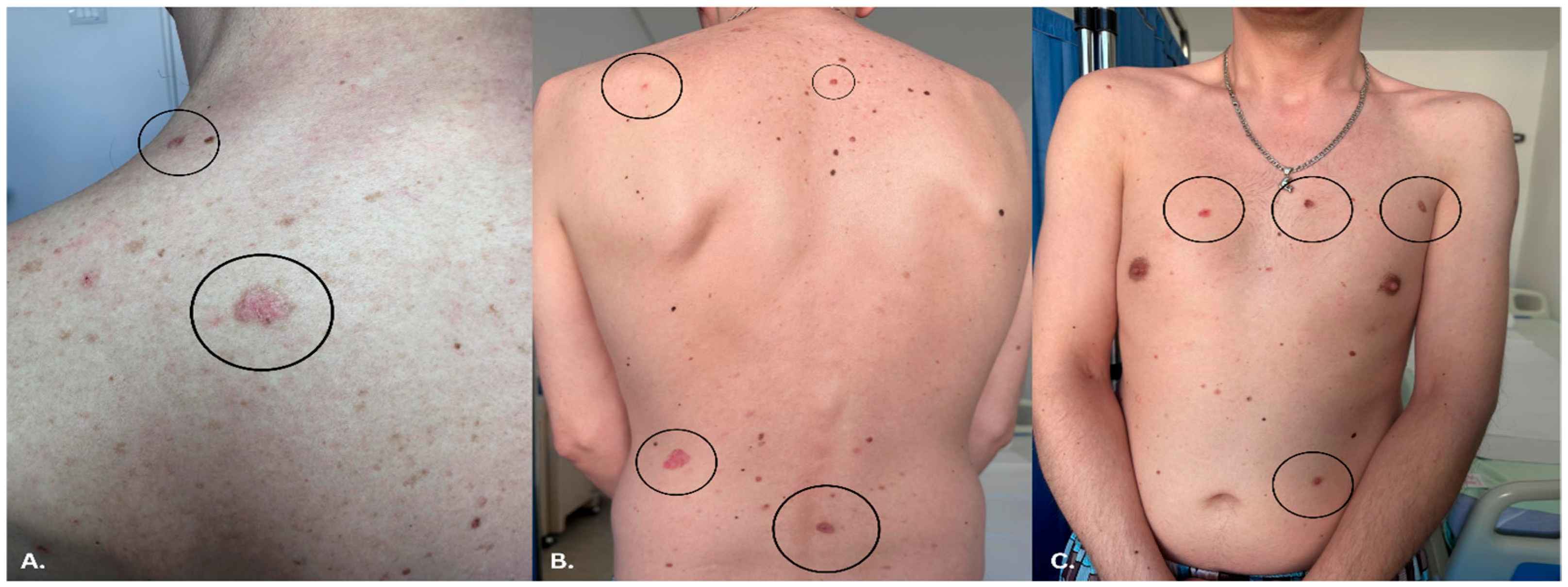
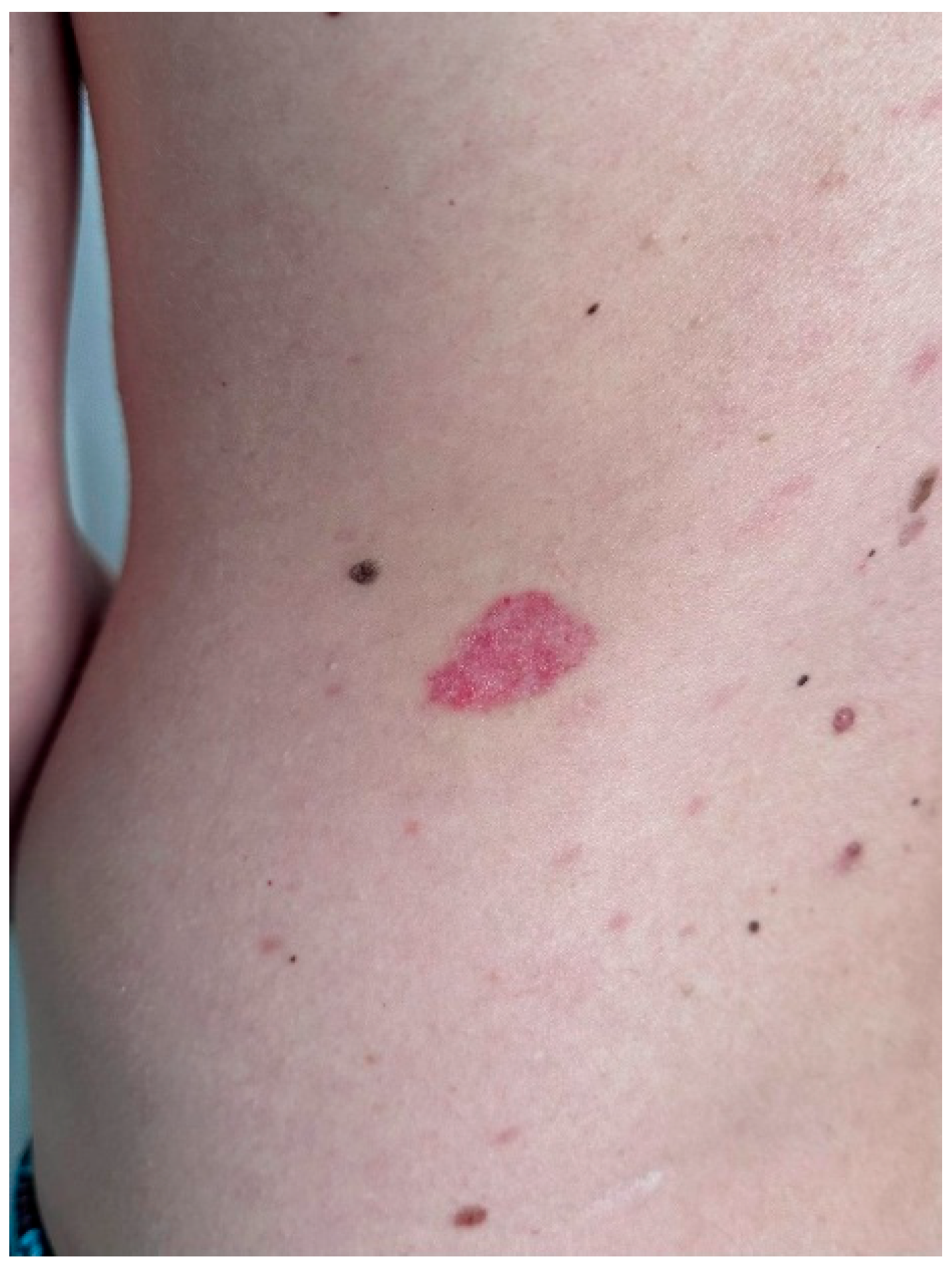
At age 34, the patient noted the development of a nodular lesion in the left lumbar region (Figure 1). Over the subsequent 12 months, nine additional lesions appeared across multiple cutaneous sites, including the back, chest, abdomen, right hip, and presternal region. The lesions varied in size, pigmentation, and surface characteristics.
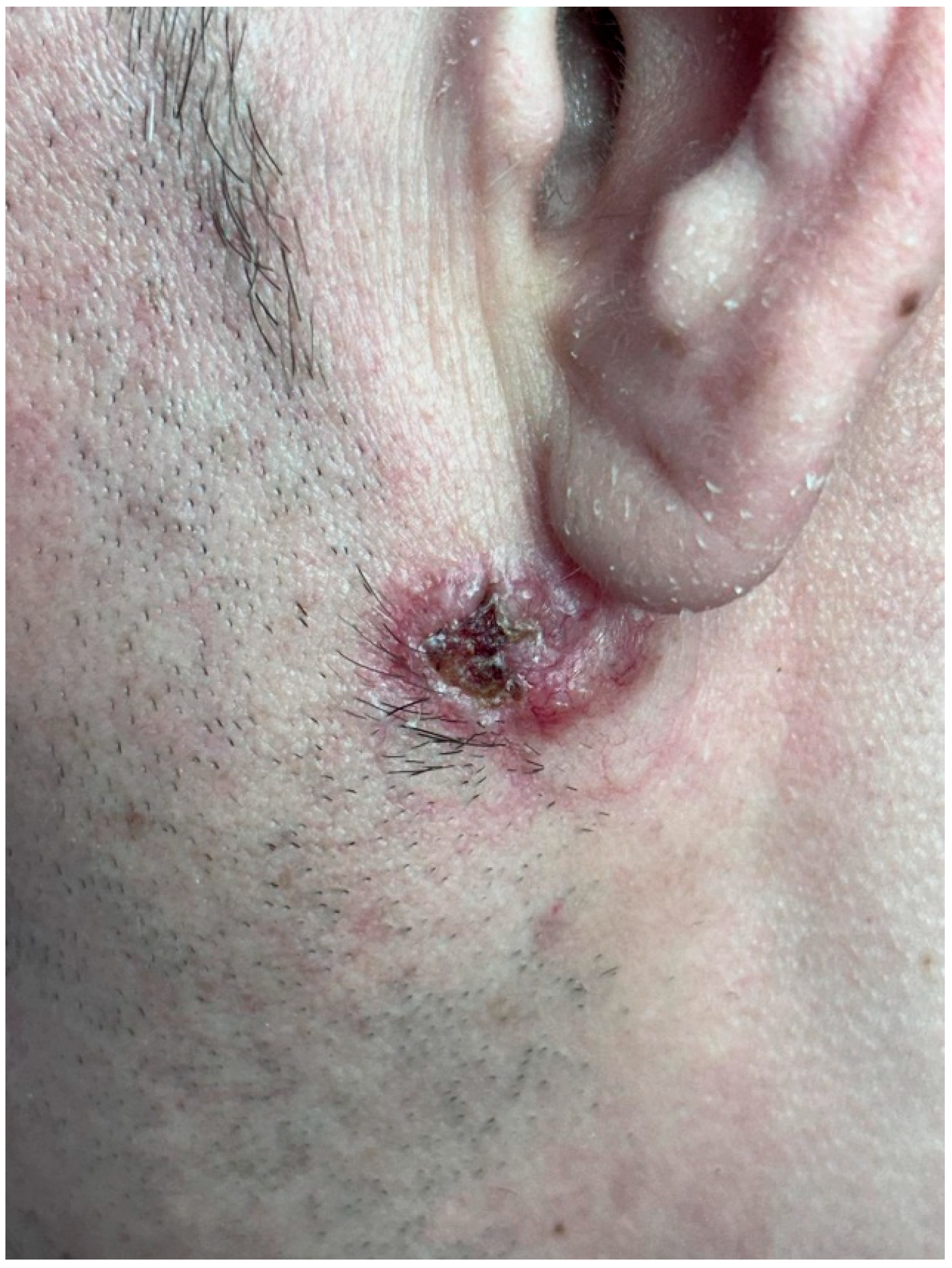
Clinical examination revealed ten well-demarcated, elevated papules and plaques, measuring between 0.3 cm and 1.3 cm in diameter (Figure 2A–C). One lesion, located below the left ear, was ulcerated with irregular borders and an erythematous halo (Figure 3). This was the only ulcerated lesion and appeared the most clinically suggestive among all cutaneous findings. The other lesions presented as shiny, pearly papules with varying degrees of pigmentation and surface scaling. No regional lymphadenopathy or systemic symptoms were reported.
The coexistence of lesions with distinct morphologic and dermoscopic signatures in a single patient provides a unique opportunity to observe the natural spectrum of BCC evolution in an immunologically altered, postradiation environment. This underscores the heterogeneity of BCC in transplant survivors compared to sporadic cases, where lesions tend to follow more predictable clinical patterns.

3.4. Dermoscopy and Diagnosis

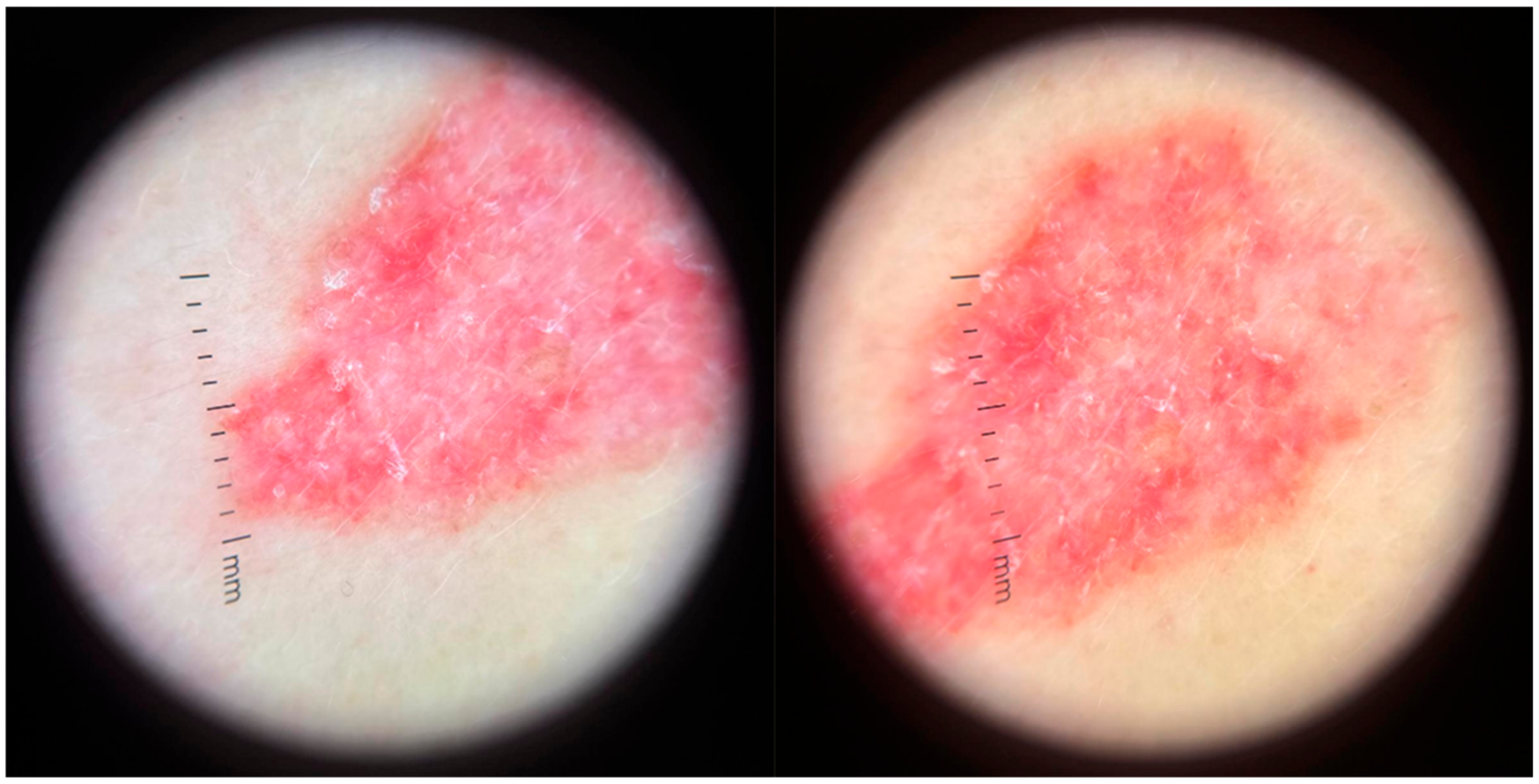
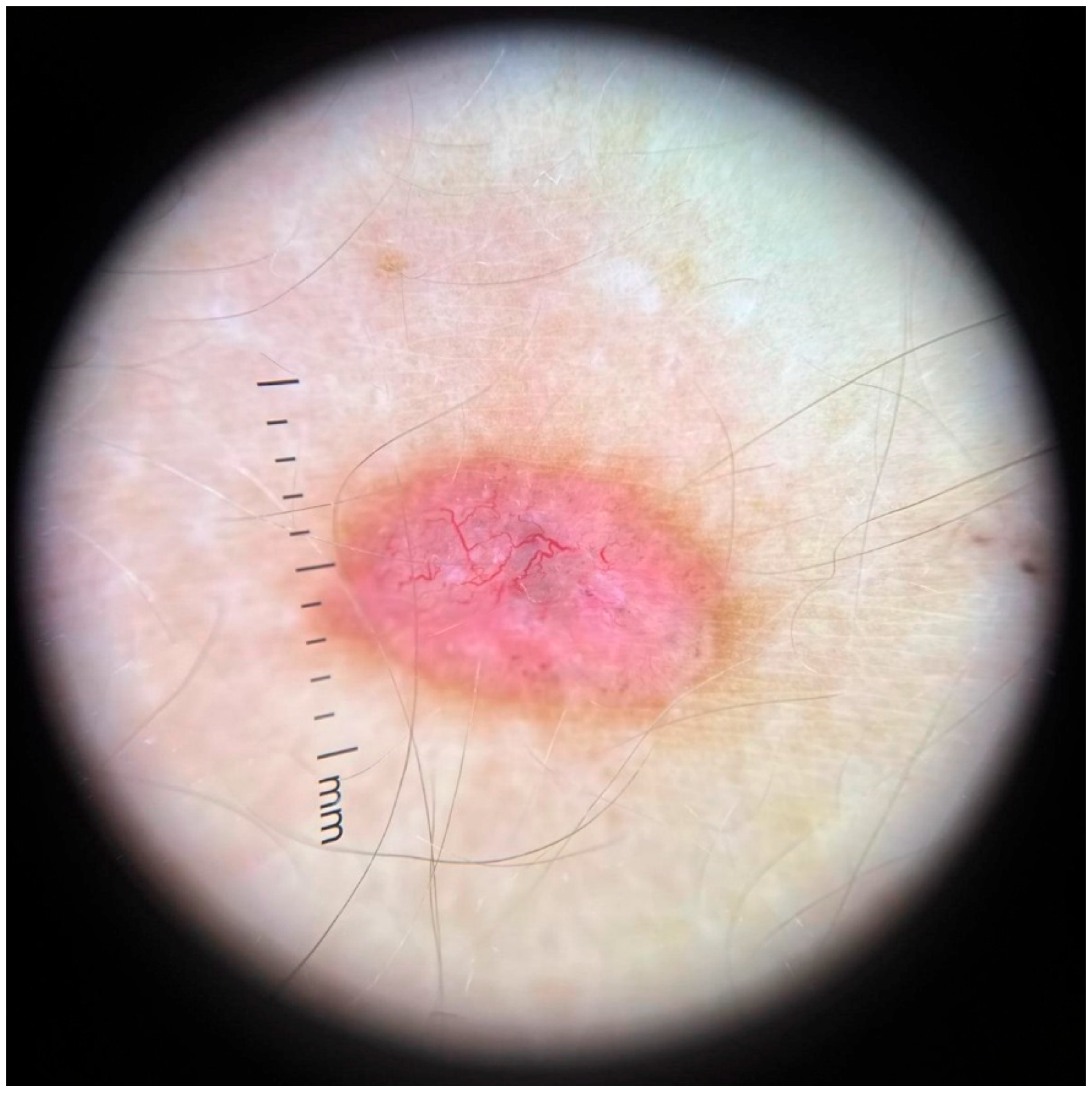
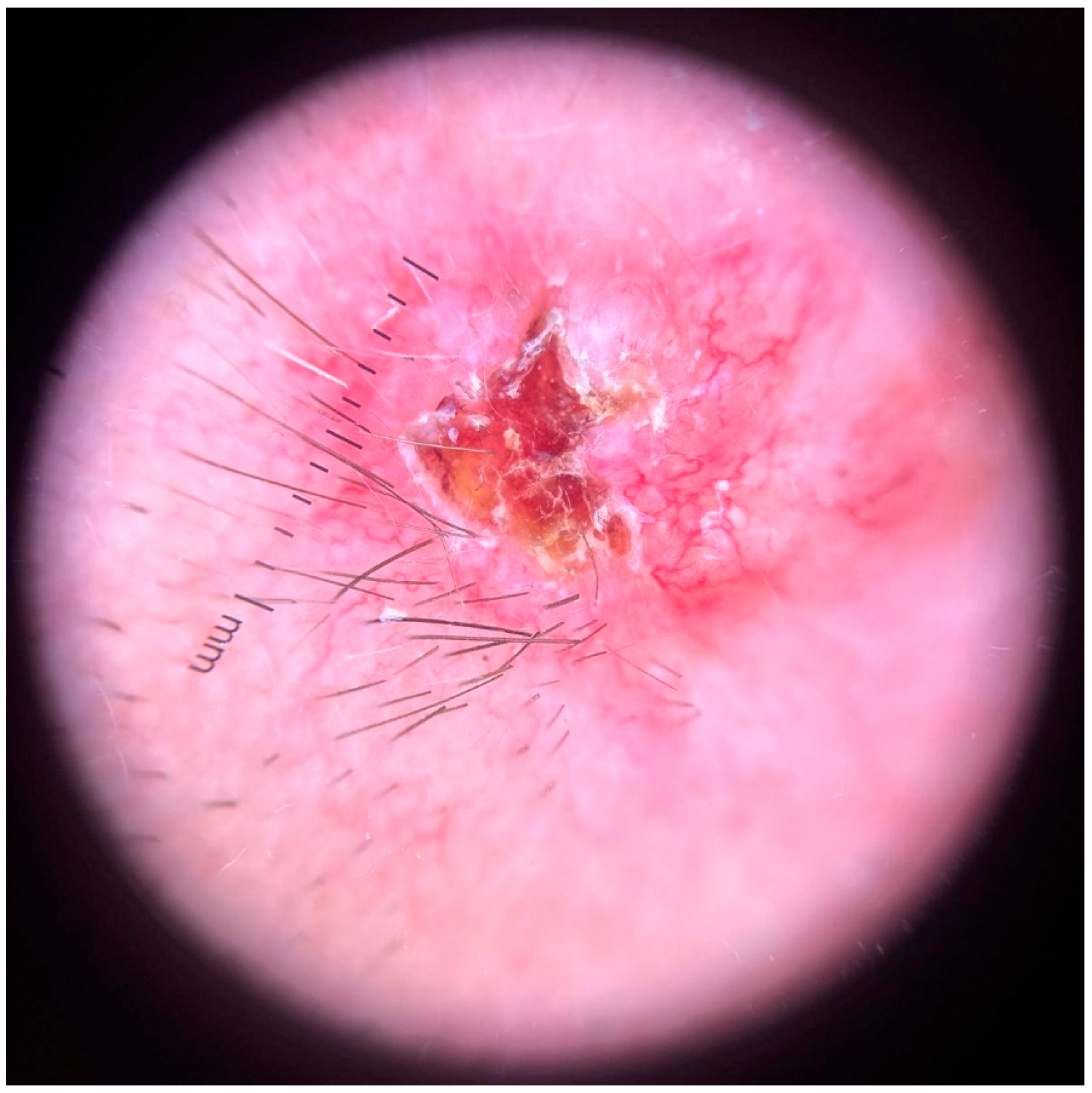
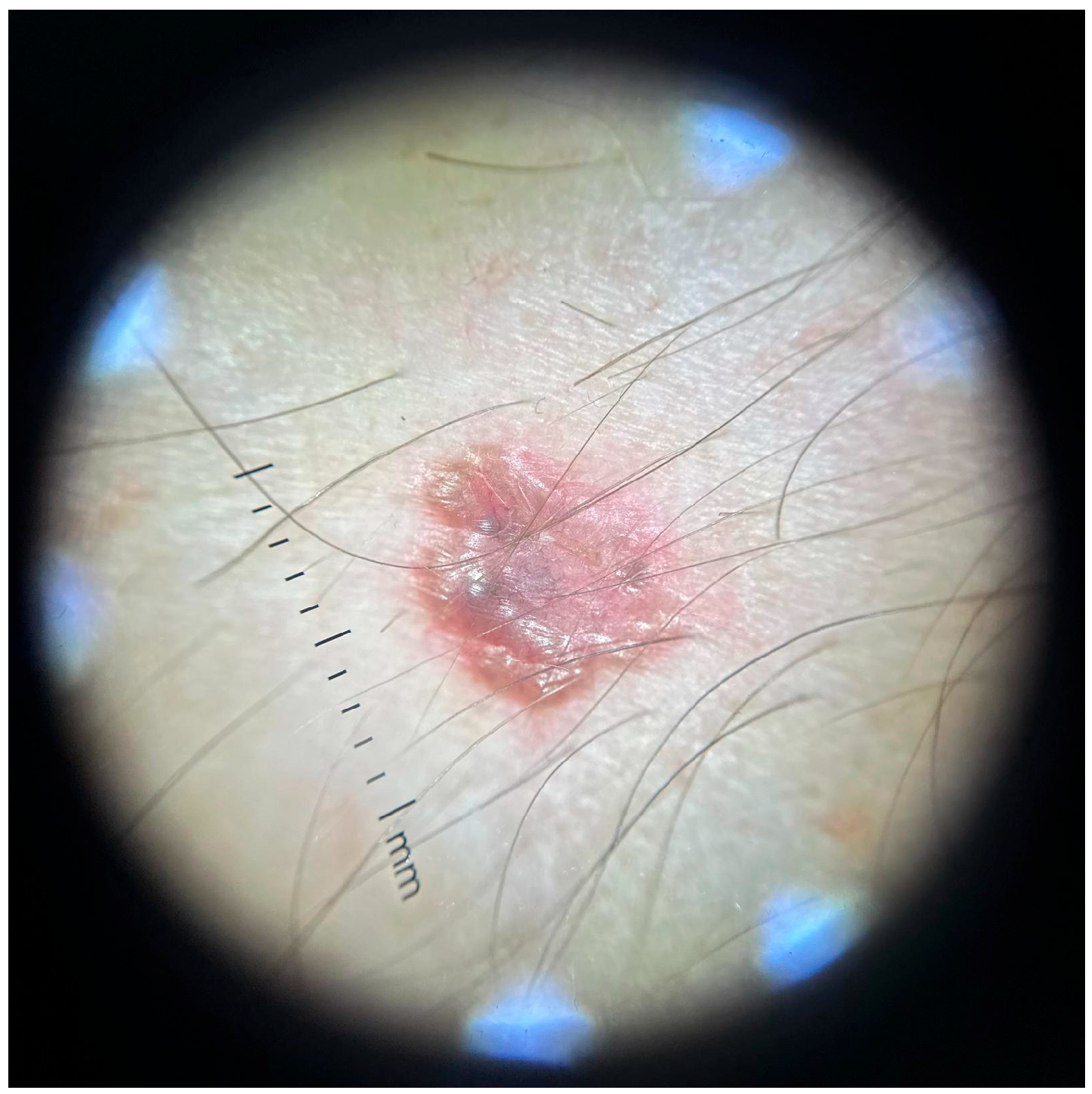
Dermoscopy revealed a highly polymorphic pattern across the examined lesions, with several key features varying in prominence depending on the lesion’s temporal evolution. The predominant findings included structureless pink areas (Figure 4), often interspersed with polymorphous vascular structures, reflecting the underlying angiogenic activity. Aspects described are structureless pink areas, structureless white areas, discrete squamae—no component is suggestive of classic BCC dermoscopic descriptions. Arborizing vessels, typically associated with BCC, were present in some (Figure 5) but not all lesions (Figure 4). These were accompanied by shiny white streaks, also known as chrysalis structures, which correspond to dermal fibrosis and were more pronounced in certain lesions (Figure 6).
Additionally, ovoid nests were identified in several lesions, appearing as well defined, dark brown to black structures suggestive of aggregations of basal cell nests within the epidermis. Structureless brown areas were also observed, varying in intensity and distribution, potentially indicative of melanin dispersion. Some lesions displayed white regression areas, characterized by a loss of pigmentation, likely reflecting immune-mediated tumor regression.
A distinct pearly crown at the periphery was noted in some lesions, manifesting as a translucent, light-reflecting rim, a feature often seen in nodular BCC (Figure 7).
Notably, the lesions developed in a sequential manner rather than simultaneously, with newer lesions exhibiting more vascularized and erythematous patterns, whereas older lesions displayed increased fibrosis and regression features. The patient was able to indicate the approximate order of lesion appearance, allowing for an assessment of the dermoscopic progression over time. Lesions that emerged in close temporal succession exhibited similar dermoscopic characteristics, whereas those that developed over a longer interval demonstrated more pronounced differences, positioning them on a continuous spectrum of dermoscopic evolution.

3.5. Histopathology

Punch and excisional biopsies confirmed nodular and superficial BCC subtypes, showing basaloid cell clusters with peripheral palisading, mucinous stroma, focal ulceration, and stromal retraction.

3.6. Management and Follow-Up

Lesions were treated with standard surgical excision and curettage. No Hh inhibitors were required (Table 1).

4. Discussion and Literature Review

4.1. Risk of BCC After Childhood ALL and HSCT

Childhood cancer survivors carry increased SMN risk; HSCT and TBI amplify this tendency, particularly for BCC. Studies demonstrate a 10–30-fold increased BCC incidence compared to age-matched controls. Younger age at radiation and fair skin phototypes contribute significantly.
This case highlights an underrecognized but clinically significant manifestation of long-term survivorship in patients treated for childhood acute lymphoblastic leukemia—namely the development of multiple basal cell carcinomas decades after hematopoietic stem cell transplantation. While the oncologic community has long been attuned to therapy-related hematologic malignancies, there is growing awareness of secondary solid tumors, with cutaneous malignancies emerging as a particularly relevant subset. The cumulative risk of non-melanoma skin cancers is notably increased among survivors who underwent total body irradiation as part of their conditioning regimen, with some studies reporting incidence rates up to 20-fold higher than those in non-irradiated controls. In a cohort of 3880 Blood or Marrow Transplantation (BMT) survivors, the 30-year cumulative incidence of any cutaneous malignant neoplasm was ~27.4% (18% for BCC), with cGVHD, immunosuppression, and age at transplant as significant risk factors [8,16,40,55,56,57,58]. The Boull et al. report gives cumulative incidence estimates and treatment/treatment-related risk factors in childhood cancer survivors (<21 yrs) [59]. Consistent with Thorsness et al., low-risk histologic subtypes predominate, recurrence is rare, and lesions are most often located in prior radiotherapy (Radiation Therapy, RT) fields [60].
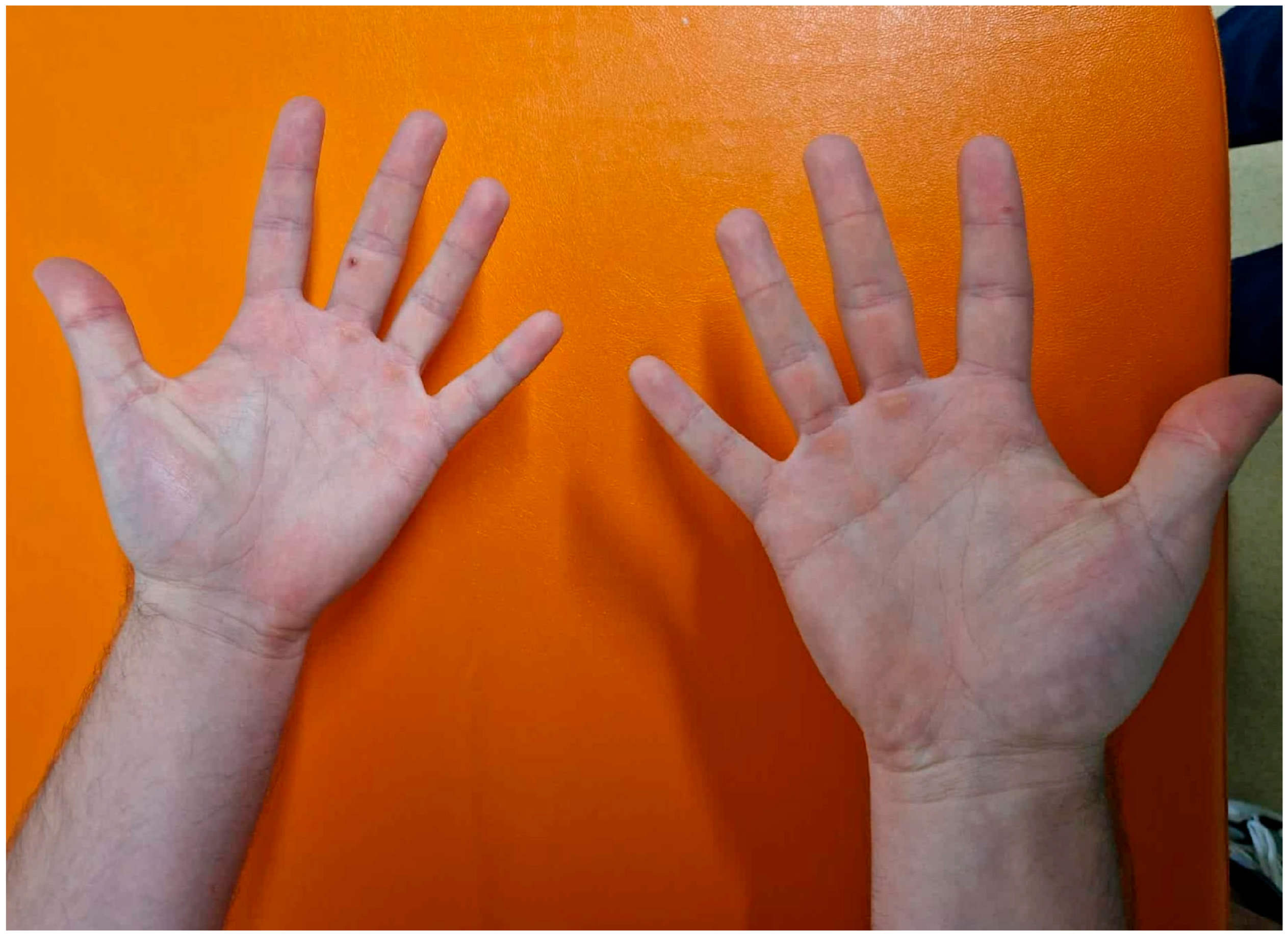
Given the unusually high number of BCCs identified in this patient, we carefully considered the possibility of Nevoid Basal Cell Carcinoma Syndrome (NBCCS), also known as Gorlin-Goltz syndrome. According to established diagnostic criteria, NBCCS requires the presence of at least two major criteria or one major and two minor criteria. In our case, the only fulfilled major criterion was the presence of multiple BCCs. The patient lacked palmar or plantar pits (documented clinically and supplemented with palmar photographs, Figure 8), had no histologically confirmed odontogenic keratocysts, and no imaging evidence suggestive of lamellar calcification of the falx cerebri or rib anomalies. Furthermore, no first-degree relatives were affected by NBCCS or related cutaneous syndromes.
With respect to the minor criteria, the patient exhibited no signs of macrocephaly, congenital facial malformations (such as frontal bossing, hypertelorism, cleft lip or palate), skeletal deformities, radiographic anomalies, or neurologic sequelae such as medulloblastoma. These features were assessed through comprehensive physical examination, review of historical imaging, and multidisciplinary input (including hematology and dermatology). To preserve patient anonymity, facial images were withheld, but clinical documentation confirms absence of dysmorphic features or ocular abnormalities. As such, this constellation of findings fails to satisfy the diagnostic threshold for NBCCS and strongly supports an acquired, non-syndromic etiology for the multiple BCCs in this case.
Importantly, this patient developed ten distinct BCCs over a one-year period, all exhibiting clinical and dermoscopic heterogeneity. This polymorphism may complicate early diagnosis, especially in the absence of routine dermatologic surveillance. Notably, the lesions did not arise simultaneously but appeared in a sequential fashion, suggesting a progressive and persistent carcinogenic field effect likely driven by prior TBI exposure, cumulative UV radiation, and immunologic dysfunction. This underscores the long latency and multifactorial nature of cutaneous SMNs in post-transplant populations [24,60,61,62].
The role of graft-versus-host disease and its management further amplifies risk. Chronic inflammation and long-term immunosuppression impair cutaneous immune surveillance, diminishing the skin’s ability to detect and clear emerging tumor clones. While the patient in this case did not exhibit chronic GVHD, his prior use of systemic corticosteroids and cyclosporine during a vulnerable developmental period may have contributed to durable immune dysregulation, further enhancing susceptibility to skin neoplasia [24,28,63,64,65,66,67]. Highlights field cancerization, risk of multiple NMSCs in immunosuppressed transplant recipients; parallels with HSCT patients, especially immunosuppression and surveillance [68,69,70].
Despite these well-established risk factors, current post-HSCT surveillance strategies rarely prioritize dermatologic assessment, particularly in adult survivors of pediatric malignancies. This gap may lead to underdiagnosis or delayed intervention, allowing lesions to reach more advanced stages before detection. The case presented here supports calls for the integration of structured skin cancer screening into survivorship protocols, particularly for patients with histories of TBI and immunosuppression [11,45,71,72,73,74]. Full-body skin examination, annual dermoscopy, and digital monitoring should become standard practice in this population, coupled with patient education on UV protection and self-examination. The meta-analysis of 100 studies revealed that experienced dermatologists employing dermoscopy achieve sensitivity and specificity for keratinocytic cancers substantially higher than with clinical examination alone [49,51,61,75,76,77,78,79,80].
Moreover, the high lesion burden observed in this patient raises important questions about chemoprevention and early intervention strategies. While surgical excision remains the gold standard for BCC management, future studies should explore the role of topical agents, photodynamic therapy, or systemic HHIs in patients with multiple or recurrent lesions, particularly when surgical morbidity is high.
From a research standpoint, this case reinforces the need for large-scale longitudinal studies investigating the long-term dermatologic outcomes of pediatric cancer survivors. Further work is needed to quantify the incidence, latency, and risk factors for cutaneous SMNs across various treatment regimens. There is also an unmet need to validate dermoscopic criteria specific to radiation- and immunosuppression-associated BCCs, which may differ in morphology from sporadic cases.
This case exemplifies the concept of a “field cancerization effect” in irradiated and immunologically compromised skin, where sequential, multifocal carcinogenesis occurs over time. The phenomenon suggests that ongoing mutagenic stress and impaired DNA repair mechanisms continue to drive tumorigenesis decades after the initial lesion.
Beyond clinical implications, this report advances an innovative perspective: dermoscopic polymorphism in post-HSCT patients should be recognized as a potential diagnostic hallmark. Developing dermoscopic algorithms specifically tailored to radiation- and immunosuppression-related BCCs could improve early recognition in this population.
Recent transcriptional profiling has identified distinct molecular signatures in high-risk aggressive BCCs, including dysregulation of pathways relevant to Hedgehog signaling and immune checkpoint activation [81,82,83,84,85,86,87]. Furthermore, the translational potential of chemopreventive strategies—such as systemic retinoids, nicotinamide supplementation, or immunomodulatory interventions—deserves exploration through multicenter clinical trials. Such preventive approaches may substantially reduce surgical burden and morbidity, especially in patients with multiple synchronous or metachronous lesions [88,89,90,91].
This case operationalizes the concept of radiation- and immunosuppression-primed field cancerization, in which sequential BCCs arise over years with dermoscopic heterogeneity. Population-level data from transplant and childhood cancer survivor cohorts now quantify this risk and justify proactive, life-long skin surveillance [40,45,59,92,93,94,95].
Methodologically, the strongest evidence for improving early detection is the routine use of dermoscopy by trained clinicians, which should be embedded into survivorship guidelines and electronic care pathways. On the preventive side, nicotinamide represents a practical chemopreventive tool to discuss with high-risk survivors, while systemic Hedgehog inhibition and, where appropriate, Programmed Death-1 (PD-1) therapy extend options for anatomically challenging or recurrent disease [49,61,96,97,98,99,100,101,102].

4.2. Molecular Pathogenesis in HSCT Survivorship

BCC pathogenesis in this context reflects the interaction of UV-induced DNA damage with therapy-induced genomic vulnerability.
Key mechanisms include: Hedgehog pathway activation (Patched1 loss, Smoothened mutations), p53 mutations from radiation exposure, impaired DNA repair capacity after TBI, altered immune surveillance due to HSCT and prior immunosuppression

Molecular Dermatology Perspective: Pathways, Biomarkers, and the “Field”

Ionizing radiation (RT/TBI) induces complex DNA lesions (double-strand breaks) and persistent oxidative stress; together with UV signatures (e.g., C > T transitions), this accelerates driver events in Patched1 (PTCH1)/Smoothened (SMO) (Hedgehog), TP53, and other genomic loci relevant to BCC. The post-transplant immune milieu further weakens immunosurveillance, fostering clonal persistence and recurrence potential. Clinically, this manifests as multifocal, metachronous BCCs in irradiated fields—precisely the pattern observed in our patient—supporting a durable field cancerization model. Large survivor cohorts corroborate these clinical patterns, including elevated keratinocyte carcinoma burden after childhood cancer, particularly with prior RT [59,103,104,105].
Translational biomarkers under study include genomic profiling (PTCH1/SMO mutations), circulating tumor DNA for difficult sites, and stromal/immune signatures that may predict responsiveness to hedgehog inhibition or immunotherapy. While not yet standard for routine BCC care, these tools are increasingly relevant for complex, multi-lesional disease in survivorship settings [106,107,108,109].

4.3. Dermoscopy in High-Risk Populations

Dermoscopy is essential for early detection. HSCT survivors may show: multiple lesion morphologies, subtle early BCC indicators, rapid evolution of superficial lesions.
In high-risk survivors, dermoscopic polymorphism may reflect lesion age, microenvironmental fibrosis, and variable Hedgehog pathway activation; documenting sequential evolution with digital dermoscopy supports earlier biopsy thresholds and staged management. Systematic review data reinforce that dermoscopy meaningfully raises sensitivity/specificity for keratinocyte cancers compared with clinical inspection alone, especially in expert hands, making it indispensable for HSCT/RT cohorts [49,110].

4.4. Therapeutic Options

A new figure summarizing BCC treatments has been added, covering: surgery, Mohs micrographic surgery, Hedgehog inhibitors (vismodegib, sonidegib), immune checkpoint inhibitors (cemiplimab), photodynamic therapy, field therapy (imiquimod, 5-FU).
The patient has been referred to a plastic surgery clinic to initiate the surgical removal of all identified skin tumors. Given the multiplicity and varied topography of the lesions, a staged excision approach has been recommended. Priority will be given to the most clinically significant lesions—those that are larger, more infiltrative, ulcerated, or located in functionally or cosmetically sensitive areas, such as the preauricular lesion beneath the left ear. Subsequent interventions will target lesions that are less prominent, located in covered anatomical regions, or demonstrate features of early-stage basal cell carcinoma. The decision-making process in the surgical management will integrate clinical, dermoscopic, and histopathological factors to optimize both oncologic control and esthetic outcomes.
Equally critical in the comprehensive management of this patient is ongoing hematologic supervision. Periodic assessments by the hematology team remain essential to ensure sustained remission of acute lymphoblastic leukemia and to monitor for late complications of hematopoietic stem cell transplantation, including secondary malignant neoplasms, bone marrow dysfunction, and chronic GVHD manifestations.
The integration of pediatric palliative care (PPC) into oncologic and post-transplant follow-up is increasingly recognized as a critical dimension of comprehensive care. A retrospective analysis of 2022–2023 Romanian data demonstrated that early, multidisciplinary PPC interventions improve quality of life, psychosocial adaptation, and long-term family outcomes for children facing life-limiting conditions. Within the context of molecular dermatology and long-term cancer survivorship, PPC should be reframed not merely as end-of-life support but as a continuum of care encompassing symptom management, psychological counseling, and educational guidance for both patients and families. In survivors of childhood leukemia and HSCT, chronic dermatologic sequelae—such as radiation-induced skin fibrosis, multiple carcinomas, and psychosocial distress—can persist well into adulthood. Integrating PPC principles into dermatologic survivorship care enables earlier identification of suffering (physical or emotional), improved adherence to preventive strategies, and enhanced coordination between oncology, dermatology, and psychosocial services. This approach aligns with a precision-medicine philosophy in which clinical innovation coexists with compassionate, human-centered care, ensuring that advances in molecular dermatology are translated into meaningful, patient-oriented outcomes [54].

4.5. Dermatologic Surveillance in Survivorship

Dermatologic follow-up at regular intervals is indispensable. Annual full-body skin exams are recommended; high-risk survivors may require biannual surveillance, sun protection counseling, and photographic monitoring. Shared-care models between dermatology and survivorship clinics improve outcomes.
Given the patient’s demonstrated propensity for developing multiple basal cell carcinomas within a short timeframe, lifelong surveillance is warranted. This should include routine total body skin examinations with dermoscopy, documentation of evolving or new lesions through clinical photography, and a low threshold for biopsy of atypical findings. Emphasis should be placed on patient education, encouraging self-examination and prompt reporting of new or changing skin lesions. Adjunctive tools such as digital dermoscopy and sequential monitoring may enhance early detection in this high-risk population.
Beyond staged surgical excision, a precision–prevention framework is warranted:
  • Photoprotection and UV avoidance;
  • Chemoprevention—randomized Phase III evidence supports oral nicotinamide (500 mg twice daily) in patients with prior NMSC to reduce new lesions during active treatment;
  • Risk-adapted intervals for full-body dermoscopy;
  • Consideration of topical field therapies (5-FU, imiquimod, daylight-PDT) for actinic field control;
  • Early multidisciplinary evaluation for unresectable/morbid lesions, including hedgehog inhibitors or PD-1 blockade where indicated [101,102,111,112,113,114].
For locally advanced or periorbital tumors, hedgehog inhibitors (vismodegib, sonidegib) achieve meaningful responses but require proactive toxicity management and adherence strategies; newer reviews outline long-term optimization models [115,116,117,118].

4.5.1. Innovative Diagnostics: Digital Dermoscopy, AI, and Longitudinal Monitoring

Embedding dermoscopy into survivorship clinics is supported by high-quality evidence; the incremental value is greatest when paired with longitudinal digital imaging and standardized descriptors. Meta-analytic data show that dermatologist performance improves substantially with dermoscopy versus unaided exam, with implications for triage, earlier detection, and reduced unnecessary biopsies [49,80,119,120].
Pragmatically, HSCT/RT-exposed survivors benefit from: baseline total-body photography; lesion mapping with serial dermoscopy; risk-tiered recall (6–12 months) escalated by UV history, radiation fields, and immunosuppression history; and teledermoscopy adjuncts for interim changes.

4.5.2. Translational Therapeutics and Precision Prevention

Hedgehog pathway inhibitors (HHIs: vismodegib, sonidegib) remain first-line systemic options for advanced BCC; emerging strategies emphasize intermittent dosing, toxicity mitigation, and combination approaches to enhance durability while preserving quality of life [100,114,121,122,123].
Chemoprevention: The ONTRAC Phase III RCT supports nicotinamide 500 mg BID to reduce new NMSC events during treatment in high-risk populations—an attractive, low-cost option for irradiated survivors, with the caveat that benefits wane after discontinuation [101,124,125,126].
Immuno-oncology: For HHI-refractory disease or contraindications, PD-1 blockade has activity in advanced BCC; patient selection may be refined by tumor mutational burden and immune microenvironment features in future studies [127,128,129,130].
Field therapy and surgery: Algorithmic integration of field therapies (e.g., daylight-PDT) with staged excisions can reduce cumulative surgical morbidity in multi-lesional patients, while maintaining oncologic control [131,132,133,134].

5. Conclusions and Future Perspectives

This case highlights cutaneous malignancies—particularly basal cell carcinoma (BCC)—as a significant yet still underrecognized late complication in long-term survivors of childhood acute lymphoblastic leukemia (ALL) treated with hematopoietic stem cell transplantation (HSCT), radiotherapy, and prolonged immunosuppression. The development of multiple, clinically heterogeneous BCCs decades after oncologic therapy illustrates the persistent carcinogenic vulnerability of this population and underscores the concept of long-lasting field cancerization in previously irradiated and immunologically altered skin.
Lifelong dermatologic surveillance should therefore be regarded as an essential component of survivorship care rather than an optional adjunct. The systematic integration of structured skin cancer screening—including regular full-body examinations, dermoscopy-assisted assessment, and patient education for self-surveillance—can facilitate earlier diagnosis, reduce cumulative surgical morbidity, and improve long-term quality of life. These measures are particularly critical for survivors exposed to total body irradiation or chronic immunosuppression, who remain at elevated risk well into adulthood.
The findings of this report support the need for an interdisciplinary survivorship model in which dermatologists, oncologists, hematologists, and transplant specialists collaborate to develop standardized, risk-adapted guidelines for skin cancer prevention and early detection. Advances in molecular dermatology, including targeted inhibition of the Hedgehog pathway, immunotherapeutic strategies, and evidence-based chemoprevention, offer opportunities to complement surgical management and reduce disease burden in selected high-risk patients.
Looking forward, future research should prioritize longitudinal cohort studies to better define cumulative risk trajectories, identify molecular and genetic susceptibility markers—such as PTCH1 or SMO variants—and validate precision–prevention approaches. The integration of digital surveillance tools, including artificial intelligence–assisted dermoscopy and teledermatology platforms, may further enhance early detection while expanding access to specialized care, particularly in resource-limited settings. As the population of childhood cancer survivors continues to grow, proactive, molecularly informed dermatologic care will be pivotal in preventing avoidable morbidity from otherwise treatable skin malignancies.

Author Contributions

Conceptualization, E.P.-A., G.S., V.P. and D.E.B.; methodology, E.P.-A., G.S. and D.E.B.; software, E.P.-A., G.S. and A.E.H.; validation, C.M., M.-P.T., C.C.-B. and A.L.; formal analysis, C.M., V.P., G.R.-Z. and E.A.; investigation, E.P.-A., A.E.H., V.P., C.C.-B., A.L. and D.E.B.; resources, A.E.H., M.-P.T., C.C.-B., A.L., G.R.-Z. and E.A.; data curation, C.M., M.-P.T., V.P., G.R.-Z. and E.A.; writing—original draft preparation, A.E.H., V.P. and C.C.-B.; writing—review and editing, E.P.-A., G.S. and D.E.B.; visualization, E.P.-A., G.S., A.E.H., C.M., M.-P.T., V.P., C.C.-B., A.L., G.R.-Z., E.A. and D.E.B.; supervision, E.P.-A. and G.S.; project administration, E.P.-A. and D.E.B.; funding acquisition, not applicable. All authors have read and agreed to the published version of the manuscript.

Funding

This research received no external funding.

Institutional Review Board Statement

Ethical review and approval were waived for this study as the present paper is a retrospective report of routine clinical care. No experimental procedures or research interventions were involved in the management or outcome of the case.

Informed Consent Statement

Written informed consent has been obtained from the patient to publish this paper.

Data Availability Statement

No new data were created or analyzed in this study. Data sharing is not applicable to this article due to patient privacy and ethical considerations.

Acknowledgments

The authors wish to thank the dermatology, hematology, and plastic surgery teams involved in the multidisciplinary care of the patient. Their collaboration was essential in the diagnostic and therapeutic approach detailed in this report. The authors have reviewed and edited the output and take full responsibility for the content of this publication.

Conflicts of Interest

The authors declare no conflicts of interest. The funders had no role in the design of the study; in the collection, analyses, or interpretation of data; in the writing of the manuscript; or in the decision to publish the results.

Abbreviations

The following abbreviations are used in this manuscript:
5-FU5-fluorouracil
AIArtificial Intelligence
ALLAcute Lymphoblastic Leukemia
BCCBasal Cell Carcinoma
BFMBerlin-Frankfurt-Münster
BMTBlood or Marrow Transplantation
DNADeoxyribonucleic Acid
GVHDGraft-Versus-Host Disease
HHIHedgehog pathway Inhibitor
HSCTHematopoietic Stem Cell Transplantation
NBCCSNevoid Basal Cell Carcinoma Syndrome
NMSCNon-Melanoma Skin Cancer
ONTRACOral Nicotinamide to Reduce Actinic Cancer
PD-1Programmed Death-1
PDTPhotodynamic Therapy
PPCPediatric Palliative Care
PRISMA-ScRPreferred Reporting Items for Systematic Reviews and Meta-Analyses—Scoping Reviews
PTCH1Protein patched homolog 1
RTRadiation Therapy (Radiotherapy)
SMNsSecondary Malignant Neoplasms
SMOSmoothened = a 7-transmembrane protein essential to the activation of Gli transcription factors (Gli) by hedgehog morphogens
TBITotal Body Irradiation
TP53A gene that codes for the tumor protein p53
UVUltraviolet

References

  1. Roky, A.H.; Islam, M.M.; Ahasan, A.M.F.; Mostaq, M.S.; Mahmud, M.Z.; Amin, M.N.; Mahmud, M.A. Overview of skin cancer types and prevalence rates across continents. Cancer Pathog. Ther. 2024, 3, 89–100. [Google Scholar] [CrossRef]
  2. Bhojwani, D.; Yang, J.J.; Pui, C.H. Biology of childhood acute lymphoblastic leukemia. Pediatr. Clin. N. Am. 2015, 62, 47–60. [Google Scholar] [CrossRef]
  3. Esparza, S.D.; Sakamoto, K.M. Topics in pediatric leukemia—Acute lymphoblastic leukemia. MedGenMed 2005, 7, 23. [Google Scholar]
  4. Ivanov, A.V.; Alecsa, M.S.; Popescu, R.; Starcea, M.I.; Mocanu, A.M.; Rusu, C.; Miron, I.C. Pediatric Acute Lymphoblastic Leukemia Emerging Therapies—From Pathway to Target. Int. J. Mol. Sci. 2023, 24, 4661. [Google Scholar] [CrossRef]
  5. Hunger, S.P.; Mullighan, C.G. Acute lymphoblastic leukemia in children. N. Engl. J. Med. 2015, 373, 1541–1552. [Google Scholar] [CrossRef] [PubMed]
  6. Park, H.; Lee, J.H.; Lee, J.H.; Park, H.S.; Choi, E.J.; Lee, K.H.; Lee, Y.S.; Kang, Y.A.; Jeon, M.; Woo, J.M.; et al. Effectiveness of prophylactic intrathecal chemotherapy and risk factors of central nervous system relapse after allogeneic hematopoietic cell transplantation in acute myeloid leukemia. Leuk. Lymphoma 2025, 66, 2249–2259. [Google Scholar] [CrossRef] [PubMed]
  7. Bhatia, S. Long-term health impacts of hematopoietic stem cell transplantation inform recommendations for follow-up. Expert Rev. Hematol. 2011, 4, 437–454. [Google Scholar] [CrossRef]
  8. Curtis, R.E.; Rowlings, P.A.; Deeg, H.J.; Shriner, D.A.; Socié, G.; Travis, L.B.; Horowitz, M.M.; Witherspoon, R.P.; Hoover, R.N.; Sobocinski, K.A.; et al. Solid cancers after bone marrow transplantation. N. Engl. J. Med. 1997, 336, 897–904. [Google Scholar] [CrossRef] [PubMed]
  9. Yavvari, S.; Makena, Y.; Sukhavasi, S.; Makena, M.R. Large Population Analysis of Secondary Cancers in Pediatric Leukemia Survivors. Children 2019, 6, 130. [Google Scholar] [CrossRef] [PubMed]
  10. Turcotte, L.M.; Whitton, J.A.; Friedman, D.L.; Hammond, S.; Armstrong, G.T.; Leisenring, W.; Robison, L.L.; Neglia, J.P. Risk of subsequent neoplasms during the fifth and sixth decades of life in the Childhood Cancer Survivor Study cohort. J. Clin. Oncol. 2015, 33, 3568–3575. [Google Scholar] [CrossRef]
  11. Stapleton, J.L.; Tatum, K.L.; Devine, K.A.; Stephens, S.; Masterson, M.; Baig, A.; Hudson, S.V.; Coups, E.J. Skin cancer surveillance behaviors among childhood cancer survivors treated with radiation. Pediatr. Blood Cancer 2016, 63, 554–557. [Google Scholar] [CrossRef]
  12. Armstrong, G.T.; Chen, Y.; Yasui, Y.; Leisenring, W.; Gibson, T.M.; Mertens, A.C.; Stovall, M.; Oeffinger, K.C.; Bhatia, S.; Krull, K.R. Reduction in late mortality among 5-year survivors of childhood cancer. N. Engl. J. Med. 2016, 374, 833–842. [Google Scholar] [CrossRef] [PubMed]
  13. Liu, Y.C.; Eldomery, M.K.; Maciaszek, J.L.; Klco, J.M. Inherited Predispositions to Myeloid Neoplasms: Pathogenesis and Clinical Implications. Annu. Rev. Pathol. 2025, 20, 87–114. [Google Scholar] [CrossRef]
  14. Costa, A.; Pilo, F.; Pettinau, M.; Piras, E.; Targhetta, C.; Rojas, R.; Deias, P.; Mulas, O.; Caocci, G. Impact of primary cancer history and molecular landscape in therapy-related myeloid neoplasms. Front. Oncol. 2025, 15, 1563990. [Google Scholar] [CrossRef]
  15. Dores, G.M.; Linet, M.S.; Curtis, R.E.; Morton, L.M. Risks of therapy-related hematologic neoplasms beyond myelodysplastic syndromes and acute myeloid leukemia. Blood 2023, 141, 951–955. [Google Scholar] [CrossRef]
  16. Teepen, J.C.; Kok, J.L.; Kremer, L.C.; Tissing, W.J.E.; van den Heuvel-Eibrink, M.M.; Loonen, J.J.; Bresters, D.; van der Pal, H.J.; Versluys, B.; van Dulmen-den Broeder, E.; et al. Long-term risk of skin cancer among childhood cancer survivors: A DCOG-LATER cohort study. J. Natl. Cancer Inst. 2019, 111, 845–853. [Google Scholar] [CrossRef]
  17. Im, C.; Boull, C.; Lu, Z.; Liao, K.; Hasan, H.; Xu, L.; Sapkota, Y.; Howell, R.M.; Arnold, M.A.; Conces, M.R.; et al. Basal cell carcinoma risk prediction in survivors of childhood cancer. J. Natl. Cancer Inst. 2025, 117, 2352–2361. [Google Scholar] [CrossRef]
  18. Apalla, Z.; Sotiriou, E.; Lallas, A.; Lazaridou, E.; Vakirlis, E.; Ioannides, D. Basal Cell Carcinoma in a Childhood Cancer Survivor: What Neurosurgeons Should Avoid. Ski. Appendage Disord. 2017, 3, 202–204. [Google Scholar] [CrossRef] [PubMed]
  19. Wunderlich, K.C.; Orte Cano, C.; Suppa, M.; Gaide, O.; White, J.M.; Njimi, H.; Euromelanoma Working Group; Marmol, V.D. High-Frequency Basal Cell Carcinoma: Demographic, Clinical, and Histopathological Features in a Belgian Cohort. J. Clin. Med. 2025, 14, 4678. [Google Scholar] [CrossRef]
  20. DeFine, K.A.; Weinstock, M.A. Early-stage nonmelanoma skin cancer and radiation therapy in childhood. Arch. Dermatol. 2008, 144, 873–878. [Google Scholar]
  21. Bhatia, S.; Sklar, C. Second cancers in survivors of childhood cancer. Nat. Rev. Cancer 2002, 2, 124–132. [Google Scholar] [CrossRef] [PubMed]
  22. Li, C.; Athar, M. Ionizing Radiation Exposure and Basal Cell Carcinoma Pathogenesis. Radiat. Res. 2016, 185, 217–228. [Google Scholar] [CrossRef] [PubMed]
  23. Schwartz, J.L.; Kopecky, K.J.; Mathes, R.W.; Leisenring, W.M.; Friedman, D.L.; Deeg, H.J. Basal cell skin cancer after total-body irradiation and hematopoietic cell transplantation. Radiat. Res. 2009, 171, 155–163. [Google Scholar] [CrossRef]
  24. Inamoto, Y.; Lee, S.J. Late effects of blood and marrow transplantation. Haematologica 2017, 102, 614–625. [Google Scholar] [CrossRef]
  25. Bhatia, S. Therapy-related myelodysplasia and leukemia after childhood cancer. Nat. Rev. Clin. Oncol. 2013, 10, 132–142. [Google Scholar]
  26. Yang, H.; Cheong, S.; He, Y.; Lu, F. Mesenchymal stem cell-based therapy for autoimmune-related fibrotic skin diseases—Systemic sclerosis and sclerodermatous graft-versus-host disease. Stem Cell Res. Ther. 2023, 14, 372. [Google Scholar] [CrossRef]
  27. Choi, S.W.; Levine, J.E.; Ferrara, J.L. Pathogenesis and management of graft-versus-host disease. Immunol. Allergy Clin. N. Am. 2010, 30, 75–101. [Google Scholar] [CrossRef]
  28. Euvrard, S.; Kanitakis, J.; Claudy, A. Skin cancers after organ transplantation. N. Engl. J. Med. 2003, 348, 1681–1691. [Google Scholar] [CrossRef]
  29. Hojo, M.; Morimoto, T.; Maluccio, M.; Asano, T.; Morishita, Y.; Suthanthiran, M. Cyclosporine induces cancer progression by a cell-autonomous mechanism. Nature 1999, 397, 530–534. [Google Scholar] [CrossRef]
  30. Starace, M.; Rapparini, L.; Cedirian, S. Skin Malignancies Due to Anti-Cancer Therapies. Cancers 2024, 16, 1960. [Google Scholar] [CrossRef]
  31. Ume, A.C.; Pugh, J.M.; Kemp, M.G.; Williams, C.R. Calcineurin inhibitor (CNI)-associated skin cancers: New insights on exploring mechanisms by which CNIs downregulate DNA repair machinery. Photodermatol. Photoimmunol. Photomed. 2020, 36, 433–440. [Google Scholar] [CrossRef]
  32. Mittal, A.; Colegio, O.R. Skin Cancers in Organ Transplant Recipients. Am. J. Transplant. 2017, 17, 2509–2530. [Google Scholar] [CrossRef] [PubMed]
  33. Kreher, M.A.; Noland, M.M.B.; Konda, S.; Longo, M.I.; Valdes-Rodriguez, R. Risk of melanoma and nonmelanoma skin cancer with immunosuppressants, part I: Calcineurin inhibitors, thiopurines, IMDH inhibitors, mTOR inhibitors, and corticosteroids. J. Am. Acad. Dermatol. 2023, 88, 521–530. [Google Scholar] [CrossRef]
  34. Perkins, J.L.; Liu, Y.; Mitby, P.A.; Neglia, J.P.; Hammond, S.; Stovall, M.; Meadows, A.T.; Hutchinson, R.; Dreyer, Z.E.; Robison, L.L.; et al. Nonmelanoma skin cancer in survivors of childhood and adolescent cancer: A report from the childhood cancer survivor study. J. Clin. Oncol. 2005, 23, 3733–3741. [Google Scholar] [CrossRef]
  35. Al-Mahayri, Z.N.; AlAhmad, M.M.; Ali, B.R. Long-Term Effects of Pediatric Acute Lymphoblastic Leukemia Chemotherapy: Can Recent Findings Inform Old Strategies? Front. Oncol. 2021, 11, 710163. [Google Scholar] [CrossRef]
  36. Zahnreich, S.; Schmidberger, H. Childhood Cancer: Occurrence, Treatment and Risk of Second Primary Malignancies. Cancers 2021, 13, 2607. [Google Scholar] [CrossRef] [PubMed]
  37. Guilcher, G.M.T.; Rivard, L.; Huang, J.T.; Wright, N.A.M.; Anderson, L.; Eissa, H.; Pelletier, W.; Ramachandran, S.; Schechter, T.; Shah, A.J.; et al. Immune function in childhood cancer survivors: A Children’s Oncology Group review. Lancet Child Adolesc. Health 2021, 5, 284–294. [Google Scholar] [CrossRef]
  38. Perkins, S.M.; Dewees, T.; Shinohara, E.T.; Reddy, M.M.; Frangoul, H. Risk of subsequent malignancies in survivors of childhood leukemia. J. Cancer Surviv. 2013, 7, 544–550. [Google Scholar] [CrossRef]
  39. Evangelidis, P.; Gavriilaki, E.; Tsakiris, D.A. Thrombotic complications after hematopoietic stem cell transplantation and other cellular therapies. Thromb. Update 2024, 16, 100186. [Google Scholar] [CrossRef]
  40. Broman, K.K.; Meng, Q.; Holmqvist, A.; Balas, N.; Richman, J.; Landier, W.; Hageman, L.; Ross, E.; Bosworth, A.; Te, H.S.; et al. Incidence of and Risk Factors for Cutaneous Malignant Neoplasms After Blood or Marrow Transplant. JAMA Dermatol. 2025, 161, 265–273. [Google Scholar] [CrossRef] [PubMed]
  41. Ghosh, T.; Hyun, G.; Dhaduk, R.; Conces, M.; Arnold, M.A.; Howell, R.M.; Henderson, T.O.; McDonald, A.; Robison, L.L.; Yasui, Y.; et al. Late subsequent leukemia after childhood cancer: A report from the Childhood Cancer Survivor Study (CCSS). Cancer Med. 2024, 13, e70086. [Google Scholar] [CrossRef]
  42. Kızılocak, H.; Okcu, F. Late Effects of Therapy in Childhood Acute Lymphoblastic Leukemia Survivors. Turk. J. Haematol. 2019, 36, 1–11. [Google Scholar] [CrossRef]
  43. Hudson, M.M.; Link, M.P.; Simone, J.V. Milestones in the curability of pediatric cancers. J. Clin. Oncol. 2014, 32, 2391–2397. [Google Scholar] [CrossRef]
  44. Robison, L.L.; Hudson, M.M. Survivors of childhood and adolescent cancer: Life-long risks and responsibilities. Nat. Rev. Cancer 2014, 14, 61–70. [Google Scholar] [CrossRef]
  45. Chow, E.J.; Anderson, L.; Baker, K.S.; Bhatia, S.; Guilcher, G.M.; Huang, J.T.; Pelletier, W.; Perkins, J.L.; Rivard, L.S.; Schechter, T. Late Effects Surveillance Recommendations among Survivors of Childhood Hematopoietic Cell Transplantation: A Children’s Oncology Group Report. Biol. Blood Marrow Transplant. 2016, 22, 782–795. [Google Scholar] [CrossRef]
  46. de Gruijl, F.R.; Tensen, C.P. Pathogenesis of Skin Carcinomas and a Stem Cell as Focal Origin. Front. Med. 2018, 5, 165. [Google Scholar] [CrossRef]
  47. Carvalho, C.; Silva, R.; Melo, T.M.V.D.P.E.; Inga, A.; Saraiva, L. P53 and the Ultraviolet Radiation-Induced Skin Response: Finding the Light in the Darkness of Triggered Carcinogenesis. Cancers 2024, 16, 3978. [Google Scholar] [CrossRef] [PubMed]
  48. Aszterbaum, M.; Epstein, J.; Oro, A.; Douglas, V.; LeBoit, P.E.; Scott, M.P.; Epstein, E.H., Jr. Ultraviolet and ionizing radiation enhance the growth of BCCs and trichoblastomas in patched heterozygous knockout mice. Nat. Med. 1999, 5, 1285–1291. [Google Scholar] [CrossRef]
  49. Chen, J.Y.; Fernandez, K.; Fadadu, R.P.; Reddy, R.; Kim, M.O.; Tan, J.; Wei, M.L. Skin Cancer Diagnosis by Lesion, Physician, and Examination Type: A Systematic Review and Meta-Analysis. JAMA Dermatol. 2025, 161, 135–146. [Google Scholar] [CrossRef] [PubMed]
  50. Klein, C.M.; Sivesind, T.E.; Dellavalle, R.P. From the Cochrane Library: Visual Inspection and Dermoscopy, Alone or in Combination, for Diagnosing Keratinocyte Skin Cancers in Adults. JMIR Dermatol. 2024, 7, e41657. [Google Scholar] [CrossRef] [PubMed]
  51. Dinnes, J.; Deeks, J.J.; Chuchu, N.; Matin, R.N.; Wong, K.Y.; Aldridge, R.B.; Durack, A.; Gulati, A.; Chan, S.A.; Johnston, L.; et al. Visual inspection and dermoscopy, alone or in combination, for diagnosing keratinocyte skin cancers in adults. Cochrane Database Syst. Rev. 2018, 12, CD011901. [Google Scholar] [CrossRef] [PubMed]
  52. Middleton, H.T.; Swanson, D.L.; Sartori-Valinotti, J.C.; O’Laughlin, D.J.; Young, P.A.; Merry, S.P.; Nelson, K.; Fischer, K.; Weatherly, R.M.; Boswell, C.L. Impact of Dermoscopy Training on Diagnostic Accuracy, and Its Association With Biopsy and Referral Patterns Among Primary Care Providers: A Retrospective and Prospective Educational Intervention Study. J. Prim. Care Community Health 2024, 15, 21501319241296625. [Google Scholar] [CrossRef]
  53. Harrison, K. The Accuracy of Skin Cancer Detection Rates with the Implementation of Dermoscopy Among Dermatology Clinicians: A Scoping Review. J. Clin. Aesthet. Dermatol. 2024, 17, S18–S27. [Google Scholar]
  54. Hizanu Dumitrache, M.; Duceac Covrig, M.; Mîndru, D.E.; Plesea Condratovici, A.; Mitrea, G.; Elkan, E.M.; Curici, A.; Gafton, B.; Duceac, L.D. The Need for Pediatric Palliative Care in Romania: A Retrospective Study (2022–2023) Based on Quantitative Research and Analysis of Secondary Statistical Data. Medicina 2025, 61, 1282. [Google Scholar] [CrossRef]
  55. Rohan, T.Z.; Mandel, J.; Banner, L.; Zachian, R.; Yang, H.; Lee, E.; O’Donnell-Cappelli, M.; Bhatti, S.; Zhan, T.; Lee, J.B.; et al. The risk of developing second primary malignancies in cutaneous melanoma survivors. J. Am. Acad. Dermatol. 2025, 92, 914–917. [Google Scholar] [CrossRef]
  56. Lungu, M.; Telehuz, A.; Voinescu, D.C.; Sapira, V.; Trifan, A.; Elkan, E.M.; Fătu, A.; Creangă, V.Z.; Polinschi, M.; Stoleriu, G.; et al. NK/T-cell non-Hodgkin lymphoma: Case report and review of the literature. Exp. Ther. Med. 2021, 21, 91. [Google Scholar] [CrossRef] [PubMed]
  57. Liu, R.; Huang, Y.; Tang, Y.; Wa, Q.; Chen, Z. Extracutaneous second primary cancer risk in nonmelanoma skin cancer patients: A systematic review and meta-analysis. Crit. Rev. Oncol. Hematol. 2025, 212, 104769. [Google Scholar] [CrossRef]
  58. Halmágyi, S.-R.; Ungureanu, L.; Trufin, I.-I.; Apostu, A.P.; Șenilă, S.C. Melanoma as Subsequent Primary Malignancy in Hematologic Cancer Survivors—A Literature Review. J. Clin. Med. 2024, 13, 4501. [Google Scholar] [CrossRef]
  59. Boull, C.; Chen, Y.; Im, C.; Geller, A.; Sapkota, Y.; Bates, J.E.; Howell, R.; Arnold, M.A.; Conces, M.; Constine, L.S.; et al. Keratinocyte carcinomas in survivors of childhood cancer: A report from the Childhood Cancer Survivor Study. J. Am. Acad. Dermatol. 2024, 91, 1125–1135. [Google Scholar] [CrossRef] [PubMed]
  60. Lupu, M.; Caruntu, C.; Popa, M.I.; Voiculescu, V.M.; Zurac, S.; Boda, D. Vascular patterns in basal cell carcinoma: Dermoscopic, confocal and histopathological perspectives. Oncol. Lett. 2019, 17, 4112–4125. [Google Scholar] [CrossRef]
  61. Peris, K.; Fargnoli, M.C.; Kaufmann, R.; Arenberger, P.; Bastholt, L.; Seguin, N.B.; Bataille, V.; Brochez, L.; Del Marmol, V.; Dummer, R.; et al. European consensus-based interdisciplinary guideline for diagnosis and treatment of basal cell carcinoma—Update 2023. Eur. J. Cancer 2023, 192, 113254. [Google Scholar] [CrossRef]
  62. Wojtowicz, I.; Żychowska, M. Dermoscopy of Basal Cell Carcinoma Part 1: Dermoscopic Findings and Diagnostic Accuracy—A Systematic Literature Review. Cancers 2025, 17, 493. [Google Scholar] [CrossRef]
  63. Thorsness, S.L.; Freites-Martinez, A.; Marchetti, M.A.; Navarrete-Dechent, C.; Lacouture, M.E.; Tonorezos, E.S. Nonmelanoma Skin Cancer in Childhood and Young Adult Cancer Survivors Previously Treated with Radiotherapy. J. Natl. Compr. Cancer Netw. 2019, 17, 237–246. [Google Scholar] [CrossRef]
  64. Rambhia, P.H.; Conic, R.Z.; Atanaskova-Mesinkovska, N.; Piliang, M.; Bergfeld, W.F. Role of graft-versus-host disease in the development of secondary skin cancers in hematopoietic stem cell transplant recipients: A meta-analysis. J. Am. Acad. Dermatol. 2018, 79, 378–380.e3. [Google Scholar] [CrossRef]
  65. Jacobsohn, D.A.; Vogelsang, G.B. Acute graft versus host disease. Orphanet J. Rare Dis. 2007, 2, 35. [Google Scholar] [CrossRef]
  66. Cooke, K.R.; Luznik, L.; Sarantopoulos, S.; Hakim, F.T.; Jagasia, M.; Fowler, D.H.; van den Brink, M.R.M.; Hansen, J.A.; Parkman, R.; Miklos, D.B.; et al. The Biology of Chronic Graft-versus-Host Disease: A Task Force Report from the NIH Consensus Development Project. Biol. Blood Marrow Transplant. 2017, 23, 211–234. [Google Scholar] [CrossRef]
  67. Gail, L.M.; Schell, K.J.; Łacina, P.; Strobl, J.; Bolton, S.J.; Steinbakk Ulriksen, E.; Bogunia-Kubik, K.; Greinix, H.; Crossland, R.E.; Inngjerdingen, M.; et al. Complex interactions of cellular players in chronic Graft-versus-Host Disease. Front. Immunol. 2023, 14, 1199422. [Google Scholar] [CrossRef] [PubMed]
  68. Granata, S.; Tessari, G.; Stallone, G.; Zaza, G. Skin cancer in solid organ transplant recipients: Still an open problem. Front. Med. 2023, 10, 1189680. [Google Scholar] [CrossRef] [PubMed]
  69. Zavattaro, E.; Fava, P.; Veronese, F.; Cavaliere, G.; Ferrante, D.; Cantaluppi, V.; Ranghino, A.; Biancone, L.; Fierro, M.T.; Savoia, P. Identification of Risk Factors for Multiple Non-Melanoma Skin Cancers in Italian Kidney Transplant Recipients. Medicina 2019, 55, 279. [Google Scholar] [CrossRef] [PubMed]
  70. Santangelo, M.L.; Criscitiello, C.; Renda, A.; Federico, S.; Curigliano, G.; Dodaro, C.; Scotti, A.; Tammaro, V.; Calogero, A.; Riccio, E.; et al. Immunosuppression and Multiple Primary Malignancies in Kidney-Transplanted Patients: A Single-Institute Study. Biomed Res. Int. 2015, 2015, 183523. [Google Scholar] [CrossRef]
  71. Yen, H.J.; Eissa, H.M.; Bhatt, N.S.; Huang, S.; Ehrhardt, M.J.; Bhakta, N.; Ness, K.K.; Krull, K.R.; Srivastava, D.K.; Robison, L.L.; et al. Patient-reported outcomes in survivors of childhood hematologic malignancies with hematopoietic stem cell transplant. Blood 2020, 135, 1847–1858. [Google Scholar] [CrossRef]
  72. Amonoo, H.L.; Markovitz, N.H.; Johnson, P.C.; Kwok, A.; Dale, C.; Deary, E.C.; Daskalakis, E.; Choe, J.J.; Yamin, N.; Gothoskar, M.; et al. Delirium and Healthcare Utilization in Patients Undergoing Hematopoietic Stem Cell Transplantation. Transplant. Cell Ther. 2023, 29, 334.e1–334.e7. [Google Scholar] [CrossRef]
  73. Cuvelier, G.D.E.; Schoettler, M.; Buxbaum, N.P.; Pinal-Fernandez, I.; Schmalzing, M.; Distler, J.H.W.; Penack, O.; Santomasso, B.D.; Zeiser, R.; Angstwurm, K.; et al. Atypical Features of Chronic Graft-Versus-Host Disease: 2020 NIH Consensus Project Task Force Report. Transplant. Cell Ther. 2022, 28, 426–445. [Google Scholar] [CrossRef]
  74. Diesch-Furlanetto, T.; Gabriel, M.; Zajac-Spychala, O.; Cattoni, A.; Hoeben, B.A.W.; Balduzzi, A. Late Effects After Hematopoietic Stem Cell Transplantation in ALL, Long-Term Follow-Up and Transition. Front. Pediatr. 2021, 9, 773895. [Google Scholar] [CrossRef]
  75. Fu, S.; Kim, S.; Wasko, C. Dermatological guide for primary care physicians: Full body skin checks, skin cancer detection, and patient education on self-skin checks and sun protection. In Baylor University Medical Center Proceedings; Taylor & Francis: Abingdon, UK, 2024; Volume 37, pp. 647–654. [Google Scholar]
  76. Jurakić Tončić, R.; Vasari, L.; Štulhofer Buzina, D.; Ledić Drvar, D.; Petković, M.; Čeović, R. The Role of Digital Dermoscopy and Follow-Up in the Detection of Amelanotic/Hypomelanotic Melanoma in a Group of High-Risk Patients—Is It Useful? Life 2024, 14, 1200. [Google Scholar] [CrossRef] [PubMed]
  77. Dugan, M.M.; Shannon, A.B.; DePalo, D.K.; Tsai, K.Y.; Farma, J.M.; Gonzalez, R.J.; Zager, J.S. Current management of nonmelanoma skin cancers. Curr. Probl. Surg. 2025, 62, 101565. [Google Scholar] [CrossRef]
  78. Lallas, A.; Argenziano, G.; Zendri, E.; Moscarella, E.; Longo, C.; Grenzi, L.; Pellacani, G.; Zalaudek, I. Update on non-melanoma skin cancer and the value of dermoscopy in its diagnosis and treatment monitoring. Expert Rev. Anticancer. Ther. 2013, 13, 541–558. [Google Scholar] [CrossRef] [PubMed]
  79. Hurley, A.R.; Totty, J.P.; Pinder, R.M. Dermoscopy as an adjunct to surgical excision of nonmelanoma skin lesions: A systematic review and meta-analysis. J. Clin. Aesthet. Dermatol. 2022, 15, 45–49. [Google Scholar]
  80. Wolner, Z.J.; Yélamos, O.; Liopyris, K.; Rogers, T.; Marchetti, M.A.; Marghoob, A.A. Enhancing Skin Cancer Diagnosis with Dermoscopy. Dermatol. Clin. 2017, 35, 417–437. [Google Scholar] [CrossRef]
  81. Lefrançois, P.; Ghezelbash, S.; Nallanathan, B.; Cohn, H.; Xie, P.; Litvinov, I.V.; Billick, R.C.; Blouin, M.M.; Khanna, M.; Fortier-Riberdy, G.; et al. 63205 The Transcriptional Landscape Analysis of High-Risk Aggressive Basal Cell Carcinoma Identifies Subtype-Specific Biomarkers and Cancer Promotion Pathways. J. Am. Acad. Dermatol. 2025, 93, AB326. [Google Scholar] [CrossRef]
  82. Dukes, M.W.; Meade, T.J. Modulation of Hedgehog Signaling for the Treatment of Basal Cell Carcinoma and the Development of Preclinical Models. Biomedicines 2022, 10, 2376. [Google Scholar] [CrossRef]
  83. Wan, J.; Dai, H.; Zhang, X.; Liu, S.; Lin, Y.; Somani, A.K.; Xie, J.; Han, J. Distinct transcriptomic landscapes of cutaneous basal cell carcinomas and squamous cell carcinomas. Genes Dis. 2019, 8, 181–192. [Google Scholar] [CrossRef]
  84. Chmiel, P.; Kłosińska, M.; Forma, A.; Pelc, Z.; Gęca, K.; Skórzewska, M. Novel Approaches in Non-Melanoma Skin Cancers—A Focus on Hedgehog Pathway in Basal Cell Carcinoma (BCC). Cells 2022, 11, 3210. [Google Scholar] [CrossRef]
  85. Gambini, D.; Passoni, E.; Nazzaro, G.; Beltramini, G.; Tomasello, G.; Ghidini, M.; Kuhn, E.; Garrone, O. Basal Cell Carcinoma and Hedgehog Pathway Inhibitors: Focus on Immune Response. Front. Med. 2022, 9, 893063. [Google Scholar] [CrossRef]
  86. Steel, H.C.; Rossouw, T.M.; Anderson, R.; Anderson, L.; van Tonder, D.; Smit, T.; Rapoport, B.L. Immunopathogenesis and Therapeutic Implications in Basal Cell Carcinoma: Current Concepts and Future Directions. Medicina 2025, 61, 1914. [Google Scholar] [CrossRef]
  87. Datta, D.; Sulthana, S.; Strauss, J.; Puri, A.; Priyanka Bandi, S.; Singh, S. Reconnoitring signaling pathways and exploiting innovative approaches tailoring multifaceted therapies for skin cancer. Int. J. Pharm. 2024, 665, 124719. [Google Scholar] [CrossRef]
  88. Santibanez, J.F.; Villar, V.H.; Echeverria, C. Current and Future Cancer Chemoprevention Strategies. Pharmaceutics 2023, 15, 1543. [Google Scholar] [CrossRef]
  89. Chen, S.; Hu, Q.; Tao, X.; Xia, J.; Wu, T.; Cheng, B.; Wang, J. Retinoids in cancer chemoprevention and therapy: Meta-analysis of randomized controlled trials. Front. Genet. 2022, 13, 1065320. [Google Scholar] [CrossRef]
  90. Tosti, G.; Pepe, F.; Gnagnarella, P.; Silvestri, F.; Gaeta, A.; Queirolo, P.; Gandini, S. The Role of Nicotinamide as Chemo-Preventive Agent in NMSCs: A Systematic Review and Meta-Analysis. Nutrients 2023, 16, 100. [Google Scholar] [CrossRef]
  91. Tow, R.; Hanoun, S.; Andresen, B.; Shahid, A.; Wang, J.; Kelly, K.M.; Meyskens, F.L., Jr.; Huang, Y. Recent Advances in Clinical Research for Skin Cancer Chemoprevention. Cancers 2023, 15, 3819. [Google Scholar] [CrossRef] [PubMed]
  92. Egger-Heidrich, K.; Wolters, F.; Frick, M.; Halbsguth, T.; Müller, T.; Woopen, H.; Tausche, K.; Richter, D.; Gebauer, J. Long-term surveillance recommendations for young adult cancer survivors. Cancer Treat. Rev. 2025, 139, 102992. [Google Scholar] [CrossRef] [PubMed]
  93. Sanders, J.E.; Hoffmeister, P.A.; Storer, B.E.; Appelbaum, F.R.; Storb, R.F.; Syrjala, K.L. The quality of life of adult survivors of childhood hematopoietic cell transplant. Bone Marrow Transplant. 2010, 45, 746–754. [Google Scholar] [CrossRef] [PubMed]
  94. Frangoul, H.; Najjar, J.; Simmons, J.; Domm, J. Long-term follow-up and management guidelines in pediatric patients after allogenic hematopoietic stem cell transplantation. Semin. Hematol. 2012, 49, 94–103. [Google Scholar] [CrossRef]
  95. Kane, E.; Kinsey, S.; Bonaventure, A.; Johnston, T.; Simpson, J.; Howell, D.; Smith, A.; Roman, E. Excess morbidity and mortality among survivors of childhood acute lymphoblastic leukaemia: 25 years of follow-up from the UKCCS. BMJ Open 2022, 12, e056216. [Google Scholar] [CrossRef]
  96. Deinlein, T.; Richtig, G.; Schwab, C.; Scarfi, F.; Arzberger, E.; Wolf, I.; Hofmann-Wellenhof, R.; Zalaudek, I. The use of dermatoscopy in diagnosis and therapy of nonmelanocytic skin cancer. J. Dtsch. Dermatol. Ges. 2016, 14, 144–151. [Google Scholar] [CrossRef]
  97. McCaffrey, N.; Bucholc, J.; Ng, L.; Chai, K.; Livingstone, A.; Murphy, A.; Gordon, L.G. Protocol for a systematic review of reviews on training primary care providers in dermoscopy to detect skin cancers. BMJ Open 2023, 13, e079052. [Google Scholar] [CrossRef]
  98. Ballotti, R.; Healy, E.; Bertolotto, C. Nicotinamide as a chemopreventive therapy of skin cancers. Too much of good thing? Pigment Cell Melanoma Res. 2019, 32, 601–602. [Google Scholar] [CrossRef] [PubMed]
  99. Fahradyan, A.; Howell, A.C.; Wolfswinkel, E.M.; Tsuha, M.; Sheth, P.; Wong, A.K. Updates on the Management of Non-Melanoma Skin Cancer (NMSC). Healthcare 2017, 5, 82. [Google Scholar] [CrossRef]
  100. Bossi, P.; Ascierto, P.A.; Basset-Seguin, N.; Dreno, B.; Dummer, R.; Hauschild, A.; Mohr, P.; Kaufmann, R.; Pellacani, G.; Puig, S.; et al. Long-term strategies for management of advanced basal cell carcinoma with hedgehog inhibitors. Crit. Rev. Oncol. Hematol. 2023, 189, 104066. [Google Scholar] [CrossRef]
  101. Chen, A.C.; Martin, A.J.; Choy, B.; Fernández-Peñas, P.; Dalziell, R.A.; McKenzie, C.A.; Scolyer, R.A.; Dhillon, H.M.; Vardy, J.L.; Kricker, A.; et al. A Phase 3 Randomized Trial of Nicotinamide for Skin-Cancer Chemoprevention. N. Engl. J. Med. 2015, 373, 1618–1626. [Google Scholar] [CrossRef]
  102. Breglio, K.F.; Knox, K.M.; Hwang, J.; Weiss, R.; Maas, K.; Zhang, S.; Yao, L.; Madden, C.; Xu, Y.; Hartman, R.I.; et al. Nicotinamide for Skin Cancer Chemoprevention. JAMA Dermatol. 2025, 161, 1140–1147. [Google Scholar] [CrossRef] [PubMed]
  103. Ramos, B.; Gómez-Cayupán, J.; Aranis, I.; García Tapia, E.; Coghlan, C.; Ulloa, M.J.; Gelerstein Claro, S.; Urbina, K.; Espinoza, G.; De Grazia, J.; et al. Oxidative Stress-Mediated DNA Damage Induced by Ionizing Radiation in Modern Computed Tomography: Evidence for Antioxidant-Based Radioprotective Strategies. Antioxidants 2025, 14, 1085. [Google Scholar] [CrossRef]
  104. Vignard, J.; Mirey, G.; Salles, B. Ionizing-radiation induced DNA double-strand breaks: A direct and indirect lighting up. Radiother. Oncol. 2013, 108, 362–369. [Google Scholar] [CrossRef]
  105. Mavragani, I.V.; Nikitaki, Z.; Kalospyros, S.A.; Georgakilas, A.G. Ionizing Radiation and Complex DNA Damage: From Prediction to Detection Challenges and Biological Significance. Cancers 2019, 11, 1789. [Google Scholar] [CrossRef]
  106. Xie, D.; Chen, X.; Wu, H.; Ning, D.; Cao, X.; Wan, C. Prediction of Diagnostic Gene Biomarkers Associated with Immune Infiltration for Basal Cell Carcinoma. Clin. Cosmet. Investig. Dermatol. 2022, 15, 2657–2673. [Google Scholar] [CrossRef] [PubMed]
  107. Haddadin, L.; Sun, X. Stem Cells in Cancer: From Mechanisms to Therapeutic Strategies. Cells 2025, 14, 538. [Google Scholar] [CrossRef]
  108. Lang, X.; Wang, T.; Guo, S.; Dang, Y.; Zhang, Y.; Liu, H.; He, H.; Li, L.; Yuan, H.; He, T.; et al. Case report: A novel PTCH1 frameshift mutation leading to nevoid basal cell carcinoma syndrome. Front. Med. 2024, 11, 1327505. [Google Scholar] [CrossRef] [PubMed]
  109. Lee, H.; Kim, B.; Park, J.; Park, S.; Yoo, G.; Yum, S.; Kang, W.; Lee, J.M.; Youn, H.; Youn, B. Cancer stem cells: Landscape, challenges and emerging therapeutic innovations. Signal Transduct. Target. Ther. 2025, 10, 248. [Google Scholar] [CrossRef] [PubMed]
  110. Borroni, R.G.; Panasiti, V.; Valenti, M.; Gargiulo, L.; Perrone, G.; Dall’Alba, R.; Fava, C.; Sacrini, F.; Mancini, L.L.; Manara, S.A.; et al. Long-Term Sequential Digital Dermoscopy of Low-Risk Patients May Not Improve Early Diagnosis of Melanoma Compared to Periodical Handheld Dermoscopy. Cancers 2023, 15, 1129. [Google Scholar] [CrossRef]
  111. Damian, D.L. Nicotinamide for skin cancer chemoprevention. Australas. J. Dermatol. 2017, 58, 174–180. [Google Scholar] [CrossRef]
  112. Damian, D.L. Photoprotective effects of nicotinamide. Photochem. Photobiol. Sci. 2010, 9, 578–585. [Google Scholar] [CrossRef]
  113. PDQ Cancer Genetics Editorial Board. Genetics of Skin Cancer (PDQ®): Health Professional Version. In PDQ Cancer Information Summaries; National Cancer Institute (US): Bethesda, MD, USA, 2002. [Google Scholar]
  114. Krakowski, A.C.; Hafeez, F.; Westheim, A.; Pan, E.Y.; Wilson, M. Advanced basal cell carcinoma: What dermatologists need to know about diagnosis. J. Am. Acad. Dermatol. 2022, 86, S1–S13. [Google Scholar] [CrossRef]
  115. Wladis, E.J.; Aakalu, V.K.; Vagefi, M.R.; Tao, J.P.; McCulley, T.J.; Freitag, S.K.; Foster, J.A.; Kim, S.J. Oral Hedgehog Inhibitor, Vismodegib, for Locally Advanced Periorbital and Orbital Basal Cell Carcinoma: A Report by the American Academy of Ophthalmology. Ophthalmology 2024, 131, 1339–1344. [Google Scholar] [CrossRef]
  116. Dummer, R.; Ascierto, P.A.; Basset-Seguin, N.; Dréno, B.; Garbe, C.; Gutzmer, R.; Hauschild, A.; Krattinger, R.; Lear, J.T.; Malvehy, J.; et al. Sonidegib and vismodegib in the treatment of patients with locally advanced basal cell carcinoma: A joint expert opinion. J. Eur. Acad. Dermatol. Venereol. 2020, 34, 1944–1956. [Google Scholar] [CrossRef]
  117. Kurnia Wijaya, J.; Djawad, K.; Wahab, S.; Nurdin, A.; Irawan Anwar, A. Vismodegib and Sonidegib in Locally Advanced and Metastatic Basal Cell Carcinoma: Update on Hedgehog Pathway Inhibitors. Actas Dermo-Sifiliogr. 2022, 113, 443–450. [Google Scholar] [CrossRef]
  118. Patel, S.; Armbruster, H.; Pardo, G.; Archambeau, B.; Kim, N.H.; Jeter, J.; Wu, R.; Kendra, K.; Contreras, C.M.; Spaccarelli, N.; et al. Hedgehog pathway inhibitors for locally advanced and metastatic basal cell carcinoma: A real-world single-center retrospective review. PLoS ONE 2024, 19, e0297531. [Google Scholar] [CrossRef]
  119. Witkowski, A.M.; Burshtein, J.; Christopher, M.; Cockerell, C.; Correa, L.; Cotter, D.; Ellis, D.L.; Farberg, A.S.; Grant-Kels, J.M.; Greiling, T.M.; et al. Clinical Utility of a Digital Dermoscopy Image-Based Artificial Intelligence Device in the Diagnosis and Management of Skin Cancer by Dermatologists. Cancers 2024, 16, 3592. [Google Scholar] [CrossRef]
  120. Halawani, H.T.; Senan, E.M.; Asiri, Y.; Abunadi, I.; Mashraqi, A.M.; Alshari, E.A. Enhanced early skin cancer detection through fusion of vision transformer and CNN features using hybrid attention of EViT-Dens169. Sci. Rep. 2025, 15, 34776. [Google Scholar] [CrossRef]
  121. Farberg, A.S.; Portela, D.; Sharma, D.; Kheterpal, M. Evaluation of the Tolerability of Hedgehog Pathway Inhibitors in the Treatment of Advanced Basal Cell Carcinoma: A Narrative Review of Treatment Strategies. Am. J. Clin. Dermatol. 2024, 25, 779–794. [Google Scholar] [CrossRef] [PubMed]
  122. Wilson, M.; Johnson, R.P.; Senft, S.C.; Pan, E.Y.; Krakowski, A.C. Advanced basal cell carcinoma: What dermatologists need to know about treatment. J. Am. Acad. Dermatol. 2022, 86, S14–S24. [Google Scholar] [CrossRef] [PubMed]
  123. Hafeez, F.; Wilson, M.; Senft, S.C.; Johnson, R.P.; Westheim, A.; Abidi, N.; Krakowski, A.C. Advanced basal cell carcinoma: What dermatologists need to know about treatment. J. Am. Acad. Dermatol. 2023, 88, e63. [Google Scholar] [CrossRef]
  124. Bagcchi, S. Nicotinamide yields impressive results in skin cancer. Lancet Oncol. 2015, 16, e591. [Google Scholar] [CrossRef]
  125. Drago, F.; Ciccarese, G.; Parodi, A. Nicotinamide for Skin-Cancer Chemoprevention. N. Engl. J. Med. 2016, 374, 789–790. [Google Scholar]
  126. Hunt, S.V.; Jamison, A.; Malhotra, R. Oral nicotinamide for non-melanoma skin cancers: A review. Eye 2023, 37, 823–829. [Google Scholar] [CrossRef] [PubMed]
  127. Silk, A.W.; Barker, C.A.; Bhatia, S.; Bollin, K.B.; Chandra, S.; Eroglu, Z.; Gastman, B.R.; Kendra, K.L.; Kluger, H.; Lipson, E.J.; et al. Society for Immunotherapy of Cancer (SITC) clinical practice guideline on immunotherapy for the treatment of nonmelanoma skin cancer. J. Immunother. Cancer 2022, 10, e004434. [Google Scholar] [CrossRef] [PubMed]
  128. Wang, X.; Lamberti, G.; Di Federico, A.; Alessi, J.; Ferrara, R.; Sholl, M.L.; Awad, M.M.; Vokes, N.; Ricciuti, B. Tumor mutational burden for the prediction of PD-(L)1 blockade efficacy in cancer: Challenges and opportunities. Ann. Oncol. 2024, 35, 508–522. [Google Scholar] [CrossRef]
  129. Dessinioti, C.; Stratigos, A.J. Immunotherapy and Its Timing in Advanced Basal Cell Carcinoma Treatment. Dermatol. Pract. Concept. 2023, 13, e2023252. [Google Scholar] [CrossRef]
  130. Stratigos, A.J.; Sekulic, A.; Peris, K.; Bechter, O.; Prey, S.; Lewis, K.D.; Basset-Seguin, N.; Chang, A.L.S.; Dalle, S.; Fernández Orland, A.; et al. Phase 2 open-label, multi-center, single-arm study of cemiplimab in patients with locally advanced basal cell carcinoma after hedgehog inhibitor therapy: Extended follow-up. J. Am. Acad. Dermatol. 2024, 90, 414–418. [Google Scholar] [CrossRef] [PubMed]
  131. Bakirtzi, K.; Papadimitriou, I.; Vakirlis, E.; Lallas, A.; Sotiriou, E. Photodynamic Therapy for Field Cancerization in the Skin: Where Do We Stand? Dermatol. Pract. Concept. 2023, 13, e2023291. [Google Scholar] [CrossRef]
  132. Yang, W.; Liu, L.; Yang, W.; Wang, D. Surgery combined with photodynamic therapy versus surgery alone for the treatment of non-melanoma skin cancer and actinic keratosis: A retrospective cohort study. Dermatol. Ther. 2022, 35, e15652. [Google Scholar] [CrossRef]
  133. Algorri, J.F.; López-Higuera, J.M.; Rodríguez-Cobo, L.; Cobo, A. Advanced Light Source Technologies for Photodynamic Therapy of Skin Cancer Lesions. Pharmaceutics 2023, 15, 2075. [Google Scholar] [CrossRef] [PubMed]
  134. Sotiriou, E.; Kiritsi, D.; Chaitidis, N.; Arabatzis, M.; Lallas, A.; Vakirlis, E. Daylight Photodynamic Therapy for Actinic Keratosis and Field Cancerization: A Narrative Review. Cancers 2025, 17, 1050. [Google Scholar] [CrossRef] [PubMed]
Figure 1. The initial lesion, located in the left lumbar region.
Life 16 00055 g001
Figure 2. Clinical images showing multiple erythematous-violaceous papules and plaques located on the (A) shoulders, (B) back, and (C) chest. The black circles highlight representative lesions as observed during clinical examination.
Life 16 00055 g002
Figure 3. Ulcerated erythemato-violaceous plaque located below the left ear.
Life 16 00055 g003
Figure 4. Dermoscopic findings in the lesion located in the left lumbar region (the initial lesion).
Life 16 00055 g004
Figure 5. Polymorphous vessels present in one of the lesions located in the lumbar region.
Life 16 00055 g005
Figure 6. Dermoscopy of the lesion located below the left ear. Chrysalis structures, ulceration and arborizing vessels are present, indicating strong hints for a BCC type tumor.
Life 16 00055 g006
Figure 7. Pearly crown visible in non-polarized light dermoscopy of a lesion located in the presternal region.
Life 16 00055 g007
Figure 8. Clinical image of the patient’s palms showing smooth, uninterrupted epidermal surface with no evidence of palmar pits. The absence of these hallmark features supports exclusion of Nevoid Basal Cell Carcinoma Syndrome (Gorlin Syndrome) as part of the differential diagnosis.
Life 16 00055 g008
Table 1. Chronological timeline of diagnostic procedures and treatment approaches related to cutaneous malignancies.
Year/PeriodAgeClinical EventDiagnostic ProceduresHistopathologic FindingsTherapeutic Interventions
 2007 ChildhoodTreatment for acute lymphoblastic leukemiaHematologic evaluation; imagingAllogeneic HSCT following conditioning with total body irradiation (12 Gy) and cyclophosphamide
2007–2008ChildhoodAcute graft-versus-host diseaseClinical assessment (skin, gastrointestinal tract)Systemic immunosuppression (cyclosporine, corticosteroids); aGvHD graded according to modified Glucksberg criteria (Grade II)
2014Young adultLong-term remissionRoutine hematologic follow-upDiscontinuation of immunosuppressive therapy
202234First cutaneous lesion detected (left lumbar region)Full-body clinical examination; dermoscopy; skin biopsyBasal cell carcinoma, nodular subtypeComplete surgical excision
2022–202334–35Sequential development of multiple skin lesions (n = 10)Repeated full-body examinations; serial dermoscopic assessmentsMultiple basal cell carcinomas (nodular and superficial subtypes)Staged surgical excisions; curettage where appropriate
202335Multidisciplinary managementDermatologic and plastic surgery evaluationConfirmatory histopathology of excised lesionsSurgical management; systemic therapies (Hedgehog pathway inhibitors) not indicated
OngoingSurvivorship follow-upRegular dermatologic surveillance; dermoscopy-assisted monitoringLifelong follow-up; patient education; self-skin examination; hematologic survivorship care
Disclaimer/Publisher’s Note: The statements, opinions and data contained in all publications are solely those of the individual author(s) and contributor(s) and not of MDPI and/or the editor(s). MDPI and/or the editor(s) disclaim responsibility for any injury to people or property resulting from any ideas, methods, instructions or products referred to in the content.