AI-Enabled Reduction of Animal Use in Cardiovascular Translational Medicine: Regulatory and Technological Perspectives

Abstract
1. Introduction
2. Regulatory Environment and 2025 FDA Roadmap
2.1. Policy Evolution
2.2. Standards and Global Harmonization
2.3. Regulatory Considerations Specific to Cardiovascular Products
2.4. Ethical and Translational Implications
2.5. International Perspectives and Global Harmonization
2.6. New Ethical Considerations in AI-Enabled Alternative Methods
2.7. Patient and Public Perspectives
3. AI-Enabled Technologies: Current Capabilities by Development Stage
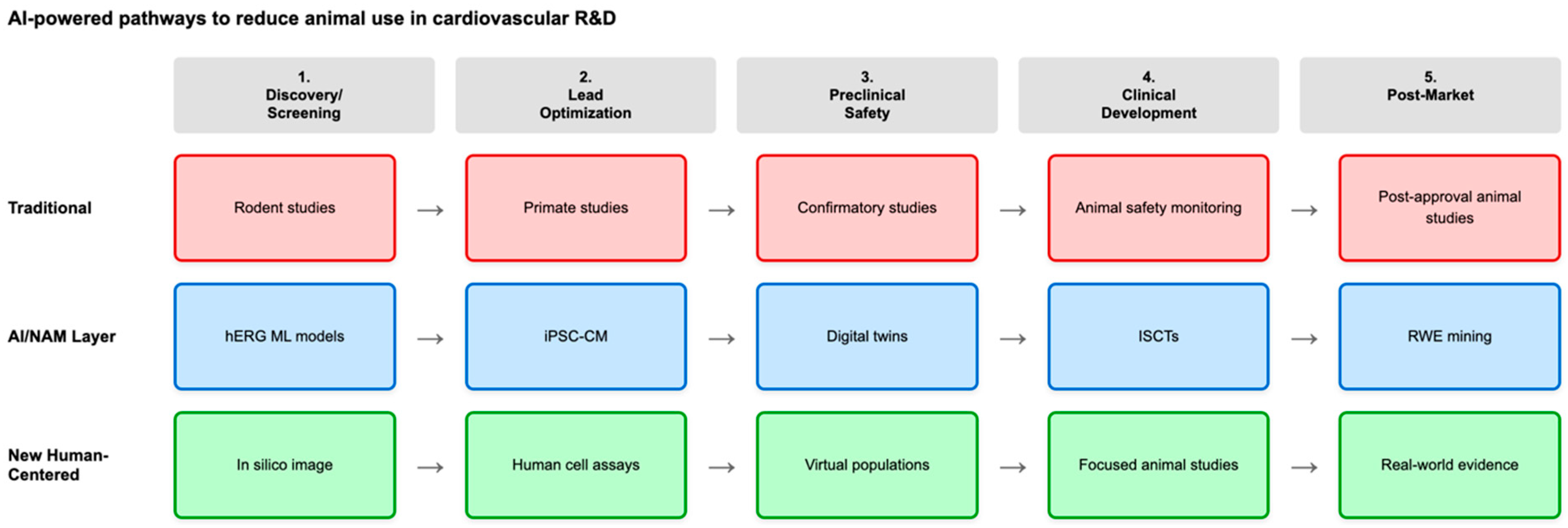
3.1. Discovery and Early Screening Technologies
3.2. Artificial Intelligence-Enhanced Human Cell and Organ-on-Chip Analyses
3.3. Mechanistic Modeling and Ml Surrogates
3.4. PK/PD and Systems Pharmacology Modeling
3.5. Network Pharmacology Approaches
4. Digital Twins, In Silico Experiments, and Real-World Data
4.1. Cardiac Digital Twins and Population Modeling
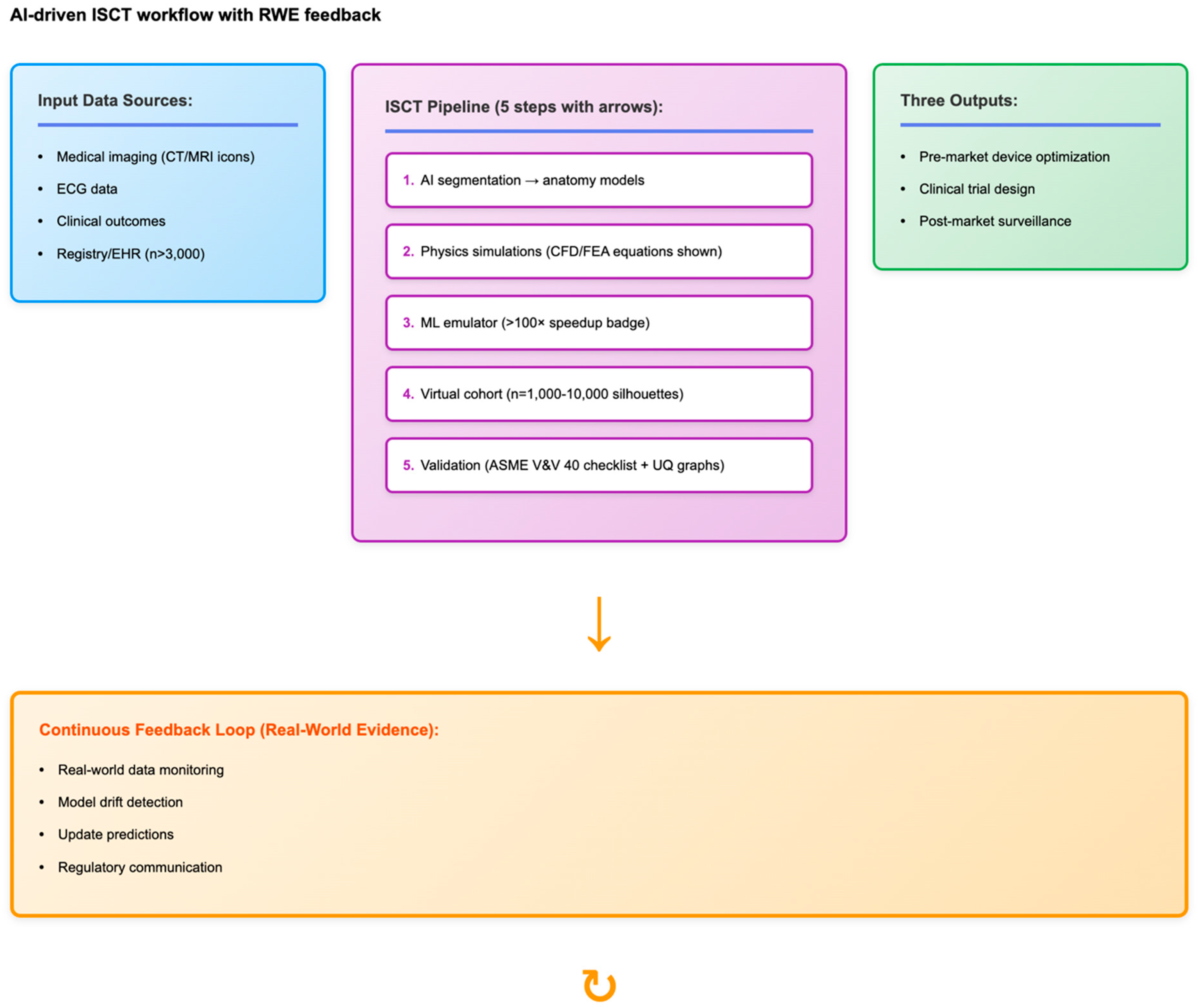
4.2. In Silico Clinical Trials (ISCTs)
4.3. Real-World Evidence (RWE) and Post-Market Ai Surveillance
5. Validation, Credibility, and Data Transparency
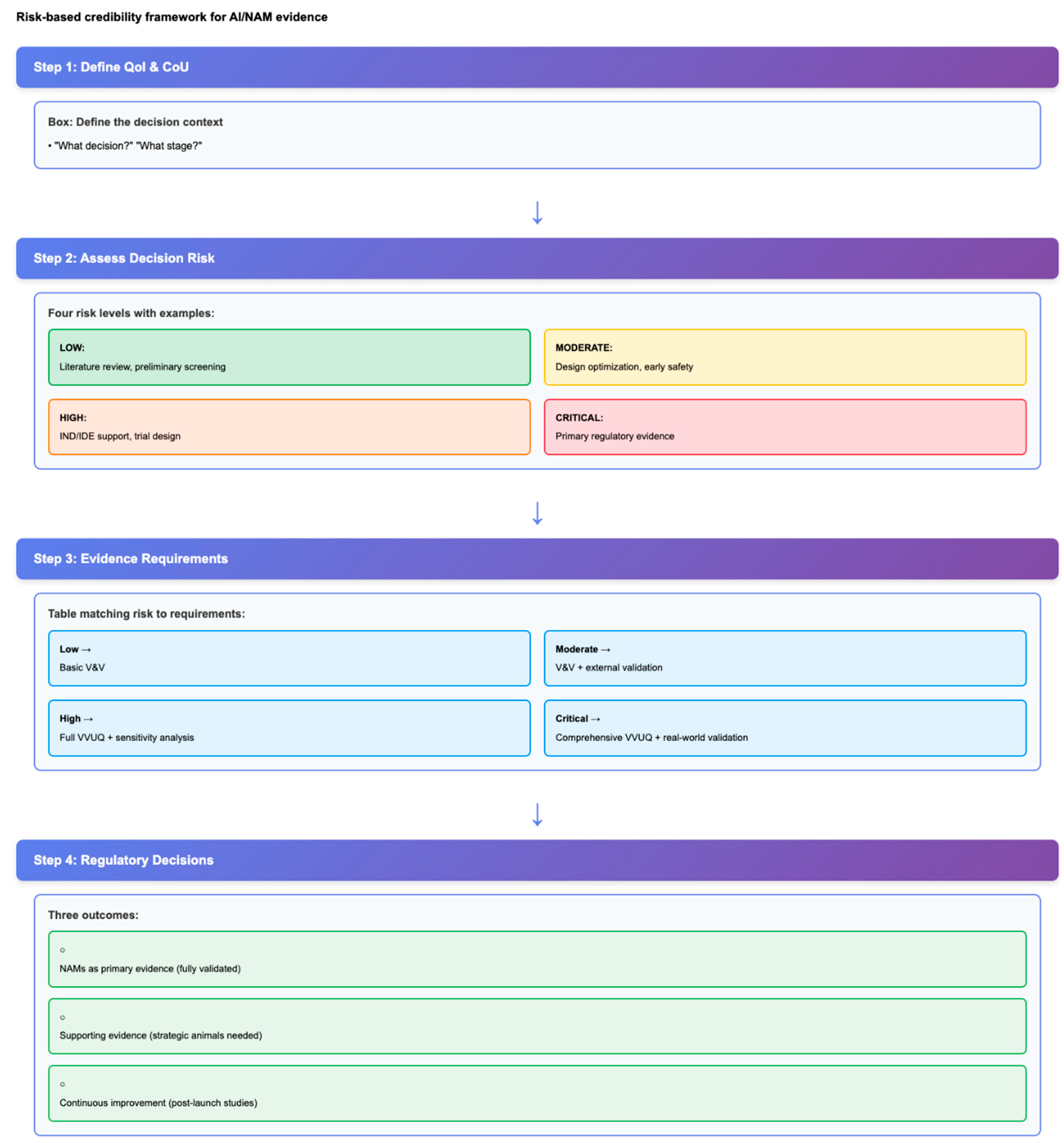
- QoI and CoU: Clearly define which decision the model is informing and at what stage of development/review it is.
- Risk Assessment: Classify decision risk (low/moderate/high/critical) based on the potential impact of model error.
- Verification: Ensure the model solves correctly (code testing, network convergence, numerical accuracy).
- Validation: Demonstrate that the model represents reality for its intended use (external test data, clinical benchmarks).
- UQ: Bound prediction with confidence intervals that account for parameter, model, and data uncertainty.
- Applicability domain: Define the input ranges and boundary conditions within which model predictions are reliable.
Current Validation Gaps and Challenges
- Mechanistic interpretability: Deep learning models often lack transparency in decision-making, leading to regulatory hesitancy for high-stakes decisions where mechanistic understanding is valuable [49].
6. Ethical and Economic Outlook
6.1. Economic Impact and Return on Investment
- Capital expenditures (CapEx): Investments in microphysiological platforms, imaging and automation infrastructure, high-performance computing, and data engineering teams. For example, establishing an in-house microphysiological system and AI analysis pipeline can require seven-figure investments in equipment, software, and specialized personnel, especially for large biopharmaceutical programs.
- Operating expenses (OpEx): Ongoing costs for analysis consumables, cloud or on-premises computing, data storage, maintenance, and quality assurance. While unit costs for in vitro assays are lower than for large-scale animal studies, early implementation often requires redundancy (running both traditional studies and NAMs in parallel) during the learning curve.
- Downstream savings and risk reduction: Fewer large animal studies, shorter timelines for lead optimization and dose selection, reduced likelihood of late-stage failure, and the ability to reuse validated platforms across projects. These benefits are most pronounced for primate-intensive modalities (e.g., monoclonal antibodies and certain biologics) and device programs where in silico design can replace multiple iterative animal studies [6,11,12,32,33].
- Baseline animal burden and cost per program are high (e.g., primate-intensive biologics, complex implantable devices);
- NAMs can be reused across multiple assets, indications, or device generations;
- Regulators can consider NAM data as primary or co-primary evidence for specific areas of interest, resulting in a true reduction in animal testing rather than simply adding new assays.
6.2. Practical Barriers to Widespread Implementation
- Technology availability and scalability: Advanced organ-on-chip platforms, human iPSC-CMs, and high-fidelity digital twin simulations are currently concentrated in a small number of specialized suppliers and academic centers. Procurement costs, long lead times, and limited production capacity may hinder routine use, especially for smaller companies and public laboratories.
- Standardization and assay robustness: The lack of harmonized protocols, reference materials, and interlaboratory proficiency testing makes it difficult to compare results across centers. Even for seemingly mature systems such as hiPSC-CM assays, differences in cell source, culture conditions, and readout methods can lead to different results [34,35,36]. Standardization efforts by the OECD, FDA, and EMA are ongoing but incomplete [8,9,36].
- Workforce and training constraints: Effectively deploying AI-powered NAMs requires interdisciplinary teams combining regulatory science, toxicology, bioengineering, data science, and software engineering. Many organizations, especially small and medium-sized businesses, struggle to recruit or train staff with this skill set. Regulators also need the time and resources to build in-house expertise in evaluating complex AI and simulation-based applications.
- Regulatory and institutional inertia: Even if alternative methods demonstrate strong performance, entrenched standard operating procedures, contracts with animal shelters, and risk-averse corporate cultures can slow change. Sponsors may be hesitant to trust NAMs for important decisions if they are unsure how regulators will evaluate the evidence.
- Access inequities: Larger multinationals are more likely to afford state-of-the-art NAM platforms and participate in regulatory pilot programs, while smaller organizations risk being left behind. If this is not addressed, a two-tiered ecosystem can emerge in which only well-resourced actors benefit from NAM-driven efficiencies and ethical gains.
6.3. Ethical Considerations and Algorithmic Bias
- Mechanisms for which human biology is not fully understood;
- Systemic toxicity endpoints not yet modeled in vitro/in silico;
- Immunogenicity assessment for some biologics;
- Long-term durability and biocompatibility for implantable devices.
- Documentation of the composition of the training data and known gaps;
- Evaluation of performance across clinically relevant subgroups;
- Transparency about uncertainty and limitations when applying models outside of development contexts;
- Governance mechanisms (such as independent auditing, stakeholder oversight, and post-market monitoring) to detect and respond to systematic errors.
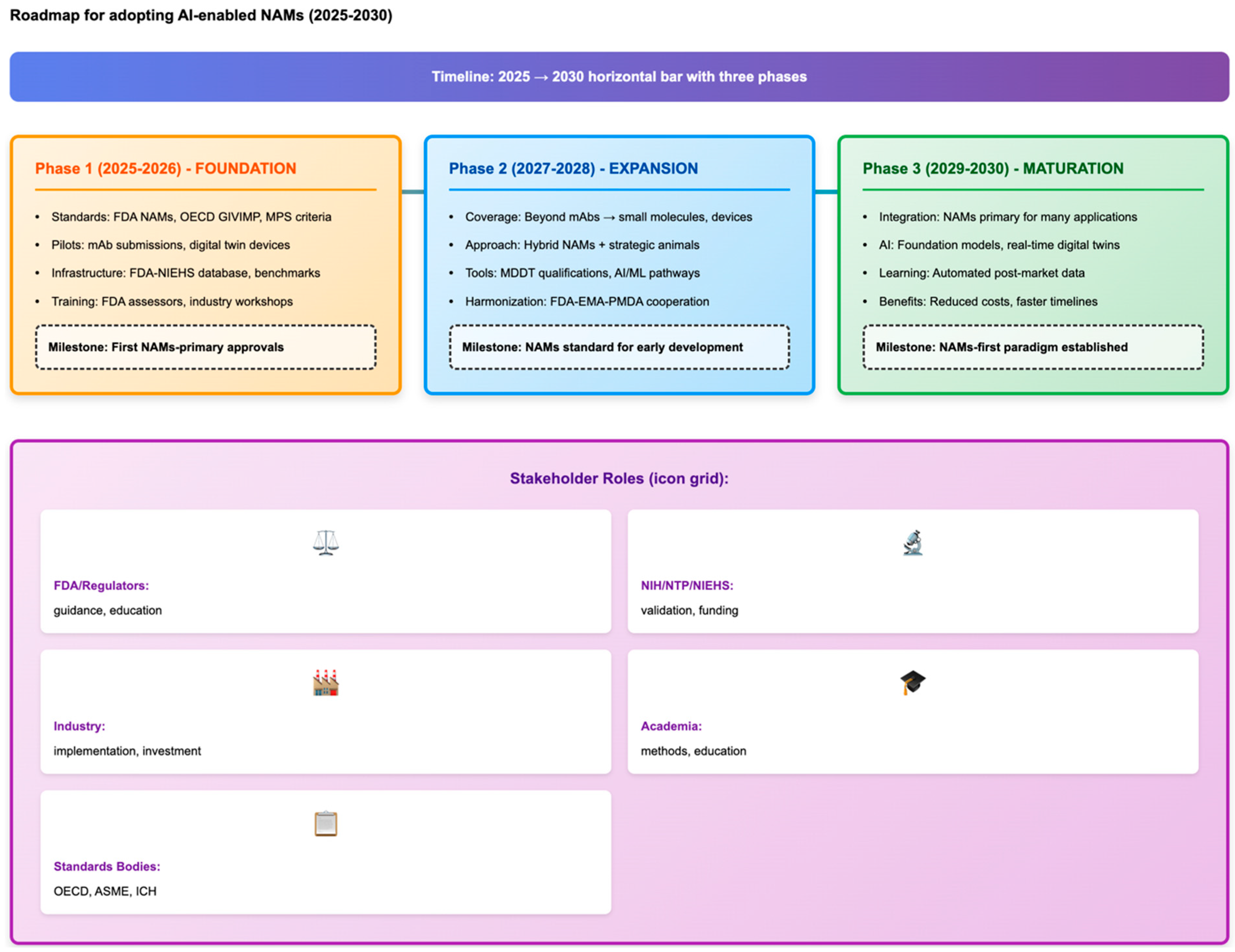
7. Limitation and Future Directions (2025–2030)
8. Conclusions
- New Approach Methodologies (NAMs): Alternative methods to animal testing, including in vitro systems, computational models, and human-derived data.
- ASME V&V 40: The American Society of Mechanical Engineers’ standard for verification and validation of computational models.
- Context of Use (CoU): The specific regulatory purpose and scope for which a model or method qualifies.
- Drug-induced QT prolongation: A condition in which certain medications cause the heart’s electrical charging to take longer than normal.
- İn silico Clinical Trial (ISCT): Computational simulation of patient cohorts to predict intervention outcomes.
- Physiologically Based Pharmacokinetics (PBPK): Mechanistic modeling of drug distribution based on organ physiology.
- MPS (Microphysiological Systems): Organ-on-a-chip platforms that recapitulate human tissue function.
- iPSC-CM: Induced pluripotent stem cell-derived cardiomyocytes.
- Uncertainty Quantification (UQ): Statistical characterization of model prediction uncertainty.
- hERG: Human ether-à-go-go-related gene; Potassium channel target for cardiotoxicity screening.
- Question of Interest (QoI): The specific question a computational model is designed to answer.
Author Contributions
Funding
Institutional Review Board Statement
Informed Consent Statement
Data Availability Statement
Conflicts of Interest
References
- The US Food and Drug Administration (FDA). Roadmap to Reducing Animal Testing in Preclinical Safety Studies. 10 April 2025. Available online: https://www.fda.gov/media/186092/download (accessed on 27 October 2025).
- Seok, J.; Warren, H.S.; Cuenca, A.G.; Mindrinos, M.N.; Baker, H.V.; Xu, W.; Richards, D.R.; McDonald-Smith, G.P.; Gao, H.; Hennessy, L.; et al. Genomic responses in mouse models poorly mimic human inflammatory diseases. Proc. Natl. Acad. Sci. USA 2013, 110, 3507–3512. [Google Scholar] [CrossRef]
- Olson, H.; Betton, G.; Robinson, D.; Thomas, K.; Monro, A.; Kolaja, G.; Lilly, P.; Sanders, J.; Sipes, G.; Bracken, W.; et al. Concordance of the toxicity of pharmaceuticals in humans and in animals. Regul. Toxicol. Pharmacol. 2000, 32, 56–67. [Google Scholar] [CrossRef]
- Congress.gov. S.5002—FDA Modernization Act 2.0 (S.5002—117th Congress (2021–2022)). 2022. Available online: https://www.congress.gov/bill/117th-congress/senate-bill/5002 (accessed on 27 October 2025).
- The US Food and Drug Administration (FDA). FDA Announces Plan to Phase Out Animal Testing Requirement for Monoclonal Antibodies and Other Drugs. 2025. Available online: https://www.fda.gov/news-events/press-announcements/fda-announces-plan-phase-out-animal-testing-requirement-monoclonal-antibodies-and-other-drugs (accessed on 27 October 2025).
- BioIVT FDA Roadmap to Reducing Animal Testing: A New Regulatory Era. 2025. Available online: https://bioivt.com/blogs/fda-roadmap-to-reducing-animal-testing-a-new-regulatory-era (accessed on 27 October 2025).
- Dunn, G. FDA’s Roadmap to Reducing Preclinical Animal Safety Studies: Six Things to Know. 15 April 2025. Available online: https://biotechbriefings.gibsondunn.com/fdas-roadmap-to-reducing-preclinical-animal-safety-studies-six-things-to-know/ (accessed on 27 October 2025).
- OECD. OECD Guidance Document on Good In Vitro Method Practices (GIVIMP); OECD Series on Testing and Assessment, No. 286; OECD Publishing: Paris, France, 2018. [Google Scholar] [CrossRef]
- European Medicines Agency. EMA Regulatory Science to 2025: Strategic Reflection; European Medicines Agency: Amsterdam, The Netherlands, 2020; Available online: https://www.ema.europa.eu/en/documents/regulatory-procedural-guideline/ema-regulatory-science-2025-strategic-reflection_en.pdf (accessed on 27 October 2025).
- The US Food Drug Administration (FDA) Advancing Alternative Methods at FDA. 2023. Available online: https://www.fda.gov/science-research/about-science-research-fda/advancing-alternative-methods-fda (accessed on 27 October 2025).
- Bai, J.P.F.; Liu, G.; Zhao, M.; Wang, J.; Xiong, Y.; Truong, T.; Earp, J.C.; Yang, Y.; Liu, J.; Zhu, H.; et al. Landscape of regulatory quantitative systems pharmacology submissions to the U.S. Food and Drug Administration: An update report. CPT Pharmacomet. Syst. Pharmacol. 2024, 13, 2102–2110. [Google Scholar] [CrossRef]
- Li, Y.; Wang, Z.; Li, Y.; Du, J.; Gao, X.; Li, Y.; Lai, L. A Combination of Machine Learning and PBPK Modeling Approach for Pharmacokinetics Prediction of Small Molecules in Humans. Pharm. Res. 2024, 41, 1369–1379. [Google Scholar] [CrossRef]
- Chapman, K.; Pullen, N.; Coney, L.; Dempster, M.; Andrews, L.; Bajramovic, J.; Baldrick, P.; Buckley, L.; Jacobs, A.; Hale, G.; et al. Preclinical development of monoclonal antibodies: Considerations for the use of non-human primates. MAbs 2009, 1, 505–516. [Google Scholar] [CrossRef]
- The US Food and Drug Administration (FDA). Assessing the Credibility of Computational Modeling and Simulation in Medical Device Submissions. 2023. Available online: https://www.fda.gov/regulatory-information/search-fda-guidance-documents/assessing-credibility-computational-modeling-and-simulation-medical-device-submissions (accessed on 27 October 2025).
- The US Food and Drug Administration (FDA). Recognized Consensus Standards: Medical Devices. Available online: https://www.accessdata.fda.gov/scripts/cdrh/cfdocs/cfstandards/detail.cfm?standard__identification_no=38534 (accessed on 27 October 2025).
- Bideault, G.; Scaccia, A.; Zahel, T.; Landertinger, R.W.; Daluwatte, C. Verification and Validation of Computational Models Used in Biopharmaceutical Manufacturing: Potential Application of the ASME Verification and Validation 40 Standard and FDA Proposed AI/ML Model Life Cycle Management Framework. J. Pharm. Sci. 2021, 110, 1540–1544. [Google Scholar] [CrossRef] [PubMed]
- Fu, L.; Jia, G.; Liu, Z.; Pang, X.; Cui, Y. The applications and advances of artificial intelligence in drug regulation: A global perspective. Acta Pharm. Sin. B 2025, 15, 1–14. [Google Scholar] [CrossRef] [PubMed]
- National Medical Products Administration (NMPA). NMPA Announcement on Guidance for the Classification Defining of AI-Based Medical Software Products. 8 July 2021. Available online: https://english.nmpa.gov.cn/2021-07/08/c_660267.htm (accessed on 3 November 2025).
- Liu, Y.; Yu, W.; Dillon, T. Regulatory responses and approval status of artificial intelligence medical devices with a focus on China. NPJ Digit. Med. 2024, 7, 255. [Google Scholar] [CrossRef]
- Mori, K. Regulatory Innovation for Safe and Early Access to Medical Devices in Japan. Ministry of Health, Labour and Welfare. 2019. Available online: https://www.pmda.go.jp/files/000232939.pdf (accessed on 3 November 2025).
- Tanaka, M.; Idei, M.; Sakaguchi, H.; Kato, R.; Sato, D.; Sawanobori, K.; Kawarasaki, S.; Hata, T.; Yoshizaki, A.; Nakamura, M.; et al. Achievements and challenges of the Sakigake designation system in Japan. Br. J. Clin. Pharmacol. 2021, 87, 4027–4035. [Google Scholar] [CrossRef] [PubMed]
- Pharmaceuticals and Medical Devices Agency (PMDA). Report on AI-Based Software as a Medical Device (SaMD). 2023. Available online: https://www.pmda.go.jp/files/000266100.pdf (accessed on 3 November 2025).
- Medicines and Healthcare Products Regulatory Agency (MHRA). Innovative Licensing and Access Pathway (ILAP). 30 January 2025. Available online: https://www.gov.uk/government/publications/innovative-licensing-and-access-pathway-ilap (accessed on 3 November 2025).
- European Medicines Agency (EMA). Regulatory Science Research Needs—2025 Update. 2025. Available online: https://www.ema.europa.eu/en/documents/other/regulatory-science-research-needs-2025-update_en.pdf (accessed on 3 November 2025).
- European Medicines Agency (EMA). ICH S5 (R3) Guideline on Detection of Reproductive and Developmental Toxicity for Human Pharmaceuticals—Scientific Guideline. 2020. Available online: https://www.ema.europa.eu/en/ich-s5-r3-guideline-detection-reproductive-developmental-toxicity-human-pharmaceuticals-scientific-guideline (accessed on 3 November 2025).
- Rajkomar, A.; Hardt, M.; Howell, M.D.; Corrado, G.; Chin, M.H. Ensuring Fairness in Machine Learning to Advance Health Equity. Ann. Intern. Med. 2018, 169, 866–872. [Google Scholar] [CrossRef]
- Obermeyer, Z.; Powers, B.; Vogeli, C.; Mullainathan, S. Dissecting racial bias in an algorithm used to manage the health of populations. Science 2019, 366, 447–453. [Google Scholar] [CrossRef] [PubMed]
- Cai, C.; Guo, P.; Zhou, Y.; Zhou, J.; Wang, Q.; Zhang, F.; Fang, J.; Cheng, F. Deep Learning-Based Prediction of Drug-Induced Cardiotoxicity. J. Chem. Inf. Model. 2019, 59, 1073–1084. [Google Scholar] [CrossRef]
- Delre, P.; Lavado, G.J.; Lamanna, G.; Saviano, M.; Roncaglioni, A.; Benfenati, E.; Mangiatordi, G.F.; Gadaleta, D. Ligand-based prediction of hERG-mediated cardiotoxicity based on the integration of different machine learning techniques. Front. Pharmacol. 2022, 13, 951083. [Google Scholar] [CrossRef] [PubMed]
- Blinova, K.; Stohlman, J.; Vicente, J.; Chan, D.; Johannesen, L.; Hortigon-Vinagre, M.P.; Zamora, V.; Smith, G.; Crumb, W.J.; Pang, L.; et al. Comprehensive Translational Assessment of Human-Induced Pluripotent Stem Cell Derived Cardiomyocytes for Evaluating Drug-Induced Arrhythmias. Toxicol. Sci. 2017, 155, 234–247. [Google Scholar] [CrossRef]
- Redfern, W.; Carlsson, L.; Davis, A.; Lynch, W.; Mackenzie, I.; Palethorpe, S.; Siegl, P.; Strang, I.; Sullivan, A.; Wallis, R. Relationships between preclinical cardiac electrophysiology, clinical QT interval prolongation and torsade de pointes for a broad range of drugs: Evidence for a provisional safety margin in drug development. Cardiovasc. Res. 2003, 58, 32–45. [Google Scholar] [CrossRef]
- Zhang, H.; Tarabanis, C.; Jethani, N.; Goldstein, M.; Smith, S.; Chinitz, L.; Ranganath, R.; Aphinyanaphongs, Y.; Jankelson, L. QTNet: Predicting Drug-Induced QT Prolongation with Artificial Intelligence-Enabled Electrocardiograms. JACC Clin. Electrophysiol. 2024, 10, 956–966. [Google Scholar] [CrossRef]
- Alam, R.; Aguirre, A.; Stultz, C.M. Detecting QT prolongation from a single-lead ECG with deep learning. PLOS Digit. Health 2024, 3, e0000539. [Google Scholar] [CrossRef]
- Grafton, F.; Ho, J.; Ranjbarvaziri, S.; Farshidfar, F.; Budan, A.; Steltzer, S.; Maddah, M.; E Loewke, K.; Green, K.; Patel, S.; et al. Deep learning detects cardiotoxicity in a high-content screen with induced pluripotent stem cell-derived cardiomyocytes. eLife 2021, 10, e68714. [Google Scholar] [CrossRef]
- The US Food and Drug Administration (FDA). Implementing Alternative Methods. 2025. Available online: https://www.fda.gov/science-research/advancing-alternative-methods-fda/implementing-alternative-methods (accessed on 28 October 2025).
- The US Food and Drug Administration (FDA). Alternative Methods Publications and Events. 2025. Available online: https://www.fda.gov/science-research/advancing-alternative-methods-fda/alternative-methods-publications-and-events (accessed on 28 October 2025).
- Domínguez-Gómez, P.; Zingaro, A.; Baldo-Canut, L.; Balzotti, C.; Darpo, B.; Morton, C.; Vázquez, M.; Aguado-Sierra, J. Fast and accurate prediction of drug induced proarrhythmic risk with sex specific cardiac emulators. NPJ Digit. Med. 2024, 7, 380. [Google Scholar] [CrossRef]
- Rostami-Hodjegan, A. Physiologically based pharmacokinetics joined with in vitro-in vivo extrapolation of ADME: A marriage under the arch of systems pharmacology. Clin. Pharmacol. Ther. 2012, 92, 50–61. [Google Scholar] [CrossRef] [PubMed]
- Hopkins, A.L. Network pharmacology: The next paradigm in drug discovery. Nat. Chem. Biol. 2008, 4, 682–690. [Google Scholar] [CrossRef] [PubMed]
- Qian, S.; Ugurlu, D.; Fairweather, E.; Toso, L.D.; Deng, Y.; Strocchi, M.; Cicci, L.; Jones, R.E.; Zaidi, H.; Prasad, S.; et al. Developing cardiac digital twin populations powered by machine learning provides electrophysiological insights in conduction and repolarization. Nat. Cardiovasc. Res. 2025, 4, 624–636. [Google Scholar] [CrossRef] [PubMed]
- Rodero, C.; Baptiste, T.M.G.; Barrows, R.K.; Keramati, H.; Sillett, C.P.; Strocchi, M.; Lamata, P.; A Niederer, S. A systematic review of cardiac in-silico clinical trials. Prog. Biomed. Eng. 2023, 5, 032004. [Google Scholar] [CrossRef]
- Catalano, C.; Scuoppo, R.; Turgut, T.; Bouwman, V.; Götzen, N.; Cannata, S.; Gentile, G.; Gandolfo, C.; Pasta, S. Credibility assessment of patient-specific modeling in transcatheter aortic valve implantation. I. A population-based validation of patient-specific modeling. APL Bioeng. 2025, 9, 046101. [Google Scholar] [CrossRef]
- Scuoppo, R.; Catalano, C.; Turgut, T.; Götzen, N.; Cannata, S.; Gentile, G.; Gandolfo, C.; Pasta, S. Credibility assessment of patient-specific modeling in transcatheter aortic valve implantation-Part 2: Uncertainty quantification and sensitivity analysis. APL Bioeng. 2025, 9, 046102. [Google Scholar] [CrossRef]
- Mao, P.; Jin, M.; Li, W.; Zhang, H.; Li, H.; Li, S.; Yang, Y.; Zhu, M.; Shi, Y.; Zhang, X.; et al. In Silico Trials of Prosthetic Valves Replicate Methodologies for Evaluating the Fatigue Life of Artificial Leaflets to Expand Beyond In Vitro Tests and Conventional Clinical Trials. Biomedicines 2025, 13, 1135. [Google Scholar] [CrossRef]
- Angoulvant, D.; Granjeon-Noriot, S.; Amarenco, P.; Bastien, A.; Bechet, E.; Boccara, F.; Boissel, J.-P.; Cariou, B.; Courcelles, E.; Diatchenko, A.; et al. In-silico trial emulation to predict the cardiovascular protection of new lipid-lowering drugs: An illustration through the design of the SIRIUS programme. Eur. J. Prev. Cardiol. 2024, 31, 1820–1830. [Google Scholar] [CrossRef]
- Beam, A.L.; Kohane, I.S. Big Data and Machine Learning in Health Care. JAMA 2018, 319, 1317–1318. [Google Scholar] [CrossRef]
- Goldstein, B.A.; Navar, A.M.; Pencina, M.J.; Ioannidis, J.P. Opportunities and challenges in developing risk prediction models with electronic health records data: A systematic review. J. Am. Med. Inf. Assoc. 2017, 24, 198–208. [Google Scholar] [CrossRef]
- Niederer, S.A.; Lumens, J.; Trayanova, N.A. Computational models in cardiology. Nat. Rev. Cardiol. 2019, 16, 100–111. [Google Scholar] [CrossRef] [PubMed]
- The US Food and Drug Administration (FDA). Artificial Intelligence-Enabled Medical Devices. 2021. Available online: https://www.fda.gov/medical-devices/software-medical-device-samd/artificial-intelligence-and-machine-learning-aiml-enabled-medical-devices (accessed on 29 October 2025).
- European Dissemination Media Agency (EDMA). Building Credibility of Computational Models in Cardiovascular Medicine Through Verification and Validation. 2024. Available online: https://www.europeandissemination.eu/article/building-credibility-of-computational-models-in-cardiovascular-medicine-through-verification-and-validation/21403 (accessed on 29 October 2025).
- The US Food and Drug Administration (FDA). MOU 225-25-012: Memorandum of Understanding Between FDA and NIH on Alternative Research and Innovation in Evaluation (ARIE) for Cardiovascular Applications. 2025. Available online: https://www.fda.gov/about-fda/domestic-mous/mou-225-25-012 (accessed on 29 October 2025).
- Rieke, N.; Hancox, J.; Li, W.; Milletarì, F.; Roth, H.R.; Albarqouni, S.; Bakas, S.; Galtier, M.N.; Landman, B.A.; Maier-Hein, K.; et al. The future of digital health with federated learning. NPJ Digit. Med. 2020, 3, 119. [Google Scholar] [CrossRef] [PubMed]
- Moor, M.; Banerjee, O.; Abad, Z.S.H.; Krumholz, H.M.; Leskovec, J.; Topol, E.J.; Rajpurkar, P. Foundation models for generalist medical artificial intelligence. Nature 2023, 616, 259–265. [Google Scholar] [CrossRef] [PubMed]



| Aspect | FDA (US) | NMPA (China) | PMDA (Japan) | MHRA (UK) | EMA (EU) |
|---|---|---|---|---|---|
| Alternative method acceptance | Medium-High | Low-Medium | Medium | High | Medium |
| Computational modeling pathway | MDDT program | Case-by-case | Sōdan consultation | ILAP | Innovation Task Force |
| Primary evidence acceptance | Yes (with validation) | Rare | Rare | Yes | Variable by member state |
| Timeline for new methods | 6–12 months | 18–24 months | 12–18 months | 4–10 months | 12–18 months |
| International data acceptance | Yes | Domestic required | Yes, with supplement | Yes | Yes, within the EU |
| ASME V&V 40 approval | Recognized standard | Under evaluation | Recognized | Recognized | Recognized |
| Use Case | Representative Model | Key Output | Implication for Animal Use | Role Reference |
|---|---|---|---|---|
| hERG risk prediction | DeepHIT/GBDT models | Block probability | Filters compounds pre-in vivo; reduces exploratory animal studies by 60–80% | [28,29] |
| QT prolongation (clinical) | QTNet CNN in ECGs | ECG-based QT risk | Guides safer dosing; informs trial design; reduces confirmatory studies | [33] |
| iPSC-CM phenotyping | CNN in high-content imaging | Toxicity morphology scoring | Replaces exploratory animal safety screenings with human testing | [35] |
| Mechanistic + ML surrogate | Cardiac electrophysiology emulator | Rapid population UQ | Virtual population modeling replaces animal variability studies | [37] |
| Hybrid exposure-response | PBPK/QSP + ML-augmented parameterization | Organ/tissue exposure and safety margin, dose optimization | Reduces cross-species extrapolation; accelerates mAb development | [11,12] |
| Network pharmacology | Graph neural networks | Pathway toxicity links | Generates mechanistic hypotheses without animals | [39] |
| Application | Decision Risk | Basic Credibility Tasks | Reference Framework |
|---|---|---|---|
| Early compound triage (hERG AI) | Low | External test set validation; calibration curves; applicability domain documentation | [10,49] |
| iPSC-CM/MPS analyses | Moderate | Interlaboratory reproducibility; orthogonal endpoint validation; performance criteria | [8,36] |
| Device design iteration (CFD/FEA) | Moderate-High | Code validation; validation against benchtop and clinical data; sensitivity analysis; UQ | [14,15] |
| Regulatory labeling (primary evidence) | High-Critical | Full VVUQ per CoU; validation against independent clinical datasets; comprehensive sensitivity analysis; bias assessment | [14,15] |
Disclaimer/Publisher’s Note: The statements, opinions and data contained in all publications are solely those of the individual author(s) and contributor(s) and not of MDPI and/or the editor(s). MDPI and/or the editor(s) disclaim responsibility for any injury to people or property resulting from any ideas, methods, instructions or products referred to in the content. |
© 2025 by the authors. Licensee MDPI, Basel, Switzerland. This article is an open access article distributed under the terms and conditions of the Creative Commons Attribution (CC BY) license (https://creativecommons.org/licenses/by/4.0/).
Share and Cite
Dinc, R.; Ardic, N. AI-Enabled Reduction of Animal Use in Cardiovascular Translational Medicine: Regulatory and Technological Perspectives. Life 2025, 15, 1916. https://doi.org/10.3390/life15121916
Dinc R, Ardic N. AI-Enabled Reduction of Animal Use in Cardiovascular Translational Medicine: Regulatory and Technological Perspectives. Life. 2025; 15(12):1916. https://doi.org/10.3390/life15121916
Chicago/Turabian StyleDinc, Rasit, and Nurittin Ardic. 2025. "AI-Enabled Reduction of Animal Use in Cardiovascular Translational Medicine: Regulatory and Technological Perspectives" Life 15, no. 12: 1916. https://doi.org/10.3390/life15121916
APA StyleDinc, R., & Ardic, N. (2025). AI-Enabled Reduction of Animal Use in Cardiovascular Translational Medicine: Regulatory and Technological Perspectives. Life, 15(12), 1916. https://doi.org/10.3390/life15121916