AI-Enabled Axiomatic Design for MES-Level Process Parameters Optimization in Cloud-Based Manufacturing Execution Systems


Abstract
1. Introduction
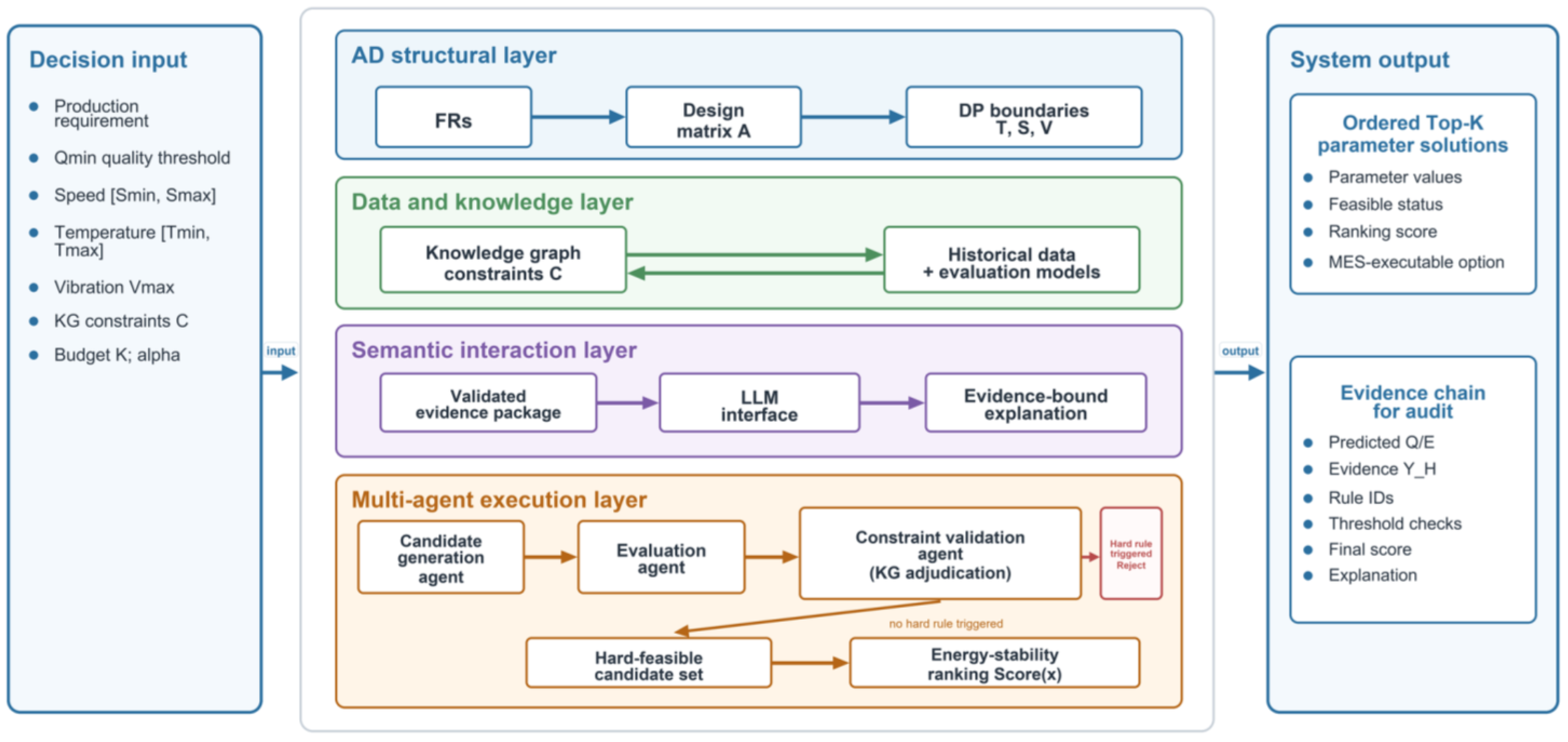
2. AI-Enabled Axiomatic Design for MES-Level Parameter Optimization
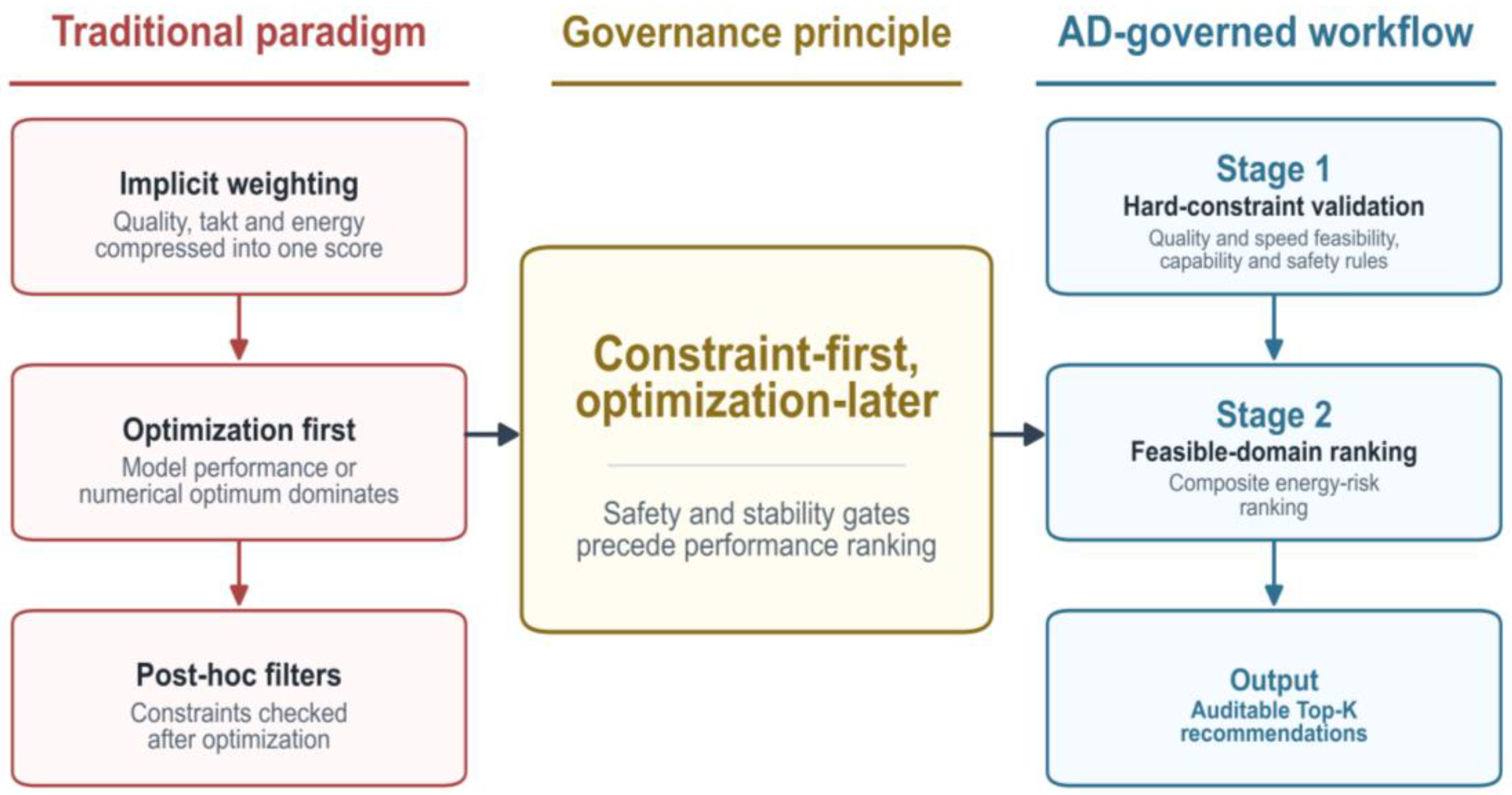
2.1. Overall Approach and Its Framework from Decision-Governance Perspectives
2.2. Functional Requirement Modeling Based on Axiomatic Design
2.3. Design Parameters Modeling and Engineering Controllability Analysis
2.4. Design Matrix and Sequential Decoupling Solution Strategy
2.5. Constraint Adjudication, Evaluation, and Semantic Interface
3. Experiments and Analysis
3.1. Manufacturing Dataset Description and Experimental Setup
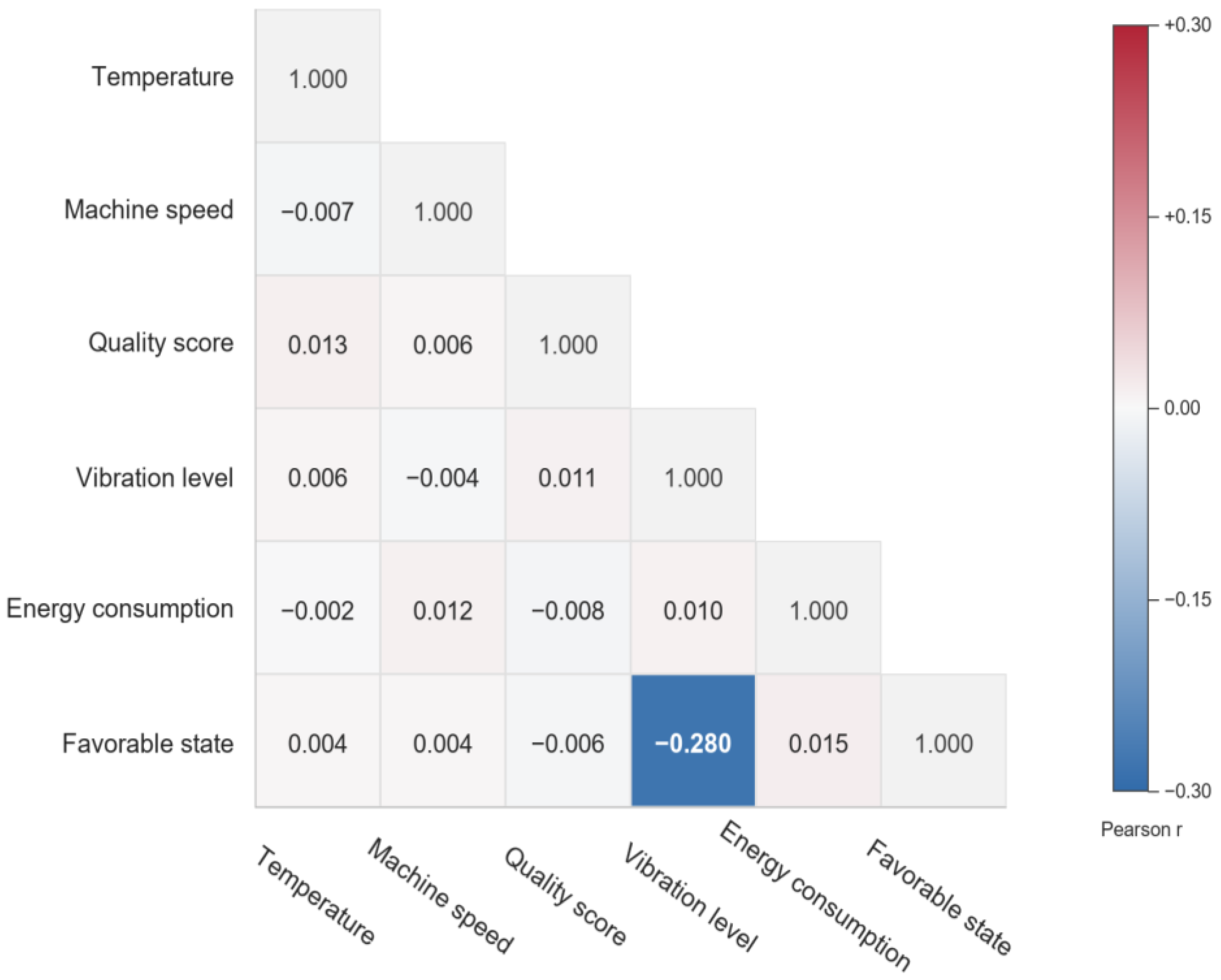
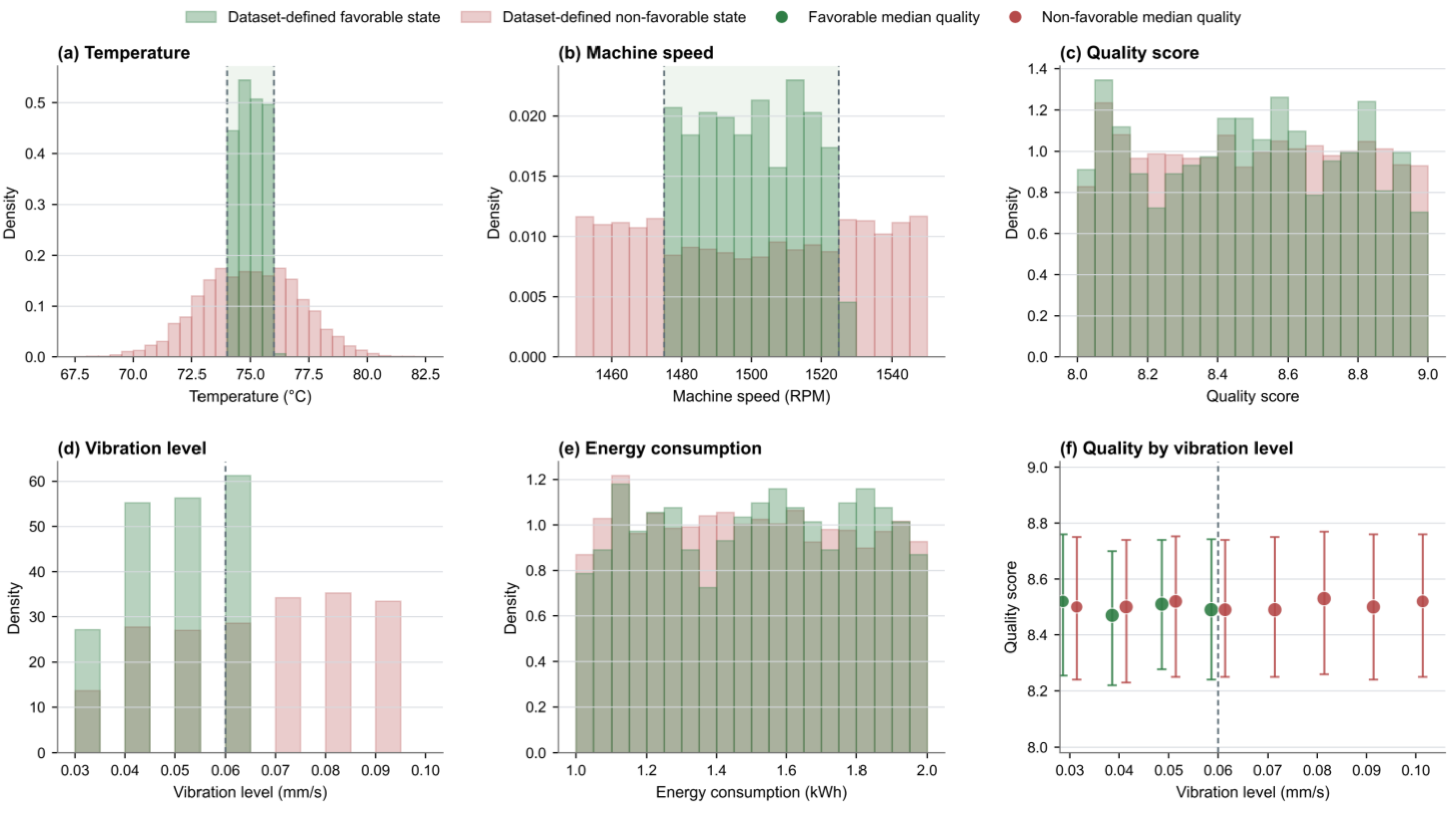
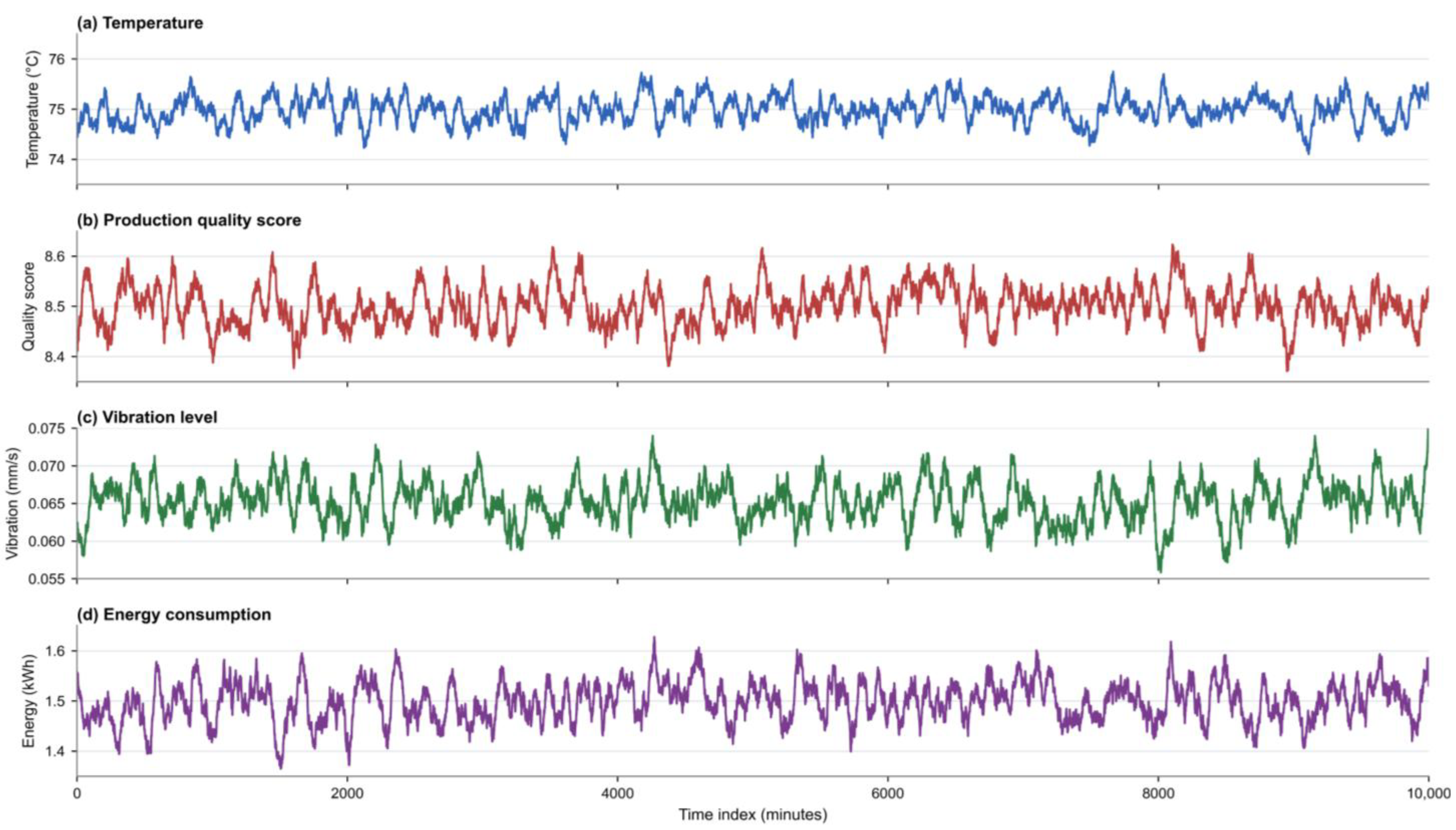
3.2. Exploratory Data Analysis and Time-Series Characteristics
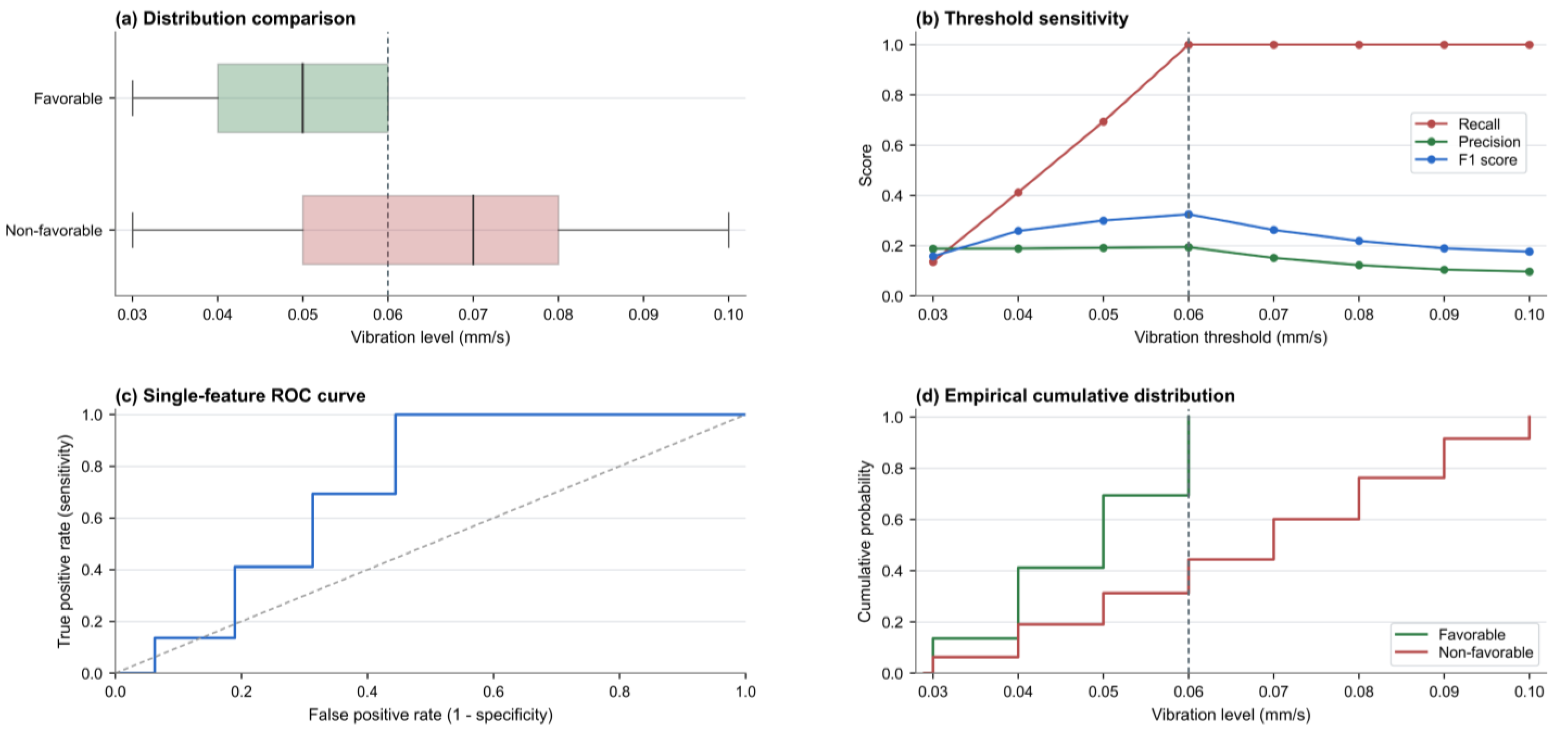
3.3. Dataset-Defined Favorable-State Label Reconstruction and Validation
3.4. Recommendation Consistency and Offline Validation
4. Discussion
5. Conclusions
Author Contributions
Funding
Data Availability Statement
Acknowledgments
Conflicts of Interest
References
- Tao, F.; Zhang, L.; Venkatesh, V.C.; Luo, Y.; Cheng, Y. Cloud manufacturing: A computing and service-oriented manufacturing model. Proc. Inst. Mech. Eng. Part B J. Eng. Manuf. 2011, 225, 1969–1976. [Google Scholar] [CrossRef]
- Shojaeinasab, A.; Charter, T.; Jalayer, M.; Khadivi, M.; Ogunfowora, O.; Raiyani, N.; Yaghoubi, M.; Najjaran, H. Intelligent manufacturing execution systems: A systematic review. J. Manuf. Syst. 2022, 62, 503–522. [Google Scholar] [CrossRef]
- Wu, D.; Rosen, D.W.; Wang, L.; Schaefer, D. Cloud-based design and manufacturing: A new paradigm in digital manufacturing and design innovation. Comput.-Aided Des. 2015, 59, 1–14. [Google Scholar] [CrossRef]
- Wu, D.; Rosen, D.W.; Panchal, J.H.; Schaefer, D. Understanding communication and collaboration in social product development through social network analysis. ASME J. Comput. Inf. Sci. Eng. 2016, 16, 011001. [Google Scholar] [CrossRef]
- Morariu, O.; Borangiu, T.; Răileanu, S.; Morariu, C. Redundancy and scalability for virtualized MES systems with programmable infrastructure. Comput. Ind. 2016, 81, 26–35. [Google Scholar] [CrossRef]
- Deshmankar, A.P.; Challa, J.S.; Singh, A.R.; Regalla, S.P. A review of the applications of machine learning for prediction and analysis of mechanical properties and microstructures in additive manufacturing. ASME J. Comput. Inf. Sci. Eng. 2024, 24, 120801. [Google Scholar] [CrossRef]
- Chen, T.; Guestrin, C. XGBoost: A scalable tree boosting system. In Proceedings of the 22nd ACM SIGKDD International Conference on Knowledge Discovery and Data Mining, San Francisco, CA, USA, 13–17 August 2016; pp. 785–794. [Google Scholar] [CrossRef]
- Cortes, C.; Vapnik, V. Support-vector networks. In Machine Learning; Springer: Berlin/Heidelberg, Germany, 1995; Volume 20, pp. 273–297. [Google Scholar] [CrossRef]
- Xu, H.; Liu, R.; Choudhary, A.; Chen, W. A machine learning-based design representation method for designing heterogeneous microstructures. ASME J. Mech. Des. 2015, 137, 051403. [Google Scholar] [CrossRef]
- Tootchi, A.; Du, X. Robust design under machine learning model uncertainty. ASME J. Mech. Des. 2026, 148, 021701. [Google Scholar] [CrossRef]
- Chawla, N.V.; Bowyer, K.W.; Hall, L.O.; Kegelmeyer, W.P. SMOTE: Synthetic minority over-sampling technique. J. Artif. Intell. Res. 2002, 16, 321–357. [Google Scholar] [CrossRef]
- Bateman, R.J.; Cheng, K. Extending the product portfolio with ‘devolved manufacturing’: Methodology and case studies. Int. J. Prod. Res. 2006, 44, 3325–3343. [Google Scholar] [CrossRef]
- Yhdego, T.O.; Wang, H.; Chi, H.; Yu, Z. Ontology-guided data sharing and federated quality control with differential privacy in additive manufacturing. ASME J. Comput. Inf. Sci. Eng. 2025, 25, 011006. [Google Scholar] [CrossRef]
- Kritzinger, W.; Karner, M.; Traar, G.; Henjes, J.; Sihn, W. Digital Twin in manufacturing: A categorical literature review and classification. IFAC-PapersOnLine 2018, 51, 1016–1022. [Google Scholar] [CrossRef]
- Cimino, C.; Negri, E.; Fumagalli, L. Review of digital twin applications in manufacturing. Comput. Ind. 2019, 113, 103130. [Google Scholar] [CrossRef]
- Wu, C.; Zhou, Y.; Pessôa, M.; Peng, Q.; Tan, R. Conceptual digital twin modelling based on an integrated five-dimensional framework and TRIZ function model. J. Manuf. Syst. 2021, 58, 79–93. [Google Scholar] [CrossRef]
- Nath, P.; Mahadevan, S. Probabilistic digital twin for additive manufacturing process design and control. ASME J. Mech. Des. 2022, 144, 091704. [Google Scholar] [CrossRef]
- He, B.; Song, Y.; Wang, Y. Special Issue: Digital twin-driven design and manufacturing. ASME J. Comput. Inf. Sci. Eng. 2021, 21, 030301. [Google Scholar] [CrossRef]
- Chen, Y.P.; Tsai, Y.K.; Karkaria, V.; Chen, W. Uncertainty-aware digital twins: Robust model predictive control using time-series deep quantile learning. ASME J. Mech. Des. 2026, 148, 021702. [Google Scholar] [CrossRef]
- Wan, Y.; Liu, Y.; Chen, Z.; Chen, C.; Li, X.; Hu, F.; Packianather, M. Making knowledge graphs work for smart manufacturing: Research topics, applications and prospects. J. Manuf. Syst. 2024, 76, 103–132. [Google Scholar] [CrossRef]
- Liu, B.; Chen, C.-H.; Wang, Z. A multi-hierarchical aggregation-based graph convolutional network for industrial knowledge graph embedding towards cognitive intelligent manufacturing. J. Manuf. Syst. 2024, 76, 320–332. [Google Scholar] [CrossRef]
- Chhim, P.; Chinnam, R.B.; Sadawi, N. Product design and manufacturing process based ontology for manufacturing knowledge reuse. J. Intell. Manuf. 2019, 30, 905–916. [Google Scholar] [CrossRef]
- Siddharth, L.; Blessing, L.T.M.; Wood, K.L.; Luo, J. Engineering knowledge graph from patent database. ASME J. Comput. Inf. Sci. Eng. 2022, 22, 021008. [Google Scholar] [CrossRef]
- Wu, T.; Li, J.; Bao, J.; Liu, Q.; Jin, Z.; Gao, J. CarbonKG: Industrial carbon emission knowledge graph-based modeling and application for carbon traceability of complex manufacturing process. ASME J. Comput. Inf. Sci. Eng. 2024, 24, 081001. [Google Scholar] [CrossRef]
- Hagedorn, T.J.; Krishnamurty, S.; Grosse, I.R. A knowledge-based method for innovative design for additive manufacturing supported by modular ontologies. ASME J. Comput. Inf. Sci. Eng. 2018, 18, 021009. [Google Scholar] [CrossRef]
- Zhong, Y.; Qin, Y.; Huang, M.; Lu, W.; Gao, W.; Du, Y. Automatically generating assembly tolerance types with an ontology-based approach. Comput.-Aided Des. 2013, 45, 1253–1275. [Google Scholar] [CrossRef]
- Hanna, L.; Cagan, J. Evolutionary multi-agent systems: An adaptive and dynamic approach to optimization. ASME J. Mech. Des. 2009, 131, 011010. [Google Scholar] [CrossRef]
- Cao, J.; Ming, Z.; Allen, J.K.; Mistree, F. Design of multi-agent systems based on bilevel closed-loop planning. ASME J. Mech. Des. 2025, 147, 081706. [Google Scholar] [CrossRef]
- Chen, Q.; Ilami, S.; Lore, N.; Heydari, B. Adaptive information modulation: Designing governance mechanisms for multi-agent AI systems. ASME J. Mech. Des. 2026, 148, 041708. [Google Scholar] [CrossRef]
- Du, K.; Yang, B.; Xie, K.; Dong, N.; Zhang, Z.; Wang, S.; Mo, F. LLM-MANUF: An integrated framework of fine-tuning large language models for intelligent decision-making in manufacturing. Adv. Eng. Inform. 2025, 65, 103263. [Google Scholar] [CrossRef]
- Wang, T.; Zhang, B.; Jiang, D.; Li, D. A multimodal large language model framework for intelligent perception and decision-making in smart manufacturing. Sensors 2025, 25, 3072. [Google Scholar] [CrossRef] [PubMed]
- Massoudi, S.; Fuge, M. Agentic large language models for conceptual systems engineering and design. ASME J. Mech. Des. 2026, 148, 051405. [Google Scholar] [CrossRef]
- Li, Y.; Ko, H.; Ameri, F. Integrating graph retrieval-augmented generation with large language models for supplier discovery. ASME J. Comput. Inf. Sci. Eng. 2025, 25, 021010. [Google Scholar] [CrossRef]
- Sun, Y.; Li, X.; Sha, Z. Large language models for computer-aided design fine tuned: Dataset and experiments. ASME J. Mech. Des. 2025, 147, 041710. [Google Scholar] [CrossRef]
- Zhang, C.; Zhao, Y.F.; El Haddad, R. Understanding the impact of applying large language model in engineering design education. ASME J. Comput. Inf. Sci. Eng. 2025, 25, 021008. [Google Scholar] [CrossRef]
- Fan, H.; Chow, E.; Lu, T.; Fuh, J.Y.H.; Lu, W.F.; Li, B. A unified framework for large language model-guided reinforcement learning in digital twin industrial environments. Robot. Comput.-Integr. Manuf. 2026, 99, 103215. [Google Scholar] [CrossRef]
- Qin, Z.; Lu, Y. Knowledge graph-enhanced multi-agent reinforcement learning for adaptive scheduling in smart manufacturing. J. Intell. Manuf. 2025, 36, 5943–5966. [Google Scholar] [CrossRef]
- Sun, Z.; Zheng, C.; Sun, X.; Hou, X.; Yang, Y. Dual multi-objective optimization design method for compliant guide mechanism. Struct. Multidiscip. Optim. 2024, 67, 75. [Google Scholar] [CrossRef]
- Suh, N.P. Axiomatic design of mechanical systems. ASME J. Mech. Des. 1995, 117, 2–10. [Google Scholar] [CrossRef]
- Suh, N.P. Design of systems. CIRP Ann. 1997, 46, 75–80. [Google Scholar] [CrossRef]
- Hazelrigg, G.A. An axiomatic framework for engineering design. ASME J. Mech. Des. 1999, 121, 342–347. [Google Scholar] [CrossRef]
- Rauch, E.; Matt, D.T.; Dallasega, P. Application of axiomatic design in manufacturing system design: A literature review. Procedia CIRP 2016, 53, 1–7. [Google Scholar] [CrossRef]
- Python Developer. Smart Manufacturing Process Data. Available online: https://www.kaggle.com/datasets/programmer3/smart-manufacturing-process-data (accessed on 19 December 2025).
- Pivin-Bachler, J.R.; van den Broek, E.L. SIMBA: A robust and generalizable measure of data imbalance. Patterns 2025, 6, 101395. [Google Scholar] [CrossRef] [PubMed]
- Hanley, J.A.; McNeil, B.J. The meaning and use of the area under a receiver operating characteristic (ROC) curve. Radiology 1982, 143, 29–36. [Google Scholar] [CrossRef] [PubMed]
- DeLong, E.R.; DeLong, D.M.; Clarke-Pearson, D.L. Comparing the areas under two or more correlated receiver operating characteristic curves: A nonparametric approach. Biometrics 1988, 44, 837–845. [Google Scholar] [CrossRef] [PubMed]
- Davis, J.; Goadrich, M. The relationship between Precision–Recall and ROC curves. In Proceedings of the 23rd International Conference on Machine Learning, Pittsburgh, PA, USA, 25–29 June 2006; pp. 233–240. [Google Scholar] [CrossRef]
- Saito, T.; Rehmsmeier, M. The Precision–Recall plot is more informative than the ROC plot when evaluating binary classifiers on imbalanced datasets. PLoS ONE 2015, 10, e0118432. [Google Scholar] [CrossRef] [PubMed]
- Cheng, K.; Niu, Z.C.; Wang, R.C.; Rakowski, R.; Bateman, R.J. Smart cutting tools and smart machining: Development approaches, and their implementation and application perspectives. Chin. J. Mech. Eng. 2017, 30, 1162–1176. [Google Scholar] [CrossRef]



| Variable | Unit | Description | Min | Median | Max | Mean ± Std |
|---|---|---|---|---|---|---|
| Temperature | °C | Process temperature | 67.58 | 75.00 | 82.47 | 74.99 ± 1.99 |
| Machine Speed | RPM | Rotational speed of the machine | 1450.0 | 1500.0 | 1549.0 | 1499.56 ± 29.06 |
| Vibration Level | mm/s | Vibration level of the machine | 0.03 | 0.07 | 0.10 | 0.07 ± 0.02 |
| Production Quality Score | - | Quality score of the manufactured product | 8.00 | 8.50 | 9.00 | 8.50 ± 0.29 |
| Energy Consumption | kWh | Energy consumed during the process | 1.00 | 1.50 | 2.00 | 1.50 ± 0.29 |
| Decision Role | Evidence Used in This Study | Role in the AD-Governed Sequence |
|---|---|---|
| Quality conformity | Required quality lower bound | Rejects candidates that fail the satisfaction requirement before ranking. |
| Production-takt feasibility | Required speed interval | Applies the MES feasibility gate before any energy-oriented sorting. |
| Process-capability window | Admissible temperature interval | Restricts candidate solutions to executable operating conditions. |
| Equipment stability and safety | Vibration threshold and knowledge-graph safety rules | Prevents unstable or unsafe states from entering the ranking stage. |
| Historical favorable-state consistency | Dataset-defined reconstructed from the T, S, and V threshold structure | Provides dataset-state consistency evidence for the evaluation stage. |
| Feasible-domain ranking | Energy consumption, vibration-risk penalty, and Top-K budget | Ranks candidates after the hard constraints have been satisfied. |
| Validation Item | Result | Interpretation |
|---|---|---|
| Dataset-defined threshold rule | TP = 966; FP = 0; FN = 0; TN = 9034; accuracy = 1.0000 | The dataset label is exactly reconstructable from threshold conditions on T, S and V. |
| Evaluation-agent classification module (Extreme Gradient Boosting (XGBoost) implementation, 70/30 split) | Accuracy = 1.0000; AUC-ROC = 1.0000; AP = 1.0000 | The result verifies that the evaluation module reproduces the dataset-defined label structure. |
| Role in the framework | Label-structure verification | Workflow validation is based on Top-K constraint compliance, KG adjudication, and evidence-chain traceability. |
| Rank | Sample Time | Parameters | Quality | Energy | Evidence Chain and Score |
|---|---|---|---|---|---|
| 1 | 6 April 2025 21:59:00 | °C; RPM; mm/s | 8.92 | 1.00 kWh | pass; pass; pass; pass; Historical Favorable State = 1; |
| 2 | 5 April 2025 01:12:00 | °C; RPM; mm/s | 8.83 | 1.01 kWh | pass; pass; pass; pass; Historical Favorable State = 1; |
| 3 | 1 April 2025 19:54:00 | °C; RPM; mm/s | 8.86 | 1.03 kWh | pass; pass; pass; pass; Historical Favorable State = 1; |
| 4 | 7 April 2025 23:58:00 | °C; RPM; mm/s | 8.96 | 1.04 kWh | pass; pass; pass; pass; Historical Favorable State = 1; |
| 5 | 4 April 2025 21:24:00 | °C; RPM; mm/s | 8.78 | 1.04 kWh | pass; pass; pass; pass; Historical Favorable State = 1; |
| Method | Gate Order | Top-20 Hard-Constraint Violations | Violation Rate | Best Energy | Interpretation |
|---|---|---|---|---|---|
| AD-governed feasible-domain ranking | Hard gates before ranking | 0/20 | 0% | 1.00 kWh | Quality, speed, temperature, vibration, and knowledge-graph constraints are satisfied before final ranking. |
| Weighted energy-stability ranking prior to hard gates | Ranking before hard gates | 17/20 | 85% | 1.00 kWh | Low-energy candidates are selected, but many violate at least one hard requirement when audited after ranking under the deterministic tie-breaking rule. |
| Historical-label/data-driven ranking | Historical label before hard gates | 17/20 | 85% | 1.00 kWh | Historical favorable-state evidence alone is insufficient for enforcing hard engineering constraints. |
Disclaimer/Publisher’s Note: The statements, opinions and data contained in all publications are solely those of the individual author(s) and contributor(s) and not of MDPI and/or the editor(s). MDPI and/or the editor(s) disclaim responsibility for any injury to people or property resulting from any ideas, methods, instructions or products referred to in the content. |
© 2026 by the authors. Licensee MDPI, Basel, Switzerland. This article is an open access article distributed under the terms and conditions of the Creative Commons Attribution (CC BY) license.
Share and Cite
Chen, X.; Cheng, K. AI-Enabled Axiomatic Design for MES-Level Process Parameters Optimization in Cloud-Based Manufacturing Execution Systems. Machines 2026, 14, 787. https://doi.org/10.3390/machines14070787
Chen X, Cheng K. AI-Enabled Axiomatic Design for MES-Level Process Parameters Optimization in Cloud-Based Manufacturing Execution Systems. Machines. 2026; 14(7):787. https://doi.org/10.3390/machines14070787
Chicago/Turabian StyleChen, Xin, and Kai Cheng. 2026. "AI-Enabled Axiomatic Design for MES-Level Process Parameters Optimization in Cloud-Based Manufacturing Execution Systems" Machines 14, no. 7: 787. https://doi.org/10.3390/machines14070787
APA StyleChen, X., & Cheng, K. (2026). AI-Enabled Axiomatic Design for MES-Level Process Parameters Optimization in Cloud-Based Manufacturing Execution Systems. Machines, 14(7), 787. https://doi.org/10.3390/machines14070787