1. Introduction
Robotics is an interdisciplinary field that integrates artificial intelligence, automatic control, sensing technology, and computer science. In this field, robot control tasks are a core component of robotics technology, enabling robots to autonomously perceive their environment, make decisions, and take action [
1]. From early path planning algorithms to modern intelligent obstacle avoidance [
2], autonomous navigation [
3,
4], and human–robot interaction [
5], robot control technologies have advanced substantially. However, achieving efficient robot motion control in complex decision-making environments remains a formidable challenge. During robot movement, robots need to autonomously perceive the surrounding environment and adjust their movement strategies according to environmental information. Especially in dynamically changing environments, robust perception, decision-making capabilities, and advanced control algorithms are required to adjust the robot’s motion more quickly and accurately. Traditional robot control algorithms include the Proportional–Integral–Derivative (PID) control [
6], sliding mode control [
7], and fuzzy control [
8]. Nevertheless, these methods depend on the accuracy of the fixed model and parameters, making it difficult to adapt to robot control in complex and changeable environments [
9].
Driven by advances in deep learning and reinforcement learning, data-driven control approaches have enabled more adaptive and robust robotic systems, improving their performance in complex and uncertain environments. These enhancements have enabled robots to play a crucial role in many fields. Reinforcement learning aims to learn an optimal policy to maximize rewards through interaction with the environment [
10]. Therefore, the primary goal of reinforcement learning is to improve policies, which can generally be categorized into two types of methods. Value-based optimization methods, such as Q-Learning [
11] and DQN [
12], evaluate the long-term expected return of each action in a given state by optimizing an action-value function. Based on the aforementioned assessment, the optimal action is further determined. The other is Policy-Based Optimization methods, including Policy Gradient algorithms [
13], Trust Region Policy Optimization [
14], and Proximal Policy Optimization (PPO) [
15]. These methods directly optimize the policy and update the policy parameters by computing the policy gradient to maximize expected return. Among them, the PPO algorithm ensures the stability of policy updates by imposing constraints on the step size of the update. This stability enhances learning efficiency and policy quality, leading to improved performance in continuous control tasks.
However, policy gradient methods often exhibit high variance, which may lead to learning instability or overfitting [
16]. To overcome these problems, some researchers have introduced the advantage function to construct the policy gradient. The advantage function denotes the disparity between the Q-value and the average value of all possible actions in that state. Thus, an accurate estimation of the advantage function is crucial for the performance of policy gradient methods and Actor–Critic architectures. As a fundamental method utilizing advantage functions, the Asynchronous Advantage Actor–Critic (A3C) approach operates on fixed-length experience segments (e.g., 20 time steps), which are used to compute discounted returns and advantage estimates for asynchronous parameter updates [
17]. The implementation of A3C by OpenAI demonstrates that the synchronous, deterministic version, known as Advantage Actor–Critic [
18], outperforms the asynchronous variant and better utilizes GPUs. Nonetheless, since advantage estimation is typically influenced by a variety of factors, including data sparsity, model bias, and parameter sensitivity, the resulting estimation errors will ultimately impede the effectiveness of policy learning and reduce sample efficiency.
In recent years, extensive studies have been devoted to reducing value function estimation errors through improved data utilization and optimized network architectures. For instance, Generalized Advantage Estimation (GAE) incorporates Temporal Difference (TD) residuals and adjusts the
parameter to balance the current state value and future returns, thereby seeking the optimal balance between short-term and long-term benefits [
19]. Direct Advantage Estimation [
20] establishes an advantage function model that is independent of the action-value function from the policy trajectory, thereby minimizing error accumulation and enhancing estimation accuracy. To address the exploration–exploitation dilemma, Park et al. [
21] employed multi-modal advantage functions to approximate the true advantage and achieve more accurate results with more comprehensive experience. Following their work [
21], Zhang et al. [
22] introduced a learnable explorer to reduce overestimation and seek a better policy while studying the effect of action selection strategies on estimation biases. In addition, the sensitivity of the advantage function parameters can also cause misjudgment of advantage-maximizing actions, reducing sample efficiency. To overcome these difficulties, Zhang et al. [
23] introduced independent advantage estimation to reduce estimation variance by identifying independence between current actions and future states when learning a reward decomposition model. To further balance bias and variance in estimating advantages, Chen et al. [
24] proposed an adaptive method to optimize the combination of state values and sample returns by adjusting the weight parameter
.
Moreover, the choice of the discount factor
has an important impact on the accuracy and sample efficiency of the advantage function estimation. The selection of an appropriate
may vary from task to task and usually requires experience and debugging. In practice, the value of
needs to be adjusted according to the characteristics of the specific problem and algorithm. It is common practice to use Exponential Discounting
, assigning a constant value to the discount factor while propagating it exponentially. Illustratively, in the PPO algorithm,
is often set to 0.99, signifying that the agent weighs long-term rewards more heavily when making decisions. Naik et al. [
25] showed that maximizing the objective function of discounted reinforcement learning is not equivalent to finding an optimal policy in a continuous task. The introduced discounting mechanism results in long-term return decaying exponentially, making it complex and challenging to optimize the policy directly with traditional methods. Alexander et al. [
26] conducted a study exploring the connection between hyperbolic discount factors and exponentially discounted future rewards. Their findings revealed that within the classical framework of monotonically decreasing exponential rewards, agents struggled to fully capitalize on rewards spanning a broad range. Zinzuvadiya et al. [
27] optimized learning processes by dynamically adjusting the discount factor. Their method employed empirical observations of state values encountered during episodic trajectories to iteratively refine state-specific discount rates. The algorithm, based on state-dependent discount factors, relies on retaining the observation sequence and is not suitable for application in Deep Reinforcement Learning (DRL). François-Lavet et al. [
28] experimentally demonstrated that gradually incrementing the discount factor to its final value led to a marked reduction in learning steps, thereby enhancing learning efficiency. The dynamic discount factor policy introduced in their study outperformed the conventional DQN method across multiple experiments.
To address the issues discussed above, this paper proposes a novel algorithm named “A3E-PLE”, which improves advantage estimation through adaptive adjustment based on real-time feedback from policy changes. Specifically, we introduce the concept of policy entropy into the algorithm and adjust it using a Gaussian distribution. This involves incorporating entropy into the loss function to harmonize the objectives of maximizing rewards and encouraging exploration. In this manner, all agents are encouraged to explore new actions and uncover potential optimal strategies. Subsequently, we leverage policy loss as a feedback signal to dynamically update the discount factor, which addresses the limitation of fixed discounting in conventional advantage estimation. It should be noted that the algorithm proposed in this paper can adaptively adjust to policy changes, thereby further enhancing the accuracy of the advantage function estimation. Finally, using the PPO algorithm, we conducted extensive experimental evaluations across various simulated robot control environments.
The contributions of this paper are summarized as follows:
(1) Employing a policy entropy based on the Gaussian distribution to adjust policy loss reduces randomness and enhances exploration efficiency.
(2) Introducing policy loss to dynamically update the discount factor , thereby strengthening the connection between policy gradients and advantages.
(3) Adjusting policy Loss through policy entropy to indirectly improve the advantage estimation.
The remainder of this paper is structured as follows.
Section 2 introduces the fundamental background of the advantage function.
Section 3 provides a detailed explanation of the principles and implementation details of the A3E-PLE algorithm. In
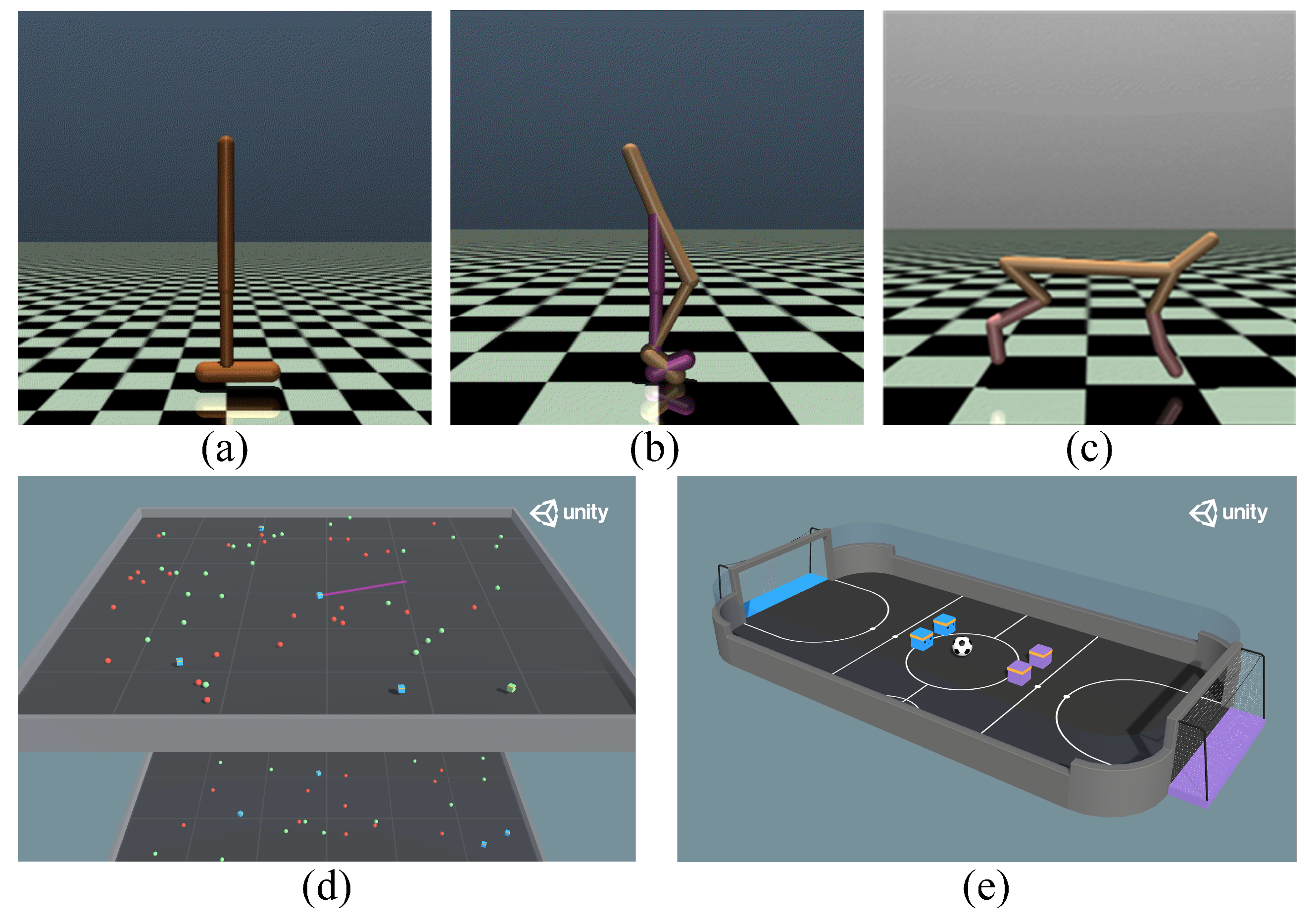
Section 4, experiments are conducted using standard control environments from OpenAI Gym and adversarial environments provided by ML-Agents to validate the effectiveness of the proposed method. Finally,
Section 5 presents the conclusions, including a thorough analysis of the experimental results and a discussion on the potential applications of the A3E-PLE algorithm in the study of robot motion control strategies.
Notation Nomenclature
Table 1 summarizes the mathematical notations, model parameters, and hyperparameters used throughout the study for quick reference.
3. Adaptive Adjustment of Advantage Estimation
The proposed method dynamically adjusts the discount factor
for advantage estimation and incorporates policy entropy regularization, which reduces the need for manual hyperparameter tuning. This adaptive mechanism automatically tunes
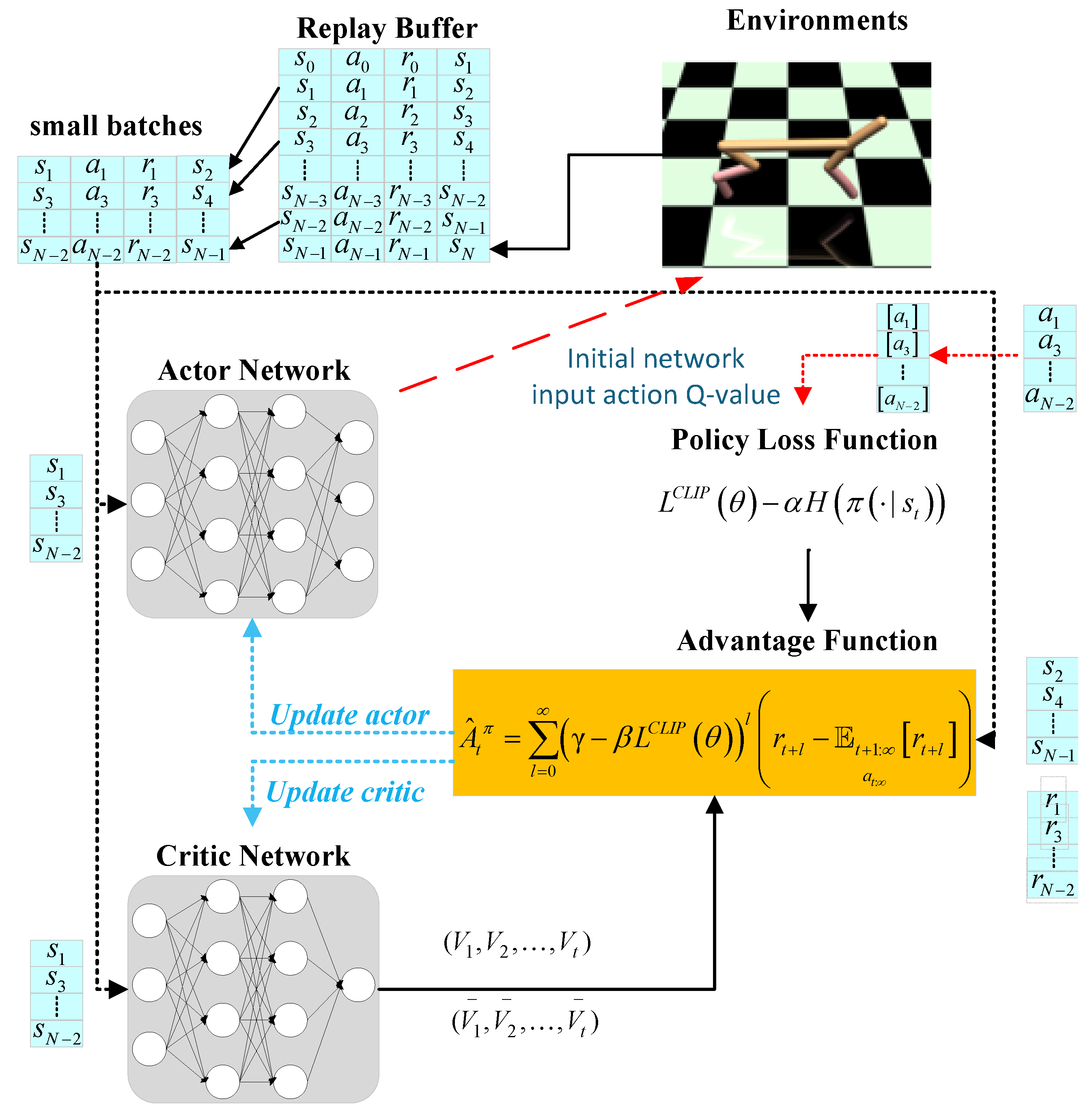
throughout training to balance immediate and long-term rewards dynamically. In the initial training phases focused on exploration, immediate rewards expedite the development of effective strategies. Conversely, as the objective shifts towards maximizing long-term returns, a heightened emphasis on future rewards becomes paramount. Algorithm 1 summarizes the implementation procedure of A3E-PLE, and
Figure 1 illustrates its overall framework.
| Algorithm 1 A3E-PLE |
- Require:
Hyperparameters: K: number of iterations, : clipping factor, : discount factor
- 1:
Initialize policy parameters , value function parameters - 2:
for do - 3:
Execute policy , collect trajectory set - 4:
Compute discounted returns for all timesteps - 5:
Calculate clipping loss - 6:
Compute advantage estimates - 7:
Compute target value function - 8:
for each epoch do - 9:
Compute policy entropy - 10:
Update policy parameters: - 11:
Update discount factor: - 12:
Recompute advantages: - 13:
Update value function: - 14:
end for - 15:
end for
|
As shown in
Figure 1, the agent interacts with the environment using the current policy, generating trajectories consisting of states, actions, and rewards. These trajectories are fed into a feature extraction module that quantifies spatial complexity and motion constraints. The extracted features are used by a target entropy calculator to determine an entropy target suitable for the current environment, which in turn drives the update of the temperature coefficient
. The updated entropy coefficient is simultaneously mapped to the GAE discount factor
, dynamically adjusting the advantage estimation.
During the policy optimization phase, the algorithm employs an entropy-enhanced clipping mechanism and clipped importance sampling to balance the introduction of exploratory actions with the stability of policy updates. The final updated policy parameters are fed back into the environmental interaction loop, forming a continuous cycle of “perception–adjustment–optimization”. The closed-loop structure enables the algorithm to automatically adjust the discount factor in response to policy loss and entropy, thereby diminishing the necessity for manual tuning and intelligently resolving the exploration–exploitation trade-off in path planning.
This architecture enables adaptive advantage estimation, which substantially improves training stability and asymptotic performance in complex environments.
3.1. Policy Entropy Adjustment Policy Loss Function
Policy entropy serves as a metric to quantify the degree of uncertainty in action selection within a given state under a policy [
37]. Essentially, when the probabilities of executing each potential action at the current state
are more uniformly distributed, it indicates a heightened level of exploration by the policy, resulting in a correspondingly higher entropy value. The mathematical expression for computing policy entropy is given in Equation (
13):
where
is the probability of executing action
given state
, when modeling the policy using a Gaussian distribution with a standard deviation
[
38], the formula for calculating policy entropy is presented in Equation (
14):
Entropy serves as a measure of the degree of uncertainty or unpredictability inherent in policy decisions. An increase in entropy indicates a shift towards more exploratory approaches in strategy formulation, while a decrease signifies the adoption of more definitive and less variable policies. The mathematical expression for calculating policy loss is presented in Equation (
15):
where
is the policy entropy coefficient.
3.2. Reconstructing the Discount Factor by Policy Loss
Traditional generalized advantage estimation relies on a fixed discount factor , which cannot dynamically adjust the credit assignment horizon according to the policy learning state. To address this limitation, this paper proposes a policy-loss-driven dynamic discount factor mechanism, which adjusts the weight of long-term returns in real time according to the fluctuation of policy loss, so as to balance the convergence speed and learning stability. In this section, we first review the basic formulation of GAE, then rigorously verify the theoretical validity of the dynamic discount factor mechanism, derive the mathematical expression of the adaptive advantage estimator, and finally introduce the boundary safeguard mechanism to ensure stable training.
The traditional advantage function estimation employs a fixed discount factor
, which is defined as shown in Equation (
16):
The temporal difference error
is defined as shown in Equation (
17):
Substituting the TD error definition into Equation (
16) yields Equation (
18):
To dynamically adjust the balance between short-term and long-term rewards, this paper introduces a discount factor update mechanism driven by policy clipped loss:
where
is the update step coefficient, and
is the clipped surrogate loss function of PPO. In this work, we set the initial discount factor to
and the step coefficient to
.
3.2.1. Theoretical Validity Analysis
To verify the theoretical soundness of the proposed dynamic discount factor mechanism, we analyze three aspects: optimization stability under bounded dynamic discount factors, gradient unbiasedness under non-stationary objectives, and the parameter range justification. In addition, an approximation error bound for the first-order binomial approximation is provided in the subsequent mathematical derivation.
(1) Optimization Stability Under Bounded Dynamic
The optimization framework of the proposed method is built upon the classical GAE and PPO formulations. Schulman et al. [
19] defined the concept of a
-just estimator and proved that for any discount factor
, the generalized advantage estimator maintains an unbiased estimate of the discounted policy gradient, which establishes the theoretical foundation of discounted policy gradient estimation. On this basis, Schulman et al. [
15] further demonstrated that the clipped surrogate objective of PPO constructs a pessimistic lower bound of the original policy performance. By restricting the importance sampling ratio
within
, it mitigates catastrophic policy degradation and contributes to stable policy updates.
In the proposed algorithm, the dynamic discount factor is strictly truncated to the interval throughout the training process. Since is always constrained within , the assumptions required by the original GAE framework remain satisfied.
Although becomes time-varying, its update magnitude satisfies , where C is a positive constant representing an upper bound of the clipped surrogate loss. Therefore, the proposed mechanism can be viewed as introducing a small perturbation to the original PPO/GAE framework, and does not significantly change its optimization dynamics.
Meanwhile, the update step size of is set to an extremely small value , which makes the per-iteration variation of on the order of . This slow-varying characteristic ensures that the adjustment of will not cause abrupt changes in the advantage estimation or the direction of the policy gradient. The core clipping mechanism of PPO remains effective, preventing excessively large policy updates and maintaining optimization stability.
(2) Gradient Unbiasedness Under Non-Stationary Objectives
The coupling of dynamic and policy loss introduces mild non-stationarity into the optimization objective. In the following, we analyze its effect on policy gradient estimation and show that the induced perturbation remains bounded.
Let
denote the advantage estimate under discount factor
, and
denote the discount factor at the
k-th iteration. The policy gradient at iteration
k is:
The gradient bias introduced by the change of
is:
Since
, where
C denotes the bounded maximum value of the clipped policy loss, it follows that
. Moreover, the advantage estimator
is continuously differentiable with respect to
for
. A first-order Taylor expansion gives
. Substituting this result into Equation (
21) gives
.
Therefore, the perturbation introduced by the adaptive discount factor is bounded by the update coefficient . Since is sufficiently small, the resulting gradient deviation is negligible compared with the intrinsic stochastic variance of policy gradient estimation. Consequently, the adaptive discount factor introduces only a mild perturbation to the optimization objective and does not significantly affect the approximate unbiasedness of the policy gradient in practice.
(3) Rationale for the Boundary Setting
The setting of the dynamic discount-factor interval is based on empirical observations reported in previous reinforcement-learning studies.
François-Lavet et al. [
28] investigated the influence of discount factors on the stability of deep reinforcement learning. Their results indicate that excessively large discount factors may amplify value-estimation errors and increase optimization variance, whereas excessively small discount factors tend to produce overly myopic policies that fail to capture long-term dependencies.
Their experiments further suggest that satisfactory performance is generally obtained when lies approximately within the interval .
Based on these observations, the proposed method constrains the dynamic discount factor to , which provides a practical balance between long-term credit assignment and training stability while remaining within the feasible range required by the original GAE and PPO frameworks.
3.2.2. Mathematical Derivation of Adaptive Advantage Estimator
Based on the above theoretical guarantees and parameter settings, we substitute the dynamic discount factor into the GAE framework to derive the specific expression of the adaptive advantage estimator.
Substituting the dynamic discount factor into the advantage function yields:
We begin with a full binomial expansion of the dynamic discount term:
We further quantify the truncation error of the first-order approximation used in Equation (
22) by analyzing the magnitude of the higher-order remainder. Define the remainder term as
Taking absolute values and applying the triangle inequality yields:
Since
and the clipped surrogate loss is bounded by the clipping mechanism, satisfying
, we substitute the upper bound into the summation to obtain
Since , the magnitude of each term in the summation decays rapidly as the order i increases. The term with the lowest power is the dominant term that determines the overall magnitude of the remainder. Substituting the binomial coefficient , the leading second-order term of the remainder takes the form of .
All terms with
are higher-order small quantities compared with the second-order term. Therefore, the magnitude of the remainder is bounded by
The above analysis shows that the truncation error is of second order with respect to the perturbation magnitude. Given that
, the contribution of the second-order and higher-order terms is negligible compared with the first-order term. Thus, the higher-order remainder is neglected in the subsequent derivation, and we adopt the first-order approximation:
Substituting the first-order approximation back into Equation (
22), we obtain the decomposed form of the adaptive advantage estimator:
It can be seen that the adaptive advantage estimator consists of the original GAE component and an additional loss-dependent correction term. As the policy loss increases, the influence of the correction term becomes more pronounced, enabling adaptive adjustment of the effective discounting behavior. Conversely, when the policy loss becomes small, the adaptive estimator gradually approaches the standard GAE formulation.
3.2.3. Boundary Safeguard Mechanism
Although the dynamic has a small update step size, to avoid boundary risks during long-term iterative training, we design a hard truncation mechanism to ensure that always stays within the predefined admissible interval. The specific rules are as follows:
(1) When the updated , set to prevent value function overestimation and training instability.
(2) When the updated , set to avoid the policy becoming excessively short-sighted and failing to learn long-term sequential behaviors.
This dual safeguard of slow-varying updates and boundary truncation ensures that the dynamic discount factor always remains within the feasible range . Since the variation of between consecutive updates is bounded by , the proposed mechanism introduces only a mild perturbation to the original PPO optimization process. Therefore, the optimization stability of PPO is expected to be preserved in practice.
3.2.4. Implementation Workflow of the Dynamic Adjustment Mechanism
To further clarify the operational logic of the proposed dynamic adjustment mechanism and improve methodological transparency, this subsection details its implementation workflow and execution timing within the training pipeline, corresponding to the pseudocode presented in Algorithm 1.
The dynamic discount factor is updated during each training epoch according to a fixed execution sequence that is tightly coupled with the policy and value network optimization process:
(1) After collecting a full batch of trajectories, compute the initial advantage estimates and the clipped surrogate loss based on the current policy and the discount factor inherited from the previous iteration.
(2) In each inner training epoch, first calculate the batch-averaged policy entropy and update the policy network parameters using the policy loss defined in Equation (
15).
(3) Compute the average clipped surrogate loss across all samples in the current batch, and update the discount factor according to Equation (
19):
, where
is a small fixed update step coefficient. The clipped surrogate loss is employed as the feedback signal because it directly reflects the current optimization status of the policy and provides a stable indicator for adaptive discount factor adjustment during training.
(4) Apply the boundary truncation safeguard described in
Section 3.2.3 to constrain
within the interval
, ensuring numerical stability and preventing invalid discount factor values.
(5) Recalculate the generalized advantage estimates for the current batch of trajectories using the updated discount factor.
(6) Update the value network parameters using the recomputed advantage estimates and the corresponding target returns.
Consistent with Algorithm 1, the updated discount factor is immediately incorporated into the advantage estimation process before value function optimization. This design enables the value network to utilize the most recent reward horizon information while preserving the stability of policy optimization.
Notably, the discount factor is updated once per inner epoch rather than per mini-batch, which avoids excessive fluctuations in advantage estimation caused by overly frequent updates and preserves the stability of value function optimization. The update step coefficient is set to an extremely small value, such that the variation of per iteration stays on the order of to , ensuring a slow and smooth adaptive adjustment process.
In addition, the entropy regularization term uses a fixed coefficient throughout training and is incorporated into every policy update step. The entropy regularization mechanism operates independently of the dynamic discount factor adjustment mechanism. Specifically, the entropy term promotes exploration by controlling policy randomness, whereas the adaptive discount factor improves the accuracy of return and advantage estimation through dynamic reward horizon adjustment. Together, these two mechanisms contribute to enhanced learning efficiency and training stability.
5. Conclusions
This paper proposes A3E-PLE, an adaptive advantage estimation algorithm for reinforcement-learning-based robot motion control. To address the limitations of fixed discount factors and insufficient exploration in standard PPO with GAE, the proposed method integrates two core components: a policy-loss-driven dynamic discount factor mechanism and entropy regularization for Gaussian-distributed policies.
Theoretical analysis indicates that the adaptive modulation of adjusts the effective credit assignment horizon according to the evolving policy optimization status, while the entropy regularization term promotes sufficient exploration and maintains stable policy updates.
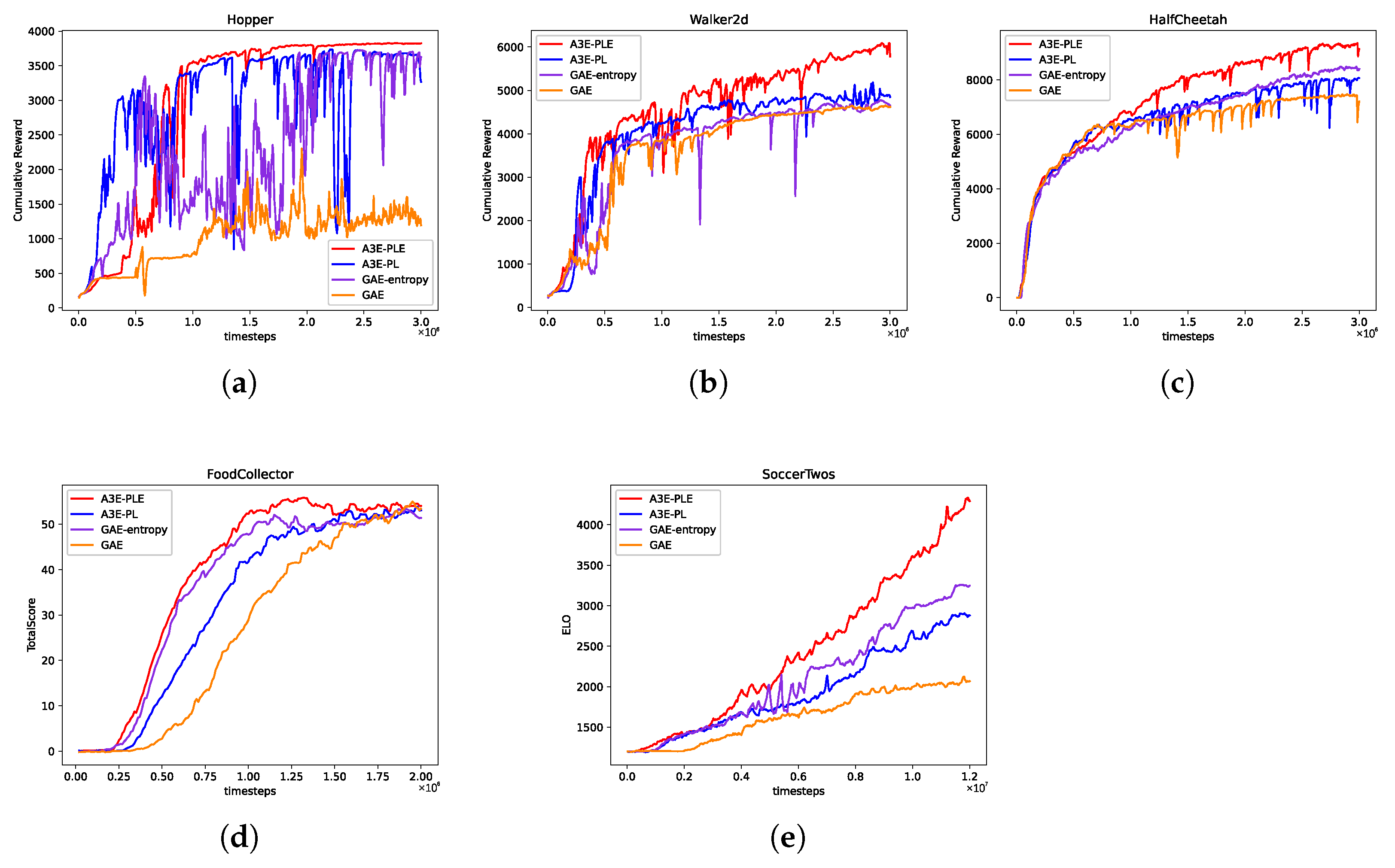
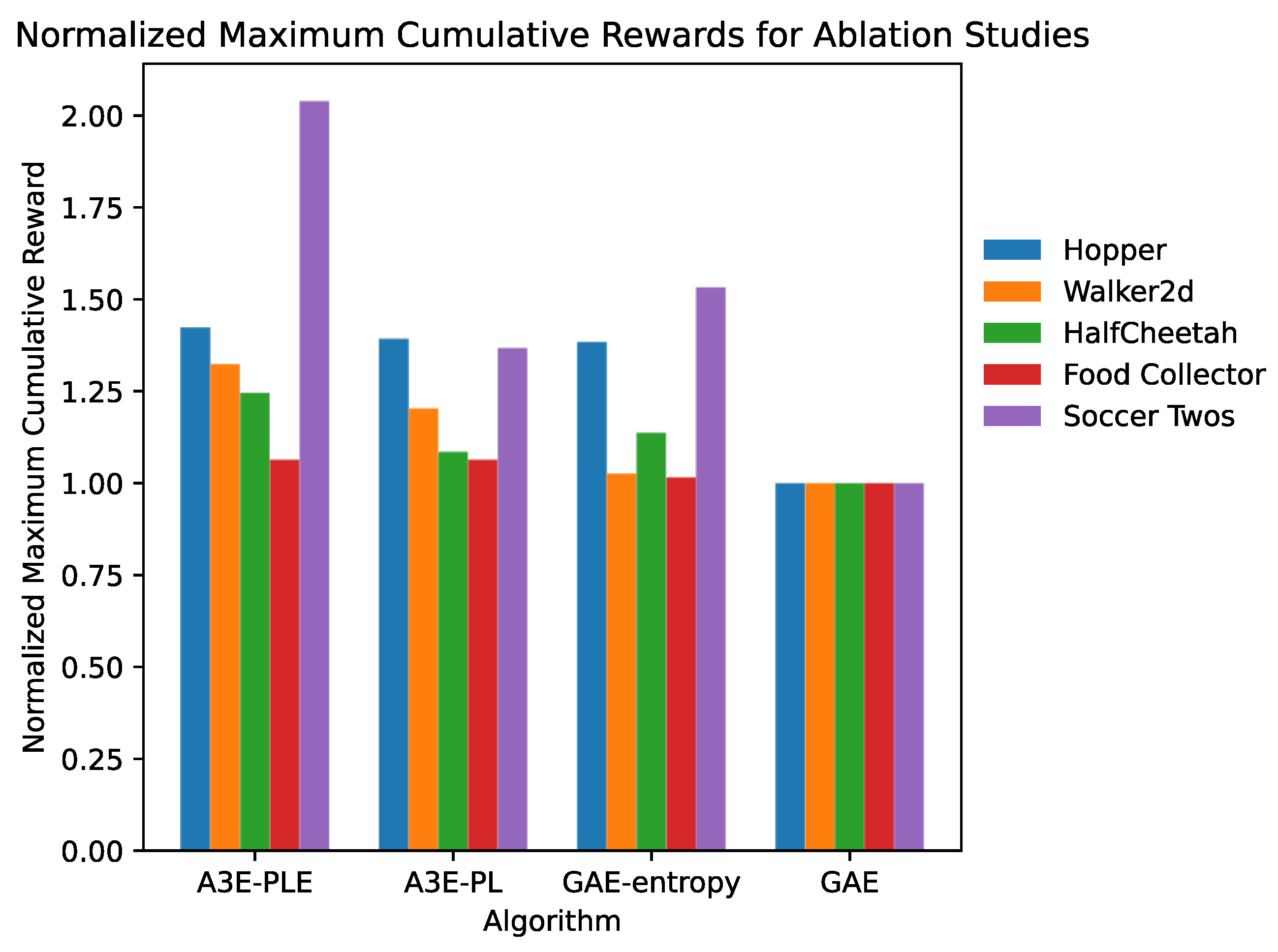
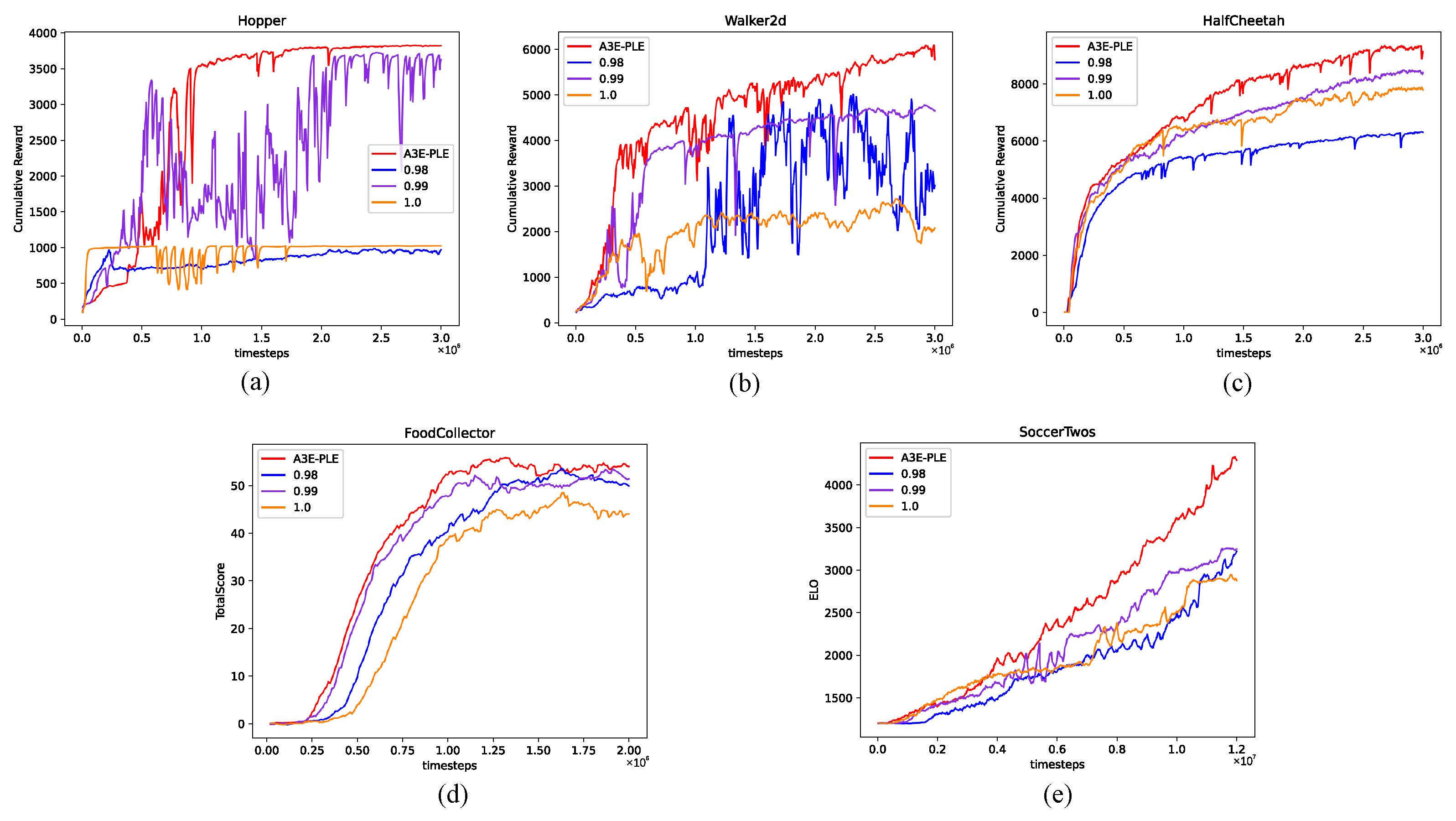
Extensive experiments were conducted on five benchmark environments, including three MuJoCo continuous locomotion tasks (Hopper-v2, Walker2d-v2, HalfCheetah-v2) and two Unity ML-Agents multi-agent scenarios (Food Collector and Soccer Twos). The results demonstrate that A3E-PLE consistently outperforms the fixed- GAE baseline in terms of both asymptotic performance and sample efficiency. In particular, the method exhibits improved learning stability and stronger performance gains in complex multi-agent settings, which verifies its strong generalization across both single-agent continuous control and multi-agent competitive tasks.
From an implementation perspective, A3E-PLE is highly compatible with standard PPO implementations and introduces negligible computational overhead, facilitating practical deployment in robotic systems.
For future work, two promising directions are outlined. First, the linear update rule for can be further improved by exploring more theoretically grounded adaptive weighting strategies based on policy optimization signals. Second, the method will be extended to physical robotic platforms, including legged robots and industrial manipulators, to evaluate its robustness under real-world sensor noise and environmental uncertainties.
Overall, the proposed A3E-PLE provides a simple yet effective mechanism for adaptive advantage estimation, providing a lightweight, easy-to-deploy solution for improving PPO-based reinforcement learning in robotic motion control applications.




 ,
,