Article

A Cable-Driven Hip Exoskeleton with a Postural Control Strategy for Reinforcing Human Balance

by
Giovanni Gerardo Muscolo
1,2,3,*,
Michele Conconi
4,
Alessandra Del Felice
5,6,
Lorenzo Chiari
1 and
Nicola Sancisi
4
1
Department of Electrical, Electronic, and Information Engineering Guglielmo Marconi, Università di Bologna, Viale del Risorgimento, 2, 40136 Bologna, Italy
2
European Center for Theoretical Studies in Nuclear Physics and Related Areas, Fondazione Bruno Kessler, Strada delle Tabarelle, 286, Villazzano, 38123 Trento, Italy
3
Department of Physics, University of Trento, Via Sommarive 14, Povo, 38123 Trento, Italy
4
Department of Industrial Engineering, Università di Bologna, Viale del Risorgimento, 2, 40136 Bologna, Italy
5
Department of Neuroscience, Section of Neurology, University of Padova, Via Belzoni 160, 35121 Padova, Italy
6
Padova Neuroscience Center, University of Padova, Via Orus 2/B, 35129 Padova, Italy
*
Author to whom correspondence should be addressed.
Machines 2026, 14(5), 484; https://doi.org/10.3390/machines14050484
Submission received: 20 March 2026 / Revised: 14 April 2026 / Accepted: 17 April 2026 / Published: 24 April 2026
(This article belongs to the Special Issue Design and Control of Assistive Robots)

Featured Application

This paper presents a new hip exoskeleton with a postural control strategy to reinforce human balance after an unexpected perturbation.

Abstract

Balance loss in older adults often leads to severe consequences, and wearable exoskeletons may help restore postural stability. This paper presents a novel hip cable-driven exoskeleton designed to support balance recovery. The proposed postural control strategy implemented on the device is based on maintaining balance by reducing the center of mass displacement from its equilibrium condition. Loss of balance is analyzed using multibody human models both with and without the exoskeleton. Simulation results evaluating static and dynamic balance demonstrate the effectiveness of the proposed control strategy and support its feasibility for implementation in a real system. The simulations presented in this study will be compared with experimental results from human subjects in future work.

1. Introduction

Loss of balance in the older adults often leads to severe consequences, including falls [1], injuries [2], hospitalization [3], and even death. Extensive research has explored the mechanisms underlying falls, with the focus on understanding human balance recovery strategies [4]. Many research projects are dedicated to predicting, identifying, and preventing falls [5,6], supported by experimental studies involving human subjects. For example, previous work has examined falls induced by tripping [7] or by introducing obstacles during walking [8].
In this context, wearable exoskeletons have emerged as promising tools to assist balance recovery [9,10]. Their development has been influenced by factors such as advancements in health care technologies [11], the rise of wearable smart systems [12], smart city initiatives [13], and inclusive health policies [14]. However, there remains a strong need for engineered systems that seamlessly integrate available technologies with human biomechanical needs. An early example is the work of Monaco et al. [15], who, in 2017, used a rigid hip exoskeleton to aid balance recovery during walking. Their system, composed of rigid links connected to the thighs and waist, used motors to transfer assistive torques to the user’s body. In the past decade, the advent of soft robotics has significantly reshaped exoskeleton design, leading to lighter and more flexible wearable systems [16,17]. More recently, Tricomi et al. [18] introduced a soft hip exoskeleton that reduces human effort during running by transmitting motor-generated forces through cables to the user’s thighs.
The human–machine control interface plays an important role in interactive communication between real systems (humans) and artificial systems (exoskeletons) [19]. However, technological limitations reduce the exoskeleton’s ability to help subjects recover from balance loss. The dynamic balance control algorithm must indeed guarantee equilibrium under different environmental conditions and, at the same time, interact with human action and perception capabilities [19,20,21,22]. The human body must be free to move without the constraints of the exoskeleton, but the robot’s transparency limits the exoskeleton’s instantaneous intervention capability to recover balance in a dangerous situation [22]. A compromise must be reached between transparency and promptness, increasing the complexity of the control system and, more generally, of the mechanical solution. A possible solution can rely on the design of simple mechanical systems whose mechanical characteristics inherently satisfy these conditions, either without implemented control or with a simple control system. An example of this concept is the use of soft interfaces, in which the material’s compliance directly responds to external stimuli. Soft systems reduce some constraints (with respect to the rigid counterpart), but new mechanisms should be designed to adapt the soft systems to the human body. In line with this concept, many designs for new hip exoskeletons have been proposed [23,24,25].
The rigid [15] and soft [16] exoskeletons offer distinct advantages and limitations. Rigid exoskeletons may deliver high torques but often suffer from misalignment between the mechanical and anatomical joint axes, which could increase user effort during movement [22,26]. In contrast, soft exoskeletons prioritize comfort and wearability but typically provide lower levels of assistance [27]. In response to the growing interest in this area, numerous designs with varying degrees of rigidity have been proposed in the literature [26,27].
In this work, we introduce a hybrid hip exoskeleton that combines the benefits of rigid and soft structures [9,10]. Our design employs cable-driven actuation to mitigate joint misalignment issues, while a combination of rigid and soft layers enhances both wearability and torque transmission compared to traditional designs. In addition, we present the implementation of a novel postural control strategy designed for the proposed exoskeleton to prevent balance loss following external perturbations. A preliminary design has been detailed in previous publications [9,10], and it provides the basis for the control strategies developed here. To validate our approach, we conducted multibody (MBD) simulations involving a one-degree-of-freedom (DoF) balance board and MBD human models (MBDHMs) with and without the exoskeleton. The virtual balance board was chosen as a reference to induce a simple disturbance and, at the same time, to replicate experimental conditions that will be used for validation in a future study.
The proposed mechanical design inherently simplifies transparency handling, while the control algorithm, which coordinates motor actuation and sensor feedback, remains simple and enables rapid intervention to support balance recovery.
The paper is organized as follows:
  • Section 2 describes the functional design of the proposed solution;
  • Section 3 details the implemented control architecture;
  • Section 4 presents the optimization procedures, results, and discussion;
  • The paper concludes with a summary and directions for future works.

2. Cable-Driven Hip Exoskeleton

2.1. Conceptual and Functional Design

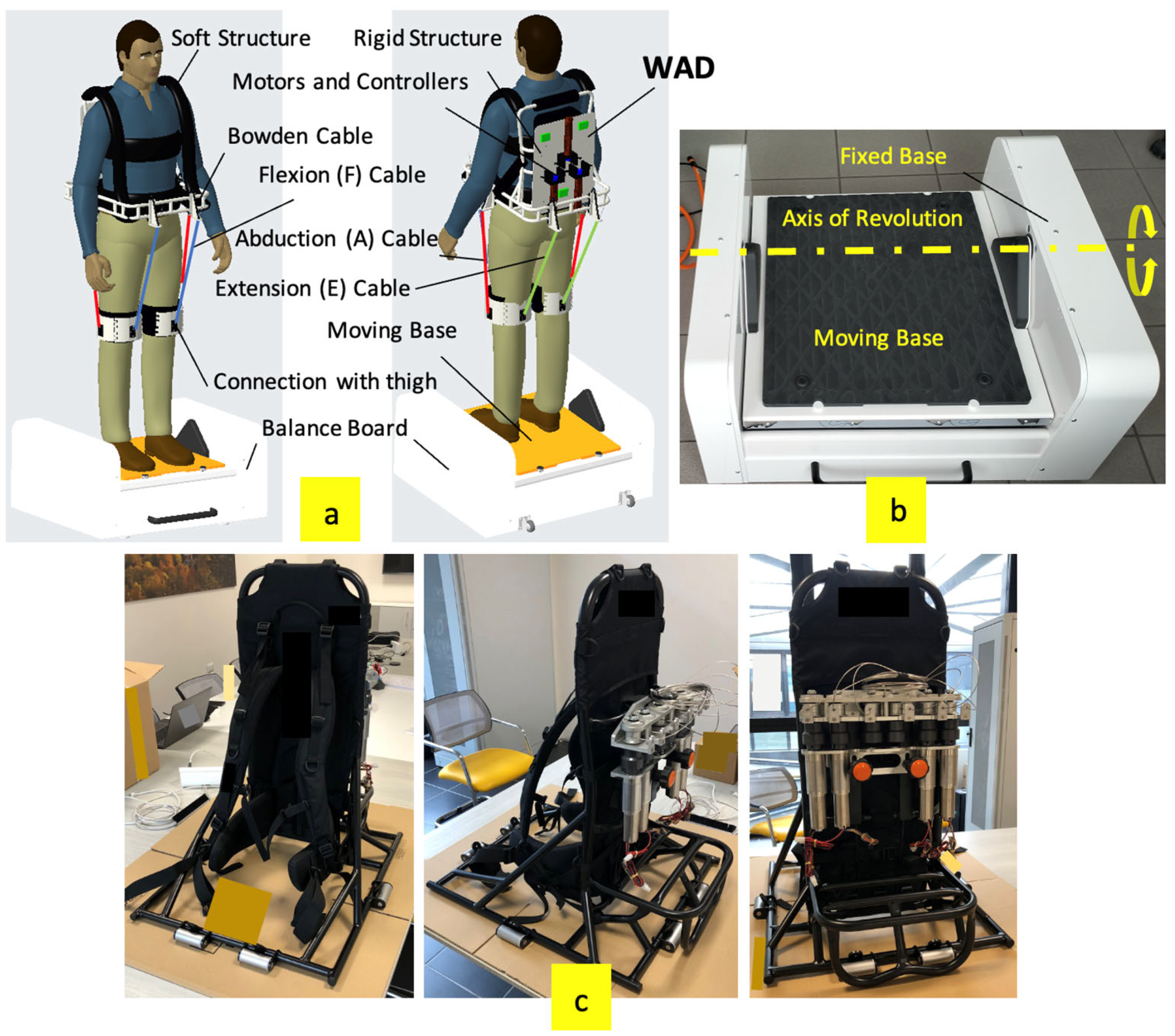
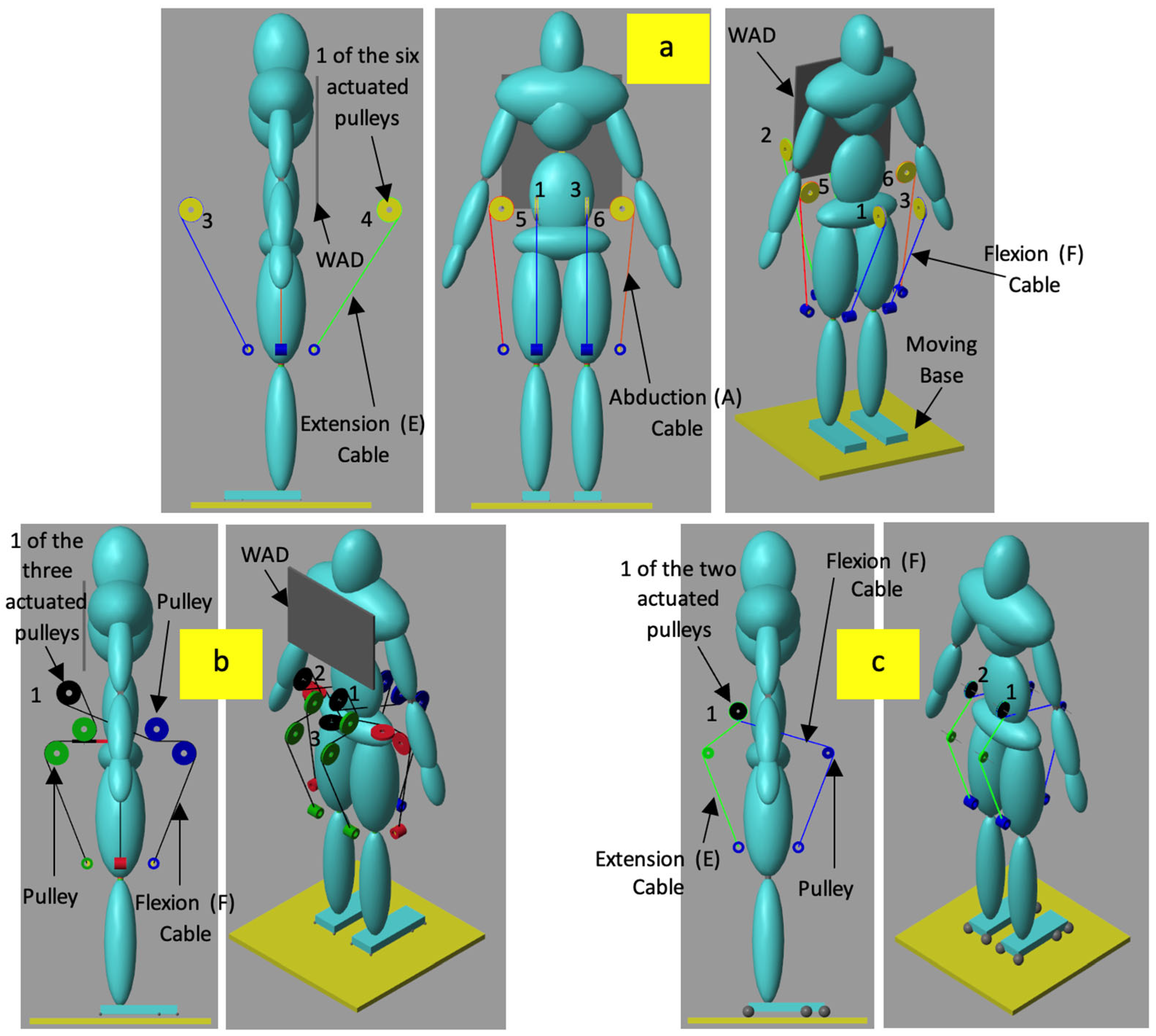
The Wearable Assistive Device (WAD), shown in Figure 1a, was developed within the framework of the REBALANCE project (REinforcing BALANCE with a neurally driven wearable assistive device) [9,10]. The project focuses on studying the postural responses of older individuals subjected to unexpected external perturbations, specifically antero-posterior or latero-lateral tilting, induced using a balance board (see Figure 1b). Experimental trials with and without WAD [9,10] are planned. The balance board consists of a fixed platform and a single-degree-of-freedom (DoF) moving base, capable of generating tilt perturbations at 30°/s over an angular range of ±10° (Figure 1b).
The proposed WAD is an innovative cable-driven hip exoskeleton designed to assist users in maintaining stability and preventing balance loss. One of its key innovations is its ability to independently control hip flexion, extension, and abduction for each leg.
Figure 1a and 1c present the schematic representation and the prototype of the WAD, respectively. The device consists of two primary layers: a wearable soft structure in contact with the user and a rigid external structure that houses the actuation system. Motors and controllers are mounted at the rear of the rigid structure. Bowden cables transmit forces from the motors to the user’s thighs: one end of each cable is attached to the leg, while the other is wrapped around pulleys connected to the motor shafts. Pulley rotation adjusts the free length of the cables, allowing actuation. Each leg is equipped with three cable connections to independently control hip flexion, extension, and abduction.

2.2. Multibody and Analytical Modeling

The mechanical behavior of the WAD was studied using a MBDHM developed in MATLAB®, Simulink®, and Simscape™ Multibody™ (Figure 2). The anatomical parameters for the MBDHM were derived from the established literature [28,29]. It features a spherical joint at the hip and revolute joints at both the knee and the ankle. Though other representations are possible for these joints, this solution is common in the literature and was considered sufficiently representative for the specific study.
The objective of the exoskeleton is to balance the user after a perturbation coming from the balance board. Figure 2a shows the MBDHM with the feet on a moving base and the WAD on the back, composed of six actuated pulleys, three per leg, corresponding to motors that independently control hip flexion, extension, and abduction. Since the exoskeleton should balance the user also with no voluntary muscle control, muscle activation is not considered, except for equivalent joint stiffness, which will be described below. Figure 2b shows a possible design for the implemented exoskeleton actuation. In this case, all motions are achieved with a total of three actuators: one pulley is directly actuated by one motor for flexion and extension in each leg (for a total of two actuators), and one pulley is directly actuated by one motor for abduction (for a total of one actuator). The other pulleys shown in Figure 2b are not connected to the motors. Further simplification is presented in Figure 2c, which focuses exclusively on the antero-posterior dynamics. This model is used to investigate the postural control strategy discussed in the subsequent sections of the article. We included the three solutions of the multibody model in Figure 2 (with six (a), three (b), and one (c) actuators) to illustrate the original exoskeleton and multibody design, while removing, during simulations, aspects that are meaningful from a practical point of view but can be simplified in the simulation without loss of accuracy. Thus, for simplicity, all simulations presented in this paper are performed using only the multibody human model shown in Figure 2c, while the mathematical formulation is obtained from the more general model shown in Figure 2a.
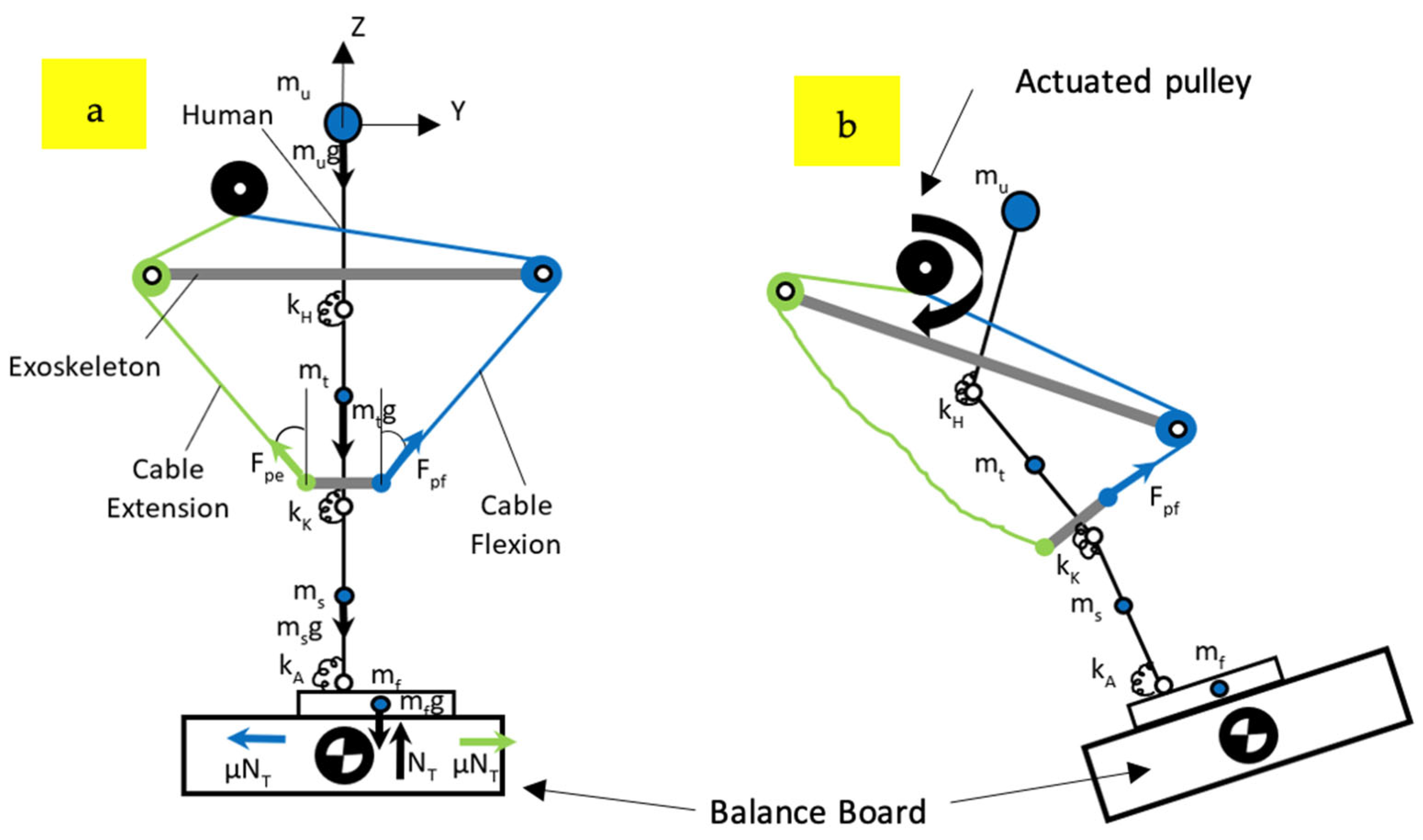
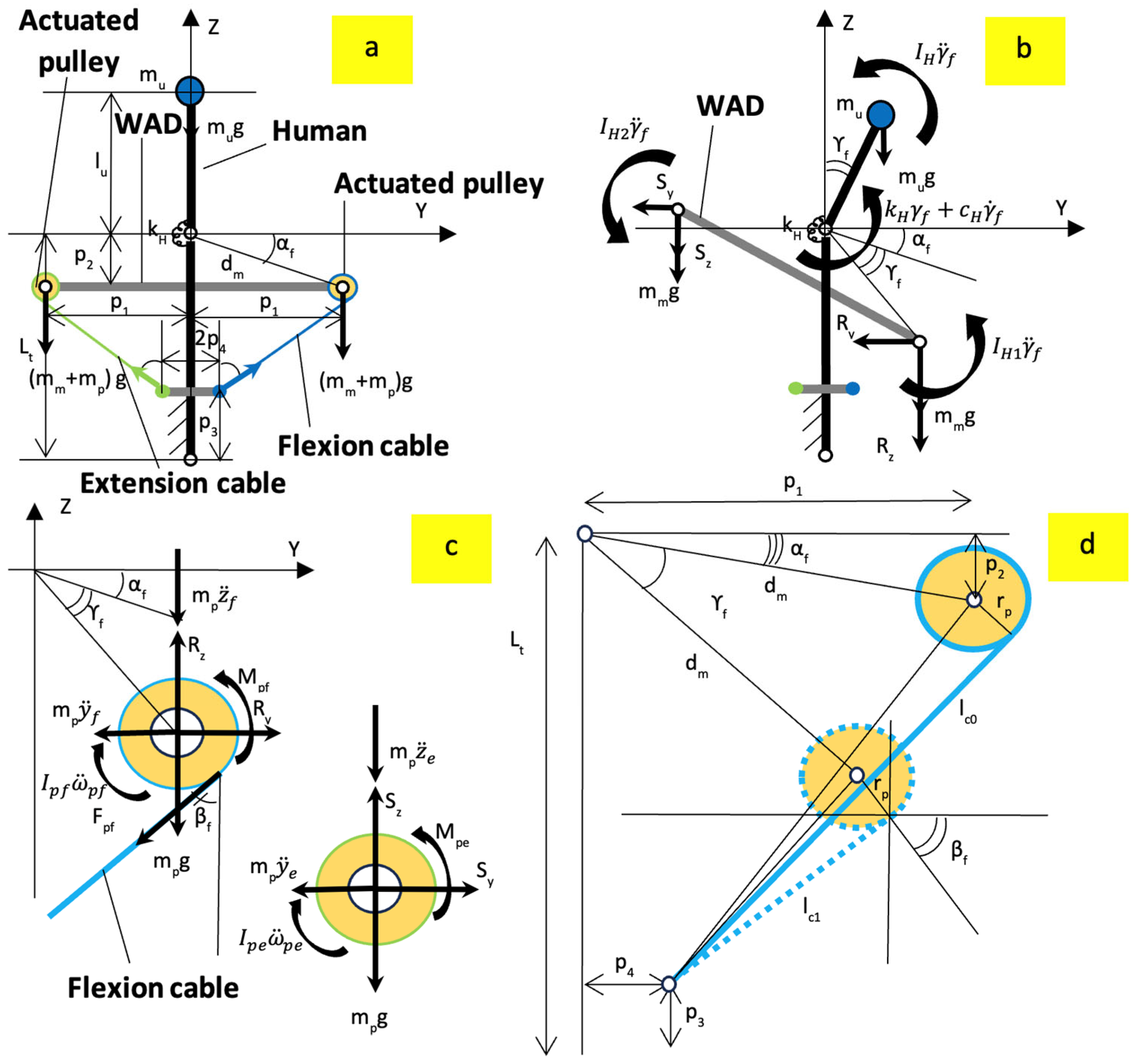
In particular, to develop this mathematical formulation, a representation in the sagittal plane is considered in Figure 3 for the analysis of a disturbance along the flexion-extension direction. A similar formulation also holds for the analysis of ab-adduction disturbance. In this configuration, only hip flexion is represented, together with the two actuated pulleys (Figure 3a), one connected to the flexion cable and the other to the extension cable. When the flexion motor is actuated, the blue cable is pulled, reducing its length. At the same time, the extension motor unwinds the extension cable (green cable).
The effect of musculotendon structures on the joints is represented using equivalent joint stiffnesses at the hip, knee, and ankle, as proposed in other works [30,31], to account for passive or involuntary resistance in the absence of voluntary muscular control. Specifically, stiffness elements were introduced at the hip (kH) [30], knee (kK), and ankle (kA) joints [31]. This strategy allows the model to approximate the stabilizing role of the musculoskeletal system during perturbations without explicitly simulating neuromuscular activation. This simplification allows us to bypass all problems related to determining a real muscle activation strategy, for which many uncertainties still exist in healthy subjects and, in pathological patients, remain a subject of research. It should also be noted that a detailed muscle activation strategy is not really needed in the model, as a resultant joint torque is sufficient. Table 1 lists the variables used in the paper.
The motors produce the torques Mpf (for the flexion cable) and Mpe (for the extension cable), as well as the relative cable tensions (Fpf, Fpe). For clarity, only flexion will be discussed here, as extension can be analyzed similarly (Figure 3c). Masses and inertias of all body segments and WAD are included in the simulation. All human joints are considered passive with equivalent joint stiffness, as described. The only actively controlled joint is the hip, through the WAD.
This approach also supports a control strategy that focuses on the hip flexion (or extension or ab/adduction) angle. In general, the main idea of this control strategy is that the forces exerted by the cables induce tilting in the upper body, enabling it to control the position of the center of mass. The same forces applied to the thigh may cause detachment or sliding between the foot and the board. Thus, two additional objectives for the simulations are to determine the amplitude of the motor forces and to measure sliding or detachment. Figure 3 includes the main model parameters (summarized also in Table 1): Ipf and Ipe are the moments of inertia of the pulleys and motors (respectively for flexion and extension); ω ¨ p f and ω ¨ p e are the angular accelerations of the pulleys (respectively for flexion and extension); mm and mp are, respectively, the masses of the motors and pulleys; Ry, Rz, Sy, and Sz are the reaction forces between the pulleys and the motor shaft of the motor (connected to the WAD structure and human trunk); kH and cH are, respectively, the stiffness and damping coefficients of the hip; g is gravity; mu includes the masses of the trunk and the WAD; γf is the angular displacement of the hip; IH, IH1, IH2 are three moments of inertia (calculated with respect to the center of the reference system shown in Figure 3), respectively, of the trunk, the anterior part of the WAD, and the posterior part of the WAD; rp is the pulley ray.
In the following equations, we calculated the equilibrium of the trunk, the WAD (Figure 3b), and the pulleys (Figure 3c), for the human configuration in upright position with fixed legs, as shown in Figure 3a:
S z = m p g + m p z ¨ e
S y = m p y ¨ e
M p e = I p e ω ¨ p e
M p f = F p f r p + I p f ω ¨ p f
R y = F p f sin β f + m p y ¨ f
R z = m p g + F p f cos β f + m p z ¨ f
m u g l u sin γ f I H + I H 1 + I H 2 γ ¨ f + R y d m sin γ f + α f k H γ f c H γ ˙ f + R z + m m g d m cos γ f + α f m m g + S z d m cos γ f α f S y d m sin γ f α f = 0
Assuming y ¨ e = y ¨ f = y ¨ and z ¨ e = z ¨ f = z ¨ , the boundary conditions allow us to write the following acceleration of the pulleys:
y ¨ = γ ¨ f d m sin γ f + α f + γ ˙ f 2 d m cos γ f + α f
z ¨ = γ ¨ f d m cos γ f + α f + γ ˙ f 2 d m sin γ f + α f
And with approximation for our scopes:
y ¨ = γ ¨ f d m sin γ f + α f
z ¨ = γ ¨ f d m cos γ f + α f
Substituting Equations (1), (2), (5), (6), (10) and (11) in Equation (7)
F p f = f ( γ ¨ f , γ ˙ f , γ f )
where γ ¨ f = γ ˙ f = 0 when the subject reaches static equilibrium. Substituting Equation (12) in Equation (4), the minimum torque Mpf to move the trunk is calculated, where I H 1 = I H 2 = m m + m p d m 2 , I H = m u l u 2 , α f = tan 1 p 2 p 1 , d m = p 1 2 + p 2 2 . The angle β f is obtained with the following formulations (Figure 3d).
l c 1 2 = d m cos γ f + α f p 4 2 + L t p 3 d m sin γ f + α f 2 r p 2
l c 0 2 = p 1 p 4 2 + L t p 3 p 2 2 r p 2
β f = π t a n 1 l c 1 r p t a n 1 L t p 3 d m sin γ f + α f d m cos γ f + α f p 4

3. Control System: Strategy and Architecture

3.1. Postural Control Strategy

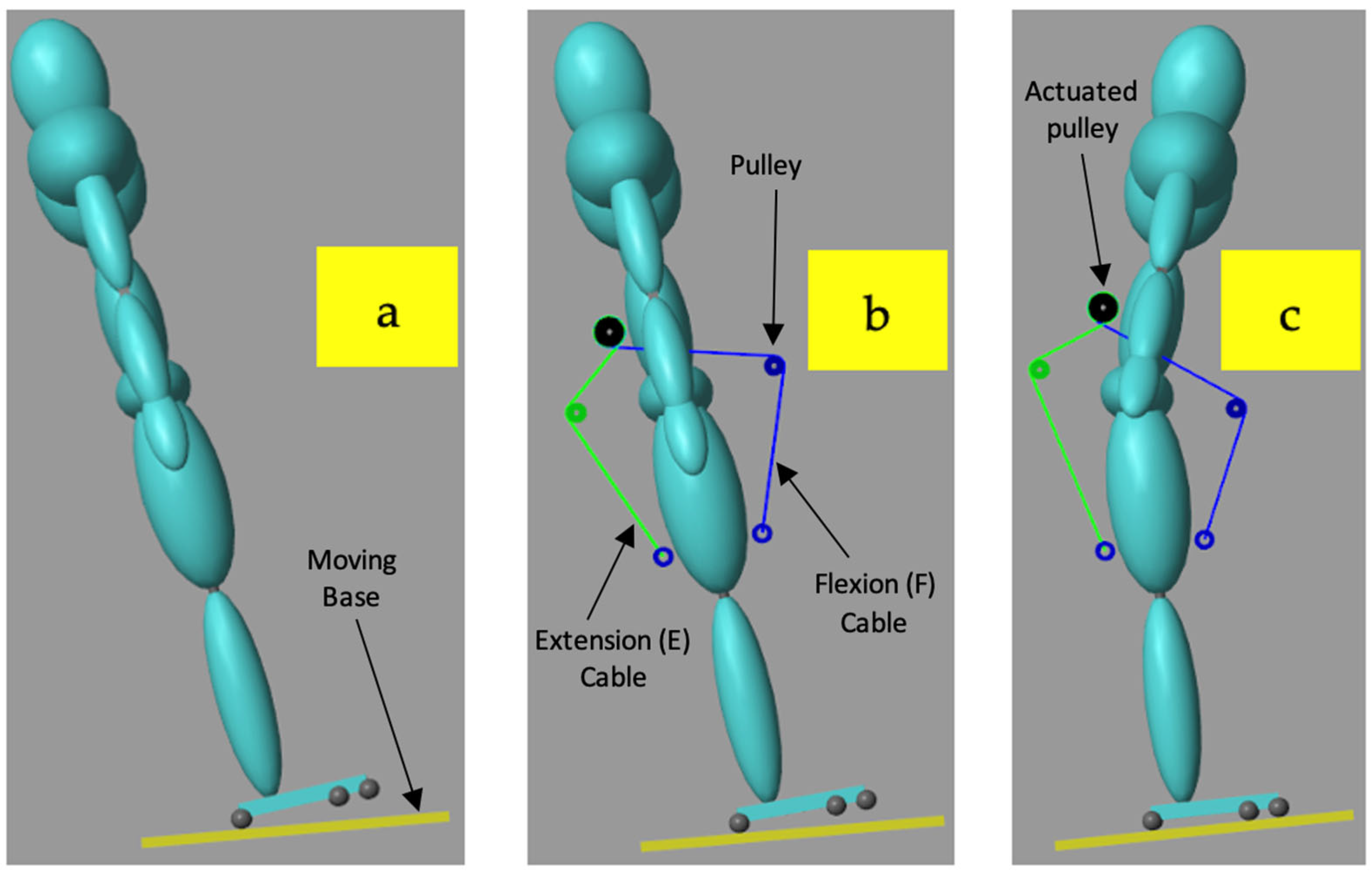
The postural control strategy developed for the WAD helps users recover balance following unexpected external perturbations. Figure 4 illustrates a simplified schematic of the WAD system in response to perturbations generated by the balance board. It is the same as in Figure 3, except that it uses a single motor pulley for a simplified, equivalent simulation (like in the model shown in Figure 2c). Figure 5 presents the corresponding MBDHM that undergoes perturbations under three different conditions: (i) without the WAD, (ii) wearing a deactivated WAD, and (iii) wearing the WAD with active assistance.
The balance board generates antero-posterior and latero-lateral tilting perturbations. In response to such perturbations, the WAD aims to stabilize the user by actively controlling antero-posterior and latero-lateral trunk tilting.
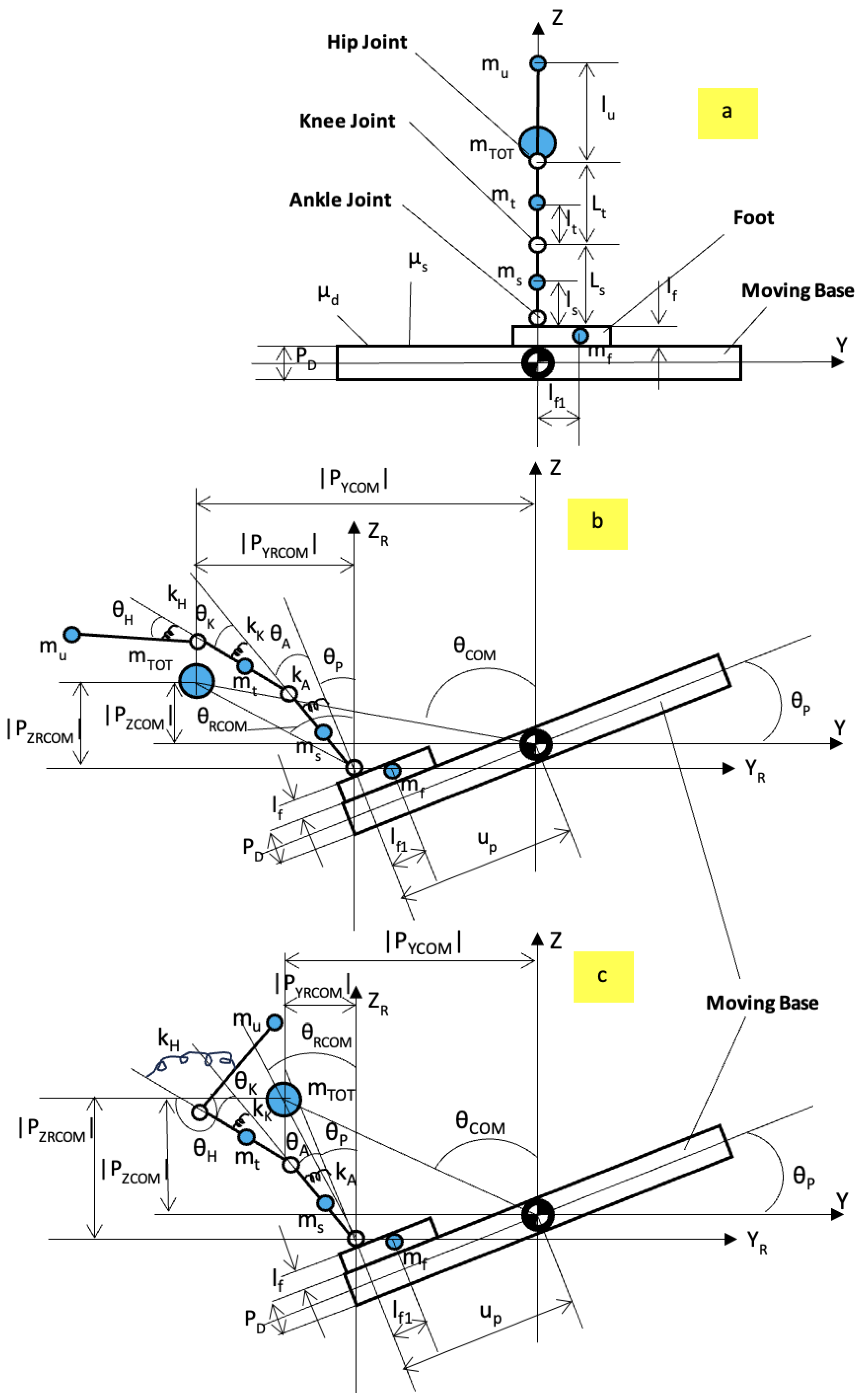
Figure 6 details the dynamic model used for the WAD control strategy during balance recovery. Also, in this case, the model is developed for flexion–extension and thus shown in the sagittal plane, but a similar formulation holds for ab–adduction. The model illustrates three key configurations:
(a)
the initial standing posture (Figure 6a);
(b)
the perturbed posture while wearing a passive (deactivated) WAD (Figure 6b);
(c)
the perturbed posture with active motorized intervention (Figure 6c).
In all configurations, the user’s foot maintains contact with the moving base of the balance board. The interaction is characterized by the static (µs) and dynamic (µd) friction coefficients between the foot and the base surface. The total mass of the system (mTOT), concentrated at the center of mass (CoM), represents the combined mass of the human body (mb) and the WAD (mE).
Specifically (see Table 1): mu represents the mass of the trunk and WAD, mt the mass of the thigh, ms the mass of the shank, and mf the mass of the foot. Additional model parameters include: Lt and Ls, the lengths of the thigh and shank, respectively; lu, lt, and ls, the distances from the hip, knee, and ankle joints to their corresponding segmental center of masses; lf1, the distance from the center of mass of the foot to the ankle joint; lf is the double of the distance from the center of mass of the foot to the moving base surface.
This dynamic representation provides the foundation for designing and optimizing the postural control strategy implemented in the WAD.

3.2. Control Architecture

During perturbations induced by the balance board, the moving base (characterized by a platform thickness PD) undergoes an angular motion described by the input θp. This perturbation may result in displacement of the foot along the moving surface (up) and induces angular motion across the body segments: the trunk experiences a combined rotation of (θH + θK + θA + θp), the thigh rotates by (θK + θA + θp), and the shank by (θA + θp).
We adopted a modeling approach similar to that proposed in [30,31], as described in the previous section.
During the antero-posterior perturbation shown in Figure 6b,c, the linear absolute displacements (PYCOM and PZCOM) of the CoM with respect to the reference system (shown in Figure 6) can be calculated as:
P Y C O M = 1 m T O T ( 2 m f + 2 m s + 2 m t + m u ) u p cos θ P P D 2 + l f 2 sin θ P + 2 m f l f 1 cos θ P l f 2 2 m s + 2 m t + m u sin θ P 2 m s l s + 2 m t L s + m u L s sin θ A + θ P 2 m t l t + m u L t sin θ A + θ K + θ P m u l u sin θ A + θ K + θ H + θ P
P Z C O M = 1 m T O T { ( 2 m f + 2 m s + 2 m t + m u ) u p sin θ P + P D 2 + l f 2 cos θ P + 2 m f l f 1 sin θ P + l f 2 2 m s + 2 m t + m u cos θ P + 2 m s l s + 2 m t L s + m u L s cos θ A + θ P + 2 m t l t + m u L t cos θ A + θ K + θ P + m u l u cos θ A + θ K + θ H + θ P }
The absolute (θCOM) and relative (θRCOM) angular displacements of the CoM are also shown in Figure 6, together with the relative displacements (PYRCOM and PZRCOM), and are obtained as:
θ C O M = tan 1 P Y C O M P Z C O M
θ R C O M = tan 1 P Y R C O M P Z R C O M
P Y R C O M = P Y C O M u p cos θ P P D 2 + l f 2 sin θ P
P Z R C O M = P Z C O M + u p sin θ P + P D 2 + l f 2 cos θ P
Thus, the angular motion of the moving base (θp) disturbs human balance, as measured by θCOM and θRCOM, and WAD is activated to reinforce postural control, preventing a loss of balance. This latter θRCOM is used in the literature to calculate the static and dynamic stability of the human model [32,33,34,35].
The new postural control strategy is based on a simple approach: the horizontal motion of the CoM must be avoided to maintain balance. This objective may be obtained only for very small displacements (up) by assuming PYCOM = 0 in Equation (16) and solving for θ H , using as input θp, θA, θK and up as shown in Equation (22) below. The MBDHM measures the three angles θp, θA, θK and the foot-platform motion up to test the control strategy, to find the motor angle θM with Equation (23) (G is a constant), and to obtain other variables such as motor torque and pulley joint angles for flexion–extension. In a real application, the angles can be measured using wearable sensors, such as IMUs or similar devices.
θ H = sin 1 { 1 m u l u [ 2 m f + 2 m s + 2 m t + m u u p cos θ p P D + l f 2 sin θ p + 2 m f l f 1 cos θ p l f 2 2 m s + 2 m t + m u sin θ p 2 m s l s + 2 m t L s + m u L s sin θ A + θ p 2 m t l t + m u L t sin θ A + θ K + θ p ] } θ A θ K θ p
θ M = G θ H
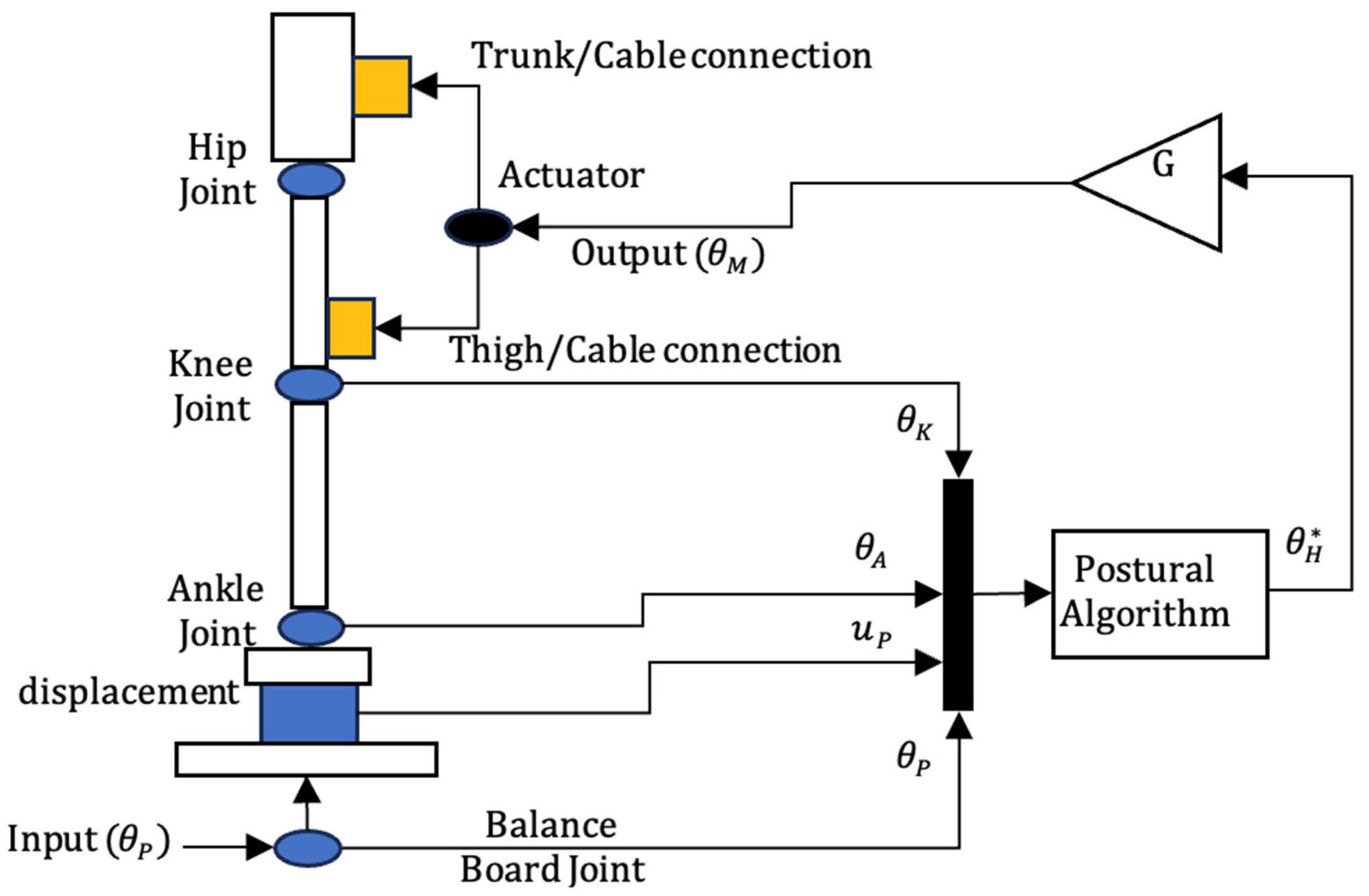
Figure 7 shows the control architecture of two legs implemented in the MBDHM shown in Figure 2c. The simulation input is the angular displacement θP. The output is the angular tilt of the actuator θM obtained from Equation (23), including the G constant.

3.3. Multibody Simulations

Table 2 shows the numerical simulation setting used in our simulations.
The maximum angle and velocity of the balance board are respectively settled to 6 degrees and 10°/s. The balance board can be moved around of ±10° at 30°/s, and it was designed to test many perturbation conditions. In our simulation, we used the same perturbation condition to create falls while wearing a deactivated exoskeleton and without wearing an exoskeleton. We noted that in our MDBHM shown in Figure 2c, the fall occurs around minus than 6° and 10°/s, however, if the subject wears the activated exoskeleton and using our postural control strategy, loss of balance is avoided. These general values are used to compare the stability analysis for the three conditions: with an activated WAD, with a deactivated WAD, and without WAD.

4. Results and Discussion

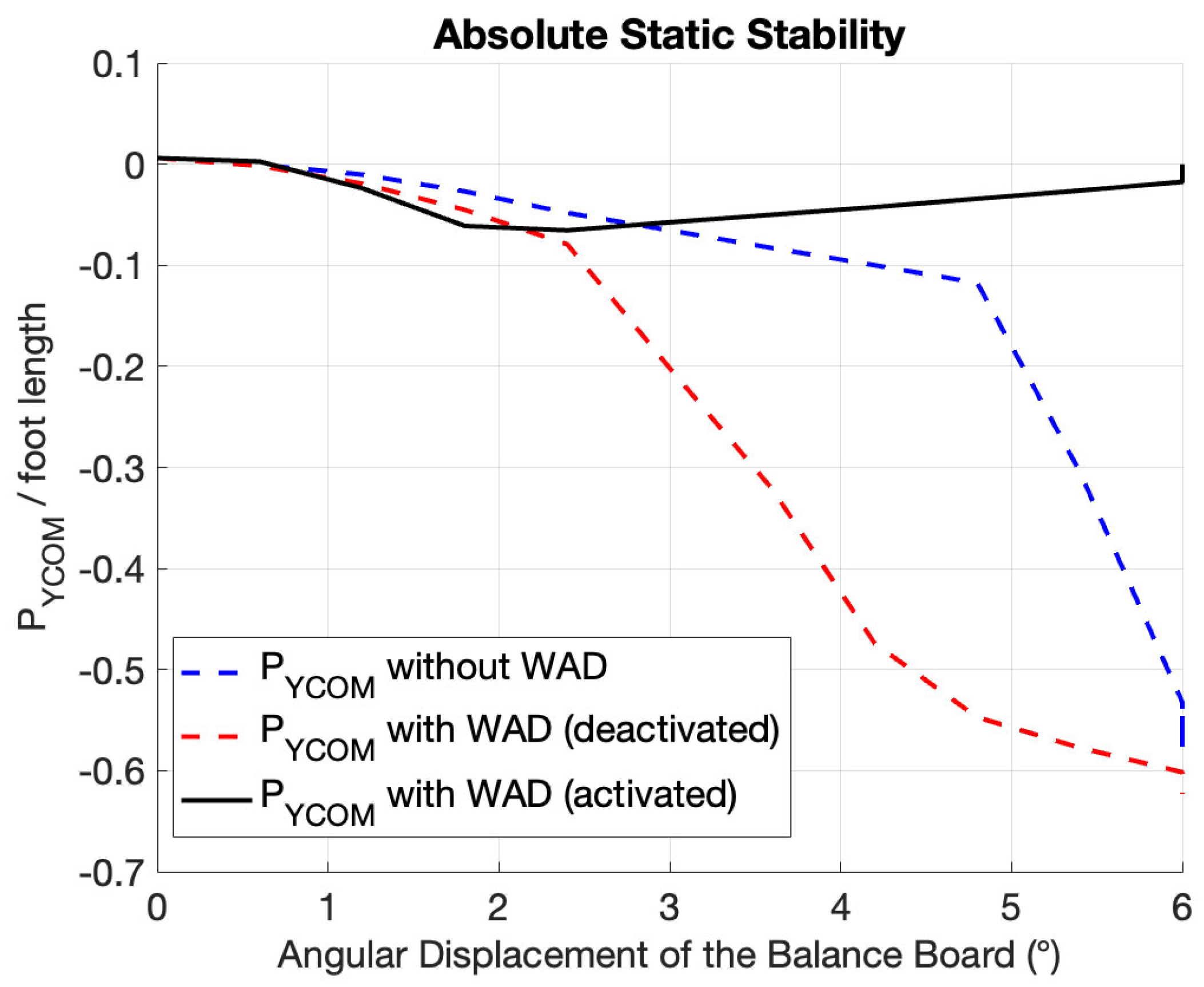
Figure 8 presents the static stability analysis for the three conditions (with an activated WAD, with a deactivated WAD, and without WAD) with respect to the absolute reference system. The horizontal component of the center of mass position (PYCOM)—introduced in Figure 6—is used as a stability metric. Activation of the WAD using the postural control algorithm of Equation (23) successfully maintains PYCOM near zero, ensuring the center of mass remains within the Feasible Stability Region (FSR) [32,33,34,35]. In contrast, configurations with a deactivated or absent WAD show a significant deviation of PYCOM from zero, indicating instability. At the same time, in these conditions, loss of foot contact with the balance board is observed, corresponding to the onset of a Backward Balance Loss (BBL), as shown in Figure 5.
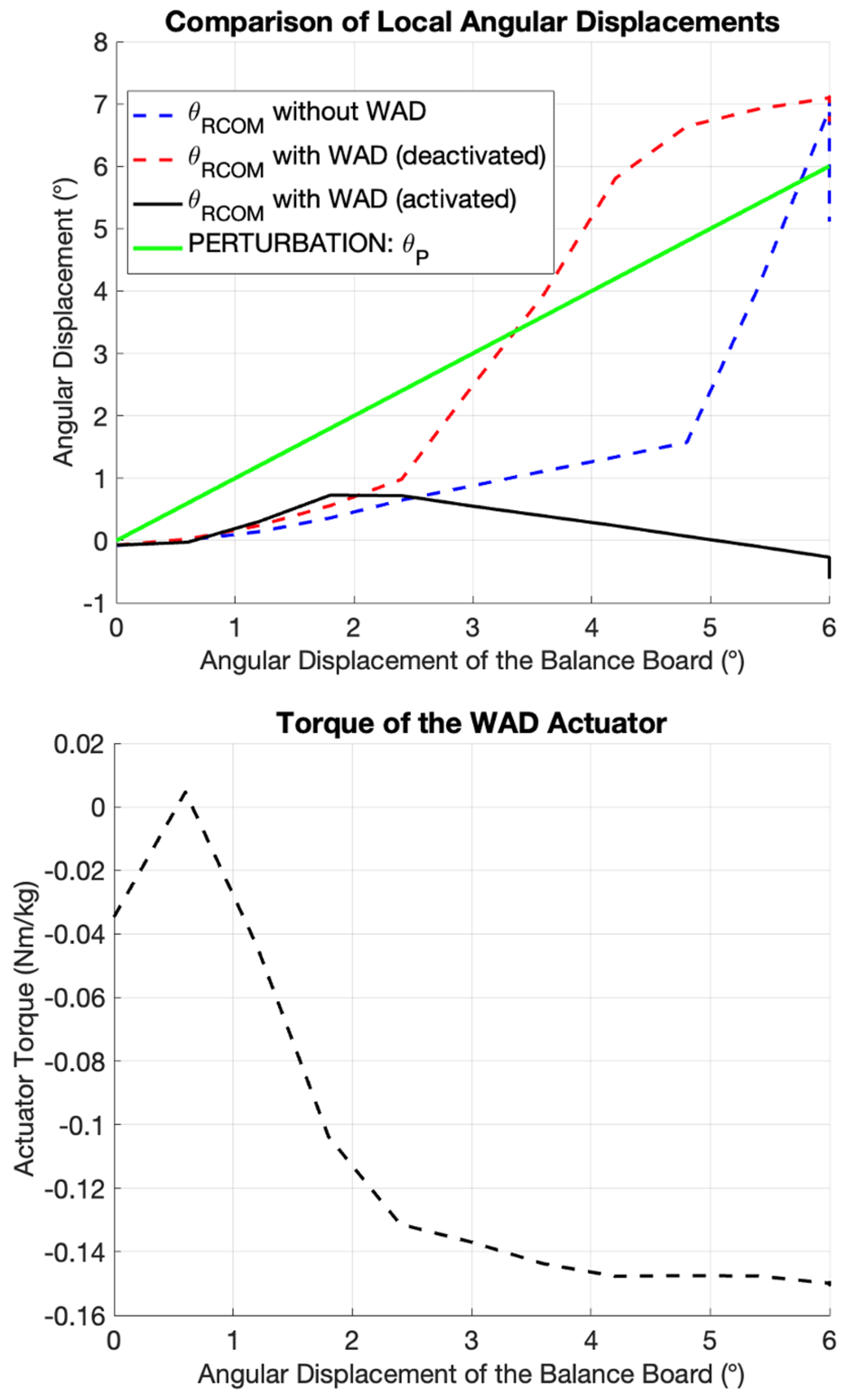
Figure 9 compares the angular displacement of the center of mass (θRCOM, as defined in Equation (19)) with the balance board input perturbation (θP), both referenced to Figure 6. The results demonstrate significantly greater instability in the configurations without an activated WAD. Finally, the other plot in Figure 9 shows the trend in actuator torque during perturbation and recovery, illustrating the WAD’s active role in maintaining balance. We used the total body mass of the multibody human model (mb), adding the mass of the WAD (mE), to normalize the actuator torque. All information is shown in Table 2.
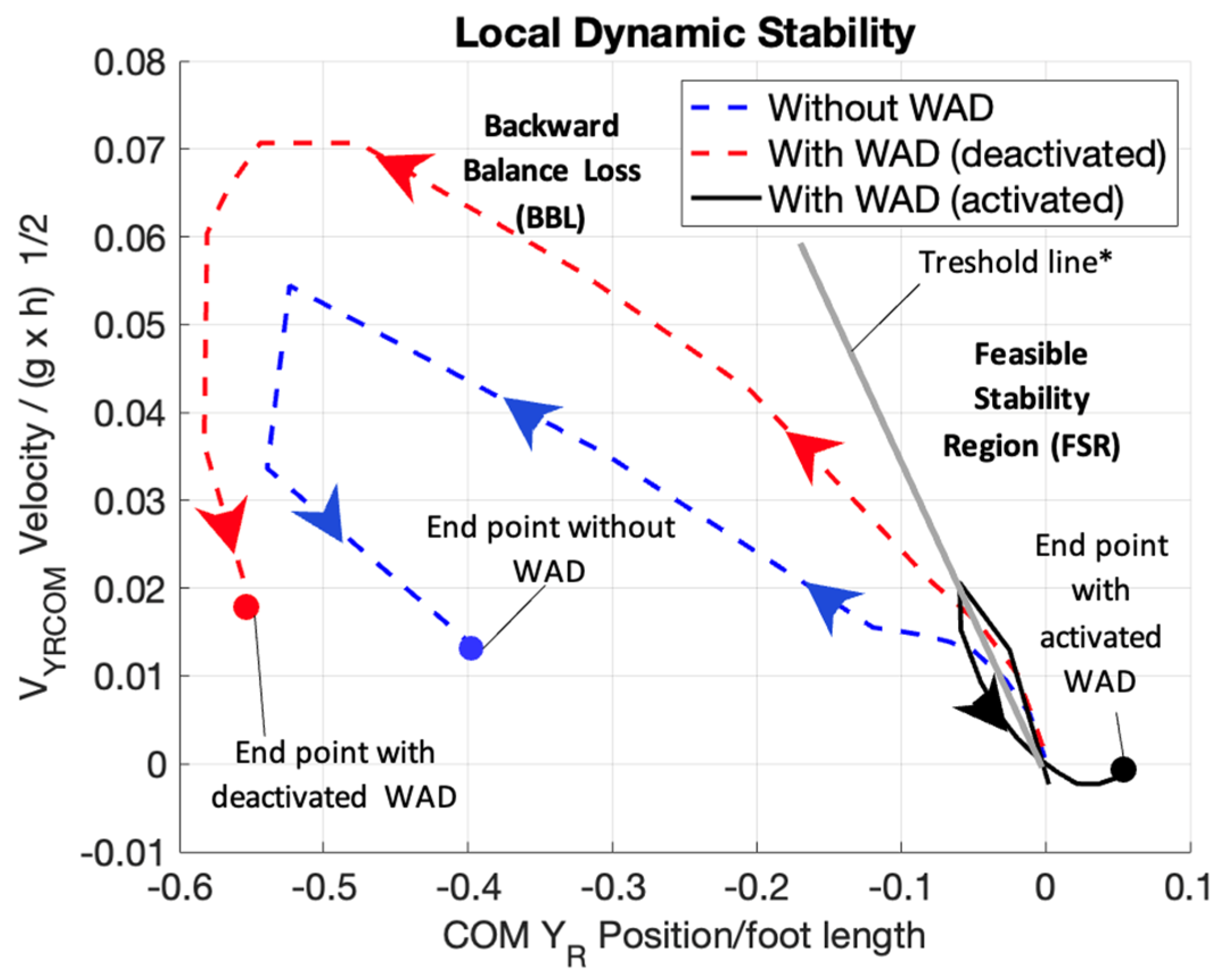
Figure 10 illustrates the human dynamic stability plot commonly used in the literature to define the FSR [32,33,34,35]. Simulations with the WAD activated show that the system’s final state lies within the FSR, indicating successful balance recovery. In contrast, simulations with a deactivated WAD (or without the WAD) yield trajectories that do not enter the FSR, resulting in a BBL in both configurations. The threshold line separating the FSR from the BBL zone, as defined by Yang et al. [34], is also included in the graph. Arrows indicate the direction of the motion during perturbation recovery.
The abrupt local changes in slope and direction of the trajectories shown in the following figures are caused by changes of the balancing configuration passing the zone of stability and falling over the balance board. The simulations presented in this study will be compared with experimental results from human subjects in future work.
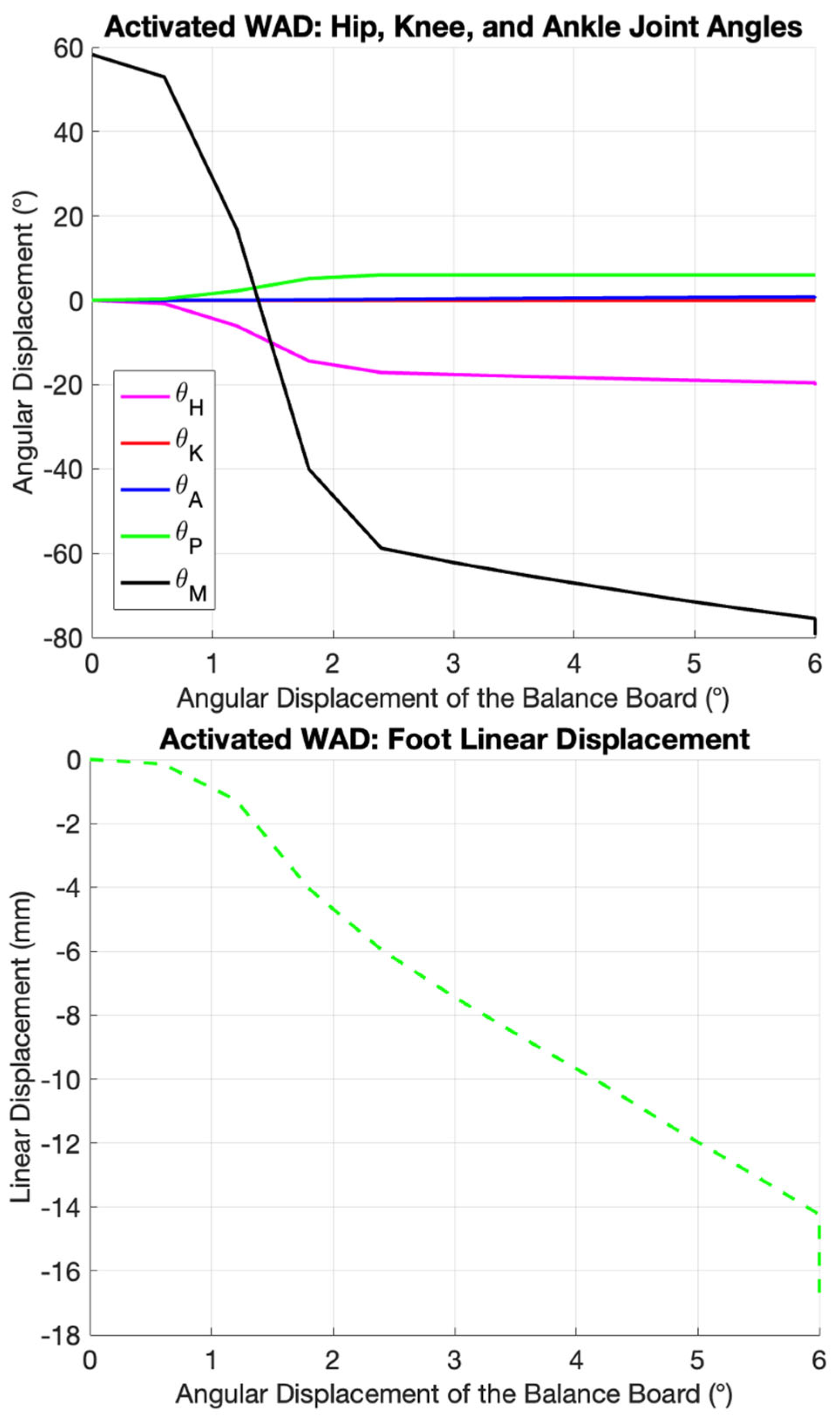
Figure 11 shows hip (θH), knee (θK), and ankle (θK) joint angles with the activated WAD, including angles of perturbation (θP) and actuator (θM). The second graph of Figure 11 shows the displacement of the foot with respect to the surface of the balance board (up) during the motion of the balance board. During the MBDHM simulations, the measured value of the up was very small, and no significant differences were observed between the relative (YRZR) and absolute (YZ) planar reference systems. Moreover, the sign of this displacement indicates that this motion is mostly due to gravity sliding, rather than to the forces that move the trunk. The calculation of the angle of the center of mass with respect to the absolute reference system (θCOM) and with respect to the local reference system (θRCOM) gives similar results. This also provides validation of the possible foot–platform displacements: the WAD with the proposed control system allows very small detachment or sliding (upward), favoring a more stable balance recovery for the user.

5. Conclusions

Dynamic balance is improved using the WAD and the postural control strategy proposed in this paper. A comparison among human models wearing an activated exoskeleton, a deactivated exoskeleton, and no exoskeleton highlighted the effectiveness of the proposed device. In addition, the simulation pipeline presented here enabled the estimation of required motor torques and cable and joint forces, providing useful information for the overall design and optimization of the WAD. The simulations also confirmed the very small foot detachment or sliding, with trunk oscillations acting as the primary stabilizing mechanism.
Analysis of the proposed system was performed through multibody simulations using human models on a balance board, with and without the exoskeleton. Equivalent joint stiffness and damping were used to simulate involuntary muscle contractions. This is a strong assumption, which, however, seems reasonable for the WAD’s specific application. In both simulations and real applications, the overall system dynamics is actually needed, i.e., body motion, external loads, and resisting joint loads, which can be measured or computed from the system’s sensors (IMUs and encoders). This information is used in the control system to activate the hip joint via the exoskeleton, using the formulation presented here to reinforce the overall system balance. As for the resistant joint loads, most fallers exhibit reduced proprioception, which delays muscle control. This is modeled here by considering a “frozen” muscle activation state during stance, for which stiffness characteristics are presented in the literature. This simplification allows us to bypass all problems related to determining a real muscle activation strategy, for which many uncertainties still exist in healthy adults and, in pathological patients, remain a subject of research. We believe it is not convenient to try to control muscular activation in these pathological subjects. The proposed control strategy and overall methodology are a first reference point that can be validated in future work with real subjects.
The results are not compared with real experimental data, which are not yet available. Experiments with younger and older adults, with and without the WAD, are planned. They will help validate our human model and optimize the WAD and postural control strategy.
Future experimental data will help overcome other limitations of the present study. We decided to apply a very simple concept for the postural control strategy, without adding complexity to a complex model of the human and exoskeleton. The proposed strategy was successful in balancing, but other possibilities can be explored. Future work will be oriented to include, in parallel with the postural control, velocity and force controllers, and to compare all three controllers to achieve a faster and more robust balance. In this paper, we avoided including other controllers for comparison for several reasons. The scope of the manuscript is threefold: to present the exoskeleton design, the control system, and the computation framework for evaluating and dimensioning the overall system. The proposed control strategy has a strong physical foundation: a healthy proprioception system tries to keep the CoM within the foot’s projection. This implementation was chosen since it is already quite simple to include. Other strategies could further simplify this approach. However, since the proposed strategy was successful, alternative approaches must be validated using real experimental data and tested on subjects.
For the same reason, a sensitivity analysis was not included, since a comprehensive analysis in this direction would have been outside the scope of the manuscript. Stability was tested with alternative parameter sets around those considered in the paper, but here we preferred to rely on realistic parameters that reflect the real system. A full sensitivity analysis will be the subject of a further study, when we will have access to experimental data from real patients wearing the system to validate the results under different conditions.

Author Contributions

Conceptualization, G.G.M., N.S., M.C.; methodology, G.G.M., N.S., M.C.; software, G.G.M.; validation, G.G.M., N.S., M.C., L.C.; formal analysis, G.G.M., N.S.; investigation, G.G.M.; resources, G.G.M., N.S., M.C., L.C.; data curation, G.G.M., N.S., M.C.; writing—original draft preparation, G.G.M.; writing—review and editing, G.G.M., N.S., M.C., A.D.F., L.C.; visualization, N.S., M.C., L.C.; supervision, N.S., M.C., L.C.; project administration, A.D.F., L.C.; funding acquisition, A.D.F., L.C. All authors have read and agreed to the published version of the manuscript.

Funding

This paper is partially funded by REBALANCE (REinforcing BALANCE with a neurally driven wearable assistive device, 2022YPK5YB 002—CUP J53D23012900006) and Next Generation EU—Age-It project (Ageing well in an ageing society—PE0000015, National Recovery and Resilience Plan—NRRP—PE8—Mission 4, C2, Intervention 1.3).

Institutional Review Board Statement

Not applicable.

Informed Consent Statement

Not applicable.

Data Availability Statement

The original contributions presented in this study are included in the article. Further inquiries can be directed to the corresponding author.

Conflicts of Interest

The authors declare no conflicts of interest.

Abbreviations

The following abbreviations are used in this manuscript:
MBDMultibody
DoFDegree of Freedom
MBDHMMultibody Human Model
WADWearable Assistive Device
CoMCenter of Mass
FSRFeasible Stability Region
BBLBackward Balance Loss

References

  1. Sturnieks, D.L.; George, R.S.; Lord, S.R. Balance disorders in the elderly. Neurophysiol. Clin./Clin. Neurophysiol. 2008, 38, 467–478. [Google Scholar] [CrossRef] [PubMed]
  2. Cuevas-Trisan, R. Balance problems and fall risks in the elderly. Phys. Med. Rehabil. Clin. 2017, 28, 727–737. [Google Scholar] [CrossRef] [PubMed]
  3. Corsinovi, L.; Bo, M.; Ricauda Aimonino, N.; Marinello, R.; Gariglio, F.; Marchetto, C.; Gastaldi, L.; Fissore, L.; Zanocchi, M.; Molaschi, M. Predictors of falls and hospitalization outcomes in elderly patients admitted to an acute geriatric unit. Arch. Gerontol. Geriatr. 2009, 49, 142–145. [Google Scholar] [CrossRef] [PubMed]
  4. Zijlstra, A.; Mancini, M.; Chiari, L.; Zijlstra, W. Biofeedback for training balance and mobility tasks in older populations: A systematic review. J. Neuroeng. Rehabil. 2010, 7, 58. [Google Scholar] [CrossRef]
  5. Fareseeing European Project. Available online: https://cordis.europa.eu/article/id/188518-farreaching-benefits-for-keeping-an-ageing-population-active (accessed on 16 April 2026).
  6. Profound European Project. Available online: https://profound.eu (accessed on 10 May 2025).
  7. Pijnappels, M.; Reeves, N.D.; Maganaris, C.N.; van Dieën, J.H. Tripping without falling; lower limb strength, a limitation for balance recovery and a target for training in the elderly. J. Electromyogr. Kinesiol. 2008, 18, 188–196. [Google Scholar] [CrossRef]
  8. Smulders, E.; van Lankveld, W.; Laan, R.; Duysens, J.; Weerdesteyn, V. Does osteoporosis predispose falls? A study on obstacle avoidance and balance confidence. BMC Musculoskelet. Disord. 2011, 12, 1. [Google Scholar] [CrossRef]
  9. Muscolo, G.G.; Conconi, M.; Chiari, L.; Del Felice, A.; Sancisi, N. Conceptual and Functional Design of a New Sustainable Cable-Driven Hip Exoskeleton. In Proceedings of I4SDG Workshop 2025-IFToMM for Sustainable Development Goals. I4SDG 2025; Carbone, G., Quaglia, G., Eds.; Mechanisms and Machine Science; Springer: Cham, Switzerland, 2025; Volume 180. [Google Scholar] [CrossRef]
  10. Muscolo, G.G.; Sancisi, N.; Conconi, M.; Del Felice, A.; Chiari, L. A New Hip Cable-Driven Wearable Assistive Device to Reinforce Human Balance. In Proceedings of the 12th ECCOMAS Thematic Conference on Multibody Dynamics, Innsbruck, Austria, 13–18 July 2025. [Google Scholar]
  11. Skempes, D.; Kiekens, C.; Malmivaara, A.; Michail, X.; Bickenbach, J.; Stucki, G. Supporting government policies to embed and expand rehabilitation in health systems in Europe: A framework for action. Health Policy 2022, 126, 158–172. [Google Scholar] [CrossRef]
  12. Lou, Z.; Wang, L.; Shen, G. Recent advances in smart wearable sensing systems. Adv. Mater. Technol. 2018, 3, 1800444. [Google Scholar] [CrossRef]
  13. Jacob, S.; Alagirisamy, M.; Xi, C.; Balasubramanian, V.; Srinivasan, R.; Parvathi, R. AI and IoT-enabled smart exoskeleton system for rehabilitation of paralyzed people in connected communities. IEEE Access 2021, 9, 80340–80350. [Google Scholar] [CrossRef]
  14. Rojas, M.; Balderas, D.C.; Maldonado, J.; Ponce, P.; Lopez-Bernal, D.; Molina, A. Lack of verified Inclusive Technology for Workers with disabilities in industry 4.0: A systematic review. Int. J. Sustain. Eng. 2024, 17, 190–210. [Google Scholar] [CrossRef]
  15. Monaco, V.; Tropea, P.; Aprigliano, F.; Martelli, D.; Parri, A.; Cortese, M.; Molino-Lova, R.; Vitiello, N.; Micera, S. An ecologically-controlled exoskeleton can improve balance recovery after slippage. Sci. Rep. 2017, 7, 46721. [Google Scholar] [CrossRef] [PubMed]
  16. Asbeck, A.T.; Dyer, R.J.; Larusson, A.F.; Walsh, C.J. Biologically-inspired soft exosuit. In Proceedings of the 2013 IEEE 13th International Conference on Rehabilitation Robotics (ICORR), Seattle, WA, USA, 24–26 June 2013. [Google Scholar]
  17. Ciaramella, A.; Bagneschi, T.; Tricomi, E.; Missiroli, F.; Zhang, X.; Frisoli, A. Design and Overground Testing of a Portable Hip Exosuit for Enhancing Running Efficiency. IEEE Trans. Med. Robot. Bionics 2024, 7, 33–42. [Google Scholar] [CrossRef]
  18. Tricomi, E.; Missiroli, F.; Xiloyannis, M.; Lotti, N.; Zhang, X.; Stefanakis, M.; Theisen, M.; Bauer, J.; Becker, C.; Masia, L. Soft robotic shorts improve outdoor walking efficiency in older adults. Nat. Mach. Intell. 2024, 6, 1145–1155. [Google Scholar] [CrossRef]
  19. Muscolo, G.; Marcheschi, S.; Fontana, M.; Bergamasco, M. Dynamics Modeling of Human–Machine Control Interface for Underwater Teleoperation. Robotica 2021, 39, 618–632. [Google Scholar] [CrossRef]
  20. Muscolo, G.G.; Recchiuto, C.T.; Molfino, R. Dynamic balance optimization in biped robots: Physical modeling, implementation and tests using an innovative formula. Robotica 2015, 33, 2083–2099. [Google Scholar] [CrossRef]
  21. Chen, Y.N.; Wu, Y.N.; Yang, B.S. The neuromuscular control for lower limb exoskeleton-a 50-year perspective. J. Biomech. 2023, 158, 111738. [Google Scholar] [CrossRef]
  22. Qian, Y.; Han, S.; Wang, Y.; Yu, H.; Fu, C. Toward improving actuation transparency and safety of a hip exoskeleton with a novel nonlinear series elastic actuator. IEEE/ASME Trans. Mechatron. 2022, 28, 417–428. [Google Scholar] [CrossRef]
  23. Wang, X.; Guo, S.; Bai, S. A cable-driven parallel hip exoskeleton for high-performance walking assistance. IEEE Trans. Ind. Electron. 2023, 71, 2705–2715. [Google Scholar] [CrossRef]
  24. Wang, X.; Guo, S.; Qu, B.; Bai, S. Design and experimental verification of a hip exoskeleton based on human–machine dynamics for walking assistance. IEEE Trans. Hum.-Mach. Syst. 2022, 53, 85–97. [Google Scholar] [CrossRef]
  25. Fang, Y.; Lerner, Z.F. How adaptive ankle exoskeleton assistance affects stability during perturbed and unperturbed walking in the elderly. Ann. Biomed. Eng. 2023, 51, 2606–2616. [Google Scholar] [CrossRef]
  26. Rodríguez-Fernández, A.; Lobo-Prat, J.; Font-Llagunes, J.M. Systematic review on wearable lower-limb exoskeletons for gait training in neuromuscular impairments. J. Neuroeng. Rehabil. 2021, 18, 22. [Google Scholar] [CrossRef] [PubMed]
  27. Morris, L.; Diteesawat, R.S.; Rahman, N.; Turton, A.; Cramp, M.; Rossiter, J. The-state-of-the-art of soft robotics to assist mobility: A review of physiotherapist and patient identified limitations of current lower-limb exoskeletons and the potential soft-robotic solutions. J. Neuroeng. Rehabil. 2023, 20, 18. [Google Scholar] [CrossRef] [PubMed]
  28. Dempster, W.T.; Gaughran, G.R.L. Properties of body segments based on size and weight. Am. J. Anat. 1967, 120, 33–54. [Google Scholar] [CrossRef]
  29. NASA. Man-Systems Integration Standards, Revision b. NASA-STD-3000. Volume I. 1995. Available online: https://standards.nasa.gov/standard/NASA/NASA-STD-3000_VOL_I (accessed on 15 January 2025).
  30. Trono, G.; Nicolì, A.; Muscolo, G.G. Sustainable Compliant Physical Interaction in a Biped-Wheeled Wearable Machine. Front. Mech. Eng. 2020, 6, 581626. [Google Scholar] [CrossRef]
  31. Shamaei, K.; Sawicki, G.S.; Dollar, A.M. Estimation of Quasi-Stiffness of the Human Hip in the Stance Phase of Walking. PLoS ONE 2013, 8, e81841. [Google Scholar] [CrossRef]
  32. Shin, S.; Simpkins, C.; Ahn, J.; Yang, F. Impact of standing perturbation intensities on fall and stability outcomes in healthy young adults. J. Biomech. 2024, 168, 112123. [Google Scholar] [CrossRef]
  33. Pai, Y.-C.; Patton, J. Center of mass velocity-position predictions for balance control. J. Biomech. 1997, 30, 347–354. [Google Scholar] [CrossRef]
  34. Yang, F.; Anderson, F.C.; Pai, Y.-C. Predicted threshold against backward balance loss following a slip in gait. J. Biomech. 2008, 41, 1823–1831. [Google Scholar] [CrossRef]
  35. Pai, Y.-C.; Iqbal, K. Simulated movement termination for balance recovery: Can movement strategies be sought to maintain stability in the presence of slipping or forced sliding? J. Biomech. 1999, 32, 779–786. [Google Scholar] [CrossRef]
  36. Jones, R.; Ratnakumar, N.; Akbaş, K.; Zhou, X. Delayed center of mass feedback in elderly humans leads to greater muscle co-contraction and altered balance strategy under perturbed balance: A predictive musculoskeletal simulation study. PLoS ONE 2024, 19, e0296548. [Google Scholar] [CrossRef]
Figure 1. Overview of the Wearable Assistive Device (WAD) and the balance board setup. (a) WAD worn by a virtual user, highlighting the soft structure, rigid frame, motors, controllers, and Bowden cables for hip flexion (F) (blue cables), extension (E) (green cables), and abduction (A) (red cables) actuation. (b) Balance board used for external perturbations, featuring a fixed base, a moving base with one degree of freedom (DoF) around a rotation axis, and capable of tilting within ±10° at 30°/s. (c) WAD prototype.
Machines 14 00484 g001
Figure 2. MBDHM with a total of six actuators (shown in yellow) (a); another solution with a total of three actuators (shown in black) (b); another solution with one actuator in each leg (shown in black) for flexion-extension and used for the postural control analysis and simulations in this paper (c).
Machines 14 00484 g002
Figure 3. Planar representation of the general model with WAD shown in Figure 2a and during hip flexion (flexion: blue cable; extension: green cable): (a) starting position of the whole system with the human in upright position with fixed legs; (b) free body diagram of the WAD and human with angular displacement; (c) free body diagram of the actuated pulleys; (d) sketch for the calculation of the lengths of cables.
Machines 14 00484 g003
Figure 4. Simplified scheme of the model shown in Figure 2c for the control of the WAD: (a) starting position; (b) pulley’s activation. Two cables: flexion cable (blue) and extension cable (green).
Machines 14 00484 g004
Figure 5. MBDHM shown in Figure 2c with the moving base perturbation: (a) without WAD; (b) wearing a deactivated WAD; (c) wearing the activated WAD. Only the third case guarantees foot contact and stability at the end of the perturbation. Two cables: flexion cable (blue) and extension cable (green).
Machines 14 00484 g005
Figure 6. Scheme for the control of the model in the sagittal plane: (a) starting position; (b) antero-posterior perturbation wearing the deactivated WAD; (c) antero-posterior perturbation wearing the activated WAD.
Machines 14 00484 g006
Figure 7. Control architecture of the postural control with two legs. G is a constant. Revolute and prismatic joints are shown in blue; human-robot connections are shown in orange.
Machines 14 00484 g007
Figure 8. Static stability with WAD (activated and deactivated) and without WAD, calculated with respect to the absolute reference system. Simulations are performed with a balance board angle of 6 degrees and a velocity of 10 degrees/s, using the MBDHM of Figure 2c.
Machines 14 00484 g008
Figure 9. Comparison of local angular displacements with WAD (activated and deactivated) and without WAD, and torque of the WAD actuator (or actuated pulley shown in Figure 2c). Simulations are performed with an angle of the balance board of 6 degrees and velocity of 10°/s and using the MBDHM of Figure 2c, in the same condition as Figure 8. The sign of the torque depends on the sense of revolution. We used the total body mass of the multibody human model (mb), adding the mass of the WAD (mE), to normalize the actuator torque (see Table 2).
Machines 14 00484 g009
Figure 10. Dynamic Stability with WAD (activated and deactivated) and without WAD and with respect to the local reference system. Simulations are performed with an angle of the balance board of 6 degrees and velocity of 10°/s, and using the MBDHM of Figure 2c in the same condition as Figure 8 and Figure 9. Feasible Stability Region with threshold line (*) from Yang, et al. [34]. Arrows indicate the direction of the motion during perturbation recovery.
Machines 14 00484 g010
Figure 11. Activated WAD: human hip, knee, and ankle joint angles, including angles of perturbation, the actuator, and foot linear displacement on the balance board. Simulations are performed with an angle of the balance board of 6 degrees and velocity of 10°/s and using the MBDHM of Figure 2c in the same condition as Figure 8, Figure 9 and Figure 10.
Machines 14 00484 g011
Table 1. List of variables used in the paper.
VariableDescriptionVariableDescription
kH, kK, kAHip, knee, and ankle stiffness coefficients ω ¨ p f , ω ¨ p e Agular accelerations of the pulleys (respectively for flexion and extension)
cH, cK, cAHip, knee, and ankle damping coefficientsRy, Rz, Sy, SzReaction forces between the pulleys and the motor shaft of the motor
Mpf, MpeMotor torques for the flexion and extension cablesgGravity
Fpf, FpeCable tensions for flexion and extensionmuIncludes the masses of the trunk and the WAD
Ipf, IpeMoments of inertia of the pulleys and motors (respectively for flexion and extension)γfAngular displacement of the hip
mm, mpRespectively, the masses of the motors and pulleysIH, IH1, IH2Moments of inertia (calculated with respect to the center of the reference system shown in Figure 3), respectively, of the trunk, the anterior part of the WAD, and the posterior part of the WAD
µs, µdStatic and dynamic friction coefficients between the foot and the base surface.rpPulley ray
mTOT, mb, mETotal mass of the system, mass of the human body and the WADLt, LsLengths of the thigh and shank, respectively
mu, mt, ms, mfMass of the trunk and WAD, mass of the thigh, mass of the shank, mass of the footlu, lt, lsDistances from the hip, knee, and ankle joints to their corresponding segmental center of masses
lf1Distance from the center of mass of the foot to the ankle jointlfDouble of the distance from the center of mass of the foot to the moving base surface.
θH, θK, θA, θp, θMJoint angles of hip, knee, ankle, balance board and actuatorPYCOM, PZCOMLinear absolute displacements in Y and Z
PYRCOM, PZRCOMLinear local displacements in Y and ZθCOM, θRCOMAbsolute and local angular displacement of the center of mass
upLinear displacement between foot and balance boardGConstant
PDBalance board thickness θ H Hip joint angle when PYCOM = 0
Table 2. Numerical Simulation Setting.
Human body mass (mb)72.162 kgSimulation time2 s
Mass of the WAD (mE)5 kgHuman height (h)1.69 m
Static (μs) and Dynamic (μd) Friction Coefficients with the board [36]0.9 and 0.6Pitch radius of the actuator30 mm
Hip stiffness (kH)335 Nm/radPitch radius of the pulleys20 mm
Ankle stiffness (kA)338 Nm/radTolerance factor (solver configuration)0.001
Knee stiffness (kK)275 Nm/radTime-step size (s)0.1
Damping: Ankle (cA), Knee (cK), Hip (cH)573 Nms/radGravity (g)9.81 m/s2
Disclaimer/Publisher’s Note: The statements, opinions and data contained in all publications are solely those of the individual author(s) and contributor(s) and not of MDPI and/or the editor(s). MDPI and/or the editor(s) disclaim responsibility for any injury to people or property resulting from any ideas, methods, instructions or products referred to in the content.