Systematic Review

Design, Testing, and Safety Performance of Movable Guardrail Systems: A PRISMA-Based Systematic Review


by
Navid Hashemi Taba
1,*,
Ahdieh Sadat Khatavakhotan
2 and
Majid Tolouei-Rad
1,*
1
School of Engineering, Edith Cowan University, Joondalup, WA 6027, Australia
2
School of Business and Law, Edith Cowan University, City Campus, Perth, WA 6000, Australia
*
Authors to whom correspondence should be addressed.
Machines 2026, 14(3), 306; https://doi.org/10.3390/machines14030306
Submission received: 5 February 2026 / Revised: 5 March 2026 / Accepted: 6 March 2026 / Published: 8 March 2026
(This article belongs to the Section Automation and Control Systems)

Abstract

Movable guardrail systems are increasingly used in work zones, reversible lanes, and temporary traffic operations; however, evidence on their crashworthiness, material performance, and operational reliability remains dispersed across multiple design typologies and regulatory frameworks. This PRISMA-compliant systematic review synthesizes 78 studies involving full-scale crash tests, validated finite-element simulations, field performance evaluations, and compliance evaluations under MASH, EN 1317, NCHRP 350, and AS/NZS 3845.1. The findings indicate that modular rigid barriers reliably achieve TL-3/TL-4 performance when joint alignment and foundation conditions are properly controlled; semi-rigid steel systems provide a practical balance between containment capacity and redeployability, but remain sensitive to post spacing and connector detailing; and flexible polymer systems are best suited for short-duration, low-speed applications. Material-focused research highlights the advantages of UHPC section refinement, high-strength steels, and hybrid FRP–metal configurations in enhancing energy absorption without exceeding occupant-risk thresholds. Across studies, connection integrity consistently emerges as the dominant factor governing redirection stability and working-width performance. Field evaluations confirm satisfactory operational performance in constrained environments, while life-cycle assessments identify refurbishment intervals and mass-related logistics as major cost contributors. This review provides an integrated, evidence-based synthesis and a structured engineering foundation for advancing next-generation movable barrier designs, testing protocols, and deployment strategies.

1. Introduction

Roadside safety barriers are among the most effective engineering countermeasures for mitigating severe and fatal crash outcomes [1]. Empirical evaluations across multiple jurisdictions consistently demonstrate that appropriate selection and deployment of median and roadside barriers substantially reduce occupant injury risk [2], reinforcing their function as tertiary protection elements within the safe system framework [3,4].
Contemporary road networks increasingly demand dynamic and flexible protection solutions due to construction staging, geometric constraints, reversible lane operations, and temporal imbalances in traffic flow [5]. These operational requirements have stimulated widespread interest in movable and reconfigurable barrier systems that are capable of rapid deployment, retrieval, and redeployment without compromising safety performance [6]. Evidence from crash testing programs, validated numerical simulations, and field deployment studies shows that well engineered movable barriers can achieve containment and redirection performance that is comparable to conventional fixed systems [7,8].
Movable guardrail systems, including portable, mobile, temporary, and increasingly automated configurations, are now deployed across work zones, tunnels, bridge decks, and reversible lanes [9,10,11]. Specialized barrier configurations engineered for constrained environments such as tunnels and bridges have demonstrated H4b-class containment (CL = 725 kJ) with a working width as low as W2 (0.74 m), enabling installation within 70 cm of tunnel walls [12]. Deformation assessment methodologies developed specifically for deployed barriers in these environments support post-impact condition evaluation without requiring lane closure [13]. Unlike fixed installations, these systems must balance crashworthiness with operational efficiency, repeated-use durability, ease of transport, and predictable life-cycle costs. Relevant evidence remains distributed across experimental crash testing (primarily under frameworks such as MASH and EN 1317), validated finite element studies, field observations, and agency design guidelines [14,15,16]. This review synthesizes these diverse sources to provide an integrated engineering perspective on performance, design tradeoffs, and future research priorities.

1.1. Background and Motivation

Real-world roadway operations increasingly demand safety solutions that are both relocatable and resilient to repeated deployment cycles, particularly in work zones, reversible corridors, and geometrically constrained environments. Recent advances in computer vision and machine-learning-based inspection technologies have significantly improved the detection of barrier deterioration and structural distress, enabling more reliable and timely maintenance interventions [17,18,19,20].
In parallel, advances in materials engineering, particularly ultra-high-performance concrete (UHPC), fiber-reinforced polymer (FRP) composites, and high-strength steels (HSS), have demonstrated enhanced impact resistance, favorable strength-to-weight characteristics, and improved durability compared with conventional barrier materials [21,22,23,24]. These developments align well with the functional requirements of movable and modular barrier systems, where reduced weight, transportability, and resistance to repeated loading are important design considerations.
Equally important are innovations in connection and interface mechanisms, including pin and loop joints, bolted flanges, and interlocking geometries, which govern load transfer capacity, global deflection, post-impact stability, and overall crashworthiness [25,26]. Together, these technological developments underscore the need for a multidisciplinary synthesis that links design choices, material behavior, connection mechanics, crash performance, and real-world operational outcomes.

1.2. Research Gaps

Despite technological progress, several critical gaps remain that hinder optimal design, standardization, and deployment strategies:
  • Cross-standard comparability: Differences in impact conditions, evaluation metrics, and vehicle classes across EN 1317, MASH, NCHRP 350, and AS/NZS 3845 complicate harmonized certification and comparative analysis [5,27].
  • Design and material parameters for repeated deployment: While tests on UHPC, FRP, hybrid composites, and advanced joint systems show promising results, systematic evaluation under repeated redeployment cycles is lacking [28,29,30].
  • Numerical model validation: Finite-element studies face limitations in boundary conditions, soil–structure interaction modeling, and validation breadth, restricting confidence in simulation-driven design optimization [31].
  • Field operations and durability: Empirical data on installation efficiency, reusability cycles, mechanical stability, maintenance needs, and long-term deterioration remain fragmented and largely case-specific [9].
  • Economic viability: Life-cycle cost evidence for movable barriers is scarce; existing frameworks such as NCHRP 869 and MAP 21 CBA are rarely applied specifically to these systems [32,33].
  • Digital integration and automation: AI-enabled inspection and automated deployment technologies show potential but lack standardized performance assessment [20,34].
To address these gaps, this review adopts a PRISMA-aligned methodology to systematically assemble and evaluate multimodal evidence while aligning engineering insights with standardization and policy requirements.

1.3. Objectives and Research Questions

This systematic review pursues six core objectives grounded in internationally recognized crash testing standards, advanced material systems, and validated numerical and field evaluation methods:
  • O1. Benchmark the crashworthiness and working width performance of movable barriers evaluated under established standards, including MASH, EN 1317, NCHRP 350, and AS/NZS 3845.1.
  • O2. Synthesize the influence of connection systems, anchorage configurations, and advanced materials (UHPC, FRP, HSS) on the impact response, energy absorption, and redeployment durability.
  • O3. Assess the maturity, assumptions, and limitations of finite element validation frameworks across varying boundary conditions, soil–structure interactions, and material models.
  • O4. Characterize the field deployment performance with respect to installation efficiency, reusability cycles, mechanical stability, and maintenance requirements in real-world operational contexts.
  • O5. Examine life-cycle cost profiles and economic viability, relative to conventional fixed-barrier alternatives.
  • O6. Identify the research priorities for next generation movable systems, including standard harmonization, sustainability assessment, ITS integration, and automated inspection technologies.
These objectives are operationalized through six research questions (RQ1–RQ6), addressing system performance, structural design, numerical modeling, operational behavior, economics, and future research directions.

1.4. Scope and Structure

This review synthesizes evidence from four primary sources:
  • Full-scale crash tests conducted under established protocols, including MASH, EN 1317, NCHRP 350, and AS/NZS 3845.1, which report impact severity indices, structural deformation profiles, and vehicle trajectory outcomes [8,27].
  • Validated finite element models developed using LS-DYNA, ABAQUS, and ANSYS, with emphasis on sensitivity to boundary conditions, soil properties, material models, and vehicle parameters [35,36].
  • Field deployment studies documenting the installation procedures, mechanical stability, reusability cycles, and operational performance of movable systems in real-world environments [37].
  • Agency design guidelines addressing material specifications, connection detailing, installation requirements, and system certification processes [3,16].
The review excludes permanently installed barriers, non-modular cable systems, and impact attenuators that do not provide lateral containment. The integrated synthesis is structured to support engineers, researchers, policymakers, and standards committees in evaluating current movable barrier technologies and identifying pathways for future development.

2. Materials and Methods

2.1. Systematic Review Protocol

This systematic review was conducted following the Preferred Reporting Items for Systematic Reviews and Meta-Analyses (PRISMA 2020) guidelines, ensuring methodological rigor, transparency, and reproducibility [38]. The review protocol was predefined in accordance with PRISMA-P guidance to minimize selection and reporting biases [39].
Quality assessment and search reliability procedures were adapted from a combination of general and engineering-oriented systematic review frameworks. Principles of the systematic review methodology, including automated search evaluation, were informed by previous studies [40] and domain-specific SLR practices for engineering and management research [41,42,43]. Specifically, structured guidance for review planning and reporting [42], and frameworks for evidence synthesis, study selection, and methodological appraisal within applied engineering contexts [41,43], were applied.
This integrated approach enabled transparent study identification and selection, minimizing bias through predefined inclusion and exclusion criteria, as well as reliable and reproducible search strategies that were evaluated for consistency and coverage. Rigorous quality assessment procedures were applied, leveraging both general systematic review principles and engineering-specific adaptations, while heterogeneous evidence, including experimental, numerical, and field-based studies, was systematically synthesized.
Recent developments in systematic-review methodology highlight that automation and semi-automation tools can support, but not replace, expert-driven screening and data-extraction workflows. Evidence from established reviews shows that text-mining and machine-assisted processes may improve efficiency in the identification and prioritization of studies, provided that human oversight is retained to ensure methodological transparency and validity [44]. In this review, automation tools were used only to complement manual screening, with all eligibility decisions made by the authors.

2.2. Formulation of Research Question and Review Protocol

The research question was formulated using a structured PICO framework (population–intervention–comparison–outcome) to ensure engineering-oriented scoping, methodological transparency, and reproducibility. This framework enabled systematic delineation of the relevant roadway environments (population), the range of movable and automated guardrail systems (intervention), conventional fixed barrier configurations used as benchmarks (comparison), and the safety and operational performance metrics examined in the literature (outcomes).
Outcome categories, including containment levels, working width classifications, vehicle redirection behavior, occupant risk indices, deployment efficiency, reusability cycles, life-cycle cost, and numerical model validation, were defined based on prior experimental and computational research [31,45]. The complete PICO mapping guiding this review is presented in Table 1.
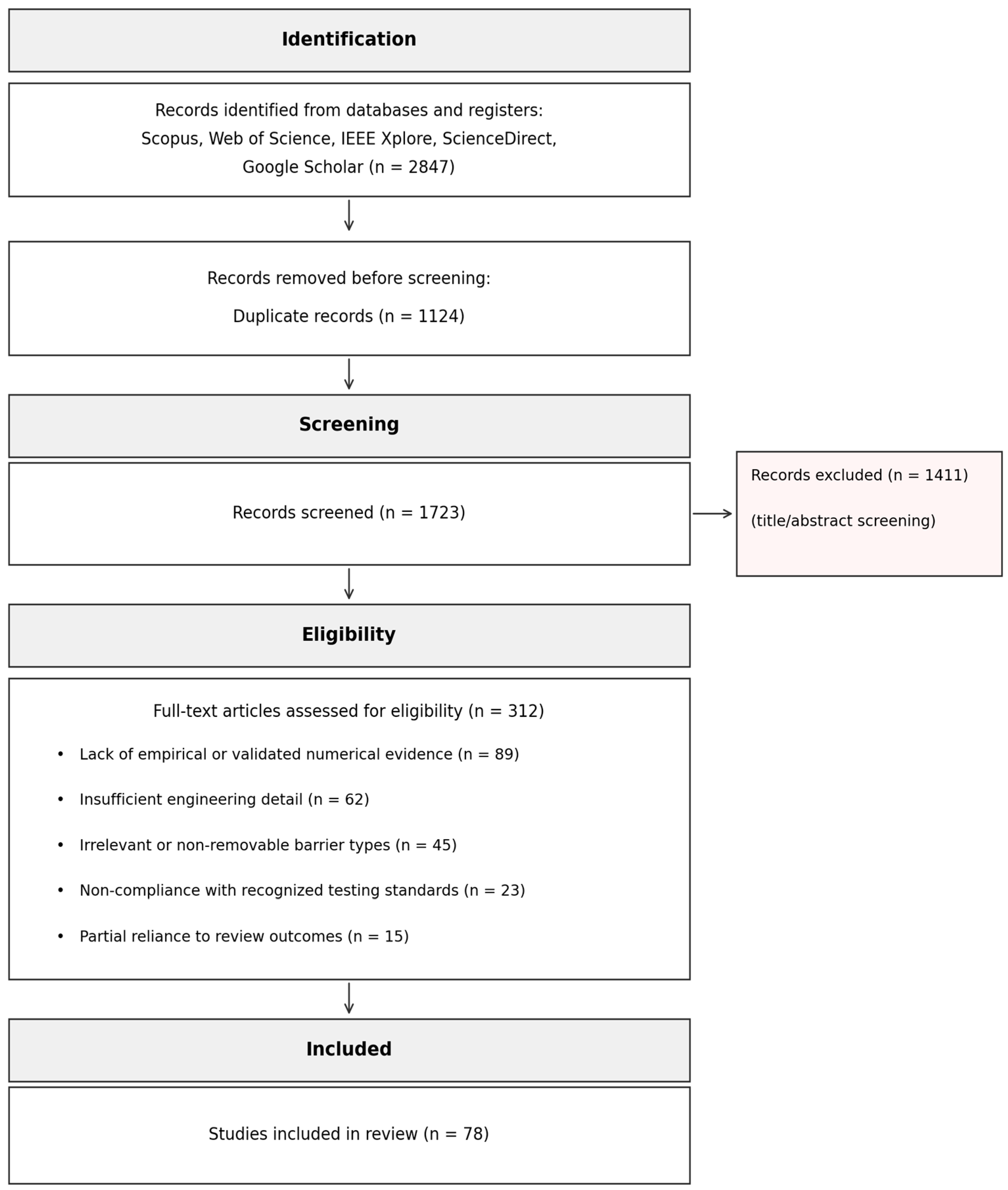
The review protocol was predefined in accordance with the PRISMA 2020 guidelines (Figure 1), encompassing database selection, search strategies, inclusion and exclusion criteria, screening procedures, data extraction, quality appraisal, and synthesis approaches. Following title and abstract screening, 1411 records were excluded, and 312 full-text articles were subsequently assessed for eligibility.

2.3. Literature Identification and Search Strategy

A comprehensive literature search was conducted across five major scientific databases—Scopus, Web of Science Core Collection, IEEE Xplore, ScienceDirect, and Google Scholar (top 500 results per query)—and all were searched for the period 1970–2026. Full institutional access was provided through the library of Edith Cowan University (ECU), ensuring comprehensive retrieval across subscription-based and open-access sources. Additional records were identified using Publish or Perish (Version 8; Harzing.com, Melbourne, Australia), which facilitated systematic Google Scholar harvesting and citation analysis to capture the gray literature and conference proceedings that are not indexed in primary databases.
Supplementary sources included government and agency reports (FHWA, NHTSA, TRB, NCHRP, Austroads, Highways England), technical standards bodies (AASHTO, CEN, SAE, ISO), specialized research center publications (Texas A&M Transportation Institute, SWOV, CEDR), and industry testing facility reports.
A single unified Boolean search string was applied consistently across all databases, combining the controlled vocabulary with free-text keywords to capture studies on movable barrier systems, crash testing frameworks, and numerical modeling approaches:
(“movable guardrail” OR “portable barrier” OR “mobile barrier*” OR “temporary barrier*” OR “relocatable guardrail*” OR “work zone barrier*” OR “reversible lane barrier*” OR “automated barrier*” OR “zipper barrier*”) AND (“crash test” OR “impact test” OR “safety performance” OR “containment level” OR “vehicle redirection” OR “MASH” OR “EN 1317” OR “NCHRP 350” OR “AS/NZS 3845” OR “finite element analysis” OR “numerical simulation” OR “LS-DYNA”)
The same search string was applied to each database without modification, with only interface-specific syntax adaptations where required by the platform. No language restrictions were applied; however, all studies included in the final synthesis were published in English or had a peer-reviewed English translation available. Temporal filters were set to capture publications from 1970 onwards to include foundational NCHRP 350-era studies alongside contemporary MASH and EN 1317 evaluations. Search strings were developed in accordance with established methodological recommendations [38,40,41,46]. Table 2 summarizes the number of records retrieved from each database.
The review protocol was predefined and approved under ECU Research Ethics (REMS No. 2024-06050-HASHEMITABA). The protocol was not registered in an external public registry, as existing registries such as PROSPERO primarily support health-related systematic reviews. Screening and selection followed the PRISMA 2020 guidelines [38] and established systematic review protocols in engineering research [42,47].

2.4. Inclusion and Exclusion Criteria

A two-stage screening process (title/abstract review, followed by full text assessment) was applied, using predefined inclusion and exclusion criteria. Compliance with recognized crash testing standards and the availability of quantitative performance data were treated as essential requirements [4,15,16,32,46,47,48,49,50,51]. The criteria ensured that the included studies provided empirically grounded evidence through full-scale crash tests, validated numerical simulations, or field deployment evaluations that were relevant to movable barrier systems.

2.5. Study Selection

The initial database search retrieved 2847 records. After deduplication using Mendeley Reference Manager (Version 2.143.0; Elsevier, Amsterdam, Netherlands), 1723 unique records remained. Two reviewers independently screened titles and abstracts based on the predefined inclusion and exclusion criteria. The inter-rater reliability was high (Cohen’s κ = 0.87), indicating substantial agreement according to the established thresholds [52]. Of the 1723 screened records, 1411 were excluded at the title and abstract stage, which was primarily due to irrelevance to movable or temporary barrier systems, absence of empirical crash testing or numerical simulation data, or focus on fixed permanent infrastructure. The remaining 312 records proceeded to full-text assessment, applying engineering-specific eligibility criteria covering full-scale crash tests, validated numerical simulations, field deployment studies, and operational safety metrics. A total of 78 studies satisfied all criteria and were included in the qualitative synthesis.
Common reasons for exclusion at the full-text stage included insufficient methodological detail, use of non-standard or unvalidated testing procedures, lack of quantitative performance metrics, or lack of relevance to movable barrier systems.

2.6. Data Extraction, Quality Appraisal, and Contextual–Technical Coding

To ensure transparency and reproducibility, the review workflow was structured into three tightly integrated stages: structured data extraction, quality appraisal, and dual-axis contextual–technical coding. These stages were applied consistently to each included study and documented using standardized forms. The overall procedure aligns with PRISMA 2020 reporting guidance and established systematic review frameworks adapted for engineering research [42,43]. Data extraction, coding, and thematic classification were supported by NVivo Release 12.6 (QSR International, Melbourne, Australia). Statistical summaries were compiled using Microsoft Excel for Microsoft 365 (Version 16.0, Build 2508, Microsoft Corporation, Redmond, WA, USA), and figures were generated using GraphPad Prism (Version 10.0.0, GraphPad Software, San Diego, CA, USA), and SigmaPlot (Version 14.5, Systat Software, San Jose, CA, USA).
  • Data extraction
    For each eligible study, detailed metadata were extracted, including bibliographic information (authors, year, venue, DOI), study design (experimental, numerical, field, hybrid, or review), barrier characteristics (typology, material system, structural configuration), and testing parameters (applicable standard, vehicle class, impact speed and angle). Performance outputs, such as containment outcomes, working width, and occupant risk indices, were also systematically recorded, along with deployment context (road environment and jurisdiction), key contributions, and author-reported limitations.
    The complete extraction schema is provided in Supplementary Materials Table S1_MetaData, including an exemplar row illustrating summarization at the theory–engineering interface [6,10,27].
  • Quality appraisal
    Establishing explicit and comprehensive quality-assessment criteria is widely recommended in systematic evidence-evaluation practice [53]. Accordingly, methodological rigor and reporting adequacy were assessed using a 16-criterion appraisal rubric adapted and expanded from the Critical Appraisal Skills Programme (CASP) framework and related evidence-synthesis guidance. The rubric was tailored to the specific context of engineering and impact-performance studies and encompassed the clarity of research aims, methodological transparency, adequacy of experimental or numerical design, definition and control of variables, data availability, stated limitations, replicability, contextual relevance, analytical appropriateness, coherence between results and interpretation, balance of discussion, venue quality, citation currency, author credibility, and overall contribution or innovation.
    Each criterion was scored on a three-level scale (high/medium/low) and normalized to a composite 0–3 index. Studies were classified as high (≥2.3), moderate (1.5–2.2), or low (<1.5). The full scoring results and justification for borderline cases are provided in Supplementary Materials Table S2_QualityAppraisal. This appraisal framework is consistent with methodological approaches that are widely applied in engineering-focused SLRs [40,41,42].
  • Contextual and technical coding
    To integrate full-scale crash testing, validated numerical simulations, and field-deployment evidence, each included study was classified using a structured two-dimensional coding framework, consistent with established SLR methodologies in engineering and evidence-synthesis research [42,47].
    The context dimension captured the operational environment (e.g., expressway work zones, reversible lanes, bridges and tunnels), geographic setting, jurisdictional factors, and whether real-world deployments or field trials were reported.
    The technical dimension characterized barrier typology, referenced standards (e.g., MASH, EN 1317, AS/NZS 3845.1), impact-testing conditions (vehicle class, impact speed and angle), key performance indicators (containment level, working width, occupant-risk indices), and design-specific attributes such as the material system, connection mechanisms, and structural configuration, alongside study-reported limitations.
    These coded dimensions are provided in Supplementary Materials Table S3_ContextApplication and Supplementary Materials Table S4_TechnicalFocus and are used throughout Section 3.2, Section 3.3, Section 3.4, Section 3.5, Section 3.6, Section 3.7 and Section 3.8 to support structured comparative synthesis and cross-study interpretation.
  • Integration with the main synthesis
The coded fields enabled:
  • Aggregation of safety performance outcomes by barrier typology;
  • Analysis of how material and design choices influence containment and working width behavior;
  • Assessment of the maturity of numerical validation frameworks, relative to crash testing evidence;
  • Mapping of field deployment data to regulatory and economic considerations.
This integrated approach provides a structured basis for the narrative synthesis in Section 3 and Section 4 and aligns with the standards and sources cited throughout the manuscript.

3. Results

3.1. Coding Study Characteristics and Distribution

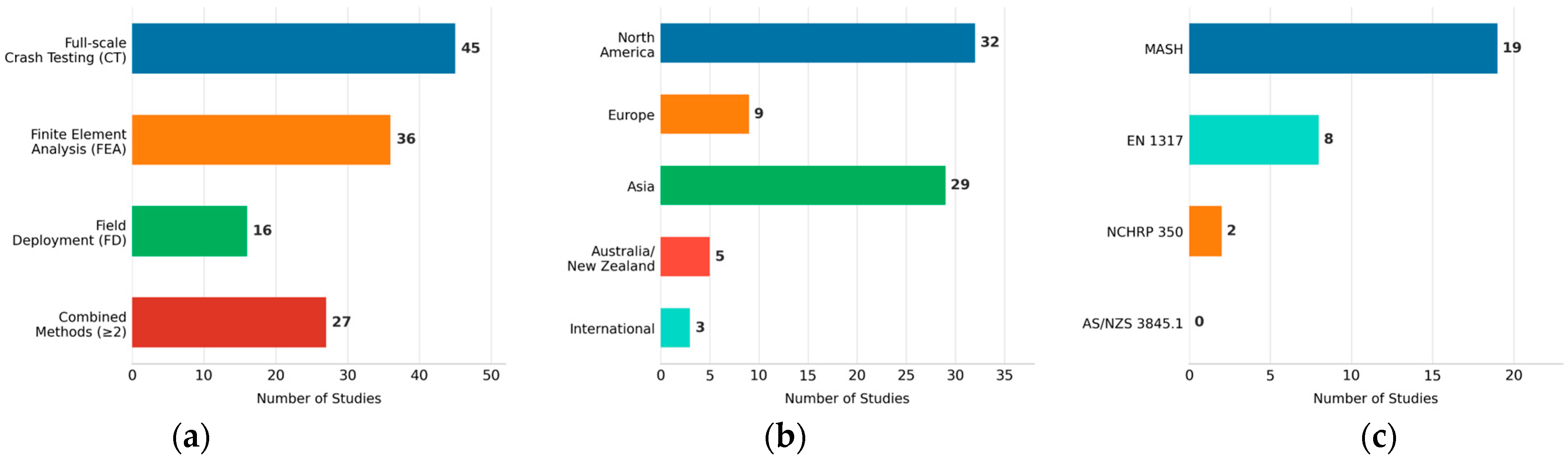
This systematic review included 78 peer-reviewed studies on movable, temporary, and modular roadside barrier systems, spanning full-scale crash testing, numerically validated finite element simulations, and field deployment evaluations. Multi-label classification across the methodological domains reveals that 45 studies involved full-scale crash testing, 36 employed finite element analysis (FEA), 16 reported field deployment assessments, and 27 applied combined methods such as crash testing integrated with FEA for model validation.
Geographic attribution, based strictly on the study or test location or the jurisdiction of the applied crash-testing standard, shows that the 78 included studies originated from North America (n = 32), Europe (n = 9), Asia (n = 29), Australia/New Zealand (n = 5), and a small group of non-regional or laboratory-only studies classified as International (n = 3). Table 3 provides a comprehensive summary of all coded study characteristics, while Figure 2 visualizes the three primary distribution dimensions of research methodology, geographic origin, and testing standard to facilitate cross-study comparison.
A clear temporal increase in publication activity was observed, with 8 studies (10%) published prior to 2010, 18 (23%) during 2010–2015, 27 (35%) during 2016–2020, and 25 (32%) between 2021 and 2026.
Across publication venues, 52 studies (67%) appeared in peer-reviewed journals, 14 (18%) in conference proceedings, and 12 (15%) in technical or agency reports. Testing standards used for crash evaluation, rather than those merely referenced, comprised MASH (n = 19), EN 1317 (n = 8), NCHRP 350 (n = 2), and AS/NZS 3845.1 (n = 0).
Although AS/NZS 3845.1 is the primary regulatory framework for road safety barriers in Australia and New Zealand, full-scale crash test reports conducted explicitly under this standard are rarely published in peer-reviewed outlets. The absence of AS/NZS-based crash evaluations in the final dataset therefore reflects a limitation of the published evidence base, rather than the review methodology.
Barrier typologies clustered into modular rigid systems, semi-rigid steel barriers, and flexible polymer systems. A quality appraisal using a 16-item rubric classified 54 studies (69%) as high quality, 18 (23%) as moderate, and 6 (8%) as low.

3.2. Barrier Design Characteristics Identified in the Literature

3.2.1. Barrier Typologies

The synthesis of the 78 included studies reveals three dominant families of movable barrier systems, modular rigid, semi-rigid steel, and flexible polymer configurations, with each exhibiting distinct structural behaviors and operational trade-offs [54,55]:
  • Modular rigid systems (n = 34; 44%)
    Modular rigid barriers typically comprise precast concrete or prefabricated steel units evaluated under established crash-testing standards such as MASH, EN 1317, and NCHRP 350. Recent TL-4 assessments of rubber mounted single slope movable systems further demonstrate the compliant structural performance and stable vehicle redirection [7]. Evidence from full-scale crash tests consistently highlights the critical role of joint detailing, module alignment, and base/interface conditions in governing global deflection and vehicle trajectory control. When these elements are properly engineered, modular rigid systems reliably satisfy the TL-3/TL-4 requirements.
    Operationally, installation tolerances, particularly at joints and anchorage/footing interfaces, are repeatedly noted as being essential for achieving reproducible crashworthiness [16,48].
  • Semi-rigid steel systems (n = 26; 33%)
    Semi-rigid steel systems, including demountable W-beam and three-beam configurations, offer a balance between containment performance and redeployability. Their structural response is highly sensitive to post spacing, rail height, and connector torque, with numerous studies documenting the direct effects on containment capacity and working width behavior [26,54,56,57]. The use of high-strength steels can further reduce the system mass while preserving TL-2/TL-3 performance envelopes, benefiting transportability and the repeated deployment cycles [58].
  • Flexible polymer systems (n = 18; 23%)
    Flexible polymer barriers, typically water, sand, or foam-filled, are widely deployed in low-speed or short-duration applications. Reported performance ranges from TL-1 to TL-2, with foam core or foam fill configurations shown to mitigate sloshing effects and substantially improve energy absorption efficiency, relative to purely water-filled modules [59]. Experimental evidence further indicates that polymer foam cores within interlocking composite assemblies enhance specific energy absorption and promote stable crushing progression under impact loading [60]. Several commercially deployed portable barrier systems in this category have been evaluated under controlled crash-test and field conditions in active work zones, providing empirical validation for short-duration TL-3 applications [9,61].
  • Cross-standard and field relevance
    Across typologies, reported performance claims and application envelopes are strongly anchored in formal testing protocols and deployment guidance frameworks [9,15,48,50,62].
Collectively, these studies demonstrate that the movable barrier performance is governed not only by material and structural configuration but also by installation quality, connection integrity, and compliance with standardized crash-testing procedures. Beyond component-level joints, transition regions between barrier systems have been identified as being critical to maintaining redirection performance under standardized impacts [63].
In addition to conventional typologies, recent advances in roadside safety engineering have introduced a class of novel barrier systems that were specifically developed for geometrically constrained environments such as tunnels, bridge decks, and narrow urban corridors. These designs depart from traditional portable and semi-rigid systems through the use of high-performance materials, refined anchorage concepts, and optimized cross-sections that enable high containment levels with minimal working width. A key example is the NDBA concrete barrier [12], which achieved EN 1317 H4b-level containment with a working width as low as W2 (0.74 m) across two consecutive TB81 impacts on the same structure: a performance level rarely observed in portable or modular configurations. These solutions highlight the potential for advanced barrier geometries to provide stable redirection in confined spaces where installation offsets are significantly limited.
Complementing these structural innovations, recent research has also introduced systematic deformation-estimation methodologies to support post-impact evaluation and maintenance planning. Instead of relying solely on full-scale testing or static measurements, these approaches integrate geometric profiling, displacement-prediction models, and dynamic response parameters to quantify barrier deformation under standardized loading. Analytical formulations developed for longitudinal safety barriers [13] offer a structured means of estimating impact-induced deflection based on moment distribution, section flexibility, and support conditions, providing a practical framework for assessing the residual capacity without requiring lane closures. Incorporating such methods into movable-barrier applications can enhance rapid post-impact assessment, particularly in work zones and reversible corridors where barriers undergo frequent handling and redeployment.

3.2.2. Connection Systems

Connection detailing is a primary determinant of movable barrier system response, governing load transfer across modules, global deflection, vehicle redirection, and post-impact stability. Across the literature, three connection families dominate—pin and loop, bolted flanges, and interlocking profiles—each offering distinct advantages and limitations. Although all three can satisfy regulatory performance envelopes when designed and installed correctly, their operational characteristics differ markedly in terms of installation speed, load capacity, stiffness, fatigue performance, and repeatability. Full-scale evaluations demonstrate that properly engineered joints enable modular rigid systems to meet TL-3/TL-4 requirements, whereas inadequate bearing, poor fit-up, or misalignment at joints frequently initiate sequential connection failures [7,8].
  • Pin and loop connections
    Pin and loop connections are widely employed in applications requiring rapid deployment and tool-light assembly, particularly in short-duration work zones. When manufacturing tolerances are properly maintained and bearing stresses are adequately controlled, the reviewed studies report consistent load-transfer behavior and high repeatability. However, the synthesized evidence indicates that degradation in assembly quality, especially under oblique impact conditions or low-friction surface scenarios, is associated with localized distress in the pin or eye components and may contribute to progressive joint failure [7]. Collectively, the available literature suggests that connection reliability is highly sensitive to assembly precision, indicating that installation control may be as critical as the nominal structural capacity in determining the impact performance.
  • Bolted flanges
    Bolted interfaces offer superior stiffness and load capacity characteristics, making them suitable for TL-3/TL-4 applications and installations with constrained footprints. Their performance, however, is highly sensitive to bolt torque, fit-up quality, and QA/QC practices. Recent full-scale tests demonstrate that improper torqueing or uneven clamping can induce premature connector failure, increase global system deflection, and compromise lateral stability. These findings underscore the vulnerability of semi-rigid steel systems to connection design deficiencies [54,56,57].
  • Interlocking profiles
    Mechanical interlocks enable tool-free assembly at intermediate installation speeds and reduce the need for loose hardware. Their performance depends strongly on dimensional accuracy, engagement length, and fit-up quality. Even small geometric deviations can alter effective stiffness, influence working width behavior, and affect vehicle exit trajectories during impact events [26,54].
  • Design implications
Insights from crash testing, numerical simulations, and synthesis studies point to several consistent design implications:
  • Connection detailing should be treated as a primary design variable for all movable systems;
  • Measurable QA/QC requirements, particularly for alignment, torque, and clamping, are essential;
  • Post spacing, rail height, base friction, and joint stiffness must be calibrated as an integrated system, and transition detailing has been shown to strongly influence containment and redirection effectiveness [63];
  • Redeployment protocols should explicitly include inspection and retightening procedures.
Across the literature, the consensus is clear: connection integrity, not panel mass, dominates real-world crash performance and governs whether movable barrier systems achieve their intended containment and redirection functions [7,54].

3.2.3. Material Selection and Optimization

The reviewed literature identifies several material strategies and system-level optimization approaches for enhancing the performance of movable barrier systems, as synthesized in Table 4. These approaches primarily focus on reducing mass, improving energy absorption characteristics, and increasing durability without compromising compliance with standardized impact testing requirements.
  • High-strength steels (HSS)
    Across the included studies, the substitution of conventional barrier steels with high-strength steels consistently yields significant mass reductions, typically in the range of 15–35%, while maintaining TL-2/TL-3 crash performance levels, if connection detailing and post spacing are properly calibrated [16,54,58]. HSS is widely utilized in semi-rigid systems with demountable posts, where strict QA/QC practices for torque and spacing are essential.
    Recent material characterization research further demonstrates that incorporating stress-state-dependent failure criteria for AASHTO M180 steels substantially improves the fidelity of finite element (FE) models used for guardrail simulation and design [23]. In parallel, new lightweight HSS barrier concepts have achieved compliant TL-3 performance while reducing the overall system mass, improving transportability, and facilitating repeated redeployment: attributes that are especially advantageous for movable barrier applications [24].
  • Ultra-high-performance concrete (UHPC)
    UHPC modules leverage ultra-high compressive strength (≥120 MPa) and steel fiber-reinforcement to achieve thinner sections and reduced mass while maintaining or enhancing crashworthiness. Optimized UHPC barrier designs demonstrate TL-3/TL-4 compliance and exhibit excellent durability, impact resistance, and damage tolerance under repeated loading [28,55,64]. Successful implementation, however, requires careful verification of joint anchorage and section detailing to ensure structural continuity and impact load transfer.
  • Fiber-reinforced polymers (FRP/CFRP)
    FRP materials offer high specific strength and corrosion resistance, with energy absorption characteristics that can exceed those of conventional steel in specific loading configurations, making them attractive for lightweight crash mitigation applications [29,65,66]. Hybrid metal–FRP systems have demonstrated containment performance within TL-2/TL-3 envelopes in validated studies, whereas stand-alone FRP configurations are generally limited by stiffness constraints; connection detailing and interlaminar failure mitigation remain critical design considerations [29,67].

Broader composite crashworthiness studies highlight progressive crushing, laminate tailoring, and foam core integration as key mechanisms enhancing energy absorption efficiency and crushing stability [68,69,70]. Foam-filled composite sandwich configurations significantly improve energy dissipation behavior and stabilize crushing progression [60,71]. Recent guardrail-specific evaluations confirm that well designed CFRP-based modules achieve stable redirection and predictable dynamic energy absorption [72], supported by field-validated finite element simulations of assembled median guardrail systems demonstrating robust crashworthiness performance [73].
Table 4. Compact synthesis of material families, performance characteristics, and design considerations.
Material FamilyWhat the Literature ShowsTypical Application WindowCaveats/Requirements
HSSDemonstrates 15–35% mass, reduction relative to conventional steels, while maintaining TL-2/TL-3 performance when joint and post design are properly calibrated [54,58].Semi-rigid steel systems; demountable post configurations.Corrosion protection required (galvanizing/powder coating); strict QA/QC for bolt torque and post spacing [16].
UHPCVery high compressive strength (≥120 MPa) enables thinner sections, reduced mass, and compliant TL-3/TL-4 behavior with enhanced durability [28,55,64].Modular rigid units; geometrically constrained corridors.Higher material cost offset by durability and section reduction; joint anchorage and detailing must be verified.
FRP/CFRPHigh specific strength and 2–3× higher specific energy absorption than steel; hybrid FRP–metal systems validated at TL-2/TL-3, standalone FRP at TL-1/TL-2 [29,65,73].Lightweight/rapid deployments; hybrid retrofits.Deflection and working width control depend on joint stiffness; environmental durability and interlaminar failure resistance require qualification.
SustainabilityRecycled/bio composite concepts show comparable performance when optimized; lower embodied impacts for recycled UHPC/steel and mass-reduced designs [74,75].Program-level planning and procurement frameworks.Incorporate LCA/LCCA; establish end of life strategies for recyclability and disposal.

3.2.4. Sustainability Considerations

The reviewed literature identifies several material strategies and system-level optimization approaches for enhancing the performance of movable barrier systems. These approaches primarily focus on reducing mass, improving energy absorption characteristics, and increasing durability without compromising compliance with standardized impact testing requirements. Evidence from sustainability-focused studies indicates that optimized bio-composites and recycled material variants can match the structural and crashworthy performance of conventional systems. Life-cycle assessment and full cost accounting suggest that recycled UHPC/steel hybrids and mass reduced designs offer meaningful reductions in embodied environmental impacts [74,75]. End-of-life considerations, such as recyclability, material recovery, and composite disposal, remain important factors for program-level decision making and procurement frameworks.

3.3. Testing Methodologies and Validation Approaches

A diverse set of testing and evaluation methodologies was identified across the 78 included studies. Of these, 45 conducted full-scale crash tests, 28 employed finite element analysis (FEA), and 23 reported field deployment evaluations. Seventeen studies implemented combined approaches. Representative examples include [8,27] for full-scale evaluations and [6,76,77] for movable median and assembled portable systems.
Several studies have expanded the evaluation of portable concrete barriers under MASH TL-3 criteria, examining tied-down anchorage systems [78], box-beam stiffened profiles [79], vertical anchor configurations [80], gap-spanning hardware [81], and low-deflection retrofit systems [82,83]. Numerical investigations have further clarified the deflection behavior and connection performance of portable concrete barriers subjected to vehicle impact [84].
Testing practices varied across jurisdictions. North American studies primarily referenced the MASH framework [48]. European investigations relied on the EN 1317 series, including EN 1317-1 for terminology and classification criteria [14] and EN 1317-2 for performance categories and test procedures [49]. Studies from Australia and New Zealand cited AS/NZS 3845.1 [15], supported by Austroads guidelines [85,86] and the AASHTO Roadside Design Guide [3]. Earlier evaluations of contraflow and median-transfer systems demonstrate the long-standing use of movable barrier technologies in dynamic lane management applications.
Commonly reported performance metrics included structural adequacy, occupant risk indices such as THIV and ASI, a vehicle exit trajectory, and the working width. These consistent reporting practices facilitated cross-study comparison. Composite and polymer-based systems increasingly referred to ASTM material standards alongside crash-testing protocols.
Full-scale evaluations highlight clear typology-dependent performance trends. Modular rigid systems have achieved MASH TL-3/TL-4 and EN H2–H4b compliance when joint integrity and base friction were maintained. Semi-rigid steel systems exhibited sensitivity to parameters such as post spacing, embedment depth, and connector performance. Flexible and polymer-based configurations displayed greater variability due to differences in ballast strategies and module geometry. Recent studies of hybrid and composite systems (e.g., [6,29,87,88,89]) identified recurring failure mechanisms, including insufficient joint capacity, ballast instability, and installation misalignment.
FEA remained a central analytical methodology. Validated models successfully reproduced key crash-test outputs, including lateral displacement, exit angle, deceleration histories, and energy-absorption profiles. Advanced models incorporated soil–structure interaction, post embedment behavior, and section geometry effects, all of which strongly influence global system deflection and load transfer. Recent investigations further extended the simulation capability through optimization-oriented design studies, laboratory-supported material calibration [90], MASH-consistent flare-rate analyses for single-slope barriers [91], and full-scale field-test-driven development of high-performance portable systems [92]. LS-DYNA-based guidelines for concrete barrier modeling provide additional standardized procedures for finite element analysis [93,94].
Multiple studies emphasized the importance of mesh-sensitivity evaluation, strain-rate-dependent material models, and appropriate failure criterion selection, particularly for thin-walled steel and composite components. Uncertainty analyses demonstrated that variations in material parameters and boundary conditions were major contributors to simulation variance. Optimization-oriented FEA studies further expanded this analytical space; for example, parametric evaluations of roller-barrier configurations showed that geometric refinement and stiffness tuning can improve energy absorption and redirection stability.
Overall, the reviewed methodologies demonstrate that FEA provides an efficient and experimentally aligned platform for evaluating movable barrier performance. However, model accuracy remains sensitive to the soil modeling fidelity, material calibration, and connection detailing. Consistently across methods, connection design, material-specific performance limits, and installation tolerances emerged as the primary determinants of system behavior. Remaining methodological gaps include long-term durability assessment, integration of automated deployment and inspection technologies, and harmonization across testing standards.
Despite these advances, several limitations recur across FEA-based studies. Soil–structure interaction is frequently simplified using fixed or pinned boundaries, which do not capture the lateral compliance or energy dissipation characteristics of real foundation soils; studies that explicitly include soil confinement and post embedment generally report stronger agreement with full-scale deflection profiles. Material constitutive modeling remains a related challenge: high-rate impact behavior in concrete and steel requires strain-rate-sensitive formulations, yet some studies employed quasi-static properties, potentially underestimating energy absorption. Validation practices also varied: while most studies confirmed agreement in the lateral displacement or exit angle, fewer independently validated occupant risk indices, such as THIV and ASI or post-impact geometry. Without these secondary validations, confidence in simulation-driven design decisions remains limited. Collectively, these challenges underscore the need for standardized FEA benchmarking protocols for movable barrier systems, covering boundary condition assumptions, material model selection, and multi-output validation criteria [35,84,93,94,95].

3.4. Safety Performance Outcomes

Safety performance was evaluated across all barrier types. Modular rigid systems showed the highest containment capability and the most consistent redirection performance. Semi-rigid steel systems were observed to perform consistently, whereas flexible and polymer-based configurations generally exhibited larger working widths and greater deflections. Empirical and simulation studies of modular, assembled, and composite barrier systems consistently reported occupant-risk indices within regulatory limits when installation quality and test-level requirements were satisfied [6,25,30,96].
Key determinants of superior safety performance included structural detailing, connection integrity, and material selection. Studies highlighted the contribution of high-strength steels, hybrid systems, and advanced composite solutions to improved containment, reduced vehicle trajectory deviation, and enhanced energy absorption behavior. These findings were consistently supported by validated full-scale crash tests and numerical analyses [31,70,89]. At the network level, empirical studies of real-world crashes similarly report barrier-type effects on injury severity distributions [97].

3.5. Operational Deployment Evidence from Field Studies

Twenty-three studies reported field deployment evidence in work zones, reversible lanes, and special event operations. Modular rigid and semi-rigid steel systems were most frequently deployed, with installation effort and stability varying according to site conditions. Field observations documented reductions in intrusions and sideswipe incidents, consistent with the trends identified in controlled crash test studies.
Reversible lane applications, including the Golden Gate Bridge movable median system, demonstrated sustained operational safety when combined with coordinated control protocols [98,99,100]. Similar contraflow operations employing zipper truck technology have been documented in Canada, confirming the transferability of movable median concepts to alternative deployment platforms [101]. Work zone guidelines such as Caltrans DIB 91 and evaluations of mobile systems like ArmorGuard provided additional procedural and empirical support [9,61]. Specialized designs addressing site-specific challenges, such as concrete median barriers adapted for flood-prone environments, further illustrate the range of operational conditions under which movable barrier systems have been evaluated [102]. For special events and contraflow operations, performance was influenced by the traffic demand, geometry, barrier placement, and traffic control measures.

3.6. Movable and Retractable Roadside Safety Systems

Movable and retractable systems support dynamic traffic management and maintain a crashworthy performance under standardized test conditions. Applications include temporary work, reversible lane operations, and urban corridors, subject to variable demand [11,48,54]. Full-scale crash testing and validated FEA studies indicate that systems designed to MASH TL-3/TL-4 can achieve containment and energy absorption behavior that is comparable to fixed barriers when post spacing, rail height, joint design, and material selection are appropriately controlled [6,8,10].
Lightweight composite and hybrid materials reduce structural mass while preserving or improving impact performance. Recent studies report stable behavior under standardized impacts for CFRP/BFRP components and hybrid composite–metal systems [29,67,103].
Retractable systems such as bollards and movable lane dividers improve access control and separation in urban conditions. Experimental and simulation-based evaluations show reductions in peak forces and decelerations due to energy-absorbing designs [25,30,96,104]. Developments in smart lane management systems, including connected/automated controls and computer vision-based inspection, enable real-time condition assessment and proactive maintenance [20,34,105]. Prototype software-based automated systems have been developed to control movable barrier repositioning across traffic lanes in response to real-time demand [106].
Design validation in these studies integrates full-scale crash tests, FE simulations, and, in selected cases, life-cycle assessments. Relevant crashworthiness indicators include impact speed tolerance, global deflection, working width, and post failure performance. Sensitivity analyses addressing impact angle and material or mesh modeling guide design decisions. Automated inspection and monitoring approaches support maintenance planning in operational environments.

3.7. Economic and Life-Cycle Cost Evidence from the Literature

Only a small subset of studies (approximately eight) reported quantitative economic evaluations. Most analyses focused on reversible lane deployments or work zone applications. Capital costs depend on the system typology and automation level. Transfer machine-based movable median systems require higher initial investment, while portable or semi-portable systems have lower procurement and deployment costs [107]. State-level unit cost datasets provide additional benchmarks for deployment and procurement cost estimation; for example, recent cost-per-mile summaries from Arkansas DOT offer indicative ranges for barrier installation and roadway safety treatments [108], complementing the life-cycle cost analyses reported in the peer-reviewed literature [74].
Life-cycle cost drivers include routine inspection, connector refurbishment, and repair after impacts. Automated systems add maintenance requirements for mechanical components and transfer equipment, with uncertainties arising from limited long-term performance data. Life-cycle assessment and full-cost accounting studies show that material and refurbishment decisions significantly influence total cost of ownership [74,109].
Formal economic assessments generally follow standardized frameworks, including the FHWA Work Zone Road User Cost methodology [33] and NCHRP guidance on work zone countermeasures [32,107]. Safety benefits are typically monetized using comprehensive crash cost values, based on the KABCO injury severity classification system (K = Fatal, A = incapacitating injury, B = non-incapacitating injury, C = possible injury, O = no injury), while environmental externalities commonly reference the U.S. EPA Social Cost of Greenhouse Gases [75]. Recent methodological advances in guardrail-specific life-cycle assessment provide improved frameworks for incorporating greenhouse gas externalities into life-cycle cost analyses [36]. Reported benefit–cost ratios are highly sensitive to baseline traffic volumes, geometric constraints, crash exposure, and discount rates, making them inherently site-specific, rather than directly transferable across projects.

3.8. Regulatory Compliance and Standards Assessment

This section examines how regulatory standards and compliance frameworks were applied within the reviewed studies. Rather than restating the standards themselves, the analysis focuses on how experimental, numerical, and field investigations operationalized requirements from MASH, EN 1317, NCHRP 350, and AS/NZS 3845.1. Studies demonstrated varying degrees of adherence to these frameworks through test-level selection, reporting of performance indices, and documentation of installation or deployment conditions that were relevant to compliance evaluation.

3.8.1. Standards Compliance Across Reviewed Studies

Across the reviewed literature, regulatory compliance was most frequently documented in relation to the crashworthiness evaluation of movable and portable barrier systems. North American studies predominantly referenced the Manual for Assessing Safety Hardware [48] and associated implementation guidance for evaluating structural adequacy, occupant-risk metrics, and working-width requirements. For example, Ref. [7] conducted a full-scale MASH TL-4 crash evaluation of a rubber-mounted single-slope movable barrier, demonstrating compliance with the required impact performance criteria.
European studies consistently applied the EN 1317 framework, particularly emphasizing test-condition fidelity, such as vehicle mass classes, impact angles, and approach speeds. Ref. [27] systematically examined compliance with EN 1317 impact configurations and demonstrated how variations in impact geometry influence containment and redirection effectiveness.
In work zone contexts, laboratory-based compliance assessments were extended to field-relevant deployment scenarios. Ref. [45] evaluated portable concrete barrier systems under MASH TL-3 conditions within active work zones, showing that crashworthy behavior observed in controlled testing translated into acceptable safety performance under exposure to real traffic.
Reversible-lane installations and movable median guardrails were also evaluated under the established regulatory frameworks. Ref. [6] conducted crash performance testing of a newly developed movable median guardrail, confirming that conformity with standardized impact protocols was essential for achieving stable redirection, minimized occupant acceleration, and post-impact system stability.
Across all included studies, regulatory references were derived from either the formal standards (e.g., MASH, EN 1317, AS/NZS 3845.1) explicitly cited within the research or the compliance criteria directly employed in the reported crash tests.
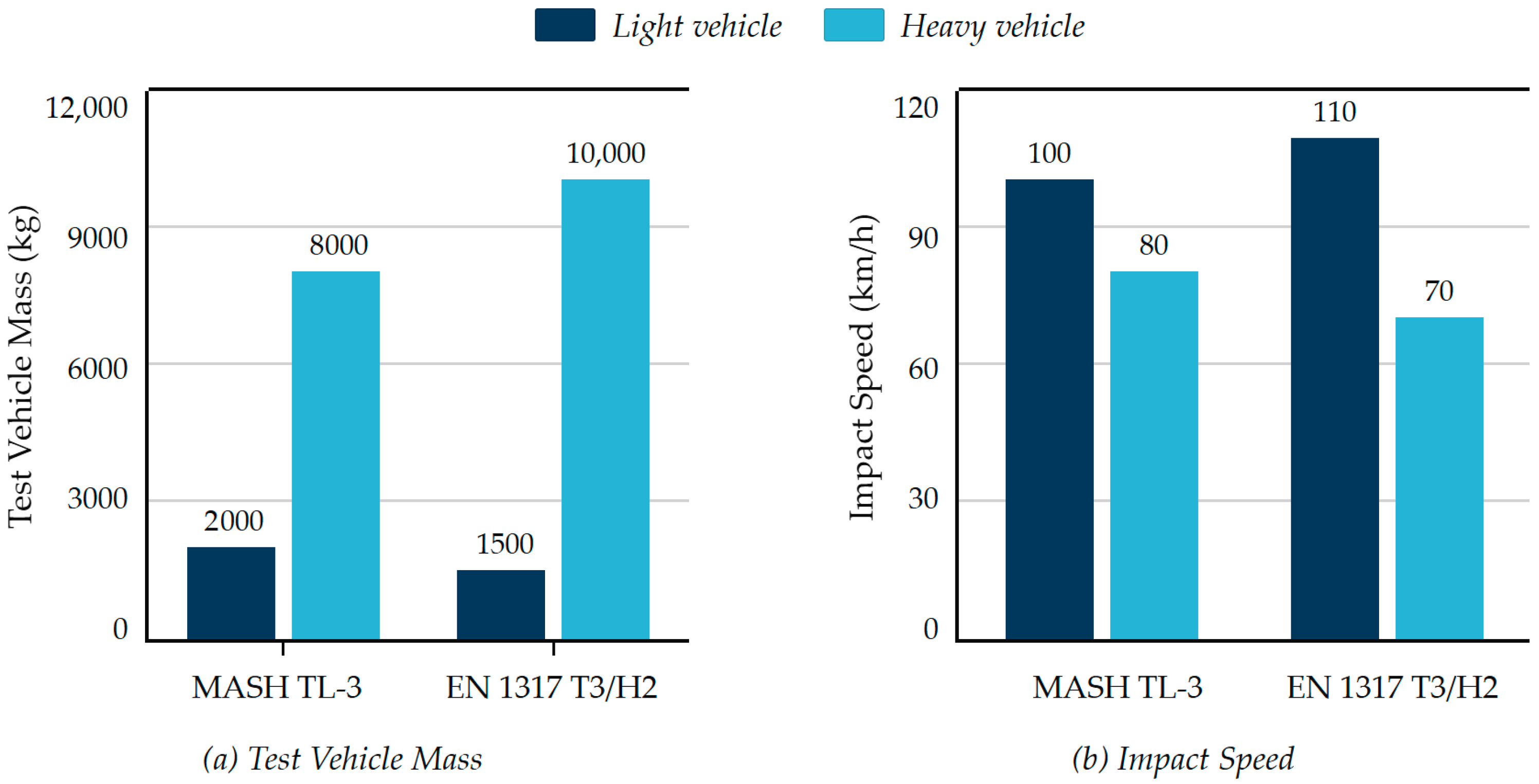
A representative illustration of inter-standard divergence is the treatment of test-vehicle mass and impact speed requirements used to classify containment levels. Under MASH, Test Level 3 (TL-3) specifies a 2000 kg passenger vehicle at 100 km/h and an 8000 kg single-unit truck at 80 km/h, whereas the corresponding EN 1317 classes T3/H2 apply a 1500 kg car at 110 km/h and a 10,000 kg bus at 70 km/h. This misalignment means that a semi-rigid steel barrier meeting MASH TL-3 structural-adequacy criteria may not satisfy EN 1317 H2 occupant-risk thresholds (ASI ≤ 1.4, THIV ≤ 33 km/h) under comparable impact configurations. As a result, direct equivalence between standards is difficult to establish, creating practical challenges for mutual recognition, procurement, and international deployment (Figure 3).

3.8.2. Identified Standards Gaps and Emerging Challenges

Despite broad alignment with the existing regulatory frameworks, several studies identified structural limitations in applying the current standards to modern movable and intelligent roadside safety systems. A recurring gap concerns the absence of explicit testing guidance for dynamically reconfigurable, automated, or robotically deployed barrier systems. While conventional static crash configurations are well prescribed in MASH and EN 1317, no existing standard addresses system behavior during movement, retraction, mechanized deployment, or in-motion transitions, as reported in studies evaluating movable guardrails and automated repositioning platforms [6,7].
The growing incorporation of intelligent sensing and automated inspection technologies introduces additional regulatory challenges. Ref. [19] demonstrated the reliability of computer-vision-based guardrail inspection systems, but noted the absence of formally defined performance criteria for sensor-based structural-condition assessment within the existing barrier standards. Neither MASH nor EN 1317 currently specifies thresholds, calibration requirements, or acceptance criteria for data-driven monitoring systems.
Overall, the literature indicates that the current standards are robust for evaluating the static crash performance of movable barriers but remain underdeveloped for addressing dynamic operation, automation, and cyber-physical integration. Future standardization efforts should therefore prioritize harmonized testing protocols for movable systems under operational conditions, along with formal integration of intelligent monitoring and automated inspection technologies into regulatory compliance structures.
This section relies exclusively on how standards were operationalized within experimental, numerical, and field studies, not on the direct content of policy documents themselves.

4. Discussion

4.1. Synthesis of Principal Findings

This systematic review synthesizes evidence from 78 peer-reviewed studies evaluating the engineering performance, regulatory compliance, and operational behavior of movable guardrail systems. The collective findings demonstrate that when movable barriers are designed and tested in accordance with recognized crash-testing frameworks, particularly MASH, EN 1317, and AS/NZS 3845.1, they can achieve crashworthiness levels that are comparable to conventional fixed systems while providing operational flexibility for work zones, reversible lanes, and dynamically managed corridors.
Across the literature, the dominant conclusion is that movable barriers constitute a technically mature category of roadside safety infrastructure, especially for temporary and reconfigurable applications. This maturity is most evident when structural detailing, connection mechanisms, and deployment protocols are explicitly aligned with standardized impact-testing requirements, as demonstrated in the empirical and full-scale evaluations reported in [7] and the performance assessment of movable median systems in [6].

4.2. Design Performance and Structural Behavior

4.2.1. Material and Structural Performance

The experimental evidence indicates that rigid modular concrete systems remain the most extensively validated typology for high energy containment. Full-scale MASH TL-4 crash tests of rubber-mounted single slope barriers show that these systems satisfy structural adequacy, occupant risk, and working width criteria, even under heavy vehicle impacts. This demonstrates that the movable configuration does not diminish the inherent crash performance compared with fixed concrete installations [7].
Validated finite element investigations further support these findings. Studies using LS-DYNA, ABAQUS, and related platforms show close agreement between numerical predictions and full-scale experiments in terms of deformation patterns, energy absorption behavior, and vehicle trajectory outcomes [35]. These findings highlight the maturity of current computational modeling and support its use for cost-efficient parameter exploration and pre-prototype optimization.

4.2.2. Influence of Connection Integrity on Redirection Stability

Across the reviewed literature, connection systems consistently emerge as a critical structural component influencing the performance of movable barriers. Full-scale evaluations demonstrate that joint behavior governs the load transfer, global system deflection, and post-impact stability, often more directly than barrier mass or material composition [7,55,76,77]. Numerical investigations further reinforce this conclusion. High-resolution finite element models of assembled and movable guardrails indicate that connector stiffness, shear capacity, and failure progression are dominant factors controlling redirection stability [95]: a finding consistent with broader FE evaluations of guardrail and bridge barrier crashworthiness [31,110]. Additional simulations show that movable median strip systems can be optimized to improve impact energy dissipation and redirection performance, particularly under oblique loading conditions [10].

4.3. Testing Frameworks and Regulatory Compliance

4.3.1. Alignment with International Standards

The reviewed studies demonstrate consistent alignment with recognized crash testing standards. North American research primarily relies on MASH [4,48] and performs full-scale evaluations at TL-3 and TL-4 levels [7,45]. European studies adopt EN 1317, with detailed analyses of how impact geometry, vehicle class, and speed influence containment performance [27].
Collectively, the evidence indicates that movable barriers can satisfy internationally accepted occupant risk criteria, including THIV, ASI, and PHD, when tested under appropriate standardized configurations. These results support the suitability of movable systems for both temporary and permanent installations.

4.3.2. Cross-Standard Limitations

Despite overall consistency, several studies highlight methodological inconsistencies between major standards. Ref. [27] identifies the differences between MASH and EN 1317 in impact angles, vehicle mass assumptions, and performance classification thresholds. Ref. [27] notes the absence of equivalent definitions for working width across frameworks, complicating the direct comparison of test results.
These discrepancies present challenges for international procurement, multi-jurisdictional certification, and harmonized engineering assessment. The findings underscore the need for coordinated efforts toward the global standard alignment.

4.4. Operational Safety and Field Performance

4.4.1. Work Zone Applications

Empirical field studies confirm that movable barriers can enhance safety in temporary traffic environments. Ref. [45] reported a reduced intrusion risk and improved positive protection for MASH-compliant portable concrete barriers in active work zones. However, field performance remains strongly dependent on local conditions such as geometry, traffic density, closure configuration, and enforcement levels. Movable barriers therefore function as enabling components complementing broader traffic management strategies.

4.4.2. Reversible Lane Systems

Ref. [6] provides the most comprehensive evaluation of movable median guardrails for reversible lane operations. Their full-scale testing shows consistent vehicle redirection, controlled deflection, and stable post-impact alignment under standardized conditions. These findings highlight the socio-technical nature of reversible lane operations, which depend on coordinated lane control systems, driver information, and operational monitoring in addition to barrier crashworthiness.

4.5. Intelligent and Automated Systems

Recent studies indicate a shift toward digitally supported barrier systems. Ref. [19] demonstrate that computer vision-based inspection can achieve high accuracy in detecting guardrail damage under field conditions. Such technologies offer promising pathways for real-time monitoring and maintenance optimization.
However, none of the major regulatory frameworks explicitly incorporate sensor-based assessment or automated system validation. This absence of formal requirements presents a barrier to large-scale deployment of intelligent movable systems. Future frameworks will need to address automated inspection, data-driven performance metrics, and integration with connected vehicle and smart infrastructure ecosystems.

4.6. Economic and Life-Cycle Considerations

Economic evaluation remains limited within the reviewed literature, but the available evidence indicates that movable barriers can be cost-effective in constrained corridors where roadway widening is impractical. Studies by [7,45] highlight durability and redeployment efficiency as being major contributors to life-cycle cost performance.
Operational findings consistently identify maintenance and connector refurbishment as the primary recurring cost components. These observations reinforce the importance of robust connection design, particularly for systems subjected to frequent redeployment cycles or variable site conditions.

4.7. Comparison with Prior Reviews

Previous reviews of roadside safety infrastructure have predominantly focused on conventional fixed barrier systems, with no prior synthesis offering a systematic evaluation of movable or reconfigurable configurations. The present review addresses this gap by integrating crash-testing evidence, validated finite-element analyses, regulatory assessments, and field deployment findings within a unified PRISMA-compliant framework to provide a comprehensive engineering perspective.
In contrast to earlier reviews, which typically emphasized material selection or structural typology, the current analysis identifies connection performance and regulatory alignment as the dominant determinants of real-world behavior for movable systems.

4.8. Research Gaps and Future Directions

Three major research gaps emerge from the review:
  • Dynamic operation standards
    No current framework addresses behavior during barrier movement, automated transfer, or fail-safe deployment transitions [6].
  • Long-term durability
    Evidence beyond short-term testing remains scarce, particularly for composite, polymeric, or hybrid materials that are subject to environmental degradation.
  • Intelligent system regulation
    Sensor-enabled monitoring and automated inspection systems lack formal performance benchmarks or validation criteria [19].
Future research should emphasize the harmonization of international standards, development of dynamic crash testing protocols, and creation of validated digital inspection and automated operation frameworks.

4.9. Limitations of This Review

The findings of this review are constrained by the scope and availability of published studies. Most research emphasizes engineering performance, rather than long-term operational resilience, socio-economic impacts, or large-scale deployment outcomes. The evidence base is concentrated in a small number of regions, primarily in North America, Europe, China, and Australia, limiting the generalizability to diverse global contexts.
Heterogeneity in testing approaches, impact conditions, and performance metrics prevented quantitative meta-analysis. As a result, the synthesis relies on narrative integration, rather than pooled statistical estimates. Beyond methodological heterogeneity, the geographical distribution of the evidence base itself introduces a further layer of contextual limitations. Studies from North America and Europe predominantly reflect regulatory environments in which MASH and EN 1317 are well established, testing infrastructure is mature, and published crash-test data are systematically archived. Findings derived from these contexts may not transfer directly to regions where road geometries, vehicle fleets, maintenance capacity, or governance structures differ substantially. In particular, the performance characteristics of polymer and lightweight systems, which are more widely used in lower-income settings, remain underrepresented in the reviewed evidence base.

5. Conclusions

5.1. Summary of Key Findings

This systematic review synthesized evidence from 78 peer-reviewed studies spanning full-scale crash tests, validated simulations, and field deployments. The principal finding is that connection integrity, rather than barrier mass or material composition, is the dominant determinant of real-world crash performance across all typologies. This has direct implications for procurement specifications, installation quality control, and redeployment protocols.
Material innovations, including UHPC, high-strength steels, and hybrid FRP configurations, have demonstrated measurable gains in energy absorption and mass reduction. However, these benefits are consistently contingent on adequate joint design and installation tolerances, reinforcing the primacy of connection performance.
The literature also reflects a gradual shift toward digitally supported systems. Sensor-based condition monitoring and machine learning inspection tools are beginning to appear in the domain, though none have been formally incorporated into MASH, EN 1317, or AS/NZS 3845.1 yet.

5.2. Implications for Engineering Practice

Barrier selection should align with operational context. Modular rigid systems are suited for constrained, higher speed corridors; semi-rigid steel systems for medium-term deployments; and flexible or polymer systems for short term urban locations requiring rapid placement and retrieval. Selection should be informed by standardized test-level evidence and supported by the deployment and operation guidelines.
Quality assurance remains critical. Joint detailing, anchorage conditions, and torque control directly influence the load transfer, global deflection, and post-impact stability. Agencies should enforce strict installation tolerances, verify conformity with relevant standards, and schedule periodic inspection and refurbishment in line with deployment cycles.
Economic assessment should use established appraisal frameworks such as FHWA MAP 21 and Work Zone Road User Costs, supported by NCHRP guidance. Life-cycle analyses show that material type and connection refurbishment strategies significantly influence long-term ownership costs.

5.3. Priorities for Future Research

Several research needs emerge from this review:
  • Durability and life-cycle performance: Multi-year field studies are required to understand in-service degradation mechanisms (e.g., UV exposure, freeze–thaw cycles, connector fatigue, composite aging) and to develop predictive maintenance models.
  • Standards harmonization and dynamic operation: Formal alignment across MASH, EN 1317, and AS/NZS 3845.1 is needed, along with supplements addressing the connection design, redeployment durability, and dynamic or in-motion crash behavior of automated systems.
  • Sustainability: Future work should assess the recyclability of FRP components, validate bio-based composites, and incorporate comprehensive life-cycle greenhouse gas analysis within circular economy frameworks (e.g., design for disassembly and design for secondary material markets).
  • Digital integration: Research should develop validated surrogate models for design optimization, digital twin frameworks for monitoring and predictive maintenance, and mechanisms that enable integration with CAV and connected infrastructure systems.

5.4. Contribution to Knowledge

This review makes four primary contributions.
  • First, it provides a comprehensive PRISMA-aligned synthesis integrating full-scale crash tests, validated simulations, regulatory analysis, and field deployment evidence for movable barriers.
  • Second, it offers actionable design guidance by demonstrating that connection integrity is the dominant factor governing system behavior.
  • Third, it aligns economic analysis with established work zone and life-cycle cost accounting methodologies, supporting context-specific evaluation.
  • Fourth, it outlines a multidisciplinary research agenda spanning structural engineering, transportation systems, materials science, and data-driven asset management.

5.5. Closing Statement

Movable guardrail systems represent a mature yet evolving category of roadside safety hardware. When designed, tested, and deployed in accordance with recognized standards, they offer crashworthy protection while enabling operational flexibility that fixed barriers cannot provide. Realizing their full potential requires continued attention to connection detailing, installation quality, and context-appropriate economic evaluation, along with advances in sustainable materials, automated deployment, and data-enabled monitoring. Addressing the identified gaps, particularly long-term durability, international standardization, and circular economy integration, will support the development of optimized, sustainable, and intelligent movable barrier systems for future transport networks.

6. Delimitations, Methodological Limitations, and Scope of the Review

This review was deliberately scoped to address the structural, material, and crashworthiness performance of movable guardrail systems as evaluated through crash testing, finite element analysis, and field deployment studies. Several boundaries were intentionally drawn to maintain the analytical focus.
The review does not address the mechatronic, electronic control, or traffic management systems used to operate and reposition movable barriers. Automated transfer machines, lane control algorithms, real-time traffic-responsive deployment systems, and intelligent scheduling software fall outside the structural and crashworthiness focus of this synthesis and represent a distinct interdisciplinary domain that warrants dedicated review. Similarly, permanently fixed barriers, non-modular cable systems, and impact attenuators without a lateral containment function were excluded, as their design logic and performance evaluation differ fundamentally from movable configurations. Studies not published in peer-reviewed outlets or retrievable through the five searched databases were also not included, which may introduce some publication bias toward compliance-confirming results.
Beyond these intentional delimitations, several methodological limitations also constrain the findings of this review. The synthesis depends on the availability and reporting quality of the primary studies; variability in experimental designs, impact conditions, and performance metrics introduced heterogeneity that prevented quantitative meta-analysis, necessitating narrative integration rather than pooled statistical estimates. Most evidence originates from regions with an established crash-testing infrastructure, primarily in North America, Europe, and East Asia, which limits the generalizability to contexts with different vehicle fleets, governance structures, or maintenance capacity. Finally, the absence of standardized benchmarking frameworks across publications restricted the ability to synthesize results into unified performance indicators, reinforcing the need for harmonized evaluation protocols across MASH, EN 1317, and AS/NZS 3845.1.

7. Future Research Directions and Policy-Relevant Implications

Future research on movable guardrail systems should move beyond isolated technical evaluations and adopt more integrative and interdisciplinary analytical frameworks. While existing studies provide valuable insights into structural behavior and mechanical performance, there remains a considerable gap in understanding system-level impacts under dynamic traffic conditions and evolving mobility paradigms.
One promising direction involves incorporating intelligent control technologies and automation into movable barrier operations. Artificial intelligence and adaptive optimization methods may support real-time lane allocation, congestion mitigation, and incident response. However, these approaches require rigorous empirical validation to ensure reliability, safety, and regulatory compliance.
Emerging trends in connected and autonomous vehicle (CAV) systems also suggest that future guardrail infrastructure must interact effectively with digitally mediated traffic environments. The compatibility of movable barrier systems with intelligent transportation systems (ITS) remains underexplored and represents an important avenue for further investigation.
From a policy standpoint, equity and accessibility should be more explicitly integrated into infrastructure planning. The current research provides limited insight into how movable barrier deployment affects different user groups, particularly vulnerable road users or communities with limited mobility alternatives. Addressing these dimensions is necessary to align technological advancement with broader sustainability and social inclusion objectives.
Environmental sustainability also represents a major research gap. Although material durability and mechanical efficiency are frequently examined, comprehensive life-cycle assessment frameworks that account for embodied carbon, recyclability, and long-term maintenance impacts remain scarce. Future work should incorporate circular economy principles to assess and improve the environmental performance of movable barrier systems across their operational lifespan.

Supplementary Materials

The following supporting information can be downloaded at: https://www.mdpi.com/article/10.3390/machines14030306/s1. Table S1: Study Characteristics, Table S2: Quality Appraisal Summary, Table S3: Context Application (Operational Environment & Deployment), Table S4: Technical Focus (Typology, Standards, Conditions, Innovations), Table S5: Standards & Testing Metrics across Studies, Table S6: Full-scale Crash Test Results by Barrier Type, Table S7: FEA Simulation Metrics & Material Models, Table S8: Operational Field Deployment Metrics, Table S9: Occupant Risk Metrics, Table S10: Material Strategies & Performance Considerations, Table S11: Lifecycle & Maintenance Cost Components, Table S12: Social Cost of Greenhouse Gases, Table S13: Regulatory Compliance across Reviewed Studies. Table S14, Work Zone & Operational Standards Referenced, Table S15: Standards Gaps Identified, Table S16: Capital Cost Ranges for Movable Guardrail Systems, Table S17: KABCO Unit Crash Costs, Table S18: Notes & Definitions.

Author Contributions

Conceptualization, N.H.T., M.T.-R. and A.S.K.; methodology, N.H.T., M.T.-R. and A.S.K.; software; validation, N.H.T., M.T.-R. and A.S.K.; formal analysis, N.H.T. and A.S.K.; investigation, N.H.T.; resources, N.H.T., M.T.-R. and A.S.K.; data curation, N.H.T. and A.S.K.; writing—original draft preparation, N.H.T.; writing—review and editing, N.H.T., M.T.-R. and A.S.K.; visualization, N.H.T.; supervision, N.H.T., M.T.-R. and A.S.K.; project administration, N.H.T., M.T.-R. and A.S.K. All authors have read and agreed to the published version of the manuscript.

Funding

This research received no external funding.

Data Availability Statement

The data supporting this study are not publicly accessible, except for the material included within this publication.

Acknowledgments

The authors gratefully acknowledge the support of ECU engineering students—Sudip Pradhan, Div Patel, Vu Hoang, Sharon Shaji, and Gregor Lawrie—for their assistance in identifying relevant sources, classifying and extracting information according to the PRISMA guidelines, and completing the templates provided for this systematic review. Their contributions were instrumental in ensuring methodological consistency and the accuracy of the extracted data. The authors would also like to thank the schools of “Engineering” and “Business and Law” of Edith Cowan University for their support and for providing access to the required data and resources.

Conflicts of Interest

The authors declare no conflicts of interest. The ECU Research ID Approval Number is 2024-06050-HASHEMITABA.

Abbreviations

The following abbreviations are used in this manuscript:
AASHTOAmerican Association of State Highway and Transportation Officials
AS/NZSAustralian/New Zealand Standard
ASIAcceleration Severity Index (EN 1317 occupant risk metric)
CAVConnected and Autonomous Vehicles
CENEuropean Committee for Standardization (Comité Européen de Normalisation)
CFRPCarbon Fiber-Reinforced Polymer
EPAU.S. Environmental Protection Agency
EN 1317European Standard 1317 (Road Restraint Systems)
FEAFinite Element Analysis
FHWAFederal Highway Administration (U.S.)
FRPFiber-Reinforced Polymer
HSSHigh-Strength Steel(s)
ISOInternational Organization for Standardization
ITSIntelligent Transportation Systems
KABCOInjury Severity Scale (K = Fatal, A = Incapacitating, B = Non-Incapacitating, C = Possible Injury, O = No Injury)
LCALife-Cycle Assessment
LCCALife-Cycle Cost Analysis
LS-DYNAExplicit finite-element software widely used in guardrail crashworthiness research
MAP 21Moving Ahead for Progress in the 21st Century Act (U.S.)
MASHManual for Assessing Safety Hardware
NCHRPNational Cooperative Highway Research Program
NHTSANational Highway Traffic Safety Administration (U.S.)
PHDPost-Impact Head Deceleration (EN 1317 occupant risk metric)
PICOPopulation–Intervention–Comparison–Outcome (framework)
PRISMAPreferred Reporting Items for Systematic Reviews and Meta-Analyses
QA/QCQuality Assurance/Quality Control
SAESAE International (formerly Society of Automotive Engineers)
THIVTheoretical Head Impact Velocity (EN 1317 occupant risk metric)
TL-3/TL-4Test Level 3/4 (e.g., MASH/EN 1317 context)
TRBTransportation Research Board
UHPCUltra-High-Performance Concrete
V2IVehicle to Infrastructure (communications)

References

  1. Butāns, Ž.; Gross, K.A.; Gridnevs, A.; Karzubova, A. Road Safety Barriers, the Need and Influence on Road Traffic Accidents. IOP Conf. Ser. Mater. Sci. Eng. 2015, 96, 012063. [Google Scholar] [CrossRef]
  2. Zou, Y.; Tarko, A.P.; Chen, E.; Romero, M.A. Effectiveness of Cable Barriers, Guardrails, and Concrete Barrier Walls in Reducing Injury Risk. Accid. Anal. Prev. 2014, 72, 55–65. [Google Scholar] [CrossRef]
  3. AASHTO. Roadside Design Guide, 4th ed.; American Association of State Highway and Transportation Officials: Washington, DC, USA, 2011. [Google Scholar]
  4. AASHTO; FHWA. MASH Implementation Guidance; American Association of State Highway and Transportation Officials: Washington, DC, USA, 2016. [Google Scholar]
  5. Han, L.; Du, B. Status, Challenges, and Trends of International Research on Roadside Safety. Transp. Res. Rec. 2024, 2678, 881–914. [Google Scholar] [CrossRef]
  6. Yang, J.; Xu, G.; Cai, C.S.; Kareem, A. Crash Performance Evaluation of a New Movable Median Guardrail. Eng. Struct. 2019, 182, 459–472. [Google Scholar] [CrossRef]
  7. Abu-Odeh, A.Y.; Brackin, M.S.; Schulz, N.D.; Kovar, J.C.; Ferron, R.D.; Ahsan, S.; Rung, M.; Ivev, D.L.; Kuhn, D.L. Development and MASH TL-4 Evaluation of TxDOT Rubber Mounted Single Slope Barrier; Caltrans: Sacramento, CA, USA, 2019. Available online: https://rosap.ntl.bts.gov/view/dot/40152 (accessed on 2 March 2026).
  8. Schmidt, J.D.; Schmidt, T.L.; Rosenbaugh, S.K.; Faller, R.K.; Bielenberg, R.W.; Reid, J.D.; Rohde, J.R. MASH TL-4 Crash Testing and Evaluation of the RESTORE Barrier; Report No. TRP-03-318-15; Nebraska Department of Roads: Lincoln, NE, USA, 2015. Available online: https://digitalcommons.unl.edu/ndor/166/ (accessed on 2 March 2026).
  9. Ravani, B.; Wong, J.; Fyhrie, P.; Bosler, G. Scientific Evaluation of the ArmorGuard Mobile Barrier System; Report No. UCD-ARR-10-06-30-01; Caltrans: Sacramento, CA, USA, 2011. Available online: https://rosap.ntl.bts.gov/view/dot/26454 (accessed on 2 March 2026).
  10. Sun, X.; Wang, Y. Simulation and Optimization of Crash Performance of Movable Barrier at Median Strip. KSCE J. Civ. Eng. 2022, 26, 874–881. [Google Scholar] [CrossRef]
  11. Liu, T.; Zuo, L.; Wu, P.; Tian, Y.; Ge, Y.; Zhang, Y. Optimization Design of W-Beam-Modified Guardrail Structure Based on the RBF Model and Anticrossing Consideration. J. Adv. Transp. 2024, 2024, 6030049. [Google Scholar] [CrossRef]
  12. Dinnella, N.; Chiappone, S.; Guerrieri, M. The Innovative “NDBA” Concrete Safety Barrier Able to Withstand Two Subsequent TB81 Crash Tests. Eng. Fail. Anal. 2020, 115, 104660. [Google Scholar] [CrossRef]
  13. Guerrieri, M. A New Methodology to Estimate Deformation of Longitudinal Safety Barriers. ARPN J. Eng. Appl. Sci. 2013, 8, 1020–1027. Available online: https://iris.unitn.it/handle/11572/402001 (accessed on 2 March 2026).
  14. BS EN 1317-1:2010; Road Restraint Systems—Part 1: Terminology and General Criteria for Test Methods. BSI: London, UK, 2010.
  15. AS/NZS 3845.1:2015; Road Safety Barrier Systems. Standards Australia: Sydney, Australia, 2015.
  16. Austroads. Safety Barrier Assessment Information Pack; Version 3.0; Austroads: Sydney, Australia, 2018. Available online: https://austroads.gov.au/__data/assets/pdf_file/0030/104898/201807_Austroads_Safety_Barrier_Assessment_Information_Pack_V3.0.pdf (accessed on 5 February 2026).
  17. Ai, C.; Hou, M. Automated Guardrail Inventory and Condition Evaluation; Report No. 22-031; Massachusetts Department of Transportation: Boston, MA, USA, 2022. Available online: https://rosap.ntl.bts.gov/view/dot/63368 (accessed on 2 March 2026).
  18. Chang, Y.; Lu, X.; Zhang, H. Design and Mechanical Behavior Research of Highway Guardrail Patrol Robot. Appl. Sci. 2025, 15, 2597. [Google Scholar] [CrossRef]
  19. Al Oide, A.; Manasreh, D.; Karasneh, M.; Melhem, M.; Nazzal, M.D. Enhancing Road Safety on US Highways: Leveraging Advanced Computer Vision for Automated Guardrail Damage Detection and Evaluation. Buildings 2025, 15, 668. [Google Scholar] [CrossRef]
  20. Johansen, K.W.; Teizer, J.; Schultz, C. Automated Rule-Based Safety Inspection and Compliance Checking of Temporary Guardrail Systems in Construction. Autom. Constr. 2024, 168, 105849. [Google Scholar] [CrossRef]
  21. Alparslan, C.; Yentimur, M.F.; Kütük, S.T.; Bayraktar, Ş. A Review on Additive Manufactured Engineering Materials for Enhanced Road Safety and Transportation Applications. Polymers 2025, 17, 877. [Google Scholar] [CrossRef]
  22. Mai, V.C.; Vu, Q.A.; Nguyen, V.T.; Pham, D.T. Performance Assessment of UHPC Composite Barriers Under Velocity Impacts. Case Stud. Constr. Mater. 2025, 23, e05062. [Google Scholar] [CrossRef]
  23. Alomari, Q.A.; Yosef, T.Y.; Bielenberg, R.W.; Faller, R.K.; Negahban, M.; Reid, J.D. Material Characterization and Stress State Dependent Failure Criteria of AASHTO M180 Guardrail Steel: Experimental and Numerical Investigation. Materials 2025, 18, 2523. [Google Scholar] [CrossRef]
  24. Wei, H.; Sun, F.; Zhao, L.; Li, Q. Structural Design and Safety Performance of a Novel High Strength Steel Lightweight Guardrail. PLoS ONE 2025, 20, e0317353. [Google Scholar] [CrossRef]
  25. Apak, M.; Yumrutas, I.; Korkmaz, E. A Novel Modular Shallow Mounted Bollard System for Vehicle Impact Protection. Proc. Inst. Mech. Eng. Part D J. Automob. Eng. 2022, 237, 688–702. [Google Scholar] [CrossRef]
  26. Teng, T.; Xie, F.; Zhang, Y. Effect of W-Beam Post Spacings and Rail Heights on Safety Performance. Adv. Mech. Eng. 2015, 7, 1–16. [Google Scholar] [CrossRef]
  27. Abraham, M.; Sireesh, S.; Ramu, P. Assessment of the Impact Speed and Angle Conditions for the EN 1317 Barrier Tests. Int. J. Crashworthiness 2016, 21, 211–221. [Google Scholar] [CrossRef]
  28. Li, Y.; Li, Z.; Luo, Z.; Yu, K. Research and Application of Rapid Reconstruction Technology to Existing Bridge Guardrails Based on UHPC Connection. Adv. Bridge Eng. 2024, 5, 24. [Google Scholar] [CrossRef]
  29. Sun, S.; Li, H.; Zhu, C.; Mei, K.; Jiang, H.; Wang, H. Study on the Anti-Collision Performance of Basalt Fiber Reinforced Polymer Beam–Column Guardrail. Compos. Struct. 2021, 276, 114588. [Google Scholar] [CrossRef]
  30. Yumrutas, H.I.; Apak, M.Y. Crashworthiness of the Bollard System by Experimentally Validated Virtual Test. Eng. Fail. Anal. 2023, 148, 107167. [Google Scholar] [CrossRef]
  31. Yin, H.; Zhang, L.; Liu, Z.; Fan, W.; Wu, X.; Wang, Q. Crash Analysis and Evaluation of a New Separate W-beam Guardrail on Highways Using the Finite Element Method. Eng. Struct. 2023, 278, 115551. [Google Scholar] [CrossRef]
  32. Ullman, G.L.; Pratt, M.; Fontaine, M.D.; Porter, R.J.; Medina, J.; Finley, M.D. Estimating the Safety Effects of Work Zone Characteristics and Countermeasures: A Guidebook; NCHRP Report 869; Transportation Research Board: Washington, DC, USA, 2018. [Google Scholar] [CrossRef]
  33. Federal Highway Administration (FHWA). Benefit-Cost Analysis Guidance for the Transportation Alternatives Program Under MAP-21; U.S. Department of Transportation: Washington, DC, USA, 2013.
  34. Rathee, M.; Bacic, B.; Doborjeh, M. Hybrid Machine Learning for Automated Road Safety Inspection of Guardrails. Electronics 2024, 13, 3030. [Google Scholar] [CrossRef]
  35. Liu, C.; Liao, H.-J.; Chen, J.; Deng, Q.-Q. Sensitivity Analysis of the Coupled Dynamic Behavior of Vehicles in Collision with Semirigid Guardrails. Shock Vib. 2024, 2024, 1423439. [Google Scholar] [CrossRef]
  36. Mattos, D.; Esteves da Silva, J.C.G.; Pinto da Silva, L. Life Cycle Assessment of Reconditioned Guardrail Beams. Waste 2025, 3, 36. [Google Scholar] [CrossRef]
  37. Peng, G.; Li, H.; Liu, Z.; Zhang, Z.; Yan, Y. The Mechanism and Design Optimization of Snowdrift Disaster Prevention and Control by the Wind Deflector of the Roadside Guardrail. Int. J. Transp. Sci. Technol. 2026. [Google Scholar] [CrossRef]
  38. Page, M.J.; McKenzie, J.E.; Bossuyt, P.M.; Boutron, I.; Hoffmann, T.C.; Mulrow, C.D.; Shamseer, L.; Tetzlaff, J.M.; Akl, E.A.; Brennan, S.E.; et al. The PRISMA 2020 Statement: An Updated Guideline for Reporting Systematic Reviews. BMJ 2021, 372, n71. [Google Scholar] [CrossRef]
  39. Moher, D.; Shamseer, L.; Clarke, M.; Ghersi, D.; Liberati, A.; Petticrew, M.; Shekelle, P.; Stewart, L.A.; PRISMA-P Group. Preferred Reporting Items for Systematic Review and Meta-Analysis Protocols (PRISMA-P) 2015 Statement. Syst. Rev. 2015, 4, 1. [Google Scholar] [CrossRef] [PubMed]
  40. Ali, N.B.; Usman, M. Reliability of Search in Systematic Reviews: Towards a Quality Assessment Framework for the Automated-Search Strategy. Inf. Softw. Technol. 2018, 99, 133–147. [Google Scholar] [CrossRef]
  41. Jiao, B.; Evdorides, H. Methods of Strategic Road Safety Management: A Systematic Review. Int. J. Inj. Control Saf. Promot. 2024, 31, 420–430. [Google Scholar] [CrossRef]
  42. Kitchenham, B.; Brereton, O.P.; Budgen, D.; Turner, M.; Bailey, J.; Linkman, S. Systematic Literature Reviews in Software Engineering—A Systematic Literature Review. Inf. Softw. Technol. 2009, 51, 7–15. [Google Scholar] [CrossRef]
  43. Tranfield, D.; Denyer, D.; Smart, P. Towards a Methodology for Developing Evidence-Informed Management Knowledge by Means of Systematic Review. Br. J. Manag. 2003, 14, 207–222. [Google Scholar] [CrossRef]
  44. O’Mara-Eves, A.; Thomas, J.; McNaught, J.; Miwa, M.; Ananiadou, S. Using Text Mining for Study Identification in Systematic Reviews: A Systematic Review of Current Approaches. Syst. Rev. 2015, 4, 5. [Google Scholar] [CrossRef]
  45. Molan, M.A.; Rezapour, M.; Ksaibati, K. Investigating the Relationship Between Crash Severity, Traffic Barrier Type, and Vehicle Type in Crashes Involving Traffic Barrier. J. Traffic Transp. Eng. 2020, 7, 125–136. [Google Scholar] [CrossRef]
  46. Lunny, C.; Brennan, S.E.; McDonald, S.; McKenzie, J.E. Toward a Comprehensive Evidence Map of Overview of Systematic Review Methods: Paper 1—Purpose, Eligibility, Search and Data Extraction. Syst. Rev. 2017, 6, 231. [Google Scholar] [CrossRef]
  47. Gough, D.; Oliver, S.; Thomas, J. An Introduction to Systematic Reviews, 2nd ed.; SAGE Publications: London, UK, 2017. [Google Scholar]
  48. AASHTO. Manual for Assessing Safety Hardware (MASH), 2nd ed.; American Association of State Highway and Transportation Officials: Washington, DC, USA, 2016. [Google Scholar]
  49. BS EN 1317-2:2010; Road Restraint Systems—Part 2: Performance Classes, Impact Test Acceptance Criteria and Test Methods for Safety Barriers Including Vehicle Parapets. BSI: London, UK, 2010.
  50. EN 1317; Overview. European Road Federation: Brussels, Belgium, 2020.
  51. Ross, H.E.; Sicking, D.L.; Zimmer, R.A.; Michie, J.D. Recommended Procedures for the Safety Performance Evaluation of Highway Features; NCHRP Report No. 350; Transportation Research Board: Washington, DC, USA, 1993. [Google Scholar]
  52. Landis, J.R.; Koch, G.G. The Measurement of Observer Agreement for Categorical Data. Biometrics 1977, 33, 159–174. [Google Scholar] [CrossRef]
  53. CASP. Critical Appraisal Checklists; Critical Appraisal Skills Programme. 2024. Available online: https://casp-uk.net/casp-tools-checklists/ (accessed on 2 March 2026).
  54. Sheikh, N.M.; Bligh, R.P. Design and Crash Testing of a Surface-Mounted Median Guardrail System. Transp. Res. Rec. 2024, 2678, 806–818. [Google Scholar] [CrossRef]
  55. Zhang, A.; Bu, Q.; Zhang, W.; He, G.; Deng, Y. Test and Application of Movable Steel Barrier with SB Grade Light Composite Corrugated Beam. J. Meas. Eng. 2024, 12, 1–22. [Google Scholar] [CrossRef]
  56. Texas A&M Transportation Institute. Design and MASH TL-3 Evaluation of Surface Mounted Median Guardrail; Report No. 0-7052-R1; Texas Department of Transportation: Austin, TX, USA, 2021. Available online: https://library.ctr.utexas.edu/hostedpdfs/tti/0-7052-r1.pdf (accessed on 5 February 2026).
  57. Texas Department of Transportation; TTI. Evaluation of Surface Mounted Median Guardrail; Project Summary 0-7052; Texas Department of Transportation: Austin, TX, USA, 2022. Available online: https://rosap.ntl.bts.gov/view/dot/62468 (accessed on 24 February 2026).
  58. Mujahid, M.; Lis, A.K.; Garcia, C.I.; DeArdo, A.J. HSLA 100 Steels: Influence of Aging Heat Treatment on Microstructure and Properties. J. Mater. Eng. Perform. 1998, 7, 247–257. [Google Scholar] [CrossRef]
  59. Thiyahuddin, M.I.; Gu, Y.T.; Thambiratnam, D.P. Revolute Joint Approach to Model Joint Mechanism in Water-Filled Road Safety Barriers. Appl. Mech. Mater. 2014, 553, 763–768. [Google Scholar] [CrossRef]
  60. Alsubari, S.; Zuhri, M.Y.M.; Sapuan, S.M.; Ishak, M.R. Effect of Foam Filling on the Energy Absorption Behaviour of Flax/Polylactic Acid Composite Interlocking Sandwich Structures. Compos. Struct. 2022, 292, 115685. [Google Scholar] [CrossRef]
  61. Caltrans Division of Design. Design Information Bulletin 91: Guidelines on the Use of Positive Work Zone Protection and Mitigation Measures; California Department of Transportation: Sacramento, CA, USA, 2021. Available online: https://dot.ca.gov/-/media/dot-media/programs/design/documents/final-dib-91_06282021_a11y.pdf (accessed on 25 February 2026).
  62. Cantisani, G.; Di Mascio, P.; Polidori, C. New Research Opportunities for Roadside Safety Barriers Improvement. IOP Conf. Ser. Mater. Sci. Eng. 2017, 236, 012097. [Google Scholar] [CrossRef]
  63. Soltani, M.; Moghaddam, T.B.; Karim, M.R.; Ramli, S.N.H. Analysis of Developed Transition Road Safety Barrier Systems. Accid. Anal. Prev. 2013, 59, 240–252. [Google Scholar] [CrossRef] [PubMed]
  64. Xue, W.; Liao, Z.; Liao, L.; Hao, R.; Shen, Y. Safety Performance Evaluation of Ultra-High-Performance Concrete Semi-Assembled Barrier. Appl. Sci. 2025, 15, 3156. [Google Scholar] [CrossRef]
  65. Awd Allah, M.M.; Abd El-Halim, M.F.; Almuflih, A.S.; Mahmoud, S.F.; Saleh, D.I.; Abd El-baky, M.A. Innovative, High-Performance, and Cost-Effective Hybrid Composite Materials for Crashworthiness Applications. Polym. Compos. 2025, 46, 11832–11853. [Google Scholar] [CrossRef]
  66. Abd El-baky, M.A.; Awd Allah, M.M.; Kamel, M.; Abd-Elaziem, W. Lightweight Cost-Effective Hybrid Materials for Energy Absorption Applications. Sci. Rep. 2022, 12, 21101. [Google Scholar] [CrossRef]
  67. Turvey, G.J.; Sutch, G. Inclined Composite Guardrails/Safety Barriers—Numerical and Experimental Evaluation of Their Transverse Stiffnesses and Compliance with Standards. Compos. Struct. 2021, 276, 114552. [Google Scholar] [CrossRef]
  68. Falaschetti, M.P.; Semprucci, F.; Birnie, H.J.; Troiani, E. Experimental and Numerical Assessment of Crashworthiness Properties of Composite Materials: A Review. Aerospace 2025, 12, 122. [Google Scholar] [CrossRef]
  69. Bhutada, S.; Goel, M.D. Crashworthiness Performance of Lightweight Composites. In Lightweight Composites; CRC Press: Boca Raton, FL, USA, 2026; pp. 149–178. [Google Scholar] [CrossRef]
  70. Jia, B.; Liang, Z.; Yu, X.; Zhang, S. Crash Performance Study of a Novel Re-Entrant Hexagonal Honeycomb Composite Guardrail on Highways Using Numerical Simulation. Compos. Struct. 2025, 374, 119717. [Google Scholar] [CrossRef]
  71. Zhang, Y.; Zong, Z.; Liu, Q.; Ma, J.; Wu, Y.; Li, Q. Static and Dynamic Crushing Responses of CFRP Sandwich Panels Filled with Different Reinforced Materials. Mater. Des. 2017, 117, 396–408. [Google Scholar] [CrossRef]
  72. Mohammadi, I.; Haghighi-Yazdi, M.; Safarabadi, M.; Yousefi, A. Crashworthiness Analysis of a Composite Guardrail Under Impact Loading. Proc. Inst. Mech. Eng. Part L J. Mater. Des. Appl. 2023, 237, 1651–1664. [Google Scholar] [CrossRef]
  73. Cui, H.; Li, Y.; Zhu, M.; Liang, X.; Chen, Y.; Fang, H. Crashworthiness Analysis and Evaluation of Assembled Multifunctional Highway Median Guardrail Using the Field-Validated Finite Element Simulation. Structures 2025, 82, 110577. [Google Scholar] [CrossRef]
  74. Scouse, A.A.; Kelley, S.S.; Venditti, R.A.; McConnell, T.E. Evaluating Sustainable Product Alternatives by Combining Life Cycle Assessment with Full-Cost Accounting: A Highway Guardrail Case Study. BioResources 2020, 15, 9103–9127. [Google Scholar] [CrossRef]
  75. U.S. Environmental Protection Agency. Report on the Social Cost of Greenhouse Gases: Estimates Incorporating Recent Scientific Advances; U.S. EPA: Washington, DC, USA, 2023. Available online: https://www.epa.gov/system/files/documents/2023-12/epa_scghg_2023_report_final.pdf (accessed on 5 February 2026).
  76. Yao, J.; Wang, B.; Hou, Y.; Huang, L. Analysis of Vehicle Collision on an Assembled Anti-Collision Guardrail. Sensors 2021, 21, 5152. [Google Scholar] [CrossRef]
  77. Yao, J.; Zhang, J.; Huang, L.; Xu, J.; Wang, B. Analysis of Anti-Collision Performance of a New Assembled Rolling Guardrail. Structures 2023, 47, 246–259. [Google Scholar] [CrossRef]
  78. Bielenberg, R.W.; Asselin, N.M.; Faller, R.K. MASH TL-3 Evaluation of Concrete and Asphalt Tied-Down Anchorage for Portable Concrete Barrier; Report No. TRP-03-386-19; Midwest Roadside Safety Facility, University of Nebraska-Lincoln: Lincoln, NE, USA, 2019; Available online: https://mwrsf.unl.edu/researchhub/files/Report358/TRP-03-386-19.pdf (accessed on 27 February 2026).
  79. Bhakta, S.K.; Bielenberg, R.W.; Faller, R.K.; Reid, J.D.; Rosenbaugh, S.K. Performance Evaluation of New Jersey’s Portable Concrete Barrier with a Box-Beam Stiffened Configuration and Grouted Toes; Report No. TRP-03-372-18; Midwest Roadside Safety Facility, University of Nebraska-Lincoln: Lincoln, NE, USA, 2019; Available online: https://www.roadsidepooledfund.org/longitudinal-barrier/new-jerseys-portable-concrete-barrier-with-a-box-beam-stiffened-configuration-and-grouted-toes/ (accessed on 27 February 2026).
  80. Sheikh, N.M. Design and Testing of MASH TL-3 Compliant Anchored F-Shape Portable Concrete Barrier System with Vertical Anchors; Report No. TTI-616811; Texas A&M Transportation Institute: College Station, TX, USA, 2024; Available online: https://www.roadsidepooledfund.org/design-and-testing-of-mash-tl-3-compliant-anchored-f-shape-portable-concrete-barrier-system-with-vertical-anchors-616811-task-order-en/ (accessed on 27 February 2026).
  81. Ruskamp, R.J.; Asadollahi Pajouh, M.; Bielenberg, R.W.; Rosenbaugh, S.K.; Faller, R.K. Development, Crash Testing, and Evaluation of Portable Concrete Barriers Gap-Spanning Hardware. Transp. Res. Rec. 2022, 2676, 635–649. [Google Scholar] [CrossRef]
  82. Bielenberg, R.W.; Faller, R.K.; Reid, J.D.; Schmidt, J.D.; Asadollahi Pajouh, M.; Emerson, E. Development of Retrofit, Low-Deflection Portable Concrete Barrier System. J. Transp. Saf. Secur. 2019, 11, 333–352. [Google Scholar] [CrossRef]
  83. Asadollahi Pajouh, M.; Bielenberg, R.W.; Reid, J.D.; Schmidt, J.D.; Faller, R.K.; Emerson, E. Development of Transition Between Free-Standing and Reduced-Deflection Portable Concrete Barriers. Transp. Res. Rec. 2018, 2672, 118–129. [Google Scholar] [CrossRef]
  84. Chen, F.; Rasmussen, J.D.; Bielenberg, R.W.; Lechtenberg, K.A.; Faller, R.K.; Linzell, D.G. Experimental and Numerical Investigation on Deflection and Behavior of Portable Construction Barrier Subjected to Vehicle Impacts. Eng. Struct. 2021, 235, 112071. [Google Scholar] [CrossRef]
  85. Austroads. Guide to Road Design: Part 3—Geometric Design; AGRD03-21, Edition 3.4; Austroads: Sydney, Australia, 2021. Available online: https://austroads.com.au/publications/road-design/agrd03 (accessed on 25 February 2026).
  86. Austroads. Guide to Road Safety: Part 2—Safe Roads; AGRS02-21; Austroads: Sydney, Australia, 2021. Available online: https://austroads.com.au/publications/road-safety/agrs02 (accessed on 25 February 2026).
  87. Chen, S.; Liu, T.; Li, G.; Liu, Q.; Sun, J. Optimal Design and Dynamic Impact Tests of Removable Bollards. Earthq. Eng. Eng. Vib. 2017, 16, 793–802. [Google Scholar] [CrossRef]
  88. Tambe, P.; Tiwari, G.; Andraskar, N.; Jain, U. Investigating Crashworthiness of W-Beam Guardrail Crash Barriers. Int. J. Crashworthiness 2023, 29, 445–453. [Google Scholar] [CrossRef]
  89. Jiang, L.; Wang, K.; Fang, H.; Chen, B.; Zhu, L.; Zhang, Q.; Zhang, X. Protection Performance of a Novel Anti-Collision Guardrail with Recycled Foamed Concrete Under Vehicle Collision. Eng. Struct. 2024, 305, 117795. [Google Scholar] [CrossRef]
  90. Skibicki, S.; Zielinski, A.; Aguilar, V.; Hurtado, P.E.; Kaszynska, M.; Nowak, A. Optimization of a Temporary Road Traffic Steel Barrier Using Explicit Finite Element Method and Laboratory Testing. Eng. Struct. 2023, 291, 116463. [Google Scholar] [CrossRef]
  91. Cakalli, S.; Bligh, R.P.; Sheikh, N.M. MASH Allowable Flare Rates for Portable Single-Slope Concrete Barriers. Transp. Res. Rec. 2025. [Google Scholar] [CrossRef]
  92. Wang, F.; Xiang, G.; Cheng, Q.; Zhang, Y.; Fang, X.; Xu, X. Development of a Novel High-Performance Portable Barrier Based on Full-Scale Field Tests and Simulation Optimization. Sci. Rep. 2025, 16, 33253. [Google Scholar] [CrossRef]
  93. Pokhrel, A.; Sorensen, A. Evaluation of Concrete Barriers Using Finite-Element Analysis: Analysis Guidelines Using LS-DYNA. J. Perform. Constr. Facil. 2025, 39, 04025007. [Google Scholar] [CrossRef]
  94. Pokhrel, A.; Sorensen, A.D.; Zaker Esteghamati, M. A Numerical Investigation of the Performance of Damaged Concrete Barriers Under Sequential Vehicular Impacts. Buildings 2025, 15, 1271. [Google Scholar] [CrossRef]
  95. Meng, Y.; Chen, Z.; Wang, Z.; Liu, Z.; Qing, G.; Zhang, Y.; Qiao, J.; Liao, H. Crash Performance of a Novel Movable Assembled Barriers for Expressway Work Zone: Finite Element Model and Full-Scale Collision Test. Eng. Struct. 2025, 333, 120113. [Google Scholar] [CrossRef]
  96. Yumrutas, H.I.; Ozcanan, S.; Apak, M.Y.; Anwer, M.J. Experimental and Numerical Comparative Crashworthiness Analysis of Innovative Renewable Hybrid Barrier with Conventional Roadside Barriers. Int. J. Crashworthiness 2023, 28, 334–350. [Google Scholar] [CrossRef]
  97. Dong, Y.; Mumtarin, M.; Wood, J.S. Impacts of Traffic Barrier Types on Crash Severity. Transp. Res. Interdiscip. Perspect. 2025, 32, 101517. [Google Scholar] [CrossRef]
  98. Golden Gate Bridge District. Natural Environment Study: Moveable Median Barrier; Golden Gate Bridge District: San Francisco, CA, USA, 2011; Available online: https://www.goldengate.org/assets/1/6/natural_environment_study_minimal_impact_ggb_mmb.pdf (accessed on 24 February 2026).
  99. Golden Gate Bridge, Highway and Transportation District. Moveable Median Barrier: Operational Safety Report; GGBHTD: San Francisco, CA, USA, 2015; Available online: https://www.goldengate.org/bridge/bridge-operations/moveable-median-barrier/ (accessed on 27 February 2026).
  100. Glauz, W.D. Performance Evaluation of a Movable Concrete Barrier. Transp. Res. Rec. 1990, 1258, 63–72. Available online: https://onlinepubs.trb.org/Onlinepubs/trr/1990/1258/1258-009.pdf (accessed on 27 February 2026).
  101. BC Ministry of Transportation and Infrastructure. Zipper Truck Counterflow to Begin on Alex Fraser Bridge. BC Gov News, 12 December 2019. Available online: https://news.gov.bc.ca/releases/2019TRAN0227-002399 (accessed on 27 February 2026).
  102. Silvestri Dobrovolny, C.; Johnson, B.A.; Bligh, R.; Kovar, J.; Barrett, M.E.; Klenzendorf, B.; Hendrickson, G.; Retterer, T.; Ries, J. Development and Testing of a Concrete Median Barrier for Flood-Prone Areas. Transp. Res. Rec. 2021, 2675, 1015–1027. [Google Scholar] [CrossRef]
  103. El-Aasar, M. The Development of Crashworthy Rails for Fiber Reinforced Polymer Honeycomb Bridge Deck System; Technical Report; U.S. Department of Transportation: Washington, DC, USA, 2015. Available online: https://rosap.ntl.bts.gov/view/dot/29177 (accessed on 25 February 2026).
  104. Tran, P.; Linforth, S.; Ngo, T.D.; Lumantarna, R.; Nguyen, T.Q. Design Analysis of Hybrid Composite Anti-Ram Bollard. Compos. Struct. 2018, 189, 598–613. [Google Scholar] [CrossRef]
  105. U.S. DOT ITS Joint Program Office. Connected Vehicle Pilot Deployment Program—Executive Briefing; U.S. Department of Transportation: Washington, DC, USA, 2024. Available online: https://www.itskrs.its.dot.gov/briefings/executive-briefing/connected-vehicle-pilot-deployment-program-2024-update (accessed on 2 March 2026).
  106. Ravish, R.; Gupta, V.R.; Nagesh, K.J.; Karnam, A.; Rangaswamy, S. Software Implementation of an Automatic Movable Road Barrier. In Proceedings of the 2019 International Carnahan Conference on Security Technology (ICCST), Chennai, India, 1–3 October 2019; pp. 1–6. [Google Scholar] [CrossRef]
  107. Estahbanati, A.N.; Nazari, S. Cost-Benefit Analysis for Concrete vs. Metal Guardrails and Wood vs. Metal Posts for Signs and Guardrails; University of California: Davis, CA, USA, 2023. Available online: https://rosap.ntl.bts.gov/view/dot/75607 (accessed on 25 February 2026).
  108. Arkansas Department of Transportation. Estimated Costs per Mile; Arkansas DOT: Little Rock, AR, USA, 2024. Available online: https://ardot.gov/wp-content/uploads/2024-CPM-Report.pdf (accessed on 25 February 2026).
  109. Nemati, A.; Haas, M.; Torick, D.; Nazari, S. Lifetime Cost Analysis of Concrete Barriers and Steel Guardrails. Sci. Rep. 2024, 14, 15699. [Google Scholar] [CrossRef] [PubMed]
  110. Zhang, M.; Bu, Q. Research on Finite Element Simulation and Full-Scale-Vehicle Crash Test of B750HL Bridge Barrier. Sci. Rep. 2024, 14, 17240. [Google Scholar] [CrossRef] [PubMed]
Figure 1. PRISMA 2020 flow diagram summarizing the identification, screening, eligibility assessment, and final inclusion of studies on movable guardrail systems. From an initial 2847 records, 78 studies met all predefined criteria and were included in the qualitative synthesis.
Machines 14 00306 g001
Figure 2. Distribution of included studies (n = 78) by: (a) research methodology; (b) geographic origin; and (c) testing standard used for crash evaluation. Note: Studies may employ multiple methodologies and testing standards; counts in panels (a,c) may therefore exceed n = 78, and not all studies cite a specific standard.
Machines 14 00306 g002
Figure 3. Comparison of test-vehicle mass and impact speed requirements under MASH TL-3 and EN 1317 T3/H2.
Machines 14 00306 g003
Table 1. PICO framework for systematic review scope.
ElementDefinition
Population
(P)
Roadway environments and traffic-management contexts, including highways, work zones, urban arterials, bridges, tunnels, and reversible lanes.
Intervention
(I)
Movable, mobile, portable, temporary, and automated guardrail systems.
Comparison (C)Conventional fixed roadside and median barrier systems.
Outcomes
(O)
Safety-performance metrics (containment, redirection effectiveness, vehicle stability, occupant-risk indices), structural behavior under impact, compliance with standardized testing protocols, operational efficiency, deployment feasibility, and life-cycle cost analysis [45].
Table 2. Databases searched and records retrieved.
DatabaseDatabase Coverage *Search Period AppliedRecords Retrieved
Scopus1996–Present1970–2026847
Web of Science Core Collection1970–Present1970–2026623
IEEE Xplore1980–Present1970–2026512
ScienceDirect1990–Present1990–2026865
Google Scholar
(via Publish or Perish)
1970–Present1970–2026top 500 per query **
Total (before deduplication) 2847
* Notes: The search–query structure followed established practices in roadside barrier safety and modeling research [40,41,42]. Supplementary standards and agency sources included AASHTO/MASH, EN 1317, AS/NZS 3845.1, and Austroads guidelines. The search coverage reflects the temporal scope applied; actual indexed content varies by database. ** Google Scholar results were screened for records not captured by primary databases; overlap with indexed sources was managed during deduplication.
Table 3. Characteristics of included studies (n = 78).
CharacteristicCategoryStudies (n)Percentage
Methodology *Crash testing4558%
Numerical simulation (FEA)3646%
Field deployment1621%
Combined methods2735%
Geographic OriginNorth America3241%
Europe912%
Asia2937%
Australia/New Zealand56%
International (non-regional)34%
Testing StandardMASH1924%
EN 1317810%
NCHRP 35023%
AS/NZS 3845.100%
Barrier TypologyModular rigid3444%
Semi-rigid steel2633%
Flexible polymer1823%
Publication TypePeer-reviewed journals5267%
Conference proceedings1418%
Technical/agency reports1215%
Quality RatingHigh5469%
Moderate1823%
Low68%
* Multi label coding; totals exceed n = 78.
Disclaimer/Publisher’s Note: The statements, opinions and data contained in all publications are solely those of the individual author(s) and contributor(s) and not of MDPI and/or the editor(s). MDPI and/or the editor(s) disclaim responsibility for any injury to people or property resulting from any ideas, methods, instructions or products referred to in the content.