
Design, Testing, and Safety Performance of Movable Guardrail Systems: A PRISMA-Based Systematic Review



Abstract
1. Introduction
1.1. Background and Motivation
1.2. Research Gaps
- Numerical model validation: Finite-element studies face limitations in boundary conditions, soil–structure interaction modeling, and validation breadth, restricting confidence in simulation-driven design optimization [31].
- Field operations and durability: Empirical data on installation efficiency, reusability cycles, mechanical stability, maintenance needs, and long-term deterioration remain fragmented and largely case-specific [9].
1.3. Objectives and Research Questions
- O1. Benchmark the crashworthiness and working width performance of movable barriers evaluated under established standards, including MASH, EN 1317, NCHRP 350, and AS/NZS 3845.1.
- O2. Synthesize the influence of connection systems, anchorage configurations, and advanced materials (UHPC, FRP, HSS) on the impact response, energy absorption, and redeployment durability.
- O3. Assess the maturity, assumptions, and limitations of finite element validation frameworks across varying boundary conditions, soil–structure interactions, and material models.
- O4. Characterize the field deployment performance with respect to installation efficiency, reusability cycles, mechanical stability, and maintenance requirements in real-world operational contexts.
- O5. Examine life-cycle cost profiles and economic viability, relative to conventional fixed-barrier alternatives.
- O6. Identify the research priorities for next generation movable systems, including standard harmonization, sustainability assessment, ITS integration, and automated inspection technologies.
1.4. Scope and Structure
- Field deployment studies documenting the installation procedures, mechanical stability, reusability cycles, and operational performance of movable systems in real-world environments [37].
2. Materials and Methods
2.1. Systematic Review Protocol
2.2. Formulation of Research Question and Review Protocol
2.3. Literature Identification and Search Strategy
2.4. Inclusion and Exclusion Criteria
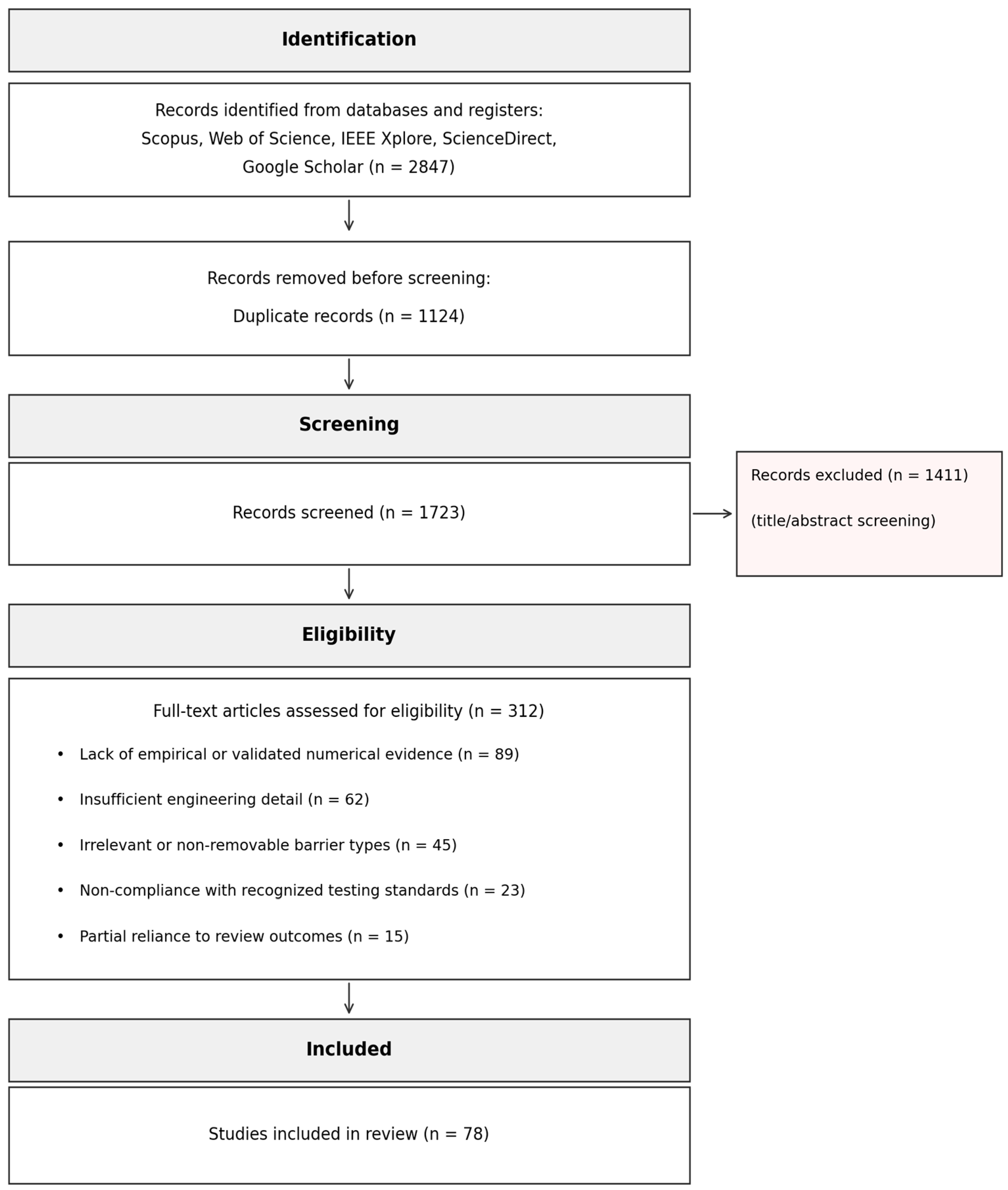
2.5. Study Selection
2.6. Data Extraction, Quality Appraisal, and Contextual–Technical Coding
- Data extractionFor each eligible study, detailed metadata were extracted, including bibliographic information (authors, year, venue, DOI), study design (experimental, numerical, field, hybrid, or review), barrier characteristics (typology, material system, structural configuration), and testing parameters (applicable standard, vehicle class, impact speed and angle). Performance outputs, such as containment outcomes, working width, and occupant risk indices, were also systematically recorded, along with deployment context (road environment and jurisdiction), key contributions, and author-reported limitations.The complete extraction schema is provided in Supplementary Materials Table S1_MetaData, including an exemplar row illustrating summarization at the theory–engineering interface [6,10,27].
- Quality appraisalEstablishing explicit and comprehensive quality-assessment criteria is widely recommended in systematic evidence-evaluation practice [53]. Accordingly, methodological rigor and reporting adequacy were assessed using a 16-criterion appraisal rubric adapted and expanded from the Critical Appraisal Skills Programme (CASP) framework and related evidence-synthesis guidance. The rubric was tailored to the specific context of engineering and impact-performance studies and encompassed the clarity of research aims, methodological transparency, adequacy of experimental or numerical design, definition and control of variables, data availability, stated limitations, replicability, contextual relevance, analytical appropriateness, coherence between results and interpretation, balance of discussion, venue quality, citation currency, author credibility, and overall contribution or innovation.Each criterion was scored on a three-level scale (high/medium/low) and normalized to a composite 0–3 index. Studies were classified as high (≥2.3), moderate (1.5–2.2), or low (<1.5). The full scoring results and justification for borderline cases are provided in Supplementary Materials Table S2_QualityAppraisal. This appraisal framework is consistent with methodological approaches that are widely applied in engineering-focused SLRs [40,41,42].
- Contextual and technical codingTo integrate full-scale crash testing, validated numerical simulations, and field-deployment evidence, each included study was classified using a structured two-dimensional coding framework, consistent with established SLR methodologies in engineering and evidence-synthesis research [42,47].The context dimension captured the operational environment (e.g., expressway work zones, reversible lanes, bridges and tunnels), geographic setting, jurisdictional factors, and whether real-world deployments or field trials were reported.The technical dimension characterized barrier typology, referenced standards (e.g., MASH, EN 1317, AS/NZS 3845.1), impact-testing conditions (vehicle class, impact speed and angle), key performance indicators (containment level, working width, occupant-risk indices), and design-specific attributes such as the material system, connection mechanisms, and structural configuration, alongside study-reported limitations.These coded dimensions are provided in Supplementary Materials Table S3_ContextApplication and Supplementary Materials Table S4_TechnicalFocus and are used throughout Section 3.2, Section 3.3, Section 3.4, Section 3.5, Section 3.6, Section 3.7 and Section 3.8 to support structured comparative synthesis and cross-study interpretation.
- Integration with the main synthesis
- Aggregation of safety performance outcomes by barrier typology;
- Analysis of how material and design choices influence containment and working width behavior;
- Assessment of the maturity of numerical validation frameworks, relative to crash testing evidence;
- Mapping of field deployment data to regulatory and economic considerations.
3. Results
3.1. Coding Study Characteristics and Distribution
3.2. Barrier Design Characteristics Identified in the Literature
3.2.1. Barrier Typologies
- Modular rigid systems (n = 34; 44%)Modular rigid barriers typically comprise precast concrete or prefabricated steel units evaluated under established crash-testing standards such as MASH, EN 1317, and NCHRP 350. Recent TL-4 assessments of rubber mounted single slope movable systems further demonstrate the compliant structural performance and stable vehicle redirection [7]. Evidence from full-scale crash tests consistently highlights the critical role of joint detailing, module alignment, and base/interface conditions in governing global deflection and vehicle trajectory control. When these elements are properly engineered, modular rigid systems reliably satisfy the TL-3/TL-4 requirements.
- Semi-rigid steel systems (n = 26; 33%)Semi-rigid steel systems, including demountable W-beam and three-beam configurations, offer a balance between containment performance and redeployability. Their structural response is highly sensitive to post spacing, rail height, and connector torque, with numerous studies documenting the direct effects on containment capacity and working width behavior [26,54,56,57]. The use of high-strength steels can further reduce the system mass while preserving TL-2/TL-3 performance envelopes, benefiting transportability and the repeated deployment cycles [58].
- Flexible polymer systems (n = 18; 23%)Flexible polymer barriers, typically water, sand, or foam-filled, are widely deployed in low-speed or short-duration applications. Reported performance ranges from TL-1 to TL-2, with foam core or foam fill configurations shown to mitigate sloshing effects and substantially improve energy absorption efficiency, relative to purely water-filled modules [59]. Experimental evidence further indicates that polymer foam cores within interlocking composite assemblies enhance specific energy absorption and promote stable crushing progression under impact loading [60]. Several commercially deployed portable barrier systems in this category have been evaluated under controlled crash-test and field conditions in active work zones, providing empirical validation for short-duration TL-3 applications [9,61].
- Cross-standard and field relevance
3.2.2. Connection Systems
- Pin and loop connectionsPin and loop connections are widely employed in applications requiring rapid deployment and tool-light assembly, particularly in short-duration work zones. When manufacturing tolerances are properly maintained and bearing stresses are adequately controlled, the reviewed studies report consistent load-transfer behavior and high repeatability. However, the synthesized evidence indicates that degradation in assembly quality, especially under oblique impact conditions or low-friction surface scenarios, is associated with localized distress in the pin or eye components and may contribute to progressive joint failure [7]. Collectively, the available literature suggests that connection reliability is highly sensitive to assembly precision, indicating that installation control may be as critical as the nominal structural capacity in determining the impact performance.
- Bolted flangesBolted interfaces offer superior stiffness and load capacity characteristics, making them suitable for TL-3/TL-4 applications and installations with constrained footprints. Their performance, however, is highly sensitive to bolt torque, fit-up quality, and QA/QC practices. Recent full-scale tests demonstrate that improper torqueing or uneven clamping can induce premature connector failure, increase global system deflection, and compromise lateral stability. These findings underscore the vulnerability of semi-rigid steel systems to connection design deficiencies [54,56,57].
- Interlocking profilesMechanical interlocks enable tool-free assembly at intermediate installation speeds and reduce the need for loose hardware. Their performance depends strongly on dimensional accuracy, engagement length, and fit-up quality. Even small geometric deviations can alter effective stiffness, influence working width behavior, and affect vehicle exit trajectories during impact events [26,54].
- Design implications
- Connection detailing should be treated as a primary design variable for all movable systems;
- Measurable QA/QC requirements, particularly for alignment, torque, and clamping, are essential;
- Post spacing, rail height, base friction, and joint stiffness must be calibrated as an integrated system, and transition detailing has been shown to strongly influence containment and redirection effectiveness [63];
- Redeployment protocols should explicitly include inspection and retightening procedures.
3.2.3. Material Selection and Optimization
- High-strength steels (HSS)Across the included studies, the substitution of conventional barrier steels with high-strength steels consistently yields significant mass reductions, typically in the range of 15–35%, while maintaining TL-2/TL-3 crash performance levels, if connection detailing and post spacing are properly calibrated [16,54,58]. HSS is widely utilized in semi-rigid systems with demountable posts, where strict QA/QC practices for torque and spacing are essential.Recent material characterization research further demonstrates that incorporating stress-state-dependent failure criteria for AASHTO M180 steels substantially improves the fidelity of finite element (FE) models used for guardrail simulation and design [23]. In parallel, new lightweight HSS barrier concepts have achieved compliant TL-3 performance while reducing the overall system mass, improving transportability, and facilitating repeated redeployment: attributes that are especially advantageous for movable barrier applications [24].
- Ultra-high-performance concrete (UHPC)UHPC modules leverage ultra-high compressive strength (≥120 MPa) and steel fiber-reinforcement to achieve thinner sections and reduced mass while maintaining or enhancing crashworthiness. Optimized UHPC barrier designs demonstrate TL-3/TL-4 compliance and exhibit excellent durability, impact resistance, and damage tolerance under repeated loading [28,55,64]. Successful implementation, however, requires careful verification of joint anchorage and section detailing to ensure structural continuity and impact load transfer.
- Fiber-reinforced polymers (FRP/CFRP)FRP materials offer high specific strength and corrosion resistance, with energy absorption characteristics that can exceed those of conventional steel in specific loading configurations, making them attractive for lightweight crash mitigation applications [29,65,66]. Hybrid metal–FRP systems have demonstrated containment performance within TL-2/TL-3 envelopes in validated studies, whereas stand-alone FRP configurations are generally limited by stiffness constraints; connection detailing and interlaminar failure mitigation remain critical design considerations [29,67].

| Material Family | What the Literature Shows | Typical Application Window | Caveats/Requirements |
|---|---|---|---|
| HSS | Demonstrates 15–35% mass, reduction relative to conventional steels, while maintaining TL-2/TL-3 performance when joint and post design are properly calibrated [54,58]. | Semi-rigid steel systems; demountable post configurations. | Corrosion protection required (galvanizing/powder coating); strict QA/QC for bolt torque and post spacing [16]. |
| UHPC | Very high compressive strength (≥120 MPa) enables thinner sections, reduced mass, and compliant TL-3/TL-4 behavior with enhanced durability [28,55,64]. | Modular rigid units; geometrically constrained corridors. | Higher material cost offset by durability and section reduction; joint anchorage and detailing must be verified. |
| FRP/CFRP | High specific strength and 2–3× higher specific energy absorption than steel; hybrid FRP–metal systems validated at TL-2/TL-3, standalone FRP at TL-1/TL-2 [29,65,73]. | Lightweight/rapid deployments; hybrid retrofits. | Deflection and working width control depend on joint stiffness; environmental durability and interlaminar failure resistance require qualification. |
| Sustainability | Recycled/bio composite concepts show comparable performance when optimized; lower embodied impacts for recycled UHPC/steel and mass-reduced designs [74,75]. | Program-level planning and procurement frameworks. | Incorporate LCA/LCCA; establish end of life strategies for recyclability and disposal. |
3.2.4. Sustainability Considerations
3.3. Testing Methodologies and Validation Approaches
3.4. Safety Performance Outcomes
3.5. Operational Deployment Evidence from Field Studies
3.6. Movable and Retractable Roadside Safety Systems
3.7. Economic and Life-Cycle Cost Evidence from the Literature
3.8. Regulatory Compliance and Standards Assessment
3.8.1. Standards Compliance Across Reviewed Studies
3.8.2. Identified Standards Gaps and Emerging Challenges
4. Discussion
4.1. Synthesis of Principal Findings
4.2. Design Performance and Structural Behavior
4.2.1. Material and Structural Performance
4.2.2. Influence of Connection Integrity on Redirection Stability
4.3. Testing Frameworks and Regulatory Compliance
4.3.1. Alignment with International Standards
4.3.2. Cross-Standard Limitations
4.4. Operational Safety and Field Performance
4.4.1. Work Zone Applications
4.4.2. Reversible Lane Systems
4.5. Intelligent and Automated Systems
4.6. Economic and Life-Cycle Considerations
4.7. Comparison with Prior Reviews
4.8. Research Gaps and Future Directions
- Dynamic operation standardsNo current framework addresses behavior during barrier movement, automated transfer, or fail-safe deployment transitions [6].
- Long-term durabilityEvidence beyond short-term testing remains scarce, particularly for composite, polymeric, or hybrid materials that are subject to environmental degradation.
- Intelligent system regulationSensor-enabled monitoring and automated inspection systems lack formal performance benchmarks or validation criteria [19].
4.9. Limitations of This Review
5. Conclusions
5.1. Summary of Key Findings
5.2. Implications for Engineering Practice
5.3. Priorities for Future Research
- Durability and life-cycle performance: Multi-year field studies are required to understand in-service degradation mechanisms (e.g., UV exposure, freeze–thaw cycles, connector fatigue, composite aging) and to develop predictive maintenance models.
- Standards harmonization and dynamic operation: Formal alignment across MASH, EN 1317, and AS/NZS 3845.1 is needed, along with supplements addressing the connection design, redeployment durability, and dynamic or in-motion crash behavior of automated systems.
- Sustainability: Future work should assess the recyclability of FRP components, validate bio-based composites, and incorporate comprehensive life-cycle greenhouse gas analysis within circular economy frameworks (e.g., design for disassembly and design for secondary material markets).
- Digital integration: Research should develop validated surrogate models for design optimization, digital twin frameworks for monitoring and predictive maintenance, and mechanisms that enable integration with CAV and connected infrastructure systems.
5.4. Contribution to Knowledge
- First, it provides a comprehensive PRISMA-aligned synthesis integrating full-scale crash tests, validated simulations, regulatory analysis, and field deployment evidence for movable barriers.
- Second, it offers actionable design guidance by demonstrating that connection integrity is the dominant factor governing system behavior.
- Third, it aligns economic analysis with established work zone and life-cycle cost accounting methodologies, supporting context-specific evaluation.
- Fourth, it outlines a multidisciplinary research agenda spanning structural engineering, transportation systems, materials science, and data-driven asset management.
5.5. Closing Statement
6. Delimitations, Methodological Limitations, and Scope of the Review
7. Future Research Directions and Policy-Relevant Implications
Supplementary Materials
Author Contributions
Funding
Data Availability Statement
Acknowledgments
Conflicts of Interest
Abbreviations
| AASHTO | American Association of State Highway and Transportation Officials |
| AS/NZS | Australian/New Zealand Standard |
| ASI | Acceleration Severity Index (EN 1317 occupant risk metric) |
| CAV | Connected and Autonomous Vehicles |
| CEN | European Committee for Standardization (Comité Européen de Normalisation) |
| CFRP | Carbon Fiber-Reinforced Polymer |
| EPA | U.S. Environmental Protection Agency |
| EN 1317 | European Standard 1317 (Road Restraint Systems) |
| FEA | Finite Element Analysis |
| FHWA | Federal Highway Administration (U.S.) |
| FRP | Fiber-Reinforced Polymer |
| HSS | High-Strength Steel(s) |
| ISO | International Organization for Standardization |
| ITS | Intelligent Transportation Systems |
| KABCO | Injury Severity Scale (K = Fatal, A = Incapacitating, B = Non-Incapacitating, C = Possible Injury, O = No Injury) |
| LCA | Life-Cycle Assessment |
| LCCA | Life-Cycle Cost Analysis |
| LS-DYNA | Explicit finite-element software widely used in guardrail crashworthiness research |
| MAP 21 | Moving Ahead for Progress in the 21st Century Act (U.S.) |
| MASH | Manual for Assessing Safety Hardware |
| NCHRP | National Cooperative Highway Research Program |
| NHTSA | National Highway Traffic Safety Administration (U.S.) |
| PHD | Post-Impact Head Deceleration (EN 1317 occupant risk metric) |
| PICO | Population–Intervention–Comparison–Outcome (framework) |
| PRISMA | Preferred Reporting Items for Systematic Reviews and Meta-Analyses |
| QA/QC | Quality Assurance/Quality Control |
| SAE | SAE International (formerly Society of Automotive Engineers) |
| THIV | Theoretical Head Impact Velocity (EN 1317 occupant risk metric) |
| TL-3/TL-4 | Test Level 3/4 (e.g., MASH/EN 1317 context) |
| TRB | Transportation Research Board |
| UHPC | Ultra-High-Performance Concrete |
| V2I | Vehicle to Infrastructure (communications) |
References
- Butāns, Ž.; Gross, K.A.; Gridnevs, A.; Karzubova, A. Road Safety Barriers, the Need and Influence on Road Traffic Accidents. IOP Conf. Ser. Mater. Sci. Eng. 2015, 96, 012063. [Google Scholar] [CrossRef]
- Zou, Y.; Tarko, A.P.; Chen, E.; Romero, M.A. Effectiveness of Cable Barriers, Guardrails, and Concrete Barrier Walls in Reducing Injury Risk. Accid. Anal. Prev. 2014, 72, 55–65. [Google Scholar] [CrossRef]
- AASHTO. Roadside Design Guide, 4th ed.; American Association of State Highway and Transportation Officials: Washington, DC, USA, 2011. [Google Scholar]
- AASHTO; FHWA. MASH Implementation Guidance; American Association of State Highway and Transportation Officials: Washington, DC, USA, 2016. [Google Scholar]
- Han, L.; Du, B. Status, Challenges, and Trends of International Research on Roadside Safety. Transp. Res. Rec. 2024, 2678, 881–914. [Google Scholar] [CrossRef]
- Yang, J.; Xu, G.; Cai, C.S.; Kareem, A. Crash Performance Evaluation of a New Movable Median Guardrail. Eng. Struct. 2019, 182, 459–472. [Google Scholar] [CrossRef]
- Abu-Odeh, A.Y.; Brackin, M.S.; Schulz, N.D.; Kovar, J.C.; Ferron, R.D.; Ahsan, S.; Rung, M.; Ivev, D.L.; Kuhn, D.L. Development and MASH TL-4 Evaluation of TxDOT Rubber Mounted Single Slope Barrier; Caltrans: Sacramento, CA, USA, 2019. Available online: https://rosap.ntl.bts.gov/view/dot/40152 (accessed on 2 March 2026).
- Schmidt, J.D.; Schmidt, T.L.; Rosenbaugh, S.K.; Faller, R.K.; Bielenberg, R.W.; Reid, J.D.; Rohde, J.R. MASH TL-4 Crash Testing and Evaluation of the RESTORE Barrier; Report No. TRP-03-318-15; Nebraska Department of Roads: Lincoln, NE, USA, 2015. Available online: https://digitalcommons.unl.edu/ndor/166/ (accessed on 2 March 2026).
- Ravani, B.; Wong, J.; Fyhrie, P.; Bosler, G. Scientific Evaluation of the ArmorGuard Mobile Barrier System; Report No. UCD-ARR-10-06-30-01; Caltrans: Sacramento, CA, USA, 2011. Available online: https://rosap.ntl.bts.gov/view/dot/26454 (accessed on 2 March 2026).
- Sun, X.; Wang, Y. Simulation and Optimization of Crash Performance of Movable Barrier at Median Strip. KSCE J. Civ. Eng. 2022, 26, 874–881. [Google Scholar] [CrossRef]
- Liu, T.; Zuo, L.; Wu, P.; Tian, Y.; Ge, Y.; Zhang, Y. Optimization Design of W-Beam-Modified Guardrail Structure Based on the RBF Model and Anticrossing Consideration. J. Adv. Transp. 2024, 2024, 6030049. [Google Scholar] [CrossRef]
- Dinnella, N.; Chiappone, S.; Guerrieri, M. The Innovative “NDBA” Concrete Safety Barrier Able to Withstand Two Subsequent TB81 Crash Tests. Eng. Fail. Anal. 2020, 115, 104660. [Google Scholar] [CrossRef]
- Guerrieri, M. A New Methodology to Estimate Deformation of Longitudinal Safety Barriers. ARPN J. Eng. Appl. Sci. 2013, 8, 1020–1027. Available online: https://iris.unitn.it/handle/11572/402001 (accessed on 2 March 2026).
- BS EN 1317-1:2010; Road Restraint Systems—Part 1: Terminology and General Criteria for Test Methods. BSI: London, UK, 2010.
- AS/NZS 3845.1:2015; Road Safety Barrier Systems. Standards Australia: Sydney, Australia, 2015.
- Austroads. Safety Barrier Assessment Information Pack; Version 3.0; Austroads: Sydney, Australia, 2018. Available online: https://austroads.gov.au/__data/assets/pdf_file/0030/104898/201807_Austroads_Safety_Barrier_Assessment_Information_Pack_V3.0.pdf (accessed on 5 February 2026).
- Ai, C.; Hou, M. Automated Guardrail Inventory and Condition Evaluation; Report No. 22-031; Massachusetts Department of Transportation: Boston, MA, USA, 2022. Available online: https://rosap.ntl.bts.gov/view/dot/63368 (accessed on 2 March 2026).
- Chang, Y.; Lu, X.; Zhang, H. Design and Mechanical Behavior Research of Highway Guardrail Patrol Robot. Appl. Sci. 2025, 15, 2597. [Google Scholar] [CrossRef]
- Al Oide, A.; Manasreh, D.; Karasneh, M.; Melhem, M.; Nazzal, M.D. Enhancing Road Safety on US Highways: Leveraging Advanced Computer Vision for Automated Guardrail Damage Detection and Evaluation. Buildings 2025, 15, 668. [Google Scholar] [CrossRef]
- Johansen, K.W.; Teizer, J.; Schultz, C. Automated Rule-Based Safety Inspection and Compliance Checking of Temporary Guardrail Systems in Construction. Autom. Constr. 2024, 168, 105849. [Google Scholar] [CrossRef]
- Alparslan, C.; Yentimur, M.F.; Kütük, S.T.; Bayraktar, Ş. A Review on Additive Manufactured Engineering Materials for Enhanced Road Safety and Transportation Applications. Polymers 2025, 17, 877. [Google Scholar] [CrossRef]
- Mai, V.C.; Vu, Q.A.; Nguyen, V.T.; Pham, D.T. Performance Assessment of UHPC Composite Barriers Under Velocity Impacts. Case Stud. Constr. Mater. 2025, 23, e05062. [Google Scholar] [CrossRef]
- Alomari, Q.A.; Yosef, T.Y.; Bielenberg, R.W.; Faller, R.K.; Negahban, M.; Reid, J.D. Material Characterization and Stress State Dependent Failure Criteria of AASHTO M180 Guardrail Steel: Experimental and Numerical Investigation. Materials 2025, 18, 2523. [Google Scholar] [CrossRef]
- Wei, H.; Sun, F.; Zhao, L.; Li, Q. Structural Design and Safety Performance of a Novel High Strength Steel Lightweight Guardrail. PLoS ONE 2025, 20, e0317353. [Google Scholar] [CrossRef]
- Apak, M.; Yumrutas, I.; Korkmaz, E. A Novel Modular Shallow Mounted Bollard System for Vehicle Impact Protection. Proc. Inst. Mech. Eng. Part D J. Automob. Eng. 2022, 237, 688–702. [Google Scholar] [CrossRef]
- Teng, T.; Xie, F.; Zhang, Y. Effect of W-Beam Post Spacings and Rail Heights on Safety Performance. Adv. Mech. Eng. 2015, 7, 1–16. [Google Scholar] [CrossRef]
- Abraham, M.; Sireesh, S.; Ramu, P. Assessment of the Impact Speed and Angle Conditions for the EN 1317 Barrier Tests. Int. J. Crashworthiness 2016, 21, 211–221. [Google Scholar] [CrossRef]
- Li, Y.; Li, Z.; Luo, Z.; Yu, K. Research and Application of Rapid Reconstruction Technology to Existing Bridge Guardrails Based on UHPC Connection. Adv. Bridge Eng. 2024, 5, 24. [Google Scholar] [CrossRef]
- Sun, S.; Li, H.; Zhu, C.; Mei, K.; Jiang, H.; Wang, H. Study on the Anti-Collision Performance of Basalt Fiber Reinforced Polymer Beam–Column Guardrail. Compos. Struct. 2021, 276, 114588. [Google Scholar] [CrossRef]
- Yumrutas, H.I.; Apak, M.Y. Crashworthiness of the Bollard System by Experimentally Validated Virtual Test. Eng. Fail. Anal. 2023, 148, 107167. [Google Scholar] [CrossRef]
- Yin, H.; Zhang, L.; Liu, Z.; Fan, W.; Wu, X.; Wang, Q. Crash Analysis and Evaluation of a New Separate W-beam Guardrail on Highways Using the Finite Element Method. Eng. Struct. 2023, 278, 115551. [Google Scholar] [CrossRef]
- Ullman, G.L.; Pratt, M.; Fontaine, M.D.; Porter, R.J.; Medina, J.; Finley, M.D. Estimating the Safety Effects of Work Zone Characteristics and Countermeasures: A Guidebook; NCHRP Report 869; Transportation Research Board: Washington, DC, USA, 2018. [Google Scholar] [CrossRef]
- Federal Highway Administration (FHWA). Benefit-Cost Analysis Guidance for the Transportation Alternatives Program Under MAP-21; U.S. Department of Transportation: Washington, DC, USA, 2013.
- Rathee, M.; Bacic, B.; Doborjeh, M. Hybrid Machine Learning for Automated Road Safety Inspection of Guardrails. Electronics 2024, 13, 3030. [Google Scholar] [CrossRef]
- Liu, C.; Liao, H.-J.; Chen, J.; Deng, Q.-Q. Sensitivity Analysis of the Coupled Dynamic Behavior of Vehicles in Collision with Semirigid Guardrails. Shock Vib. 2024, 2024, 1423439. [Google Scholar] [CrossRef]
- Mattos, D.; Esteves da Silva, J.C.G.; Pinto da Silva, L. Life Cycle Assessment of Reconditioned Guardrail Beams. Waste 2025, 3, 36. [Google Scholar] [CrossRef]
- Peng, G.; Li, H.; Liu, Z.; Zhang, Z.; Yan, Y. The Mechanism and Design Optimization of Snowdrift Disaster Prevention and Control by the Wind Deflector of the Roadside Guardrail. Int. J. Transp. Sci. Technol. 2026. [Google Scholar] [CrossRef]
- Page, M.J.; McKenzie, J.E.; Bossuyt, P.M.; Boutron, I.; Hoffmann, T.C.; Mulrow, C.D.; Shamseer, L.; Tetzlaff, J.M.; Akl, E.A.; Brennan, S.E.; et al. The PRISMA 2020 Statement: An Updated Guideline for Reporting Systematic Reviews. BMJ 2021, 372, n71. [Google Scholar] [CrossRef]
- Moher, D.; Shamseer, L.; Clarke, M.; Ghersi, D.; Liberati, A.; Petticrew, M.; Shekelle, P.; Stewart, L.A.; PRISMA-P Group. Preferred Reporting Items for Systematic Review and Meta-Analysis Protocols (PRISMA-P) 2015 Statement. Syst. Rev. 2015, 4, 1. [Google Scholar] [CrossRef] [PubMed]
- Ali, N.B.; Usman, M. Reliability of Search in Systematic Reviews: Towards a Quality Assessment Framework for the Automated-Search Strategy. Inf. Softw. Technol. 2018, 99, 133–147. [Google Scholar] [CrossRef]
- Jiao, B.; Evdorides, H. Methods of Strategic Road Safety Management: A Systematic Review. Int. J. Inj. Control Saf. Promot. 2024, 31, 420–430. [Google Scholar] [CrossRef]
- Kitchenham, B.; Brereton, O.P.; Budgen, D.; Turner, M.; Bailey, J.; Linkman, S. Systematic Literature Reviews in Software Engineering—A Systematic Literature Review. Inf. Softw. Technol. 2009, 51, 7–15. [Google Scholar] [CrossRef]
- Tranfield, D.; Denyer, D.; Smart, P. Towards a Methodology for Developing Evidence-Informed Management Knowledge by Means of Systematic Review. Br. J. Manag. 2003, 14, 207–222. [Google Scholar] [CrossRef]
- O’Mara-Eves, A.; Thomas, J.; McNaught, J.; Miwa, M.; Ananiadou, S. Using Text Mining for Study Identification in Systematic Reviews: A Systematic Review of Current Approaches. Syst. Rev. 2015, 4, 5. [Google Scholar] [CrossRef]
- Molan, M.A.; Rezapour, M.; Ksaibati, K. Investigating the Relationship Between Crash Severity, Traffic Barrier Type, and Vehicle Type in Crashes Involving Traffic Barrier. J. Traffic Transp. Eng. 2020, 7, 125–136. [Google Scholar] [CrossRef]
- Lunny, C.; Brennan, S.E.; McDonald, S.; McKenzie, J.E. Toward a Comprehensive Evidence Map of Overview of Systematic Review Methods: Paper 1—Purpose, Eligibility, Search and Data Extraction. Syst. Rev. 2017, 6, 231. [Google Scholar] [CrossRef]
- Gough, D.; Oliver, S.; Thomas, J. An Introduction to Systematic Reviews, 2nd ed.; SAGE Publications: London, UK, 2017. [Google Scholar]
- AASHTO. Manual for Assessing Safety Hardware (MASH), 2nd ed.; American Association of State Highway and Transportation Officials: Washington, DC, USA, 2016. [Google Scholar]
- BS EN 1317-2:2010; Road Restraint Systems—Part 2: Performance Classes, Impact Test Acceptance Criteria and Test Methods for Safety Barriers Including Vehicle Parapets. BSI: London, UK, 2010.
- EN 1317; Overview. European Road Federation: Brussels, Belgium, 2020.
- Ross, H.E.; Sicking, D.L.; Zimmer, R.A.; Michie, J.D. Recommended Procedures for the Safety Performance Evaluation of Highway Features; NCHRP Report No. 350; Transportation Research Board: Washington, DC, USA, 1993. [Google Scholar]
- Landis, J.R.; Koch, G.G. The Measurement of Observer Agreement for Categorical Data. Biometrics 1977, 33, 159–174. [Google Scholar] [CrossRef]
- CASP. Critical Appraisal Checklists; Critical Appraisal Skills Programme. 2024. Available online: https://casp-uk.net/casp-tools-checklists/ (accessed on 2 March 2026).
- Sheikh, N.M.; Bligh, R.P. Design and Crash Testing of a Surface-Mounted Median Guardrail System. Transp. Res. Rec. 2024, 2678, 806–818. [Google Scholar] [CrossRef]
- Zhang, A.; Bu, Q.; Zhang, W.; He, G.; Deng, Y. Test and Application of Movable Steel Barrier with SB Grade Light Composite Corrugated Beam. J. Meas. Eng. 2024, 12, 1–22. [Google Scholar] [CrossRef]
- Texas A&M Transportation Institute. Design and MASH TL-3 Evaluation of Surface Mounted Median Guardrail; Report No. 0-7052-R1; Texas Department of Transportation: Austin, TX, USA, 2021. Available online: https://library.ctr.utexas.edu/hostedpdfs/tti/0-7052-r1.pdf (accessed on 5 February 2026).
- Texas Department of Transportation; TTI. Evaluation of Surface Mounted Median Guardrail; Project Summary 0-7052; Texas Department of Transportation: Austin, TX, USA, 2022. Available online: https://rosap.ntl.bts.gov/view/dot/62468 (accessed on 24 February 2026).
- Mujahid, M.; Lis, A.K.; Garcia, C.I.; DeArdo, A.J. HSLA 100 Steels: Influence of Aging Heat Treatment on Microstructure and Properties. J. Mater. Eng. Perform. 1998, 7, 247–257. [Google Scholar] [CrossRef]
- Thiyahuddin, M.I.; Gu, Y.T.; Thambiratnam, D.P. Revolute Joint Approach to Model Joint Mechanism in Water-Filled Road Safety Barriers. Appl. Mech. Mater. 2014, 553, 763–768. [Google Scholar] [CrossRef]
- Alsubari, S.; Zuhri, M.Y.M.; Sapuan, S.M.; Ishak, M.R. Effect of Foam Filling on the Energy Absorption Behaviour of Flax/Polylactic Acid Composite Interlocking Sandwich Structures. Compos. Struct. 2022, 292, 115685. [Google Scholar] [CrossRef]
- Caltrans Division of Design. Design Information Bulletin 91: Guidelines on the Use of Positive Work Zone Protection and Mitigation Measures; California Department of Transportation: Sacramento, CA, USA, 2021. Available online: https://dot.ca.gov/-/media/dot-media/programs/design/documents/final-dib-91_06282021_a11y.pdf (accessed on 25 February 2026).
- Cantisani, G.; Di Mascio, P.; Polidori, C. New Research Opportunities for Roadside Safety Barriers Improvement. IOP Conf. Ser. Mater. Sci. Eng. 2017, 236, 012097. [Google Scholar] [CrossRef]
- Soltani, M.; Moghaddam, T.B.; Karim, M.R.; Ramli, S.N.H. Analysis of Developed Transition Road Safety Barrier Systems. Accid. Anal. Prev. 2013, 59, 240–252. [Google Scholar] [CrossRef] [PubMed]
- Xue, W.; Liao, Z.; Liao, L.; Hao, R.; Shen, Y. Safety Performance Evaluation of Ultra-High-Performance Concrete Semi-Assembled Barrier. Appl. Sci. 2025, 15, 3156. [Google Scholar] [CrossRef]
- Awd Allah, M.M.; Abd El-Halim, M.F.; Almuflih, A.S.; Mahmoud, S.F.; Saleh, D.I.; Abd El-baky, M.A. Innovative, High-Performance, and Cost-Effective Hybrid Composite Materials for Crashworthiness Applications. Polym. Compos. 2025, 46, 11832–11853. [Google Scholar] [CrossRef]
- Abd El-baky, M.A.; Awd Allah, M.M.; Kamel, M.; Abd-Elaziem, W. Lightweight Cost-Effective Hybrid Materials for Energy Absorption Applications. Sci. Rep. 2022, 12, 21101. [Google Scholar] [CrossRef]
- Turvey, G.J.; Sutch, G. Inclined Composite Guardrails/Safety Barriers—Numerical and Experimental Evaluation of Their Transverse Stiffnesses and Compliance with Standards. Compos. Struct. 2021, 276, 114552. [Google Scholar] [CrossRef]
- Falaschetti, M.P.; Semprucci, F.; Birnie, H.J.; Troiani, E. Experimental and Numerical Assessment of Crashworthiness Properties of Composite Materials: A Review. Aerospace 2025, 12, 122. [Google Scholar] [CrossRef]
- Bhutada, S.; Goel, M.D. Crashworthiness Performance of Lightweight Composites. In Lightweight Composites; CRC Press: Boca Raton, FL, USA, 2026; pp. 149–178. [Google Scholar] [CrossRef]
- Jia, B.; Liang, Z.; Yu, X.; Zhang, S. Crash Performance Study of a Novel Re-Entrant Hexagonal Honeycomb Composite Guardrail on Highways Using Numerical Simulation. Compos. Struct. 2025, 374, 119717. [Google Scholar] [CrossRef]
- Zhang, Y.; Zong, Z.; Liu, Q.; Ma, J.; Wu, Y.; Li, Q. Static and Dynamic Crushing Responses of CFRP Sandwich Panels Filled with Different Reinforced Materials. Mater. Des. 2017, 117, 396–408. [Google Scholar] [CrossRef]
- Mohammadi, I.; Haghighi-Yazdi, M.; Safarabadi, M.; Yousefi, A. Crashworthiness Analysis of a Composite Guardrail Under Impact Loading. Proc. Inst. Mech. Eng. Part L J. Mater. Des. Appl. 2023, 237, 1651–1664. [Google Scholar] [CrossRef]
- Cui, H.; Li, Y.; Zhu, M.; Liang, X.; Chen, Y.; Fang, H. Crashworthiness Analysis and Evaluation of Assembled Multifunctional Highway Median Guardrail Using the Field-Validated Finite Element Simulation. Structures 2025, 82, 110577. [Google Scholar] [CrossRef]
- Scouse, A.A.; Kelley, S.S.; Venditti, R.A.; McConnell, T.E. Evaluating Sustainable Product Alternatives by Combining Life Cycle Assessment with Full-Cost Accounting: A Highway Guardrail Case Study. BioResources 2020, 15, 9103–9127. [Google Scholar] [CrossRef]
- U.S. Environmental Protection Agency. Report on the Social Cost of Greenhouse Gases: Estimates Incorporating Recent Scientific Advances; U.S. EPA: Washington, DC, USA, 2023. Available online: https://www.epa.gov/system/files/documents/2023-12/epa_scghg_2023_report_final.pdf (accessed on 5 February 2026).
- Yao, J.; Wang, B.; Hou, Y.; Huang, L. Analysis of Vehicle Collision on an Assembled Anti-Collision Guardrail. Sensors 2021, 21, 5152. [Google Scholar] [CrossRef]
- Yao, J.; Zhang, J.; Huang, L.; Xu, J.; Wang, B. Analysis of Anti-Collision Performance of a New Assembled Rolling Guardrail. Structures 2023, 47, 246–259. [Google Scholar] [CrossRef]
- Bielenberg, R.W.; Asselin, N.M.; Faller, R.K. MASH TL-3 Evaluation of Concrete and Asphalt Tied-Down Anchorage for Portable Concrete Barrier; Report No. TRP-03-386-19; Midwest Roadside Safety Facility, University of Nebraska-Lincoln: Lincoln, NE, USA, 2019; Available online: https://mwrsf.unl.edu/researchhub/files/Report358/TRP-03-386-19.pdf (accessed on 27 February 2026).
- Bhakta, S.K.; Bielenberg, R.W.; Faller, R.K.; Reid, J.D.; Rosenbaugh, S.K. Performance Evaluation of New Jersey’s Portable Concrete Barrier with a Box-Beam Stiffened Configuration and Grouted Toes; Report No. TRP-03-372-18; Midwest Roadside Safety Facility, University of Nebraska-Lincoln: Lincoln, NE, USA, 2019; Available online: https://www.roadsidepooledfund.org/longitudinal-barrier/new-jerseys-portable-concrete-barrier-with-a-box-beam-stiffened-configuration-and-grouted-toes/ (accessed on 27 February 2026).
- Sheikh, N.M. Design and Testing of MASH TL-3 Compliant Anchored F-Shape Portable Concrete Barrier System with Vertical Anchors; Report No. TTI-616811; Texas A&M Transportation Institute: College Station, TX, USA, 2024; Available online: https://www.roadsidepooledfund.org/design-and-testing-of-mash-tl-3-compliant-anchored-f-shape-portable-concrete-barrier-system-with-vertical-anchors-616811-task-order-en/ (accessed on 27 February 2026).
- Ruskamp, R.J.; Asadollahi Pajouh, M.; Bielenberg, R.W.; Rosenbaugh, S.K.; Faller, R.K. Development, Crash Testing, and Evaluation of Portable Concrete Barriers Gap-Spanning Hardware. Transp. Res. Rec. 2022, 2676, 635–649. [Google Scholar] [CrossRef]
- Bielenberg, R.W.; Faller, R.K.; Reid, J.D.; Schmidt, J.D.; Asadollahi Pajouh, M.; Emerson, E. Development of Retrofit, Low-Deflection Portable Concrete Barrier System. J. Transp. Saf. Secur. 2019, 11, 333–352. [Google Scholar] [CrossRef]
- Asadollahi Pajouh, M.; Bielenberg, R.W.; Reid, J.D.; Schmidt, J.D.; Faller, R.K.; Emerson, E. Development of Transition Between Free-Standing and Reduced-Deflection Portable Concrete Barriers. Transp. Res. Rec. 2018, 2672, 118–129. [Google Scholar] [CrossRef]
- Chen, F.; Rasmussen, J.D.; Bielenberg, R.W.; Lechtenberg, K.A.; Faller, R.K.; Linzell, D.G. Experimental and Numerical Investigation on Deflection and Behavior of Portable Construction Barrier Subjected to Vehicle Impacts. Eng. Struct. 2021, 235, 112071. [Google Scholar] [CrossRef]
- Austroads. Guide to Road Design: Part 3—Geometric Design; AGRD03-21, Edition 3.4; Austroads: Sydney, Australia, 2021. Available online: https://austroads.com.au/publications/road-design/agrd03 (accessed on 25 February 2026).
- Austroads. Guide to Road Safety: Part 2—Safe Roads; AGRS02-21; Austroads: Sydney, Australia, 2021. Available online: https://austroads.com.au/publications/road-safety/agrs02 (accessed on 25 February 2026).
- Chen, S.; Liu, T.; Li, G.; Liu, Q.; Sun, J. Optimal Design and Dynamic Impact Tests of Removable Bollards. Earthq. Eng. Eng. Vib. 2017, 16, 793–802. [Google Scholar] [CrossRef]
- Tambe, P.; Tiwari, G.; Andraskar, N.; Jain, U. Investigating Crashworthiness of W-Beam Guardrail Crash Barriers. Int. J. Crashworthiness 2023, 29, 445–453. [Google Scholar] [CrossRef]
- Jiang, L.; Wang, K.; Fang, H.; Chen, B.; Zhu, L.; Zhang, Q.; Zhang, X. Protection Performance of a Novel Anti-Collision Guardrail with Recycled Foamed Concrete Under Vehicle Collision. Eng. Struct. 2024, 305, 117795. [Google Scholar] [CrossRef]
- Skibicki, S.; Zielinski, A.; Aguilar, V.; Hurtado, P.E.; Kaszynska, M.; Nowak, A. Optimization of a Temporary Road Traffic Steel Barrier Using Explicit Finite Element Method and Laboratory Testing. Eng. Struct. 2023, 291, 116463. [Google Scholar] [CrossRef]
- Cakalli, S.; Bligh, R.P.; Sheikh, N.M. MASH Allowable Flare Rates for Portable Single-Slope Concrete Barriers. Transp. Res. Rec. 2025. [Google Scholar] [CrossRef]
- Wang, F.; Xiang, G.; Cheng, Q.; Zhang, Y.; Fang, X.; Xu, X. Development of a Novel High-Performance Portable Barrier Based on Full-Scale Field Tests and Simulation Optimization. Sci. Rep. 2025, 16, 33253. [Google Scholar] [CrossRef]
- Pokhrel, A.; Sorensen, A. Evaluation of Concrete Barriers Using Finite-Element Analysis: Analysis Guidelines Using LS-DYNA. J. Perform. Constr. Facil. 2025, 39, 04025007. [Google Scholar] [CrossRef]
- Pokhrel, A.; Sorensen, A.D.; Zaker Esteghamati, M. A Numerical Investigation of the Performance of Damaged Concrete Barriers Under Sequential Vehicular Impacts. Buildings 2025, 15, 1271. [Google Scholar] [CrossRef]
- Meng, Y.; Chen, Z.; Wang, Z.; Liu, Z.; Qing, G.; Zhang, Y.; Qiao, J.; Liao, H. Crash Performance of a Novel Movable Assembled Barriers for Expressway Work Zone: Finite Element Model and Full-Scale Collision Test. Eng. Struct. 2025, 333, 120113. [Google Scholar] [CrossRef]
- Yumrutas, H.I.; Ozcanan, S.; Apak, M.Y.; Anwer, M.J. Experimental and Numerical Comparative Crashworthiness Analysis of Innovative Renewable Hybrid Barrier with Conventional Roadside Barriers. Int. J. Crashworthiness 2023, 28, 334–350. [Google Scholar] [CrossRef]
- Dong, Y.; Mumtarin, M.; Wood, J.S. Impacts of Traffic Barrier Types on Crash Severity. Transp. Res. Interdiscip. Perspect. 2025, 32, 101517. [Google Scholar] [CrossRef]
- Golden Gate Bridge District. Natural Environment Study: Moveable Median Barrier; Golden Gate Bridge District: San Francisco, CA, USA, 2011; Available online: https://www.goldengate.org/assets/1/6/natural_environment_study_minimal_impact_ggb_mmb.pdf (accessed on 24 February 2026).
- Golden Gate Bridge, Highway and Transportation District. Moveable Median Barrier: Operational Safety Report; GGBHTD: San Francisco, CA, USA, 2015; Available online: https://www.goldengate.org/bridge/bridge-operations/moveable-median-barrier/ (accessed on 27 February 2026).
- Glauz, W.D. Performance Evaluation of a Movable Concrete Barrier. Transp. Res. Rec. 1990, 1258, 63–72. Available online: https://onlinepubs.trb.org/Onlinepubs/trr/1990/1258/1258-009.pdf (accessed on 27 February 2026).
- BC Ministry of Transportation and Infrastructure. Zipper Truck Counterflow to Begin on Alex Fraser Bridge. BC Gov News, 12 December 2019. Available online: https://news.gov.bc.ca/releases/2019TRAN0227-002399 (accessed on 27 February 2026).
- Silvestri Dobrovolny, C.; Johnson, B.A.; Bligh, R.; Kovar, J.; Barrett, M.E.; Klenzendorf, B.; Hendrickson, G.; Retterer, T.; Ries, J. Development and Testing of a Concrete Median Barrier for Flood-Prone Areas. Transp. Res. Rec. 2021, 2675, 1015–1027. [Google Scholar] [CrossRef]
- El-Aasar, M. The Development of Crashworthy Rails for Fiber Reinforced Polymer Honeycomb Bridge Deck System; Technical Report; U.S. Department of Transportation: Washington, DC, USA, 2015. Available online: https://rosap.ntl.bts.gov/view/dot/29177 (accessed on 25 February 2026).
- Tran, P.; Linforth, S.; Ngo, T.D.; Lumantarna, R.; Nguyen, T.Q. Design Analysis of Hybrid Composite Anti-Ram Bollard. Compos. Struct. 2018, 189, 598–613. [Google Scholar] [CrossRef]
- U.S. DOT ITS Joint Program Office. Connected Vehicle Pilot Deployment Program—Executive Briefing; U.S. Department of Transportation: Washington, DC, USA, 2024. Available online: https://www.itskrs.its.dot.gov/briefings/executive-briefing/connected-vehicle-pilot-deployment-program-2024-update (accessed on 2 March 2026).
- Ravish, R.; Gupta, V.R.; Nagesh, K.J.; Karnam, A.; Rangaswamy, S. Software Implementation of an Automatic Movable Road Barrier. In Proceedings of the 2019 International Carnahan Conference on Security Technology (ICCST), Chennai, India, 1–3 October 2019; pp. 1–6. [Google Scholar] [CrossRef]
- Estahbanati, A.N.; Nazari, S. Cost-Benefit Analysis for Concrete vs. Metal Guardrails and Wood vs. Metal Posts for Signs and Guardrails; University of California: Davis, CA, USA, 2023. Available online: https://rosap.ntl.bts.gov/view/dot/75607 (accessed on 25 February 2026).
- Arkansas Department of Transportation. Estimated Costs per Mile; Arkansas DOT: Little Rock, AR, USA, 2024. Available online: https://ardot.gov/wp-content/uploads/2024-CPM-Report.pdf (accessed on 25 February 2026).
- Nemati, A.; Haas, M.; Torick, D.; Nazari, S. Lifetime Cost Analysis of Concrete Barriers and Steel Guardrails. Sci. Rep. 2024, 14, 15699. [Google Scholar] [CrossRef] [PubMed]
- Zhang, M.; Bu, Q. Research on Finite Element Simulation and Full-Scale-Vehicle Crash Test of B750HL Bridge Barrier. Sci. Rep. 2024, 14, 17240. [Google Scholar] [CrossRef] [PubMed]

| Element | Definition |
|---|---|
| Population (P) | Roadway environments and traffic-management contexts, including highways, work zones, urban arterials, bridges, tunnels, and reversible lanes. |
| Intervention (I) | Movable, mobile, portable, temporary, and automated guardrail systems. |
| Comparison (C) | Conventional fixed roadside and median barrier systems. |
| Outcomes (O) | Safety-performance metrics (containment, redirection effectiveness, vehicle stability, occupant-risk indices), structural behavior under impact, compliance with standardized testing protocols, operational efficiency, deployment feasibility, and life-cycle cost analysis [45]. |
| Database | Database Coverage * | Search Period Applied | Records Retrieved |
|---|---|---|---|
| Scopus | 1996–Present | 1970–2026 | 847 |
| Web of Science Core Collection | 1970–Present | 1970–2026 | 623 |
| IEEE Xplore | 1980–Present | 1970–2026 | 512 |
| ScienceDirect | 1990–Present | 1990–2026 | 865 |
| Google Scholar (via Publish or Perish) | 1970–Present | 1970–2026 | top 500 per query ** |
| Total (before deduplication) | 2847 |
| Characteristic | Category | Studies (n) | Percentage |
|---|---|---|---|
| Methodology * | Crash testing | 45 | 58% |
| Numerical simulation (FEA) | 36 | 46% | |
| Field deployment | 16 | 21% | |
| Combined methods | 27 | 35% | |
| Geographic Origin | North America | 32 | 41% |
| Europe | 9 | 12% | |
| Asia | 29 | 37% | |
| Australia/New Zealand | 5 | 6% | |
| International (non-regional) | 3 | 4% | |
| Testing Standard | MASH | 19 | 24% |
| EN 1317 | 8 | 10% | |
| NCHRP 350 | 2 | 3% | |
| AS/NZS 3845.1 | 0 | 0% | |
| Barrier Typology | Modular rigid | 34 | 44% |
| Semi-rigid steel | 26 | 33% | |
| Flexible polymer | 18 | 23% | |
| Publication Type | Peer-reviewed journals | 52 | 67% |
| Conference proceedings | 14 | 18% | |
| Technical/agency reports | 12 | 15% | |
| Quality Rating | High | 54 | 69% |
| Moderate | 18 | 23% | |
| Low | 6 | 8% |
Disclaimer/Publisher’s Note: The statements, opinions and data contained in all publications are solely those of the individual author(s) and contributor(s) and not of MDPI and/or the editor(s). MDPI and/or the editor(s) disclaim responsibility for any injury to people or property resulting from any ideas, methods, instructions or products referred to in the content. |
© 2026 by the authors. Licensee MDPI, Basel, Switzerland. This article is an open access article distributed under the terms and conditions of the Creative Commons Attribution (CC BY) license.
Share and Cite
Hashemi Taba, N.; Khatavakhotan, A.S.; Tolouei-Rad, M. Design, Testing, and Safety Performance of Movable Guardrail Systems: A PRISMA-Based Systematic Review. Machines 2026, 14, 306. https://doi.org/10.3390/machines14030306
Hashemi Taba N, Khatavakhotan AS, Tolouei-Rad M. Design, Testing, and Safety Performance of Movable Guardrail Systems: A PRISMA-Based Systematic Review. Machines. 2026; 14(3):306. https://doi.org/10.3390/machines14030306
Chicago/Turabian StyleHashemi Taba, Navid, Ahdieh Sadat Khatavakhotan, and Majid Tolouei-Rad. 2026. "Design, Testing, and Safety Performance of Movable Guardrail Systems: A PRISMA-Based Systematic Review" Machines 14, no. 3: 306. https://doi.org/10.3390/machines14030306
APA StyleHashemi Taba, N., Khatavakhotan, A. S., & Tolouei-Rad, M. (2026). Design, Testing, and Safety Performance of Movable Guardrail Systems: A PRISMA-Based Systematic Review. Machines, 14(3), 306. https://doi.org/10.3390/machines14030306