Dynamic Multi-Robot Task Allocation for Human-in-the-Loop Space Exploration: Knowledge Graph-Guided CBBA with LLM-Assisted Fault Analysis

Abstract
1. Introduction
- KG-based modeling framework for space missions. A KG is developed to incorporate task attributes, robot capabilities, and their relationships. This framework uniformly encodes semantic information, including spatiotemporal constraints, capability matching, and resource consumption. On this basis, task allocation objectives tailored to the characteristics of space missions are defined, providing a systematic modeling foundation for task allocation algorithms.
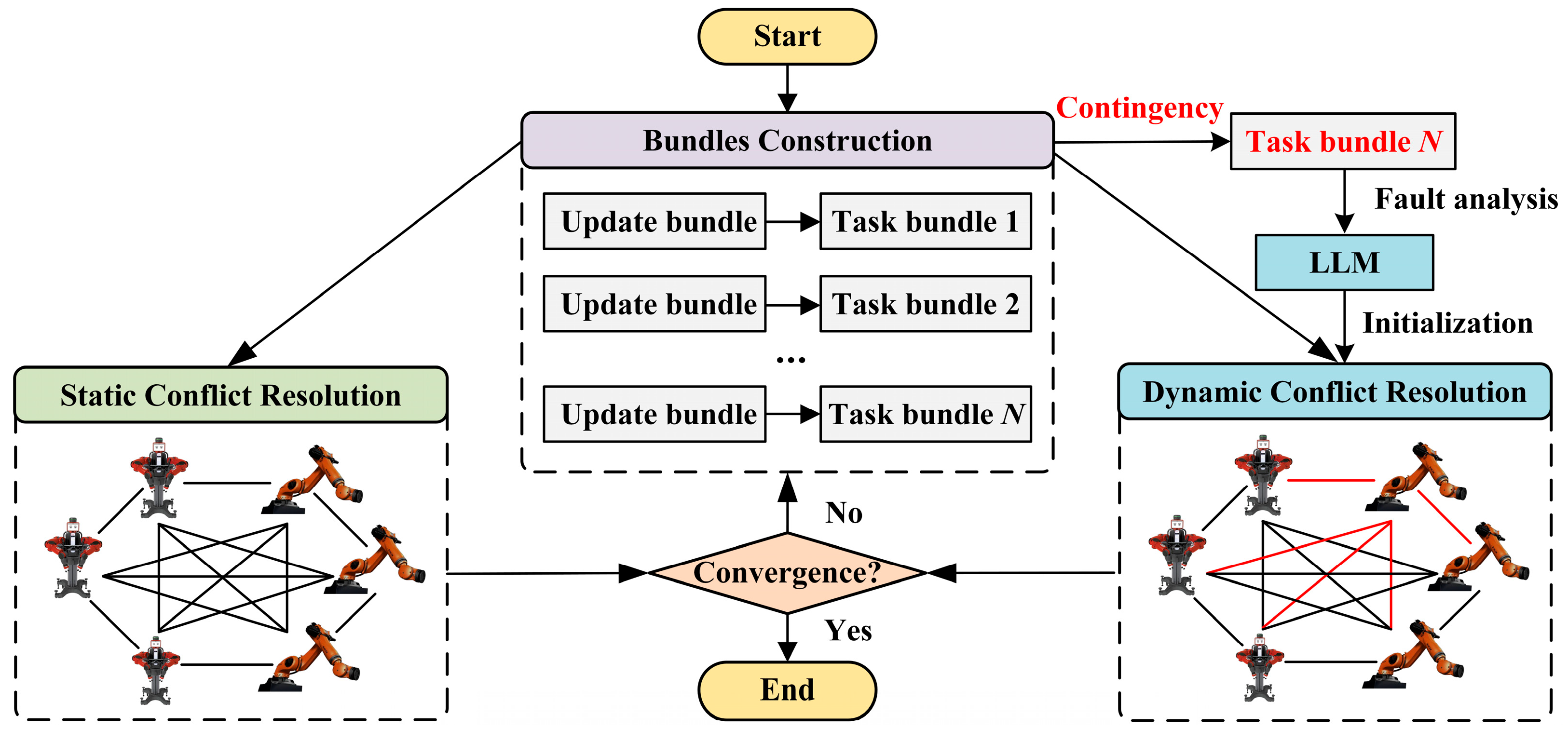
- Multi-robot allocation mechanisms for static and dynamic scenarios. Addressing the coexistence of static and dynamic characteristics in MRTA for space exploration [29], KG-CBBA improves the traditional CBBA framework by implementing both static and dynamic allocation methods. It addresses efficiency and distributed consistency challenges under dynamically arriving tasks, while optimizing utility and ensuring task feasibility during the initial allocation phase.
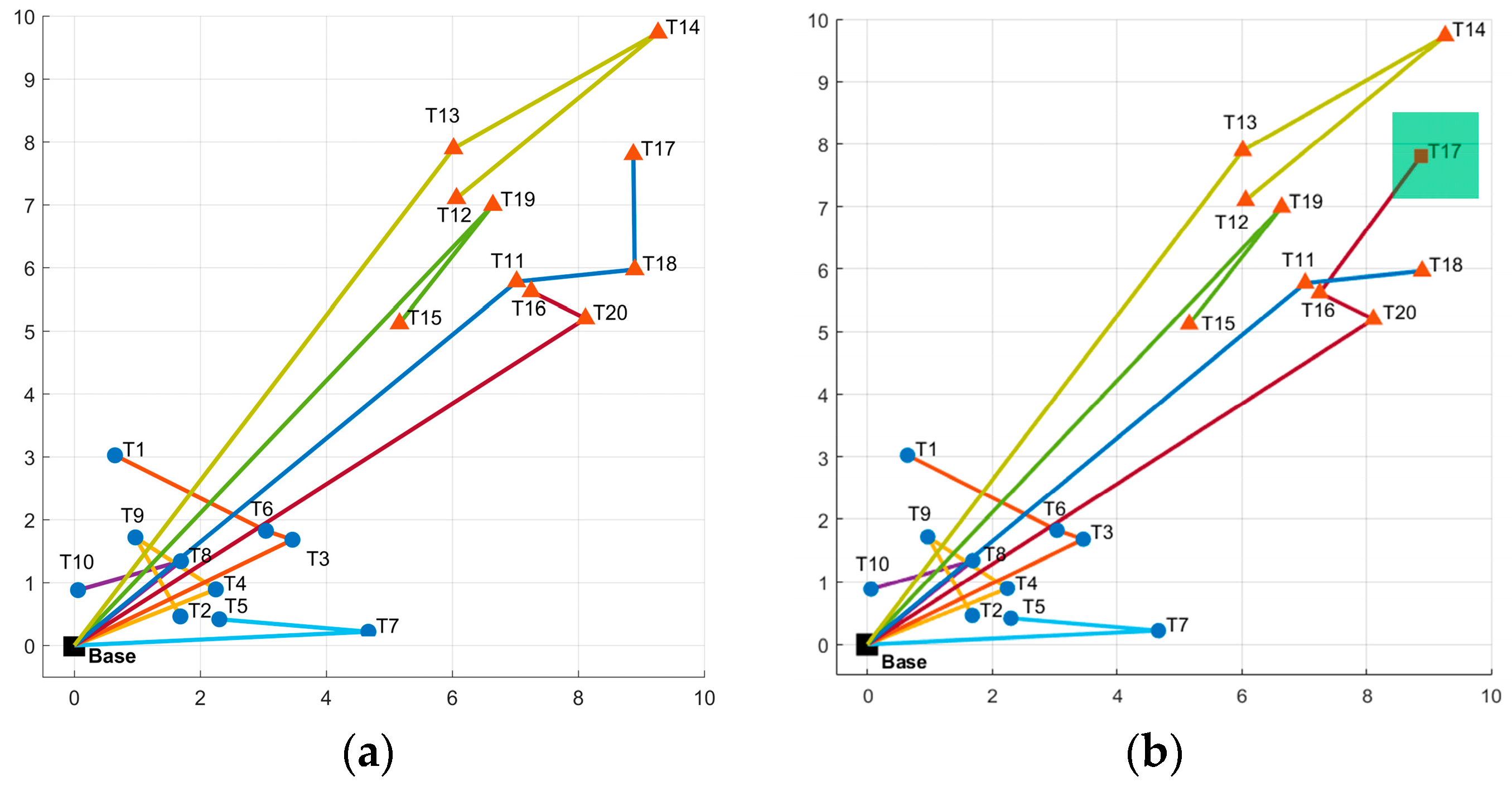
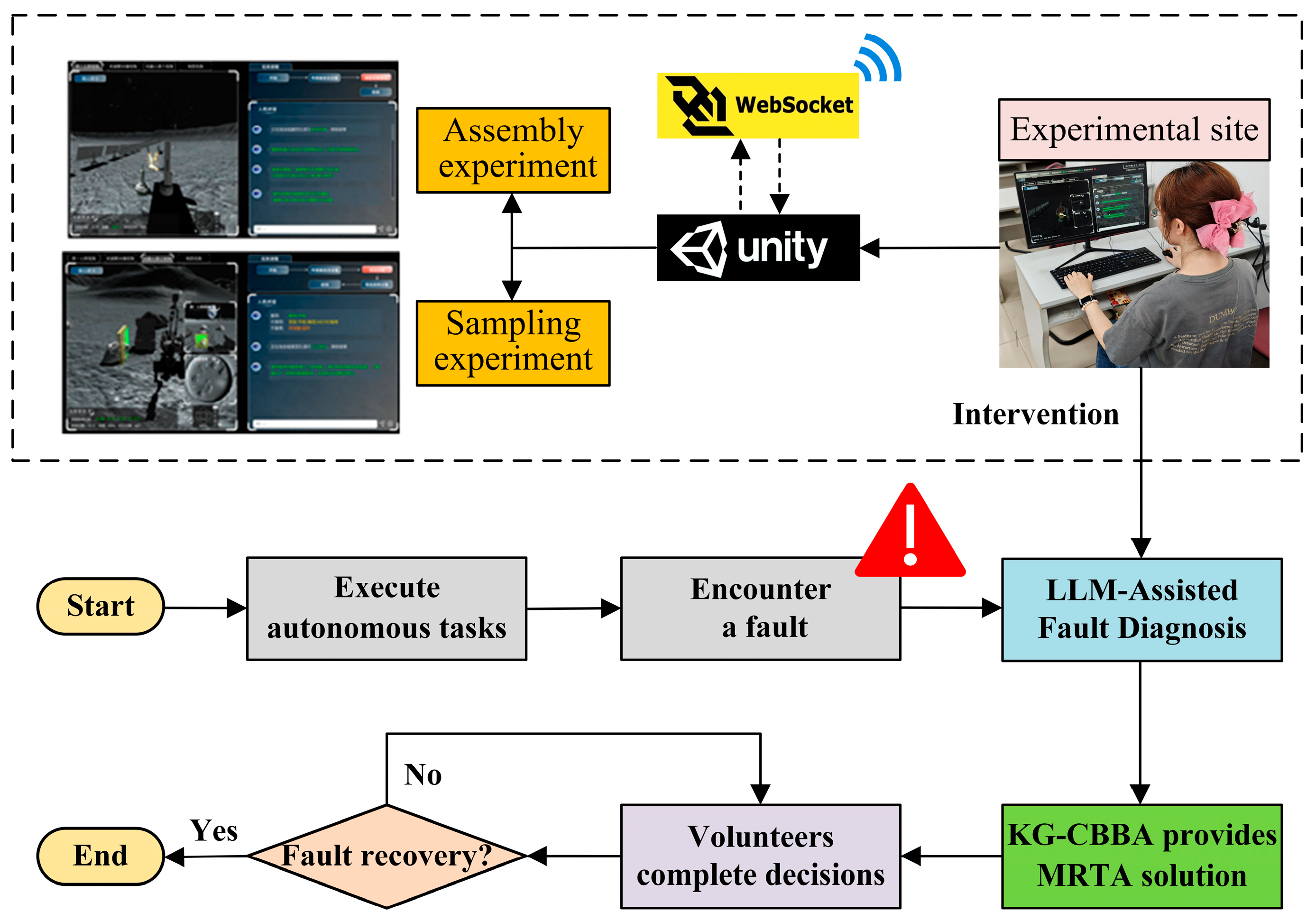
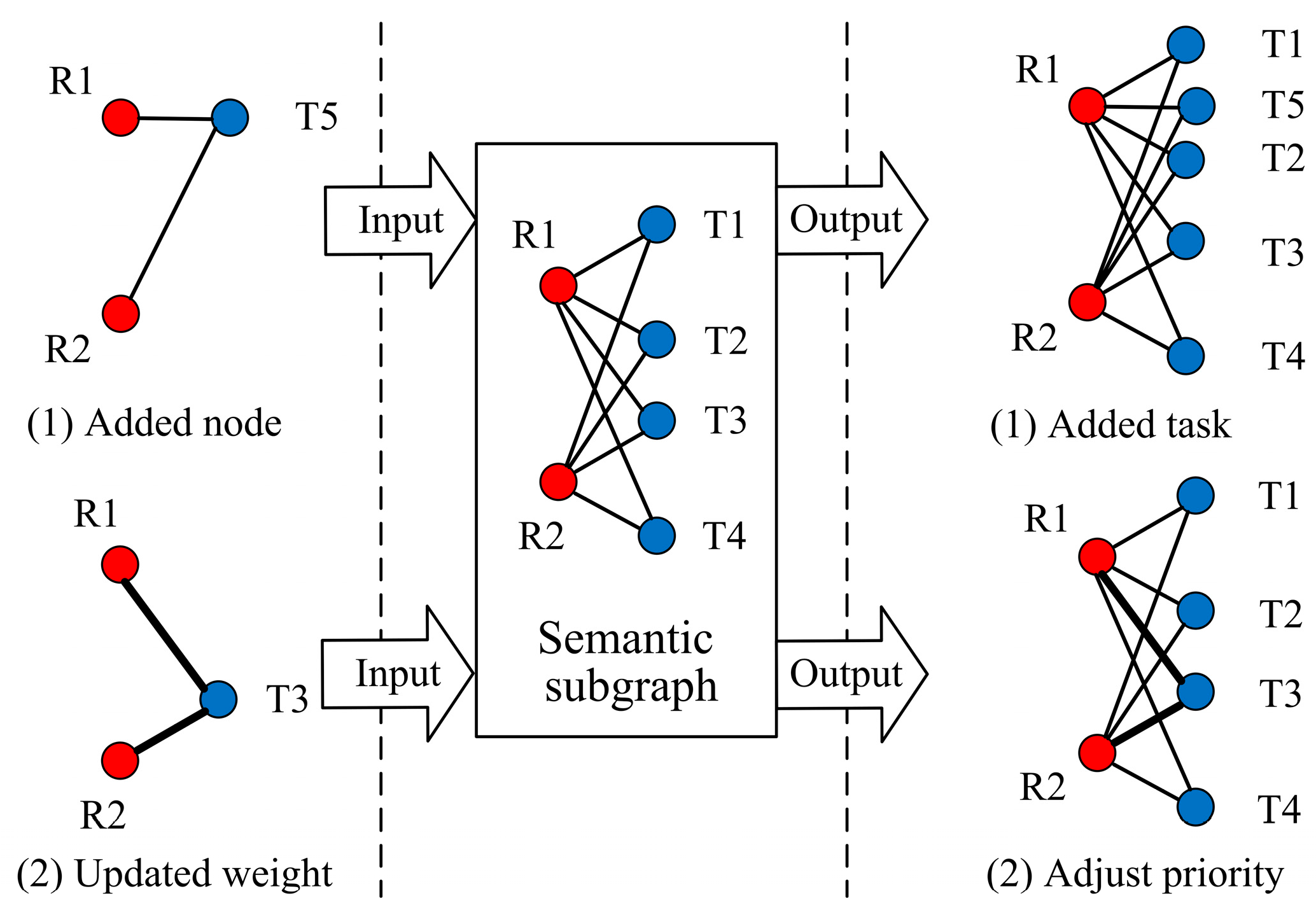
- Dynamic task integration for LLM-assisted fault analysis. In scenarios where LLMs assist astronauts in fault analysis, KG-CBBA transforms newly added or modified tasks into dynamic subgraph updates. Through incremental processing, the framework enables distributed bidding, allocation, and conflict resolution for these tasks, thereby facilitating multi-robot fault recovery driven by LLMs.
2. Problem Formulation
2.1. KG-Based Modeling Framework for Space Missions
- Discounted Value. This property represents the decreasing value of tasks over time, encouraging robots to execute tasks earlier to minimize delays.
- Spatial Distance. This property denotes the Euclidean distance between robot and task , forming the basis for subsequent calculations. A shorter distance reduces execution cost and increases execution efficiency.
- Travel Time. This property represents the time required for robot to reach task from its current position, converting spatial distance into a temporal cost to evaluate task feasibility.
- Time Urgency. This metric quantifies the urgency for robot to execute task , enabling prioritization of time-sensitive tasks and prevention of potential time-window violations.
- Value Density. This metric represents the value density of task relative to robot , measuring the task’s value per unit distance and supporting optimization of overall benefit.
- Fuel Cost. This metric represents the energy expenditure required for robot to execute task , quantifying resource consumption during task execution.
2.2. Task Allocation Objectives
3. Methodology of KG-CBBA
- Robot–task compatibility: robot and task types must match;
- Time window constraint: the robot’s arrival time satisfies ;
- Path feasibility constraint: the robot’s trajectory must be feasible;
- Exclusive task assignment: each task can be executed by at most one robot.
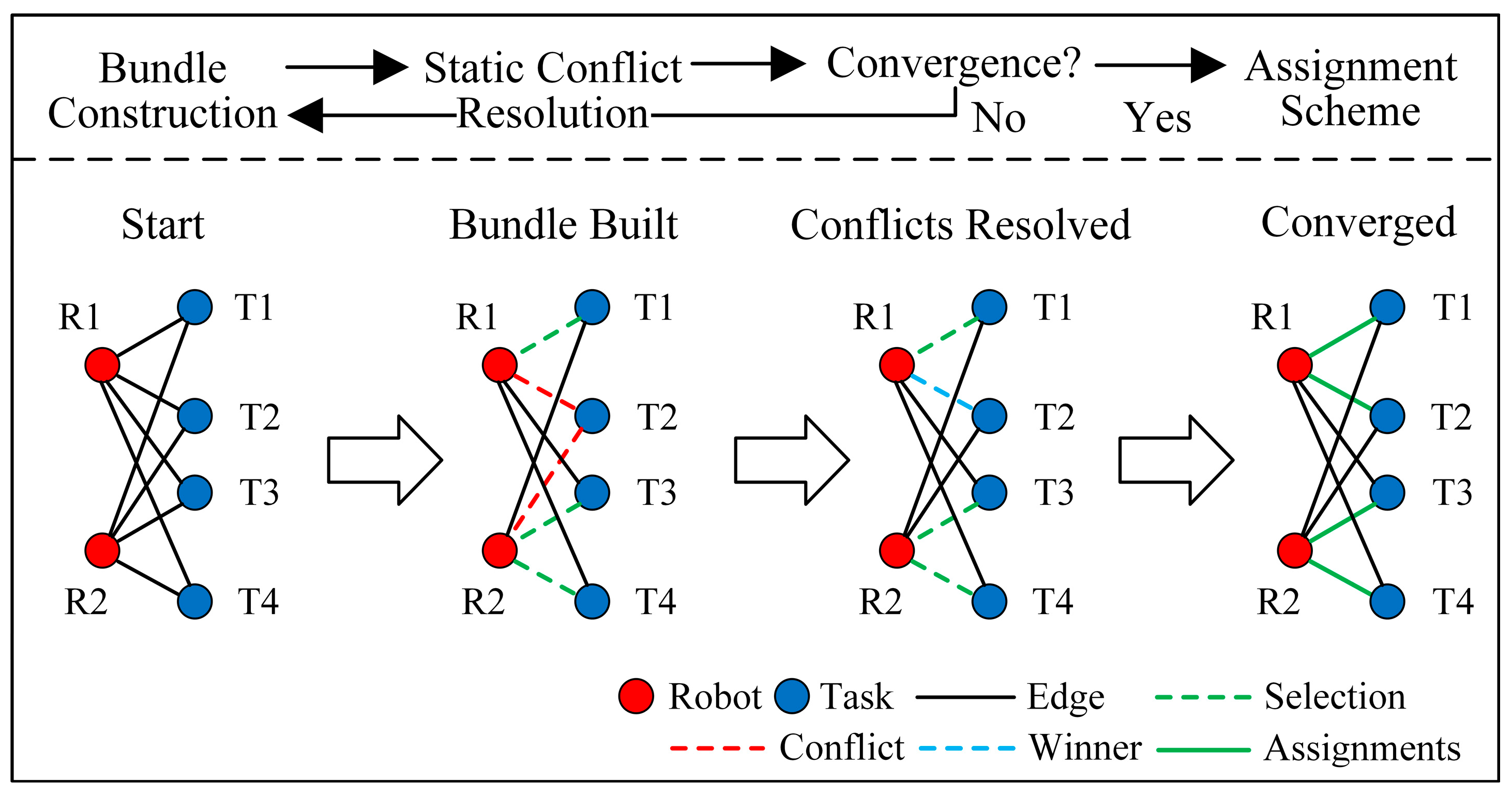
3.1. MRTA Static Task Allocation
| Algorithm 1: KG-CBBA static task allocation |
| Input: The set of robot nodes and the set of task nodes . Output: Static assignment scheme . |
| 1. Initialization: Set KG-CBBA parameters and the communication graph . Initialize data structures for each robot , including the task bundle , execution path , bid value , and winner . Set the global iteration counter . |
| 2. Semantic Graph Construction: Construct the graph . Establish edges between robot nodes and compatible task nodes . For each robot node , construct a subgraph containing all compatible task nodes and edges. 3. Iteration: If convergence has not been reached: 4. Communication Phase: Each robot exchanges its subgraph with adjacent robots according to the communication topology. Update and via the consensus mechanism, and update the distributed timestamp matrix . 5. Graph Synchronization: If , perform graph synchronization across all robot nodes. 6. Task-Bundle Construction: For each robot : 7. Task Removal: Remove tasks from that have been outbid based on . 8. Task Addition: If is not full: 9. Bid Calculation: For each unassigned task , compute the semantic utility and determine the optimal insertion position within . 10. Task Selection: Choose the task with the highest bid value from , provided that exceeds s current bid or satisfies the tie-breaking rule. |
| 11. Update Task Bundle: Insert into at the optimal position in , and update , and . 12. Convergence Check: If no new bids are submitted for consecutive iterations, set the convergence flag; else . 13. Result Mapping: Convert task indices in and for each robot to task IDs. 14. Return: |
3.2. MRTA Dynamic Task Allocation
| Algorithm 2: KG-CBBA dynamic task allocation |
| Input: The set of robot nodes , the set of task nodes , static assignment scheme , the set of new task nodes . Output: Dynamic assignment scheme . |
| 1. Initialization: Set KG-CBBA parameters and the communication graph . Initialize data structures for each robot , including the task bundle , execution path , bid value , and winner . Set the global iteration counter . |
| 2. Semantic Graph Construction: Construct the graph . Establish edges between robot nodes and compatible task nodes . For each robot node , construct a subgraph containing all compatible task nodes and edges. 3. Preserve Initial Assignments: Map task IDs in and from the static assignment scheme to task indices. Update to include static assignment details and construct a tag array to mark initial tasks. 4. Prepare New Tasks: Initialize to unassigned state and clear bids for static tasks. 5. Initialize Iteration Structures: Set global iteration counter and initialize the distributed timestamp matrix . 6. Iteration: If convergence has not been reached: 7. Communication Phase: Each robot exchanges its subgraph with adjacent robots according to the communication topology. Update and via the consensus mechanism, and update the distributed timestamp matrix . 8. Graph Synchronization: If , perform graph synchronization across all robot nodes. |
| 9. New Task-Bundle Construction: For each robot : 10. Task Removal: Remove newly assigned tasks from that have been outbid based on . |
| 11. Task Addition: If is not full: 12. Bid Calculation: For each unassigned task , compute the semantic utility and determine the optimal insertion position within 13. Bid Filtering: Set to prevent bidding on initial tasks. 14. Task Selection: Choose the task with the highest bid , provided that exceeds ’s current bid or satisfies tie-breaking conditions. 15. Update Task Bundle: Insert into at the optimal position in , and update , and, . 16. Convergence Check: If no new bids exist for new tasks, set the convergence flag; else . 17. Result Mapping: Convert task indices in and for each robot to task IDs. 18. Return: |
4. Numerical Simulations and User Study
4.1. Experimental Setup
4.2. Feasibility Experiment
4.2.1. Task Adjustment Experiment
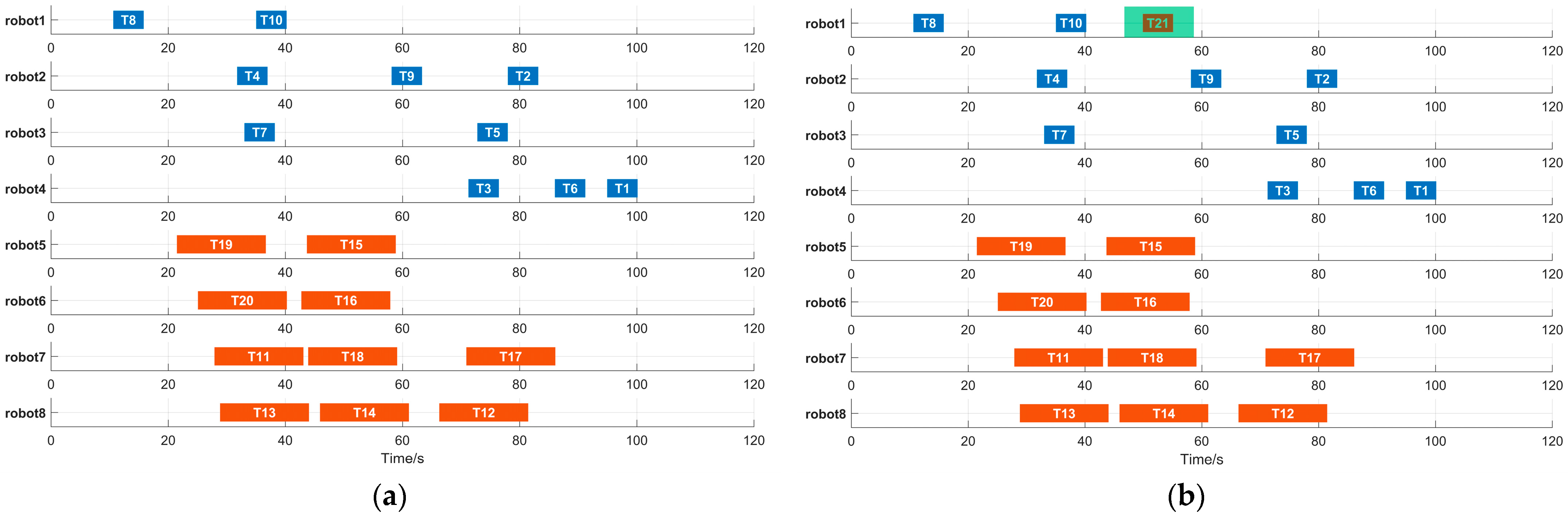
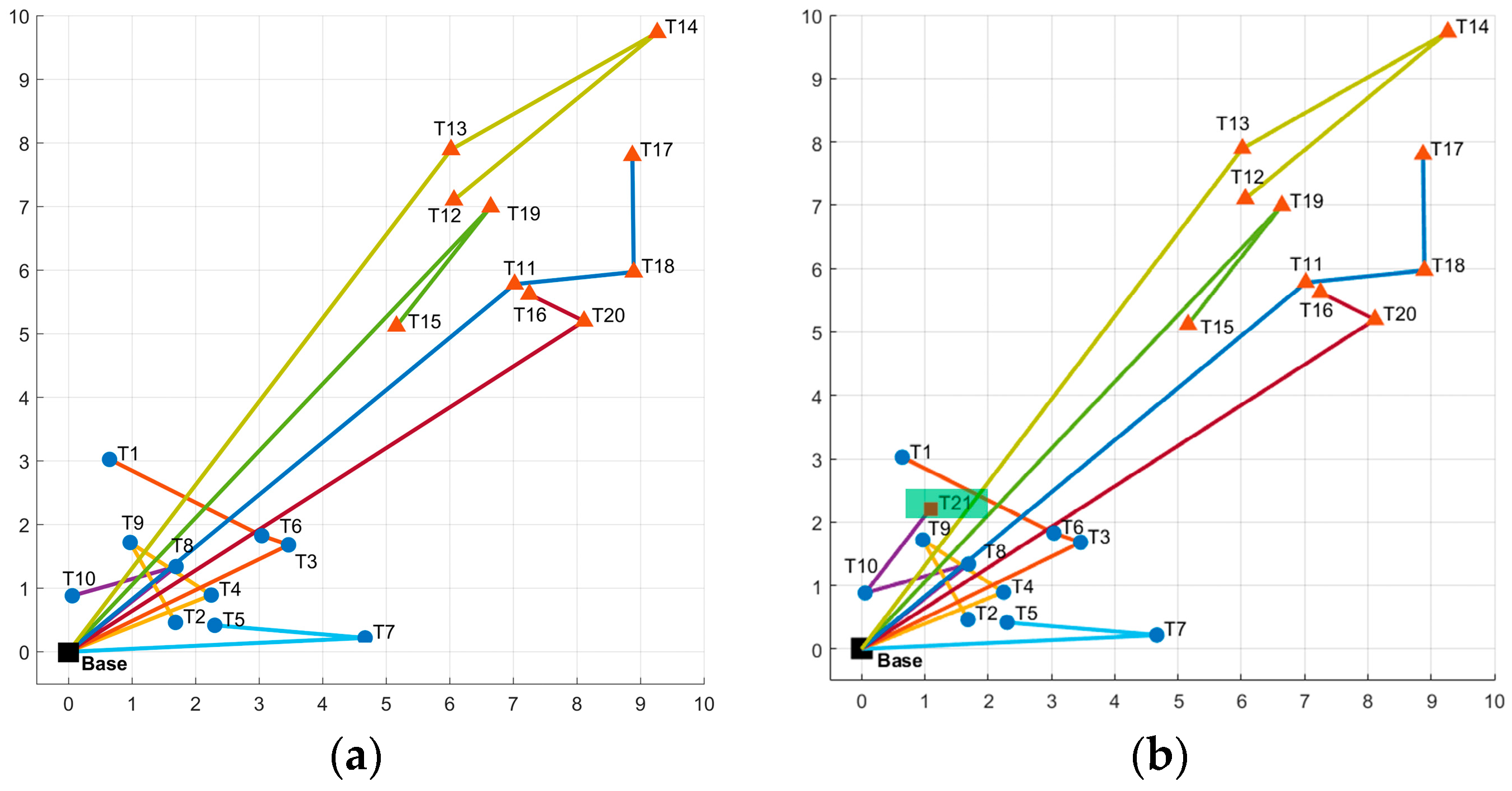
4.2.2. Task Addition Experiment
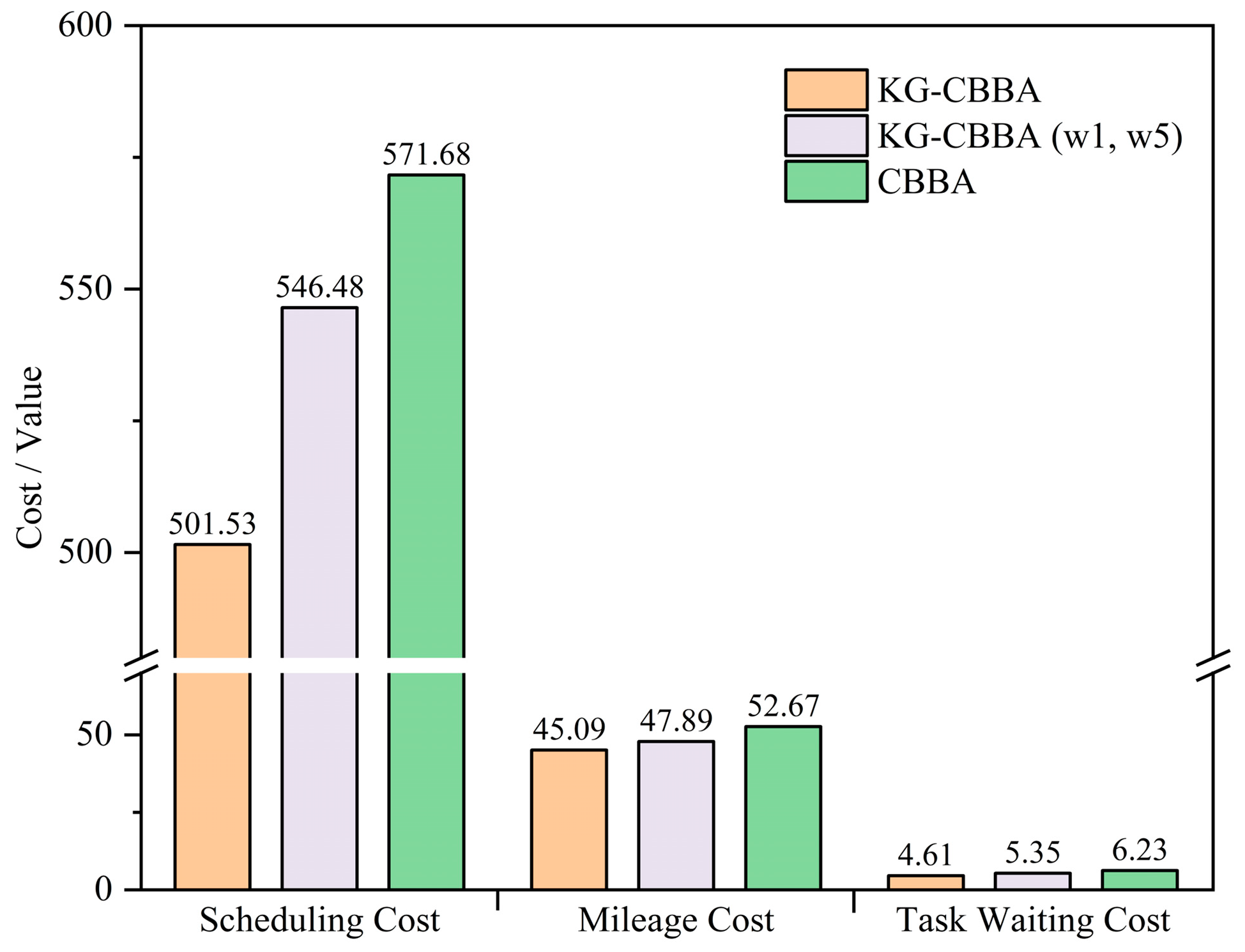
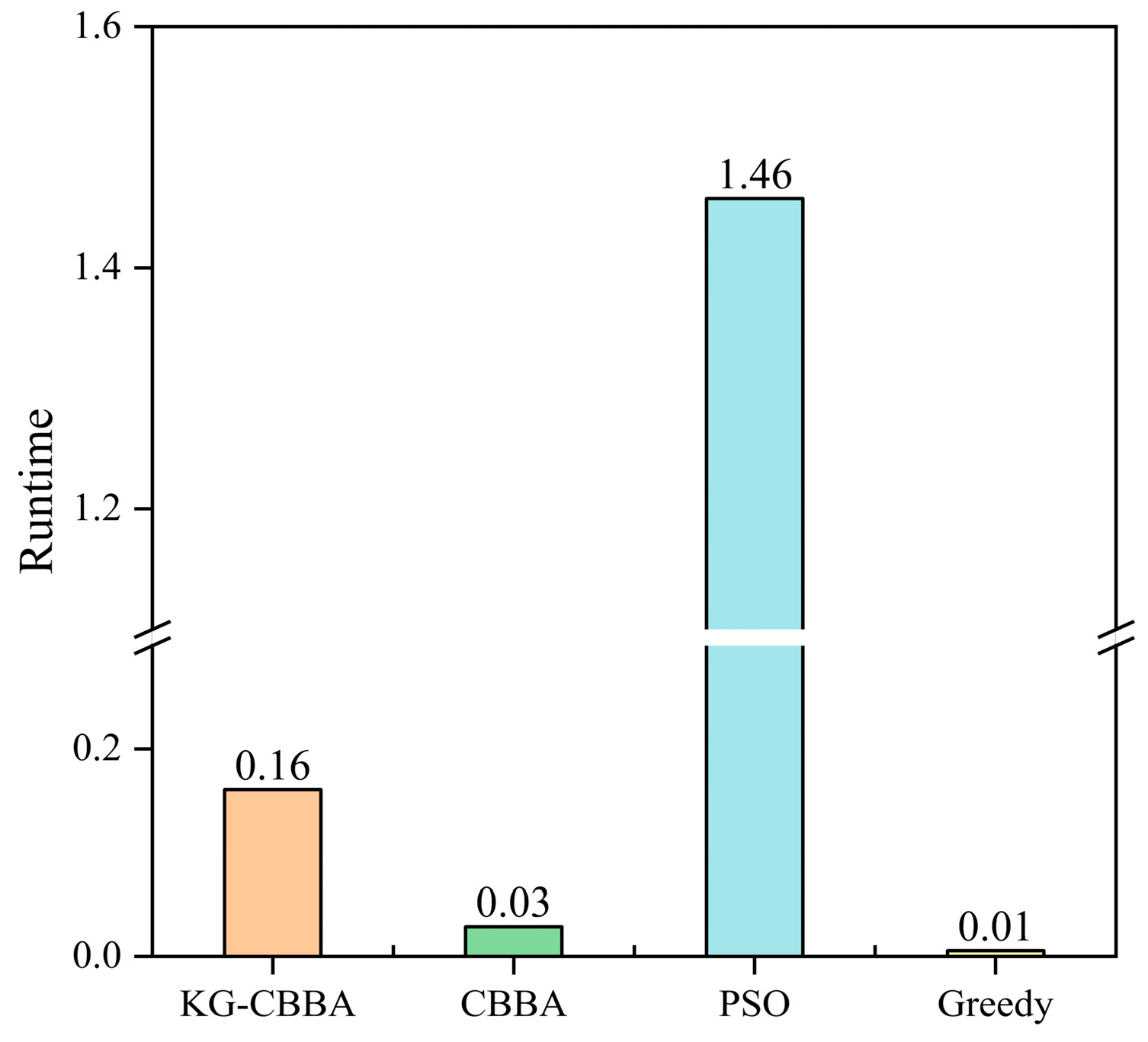
4.3. Performance Experiment
4.4. User Study
5. Conclusions
Author Contributions
Funding
Institutional Review Board Statement
Informed Consent Statement
Data Availability Statement
Conflicts of Interest
Abbreviations
| MRTA | Multi-robot task allocation |
| KG-CBBA | Knowledge Graph-guided Consensus-Based Bundle Algorithm |
| LLM | Large language model |
| KG | Knowledge graph |
| CBBA | Consensus-based bundle algorithm |
| PSO | Particle swarm optimization |
| GWO | Gray wolf optimizer |
| UAV | Unmanned aerial vehicle |
| CBR | Case-based reasoning |
| HIR | Highly illuminated region |
| PSR | Permanently shadowed region |
References
- Wang, C.; Jia, Y.Z.; Xue, C.B.; Lin, Y.T.; Liu, J.Z.; Fu, X.H.; Xu, L.; Huang, Y.; Zhao, Y.F.; Xu, Y.G.; et al. Scientific objectives and payload configuration of the Chang’E-7 mission. Natl. Sci. Rev. 2024, 11, nwad329. [Google Scholar] [CrossRef]
- Wang, B.; Xu, R.; Yu, D.Y.; Li, Z.Y.; Lu, S.Y. A mark-based hierarchical asynchronous temporal constraints reasoning algorithm for multi-agent mission planning. Expert Syst. Appl. 2024, 249, 123624. [Google Scholar] [CrossRef]
- Ali, Z.A.; Alkhammash, E.H.; Hasan, R. State-of-the-Art Flocking Strategies for the Collective Motion of Multi-Robots. Machines 2024, 12, 739. [Google Scholar] [CrossRef]
- Dominguez, R.; Pérez-del-Pulgar, C.; Paz-Delgado, G.J.; Polisano, F.; Babel, J.; Germa, T.; Dragomir, I.; Ciarletti, V.; Berthet, A.C.; Danter, L.C.; et al. Cooperative robotic exploration of a planetary skylight surface and lava cave. Sci. Robot. 2025, 10, eadj9699. [Google Scholar] [CrossRef]
- Chu, J.; Zhang, S.X.; Yue, Q.; Huang, Y.; Du, Y.L.; Huangfu, X.K. A collaborative path planning approach for multiple robots persistently building a lunar base. Acta Astronaut. 2025, 229, 874–884. [Google Scholar] [CrossRef]
- Nayak, S.; Lim, G.; Rossi, F.; Otte, M.; de la Croix, J.P. Multi-robot exploration for the CADRE mission. Auton. Robot. 2025, 49, 17. [Google Scholar] [CrossRef]
- Caluk, N.; Azizinamini, A. Introduction to the concept of modular blocks for lunar infrastructure. Acta Astronaut. 2023, 207, 153–166. [Google Scholar] [CrossRef]
- Ding, L.; Zhou, R.; Yuan, Y.; Yang, H.; Li, J.; Yu, T.; Liu, C.; Wang, J.; Li, S.; Gao, H.; et al. A 2-year locomotive exploration and scientific investigation of the lunar farside by the Yutu-2 rover. Sci. Robot. 2022, 7, eabj6660. [Google Scholar] [CrossRef]
- Park, B.J.; Chung, H.J. Deep Reinforcement Learning-Based Failure-Safe Motion Planning for a 4-Wheeled 2-Steering Lunar Rover. Aerospace 2023, 10, 219. [Google Scholar] [CrossRef]
- Kalempa, V.C.; Piardi, L.; Limeira, M.; de Oliveira, A.S. Multi-Robot Task Scheduling for Consensus-Based Fault-Resilient Intelligent Behavior in Smart Factories. Machines 2023, 11, 431. [Google Scholar] [CrossRef]
- Li, Y.X.; Wang, Q.Z.; Li, X.Y.; Gao, L.; Fu, L.; Yu, Y.B.; Zhou, W. Real-Time Scheduling for Flexible Job Shop With AGVs Using Multiagent Reinforcement Learning and Efficient Action Decoding. IEEE Trans. Syst. Man Cybern.-Syst. 2025, 55, 2120–2132. [Google Scholar] [CrossRef]
- Chen, X.C.; Lu, X.Y.; Li, Q.; Li, D.Z.; Zhu, F. Integration of LLM and Human-AI Coordination for Power Dispatching With Connected Electric Vehicles Under SAGVNs. IEEE Trans. Veh. Technol. 2025, 74, 1992–2002. [Google Scholar] [CrossRef]
- Al-Hussaini, S.; Gregory, J.M.; Gupta, S.K. Generating Task Reallocation Suggestions to Handle Contingencies in Human-Supervised Multi-Robot Missions. IEEE Trans. Autom. Sci. Eng. 2024, 21, 367–381. [Google Scholar] [CrossRef]
- Wang, H.; Xue, S.Q.; Zhang, H.B.; Wang, C.H.; Fu, Y. A Human-Robot Team Knowledge-Enhanced Large Language Model for Fault Analysis in Lunar Surface Exploration. Aerospace 2025, 12, 325. [Google Scholar] [CrossRef]
- Zhao, D.H.; Yang, C.H.; Zhang, T.Q.; Yang, J.Y.; Hiroshi, Y. A Task Allocation Approach of Multi-Heterogeneous Robot System for Elderly Care. Machines 2022, 10, 622. [Google Scholar] [CrossRef]
- Bai, J.Y.; Wang, X.B. Distributed-Optimization With Centralized-Refining for Efficient Resource Allocation in Future Wireless Networks. IEEE Trans. Commun. 2024, 72, 4829–4843. [Google Scholar] [CrossRef]
- Zeng, L.C.; Qin, P.F.; Zhou, Y.J.; Liu, H.L.; Cai, Y.X. A Heterogeneous Multi-Satellite Dynamic Mission Planning Method Based on Metaheuristic Algorithms. Electronics 2024, 13, 4353. [Google Scholar] [CrossRef]
- Tang, J.; Chen, X.; Zhu, X.M.; Zhu, F. Dynamic Reallocation Model of Multiple Unmanned Aerial Vehicle Tasks in Emergent Adjustment Scenarios. IEEE Trans. Aerosp. Electron. Syst. 2023, 59, 1139–1155. [Google Scholar] [CrossRef]
- Liao, B.; Wan, F.Y.; Hua, Y.; Zhu, S.R.; Ma, T.; Qing, X.L. BDBM: A distributed network simplification method for solving task allocation problems. Expert Syst. Appl. 2024, 246, 123170. [Google Scholar] [CrossRef]
- Wang, Y.C.; Wang, C.J.; Ren, S.Y. A Two-Level Clustered Consensus-Based Bundle Algorithm for Dynamic Heterogeneous Multi-UAV Multi-Task Allocation. Sensors 2025, 25, 6738. [Google Scholar] [CrossRef] [PubMed]
- Cao, Y.; Long, T.; Sun, J.L.; Wang, Z.; Xu, G.T. Comparison of Distributed Task Allocation Algorithms Considering Non-Ideal Communication Factors for Multi-UAV Collaborative Visit Missions. IEEE Robot. Autom. Lett. 2025, 10, 1928–1935. [Google Scholar] [CrossRef]
- Bi, W.H.; Shen, J.Y.; Zhou, J.L.; Zhang, A. Heterogeneous Multi-UAV Mission Reallocation Based on Improved Consensus-Based Bundle Algorithm. Drones 2024, 8, 345. [Google Scholar] [CrossRef]
- Zhang, Y.C.; Xu, W.; Ye, H.L.; Shi, Z.Y. A Two-Stage Optimization Framework for UAV Fleet Sizing and Task Allocation in Emergency Logistics Using the GWO and CBBA. Drones 2025, 9, 501. [Google Scholar] [CrossRef]
- Ulierte, T.A.; Kuladinithi, K.; Timm-Giel, A.; Flentge, F. Enabling Traffic Prioritization for Space Communications Over DTNs. IEEE J. Radio Freq. Identif. 2024, 8, 748–760. [Google Scholar] [CrossRef]
- Charvat, J.M.; Leonard, D.; Barlow, C.E.; DeFina, L.F.; Willis, B.L.; Lee, S.M.C.; Stenger, M.B.; Mercaldo, S.F.; Van Baalen, M. Long-term Cardiovascular Risk in Astronauts: Comparing NASA Mission Astronauts With a Healthy Cohort From the Cooper Center Longitudinal Study. Mayo Clin. Proc. 2022, 97, 1237–1246. [Google Scholar] [CrossRef]
- Yu, W.G.; Lv, J.H.; Zhuang, W.B.; Pan, X.Y.; Wen, S.J.; Bao, J.S.; Li, X.Y. Rescheduling human-robot collaboration tasks under dynamic disassembly scenarios: An MLLM-KG collaboratively enabled approach. J. Manuf. Syst. 2025, 80, 20–37. [Google Scholar] [CrossRef]
- Nasar, W.; Gundersen, O.E.; Torres, R.D.; Karlsen, A. Knowledge Graphs to Accumulate and Convey Knowledge from Past Experiences in Search and Rescue Planning and Resource Allocation. Appl. Artif. Intell. 2024, 38, 2434296. [Google Scholar] [CrossRef]
- Lee, H.Y.; Zhou, P.; Zhang, B.; Qiu, L.M.; Fan, B.W.; Duan, A.Q.; Tang, J.T.; Lam, T.L.; Navarro-Alarcon, D. A Distributed Dynamic Framework to Allocate Collaborative Tasks Based on Capability Matching in Heterogeneous Multirobot Systems. IEEE Trans. Cogn. Dev. Syst. 2024, 16, 251–265. [Google Scholar] [CrossRef]
- Athira, K.A.; Udayan, J.D.; Subramaniam, U. A Systematic Literature Review on Multi-Robot Task Allocation. ACM Comput. Surv. 2025, 57, 1–28. [Google Scholar] [CrossRef]
- Ross, A.K.; Ruppert, S.; Gläser, P.; Elvis, M. Preliminary quantification of the available solar power near the lunar South Pole. Acta Astronaut. 2023, 211, 616–630. [Google Scholar] [CrossRef]
- Zuber, M.T.; Head, J.W.; Smith, D.E.; Neumann, G.A.; Mazarico, E.; Torrence, M.H.; Aharonson, O.; Tye, A.R.; Fassett, C.I.; Rosenburg, M.A.; et al. Constraints on the volatile distribution within Shackleton crater at the lunar south pole. Nature 2012, 486, 378–381. [Google Scholar] [CrossRef]
- Greenwood, J.P.; Itoh, S.; Sakamoto, N.; Warren, P.; Taylor, L.; Yurimoto, H. Hydrogen isotope ratios in lunar rocks indicate delivery of cometary water to the Moon. Nat. Geosci. 2011, 4, 79–82. [Google Scholar] [CrossRef]
- Kawashima, O.; Morota, T.; Ohtake, M.; Kasahara, S. Size-frequency measurements of meter-sized craters and boulders in the lunar polar regions for landing-site selections of future lunar polar missions. Icarus 2022, 378, 114938. [Google Scholar] [CrossRef]
- Choi, H.L.; Brunet, L.; How, J.P. Consensus-Based Decentralized Auctions for Robust Task Allocation. IEEE Trans. Robot. 2009, 25, 912–926. [Google Scholar] [CrossRef]
- Yuan, Y.D.; Yang, P.; Jiang, H.B.; Shi, T.G. A Multi-Robot Task Allocation Method Based on the Synergy of the K-Means++ Algorithm and the Particle Swarm Algorithm. Biomimetics 2024, 9, 694. [Google Scholar] [CrossRef]
- Brohan, A.; Brown, N.; Carbajal, J.; Chebotar, Y.; Chen, X.; Choromanski, K.; Ding, T.L.; Driess, D.; Dubey, A.; Finn, C.; et al. RT-2: Vision-Language-ActionModels Transfer Web Knowledge to Robotic Control. In Proceedings of the 7th Conference on Robot Learning (CoRL), Atlanta, GA, USA, 6–9 November 2023. [Google Scholar]
- Li, S.Q.; Wang, J.F.; Rong, J. Design-Oriented product fault knowledge graph with frequency weight based on maintenance text. Adv. Eng. Inform. 2023, 58, 102229. [Google Scholar] [CrossRef]







| Type | Assembly Task | Sampling Task |
|---|---|---|
| Task Numbers | ||
| Task Value | 100 | 100 |
| Time Window | 120 s | 120 s |
| Duration | 5 s | 15 s |
| Discount Factor | 0.1 | 0.1 |
| Type | Value |
|---|---|
| Discounted Value | 1.0 |
| Space Distance | 0.1 |
| Travel Time | 0.1 |
| Time Urgency | 0.1 |
| Value Density | 1.0 |
| Fuel Cost | 0.05 |
Disclaimer/Publisher’s Note: The statements, opinions and data contained in all publications are solely those of the individual author(s) and contributor(s) and not of MDPI and/or the editor(s). MDPI and/or the editor(s) disclaim responsibility for any injury to people or property resulting from any ideas, methods, instructions or products referred to in the content. |
© 2026 by the authors. Licensee MDPI, Basel, Switzerland. This article is an open access article distributed under the terms and conditions of the Creative Commons Attribution (CC BY) license.
Share and Cite
Wang, H.; Xue, S.; Zhang, H.; Tan, L.; Wang, C.; Fu, Y. Dynamic Multi-Robot Task Allocation for Human-in-the-Loop Space Exploration: Knowledge Graph-Guided CBBA with LLM-Assisted Fault Analysis. Machines 2026, 14, 265. https://doi.org/10.3390/machines14030265
Wang H, Xue S, Zhang H, Tan L, Wang C, Fu Y. Dynamic Multi-Robot Task Allocation for Human-in-the-Loop Space Exploration: Knowledge Graph-Guided CBBA with LLM-Assisted Fault Analysis. Machines. 2026; 14(3):265. https://doi.org/10.3390/machines14030265
Chicago/Turabian StyleWang, Hao, Shuqi Xue, Hongbo Zhang, Lifen Tan, Chunhui Wang, and Yan Fu. 2026. "Dynamic Multi-Robot Task Allocation for Human-in-the-Loop Space Exploration: Knowledge Graph-Guided CBBA with LLM-Assisted Fault Analysis" Machines 14, no. 3: 265. https://doi.org/10.3390/machines14030265
APA StyleWang, H., Xue, S., Zhang, H., Tan, L., Wang, C., & Fu, Y. (2026). Dynamic Multi-Robot Task Allocation for Human-in-the-Loop Space Exploration: Knowledge Graph-Guided CBBA with LLM-Assisted Fault Analysis. Machines, 14(3), 265. https://doi.org/10.3390/machines14030265