1. Introduction
Manipulators are widely deployed in assembly, handling, and other operational scenarios, where trajectory planning critically influences efficiency, stability, and energy consumption [
1]. During container-handling operations, manipulators must rapidly complete part grasping and releasing within limited spaces, while avoiding excessive impact and controlling energy consumption to enhance operational economy. Thus, collaborative optimization of “efficiency–stability–energy consumption” has become the core requirement of trajectory planning in this scenario.
Current domestic and international scholars have conducted extensive research on manipulator trajectory planning. Ekrem et al. [
2,
3,
4,
5,
6,
7,
8,
9,
10,
11,
12,
13,
14,
15] focus on a time-optimal objective, achieving trajectory optimization by combining polynomial interpolation with intelligent algorithms such as PSO and improved cuckoo search. Garriz et al. [
16,
17] focus on energy optimization and proposed a polynomial interpolation trajectory-planning method for energy optimization. Jin et al. [
18,
19] combined chaotic PSO with spline curves to achieve time-optimal trajectory planning. Wu et al. [
20] studied the trajectory planning for the jerk minimization problem. Wang et al. [
21,
22,
23,
24] employed a hybrid optimization algorithm combined with spline curve interpolation to solve the time–jerk optimization problem. Patle et al. [
25,
26] proposed an S-curve–PSO method for time-optimal solutions. Ma et al. [
27,
28] respectively utilized convex optimization (CO) methods and point-to-point trajectory-planning algorithms (PTPAs) to address time-optimal problems. The existing research has obvious defects: the single-objective optimization neglects the synergy of multiple metrics, and the dual-objective optimization lacks the consideration of the energy consumption dimension. The multi-objective optimization method faces the problem of high computational complexity and poor real-time performance. It is difficult to balance the time, jerk, and energy consumption in the container material-handling scenario. Therefore, it is necessary to find a trajectory-planning method that can make the manipulator more stable, more continuous, and easier to implement in the process of motion.
Aiming at the core problem that efficiency, smoothness, and energy consumption are difficult to coordinate in the trajectory planning of a container-handling robot. This paper employs a 3-5-3 hybrid polynomial interpolation method to balance trajectory smoothness and computational efficiency, and designs an improved particle swarm optimization (IPSO) algorithm with dynamic parameter adjustment. A multi-objective trajectory optimization scheme is proposed to solve the multi-objective optimization problem of time–jerk–energy consumption. Finally, through simulation in Matlab and Adams, the performance of the four strategies of unoptimized, time optimization, time–jerk optimization, and time–jerk–energy optimization is compared, and the effectiveness of the method is verified by physical experiments.
2. Analysis of the Material-Handling Process for the Container
2.1. Working Condition
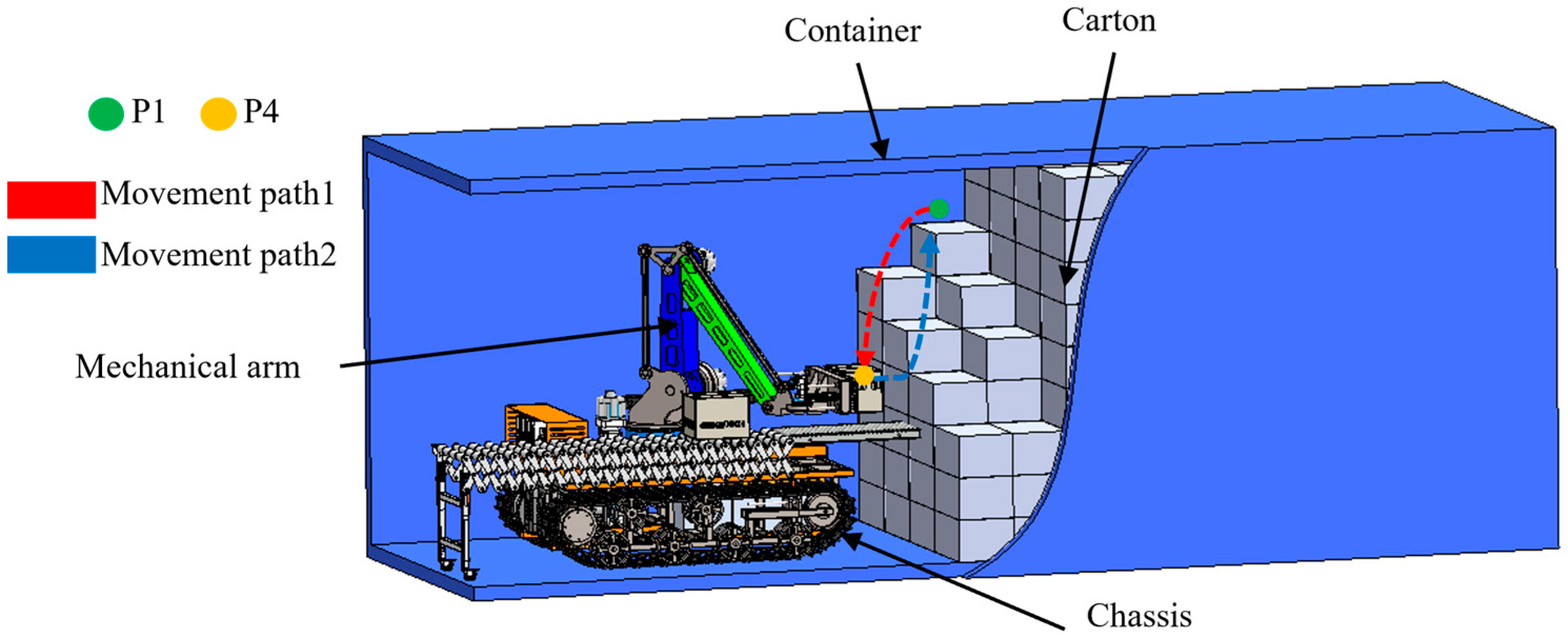
Current container-handling operations face many problems: manual operation efficiency significantly declines over time, high-temperature and high-humidity environments pose health risks to workers, and heavy-load handling involves safety hazards. Additionally, manual handling operations have extended cycle times and relatively low space utilization, which make it difficult to meet the needs of large-scale operations. To address these issues, this paper carries out the container-handling operation based on the designed manipulator. The operation process is illustrated in
Figure 1: the end-effector grasps the part from the starting point P
1 and moves through via points P
2 and P
3 to release the part at endpoint P
4, completing the entire handling process.
2.2. Kinematic Calculation
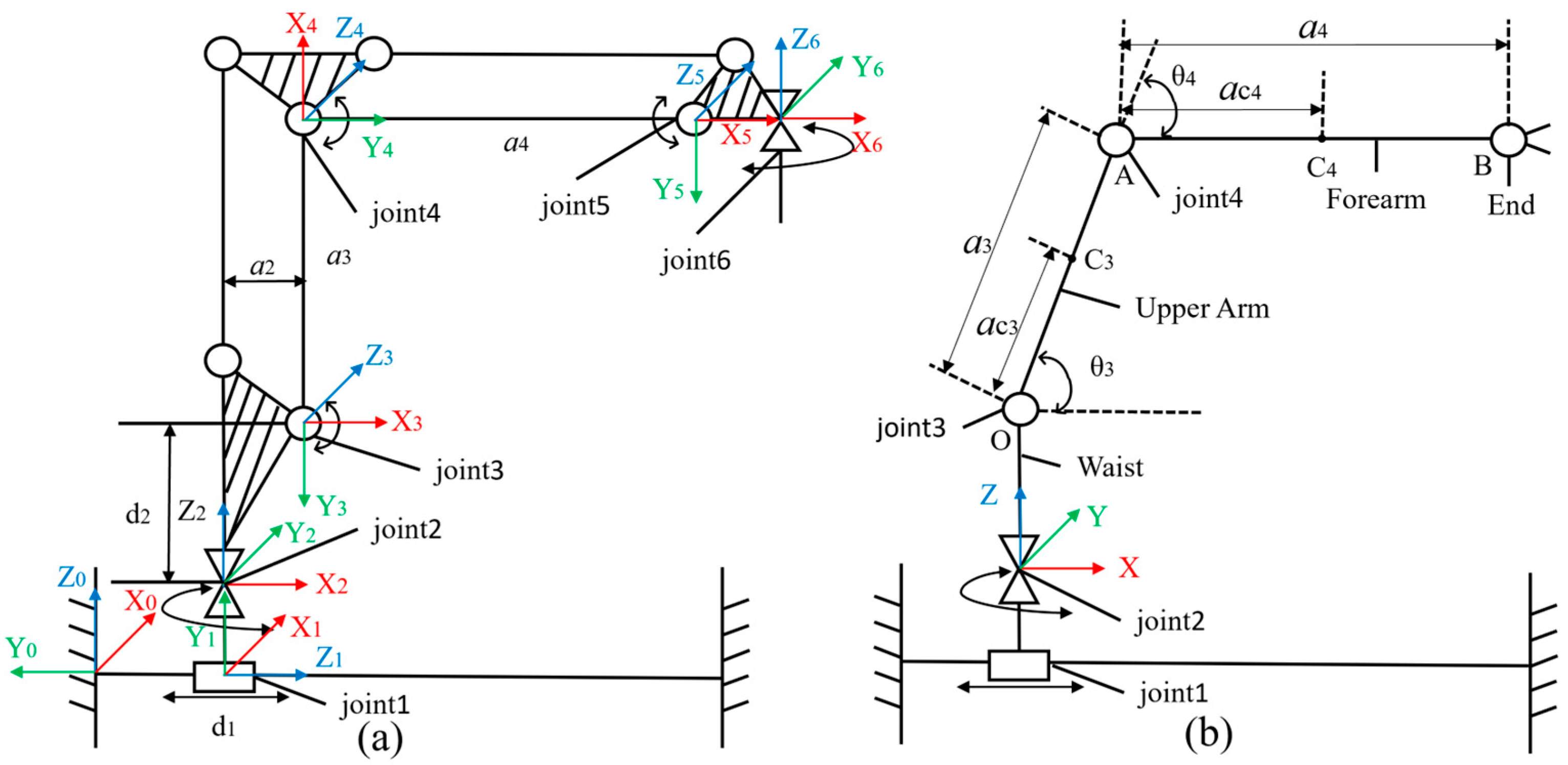
To meet containerized handling requirements, the manipulator consists of one prismatic joint, five revolute joints, and an end-effector. By adding parallel linkages between serial linkages, two parallelogram mechanisms are formed. This design associated the angular change in joint 5 with joints 3 and 4, thereby reducing the mechanism’s degrees of freedom. An improved D-H parameter method was employed to establish the robot link coordinate system shown in
Figure 2a. The specific parameters of the joint rotation angle
θi, the link twist angle α
i−1, the link length
ai−1, the joint displacement
di and the initial joint angle (the initial pose compensation angle of the end-effector) offset are shown in
Table 1 (Joint 1 is the prismatic joint, all others are revolute joints).
Transformation relationships between adjacent linkage coordinate systems are derived through matrix operations [
29], as shown in Equation (1). Multiplying homogeneous transformation matrices of adjacent links yields the homogeneous transformation matrix of the end-effector coordinate system relative to the base coordinate system [
30], as shown in Equation (2).
Through inverse kinematics calculations, the joint angles corresponding to the four interpolation points are obtained, as shown in
Table 2, providing foundational data for subsequent trajectory planning.
2.3. Dynamic Calculation
The dynamic model is constructed based on the Lagrange method, assuming rigid connections between linkages, neglecting friction, and simplifying the load. The expressions of joint torque are derived with the system energy relationship as the core [
31]. Defining the total kinetic energy
Ek of the system as the sum of the kinetic energy of all links and the total potential energy
Ep as the sum of the potential energies of all links, the Lagrange function
L =
Ek −
Ep. The calculation formula of the joint torque
T is shown in the Equation (3).
where θ represents the joint angle vector and
represents the joint angular velocity vector. The simplified dynamic model of the robot is shown in
Figure 2b. In the figure, O and A represent the rotation centers of the big arm and small arm of the robot,
a3 and
a4 represent the length of the big arm and small arm, c
3 and c
4 represent the centroids of the big arm and small arm,
ac3 and
ac4 represent the distances from c
3 and c
4 to the rotational centers O and A, and m
3 and m
4 represent the mass of the big arm and small arm, the end-effector and load mass are attributed to the end of the small arm (joint 5); its centroid is point B and mass is m
5. The specific parameters of the dynamic model measured in 3D modeling software are shown in
Table 3. To simplify calculations, joint 1 is only used to expand the workspace of the robot without considering its dynamic characteristics, and the coupling effect of the robot’s end attitude on the dynamics is not considered. The kinetic energy of each link is composed of translational kinetic energy and rotational kinetic energy, and the potential energy is determined by the gravitational potential energy. Combined with the parameters of the robot shown in
Table 1, the relationship between joint torque and the motion parameters is calculated as shown in Equation (4).
Through the above dynamic model, the mapping relationship between the joint torque and motion parameters can be precisely obtained, which provides a theoretical basis for the subsequent construction of the energy consumption objective function.
Table 3.
Kinematic model parameters.
Table 3.
Kinematic model parameters.
| | Mass/kg | Centroids/mm | Izz/kg·m2 | Iyy/kg·m2 |
|---|
| m3 | 73 | 732 | 6.09 | 6.15 |
| m4 | 52 | 748 | 7.25 | 7.28 |
| m5 | 124 | 1234 | 0 | 0 |
| md | 45 | 867 | 0 | 0 |
3. Hybrid Polynomial Trajectory Planning
Aiming at the “start–middle–end” three-stage movement characteristics of the handling operation, a 3-5-3 hybrid polynomial interpolation method is used. The start stage (P1-P2) and end stage (P3-P4) use cubic polynomials, and the middle stage (P2-P3) uses a quintic polynomial. Balance computational efficiency and movement stability, ensure smooth transition of trajectory, and reduce joint jerk.
Let
θ(t) denote the joint angle as a function of time
t. Each interpolation function for each segment is defined as shown in Equation (5).
where
aij denotes the polynomial coefficients, and
ti denotes the interpolation time of each segment. To ensure the trajectory is continuous and smooth, the following constraint in Equation (6) is imposed: both velocity and acceleration at the start and end points are 0, and the angle, velocity, and acceleration at the junction of adjacent segments are continuous [
10].
Based on these constraints, the polynomial coefficients are solved by matrix operation, yielding the trajectory functions for each joint.
4. Construction of Optimal Trajectory Objective Function
Under the constraint of satisfying the operational requirements of the manipulator, the initial trajectory planning is usually carried out first, and then the optimization algorithm is used to iteratively optimize the planned trajectory, so as to obtain the optimal trajectory. In this paper, the manipulator is taken as the research object, and the time, jerk, and energy consumption are set as the optimization objectives to construct the optimization objective function, as shown in Equation (7).
where
f1,
f2, and
f3 are the objective functions based on time, jerk, and energy consumption, respectively. The energy efficiency and endurance of material-handling equipment have strict requirements. The motor drive torque directly affects the energy consumption level; it is not only the critical parameter of motor selection, but also the direct mapping index of energy consumption. Therefore, the average drive torque is selected as the objective function of energy consumption, which not only reduces the computational complexity (without complex energy modeling) but also directly relates to the practical engineering requirements. Considering the physical limit and operational safety of the manipulator, the following constraints are shown in Equation (8).
where
T represents the joint torque of the manipulator,
represents the velocity of the joint,
represents the acceleration of the joint, and
represents the jerk of the joint.
Min–Max Normalization is applied to each objective function to eliminate dimensional effects, as shown in Equation (9).
where
is the normalized objective function value, and
fimin and
fimax are the minimum and maximum values of the
i-th objective function, respectively. Considering the requirements of container-handling operations, prioritizing efficiency while balancing stability and energy conservation, the weight coefficients are determined:
w1 = 0.4,
w2 = 0.3,
w3 = 0.3. The multi-objective optimization problem is transformed into a single-objective optimization model through a linear weighted combination, as shown in Equation (10).
5. Trajectory Optimization Based on an Improved Particle Swarm Algorithm
The above optimization problem exhibits characteristics of multiple constraints and high dimension, and the traditional optimization methods find it difficult to achieve efficient and accurate solutions. The particle swarm optimization (PSO) algorithm is suitable for such problems because of its simple structure and fast convergence speed. However, the standard algorithm has limitations, such as insufficient convergence accuracy, and needs to be improved.
5.1. Particle Swarm Optimization Algorithm
The PSO algorithm originates from simulating biological swarm foraging behavior. Each candidate solution is treated as a “particle” that dynamically adjusts its movement state by sharing swarm information [
32]. The core formula is shown in Equation (11):
where
vk represents particle velocity,
xk represents particle position,
w represents the inertia weight,
c1 and
c2 are learning factors,
r1 and
r2 are random numbers,
pbestk represents the individual optimal position, and
gbestk represents the global optimal position.
For the 3-5-3 hybrid polynomial trajectory planning problem, three interpolation time segments,
t1,
t2, and
t3, are selected as optimization variables, reducing the optimization dimension from 14 (polynomial coefficients) to 3, effectively lowering computational complexity [
10].
5.2. Improved Particle Swarm Optimization Algorithm (IPSO)
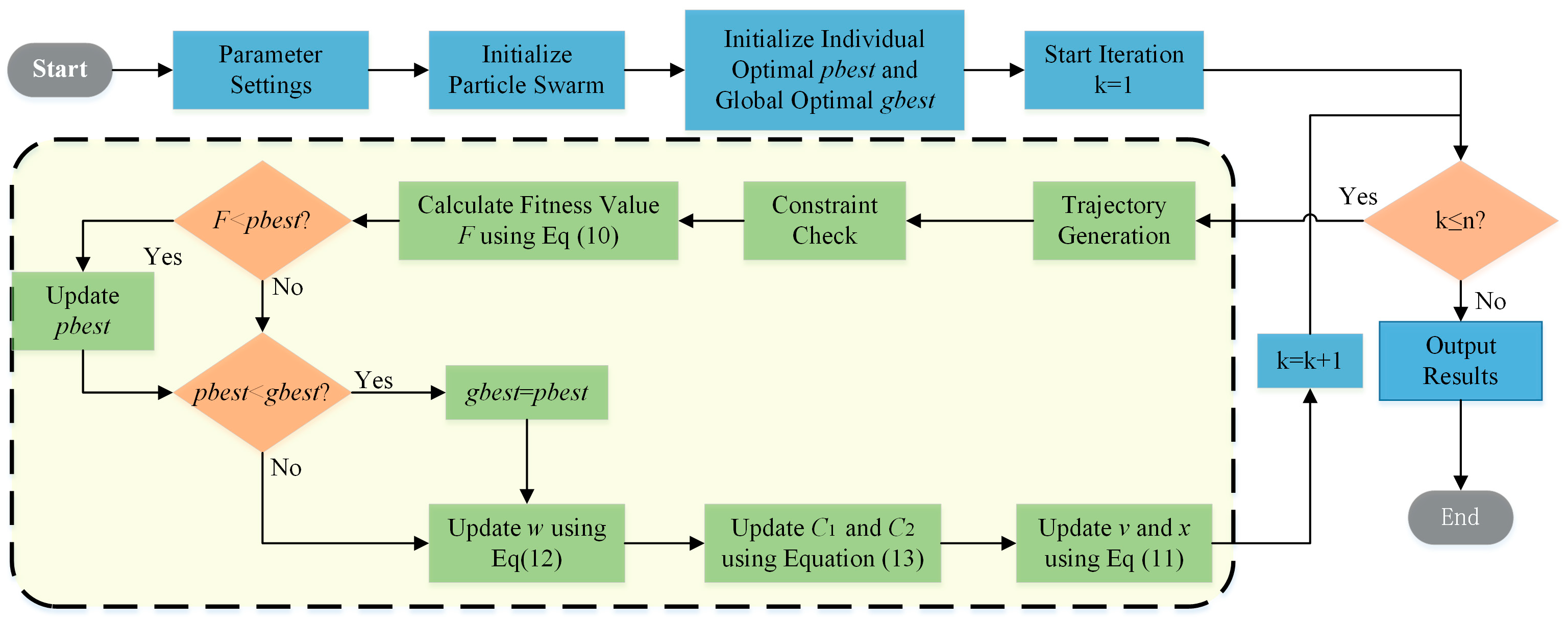
To address the insufficient convergence accuracy and declining search efficiency in the later stages of the standard PSO algorithm, this paper adopts the composite strategy of “cosine attenuation + linear attenuation” to adjust the inertia weight, thereby balancing global search and local refinement capabilities, as shown in Equation (12).
where
wmax = 0.9,
wmin = 0.4, k is the current number of iterations, and
n is the maximum number of iterations. Cosine attenuation is used during the first 60% of iterations, followed by linear attenuation to 0.2 in the subsequent 40%, thereby balancing global search and local refinement. Similarly, a nonlinear dynamic function is used to adjust the learning factor, as shown in Equation (13). The process of IPSO is shown in
Figure 3.
5.3. Analysis of Optimization Results
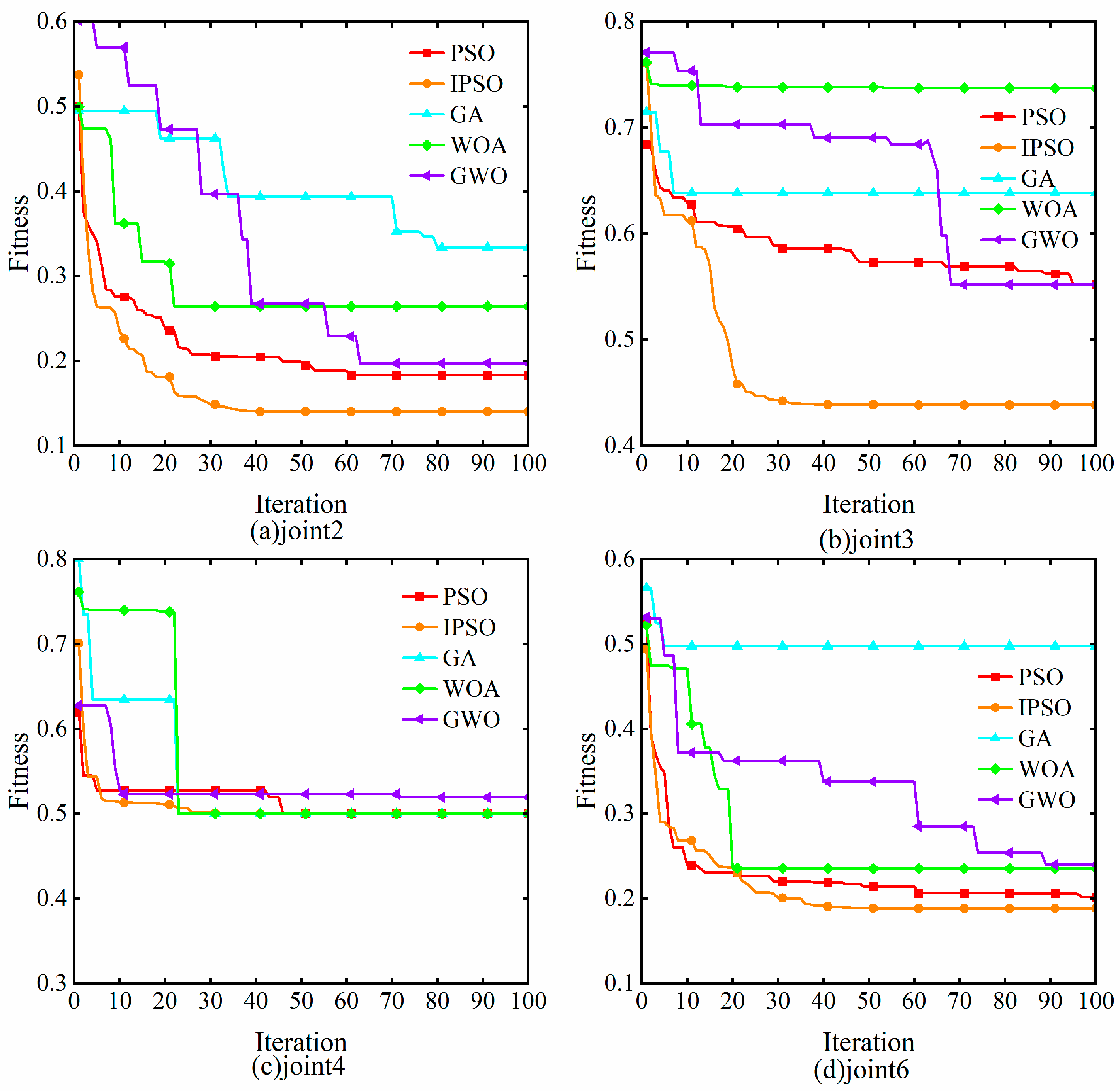
The algorithm parameters were set as follows: the population size is 50, the maximum number of iterations is 100, the inertia weight range is 0.4–0.9, and the learning factor range is 1.5–2.5. The optimization model was solved using PSO, GA, WOA, GWO, and IPSO algorithms, respectively. The performance comparison results are shown in
Table 4, and the convergence process of the algorithm is shown in
Figure 4. The results show that the IPSO algorithm has better optimization performance, and its initial fitness is significantly lower than that of other algorithms. Compared with the PSO algorithm, the average fitness value of each joint of the IPSO algorithm is reduced by 12.7%, and the average convergence speed is increased by 39.6%. Among the joints, joint 3 shows the most significant improvement in convergence speed (46.9%), while joint 2 shows the largest reduction in fitness value (22.2%). After 50 iterations, it converges stably, and the fluctuation is small during the whole iteration process, and the optimization stability is better. It should be noted that joint 1 remains fixed during the optimization process, and the angular change in joint 5 is related to joints 3 and 4, so there is no need for trajectory planning.
The IPSO algorithm was adopted to solve optimal interpolation times under different optimization strategies, as shown in
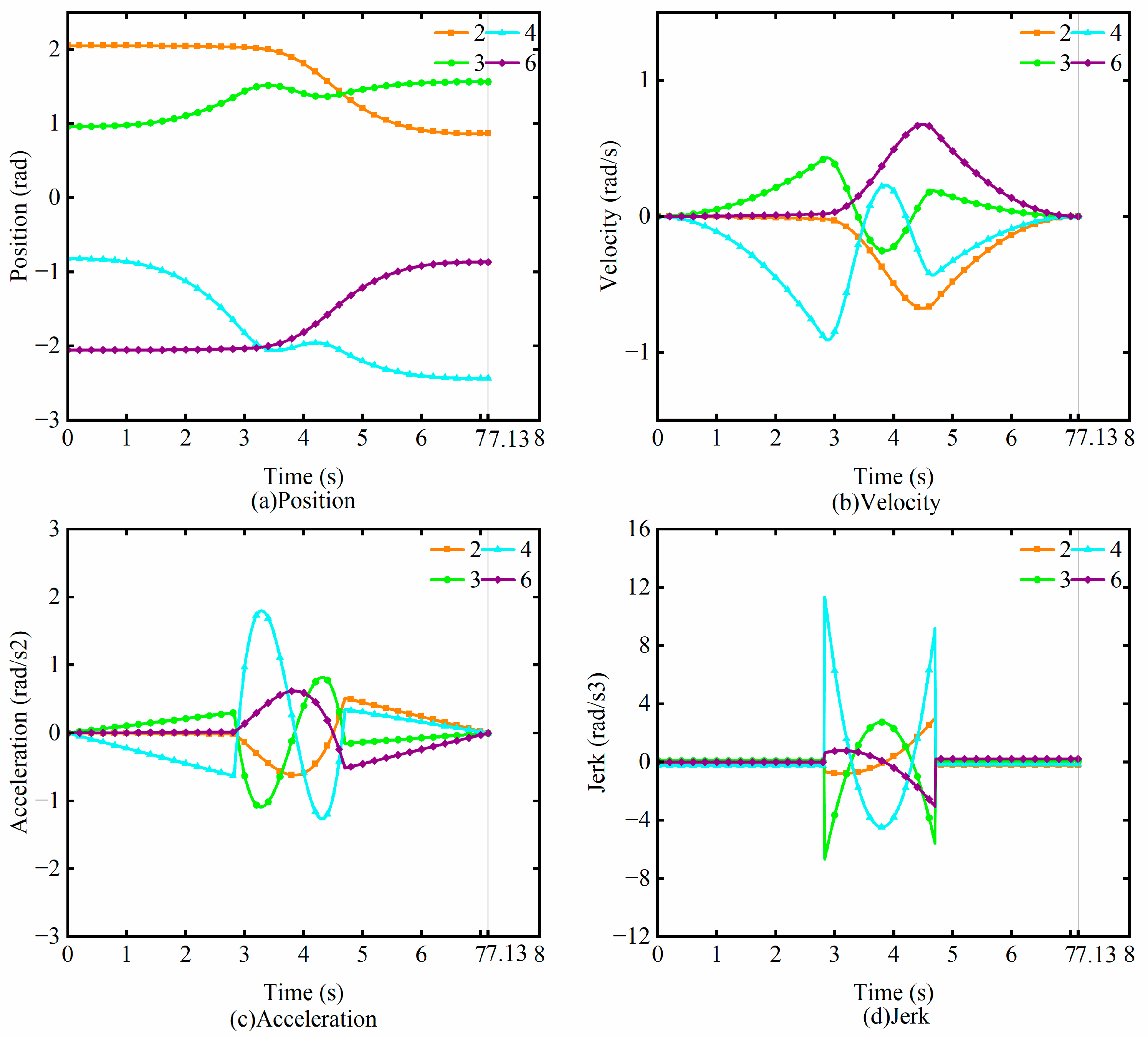
Table 5. To ensure synchronized joint movement, the maximum value of the optimal time for each joint was adopted. Under the time–jerk–energy optimization strategy, the three-segment interpolation times were determined as t
1 = 2.82 s, t
2 = 1.88 s, and t
3 = 2.43 s, in a total time of 7.13 s. The MATLAB trajectory planning results are shown in
Figure 5. The displacement, velocity, and acceleration curves of each joint are continuous and smooth, with no mutation phenomenon, and all are within the set limits, demonstrating the feasibility of the algorithm.
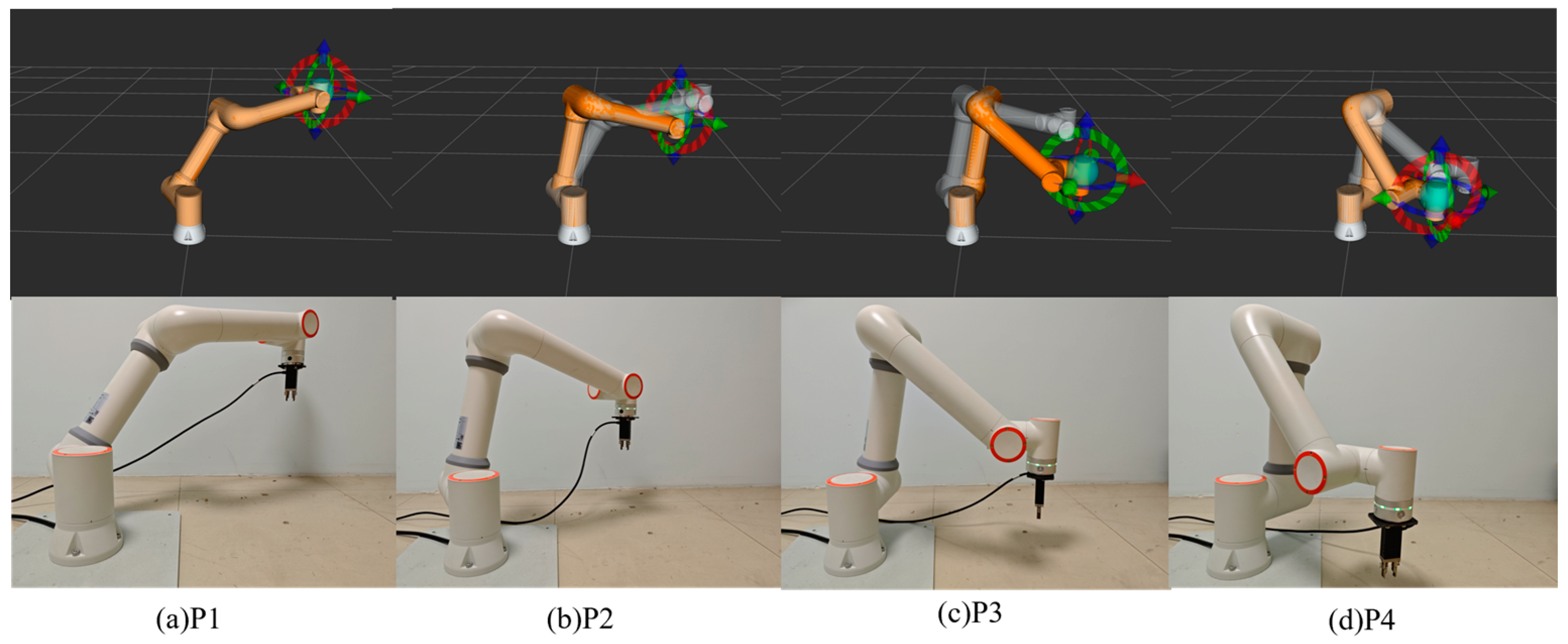
To verify the feasibility of the trajectory planning, the commercial manipulator FAIRINO-FR5 is selected to carry out experimental verification. Taking the actual scene of the manipulator movement scenario as an example, the trajectory of the end-effector in Cartesian space was calculated and subsequently sent to the manipulator for execution. The movement state change of the manipulator is shown in
Figure 6.
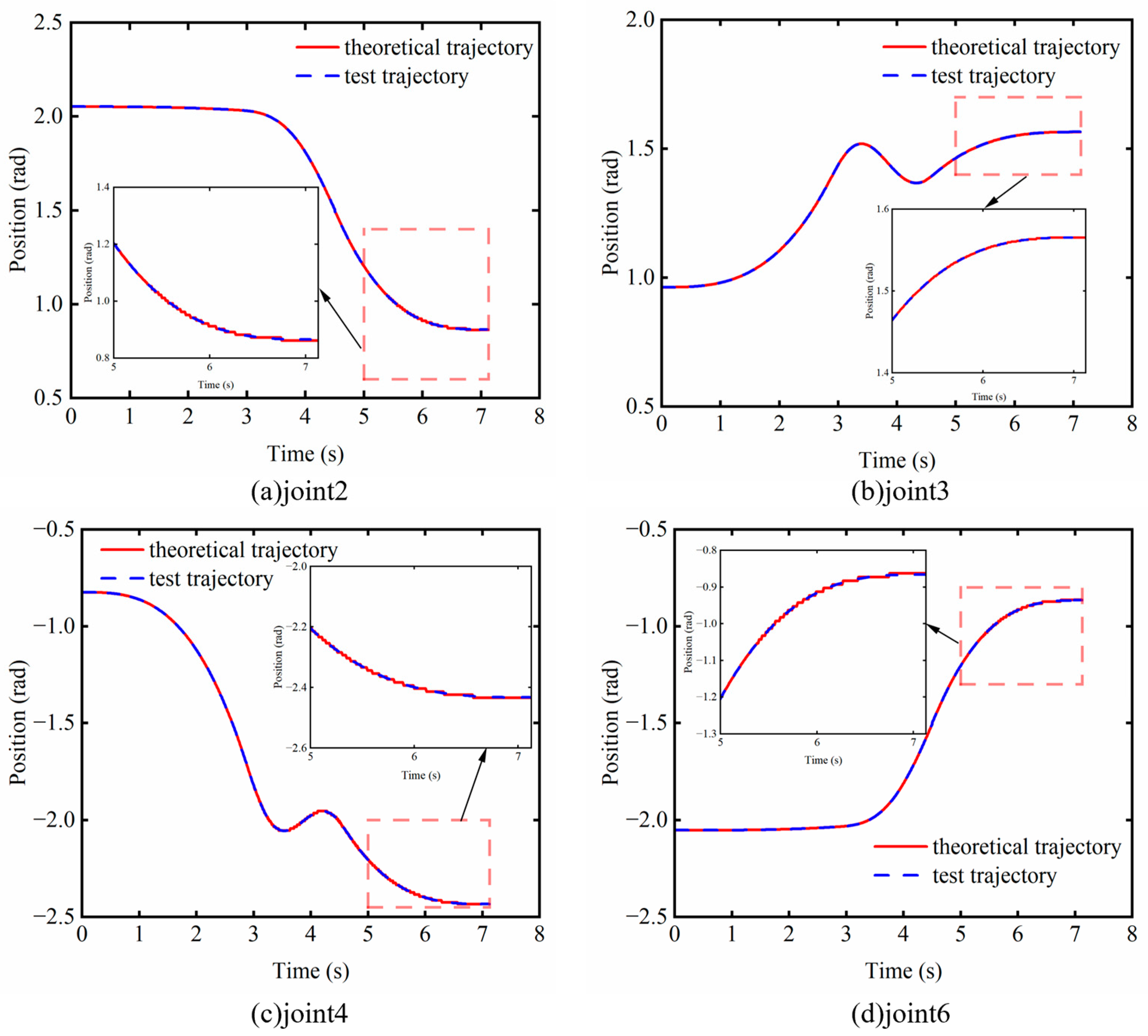
Figure 7 shows the comparison between the joint angle measured during actual movement and the planned trajectory of the manipulator, and the error analysis is shown in
Table 6. The results show that the experimental trajectory is highly fitted with the planned trajectory, and the maximum position errors of the four joints are about 0.0049 rad, 0.0005 rad, 0.005 rad, and 0.0049 rad, respectively. These errors fall within an extremely small range, which verifies the applicability of the proposed method in the actual manipulator.
5.4. Sensitivity Analysis of Weight Coefficient
In the multi-objective optimization model, the values of weight coefficients
w1,
w2, and
w3 directly affect the priority of optimization objectives. In order to verify the rationality of the current weight combination (
w1 = 0.4,
w2 = 0.3,
w3 = 0.3), we performed a sensitivity analysis using the orthogonal experimental design (L9(3
3)). The test covered three factors and three levels, which ensured the comprehensiveness of the results while reducing the number of tests. The specific level was set as shown in
Table 7.
Thus, the weight combination for the nine orthogonal test groups is shown in
Table 8.
Using the same IPSO algorithm parameters (the maximum number of iterations is 100, the population size is 50, the inertia weight is 0.4–0.9, and the learning factor is 1.5–2.5), solutions were obtained for nine weight combinations, and the results are shown in
Table 9.
Sensitivity test results indicate that as w1 (time weight) increases, the overall movement time shows a decreasing trend, while T3max and T4max exhibit an increasing trend, and Jmax generally shows an increasing trend. When w2 (impact weight) increases, Jmax generally decreases, while running time increases, and T3max and T4max show relatively gradual changes; when w3 (energy consumption weight) increases, T3max and T4max generally decrease, running time increases, and Jmax shows a slight decrease. Test 4 (w1 = 0.3, w2 = 0.3, w3 = 0.4) yielded the lowest fitness value but exhibited relatively high T3max and T4max. Test 8 (the weighting scheme proposed in this paper) achieved a fitness value in the upper-middle range, with no significant weaknesses in individual metrics. It simultaneously satisfies the multi-objective requirements of “efficiency, smoothness, and low energy consumption,” validating the rationality of the current weighting combination.
6. Simulation Validation
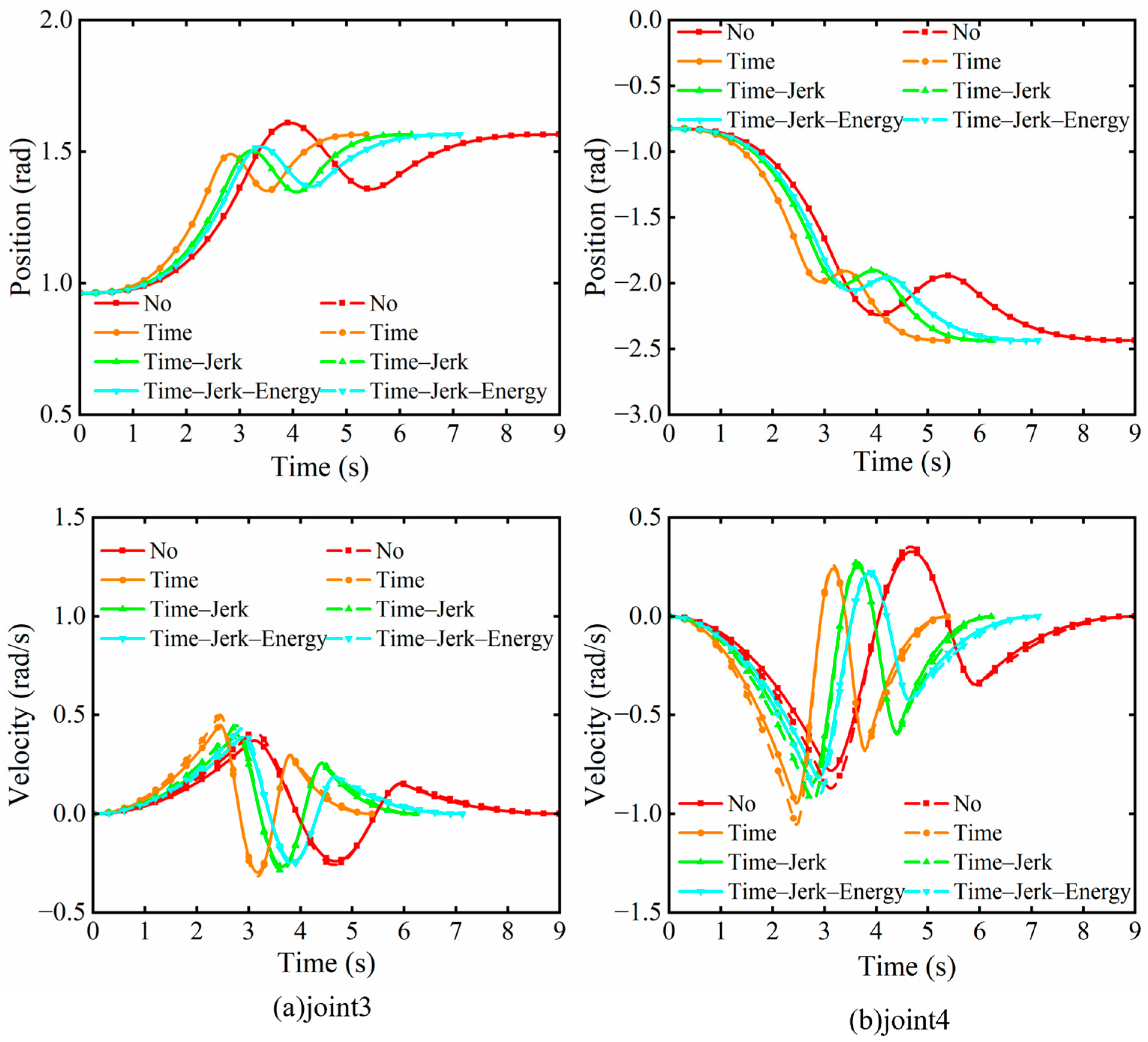
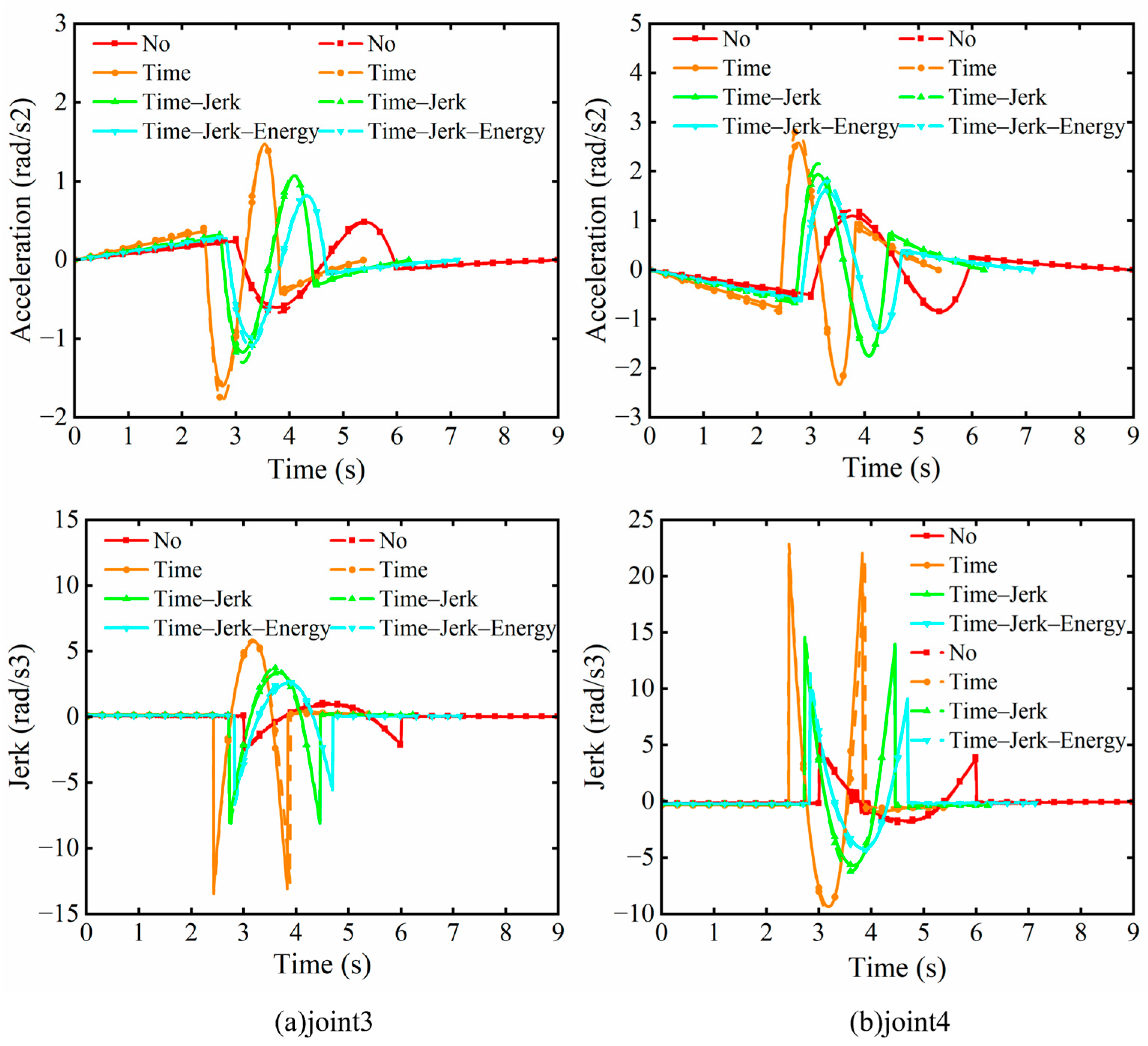
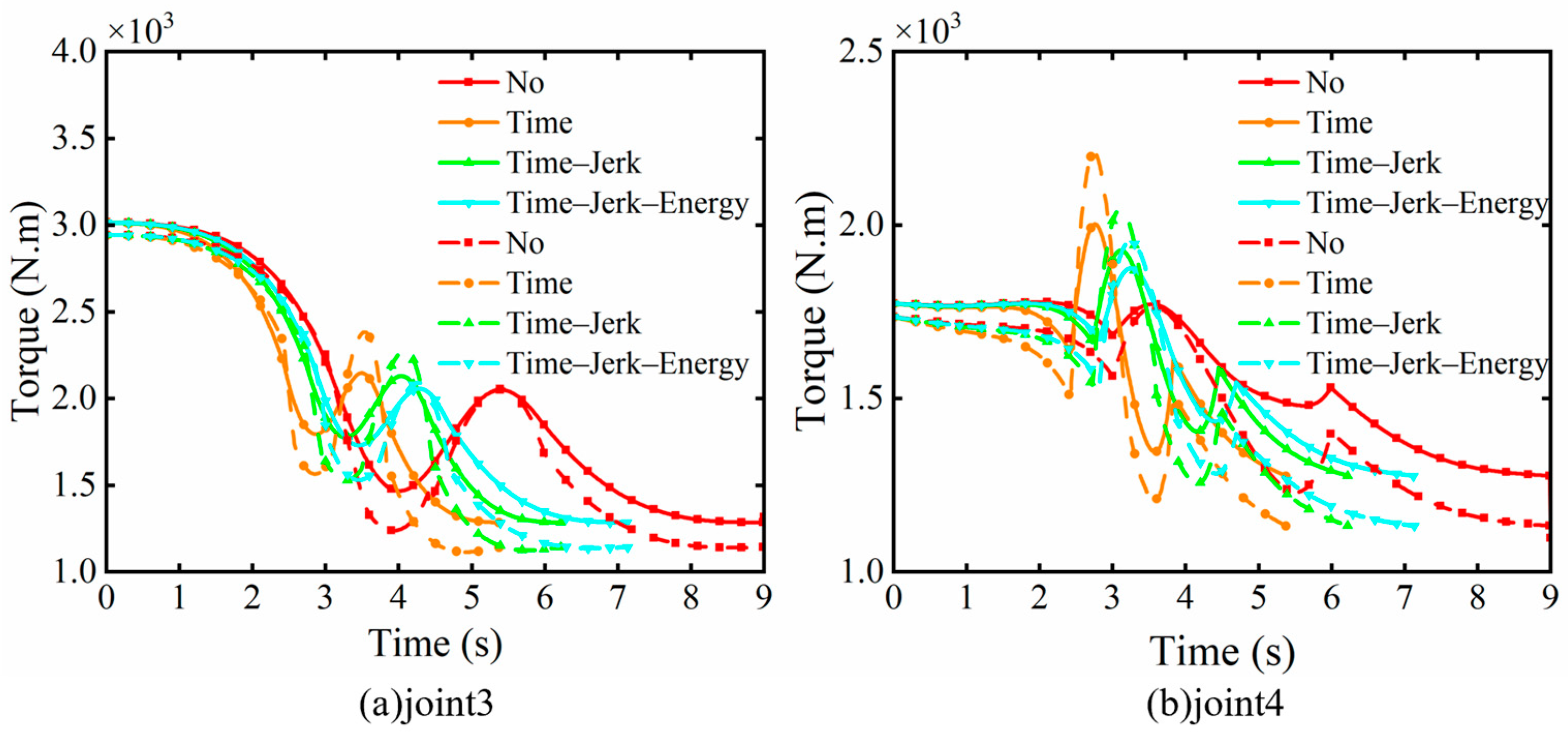
Through IPSO algorithm optimization and experiment verification, the feasibility and applicability of the proposed trajectory-planning method have been preliminarily verified. However, in order to more comprehensively and meticulously evaluate the performance differences of different optimization strategies in trajectory smoothness, impact suppression, and energy consumption control, further analysis is needed. Therefore, this chapter establishes a co-simulation platform based on Matlab and Adams, focusing on simulation analysis on joints 3 and 4 (as the core execution joints, bearing the primary load transfer tasks). The simulation parameters are set as follows: the material is Q235 steel, the end load is 60 kg, the maximum angular velocity is π/3 rad/s, the maximum acceleration is π rad/s2, and the maximum jerk is 8π rad/s3. The performance of the four strategies of unoptimized, time optimization, time–jerk optimization, and time–jerk–energy optimization is compared. In the results, the solid line represents the Adams simulation results, and the dashed line represents the Matlab calculation results.
Figure 8 shows the angular and velocity trajectories of joints 3 and 4 under different optimization strategies. The angle curve of the unoptimized strategy has abrupt transitions and noticeable inflection points. The time optimization strategy achieves the shortest movement time but the maximum peak velocity of 0.95 rad/s, with a dramatic change, makes it easy to cause impact. The time–jerk optimization strategy reduces the peak velocity to 0.84 rad/s, and the mutation of the curve is suppressed. The time–jerk–energy optimization strategy further reduces the peak velocity to 0.82 rad/s, and the curve is smooth and has no mutation.
Figure 9 shows the acceleration and jerk trajectories of joints 3 and 4 under different optimization strategies. The peak acceleration of the time optimization strategy is 2.58 rad/s
2, and the peak jerk is 22.1 rad/s
3; the mutation characteristics are strong and can easily cause vibration. The time–jerk optimization strategy reduces the peak acceleration to 1.94 rad/s
2, and the peak jerk to 13.7 rad/s
3; the curve smoothness is improved, and the impact is significantly reduced. The time–jerk–energy optimization strategy further reduces the peak acceleration to 1.62 rad/s
2, the peak jerk to 10.4 rad/s
3, and the peak jerk is reduced by 30–40%, and the smoothness is optimal.
The analysis results of the joint torque trajectories are shown in
Figure 10: The time optimization strategy exhibits the highest peak torque (reaching 2383 N·m at joint 3) and maximum energy consumption. The time–jerk–energy optimization strategy has the lowest peak torque (2091 N·m at joint 3). This represents a 12.2% reduction compared to the time optimization strategy and a 8.1% reduction compared to the time–jerk optimization strategy. The torque curve is smoother, which significantly improves the operational economy while ensuring efficiency and stability.
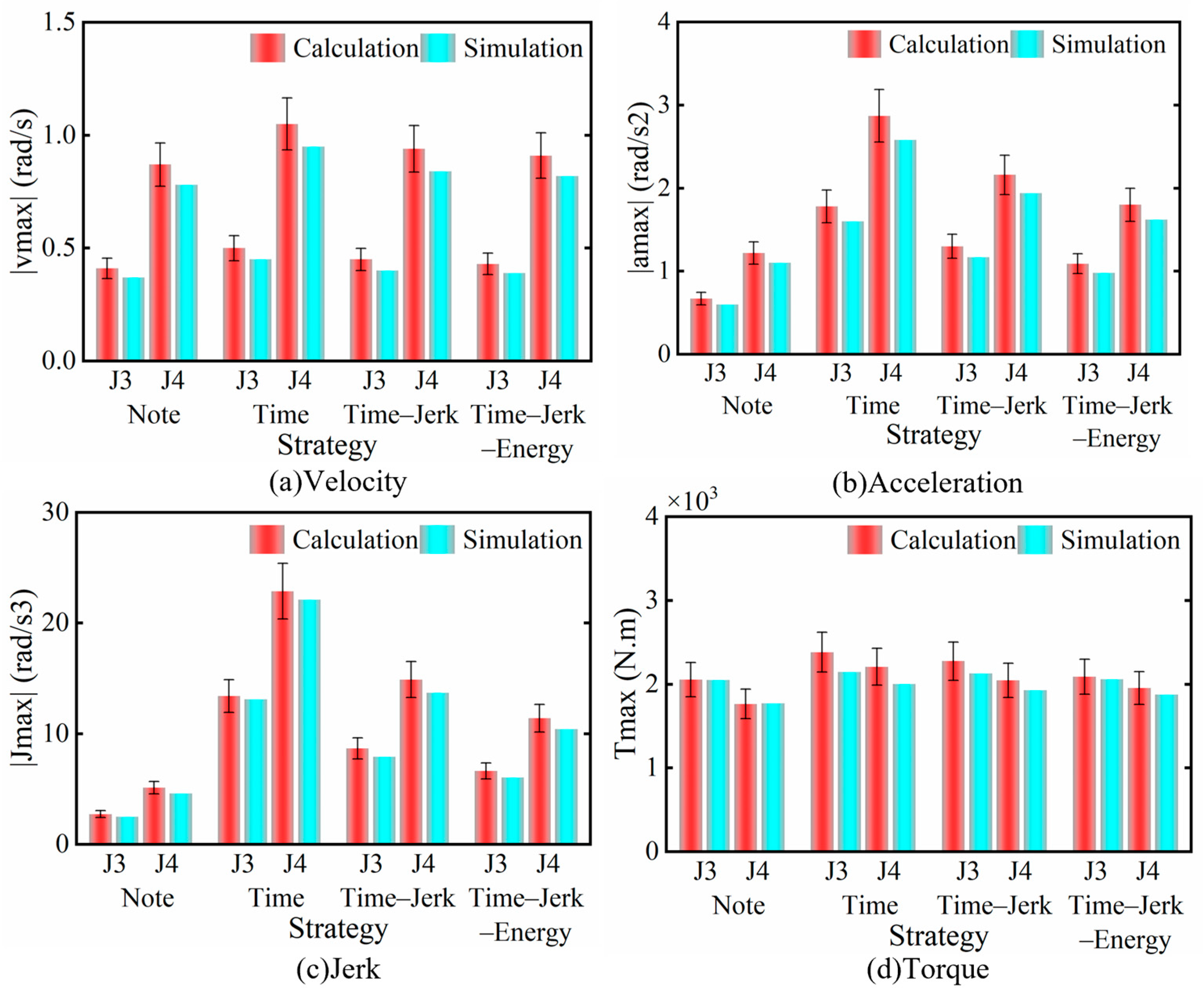
The error analysis between the Matlab calculation results and Adams 2020 simulation results shows that the errors for all indexes are generally controlled within 10% are shown in
Figure 11. The drive torque error is mainly due to the fact that the simplified model does not consider the coupling effect of end-effector attitude on dynamics. The change in end-effector attitude leads to the enhancement of torque coupling between joint 3 and joint 4, while the Lagrange model assumes that the joint acts independently. However, the change trend of the global joint torque is consistent with the optimization goal, and the torque error is controlled within the acceptable range, which verifies the validity of the dynamic model and the reliability of the optimization results.
Using the “relative comparison method + absolute threshold method”, combined with Matlab/Adams simulation data and experimental results, the comprehensive performance of the four optimization strategies is shown in
Table 10. The time–jerk–energy optimization strategy performs best in impact suppression, energy consumption control, and trajectory smoothness. Although the motion time is slightly longer than the time optimization strategy, it remained within a reasonable range, and the comprehensive performance is the best. The time optimization strategy only optimized motion time, and performed extremely poorly in impact suppression and energy consumption control. The time–jerk optimization strategy exhibited good smoothness, but the energy consumption control was insufficient. The unoptimized strategy performed poorly across all indexes and has no practical application value.
7. Conclusions
This study was conducted to research multi-objective trajectory planning for a material-handling robot in container part-handling operations. Kinematic and dynamic models based on the improved D-H parameter method and Lagrange method were constructed, accurately describing movement characteristics and joint torque variation in the manipulator, providing a mathematical foundation for subsequent trajectory planning. Building upon this foundation, a 3-5-3 hybrid polynomial interpolation method is proposed for the three-stage characteristics of handling operations, which effectively balances computational efficiency with trajectory smoothness and overcomes the discontinuity in acceleration inherent to cubic polynomials, while avoiding the high computational burden associated with quintic polynomials. To further enhance optimization performance, an improved particle swarm optimization (IPSO) algorithm with dynamic parameter adjustment was designed. By incorporating composite inertia weights and nonlinear learning factors, the algorithm’s global search capability and local fine-tuning ability were significantly strengthened. Compared with the standard PSO algorithm, its convergence speed improved by 39.6% on average, while the fitness value decreased by 12.7% on average. Finally, through the time–jerk–energy multi-objective collaborative optimization strategy, the integrated control goals of “high efficiency, smooth movement, and energy conservation” were achieved. Compared with single- or dual-objective optimization schemes, this strategy reduced peak impact by 30–40% while achieving energy savings by 5–10%. It also produced smoother joint torque variations, demonstrating optimal overall trajectory planning performance.
In the future, the research can be further expanded in the following directions: first, incorporate collision detection into the constraints of trajectory planning to address obstacle avoidance requirements within containers, thereby enhancing the practical adaptability of trajectory planning; second, establish a physical prototype experimental platform to conduct physical validation experiments, further modify the simulation model, and increase the engineering application value of the research results.
Author Contributions
Conceptualization, Z.W. and S.L.; methodology, Z.W., S.L., J.W., Q.Z. and F.L.; software, S.L. and F.L.; validation, Z.W. and S.L.; resources, Z.W. and J.W.; data curation, S.L. and Q.Z.; writing—original draft preparation, Z.W. and S.L.; writing—review and editing, Z.W. and J.W.; visualization, S.L.; project administration, Z.W.; funding acquisition, Z.W. All authors have read and agreed to the published version of the manuscript.
Funding
This work was supported by the National Natural Science Foundation of China (Grant No. 51106043). The fund of Henan Key Laboratory of Superhard Abrasives and Grinding Equipment, Henan University of Technology (No. JDKFJJ2024006). The fund of the China Scholarship Council (CSC).
Data Availability Statement
The original contributions presented in this study are included in the article. Further inquiries can be directed to the corresponding author.
Conflicts of Interest
Author Fusheng Luo was employed by the company Changzhou Shuangjing Automation Ltd. The remaining authors declare that the research was conducted in the absence of any commercial or financial relationships that could be construed as a potential conflict of interest.
References
- Zheng, K.; Hu, Y.; Wu, B. Trajectory planning of multi-degree-of-freedom robot with coupling effect. J. Mech. Sci. Technol. 2019, 33, 413–421. [Google Scholar] [CrossRef]
- Ekrem, Ö.; Aksoy, B. Trajectory planning for a 6-axis robotic arm with particle swarm optimization algorithm. Eng. Appl. Artif. Intell. 2023, 122, 106099. [Google Scholar] [CrossRef]
- Wang, W.; Tao, Q.; Cao, Y.; Wang, X.; Zhang, X. Robot time-optimal trajectory planning based on improved cuckoo search algorithm. IEEE Access 2020, 8, 86923–86933. [Google Scholar] [CrossRef]
- Liu, C.; Cao, G.H.; Qu, Y.Y.; Cheng, Y.M. An improved PSO algorithm for time-optimal trajectory planning of Delta robot in intelligent packaging. Int. J. Adv. Manuf. Technol. 2020, 107, 1091–1099. [Google Scholar] [CrossRef]
- Wang, Z.; Li, Y.; Shuai, K.; Zhu, W.; Chen, B.; Chen, K. Multi-objective trajectory planning method based on the improved elitist non-dominated sorting genetic algorithm. Chin. J. Mech. Eng. 2022, 35, 7. [Google Scholar] [CrossRef]
- Liu, Y.; Jin, Z.; Teng, L. PSO-based time optimal rapid orientation for micronano space robot. IEEE Trans. Aerosp. Electron. Syst. 2022, 59, 1921–1934. [Google Scholar] [CrossRef]
- Du, Y.; Chen, Y. Time optimal trajectory planning algorithm for robotic manipulator based on locally chaotic particle swarm optimization. Chin. J. Electron. 2022, 31, 906–914. [Google Scholar] [CrossRef]
- Hu, X.; Wu, H.; Sun, Q.; Liu, J. Robot time optimal trajectory planning based on improved simplified particle swarm optimization algorithm. IEEE Access 2023, 11, 44496–44508. [Google Scholar] [CrossRef]
- Chen, S.; Zhang, C.; Yi, J. Time-optimal trajectory planning for woodworking manipulators using an improved PSO algorithm. Appl. Sci. 2023, 13, 10482. [Google Scholar] [CrossRef]
- Liu, J.; Liu, S.; Song, M.; Ren, H.; Ji, H. Time-Optimal Robotic Arm Trajectory Planning for Coating Machinery Based on a Dynamic Adaptive PSO Algorithm. Coatings 2024, 15, 2. [Google Scholar] [CrossRef]
- Wu, R.; Yang, Y.; Yao, X.; Lu, N. Optimal Trajectory Planning for Robotic Arm Based on Improved Dynamic Multi-Population Particle Swarm Optimization Algorithm. Int. J. Adv. Comput. Sci. Appl. 2024, 15, 710–718. [Google Scholar] [CrossRef]
- Jin, H.; Yue, G. Underwater Manipulator Trajectory Planning Based on Improved Particle Swarm Optimization Algorithm. J. Field Robot. 2025, 42, 3986–4008. [Google Scholar] [CrossRef]
- Jiao, Y.; Zhao, Y.; Wen, S. Time-optimal trajectory planning for 6R manipulator arm based on chaotic improved sparrow search algorithm. Ind. Robot. 2025, 52, 509–521. [Google Scholar] [CrossRef]
- Yang, Y.; Xu, H.Z.; Li, S.H.; Zhang, L.L.; Yao, X.M. Time-optimal trajectory optimization of serial robotic manipulator with kinematic and dynamic limits based on improved particle swarm optimization. Int. J. Adv. Manuf. Technol. 2022, 120, 1253–1264. [Google Scholar] [CrossRef]
- Zhong, F.; Liu, G.; Lu, Z.; Hu, L.; Han, Y.; Xiao, Y.; Zhang, X. Dynamic parameter identification based on improved particle swarm optimization and comprehensive excitation trajectory for 6R robotic arm. Ind. Robot. 2024, 51, 148–166. [Google Scholar] [CrossRef]
- Garriz, C.; Domingo, R. Trajectory optimization in terms of energy and performance of an industrial robot in the manufacturing industry. Sensors 2022, 22, 7538. [Google Scholar] [CrossRef] [PubMed]
- Zhang, X.; Kou, H.; Zhang, Y.; Jan, K.; Ivanovic, B. Trajectory planning and control of handling robot manipulator. J. Phys. Conf. Ser. 2021, 1802, 022067. [Google Scholar] [CrossRef]
- Jin, R.; Rocco, P.; Geng, Y. Cartesian trajectory planning of space robots using a multi-objective optimization. Aerosp. Sci. Technol. 2021, 108, 106360. [Google Scholar] [CrossRef]
- Li, X.; Zhao, H.; He, X.; Ding, H. A novel cartesian trajectory planning method by using triple NURBS curves for industrial robots. Robot. Comput.-Integr. Manuf. 2023, 83, 102576. [Google Scholar] [CrossRef]
- Wu, G.; Zhang, S. Real-time jerk-minimization trajectory planning of robotic arm based on polynomial curve optimization. Proc. Inst. Mech. Eng. Part C J. Mech. Eng. Sci. 2022, 236, 10852–10864. [Google Scholar] [CrossRef]
- Wang, F.; Wu, Z.; Bao, T. Time-jerk optimal trajectory planning of industrial robots based on a hybrid WOA-GA algorithm. Processes 2022, 10, 1014. [Google Scholar] [CrossRef]
- Zhang, X.; Shi, G. Multi-objective optimal trajectory planning for manipulators in the presence of obstacles. Robotica 2022, 40, 888–906. [Google Scholar] [CrossRef]
- Zhao, J.; Zhu, X.; Song, T. Serial manipulator time-jerk optimal trajectory planning based on hybrid IWOA-PSO algorithm. IEEE Access 2022, 10, 6592–6604. [Google Scholar] [CrossRef]
- Ye, J.; Hao, L.; Cheng, H. Multi-objective optimal trajectory planning for robot manipulator attention to end-effector path limitation. Robotica 2024, 42, 1761–1780. [Google Scholar] [CrossRef]
- Patle, B.K.; Chen, S.L.; Singh, A.; Kashyap, S.K. Optimal trajectory planning of the industrial robot using hybrid S-curve-PSO approach. Robot. Intell. Autom. 2023, 43, 153–174. [Google Scholar] [CrossRef]
- Wu, N.; Jia, D.; Li, Z.; He, Z. Trajectory planning of robotic arm based on particle swarm optimization algorithm. Appl. Sci. 2024, 14, 8234. [Google Scholar] [CrossRef]
- Ma, J.W.; Gao, S.; Yan, H.T.; Lv, Q.; Hu, G.Q. A new approach to time-optimal trajectory planning with torque and jerk limits for robot. Robot. Auton. Syst. 2021, 140, 103744. [Google Scholar] [CrossRef]
- Wu, Z.; Chen, J.; Bao, T.; Wang, J.; Zhang, L.; Xu, F. A novel point-to-point trajectory planning algorithm for industrial robots based on a locally asymmetrical jerk motion profile. Processes 2022, 10, 728. [Google Scholar] [CrossRef]
- Wang, Y.; Qiu, J.; Wu, J.; Wang, J. A study on the dynamics of a novel seven degrees of freedom spray-painting robot with a telescopic forearm. Int. J. Adv. Robot. Syst. 2024, 21, 17298806241243162. [Google Scholar] [CrossRef]
- Tørdal, S.S.; Hovland, G.; Tyapin, I. Efficient implementation of inverse kinematics on a 6-dof industrial robot using conformal geometric algebra. Adv. Appl. Clifford Algebras 2017, 27, 2067–2082. [Google Scholar] [CrossRef]
- Liu, Z.; Wu, J.; Wang, L.; Zhang, B. Control parameters design based on dynamic characteristics of a hybrid robot with parallelogram structures. IEEE/ASME Trans. Mechatron. 2020, 26, 1140–1150. [Google Scholar] [CrossRef]
- Shami, T.M.; El-Saleh, A.A.; Alswaitti, M.; Al-Tashi, Q.; Summakieh, M.A.; Mirjalili, S. Particle swarm optimization: A comprehensive survey. IEEE Access 2022, 10, 10031–10061. [Google Scholar] [CrossRef]
Figure 1.
Schematic of handling operations.
Figure 1.
Schematic of handling operations.
Figure 2.
(a) Robot linkage coordinate system. (b) Simplified dynamics calculation diagram.
Figure 2.
(a) Robot linkage coordinate system. (b) Simplified dynamics calculation diagram.
Figure 3.
Optimization process of the IPSO.
Figure 3.
Optimization process of the IPSO.
Figure 4.
Comparison of convergence curves for optimization algorithms.
Figure 4.
Comparison of convergence curves for optimization algorithms.
Figure 5.
Optimal trajectory planning results based on IPSO for time–jerk–energy optimization.
Figure 5.
Optimal trajectory planning results based on IPSO for time–jerk–energy optimization.
Figure 6.
Experiment for time–jerk–energy-optimized trajectory planning based on IPSO.
Figure 6.
Experiment for time–jerk–energy-optimized trajectory planning based on IPSO.
Figure 7.
Manipulator movement trajectories.
Figure 7.
Manipulator movement trajectories.
Figure 8.
Comparison of joint angle and velocity trajectories under different optimization strategies.
Figure 8.
Comparison of joint angle and velocity trajectories under different optimization strategies.
Figure 9.
Comparison of joint acceleration and jerk trajectories under different optimization strategies.
Figure 9.
Comparison of joint acceleration and jerk trajectories under different optimization strategies.
Figure 10.
Comparison of joint torque trajectories under different optimization strategies.
Figure 10.
Comparison of joint torque trajectories under different optimization strategies.
Figure 11.
Peak comparison of calculated vs. simulated curves under different optimization strategies: (a) Velocity, (b) acceleration, (c) jerk, and (d) torque.
Figure 11.
Peak comparison of calculated vs. simulated curves under different optimization strategies: (a) Velocity, (b) acceleration, (c) jerk, and (d) torque.
Table 1.
Robot D-H parameter table.
Table 1.
Robot D-H parameter table.
| Link i | Joint Type | θi/rad | di/mm | ai−1/mm | Offset/Rad | αi−1/rad | Joint Range (mm/rad) |
|---|
| 1 | prismatic | 0 | d1 | 0 | 0 | −π/2 | 0–1400 |
| 2 | revolute | θ2 | 415 | 0 | π/2 | π/2 | −π/3–π/3 |
| 3 | revolute | θ3 | 0 | 200 | π/2 | π/2 | −4π/9–0 |
| 4 | revolute | θ4 | 0 | 867 | −π/2 | 0 | −5π/18–4π/9 |
| 5 | revolute | −θ3–θ4 | 0 | 1234 | 0 | 0 | −5π/18–11π/18 |
| 6 | revolute | θ6 | 0 | 231 | −π/2 | −π/2 | −π/3–π/3 |
Table 2.
Interpolation point coordinates and corresponding joint angles.
Table 2.
Interpolation point coordinates and corresponding joint angles.
| Point | X/mm | Y/mm | Z/mm | Angle | Joint2/° | Joint3/° | Joint4/° | Joint6/° |
|---|
| P1 | −995.1 | 1903.4 | 1298.7 | θ1 | 27.6 | −34.8 | 42.8 | −27.6 |
| P2 | −801.1 | 1599.8 | 900.5 | θ2 | 26.6 | −11.9 | −5.2 | −26.6 |
| P3 | 299.7 | 1500 | 499.8 | θ3 | −11.3 | −9 | −29.7 | 11.3 |
| P4 | 799.6 | 939.5 | 340.9 | θ4 | −40.4 | −0.3 | −49.4 | 40.4 |
Table 4.
Performance comparison of different optimization algorithms.
Table 4.
Performance comparison of different optimization algorithms.
| Joint | Algorithm | Iterations | Fitness | Iteration Change Rate | Fitness Change Rate | Time Consumption/s |
|---|
| Joint 2 | PSO | 61 | 0.18 | 0 | 0 | 0.61 |
| GA | 82 | 0.33 | 34.4% | 83.3% | 0.71 |
| WOA | 22 | 0.26 | −63.9% | 44.4% | 0.85 |
| GWO | 63 | 0.19 | 3.3% | 5.6% | 0.64 |
| IPSO | 41 | 0.14 | −32.8% | −22.2% | 0.57 |
| Joint 3 | PSO | 96 | 0.55 | 0 | 0 | 3.28 |
| GA | 61 | 0.63 | −36.5% | 14.5% | 4.31 |
| WOA | 54 | 0.73 | −43.8% | 32.7% | 4.6 |
| GWO | 69 | 0.55 | −28.1% | 0.0% | 4.2 |
| IPSO | 51 | 0.43 | −46.9% | −21.8% | 4.18 |
| Joint 4 | PSO | 46 | 0.5 | 0 | 0 | 3.13 |
| GA | 23 | 0.5 | −50% | 0 | 3.57 |
| WOA | 23 | 0.5 | −50% | 0 | 4.62 |
| GWO | 71 | 0.52 | 54.3% | 4.0% | 3.47 |
| IPSO | 26 | 0.5 | −43.5% | 0 | 3.27 |
| Joint 6 | PSO | 97 | 0.2 | 0 | 0 | 0.55 |
| GA | 31 | 0.49 | −68.0% | 145.0% | 0.69 |
| WOA | 21 | 0.23 | −78.4% | 15.0% | 0.66 |
| GWO | 89 | 0.24 | −8.2% | 20.0% | 0.61 |
| IPSO | 42 | 0.18 | −56.7% | −10.0% | 0.53 |
Table 5.
Optimal interpolation time under different optimization strategies.
Table 5.
Optimal interpolation time under different optimization strategies.
| | | t1/s | t2/s | t3/s | t/s |
|---|
| Unoptimized | | 3 | 3 | 3 | 9 |
| Time optimization | Joint2 | 0.18 | 0.80 | 1.55 | 2.53 |
| Joint3 | 1.57 | 1.46 | 0.79 | 3.81 |
| Joint4 | 2.42 | 0.43 | 1.03 | 3.88 |
| Joint6 | 0.18 | 0.79 | 1.56 | 2.53 |
| Time–jerk optimization | Joint2 | 0.28 | 0.93 | 1.78 | 2.98 |
| Joint3 | 1.74 | 1.73 | 1.03 | 4.50 |
| Joint4 | 2.72 | 0.86 | 1.76 | 5.34 |
| Joint6 | 0.29 | 0.96 | 1.72 | 2.97 |
| Time–jerk–energy optimization | Joint2 | 0.24 | 0.87 | 1.73 | 2.84 |
| Joint3 | 1.54 | 1.88 | 1.22 | 4.63 |
| Joint4 | 2.82 | 0.61 | 2.43 | 5.85 |
| Joint6 | 0.45 | 1.01 | 1.67 | 3.13 |
Table 6.
Error statistics analysis table.
Table 6.
Error statistics analysis table.
| | Mean/rad | Max/rad | Min/rad | Standard Deviation |
|---|
| Joint 2 | 0.0001 | 0.0049 | −0.0049 | 0.0015 |
| Joint 3 | 1.4 × 10⁻⁵ | 0.0005 | −0.0005 | 0.00025 |
| Joint 4 | 4.7 × 10⁻⁵ | 0.005 | −0.005 | 0.0021 |
| Joint 6 | −0.0001 | 0.0049 | −0.005 | 0.0015 |
Table 7.
Orthogonal experimental design.
Table 7.
Orthogonal experimental design.
| Factor | Level 1 | Level 2 | Level 3 |
|---|
| w1 (time weight) | 0.2 | 0.3 | 0.4 |
| w2 (jerk weight) | 0.2 | 0.3 | 0.4 |
| w3 (energy consumption weight) | 1 − w1 − w2 |
Table 8.
Weight combination table.
Table 8.
Weight combination table.
| ID | w1 | w2 | w3 |
|---|
| 1 | 0.2 | 0.2 | 0.6 |
| 2 | 0.2 | 0.3 | 0.5 |
| 3 | 0.2 | 0.4 | 0.4 |
| 4 | 0.3 | 0.2 | 0.5 |
| 5 | 0.3 | 0.3 | 0.4 |
| 6 | 0.3 | 0.4 | 0.3 |
| 7 | 0.4 | 0.2 | 0.4 |
| 8 | 0.4 | 0.3 | 0.3 |
| 9 | 0.4 | 0.4 | 0.2 |
Table 9.
Sensitivity test results.
Table 9.
Sensitivity test results.
| ID | Fitness (joint3) | t(s) | Jmax (rad/s3) | T3max (N·m) | T4max (N·m) |
|---|
| 1 | 0.38 | 7.23 | 12.3 | 2130 | 1990 |
| 2 | 0.48 | 7.25 | 10.4 | 2138 | 1997 |
| 3 | 0.5 | 7.43 | 10.7 | 2104 | 1965 |
| 4 | 0.37 | 7.2 | 10.6 | 2121 | 1981 |
| 5 | 0.5 | 7.35 | 11.8 | 2076 | 1939 |
| 6 | 0.45 | 7.03 | 11.1 | 2170 | 2027 |
| 7 | 0.39 | 7.22 | 10.6 | 2131 | 1990 |
| 8 | 0.43 | 7.13 | 11.4 | 2091 | 1953 |
| 9 | 0.5 | 6.96 | 12.5 | 2180 | 2036 |
Table 10.
Comprehensive performance evaluation of optimization strategies.
Table 10.
Comprehensive performance evaluation of optimization strategies.
| Strategy | Movement Time | Impact Suppression | Energy Control | Smoothness | Overall Performance |
|---|
| Unoptimized | Poor | Poor | Poor | Poor | Poor |
| Time Optimization | Good | Poor | Poor | Poor | Poor |
| Time–Jerk Optimization | Good | Excellent | Good | Good | Good |
| Time–Jerk–Energy Optimization | Good | Excellent | Excellent | Excellent | Excellent |
| Disclaimer/Publisher’s Note: The statements, opinions and data contained in all publications are solely those of the individual author(s) and contributor(s) and not of MDPI and/or the editor(s). MDPI and/or the editor(s) disclaim responsibility for any injury to people or property resulting from any ideas, methods, instructions or products referred to in the content. |