Article

Temporal Domain Vibration Fault Diagnosis of Drone Blades via Selective Embedding

1
Department of Mechanical Engineering, University of Ottawa, Ottawa, ON K1N 6N5, Canada
2
Department of Civil Engineering, University of British Columbia, Vancouver, BC V6T 1Z4, Canada
3
Faculty of Geoengineering, Mining and Geology, Wroclaw University of Science and Technology, Na Grobli 15, 50-421 Wroclaw, Poland
4
Department of Mechanical Engineering, Graphic Era Deemed to be University, Dehradun 248002, India
*
Authors to whom correspondence should be addressed.
Machines 2026, 14(2), 241; https://doi.org/10.3390/machines14020241
Submission received: 22 January 2026 / Revised: 3 February 2026 / Accepted: 18 February 2026 / Published: 20 February 2026

Abstract

Rotor blades are the primary cause of drone failure. To assess the health status of drone blades, vibration monitoring is required; however, this is challenging due to noisy signals and limited labeled datasets. This study investigates a data loading strategy called selective embedding (SE), which is shown to improve data diagnosis across engineering fields. The hypothesis is that this strategy can improve the classification accuracy of drone blade conditions with multi-axis vibration data. Accelerometer signals are collected under different blade health conditions; the signals are then processed and fed into a deep learning model for multi class condition classification. An ablation study is conducted with different data loading strategies, including traditional single channel, parallel channel, and SE. The results show that SE improves classification accuracy, reduces performance variance, and achieves higher generalization performance across multiple blade fault conditions. These improvements are observed consistently across domain evaluations, where traditional data loading strategies have difficulty generalizing to unseen temporal segments. The findings demonstrate that SE can effectively support vibration fault diagnostics for aerospace applications, offering a reliable way to improve safety in drone monitoring.

1. Introduction

Vibration fault diagnosis has become an important tool for monitoring the structural health of UAV systems, particularly for detecting blade related faults that can directly affect flight stability and safety [1,2,3]. However, reliable diagnosis remains challenging, due to the highly non-stationary nature of UAV vibration signals [2,4], strong coupling between sensor axis [5,6], and the limited availability of labeled flight data [7]. In many existing aerospace machine learning (ML) studies, performance improvements are primarily pursued through changes in model architecture or feature extraction [8,9], while the way raw time domain signals are loaded into the learning algorithm is often treated as a fixed implementation detail [4,10,11]. This assumption can be problematic for multi axial vibration signals, where fault-related information is distributed across multiple directions and evolves simultaneously during operation. As a result, conventional single-axis or static data loading strategies bias learning toward dominant signal directions [12] and limit generalization under unseen conditions [13], motivating a systematic investigation of data loading strategies for UAV blade condition monitoring.
The main contributions of this work can be summarized as follows:
  • A systematic comparison of traditional data loading and SE data loading strategies for UAV blade vibration diagnosis, highlighting the role of data loading in time domain aerospace signal analysis.
  • An ablation study on a five label UAV blade dataset, demonstrating that SE improves classification accuracy, reduces performance variance, and enhances training stability without increasing computational cost.
  • A shift from feature engineering to information presentation, demonstrating that the ordering, structure, and alternation of time-series vibration data influence what a model learns, establishing data loading as an underexplored design component in aerospace ML monitoring.
The goal of this work is to expand and compare data loading strategies within the aerospace field and to explain why the way data is loaded plays a critical role when operating in the time domain. In aerospace applications, sensor signals such as vibration and acceleration are inherently time-dependent and highly correlated across the axis [14,15,16,17]. Therefore, how these signals are presented to a learning algorithm directly affects the information content seen during optimization. By systematically evaluating different data loading strategies, this work demonstrates that data loading is not a trivial implementation choice but a fundamental design decision that influences learning efficiency and generalization capability. This study aims to highlight that, particularly in time domain signal analysis, the structure and ordering of data fed to the model can impact performance, making data loading strategies an essential component of aerospace ML applications.

1.1. Data Loading Strategies

This paper investigates data loading strategies. The first method examined is the single-channel data loading strategy, which consists of using a single accelerometer axis signal, where either the x, y, or z direction is used. In this method, the raw vibration signals are divided into smaller segments, referred to as time domain bins. The objective of this segmentation is to capture enough of the signal characteristics within each bin to allow for accurate diagnosis of the classification problem. By isolating an individual axis, this approach assumes that a single directional signal contains enough information for the selected labels to be identified with high accuracy.
The second strategy investigated is the parallel loading, which involves all the axis data to be loaded into an ML algorithm in parallel. The last strategy investigated is SE. Unlike single-channel and parallel loading, SE utilizes multiple signals and combines them into a single-channel format. For example, in the case of a triaxial accelerometer with x, y, and z-axis measurements, the SE method extracts a fixed portion of the time domain signal from the x-axis, followed by the y-axis, and then the z-axis. These segments are alternated between axes and are used as the new input.
This data loading strategy allows information from multiple directions to be embedded into a single input stream without increasing the dimensionality of the model input. By alternating between axes, SE allows the model to be exposed to diverse signal characteristics within each training sample, while maintaining compatibility with conventional single-channel deep learning architectures. Importantly, SE does not increase the size of the dataset; instead, it changes how the available data are presented to the learning algorithm, allowing more informative samples to be processed at each optimization step.
In addition, a parallel data loading strategy is considered, where the x, y, and z-axis signals are loaded simultaneously as separate channels, allowing for direct comparison between single-channel, parallel, and SE loading approaches under the same experimental conditions. Data loading methods can be seen in a simplified block diagram format in Figure 1.

1.2. Existing Results

The existing SE cross-domain test accuracies are summarized in Table 1. This method has been compared in the fields of heavy machinery, railway, and manufacturing, where in each field, regardless of model type, the testing classification accuracy has reached 80%+ accuracy on unseen domains, demonstrating strong generalization performance.
In the heavy machinery field, SE has been evaluated using bearing and induction electrical motor datasets. The existing results show that SE maintains high test accuracy across different unseen operating conditions and domains. Even when different datasets and setups are used, the testing accuracies remain high, indicating that the method is not limited to a specific machine type or data source.
For the railway domain, SE continues to show strong cross-domain performance. The high testing accuracy reported in Table 1 suggests that the data loading strategy is effective in capturing the important signal information required for classification, even when the testing data are collected from different railway environments and conditions.
In the manufacturing domain, SE has been applied to steel slag monitoring data. The results demonstrate that SE can handle complex industrial signals and still achieve high testing accuracy on unseen domains. This supports the robustness of the method when applied to real-world manufacturing systems.
Overall, the results in Table 1 indicate that SE provides consistent and reliable cross-domain performance across multiple fields, supporting its use as a general data loading strategy, rather than one that is specific to a single application or model type. Table 1 is provided for contextual motivation, rather than as a controlled experimental comparison; the reported test accuracies are reproduced from their respective cited studies and reflect different datasets, models, and experimental setups.
While a wide range of UAV fault diagnosis methods have been reported in the literature, most existing approaches focus on improving performance through feature extraction, signal transformation, or model architecture design. For example, wavelet methods introduce learnable time frequency representations [26], and anomaly detection frameworks rely on latent feature modeling or statistical deviation from normal behavior [27]. In contrast, the approach adopted in this study does not introduce new features, transformations, or architectures, but instead investigates how raw time domain vibration data are loaded and structured prior to learning. This distinction clarifies that the proposed work addresses a different and complementary problem: namely, information presentation through data loading, rather than competing directly with feature- or model-centric UAV fault diagnosis methods.

2. Materials and Methods

2.1. Dataset Description

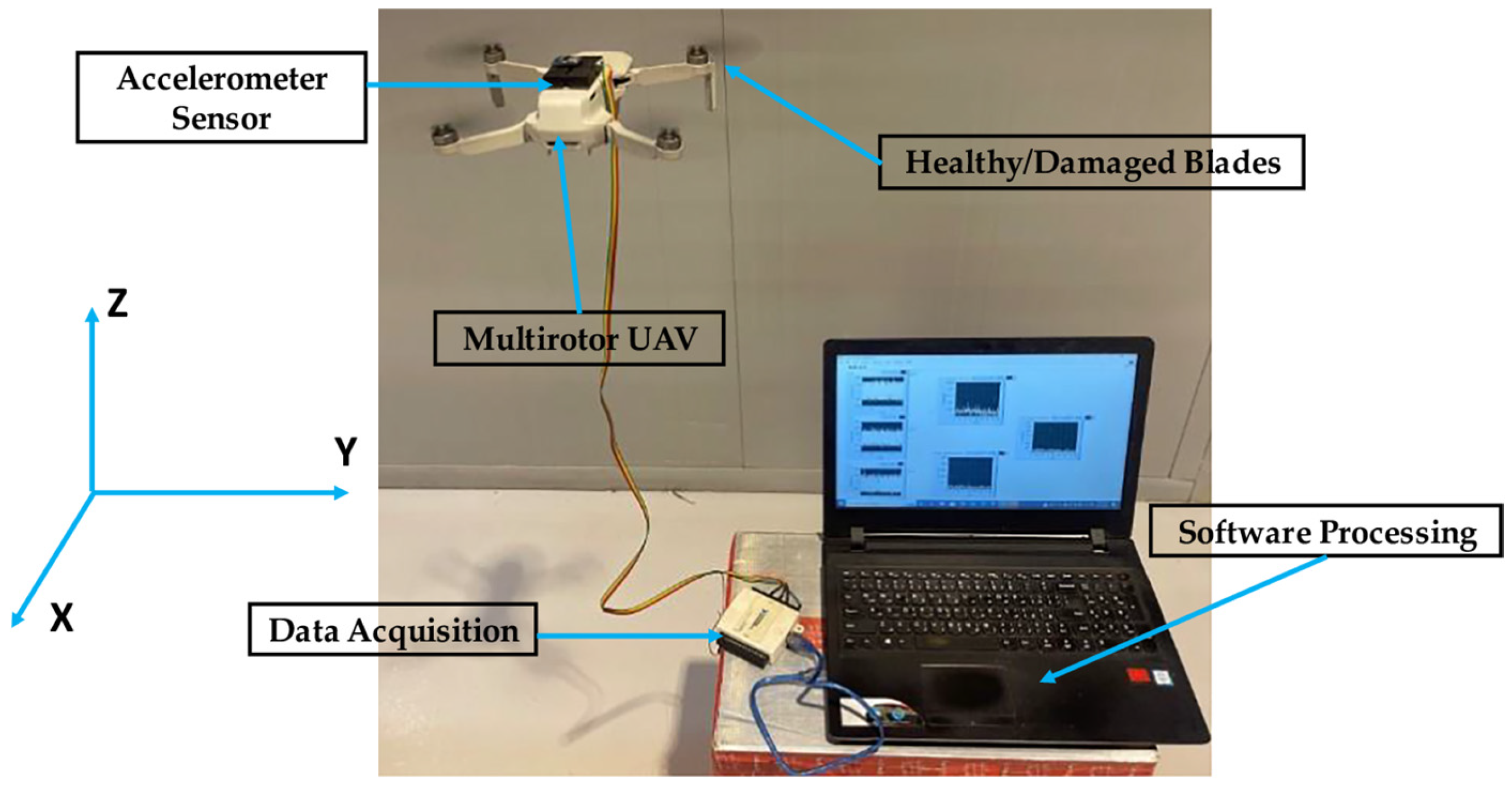
In this study, the performance of a data loading strategy called SE [19] is utilized on a publicly available multiaxial unmanned aerial vehicle (UAV) vibration dataset designed for propeller fault diagnosis. The dataset consists of a triaxial ADXL334 accelerometer (manufactured by Analog Devices, Wilmington, MA, USA) signal collected from a DJI Mini 2 quadcopter (manufactured by DJI, Shenzhen, China), where the sensor is rigidly mounted at the center of the UAV, and the data is collected while in hover mode, as seen in Figure 2. The accelerometer sensor is placed in the center to capture blade-induced vibration across the x, y, and z-axis. This dataset was collected using a National Instruments USB-6008 data acquisition (DAQ) system, which was connected to a PC with LabVIEW as the data collection software. Complete specifications of the UAV accelerometer and DAQ hardware are provided in the original dataset description [28].
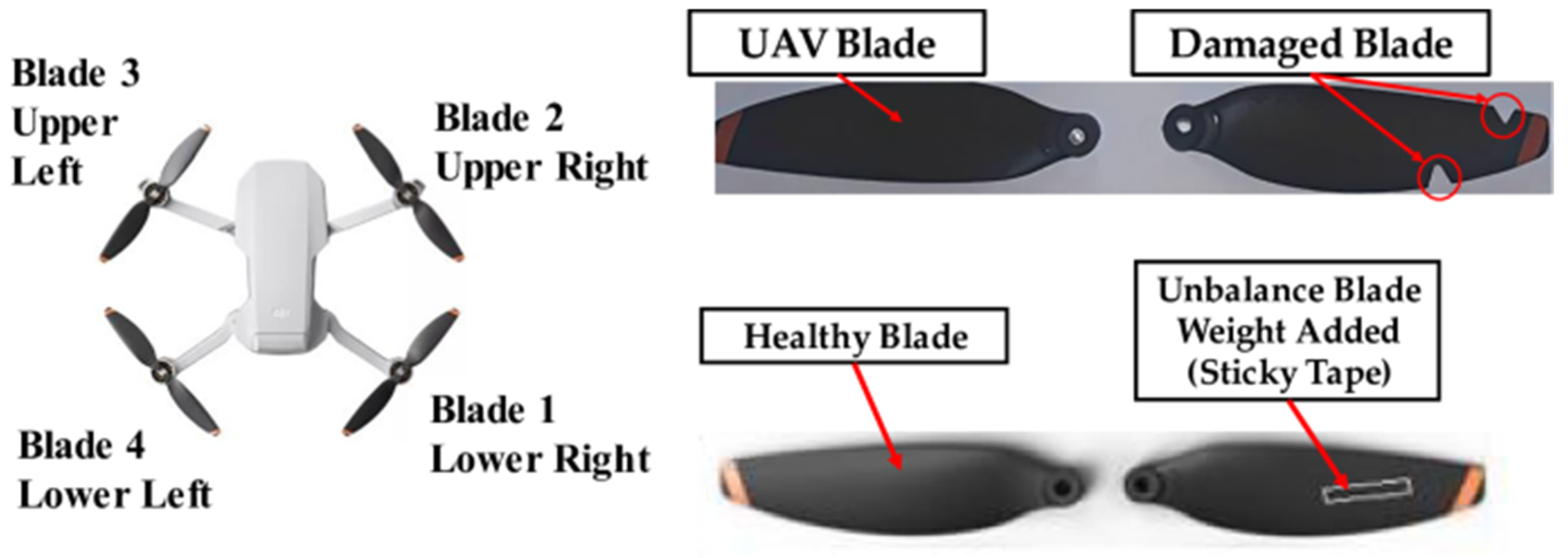
The dataset contains five flight conditions; (1) healthy blades, (2) mass removed from the bottom right blade, (3) mass removed from the top right blade, (4) unbalanced bottom right blade, and (5) unbalanced top right blade. For ease of understanding of each condition, Figure 3 is provided. Each condition has 400,000 continuous time series samples recorded over a 7 min indoor hover environment [28]. Each file consists of a four-column format, including time, and x, y, and z-axis acceleration data. The datasets are publicly available on the Springer Nature data repository [28].

2.2. Preprocessing and Signal Preparation

To make sure each class is comparable across different conditions, each raw signal is normalized by subtracting its mean and scaling to unit variance, which was done during the data collection stage on LabVIEW [28]. The fully processed signals from each axis are then segmented into shorter windows to apply to deep learning. Window sizes are selected to preserve both low frequency vibrations associated with rotor imbalance and high frequency transient responses that are caused by mass removal. Based on previous drone blade studies, an input signal of 4096 is selected, and only time series will be tested, due to varying frequency ranges and hover conditions [29,30]. This was done to make sure that the ablation study on the data loading strategy is compared without bias.
The vibration signals were sampled at 1600 Hz, resulting in a physical window duration of 2.56 s for each 4096 sample input. Each 100,000 sample segment was divided into fixed length windows of 4096 samples using a non-overlapping windowing strategy, such that no overlap was used between consecutive windows. This resulted in 24 time bins per segment per axis for each blade condition. This windowing procedure was applied consistently across all conditions and data loading strategies to ensure a fair ablation study.

2.3. SE Data Loading Strategy

This study uses SE, which is an existing data loading strategy (preprocessing) and applies it to the aerospace field via an ablation study and adds a mathematical explanation to why this method works more effectively. The key idea of SE is that the way data is loaded is just as important as how it is modeled. SE reorganizes the presentation of multiaxial vibration axis such that the model receives alternating axis and domain level window segments across training. This reduces memorizing axis-specific features and increases generalization of unseen operating conditions.
The UAV dataset was adjusted to have x, y, and z windows, which were treated as one domain with different drone blade conditions, each containing unique directional information about UAV blade dynamics during training. Each 400,000 signal length recording was divided into four non-overlapping segments of 100,000 samples. The first two segments (0–100 k, 100 k–200 k) were assigned to the training set, the third (200–300 k) to the validation set, and the fourth (300–400 k) to the test set. This ensures that no raw samples are shared between the training, validation, and test sets, while preserving the temporal structure within each recording.
For each sample i in the mini batch B t at iteration t , the time domain UAV vibration window is defined across five blade conditions as (Equation (1)).
x t ( i ) = D 1 ,   t ( i ) D 2 ,   t ( i ) D 3 ,   t ( i ) D 4 ,   t ( i ) D 5 ,   t ( i ) , D k , t ( i ) = x k , X , t ( i ) x k , Y , t ( i ) x k , Z , t ( i )   ϵ   R L ,
where k   ϵ   { 1 , , 5 } indexes the blade conditions, a   ϵ   X , Y , Z indexes the sensor axis, x k , a , t ( i )   ϵ   R L is a 4096 sample window from axis a , and L = 4096 . SE alternates the three sensor axis ( X , Y , Z ) within each blade condition by applying a permutation matrix sample at iteration t : (Equation (2)).
x ~ t ( i ) = P t D 1 , t ( i ) P t D 2 , t ( i ) P t D 3 , t ( i ) P t D 4 , t ( i ) P t D 5 , t ( i ) , P t   ϵ   { 0 , 1 } 3 × 3 , P t P t = I 3 .
where P t permutes the rows corresponding to the X , Y , a n d   Z -axis, the underlying 4096 sample signals remain unchanged, and only the loading order of the axis is alternated, which is consistent with the SE being a data loading strategy, rather than a signal transformation.
These formulations are supported by prior aerospace vibration studies that analyze triaxial accelerometer measurements in helicopter transmission and gearbox systems [15,16]. Tumer et al. investigated triaxial vibration data for helicopter gearbox health monitoring and showed that vibration responses measured along the x, y, and z directions evolve simultaneously under changes in gearbox dynamics and fault conditions [31]. Their analysis demonstrated that fault-related signatures are not confined to a single axis, but instead appear across multiple directions due to the shared mechanical excitation within the transmission system. Importantly, their study operated on raw time domain vibration signals, highlighting that transient events and amplitude variations occur jointly across axes, rather than independently.
Similarly, the NASA study on the AH-1 Cobra helicopter transmission analyzed maneuvering effects on transmission vibrations using triaxial accelerometers mounted on the gearbox [32]. The results showed that changes in operating conditions, such as maneuvering, speed, and load, lead to time-varying vibration responses that occur across all three measurement axes. This confirms that aerospace vibration signals are time-dependent and that triaxial measurements are correlated as a result of the same underlying excitation source acting on the structure.
Based on these observations, this study adopts the same physical assumption that triaxial vibration signals in aerospace systems should not be treated as independent channels in the raw time domain. Instead, correlated directional information should be preserved and systematically exposed during training. The SE data loading strategy follows this principle by reorganizing how multiaxial vibration signals are presented to the model, rather than altering the signal itself.
By alternating the axis ordering through the permutation matrix, SE prevents the model from memorizing axis-specific features, which may arise due to the fixed sensor orientation or mounting effects noted in both Tumer and Stone’s gearbox study and the NASA helicopter transmission experiments. Since the 4096 sample windows remain unchanged, SE does not modify the vibration waveform, frequency content, or temporal structure analyzed in these prior works. Instead, it changes only the loading order of the correlated axis, ensuring that the model learns blade condition relevant dynamics rather than axis dependent features.
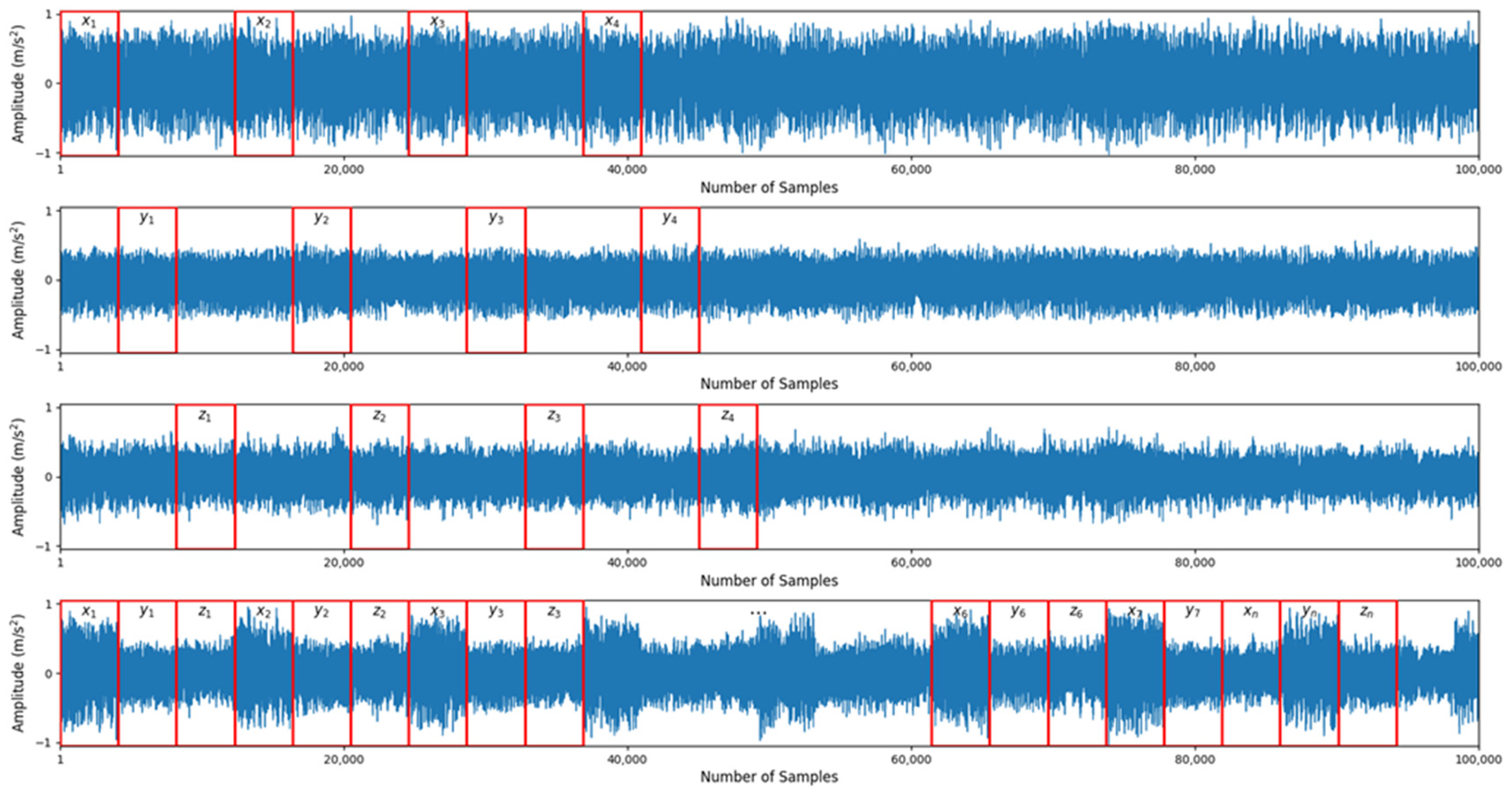
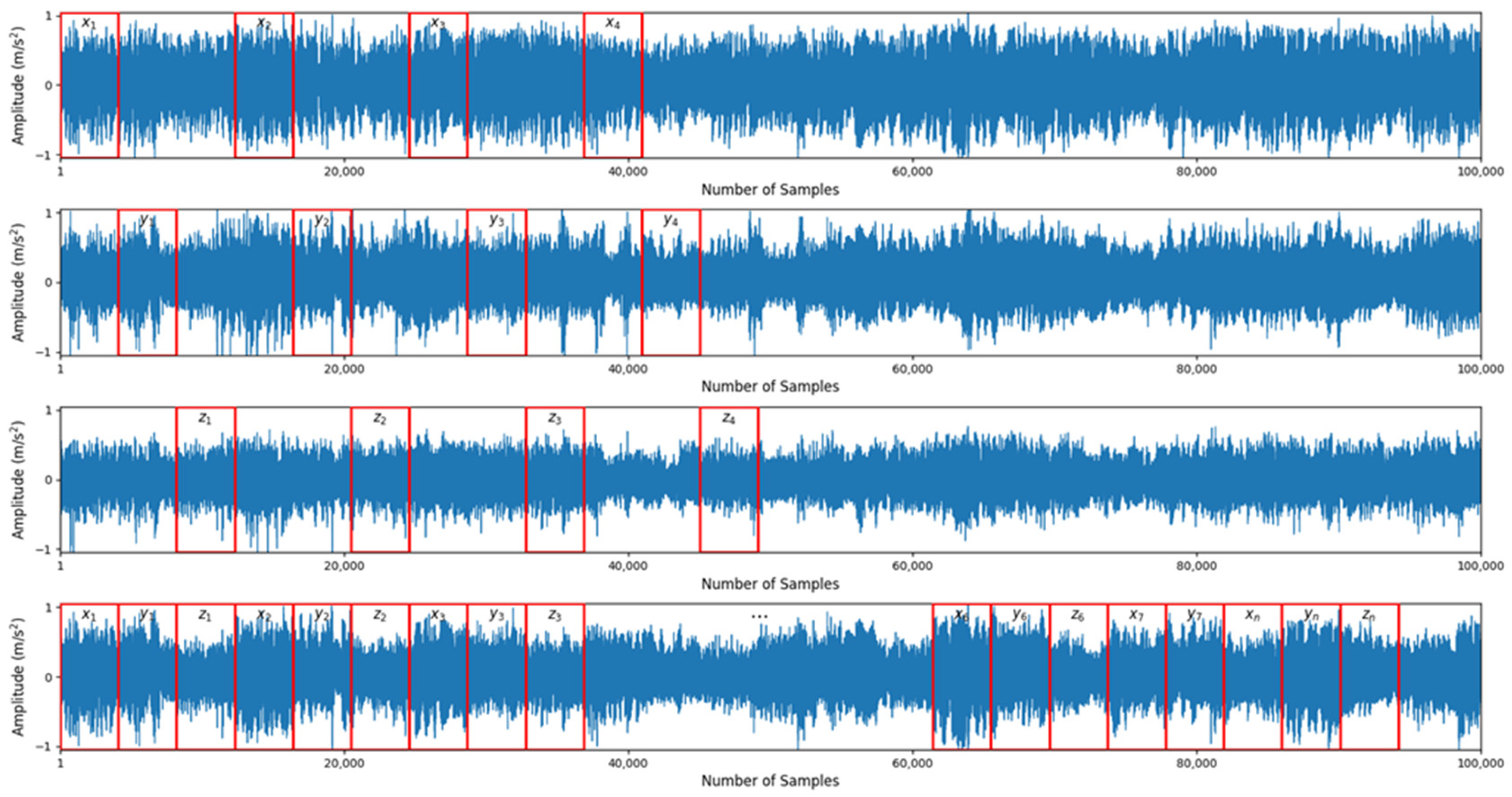
Figure 4 and Figure 5 show this process using raw x, y, and z-axis UAV vibration signals. As shown, fixed-length time domain bins of 4096 samples (highlighted by red boxes) are sequentially extracted from each axis until a total stream length of 100,000 samples is reached for each blade condition label. This segmentation strategy consists of the time domain analysis used in both helicopter gearbox and transmission vibration studies, while extending it through SE by alternating the axis level during training, validation and testing.
Therefore, SE builds directly on the established aerospace vibration literature by leveraging the nature of triaxial time domain measurements identified in helicopter gearbox and transmission studies. By incorporating this physical insight into the data loading process, SE improves generalization to unseen operating conditions without violating the underlying mechanics of aerospace vibration signals.

2.4. Deep Learning Architecture

A 1D-CNN architecture using convolutional layers, batch normalization (BatchNorm), rectified linear unit (ReLU) activation, and an AdaptiveMaxPool layer was used to classify the UAV vibration windows into the five blade conditions seen in Table 2. The network consisted of three convolutional layers, followed by two fully connected layers. The fully connected layers included dropout to reduce overfitting. The model was trained using an adaptive moment estimation (Adam) optimizer, learning rate of 0.001, batch size of 32, a loss function using cross-entropy, and 30 epochs.
Three baselines were created for comparison:
  • Traditional single-axis input (e.g., X-axis only).
  • Traditional single-axis input (e.g., Y-axis only).
  • Traditional single-axis input (e.g., Z-axis only).
SE was evaluated against these baselines under identical training conditions, network depth, and optimization settings to isolate the impact of the data loading strategy rather than architectural differences.

2.5. Evaluation Metrics

Model performance was assessed using classification accuracy, precision, recall, F1-score, and confusion matrices. For the multi class classification problem, precision, recall, and F1-score were computed using macro averaging across all blade condition classes, ensuring equal contribution from each class and consistency with the confusion matrix analysis. In addition to the overall performance, per class metrics were reported to analyze fault-specific classification behavior. To reflect aerospace diagnosis scenarios, the evaluation included a missing axis, where one or more vibration channels were intentionally removed during inference. This analysis assesses the robustness of the trained models under partial sensor availability, which is common in UAV monitoring applications.

2.6. Domain Evaluation

A domain evaluation was adopted, rather than random sample-level cross-validation. In this study, a domain refers to a non-overlapping temporal segment of the UAV vibration signal, as defined in Table 3, to prevent information leakage between training, validation, and test data.
Specifically, a one-domain-left-out evaluation strategy was adopted, where one temporal domain was held out for testing while the remaining domains were used for training and validation, as defined in Table 3. This procedure was repeated such that each domain was used once as the test domain. To account for training variability, each test-domain-left-out experiment was repeated ten times, using different random initializations, while keeping the domain split fixed. For each trial, the model was trained from scratch and evaluated on the held-out temporal domain. The reported results correspond to the average performance across the ten independent runs, providing a stable estimate of model performance and training variability.
This evaluation strategy emphasizes robustness to unseen temporal segments, rather than performance under randomly mixed data, which better reflects UAV deployment scenarios [33].

3. Results and Discussion

This section consists of an ablation study of UAV data results.

3.1. Ablation Study

3.1.1. Ablation Experimental Setup

The ablation experiments are designed to compare the different data loading strategies, which consist of a traditional data loading approach where a single column of data is used, and SE, where the dataset is combined in an alternating fashion, as explained earlier. For the traditional data loading strategy, each axis is selected for proper comparison. In this study, A1, A2, and A3 denote traditional single-channel loading using the x, y, and z-axis, respectively, with a 1D-CNN, while A4 denotes the parallel data loading strategy, using all axis information with a 1D-CNN. Finally, M5 denotes the proposed SE method combining all three axes, while keeping the input length the same as a single channel, evaluated using a 1D-CNN. The selection of ablation experiments can be found in Table 4, where A1 to A4 represent the traditional data loading strategies, while M5 represents the SE method.

3.1.2. Ablation Experimental Results

The ablation experiments are conducted based on a five-label classification problem of the UAV dataset, where label 1 (L1) is healthy, label 2 (L2) is damaged bottom right blade, label 3 (L3) is damaged top right blade, label 4 (L4) is unbalanced bottom right blade, and label 5 (L5) is unbalanced top right blade. Table 5 shows the results of the ablation study in terms of precision, recall, F1-score, validation accuracy, test accuracy, and training time.
From Table 5, it can be observed that the proposed method M5 outperforms all ablation baselines (A1–A4) across all evaluation metrics. In particular, M5 achieves the highest precision (0.963), recall (0.963), and F1-score (0.964), indicating better classification performance across all five UAV blade conditions. In addition, M5 has the highest validation accuracy (98.06%) and test accuracy (97.50%), showing improved generalization compared to the baseline methods.
More importantly, M5 has a lower standard deviation in test accuracy (1.17) compared to A1 (2.66), A2 (2.26), A3 (3.09), and A4 (2.01). This reduction in variance highlights the increased stability and robustness of the SE strategy, indicating that the proposed method produces more consistent performance across training epochs. These improvements are achieved without any increase in training time, as M5 maintains a comparable training duration to the baseline methods. Overall, the results confirm that SE not only improves classification accuracy but also improves training stability, making it particularly well suited for UAV blade condition monitoring for a small dataset.
In addition to the single-axis baselines, the parallel data loading strategy (A4) was evaluated to assess whether simply increasing input dimensionality by stacking multi-axis signals provides similar benefits. As shown in Table 5, A4 achieves competitive accuracy compared to single-axis methods; however, it does not outperform SE. While A4 improves test accuracy relative to A1–A3, it exhibits a higher training time due to the expanded input dimensionality. This indicates that the performance gains observed with SE are not solely due to access to multi-axis information, but rather due to how this information is structured and presented to the learning algorithm.
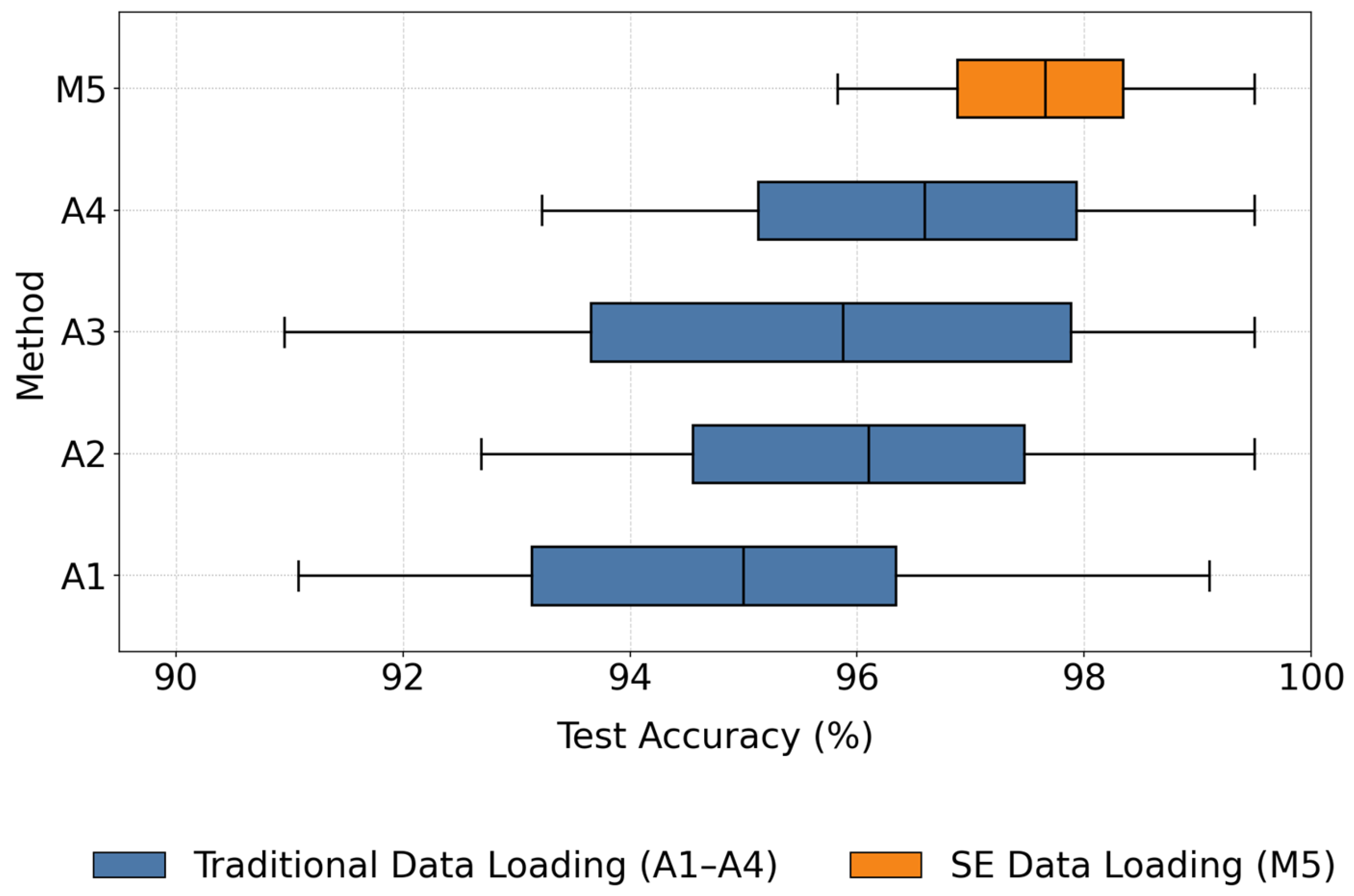
Figure 6 shows the distribution of test accuracies for the ablation methods by using box plots, providing a view of variability across testing. As shown in Figure 6, the proposed SE method (M5) achieves higher median test accuracy compared to all traditional data loading baselines (A1–A4). In addition to the improvement in median performance, M5 indicates a noticeably narrower standard deviation range shown in whiskers, indicating reduced dispersion in test accuracies.
In contrast, the traditional data loading methods show larger standard deviation variability across runs. Among them, A3 demonstrates the widest spread in performance, which aligns with its higher reported standard deviation in Table 5. This increased increase highlights the sensitivity of single-axis traditional loading strategies to initialization and training dynamics, particularly when operating under limited data conditions. A1 and A2 have more stable behavior than A3; however, both still present broader accuracy distributions when compared to M5.
The parallel loading strategy (A4) shows reduced variability compared to single-axis methods; however, its performance distribution remains wider than that of SE. This suggests that while parallel loading benefits from simultaneous multi-axis information, it does not provide the same level of stability as SE, which regulates axis exposure through structured alternation. The increased variance and longer training time observed for A4 further highlight that increasing input dimensionality can introduce optimization challenges under limited data conditions.
More importantly, Figure 6 visually confirms that the improvement achieved by M5 is not limited to isolated runs, but is consistently maintained across the entire distribution. This reduced variance justifies the claim that SE improves training stability by regulating how multi-axis information is presented to the learning algorithm. By alternating structured axis level segments, rather than relying on a single dominant direction, SE mitigates overfitting to axis-specific features and promotes more balanced feature learning.
Although traditional data loading can reach high peak accuracy, it suffers from increased standard deviation variability and inconsistent generalization. In contrast, SE achieves both higher accuracy and greater consistency, which explains the lower standard deviation observed for M5 and highlights its importance for UAV blade condition monitoring under small datasets.
From a signal processing and physical perspective, the performance gains achieved by SE can be explained by the nature of multi-axis vibration propagation in UAV blades. Blade damage and imbalance generate coupled vibration responses that are not confined to a single accelerometer axis but instead are distributed as energy across multiple directions due to structural coupling and rotor dynamics. Traditional single-axis loading forces the model to learn from a partial projection of this response, which can lead to axis-specific feature bias and unstable decision boundaries under limited data. By alternately embedding fixed-length segments from each axis into a single-input stream, SE preserves directional diversity while maintaining a constant input dimensionality. This structured alternation exposes the learning algorithm to complementary vibration characteristics within each sample, allowing for more robust feature learning that reflects the underlying physical behavior of the system, rather than axis domination. This explains both the improved classification accuracy and the reduced performance variance observed in the ablation results.
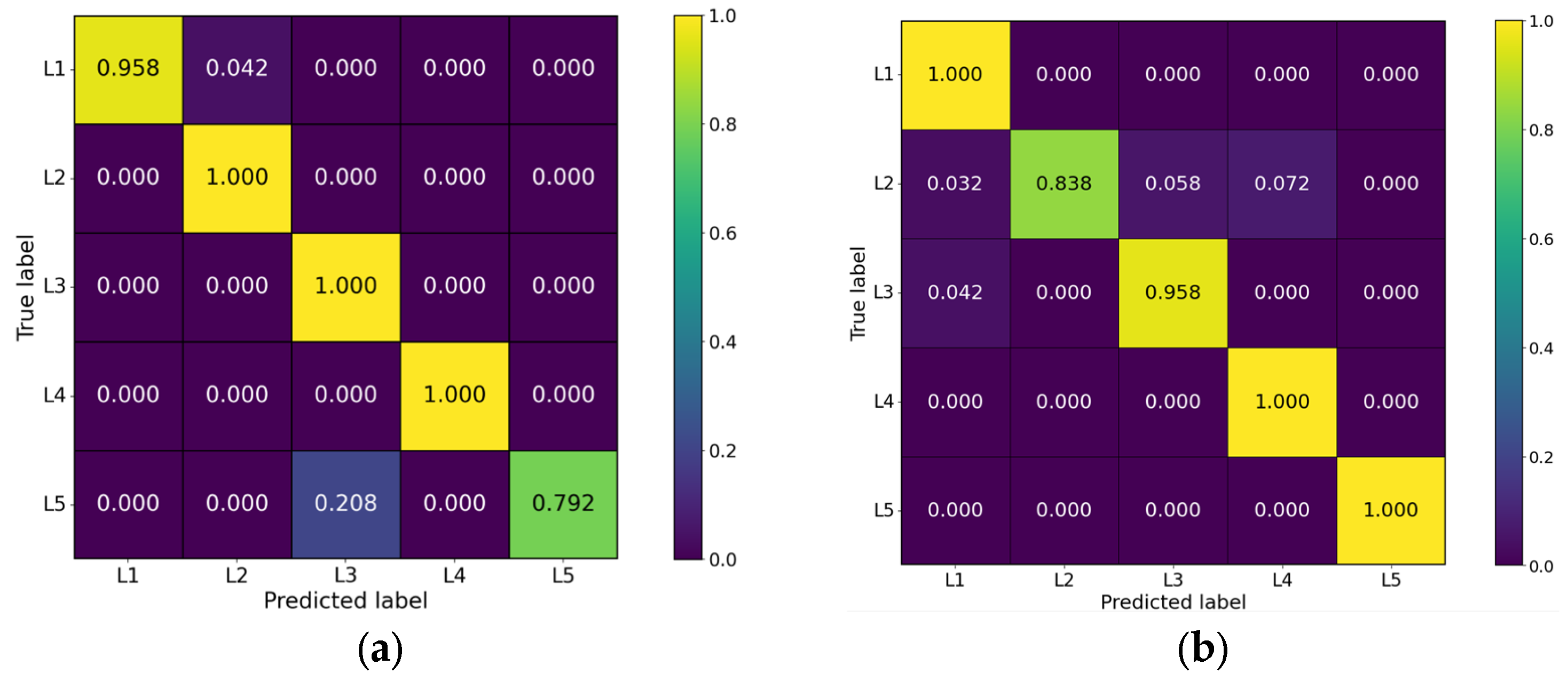
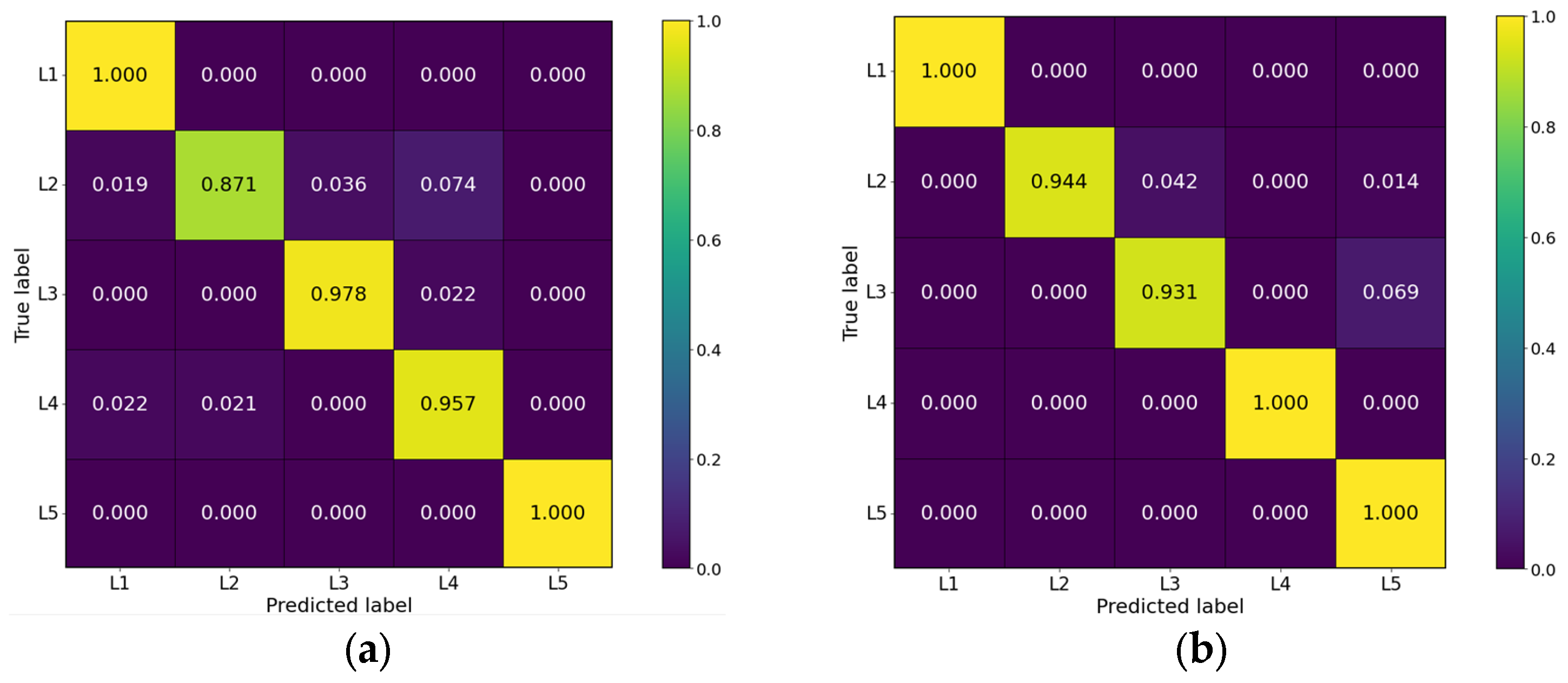
Figure 7 and Figure 8 further illustrate the individual class behavior of the results through confusion matrices. Specifically, Figure 7a,b correspond to the x and y-axis traditional data loading, while Figure 8a,b present the z-axis traditional loading and the SE method, respectively. These figures provide insight into how each method performs at the individual labels, rather than only through previously provided metrics.
From Figure 8a,b, it can be observed that traditional loading using the x-axis signals achieves strong classification performance for labels L2–L4; however, misclassification is seen for label L5 for the x-axis (unbalanced top right blade), while the y-axis has misclassification for the L2 and L3 cases. In particular, L5 shows confusion with L3 in the x loading case, indicating that single-axis representations are not enough to fully capture the dynamic characteristics of this label. Similar trends are observed for the L1 y-axis, where minor data leakage with other classes indicates overlap in the learned feature space under traditional loading.
Figure 8a, which corresponds to the z-axis traditional loading, shows good results for certain classes due to the dominant vibration content that is typically present along the vertical axis during UAV operation. While L1 and L5 benefit from this axis dominance, confusion remains for L2, indicating that reliance on a single dominant axis leads to class-specific bias and inconsistent signal assessment across all blade conditions.
In contrast, Figure 8b shows that the SE method achieves near-perfect diagonal dominance across all five labels, with reduced off-diagonal accuracies for each label. Notably, L1, L4 and L5 show a better improvement compared to all traditional loading cases, indicating that SE effectively mitigates the ambiguity observed between unbalanced and damaged blade conditions. This confirms that alternating and structured exposure to multi-axis information allows the ML algorithm to learn complementary cross-axis representations, rather than overfitting to a single dominant signal direction.
Overall, the confusion matrix analysis matches the quantitative results reported in Table 5. While traditional loading strategies can achieve high accuracy for certain labels, they suffer from label-dependent instability and increased variance, particularly for complex fault classes such as L2 and L5. The SE data loading strategy not only improves the overall classification accuracy but also achieves a more uniform and stable per-class performance, which explains the reduced standard deviation observed in the test accuracy. These results demonstrate that SE enhances robustness at the label level, validating its effectiveness for UAV blade condition monitoring.

4. Conclusions

This work demonstrated that data loading strategies have an important role in ML performance for UAV blade condition monitoring, particularly under small datasets. Through an ablation study on a five-label UAV vibration dataset, a traditional loading strategy and an SE data loading strategy are compared, and SE outperformed all traditional loading baselines across precision, recall, F1-score, validation accuracy, and test accuracy. More importantly, SE achieved a lower standard deviation in test accuracy, indicating improved training stability and robustness compared to traditional loading methods. In addition, confusion matrix analysis showed that traditional loading strategies suffer from label-dependent instability, particularly for complex fault conditions such as damaged and unbalanced blade cases, due to reliance on single-axis information. In contrast, SE achieved consistent diagonal dominance across all labels by ensuring structured and alternating exposure to multi-axis vibration information, allowing the learning algorithm to capture cross-axis representations rather than axis-specific features. These improvements were achieved without any increase in training time, confirming that SE improves information efficiency, rather than computational complexity. Overall, the results validate SE as an effective data loading strategy for UAV blade condition monitoring and show that how data are presented to a learning algorithm is as important as how the model itself is designed.
Despite these results, this study is limited to a single publicly available UAV vibration dataset collected under hover conditions. Future work will focus on validating the proposed data loading strategy under additional flight conditions and more diverse datasets to further assess generalization. In addition, while temporal domain scenarios are defined in Section 2.6, future work will extend this analysis to more systematic sensor cases to further quantify robustness under different sensor availability in realistic UAV monitoring conditions.

Author Contributions

Conceptualization, methodology, software, validation, formal analysis, investigation, data curation, writing—original draft preparation, visualization, M.S.; writing—review and editing, all authors: M.S., T.Y., G.V. and S.C. All authors have read and agreed to the published version of the manuscript.

Funding

This research received no external funding.

Data Availability Statement

Data is available upon request.

Conflicts of Interest

The authors declare no conflicts of interest.

Abbreviations

The following abbreviations are used in this manuscript:
AdamAdaptive moment estimation
BatchNormBatch normalization
CNNConvolutional neural network
DAQData acquisition
LSTMLong short term memory
MLMachine learning
ReLuRectified linear unit
SESelective embedding
UAVUnmanned aerial vehicle

References

  1. Ozkat, E.C. Vibration Data-Driven Anomaly Detection in UAVs: A Deep Learning Approach. Eng. Sci. Technol. Int. J. 2024, 54, 101702. [Google Scholar] [CrossRef]
  2. He, Y.; Fang, H.; Yan, J.; Yang, C.; Zhai, Y. Computationally Efficient UAV Fault Diagnosis with Adaptive Vibration Denoising: A Signal Processing Approach for Rotorcraft Systems. Mech. Syst. Signal Process. 2025, 240, 113413. [Google Scholar] [CrossRef]
  3. Adaika, Z.; Al-Haddad, L.A.; Giernacki, W.; Jaber, A.A.; Boumehraz, M.; Hamzah, M.N.; Flayyih, M.A. Fault Detection and Diagnosis Methodologies for Unmanned Aerial Vehicles: State-of-the-Art. J. Intell. Robot. Syst. 2025, 111, 63. [Google Scholar] [CrossRef]
  4. Ma, Y.; Sun, Y.; Chen, L.; Wang, H.; Liu, B. Self-Attention Enhanced GraphSAGE for UAV Fault Diagnosis Using Vibration Signals. Sci. Rep. 2026, 16, 2004. [Google Scholar] [CrossRef]
  5. Zou, Y.; Xia, H.; Yang, X.; Li, P.; Yi, Y.; Zou, Y.; Xia, H.; Yang, X.; Li, P.; Yi, Y. Dynamics Model of a Multi-Rotor UAV Propeller and Its Fault Detection. Drones 2025, 9, 176. [Google Scholar] [CrossRef]
  6. Sonmezocak, T. Intelligent UAV Health Monitoring: Detecting Propeller and Structural Faults with MEMS-Based Vibration. Eng. Sci. Technol. Int. J. 2025, 69, 102130. [Google Scholar] [CrossRef]
  7. Liang, X.; Zhang, M.; Feng, G.; Wang, D.; Xu, Y.; Gu, F. Few-Shot Learning Approaches for Fault Diagnosis Using Vibration Data: A Comprehensive Review. Sustainability 2023, 15, 14975. [Google Scholar] [CrossRef]
  8. Mowla, M.d.N.; Asadi, D.; Sohel, F. Real-Time Fault Detection in Multirotor UAVs Using Lightweight Deep Learning and High-Fidelity Simulation Data with Single and Double Fault Magnitudes. Complex Intell. Syst. 2025, 12, 62. [Google Scholar] [CrossRef]
  9. Shang, X.; Li, W.; Yuan, F.; Zhi, H.; Gao, Z.; Guo, M.; Xin, B.; Shang, X.; Li, W.; Yuan, F.; et al. Research on Fault Diagnosis of UAV Rotor Motor Bearings Based on WPT-CEEMD-CNN-LSTM. Machines 2025, 13, 287. [Google Scholar] [CrossRef]
  10. Al-Haddad, L.A.; Giernacki, W.; Shandookh, A.A.; Jaber, A.A.; Puchalski, R. Vibration Signal Processing for Multirotor UAVs Fault Diagnosis: Filtering or Multiresolution Analysis? Eksploat. i Niezawodn. Maint. Reliab. 2023, 26, 176318. [Google Scholar] [CrossRef]
  11. Yaman, O.; Yol, F.; Altinors, A. A Fault Detection Method Based on Embedded Feature Extraction and SVM Classification for UAV Motors. Microprocess. Microsyst. 2022, 94, 104683. [Google Scholar] [CrossRef]
  12. Puchalski, R.; Ha, Q.; Giernacki, W.; Nguyen, H.A.D.; Nguyen, L.V. PADRE—A Repository for Research on Fault Detection and Isolation of Unmanned Aerial Vehicle Propellers. J. Intell. Robot. Syst. 2024, 110, 74. [Google Scholar] [CrossRef]
  13. Azari, M.S.; Santini, S.; Edrisi, F.; Flammini, F. Self-Adaptive Fault Diagnosis for Unseen Working Conditions Based on Digital Twins and Domain Generalization. Reliab. Eng. Syst. Saf. 2025, 254, 110560. [Google Scholar] [CrossRef]
  14. Gaitan, M.; López Bautista, I.M.; Geist, J. Reduction of Calibration Uncertainty Due to Mounting of Three-Axis Accelerometers Using the Intrinsic Properties Model. Metrologia 2021, 58, 035006. [Google Scholar] [CrossRef]
  15. Jatiningrum, D.; van Paassen, M.; de Visser, C.C.; Chu, Q.P.; Mulder, M. Investigating Cross-Axis Sensitivity and Misalignment in an Angular Accelerometer Measurement Unit. In AIAA Guidance, Navigation, and Control Conference; American Institute of Aeronautics and Astronautics: Reston, VA, USA, 2011. [Google Scholar]
  16. Bruschi, P.; Nannini, A.; Paci, D.; Pieri, F. A Method for Cross-Sensitivity and Pull-in Voltage Measurement of MEMS Two-Axis Accelerometers. Sens. Actuators A Phys. 2005, 123–124, 185–193. [Google Scholar] [CrossRef]
  17. Structural Health Monitoring Damage Detection Systems for Aerospace; Sause, M.G.R., Jasiūnienė, E., Eds.; Springer Nature: Berlin/Heidelberg, Germany,, 2021. [Google Scholar]
  18. Kumar, D.; Mehran, S.; Shaikh, M.Z.; Hussain, M.; Chowdhry, B.S.; Hussain, T. Triaxial Bearing Vibration Dataset of Induction Motor under Varying Load Conditions. Data Brief 2022, 2, 108315. [Google Scholar] [CrossRef]
  19. Sehri, M.; Hua, Z.; de Assis Boldt, F.; Dumond, P. Selective Embedding for Deep Learning. Knowl. Based Syst. 2025, 330, 114535. [Google Scholar] [CrossRef]
  20. Apparatus & Procedures|Case School of Engineering. Available online: https://engineering.case.edu/bearingdatacenter/apparatus-and-procedures (accessed on 18 December 2025).
  21. Sehri, M.; Dumond, P. University of Ottawa Rolling-Element Dataset—Vibration and Acoustic Faults under Constant Load and Speed Conditions (UORED-VAFCLS). Mendeley Data 2023, 5. [Google Scholar] [CrossRef]
  22. Sehri, M.; Dumond, P. University of Ottawa Electric Motor Dataset—Vibration and Acoustic Faults under Constant and Variable Speed Conditions (UOEMD-VAFCVS). Mendeley Data 2023, 1. [Google Scholar] [CrossRef]
  23. Ding, A.; Qin, Y.; Wang, B.; Guo, L.; Jia, L.; Cheng, X. Evolvable Graph Neural Network for System-Level Incremental Fault Diagnosis of Train Transmission Systems. Mech. Syst. Signal Process. 2024, 210, 111175. [Google Scholar] [CrossRef]
  24. Sehri, M.; Ayres, L.M.; de Assis Boldt, F.; Dumond, P.; de Souza Leite Cuadros, M.A. An Accelerometer-Based Dataset for Monitoring Slag in Steel Manufacturing. BMC Res. Notes 2025, 18, 420. [Google Scholar] [CrossRef]
  25. Sehri, M.; Beatriz Cardoso, A.; de Assis Boldt, F.; Dumond, P. Industrial Steel Slag Flow Data Loading Method for Deep Learning Applications. Expert Syst. Appl. 2026, 300, 130457. [Google Scholar] [CrossRef]
  26. Li, C.; Wang, H.; Li, C.; Zhang, Y.; Feng, Y.; Zhang, X.; Negnevitsky, M. Coupled Noise-Aware UAV Fault Diagnosis Based on Learnable Wavelet Packet Transform and Scale-Graph Label Enhancement. IEEE Internet Things J. 2025, 12, 52913–52926. [Google Scholar] [CrossRef]
  27. Li, C.; Xie, W.; Zheng, B.; Yi, Q.; Yang, L.; Hu, B.; Deng, C. An Enhanced CLKAN-RF Framework for Robust Anomaly Detection in Unmanned Aerial Vehicle Sensor Data. Knowl. Based Syst. 2025, 319, 113690. [Google Scholar] [CrossRef]
  28. Al-Haddad, L.A.; Jaber, A.A.; Hamzah, M.N.; Kraiem, H.; Al-Karkhi, M.I.; Flah, A. Multiaxial Vibration Data for Blade Fault Diagnosis in Multirotor Unmanned Aerial Vehicles. Sci. Data 2025, 12, 1383. [Google Scholar] [CrossRef]
  29. Du, C.; Zhang, X.; Zhong, R.; Li, F.; Yu, F.; Rong, Y.; Gong, Y. Unmanned Aerial Vehicle Rotor Fault Diagnosis Based on Interval Sampling Reconstruction of Vibration Signals and a One-Dimensional Convolutional Neural Network Deep Learning Method. Meas. Sci. Technol. 2022, 33, 065003. [Google Scholar] [CrossRef]
  30. Baldini, A.; Felicetti, R.; Ferracuti, F.; Freddi, A.; Iarlori, S.; Monteriù, A. Real-Time Propeller Fault Detection for Multirotor Drones Based on Vibration Data Analysis. Eng. Appl. Artif. Intell. 2023, 123, 106343. [Google Scholar] [CrossRef]
  31. Tumer, I.Y.; Huff, E.M. Analysis of Triaxial Vibration Data for Health Monitoring of Helicopter Gearboxes. J. Vib. Acoust. 2003, 125, 120–128. [Google Scholar] [CrossRef]
  32. Huff, E.; Tumer, I.; Mcnames, J. An Analysis of Maneuvering Effects on Transmission Vibrations in an AH1 Cobra Helicopter. J. Am. Helicopter Soc. 2002, 47, 42–49. [Google Scholar] [CrossRef]
  33. Magliacano, D.; Tufano, V.; Letizia, A.; Sessa, B.; Filippi, M. Data-Driven Failure Criteria Prediction in Composite Wing Boxes Using Machine Learning. Compos. Struct. 2025, 373, 119675. [Google Scholar] [CrossRef]
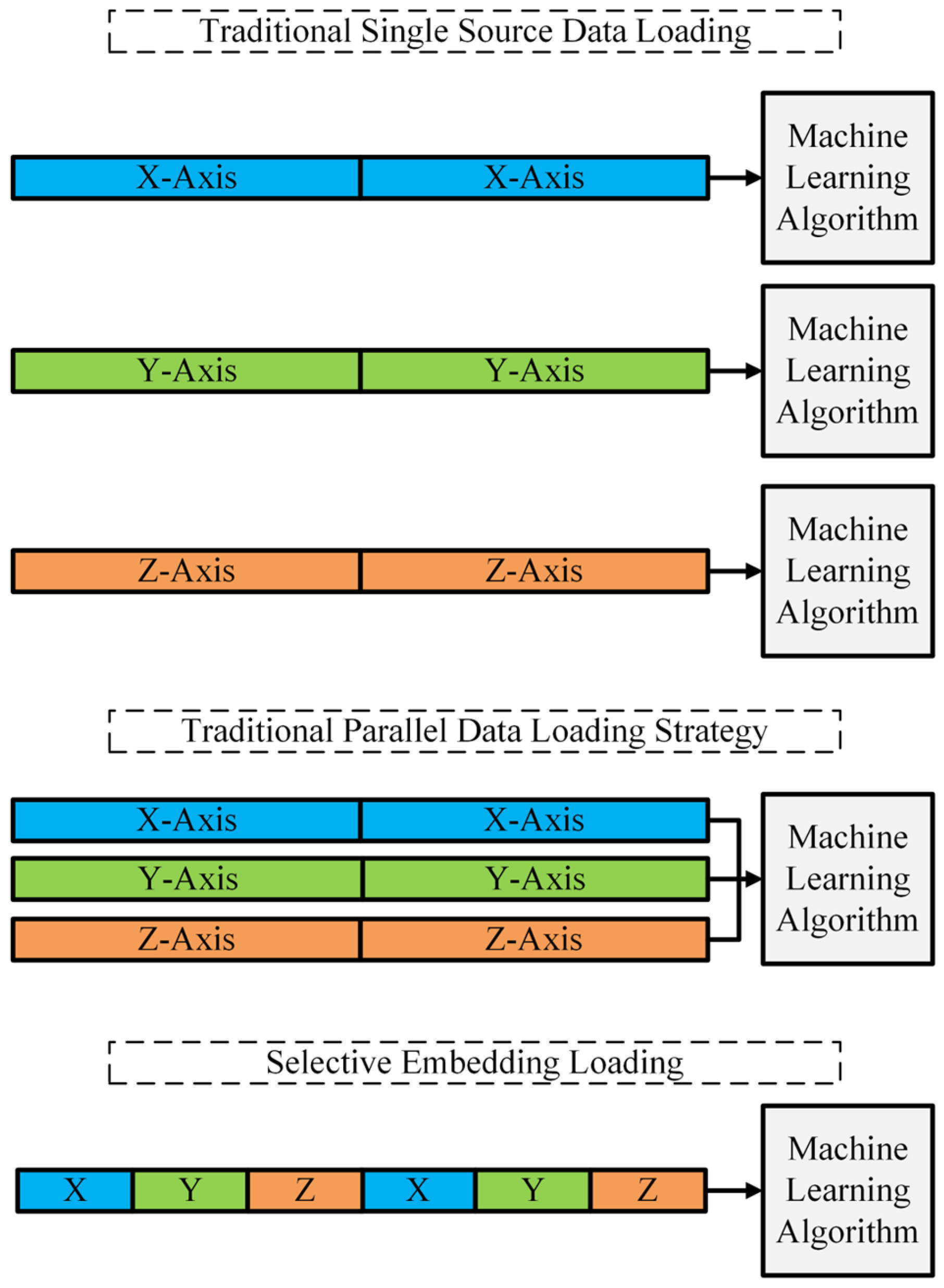
Figure 1. Data loading strategies. The colors represent the different axes.
Machines 14 00241 g001
Figure 2. Experimental setup of the drone blade with triaxial accelerometer [28].
Machines 14 00241 g002
Figure 3. Experimental condition labels [28].
Machines 14 00241 g003
Figure 4. The first three plots show that the x, y, and z-axis extracted signals respectively, where the red boxes represent the time domain bins. The signals are reconstructed in the fourth plot, which represents the SE data loading strategy at the time domain level. The fourth plot is an example of how SE is applied to a healthy rotor time signal, which consisted of 100,000 signals.
Machines 14 00241 g004
Figure 5. The first three plots show that the x, y, and z-axis extracted signals respectively, where the red boxes represent the time domain bins. The signals are reconstructed in the fourth plot, which represents the SE data loading strategy at the time domain level. The fourth plot is an example of how SE is applied to a damaged bottom right blade time signal, which consisted of 100,000 signals.
Machines 14 00241 g005
Figure 6. Ablation experiment results for test accuracy and standard deviation for the methods tested.
Machines 14 00241 g006
Figure 7. Confusion matrix results for traditional single-channel data loading (a) x-axis; (b) y-axis.
Machines 14 00241 g007
Figure 8. Confusion matrix results for (a) traditional single-channel data loading z-axis and (b) SE data loading combined x, y, z results.
Machines 14 00241 g008
Table 1. SE existing cross-domain results across different fields.
FieldSource TypeModelTest Accuracy and Standard Deviation
Heavy MachineryBearing [18]1D-Convolutional Neural Network (CNN) 95.64 ± 0.31 [19]
Bearing [20] 84.82 ± 2.72 [19]
Bearing [21] 94.21 ± 5.69 [19]
Induction Electrical Motor [22] 95.31 ± 0.31 [19]
RailwayRailway [23] 97.64 ± 4.95 [19]
ManufacturingSteel Slag [24]CNN–long short term memory (LSTM) 99.10 ± 0.30 [25]
Table 2. The 1D-CNN architecture.
LayersStructures
1Conv1d(1, 16, kernel_size = 7), BatchNorm1d(16), ReLU, MaxPool1d(kernel_size = 2, stride = 2)
2Conv1d(16, 32, kernel_size = 5), BatchNorm1d(32), ReLU, MaxPool1d(kernel_size = 2, stride = 2)
3Conv1d(32, 64, kernel_size = 3), BatchNorm1d(64), ReLU
4AdaptiveMaxPool1d(output_size = 1)
5Linear(64, 64), ReLU, Dropout
6Linear(64, 5)
Table 3. Domain splitting of the UAV dataset.
Domain NameCSV Files of Blade Classes
HealthyDamaged Bottom Right BladeDamaged Top Right BladeUnbalanced Bottom Right BladeUnbalanced Top Right Blade
10 to 100 k samples0 to 100 k samples0 to 100 k samples0 to 100 k samples0 to 100 k samples
2100 k to 200 k samples100 k to 200 k samples100 k to 200 k samples100 k to 200 k samples100 k to 200 k samples
3200 k to 300 k samples200 k to 300 k samples200 k to 300 k samples200 k to 300 k samples200 k to 300 k samples
4300 k to 400 k samples300 k to 400 k samples300 k to 400 k samples300 k to 400 k samples300 k to 400 k samples
Table 4. Ablation experiments with a batch size of 32, and an input signal length of 4096.
Accelerometer Data Axis
MethodData Loading Typexyz
A1Single Channelx
A2Single Channel x
A3Single Channel x
A4Parallel Loadingxxx
M5SExxx
Table 5. Ablation experiments results.
% and Standard Deviation
MethodPrecisionRecallF1-ScoreValidation AccuracyTest AccuracyTime for Training (s)
A10.9470.9400.94996.07 95.01 ± 2.66 58.15
A20.9560.9550.95596.46 95.92 ± 2.26 59.27
A30.9570.9580.95497.31 96.11 ± 3.09 59.52
A40.9550.9540.95597.42 96.55 ± 2.01 178.15
M50.9630.9630.96498.06 97.50 ± 1.17 58.22
Disclaimer/Publisher’s Note: The statements, opinions and data contained in all publications are solely those of the individual author(s) and contributor(s) and not of MDPI and/or the editor(s). MDPI and/or the editor(s) disclaim responsibility for any injury to people or property resulting from any ideas, methods, instructions or products referred to in the content.