1. Introduction
Refrigeration systems account for a significant proportion of global energy consumption [
1,
2]. Conventional vapor compression systems, which are widely used, cause environmental impacts due to the refrigerants they contain. This situation has increased interest in more environmentally friendly and efficient cooling technologies [
3,
4]. Magnetic refrigeration systems stand out among alternative cooling technologies because they operate without refrigerants and without compressors [
5,
6,
7,
8]. Magnetic refrigeration is based on the magnetocaloric effect. In these systems, applying and removing a magnetic field causes a temperature change in the magnetocaloric material. This effect serves cooling purposes when implemented within a suitable cycle structure [
9,
10,
11,
12,
13].
Many experimental prototypes of magnetic refrigeration systems have been reported in the literature. These studies include reciprocating systems, linear drive structures, rotating magnetic field arrangements, and Halbach arrays. In these works different regeneration geometries, various magnetocaloric materials, and different fluid configurations have been tested [
14,
15,
16,
17,
18,
19,
20,
21]. The main objective of these studies is to increase magnetic field intensity. Another objective is to enlarge temperature spans across regenerators. Increasing cooling power is also among the primary targets.
Most studies focus on improving mechanical design, enhancing the magnetic field source, and increasing thermal performance [
22,
23,
24,
25]. Experimental results are mainly reported in terms of indicators such as cooling power, regenerator temperature span, and coefficient of performance (COP) [
26,
27,
28]. Although some studies have tested different parameter sets, these changes have generally been made manually between experiments [
29,
30,
31,
32,
33]. Measurement-based automatic adaptation during operation appears in only a limited number of studies in the literature [
34,
35]. Therefore, most systems do not update their operating conditions within the same experiment based on their own outputs. This situation can lead to instability between successive cycles.
In this study, a software-based control approach driven by cycle-level performance feedback is developed for magnetic refrigeration systems. Control is defined based on the performance output of each cycle, and the system can update its operating conditions according to its own output. Control is based on the combined performance of multiple physical processes. The approach is implemented on the experimental infrastructure and prototype developed in the authors’ previous studies [
36]. The method is tested on real hardware over long-term operation. The proposed architecture and control approach have been registered as a patent by the Turkish Patent and Trademark Office, supporting their originality [
37]. The contributions of this study can be summarized as follows:
- i.
A software architecture that directly integrates cycle-based performance evaluation into the decision logic is defined. This structure provides an alternative framework to the time-based approaches commonly used in magnetic refrigeration studies.
- ii.
A structure is proposed to combine measurements from different sub-processes within a single decision layer. This approach addresses the control problem from a system-level perspective.
- iii.
Rule-based decision logic is developed to update control parameters on a cycle-by-cycle basis. In this way, the system can adapt based on its own output without relying on manual adjustments.
- iv.
An operating structure is demonstrated in which measurement data are used not only for reporting but also directly as control inputs. This shifts the role of measurement in experimental magnetic refrigeration studies from passive observation to active decision input.
- v.
The control approach is experimentally implemented on a reciprocating magnetic refrigerator prototype. This application demonstrates that the proposed structure is also applicable to real hardware.
In the remainder of the paper,
Section 2 explains the proposed software-based control architecture and method in detail.
Section 3 presents the cycle-based decision logic.
Section 4 introduces the experimental prototype and measurement infrastructure and describes the integration of the method into the system.
Section 5 presents experimental results and discussion.
Section 6 presents the overall conclusions.
2. System Architecture and Method
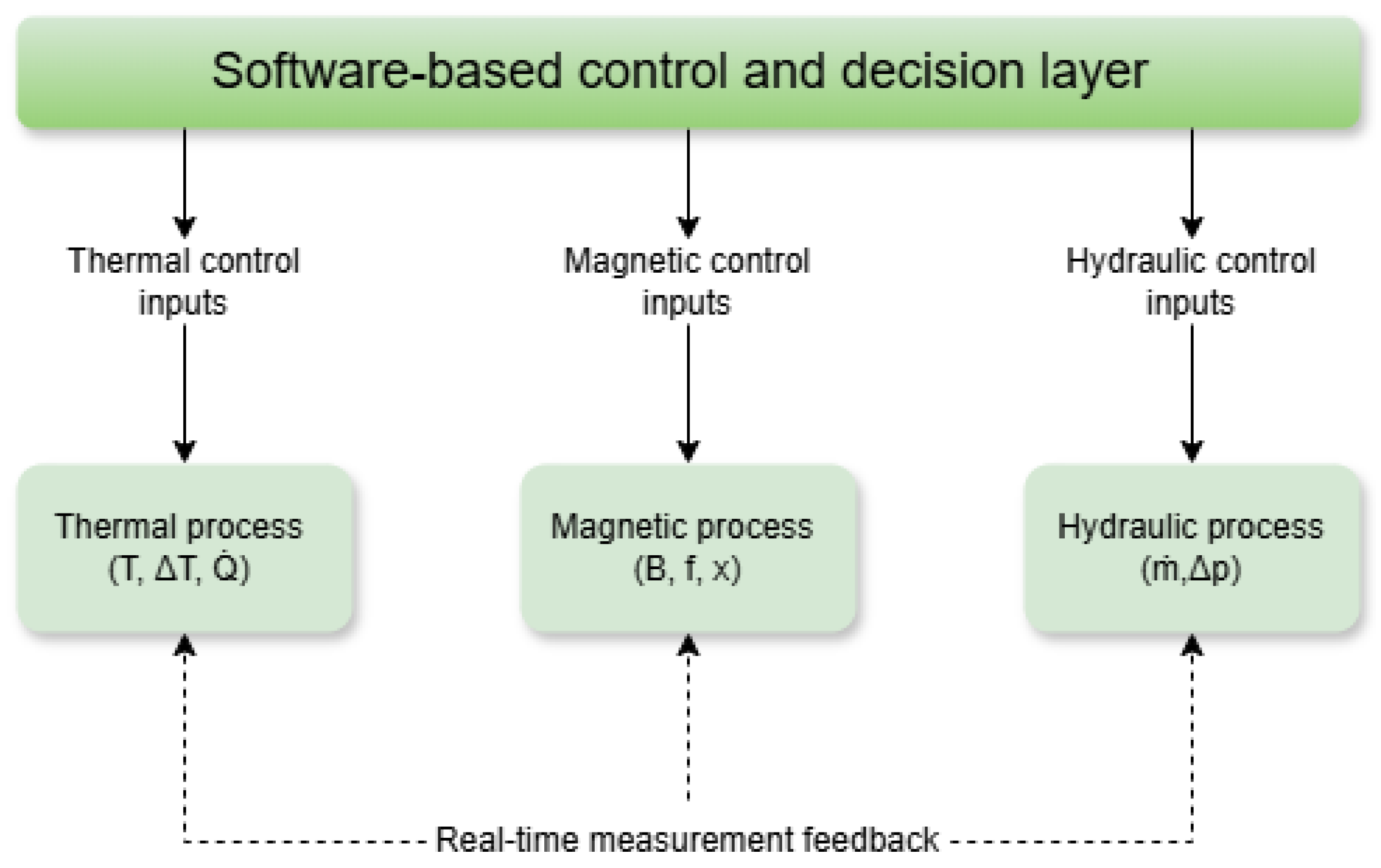
In this study, software-based automation and control architecture is developed for magnetic refrigeration systems. The architecture combines measurement data obtained from magnetic, thermal, and hydraulic sub-processes within a single decision structure. The system state is evaluated based on these data. Control actions are applied to the subsystems in a specific and coordinated manner. Thus, the system cycle is managed in a measurement-driven and performance-oriented way without relying on fixed timing sequences. A conceptual representation of the architecture is presented in
Figure 1.
Within the proposed structure, feedback signals obtained from magnetic, thermal, and hydraulic processes are evaluated simultaneously. This evaluation defines the instantaneous operating state of the system. Control actions are coordinated to ensure timing consistency between processes. The operating cycle is described through three coupled processes. The magnetic process defines the phases associated with the application and removal of the magnetic field. The hydraulic process governs the periodic circulation of the heat transfer fluid together with its flow conditions. The thermal process represents regenerative heat transfer mechanisms and the resulting temperature spans. This multi-physical structure requires control decisions to be based on overall system performance rather than on a single process.
The central decision structure does not directly handle low level hardware control. Instead, it evaluates system behavior using measurement data and determines the operating conditions to be applied to the sub-processes. This approach reduces the hardware and configuration dependency of the control architecture. Thus, a high-level control framework that can be adapted to different magnetic refrigeration setups is obtained. In many studies on magnetic refrigeration systems, performance has been evaluated only through thermal output. However, mechanical motion and fluid circulation cause energy consumption during operation. Therefore, temperature span or cooling power alone do not fully represent the energy efficiency of the system. Some studies in the literature also report COP, but this quantity has mostly been used only to present results. In this study, COP is preferred because it represents both cooling effect and total energy input. COP is not a directly controlled variable. It is used as a supervisory decision performance indicator that guides the adaptation of control parameters.
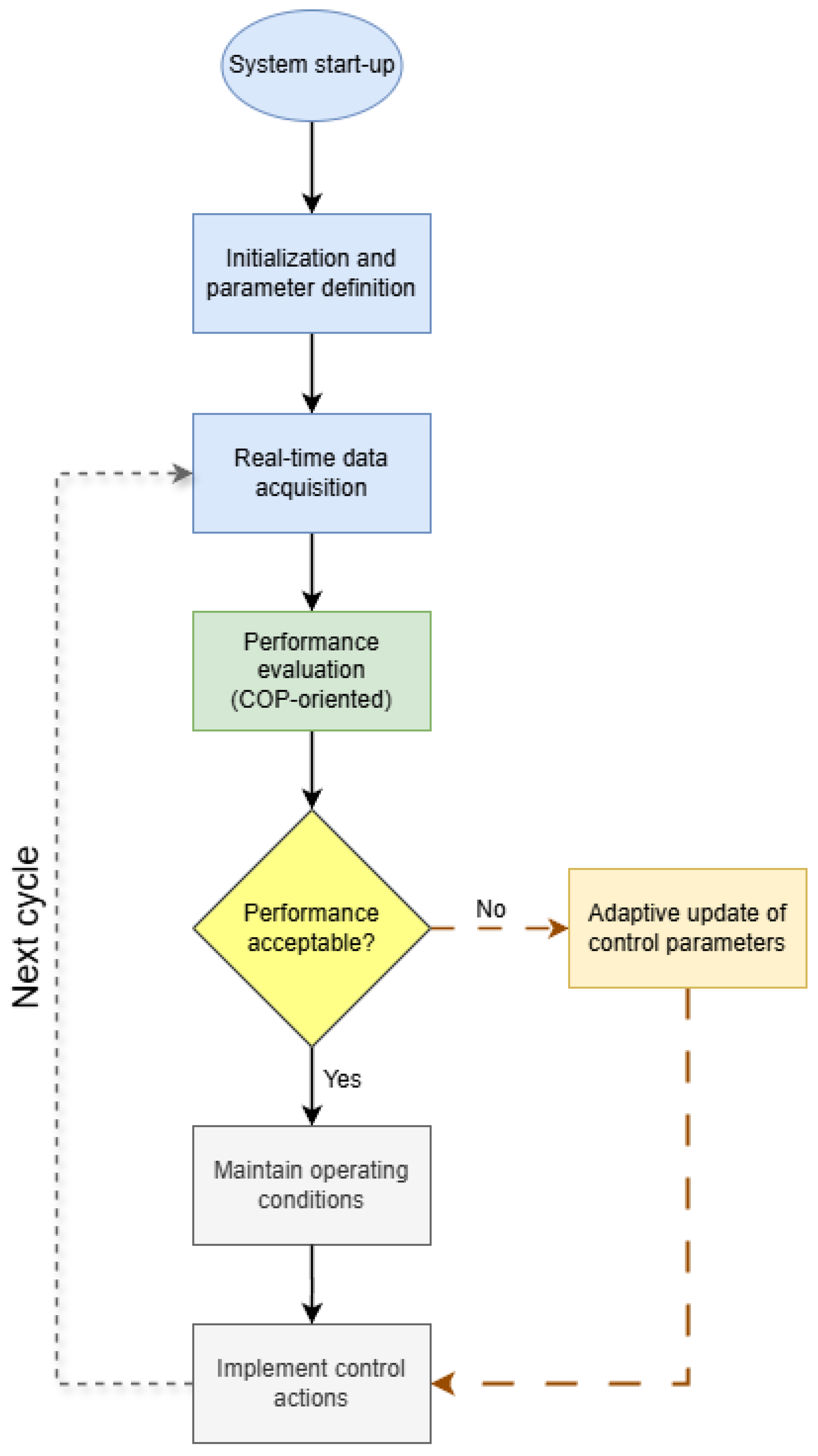
The control logic is summarized by the flowchart shown in
Figure 2. The process starts with system initialization and parameter definition. Real-time measurement data are collected on a cycle-by-cycle basis. Performance evaluation is carried out at the end of each cycle. When performance remains within an acceptable range, operating conditions are maintained. When a performance drop is detected, the control parameters are updated using measurement-based rules. The updated parameters are applied in the next cycle, preserving the cycle-based feedback structure. Thus, the method operates within a closed loop and a continuously running structure that adapts itself during operation.
Constructing the control logic on a cycle-by-cycle basis allows the behavior of the system in transient regimes to be monitored. Unlike control approaches based on predefined fixed timing, this structure enables an operation that can respond directly to measurement data. Thus, the system gains a flexible control character that can adapt to changing operating conditions. The architecture and control methods presented in this section are defined as a general magnetic refrigeration system. Their implementation and experimental demonstration on a reciprocating magnetic refrigerator prototype are presented in
Section 4.
3. Implementation of the Automation and Control Logic
System performance is quantitatively calculated using the measured data. Based on this evaluation, the control parameters for the next cycle are determined. This approach relies on cycle-level performance feedback. Performance is assessed using COP, defined on a power basis as the ratio of the cooling power to the total input power evaluated over one operating cycle. For the discrete cycle index
k, COP is calculated by Equation (
1):
In this expression,
represents the cooling power, while
,
, and
denote the electrical, hydraulic, and mechanical power contributions, respectively. The cycle index
k represents discrete operating cycles and does not assume a continuous-time dynamic model. Control decisions are based not on the absolute value of COP but on its change between successive cycles. For this purpose, the cycle-to-cycle performance variation is defined by Equation (
2):
The observed change in COP is used to decide whether the control parameters should be maintained or updated. When a decrease in performance is detected, the control parameters are adaptively updated for the next cycle. This decision logic can be summarized by the condition defined by Equation (
3):
In this implementation, COP is not treated as a directly regulated control variable. It is used as a decision indicator that evaluates the performance trend between successive cycles.
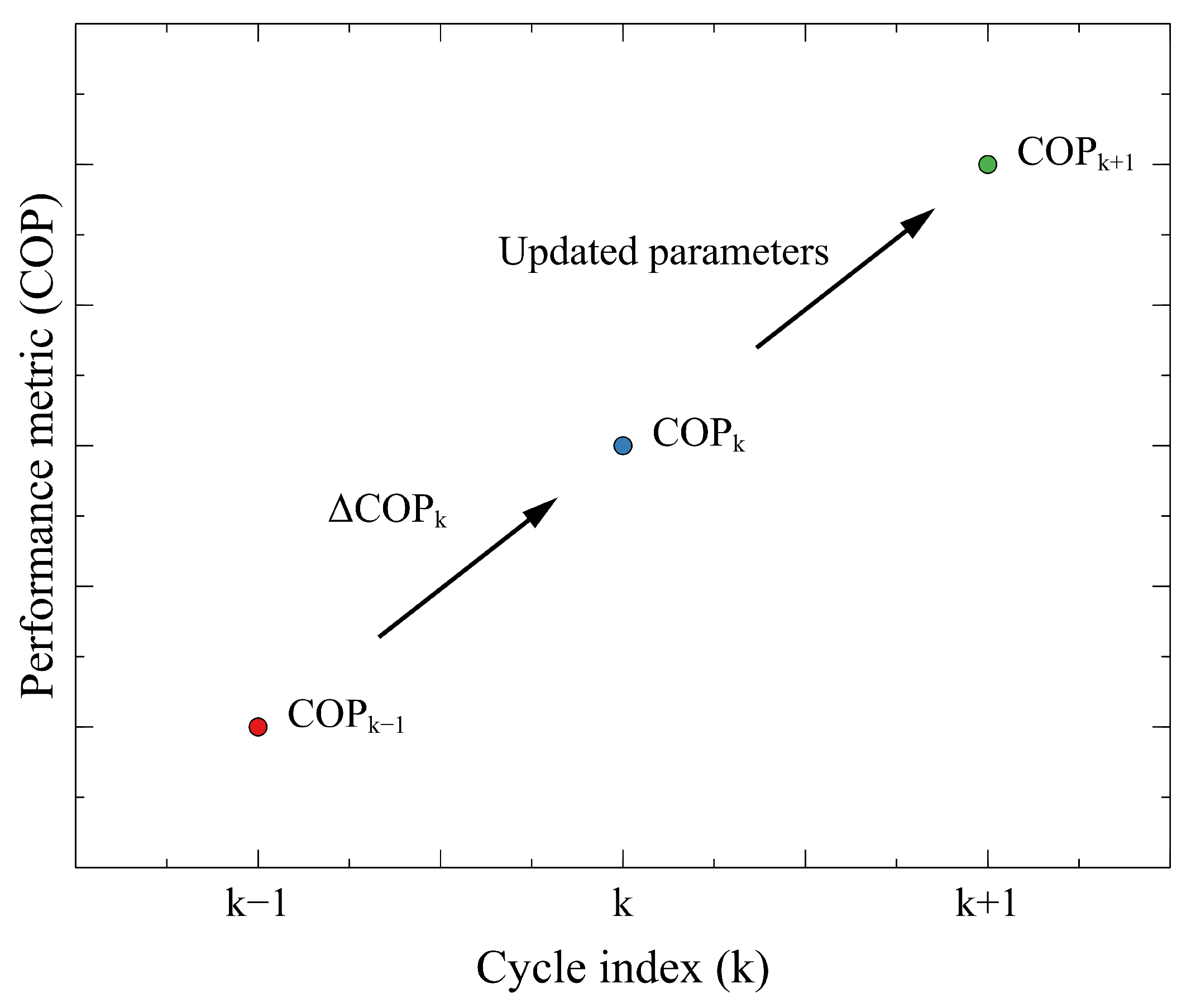
The generation of control decisions based on cycle-to-cycle performance variation is shown in
Figure 3. COP values calculated over discrete operating cycles are compared between successive cycles. The defined
is the main decision variable for maintaining or updating the control parameters. When a performance decrease is detected, the control parameters are updated for the next cycle. The effect of the updated parameters is monitored through the COP obtained in the following cycle. Control decisions are based on the performance trend between cycles.
4. Experimental Setup and Case Study
4.1. Prototype System and Measurement Infrastructure
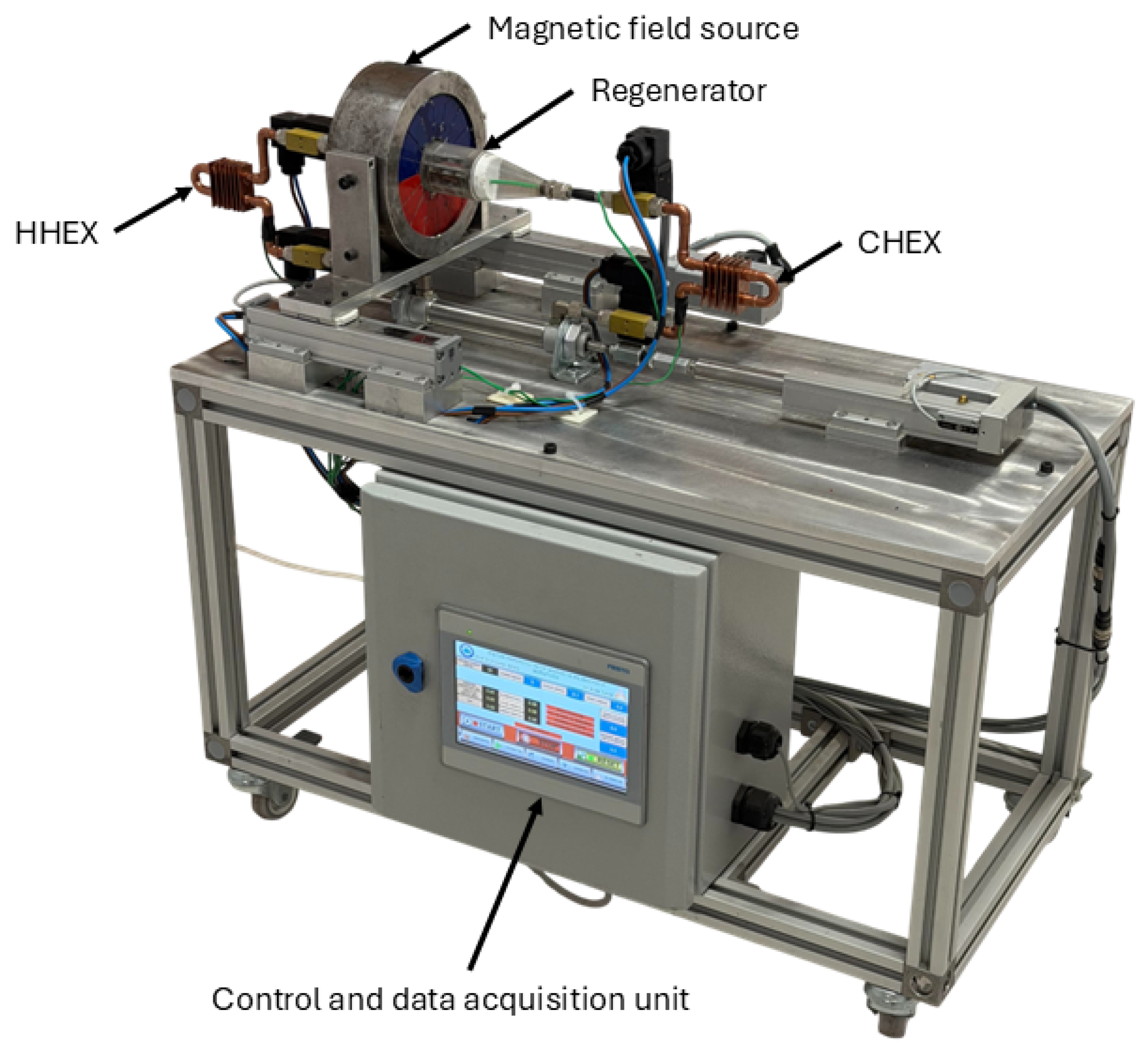
Figure 4 presents an overview of the experimental platform. The setup under investigation is based on a reciprocating magnetic refrigerator prototype. Magnetic, thermal, and hydraulic processes operate simultaneously. The core mechanical design of the prototype has been protected as a registered utility model by the Turkish Patent and Trademark Office [
38]. The design process and thermal performance of the same system were reported in our previous study. All experiments were conducted under controlled laboratory conditions. The ambient temperature was maintained at 293 K throughout the tests. Heat exchange with the surroundings was ensured via the hot heat exchanger (HHEX) and cold heat exchanger (CHEX). An external thermal load was applied at the CHEX [
39].
In the experimental setup, the magnetic field source moves linearly relative to the regenerator. In the hydraulic circuit, fluid circulation is provided by piston motion and directional control valves. The fluid flows cyclically through the regenerative bed. Through the coordinated operation of these two processes, heat is extracted from the cooled environment and subsequently rejected to the ambient surroundings. The behavior of these systems is investigated through measurements of position, flow rate, pressure difference, temperature, and electrical power. The types of sensors used, their measurement ranges, and main characteristics are summarized in
Table 1.
The HHEX and CHEX are boundary elements that enable heat exchange with the ambient environment. Temperature measurements at these points are used as the basis for determining the thermal output of the cycle. Cooling power is determined based on temperature measurements across the heat exchangers together with the flow rate of the heat transfer fluid. The calculation accounts for the cycle-averaged temperature spans and the thermophysical properties of the working fluid. The resulting cooling power constitutes one of the primary indicators used for performance assessment. The measurement infrastructure is configured to be suitable for cycle-based evaluation. Measurement data acquired throughout each operating cycle are aggregated into a single dataset at the end of the cycle. This dataset is then employed to evaluate the thermal output and the total energy consumption associated with that cycle. Thus, each cycle is represented as a temporally consistent experimental step.
4.2. Integration of the Proposed Method into the System
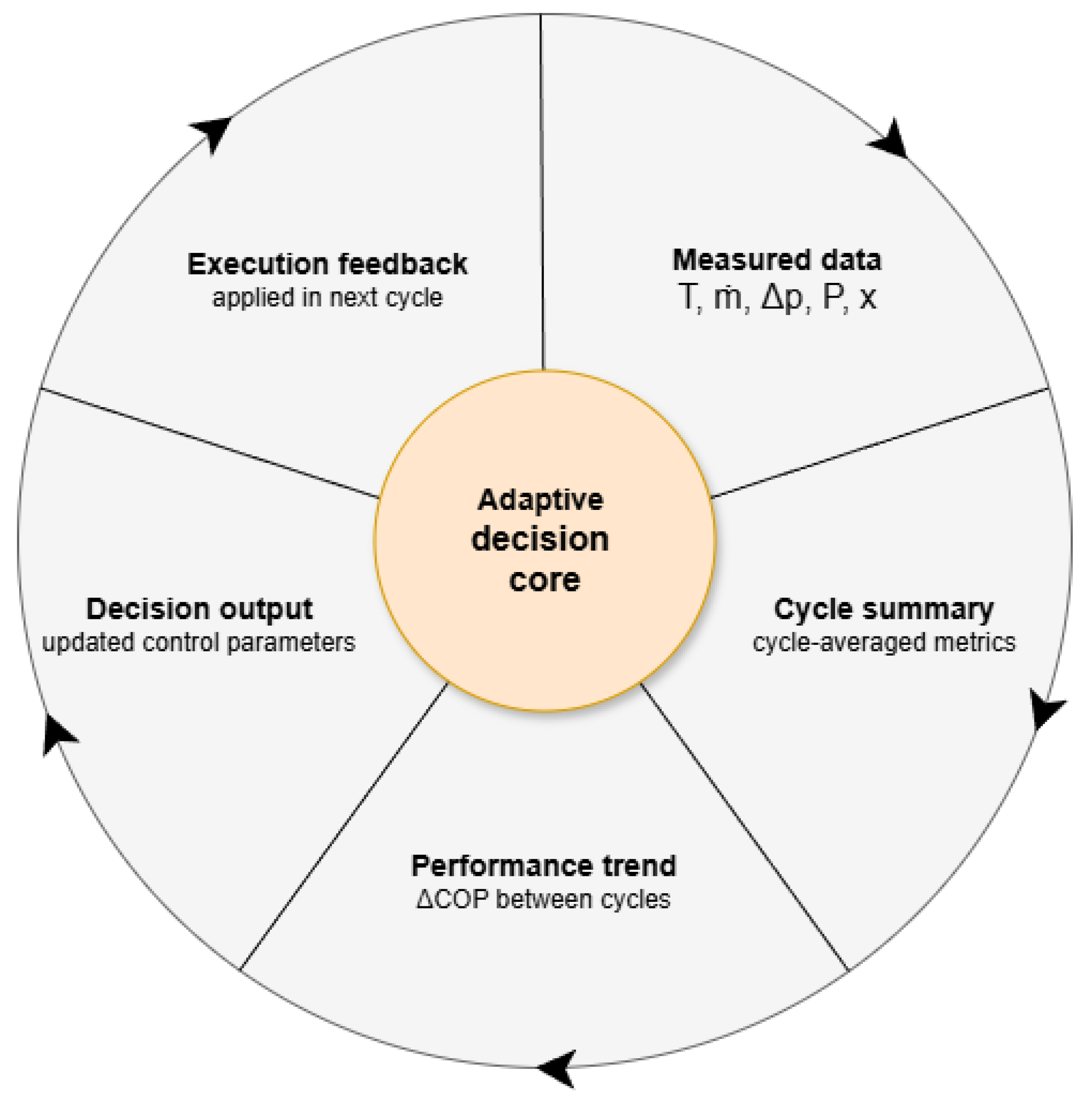
In the experimental study, the control logic is an adaptive decision loop operating over discrete operating cycles. Each cycle is a closed structure consisting of measurement, evaluation, decision, and application steps. A conceptual illustration of the cyclic decision framework is provided in
Figure 5.
The data sets obtained from the cycle-based measurement infrastructure defined in
Section 4.1 are used here as inputs to the decision mechanism. They are used to determine only the performance trend between cycles. They are also evaluated to adapt the control parameters. At the end of each cycle, the cooling power and the total energy consumption of the cycle are determined. From these quantities, the COP value of the cycle is calculated.
Control decisions are based on the change in COP between successive cycles. The COP value obtained at the end of each cycle is compared with that of the previous cycle. In this way, the performance trend is defined. When COP shows an increasing trend, the current control parameters are considered appropriate for system behavior. In contrast, when COP shows a decreasing trend, system performance is assumed to have weakened, and the adaptive decision mechanism is activated. In this case, the control algorithm uses the cycle measurement data to evaluate which parameters have caused a negative effect. Within this scope, three main tuning groups are primarily considered:
The motion speed of the magnetic field source together with the magnetization and demagnetization durations,
Heat transfer fluid flow rate,
The durations of the HHEX and CHEX phases within the operating cycle.
When an increase in pressure drop across the regenerator is detected, the piston speed is decreased in order to limit hydraulic losses. If the temperature change associated with the magnetocaloric effect diminishes, the motion speed of the magnetic field source is reduced. Simultaneously, the magnetization duration is adjusted to extend the interaction time within the regenerator. When temperature spans across the heat exchangers decrease, the duration of the corresponding cycle phase is increased to provide a longer interaction time for heat transfer.
The updated control parameters are applied in the next cycle. Thus, each cycle is shaped according to the performance result of the previous cycle. The effect of the new parameters is evaluated again at the end of the following cycle. The same decision loop is then repeated. With this structure, the system does not depend on fixed timings or predefined single settings. Instead, it gains a type of behavior that continuously rearranges its operating conditions based on its own performance output. The stable operating conditions observed during the experiments show that this decision loop operates consistently over successive cycles. The application presented in this section demonstrates how cycle-based measurement results are converted into decision inputs. It also reveals how these decisions shape system behavior.
5. Results and Discussion
5.1. System Behavior Under Adaptive Control
In this section, the way the developed adaptive control approach guides system behavior in the experimental environment is examined. The experiments are initially started with the manually defined operating parameters shown in
Table 2. These parameters define the baseline operating conditions before the adaptive decision logic is activated. After a certain number of cycles, the adaptive decision logic is activated. Thus, the transition of the system from a structure operating with fixed parameters to a self-updating structure based on performance feedback is observed. The analysis is carried out using the cycle-based evolution of COP, regenerator temperature span, cooling power, and control parameters. These quantities directly reveal how adaptive decisions are reflected in the thermal and hydraulic behavior of the system. Within this scope, the presented results aim to show that the effects of parameter changes on performance can be guided over successive cycles. In the following figures, the behaviors before and after the activation of the adaptive logic are presented in a comparative manner.
In the present study, external boundary conditions such as ambient temperature and applied cooling load are kept constant throughout the experiments. Accordingly, the observed variations in COP do not arise from external disturbances, but from internal system interactions, including the coupling between magnetic, hydraulic, and thermal processes and the associated losses. The proposed adaptive regulation is therefore intended to mitigate internal performance fluctuations under fixed external operating conditions.
In the proposed approach, COP is not treated as a regulated setpoint. Instead, it is used as a supervisory performance indicator for adaptive parameter updates. Therefore, the cooling power is not forced to remain constant when variations in COP are observed. Changes in cooling power reflect the natural system response to parameter adjustments aimed at improving overall efficiency.
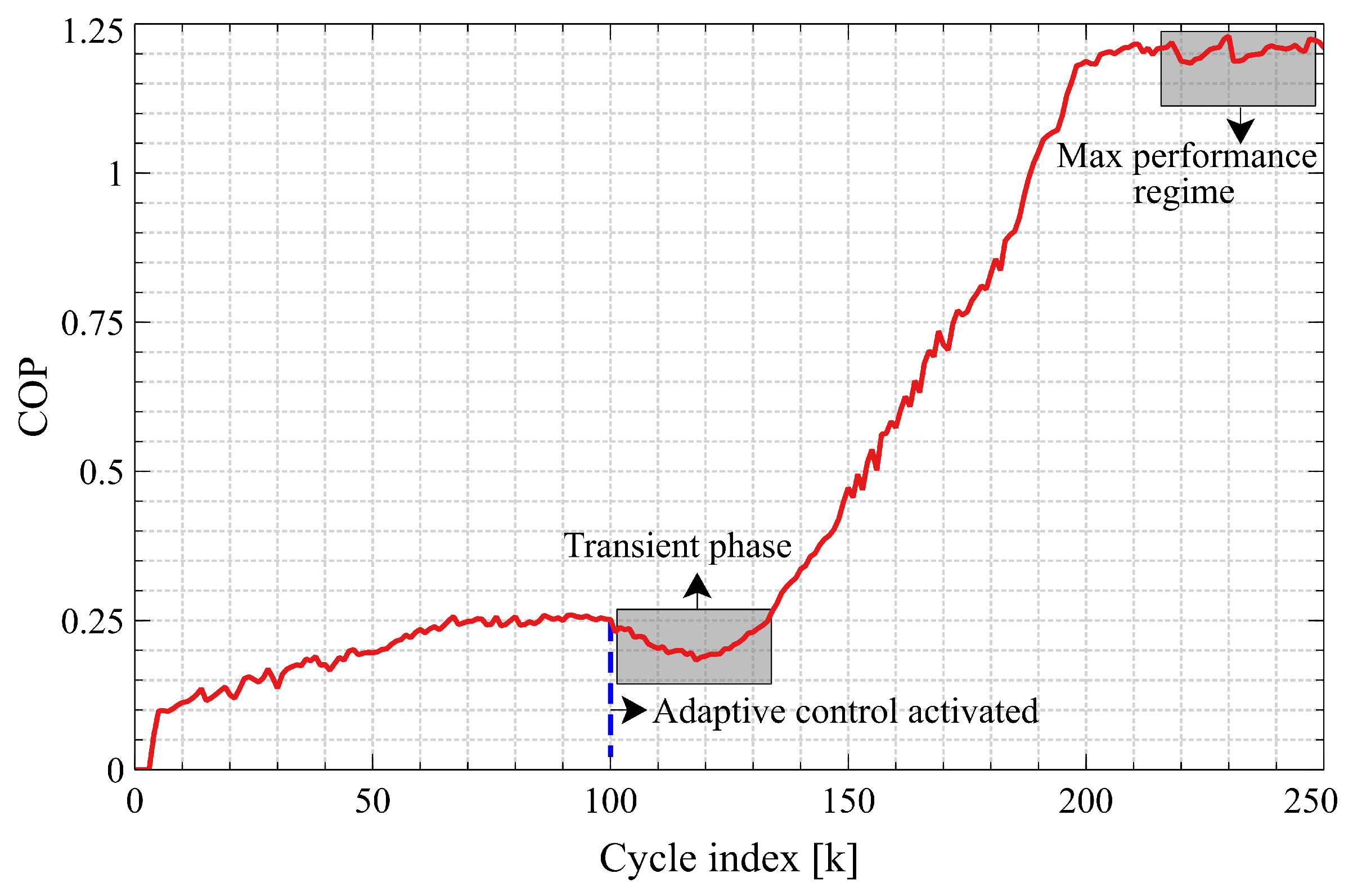
The evolution of COP over successive operating cycles is shown in
Figure 6. After the experiment starts with manual parameters, COP shows a slow increasing trend. It remains at a limited level until cycle
. At this cycle, the adaptive control logic is activated. Immediately after this point, a short transient regime is observed. A limited decrease in COP occurs for about 15–20 cycles. This behavior corresponds to the process of rearranging the control parameters according to the new decision logic. After the transient regime, system performance rapidly improves. COP increases steadily over the cycles. After about
cycles, a high-performance stable operating regime is reached. At this stage, COP remains nearly constant, with only small fluctuations, and continues to operate in the high-performance region. These results show that the adaptive decision mechanism significantly improves system behavior after a short adaptation period. They also indicate that the mechanism can autonomously establish stable and high-performance operating conditions.
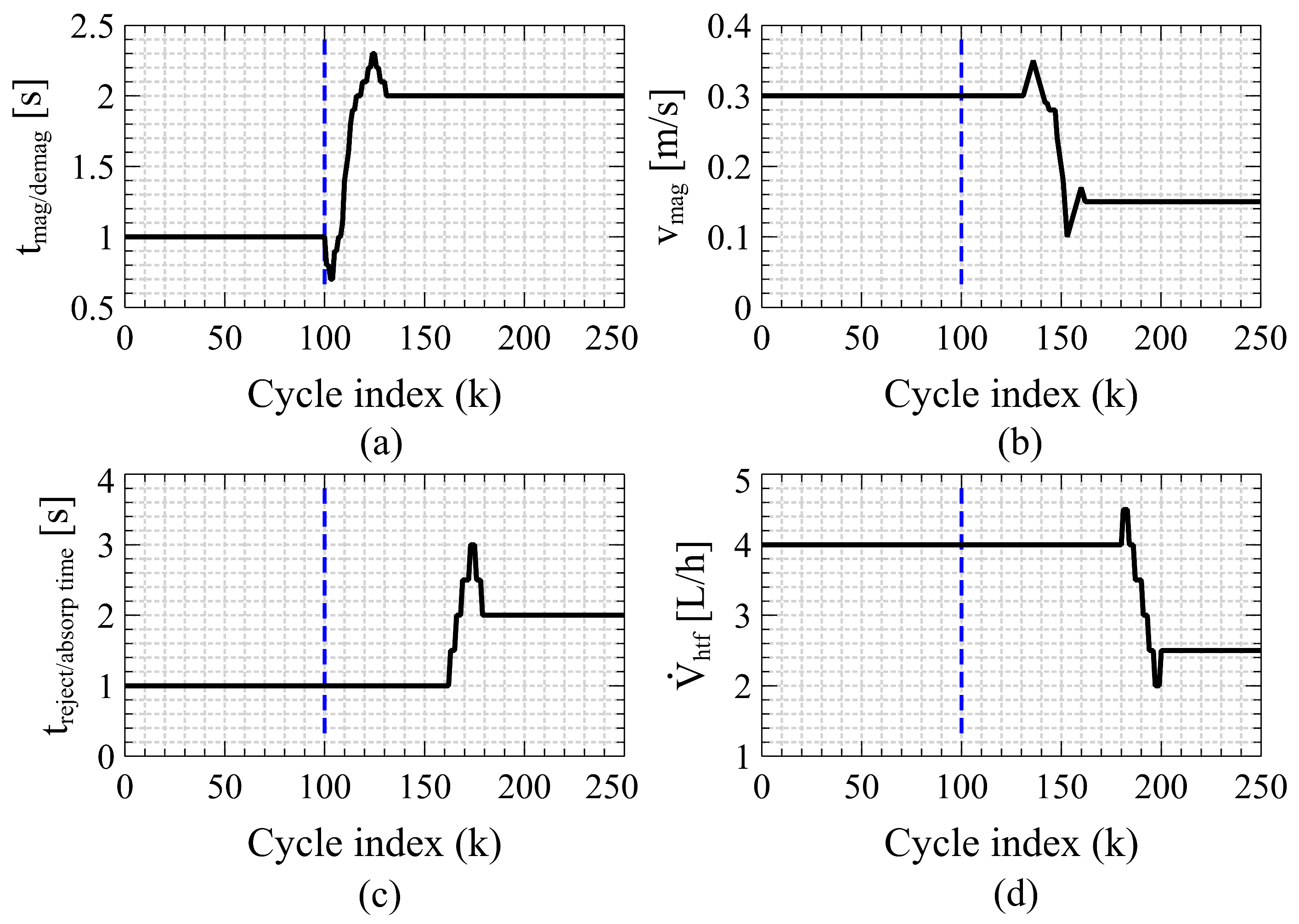
The variations in control parameters over cycles after activation of adaptive control are shown in
Figure 7. Parameters that were initially kept constant start to be readjusted when the adaptive decision logic becomes active. Magnetization and demagnetization times are defined equally for each cycle. Similarly, heat rejection and heat absorption phases have the same duration. Therefore, these paired variables are treated as single parameters. In this transition region, significant changes appear in the parameters
,
,
, and
. During the first adaptation stage, the values show fluctuating behavior. The system searches for a more suitable operating point for performance by testing different operating combinations. After this process is completed, all parameters settle at stable levels. These values are preserved over the cycles. This indicates that the adaptive mechanism is not a structure that only makes instantaneous corrections. It also has a decision character that can keep the system at an appropriate operating point once it is found.
5.2. Evaluation of Performance Trends
The effect of adaptive control on system performance is evaluated by statistically comparing the cycle-based data obtained under manual and adaptive regimes. This comparison is carried out using the COP, cooling power, and regenerator temperature span values summarized in
Table 3. Here,
is used to quantify the cycle-to-cycle variability through the standard deviation, whereas
(%) is defined as the coefficient of variation, given by the ratio of the standard deviation to the mean.
Under the manual regime, the system operates with a low average COP. It shows high cycle-to-cycle fluctuations. Considering the standard deviation and coefficient of variation, the system operated with fixed parameters exhibits an unstable character. Similarly, cooling power remains at a low average level. The regenerator temperature span staying at an average of 0.77 K indicates that the magnetocaloric effect is utilized in a limited manner. Under the adaptive regime, system behavior changes significantly. The average COP increases to 1.2047. In contrast, the standard deviation and coefficient of variation decrease markedly. Cooling power in the adaptive case rises to an average of 5.835 W. The same trend is also observed in the regenerator temperature span. From a physical perspective, the increase in the regenerator temperature span indicates a more effective utilization of the magnetocaloric effect. This improvement leads to higher cooling power by increasing the temperature difference driving heat transfer across the CHEX. In terms of Equation (
1), the resulting increase in cooling power directly contributes to the enhancement of COP. This occurs because the input power components remain within the same order of magnitude. As a result, the adaptive control strategy improves system efficiency by increasing the thermal output without a proportional rise in energy consumption.
These results show that the adaptive decision mechanism not only increases the average performance but also strongly suppresses cycle-to-cycle fluctuations. In particular, the sharp reduction in the coefficient of variation for COP clearly indicates that the system is driven toward a stable maximum performance regime. The simultaneous increases in cooling power and regenerator temperature span indicate that adaptive control primarily focuses on strengthening the magnetocaloric effect. This is directly reflected in thermal output and energy efficiency. The low performance and high fluctuations observed under manual operation prove that fixed parameter control is insufficient for magnetic refrigeration systems. In contrast, adaptive control increases performance through cyclic feedback and gathers the system around a stable maximum regime. The experimental results demonstrate that the proposed method performs in an effective and reliable manner within the tested experimental framework.
6. Conclusions
In this study, a software-based and measurement-driven control approach is presented for magnetic refrigeration systems. The architecture combines thermal, magnetic, and hydraulic processes under a single decision structure. Operation is based on cyclic feedback rather than fixed timings. The proposed structure adapts operating conditions according to performance trends. This feature distinguishes the method from time based and preset approaches. A control strategy built on cycle-to-cycle performance variation introduces a new perspective for magnetic refrigeration systems. The proposed approach has been experimentally validated using a reciprocating magnetic refrigerator prototype. Experimental application shows that the system can reach a stable and high operating level after a short adaptation phase. Quantitatively, the average COP increases from approximately 0.21 under manual operation to about 1.20 under adaptive control. In parallel, the average cooling power rises from nearly 1.0 W to approximately 5.8 W, indicating a marked improvement in performance level and operational stability. This result confirms that the cyclic feedback-based approach is practically applicable. The findings indicate that fixed parameter operation is insufficient for such systems. In contrast, the adaptive structure can move the system to a more balanced and efficient regime. This evaluation shows that the control problem is not limited to timing alone. Coordinated management of multi-physical processes plays a decisive role. The study is limited to a single prototype. Different materials, regenerator structures, and system scales are outside the scope of this work. In future studies, the method is planned to be tested under different configurations and extended with more advanced decision algorithms.
7. Patents
This study’s automation and control architecture has been patented by the Turkish Patent and Trademark Office under the title “Automation, Software, and Control Method for a Reciprocating Active Magnetic Regenerative Air Conditioning Device” with registration number TR 2025 012325 B.
Author Contributions
Conceptualization, A.Z. and H.A.; methodology, A.Z. and H.A.; software, A.Z.; validation, A.Z.; formal analysis, A.Z.; investigation, A.Z. and H.A.; resources, A.Z.; data curation, A.Z.; writing—original draft preparation, A.Z.; writing—review and editing, H.A.; visualization, A.Z.; supervision, H.A.; project administration, A.Z. and H.A. All authors have read and agreed to the published version of the manuscript.
Funding
This research received no external funding.
Institutional Review Board Statement
Not applicable.
Informed Consent Statement
Not applicable.
Data Availability Statement
The original contributions presented in this study are included in the article. Further inquiries can be directed to the corresponding author.
Conflicts of Interest
The authors declare no conflicts of interest.
Abbreviations
The following abbreviations are used in this manuscript:
| CHEX | Cold side heat exchanger |
| COP | Coefficient of performance |
| CV | Coefficient of variation |
| HHEX | Heat side heat exchanger |
| Roman Symbols | |
| Temperature span (K) |
| k | Cycle index |
| P | Power (W) |
| Cooling power (W) |
| Heat absorption time (s) |
| Demagnetization time (s) |
| Magnetization time (s) |
| Heat rejection time (s) |
| Heat transfer fluid flow rate (L/h) |
| Magnetic field source speed (m/s) |
| Greek Symbols | |
| Standard deviation indicating cycle-to-cycle dispersion |
References
- Khosla, R.; Miranda, N.D.; Trotter, P.A.; Mazzone, A.; Renaldi, R.; McElroy, C.; Cohen, F.; Jani, A.; Perera-Salazar, R.; McCulloch, M. Cooling for sustainable development. Nat. Sustain. 2021, 4, 201–208. [Google Scholar] [CrossRef]
- Farghali, M.; Osman, A.I.; Mohamed, I.M.; Chen, Z.; Chen, L.; Ihara, I.; Yap, P.S.; Rooney, D.W. Strategies to save energy in the context of the energy crisis: A review. Environ. Chem. Lett. 2023, 21, 2003–2039. [Google Scholar] [CrossRef] [PubMed]
- Yasaka, Y.; Karkour, S.; Shobatake, K.; Itsubo, N.; Yakushiji, F. Life-cycle assessment of refrigerants for air conditioners considering reclamation and destruction. Sustainability 2022, 15, 473. [Google Scholar] [CrossRef]
- Uddin, K.; Saha, B.B. An overview of environment-friendly refrigerants for domestic air conditioning applications. Energies 2022, 15, 8082. [Google Scholar] [CrossRef]
- Mellari, S. Introduction to magnetic refrigeration: Magnetocaloric materials. Int. J. Air-Cond. Refrig. 2023, 31, 5. [Google Scholar] [CrossRef]
- Ismail, M.; Yebiyo, M.; Chaer, I. A review of recent advances in emerging alternative heating and cooling technologies. Energies 2021, 14, 502. [Google Scholar] [CrossRef]
- Ciorobea, A.A.; Enescu, F.M.; Bizon, N.; Dragusin, S.A.; Popa, D.I.; Manuca, I.M.; Manuca, G.R.; Negosanu, A.; Besliu-Gherghescu, A.A. Innovations in energy sustainability: An ecological approach to refrigeration. In Proceedings of the 2025 17th International Conference on Electronics, Computers and Artificial Intelligence (ECAI), Targoviste, Romania, 26–27 June 2025; IEEE: New York, NY, USA, 2025; pp. 1–11. [Google Scholar] [CrossRef]
- Swathi, D.; Yadav, N.K.; Swamy, N.K.; Kumar, N.P. Magnetocaloric materials for green refrigeration. In Green Energy Systems; Academic Press: Cambridge, MA, USA, 2023; pp. 187–205. [Google Scholar] [CrossRef]
- Ram, N.R.; Prakash, M.; Naresh, U.; Kumar, N.S.; Sarmash, T.S.; Subbarao, T.; Kumar, R.J.; Kumar, G.R.; Naidu, K.C.B. Review on magnetocaloric effect and materials. J. Supercond. Nov. Magn. 2018, 31, 1971–1979. [Google Scholar] [CrossRef]
- Franco, V.; Blázquez, J.S.; Ipus, J.J.; Law, J.Y.; Moreno-Ramírez, L.M.; Conde, A. Magnetocaloric effect: From materials research to refrigeration devices. Prog. Mater. Sci. 2018, 93, 112–232. [Google Scholar] [CrossRef]
- Baglivo, C.; Congedo, P.M.; Donno, P.A. Analysis of thermodynamic cycles of heat pumps and magnetic refrigerators using mathematical models. Energies 2021, 14, 909. [Google Scholar] [CrossRef]
- Cugini, F.; Solzi, M. On the direct measurement of the adiabatic temperature change of magnetocaloric materials. J. Appl. Phys. 2020, 127, 123901. [Google Scholar] [CrossRef]
- Lucia, U.; Grisolia, G. Magnetocaloric refrigeration in the context of sustainability: A review of thermodynamic bases, the state of the art, and future prospects. Energies 2024, 17, 3585. [Google Scholar] [CrossRef]
- Choi, J.; Lee, S.; Kim, M.S. A testbed for a magnetic refrigeration system at room temperature and its experimental evaluation. Energy Convers. Manag. 2022, 265, 115771. [Google Scholar] [CrossRef]
- Lionte, S.; Risser, M.; Muller, C. A 15 kW magnetocaloric proof-of-concept unit: Initial development and first experimental results. Int. J. Refrig. 2021, 122, 256–265. [Google Scholar] [CrossRef]
- Peixer, G.F.; Lorenzoni, A.M.; Sucaria, R.S.; Faria, P.; Nakashima, A.T.; Teixeira, C.S.; Cadena, J.A.L.; Riso, J.B., Jr. Experimental evaluation and performance optimization of large-scale magnetic refrigeration prototype for air conditioning systems. In REHVA HVAC World Congress; Springer Nature: Cham, Switzerland, 2025; pp. 940–949. [Google Scholar] [CrossRef]
- Lupponglung, V.; Kanluang, T.; Panjatawakup, P.; Hanlamyuang, Y.; Matan, K.; Techapiesancharoenkij, R. Design and development of rotary magnetic refrigeration prototype with active magnetic regeneration system. J. Phys. Conf. Ser. 2019, 1380, 012114. [Google Scholar] [CrossRef]
- Celik, S.; Kural, M.H. Octagonal Halbach magnet array design for a magnetic refrigerator. Heat Transf. Eng. 2018, 39, 391–397. [Google Scholar] [CrossRef]
- Lei, G.; Pengyu, W.; Yaru, G.; Mohan, D.; Hao, P.; Jiaohong, H.; Peiyu, J.; Cuilan, L.; Yingde, Z.; Juan, C.; et al. Performance study of a double-regenerator room temperature magnetic refrigerator with 26 °C temperature span. Int. J. Refrig. 2023, 148, 143–151. [Google Scholar] [CrossRef]
- Kitanovski, A. Energy applications of magnetocaloric materials. Adv. Energy Mater. 2020, 10, 1903741. [Google Scholar] [CrossRef]
- Scheibel, F.; Gottschall, T.; Taubel, A.; Fries, M.; Skokov, K.P.; Terwey, A.; Keune, W.; Ollefs, K.; Wende, H.; Farle, M.; et al. Hysteresis design of magnetocaloric materials—from basic mechanisms to applications. Energy Technol. 2018, 6, 1397–1428. [Google Scholar] [CrossRef]
- Zhong, H.; Song, Y.; Long, F.; Lu, H.; Ai, M.; Li, T.; Yao, Y.; Sakai, Y.; Ikeda, M.; Takahashi, K.; et al. Design of excellent mechanical performances and magnetic refrigeration via in situ forming dual-phase alloys. Adv. Mater. 2024, 36, 2402046. [Google Scholar] [CrossRef]
- Hai, P.; Shen, J.; Li, Z.; Li, K.; Huang, H.; Zheng, W.; Dai, W.; Gao, X.; Mo, Z. Influence of different magnetic field profiles on the performance of a rotary magnetic refrigerator. Appl. Therm. Eng. 2023, 219, 119561. [Google Scholar] [CrossRef]
- Kamran, M.S.; Ahmad, H.O.; Wang, H.S. Review on the developments of active magnetic regenerator refrigerators–evaluated by performance. Renew. Sustain. Energy Rev. 2020, 133, 110247. [Google Scholar] [CrossRef]
- Greco, A.; Aprea, C.; Maiorino, A.; Masselli, C. A review of the state of the art of solid-state caloric cooling processes at room-temperature before 2019. Int. J. Refrig. 2019, 106, 66–88. [Google Scholar] [CrossRef]
- Li, Z.; Li, K.; Guo, X.; Gao, X.; Dai, W.; Gong, M.; Shen, J. Influence of timing between magnetic field and fluid flow in a rotary magnetic refrigerator. Appl. Therm. Eng. 2021, 187, 116477. [Google Scholar] [CrossRef]
- Zhang, Y.; Wu, J.; Zhang, H. Performance analysis of a cascade room temperature magnetic refrigerator for improving temperature span. Int. J. Refrig. 2022, 143, 68–77. [Google Scholar] [CrossRef]
- Masche, M.; Liang, J.; Engelbrecht, K.; Bahl, C.R.H. Efficient modulation of the magnetocaloric refrigerator capacity. Int. J. Refrig. 2023, 145, 59–67. [Google Scholar] [CrossRef]
- Bahl, C.R.H.; Petersen, T.F.; Pryds, N.; Smith, A. A versatile magnetic refrigeration test device. Rev. Sci. Instrum. 2008, 79, 093906. [Google Scholar] [CrossRef]
- Masche, M.; Liang, J.; Engelbrecht, K.; Bahl, C.R.H. Improving magnetic cooling efficiency and pulldown by varying flow profiles. Appl. Therm. Eng. 2022, 215, 118945. [Google Scholar] [CrossRef]
- Adapa, S.R.; Feng, T.; Ihnfeldt, R.V.; Chen, R. Optimisation of a packed particle magnetocaloric refrigerator: A combined experimental and theoretical study. Int. J. Refrig. 2024, 159, 64–73. [Google Scholar] [CrossRef]
- Maiorino, A.; Del Duca, M.G.; Tušek, J.; Tomc, U.; Kitanovski, A.; Aprea, C. Evaluating magnetocaloric effect in magnetocaloric materials: A novel approach based on indirect measurements using artificial neural networks. Energies 2019, 12, 1871. [Google Scholar] [CrossRef]
- Hoffmann, G.; Nakashima, A.T.; Peixer, G.F.; Lozano, J.A.; Barbosa, J.R., Jr.; Flesch, R.C. Static and dynamic modeling and identification of a magnetic refrigerator. Int. J. Refrig. 2024, 158, 303–312. [Google Scholar] [CrossRef]
- Peixer, G.F.; Silva, M.C.; Lorenzoni, A.; Hoffmann, G.; dos Santos, D.; do Rosário, G.M.; Pagnan, E.; Teza, H.F.; Silva, P.M.; Azeredo, Y.C.; et al. Energy and efficiency breakdown analysis of a magnetic refrigerator. Appl. Therm. Eng. 2025, 280, 128157. [Google Scholar] [CrossRef]
- Silva, P.M.; Peixer, G.F.; Lorenzoni, A.M.; Azeredo, Y.C.; Flesch, R.C.; Lozano, J.A.; Barbosa, J.R., Jr. Predicting the dynamic behavior of a magnetocaloric cooling prototype via artificial neural networks. Appl. Therm. Eng. 2024, 248, 123060. [Google Scholar] [CrossRef]
- Zaim, A. Reciprocating Motion Active Magnetic Regenerative Refrigerator Design and Performance Optimization. Doctoral Dissertation, Eskisehir Osmangazi University, Eskisehir, Turkey, 2025. [Google Scholar]
- Zaim, A.; Aras, H. Automation, Software and Control Method for a Reciprocating Active Magnetic Regenerative Air Conditioning Device. Turkish Patent TR 2025 012325 B, 21 January 2026. [Google Scholar]
- Zaim, A.; Aras, H. Reciprocating Motion Active Magnetic Regenerative air Conditioning Device. Turkish Patent TR 2021 013908 Y, 21 February 2023. [Google Scholar]
- Aras, H.; Zaim, A. Experimental investigation and performance analysis of a reciprocating magnetic refrigerator. Case Stud. Therm. Eng. 2025, 74, 106792. [Google Scholar] [CrossRef]
| Disclaimer/Publisher’s Note: The statements, opinions and data contained in all publications are solely those of the individual author(s) and contributor(s) and not of MDPI and/or the editor(s). MDPI and/or the editor(s) disclaim responsibility for any injury to people or property resulting from any ideas, methods, instructions or products referred to in the content. |