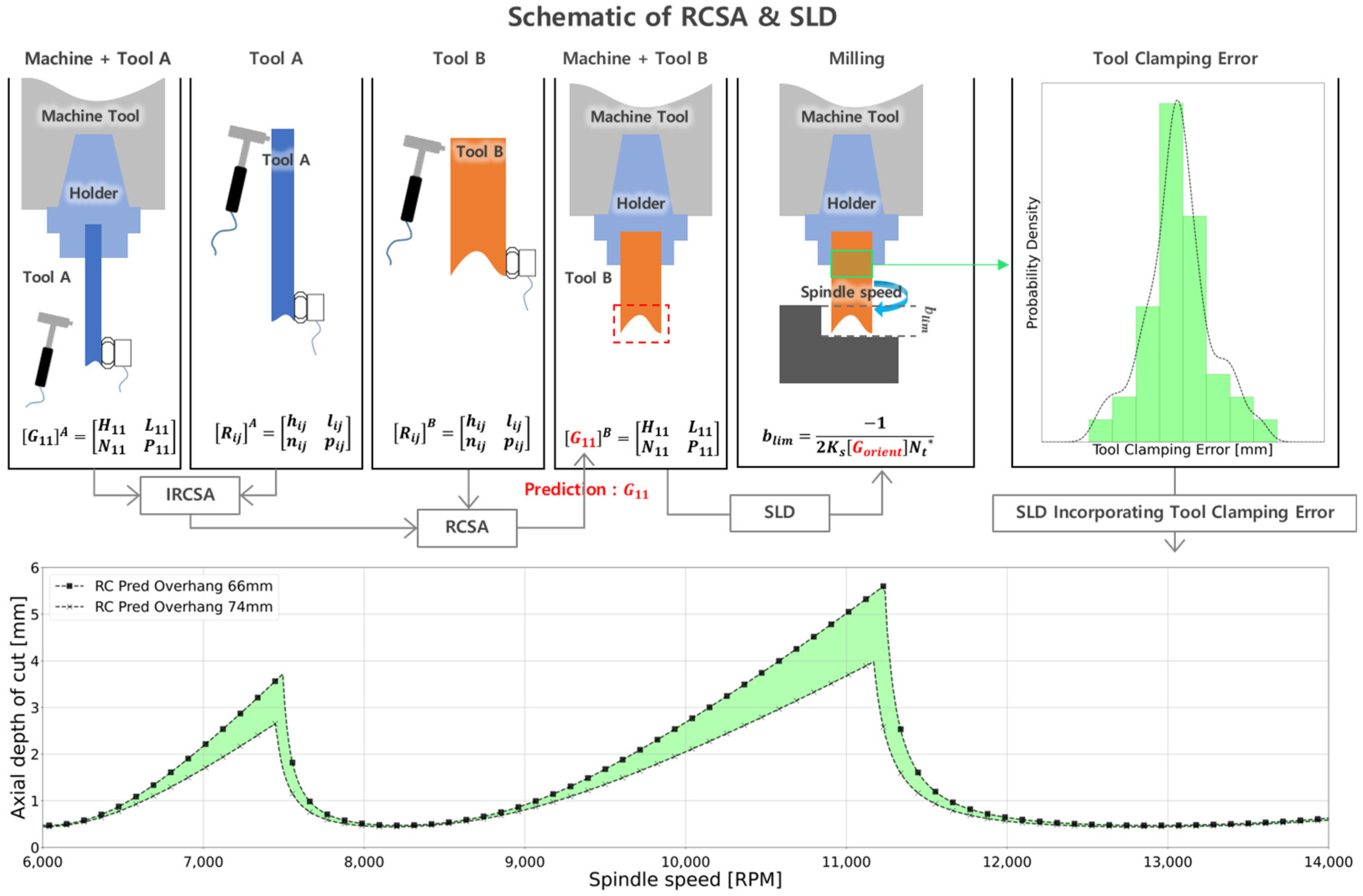

RCSA-Based Analysis of Stability Lobes in Milling Incorporating Tool Clamping Errors




Abstract
1. Introduction
2. Tool Tip Dynamic Prediction and Stability Lobe Diagram Analysis Incorporating Tool Clamping Errors
2.1. Receptance Coupling Substructure Analysis
2.2. Stability Lobe Diagram
2.3. Analysis of Tool Clamping Errors
3. Experimental Methodology
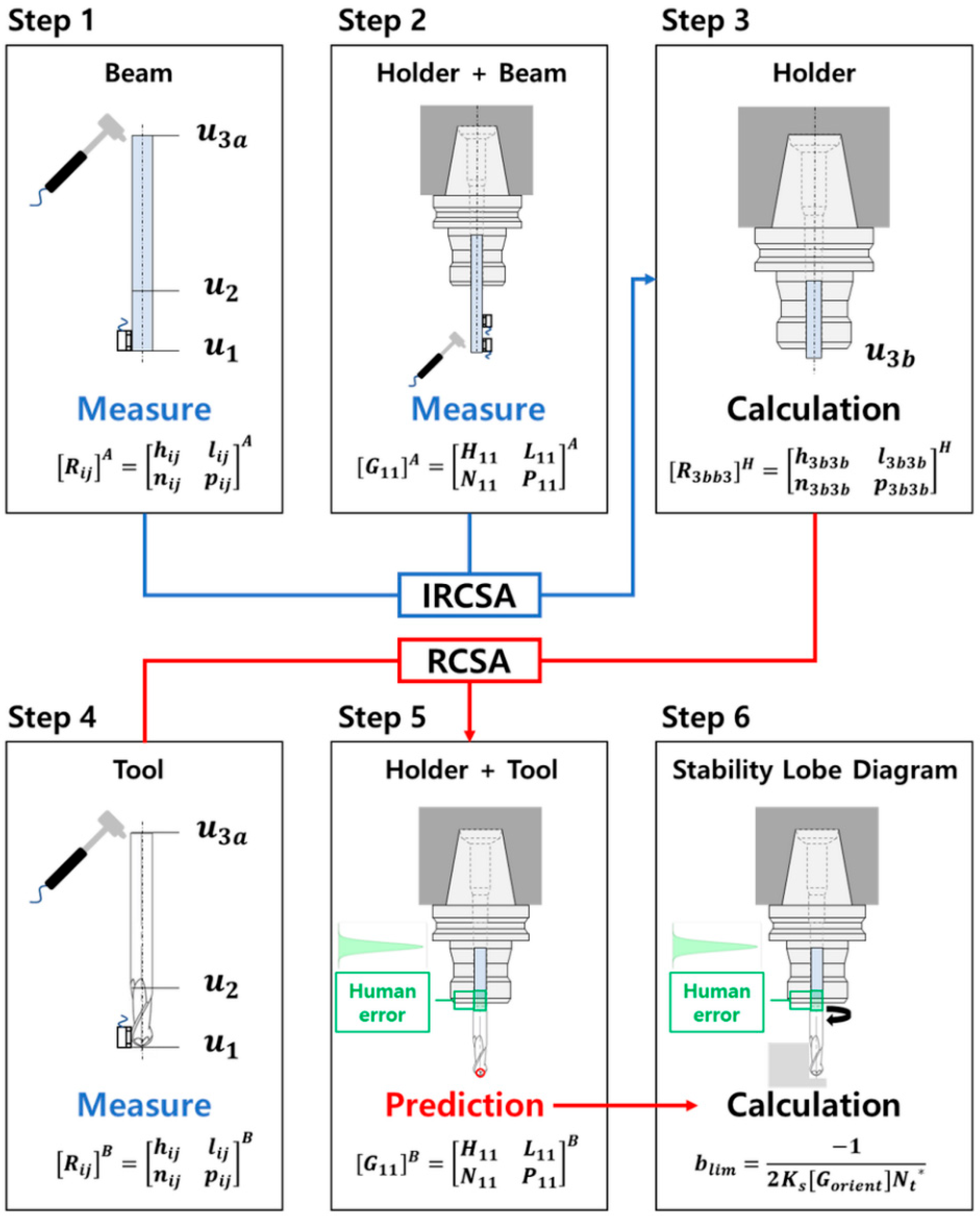
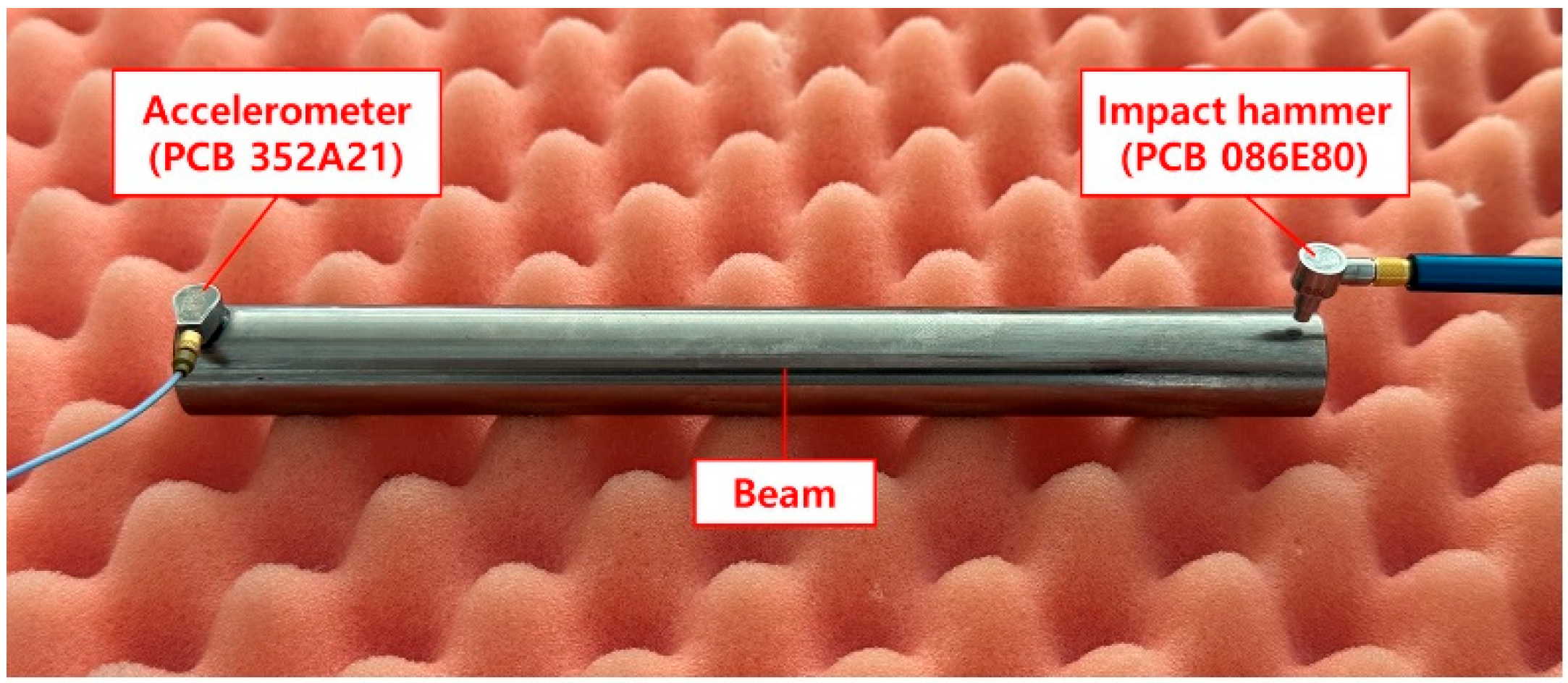
- As shown in Figure 6, the beam FRF was measured via an impact test. Divided into substructures 1 and 2, the uniform beam was analyzed using Euler–Bernoulli beam theory for each substructure, and receptance coupling was performed to obtain the characteristic curves of the uniform beam. The obtained characteristic curves and the FRF measured from vibration experiments were used for modal fitting to estimate the material properties of each substructure, such as the elastic modulus, density, and damping ratio. Using the estimated material properties, the full receptance matrix of the entire uniform beam was calculated. In addition, to perform Inverse Receptance Coupling Substructure Analysis (IRCSA), the full receptance matrix of the overhang uniform beam was calculated.
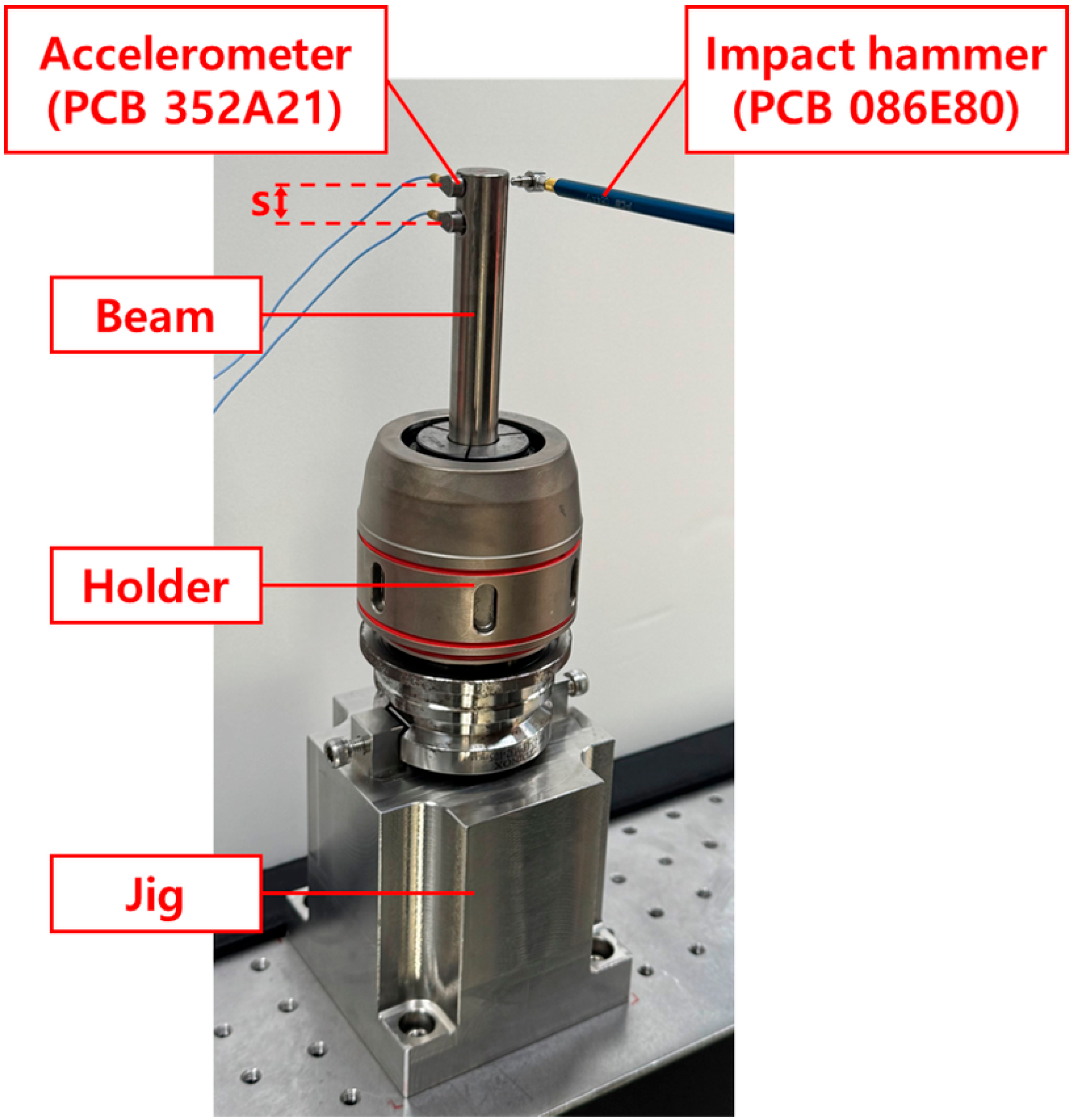
- As shown in Figure 7, to perform IRCSA, two accelerometers were attached to the uniform beam assembled with a BT40 holder, and an impact excitation was applied at the beam tip to measure the FRF. The full receptance matrix was then estimated from the measured FRF using Schmitz’s method.
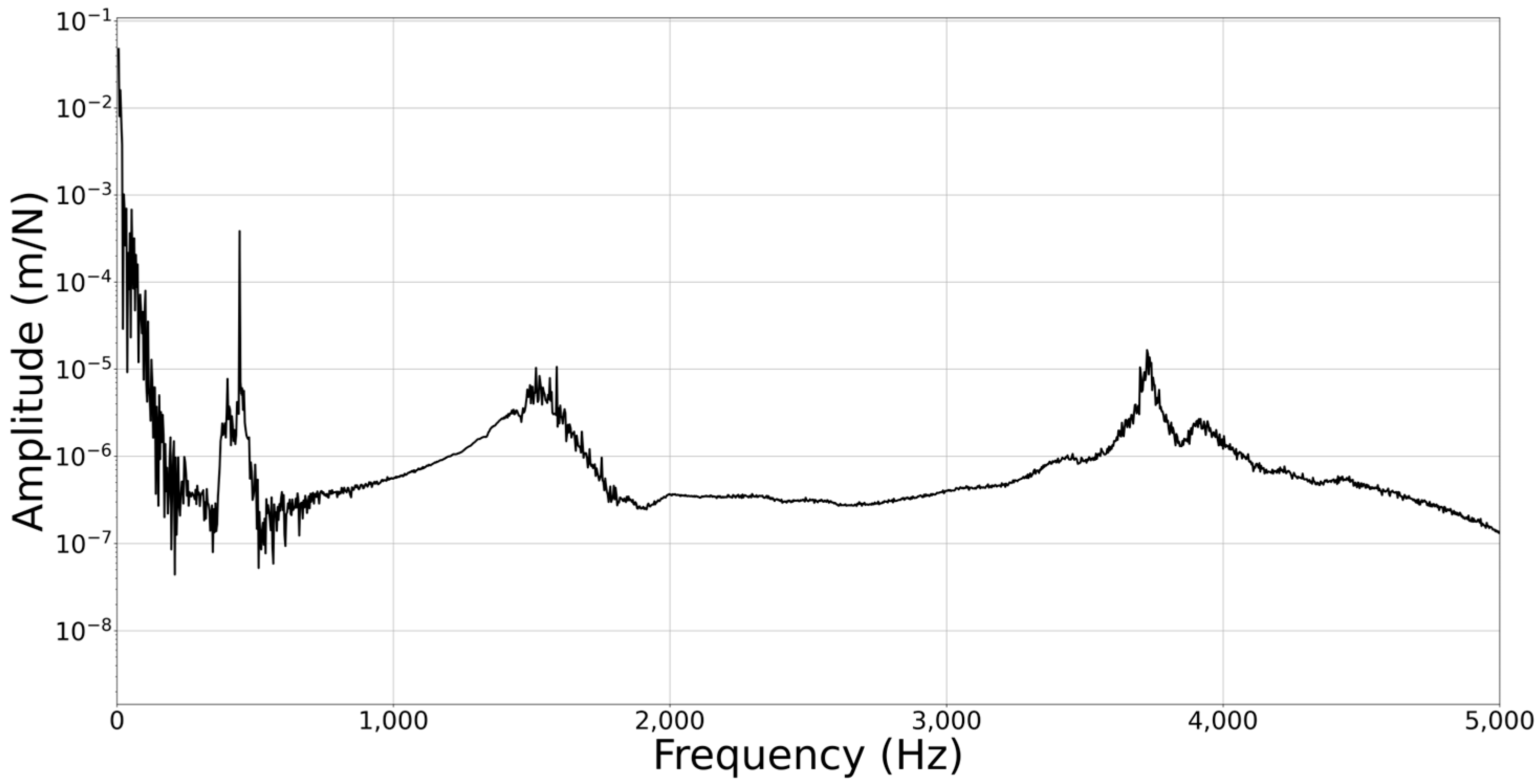
- Using IRCSA, the full receptance matrix of the holder was obtained from the full receptance matrix of the uniform beam assembled with the holder estimated in the previous step and the full receptance matrix of the overhang uniform beam. The estimated displacement to force receptance of the holder, is shown in Figure 8. This enables the overall system dynamic characteristics to be predicted in subsequent cases by measuring the FRF only for an additional cutting tool to be coupled and performing RCSA with the obtained holder receptance.
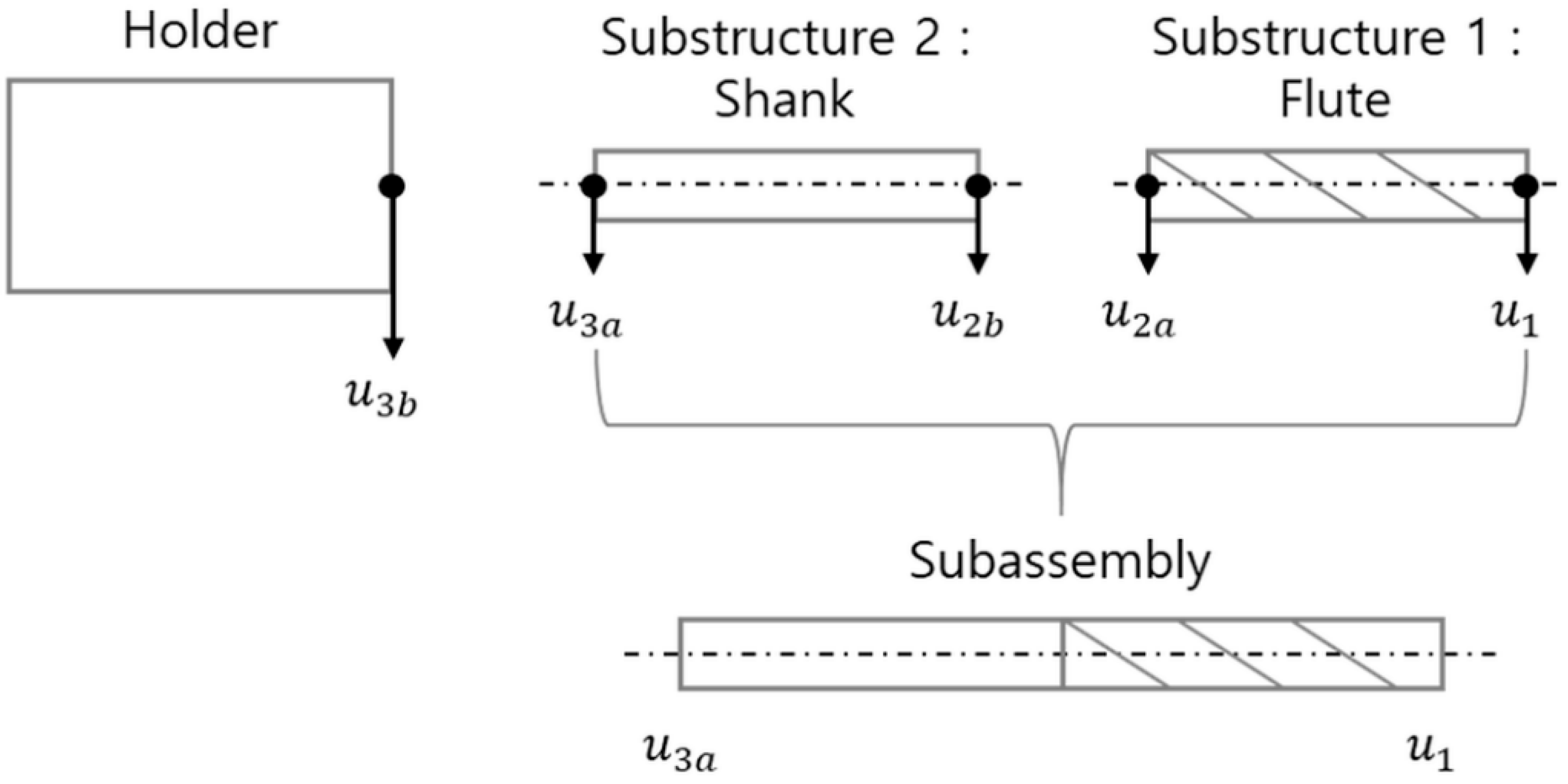
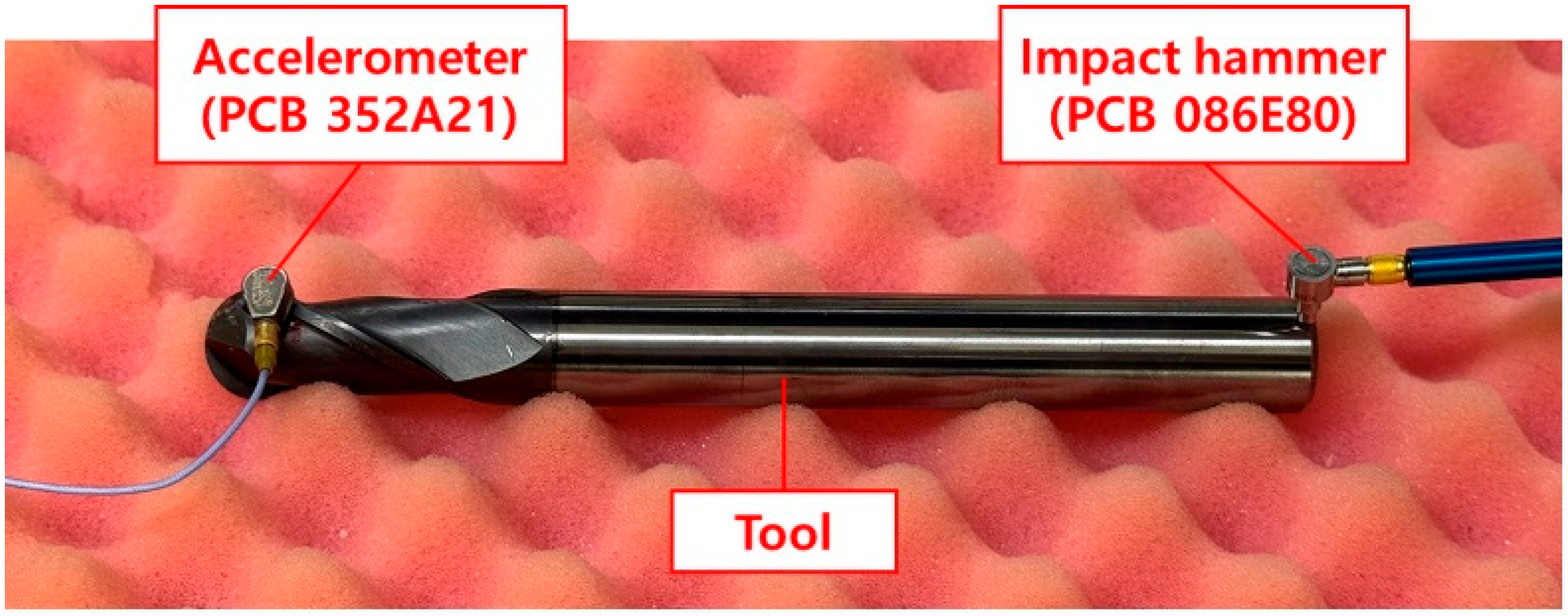
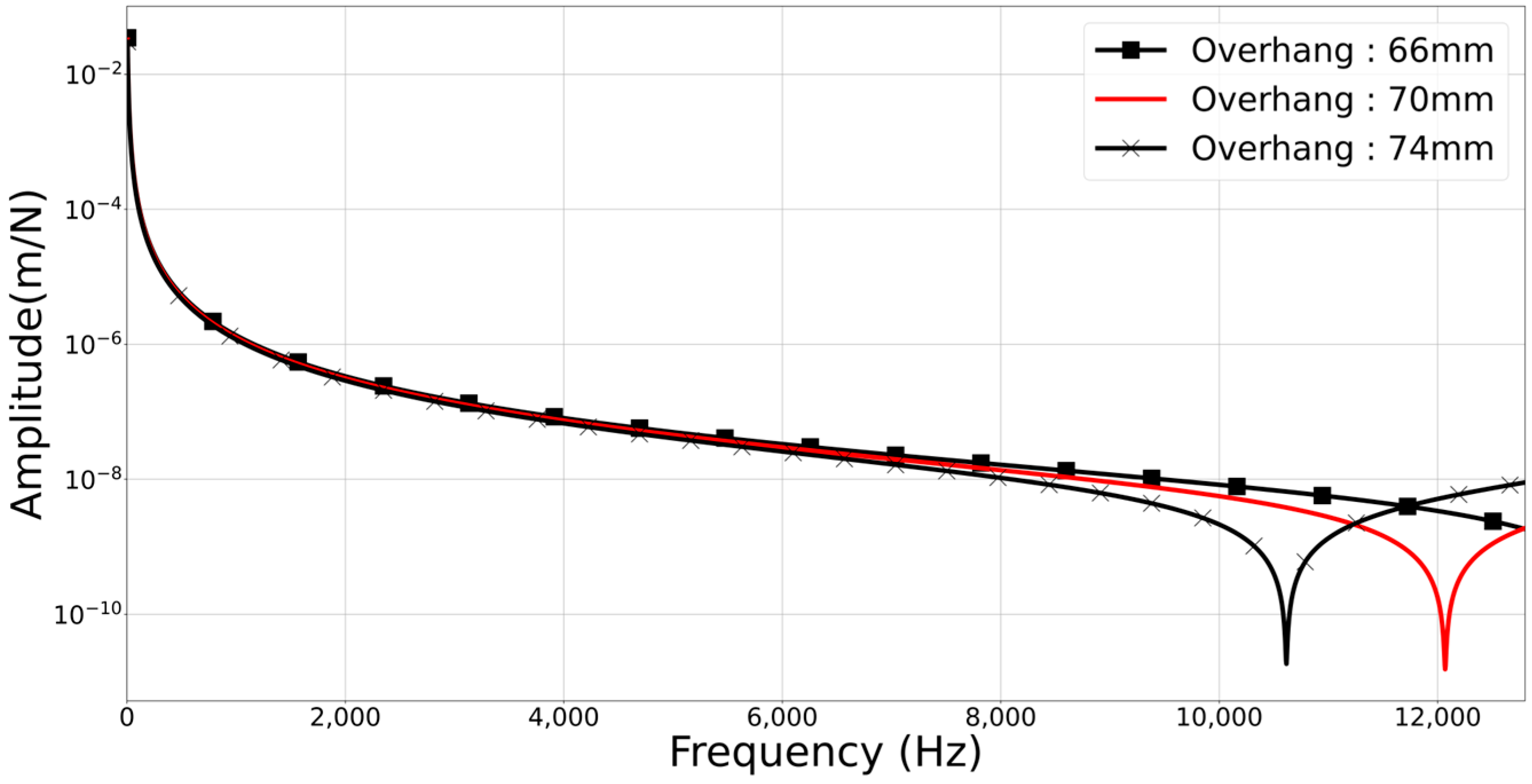
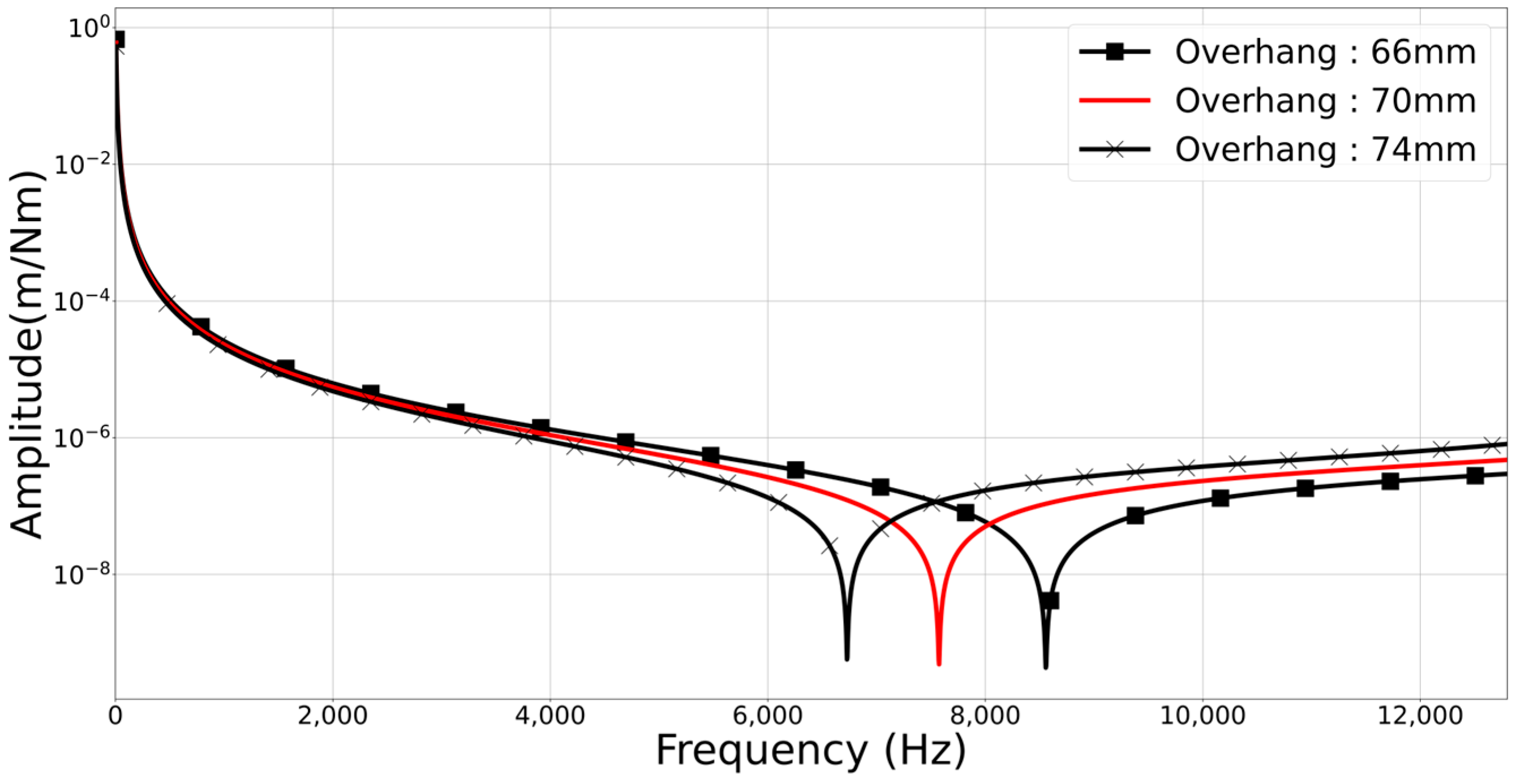
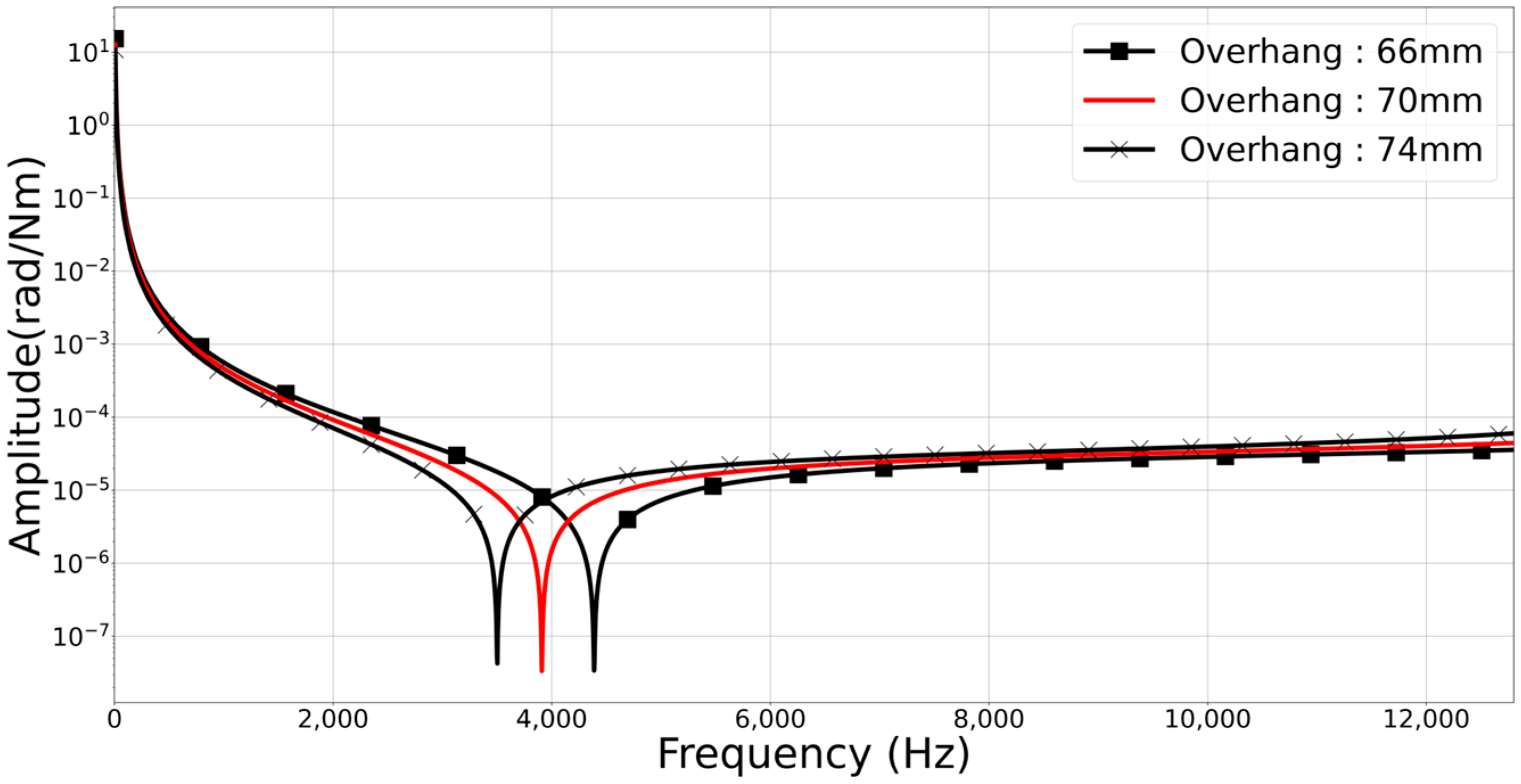
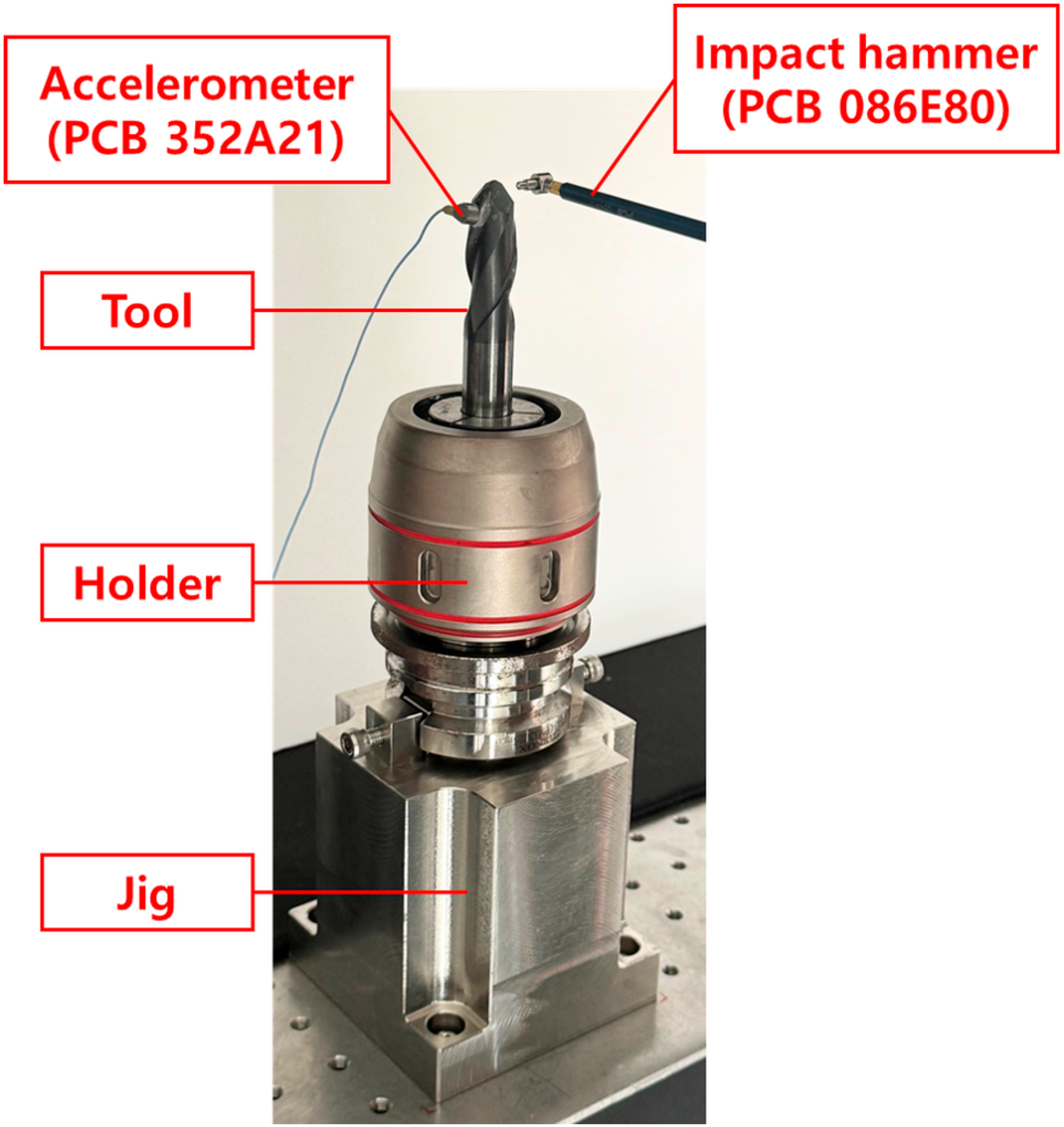
- As shown in Figure 9, the cutting tool FRF was measured via an impact test. Divided into substructures 1 and 2 to account for the heat-treated region and geometric differences, the cutting tool was analyzed using Euler–Bernoulli beam theory for each substructure, and receptance coupling was performed to obtain the characteristic curves of the cutting tool. The obtained characteristic curves and the FRF measured from vibration experiments were used for modal fitting to estimate the material properties of each substructure, such as the elastic modulus, density, and damping ratio. Using the estimated material properties, the full receptance matrix of the cutting tool was calculated. In addition, the full receptance matrix of the overhang cutting tool incorporating tool clamping errors, , was calculated. The displacement-to-force receptance is shown in Figure 10, the displacement-to-moment (=rotation-to-force) is shown in Figure 11, and the rotation-to-moment receptance is shown in Figure 12.
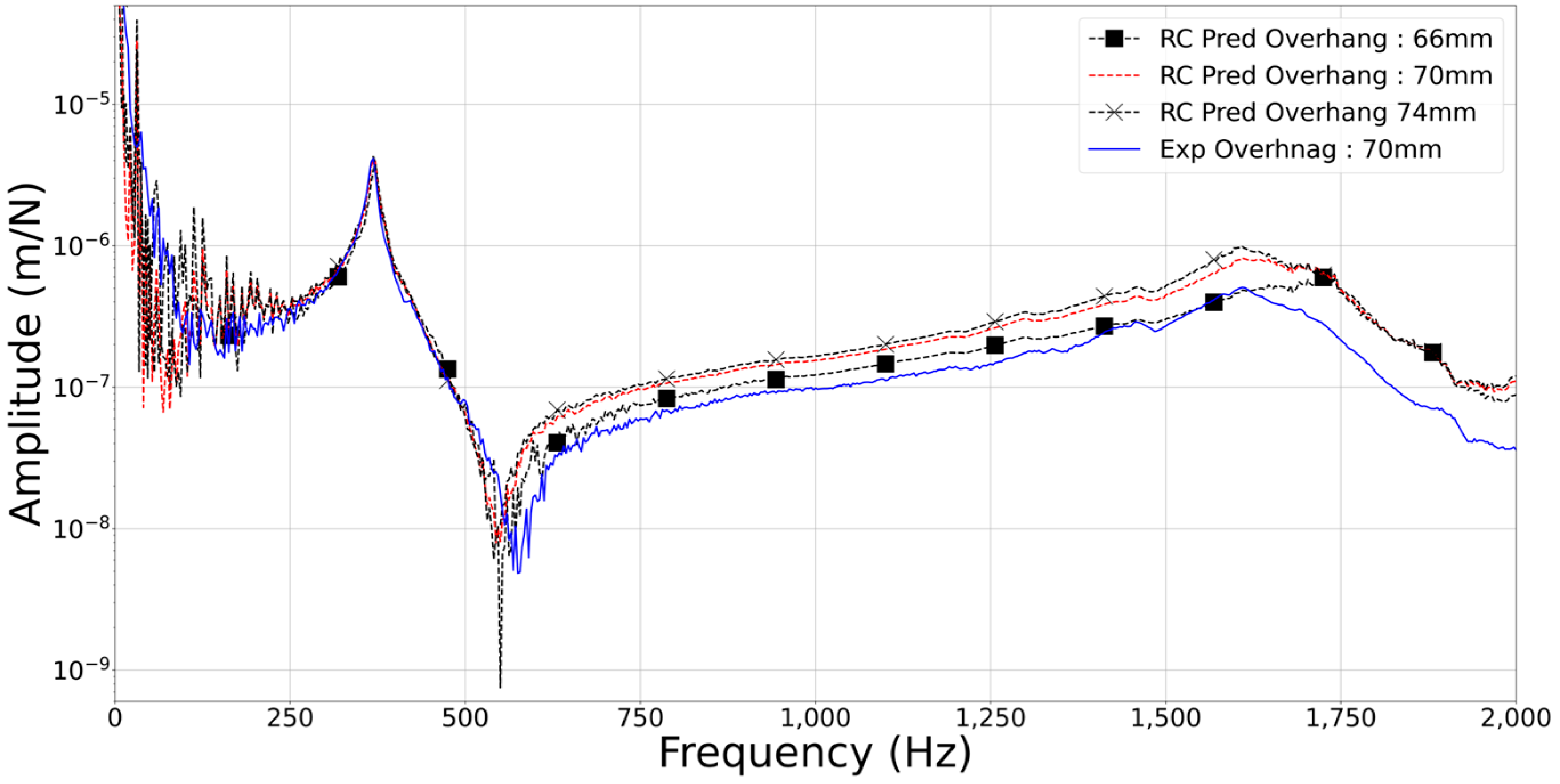
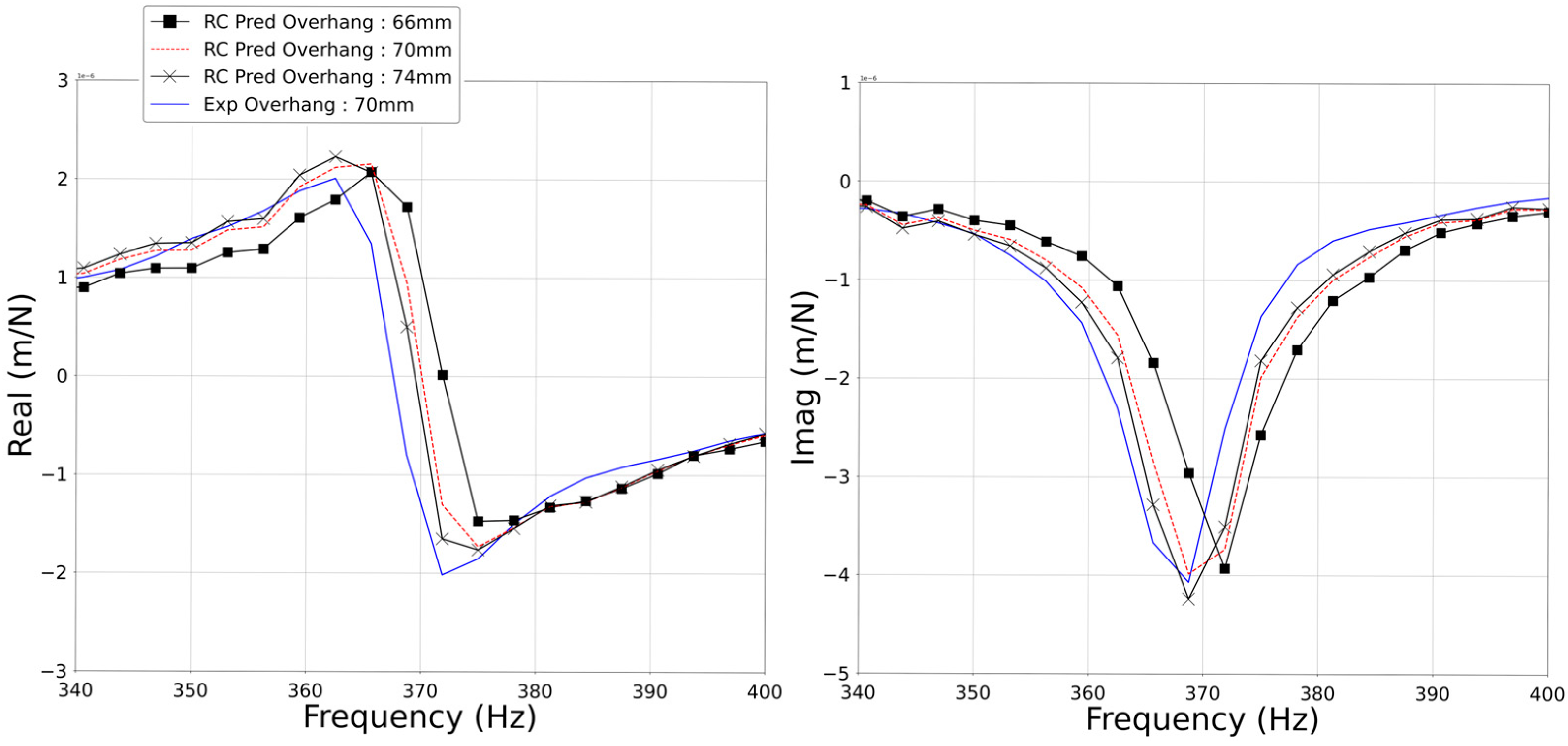
- As shown in Figure 13, the tool tip FRFs predicted by RCSA for the 70 mm overhang condition incorporating a tool clamping error of 4 mm were obtained. As summarized in Table 1, the prediction errors of the first and second natural frequencies were both within 1%, confirming the prediction reliability. As shown in Figure 14, the cutting tool FRF was measured via an impact test with the cutting tool assembled with a BT40 holder, and this measurement was used for comparison with the predicted FRFs.
- To derive the RCSA-based SLD incorporating tool clamping errors, as shown in Figure 15, the modal parameters at the tool tip are required. In this study, modal parameters such as the natural frequency and damping ratio were estimated using a peak-picking method, and a Single Degree of Freedom (SDOF) FRF was constructed based on the estimated parameters to calculate the SLD [35].
4. Result and Discussion
4.1. Validation of the Reliability of the RCSA-Based SLD
4.2. Analysis of Milling Cutting Conditions Using an SLD Incorporating Tool Clamping Errors
5. Conclusions
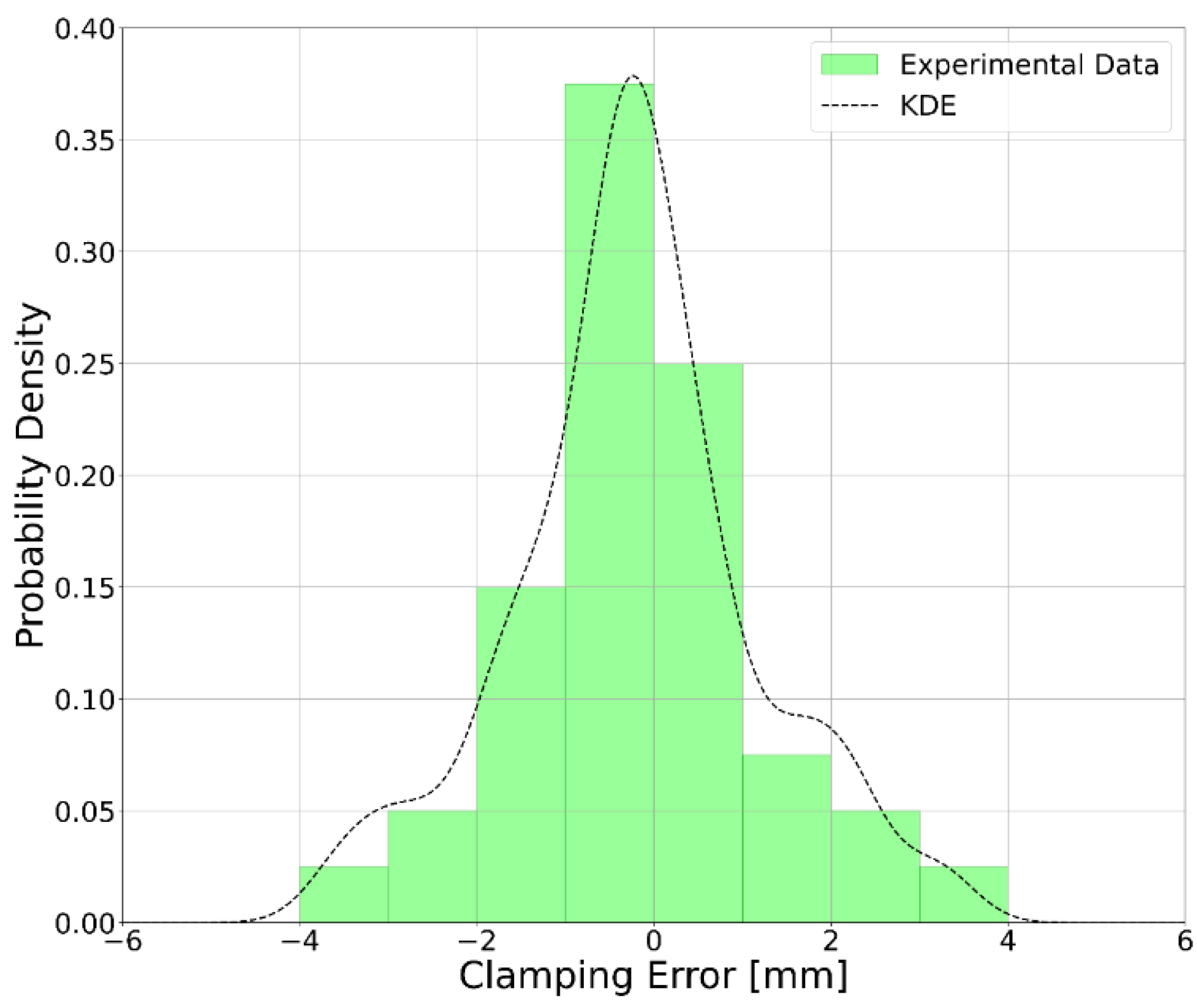
- Repeated clamping experiments with four operators (10 trials per operator, 40 trials in total) were conducted to obtain clamping length samples, and KDE confirmed that the tool clamping error forms a distribution of approximately 4 mm.
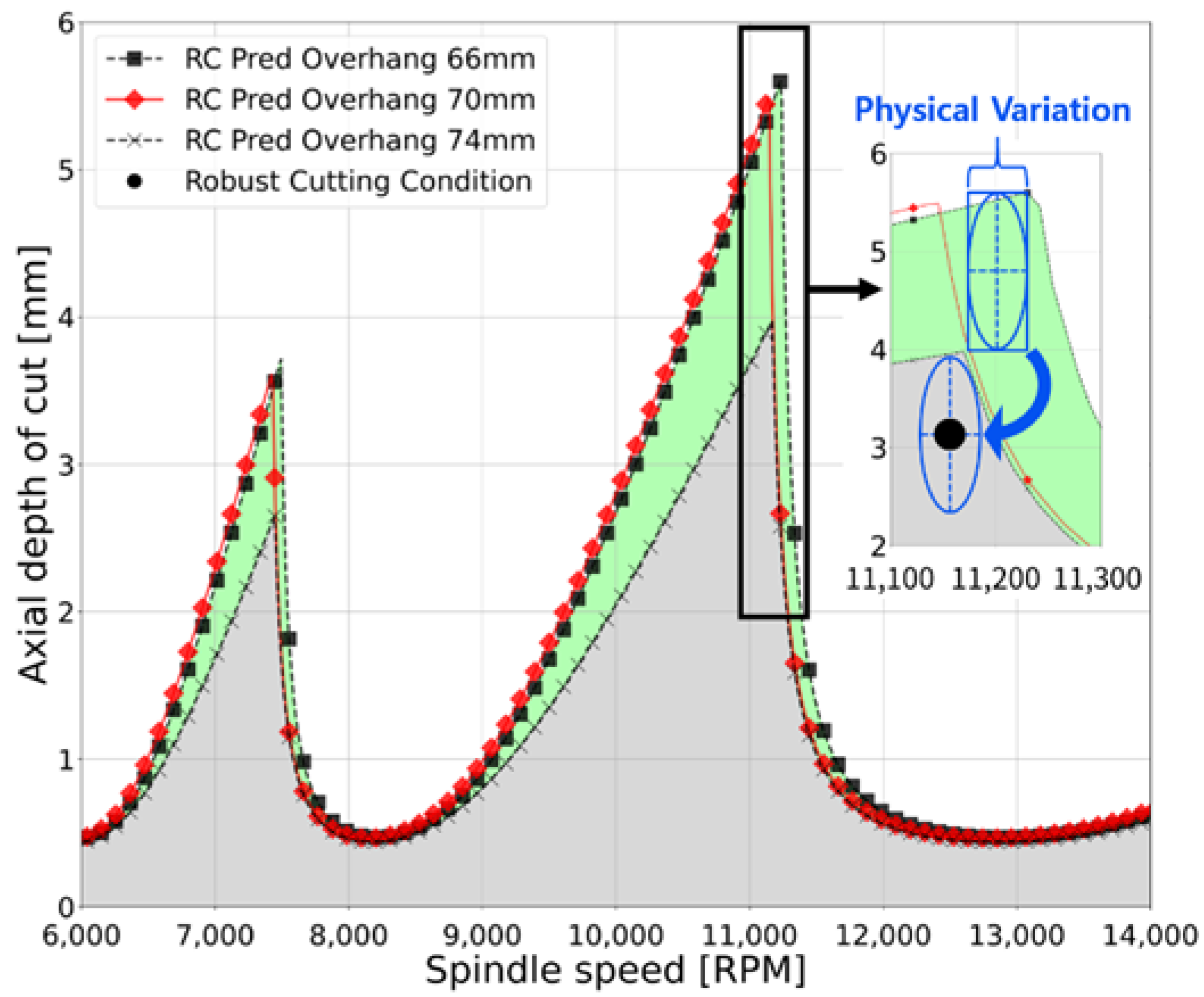
- The 4 mm distribution was incorporated into RCSA to predict the tool tip dynamic characteristics and to derive an SLD band that accounts for tool clamping error-induced variations in clamping length.
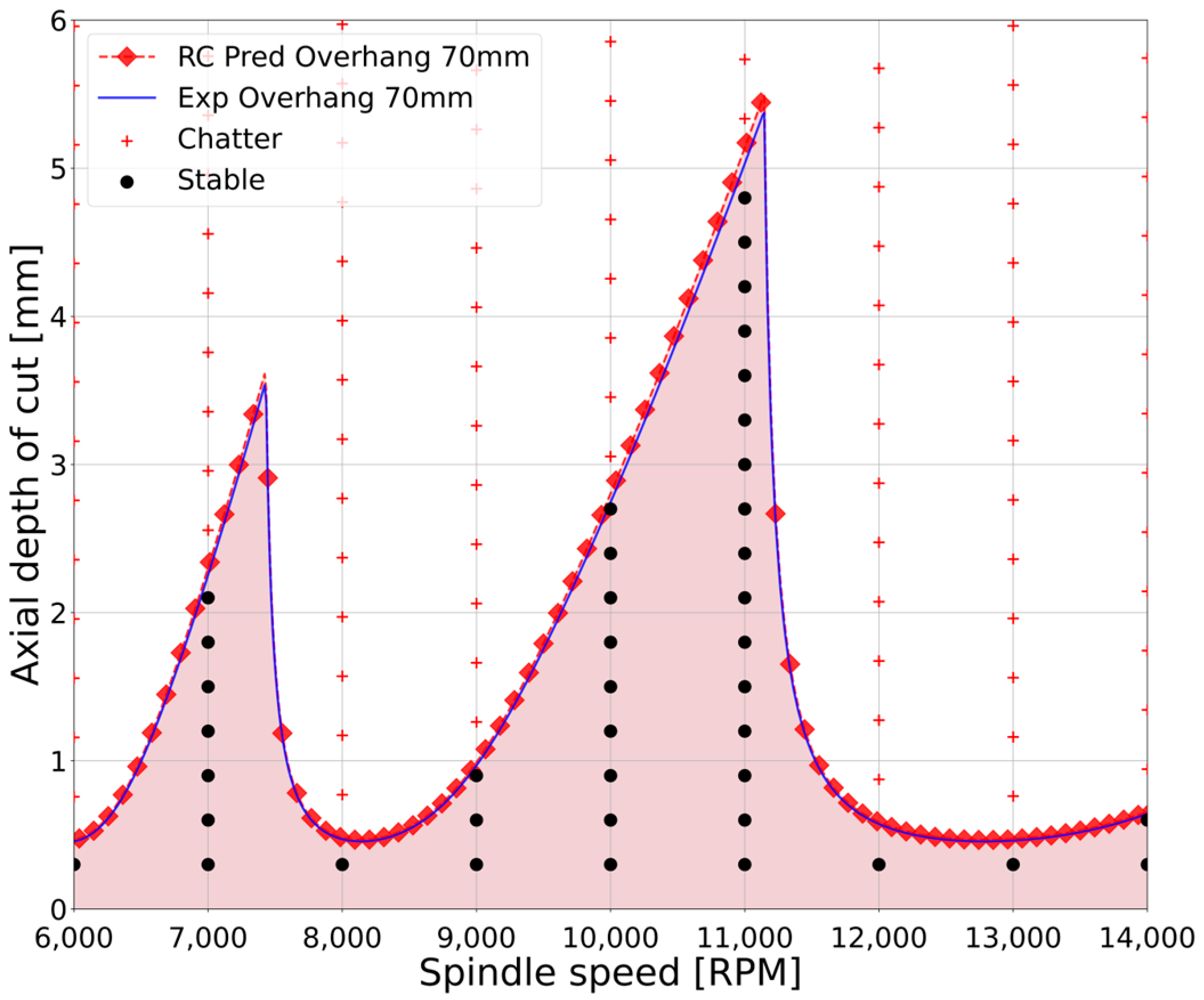
- For the 70 mm overhang condition, the RCSA-based SLD and the experimental SLD were compared using IoU to quantify the overlap of stable regions, and the IoU comparison resulted in 97.92%, indicating high reliability of the proposed RCSA-based SLD.
- The width of the SLD band was defined as a physical variation caused by clamping uncertainty, and the minor axis and major axis of the physical variation were determined to be 60 RPM and 1.62 mm, respectively, representing the range over which spindle speed and axial depth of cut are dispersed due to tool clamping errors. When selecting machining conditions, the uncertainty region expressed by the SLD band was defined as an exclusion region and removed from candidate conditions, and cutting conditions were selected within the remaining stable cutting region while accounting for the physical variation, thereby enabling stable cutting conditions that do not cross the stability boundary even under uncertain changes in spindle speed and axial depth of cut and unforeseen process disturbances. In conclusion, this paper presents a methodology to secure robustness under uncertainty by converting the physical clamping error distribution into a stability avoidance zone. While the model is currently limited to clamping variations, it provides a critical foundation for robust process planning, ensuring that selected cutting conditions remain valid even in the presence of unpredictable manual setup errors.
Author Contributions
Funding
Data Availability Statement
Conflicts of Interest
References
- Altintaş, Y.; Budak, E. Analytical prediction of stability lobes in milling. CIRP Ann. 1995, 44, 357–362. [Google Scholar] [CrossRef]
- Zhou, X.; Zhang, C.; Xu, M.; Wu, B.; Zhang, D. Prediction of chatter stability in bull-nose end milling of thin-walled cylindrical parts using layered cutting force coefficients. Appl. Sci. 2023, 13, 6737. [Google Scholar] [CrossRef]
- Patel, B.R.; Mann, B.P.; Young, K.A. Uncharted islands of chatter instability in milling. Int. J. Mach. Tools Manuf. 2008, 48, 124–134. [Google Scholar] [CrossRef]
- Insperger, T.; Mann, B.P.; Stépán, G.; Bayly, P.V. Stability of up-milling and down-milling, part 1: Alternative analytical methods. Int. J. Mach. Tools Manuf. 2003, 43, 25–34. [Google Scholar] [CrossRef]
- Mann, B.P.; Insperger, T.; Bayly, P.V.; Stépán, G. Stability of up-milling and down-milling, part 2: Experimental verification. Int. J. Mach. Tools Manuf. 2003, 43, 35–40. [Google Scholar] [CrossRef]
- Gradišek, J.; Kalveram, M.; Insperger, T.; Weinert, K.; Stépán, G.; Govekar, E.; Grabec, I. On stability prediction for milling. Int. J. Mach. Tools Manuf. 2005, 45, 769–781. [Google Scholar] [CrossRef]
- Chang, W.-Y.; Chen, C.-C.; Wu, S.-J. Chatter analysis and stability prediction of milling tool based on zero-order and envelope methods for real-time monitoring and compensation. Int. J. Precis. Eng. Manuf. 2019, 20, 693–700. [Google Scholar] [CrossRef]
- Yamato, S.; Nakanishi, K.; Suzuki, N.; Kakinuma, Y. Development of automatic chatter suppression system in parallel milling by real-time spindle speed control with observer-based chatter monitoring. Int. J. Precis. Eng. Manuf. 2021, 22, 227–240. [Google Scholar] [CrossRef]
- Wan, S.; Li, X.; Su, W.; Hong, J. Milling chatter mitigation with projection-based robust adaptive controller and active magnetic bearing. Int. J. Precis. Eng. Manuf. 2022, 23, 1453–1463. [Google Scholar] [CrossRef]
- Urbikain, G.; Campa, F.J.; Zulaika, J.J.; De Lacalle, L.N.L.; Alonso, M.A.; Collado, V. Preventing chatter vibrations in heavy-duty turning operations in large horizontal lathes. J. Sound Vib. 2015, 340, 317–330. [Google Scholar] [CrossRef]
- Compean, F.I.; Olvera, D.; Campa, F.J.; De Lacalle, L.L.; Elias-Zuniga, A.; Rodríguez, C.A. Characterization and stability analysis of a multivariable milling tool by the enhanced multistage homotopy perturbation method. Int. J. Mach. Tools Manuf. 2012, 57, 27–33. [Google Scholar] [CrossRef]
- Urbikain, G.; De Lacalle, L.L.; Campa, F.J.; Fernández, A.; Elías, A. Stability prediction in straight turning of a flexible workpiece by collocation method. Int. J. Mach. Tools Manuf. 2012, 54, 73–81. [Google Scholar] [CrossRef]
- Sanz-Calle, M.; Iglesias, A.; de Lacalle, L.L.; Dombovari, Z.; Munoa, J. Optimal milling cutter helix selection for period doubling chatter suppression. Int. J. Mach. Tools Manuf. 2024, 202, 104211. [Google Scholar] [CrossRef]
- Schmitz, T.L. Automatic trimming of machining stability lobes. Int. J. Mach. Tools Manuf. 2002, 42, 1479–1486. [Google Scholar] [CrossRef]
- Jasiewicz, M.; Miądlicki, K. Implementation of an algorithm to prevent chatter vibration in a CNC system. Materials 2019, 12, 3193. [Google Scholar] [CrossRef]
- Ealo, J.A.; Garitaonandia, I.; Fernandes, M.H.; Hernandez-Vazquez, J.M.; Muñoa, J. A practical study of joints in three-dimensional Inverse Receptance Coupling Substructure Analysis method in a horizontal milling machine. Int. J. Mach. Tools Manuf. 2018, 128, 41–51. [Google Scholar] [CrossRef]
- Schmitz, T.L.; Donaldson, R.R. Predicting high-speed machining dynamics by substructure analysis. CIRP Ann. 2000, 49, 303–308. [Google Scholar] [CrossRef]
- Schmitz, T.L.; Davies, M.A.; Kennedy, M.D. Tool point frequency response prediction for high-speed machining by RCSA. J. Manuf. Sci. Eng. 2001, 123, 700–707. [Google Scholar] [CrossRef]
- Schmitz, T.L.; Duncan, G.S. Three-Component Receptance Coupling Substructure Analysis for Tool Point Dynamics Prediction. J. Manuf. Sci. Eng. 2005, 127, 781–790. [Google Scholar] [CrossRef]
- Ertürk, A.; Özgüven, H.N.; Budak, E. Analytical modeling of spindle–tool dynamics on machine tools using Timoshenko beam model and receptance coupling for the prediction of tool point FRF. Int. J. Mach. Tools Manuf. 2006, 46, 1901–1912. [Google Scholar] [CrossRef]
- Park, S.S.; Altintas, Y.; Movahhedy, M. Receptance coupling for end mills. Int. J. Mach. Tools Manuf. 2003, 43, 889–896. [Google Scholar] [CrossRef]
- Cheng, C.-H.; Schmitz, T.L.; Duncan, G.S. Rotating tool point frequency response prediction using RCSA. Mach. Sci. Technol. 2007, 11, 433–446. [Google Scholar]
- Albertelli, P.; Goletti, M.; Monno, M. A new receptance coupling substructure analysis methodology to improve chatter free cutting conditions prediction. Int. J. Mach. Tools Manuf. 2013, 72, 16–24. [Google Scholar] [CrossRef]
- Özşahin, O.; Budak, E.; Özgüven, H.N. Estimation of dynamic contact parameters for machine tool spindle-holder-tool assemblies using artificial neural networks. In Proceedings of the 3rd International Conference on Manufacturing Engineering (ICMEN), Chalkidiki, Greece, 1–3 October 2008; pp. 131–144. [Google Scholar]
- Park, S.S.; Amani, S.; Lee, D.Y.; Lee, J.; Nam, E. Machine learning based substructure coupling of machine tool dynamics and chatter stability. CIRP Ann. 2024, 73, 297–300. [Google Scholar] [CrossRef]
- Mostaghimi, H.; Park, S.S.; Lee, D.Y.; Nam, S.; Nam, E. Prediction of tool tip dynamics through machine learning and inverse receptance coupling. Int. J. Precis. Eng. Manuf. 2023, 24, 1739–1752. [Google Scholar] [CrossRef]
- Duarte, M.L.M.; Ewins, D.J. Rotational degrees of freedom for structural coupling analysis via finite-difference technique with residual compensation. Mech. Syst. Signal Process. 2000, 14, 205–227. [Google Scholar] [CrossRef]
- Kim, J.-W.; Lee, J.-W.; Kim, K.-W.; Kang, J.-H.; Yang, M.-S.; Kim, D.-Y.; Lee, S.-Y.; Jang, J.-S. Estimation of the frequency response function of the rotational degree of freedom. Appl. Sci. 2021, 11, 8527. [Google Scholar] [CrossRef]
- Kim, J.-W.; Ko, D.-C.; Kim, D.-H.; Noh, Y.; Jang, J.-S. Approach to Receptance Coupling Substructure Analysis based on Full Receptance Estimation of Sub-assembly Using the Modal Fitting Method. Int. J. Precis. Eng. Manuf. 2024, 25, 2517–2533. [Google Scholar] [CrossRef]
- Deng, C.; Wu, Q.; Miao, J.; Lu, S.; Xie, L. Meta-transfer learning for predicting position-dependent milling stability across varying overhang lengths under limited experimental data. J. Manuf. Process. 2025, 149, 43–56. [Google Scholar] [CrossRef]
- Wang, D.; Wang, X.; Liu, Z.; Gao, P.; Ji, Y.; Löser, M.; Ihlenfeldt, S. Surface location error prediction and stability analysis of micro-milling with variation of tool overhang length. Int. J. Adv. Manuf. Technol. 2018, 99, 919–936. [Google Scholar] [CrossRef]
- Schmitz, T.L.; Burns, T.J.; Ziegert, J.C.; Dutterer, B.; Winfough, W.R. Tool length-dependent stability surfaces. Mach. Sci. Technol. 2004, 8, 377–397. [Google Scholar] [CrossRef]
- Duncan, G.; Schmitz, T.L.; Kurdi, M.H. Uncertainty Propagation for Selected Analytical Milling Stability Limit Analyses. 2000. Available online: https://api.semanticscholar.org/CorpusID:107607838 (accessed on 2 January 2026).
- Lee, K.J.; Donmez, M.A. Repeatability analysis on the tool point dynamics for investigation on uncertainty in milling stability. In Proceedings of the ASME International Mechanical Engineering Congress and Exposition (IMECE), Seattle, WA, USA, 11–15 November 2007; Volume 42975, pp. 477–483. [Google Scholar]
- Mladjenovic, C.; Monkova, K.; Zivkovic, A.; Knezev, M.; Marinkovic, D.; Ilic, V. Experimental Identification of Milling Process Damping and Its Application in Stability Lobe Diagrams. Machines 2025, 13, 96. [Google Scholar] [CrossRef]







| Overhang (mm) | Mode | Experiment (Hz) | Prediction (Hz) | Error Rate (%) |
|---|---|---|---|---|
| 70 | 368.75 | 368.80 | 0.01 | |
| 1609.38 | 1614.12 | 0.29 |
| Parameters | Value |
|---|---|
| Cutting coefficient | 850 |
| Force angle | |
| No. of teeth | 0.5 |
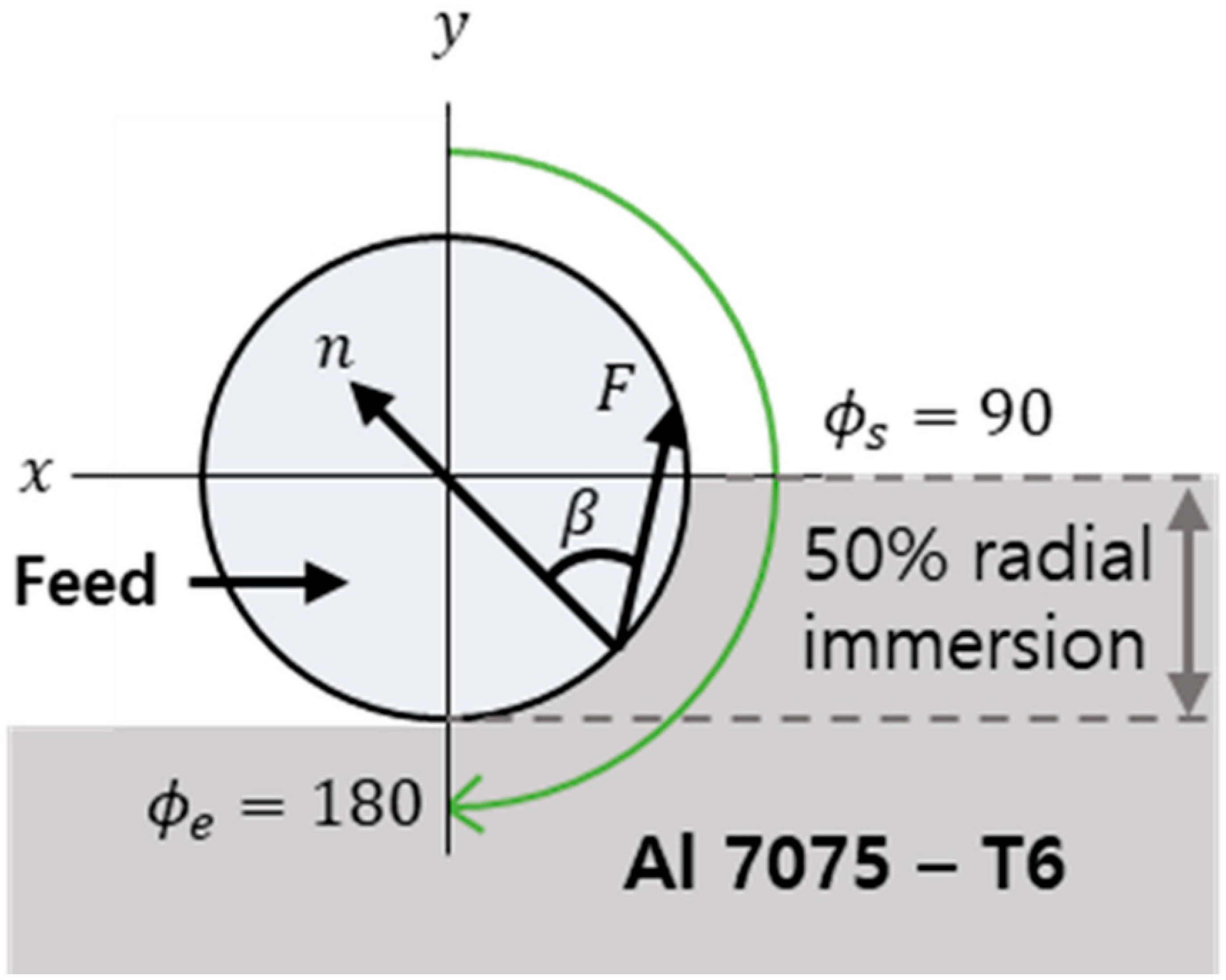
| Workpiece | Al 7075-T6 |
Disclaimer/Publisher’s Note: The statements, opinions and data contained in all publications are solely those of the individual author(s) and contributor(s) and not of MDPI and/or the editor(s). MDPI and/or the editor(s) disclaim responsibility for any injury to people or property resulting from any ideas, methods, instructions or products referred to in the content. |
© 2026 by the authors. Licensee MDPI, Basel, Switzerland. This article is an open access article distributed under the terms and conditions of the Creative Commons Attribution (CC BY) license.
Share and Cite
Jo, J.-H.; Kim, J.-W.; Won, H.-I.; Ko, D.-C.; Jang, J.-S. RCSA-Based Analysis of Stability Lobes in Milling Incorporating Tool Clamping Errors. Machines 2026, 14, 204. https://doi.org/10.3390/machines14020204
Jo J-H, Kim J-W, Won H-I, Ko D-C, Jang J-S. RCSA-Based Analysis of Stability Lobes in Milling Incorporating Tool Clamping Errors. Machines. 2026; 14(2):204. https://doi.org/10.3390/machines14020204
Chicago/Turabian StyleJo, Jun-Hyun, Ji-Wook Kim, Hong-In Won, Dae-Cheol Ko, and Jin-Seok Jang. 2026. "RCSA-Based Analysis of Stability Lobes in Milling Incorporating Tool Clamping Errors" Machines 14, no. 2: 204. https://doi.org/10.3390/machines14020204
APA StyleJo, J.-H., Kim, J.-W., Won, H.-I., Ko, D.-C., & Jang, J.-S. (2026). RCSA-Based Analysis of Stability Lobes in Milling Incorporating Tool Clamping Errors. Machines, 14(2), 204. https://doi.org/10.3390/machines14020204