
Intuitive, Low-Cost Cobot Control System for Novice Operators, Using Visual Markers and a Portable Localisation Scanner



Abstract
1. Introduction
1.1. Existing and Proposed Systems and Practices
1.1.1. Traditional Robot Programming Methods
1.1.2. Intuitive Cobot Control Methods
1.1.3. Fiducial Markers in Robotics
1.1.4. Cobot Control and Programming Concepts
1.2. Human–Cobot Interaction
1.2.1. Cobot Programming with Extended Reality
1.2.2. Cobot Programming with Computer Vision
1.2.3. Cobot Programming with Large Language Models
1.3. Limitations of Existing Methods
- There is a time and cost element involved, which may be compounded if an employer must cover the cost of training, along with a replacement worker, while the trainee is engaged in training.
- The employer may be reluctant to spend resources on training an employee who may then be recruited by a competitor [72].
- The employee may have a low aptitude for learning a programming language or understanding basic robotics.
- Despite a willingness to attend training, employees can be prevented from doing so due to time constraints, social commitments, cost, or unsupportive employers [73].
- Dexterity, concentration, and knowledge levels of the operator;
- Speed of cobot arm movement (if movements are too quick, the speed protection system can sense an excess of force acting on a joint and place the control system into a protective stop mode, which typically requires a control reset);
- Accurate positioning of the end-effector (e.g., centre point of workpiece mass to be clasped);
- Accurate orientation of the end-effector (e.g., z-axis alignment if exit path needs to be vertically disposed);
- End-effector pre-contact settings (e.g., suction off for a vacuum gripper or jaws open, with sufficient clearance to accommodate the workpiece, for a fingered gripper)
1.4. Research Gaps
1.4.1. The Gaps in Human–Cobot Interaction
1.4.2. The Gaps in Cobot Programming with Extended Reality
1.4.3. The Gaps in Cobot Programming with Computer Vision
1.4.4. The Gaps in Cobot Programming with Large Language Models
1.5. Research Contributions
- Ease of use. In contrast to traditional hand-guiding methods, which may be cumbersome for novice operators and require two-handed operation, the proposed system features a portable scanning tool that is light and easy to manage with one hand;
- Lack of formal training requirement. The intuitive nature of the scanning tool, with its point-and-press operation, means that a brief instruction to a novice user is all that is required before use;
- Cost effectiveness. The hardware for the proposed system can be purchased for around $US100. This cost is in stark contrast to existing visual systems, which cost around $US20,000;
- Scalability. By simply printing and mounting additional fiducial markers, a system can be up scaled and configured as required;
- Expansion. Connecting multiple cobots to a single visual localisation system can be achieved by securely connecting separate cobot controllers via a LAN-based switch;
- Customisation. Programs can be created at the implementation stage, that allow specific actions to be conducted within the Pick-and-Place operations;
- Democratisation. By providing an alternative to the traditional hand-guiding process for cobots, which some novice operators may find difficult, the proposed simplified control system may improve the appeal of cobot adoption by reducing barriers caused by control complexity.
2. Proposed Vision System
2.1. System Overview
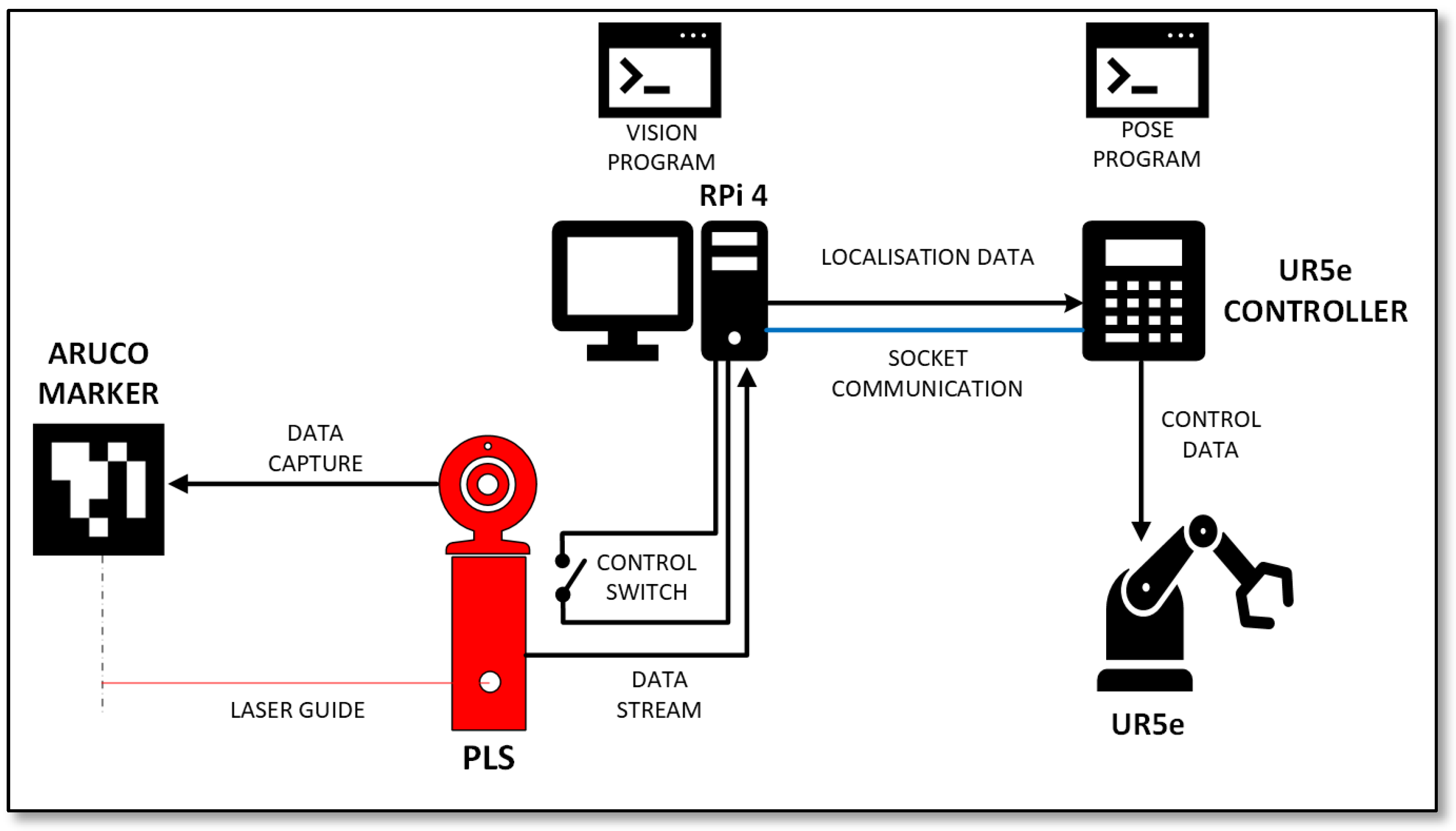
- ArUco markers are securely fitted to several precise locations around the outside of the cobot workspace to provide a visual reference frame for localisation from any vantage point;
- A user places the base of the PLS on top of an object to be picked within the cobot workspace, directing the front of the scanner towards one of the markers so that the marker is fully within the camera’s field of view;
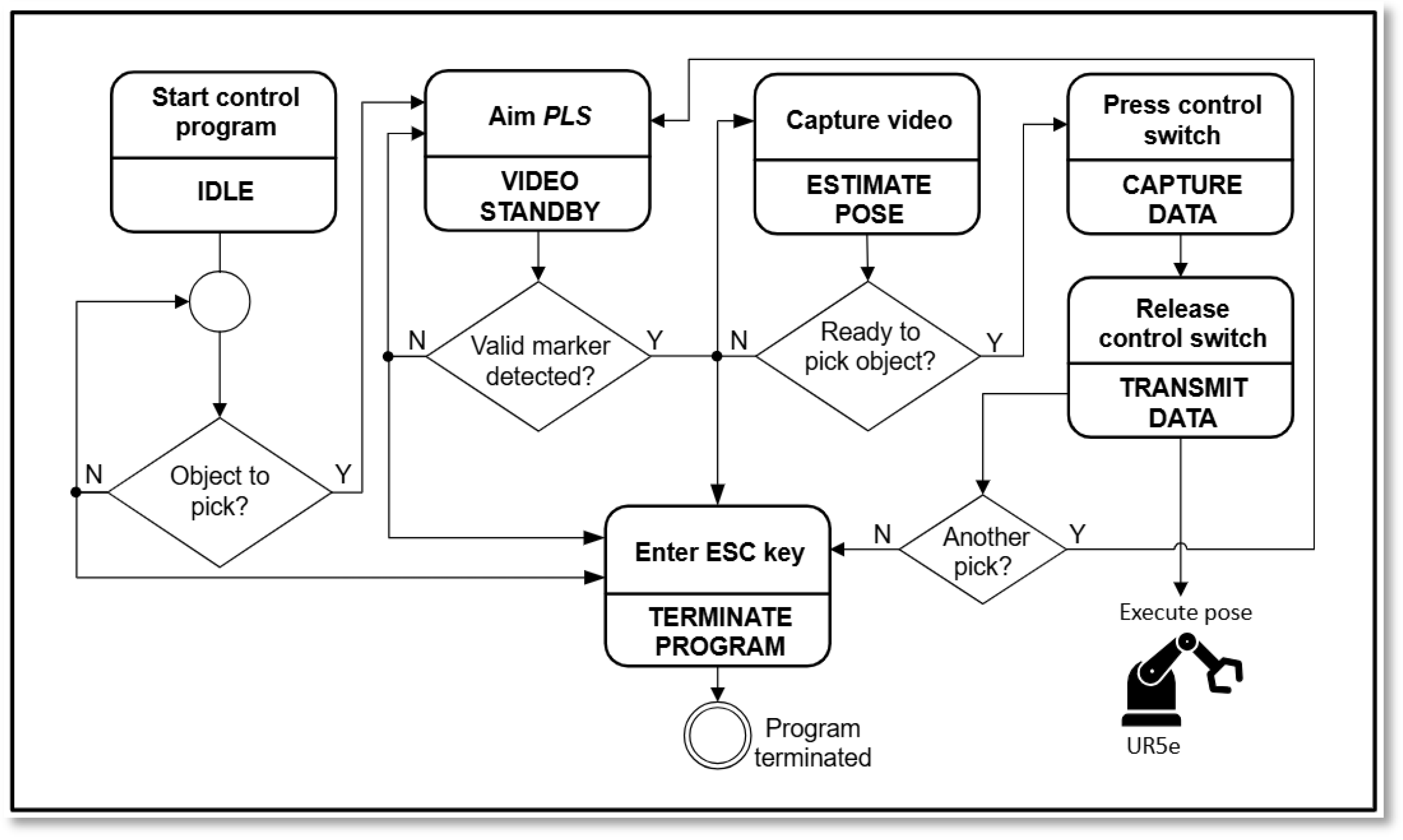
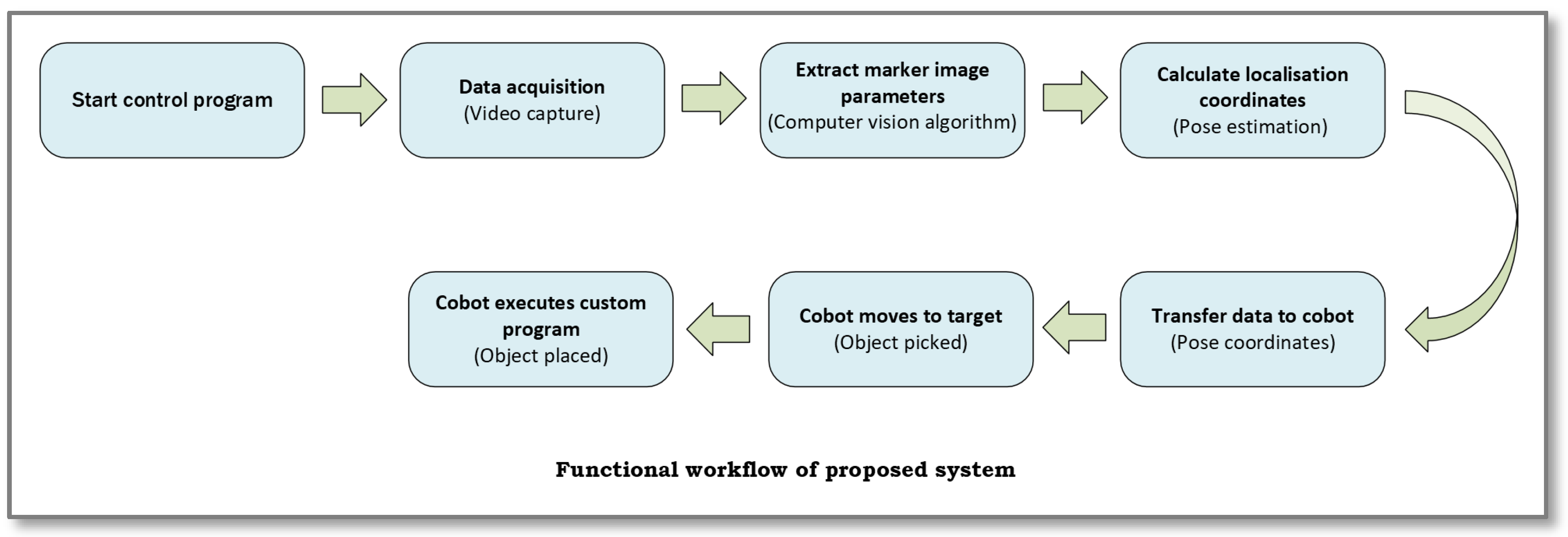
- Once the scanner is positioned at the top of the pick location, the user presses the data control switch on the scanner after a 5 s capture delay. This action captures the coordinate data for the current location of the centre of scanner’s base. On releasing the switch, the captured data, used to calculate the pose estimation, is converted using the transformation matrix (refer to Section 2.5.2). This data, along with the coordinate offsets related to the specific marker ID and delayed execution command are then transmitted to the UR5e controller. A 10 s delay is included before the UR5e moves, to allow the user time to remove the PLS from the workspace;
- The user can now remove the scanner from the object and after the 10 s delay, the cobot will move to the desired location, pick the target object and place it at a predetermined destination point;
- The system will remain in standby mode until another object is to be picked, at which point the process restarts at step 2 above. Otherwise, the program can be terminated. The system workflow is shown in Figure 3.

2.2. Hardware Components
2.2.1. Portable Localisation Scanner
2.2.2. Vision Capture
2.2.3. Processing Unit
2.2.4. Cobot
2.2.5. Communication
2.3. Software Architecture
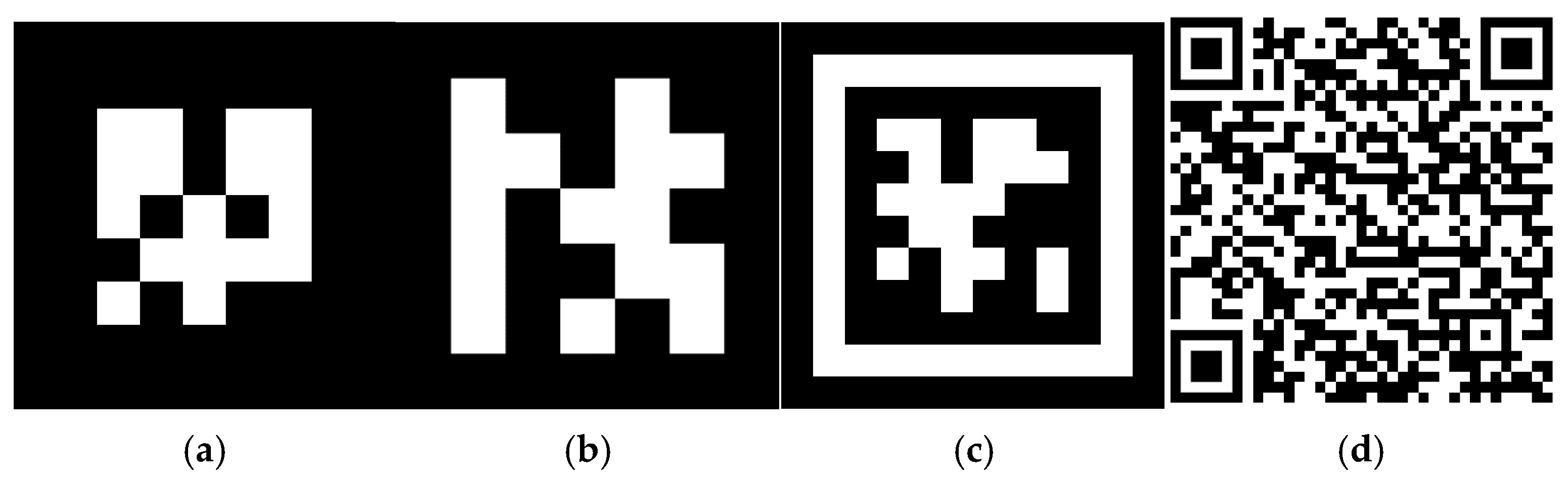
2.4. Fiducial Markers
2.4.1. ArUco Marker Detection and Pose Estimation
- Image acquisition. When the marker is in the camera’s field of view, image frames are captured with the function cv2.VideoCapture();
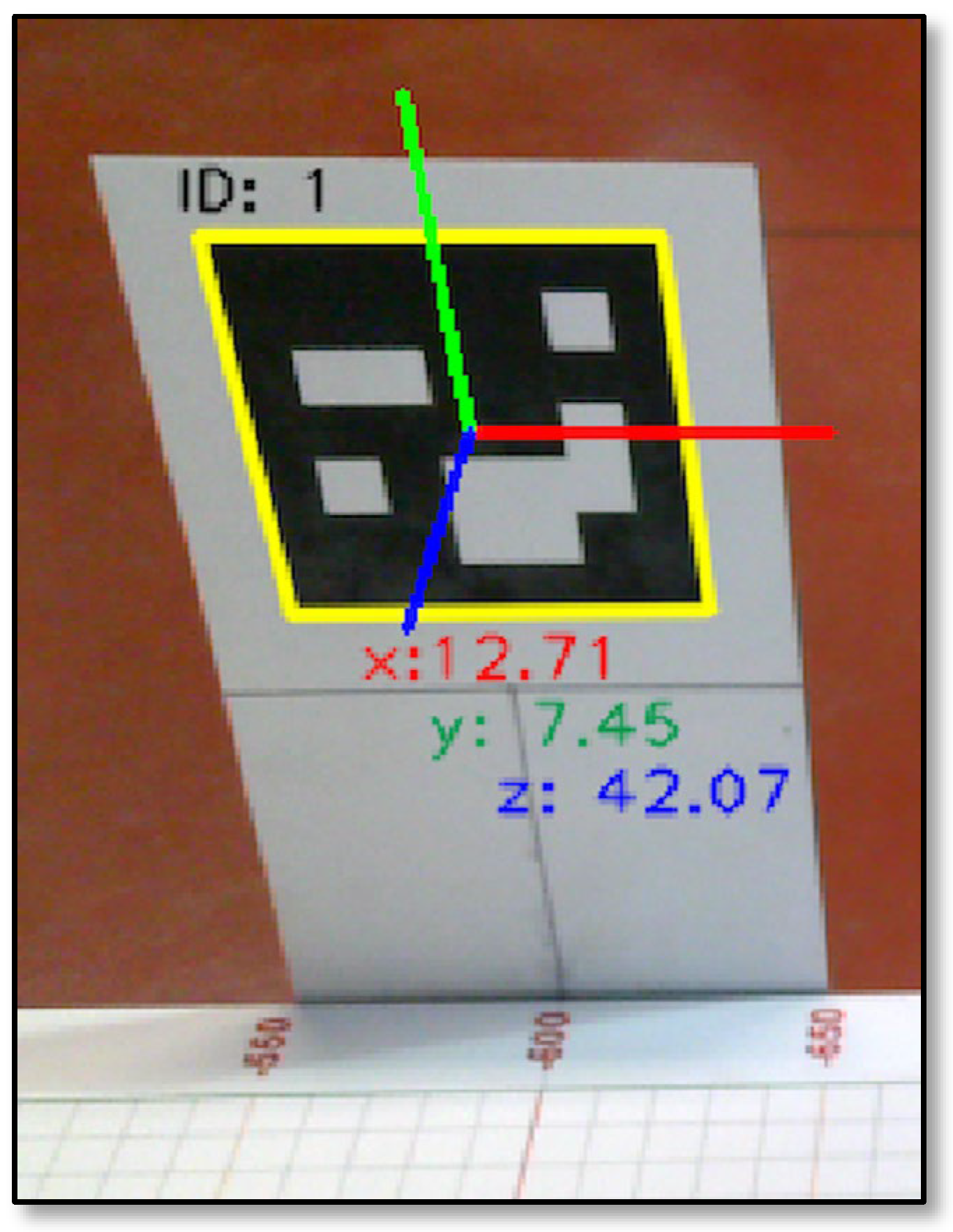
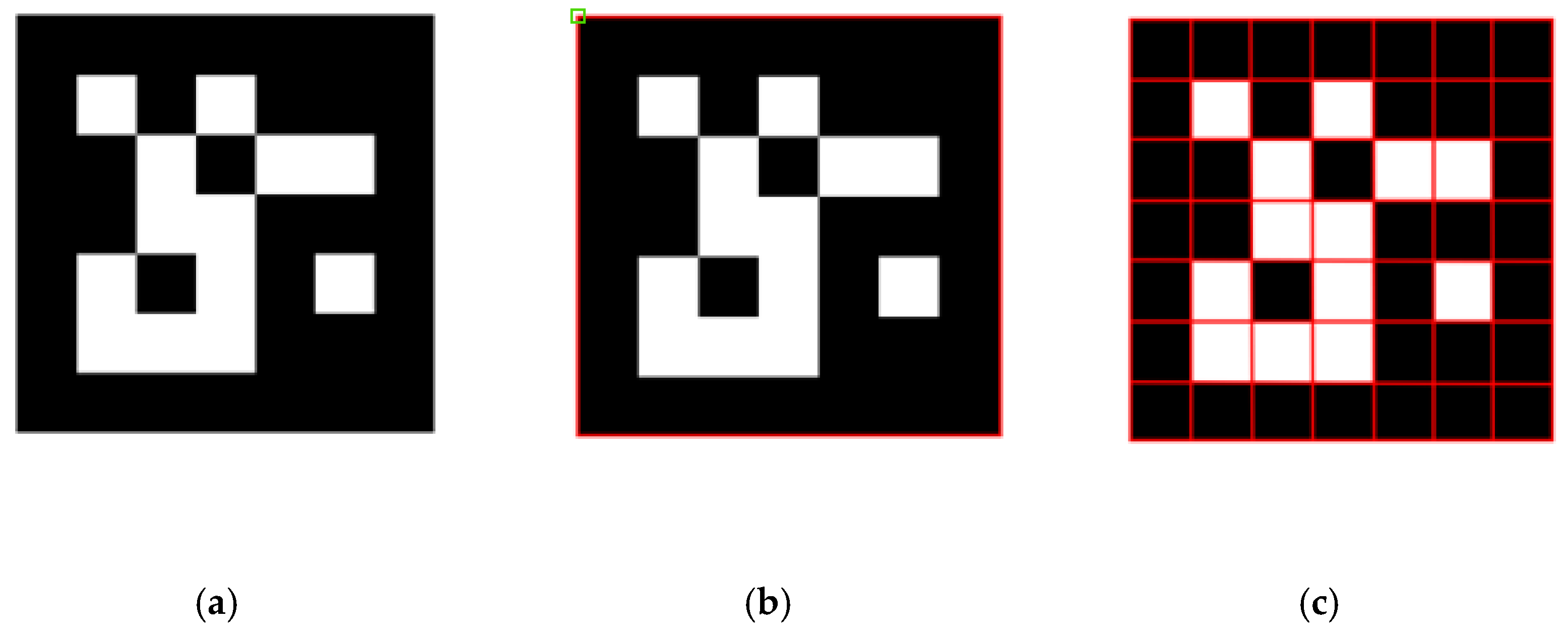
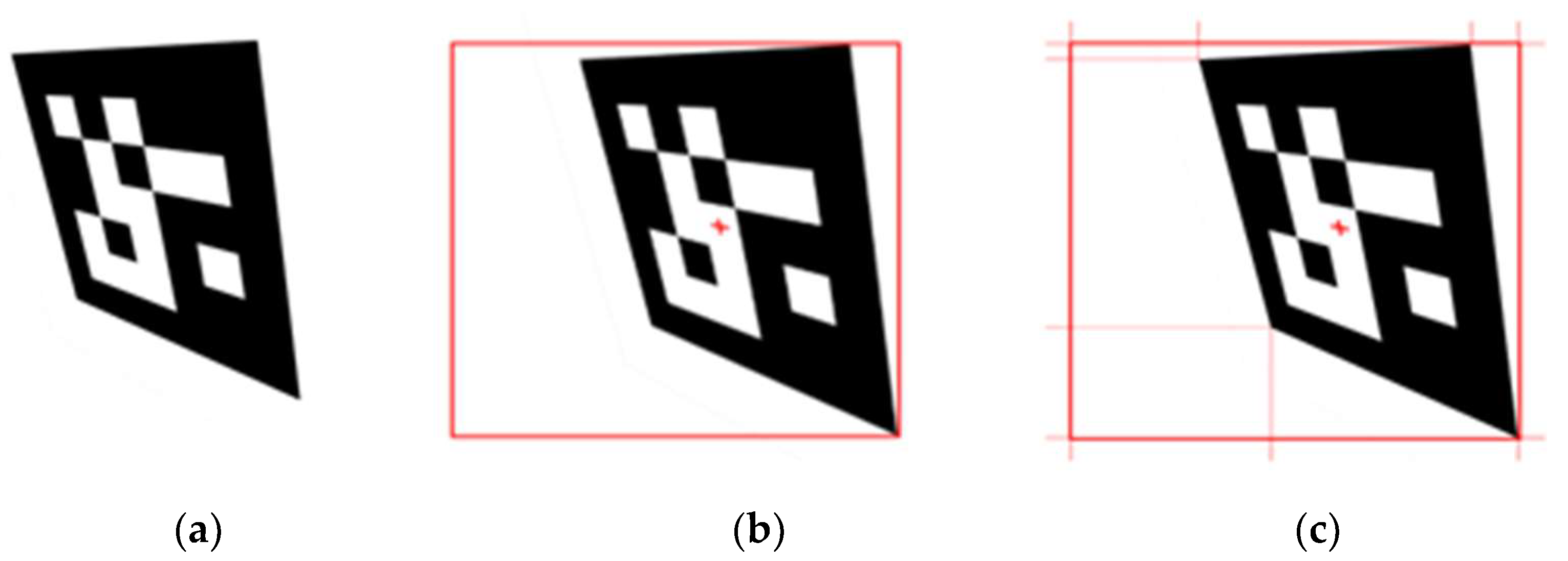
- Marker detection. If a marker is within the range of ArUco markers (referred to as ArUco dictionaries) specified in the control program, the function cv2.aruco.detectMarkers() detects the corners of the detected marker, along with its unique ID. The marker borders, ID, coordinate axes, and coordinate reference values relative to the camera can also be displayed as a colour-coded coordinate dynamic overlay (refer to Figure 6) within the control program;
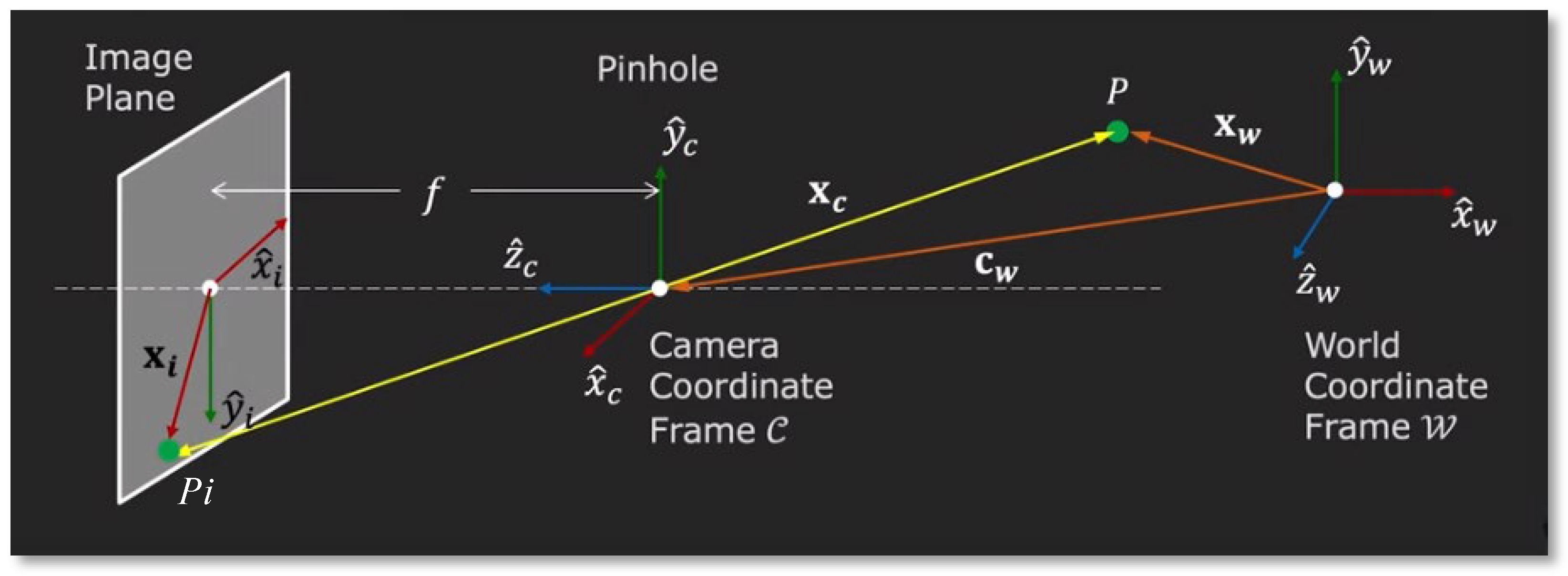
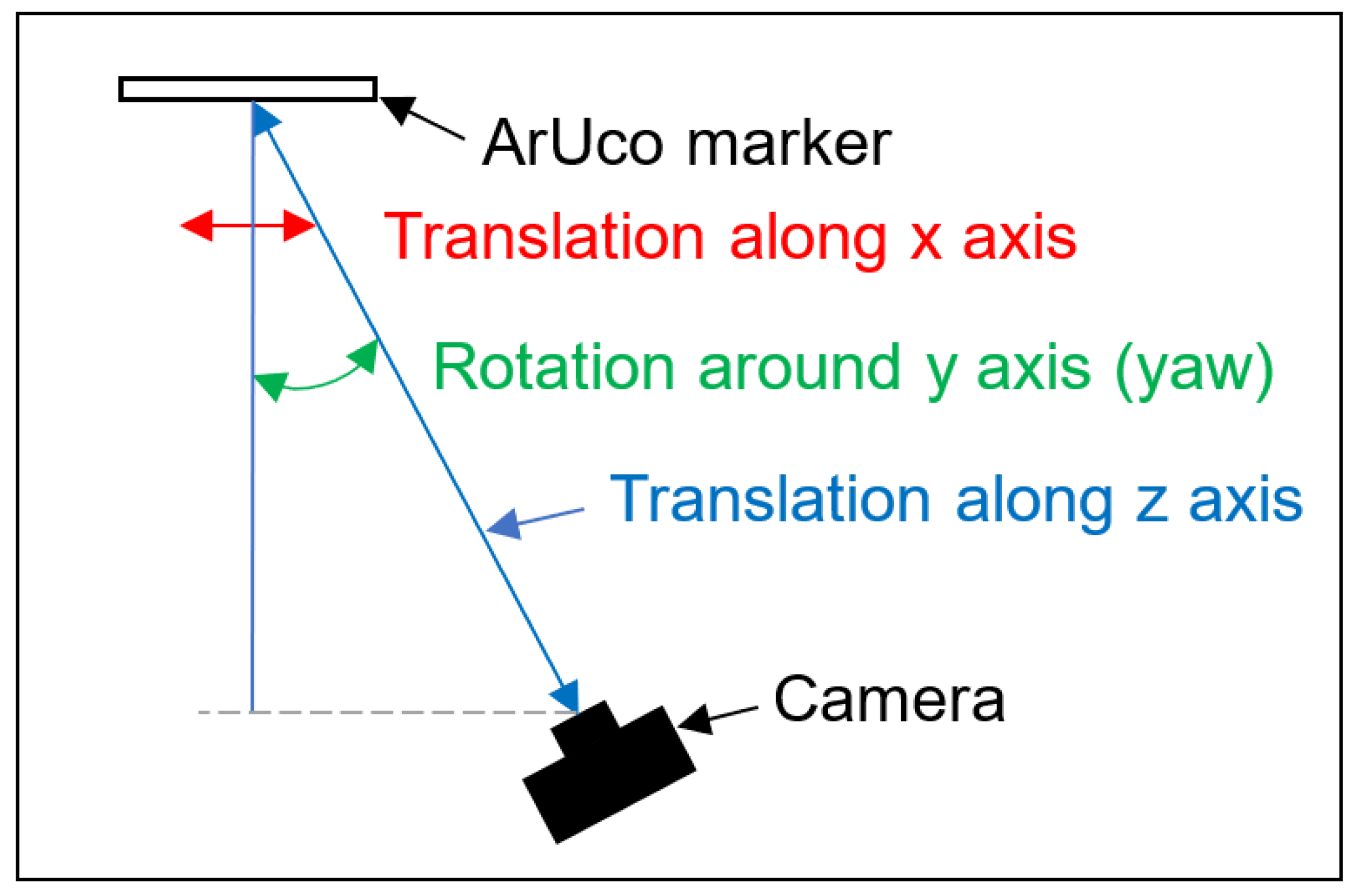
- Pose estimation. Calculations for each pose estimation are processed within the function cv2.solvePnP(), which takes in as parameters the detected marker corners, marker size, camera geometry matrix, and distortion coefficient data, which were captured during the calibration process. This function calculates the pose estimate, related to the marker, from the camera perspective, and returns tvecs, the translation vector, containing the location coordinates and a rotation vector rvecs, containing the orientation angles (also known as pitch, roll, and yaw).
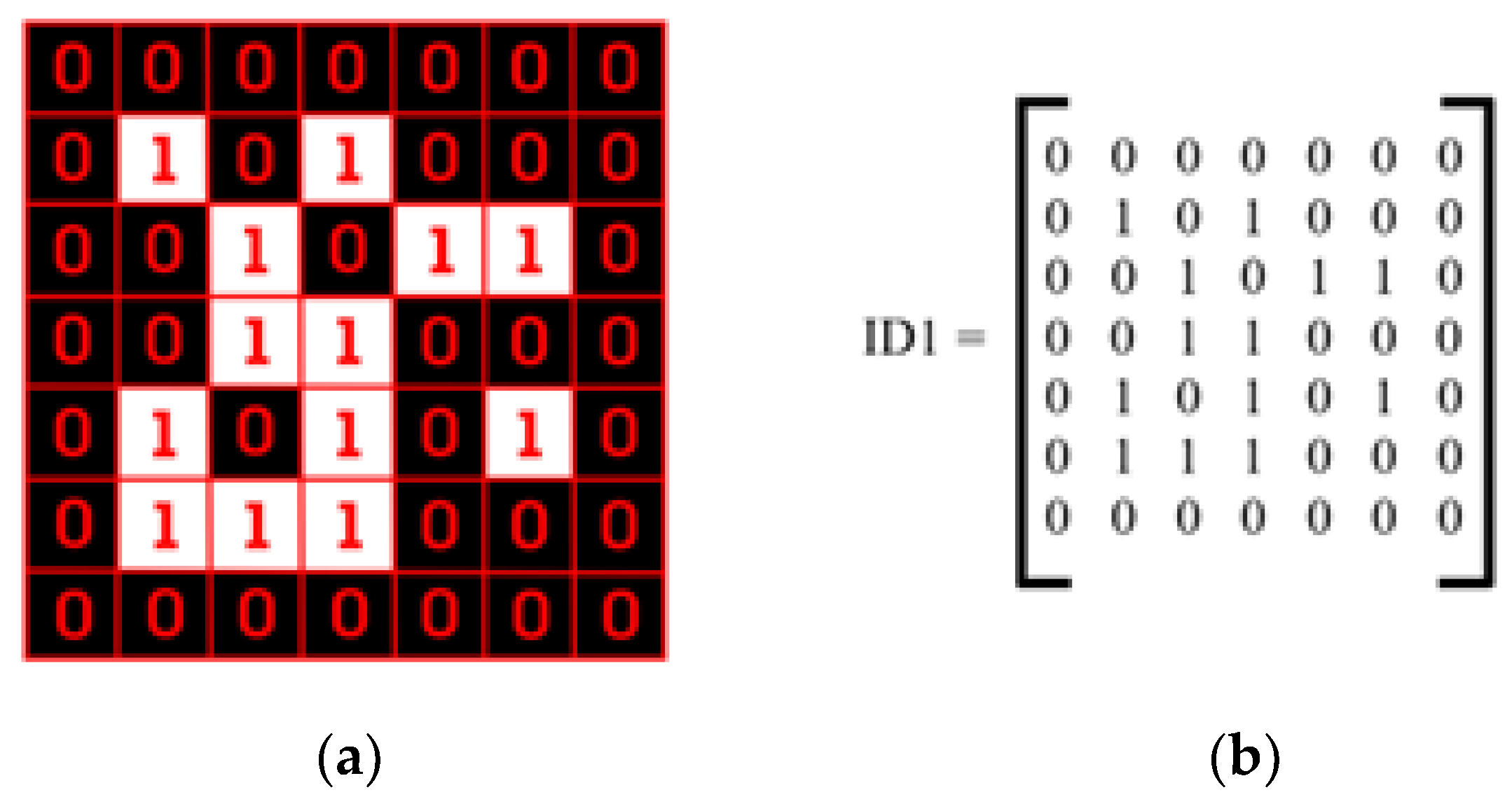
2.4.2. Fiducial Marker Functionality
2.4.3. Orientation of Markers
2.4.4. Computer Vision with Fiducial Markers

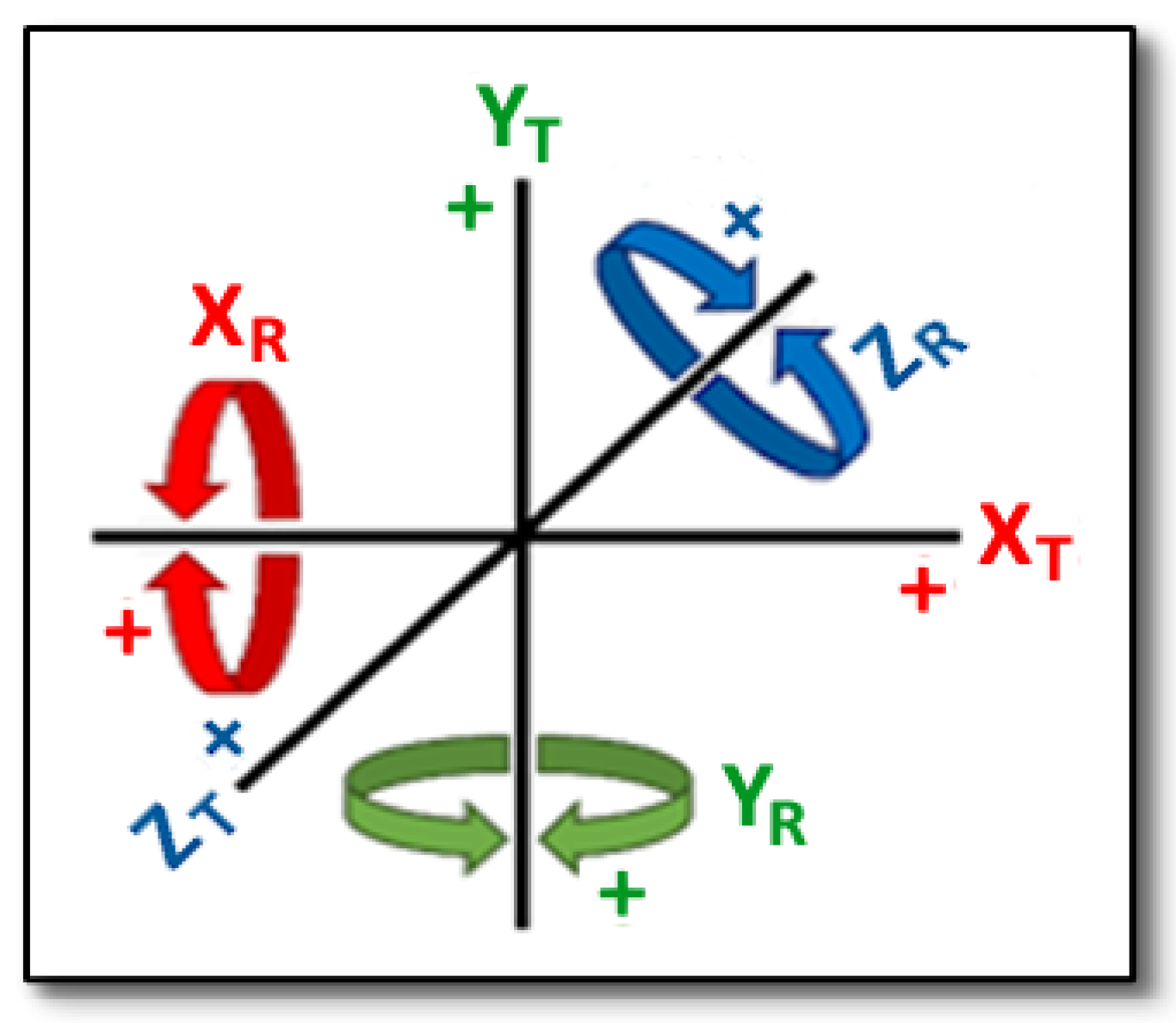
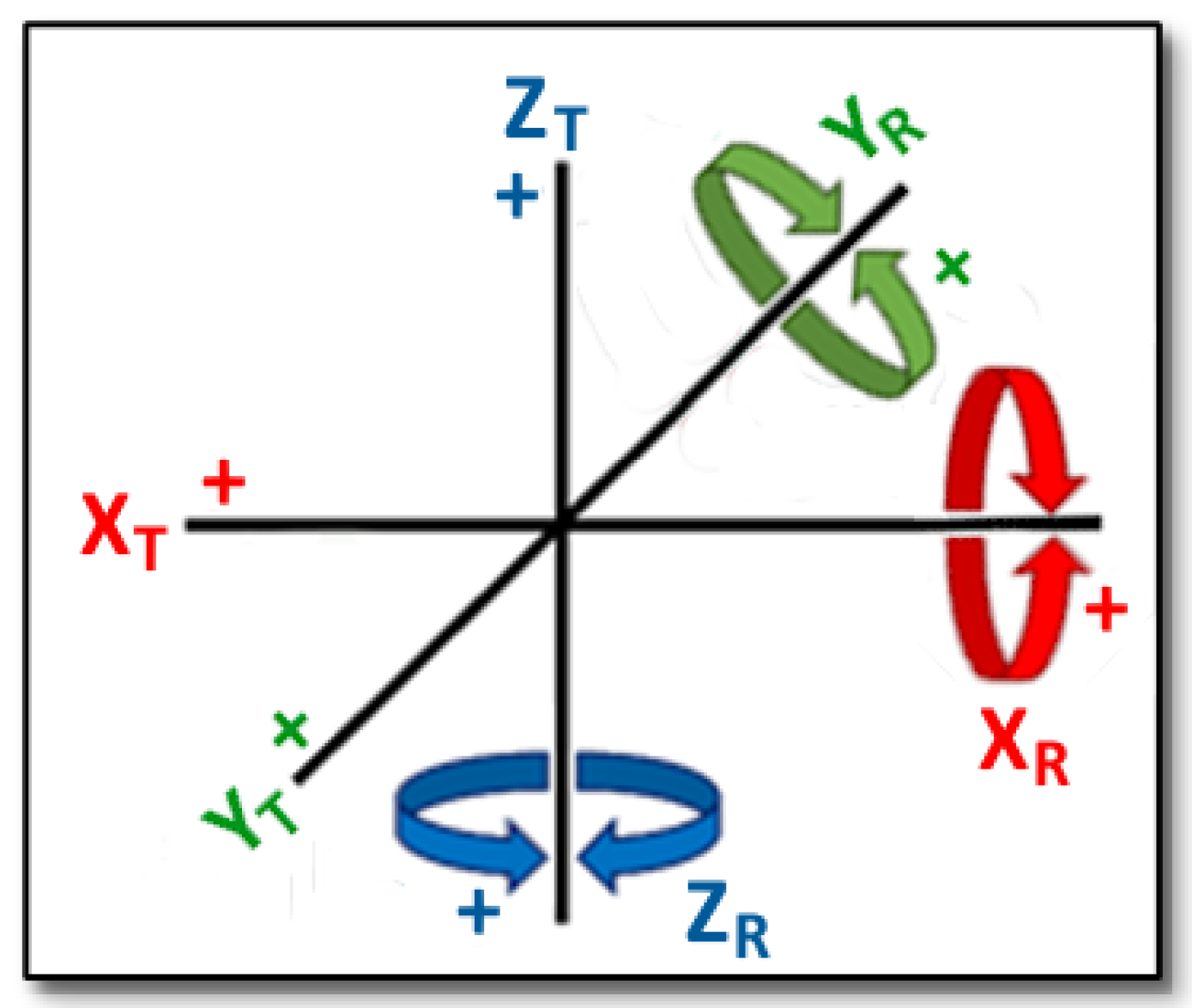
2.4.5. Coordinate Frames
2.5. System Processes
2.5.1. Controller State Management
2.5.2. Coordinate Transformation
2.5.3. Inverse Kinematics
2.5.4. Communication with the UR5e
3. Experimentation

| Element Type | Element Category | Specific Element | Purpose |
|---|---|---|---|
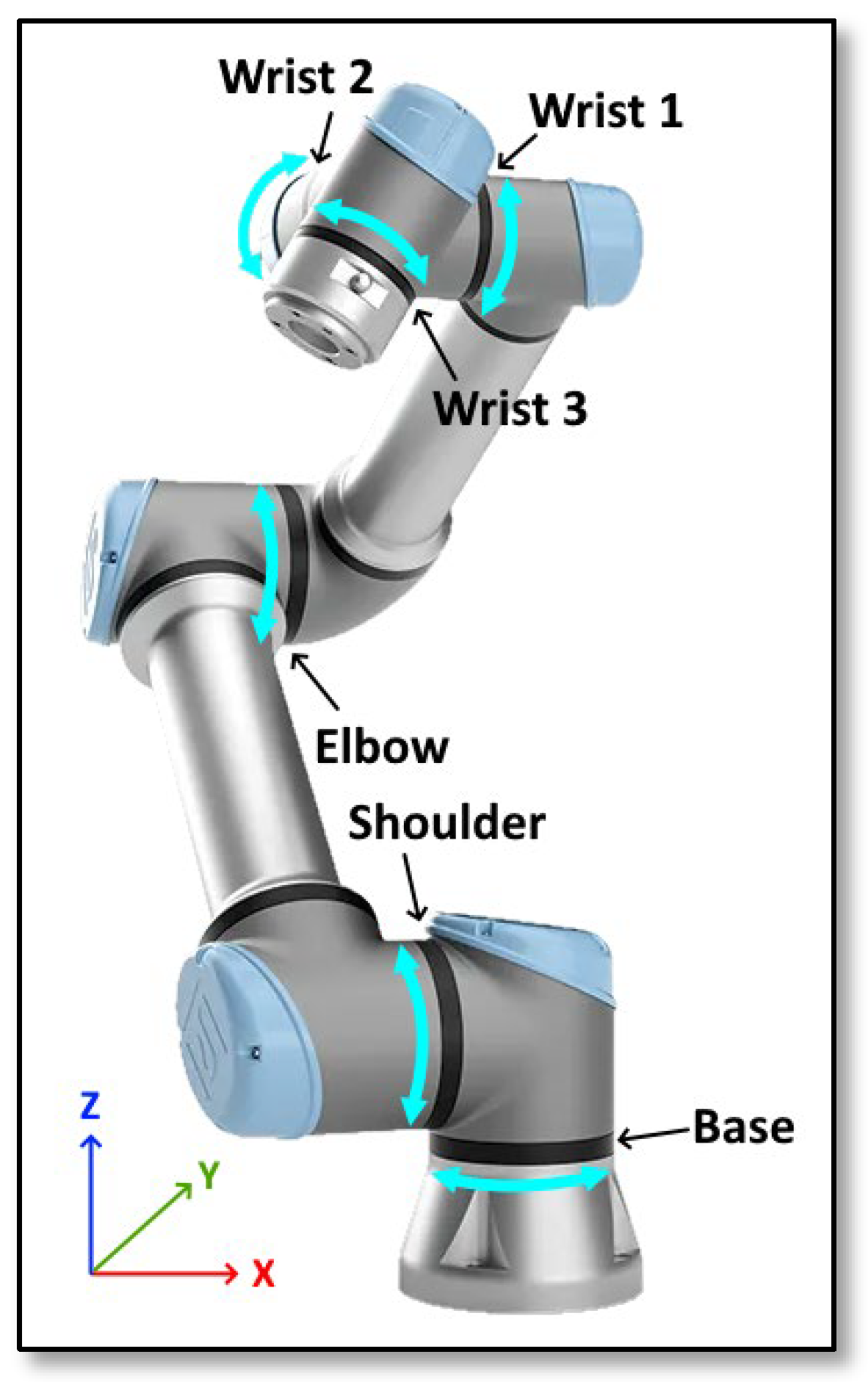
| Passive | Cobot | Universal Robots UR5e cobot with 6 DoF (Refer to Figure 18). | Practical testing of the system |
| End effector | Robotiq 2F-85 gripper (Shown in Figures 19, 21, and 22). | Object manipulation | |
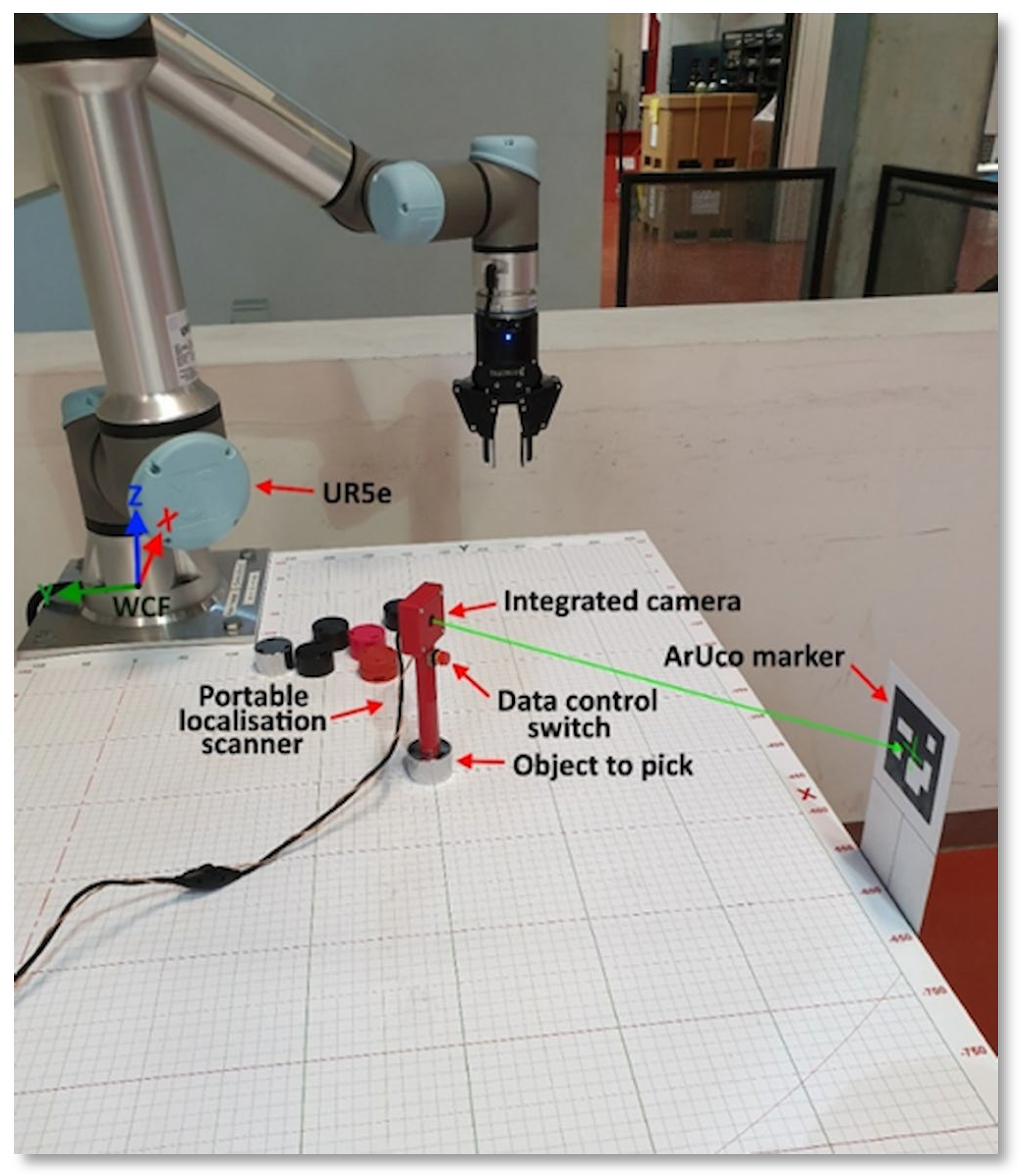
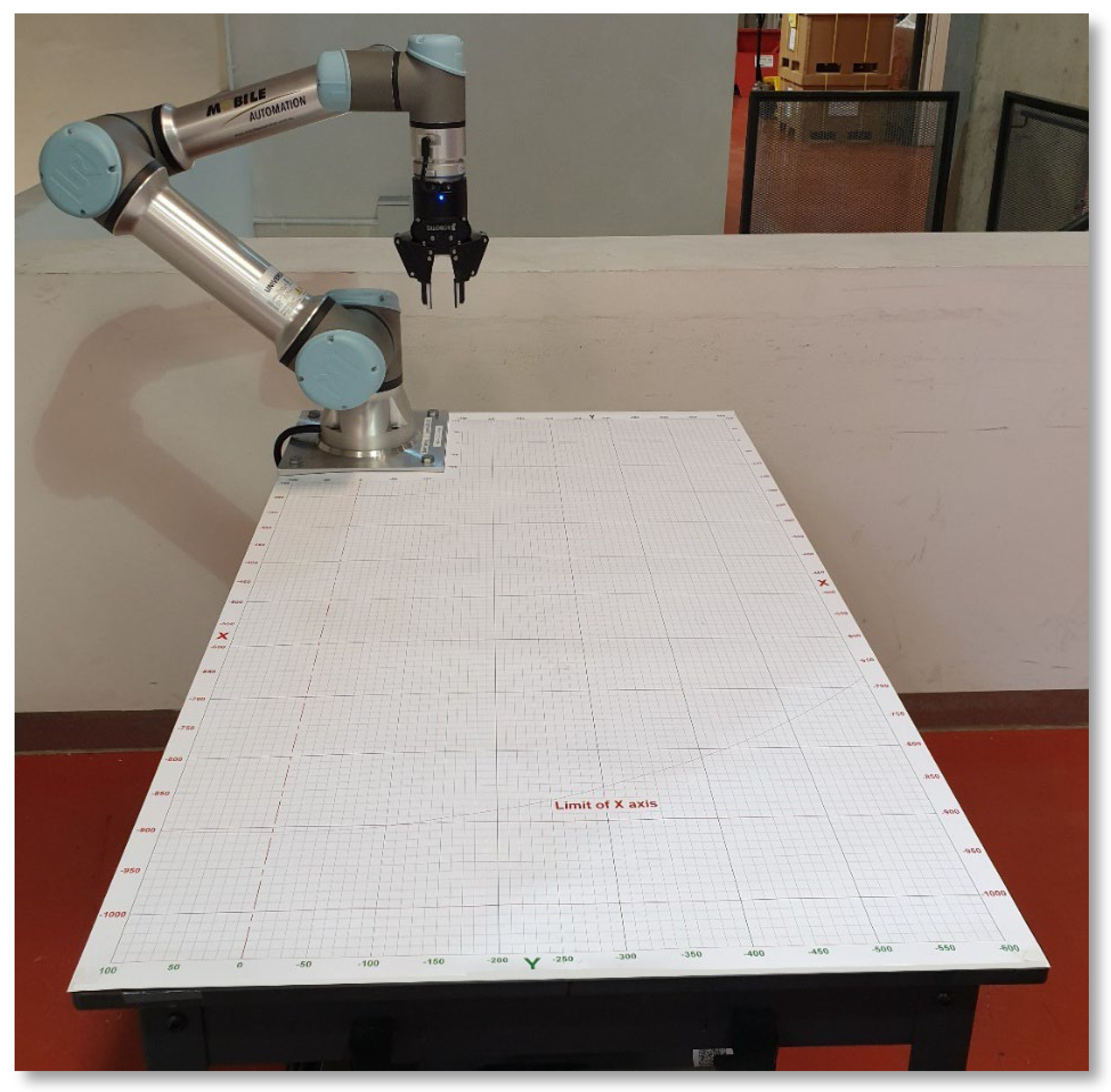
| Cartesian coordinate reference grid | Custom benchtop Cartesian coordinate grid mat, printed on 135 gsm paper with a durable matte polypropylene film. Spans from 100 to −600 across the x axis and 100 to −1050 along the y axis. The base at which the cobot is mounted is positioned at (0, 0, 0) (refer to Figure 19). | Object placement and visual position validation | |
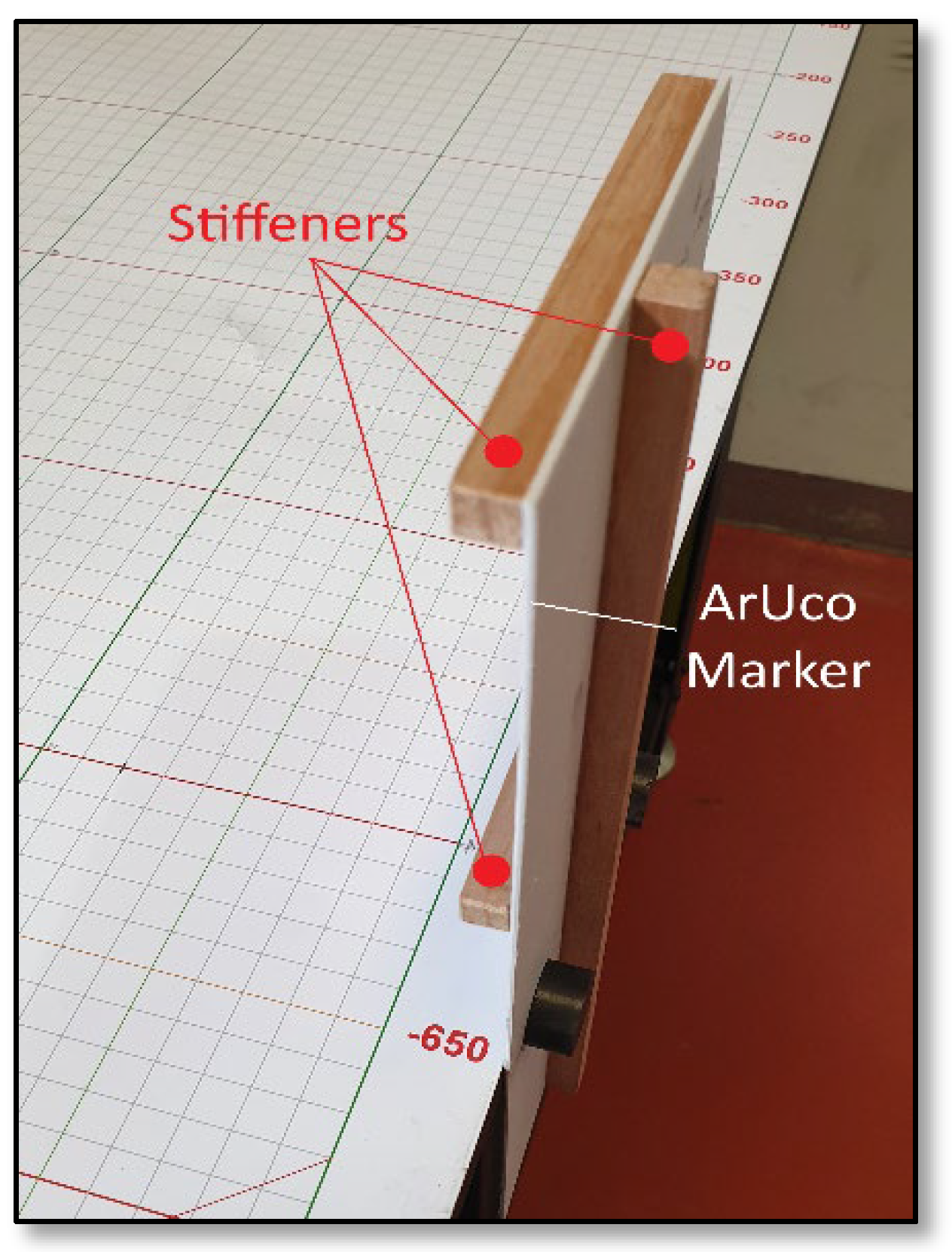
| Active | Fiducial markers | ArUco markers were adopted due to their robust image definition and high detection accuracy. Markers were sized at 70 mm square, printed on 250 gsm sheet, and mounted on 1.5 mm card stock for rigidity. A stiffener modification was later applied to the markers to mitigate against distortion, as described in Section 3.3.1. | Provides visual location and orientation perspective |
| Camera system | A standard USB webcam (detailed in Section 2.2.2), integrated into the localisation scanner and connected to the microprocessor via a USB-A cable. | Video capture of markers | |
| Microprocessor | Raspberry Pi 4 2 GB single board computer (see Section 2.2.3). | Computation | |
| Localisation scanner | Scanner body: A 3D printed tool with 18 mm handle and mounting points for the webcam PCB, data control switch, and a circular spirit level (see Section 2.2.1). | Pose simulation apparatus | |
| Data control switch: A momentary switch connected to the localisation scanner shaft, wired to GPIO terminals on the Raspberry Pi. The current localisation data is captured when the switch is pressed and transferred to UR5e controller on release. | Initiates data transfer from Vision program to UR5e cobot | ||
| Software Interface: Executable programs are used to interact between a user, the peripherals, and the cobot hardware. Python is used to interact with the ArUco markers, process the camera feed and validate the cobot’s pose in real time. The collected data is relayed back to the cobot once the data control switch has been released. | Interface between user and hardware for test trials |

3.1. Experimental Validation
3.2. Experimental Setup
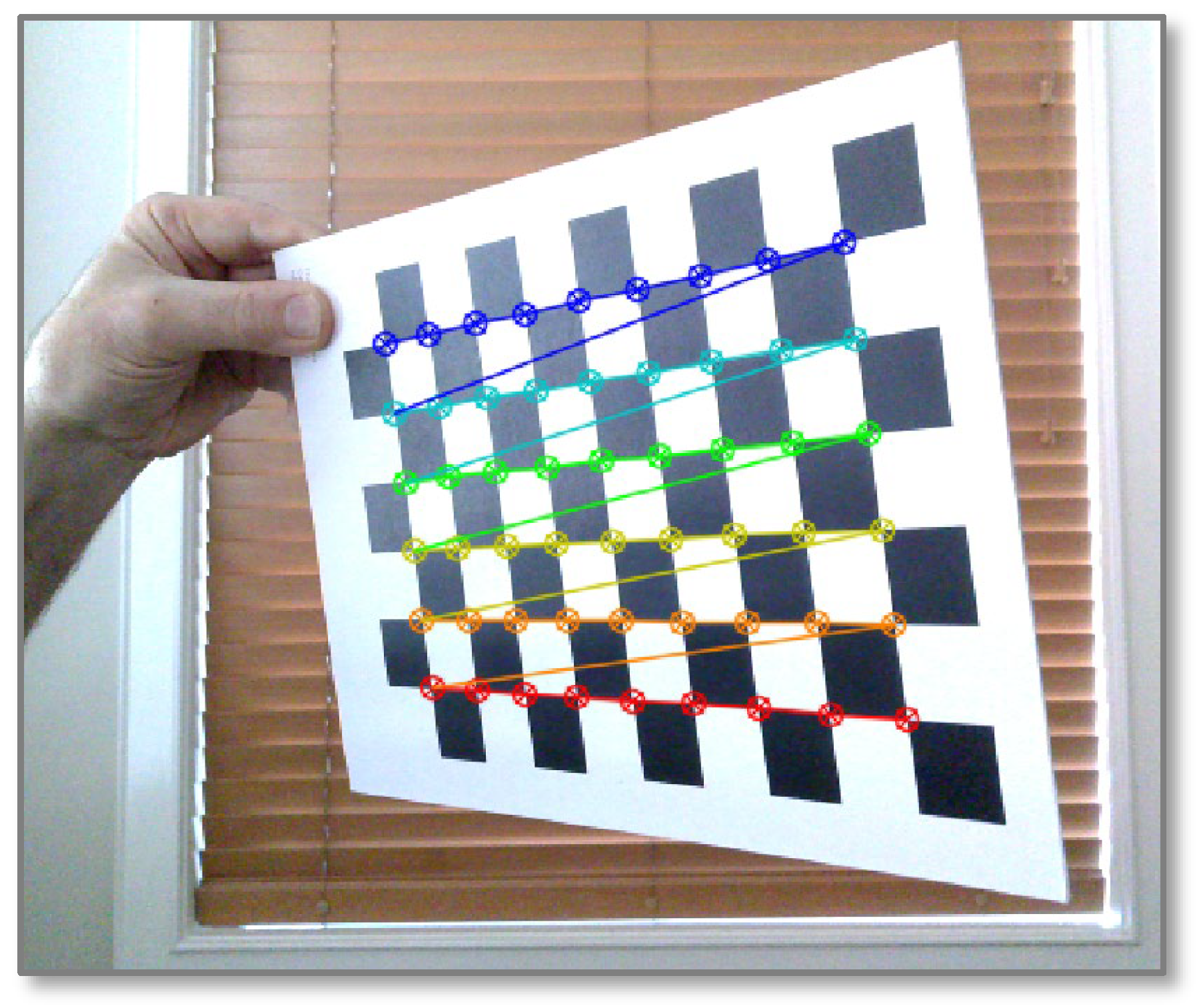
- A camera calibration was conducted, as described in Section 2.4.4, and the resulting camera calibration matrix and distortion coefficient files were then referenced from the ArUco Pose Estimation (control) program. The calibration process typically occurs only once, when a new camera is initialised in the system;
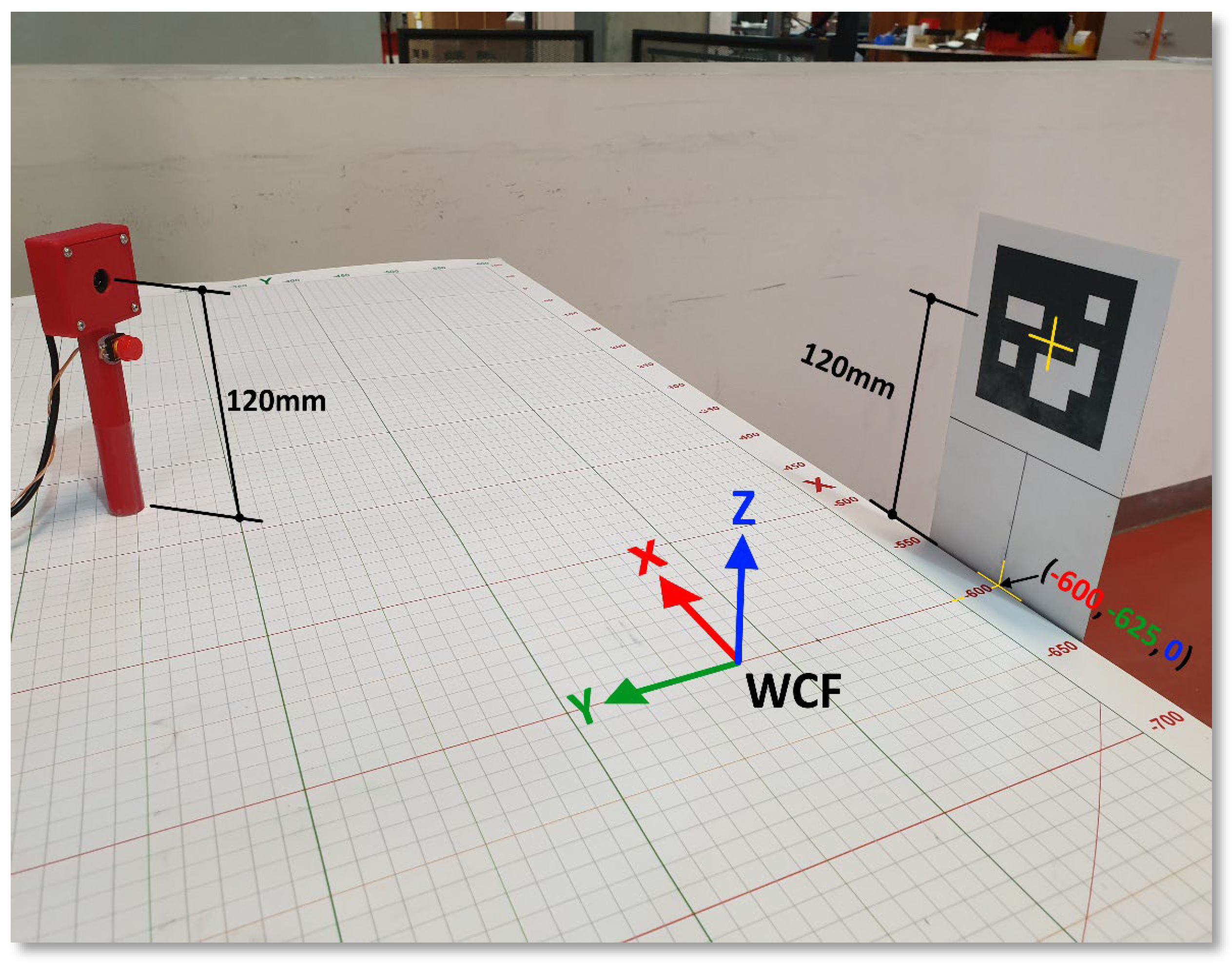
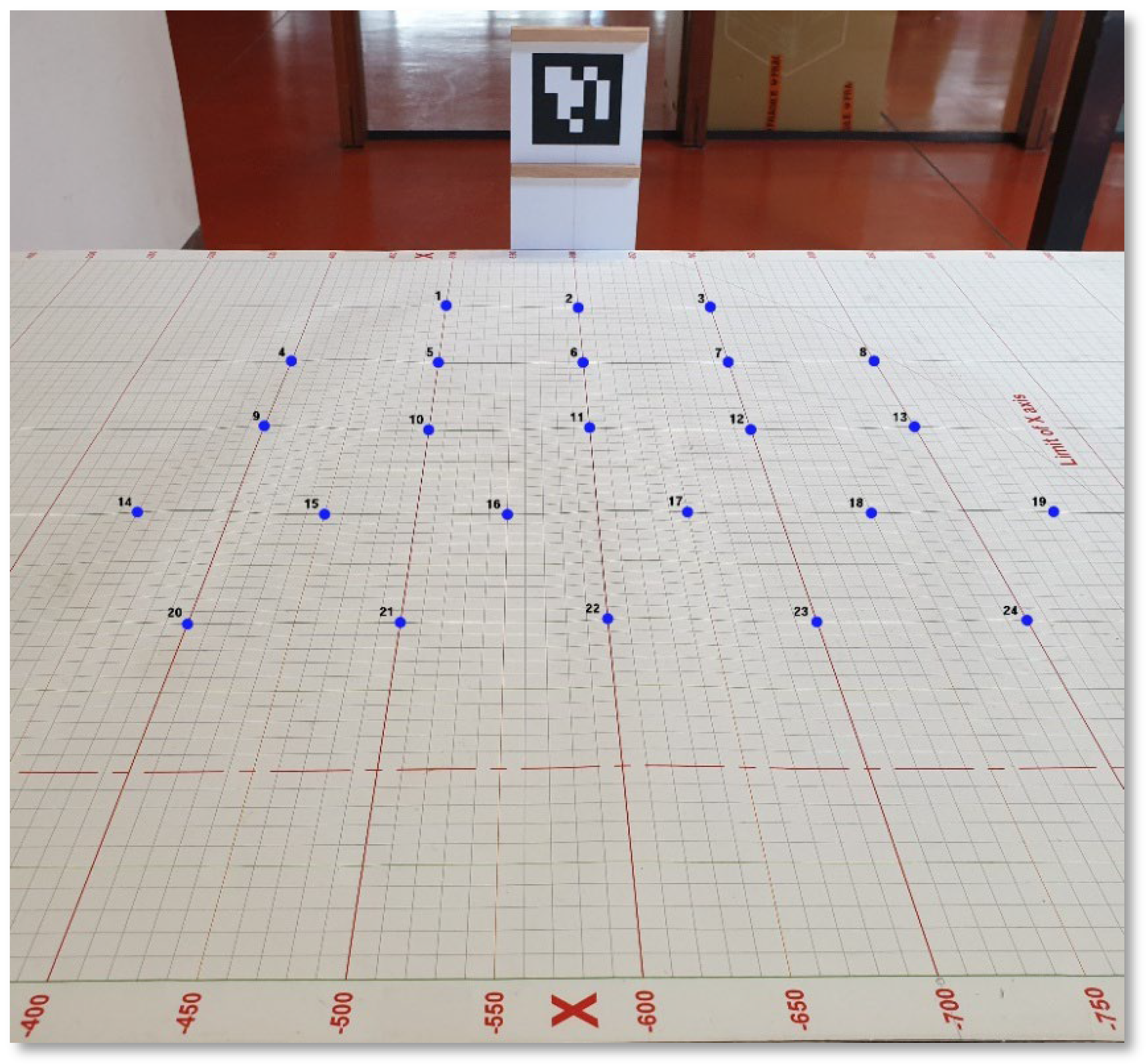
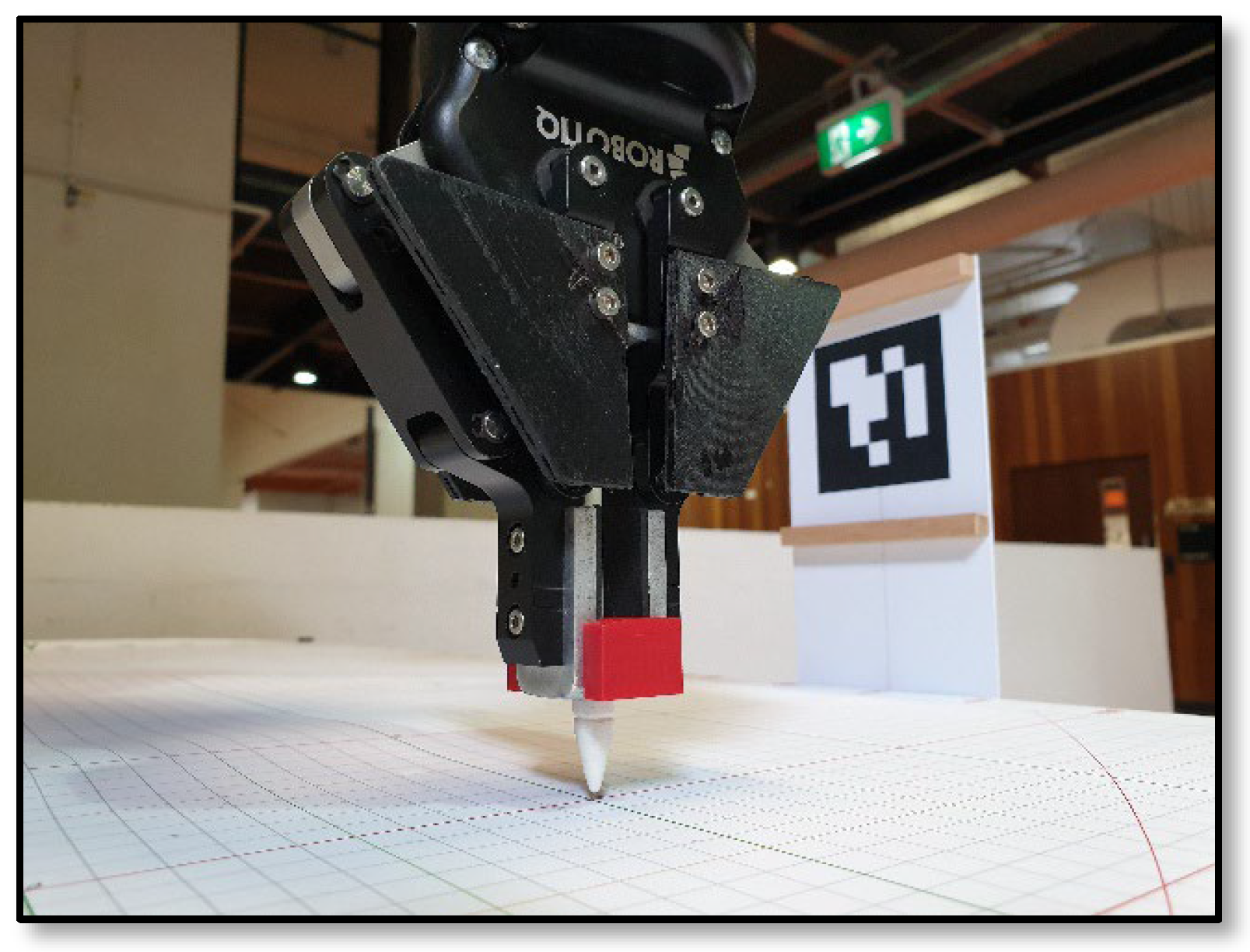
- To provide a visual localisation reference, the UR5e benchtop was covered with a Cartesian grid mat, described in Table 2 and shown in Figure 19 and was specifically designed to represent the (x, y) coordinates (with the surface of the benchtop being the Z = 0 reference), at any reachable point on the benchtop;
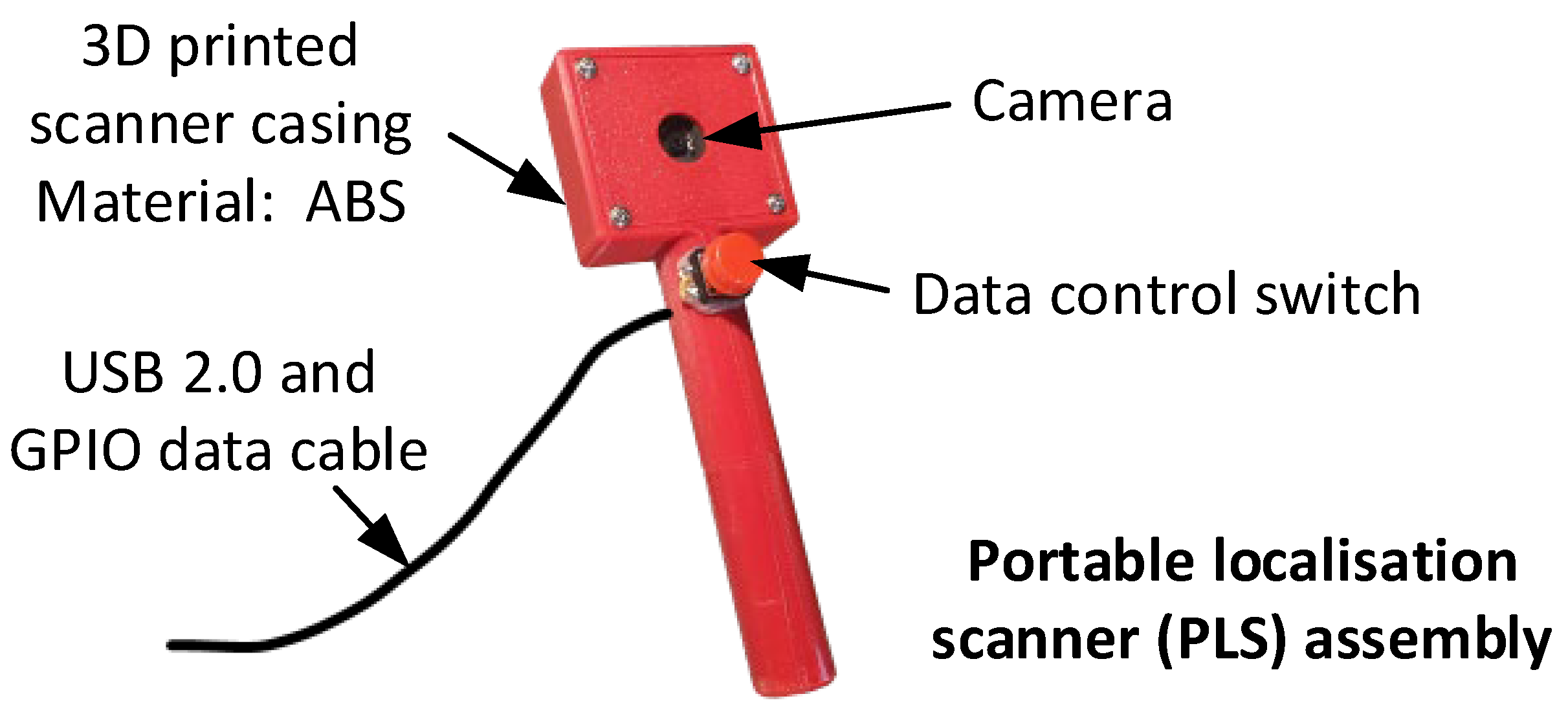
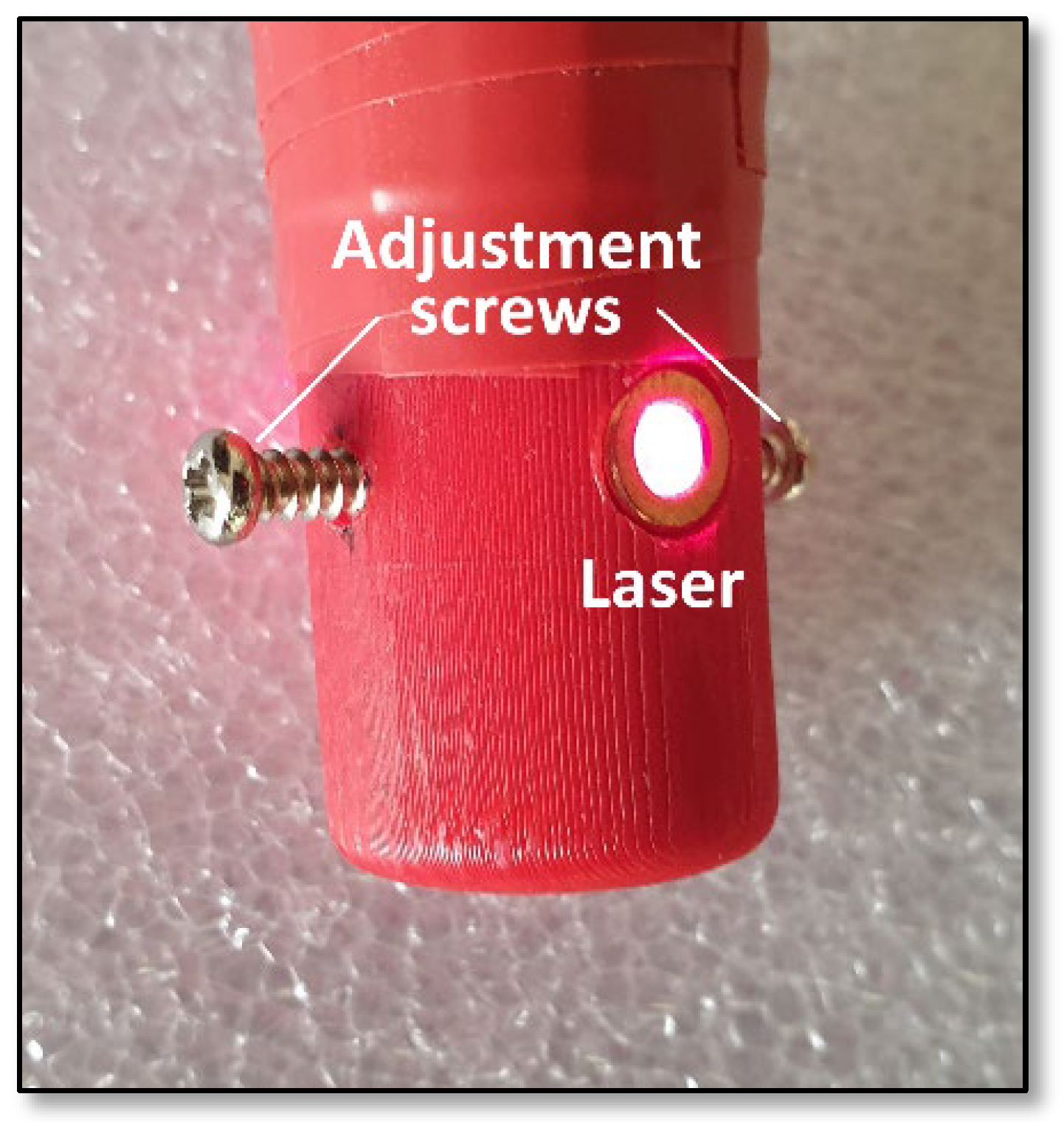
- The PLS, as shown in Figure 4, which contains a PCB-mounted webcam and data control switch, was connected to the Raspberry Pi via USB 2.0 port for the camera and via GPIO pins for the data control switch;
- ArUco markers were generated using a dedicated program, printed, mounted, and strategically placed in precise locations around the perimeter of the UR5e workspace. From any point within the cobot’s operational range, at least one marker was within the camera’s Field of View (FoV). Following a manual adjustment of the markers’ positions and alignments, each marker ID was assigned a known coordinate location and offset, with respect to the location of the camera in the PLS, as described in Section 2.4.5. ArUco markers were precisely positioned at *GRID coordinates XwGRID, YwGRID, and ZwGRID, as shown in Table 3. To compensate for the discrepancies between the Cartesian plane on the printed grid and the world coordinate frame of the UR5e, ground truth coordinates were calculated, and these are listed as *COBOT coordinates XwCOBOT, YwCOBOT and ZwCOBOT in Table 3. Therefore, if the grid is used as a localisation reference, the markers would be located at the *GRID coordinates, and without the grid, the markers would be located at the *COBOT coordinates.
- The z-axis values in Table 3 are designated as zero, since the positioned ArUco markers were raised so that the marker centreline and camera sensor centre point aligned, with the scanner positioned on the surface of the workbench.
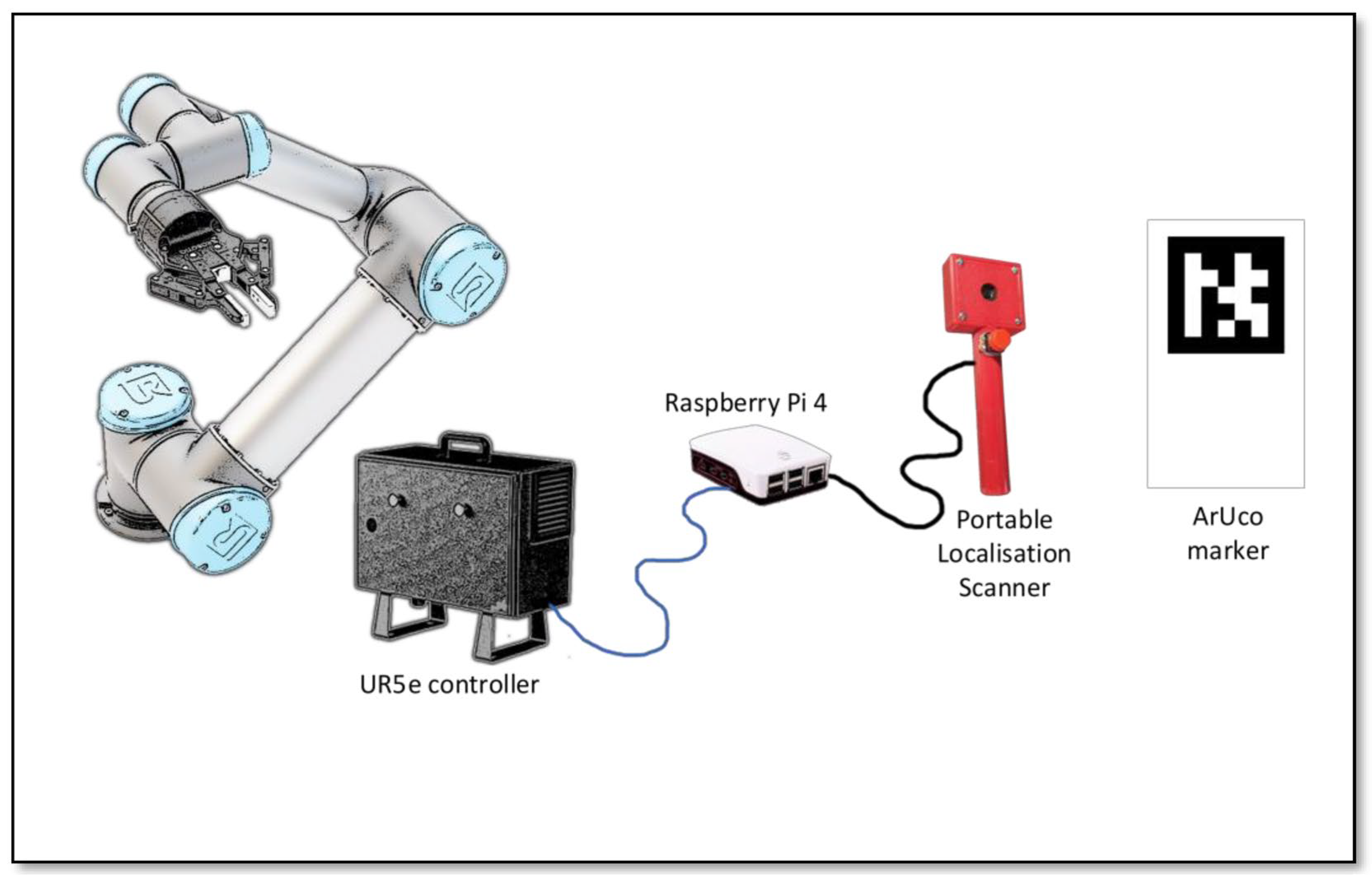
- With the software program loaded onto the Raspberry Pi, it was connected to the UR5e controller via a CAT5 Ethernet cable, as shown in Figure 2. The UR5e was then started, along with the control program on the Raspberry Pi.
3.2.1. Determining Ground Truth
3.2.2. Measurement Procedure


3.3. Evaluation Method
3.3.1. Accuracy
- n = total number of values in array;
- k = window size;
- Pi = single captured (ith) element (with a range of 0–29) of the vector value.

3.3.2. Repeatability
3.3.3. Reliability
4. Results
Analysis of Results
- Pose Estimation Error
- 2.
- Repeatability results
- 3.
- Reliability results
5. Discussion
- The ease of use for the novice operator;
- Operator engagement and job satisfaction;
- The cobot’s operational efficiency and reliability;
- Human safety, with easy operation and higher precision;
- The appeal of cobots to a broader range of potential adopters, without technical hurdles;
- The downtime and costs for operator training;
- The costs and scheduling associated with contracting programming experts.
5.1. Limitations
- 1.
- Camera: The webcam used was an inexpensive 1080p camera with basic optics and a USB 2.0 interface. The quality of the image sensor and lens, along with a relatively low data transfer rate, may have compromised system performance to some degree.
- 2.
- Lighting: To minimise costs, no dedicated artificial light was used during testing. Instead, both natural light and standard internal lighting were used to illuminate the ArUco markers, for presentation to the vision system.
- 3.
- Computation: The Raspberry Pi 4 used in the testing of this system contained a 1.5 GHz quad-core ARM Cortex-A72 CPU with 2 GB of RAM. In contrast, Raspberry Pi 5 units are available with 2.4 GHz quad-core Cortex-A76 CPU and 16 GB of RAM for much faster processing of video and program instructions. Such a processing upgrade should reduce the video capture delay, along with the time the PLS must be presented to the marker.
- 4.
- ArUco Makers: If markers are not accurately located and aligned, or if they are distorted in any way, the pose estimation process may be affected. Despite fortifying the ArUco markers with stiffening supports, some minor distortion may have occurred. Substandard printing or marker coatings may also cause performance issues.
- 5.
- PLS: The precision with which a user locates the scanner and the steadiness with which it is held will vary between individuals. This can influence the accuracy and picking capacity of the cobot.
- 6.
- Operations: The system was designed for simple Pick-and-Place operations, and, although further functionality may be possible, most complex operations are likely to be beyond the scope of the system.
5.2. Future Work
6. Conclusions
Author Contributions
Funding
Institutional Review Board Statement
Informed Consent Statement
Data Availability Statement
Acknowledgments
Conflicts of Interest
Appendix A. Terminology
- Robot Components and Anatomy
- Actuator: A mechanism (motor, hydraulic cylinder, etc.) that converts energy into motion to move the robot’s joints.
- End-Effector: A tool or device attached to the robot’s wrist that interacts with the environment (e.g., gripper, welding torch, and spray gun).
- Joint: Sections of a robot’s arm that allow for movement or rotation, similar to a human joint.
- Link: The rigid parts of a robot manipulator connecting the joints.
- Manipulator: The mechanical system of links and joints designed to move and position the end-effector (typically refers to a robot).
- Payload: The maximum weight a robot’s wrist can lift, typically measured in kilograms.
- Pose: Description of a robot’s joint configuration in terms of position and end-effector rotation.
- Sensor: Devices used to perceive the internal state (joint position, velocity) or external environment (distance, force, vision) to provide feedback to the control system.
- Workspace: The total volume of space within which a robot can operate, determined by its physical design and joint limits.
- Motion and Control
- Degrees of Freedom (DoF): The number of independent movements a robot can perform, typically corresponding to the number of joints or axes.
- Dynamics: The study of forces and torques that cause motion in a robot system, considering mass and inertia.
- Forward Kinematics: Calculating the end-effector’s position and orientation based on the given joint angles.
- Inverse Kinematics: Determining the required joint angles to achieve a desired end-effector position and orientation in space.
- Path Planning: The process of determining a collision-free route for a robot to follow from a starting point to a goal.
- Repeatability: The robot’s ability to consistently return to the exact same position over multiple cycles.
- Singularity: A configuration where a robot loses one or more degrees of freedom, potentially leading to instability or movement paralysis due to infinite joint possibilities.
- Trajectory: The specific path that a robot’s end-effector follows, often optimised for smoothness or speed.
- Coordinate Systems and Interaction
- Frame: A coordinate system used to define positions and orientations in space (e.g., base frame, tool frame and world frame).
- Human–Robot Interaction (HRI): The study and design of systems where humans and robots work in proximity or collaboration.
- Localisation: A robot’s pose position and orientation within the frame of reference
- Position Vector: A mathematical representation defining a location in space relative to a reference frame.
- Tool Centre Point (TCP): The origin of the coordinate system at the end of the end-effector, the central point between a gripper’s contact surfaces, for example.
References
- Doyle-Kent, M.; Kopacek, P. Industry 5.0: Is the manufacturing industry on the cusp of a new revolution? In International Conference on Production Research; Springer International Publishing: Cham, Switzerland, 2019; pp. 432–441. [Google Scholar]
- Peshkin, M.; Colgate, J.E. Cobots. Ind. Robot. Int. J. 1999, 26, 335–341. [Google Scholar] [CrossRef]
- Karaulova, T.; Andronnikov, K.; Mahmood, K.; Shevtshenko, E. Lean automation for low-volume manufacturing environment. In Proceedings of the 30th Annals of DAAAM and Proceedings, DAAAM International, Vienna, Austria, 23–26 October 2019; pp. 59–68. [Google Scholar]
- George, A.S.; George, A.H. The cobot chronicles: Evaluating the emergence, evolution, and impact of collaborative robots in next-generation manufacturing. Partn. Univers. Int. Res. J. 2023, 2, 89–116. [Google Scholar]
- Castillo, J.F.; Ortiz, J.H.; Velásquez, M.F.D.; Saavedra, D.F. COBOTS in industry 4.0: Safe and efficient interaction. In Collaborative and Humanoid Robots; IntechOpen: London, UK, 2021. [Google Scholar]
- Pizoń, J.; Gola, A. Vertical Integration Principles in the Age of the Industry 5.0 and Mass Personalization. In International Conference on Intelligent Systems in Production Engineering and Maintenance; Springer Nature Switzerland: Cham, Switzerland, 2023; pp. 332–345. [Google Scholar]
- Di Battista, A.; Grayling, S.; Hasselaar, E.; Leopold, T.; Li, R.; Rayner, M.; Zahidi, S. Future of jobs report 2023. In World Economic Forum; World Economic Forum: Geneva, Switzerland, 2023; pp. 978–982. [Google Scholar]
- Sikha, H. Collaborative Robot Market. Global Opportunity Analysis & Industry Forecast, 2024–2030. Next Move Strategy Consulting. 2025. Available online: https://www.nextmsc.com/report/collaborative-robot-market (accessed on 15 December 2025).
- Jennes, P.; Di Minin, A. Cobots in SMEs: Implementation Processes, Challenges, and Success Factors. In Proceedings of the 2023 IEEE International Conference on Technology and Entrepreneurship (ICTE), Kaunas, Lithuania, 9–11 October 2023; IEEE: New York, NY, USA, 2023; pp. 80–85. [Google Scholar]
- Simões, A.C.; Lucas Soares, A.; Barros, A.C. Drivers impacting cobots adoption in manufacturing context: A qualitative study. In Advances in Manufacturing II: Volume 1-Solutions for Industry 4.0; Springer International Publishing: Cham, Switzerland, 2019; pp. 203–212. [Google Scholar]
- El Zaatari, S.; Marei, M.; Li, W.; Usman, Z. Cobot programming for collaborative industrial tasks: An overview. Robot. Auton. Syst. 2019, 116, 162–180. [Google Scholar] [CrossRef]
- George, P.; Cheng, C.T.; Pang, T.Y.; Neville, K. Task complexity and the skills dilemma in the programming and control of collaborative robots for manufacturing. Appl. Sci. 2023, 13, 4635. [Google Scholar] [CrossRef]
- Emeric, C.; Geoffroy, D.; Paul-Eric, D. Development of a new robotic programming support system for operators. Procedia Manuf. 2020, 51, 73–80. [Google Scholar] [CrossRef]
- Van de Perre, G.; El Makrini, I.; Van Acker, B.B.; Saldien, J.; Vergara, C.; Pintelon, L.; Vanderborght, B. Improving productivity and worker conditions in assembly: Part 1-A collaborative architecture and task allocation. In Proceedings of the 2018 IEEE/RSJ International Conference on Intelligent Robots and Systems, IROS 2018: Towards a Robotic Society, Madrid, Spain, 1–5 October 2018. [Google Scholar]
- Develop with URScript. Available online: https://www.universal-robots.com/developer/urscript (accessed on 22 October 2025).
- ABB Robotics, Technical Reference Manual, RAPID Instructions, Functions and Data Types. Available online: https://search.abb.com/library/Download.aspx?DocumentID=3HAC050917-001 (accessed on 17 October 2025).
- FANUC Robotics SYSTEM. Available online: https://icdn.tradew.com/file/201606/1569362/pdf/7066348.pdf (accessed on 15 November 2025).
- Kuka. Application and Robot Programming. Available online: https://www.kuka.com/en-au/services/service_robots-and-machines/installation-start-up-and-programming-of-robots/application-and-robot-programming (accessed on 16 October 2025).
- RoboDK Basic Guide. Available online: https://robodk.com/doc/en/Basic-Guide.html (accessed on 4 November 2025).
- ArtiMinds Robotics. Available online: https://www.universal-robots.com/media/1226149/artiminds-software-produktflyer_ur-en-01.pdf (accessed on 18 October 2025).
- Robomaster Offline Programming Software for Robots. Available online: https://www.robotmaster.com/en (accessed on 6 November 2025).
- PolyScope X. Available online: https://www.universal-robots.com/products/polyscope-x (accessed on 15 October 2025).
- Wizard Easy Programming. Available online: https://new.abb.com/products/robotics/application-software/wizard (accessed on 15 October 2025).
- Collaborative Robots 101: Cobots and What You Need to Know. Available online: https://crx.fanucamerica.com/why-cobots-collaborative-robots/ (accessed on 15 November 2025).
- iiQKA: Robots for the People. Available online: https://www.kuka.com/en-au/future-production/iiqka-robots-for-the-people (accessed on 16 October 2025).
- Dong, J.; Kwon, W.; Kang, D.; Nam, S.W. A Study on the Usability Evaluation of Teaching Pendant for Manipulator of Collaborative Robot. In Proceedings of the International Conference on Human-Computer Interaction, Virtual, 24–29 July 2021; Springer International Publishing: Cham, Switzerland, 2021; pp. 234–238. [Google Scholar]
- Biswas, J.; Veloso, M. Depth camera based indoor mobile robot localization and navigation. In Proceedings of the 2012 IEEE International Conference on Robotics and Automation, Saint Paul, MN, USA, 14–18 May 2012; IEEE: New York, NY, USA, 2012; pp. 1697–1702. [Google Scholar]
- Francis, S.L.X.; Anavatti, S.G.; Garratt, M.; Shim, H. A ToF-camera as a 3D vision sensor for autonomous mobile robotics. Int. J. Adv. Robot. Syst. 2015, 12, 156. [Google Scholar] [CrossRef]
- OpenCV. Open Source Computer Vision. Available online: https://docs.opencv.org/4.x/d1/dfb/intro.html (accessed on 10 April 2025).
- Mantha, B.R.K.; de Soto, B.G. Designing a reliable fiducial marker network for autonomous indoor robot navigation. In Proceedings of the 36th International Symposium on Automation and Robotics in Construction (ISARC), Banff, Canada, 21–24 May 2019; pp. 74–81. [Google Scholar]
- Adámek, R.; Brablc, M.; Vávra, P.; Dobossy, B.; Formánek, M.; Radil, F. Analytical Models for Pose Estimate Variance of Planar Fiducial Markers for Mobile Robot Localisation. Sensors 2023, 23, 5746. [Google Scholar] [CrossRef]
- Alam, M.S.; Gullu, A.I.; Gunes, A. Fiducial Markers and Particle Filter Based Localization and Navigation Framework for an Autonomous Mobile Robot. SN Comput. Sci. 2024, 5, 748. [Google Scholar] [CrossRef]
- Mráz, E.; Rodina, J.; Babinec, A. Using fiducial markers to improve localization of a drone. In Proceedings of the 2020 23rd International Symposium on Measurement and Control in Robotics (ISMCR), Budapest, Hungary, 15–17 October 2020; IEEE: New York, NY, USA, 2020; pp. 1–5. [Google Scholar]
- Claro, R.M.; Silva, D.B.; Pinto, A.M. Artuga: A novel multimodal fiducial marker for aerial robotics. Robot. Auton. Syst. 2023, 163, 104398. [Google Scholar] [CrossRef]
- Zhang, W.; Gong, L.; Huang, S.; Wu, S.; Liu, C. Factor graph-based high-precision visual positioning for agricultural robots with fiducial markers. Comput. Electron. Agric. 2022, 201, 107295. [Google Scholar] [CrossRef]
- Rogeau, N.; Tiberghien, V.; Latteur, P.; Weinand, Y. Robotic insertion of timber joints using visual detection of fiducial markers. In Proceedings of the 37th International Symposium on Automation and Robotics in Construction (ISARC), Online, Japan, 27–29 October 2020; pp. 491–498. [Google Scholar]
- Jain, A.; Singhal, M.; Jhamb, M. Aruco marker-based pick and place approach using a UR5 robotic arm and vacuum gripper. In Proceedings of the International Conference on Artificial Intelligence on Textile and Apparel, Bengaluru, India, 11–12 August 2023; Springer Nature: Singapore; pp. 365–379.
- Schou, C.; Andersen, R.S.; Chrysostomou, D.; Bøgh, S.; Madsen, O. Skill-based instruction of collaborative robots in industrial settings. Robot. Comput.-Integr. Manuf. 2018, 53, 72–80. [Google Scholar] [CrossRef]
- Weintrop, D.; Afzal, A.; Salac, J.; Francis, P.; Li, B.; Shepherd, D.C.; Franklin, D. Evaluating CoBlox: A comparative study of robotics programming environments for adult novices. In Proceedings of the 2018 CHI Conference on Human Factors in Computing Systems, Montreal, QC, Canada, 21–26 April 2018; pp. 1–12. [Google Scholar]
- Shepherd, D.; Francis, P.; Weintrop, D.; Franklin, D.; Li, B.; Afzal, A. [Engineering Paper] An IDE for easy programming of simple robotics tasks. In Proceedings of the 2018 IEEE 18th International Working Conference on Source Code Analysis and Manipulation (SCAM), Madrid, Spain, 23–24 September 2018; IEEE: New York, NY, USA, 2018; pp. 209–214. [Google Scholar]
- Ionescu, T.B.; Schlund, S. A participatory programming model for democratizing cobot technology in public and industrial fablabs. Procedia CIRP 2019, 81, 93–98. [Google Scholar] [CrossRef]
- Fogli, D.; Gargioni, L.; Guida, G.; Tampalini, F. A hybrid approach to user-oriented programming of collaborative robots. Robot. Comput.-Integr. Manuf. 2022, 73, 102234. [Google Scholar] [CrossRef]
- Kaczmarek, W.; Panasiuk, J.; Borys, S.; Banach, P. Industrial robot control by means of gestures and voice commands in off-line and on-line mode. Sensors 2020, 20, 6358. [Google Scholar] [CrossRef]
- Siwach, G.; Li, C. Unveiling the potential of natural language processing in collaborative robots (Cobots): A comprehensive survey. In Proceedings of the 2024 IEEE International Conference on Consumer Electronics (ICCE), Las Vegas, NV, USA, 5–8 January 2024; IEEE: New York, NY, USA, 2024; pp. 1–6. [Google Scholar]
- Pérez, L.; Diez, E.; Usamentiaga, R.; García, D.F. Industrial robot control and operator training using virtual reality interfaces. Comput. Ind. 2019, 109, 114–120. [Google Scholar] [CrossRef]
- De Pace, F.; Manuri, F.; Sanna, A.; Fornaro, C. A systematic review of Augmented Reality interfaces for collaborative industrial robots. Comput. Ind. Eng. 2020, 149, 106806. [Google Scholar] [CrossRef]
- Ong, S.K.; Yew, A.W.W.; Thanigaivel, N.K.; Nee, A.Y. Augmented reality-assisted robot programming system for industrial applications. Robot. Comput.-Integr. Manuf. 2020, 61, 101820. [Google Scholar] [CrossRef]
- Liu, L.; Guo, F.; Zou, Z.; Duffy, V.G. Application, development and future opportunities of collaborative robots (cobots) in manufacturing: A literature review. Int. J. Hum.–Comput. Interact. 2024, 40, 915–932. [Google Scholar] [CrossRef]
- Mariscal, M.A.; Ortiz Barcina, S.; García Herrero, S.; López Perea, E.M. Working with collaborative robots and its influence on levels of working stress. Int. J. Comput. Integr. Manuf. 2024, 37, 900–919. [Google Scholar] [CrossRef]
- Hansen, A.K.; Villani, V.; Pupa, A.; Lassen, A.H. Introducing novice operators to collaborative robots: A hands-on approach for learning and training. IEEE Trans. Autom. Sci. Eng. 2025, 22, 3933–3946. [Google Scholar] [CrossRef]
- Kapinus, M.; Beran, V.; Materna, Z.; Bambušek, D. Augmented reality spatial programming paradigm applied to end-user robot programming. Robot. Comput.-Integr. Manuf. 2024, 89, 102770. [Google Scholar] [CrossRef]
- Yang, W.; Xiao, Q.; Zhang, Y. HA R 2 bot: A human-centered augmented reality robot programming method with the awareness of cognitive load. J. Intell. Manuf. 2024, 35, 1985–2003. [Google Scholar] [CrossRef] [PubMed]
- Calderón-Sesmero, R.; Duque-Domingo, J.; Gómez-García-Bermejo, J.; Zalama, E. Development of a Human–Robot Interface for Cobot Trajectory Planning Using Mixed Reality. Electronics 2024, 13, 571. [Google Scholar] [CrossRef]
- Rivera-Pinto, A.; Kildal, J.; Lazkano, E. Toward programming a collaborative robot by interacting with its digital twin in a mixed reality environment. Int. J. Hum.–Comput. Interact. 2024, 40, 4745–4757. [Google Scholar] [CrossRef]
- Ikeda, B.; Szafir, D. Programar: Augmented reality end-user robot programming. ACM Trans. Hum.-Robot. Interact. 2024, 13, 1–20. [Google Scholar] [CrossRef]
- Yin, Y.; Zheng, P.; Li, C.; Wan, K. Enhancing human-guided robotic assembly: AR-assisted DT for skill-based and low-code programming. J. Manuf. Syst. 2024, 74, 676–689. [Google Scholar] [CrossRef]
- Adebayo, R.A.; Obiuto, N.C.; Olajiga, O.K.; Festus-Ikhuoria, I.C. AI-enhanced manufacturing robotics: A review of applications and trends. World J. Adv. Res. Rev. 2024, 21, 2060–2072. [Google Scholar] [CrossRef]
- Rahman, M.M.; Khatun, F.; Jahan, I.; Devnath, R.; Bhuiyan, M.A.A. Cobotics: The Evolving Roles and Prospects of Next-Generation Collaborative Robots in Industry 5.0. J. Robot. 2024, 2024, 2918089. [Google Scholar] [CrossRef]
- Yevsieiev, V.; Maksymova, S.; Demska, N. Using Contouring Algorithms to Select Objects in the Robots’ Workspace. Tech. Sci. Res. Uzb. 2024, 2, 32–42. [Google Scholar]
- Yenjai, N.; Dancholvichit, N. Optimizing pick-place operations: Leveraging k-means for visual object localization and decision-making in collaborative robots. J. Appl. Res. Sci. Technol. (JARST) 2024, 23, 254153. [Google Scholar] [CrossRef]
- Santos, A.A.; Schreurs, C.; da Silva, A.F.; Pereira, F.; Felgueiras, C.; Lopes, A.M.; Machado, J. Integration of artificial vision and image processing into a pick and place collaborative robotic system. J. Intell. Robot. Syst. 2024, 110, 159. [Google Scholar] [CrossRef]
- GuideNOW—3D & AI Robot Guidance n.d. Available online: https://rbtx.com/en-US/components/vision-sensors/inbolt-guidenow-3d-real-time-robot-guidance-solution-for-ur (accessed on 5 January 2026).
- AI-based Camera on Robotic Arm n.d. Available online: https://rbtx.com/en-US/solutions/robotic-arm-with-ai-based-camera (accessed on 5 January 2026).
- 3D Vision Sensor—Mech-Eye PRO M n.d. Available online: https://rbtx.com/en-US/components/vision-sensors/mech-eye-pro-m/working-distance-1200-mm (accessed on 5 January 2026).
- Cambrian Robotics Machine Vision System n.d. Available online: https://unchainedrobotics.de/en/products/camera/cambrian-robotics-machine-vision-system (accessed on 5 January 2026).
- Gargioni, L.; Fogli, D. Integrating ChatGPT with Blockly for End-User Development of Robot Tasks. In Proceedings of the Companion of the 2024 ACM/IEEE International Conference on Human-Robot Interaction, Boulder, CO, USA, 11–15 March 2024; pp. 478–482. [Google Scholar]
- Karli, U.B.; Chen, J.T.; Antony, V.N.; Huang, C.M. Alchemist: Llm-aided end-user development of robot applications. In Proceedings of the Companion of the 2024 ACM/IEEE International Conference on Human-Robot Interaction, Boulder, CO, USA, 11–15 March 2024; pp. 361–370. [Google Scholar]
- De La Torre, F.; Fang, C.M.; Huang, H.; Banburski-Fahey, A.; Amores Fernandez, J.; Lanier, J. Llmr: Real-time prompting of interactive worlds using large language models. In Proceedings of the 2024 CHI Conference on Human Factors in Computing Systems, Honolulu, HI, USA, 11–16 May 2024; pp. 1–22. [Google Scholar]
- Mengying Fang, C.; Zieliński, K.; Maes, P.; Paradiso, J.; Blumberg, B.; Baun Kjærgaard, M. Enabling Waypoint Generation for Collaborative Robots using LLMs and Mixed Reality. arXiv 2024, arXiv:2403.09308. [Google Scholar] [CrossRef]
- Giannopoulou, G.; Borrelli, E.M.; McMaster, F. “Programming-It’s not for Normal People”: A Qualitative Study on User-Empowering Interfaces for Programming Collaborative Robots. In Proceedings of the 2021 30th IEEE International Conference on Robot & Human Interactive Communication (RO-MAN), Vancouver, BC, Canada, 8–12 August 2021; IEEE: New York, NY, USA, 2021; pp. 37–44. [Google Scholar]
- Ras, E.; Wild, F.; Stahl, C.; Baudet, A. Bridging the skills gap of workers in Industry 4.0 by human performance augmentation tools: Challenges and roadmap. In Proceedings of the 10th International Conference on PErvasive Technologies Related to Assistive Environments, Island of Rhodes, Greece, 21–23 June 2017; pp. 428–432. [Google Scholar]
- Jun, M.; Eckardt, R. Training and employee turnover: A social exchange perspective. BRQ Bus. Res. Q. 2025, 28, 304–323. [Google Scholar] [CrossRef]
- Advisory Council on Economic Growth. Learning Nation: Equipping Canada’s Workforce with Skills for the Future; Government of Canada: Ottawa, ON, Canada, 2017. [Google Scholar]
- Wingard, J.; Farrugia, C. (Eds.) The Great Skills Gap: Optimizing Talent for the Future of Work; Stanford University Press: Redwood City, CA, USA, 2021. [Google Scholar]
- Fürsattel, P.; Placht, S.; Balda, M.; Schaller, C.; Hofmann, H.; Maier, A.; Riess, C. A comparative error analysis of current time-of-flight sensors. IEEE Trans. Comput. Imaging 2015, 2, 27–41. [Google Scholar] [CrossRef]
- Ahmad, N.; Ghazilla, R.A.R.; Khairi, N.M.; Kasi, V. Reviews on various inertial measurement unit (IMU) sensor applications. Int. J. Signal Process. Syst. 2013, 1, 256–262. [Google Scholar] [CrossRef]
- Safeea, M.; Bearee, R.; Neto, P. End-effector precise hand-guiding for collaborative robots. In Proceedings of the Iberian Robotics Conference, Seville, Spain, 22–24 November 2017; Springer International Publishing: Cham, Switzerland, 2017; pp. 595–605. [Google Scholar]
- Patru, G.C.; Pirvan, A.I.; Rosner, D.; Rughinis, R.V. Fiducial marker systems overview and empirical analysis of ArUco AprilTag and CCTAG. Electr. Eng. Comput. Sci. 2023, 85, 49–62. [Google Scholar]
- Garrido-Jurado, S.; Muñoz-Salinas, R.; Madrid-Cuevas, F.J.; Marín-Jiménez, M.J. Automatic generation and detection of highly reliable fiducial markers under occlusion. Pattern Recognit. 2014, 47, 2280–2292. [Google Scholar] [CrossRef]
- Kalaitzakis, M.; Carroll, S.; Ambrosi, A.; Whitehead, C.; Vitzilaios, N. Experimental comparison of fiducial markers for pose estimation. In Proceedings of the 2020 International Conference on Unmanned Aircraft Systems (ICUAS), Athens, Greece, 1–4 September 2020; IEEE: New York, NY, USA, 2020; pp. 781–789. [Google Scholar]
- Nayar, S.K. First Principles of Computer Vision. Columbia University, New York. cs.columbia.edu. 2022. Available online: https://fpcv.cs.columbia.edu (accessed on 2 March 2025).
- Biology Insights. How to Interpret the Coefficient of Variation 2025. Available online: https://biologyinsights.com/how-to-interpret-the-coefficient-of-variation (accessed on 14 December 2025).









| CCF | WCF | Offset |
|---|---|---|
| −XT | XT | −600 |
| ZT | YT | −625 |
| YT | ZT | 0 |
| XR | XR | - |
| −ZR | YR | - |
| −YR | ZR | - |
| ID | XwGRID | YwGRID | ZwGRID | XwCOBOT | YwCOBOT | ZwCOBOT |
|---|---|---|---|---|---|---|
| 0 | −700 | 125 | 0 | −700.00 | 125.00 | 0 |
| 1 | −300 | 125 | 0 | −300.00 | 125.81 | 0 |
| 2 | 127 | −250 | 0 | 127.25 | −250.00 | 0 |
| 3 | −200 | −625 | 0 | −200.00 | −624.08 | 0 |
| 4 | −600 | −625 | 0 | −600.00 | −625.00 | 0 |
| 5 | −1077 | −250 | 0 | −1072.93 | −250.00 | 0 |
| POSETGT | POSEVISION(Mean) | POSEVISION(Rel err) | POSEVISION(Stdev) | EDAcc | POSEVISION(CV) | POSECGT(Grid err) | |||||||
|---|---|---|---|---|---|---|---|---|---|---|---|---|---|
| No. | Xw | Yw | Xw | Yw | Xw | Yw | Xw | Yw | Xw → Yw | Xw | Yw | Xw | Yw |
| 1 | −500 | −500 | −503.21 | −504.28 | 3.21 | 4.28 | 1.73 | 2.16 | 6.114 | 0.345 | 0.428 | −497.58 | −500.35 |
| 2 | −600 | −500 | −599.49 | −505.22 | −0.51 | 5.22 | 0.75 | 1.59 | 5.806 | 0.124 | 0.315 | −597.30 | −500.68 |
| 3 | −700 | −500 | −698.36 | −503.67 | −1.64 | 3.67 | 1.21 | 1.38 | 4.933 | 0.173 | 0.274 | −697.04 | −500.76 |
| 4 | −400 | −400 | −401.86 | −401.55 | 1.86 | 1.55 | 1.22 | 1.64 | 3.461 | 0.303 | 0.408 | −398.03 | −400.41 |
| 5 | −500 | −400 | −502.49 | −402.08 | 2.49 | 2.08 | 2.51 | 1.80 | 5.169 | 0.500 | 0.447 | −497.53 | −400.41 |
| 6 | −600 | −400 | −601.05 | −404.77 | 1.05 | 4.77 | 1.23 | 2.40 | 5.269 | 0.204 | 0.592 | −597.45 | −400.58 |
| 7 | −700 | −400 | −697.47 | −402.49 | −2.53 | 2.49 | 1.57 | 1.77 | 4.919 | 0.225 | 0.440 | −697.22 | −400.70 |
| 8 | −800 | −400 | −798.19 | −400.22 | −1.81 | 0.22 | 1.37 | 1.55 | 4.142 | 0.171 | 0.386 | −796.84 | −401.25 |
| 9 | −400 | −300 | −403.17 | −297.43 | 3.17 | −2.57 | 2.48 | 1.25 | 5.472 | 0.616 | 0.421 | −398.29 | −300.00 |
| 10 | −500 | −300 | −502.23 | −298.97 | 2.23 | −1.03 | 1.10 | 1.23 | 3.720 | 0.219 | 0.410 | −497.93 | −300.49 |
| 11 | −600 | −300 | −599.55 | −300.28 | −0.45 | 0.28 | 1.11 | 1.27 | 2.776 | 0.184 | 0.423 | −597.79 | −300.58 |
| 12 | −700 | −300 | −697.18 | −298.13 | −2.82 | −1.87 | 1.66 | 1.53 | 5.240 | 0.237 | 0.513 | −697.29 | −300.79 |
| 13 | −800 | −300 | −798.56 | −297.12 | −1.44 | −2.88 | 1.21 | 1.29 | 3.555 | 0.152 | 0.433 | −797.20 | −300.87 |
| 14 | −350 | −200 | −350.99 | −196.07 | 0.99 | −3.93 | 1.98 | 2.42 | 4.763 | 0.563 | 1.236 | −348.69 | −200.16 |
| 15 | −450 | −200 | −454.22 | −196.44 | 4.22 | −3.56 | 2.59 | 2.63 | 6.206 | 0.570 | 1.339 | −448.34 | −200.48 |
| 16 | −550 | −200 | −552.77 | −200.05 | 2.77 | 0.05 | 2.73 | 2.48 | 5.257 | 0.493 | 1.238 | −548.05 | −200.63 |
| 17 | −650 | −200 | −648.10 | −199.82 | −1.90 | −0.18 | 2.00 | 1.76 | 4.933 | 0.308 | 0.879 | −647.71 | −201.04 |
| 18 | −750 | −200 | −746.96 | −197.60 | −3.04 | −2.40 | 2.07 | 1.47 | 5.038 | 0.278 | 0.743 | −747.66 | −200.98 |
| 19 | −850 | −200 | −848.75 | −198.12 | −1.25 | −1.88 | 1.82 | 1.87 | 5.469 | 0.214 | 0.945 | −847.30 | −201.50 |
| 20 | −400 | −100 | −401.68 | −98.12 | 1.68 | −1.88 | 2.23 | 1.46 | 5.935 | 0.554 | 1.488 | −398.97 | −100.65 |
| 21 | −500 | −100 | −501.77 | −98.04 | 1.77 | −1.96 | 2.93 | 1.55 | 5.206 | 0.584 | 1.577 | −498.60 | −100.63 |
| 22 | −600 | −100 | −600.28 | −99.94 | 0.28 | −0.06 | 0.82 | 1.98 | 3.741 | 0.137 | 1.984 | −598.21 | −100.83 |
| 23 | −700 | −100 | −695.83 | −99.91 | −4.17 | −0.09 | 2.43 | 1.25 | 4.897 | 0.350 | 1.254 | −697.67 | −101.23 |
| 24 | −800 | −100 | −797.77 | −99.48 | −2.23 | −0.52 | 1.96 | 1.93 | 5.195 | 0.246 | 1.944 | −797.90 | −101.25 |
| Category | Description |
|---|---|
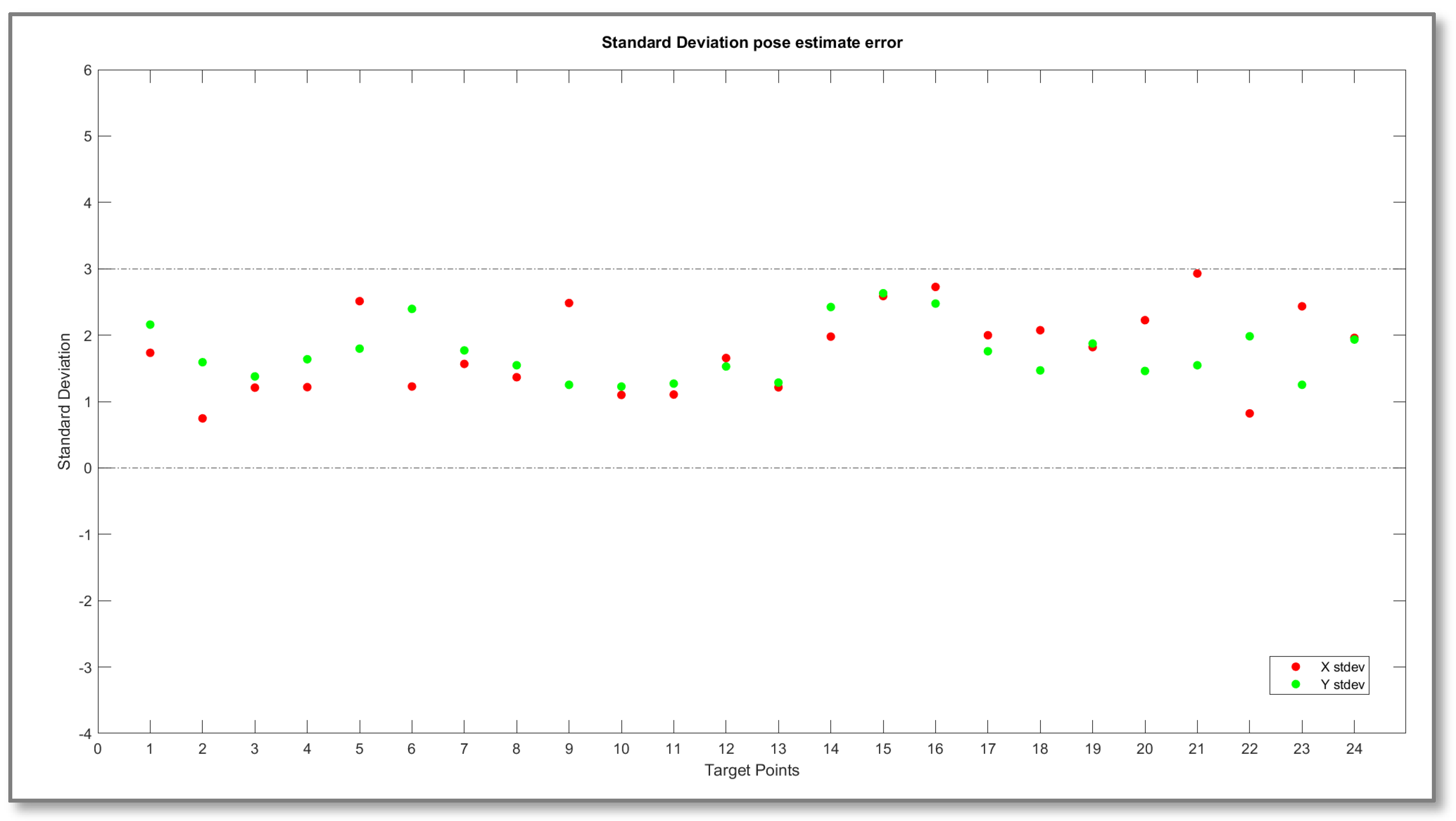
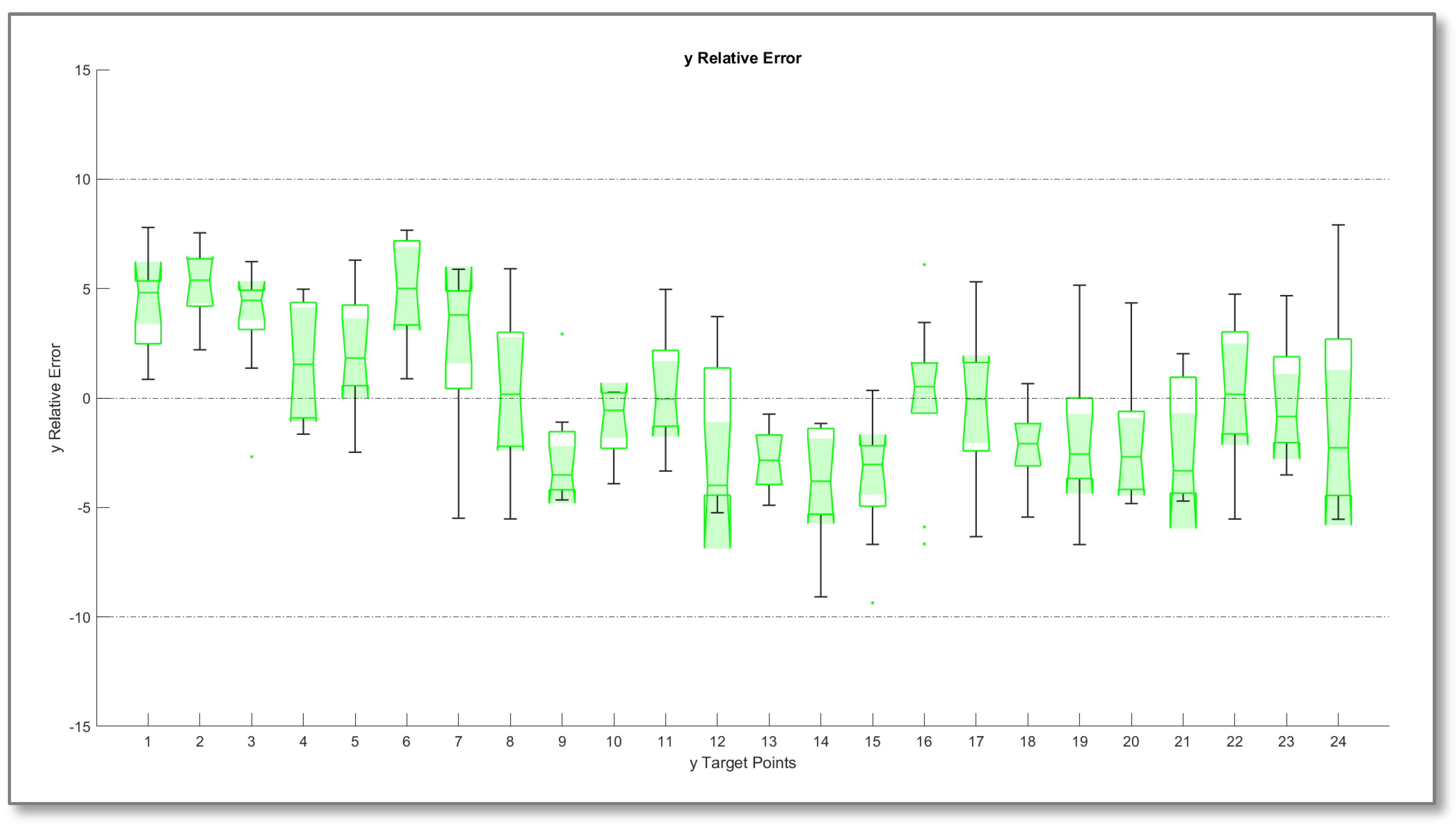
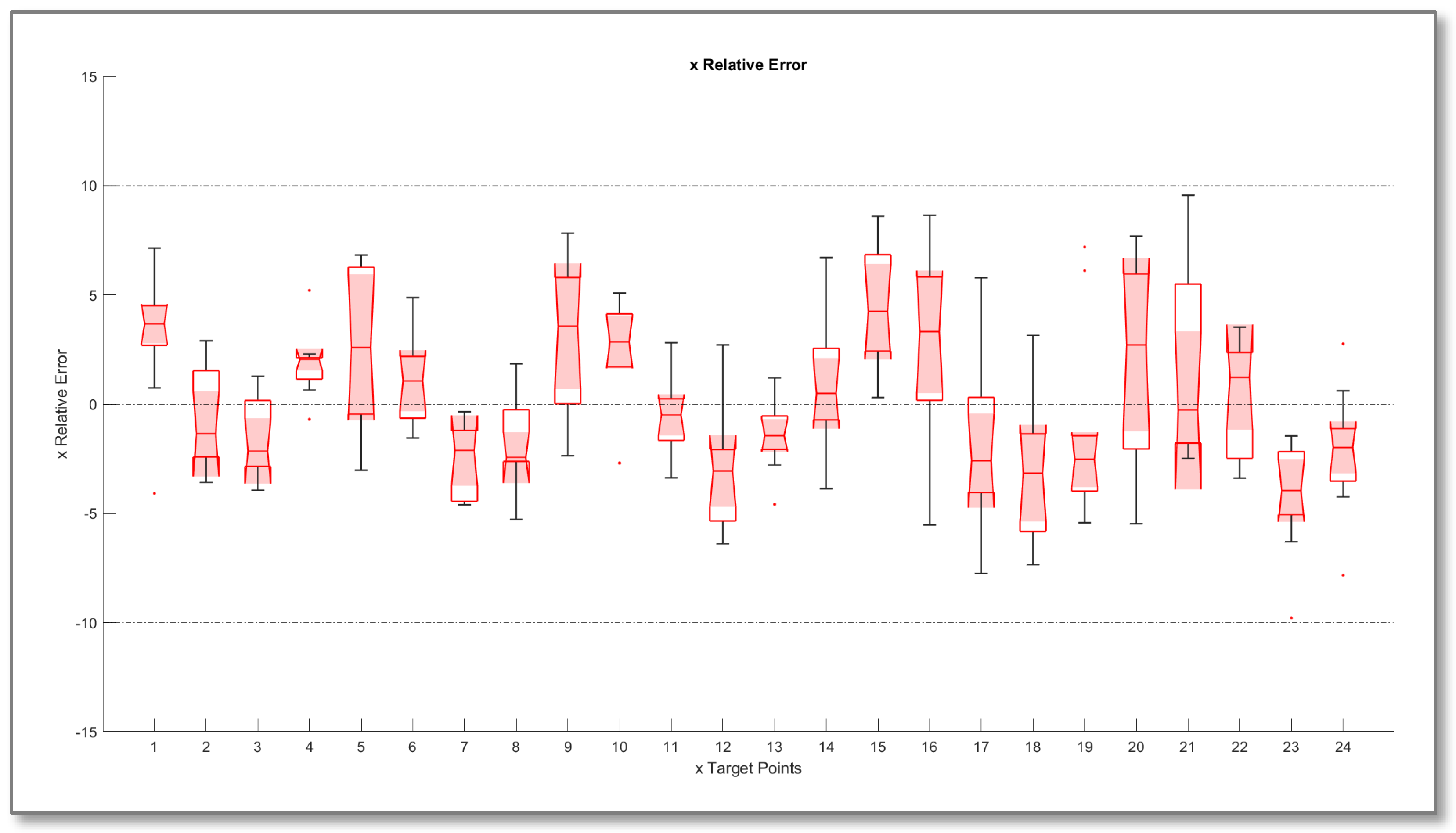
| POSETGT | 24 target (x, y) coordinates, as shown in Figure 20 |
| POSEVISION(Mean) | The mean pose estimate (x, y) coordinate values from ten rounds of tests |
| POSEVISION(Rel err) | The relative error between the target (x, y) coordinates and pose estimate (x, y) coordinate values |
| POSEVISION(Stdev) | The Standard Deviation between the (x, y) coordinate errors |
| EDAcc | A comparison between relative Euclidian Distances of (x, y) coordinate errors |
| POSEVISION(CV) | Coefficient of Variation values described in Section 3.3.3 |
| POSECGT(Grid err) | Cobot Ground Truth (x, y) coordinates compared to the grid mat (x, y) coordinates |
Disclaimer/Publisher’s Note: The statements, opinions and data contained in all publications are solely those of the individual author(s) and contributor(s) and not of MDPI and/or the editor(s). MDPI and/or the editor(s) disclaim responsibility for any injury to people or property resulting from any ideas, methods, instructions or products referred to in the content. |
© 2026 by the authors. Licensee MDPI, Basel, Switzerland. This article is an open access article distributed under the terms and conditions of the Creative Commons Attribution (CC BY) license.
Share and Cite
George, P.; Cheng, C.-T.; Pang, T.Y. Intuitive, Low-Cost Cobot Control System for Novice Operators, Using Visual Markers and a Portable Localisation Scanner. Machines 2026, 14, 201. https://doi.org/10.3390/machines14020201
George P, Cheng C-T, Pang TY. Intuitive, Low-Cost Cobot Control System for Novice Operators, Using Visual Markers and a Portable Localisation Scanner. Machines. 2026; 14(2):201. https://doi.org/10.3390/machines14020201
Chicago/Turabian StyleGeorge, Peter, Chi-Tsun Cheng, and Toh Yen Pang. 2026. "Intuitive, Low-Cost Cobot Control System for Novice Operators, Using Visual Markers and a Portable Localisation Scanner" Machines 14, no. 2: 201. https://doi.org/10.3390/machines14020201
APA StyleGeorge, P., Cheng, C.-T., & Pang, T. Y. (2026). Intuitive, Low-Cost Cobot Control System for Novice Operators, Using Visual Markers and a Portable Localisation Scanner. Machines, 14(2), 201. https://doi.org/10.3390/machines14020201