
Structural Optimization and SVPWM Control Strategy of Rotary Motors for Plasma Spraying Applications



Abstract
1. Introduction
2. Ansys Stress Simulation Analysis of Rotary Motor
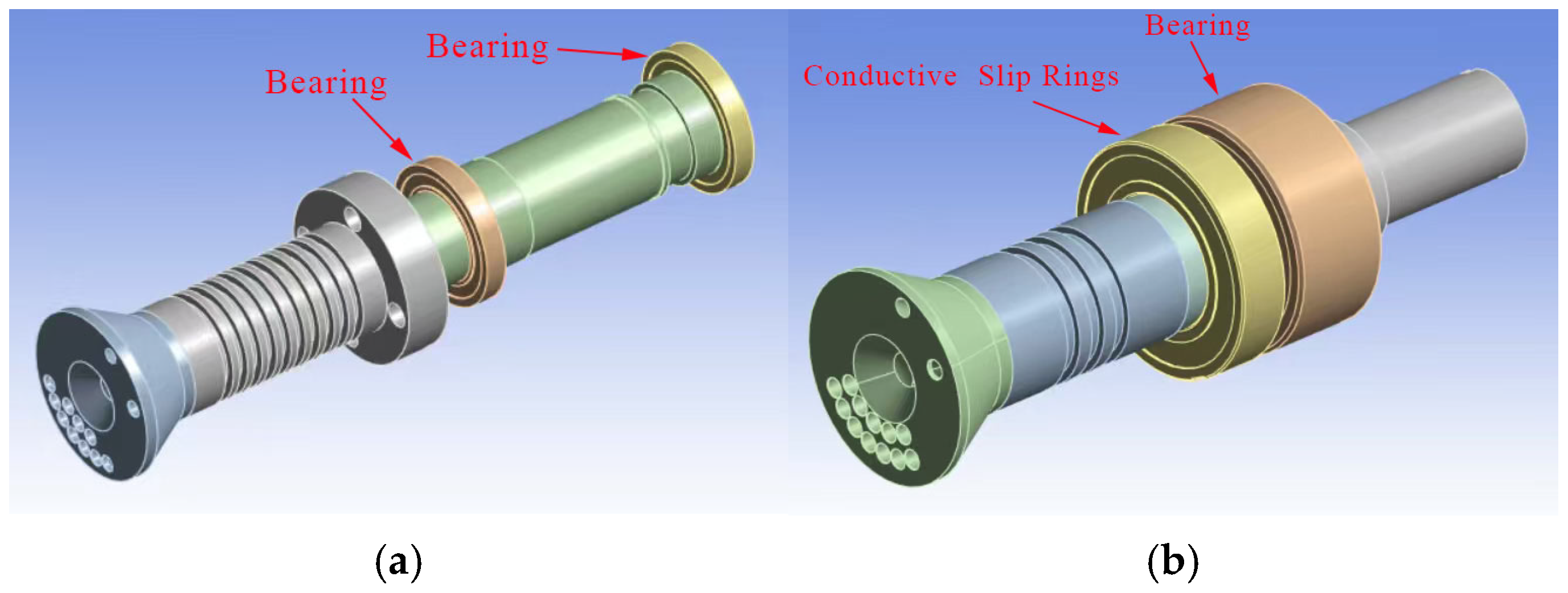
2.1. Comparative Analysis of Structural Design Between Conventional and Optimized Rotary Motors
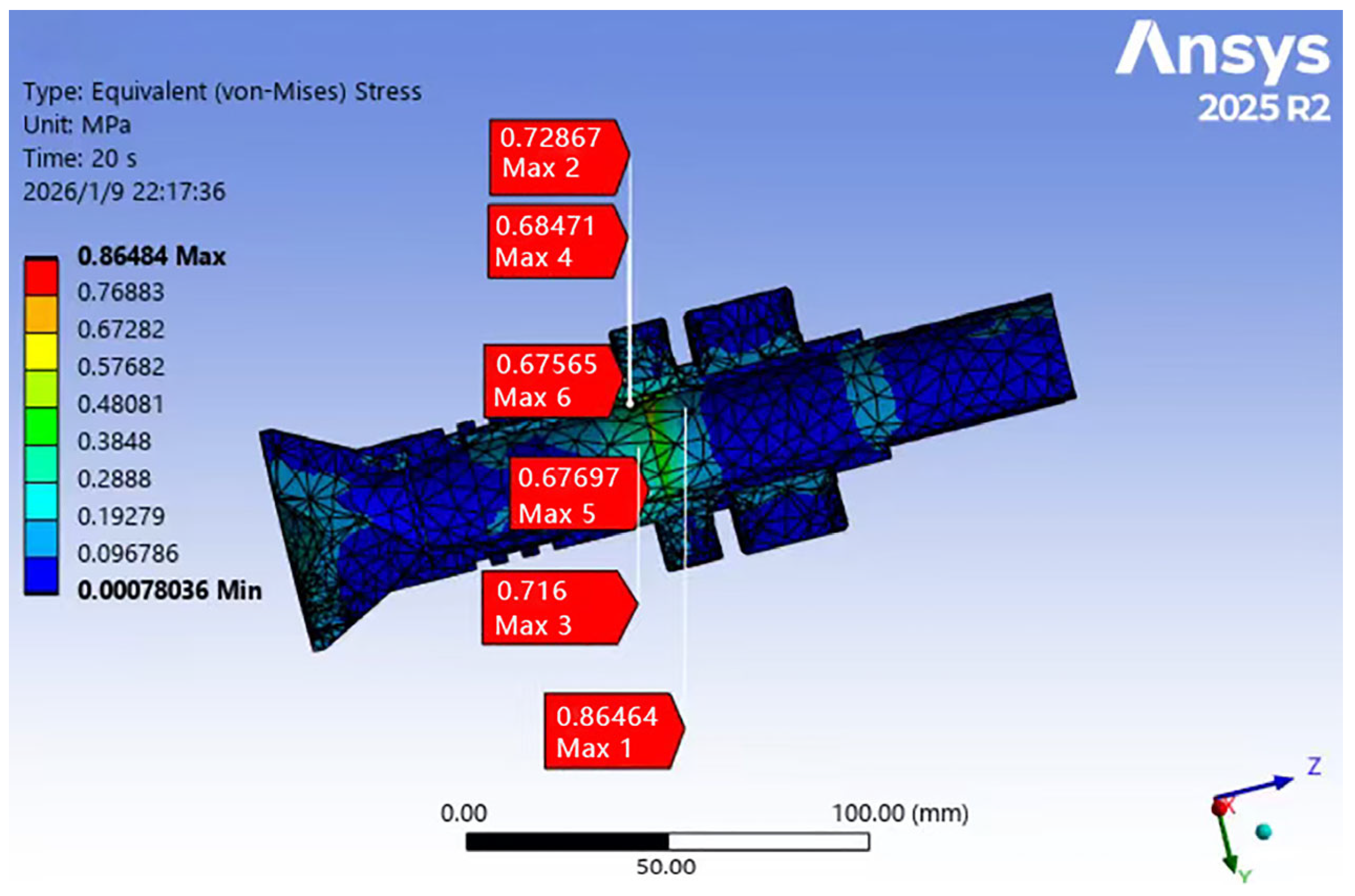
2.2. Ansys Stress Simulation Analysis of Conventional Rotary Motor
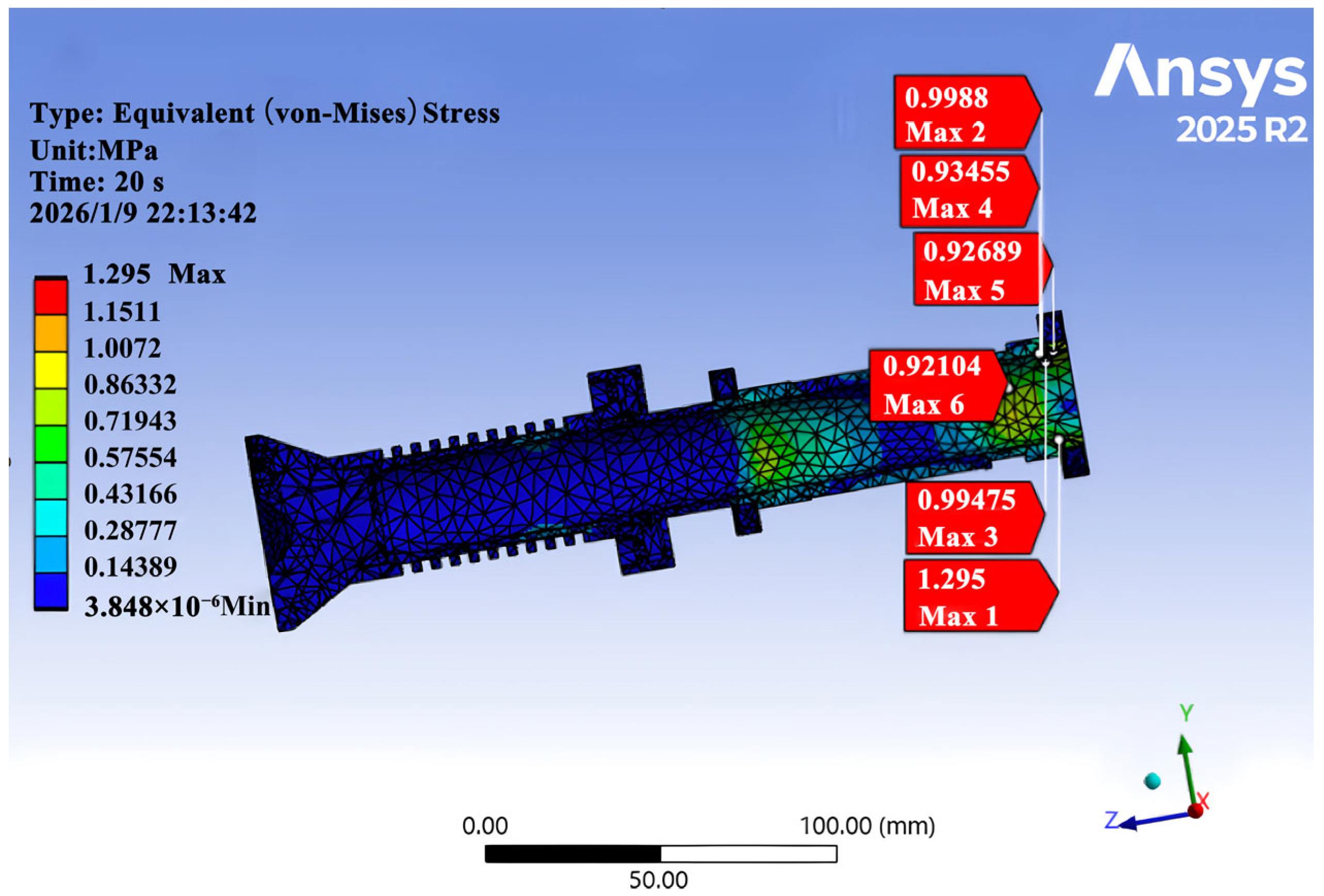
2.3. Ansys Stress Simulation Analysis of Optimized Rotary Motor
3. Adams Dynamic Balance Simulation Analysis of Rotary Motor
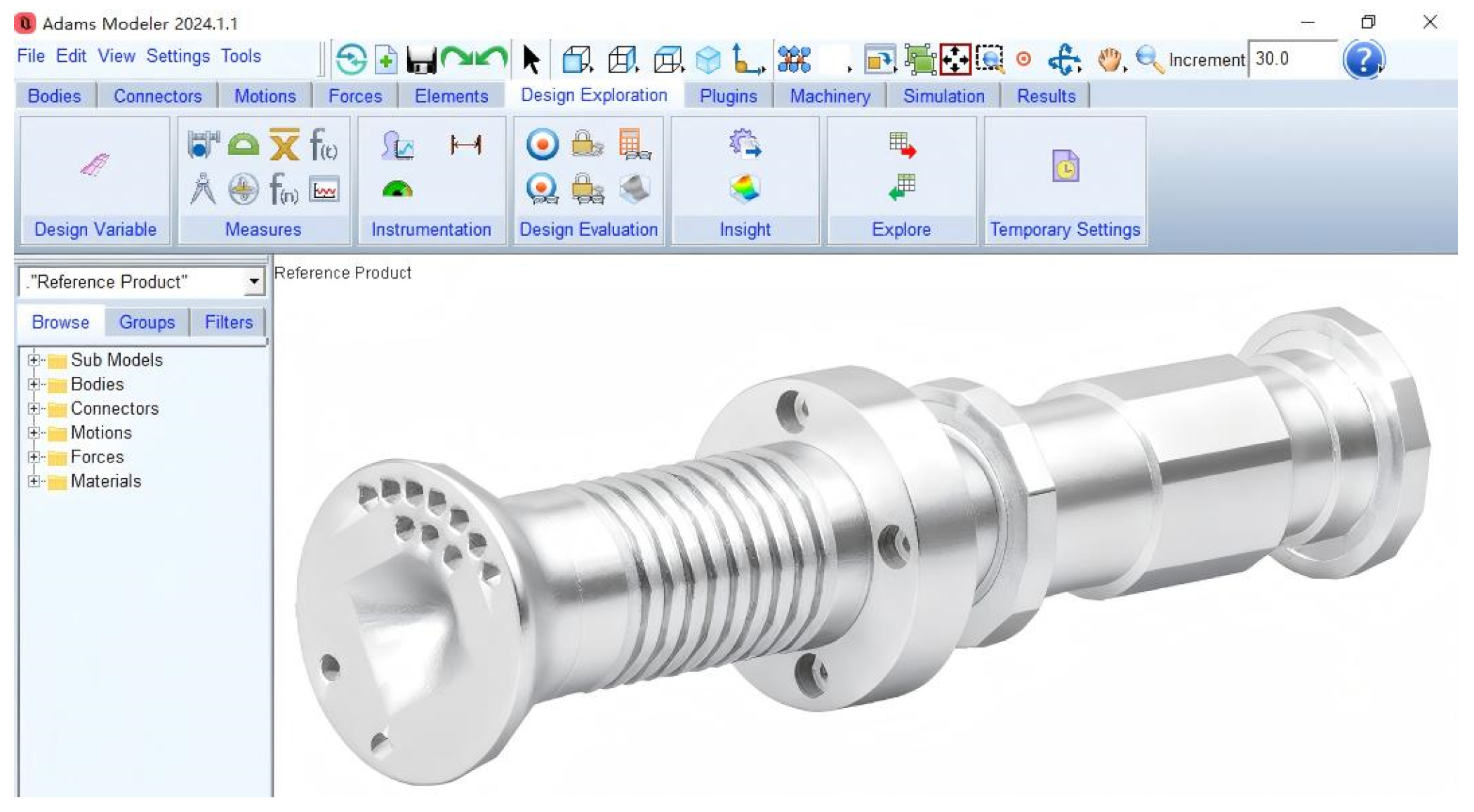
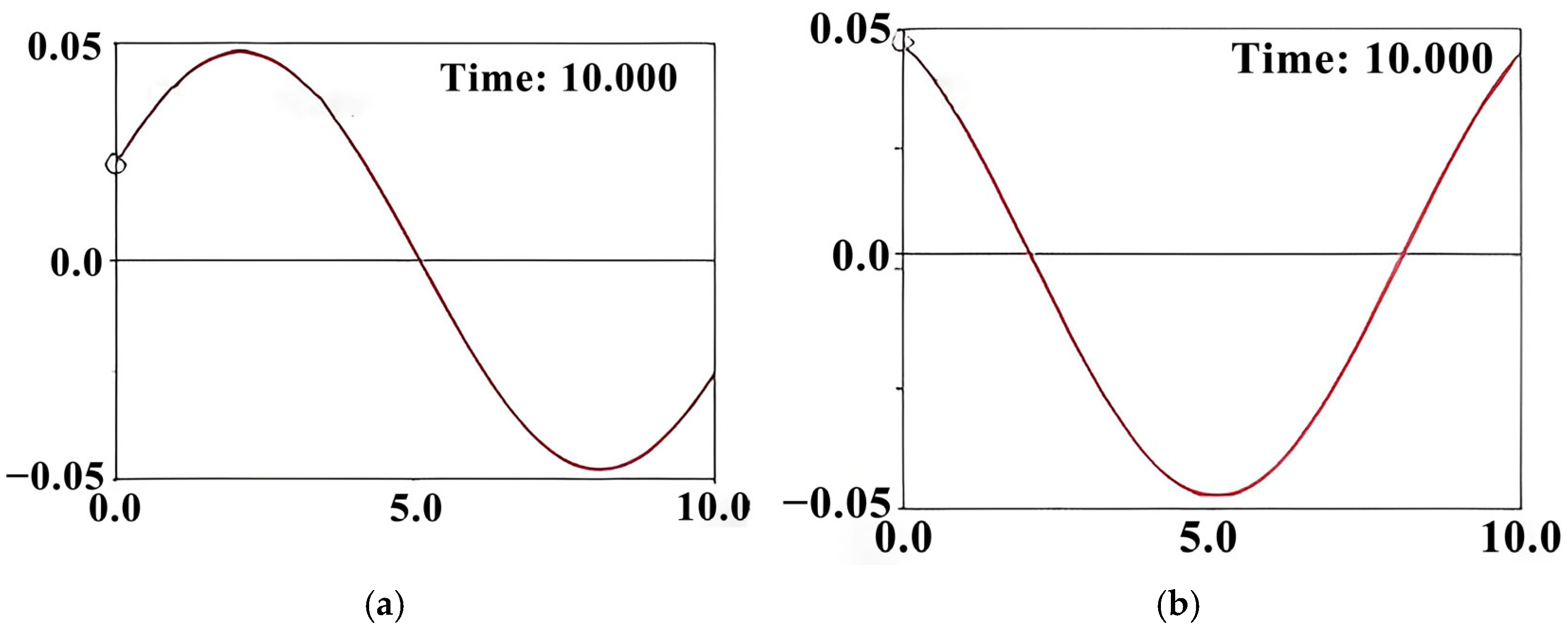
3.1. Adams Dynamic Balance Simulation Analysis of Conventional Rotary Motor
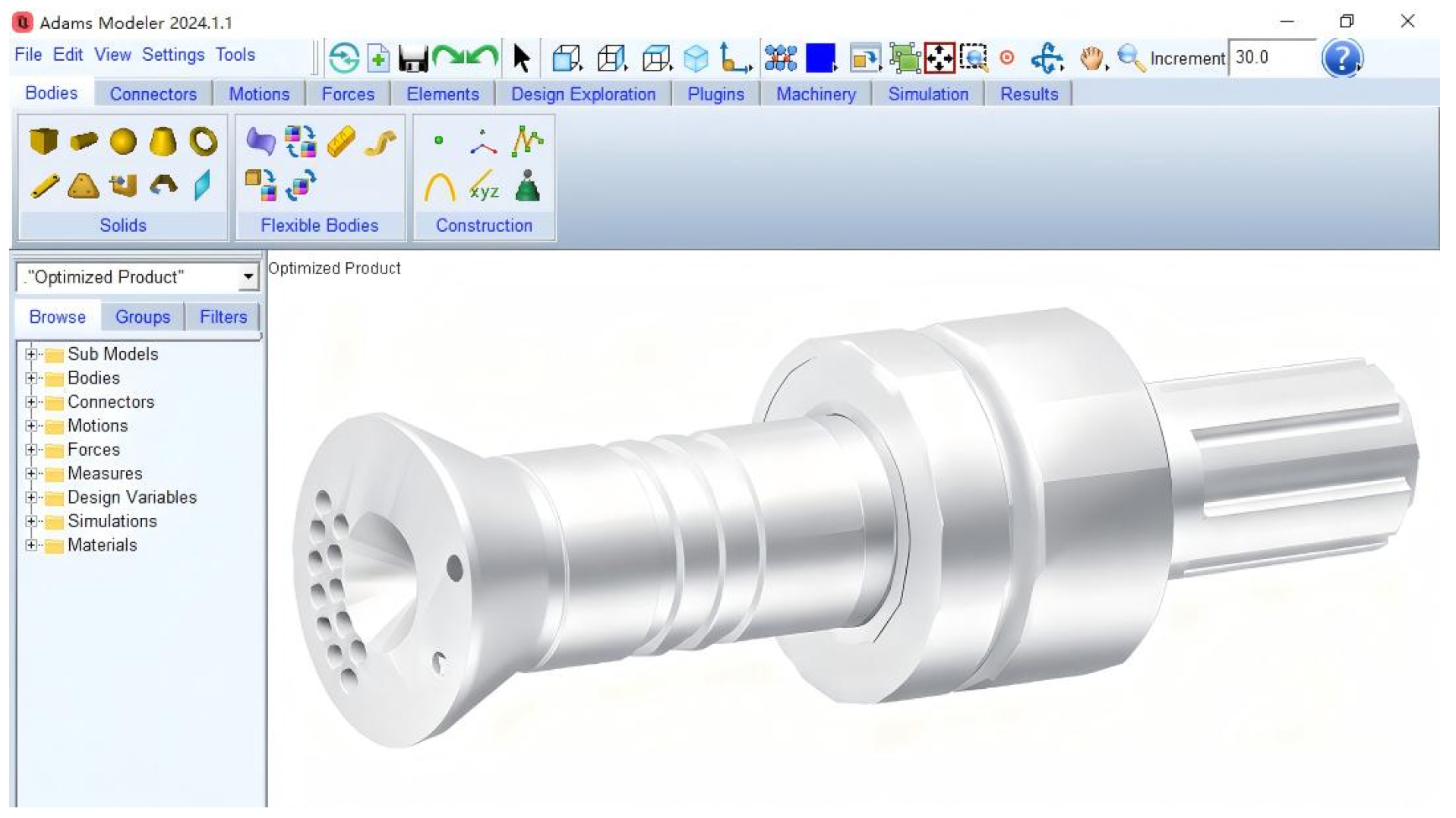
3.2. Adams Dynamic Balance Simulation Analysis of Optimized Rotary Motor
4. Hardware–Software Co-Design of Motor Drive Board
- Input Filtering and Isolation: Control signals (PWM) and current sampling signals are electrically isolated using optocouplers or Hall sensors, achieving separation between power ground and control ground and effectively blocking common-mode noise.
- PCB Design and Grounding: A four-layer board design is adopted, strictly separating the power, control, and ground layers. A “star-point single-point grounding” strategy is implemented to minimize ground-loop interference.
- Signal Processing: Digital filtering is applied to the sampled current and voltage signals. The PI controller in the FOC algorithm incorporates output limiting and anti-windup functions.
- Fast Protection: Integrated hardware protection circuits (e.g., short-circuit, undervoltage) can respond within microseconds upon fault detection and trigger an MCU interrupt to execute a safe shutdown routine.
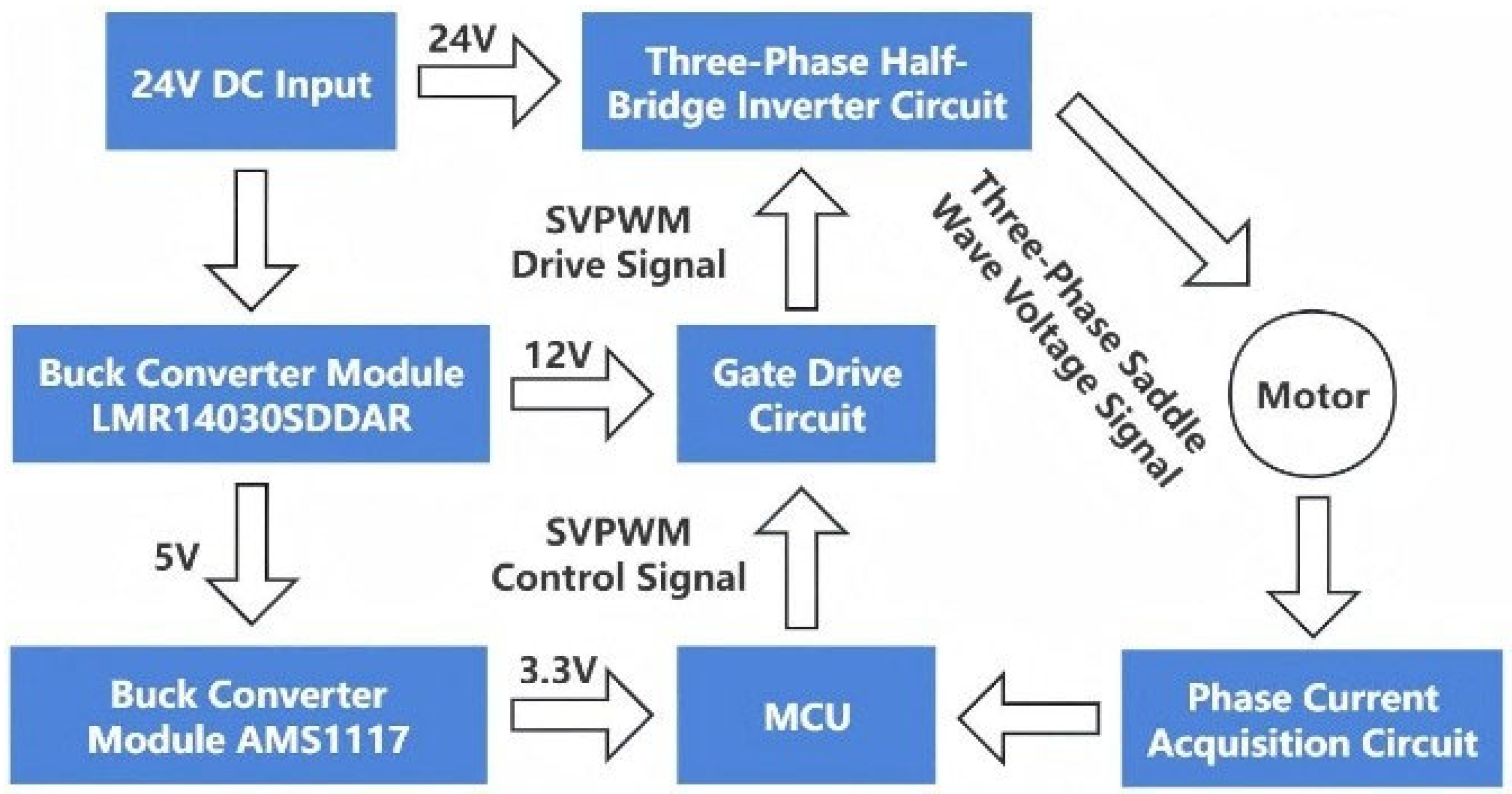
4.1. Hardware Architecture of Motor Drive System
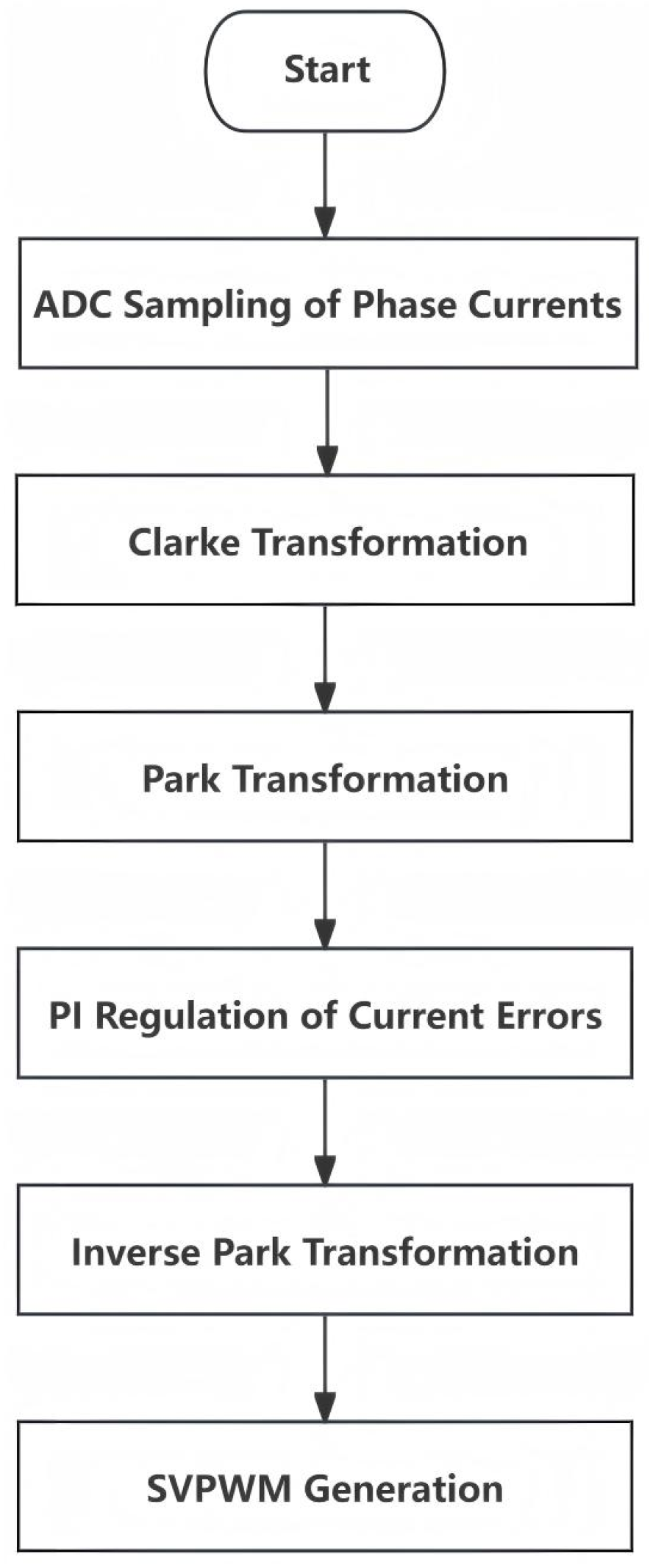
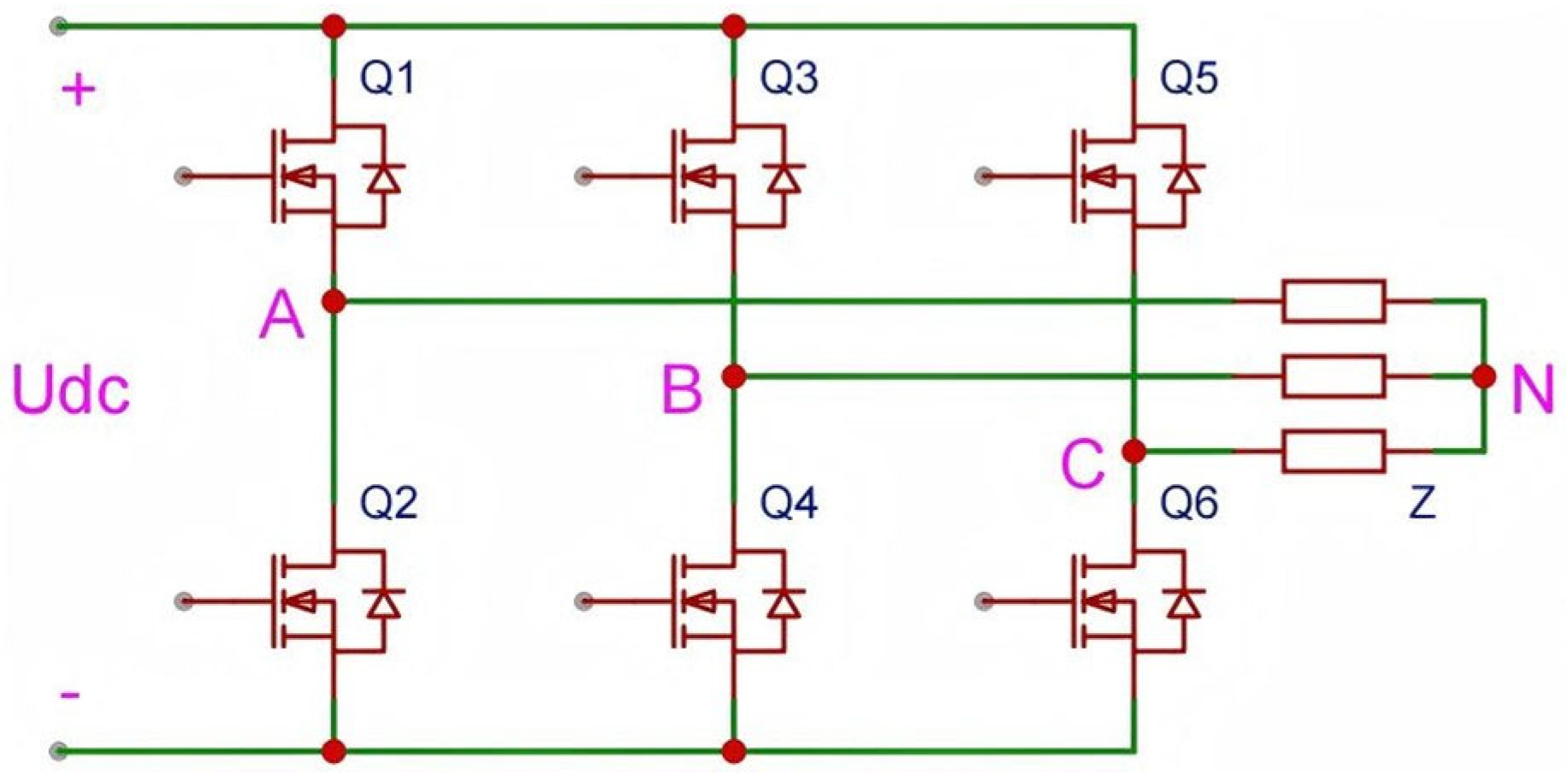
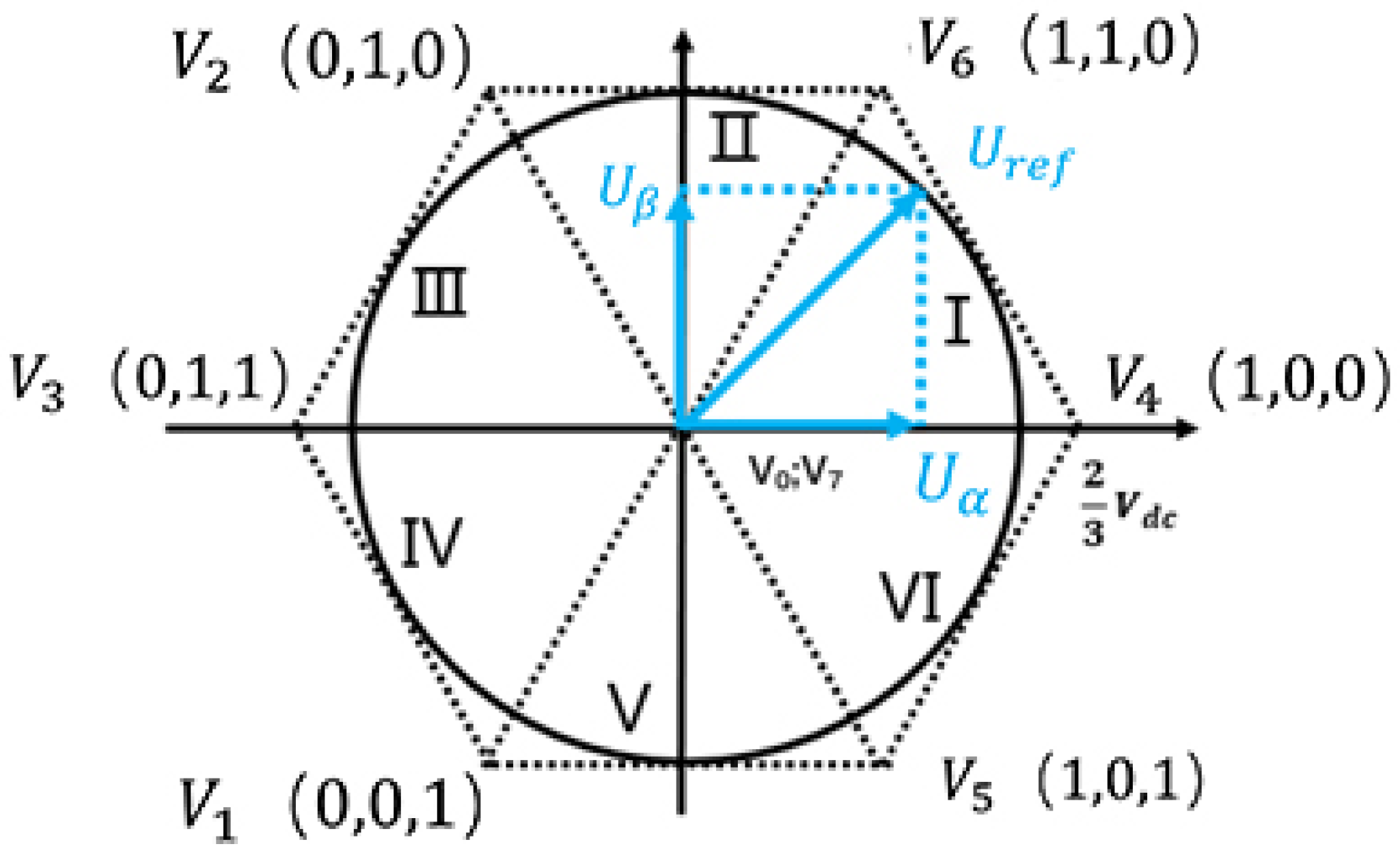
4.2. FOC Algorithm Design for Motor Drive Board
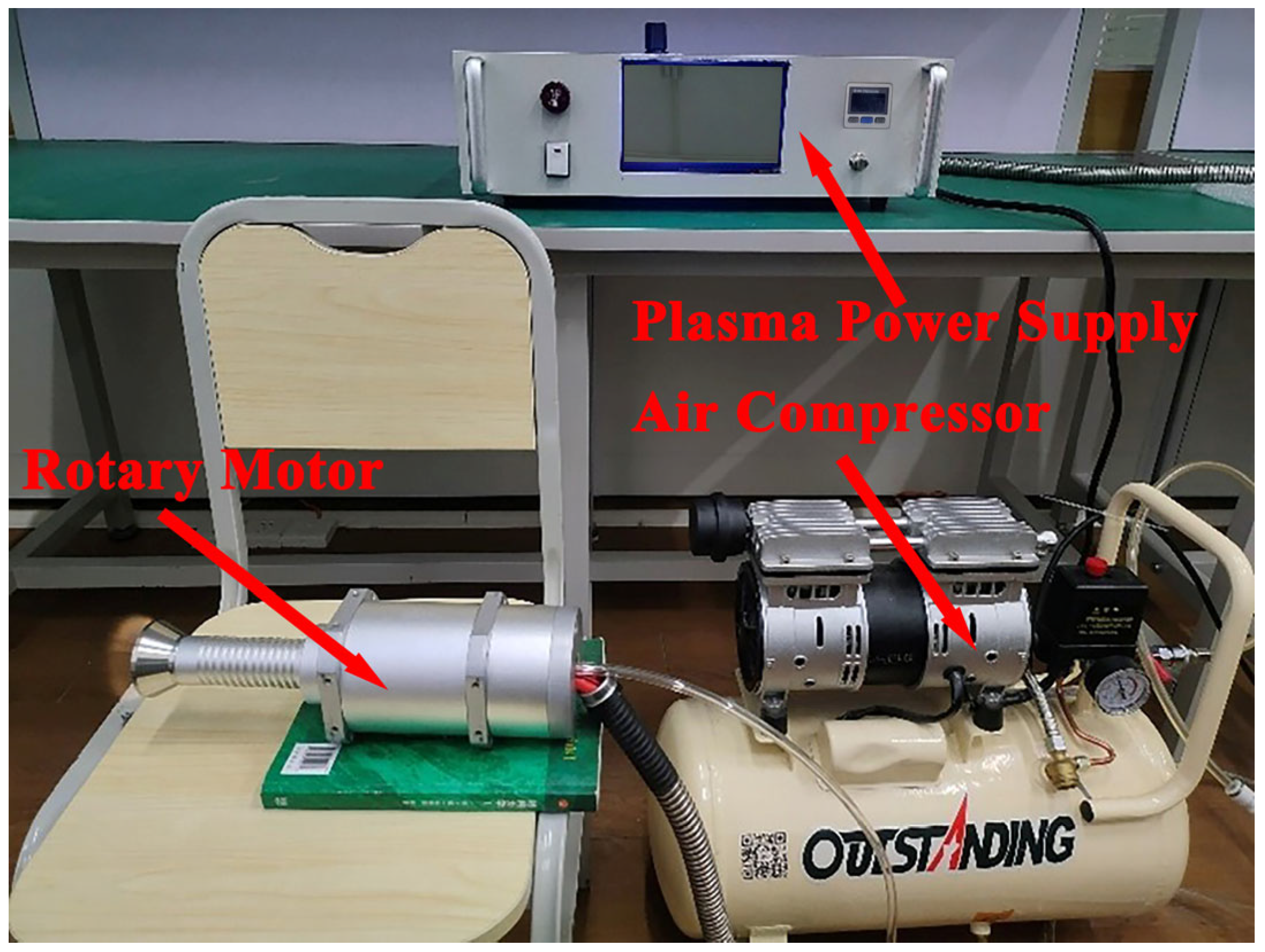
5. Performance Evaluation of Rotary Motor System
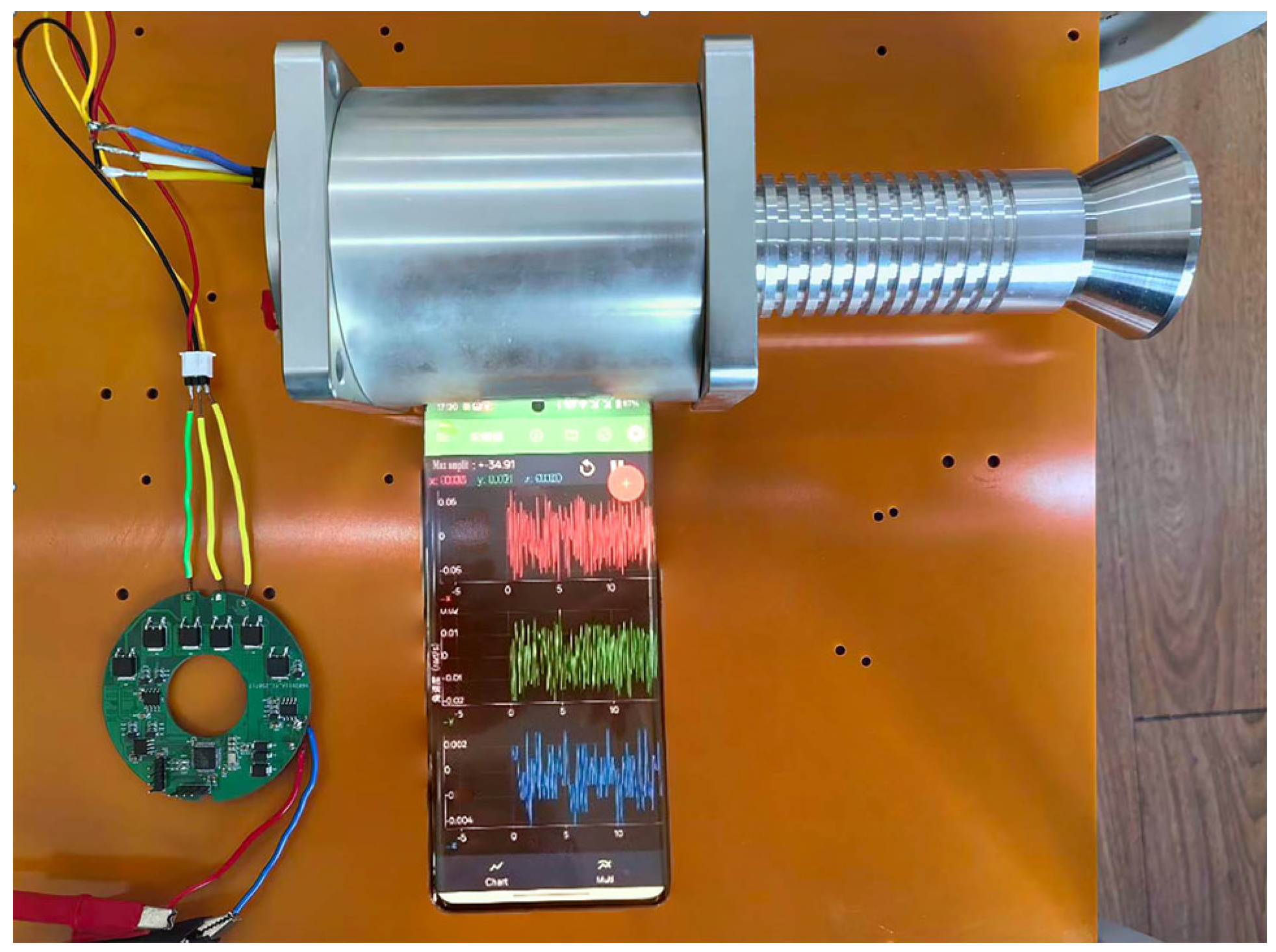
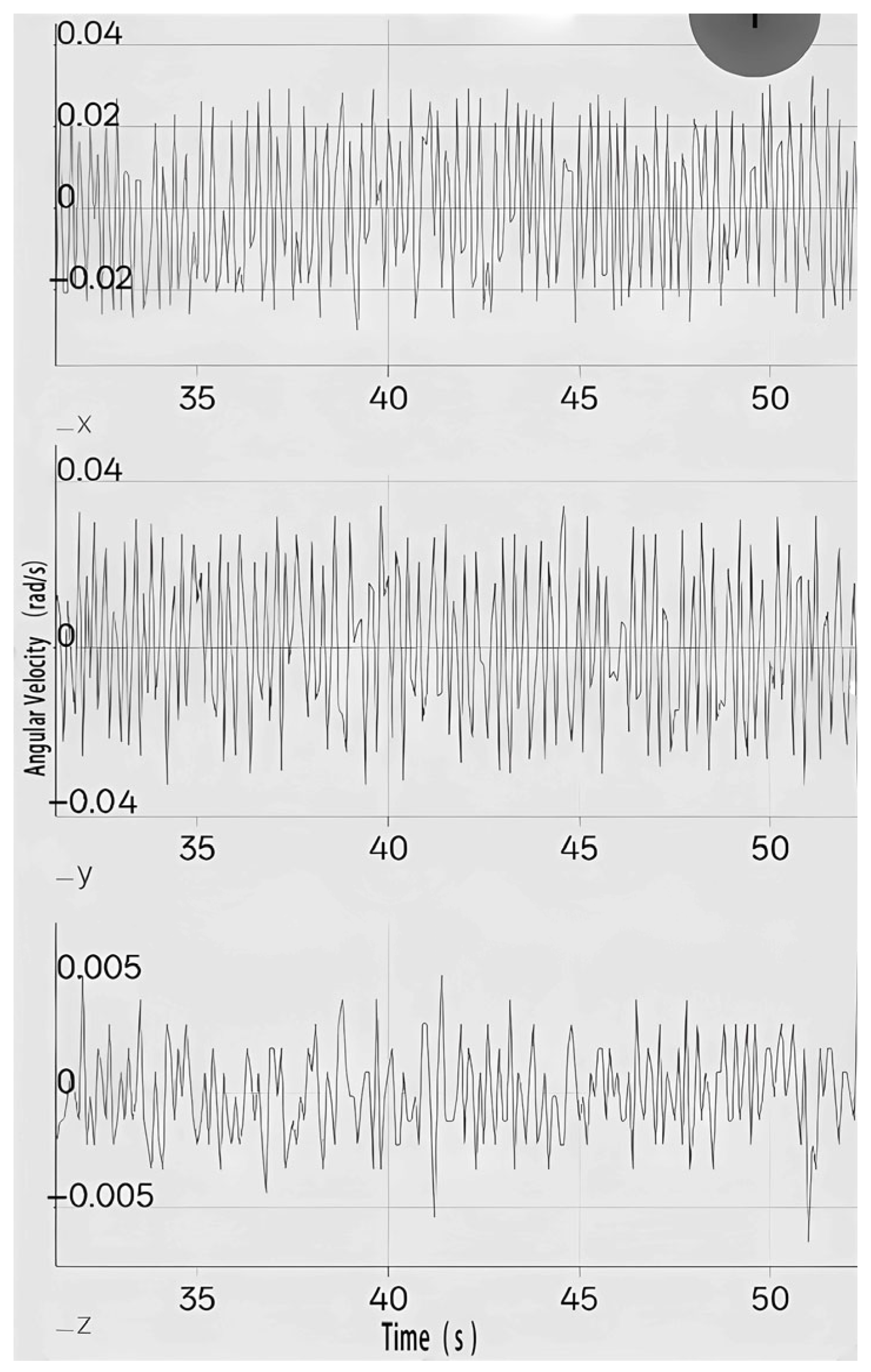
5.1. Dynamic Balance Performance Testing
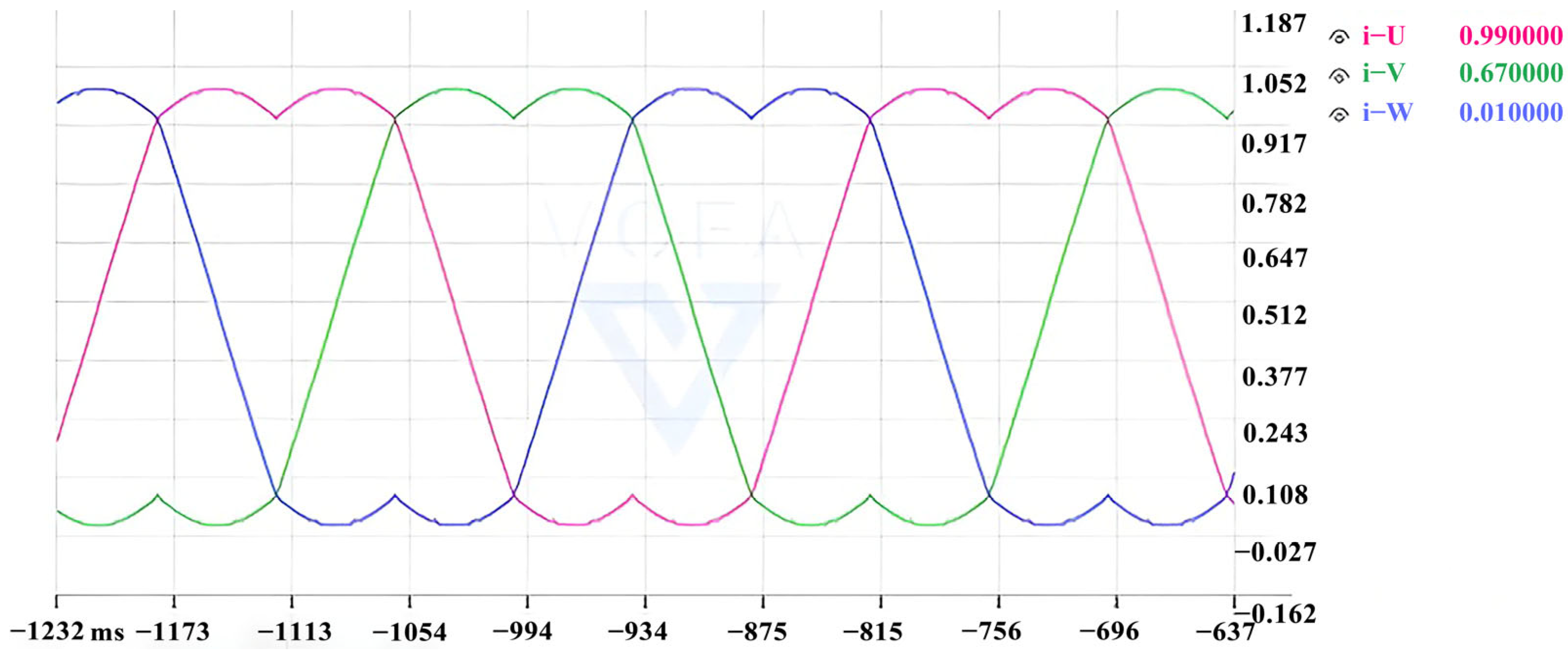
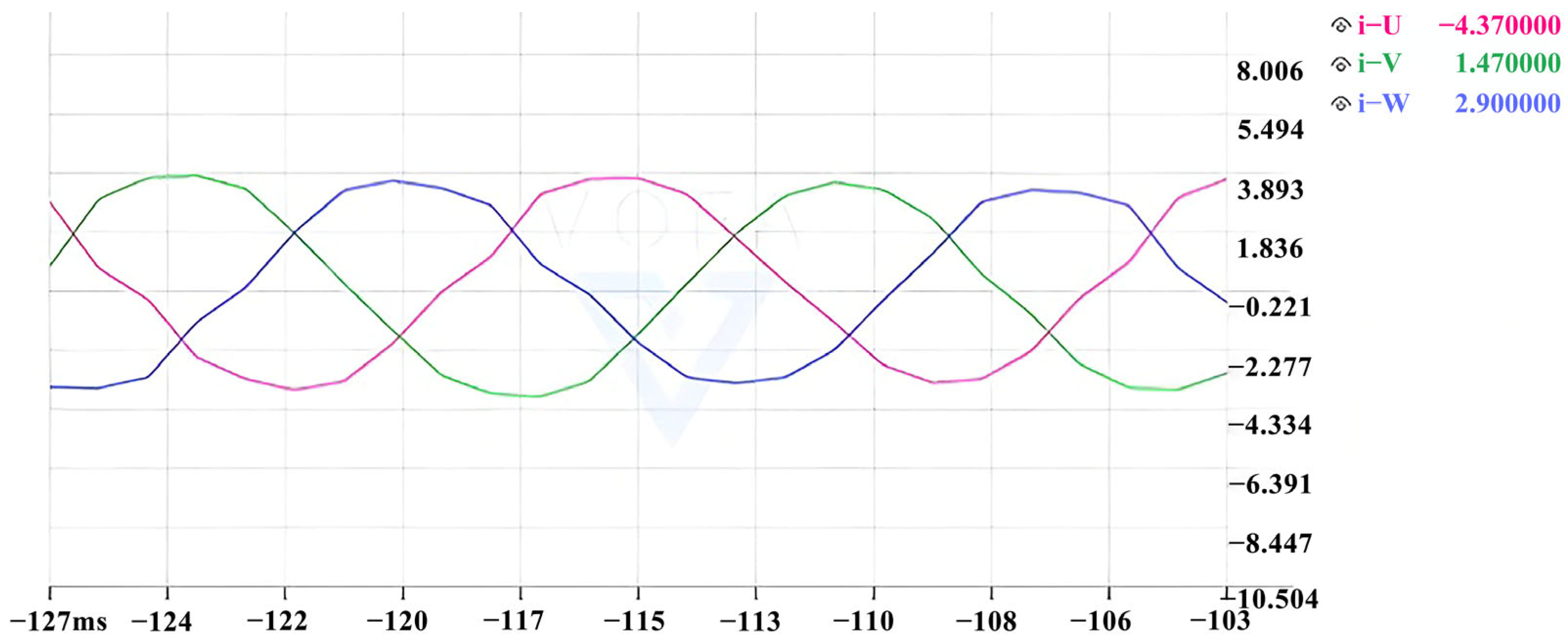
5.2. Output Waveform Analysis of Drive Board
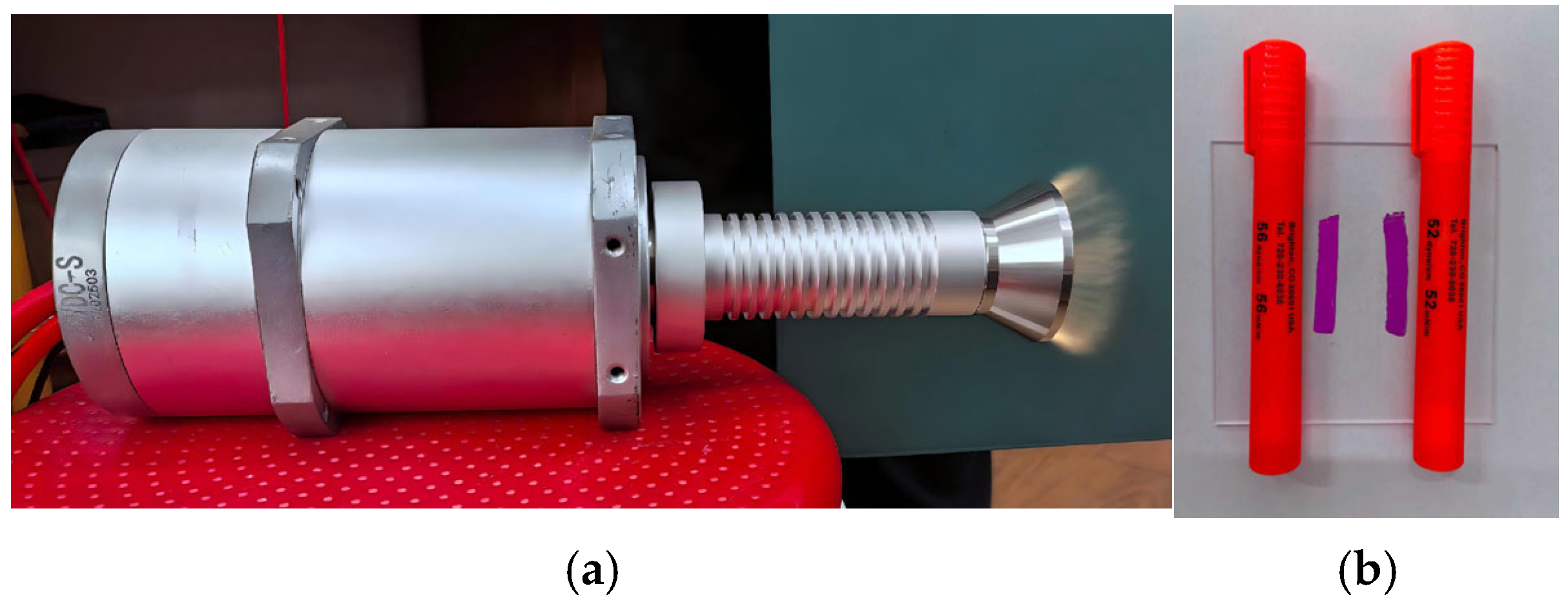
5.3. Plasma Spray Coating Performance Evaluation of Rotary Motor System
6. Conclusions
Author Contributions
Funding
Data Availability Statement
Conflicts of Interest
References
- Ding, R.; Chen, X.; Wang, R.; Jiang, D. A Review of Configurations and Control Strategies for Linear Motor-Based Electromagnetic Suspension. Machines 2026, 14, 2. [Google Scholar] [CrossRef]
- Jeddi, N.; Ouasli, N.; Amraoui, L.E.; Tadeo, F. Design of a control system based on PMS motor for solar vehicles. Int. J. Power Energy Convers. 2018, 9, 25–46. [Google Scholar] [CrossRef]
- Wu, W.; Xu, Y.; Yan, Y. Investigation on the flow characteristics of rotating nozzle cavitation water jet flow field. J. Appl. Fluid Mech. 2024, 17, 2637–2651. [Google Scholar] [CrossRef]
- Wang, Z.; Zhang, B.; Zhang, K.; Yue, G. Optimization and experiment of mass compensation strategy for built-in mechanical on-line dynamic balancing system. Appl. Sci. 2020, 10, 1464. [Google Scholar] [CrossRef]
- Qi, W.; Yu, L.; Tang, X.; Wu, J.; Zhang, Y.; He, Z. Multi-objective optimization of a hydrogen-fueled PEMFC with multi wavy channels via machine learning and CFD simulation. Int. J. Hydrogen Energy 2026, 199, 152748. [Google Scholar] [CrossRef]
- Qi, W.; Yang, J.; Zhang, Z.; Wu, J.; Lan, P.; Xiang, S. Investigation on thermal management of cylindrical lithium-ion batteries based on interwound cooling belt structure. Energy Convers. Manag. 2025, 340, 119962. [Google Scholar] [CrossRef]
- Qi, W.; Lan, P.; Yang, J.; Chen, Y.; Zhang, Y.; Wang, G.; Peng, F.; Hong, J. Multi-U-Style micro-channel in liquid cooling plate for thermal management of power batteries. Appl. Therm. Eng. 2024, 256, 123984. [Google Scholar] [CrossRef]
- Iero, D.; Carbone, R.; Carotenuto, R.; Felini, C.; Merenda, M.; Pangallo, G.; Della Corte, F.G. SPICE modelling of a complete photovoltaic system including modules, energy storage elements and a multilevel inverter. Sol. Energy 2014, 107, 338–350. [Google Scholar] [CrossRef]
- Liao, H.L.; Jia, X.; Niu, J.L. Flow structure and rock-breaking feature of the self-rotating nozzle for radial jet drilling. Petro-Leum Sci. 2020, 17, 211–221. [Google Scholar] [CrossRef]
- Wang, Y.; Ni, P.; Wen, D.; Lin, Q.; Wang, D.; Ma, C.; Rao, Y.; Wang, H.; Tan, D. Dynamic performance optimization of circular sawing machine gearbox. Appl. Sci. 2019, 9, 4458. [Google Scholar] [CrossRef]
- Liu, S.; Guo, Z.; Chen, Z. Finite-element analysis and structural optimization design study for cradle seat of CNC machine tool. J. Chin. Inst. Eng. 2016, 39, 345–352. [Google Scholar] [CrossRef]
- Li, B.; Zhang, Y.; Ren, R.; Liu, W.; Xu, G. Time-Frequency Conditional Enhanced Transformer-TimeGAN for Motor Fault Data Augmentation. Machines 2025, 13, 969. [Google Scholar] [CrossRef]
- Yamauchi, Y.; Ambe, Y.; Konyo, M. Realizing large shape deformations of a flying continuum robot with a passive rotating nozzle unit that enlarges jet directions in three-dimensional space. IEEE Access 2022, 10, 37646–37657. [Google Scholar] [CrossRef]
- Xie, G.; Zhang, R.; Manca, O. Thermal and thermomechanical performances of pyramidal core sandwich panels under aerodynamic heating. J. Therm. Sci. Eng. Appl. 2017, 9, 014503. [Google Scholar] [CrossRef]
- Cai, K.; Xiao, J.; Su, X.; Tang, Q.; Deng, H. Encapsulation Process and Dynamic Characterization of SiC Half-Bridge Power Module: Electro-Thermal Co-Design and Experimental Validation. Micromachines 2025, 16, 824. [Google Scholar] [CrossRef]
- Kinnaird, C. Electronic design of compact BLDC motor control. SAE Int. J. Passeng. Cars-Electron. Electr. Syst. 2015, 8, 229–239. [Google Scholar] [CrossRef]
- Guerrero-Rodríguez, N.F.; Rey-Boué, A.B.; Reyes-Archundia, E. Overview and comparative study of two control strategies used in 3-phase grid-connected inverters for renewable systems. Renew. Energy Focus 2017, 19, 75–89. [Google Scholar] [CrossRef]
- Mao, S.; Chen, Q.; Li, R.; Cai, X. Control of a cascaded STATCOM with battery energy storage system under unbalanced and distorted grid voltage conditions. J. Renew. Sustain. Energy 2017, 9, 044104. [Google Scholar] [CrossRef]
- Zhao, H.; Zhang, L.; Liu, J.; Zhang, C.; Cai, J.; Shen, L. Design of a low-order FIR filter for a high-frequency square-wave voltage injection method of the PMLSM used in maglev train. Electronics 2020, 9, 729. [Google Scholar] [CrossRef]
- Singh, S.; Sonar, S. Controlled diode bridge clamped three level Z source inverter and its PWM control. EPE J. 2020, 30, 107–121. [Google Scholar] [CrossRef]
- Anitha Roseline, J.; Senthil Kumaran, M.; Rajini, V. Generalized space vector control for current source inverters and rectifiers. Arch. Electr. Eng. 2016, 65, 235–248. [Google Scholar] [CrossRef][Green Version]
- Tang, Y.; Xie, S. System design of series Z-source inverter with feedforward and space vector pulse-width modulation control strategy. IET Power Electron. 2014, 7, 736–744. [Google Scholar] [CrossRef]
- Mahato, B.; Jana, K.C.; Thakura, P.R. Constant V/f control and frequency control of isolated winding induction motor using nine-level three-phase inverter. Iran. J. Sci. Technol. Trans. Electr. Eng. 2019, 43, 123–135. [Google Scholar] [CrossRef]
- Tcai, A.; Alsofyani, I.M.; Seo, I.Y.; Lee, K.B. DC-link ripple reduction in a DPWM-based two-level VSI. Energies 2018, 11, 3008. [Google Scholar] [CrossRef]
- Boulouiha, H.M.; Allali, A.; Laouer, M.; Tahri, A.; Denai, M.; Draou, A. Direct torque control of multilevel SVPWM inverter in variable speed SCIG-based wind energy conversion system. Renew. Energy 2015, 80, 140–152. [Google Scholar] [CrossRef]
- Dusmez, S.; Qin, L.; Akin, B. A new SVPWM technique for DC negative rail current sensing at low speeds. IEEE Trans. Ind. Electron. 2014, 62, 826–831. [Google Scholar] [CrossRef]
- Han, Y.; Biggs, J.D.; Cui, N. Adaptive fault-tolerant control of spacecraft attitude dynamics with actuator failures. J. Guid. Control. Dyn. 2015, 38, 2033–2042. [Google Scholar] [CrossRef]
- Slavinskis, A.; Kvell, U.; Kulu, E.; Sünter, I.; Kuuste, H.; Lätt, S.; Voormansik, K.; Noorma, M. High spin rate magnetic controller for nanosatellites. Acta Astronaut. 2014, 95, 218–226. [Google Scholar] [CrossRef]
- Feirstein, D.S.; Koryakovskiy, I.; Kober, J.; Vallery, H. Reinforcement learning of potential fields to achieve limit-cycle walking. IFAC-PapersOnLine 2016, 49, 113–118. [Google Scholar] [CrossRef]
- Hu, J.; Zha, J.; Liu, C.; Sun, C. Research on drum shearer speed control strategies under sudden-changing load. J. Braz. Soc. Mech. Sci. Eng. 2018, 40, 323. [Google Scholar] [CrossRef]
- Qiu, Z.C.; Zhang, W.Z. Trajectory planning and diagonal recurrent neural network vibration control of a flexible manipulator using structural light sensor. Mech. Syst. Signal Process. 2019, 132, 563–594. [Google Scholar] [CrossRef]
- Tang, D.; Xiao, H.; Kong, F.; Deng, Z.; Jiang, S.; Quan, Q. Thermal analysis of the driving component based on the thermal network method in a lunar drilling system and experimental verification. Energies 2017, 10, 355. [Google Scholar] [CrossRef]
- Cai, K.; Xiao, J.; Yang, Z.; Hu, R. Three-Level All-SiC High-Frequency High-Voltage Plasma Power Supply System. Energies 2025, 18, 1617. [Google Scholar] [CrossRef]
- Luo, Q.; Zheng, J.; Sun, Y.; Yang, L. Optimal modeled six-phase space vector pulse width modulation method for stator voltage harmonic suppression. Energies 2018, 11, 2598. [Google Scholar] [CrossRef]
- Sarker, K.; Chatterjee, D.; Goswami, S.K. Grid integration of photovoltaic and wind based hybrid distributed generation system with low harmonic injection and power quality improvement using biogeography-based optimization. Renew. Energy Focus 2017, 22–23, 38–56. [Google Scholar] [CrossRef]
- Song, W.; Wang, S.; Xiong, C.; Ge, X.; Feng, X. Single-phase three-level space vector pulse width modulation algorithm for grid-side railway traction converter and its relationship of carrier-based pulse width modulation. IET Electr. Syst. Transp. 2014, 4, 78–87. [Google Scholar] [CrossRef]
- Wang, W.; Zhang, B.; Xie, F. A novel SVPWM for three-level NPC inverter based on m-mode controllability. IEEE Trans. Ind. Electron. 2017, 65, 6055–6065. [Google Scholar] [CrossRef]
- Palanisamy, R.; Shanmugasundaram, V.; Vidyasagar, S.; Kalyanasundaram, V.; Vijayakumar, K. A SVPWM control strategy for capacitor voltage balancing of flying capacitor based 4-level NPC inverter. J. Electr. Eng. Technol. 2020, 15, 2639–2649. [Google Scholar] [CrossRef]






| Optimization Design Types | Methods |
|---|---|
| dynamic balancing design | stress optimization of balance block using ADAMS software [3]. |
| centroid optimization design | establishment of a mass compensation optimization model [4]. |
| motor control algorithms | adoption of model predictive control (MPC) or sliding mode variable structure control [8]. |
| Type of Rotary Motor | Bearing Design | Anode Conduction |
|---|---|---|
| conventional rotary motor | dual-bearing | housing |
| optimized rotary motor | single-bearing | internal slip ring |
| Parameters | Conventional Rotary Motor | Optimized Rotary Motor |
|---|---|---|
| boundary condition | after applying a 3 s torque to the rotating shaft, a speed of 2250 r/min is achieved | |
| mesh density | the minimum edge length is 9.4248 mm | |
| material properties | aluminum alloy 6061 with the stress of 395.8 MPa | aluminum alloy 7075 with the stress of 693 MPa |
| optimization criteria | the maximum stress in the optimized structure is 0.9 MPa | |
| Sa | Sb | Sc | Vector | |||
|---|---|---|---|---|---|---|
| 0 | 0 | 0 | 0 | 0 | 0 | |
| 0 | 0 | 1 | ||||
| 0 | 1 | 0 | ||||
| 0 | 1 | 1 | ||||
| 1 | 0 | 0 | ||||
| 1 | 0 | 1 | ||||
| 1 | 1 | 0 | ||||
| 1 | 1 | 1 | 0 | 0 | 0 |
| Switching Sequence | |
|---|---|
| Ⅰ (0° ≤ θ ≤ 60°) | 0-4-6-7-7-6-4-0 |
| Ⅱ (60° ≤ θ ≤ 120°) | 0-2-6-7-7-6-2-0 |
| Ⅲ (120° ≤ θ ≤ 180°) | 0-2-3-7-7-3-2-0 |
| Ⅳ (180° ≤ θ ≤ 240°) | 0-1-3-7-7-3-1-0 |
| Ⅴ (240° ≤ θ ≤ 300°) | 0-1-5-7-7-5-1-0 |
| Ⅵ (300° ≤ θ ≤ 360°) | 0-4-5-7-7-5-4-0 |
| Parameters | Values |
|---|---|
| rated voltage U/V | 24 |
| rated current I/A | 5 |
| pole pairs p | 4 |
| inductance L/mH | 6 |
| resistance R/Ω | 3 |
| Testing Metrics | Simulated Values | Measured Values | Error |
|---|---|---|---|
| rotational speed/rpm | 2250 | 2245 | 0.2% |
| current/A | 3.886 | 3.818 | 1.7% |
| Dyne Pen Test | Pre-Optimization Motor | Post-Optimization Motor |
|---|---|---|
| dyne 52 | failed | passed |
| dyne 56 | failed | passed |
Disclaimer/Publisher’s Note: The statements, opinions and data contained in all publications are solely those of the individual author(s) and contributor(s) and not of MDPI and/or the editor(s). MDPI and/or the editor(s) disclaim responsibility for any injury to people or property resulting from any ideas, methods, instructions or products referred to in the content. |
© 2026 by the authors. Licensee MDPI, Basel, Switzerland. This article is an open access article distributed under the terms and conditions of the Creative Commons Attribution (CC BY) license.
Share and Cite
Liang, L.; Cai, K.; Zhang, L.; Tang, Z.; Xiao, J. Structural Optimization and SVPWM Control Strategy of Rotary Motors for Plasma Spraying Applications. Machines 2026, 14, 192. https://doi.org/10.3390/machines14020192
Liang L, Cai K, Zhang L, Tang Z, Xiao J. Structural Optimization and SVPWM Control Strategy of Rotary Motors for Plasma Spraying Applications. Machines. 2026; 14(2):192. https://doi.org/10.3390/machines14020192
Chicago/Turabian StyleLiang, Lvying, Kaida Cai, Lin Zhang, Zhihuan Tang, and Jing Xiao. 2026. "Structural Optimization and SVPWM Control Strategy of Rotary Motors for Plasma Spraying Applications" Machines 14, no. 2: 192. https://doi.org/10.3390/machines14020192
APA StyleLiang, L., Cai, K., Zhang, L., Tang, Z., & Xiao, J. (2026). Structural Optimization and SVPWM Control Strategy of Rotary Motors for Plasma Spraying Applications. Machines, 14(2), 192. https://doi.org/10.3390/machines14020192