1. Introduction
Modular reconfigurable robots, which can adapt their morphology by assembling varying numbers of independent modules, represent a promising direction for achieving superior mobility in complex and unpredictable terrains. A key advantage of such systems is their ability to form cooperative multi-robot formations, enabling tasks beyond the capability of a single unit [
1,
2]. The focus of this study—a modular reconfigurable wheel-track-leg hybrid robot (
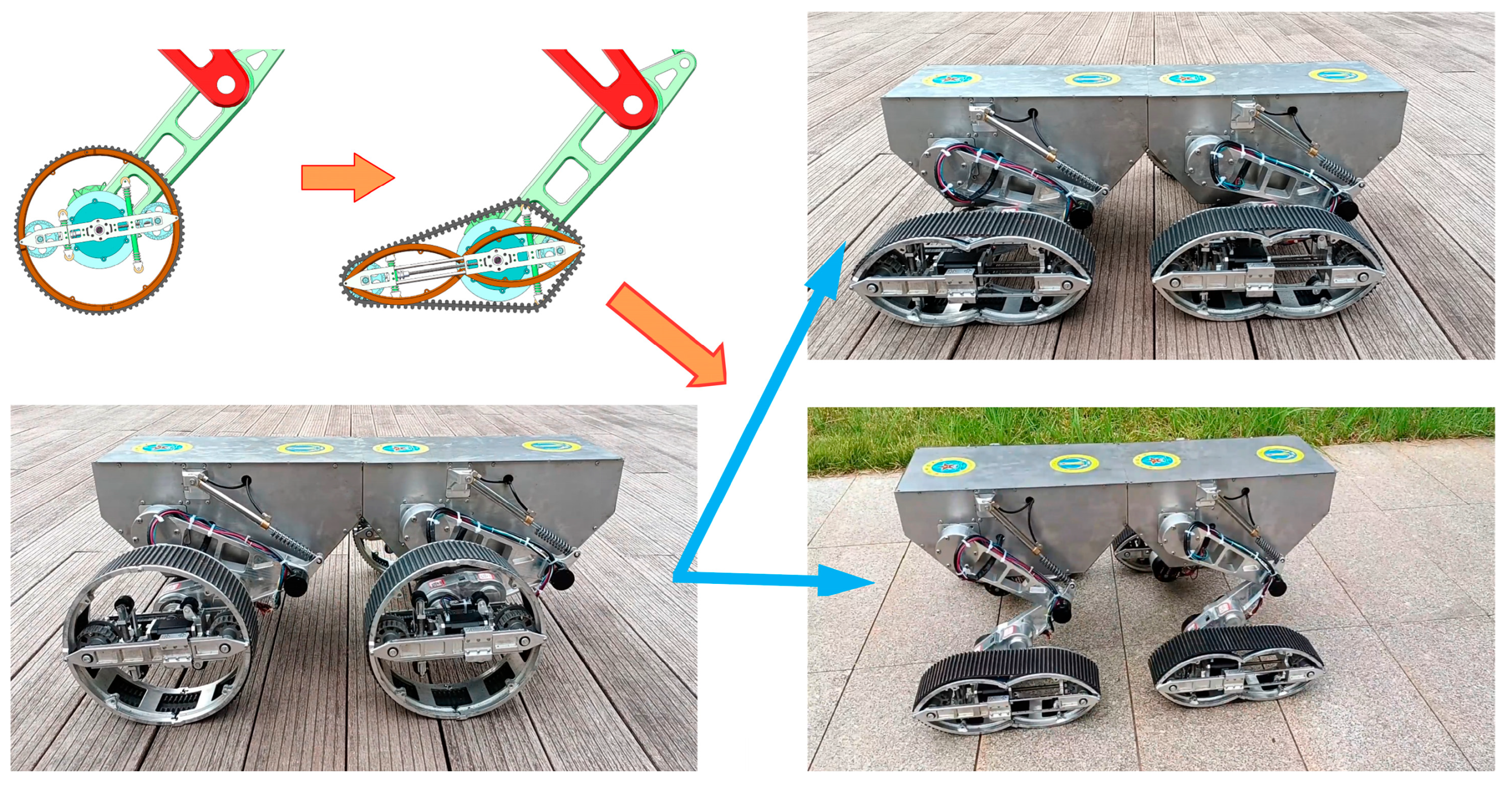
Figure 1)—represents a high-performance mobile platform distinguished by exceptional locomotion efficiency, superior obstacle-crossing capability, and advanced cooperative control. With its resilience in harsh environments, fearless task execution, and tactical flexibility, this robot can effectively replace humans in life-threatening scenarios, such as heavy-load transportation across complex terrains. The development of such high-performance, morphable, and collaborative ground robots carries significant strategic importance, positioning it as a key research frontier in global defense technology [
3,
4].
However, this very advantage introduces a fundamental control challenge: maintaining consistent and high-performance locomotion when the robot’s physical configuration—specifically the number and arrangement of legs—dynamically changes [
5,
6].
Legged locomotion, offering unparalleled adaptability to unstructured environments, is often the optimal but also the most dynamically complex mode for such robots. While effective control methods exist for fixed-configuration legged robots, they struggle in modular reconfigurable contexts [
7]. The core research problem addressed in this study is the lack of a unified and self-adaptive control framework that can seamlessly maintain stability and tracking performance across varying modular assemblies without manual re-tuning [
8,
9].
Current approaches exhibit specific limitations in this regard. Traditional Virtual Model Control (VMC) methods, while intuitive and effective for generating stable gaits in fixed morphologies, rely on a pre-tuned, static set of virtual parameters (stiffness and damping) [
10,
11]. These parameters are not optimal when the number of supporting legs, the system’s inertia, or the effective kinematics change upon reconfiguration. While some research has integrated neural networks with VMC for parameter adaptation, these solutions are typically designed for single-robot systems with fixed leg counts [
12]. They lack the inherent combinatorial scalability and parallel control architecture required to manage the independent yet coordinated leg units in a modular system. Consequently, when the module count varies, existing methods often demand extensive manual parameter re-optimization for each new configuration, leading to inefficiency and limiting the autonomous potential of modular reconfiguration [
13,
14].
Therefore, the primary scientific motivation of this work is to bridge this gap by developing a control methodology that provides both structural unity (a consistent framework for any assembly) and parametric adaptability (autonomous tuning for each specific configuration). This goes beyond the technological motivation of creating a flexible robot for applications like heavy-load transport. Specifically, we aim to answer the following research questions:
How can control parameters be autonomously and optimally adjusted in real-time as a modular robot reconfigures, ensuring performance without manual intervention?
How can a decoupled control architecture, designed for a single-leg module, be effectively extended to multi-legged configurations without sacrificing whole-body stability and coordination?
Can a neural network-enhanced, decentralized VMC system outperform traditional centralized or fixed-parameter controllers in terms of tracking accuracy and disturbance rejection across different modular assemblies?
To answer these questions, we focus on the control of legged locomotion. This mode is chosen not only for its relevance to heavy-duty applications but, more critically, because its inherent nonlinearity and underactuation present the most demanding testbed for validating the robustness and adaptability of the proposed control framework. The challenge of heavy-load transport further defines the performance envelope and reinforces the need for a stable, force-capable controller.
This paper proposes a parallel multi-legged control system integrating a Backpropagation Neural Network (BPNN) with a decoupled VMC framework. The decoupled VMC distributes control objectives to individual legs, simplifying the Jacobian and enabling a modular control structure. The BPNN is then embedded within each leg’s control unit to adaptively tune the VMC’s virtual parameters based on real-time motion states, allowing the system to self-optimize for different configurations. This integration aims to achieve a unified control architecture that is adaptively tuned for each specific assembly.
2. Overall Model Introduction and Analysis
2.1. Robot Mechanical System
The modular reconfigurable wheel-track-leg hybrid robot is shown in
Figure 1. It is mainly composed of: the chassis, legged locomotion mechanism, wheel-track transformable wheels, reconfigurable coupling mechanisms, driving components, wheel-track power switching unit, braking components, controller, and other mission payloads.
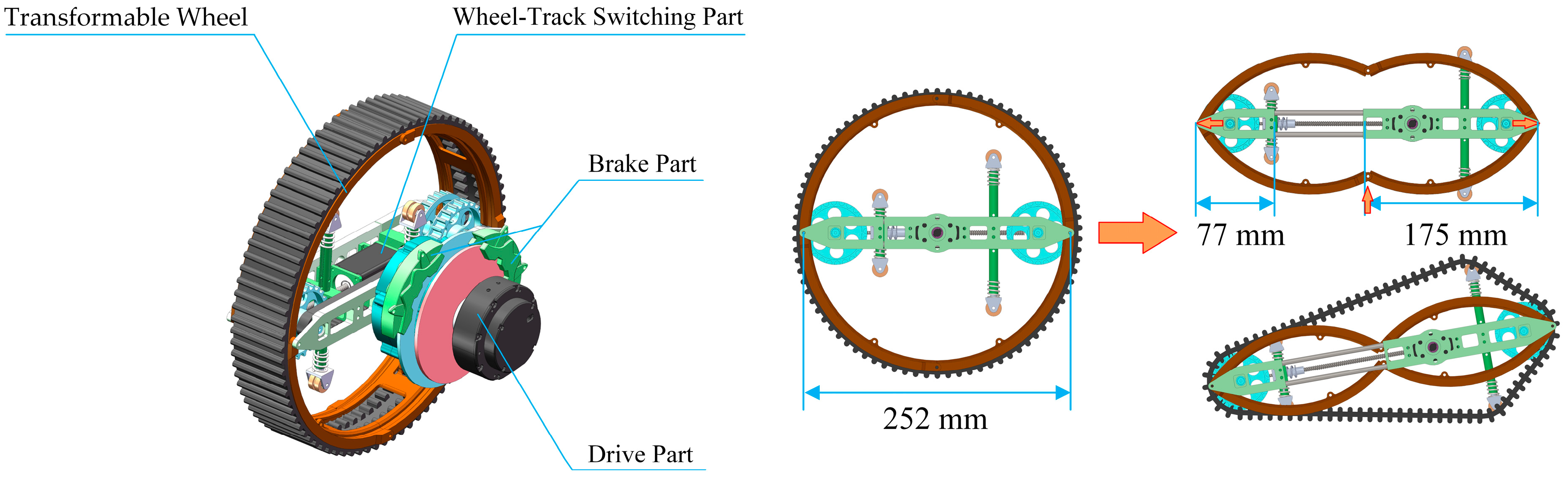
The modular reconfigurable wheel-track-leg hybrid robot achieves reliable switching between wheeled and tracked modes through a compact wheel-track transformable wheel structure design, as illustrated in
Figure 2. Its composition primarily includes the drive part, wheel-track switching part, brake part, and the transformable wheel. The wheel-track transformable wheel module employs an integrated optimization design coordinated with the legged locomotion mechanism of the robot, resulting in a compact layout and reliable power switching and transmission, meeting the drive requirements for the robot across different locomotion modes.
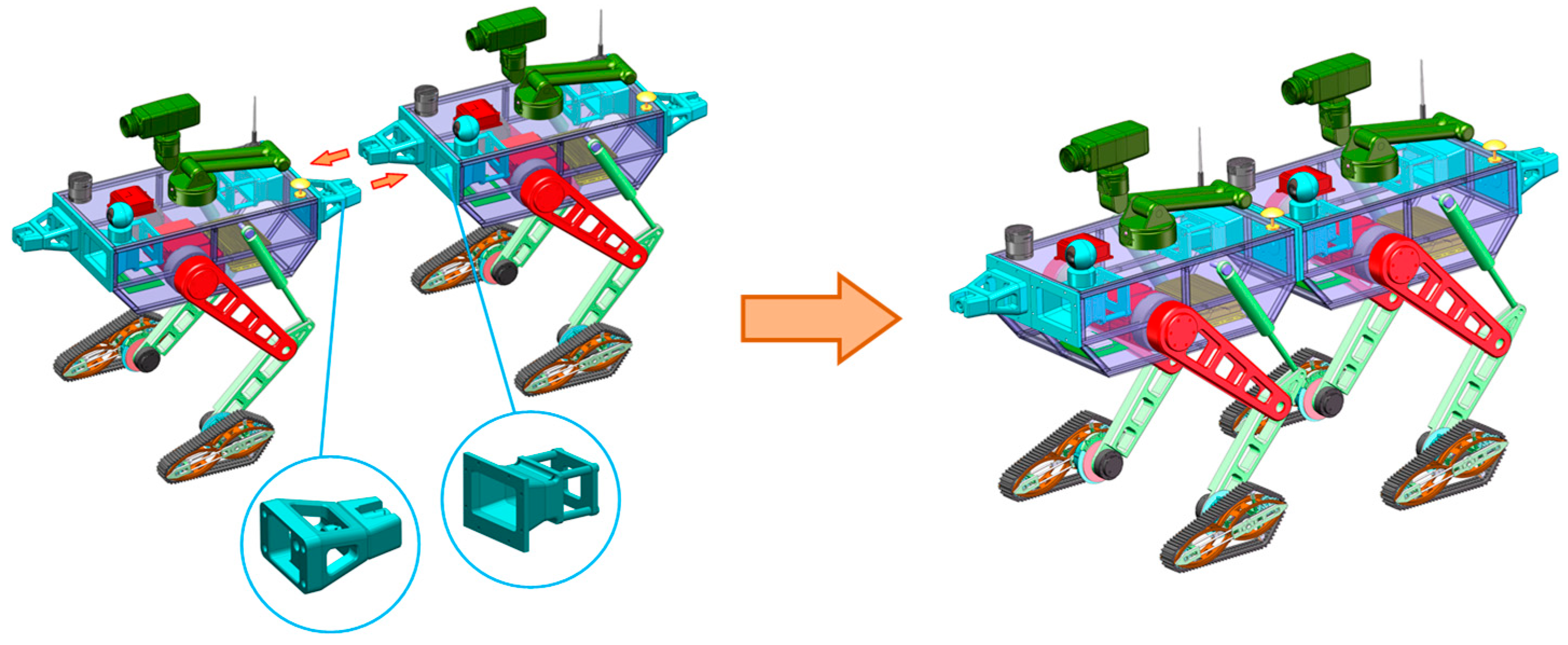
The wheel-track-leg hybrid robot adopts a modular symmetric architecture, enabling rapid inter-robot connection and reconfiguration through specialized coupling mechanisms to form multi-wheel/track/leg cooperative mobility platforms. The mechanical connection system employs diagonally arranged wedge assemblies and locking mechanisms to achieve bidirectional reconfigurable coupling. The wedge interlocking ensures rigid structural connection between robot frames, while hydraulic push–pull rods maintain longitudinal tension forces, collectively guaranteeing overall structural rigidity to meet collaborative obstacle-crossing requirements.
Figure 3 illustrates the modular docking and reconfiguration scheme of the wheel-track-leg hybrid robot.
The reconfigurable connection mechanism enables multiple modular robots to assemble into quadrupedal and higher-degree multi-legged configurations, thereby adapting to diverse mission requirements in practical operational scenarios.
2.2. Kinematics Analysis
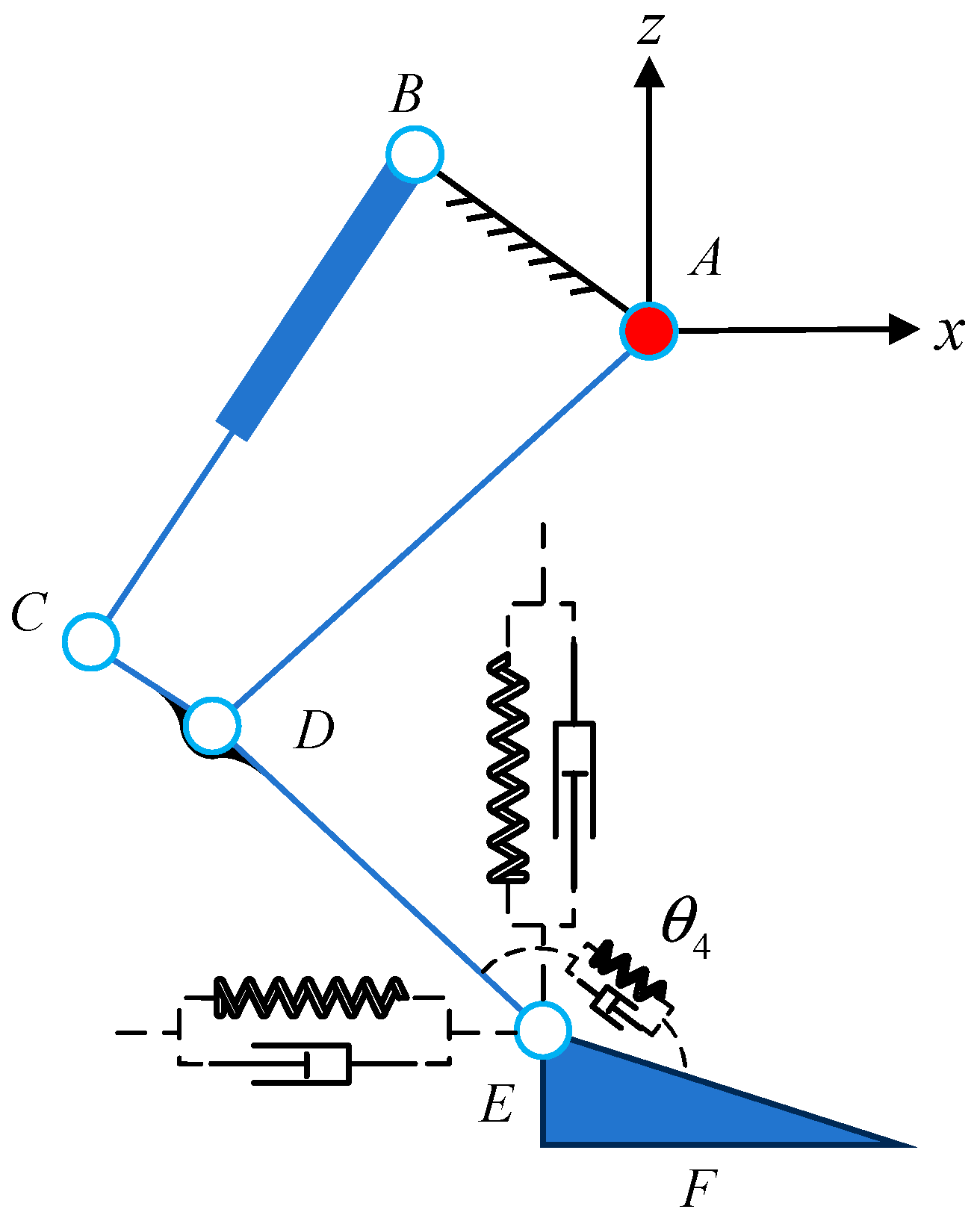
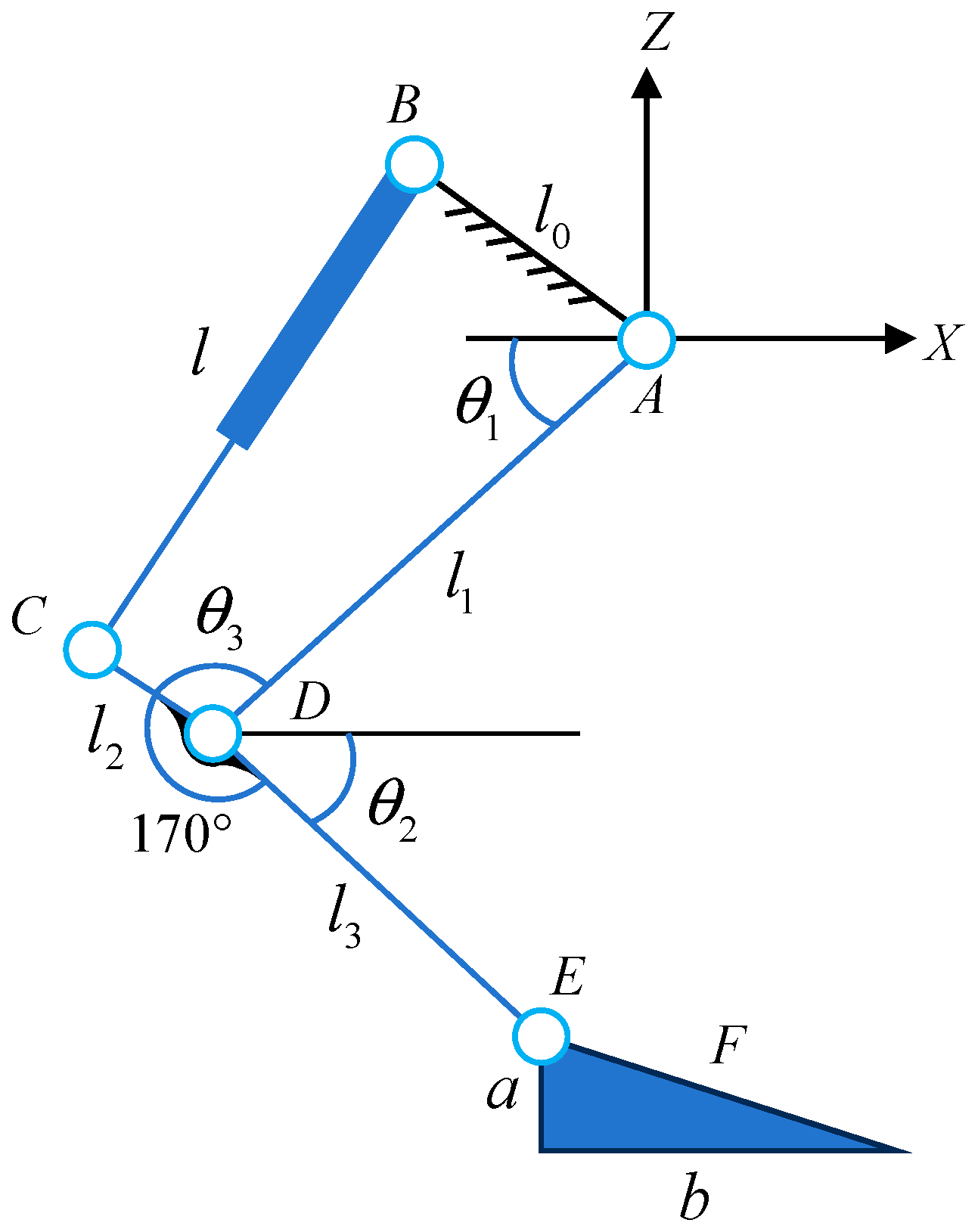
Since the leg structure and arrangement are identical in each individual module, the kinematic analysis can be conducted based on the specific structure of a single leg. The schematic diagram of the single leg is shown in
Figure 4, where link
AB serves as the fixed frame; the actuation sources consist of a prismatic joint between
B and
C and two revolute joints at hip
A and ankle
E; the hip coordinate system
is used as the reference frame, with
and
; and the relevant link parameters are denoted as
,
,
,
, and
.
During actual locomotion, the foot-end trajectory planning is primarily conducted with respect to ankle E, followed by attitude control of footplate F based on ankle E, thereby properly coordinating the ground contact and lift-off phases during robotic walking. Accordingly, to align with the hierarchical control structure of the kinematic mechanism, the kinematic relationship between ankle E and hip A is first analyzed, after which a mathematical model of footplate F’s attitude relative to ankle E is established.
Based on the geometric relationships, we obtain
Therefore, the kinematic mapping from ankle
E to hip
A is expressed as
The primary variables are . However, according to the drive configuration of the mechanical structure, the main variables in actual control should be . Therefore, it is necessary to establish a correlation function to align the kinematic mapping with the practical mechanical drive configuration.
Similarly, based on the geometric relationships, the correlation between
and
can be derived as
Deriving an explicit function
from (2) proves challenging; therefore, we maintain the implicit function
to characterize the mapping relationship between
and
.
Therefore, the kinematic mapping relationship conforming to the actual physical drive configuration is expressed as
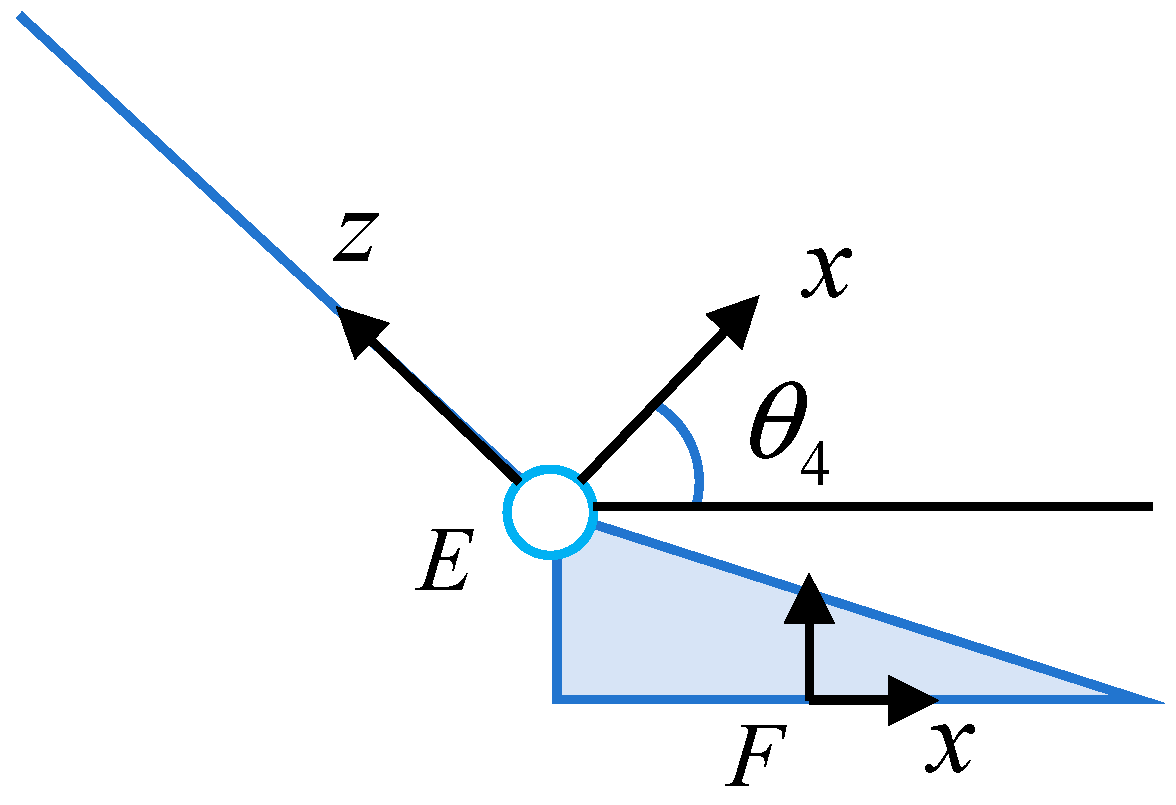
As shown in
Figure 5, a plantar coordinate frame
is established at the center of the foot sole, while an ankle coordinate frame
is defined with its origin at ankle
E and its positive
z-axis oriented upward along the lower limb segment.
Thus, the kinematic mapping relationship between the plantar center
F and ankle
E is established as
In most cases, the primary focus lies on the attitude relationship between footplate F and ankle E, specifically the angle
. Therefore, (5) can be further expressed as a mapping relationship with
as the state variable, emphasizing angular attitude transformation.
3. BP-VMC Methodology
Virtual Model Control (VMC) is an intuitive control approach that directly establishes motion relationships between the external environment and the robotic body through virtual components. It controls the motion interaction between the body and the environment in the form of virtual forces, which are then mapped to joint-space torques via the Jacobian matrix to obtain the desired output of joint motors, thereby achieving force control. This direct force control approach effectively responds to external heavy loads, thereby addressing the core requirements of heavy-load transport tasks for robots.
VMC typically takes the body center as the final internal action point, achieving desired motion control through comprehensive calculation and coordinated planning of virtual resultant forces generated by each leg. This approach involves high-order Jacobian matrices with significant computational complexity.
The decomposed VMC proposed in [
11] distributes the overall control objectives to individual legs using each leg’s hip joint as the internal action point. This decomposition reduces the order of the Jacobian matrix, thereby simplifying computations.
Traditional VMC, while effective for stable gait generation, relies on fixed virtual parameters that may not be optimal under changing module configurations or environmental conditions. In modular reconfigurable systems, the number of legs and their spatial arrangement can vary, necessitating a control framework that can adapt in real time. Previous attempts to combine VMC with adaptive methods [
12] have shown promise but remain limited in scalability and combinatorial adaptability.
To overcome these limitations, we introduce a BP-enhanced decoupled VMC framework that autonomously adjusts virtual stiffness and damping parameters based on real-time motion error and body posture. This integration allows the controller to maintain high performance across different module assemblies without manual intervention, thereby addressing a key challenge in modular robot control.
3.1. Decoupled VMC Framework
The single leg possesses three degrees of freedom, requiring three corresponding sets of virtual spring-damper components as shown in
Figure 6. Referenced to the hip coordinate system
, the three virtual component sets correspond to ankle
E along the
x-axis, ankle
E along the
z-axis, and footplate
F rotating about ankle
E in the
direction.
The virtual force applied at the foot-end can be expressed as
where
and
represent the virtual stiffness and damping, respectively;
and
denote the actual and desired positions in the
x-direction, while
and
correspond to the actual and desired velocities in the
x-direction, with analogous definitions applying to other directions.
Based on the kinematic analysis results from
Section 2, the kinematic mapping relationship with
as state variables can be derived from (4) and (6) as
Differentiating (8) with respect to the state variables
yields the Jacobian matrix:
where
can be obtained by differentiating the implicit function
.
and
3.2. Parameter Configuration of BP Neural Network
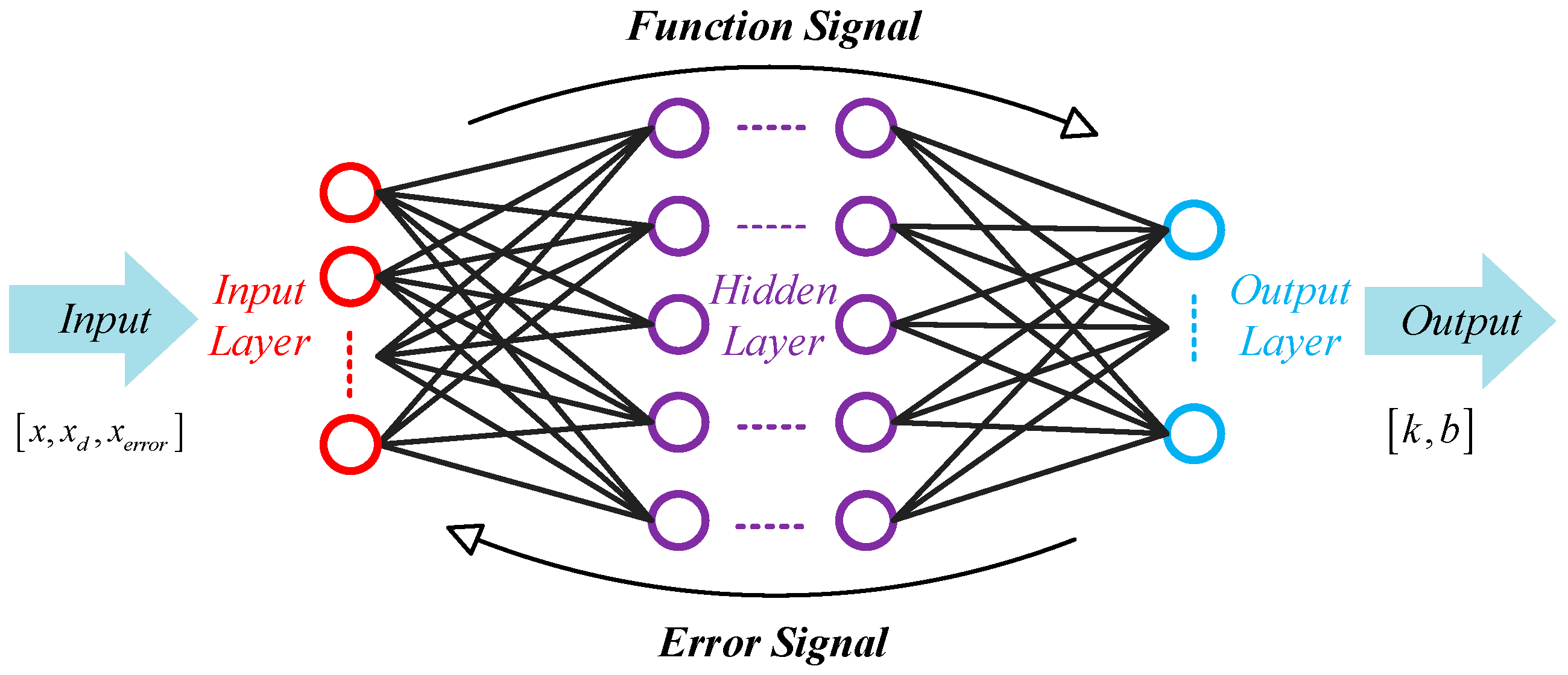
The structural composition of the BPNN comprises an input layer, hidden layer(s), and output layer [
15], as illustrated in
Figure 7. The configuration of neuron counts in the input and output layers determines the approximation capability of the BPNN to the actual multi-input multi-output (MIMO) system, while the number of hidden layer neurons governs both the training efficacy and computational efficiency [
16]. Consequently, the architectural parameters of the BPNN must be appropriately designed according to the target MIMO system’s characteristics.
The neuron counts in the input and output layers are primarily determined by the dimensionality of the system’s actual input and output variables. In the BP-VMC system presented in this paper, the specified input variables are
, and the output variables are
. The calculation formula for the output
of a lower layer during inter-layer signal propagation is given by:
where
represents the
i-th input from the preceding layer,
denotes the corresponding weight, and
is the bias term. By conventionally treating the bias
as an additional input, the input vector becomes
, while the output vector remains
. Consequently, the node counts for the input layer (
) and output layer (
) of the BPNN are determined as 4 and 2, respectively.
The selection of an appropriate number of hidden layers and nodes critically influences the performance of neural networks. Previous studies have investigated and summarized the impact of hidden layer configuration on neural network functionality [
17,
18], as shown in
Table 1.
Theoretically, increasing the number of layers enhances approximation capability, but excessive layers may induce overfitting and significantly escalate network complexity, thereby impeding convergence [
19,
20]. Based on analogous BPNN models applied in similar MIMO systems and experimental validation, a single hidden layer suffices to meet requirements; thus, no additional hidden layers are incorporated [
21,
22,
23].
Similarly, an excessive or insufficient number of nodes in the hidden layer can lead to “overfitting” or “underfitting” issues. To prevent overfitting, the determination of hidden layer nodes follows the principle that “the number of hidden layer nodes should not exceed twice the number of input layer nodes” [
24]:
where the number of input nodes
is determined as 4 (comprising 3 actual input variables and 1 bias term); we nevertheless adopt
as the constraint for this evaluation. Consequently, the preliminary determination yields
.
Through experimental trials and with reference to neural network applications in similar scenarios [
12,
25,
26], the number of hidden layer nodes is determined as
.
Consequently, the specific architecture of the BPNN adopted in this study is finalized as “”.
3.3. BP-VMC System
The selection of virtual component parameters determines the control performance of VMC. In practical applications, environmental variations necessitate corresponding adjustments in control performance requirements. To enhance the robot’s adaptive capabilities, the BP-VMC method is employed, utilizing BPNN to achieve adaptive training of virtual component parameters, thereby accommodating changes in external environments.
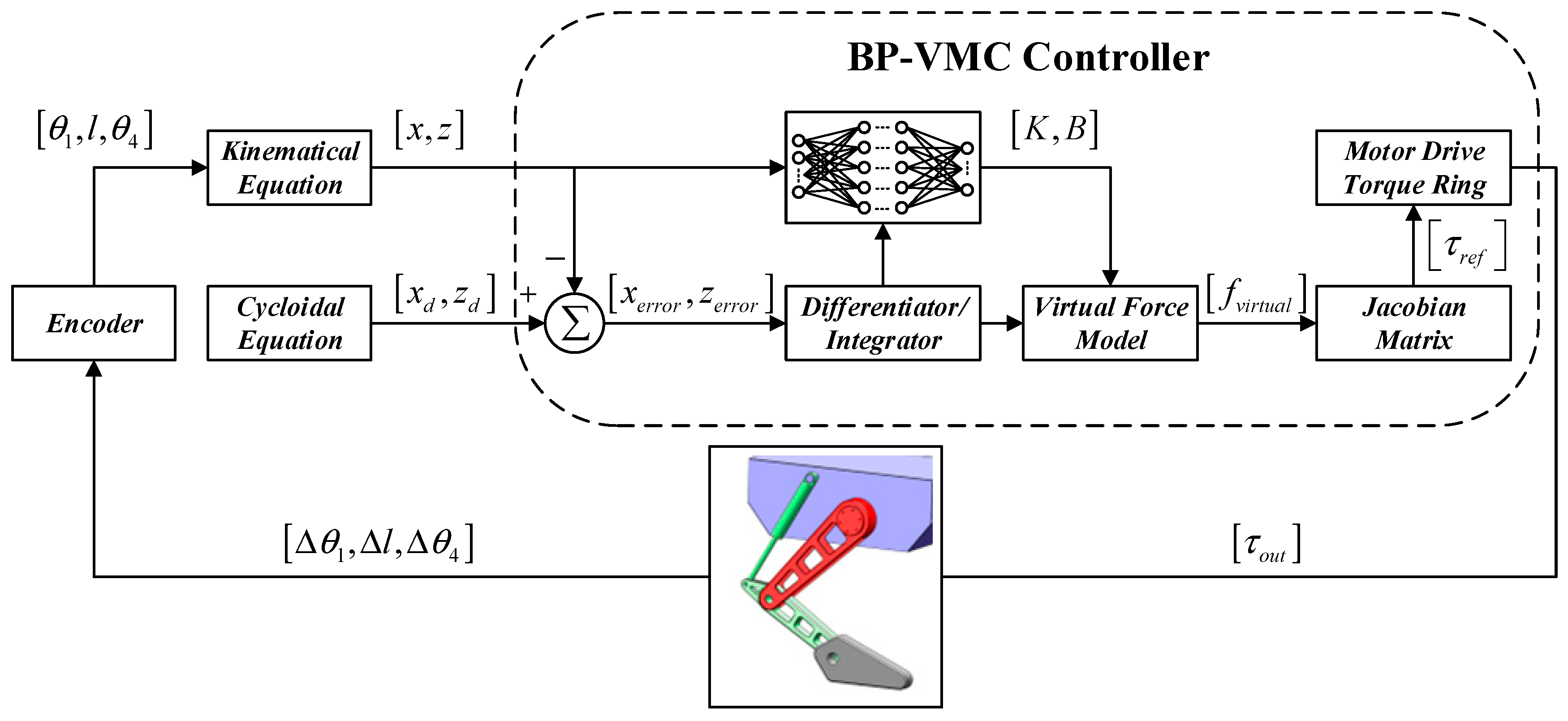
The BP-VMC framework is illustrated in
Figure 8. The incorporation of the BPNN enables adaptive tuning of the virtual component parameter matrices
K and
B. Consequently, the control law of the BP-VMC system can be expressed as
4. Control Objective Decomposition
In modular reconfigurable robots, control objective decomposition must account not only for individual leg performance but also for the combinatorial nature of multi-module assemblies. Unlike traditional multi-legged robots with fixed morphology, modular systems exhibit variable leg counts, spatial arrangements, and coupling dynamics, which complicate centralized control and parameter coordination.
Therefore, we decompose the overall control objective into three interdependent yet independently addressable sub-problems:
- (1)
Velocity Control—regulated through swing leg trajectory planning, adapted to module count and gait pattern.
- (2)
Gait Control—formulated as a composable unit based on bipedal primitives, enabling scalable gait generation for quadrupedal, hexapodal, and higher-order configurations.
- (3)
Attitude Control—distributed to stance legs via height and force adjustments, ensuring body stability across varying support polygons.
This decomposition strategy is specifically designed to preserve modularity and reconfigurability, allowing control tasks to be assigned and executed in parallel across independently controlled leg units—a departure from monolithic control architectures commonly used in fixed-structure legged robots.
4.1. Velocity Control
In legged locomotion, velocity control is achieved through the regulation of swing leg period and swing amplitude within each cycle. Specifically, by planning the foot-end trajectory and appropriately configuring swing-related parameters, the velocity control requirements can be satisfied.
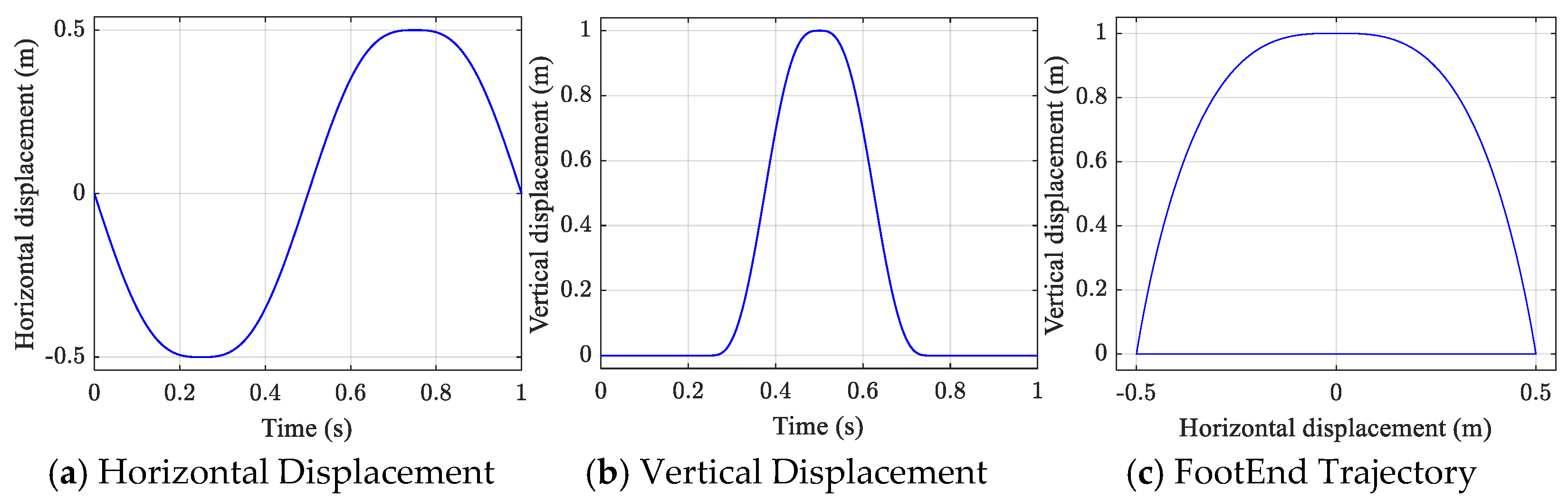
A composite cycloidal trajectory is adopted to effectively mitigate impact forces during foot strike and enhance walking stability [
27]. Reference [
28] further developed a composite cycloidal trajectory that satisfies both smoothness and zero-impact requirements, as shown in
Figure 9.
where
denotes the single-step swing stride length,
represents the leg lift height,
indicates the instantaneous time variable,
signifies the swing phase period.
In a complete gait cycle, each leg alternates between swing phase and support phase, where the actual displacement within the cycle constitutes the stride length of the individual leg. Consequently, the overall velocity control objective is implemented at the single-leg level through the following relationship:
where
represents a complete gait cycle period, which is the sum of the swing phase duration
and the support phase duration
.
4.2. Gait Control
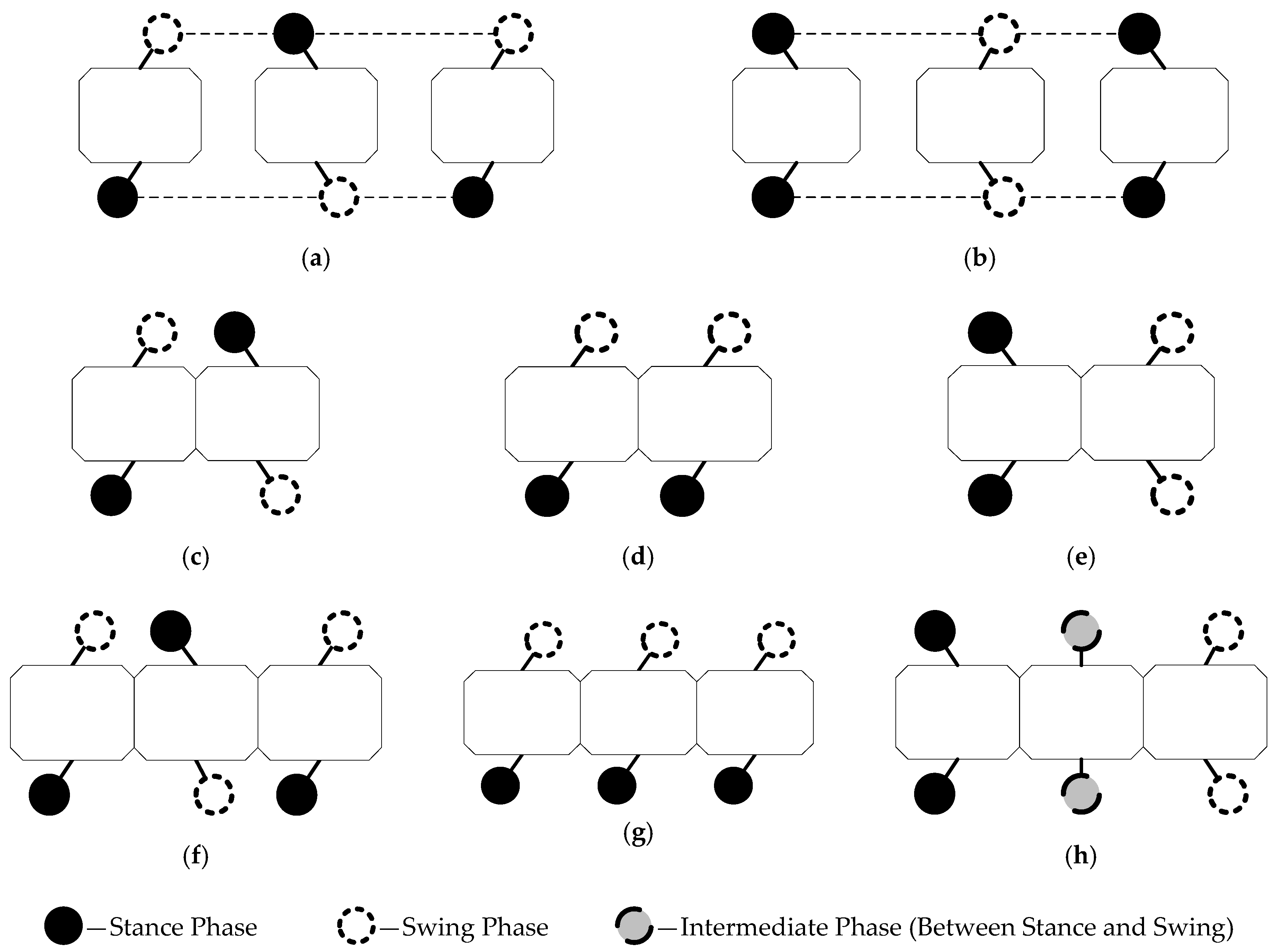
For the bipedal configuration of a single module, there are primarily two gait modes: alternating bipedal walking (Gait a,
Figure 10a) and bipedal hopping (Gait b,
Figure 10b). Through the combination of varying numbers of modular robots, quadrupedal, hexapodal, and other multi-legged configurations can be formed. Based on these two fundamental bipedal gaits, various gait patterns for multi-legged configurations can be derived.
Leveraging the robot’s reconfigurable characteristics, the planning of multi-legged gait patterns follows a “composable” approach, treating multi-legged gaits as combinations of multiple bipedal gait units. This facilitates unified gait control across varying module configurations. Consequently, the gaits illustrated in
Figure 10 do not encompass all possible quadrupedal and hexapodal gait variations, but rather present primary gait patterns formed by combinations of Gait a and Gait b.
The combined gait patterns are categorized into three primary types: diagonal alternating swing (
Figure 10c,f), ipsilateral alternating swing (
Figure 10d,g), and continuous bipedal hopping (
Figure 10e,h).
The diagonal alternating swing involves alternating movement and support between diagonally opposed legs, offering both stability and moderate speed, making it a robust continuous gait pattern.
The ipsilateral alternating swing is essentially a linear superposition of bipedal alternating motion. While its control logic is simple, the back-and-forth switching of ipsilateral legs induces repeated lateral oscillations during locomotion, resulting in poor stability.
The continuous bipedal hopping is a leaping gait that enables the robot to traverse horizontal distances or vertical heights while airborne. Achieving stable control of this gait demands high-performance balancing capabilities.
From the perspectives of gait stability, practical applicability, and control feasibility, the diagonal alternating swing gait is selected as the primary locomotion pattern for multi-legged configurations in planning and control.
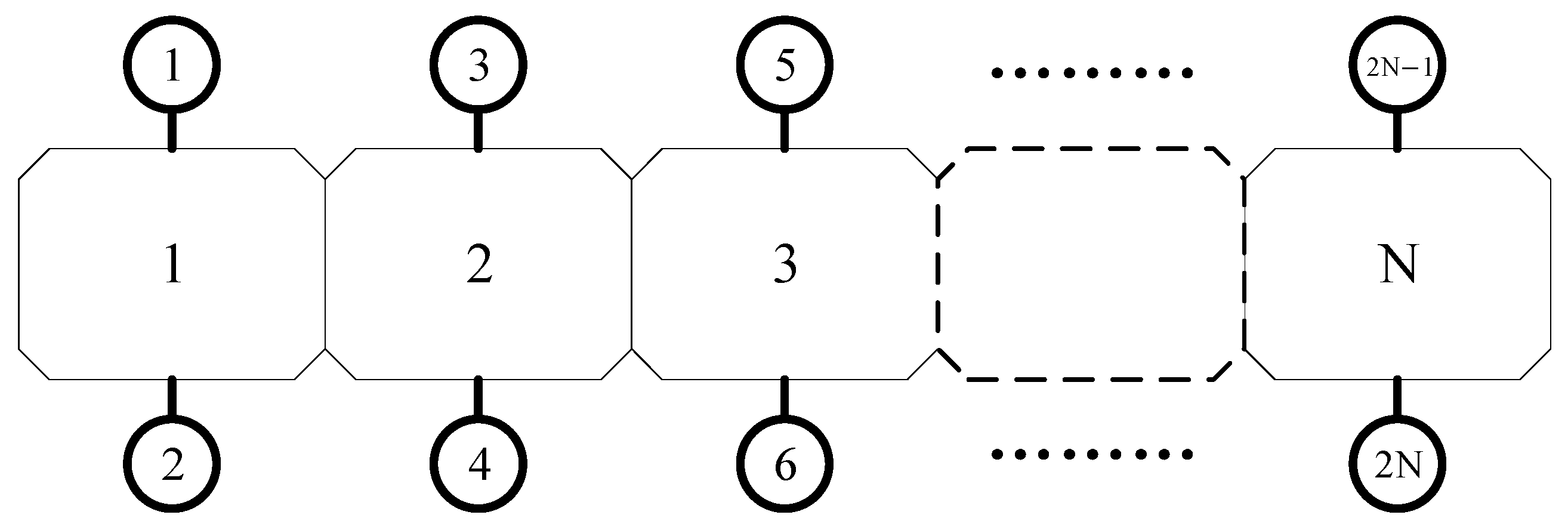
The diagonal alternating gait divides the feet into two groups based on diagonal positioning, controlling the alternating swing of these two groups to achieve walking motion. Consequently, it is necessary to systematically summarize the leg-grouping logic for robots composed of varying numbers of modules, facilitating subsequent control signal output.
Based on the numbering principle illustrated in
Figure 11, the leg-grouping logic can be formally expressed as follows:
where
denotes the remainder of
,
represents the leg identifier,
indicates the module identifier,
is the group identifier,
.
Thus, the legs in the combined multi-legged configuration are divided into two groups based on their diagonal distribution characteristics. In the subsequent control system, periodic output of control signals is employed to achieve diagonal alternating swing walking for the multi-legged configuration.
4.3. Attitude Control
The robot’s attitude primarily refers to three attitude angles of the body’s center of mass: pitch angle (
), roll angle (
), and yaw angle (
) [
29]. During actual motion, there exists no direct actuation source to control these attitude angles. Variations in attitude angles emerge indirectly through height and force control of supporting legs. Therefore, posture control must be decomposed into the support-phase control of individual legs.
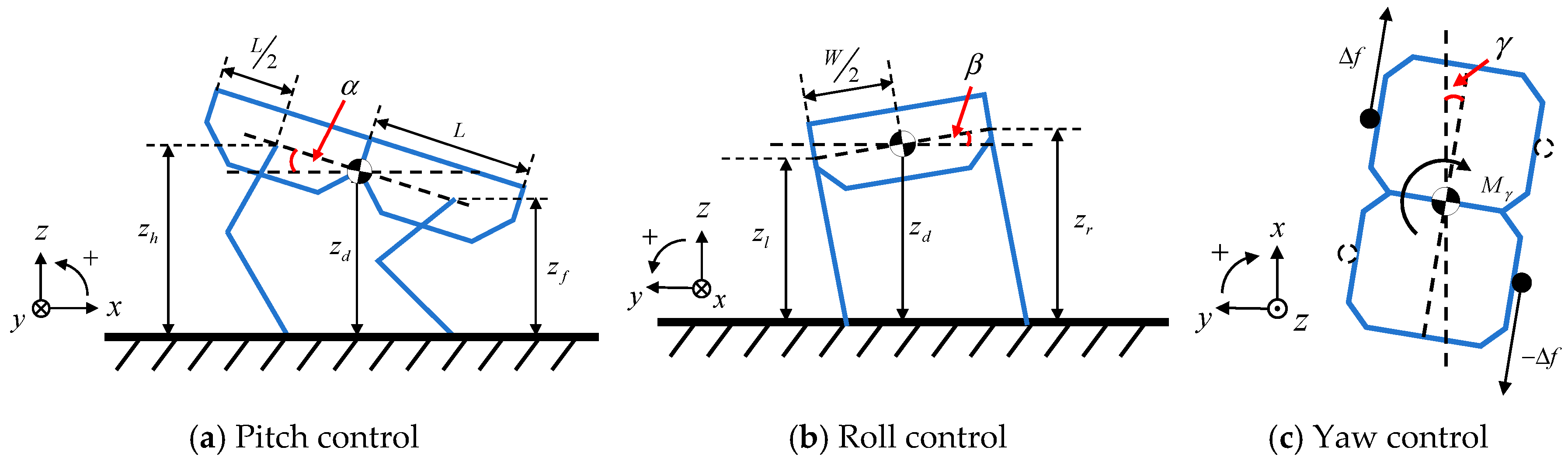
The quadrupedal configuration is first selected as the analytical subject to establish the principle of decomposing attitude control into individual leg support-phase regulation, which is subsequently generalized to multi-legged configurations. As depicted in
Figure 12, the pitch angle (
) and roll angle (
) are controlled through support height adjustment of stance legs, while the yaw angle (
) is regulated via differential support forces among stance legs.
According to the pitch control schematic diagram in
Figure 12a, the support-phase control expression for achieving the desired pitch angle
of the robot can be formulated as
where
denotes the foreleg support height,
represents the hindleg support height, and
is the desired centroid height;
refers to the length of a single module body.
Similarly, based on
Figure 12b, the supporting-phase control expression for the desired roll angle
can be derived.
where
denotes the left-leg support height,
represents the right-leg support height, and
refers to the width of a single module body.
As illustrated in
Figure 12c, the yaw control is implemented through a mechanism analogous to differential steering. A yaw moment
is generated by the differential forward support forces between the left and right supporting legs, thereby enabling control of the yaw angle
.
The resultant magnitude of the longitudinal support forces determines the robot’s forward velocity. To avoid interference with velocity control, we consider controlling the left and right sides with an equal variation magnitude to generate the required differential force while maintaining a constant resultant longitudinal force.
A set of virtual spring-damper elements oriented about the
z-axis is introduced to generate the yaw moment
for yaw angle
regulation. Consequently, the required moment to achieve the desired yaw angle
can be expressed as
where
and
represent the virtual spring stiffness and damping coefficients, respectively;
denotes the desired yaw angular velocity, which is typically set as
for control stability considerations.
Based on (22) and (23), the control expression for the longitudinal support force variation
in yaw control can be derived as
Furthermore, variations in the three attitude angles—pitch angle (
), roll angle (
), and yaw angle (
)—directly influence the motion stability of the robot. Consequently, the average standard deviation of these attitude angles during locomotion is adopted as the evaluation criterion for robotic motion stability [
30].
where
denotes the total number of samples at the current time step, and
represents the sequence index at the
-th moment;
is defined as the cumulative deviation of the attitude angles (
), where a smaller
indicates better stability.
5. Parallel BP-VMC Multi-Legged Control System
A decoupled BP-VMC system was established in
Section 3, while
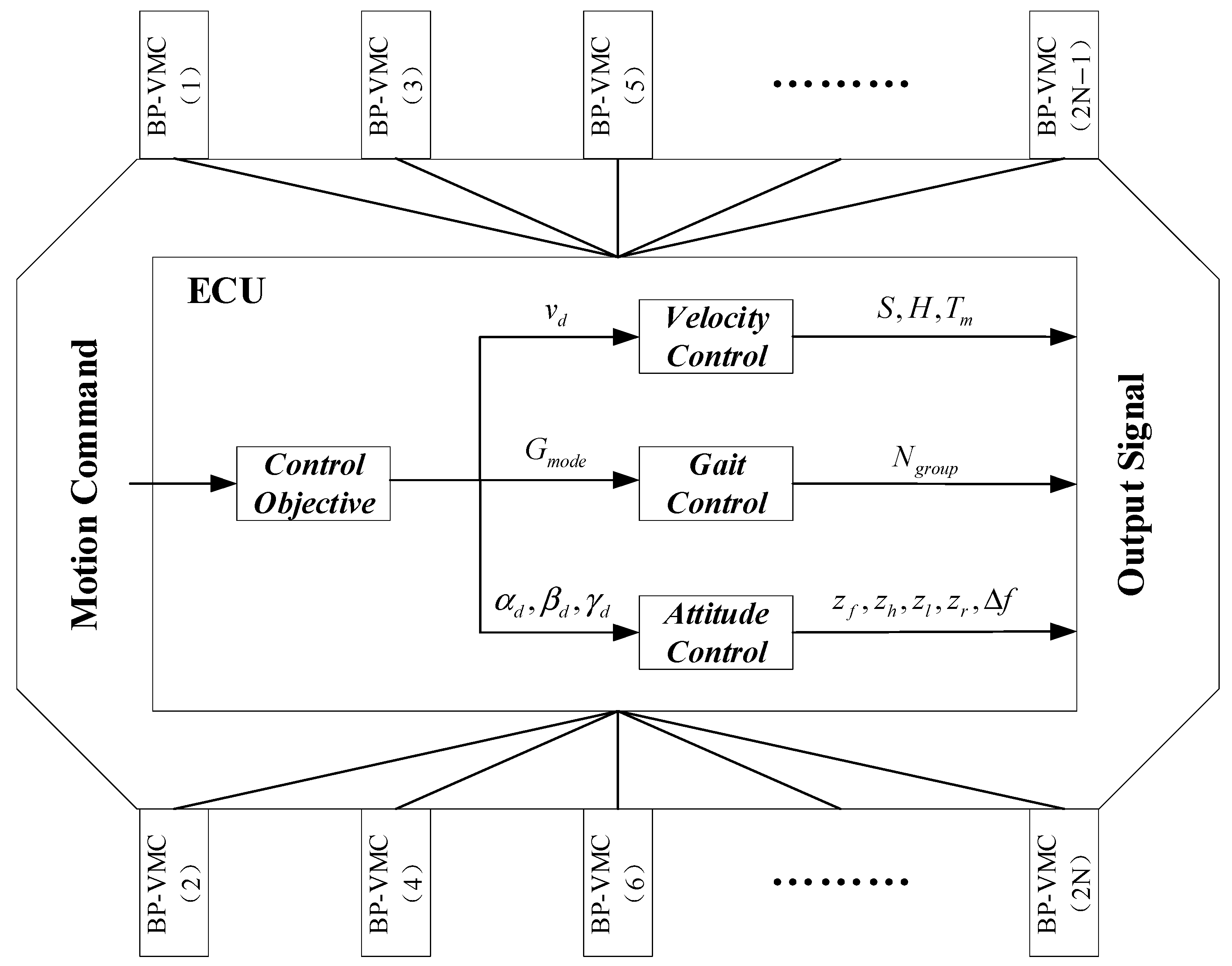
Section 4 delineated the hierarchical control strategy from whole-body coordination to individual leg motion control. Consequently, an integrated multi-legged locomotion control system was developed, as illustrated in
Figure 13.
Motion commands are input to the Electronic Control Unit (ECU). Within the ECU, control objectives are determined based on motion commands, with reference values (desired velocity
, desired gait mode
, and desired attitude angle
) being distributed to the velocity, gait, and attitude control modules, respectively. Following the control decomposition strategy, corresponding reference inputs for individual leg control are generated and transmitted to the BP-VMC leg control units for execution. The framework and operational workflow of the BP-VMC leg control unit are illustrated in
Figure 8.
6. Experiment
6.1. Simulation Experiment
The simulation control system was developed in MATLAB R2021b, where the robot and ground models were constructed using the Simscape Multibody module. Physical interactions and kinematic joints were properly defined to establish the physical simulation model, with relevant simulation parameters configured as specified in
Table 2. To ensure the robot initiates motion from a stable state, all simulation trials were conducted with a 4 s stationary initialization phase.
First, a single-leg swinging motion was simulated under bench test conditions to verify the rationality of the BP-VMC system established in
Section 3 (
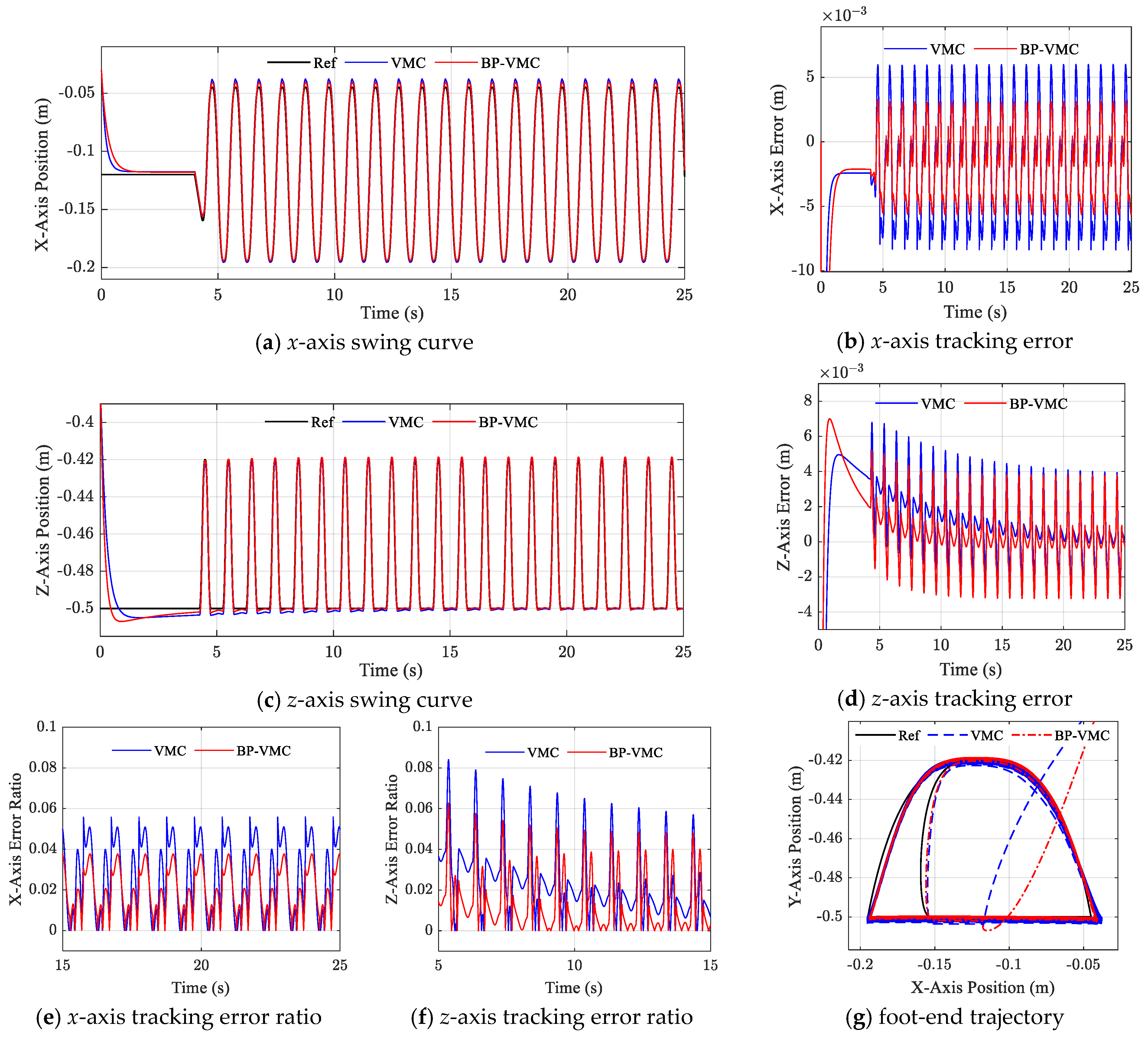
Figure 8) and the parameter configuration of the BPNN and to examine the performance of BP-VMC in comparison with traditional VMC. The resulting performance curves are shown in
Figure 14. The parameters for the comparative VMC experiments were tuned based on the BP-VMC under initial conditions. As illustrated in
Figure 14e,f, both the VMC and BP-VMC single-leg motion control systems achieved over 90% tracking accuracy in the foot-end trajectories along the
x- and
z-directions, confirming the effectiveness of the parameter tuning for BP-VMC. The root mean square errors (RMSE) for tracking the swinging trajectories were
m (VMC) and
m (BP-VMC) in the
x-direction and
m (VMC) and
m (BP-VMC) in the
z-direction. Compared with VMC, BP-VMC reduced the tracking errors by 23.91% in the
x-direction and 15.70% in the
z-direction, demonstrating excellent tracking control performance.
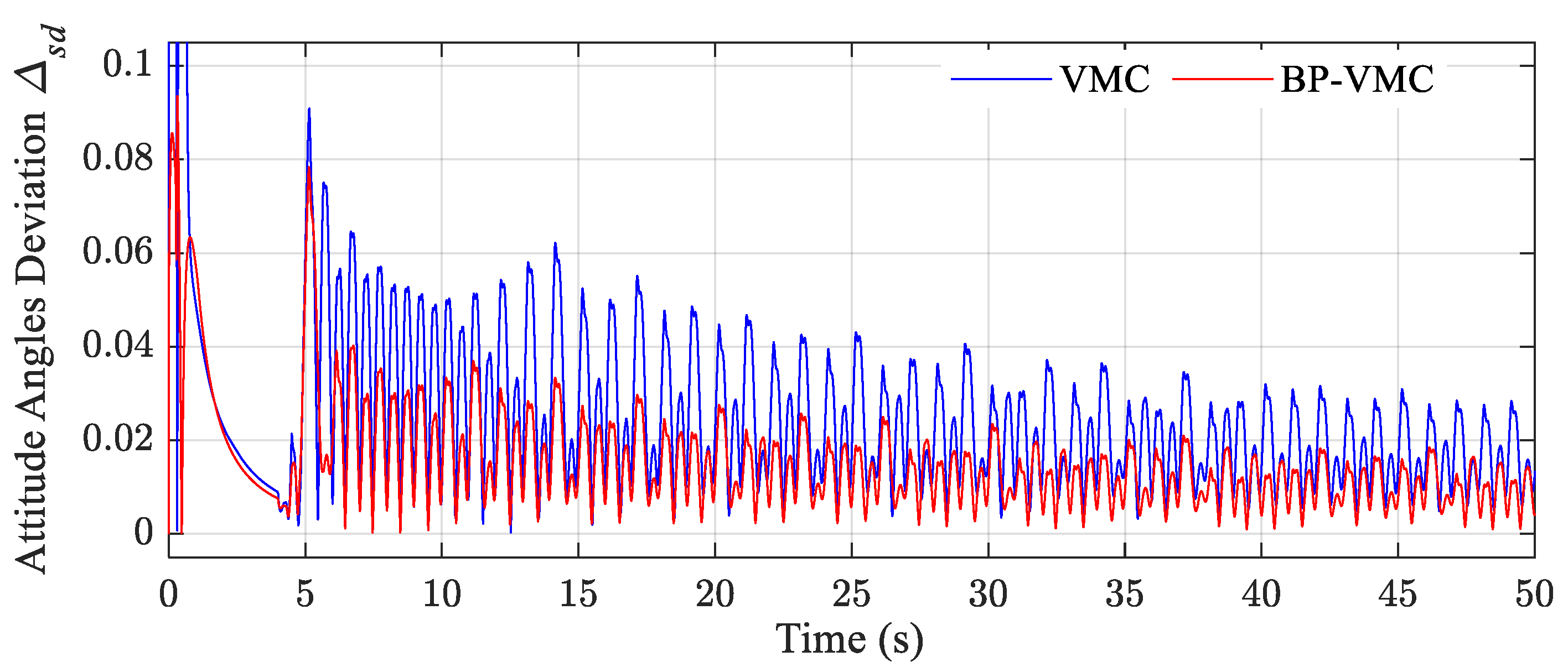
A comparative analysis was further conducted to evaluate the stability performance of VMC and BP-VMC during multi-legged walking. The experiments were carried out under a quadruped configuration with a diagonal gait, and the corresponding results are presented in
Figure 15. The experimental data indicate that BP-VMC exhibits significantly superior stability compared to traditional VMC. This improvement can be attributed to the fact that VMC employs fixed control parameters, whereas BP-VMC incorporates a BPNN that enables adaptive adjustment of the parameters based on real-time walking conditions. Consequently, this adaptive mechanism enhances both the stability and environmental adaptability of the control system.
The multi-legged control system was developed based on
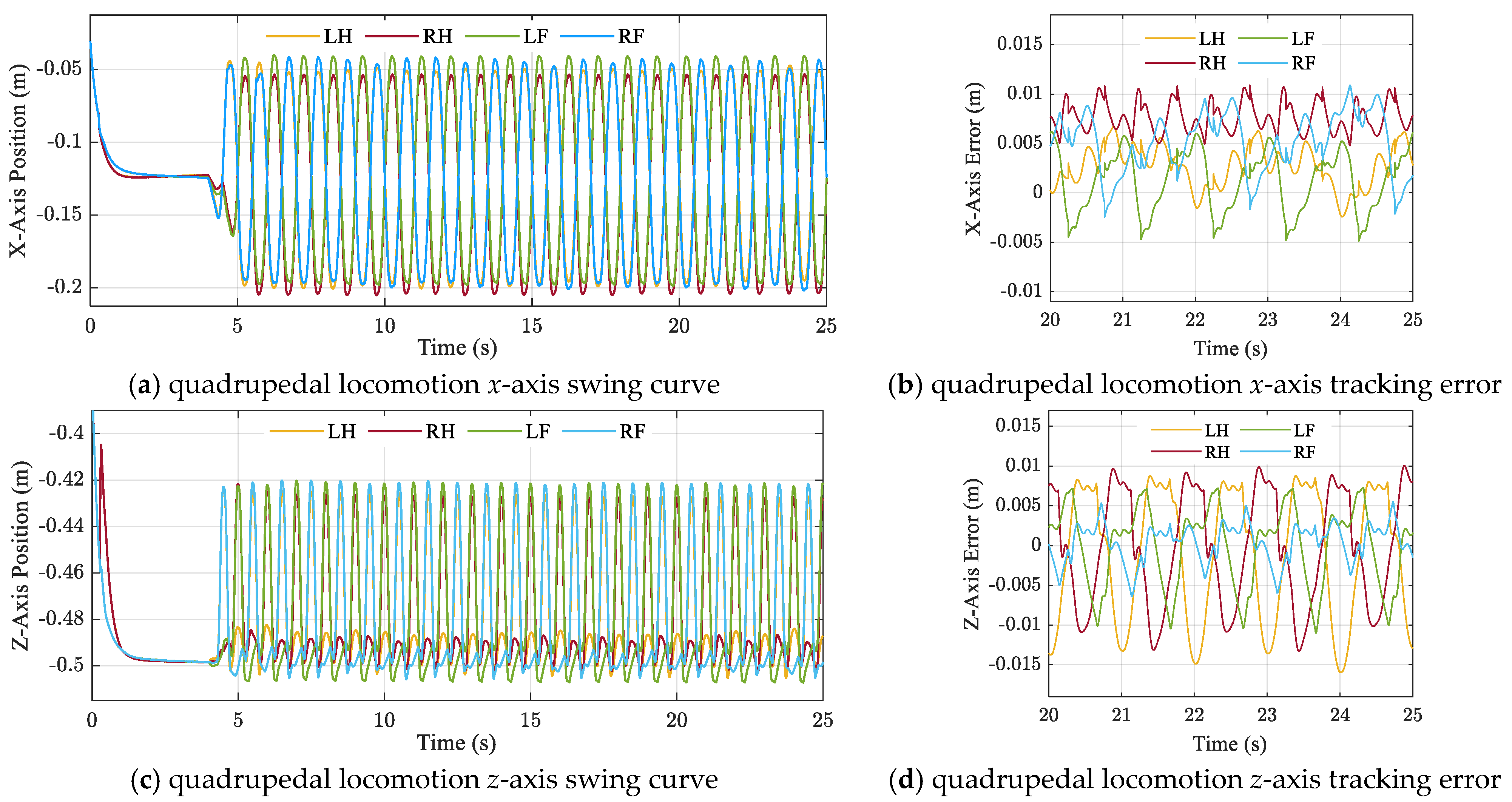
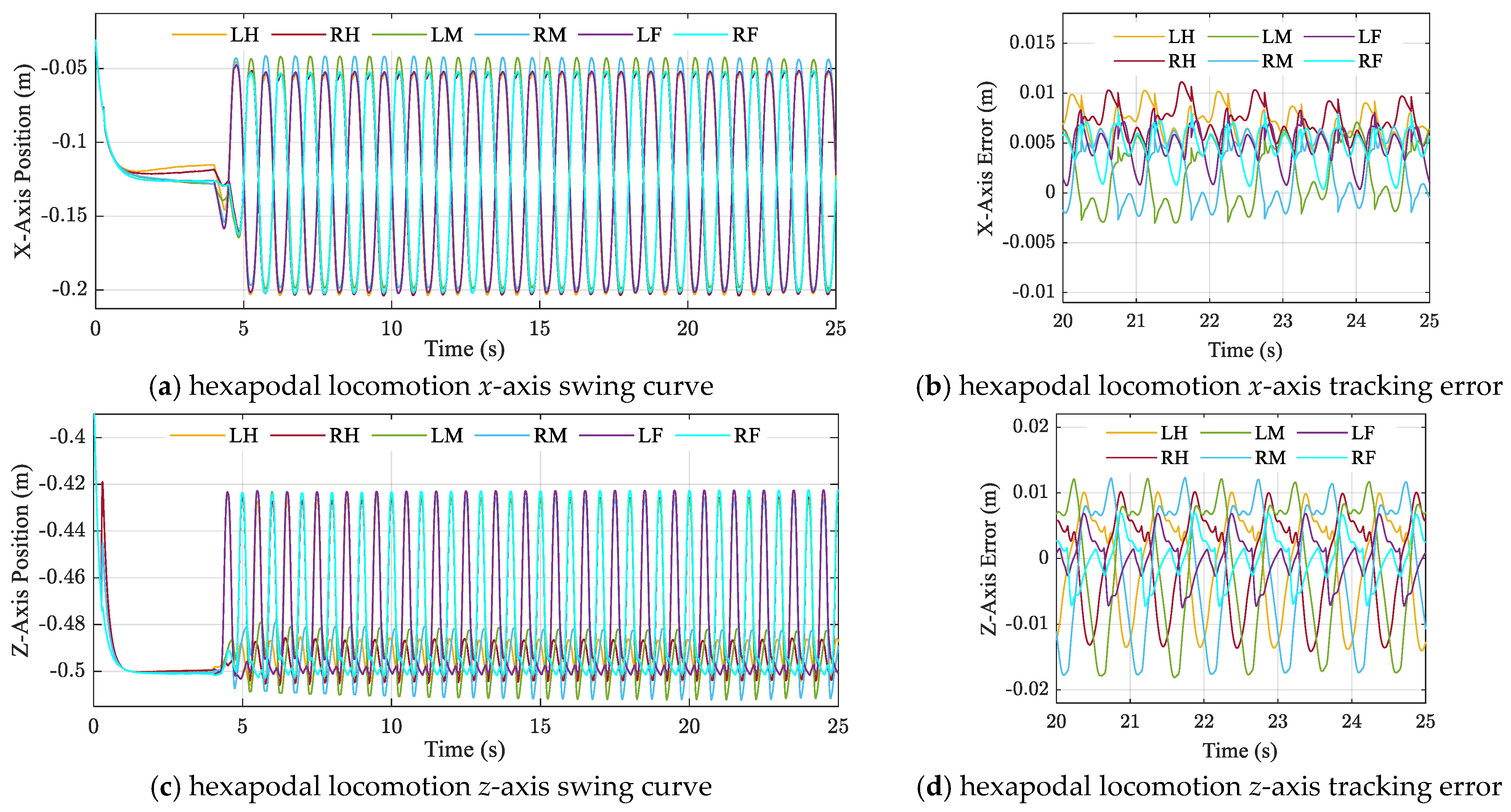
Figure 13, and walking simulations were conducted for quadrupedal and hexapodal configurations, with the results shown in
Figure 16 and
Figure 17. The diagonal gait was employed, resulting in two sets of phase-shifted curves in the figures. During the walking simulations, physical factors such as body inertia and ground impacts were considered, leading to increased control errors compared to the single-leg swinging simulation (
Figure 14). In the quadrupedal walking simulation, the average RMSE of tracking in the x- and z-directions were
and
, respectively; in the hexapodal walking simulation, the corresponding averages were
and
. These values indicate an increase in RMSE compared to the single-leg swinging motion. Nevertheless, the overall control errors remained within 0.01 m, with approximately 10% deviation.
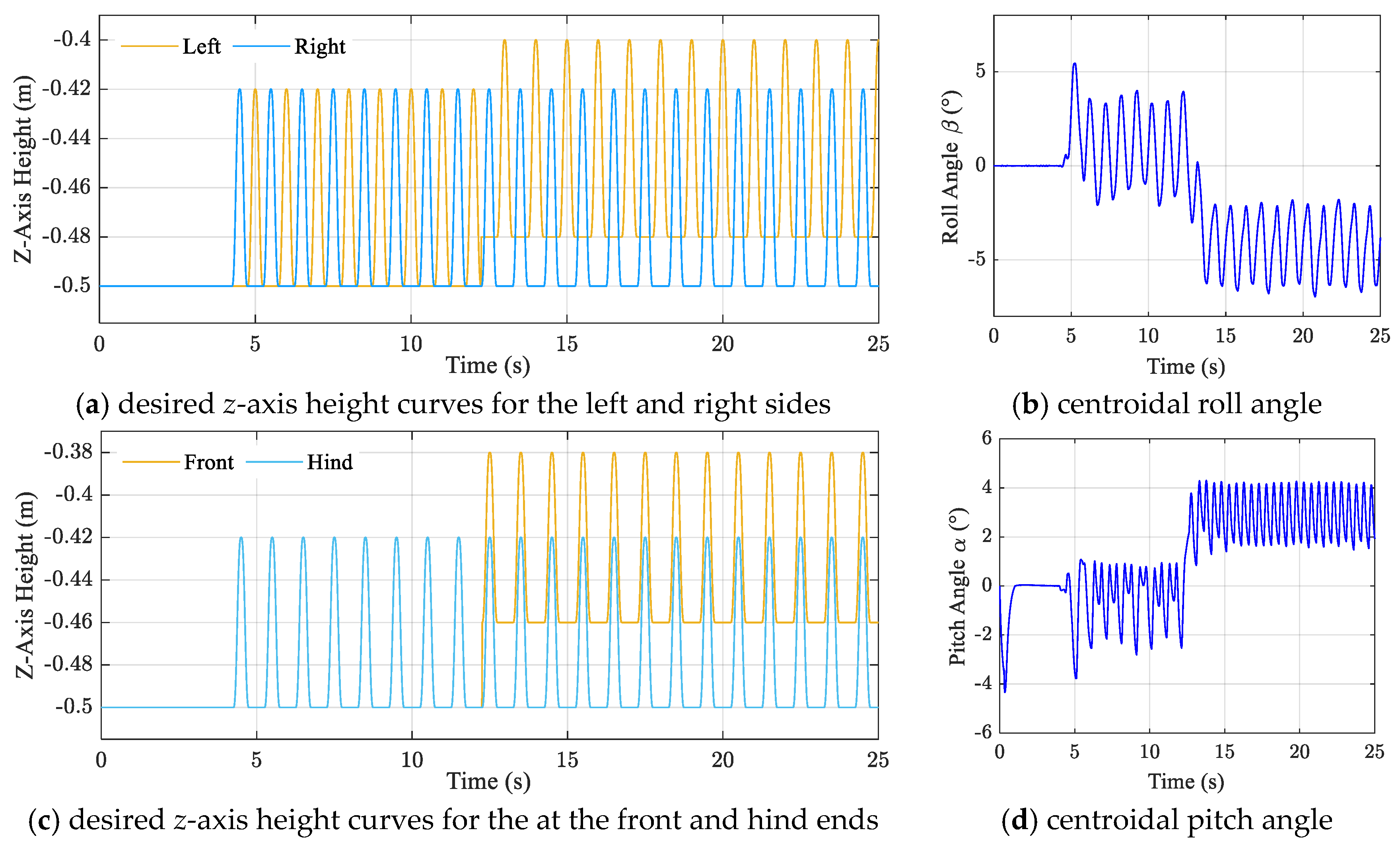
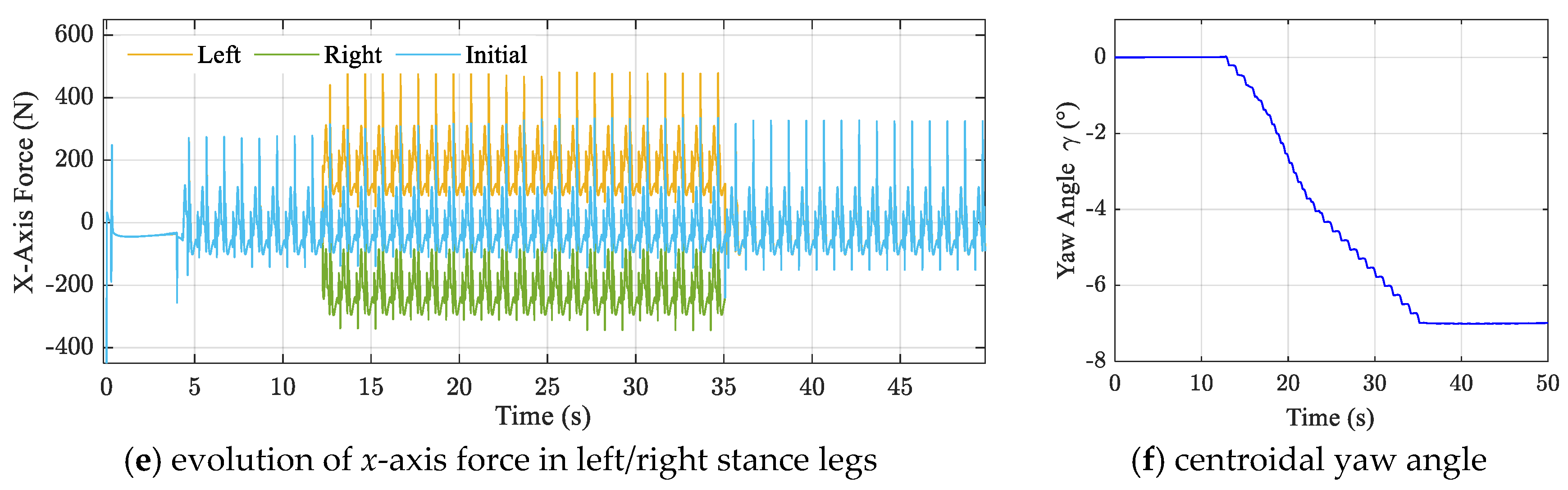
As shown in
Figure 18, the simulation results demonstrate attitude control performance for roll, pitch, and yaw angles based on the posture control strategy outlined in
Section 4.3. At the 12 s mark, corresponding attitude angle control signals were applied: roll angle control was achieved by regulating the desired support heights of left/right stance legs (
Figure 18a), pitch angle control was obtained through adjustment of fore/aft stance leg heights (
Figure 18b), and yaw angle control was realized by modifying x-direction force distribution between left/right stance legs (
Figure 18c).
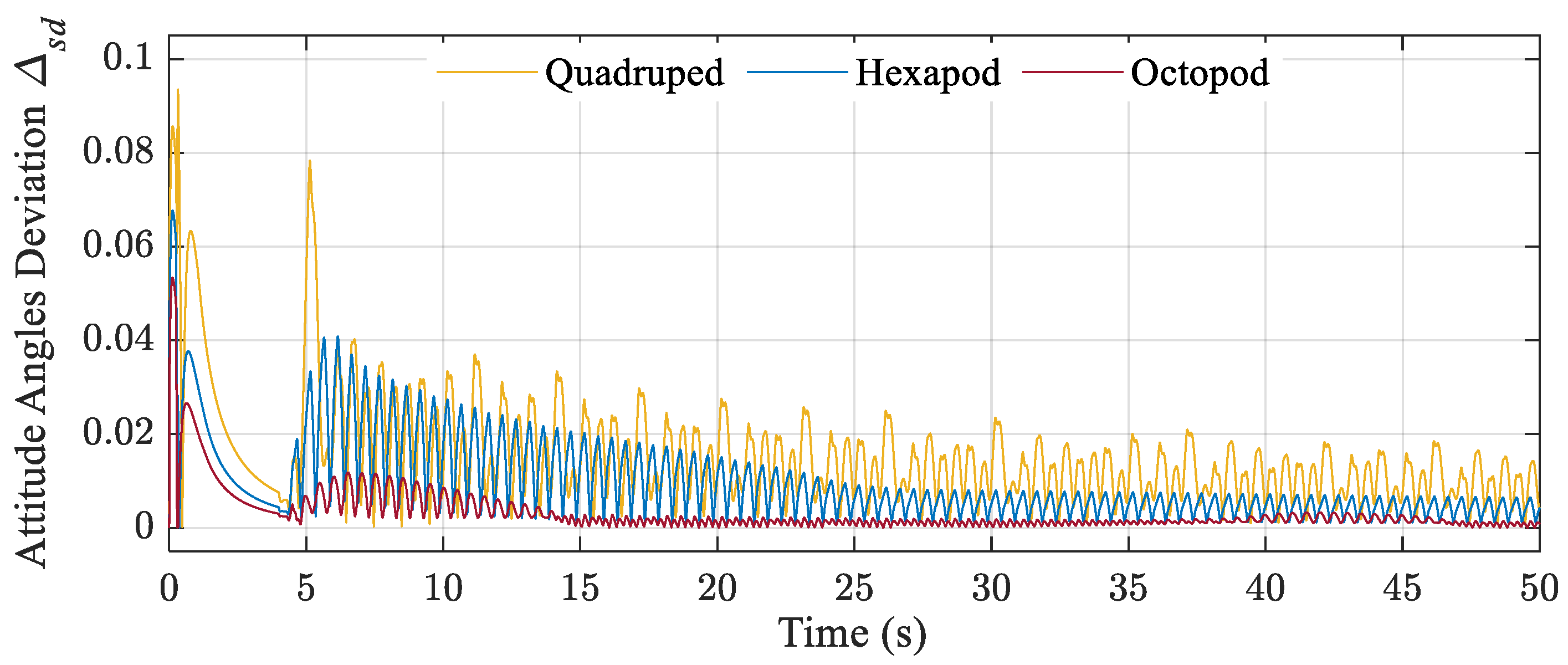
Finally, stability simulation experiments of the multi-legged control system were conducted. Stability curves during motion for different configurations (quadrupedal, hexapodal, octapodal) were plotted according to (26), as shown in
Figure 19. The trend of the curves in
Figure 18 is generally similar: maximum fluctuations occur at approximately 4 s when transitioning from static to walking state, then gradually decrease with simulation time before stabilizing into steady oscillations. As the curve trends indicate, the quadrupedal walking state stabilizes at approximately 30 s, the hexapodal state at around 25 s, and the octapodal state achieves stability at about 15 s. As the number of modules increases, the quantity of legs supporting the body per unit time rises, resulting in enhanced stability. Comparative analysis of
Figure 19 demonstrates that the attitude angle deviation in the octapodal configuration approaches zero, achieving near-perfect stable operation.
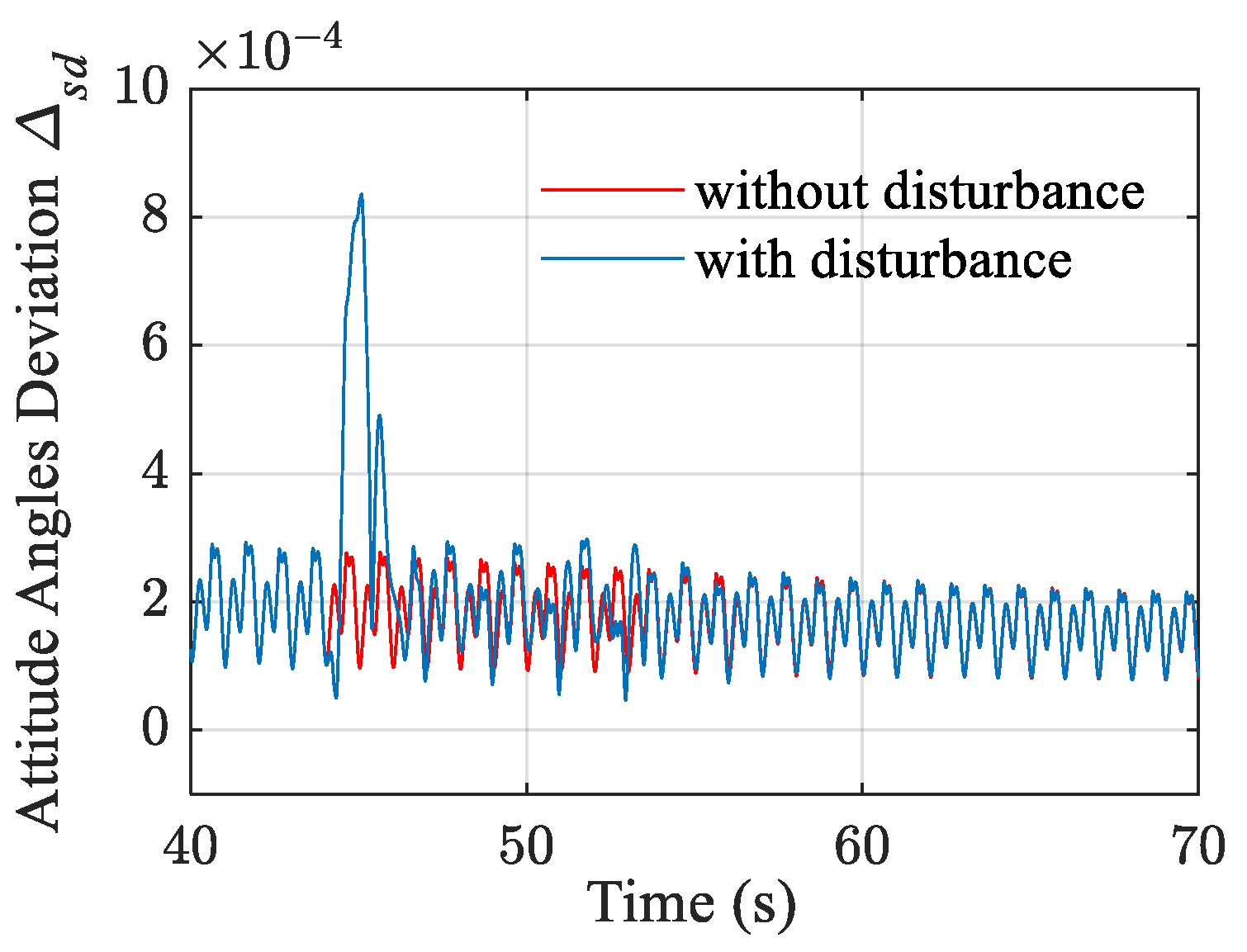
To further validate the stability of the control system, a disturbance simulation test was conducted on the quadrupedal walking mode. At the 44 s mark, a lateral step force of 100 N was applied to the robot to simulate an impact scenario during walking. The resulting stability curve, shown in
Figure 20, indicates that the robot’s postural stability was significantly affected by the external force, exhibiting substantial oscillations. However, within approximately 5 s, the posture stability recovered to its original state, and the robot resumed stable walking. As evidenced by the results in
Figure 19, the quadrupedal walking mode is the least stable configuration among all multi-legged walking modes. The fact that the system can recover stability from such a disturbance within 5 s, even in this least stable configuration, verifies the reliability of the control system in maintaining stability across various multi-legged walking states.
6.2. Prototype Experiment
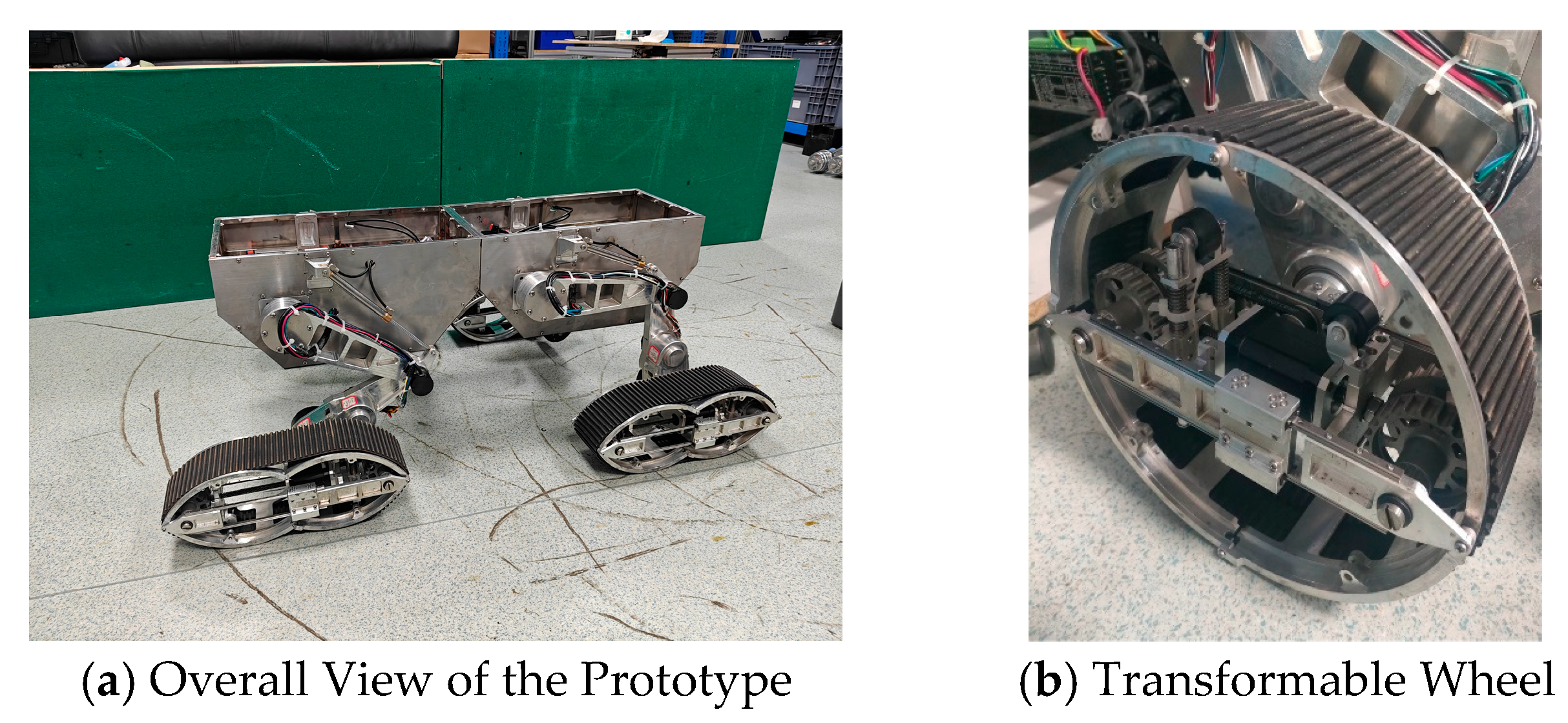
Following the simulation experiments, the parallel BP-VMC multi-legged control system was subsequently implemented on a physical prototype to validate the designed control system and strategy. The experimental prototype used in this study is shown in
Figure 21.
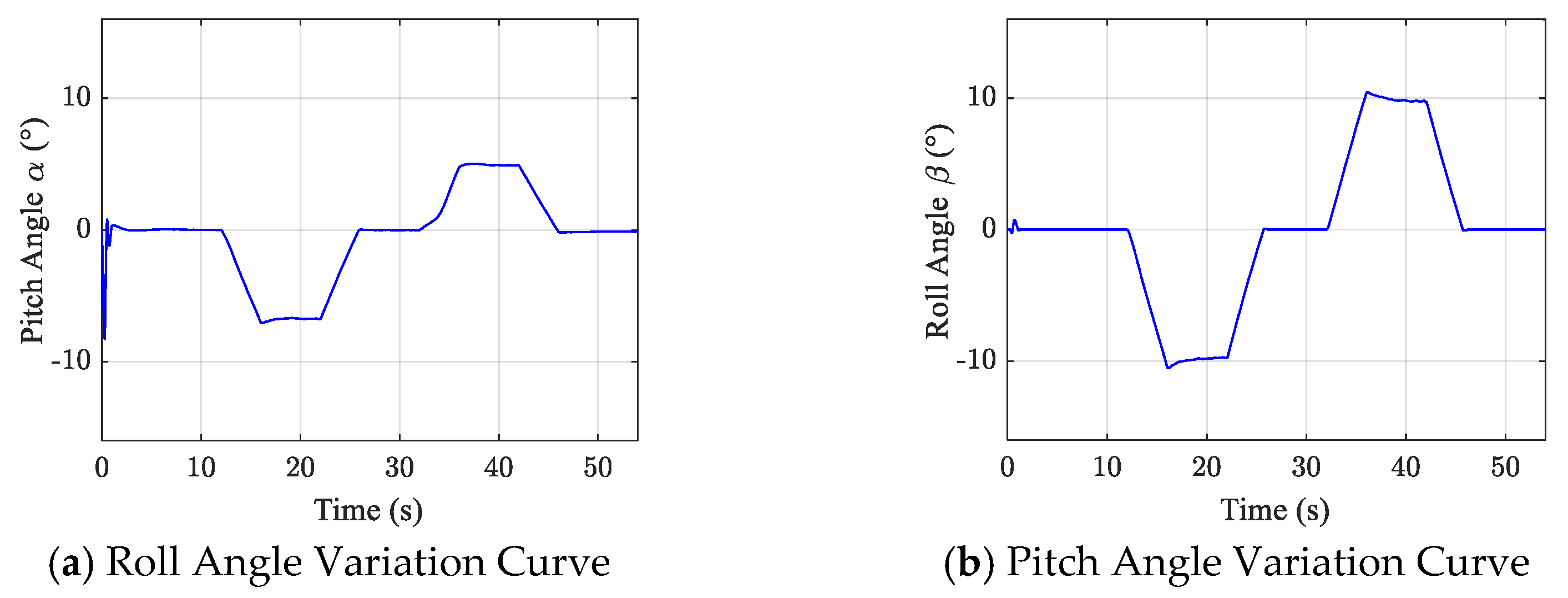
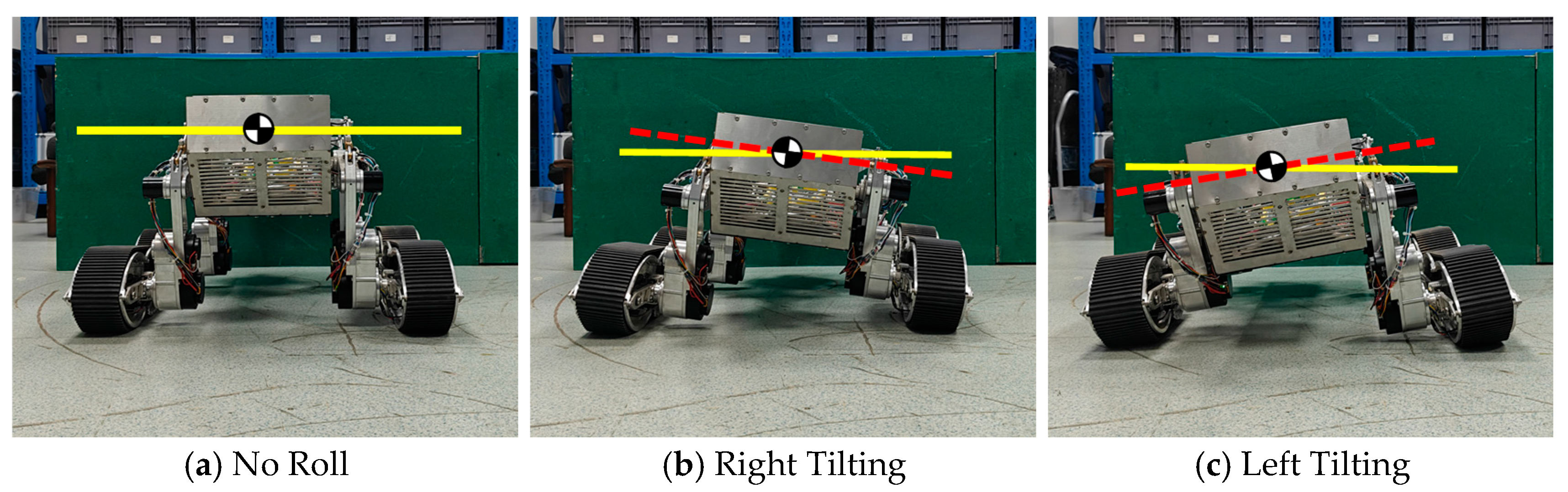
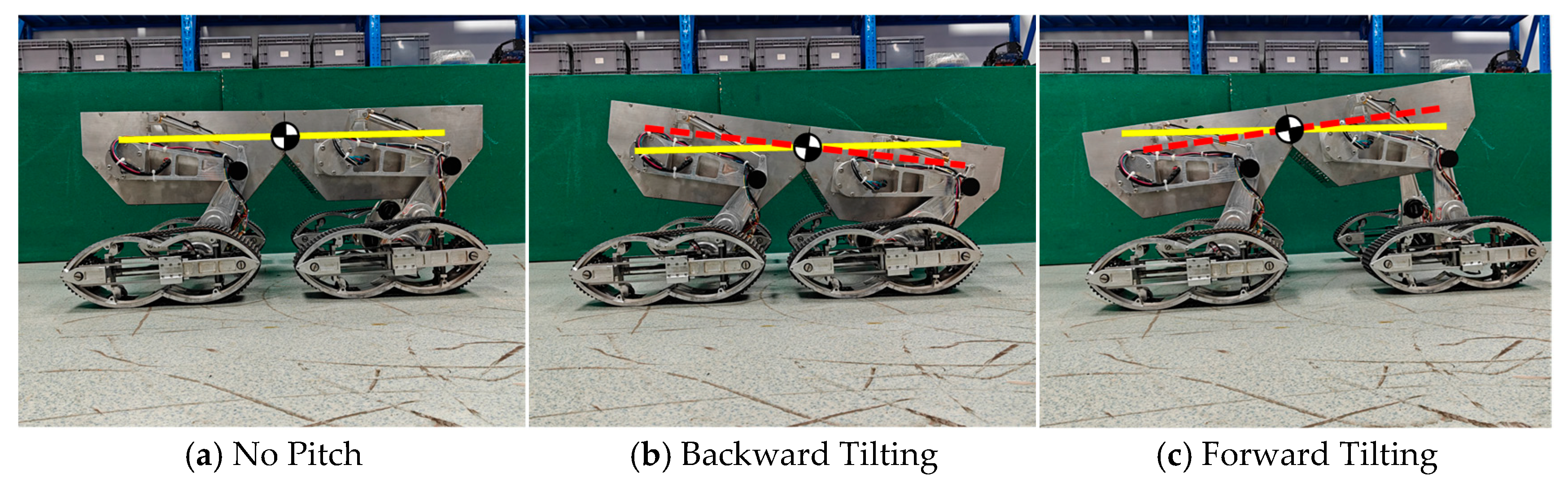
On the physical prototype, experiments were primarily conducted on single-leg swing trajectory tracking and roll-pitch attitude control.
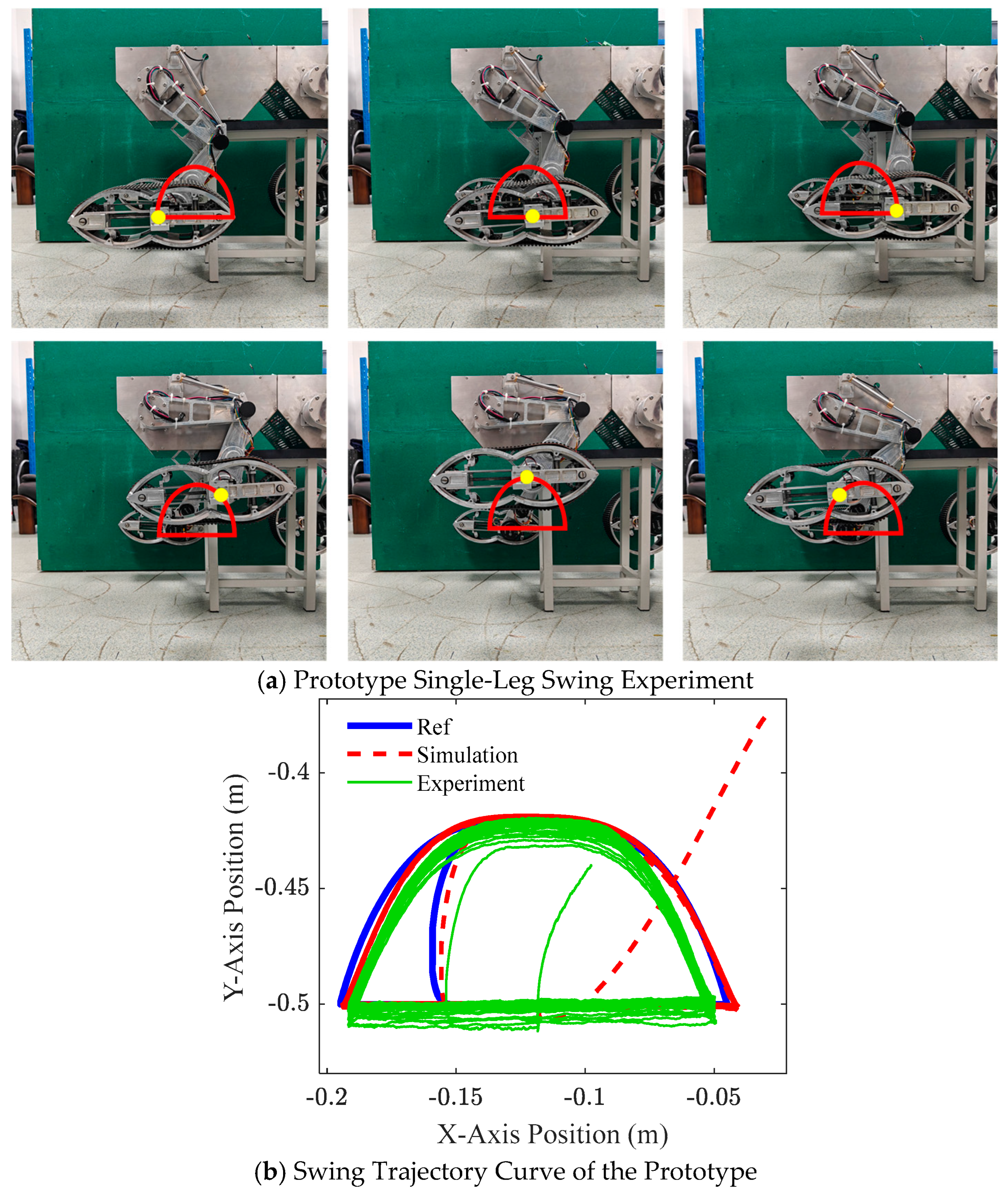
Figure 22 illustrates the single-leg swing trajectory tracking experiment. The yellow dots in the figure represent the origin of the robot’s foot-end coordinate system. The swinging foot-end trajectory is plotted based on the position data of this origin relative to the hip coordinate system. The results demonstrate that the control system effectively drives the leg to follow the predefined reference trajectory. However, as shown in
Figure 22b, the tracking performance on the prototype exhibits a noticeable deviation from the simulation results, with increased errors and a longer settling time. This discrepancy is mainly attributed to differences between the simulated mass properties of components and those of the actual hardware. Despite this, the system successfully achieved effective trajectory tracking and adaptive error correction, ultimately realizing stable swinging motion.
Figure 23 and
Figure 24 present the experimental results of roll and pitch attitude control, which aimed to validate the feasibility of the decomposed attitude control objective strategy. By assigning different desired heights to the four legs, the robot’s attitude angles were effectively regulated. As shown in
Figure 25, coordinated adjustment of the leg heights enabled smooth and continuous control of both roll and pitch angles. These results confirm the practical feasibility of the proposed attitude control decomposition strategy in real-world applications.
7. Conclusions
This paper primarily presents a methodological advancement for locomotion control of modular reconfigurable robots. The core contribution lies in proposing and validating a “top-down decomposition, bottom-up adaptation” methodology based on the “target decomposition–parallel distributed control” paradigm. This approach fundamentally differs from the monolithic or centralized control frameworks typically designed for fixed-morphology legged robots.
At the methodological level, we established a unified control framework that maintains consistency across varying module counts and leg configurations (e.g., quadruped, hexapod). This contrasts with existing adaptive VMC methods, which are often limited to single-robot systems and lack the inherent parallelism and combinatorial scalability required for modular reconfiguration. The key distinction is the integration of a decoupled VMC structure with BPNN-based parameter adaptation at the individual leg unit level, enabling autonomous and distributed parameter tuning that scales with the assembly.
At the system implementation level, the proposed overall target decomposition strategy effectively decouples complex whole-body coordination into independent, parallelizable single-leg control subproblems. This design allows the control system to seamlessly adapt to various configurations while ensuring stability. From a methodological perspective, this work provides a scalable and easily reconfigurable pathway for controlling complex robotic systems with variable morphology.
Regarding experimental validation, the effectiveness of this methodology was rigorously verified through a comprehensive suite of simulations and physical prototype experiments. Simulation results confirmed the tracking accuracy of the single-leg BP-VMC and the configuration-independent stability of the multi-legged system. Prototype experiments further demonstrated the practical feasibility of the control decomposition strategy and the system’s robustness in real-world deployment. The results show that with the proposed method, the RMSE for single-leg swing trajectory tracking is within m (x-direction) and m (z-direction). For multi-legged walking, average tracking errors remain below m, and the system can recover stable gait within 5 s after a significant lateral disturbance, demonstrating robust anti-interference capability.
While the methodology was validated on a specific wheel-track-leg hybrid platform, its principles offer a referential framework for motion control of modular robots with similar reconfigurable legged architectures.
We acknowledge that the current study focuses on the primary target application of heavy-duty, low-speed swinging operations. Consequently, dynamic factors were simplified in the single-leg BP-VMC model to prioritize controller stability and adaptability within this operational envelope. This design choice inherently limits the system’s performance in high-speed or high-inertia dynamic scenarios. However, this defined scope clearly delineates the contribution of the present work and directly points to a valuable future research direction: establishing a dynamic model interface to incorporate more comprehensive dynamic factors into the parallel BP-VMC framework. Such an extension would be a natural and significant progression, aiming to broaden the applicability of this methodology to high-dynamic-performance scenarios, thereby building upon the foundational scalable control architecture established here.
Author Contributions
Methodology, J.L. and X.X.; software, C.Y. and J.L.; validation, T.C. and Y.Z.; investigation, Y.Z.; resources, W.W., B.L. and X.X.; data curation, Y.Z. and B.L.; writing—original draft preparation, C.Y. and J.L.; writing—review and editing, C.Y., J.L., Y.Z., W.W. and B.L.; visualization, T.C.; funding acquisition, W.W. and X.X. All authors have read and agreed to the published version of the manuscript.
Funding
This research was funded by the National Natural Science Foundation of China Youth Fund, grant number 52202485; the National University of Defense Technology Research Program, grant number ZK24-22.
Data Availability Statement
The original contributions presented in this study are included in the article. Further inquiries can be directed to the corresponding author.
Acknowledgments
All sources of support are declared in the Author Contributions and Funding sections.
Conflicts of Interest
The authors declare no conflicts of interest.
References
- Santoso, F.; Finn, A. A ROS-Based Data-Driven Motion Self-Recognition System Using Deep-Learning Convolutional Neural Networks in a Military Unmanned Ground Vehicle. In Proceedings of the 2024 International Joint Conference on Neural Networks (IJCNN), Yokohama, Japan, 30 June–5 July 2024. [Google Scholar]
- Shu, Y.; Dong, L.; Liu, J.; Liu, C.; Wei, W. Overview of Terrain Traversability Evaluation for Autonomous Robots. J. Field Robot. 2024, 42, 1724–1765. [Google Scholar] [CrossRef]
- Baca, J.; Pagala, P.; Rossi, C.; Ferre, M. Modular robot systems towards the execution of cooperative tasks in large facilities. Robot. Auton. Syst. 2015, 66, 159–174. [Google Scholar] [CrossRef]
- Meng, W. Research on Cooperative Formation Motion Control Method of Multi Ground Unmanned Platforms. In Proceedings of the International Conference on Artificial Intelligence and Security, Qinghai, China, 15–20 July 2022; Volume 13339. [Google Scholar]
- Zhu, Y.; Fei, Y.; Xu, H. Stability Analysis of a Wheel-Track-Leg Hybrid Mobile Robot. J. Intell. Robot. Syst. Theory Appl. 2018, 91, 515–528. [Google Scholar] [CrossRef]
- Bruzzone, L.E.; Baggetta, M.; Nodehi, S.E.; Bilancia, P.; Fanghella, P. Functional design of a hybrid leg-wheel-track ground mobile robot. Machines 2021, 9, 10. [Google Scholar] [CrossRef]
- Zhang, C.; Zhao, J.; Zhang, T.; Niu, Q.; Gu, Y.; Yan, S.; Wang, W. Design and Simulation of Bionic Quadruped Obstacle-Overcoming Robot. Adv. Mater. Technol. 2024, 9, 1. [Google Scholar] [CrossRef]
- Liu, Y.; Zhao, M.; Hua, H. A 1-DOF Modular Robotic Hand Inspired by Human Two-Arm Cooperative Handling Strategy. Actuators 2023, 12, 151. [Google Scholar] [CrossRef]
- Zhao, N.; Gao, L.; Yang, Z.; Qi, J.; Han, K.; Sui, X.; Zhao, J.; Zhu, Y. Meta-Module Mutual Assistance: A Bioinspired Design for Self-Assembly of Modular Space Robot. Adv. Intell. Syst. 2023, 5, 2200450. [Google Scholar] [CrossRef]
- Pratt, J.; Dilworth, P. Virtual model control of a bipedal walking robot. In Proceedings of the International Conference on Robotics and Automation, Albuquerque, NM, USA, 20–25 April 1997. [Google Scholar]
- Xie, H.; Ahmadi, M.; Shang, J.; Luo, Z. An intuitive approach for quadruped robot trotting based on virtual model control. Proc. Inst. Mech. Eng. Part I J. Syst. Control Eng. 2015, 229, 342–355. [Google Scholar] [CrossRef]
- Liu, J.; Xu, X.; Wang, W.; Tang, Y.; Lu, S. Adaptive optimization for virtual model control of quadruped robots based on BP neural network. Robotica 2025, 43, 1258–1290. [Google Scholar] [CrossRef]
- Yu, X.; Shishika, D.; Saldaña, D.; Hsieh, M.A. Modular Robot Formation and Routing for Resilient Consensus. In Proceedings of the 2020 American Control Conference (ACC), Denver, CO, USA, 1–3 July 2020. [Google Scholar]
- Cong, Q.; Shi, X.; Wang, J.; Xiong, Y.; Su, B.; Xu, W.; Liu, H.; Zhou, K.; Jiang, L.; Tian, W. Stability Study and Simulation of Quadruped Robots with Variable Parameters. Appl. Bionics Biomech. 2022, 2022, 9968042. [Google Scholar] [CrossRef]
- Wang, C.-D.; Xi, W.-D.; Huang, L.; Zheng, Y.-Y.; Hu, Z.-Y.; Lai, J.-H. A BP Neural Network Based Recommender Framework with Attention Mechanism. IEEE Trans. Knowl. Data Eng. 2022, 34, 3029–3043. [Google Scholar] [CrossRef]
- Tang, Z.; Wu, X.; Han, H. Robust Reconstructed Neural Network Based on Spectral Elastic Activation. IEEE Trans. Neural Netw. Learn. Syst. 2025, 36, 15322–15336. [Google Scholar] [CrossRef]
- LeCun, Y.; Bengio, Y.; Hinton, G. Deep learning. Nature 2015, 521, 436–444. [Google Scholar] [CrossRef]
- Yan, X.; Guo, X.; He, N.; Shi, J.; Zhao, D. Model reduction of structural mechanical response in the time domain. Sci. Rep. 2025, 15, 10203. [Google Scholar] [CrossRef]
- Hecht-Nielsen, R. Theory of the backpropagation neural network. Neural Netw. 1988, 1, 445. [Google Scholar] [CrossRef]
- Basheer, I.A.; Hajmeer, M. Artificial neural networks: Fundamentals, computing, design, and application. J. Microbiol. Methods 2000, 43, 3–31. [Google Scholar] [CrossRef]
- Li, D.; Wang, S.; Song, X.; Zheng, Z.; Tao, W.; Che, J. A BP-Neural-Network-Based PID Control Algorithm of Shipborne Stewart Platform for Wave Compensation. J. Mar. Sci. Eng. 2024, 12, 2160. [Google Scholar] [CrossRef]
- Zhou, Y.; He, X.; Shao, F.; Zhang, X. Research on the Optimization of the PID Control Method for an EOD Robotic Manipulator Using the PSO Algorithm for BP Neural Networks. Actuators 2024, 13, 386. [Google Scholar] [CrossRef]
- Tang, G.; Lei, J.; Du, H.; Yao, B.; Zhu, W.; Hu, X. Proportional-integral-derivative controller optimization by particle swarm optimization and back propagation neural network for a parallel stabilized platform in marine operations. J. Ocean Eng. Sci. 2025, 10, 1–10. [Google Scholar] [CrossRef]
- Berry, M.J.A.; Linoff, G.S. Data Mining Techniques: For Marketing, Sales, and Customer Relationship Management, 3rd ed.; Wiley: Hoboken, NJ, USA, 2011. [Google Scholar]
- Zhang, M.-L.; Zhang, Y.-J.; He, X.-L.; Gao, Z.-J. Adaptive PID Control and Its Application Based on a Double-Layer BP Neural Network. Processes 2021, 9, 1475. [Google Scholar] [CrossRef]
- Wei, S.; Wu, H.; Liu, L.; Zhang, Y.; Chen, J.; Li, Q. A CPG-based gait planning and motion performance analysis for quadruped robot. Ind. Robot. 2022, 49, 779–797. [Google Scholar] [CrossRef]
- Sakakibara, Y.; Kan, K.; Hosoda, Y.; Hattori, M.; Fujie, M. Foot trajectory for a quadruped walking machine. In Proceedings of the IEEE International Workshop on Intelligent Robots and Systems, Towards a New Frontier of Applications, Ibaraki, Japan, 3–6 July 1990. [Google Scholar]
- Li, Y.; Li, B.; Rong, X.; Meng, J. Mechanical design and gait planning of a hydraulically actuated quadruped bionic robot. J. Shandong Univ. Eng. Sci. 2011, 41, 32–36. [Google Scholar]
- Shen, Y.; Chen, G.; Li, Z.; Wei, N.; Lu, H.; Meng, Q.; Guo, S. Cooperative control strategy of wheel-legged robot based on attitude balance. Robotica 2023, 41, 566–586. [Google Scholar] [CrossRef]
- Chen, G.; Guo, S.; Hou, B.; Wang, J. Virtual Model Control for Quadruped Robots. IEEE Access 2020, 8, 140736–140751. [Google Scholar] [CrossRef]
Figure 1.
Multimodal Locomotion Transition for Wheel-Track-Leg Hybrid Robots.
Figure 1.
Multimodal Locomotion Transition for Wheel-Track-Leg Hybrid Robots.
Figure 2.
Structural Diagram of the Wheel-Track Transformable Wheel Module.
Figure 2.
Structural Diagram of the Wheel-Track Transformable Wheel Module.
Figure 3.
Docking Reconfiguration Scheme.
Figure 3.
Docking Reconfiguration Scheme.
Figure 4.
Simplified Diagram of Single-Leg Mechanism.
Figure 4.
Simplified Diagram of Single-Leg Mechanism.
Figure 5.
Local Schematic of Ankle E.
Figure 5.
Local Schematic of Ankle E.
Figure 6.
Virtual Component Model.
Figure 6.
Virtual Component Model.
Figure 7.
BP Neural Network Architecture.
Figure 7.
BP Neural Network Architecture.
Figure 8.
BP-VMC Framework.
Figure 8.
BP-VMC Framework.
Figure 9.
FootEnd Trajectory for a Single Gait Cycle.
Figure 9.
FootEnd Trajectory for a Single Gait Cycle.
Figure 10.
Multi-legged Configuration Gait Patterns. (a,b) Bipedal Configuration Gaits. (c–e) Quadrupedal Combination Gaits. (f–h) Hexapod Combination Gaits.
Figure 10.
Multi-legged Configuration Gait Patterns. (a,b) Bipedal Configuration Gaits. (c–e) Quadrupedal Combination Gaits. (f–h) Hexapod Combination Gaits.
Figure 11.
Schematic Diagram of an NModule Robot Assembly.
Figure 11.
Schematic Diagram of an NModule Robot Assembly.
Figure 12.
Attitude Control (pitch angle , roll angle , yaw angle ).
Figure 12.
Attitude Control (pitch angle , roll angle , yaw angle ).
Figure 13.
Parallel BP-VMC Multi-legged Control System.
Figure 13.
Parallel BP-VMC Multi-legged Control System.
Figure 14.
Resulting Curves of Single-Leg Swing Control.
Figure 14.
Resulting Curves of Single-Leg Swing Control.
Figure 15.
Stability Curves for VMC and BP-VMC.
Figure 15.
Stability Curves for VMC and BP-VMC.
Figure 16.
Quadrupedal Locomotion Simulation Curves.
Figure 16.
Quadrupedal Locomotion Simulation Curves.
Figure 17.
Hexapodal Locomotion Simulation Curves.
Figure 17.
Hexapodal Locomotion Simulation Curves.
Figure 18.
Attitude Control Simulation Curves.
Figure 18.
Attitude Control Simulation Curves.
Figure 19.
Stability Curves for Multi-legged Locomotion.
Figure 19.
Stability Curves for Multi-legged Locomotion.
Figure 20.
Step-Disturbance Stability Response.
Figure 20.
Step-Disturbance Stability Response.
Figure 21.
Physical Prototype.
Figure 21.
Physical Prototype.
Figure 22.
Single-leg Swing Trajectory Tracking Experiment.
Figure 22.
Single-leg Swing Trajectory Tracking Experiment.
Figure 23.
Roll Attitude Control.
Figure 23.
Roll Attitude Control.
Figure 24.
Pitch Attitude Control.
Figure 24.
Pitch Attitude Control.
Figure 25.
Attitude Angle Variation Curves.
Figure 25.
Attitude Angle Variation Curves.
Table 1.
Selection of Hidden Layer Configuration.
Table 1.
Selection of Hidden Layer Configuration.
| Number of Layers | Result |
|---|
| 0 | Can map linear system |
| 1 | Can approximate any continuous function on a closed interval. |
| 2 | Can approximate any smooth mapping to arbitrary precision. |
| >2 | Additional hidden layers characterize the complex features of the system |
Table 2.
Parameter Setting.
Table 2.
Parameter Setting.
| Parameter | Value |
|---|
| MB, MT, MC, MF, MR | 10 kg, 1 kg, 1 kg, 1 kg, 1 kg |
| H0, H | 0.5 m (Initial height), 0.08 m (Lifting height) |
| η, δ | 0.8 (Learning rate), 0.3 (Momentum factor) |
| Disclaimer/Publisher’s Note: The statements, opinions and data contained in all publications are solely those of the individual author(s) and contributor(s) and not of MDPI and/or the editor(s). MDPI and/or the editor(s) disclaim responsibility for any injury to people or property resulting from any ideas, methods, instructions or products referred to in the content. |




 ,
,