Article

Feasibility Study of Combining Data from Different Sources Within Artificial Intelligence Models to Reduce the Need for Constant Velocity Joint Test Rig Runs


1
Advanced Engineering Department, GKN Driveline International GmbH, Hauptstraße 130, 53797 Lohmar, Germany
2
Institute of Technology, Resource and Energy-Efficient Engineering (TREE), Bonn-Rhein-Sieg University of Applied Sciences, Grantham-Allee 20, 53757 Sankt Augustin, Germany
3
Department Multiphysics, Fraunhofer Institute for Algorithms and Scientific Computing (SCAI), Schloss Birlinghoven 1, 53757 Sankt Augustin, Germany
*
Author to whom correspondence should be addressed.
Machines 2026, 14(2), 148; https://doi.org/10.3390/machines14020148
Submission received: 23 December 2025 / Revised: 21 January 2026 / Accepted: 25 January 2026 / Published: 28 January 2026
(This article belongs to the Special Issue Advances in Dynamics and Vibration Control in Mechanical Engineering)

Abstract

Within this paper, the feasibility of reducing test rig runs in constant velocity joint (CVJ) development by combining data from different sources (simulation and test rig) for artificial intelligence (AI) models has been investigated. Therefore, a case study on CVJ efficiency prediction using a random forest regressor, a decision-tree-based algorithm, was conducted using a data set of 95,798 points derived from both test rigs (52,486 points) and multi-body simulations (43,312 points). The amount of test rig data in the training data set of the regression model was iteratively reduced from 100% to 12.5% to investigate the need of expensive test rig data. Additionally, clustering models related to KMeans-algorithm were performed, to achieve further improvements of the AI models and more information about the data. Furthermore, regression and clustering models were performed with data dimensionally reduced by principal component analysis (PCA) to improve model complexity and performance. The number of principal components for the regression model was reduced from 65 to 5 components to investigate their influence on the models predictions. The study showed that combining data from different sources has a positive impact on the predictions of AI models and the confidence of their results, even though the R2-Score of the trained regression models did not change significantly, ranging from 0.927% to 0.9497%.

1. Introduction

Nowadays, simulations are a cheaper and faster way to test products and systems than producing costly prototypes and testing them on the rig. But with simulations, the results can be less precise than the reality and still take a long time to finish [1]. Especially with studies with large parameter, it causes this problem, for example, due to less resources and time or low computing power. This is where artificial intelligence (AI) comes into play. Compared to the internal multi-body simulation tool used in this paper, trained AI regression models with multi-body simulation results offer fast calculations in the shortest possible time. However the data on which the AI models are built is crucial for accuracy and confidence in the results. The use of physical data only, such as from testing prototypes, could result in the data set being too small. In the case of using only simulated data, the data set size can be variable. But the confidence is not fully given because simulations are a mathematical description of a problem and do not picture the real-world behavior perfectly. Therefore, AI models consisting of only simulated data have a high distortion of the reality. In fact, real data as well as simulated data already exist. So why not use both kinds of data to train an AI model? By using test rig data combined with simulated data, the problem of the data set size and confidence can be solved, with that the possibility of reducing physical test rig runs by strengthening the AI models’ performance. The extent to which simulated data can be combined with test rig data to achieve the highest possible degree of realism will be quantified. The conditions under which such substitution is possible will be identified. Finally, a reproducible workflow will be provided that experts can use to accelerate development while maintaining confidence in the predictions. This will be investigated within the example of efficiency of constant velocity joints (CVJs) [2,3,4].
Efficiency plays a major role in the automotive industry and is trimmed as positively as possible. As drive shafts are responsible for the transmission of torque between gearbox and wheel, as well for angular and axial plunge compensation, they have an essential influence on the energy flow of a vehicle. By optimizing the efficiency of a drive shaft or a CVJ, the overall efficiency of a vehicle can be improved and, for example, the fuel consumption of the vehicle can be reduced. The efficiency of the individual components of the drivetrain plays an even greater role in today’s world and the ever-increasing proportion of electric cars on the roads due to battery size, cost, and range. A paper that addresses the influence of efficiency improvements in the drivetrain on the energy efficiency of a vehicle shows that electric vehicles (EVs) achieve a savings potential of 0.9–1.6% with a CVJ efficiency improvement of 1%. Internal combustion engine (ICE) drive systems only achieve fuel savings of 0.5–0.9%. The authors have thus made clear that the efficiency improvements of powertrain components in EVs have a much greater impact on the energy consumption. The efficiency of a component is generally measured by the loss that is created through the functioning of the component. Using the example of a constant velocity joint, efficiency therefore describes the ratio between input and output torque. One reason for the loss of torque is the friction between components and the resulting heat. Optimizing the efficiency of constant velocity joints therefore means an improvement in performance, temperature development, and wear [5].
The need for different data sources for AI models and the credibility of their results will be investigated in this paper based on the example of efficiency of CVJs. Thus, a lot of data from different sources must be combined and its influence must be analyzed. Due to the many years of development of various constant velocity joints, large amounts of data from test rig runs relating to efficiency are already available. This data has already been elaborately processed and collected internally outside of this project. With 52.486 data points, the data set is large enough for this study and to investigate the influence of the size of the data set. Typically, significantly less test rig data is available due to the costly and time-consuming realization of test rig runs. Due to the existing test rig data, only a simulation data set needs to be created. So the aim of this paper is to investigate how combining simulation and test rig data influences the performance and robustness of AI models for CVJ efficiency prediction with the goal of identifying conditions under which physical test rig runs may be reduced [6].
Recent studies from various fields of application have applied principal component analysis (PCA), clustering, and regression techniques to engineering problems. However, many of these approaches treat these methods without combining data from different sources to enhance the performance of AI models and their confidence. Otherwise, recent studies from various fields of application have combined data from different sources without fully applying these methodology. This paper addresses the strengths and limitations of these combined techniques in the special context of CVJs and proposes a customized workflow that integrates PCA, clustering, and regression with a focus on data pooling to improve AI model performance. Such integration has proven promising in technical applications but has not yet been sufficiently researched in terms of methodological and domain-specific synergies. By critically reviewing the existing literature and demonstrating the added value of combining simulation and test rig data, this study contributes to a new perspective on the current state of the art [7,8,9,10,11,12,13].

2. Methodology

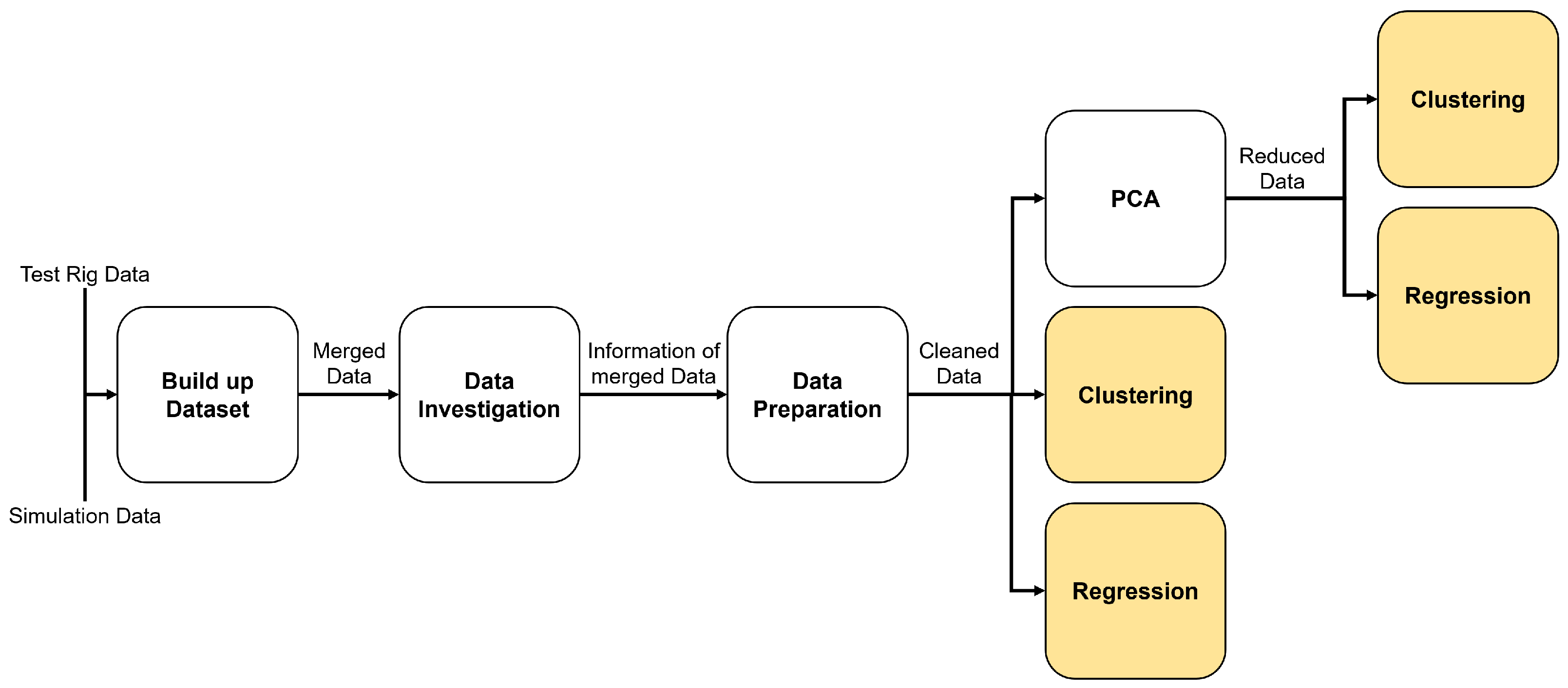
Figure 1 shows the workflow of the data analysis. At the beginning, the data set will be built up out of data from different sources (Section 2.1) followed by its investigation without AI tools (Section 2.2). Afterward, the data set will be prepared for investigations with AI (Section 2.3). Following this, clustering and regression models with the initial data set will be performed (Section 2.5 and Section 2.6.1). Additionally, a dimension reduction of the data set by principal component analysis (PCA) will be performed (Section 2.4), followed by clustering and regression models with a reduced data set (Section 2.5 and Section 2.6.2). All this will be carried out to study the potential effects of combining data source and with the help of scikit-learn library [14].

2.1. Build Up Data Set

Before both the test rig and simulation data set are merged, they must be prepared. In the case of the test rig data set, this includes the following steps: checking for correctness, filtering the parameters and cleaning out the data. In the case of the simulation data set, simulations must be performed first. Therefore, input parameters and value areas must be selected, and once the simulations have been completed, the results must be merged together.

2.1.1. Test Rig Data Set

As mentioned in Section 1, the test rig data set includes a lot of information in the form of various parameters. Some of them, such as the date or the executing engineer, have no direct influence on the efficiency or cannot be reproduced by simulation. Therefore, the affected parameters are removed. Afterwards, the data set only consists of parameters that can be reproduced by simulation or are assumed to have an influence on the efficiency. These include product-related parameters such as Joint Type and Joint Size as well as environmental related parameters such as Torque, Speed, Articulation Angle, Mode and Temperature. The Joint Type represents different CVJ variants and provides categorical identifiers in the data set. Detailed descriptions are not included because they are not required for the methodological analysis. The parameter Mode describes the combination of power-flow and speed related to their directions. On the test rig, Drive means torque and speed are going in the same direction, and in the car, it reflects acceleration. Coast means that torque and speed are going in opposite directions and that there is a recuperation or engine brake scenario in the car. These parameters are as follows in Table 1.
Finally, the data set was brought into a typical GKN internal standardized format [6].

2.1.2. Simulation Data Set

An internal multibody simulation tool to calculate kinematic conditions of CVJs under certain conditions was taken into account to generate the simulation data set. During the development, this simulation tool was balanced with test rig data so that the offset between simulation and test rig is as low as possible. In fact, simulation tools cannot represent the real use case with 100% accuracy as there is always a deviation. The parameters mentioned above were selected as input parameters for the simulations. The aim of the simulations was to simulate conditions which reflect the test rig conditions as well as conditions that appear in a real car. So, information from both worlds were collected to create simulation boundaries that cover test rig and real car condition as good as possible. To consider test rig conditions, the GKN test standard and the information of the efficiency data set were taken into account [15]. To cover typically occurring critical conditions in a vehicle, road load data of a high performance electrical sport utility vehicle (SUV) was analyzed and considered. The focus was on the load cases that occurred most frequently in percentage terms. With regard to the GKN test standard, efficiency data set and road load data a total of 127 joints were simulated according to different joint types and sizes. Additionally existing simulations out of previous studies were included. The final combined simulation data set consists of the simulation parameters in Table 2.

2.1.3. Combined Data Set

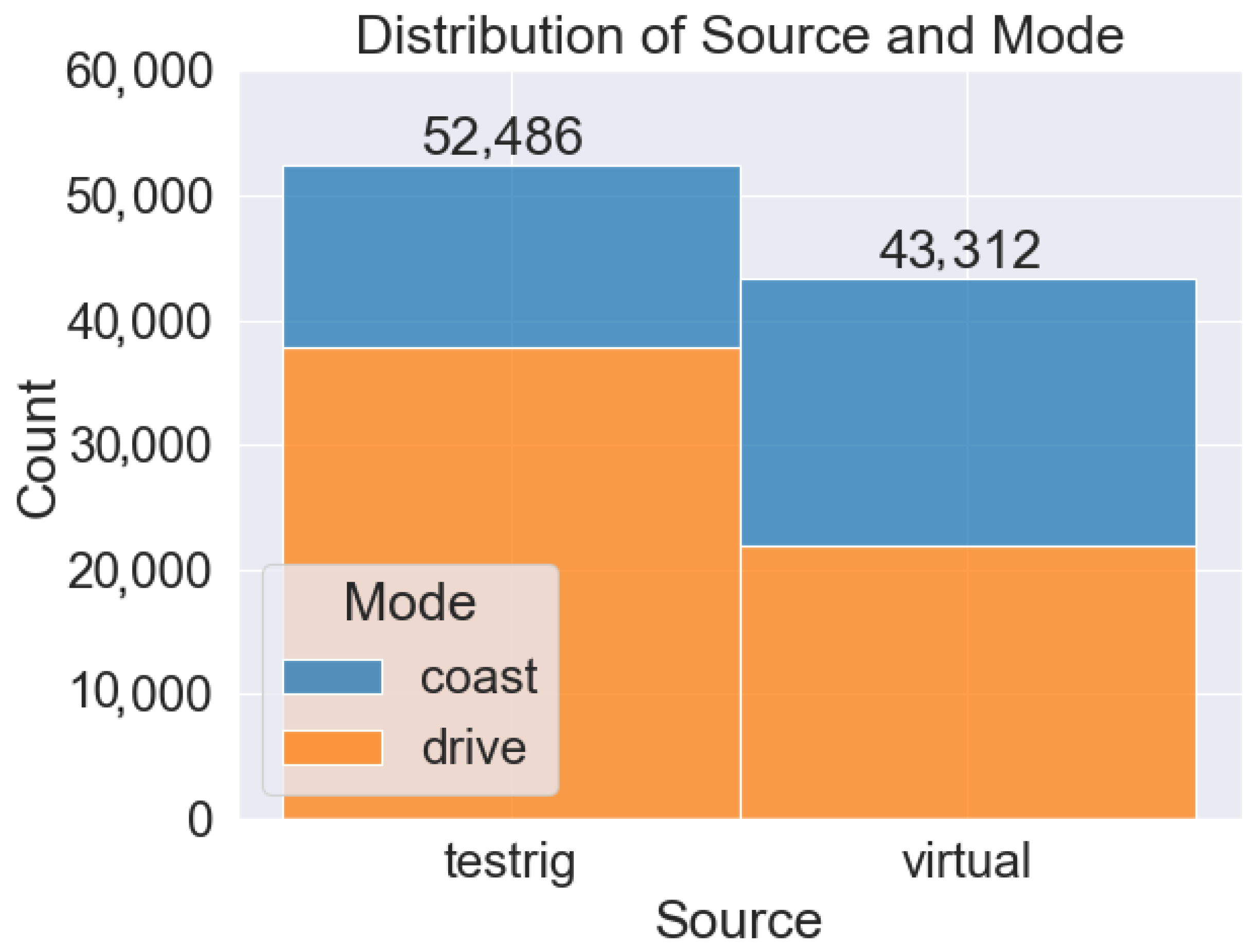
After the data sets were prepared, they were merged together, proofed regarding correctness and reasonableness, and cleaned. For example, losses with negative values, as these cannot occur in reality but rarely in simulation, were removed. To handle outliers, the distribution of losses was analyzed, and an upper limit of 3% identified. This upper limit is a practical and experience-based cutoff and neglects unusually high losses and covers 99.57% of the data points. Beside this, data points referring to Joint Size and Articulation Angles equal to zero were removed. The final data set contains 95,798 data points, and the distribution of Source and Drive Mode is divided, as shown in Figure 2.

2.2. Data Investigation

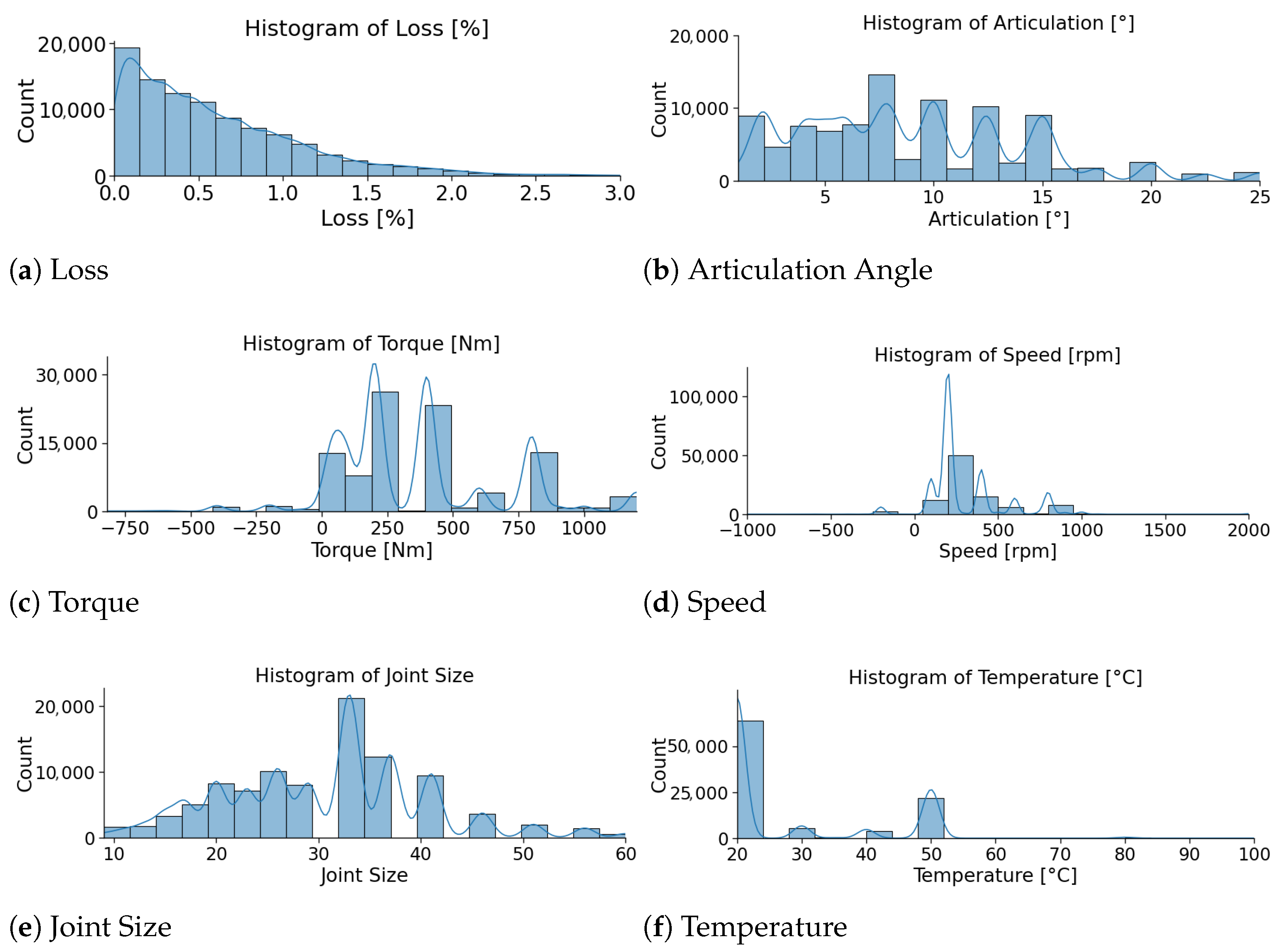
To achieve a better understanding of the data set in terms of, for example, the distribution and density of different parameters, investigations without AI were performed. Figure 3 shows the distribution of Loss, Articulation Angle, Torque, Speed, Joint Size and Temperature. The distribution of the Drive Mode shows a higher proportion of drive, which correlates to the typical occurrence in a vehicle (Figure 2). The occurrence of the various parameters can be recognized on the basis of these diagrams. They have a clear frequency of values, for example, a Joint Size of 33, Speed of 200 rpm or Temperature of 20 °C.

2.3. Data Preparation

In the next step, the data set will be prepared for the training of AI models. The removing of outliers and cleaning have already been performed. In the further process, the data will only be scaled and encoded, which is crucial for the training.
Scaling the data set prevents the weighting of values while training. MinMaxScaler was chosen as a scaling method with feature_range from 0 to 1. This allows the numerical values to be scaled and considered as far as possible without weighting.
In order for categorical data (Joint Type and Mode) to be processed, it must be encoded. As for scaling the data set, it is also important to prevent ordering and ranking of the categorical data in this case. Therefore, the OneHotEncoder with sparse_output set to False was used.
To generalize and bundle the data preparation and model training, pipelines are used [16].

2.4. PCA

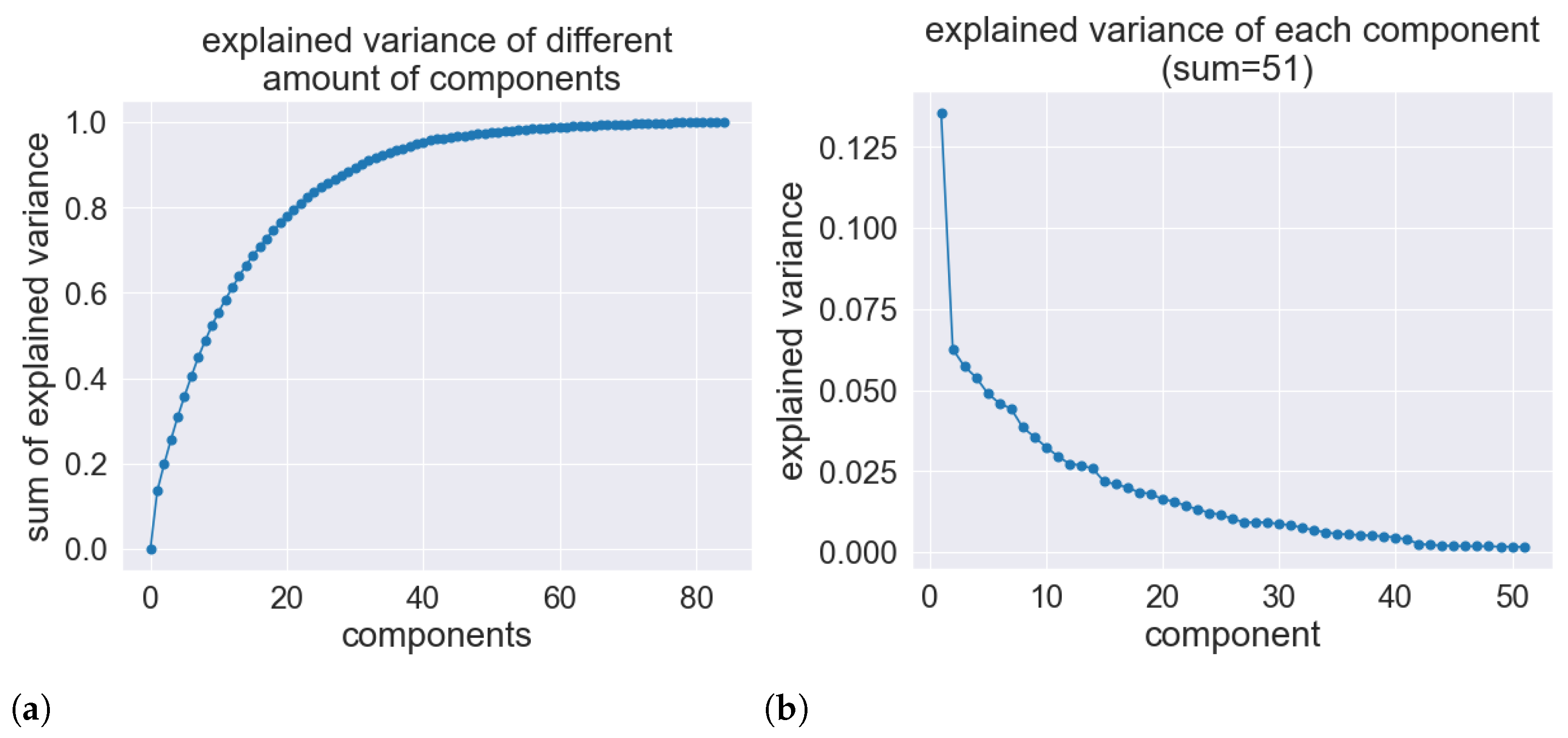
In this section, PCA will be applied to investigate the influence to the predictions of the regression model. Therefore, PCA will be carried out on the complete data set except for the target value loss. To choose the right amount of principal components that will describe the data set, a parameter study was performed (Figure 4a). Within this study, the number of components varied from 1 to 85, which corresponds to the number of parameters of the encoded data set without the target value. It can be seen that the data set is illustrated better by an increased number of components, and a correlation occurs.
To select a number of components, a quality criterion regarding the Kaiser–Guttman rule was defined. This criterion includes all components that have an explained variance higher than one. The assumption is that an explained variance lower than one comes with a loss of information. Fifty-one components fulfill the criterion. Therefore the reduced data set consists of 51 components. Figure 4b shows that the components have a decreasing information content with increasing numbering, which is usual for PCA-reduced data sets. Another criterion could be created by giving a limit of explained variance ratio, which the sum of principal component is not allowed to be under. But it is quite hard to set a logic limit [17].
Due to the fact that categorical data were included and encoded, this data shows no variance or informative value regarding distance because of the binary values compared to the numerical data. Therefore the effectiveness of the reduction is questioned. To counteract this, a reduction only with numerical data was performed. For this purpose, the affected data and the target variable were separated from the data set beforehand and added again after the PCA was performed. In this case, five numerical parameters were left to be reduced. Taking into account the criteria, the dimension could not be reduced. For example reducing to four components leads to a reduced representation of the initial data set by 20%.

2.5. Clustering

To obtain even more information from the data set, clustering was performed. A differentiation between clustering without and with PCA was performed. Due to the large amount of data and the high dimensions, the ability to basically chose the number of clusters, and the population of this algorithm, the KMeans-algorithm was selected [16,18].
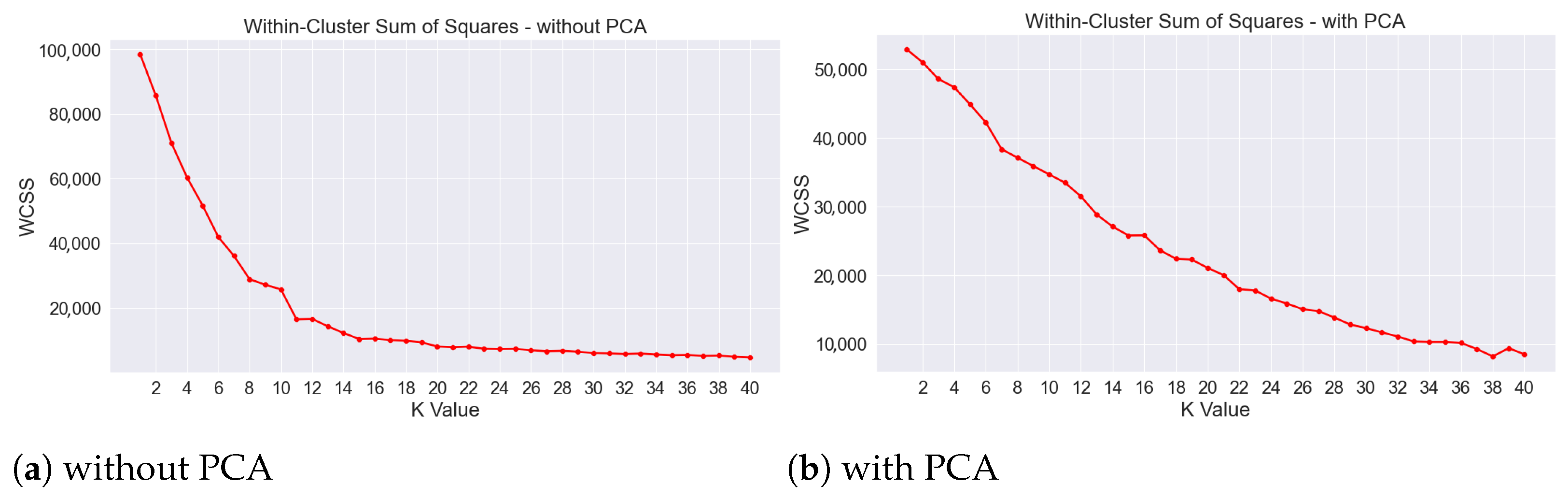
For both cases, elbow plots were created (Figure 5). Within these plots, the right amount of clusters k was then identified. Therefore, for the model without PCA, an amount of 11 (Figure 5a) clusters was selected. On the model with PCA, it was hard to identify the elbow, as there was no obvious point or edge. That means the algorithm may not have been the most optimal for this case. For illustrative reasons, an amount of 7 clusters was selected to have a manageable number for visualizing the clusters (Figure 5b).

2.6. Regression

Within the preparation steps that were previously performed, regression models (random forest regressor) can be performed. The effect of the size of the test rig data set with respect to the initial data set will be investigated in a study. There will also be a study which varies the amount of principal components of PCA.

2.6.1. Without PCA

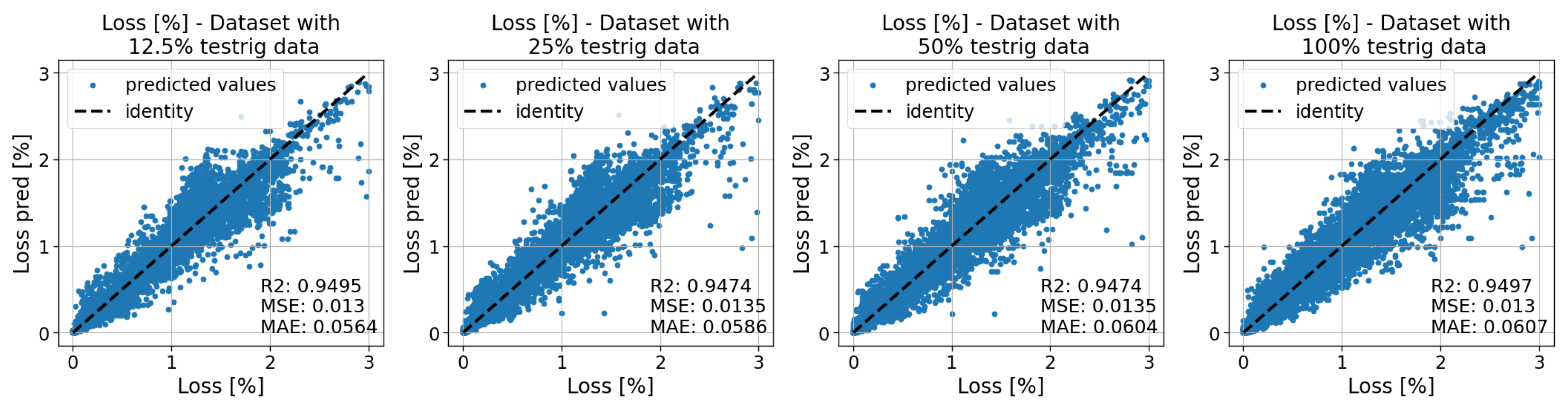
To investigate the influence of the size of test rig data regarding predictions, different regression models were trained. Previous studies looking into the prediction of CVJs showed that the random forest regressor is one of the best performing algorithms regarding efficiency predictions [19]. This was confirmed by a comparison of different algorithms by using PyCaret’s automated model comparison workflow for regression algorithms, including its standardized pipeline with preprocessing and hyperparameter tuning [20]. After selecting the algorithm, a random-forest regression model (n_estimators = 100, max_depth = None, min_samples_split = 2) was trained with the initial data set as a baseline with a train–test split of 60/40 to ensure more stable and reliable evaluation with a large test data set (Figure 6). Afterwards, the amount of test rig data was varied to study the necessity for this kind of data. Since test bench data is rare and costly, it is difficult to add new data. Therefore, the test bench data was reduced in order to investigate this behavior, which led to a reduction in the training data for each model. The test rig data was randomly cut in half three times to 50%, 25%, and 12.5% of the initial test rig data size to provide a broad coverage of different data-availability scenarios. Figure 6 shows the correlation diagrams for all trained regression models within this study.

2.6.2. With PCA

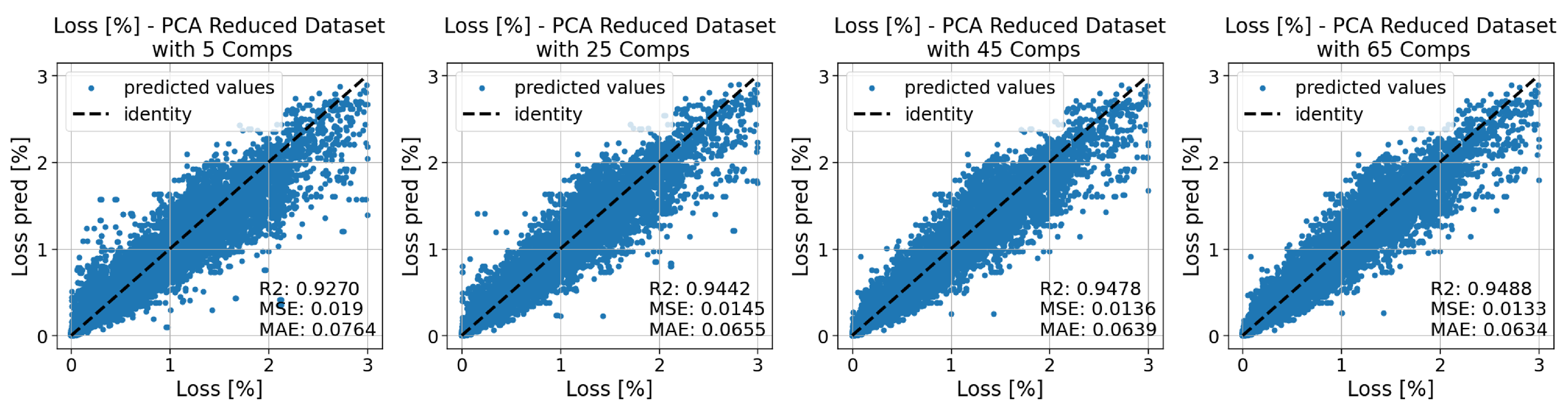
In this study, the amount of test rig data was set to the initial size and only the amount of principal components was varied. To make the range as wide as possible, the amount of components was reduced in steps of 20 components starting at 85 components. But a PCA model with 85 components was not included, because it would not have any benefit due to having as many components as parameters in the data set. Therefore, four different models were trained, consisting of 65, 45, 25 and 5 principal components. Figure 7 shows the correlation diagram of all models trained in this study.

3. Results

Below, the results of the study conducted in this paper are summarized. The results are presented according to the same scheme as in Section 2.

3.1. PCA

The implementation of the PCA of the initial data set showed that the data set can be illustrated with fewer parameters. In fact, within the defined criteria, it was possible to reduce the parameter size to 51 principal components. With these principal components, there is probably no loss of information but a lower dimension. The PCA with numerical data only was not sufficient because the criteria could not be fulfilled. By reducing at least one parameter, the data set becomes only 80% illustratable. By considering all 85 parameters, it is not worth reducing just one parameter.

3.2. Clustering

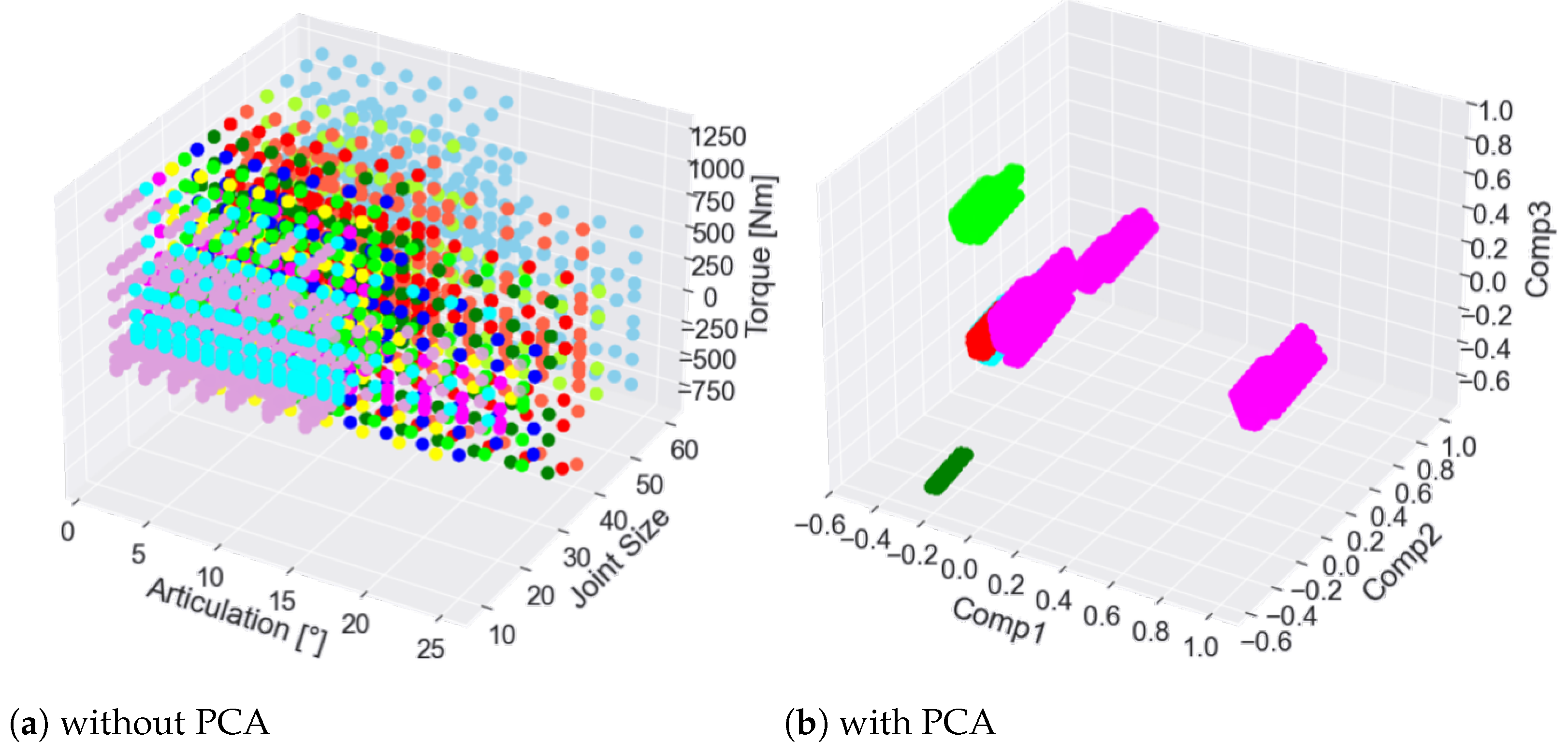
Clustering models with a specific amount of clusters were trained with the help of the elbow plots (Figure 5). For visualization of the clustering model without PCA, three significant parameters that influence the loss of a CVJ were selected: Articulation Angle, Torque and Joint Size (Figure 8a). The data points in the diagram behave in an organized way, and the clusters are noticeable due to the different colors. It can be seen that the clusters are arranged layerwise in the Joint Size direction, which means that the clusters are build up strongly regarding the size of the joints. However within the high amount of clusters for this model, its interpretability is difficult, and by changing the parameters for visualization, nothing more can be read.
The visualization of the model with PCA shows a clear group formation of the data (Figure 8b). The disadvantage of using PCA before performing clustering is that the principal components are not direct interpretable anymore, because one principal component contains information of different initial parameter. Although the grouping is clearly recognizable, it is no longer possible to see what information the parameters on the axis contain. Displaying the initial data with the clusters of the PCA model is also ineffective, because the clusters are mixed together and not grouped anymore.

3.3. Regression

3.3.1. Without PCA

The parameter study carried out in Figure 6 shows no logic results. It can be seen that the density of the data points decreases. The metrics R2-Score, mean squared error (MSE) and mean absolute error (MAE), selected in the previous study, are stable [19]. This behavior was expected because the data also has a high proportion of simulation data so that the complete amount of data does not become too small. This would mean that prediction of new data will rely predominantly on simulation results due to the ratio between simulation and test rig data.
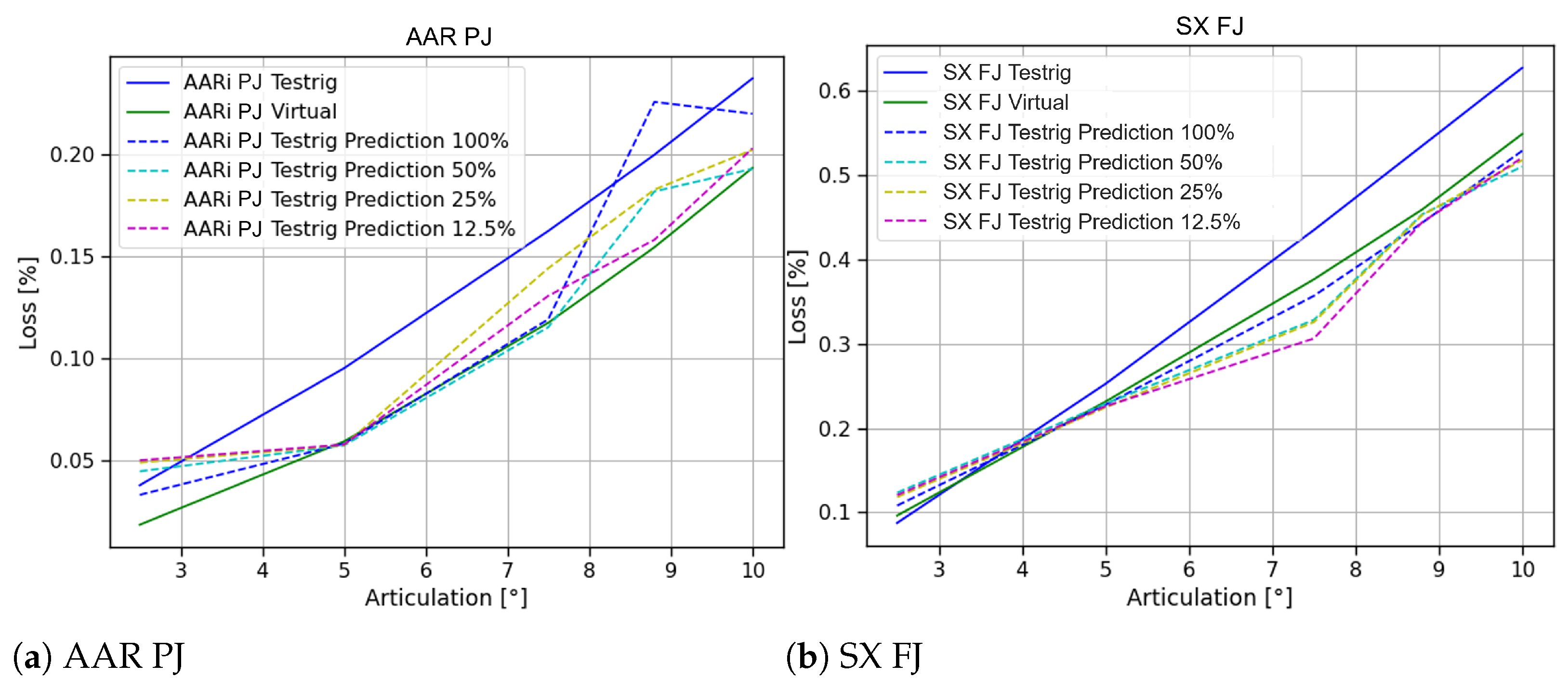
To confirm this assumption and test the accuracy of predictions, new test rig data of two different joint types (AAR Plunge Joint (PJ) type and SX Fixed Joint (FJ) type) were investigated and predicted. The results are shown in Figure 9 and compared with the real results from the rig and simulation. It is noticeable that the predictions come closer to the real test rig results as the proportion of test rig data increases. This behavior is plausible, as a small proportion of the test rig data means that the simulation data predominates and therefore dominates the prediction. This behavior can be observed for both tested joints and confirms the previously established assumption.

3.3.2. With PCA

The correlation diagrams of the models with reduced principal components in Figure 7 show a slight increase in the error metrics and R2-Score with a decreasing number of components. This increase happens especially within the step from 25 to 5 components.
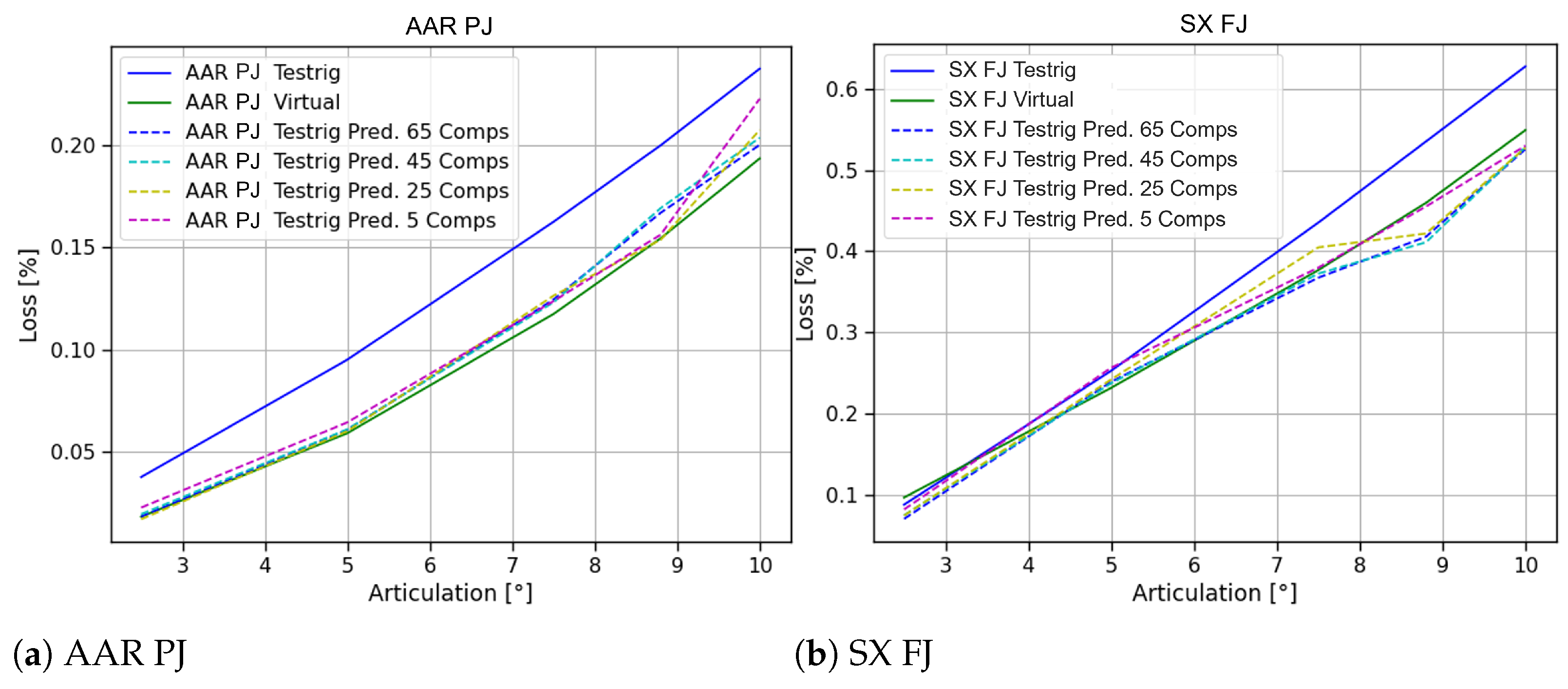
In order to compare the prediction behavior of the different models, the same new test rig data as in the previous study is predicted and visualized (Figure 10). The number of principal components has only a very small influence on the prediction of new data. It can be observed that with the AAR PJ, the correct amount of components depends on the articulation angle. But in general, having fewer components provides predictions that are closer to the results of the test rig. For the SX FJ, five components already provide the best prediction of the test rig result.

4. Discussion

In general, it is possible to improve the predictions of AI models by using mixed data. The results showed that the inclusion of different data sources increases the confidence and trust in the results produced by AI models using this mixed data.
Figure 9 shows that the prediction approaches the real test rig results with a larger proportion of test rig data. However, it can also be seen that this behavior differs between the two joints shown. It would therefore make sense to investigate this using further joints. There is no information about which data was removed because the selection of the reduced test rig data was randomly chosen. A case can occur where a large amount of data with an articulation angle greater than 6° but only a few data points lower than 6°. The weighting of the remaining data can therefore be different and thus influences the prediction.
While doing the PCA, the question arises whether it makes sense to include categorical and numerical data. The categorical data was previously encoded by the OneHotEncoder and the information only exists in binary form. Therefore the question regarding the meaningfulness of the variance compared to the one of numerical data needs to be raised. This can influence the results positively as well as negatively. This question could not be conclusively clarified but considering only numerical data is not worth it due to the high amount of parameters were still left. The criteria for selecting the principal components was defined by the Kaiser–Guttman rule, where only principal components with an explained variance higher than one are selected. The parameter study represented in Figure 10 and its predictions are showing a behavior that does not correspond to the expectation. The prediction of both joints approaches the real test rig results with decreasing number of principal components. The reason for this could be the consideration of important information only by the PCA. The prediction of the SX FJ could be improved by the PCA with a small number of principal components in relation to the real test rig result. The AAR PJ delivers better results without PCA (Figure 9).
The clustering without PCA provides results that are difficult to interpret and evaluate. The visualization shows the clusters within in the data points, but they are blurred (Figure 8a). The clusters are best recognizable when looking at the parameter combination of articulation, joint size, and torque. It is noticeable that the clusters are built layerwise along the Joint Size axis. No further information can be obtained. As the elbow plot for clustering with PCA is not showing the typical behavior, it is difficult to chose the correct number of clusters. However, the diagram in Figure 8b shows a clear group formation. But regarding the principal components of PCA, it is not recognizable what information the components contain. For example, it is possible to characterize the dominance of a specific component, but the meaning for the data set is unclear. This means a critical loss of physical relation to the reduced data could occur.
While combining simulated and test rig data can improve the robustness of predictions, it is essential to carefully check the quality and representativeness of both data sources. Discrepancies between the simulation and test rig data can lead to significant domain gaps, resulting in distorted model behavior. Such domain gaps, for example, systematic differences between simulated and real test rig data, can be critical because models may learn patterns that do not generalize to physical behavior, leading to biased or unreliable predictions when applied to real-world conditions. To mitigate such risks, particular care must be taken to ensure that the simulation data reflects conditions that are as realistic as possible and that the test rig data is of good quality [21].
As PCA, clustering and regression are widely used in the literature, this paper critically reviews existing approaches and highlights their opportunities and limitations in the context of CVJs. In addition, this methodology is used to examine the added value of data pooling. By integrating these ideas and methods into a customized workflow, the study makes a novel contribution to previous research.

5. Conclusions

The aim of this paper was to investigate combined data from different sources with different confidence factors and its influence on AI models. Therefore, various investigations, parameter studies and AI models were performed. For example, regression, clustering, and PCA models were trained and included into the studies.
All in all, the investigations and their results showed that data pooling of data from different sources with different confidences has an positive influence on the AI models. The study on new test rig data showed that having as much test rig data as possible (e.g., 100% instead of 12.5%) leads to predictions closer to the test rig result and therefore to a higher trust into these models. However, it can also be seen that even including a small amount of test rig data has a positive influence on the predictions. Additionally, this study revealed that models with fewer principal components (e.g., 5 instead of 65) often yielded predictions closer to the test rig result. But the PCA dimension reduction performed must be seen critically due to the partly included categorical data. These observations were gained even though the R2-Scores of the trained regression models did not changed significantly with a range of 0.9270 to 0.9497, as well as the MSE and MAE. Although the R2-Score differences between the models are small, the resulting prediction curves (Figure 9 and Figure 10) show noticeable qualitative changes, indicating that even minor variations in model fit can meaningfully affect how strongly the predictions align with real test rig behavior.
While the exact reduction potential of test rig runs cannot be quantified at this stage, the results indicate that using test rig data in combination with simulation data increases model confidence, suggesting that well-trained AI models may support a reduction in future physical test rig runs. As future investigations, prediction models for each of the CVJs and Articulation Angle can be trained to potentially obtain better performing models without influencing the prediction by other joint data. These results and findings could be used for further steps into implementing AI in CVJ development or general component development to speed up simulations and reduce the need for too many test rig loops and to support application teams upfront the customer.

Author Contributions

Conceptualization, J.L., O.E., D.R.; methodology, J.L., O.E., D.R.; software, J.L.; validation, J.L.; formal analysis, J.L., O.E., D.R.; investigation, J.L.; resources, J.L., O.E., A.B.; data curation, J.L.; writing—original draft preparation, J.L.; writing—review and editing, J.L., O.E., A.B., D.R.; visualization, J.L.; supervision, O.E., A.B., D.R.; project administration, J.L., A.B.; funding acquisition, none. All authors have read and agreed to the published version of the manuscript.

Funding

This research received no external funding.

Institutional Review Board Statement

Not applicable.

Informed Consent Statement

Not applicable.

Data Availability Statement

The data supporting the findings of this study are confidential and subject to non-disclosure agreements. Therefore, they are not publicly available and cannot be shared.

Conflicts of Interest

Authors Julian Lehnert, Orkan Eryilmaz and Arne Berger were employed by the company GKN Driveline International GmbH. The remaining authors declare that the research was conducted in the absence of any commercial or financial relationships that could be construed as a potential conflict of interest.

Abbreviations

The following abbreviations are used in this manuscript:
CVJconstant velocity joint
PCAprincipal component analysis
MSEmean squared error
MAEmean absolute error
SUVsport utility vehicle
AIartificial intelligence
ICEinternal combustion engine
EVelectric vehicle
PJPlunge Joint
FJFixed Joint

References

  1. Motzev, M. Prediction Accuracy—A Measure of Simulation Reality. Vanguard Sci. Instrum. Manag. 2019, 15. [Google Scholar] [CrossRef]
  2. Martin, A.C.M.; de Carvalho, M.M. Analysis of the Virtual Simulation Usage on Product Development Process. Prod. Manag. Dev. 2006, 12, 79–85. [Google Scholar]
  3. Timtong, A.; Ariyarit, A.; Boongsood, W.; Aengchuan, P.; Wiangkham, A. AI-driven data fusion modeling for enhanced prediction of mixed-mode I/III fracture toughness. Results Eng. 2024, 24, 103289. [Google Scholar] [CrossRef]
  4. Czarnetzki, L.; Iszak, Z.; Bachlechner, D.; Hetfleisch, R.; Chala, S.A.; Beecks, C. Towards Data Pooling in AI Projects: Opportunities and Challenges; University Würzburg: Würzburg, Germany, 2024; Unpublished Article. [Google Scholar]
  5. Schmahl, C.; Hildebrandt, W.; Reith, D. Der Einfluss von Wirkungsgradverbesserungen im Antriebsstrang auf die Energieeffizienz des Gesamtfahrzeuges—Elektrische und Konventionelle Antriebssysteme im Vergleich: Systemverständnis Eröffnet Zukünftige Wege; 6. ATZ-Fachtagung Tribologie; Springer: London, UK, 2018. [Google Scholar] [CrossRef]
  6. GKN Automotive. Internal Efficiency Test Rig Data Set; GKN Automotive: Lohmar, Germany, 2021. [Google Scholar]
  7. Thangm, C.; Huang, W.; Niu, T.; Li, Z.L.G.; Cao, D. Review of Clustering Technology and Its Application in Coordinating Vehicle Subsystems. Automot. Innov. 2023, 6, 89–115. [Google Scholar] [CrossRef]
  8. Guezza-Urzola, R.; Deun, K.V.; Vera, J.C.; Sijtsma, K. A Guide for Sparse PCA: Model Comparison and Applications. Psychometrika 2021, 86, 893–919. [Google Scholar] [CrossRef]
  9. Harris, M.; Smith, L. Enhancing AI Models with Data Fusion Techniques. Am. J. Artif. Intell. Neural Netw. 2023, 4. Available online: https://www.australiansciencejournals.com/ajainn/article/view/620/675 (accessed on 2 February 2025).
  10. Humbird, K.D.; Peterson, J.L.; Salmonson, J.; Spears, B.K. Cognitive simulation models for inertial confinement fusion: Combining simulation and experimental data. Phys. Plasmas 2021, 28, 042709. [Google Scholar] [CrossRef]
  11. Nguyen, T.; Khadka, R.; Phan, N.; Yazidi, A.; Halvorsen, P.; Riegler, M.A. Combining datasets to improve model fitting. In Proceedings of the 2023 International Joint Conference on Neural Networks (IJCNN), Gold Coast, Australia, 18–23 June 2023. [Google Scholar] [CrossRef]
  12. Comlek, Y.; Ravi, S.K.; Pandita, P.; Ghosh, S.; Wang, L.; Chen, W. Heterogenous Multi-Source Data Fusion Through Input Mapping and Latent Variable Gaussian Process. arXiv 2024, arXiv:2407.11268. [Google Scholar] [CrossRef]
  13. Cabrera, M.; Ninic, J.; Tizani, W. Fusion of experimental and synthetic data for reliable prediction of steel connection behaviour using machine learning. Eng. Comput. 2023, 39, 3993–4011. [Google Scholar] [CrossRef]
  14. scikit-learn: Machine Learning in Python. scikit-learn, Version: 1.7.2. Released: September 2025. Available online: https://scikit-learn.org/stable/ (accessed on 9 September 2025).
  15. GKN Automotive. Internal GKN Test Standard for Efficiency of Constant Velocity Joints; GKN Automotive: Lohmar, Germany, 2011. [Google Scholar]
  16. Albon, C. Machine Learning with Python Cookbook: Practical Solutions from Preprocessing to Deep Learning; O’Reilly: Sebastopol, CA, USA, 2008; ISBN 9781491989388. [Google Scholar]
  17. Silva, R.B.; de Oliveira, D.; Satos, D.P.; Santos, L.F.D.; Wilson, R.E.; Bedo, M. Criteria for choosing the number of dimensions in a principal component analysis: An empirical assessment. An. SimpóSio Bras. Banco Dados (SBBD) 2020, 35, 145–150. [Google Scholar] [CrossRef]
  18. Müller, A.C.; Guido, S. Introduction to Machine Learning with Python: A Guide for Data Scientists; O’Reilly: Sebastopol, CA, USA, 2016; ISBN 9781449369415. [Google Scholar]
  19. Lehnert, J. Entwicklung und Bewertung Einer Neuen KI-Basierten Produktentwicklungsmethode für Gleichlaufgelenke. Bachelor’s Thesis, Hochschule Bonn-Rhein-Sieg, Sankt Augustin, Germany, 2023. [Google Scholar]
  20. PyCaret: An Open Source, Low-Code Machine Learning Library in Python. PyCaret, Version: 3.3.2, Released: 28 April 2024. Available online: https://pycaret.org/ (accessed on 12 May 2024).
  21. Höfer, S.; Bekris, K.; Handa, A.; Higuera, J.; Mozifian, M.; Golemo, F.; Atkeson, C.; Fox, D.; Goldberg, K.; Leonard, J.; et al. Sim2Real in Robotics and Automation: Applications and Challenges. IEEE Trans. Autom. Sci. Eng. 2021, 18, 398–400. [Google Scholar] [CrossRef]
Figure 1. Schematic diagram of the single steps, including core in- and output, which are carried out in this investigation. For the preparation before model training, the data set is built up, investigated and prepared. Afterwards clustering and regression models were performed. Additionally, a dimension reduction with PCA was carried out followed by clustering and regression models. The final models are highlighted in yellow.
Machines 14 00148 g001
Figure 2. The Distribution of the Drive and Coast Modes of the combined data can be seen. Additionally, the diagram splits the data into source to see the ratio between the test rig (52,486 data points) and simulation data (43,312 data points).
Machines 14 00148 g002
Figure 3. Histograms showing the distribution of the introduced parameter from the combined data set. This includes Loss (a), Articulation Angle (b), Torque (c), Speed (d), Size (e) and Temperature (f). These histograms provide insights into the frequency and distribution of these parameters to analyze the spread of the used data.
Machines 14 00148 g003
Figure 4. Diagram (a) shows the sum of explained variance of PCA models with rising amount of components (0 to 85). Diagram (b) shows the explained variance of each component of the final PCA model with 51 components.
Machines 14 00148 g004
Figure 5. Diagram (a) showing the elbow plot for clustering model without PCA. Diagram (b) showing the elbow plot for clustering model with PCA. Both models are related to KMeans algorithm.
Machines 14 00148 g005
Figure 6. Different correlation diagrams and their metrics (R2-Score, MSE and MAE) with different amounts of test rig data size can be seen. Test rig data size is increasing from the left image to the right image: 12.5%, 25%, 50% and 100%.
Machines 14 00148 g006
Figure 7. Different correlation diagrams and their metrics (R2-Score, MSE and MAE) with different amounts of principal components can be seen. Principal components are increasing the from left image to the right image: 5, 25, 45 and 65.
Machines 14 00148 g007
Figure 8. Visualization of the clusters in three dimensions. The clusters are color-coded. The diagram of clustering without PCA considers Articulation, Joint Size and Torque as parameters (a). The diagram of clustering with PCA considers principal components one, two, and three as parameters (b).
Machines 14 00148 g008
Figure 9. Comparison of predictions within the variation of test rig data size of AAR PJ (a) and SX FJ (b). The data size has been halved three times up to 12.5% of the initial test rig data size (dotted lines). The real test rig result and the simulation result are specified in terms of comparability (straight lines).
Machines 14 00148 g009
Figure 10. Comparison of prediction within the variation of the amount of principal components in the PCA study. Results for AAR PJ (a) and SX FJ (b) are shown. The amount of principal components is reduced three times by 20, starting with 85 principal components and going to 45, 25 and 5 components (dotted lines). The real test rig result and the simulation result are specified in terms of comparability (straight lines).
Machines 14 00148 g010
Table 1. List of parameters of the test rig data set within the units, characteristics and value ranges of each parameter.
ParameterUnitCharacteristicValue Range
Joint Type 72 different joints types
Joint Size 20 different joint sizes15 to 56
TorqueNm32 different torques−820 Nm to 1000 Nm
Speedrpm21 different speeds−1000 rpm to 2000 rpm
Articulation Angle°25 different angles1° to 25°
Mode 2 different modesDrive (acc.), Coast (recup.)
Temperature°C10 different temperatures20 °C to 100 °C
Table 2. List of parameters of the simulation data set within the units, characteristics and value ranges of each parameter.
ParameterUnitCharacteristicValue Range
Joint Type 33 different joints types
Joint Size 16 different joint sizes9 to 60
TorqueNm8 different torques25 Nm to 1200 Nm
Speedrpm4 different speeds100 rpm to 800 rpm
Articulation Angle°14 different angles2° to 16°
Mode 2 different modesDrive (acc.), Coast (recup.)
Temperature°Croom temperature20 °C
Disclaimer/Publisher’s Note: The statements, opinions and data contained in all publications are solely those of the individual author(s) and contributor(s) and not of MDPI and/or the editor(s). MDPI and/or the editor(s) disclaim responsibility for any injury to people or property resulting from any ideas, methods, instructions or products referred to in the content.