
Dynamic Cooperative Control Method for Highly Maneuverable Unmanned Vehicle Formations Based on Adaptive Multi-Mode Steering


Abstract
1. Introduction
- A unified formation-planning framework based on the virtual-structure method is established. Anchored to the lead vehicle, this approach ensures consistent, decoupled control for all followers.
- An adaptive steering-mode selector is introduced. This mechanism autonomously determines the optimal steering mode by analyzing real-time vehicle states and the specific requirements of the assigned formation transition.
- Validation via MATLAB/Simulink simulations, which demonstrates that the proposed strategy maintains high tracking accuracy while significantly reducing both maneuver time and spatial occupation during complex tasks (e.g., column-to-line transitions) compared to conventional FWS methods [21].
2. Structural and Control System Modeling for Autonomous Vehicles
2.1. Architecture of Autonomous Vehicle Platforms and Definition of Coordinate Systems
2.2. Multi-Mode Steering Vehicle Kinematic Model
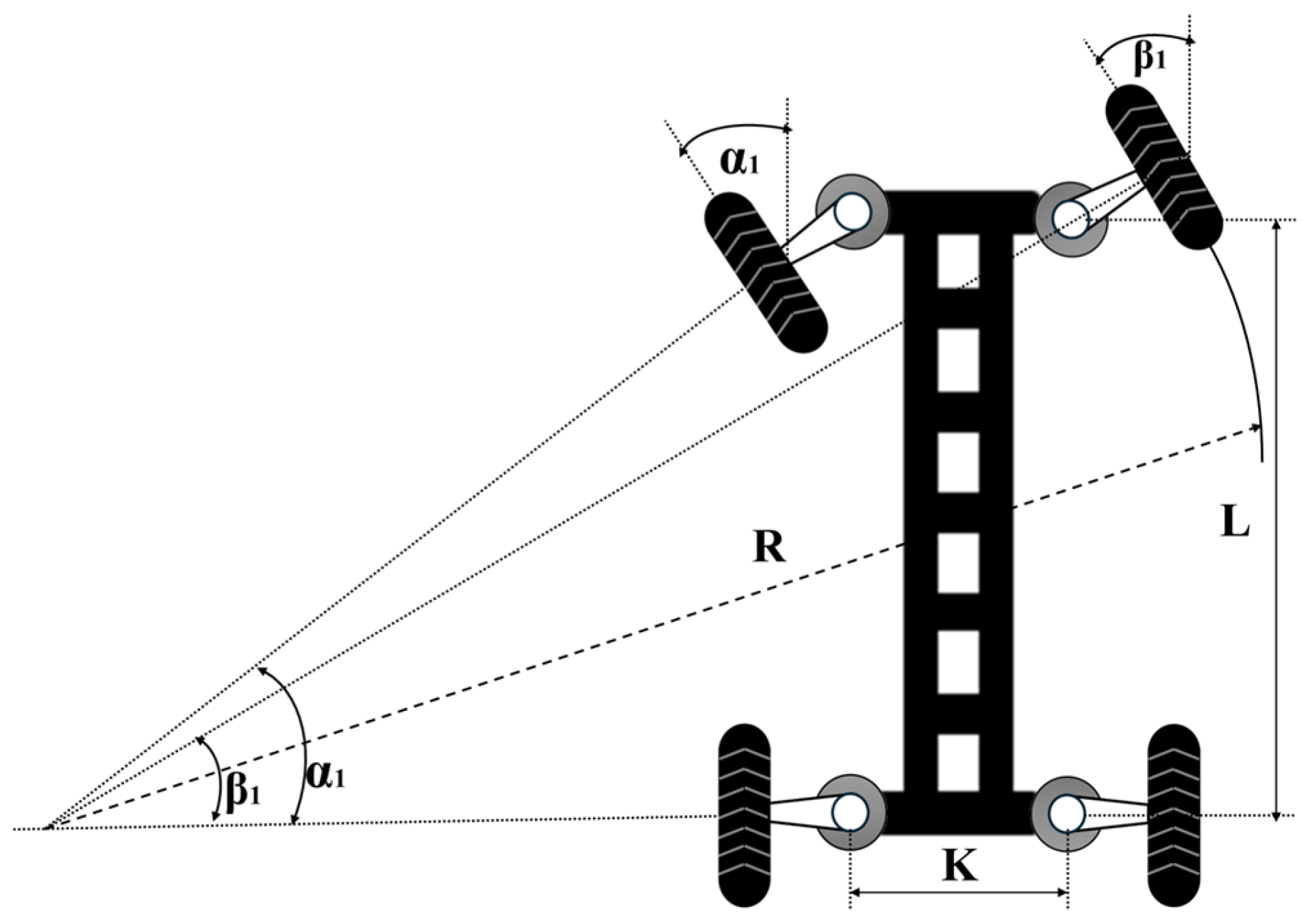
2.2.1. Front-Wheel Ackermann Steering
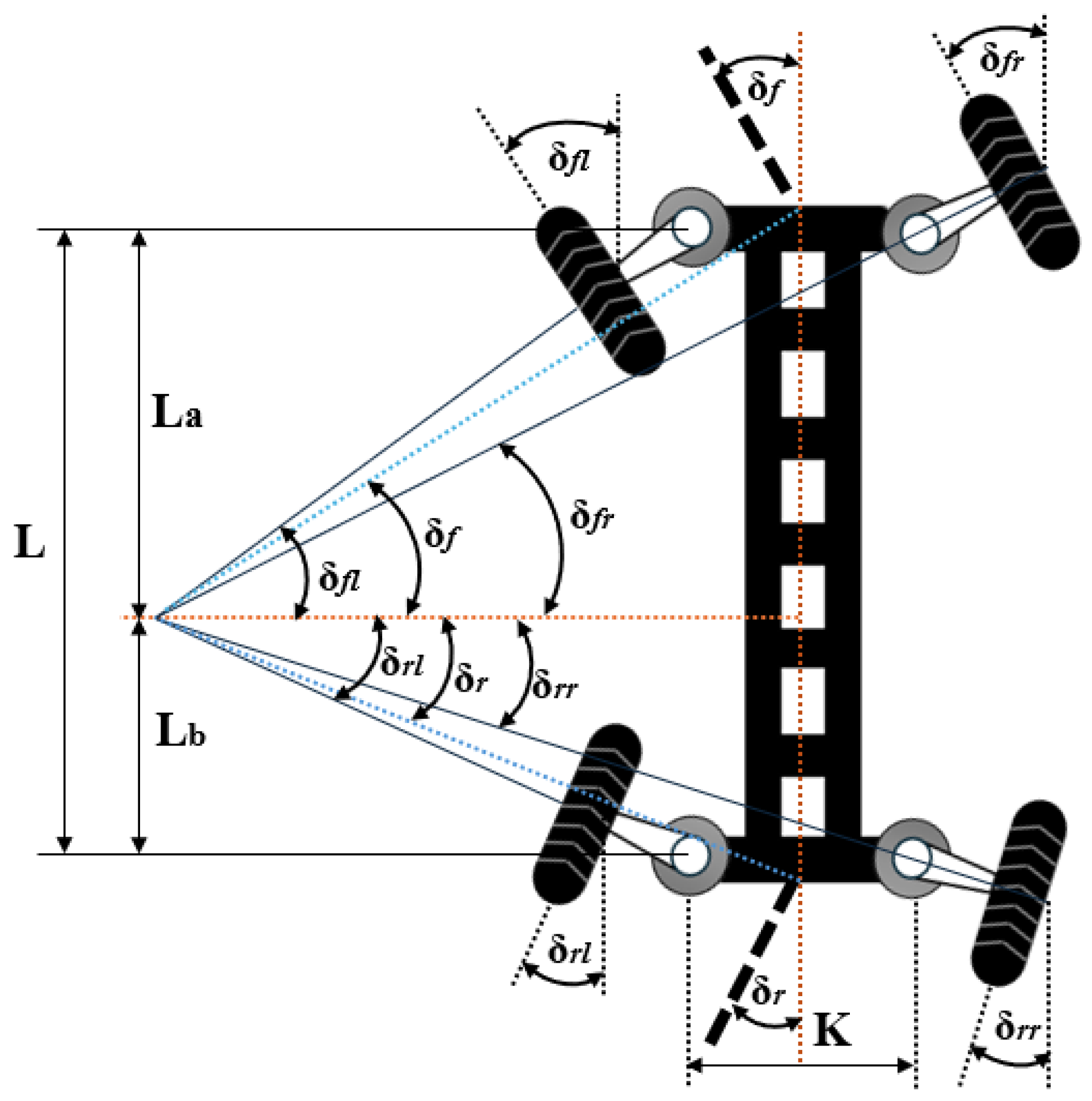
2.2.2. Four-Wheel Reverse Ackermann Steering
2.2.3. Crab Steering Kinematic Model
3. Adaptive Multi-Mode Steering Control
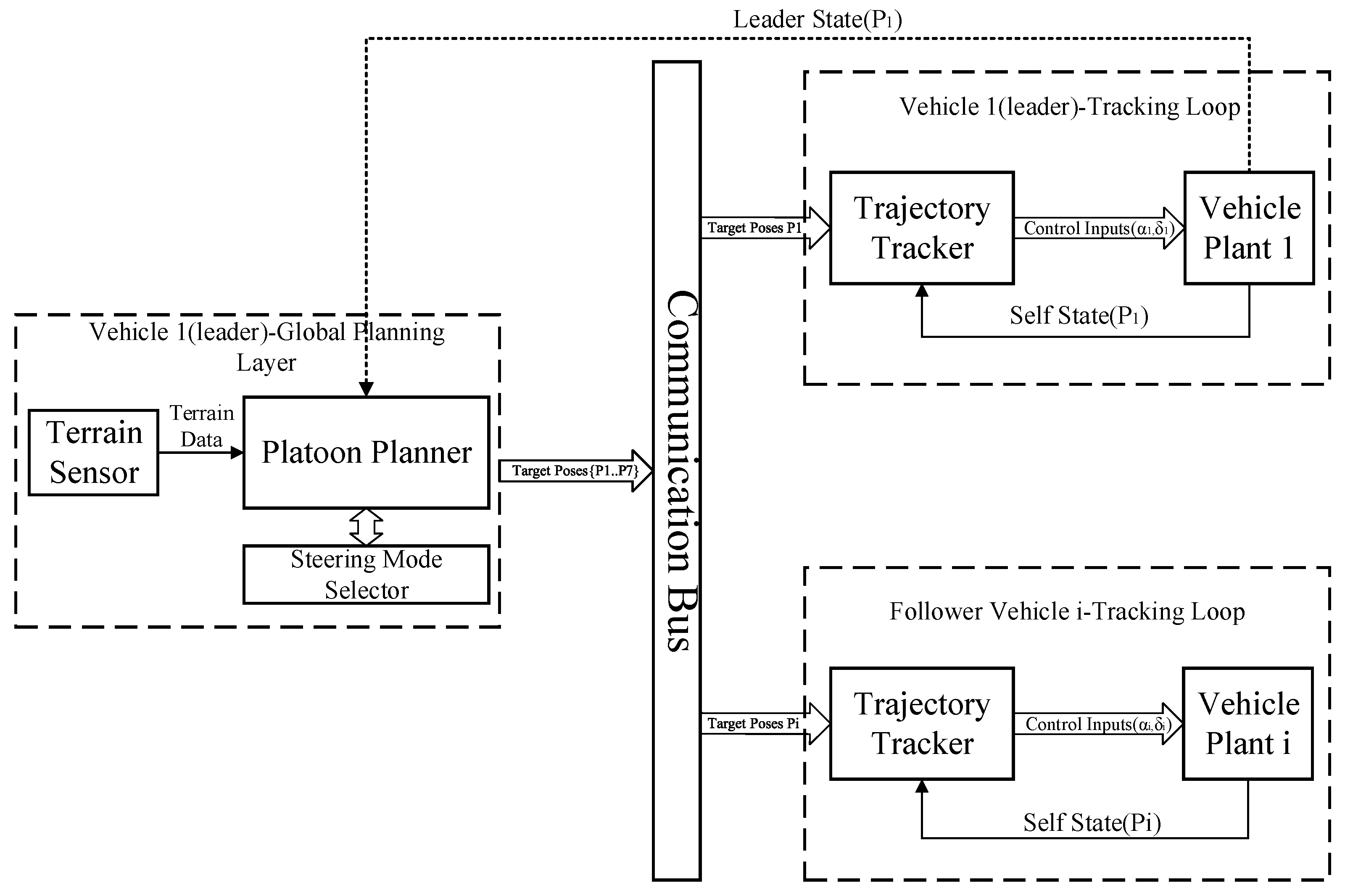
3.1. Overall Control Architecture
3.2. Formation Planner
- Linear Formation: Suitable for scenarios requiring distance maintenance and formation integrity, categorized into longitudinal and lateral types.Longitudinal Linear Formation:Horizontal Linear Formation:Among these, Lcol and Lrow represent the preset vertical and horizontal safety distances, respectively.
- V-shape Formation: Used to enhance forward visibility and reduce air resistance, with following vehicles arranged in a V-shape formation behind the lead vehicle.Among these, Lvx and Lvy control the depth and opening angle of the V-shape.
- Rectangular Formation: Suitable for patrolling or surveillance within a specific area, with vehicles arranged in multiple rows and columns to form a grid pattern.Among these, Lrx and Lry define the row spacing and column spacing of the rectangle, respectively.
- Circular Formation: Suitable for area surveillance or specific target monitoring. To ensure the lead vehicle remains at the formation’s forefront for perception and decision-making tasks, this study defines the circular formation as follows: The lead vehicle occupies the apex of an arc, with subsequent vehicles arranged in a semicircle or arc behind it, centered on a virtual point located behind the lead vehicle. The expected relative displacement vector for the i-th follower vehicle (i > 1) is defined as:where R is the formation radius, αi is the angle corresponding to the i-th vehicle on the arc. When vehicles are symmetrically distributedAmong these, Δα is the preset angular spacing between vehicles.
3.3. Trajectory Tracking Controller
3.3.1. Controlled Decoupling Transformation
3.3.2. Decoupled Control Tracking
3.3.3. Stability Analysis
3.4. Adaptive Steering Mode Selection Strategy
3.4.1. Intent Extraction
3.4.2. Rule-Based Steering Pattern Allocation
- Rule 1: Set to Crab Mode (CS)
- 2.
- Rule 2: Set to Four-Wheel Counter-Steering (4WCS)
- 3.
- Rule 3: Set to front-wheel steering mode (FWS)
- Threshold for Crab Steering (αth): Although the physical steering limit of the vehicle is δmax= 60°, operating at such high angles during motion can induce excessive lateral forces and rollover risks. To ensure safety, we implemented a software saturation limit of 30° (≈0.52 rad). Consequently, the effective range for Crab Mode is defined as |ξmaneuver| ≤ 0.5 rad (≈28°). Within this range, the vehicle performs precise linear translation. If the required angle exceeds this threshold, the system prioritizes 4WCS to utilize yaw moment for re-orientation or maintains the Crab Mode at the saturation limit, depending on the task urgency.
- Speed Threshold for Mode Switching (vth): The low-speed protection threshold is set to vth = 0.5 m/s. This value is derived from the singularity analysis of the feedback linearization control law (Equation (22)), where the term 1/v leads to numerical instability as the vehicle speed approaches zero. Below this threshold, the system locks into kinematic-based control (4WCS or FWS) to ensure smooth maneuvering during start-stop operations.
4. Simulation Results and Analysis
4.1. Simulation Platform Setup
- Control-Theoretic Rigor: The core contribution of this paper lies in the mathematical formulation of the AMM control law and the logical stability of the mode-switching state machine. Simulink is widely recognized as the standard environment for rigorous analysis of controller stability and dynamic response at the theoretical level.
- Kinematic Focus: Our research objective is to solve kinematic constraints and optimize formation geometry. The mathematical vehicle models built in Simulink are sufficient to capture the non-holonomic constraints and steering dynamics relevant to this scope, without the confounding factors of visual rendering or complex terrain friction found in physics-based simulators.
- Reproducibility: Using a standardized, equation-based environment facilitates the reproducibility of the control algorithms by the research community.
- (1)
- Global Reference Module: To ensure global consistency and repeatability of formation trajectories, the system introduces a Virtual Reference Generator to replace traditional physical reference vehicles as the global path planning benchmark, thereby providing a unified trajectory reference within the simulation environment.
- (2)
- Centralized Planning Module: This module determines the optimal formation structure for the fleet based on environmental perception data and mission requirements, while calculating the target poses for each member vehicle. Its output serves as the control reference for downstream distributed control modules.
- (3)
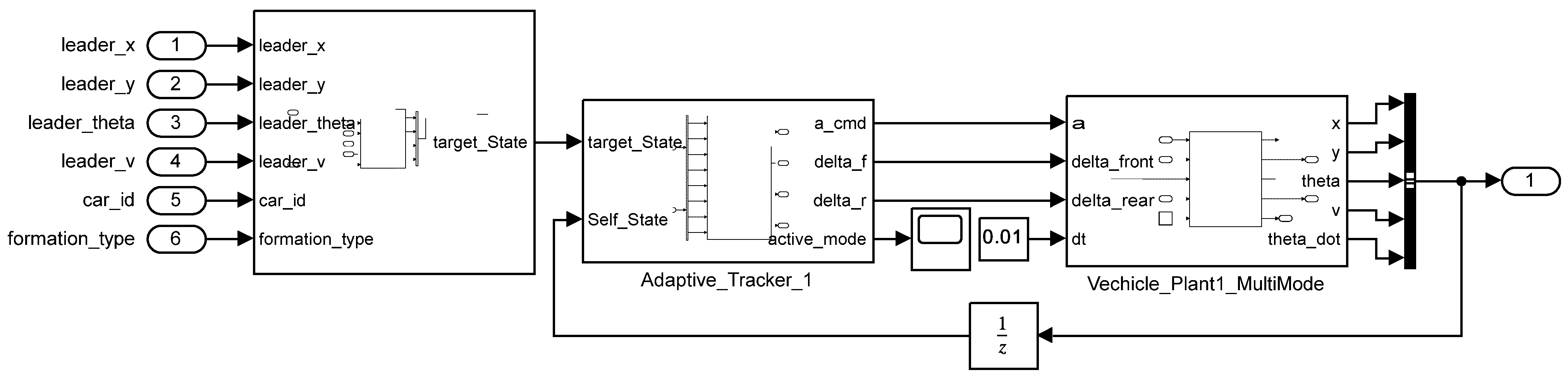
- Distributed Control Modules: Seven functionally identical vehicle control loops were constructed within the Simulink platform to simulate the independent control behavior of each vehicle in the formation. Each control loop comprises two components: a vehicle dynamics module and an adaptive trajectory tracking module. 1. The Vehicle Dynamics Module is built upon the multi-modal kinematic model proposed earlier. It dynamically responds to composite control commands (position, velocity, yaw angle, etc.) issued by the Trajectory Tracking Module and outputs the vehicle’s complete state information in real time. 2. The adaptive trajectory tracking module integrates a feedback linear decoupling controller and an adaptive steering mode selector. By comparing the target state issued by the centralized planning module with the vehicle’s own state, it achieves real-time precise control and mode switching for each vehicle.
- (4)
- Data Interface and Visualization Module: This module comprises the system bus and visualization subsystem. The bus system facilitates large-scale data exchange among multiple modules, ensuring standardized and scalable data transmission. The visualization subsystem collects real-time status information from each vehicle and dynamically renders two-dimensional motion animations of the fleet within the simulation environment. This provides an intuitive representation of formation behavior, aiding in result analysis.Partial control system models are shown in Figure 8. The complete model can be found in the Supplementary Materials.
4.2. Scenario Design and Comparison Options
4.3. Experimental Results and Analysis
4.3.1. Analysis of the Experiment on Coordinated Parallel Lane Changes in Convoys
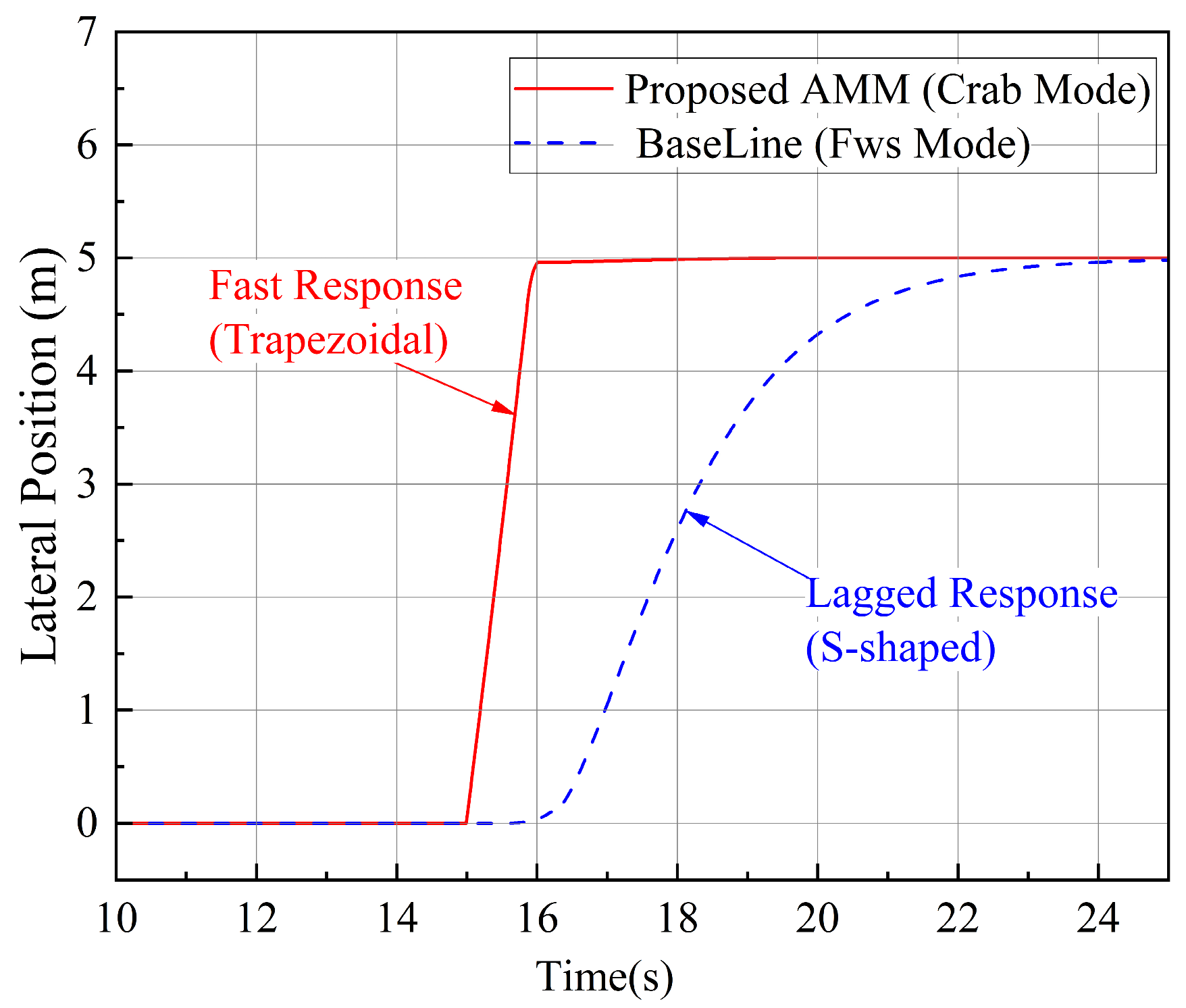
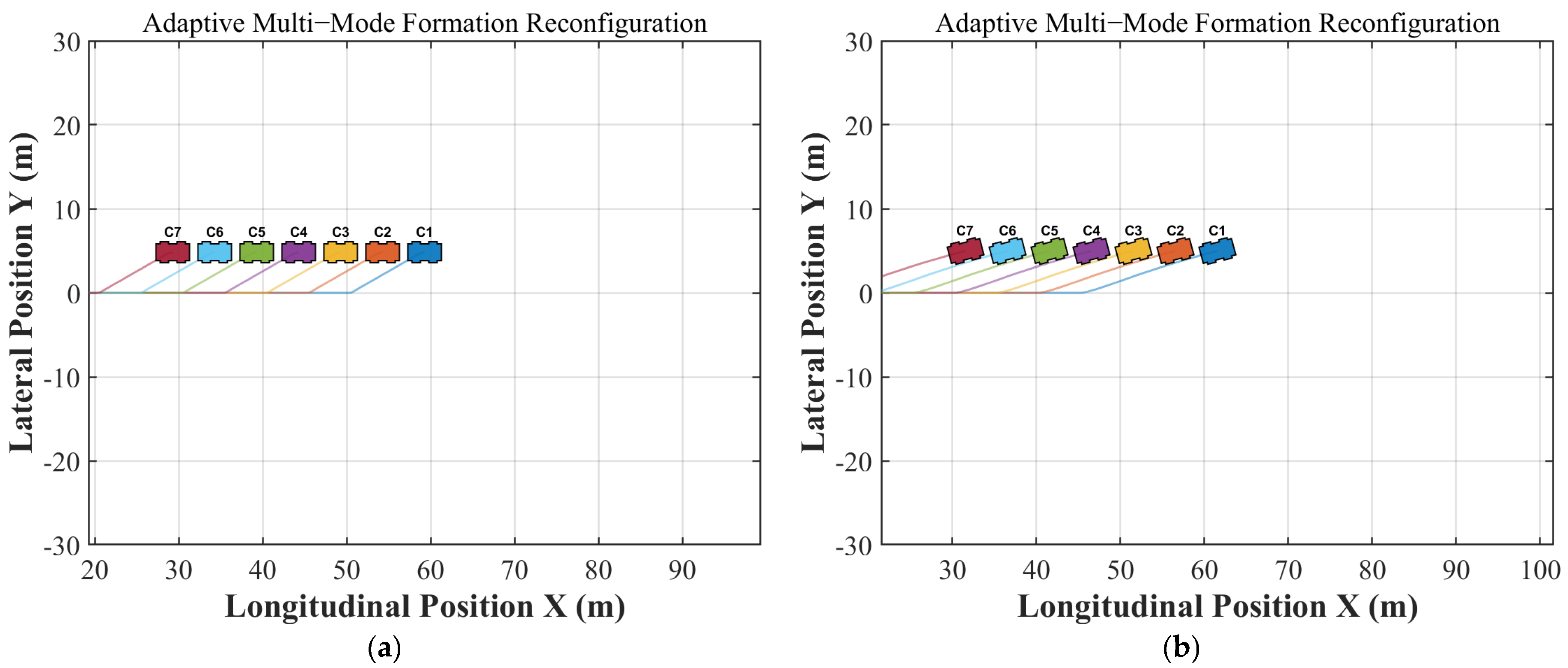
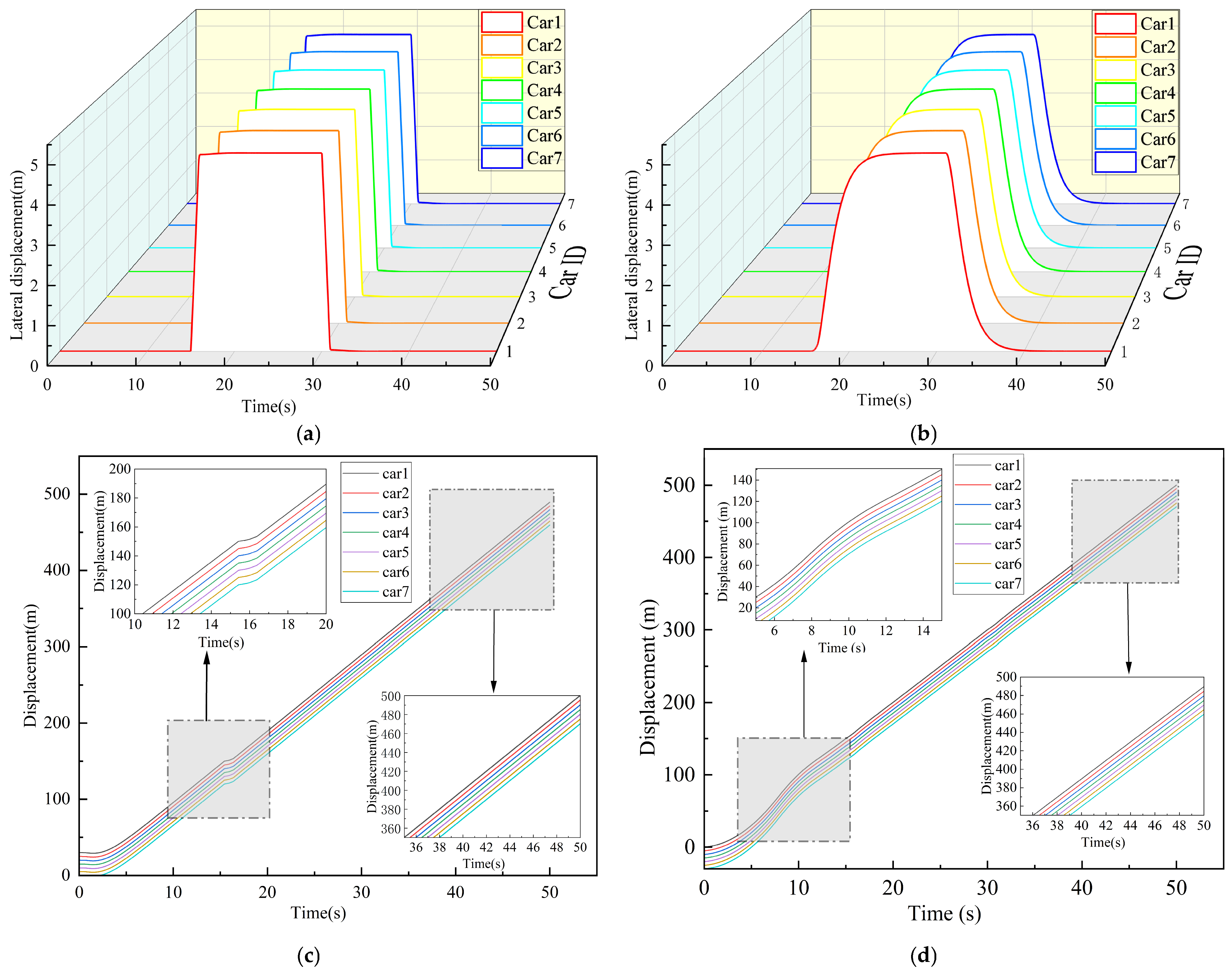
- Trajectory Analysis and Baseline Comparison: As illustrated in Figure 9, the trajectory of the proposed AMM strategy (utilizing Crab Mode) exhibits a distinct “trapezoidal” profile. Upon receiving the lane-change command (lateral offset = 5 m), each vehicle locks its body orientation (θ ≈ 0, as shown in Figure 10) and generates lateral velocity directly through coordinated wheel-angle adjustments. In contrast, the Baseline FWS method (shown as the blue dashed line in Figure 9) exhibits a typical “S-shaped” lag. Constrained by non-holonomic kinematics, FWS vehicles must first accumulate yaw angle to generate a lateral velocity component, introducing significant phase lag and path redundancy. The simulation results visually confirm that the AMM strategy achieves an almost instantaneous response to abrupt lateral reference changes with zero overshoot, whereas the baseline method requires a much longer adjustment period.
- Quantitative Performance Assessment: To rigorously quantify the advantages of the proposed method, Table 1 summarizes the performance metrics of both modes under identical lateral offset requirements. The results demonstrate significant improvements:
- Actuation Delay: The AMM strategy reduces the actuation delay by 75% (from 0.4 s to 0.1 s) compared to the baseline.
- Settling Time: The total settling time is shortened by 86.8% (from 7.68 s to 1.01 s), indicating a drastic increase in maneuvering efficiency in confined spaces.
- Steady-State Error: The position deviation is reduced by 40% (from 0.005 m to 0.003 m).
- Longitudinal Dynamics and Mode Selection Logic: Furthermore, analysis of the X-axis trajectories reveals the rationale behind the mode-switching strategy (as shown in Figure 11). The formation adopting the Crab Mode experiences a noticeable reduction in longitudinal velocity (vx = v × cos α) during the maneuver. In contrast, the formation using FWS maintains its longitudinal speed better at the onset. This physical trade-off validates the proposed adaptive logic: utilizing Crab Mode for small offsets to prioritize path efficiency and precision, while switching to Front-Wheel Steering for larger displacements to maintain longitudinal momentum and overall operational efficiency.
4.3.2. Analysis of Multi-Formation Transition and Adaptive Hierarchical Control
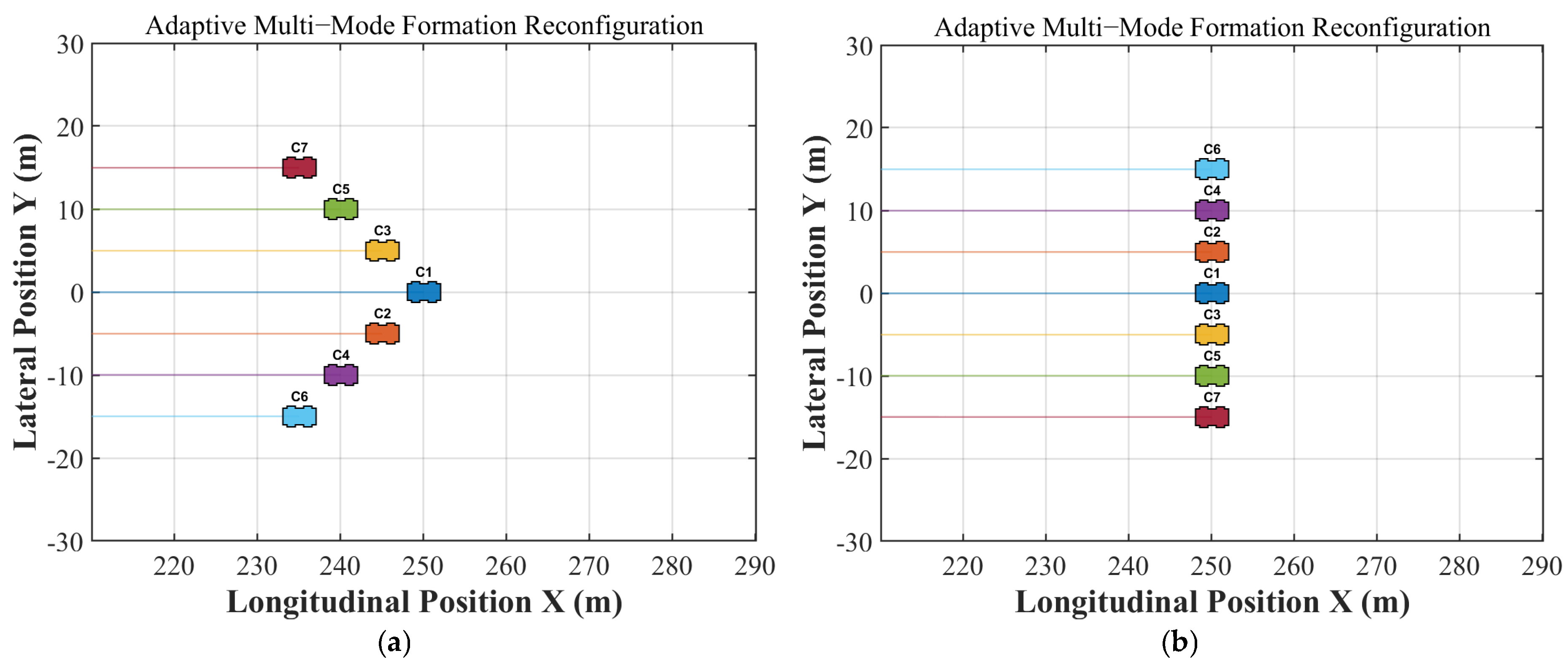
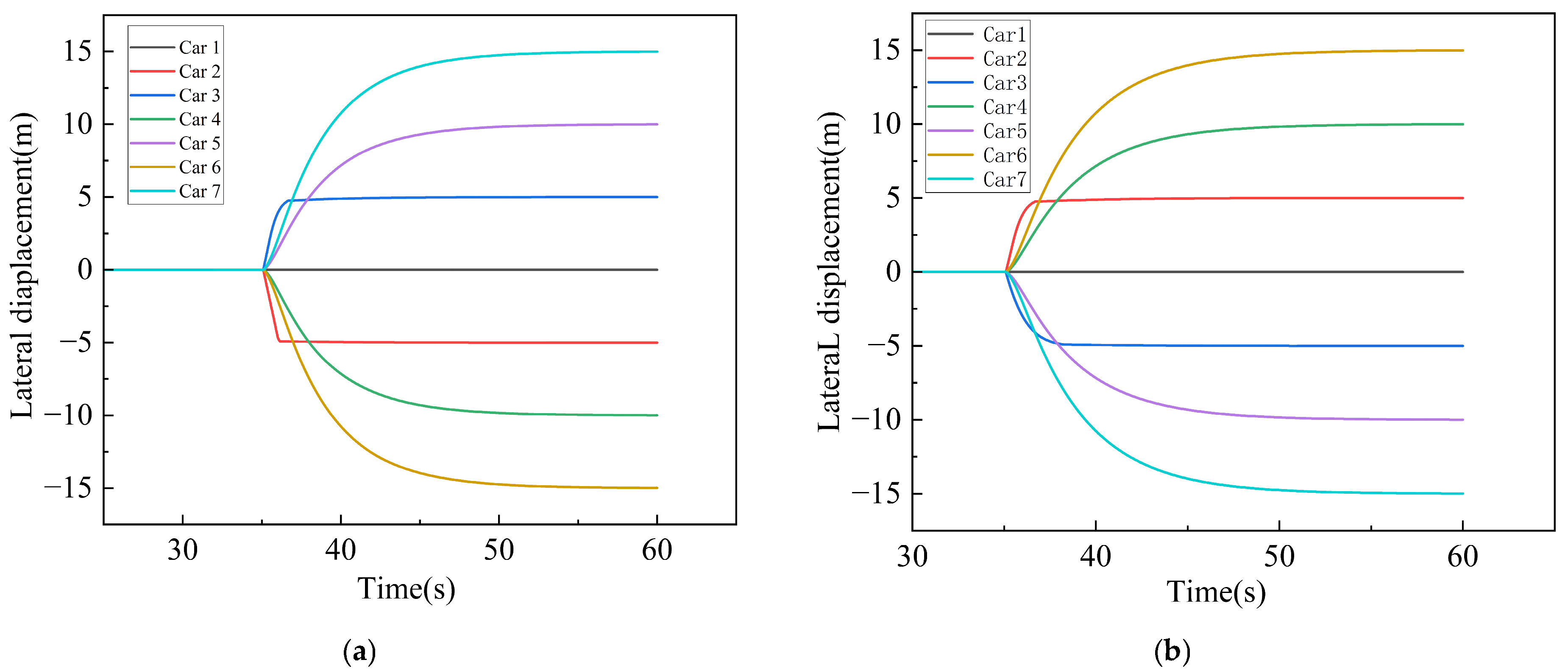
- Mechanism Analysis of Differentiated Decision-Making: The trajectory results (Figure 12 and Figure 13) explicitly demonstrate how the proposed controller assigns differentiated strategies based on the “Task Difficulty” (defined by lateral deviation magnitude):
- Inner Vehicles (e.g., C2, C3): The controller identifies these vehicles as performing “fine-tuning tasks” (Lateral deviation < 6 m). Consequently, it automatically activates Crab Mode (Mode 1). As seen in the trajectory, C2 and C3 execute precise linear oblique translations. This strategy utilizes the holonomic property of crab steering to take the shortest path, avoiding the redundant heading adjustments required by traditional Ackerman steering.
- Outer Vehicles (e.g., C6, C7): Due to the substantial lateral displacement (>10 m) and the need for significant longitudinal acceleration to catch up with the formation, the controller classifies this as a “high-dynamic maneuver.” The system forcibly locks these vehicles into Front-Wheel Steering (FWS) Mode. This decision leverages the high-speed stability of FWS, preventing the potential body oscillations and tire saturation that can occur when attempting large-angle crab maneuvers at high speeds.
- Stability and Anti-Chattering Analysis: A critical challenge in multi-mode control is the potential for “chattering” (rapid mode flickering) at the decision boundaries. As observed in the smooth mode transitions in Figure 13, the proposed Hysteresis Logic and Task Latch Mechanism effectively eliminate this issue.
- During the transition phase, even if the instantaneous error of the outer vehicles (C6, C7) fluctuates near the threshold, the hysteresis logic ensures the mode remains locked in FWS until the maneuver is substantially complete.
- The trajectory forms a smooth, continuous S-curve without the step-like discontinuities often seen in discrete switching logic. This confirms that the proposed framework not only optimizes spatial efficiency but also guarantees the dynamic stability of the closed-loop system during complex topology changes.
5. Conclusions and Future Work
5.1. Conclusions
- (1)
- Overcoming kinematic constraints to enhance maneuver efficiency: The developed AMM framework enables seamless transitions between front-wheel steering, four-wheel counter-steering (4WCS), and crab-walk modes. Simulation results demonstrate that during pure lateral translation tasks, the crab-walk mode effectively avoids path redundancy caused by heading angle adjustments. Compared to traditional front-wheel steering systems, response time is reduced by approximately 75%, enabling smooth maneuvers without overshoot.
- (2)
- Establishing a hierarchical decision-making mechanism for intelligent coordination: Addressing differentiated requirements during formation reconstruction, a task-hierarchy logic based on lateral displacement is proposed. The system automatically classifies vehicles into “Fine Adjustment Groups” (using crab mode) and “Large-Range Maneuver Groups” (maintaining FWS mode). Through V-shaped and lateral deployment experiments, this mechanism ensures precise alignment of the inner vehicles while fully leveraging the speed advantage of the outer vehicles, significantly enhancing the overall formation reconfiguration efficiency.
- (3)
- Overcoming Stability Challenges During Mode Transition: To address control jitter and overshoot issues prone to occur during discrete mode switching, we introduced hysteresis comparison logic, anti-jitter timers, and cascaded velocity planning methods. Experimental results demonstrate that all vehicles exhibit smooth trajectories under complex conditions, with decisive and stable mode transitions. This method completely eliminates the step-like oscillations commonly found in traditional control systems, fully validating the robust performance of the proposed control system.
5.2. Limitations and Future Work
- (1)
- The vehicle dynamics and nonlinear disturbance factors have not been fully considered. Current research primarily relies on kinematic models and has not yet addressed dynamic characteristics such as tire lateral deflection and ground adhesion coefficients. Future work will incorporate high-fidelity dynamic models and design corresponding robust controllers to compensate for these nonlinear disturbances.
- (2)
- The stability issue under constrained communication conditions remains unresolved. Existing control frameworks assume ideal communication, neglecting the actual delays and packet loss that exist. Future work will focus on developing formation control methods for constrained communication environments and designing observer-based state compensation algorithms to enhance system robustness.
- (3)
- The dynamic obstacle avoidance capability remains to be validated, and real-vehicle testing is currently lacking. The current avoidance scenarios are relatively simple. Future work will integrate model predictive control methods to investigate real-time obstacle avoidance in complex dynamic environments. This algorithm will be deployed on the 4WIDS unmanned vehicle test platform, with its engineering feasibility validated through real-vehicle experiments.
Supplementary Materials
Author Contributions
Funding
Data Availability Statement
Acknowledgments
Conflicts of Interest
Abbreviations
| FWS | Front-Wheel Steering |
| AMM | Adaptive Multi-Mode |
| CS | Crab Steering |
| 4WIDS | Four-Wheel Independent Drive and Steering |
| 4WCS | Four-Wheel Counter-Steering |
| UGVs | Unmanned Ground Vehicles |
References
- Zheng, Y.; Li, S.E.; Li, K.; Borrelli, F.; Hedrick, J.K. Distributed model predictive control for heterogeneous vehicle platoons under unidirectional topologies. IEEE Trans. Control Syst. Technol. 2016, 25, 899–910. [Google Scholar] [CrossRef]
- Ma, L.; Wang, Z.; Han, Q.L.; Liu, Y. Consensus control of stochastic multi-agent systems: A survey. Sci. China Inf. Sci. 2017, 60, 120201. [Google Scholar] [CrossRef]
- Wang, Z.; Wang, L.; Zhang, H.; Vlacic, L.; Chen, Q. Distributed formation control of nonholonomic wheeled mobile robots subject to longitudinal slippage constraints. IEEE Trans. Syst. Man Cybern. Syst. 2019, 51, 2992–3003. [Google Scholar] [CrossRef]
- Shen, C.; Shi, Y.; Buckham, B. Trajectory tracking control of an autonomous underwater vehicle using Lyapunov-based model predictive control. IEEE Trans. Ind. Electron. 2017, 65, 5796–5805. [Google Scholar] [CrossRef]
- Saikin, A.M.; Buznikov, S.E.; Elkin, D.S.; Strukov, V.O. Integrated navigation system for unmanned vehicle convoy. Int. J. Innov. Technol. Explor. Eng. 2019, 8, 4021–4025. [Google Scholar] [CrossRef]
- Buznikov, S.E.; Saikin, A.M.; Elkin, D.S.; Strukov, V.O. Dynamic stabilization of unmanned vehicle convoy in road climatic environment of the Russian Federation. Int. J. Eng. Adv. Technol. 2019, 8, 5302–5306. [Google Scholar] [CrossRef]
- Jond, H.B.; Platoš, J. Autonomous vehicle convoy control as a differential game. arXiv 2021, arXiv:2101.08858. [Google Scholar] [CrossRef]
- Petrov, P.; Boumbarov, O. Nonlinear adaptive control of a two-vehicle autonomous convoy using a look-ahead approach. In Proceedings of the 7th WSEAS International Conference on Signal Processing, Robotics and Automation, Cambridge, UK, 20–22 February 2008; pp. 55–60. [Google Scholar]
- Gao, L.; Chu, D.; Cao, Y.; Lu, L.; Wu, C. Multi-lane convoy control for autonomous vehicles based on distributed graph and potential field. In Proceedings of the 2019 IEEE Intelligent Transportation Systems Conference (ITSC), Auckland, New Zealand, 27–30 October 2019; pp. 2463–2469. [Google Scholar] [CrossRef]
- Sun, Y.; Liu, X.; Zhang, J.; Tian, B.; Liu, S.; Duan, W.; Zhang, Z. Neural-Network-Based Adaptive MPC Path Tracking Control for 4WID Vehicles Using Phase Plane Analysis. Appl. Sci. 2025, 15, 10598. [Google Scholar] [CrossRef]
- Qiao, Y.; Chen, X.; Liu, Z. Trajectory Tracking Coordinated Control of 4WID-4WIS Electric Vehicle Considering Energy Consumption Economy Based on Pose Sensors. Sensors 2023, 23, 5496. [Google Scholar] [CrossRef]
- Zhang, J.; Liu, C.; Zhao, J.; Liu, H. Research on Stability Control of Distributed Drive Vehicle with Four-Wheel Steering. World Electr. Veh. J. 2024, 15, 228. [Google Scholar] [CrossRef]
- Zhu, W.; Zhang, Y.; Kong, W.; Jiang, F.; Ji, P. A Versatile Control Method for Multi-Agricultural Machine Cooperative Steering Applicable to Two Steering Modes. World Electr. Veh. J. 2024, 15, 126. [Google Scholar] [CrossRef]
- Omefe, S. Design and simulation of an autonomous vehicle convoy system: Integration of V2X communication, sensor fusion, and AI-based coordination. World J. Adv. Res. Rev. 2025, 26, 2721–2726. [Google Scholar] [CrossRef]
- Li, Y.; Chen, W.; Peeta, S.; Wang, Y. Platoon control of connected multi-vehicle systems under V2X communications: Design and experiments. IEEE Trans. Intell. Transp. Syst. 2019, 21, 1891–1902. [Google Scholar] [CrossRef]
- Stoll, H.; Zimmer, P.; Hartmann, F.; Sax, E. GPS-independent localization for off-road vehicles using ultra-wideband (UWB). In Proceedings of the 2017 IEEE 20th International Conference on Intelligent Transportation Systems (ITSC), Yokohama, Japan, 16–19 October 2017; pp. 1–6. [Google Scholar] [CrossRef]
- Yu, H.; Shi, P.; Lim, C.C.; Wang, D. Formation control for multi-robot systems with collision avoidance. Int. J. Control 2019, 92, 2223–2234. [Google Scholar] [CrossRef]
- Farooq, A.; Xiang, Z.; Chang, W.J.; Aslam, M.S. Recent Advancement in Formation Control of Multi-Agent Systems: A Review. Comput. Mater. Contin. 2025, 83, 3623–3674. [Google Scholar] [CrossRef]
- Yan, Y.; Li, X.; Qiu, X.; Qiu, J.; Wang, J.; Wang, Y.; Shen, Y. Relative distributed formation and obstacle avoidance with multi-agent reinforcement learning. In Proceedings of the 2022 International Conference on Robotics and Automation (ICRA), Philadelphia, PA, USA, 23–27 May 2022; pp. 1661–1667. [Google Scholar] [CrossRef]
- Maghsoumi, H.; Fallah, Y. Convoynext: A scalable testbed platform for cooperative autonomous vehicle systems. arXiv 2025, arXiv:2505.17275. [Google Scholar] [CrossRef]
- Burns, O.; Maghsoumi, H.; Charles, I.; Fallah, Y. Openconvoy: Universal platform for real-world testing of cooperative driving systems. In Proceedings of the 2024 IEEE 100th Vehicular Technology Conference (VTC2024-Fall), Washington, DC, USA, 7–10 October 2024; pp. 1–7. [Google Scholar] [CrossRef]
- Malik, S.; El Sayed, H.; Ahmed Khan, M.; Khan, J. Autonomous convoy driving—A coalitional game framework for highway. SN Comput. Sci. 2025, 6, 89. [Google Scholar] [CrossRef]
- Peng, H.; Xiang, X.J.; Wu, L.Z.; Zhu, H. Cooperative mission control system for a manned vehicle and unmanned aerial vehicle. Acta Aeronaut. Astronaut. Sin. 2008, 29, 135–141. [Google Scholar]
- Chang, J.; Cai, W.; Wang, H.; Guo, Y.; Wu, J.; Rong, C.; Xia, C. A wireless power transfer system for unmanned aerial vehicles with CC/CV charging based on topology switching. Appl. Sci. 2025, 15, 11932. [Google Scholar] [CrossRef]
- Guo, J.; Luo, Y.; Li, K. An adaptive hierarchical trajectory following control approach of autonomous four-wheel independent drive electric vehicles. IEEE Trans. Intell. Transp. Syst. 2017, 19, 2482–2492. [Google Scholar] [CrossRef]
- Hu, C.; Wang, Z.; Taghavifar, H.; Na, J.; Qin, Y.; Guo, J.; Wei, C. MME-EKF-based path-tracking control of autonomous vehicles considering input saturation. IEEE Trans. Veh. Technol. 2019, 68, 5246–5259. [Google Scholar] [CrossRef]
- Hang, P.; Chen, X. Towards autonomous driving: Review and perspectives on configuration and control of four-wheel independent drive/steering electric vehicles. Actuators 2021, 10, 184. [Google Scholar] [CrossRef]
- Hang, P.; Chen, X.; Luo, F. LPV/H∞ controller design for path tracking of autonomous ground vehicles through four-wheel steering and direct yaw-moment control. Int. J. Automot. Technol. 2019, 20, 679–691. [Google Scholar] [CrossRef]
- Li, H.; Zhang, N.; Wu, G.; Li, Z.; Ding, H.; Jiang, C. Active Fault-Tolerant Control of a Four-Wheel Independent Steering System Based on the Multi-Agent Approach. Electronics 2024, 13, 748. [Google Scholar] [CrossRef]
- Al-saedi, M.I.; AL-bawi, H.M.A.A. Towards Sustainable Transportation: Adaptive Trajectory Tracking Control Strategies of a Four-Wheel-Steering Autonomous Vehicle for Improved Stability and Efficacy. Processes 2024, 12, 2401. [Google Scholar] [CrossRef]
- Zhang, C.; Liu, H.; Dang, M. Robust Shared Control for Four-Wheel Steering Considering Driving Comfort and Vehicle Stability. World Electr. Veh. J. 2023, 14, 283. [Google Scholar] [CrossRef]



| Evaluation Indicators | CS | FWS | Enhancement Effect |
|---|---|---|---|
| Actuation Delay | 0.1 | 0.4 | 75% |
| time-consuming (s) | 1.01 | 7.68 | 86.8% |
| Position deviation (m) | 0.003 | 0.005 | 40% |
Disclaimer/Publisher’s Note: The statements, opinions and data contained in all publications are solely those of the individual author(s) and contributor(s) and not of MDPI and/or the editor(s). MDPI and/or the editor(s) disclaim responsibility for any injury to people or property resulting from any ideas, methods, instructions or products referred to in the content. |
© 2026 by the authors. Licensee MDPI, Basel, Switzerland. This article is an open access article distributed under the terms and conditions of the Creative Commons Attribution (CC BY) license.
Share and Cite
Li, Y.; Yue, H.; Yu, H.; Gu, J.; Li, Z.; Fan, J. Dynamic Cooperative Control Method for Highly Maneuverable Unmanned Vehicle Formations Based on Adaptive Multi-Mode Steering. Machines 2026, 14, 80. https://doi.org/10.3390/machines14010080
Li Y, Yue H, Yu H, Gu J, Li Z, Fan J. Dynamic Cooperative Control Method for Highly Maneuverable Unmanned Vehicle Formations Based on Adaptive Multi-Mode Steering. Machines. 2026; 14(1):80. https://doi.org/10.3390/machines14010080
Chicago/Turabian StyleLi, Yongshuo, Huijun Yue, Hongjun Yu, Jie Gu, Zheng Li, and Jicheng Fan. 2026. "Dynamic Cooperative Control Method for Highly Maneuverable Unmanned Vehicle Formations Based on Adaptive Multi-Mode Steering" Machines 14, no. 1: 80. https://doi.org/10.3390/machines14010080
APA StyleLi, Y., Yue, H., Yu, H., Gu, J., Li, Z., & Fan, J. (2026). Dynamic Cooperative Control Method for Highly Maneuverable Unmanned Vehicle Formations Based on Adaptive Multi-Mode Steering. Machines, 14(1), 80. https://doi.org/10.3390/machines14010080