Article

Gain-Enhanced Correlation Fusion for PMSM Inter-Turn Faults Severity Detection Using Machine Learning Algorithms


by
Vasileios I. Vlachou
1,
Theoklitos S. Karakatsanis
2,*,
Karolina Kudelina
3,
Dimitrios E. Efstathiou
4 and
Stavros D. Vologiannidis
4
1
School of Electrical and Computer Engineering, National Technical University of Athens, 15780 Athens, Greece
2
Department of Production and Management Engineering, Democritus University of Thrace, 67100 Xanthi, Greece
3
Virumma College, Tallin University of Technology, 30322 Kohtla-Järve, Estonia
4
Department of Computer, Informatics and Telecommunications, International Hellenic University, 62124 Serres, Greece
*
Author to whom correspondence should be addressed.
Machines 2026, 14(1), 134; https://doi.org/10.3390/machines14010134 (registering DOI)

Submission received: 16 December 2025 / Revised: 15 January 2026 / Accepted: 19 January 2026 / Published: 22 January 2026
(This article belongs to the Special Issue Fault Diagnostics and Fault Tolerance of Synchronous Electric Drives)

Abstract

Diagnosing faults in Permanent Magnet Synchronous Motors (PMSMs) is critical for ensuring their reliable operation, particularly in detecting internal short-circuit faults in the stator windings. These faults, such as inter-turn and inter-coil short circuits, can significantly affect motor performance and lead to costly downtime if not detected early. However, detecting these faults accurately, especially in the presence of operational noise and varying load conditions, remains a challenging task. To address this, a novel methodology is proposed for diagnosing and classifying fault severity in PMSMs using vibration and current data. The key innovation of the method is the combination of signal processing for both vibration and current data, to enhance fault detection by applying advanced feature extraction techniques such as root mean square (RMS), peak-to peak values, and spectral entropy in both time and frequency domains. Furthermore, a cooperative gain transformation is applied to amplify weak correlations between vibration and current signals, improving detection sensitivity, especially during early fault progression. In this study, the publicly available dataset on Mendeley, which consists of vibration and current measurements from three PMSMs with different power ratings of 1.0 kW, 1.5 kW, and 3.0 kW, was used. The dataset includes eight different levels of stator fault severity, ranging from 0% up to 37.66%, and covers normal operation, inter-coil short circuit, and inter-turn short circuit. The results demonstrate the effectiveness of the proposed methodology, achieving an accuracy of 96.6% in fault classification. The performance values for vibration and current measurements, along with the corresponding fault severities, validate the method’s ability to accurately detect faults across various operating conditions.

1. Introduction

Permanent Magnet Synchronous Motors (PMSMs) are widely used in various industrial applications, including robotics, electric vehicles, and manufacturing processes, due to their high efficiency, high torque density, and compact design [1]. However, the reliability of PMSMs is heavily influenced by the integrity of their stator windings, where faults such as inter-turn and inter-coil short circuits can severely impact their performance [2]. Detecting these faults at an early stage is crucial to avoid significant operational failures and downtime. The challenge, however, lies in detecting these faults, especially inter-turn short circuits, which often exhibit subtle symptoms and evolve gradually [3].
The detection and diagnosis of stator faults in PMSMs have been a focus of research in recent years. Traditional diagnostic methods often rely on electrical signal analysis, mechanical vibration monitoring, or a combination of both. Vibration-based methods typically detect mechanical issues, such as bearing defects or rotor misalignments. However, they are less effective at identifying electrical faults, particularly those that cause minimal mechanical disruption [4]. For example, vibration signals can be influenced by load conditions, making fault detection under variable operating conditions challenging [5].
In contrast, current signature analysis is commonly used for detecting electrical faults such as short circuits. The technique focuses on analyzing the motor’s stator current for characteristic patterns indicative of faults. Studies such as those by Mazzoletti et al. [6] and Li et al. [7] have shown that harmonic analysis of the current signal can reveal fault-related anomalies, such as inter-turn short circuits [8]. However, current-based methods are also susceptible to the influence of load fluctuations and can sometimes produce false positives or miss subtle faults [9].
Recent advancements have proposed combining vibration and current data for improved fault diagnosis. For example, Liu et al. [10] and Kudelina et al. [11] explored the use of deep learning techniques for fault classification by integrating both data types. While these methods show promise, they often require large datasets for training and exhibit high computational demands, limiting their applicability in real-time industrial settings. Furthermore, these models often struggle to detect faults at an early stage or under dynamic load conditions, highlighting the need for more robust diagnostic approaches [12,13].
Considering these challenges, several researchers have focused on enhancing the correlation between vibration and current signals [14]. However, weak correlations between these two modalities in the presence of faults, especially during early-stage development, have hindered accurate diagnosis. To address this, recent works, such as those by Fang et al. [15] and Wang et al. [16], have proposed using hybrid models that fuse both types of signals using advanced machine learning techniques. Despite this progress, these models are often complex and computationally expensive [17,18].
The challenge in detecting inter-turn and inter-coil short circuits is particularly pronounced, as these faults often cause subtle changes in the motor’s electrical and mechanical behavior. In many cases, traditional methods struggle to differentiate between normal operational variations and fault-induced anomalies [19]. Furthermore, the early detection of such faults remains elusive, as many existing techniques require the accumulation of significant fault-related data over time before a diagnosis can be made [20].
This paper proposes a novel methodology that combines vibration and current data to diagnose and classify fault severity in PMSMs with a low computational cost. The proposed approach utilizes a cooperative gain transformation to enhance weak correlations between the vibration and current signals, improving fault detection accuracy, especially during the early stages of fault development [21,22]. Our methodology also incorporates advanced feature extraction techniques that utilize both time-domain and frequency-domain characteristics of the signals, offering a more robust fault detection process compared to traditional methods [23].
The key innovation of this study lies in its ability to combine the benefits of vibration-current correlation analysis with cooperative gain enhancement, creating a more accurate and computationally efficient fault detection model. The proposed methodology is validated using a comprehensive dataset of PMSMs with different power ratings (1.0 kW, 1.5 kW, and 3.0 kW) and fault severities [24], including both inter-turn and inter-coil short circuits. The results show that the proposed model achieves high accuracy in fault classification, surpassing traditional methods, even under varying load conditions.
The structure of this paper is as follows: Section 2 provides a detailed description of the dataset used in this study, including the experimental setup and data collection process. In Section 3, we present the proposed methodology, detailing the preprocessing steps, correlation analysis, cooperative gain transformation, feature extraction, and fault classification. In Section 4, we present experimental results, including performance benchmarking and comparisons with traditional methods. Section 5 provides an evaluation of the model’s effectiveness, followed by a discussion of the results. Finally, Section 6 concludes the paper and suggests future research directions.

2. Experimental Setup and Dataset

For validating the proposed fault diagnosis methodology, a comprehensive dataset was compiled, consisting of vibration and current measurements from three PMSMs with different power ratings: 1.0 kW, 1.5 kW, and 3.0 kW. The dataset includes several fault conditions, specifically inter-turn short circuits and inter-coil short circuits, with eight distinct levels of fault severity. The dataset is designed to evaluate the performance of the proposed methodology under various operating conditions, including different load scenarios, fault severities, and motor types. The nominal electrical and mechanical parameters of the tested PMSMs are listed in Table 1.
The experimental setup consists of three PMSMs, each connected to a controlled power supply that allows for precise control of motor load and fault severity. The PMSMs are equipped with both vibration sensors (accelerometers) and current sensors (shunt resistors), which are used to capture vibration and current signals in real-time. The motors are operated under different load conditions, including no-load, half-load, and full-load scenarios, to simulate various real-world conditions. The fault severity levels are progressively increased by introducing short circuits between the coils in the stator windings. This process is clearly illustrated in Figure 2 and Figure 3 of [24], where the stator winding short circuit fault scheme is shown, and it includes a bypass resistance (Rbypass) that is used to control the fault severity. The method involves bypassing resistances in the stator winding circuit to simulate faults of varying severities, ranging from 0% up to 37.66% of short-circuit fault severity.
It is important to note that this fault creation affects only the stator windings, and does not cause faults in other components, such as the rotor or external motor systems. The bypass resistance used for fault introduction is systematically varied, as detailed in Table 2 of [24], which provides the specific values for each fault severity level. These values were chosen to simulate realistic fault conditions without impacting other parts of the motor, ensuring that the effects on motor performance can be attributed solely to the stator faults.
Data collection is conducted over a period of six months, during which the motors are subjected to controlled fault induction. Vibration and current signals are recorded at a sampling rate of 5 kHz to ensure high-resolution measurements. The recorded vibration and current signals were pre-processed to remove noise and enhance weak fault features using Savitzky–Golay filters [25] and multi-sensor feature fusion techniques to further strengthen the correlation between electrical and mechanical indicators [26]. The dataset includes both normal and faulty conditions for each motor, with data recorded at various fault severity levels. The total dataset consists of 1200 samples, with each sample containing both time-domain and frequency-domain features. Each sample in the dataset is labeled according to the fault severity level and operating condition. The labels include “Normal,” “Inter-turn short circuit,” and “Inter-coil short circuit,” with each fault category subdivided into severity levels. The dataset is then pre-processed to extract relevant features from the vibration and current signals. The features are extracted from both the time-domain and frequency-domain representations of the signals, such as RMS values, peak-to-peak values, and harmonic frequency components. These features are then normalized to ensure consistency across different motor types and load conditions.
The Savitzky–Golay filter was chosen for noise removal and enhancement of weak fault features due to its ability to smooth data while preserving important signal characteristics, such as peaks and trends, which are critical for fault detection. This filter is particularly effective in removing high-frequency noise that can obscure the underlying fault signatures in the vibration and current signals. The filter operates by fitting successive polynomials to data points within a moving window, which helps to reduce the effects of random noise without distorting the signal’s key features, making it ideal for fault detection tasks where subtle changes in the signal are important.
In addition to the Savitzky–Golay filter, multi-sensor feature fusion techniques were employed to strengthen the correlation between the electrical (current) and mechanical (vibration) indicators. This fusion is achieved by extracting complementary features from both signal types (time-domain features such as RMS, peak-to-peak, and frequency-domain features like spectral entropy) and then combining them in a way that enhances their predictive power. Feature fusion allows the model to leverage the full spectrum of information contained in both signals, leading to a more robust fault detection process. Various methods, such as weighted averaging and principal component analysis (PCA), were used to merge the features in a manner that maximizes the separation between faulty and normal operating conditions while minimizing redundancy in the data.
The dataset is split into training and testing subsets, with 80% of the data used for training and 20% used for testing. This allows for the evaluation of the model’s performance on unseen data and ensures a fair assessment of its generalization capability. To validate the dataset, it is compared with other publicly available PMSM fault datasets, such as those provided by the IEEE (Institute of Electrical and Electronics Engineers) [27], and datasets used in similar studies [28,29]. The dataset is unique in that it includes multiple fault severities, load conditions, and motor types, providing a comprehensive basis for evaluating fault diagnosis techniques. The dataset is also verified for consistency by comparing the fault severity labels with motor performance characteristics, ensuring that the labels accurately reflect the impact of the fault on motor behavior.
The dataset has been used in previous studies for the diagnosis of PMSM faults, including fault detection and classification using vibration and current data [30,31]. The current study aims to further refine the diagnostic techniques by integrating cooperative gain transformations and advanced feature extraction methods.
The primary advantage of this dataset lies in its diversity and real-world applicability. It includes a wide range of operating conditions and fault types, making it suitable for testing the robustness of fault diagnosis algorithms. Moreover, the dataset allows for the evaluation of fault diagnosis methods under dynamic load conditions, which is critical for industrial applications where PMSMs often operate in varying environments. The dataset is also well-suited for machine learning-based approaches, as it provides sufficient data for training models and validating their performance.

3. Proposed Methodology

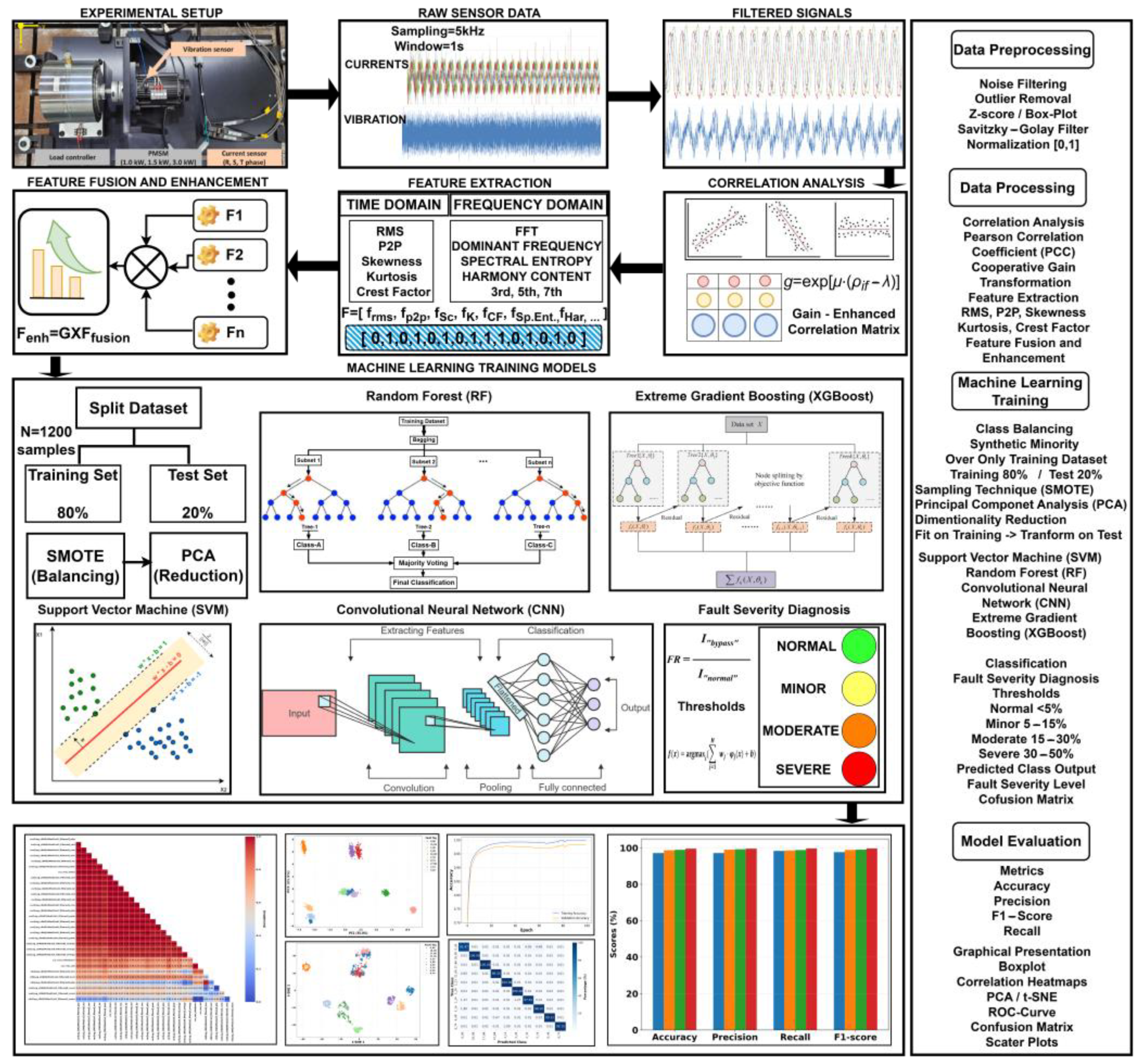
The proposed methodology for fault diagnosis in PMSMs consists of several key stages designed to ensure the accurate detection and classification of inter-turn and inter-coil short-circuit faults. These stages, as depicted in Figure 1, include the experimental set up, data preprocessing, correlation analysis between vibration and current signals, cooperative gain transformation, feature extraction, and fault severity classification. The experimental setup involves the use of vibration sensors (accelerometers) and current sensors to collect data from PMSMs under different operating conditions. This data forms the basis for fault diagnosis, where both vibration and current signals are recorded under controlled fault severities, ensuring that high-quality data is available for further processing. The raw data is then cleaned and prepared to remove noise and outliers. Preprocessing techniques such as Savitzky–Golay filters and normalization are applied to enhance the signal quality and ensure consistency across different operating conditions. A key aspect of the methodology is the correlation analysis between vibration and current signals. By analyzing the relationships between these two signals the most relevant features for fault detection are identified. The Pearson correlation coefficient is used to assess the strength of the linear relationships between vibration and current signals. In the next stage, the correlation between these signals is enhanced through an adaptive cooperative gain transformation. This method amplifies the contribution of features that exhibit strong correlations, strengthening fault-related patterns and improving sensitivity to early-stage faults. Features are then extracted from both the time-domain and frequency-domain representations of the signals. Measures such as RMS, Peak-to-Peak, Spectral Entropy, and other statistical measures are used to characterize the signals and provide useful input for classification. Finally, these extracted features are used to classify the severity of the faults, ranging from healthy to minor, moderate, and severe conditions. Several machine learning classifiers, including support vector machine (SVM), random forest (RF), convolution Neural Network (CNN) and Extreme Gradient Boosting (XGBoost), are trained and evaluated for fault severity classification. The goal is to achieve high diagnostic accuracy while minimizing computational costs for real-time applications. Each stage of the methodology plays a crucial role in ensuring accurate fault detection and classification. The following sections will provide a detailed explanation of each stage. The methodology aims to combine both vibration and current data to leverage their complementary nature and enhance diagnostic accuracy, while minimizing computational cost for real-time applications.
Data preprocessing is the first critical step in ensuring the quality and reliability of the input signals. Both vibration and current signals are initially noisy and may include irrelevant information, especially in industrial environments where measurement noise and interference are common. To address this, the raw data are filtered using advanced signal processing techniques such as the Savitzky–Golay filter for noise reduction and smoothing, which preserves the signal’s overall shape while reducing high-frequency noise.
The Savitzky–Golay filter is defined as follows:
y ( t ) = k = m m   c k x ( t + k )
where y ( t ) is the filtered signal, x ( t ) is the raw input signal, and c k are the filter coefficients derived from the least squares method, with m indicating the window size. This filter ensures that both the current and vibration signals are smooth, retaining the key features relevant for fault detection. Additionally, any outliers or abnormal data points that do not represent normal operational behavior are removed using statistical methods like the Z-score method or box plot analysis.

3.1. Correlation Analysis Between Vibration and Current Signals

After preprocessing, the next step involves analyzing the relationship between vibration and current signals. This is crucial for understanding how mechanical and electrical faults are reflected in both types of data. The correlation analysis is conducted using the Pearson correlation coefficient (PCC), which measures the linear relationship between two signals. The PCC is defined as:
ρ = i = 1 n   ( x i x ¯ ) ( y i y ¯ ) i = 1 n   ( x i x ¯ ) 2 i = 1 n ( y i y ¯ ) 2
where x i and y i are the measured values of the current and vibration signals, and x ¯ and y ¯ are their respective mean values. The Pearson correlation coefficient helps identify how strongly the vibration and current signals are related, which is particularly useful in detecting faults like inter-turn short circuits that may cause subtle changes in both electrical and mechanical behaviors.
Given that the correlation between the vibration and current signals is often weak, especially in the early stages of fault development, further enhancement is required. This leads us to the next step: cooperative gain transformation.

3.2. Cooperative Gain Transformation

In order to amplify weak correlations between the vibration and current signals, we introduce a cooperative gain transformation. This technique selectively enhances the correlation between the signals, improving fault detection sensitivity, particularly when the correlation is initially weak. The cooperative gain g is calculated as:
g = e x p [ μ ( ρ if λ ) ]
where ρ if is the Pearson correlation coefficient between the vibration signal and the square of the current signal, μ is the gain coefficient, and λ is a threshold parameter. The cooperative gain g is used to amplify the correlation when the correlation is sufficiently strong (i.e., ρ if > λ ) and suppress it otherwise.
The purpose of this transformation is to increase the weight of features that are highly correlated between vibration and current signals, making them more prominent for further analysis and fault detection. In this study, we use an exponential function for the cooperative gain transformation to enhance weak correlations between the vibration and current signals. The use of an exponential form was chosen based on its ability to amplify small variations in the data, especially when subtle fault features need to be emphasized. The exponential function provides a non-linear transformation that can better model the relationship between the features and the fault severity, particularly in the early stages of fault progression, where small changes in the signal are critical for detection.
Τhe parameters μ and λ used in the cooperative gain transformation were determined through empirical testing and sensitivity analysis. The parameter μ (gain coefficient) controls the rate at which weak correlations between vibration and current signals are amplified. Similarly, λ (threshold parameter) sets the lower bound for the correlation above which the cooperative gain applies, ensuring that only significant correlations are amplified. The values μ = 2 and λ = 0.30 were set after testing several combinations of parameters across a range of fault scenarios. The sensitivity analysis involved varying both parameters within reasonable ranges to observe their effect on model performance. The following steps outline the methodology used to determine these parameters:
The gain coefficient μ was tested within the range [1, 5]. A value of μ = 2 was found to provide a good balance between amplifying weak correlations and avoiding excessive noise amplification. Higher values of μ (greater than 3) led to over-amplification of certain features, distorting the data and negatively affecting fault classification accuracy. Lower values of μ (less than 1) reduced the amplification, making it difficult to highlight weak fault features.
The threshold λ was varied between [0.10, 0.50], with values closer to 0.30 providing the best trade-off between detecting meaningful correlations and suppressing irrelevant noise. Setting λ too low (e.g., 0.10) resulted in the amplification of noisy correlations, while λ too high (e.g., 0.50) caused certain fault features to be missed. The value λ = 0.30 was set because it effectively captured the significant electromechanical relationships associated with faults without introducing excessive noise.
Sensitivity Analysis Results: To evaluate the robustness of the selected parameters, we conducted a sensitivity analysis where we varied μ and λ independently and in combination. The analysis showed that the method’s performance (accuracy, precision, recall) remained relatively stable within the parameter ranges μ = [1, 3] and λ = [0.20, 0.40], indicating that the method is not overly sensitive to small changes in these values. However, deviations beyond these ranges resulted in a noticeable drop in classification performance, particularly for distinguishing between different fault severities.
To further clarify the effect of the cooperative gain transformation, consider the following illustrative example based on the definitions of (2) and (3). Assume a vibration feature x i with mean-subtracted value x i x ¯ = 0.34 and a squared-current feature y i 2 with mean-subtracted value y i y ¯ = 1.05 . Using (2), the Pearson correlation coefficient between the vibration signal and the squared current, denoted as ρ i f , is computed to be ρ i f = 0.42   w ith a gain coefficient   μ = 2 and a threshold parameter λ = 0.30 . The cooperative gain g defined in (3) becomes g = e x p [ 2 ( 0.42 0.30 ) ] = e x p ( 0.24 ) = 1.271 . Since ρ i f > λ , the cooperative gain amplifies the contribution of the vibration feature. The enhanced feature can therefore be expressed as: x i , e n h = g x i = 1.271 0.34 = 0.432 .
This example demonstrates how the cooperative gain selectively increases the weight of vibration–current interactions that exceed the correlation threshold λ , thereby strengthening fault-relevant information during early degradation stages. Conversely, when ρ i f is below λ , the exponential term becomes e x p [ μ ( ρ i f λ ) ] < 1 , suppressing weak or noisy correlations. This mechanism ensures that only meaningful electromechanical relationships contribute significantly to the subsequent feature analysis and classification stages.

3.3. Mathematical Model

Once the cooperative gain transformation is applied, the next step is to extract relevant features from both the vibration and current signals for fault diagnosis. Feature extraction is performed in both the time domain and frequency domain, capturing both short-term and long-term characteristics of the signals.
Time-Domain Features: The key time-domain features include:
  • Root Mean Square (RMS): Measures the magnitude of the signal.
RMS ( x ) = 1 N i = 1 N   x i 2
  • Peak-to-Peak (P2P): Measures the difference between the maximum and minimum values of the signal.
P 2 P ( x ) = m a x ( x ) m i n ( x )
  • Skewness and Kurtosis: Statistical measures of asymmetry and the peakedness of the signal distribution.
SKEW ( x ) = 1 N i = 1 N   ( x i μ σ ) 3
KURT ( x ) = 1 N i = 1 N   ( x i μ σ ) 4
where μ = 1 N i = 1 N   x i is the mean value, and σ = 1 N i = 1 N   ( x i μ ) 2 is the standard deviation.
Frequency-Domain Features: These features are extracted using the Fast Fourier Transform (FFT), which converts the time-domain signal into the frequency domain. The key frequency-domain features include:
  • Spectral Entropy: Measures the complexity of the frequency distribution.
H ( f ) = i = 1 N   p ( f i ) l o g ( p ( f i ) )
where p ( f i ) is the normalized power spectral density at frequency f i .
  • Dominant Frequency: The frequency with the highest power in the spectrum.
  • Harmonic Analysis: Analysis of the harmonic content of the signal to detect faults.
The combination of these time-domain and frequency-domain features provides a comprehensive representation of the motor’s operational state, which is crucial for accurate fault diagnosis.

3.4. Fault Severity Classification

After feature extraction, the next step is to classify the severity of the fault. Fault severity classification is achieved using machine learning models such as SVM, RF, or Deep Neural Networks (DNN). These models are trained using the extracted features and the labeled dataset, which includes both normal and fault conditions with varying severities.
For example, the classification model f ( x ) is represented as:
f ( x ) = argmax i ( j = 1 M   w j φ j ( x ) + b )
where x represents the input feature vector, φ j ( x ) are the extracted features, w j are the weights, and b is the bias term. The output of this model is the predicted fault severity level, with categories such as “Normal,” “Minor Fault,” “Moderate Fault,” and “Severe Fault.”

4. Results

According to the proposed methodology described in the previous section, this section presents and analyzes the experimental results derived from the implementation of the proposed fault diagnosis framework. The findings highlight the effectiveness of the data preprocessing techniques, the reliability of the correlation analysis between current and vibration signals, and the improvement achieved through the cooperative gain transformation.

4.1. Signal Filtering

The application of filtering techniques is essential for ensuring the quality of the collected signals prior to analysis. In this study, the Savitzky–Golay filter was employed to smooth the vibration signals and remove high-frequency noise while preserving the essential features and waveform shape. This filter operates by fitting successive subsets of adjacent data points with a low-degree polynomial using the method of least squares, effectively reducing noise without distorting the signal trend.
Metrics such as standard deviation, peak amplitude, crest factor, and waveform distortion remain at low levels, while the mean and RMS current values correspond to the normal load without asymmetries or anomalies. At the same time, the standard deviation and skewness rise, while the normality of the signal distribution decreases, reflecting the impact of faults such as inter-turn short circuits or mechanical imbalances. These variations make the statistical indicators powerful tools for distinguishing between healthy and faulty operation and contribute substantially to the fault diagnosis and severity assessment process. Table 2 and Table 3 present the differences in the current signals before and after applying the filter and Table 4 and Table 5 similarly the differences in the vibration signals before and after filtering.

4.2. Feature Extraction

Feature extraction is a crucial stage in fault diagnosis, as it transforms raw current and vibration signals into representative values that describe the system’s behavior. Through time-domain and frequency-domain analysis techniques—such as RMS, peak-to-peak value, kurtosis, skewness, and Fast Fourier Transform (FFT), it is possible to identify parameters that distinguish normal from faulty operating conditions. The extracted features serve as inputs to classification or machine learning models, enabling accurate estimation of fault severity and type.
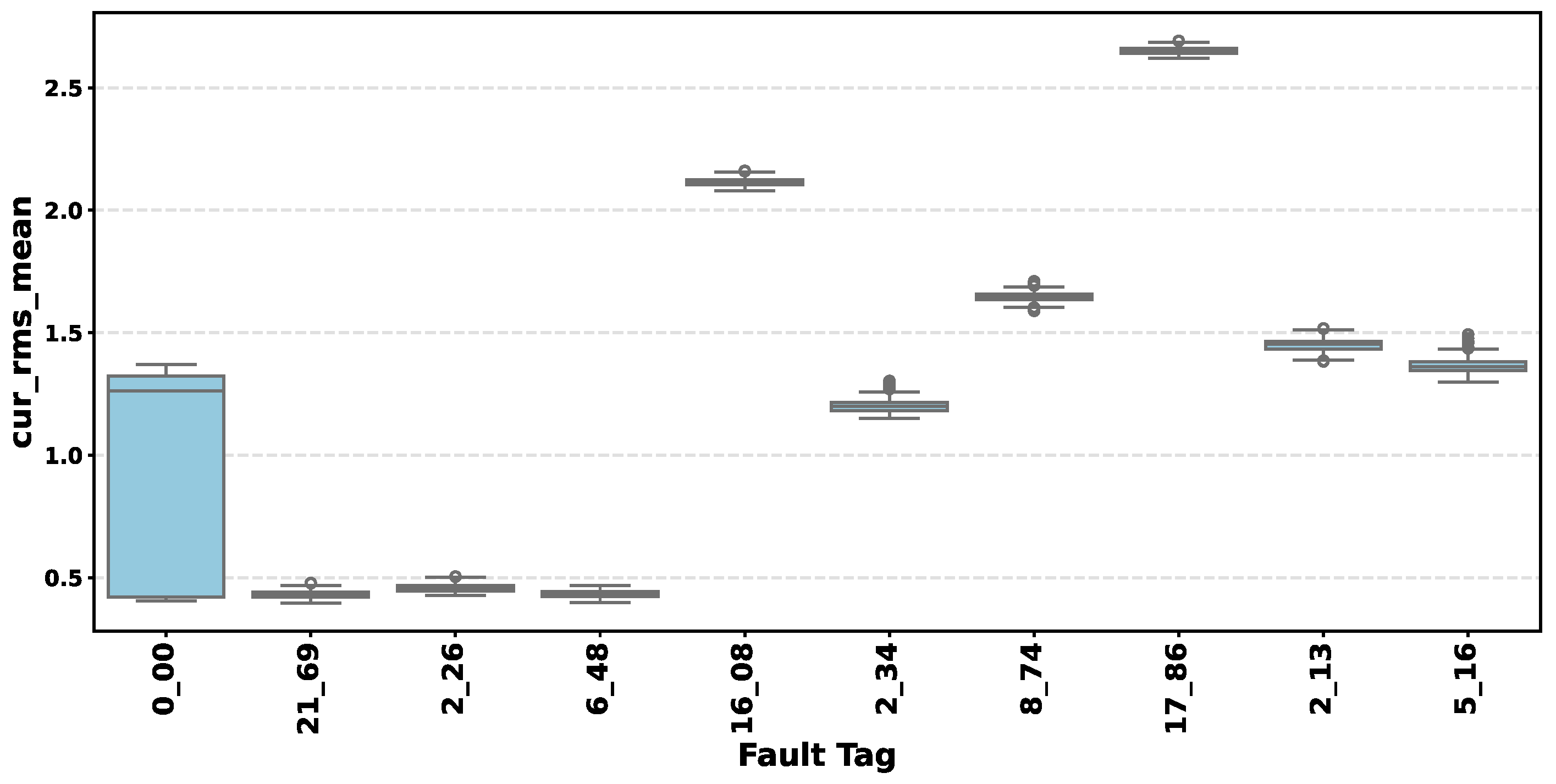
The boxplot (as shown in Figure 2) illustrates the variation in the mean RMS current across different fault conditions. The clear separation between fault tags indicates that RMS current magnitude increases with fault severity, making it a reliable feature for distinguishing between normal and faulty motor states. Moreover, the boxplot visualization allows for a quick assessment of feature distributions, highlighting the presence of outliers and the variability within each fault category. Statistical measures derived from these distributions, such as interquartile range and median, provide additional insight into the consistency of the signal patterns. By comparing these metrics across different fault types, it becomes possible to quantify the degree of deviation from normal operation. Such analysis not only facilitates the selection of the most discriminative features but also improves the robustness of the classification models. Combining multiple features from both current and vibration signals enhances the sensitivity to subtle faults, supporting early detection and accurate categorization of motor anomalies. This comprehensive feature analysis thus forms the foundation for reliable and interpretable fault diagnosis.
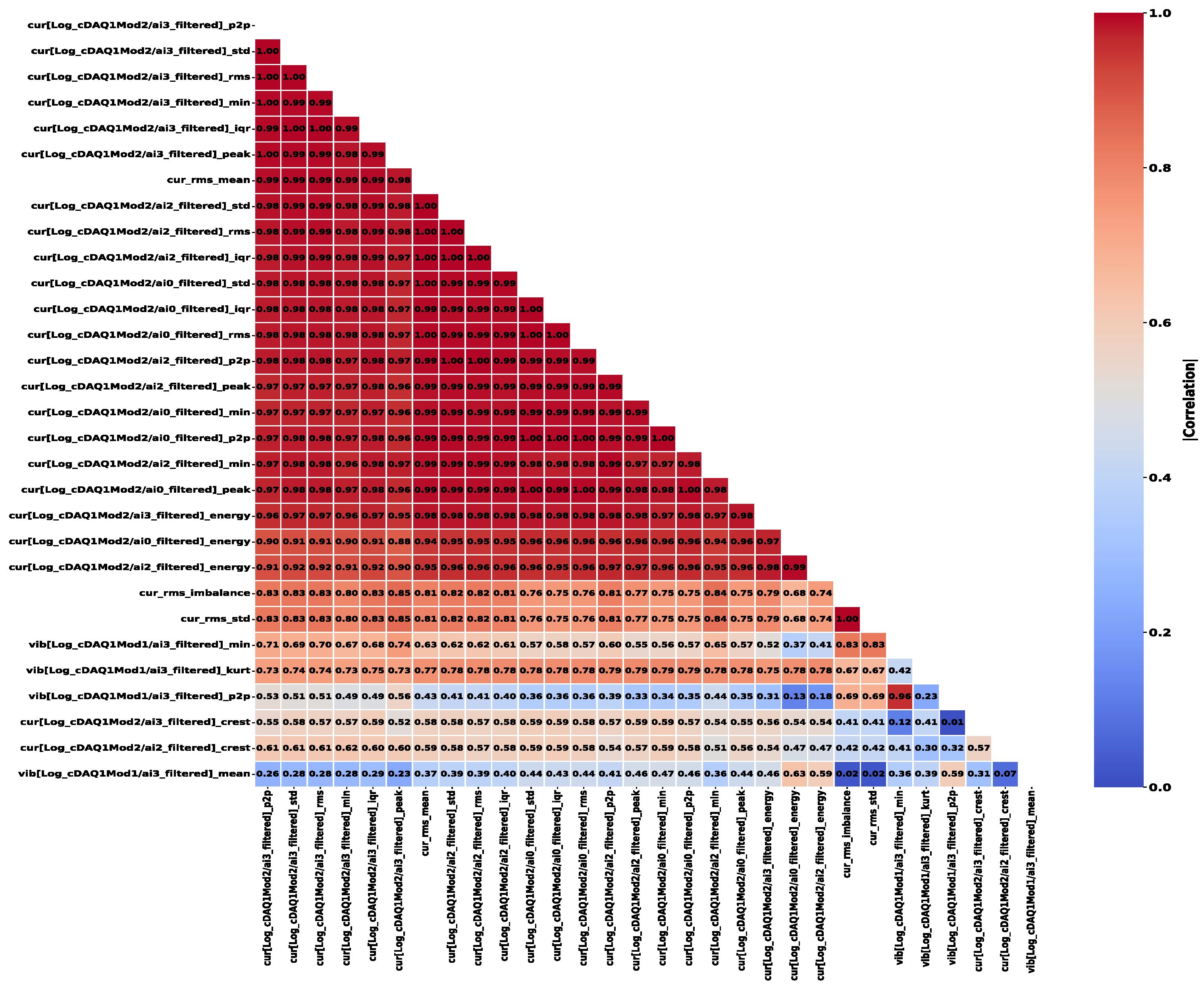
The main details of signal analysis are presented in the correlation matrix (in Figure 3) revealing strong positive relationships among current-based features (RMS, peak, energy), indicating redundancy within this group. In contrast, vibration features show weaker correlations with current features, suggesting that vibration data provide complementary diagnostic information. Combining both signal types enhances fault detection accuracy.
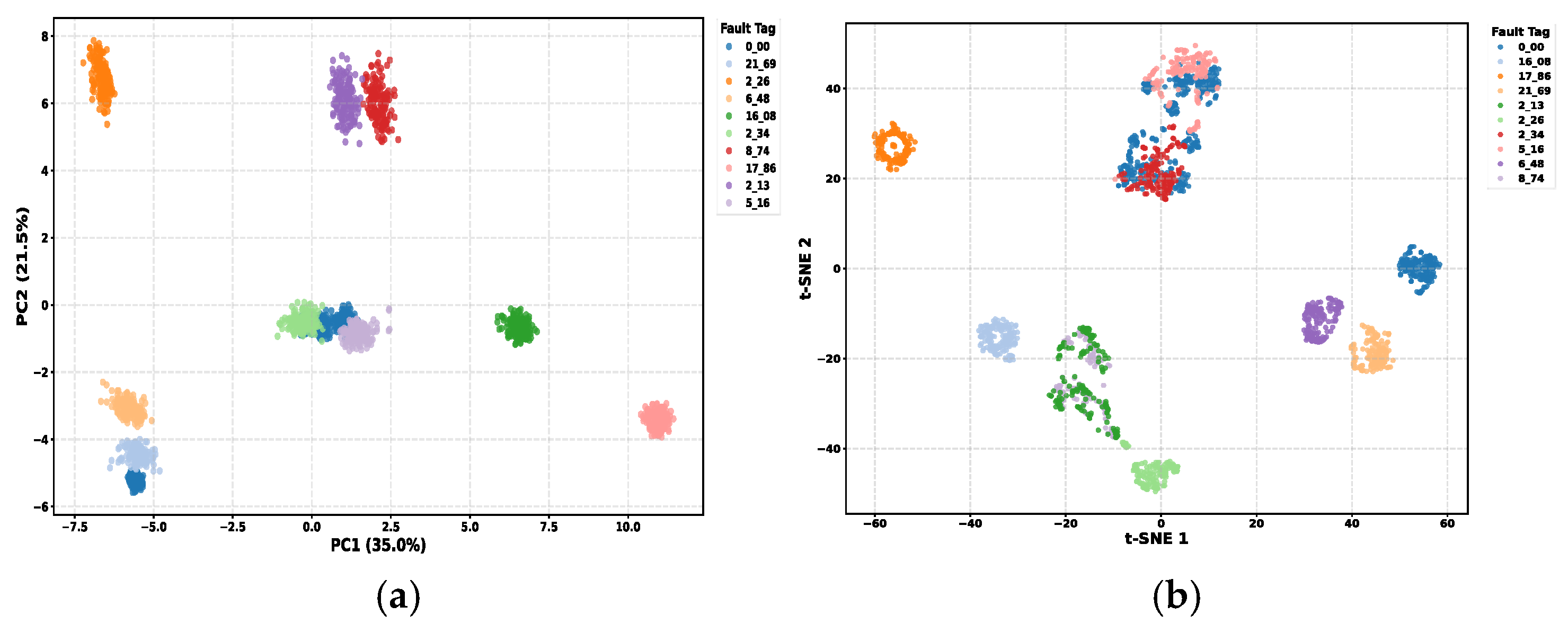
The PCA graph in Figure 4a demonstrates clear clustering among fault categories, confirming that the extracted features effectively separate different motor conditions. The first two principal components account for most of the data variance, validating the representativeness of the selected feature set for fault classification. The t-SNE in Figure 4b provides a nonlinear projection of the extracted features, showing well-defined clusters corresponding to each fault condition. This visualization confirms the separability of operating states in high-dimensional space, supporting the suitability of the extracted features for machine learning–based fault diagnosis.
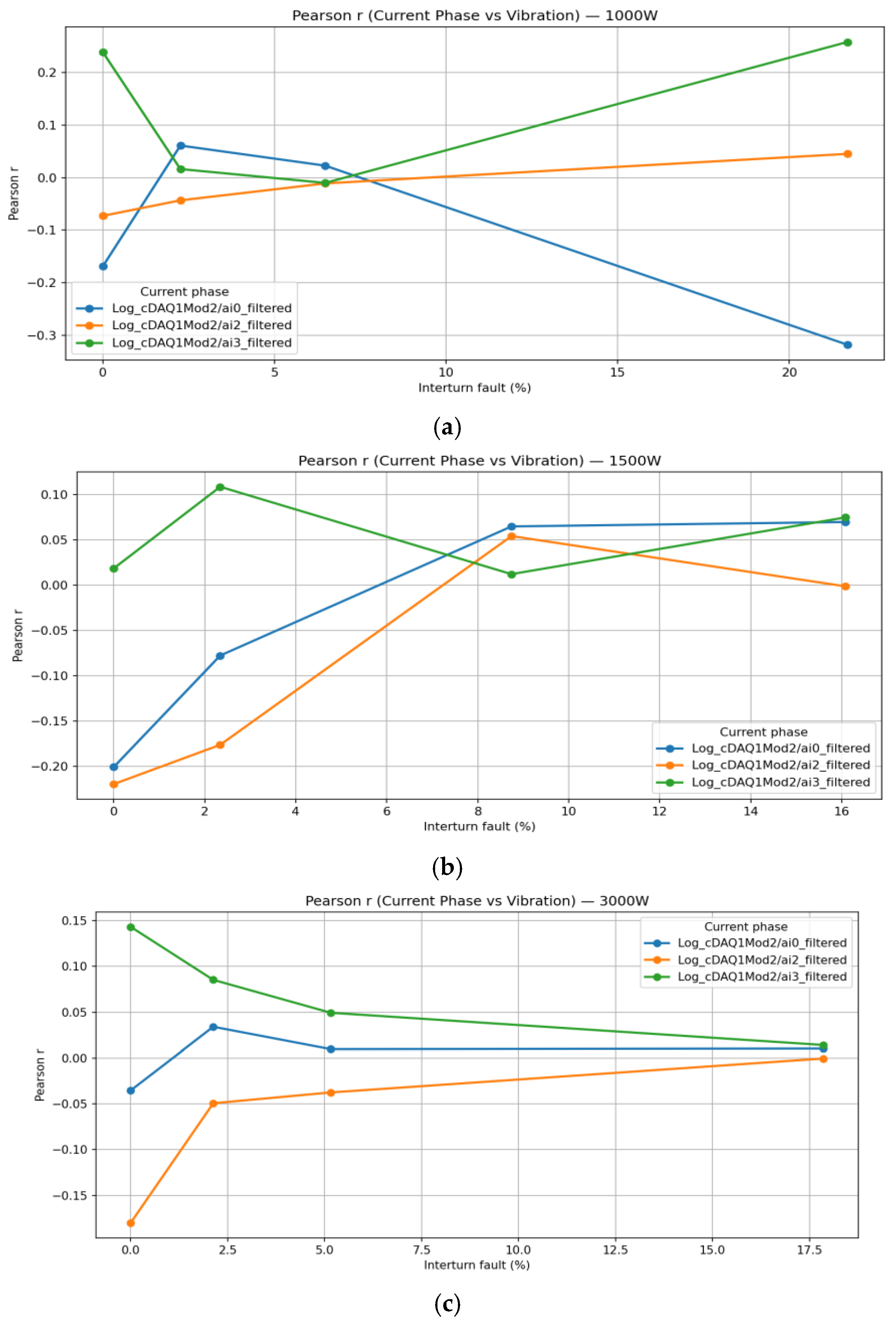
The Pearson correlation analysis (shown in Figure 5a–c) between current phases and vibration under different load conditions (1000 W, 1500 W and 3000 W) highlights the dynamic coupling between the electrical and mechanical responses of the PMSM.
The correlation coefficient varies with the inter-turn fault percentage, showing either increasing or decreasing trends depending on the phase and load level. At lower load conditions (1000 W), the correlation exhibits more distinct fluctuations as the inter-turn fault percentage increases, particularly for certain phase configurations. In contrast, at higher load levels (1500 W and 3000 W), the correlation tends to stabilize or decrease more gradually. This suggests that under higher load conditions, the mechanical response to faults becomes less sensitive to variations in the electrical phase, as the motor operates closer to its rated capacity, reducing the impact of small electrical faults on vibration patterns. The behavior of different phases further illustrates the complex interaction between electrical dynamics and fault characteristics. For some phases, the correlation increases with fault progression, while for others, it decreases. These variations can be attributed to the asymmetries in the magnetic field distribution caused by the fault, which affects both the electrical current and the mechanical vibrations. As the fault severity increases, this influence becomes more pronounced, leading to changes in the current–vibration interaction. The presence of inter-turn faults causes localized disruptions in the magnetic field, which affect both the electrical currents and the mechanical vibrations. Early stages of fault progression may result in more noticeable correlations as the motor attempts to compensate for irregularities. However, as the fault severity increases, the system’s response becomes more complex, leading to decreased or asymmetrical correlations. These fault-induced nonlinearities, especially under higher load conditions, suggest that the fault interaction becomes more intricate, with fault severity and load conditions influencing the correlation in different ways.
In summary, the variation in the Pearson correlation suggests that as the inter-turn fault progresses, the current–vibration interaction becomes more pronounced or asymmetrical, providing an indicator of early fault development. The load-dependent nature of this relationship emphasizes the importance of considering load conditions when diagnosing and predicting fault severity in PMSMs.

4.3. Fault Diagnosis Using Machine Learning Algorithms

In this study, we employ various machine learning algorithms to diagnose fault severity in PMSMs. Before training the models, Synthetic Minority Over-sampling Technique (SMOTE) is applied to the training set to address the class imbalance present in the dataset. SMOTE is a crucial step in ensuring that the models are not biased towards the majority class and that the minority classes are adequately represented. By generating synthetic samples for the underrepresented classes, SMOTE helps balance the dataset, allowing the models to learn meaningful patterns from both majority and minority classes.
It is important to note that SMOTE is applied only to the training set and not to the test set. This is done to prevent data leakage, where information from the test set could influence the model during training, leading to overoptimistic performance estimates. By applying SMOTE exclusively to the training data, we ensure that the models are trained on a more balanced representation of the classes while maintaining the integrity of the test set as a true reflection of real-world performance on unseen data.
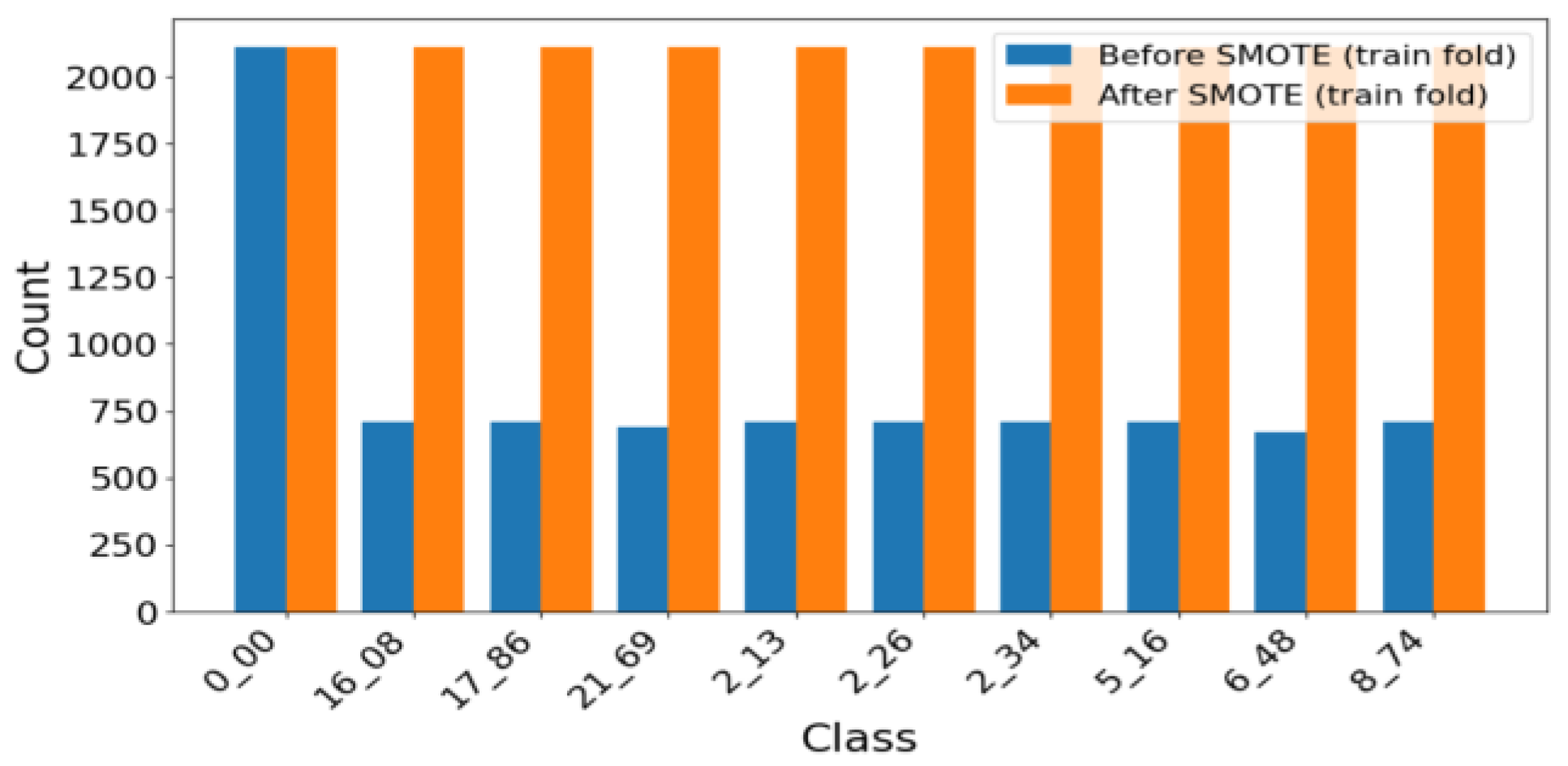
The class distribution before and after applying SMOTE is shown in Figure 6. As illustrated, the original dataset exhibits significant class imbalance, with the fault categories having far fewer samples compared to the healthy condition 0_00. After SMOTE was applied, synthetic samples were created for these underrepresented fault classes, resulting in a balanced dataset with a more even distribution of samples across all fault categories.
The application of SMOTE ensures that the models are exposed to a more representative dataset, improving their ability to detect faults in both the majority and minority classes. However, it is important to note that while SMOTE helps mitigate the imbalance issue, it may lead to an inflation of accuracy estimates. To counteract this, precision and recall are used as key performance metrics, as they provide a more comprehensive evaluation of the model’s performance, especially in terms of detecting minority class faults.
Following the application of SMOTE, PCA is used for dimensionality reduction. PCA helps reduce the feature space while retaining most of the variance, improving both computational efficiency and generalization. After these preprocessing steps, the models are trained using various machine learning algorithms.
The model training phase is a crucial step in the automatic fault diagnosis process of the PMSM motor. In this stage, the extracted features from current and vibration signals are used as inputs to various classifiers aimed at identifying operating conditions and fault severity levels. Four algorithms are implemented SVM, RF as conventional supervised classifiers, XGBoost as an optimized ensemble learning approach, and CNN as a deep learning model capable of automatic feature extraction and classification. The performance of each model is evaluated using standard metrics such as Accuracy, Precision, Recall, and F1-score to determine the most effective algorithm for reliable fault detection.
To ensure the reproducibility of the results and to enhance the model performance, the hyperparameters of each classifier were systematically tuned. The following Table 6 summarizes the hyperparameter values used for each model, along with the search strategy employed for hyperparameter optimization. These hyperparameters for each classifier were carefully determined based on a combination of grid search and random search strategies, with cross-validation used to select the best-performing parameters for each model. Grid search was employed to systematically explore all possible combinations of predefined hyperparameter values for models with a smaller number of parameters, ensuring thorough testing across all configurations. For models with a larger set of hyperparameters, random search was used, which randomly samples combinations of parameters within a specified range. This approach is more efficient when dealing with a large search space and ensures that the most effective hyperparameters are identified without exhaustively testing all combinations. The values tested for each hyperparameter were chosen based on prior research and empirical testing, and the optimization process aimed to achieve the best trade-off between model performance and computational efficiency.
For each model, the hyperparameters serve distinct roles in controlling the model’s complexity and performance:
SVM: The kernel parameter defines the function used to separate data points in high-dimensional space, with the RBF kernel being particularly effective for non-linear decision boundaries. The C parameter controls the trade-off between maximizing the margin and minimizing the classification error, while gamma influences the influence of individual training points on the decision boundary.
Random Forest (RF): The n estimators parameter controls the number of decision trees in the forest, affecting model stability and performance. A larger number of trees generally improves accuracy but also increases computational cost. The max depth parameter limits the depth of each tree, preventing overfitting by controlling the complexity of individual trees.
CNN: The number of layers and neurons per layer define the depth and complexity of the network. Increasing the number of layers and neurons can enhance the model’s ability to learn complex features but may also increase the risk of overfitting. The learning rate controls how quickly the model updates its weights during training, and batch size defines how many samples are processed before the model’s weights are updated, affecting both training time and model generalization.
XGBoost: The learning rate determines how much each new tree corrects the previous tree, with lower values resulting in a more gradual convergence. The n estimators parameter sets the number of boosting rounds (trees), and max depth controls the depth of each tree, regulating the model’s ability to fit the data. The subsample parameter specifies the fraction of samples used to train each tree, helping to prevent overfitting by introducing randomness into the training process.
To enhance the reliability and robustness of our model evaluation, we extended the experimental validation by implementing k-fold cross-validation (with k = 5 ) instead of the single 80/20 train-test split used previously. This approach ensures that the models are evaluated on different subsets of the data, which reduces the risk of overfitting and provides a more reliable estimate of model performance across various data partitions. The performance metrics (Accuracy, Precision, Recall, F1-Score) are reported along with their confidence intervals at a 95% confidence level, calculated using the bootstrapping technique. Furthermore, to assess the statistical significance of differences in classifier performance, we performed McNemar’s test, which compares the performance of two classifiers on the same test set. This test is particularly useful for determining whether differences in performance are statistically significant when comparing models that make different types of errors. The results of McNemar’s test, along with p-values for all pairwise comparisons between the classifiers, are reported to provide a clearer understanding of the relative strengths of each model. The updated performance results and statistical analysis are summarized in Table 7, which includes k-fold cross-validation results, confidence intervals, and statistical significance test results for each classifier.
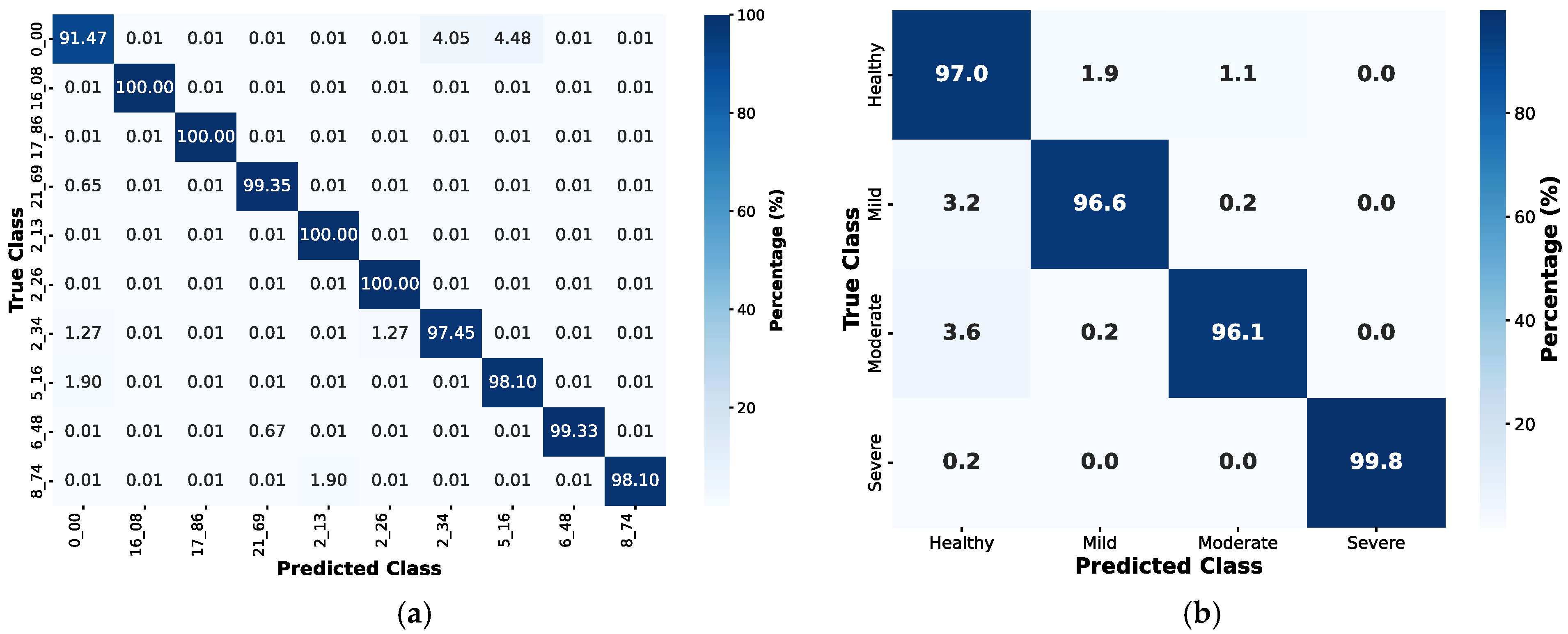
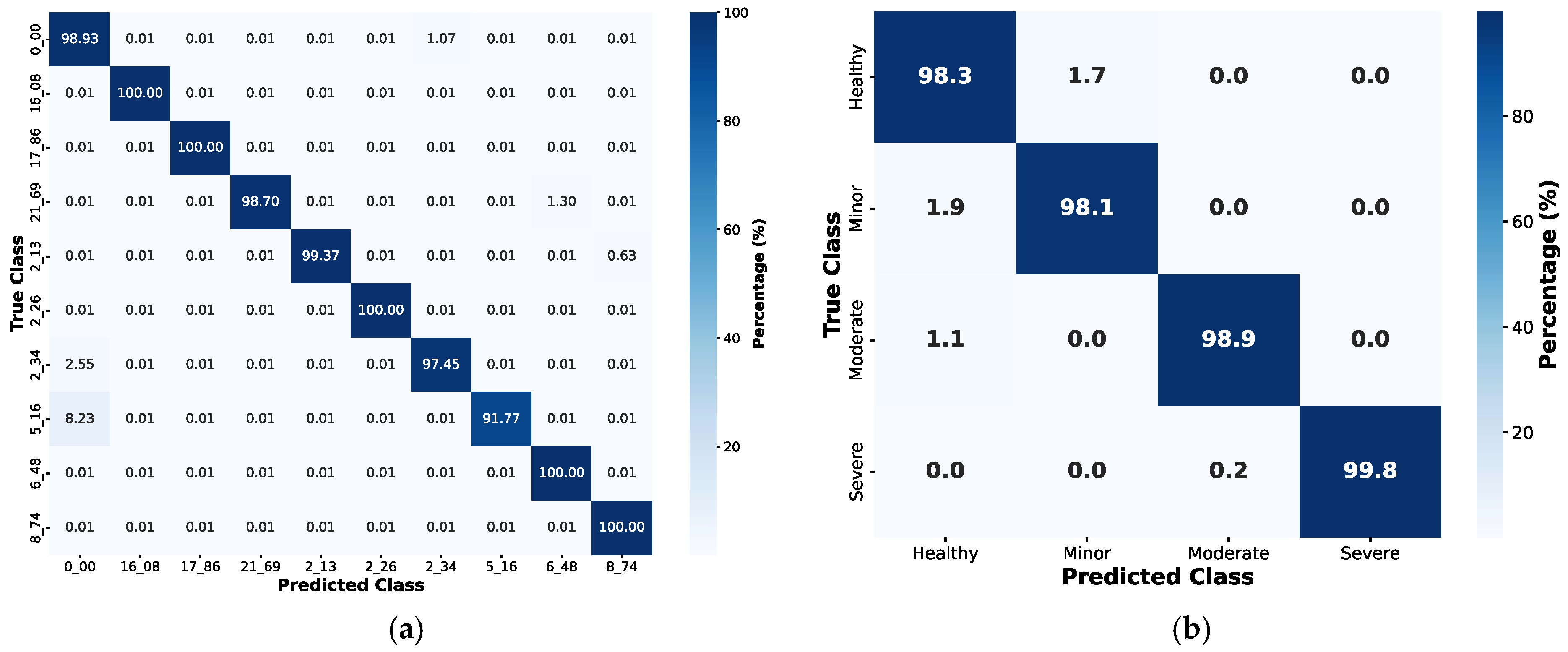
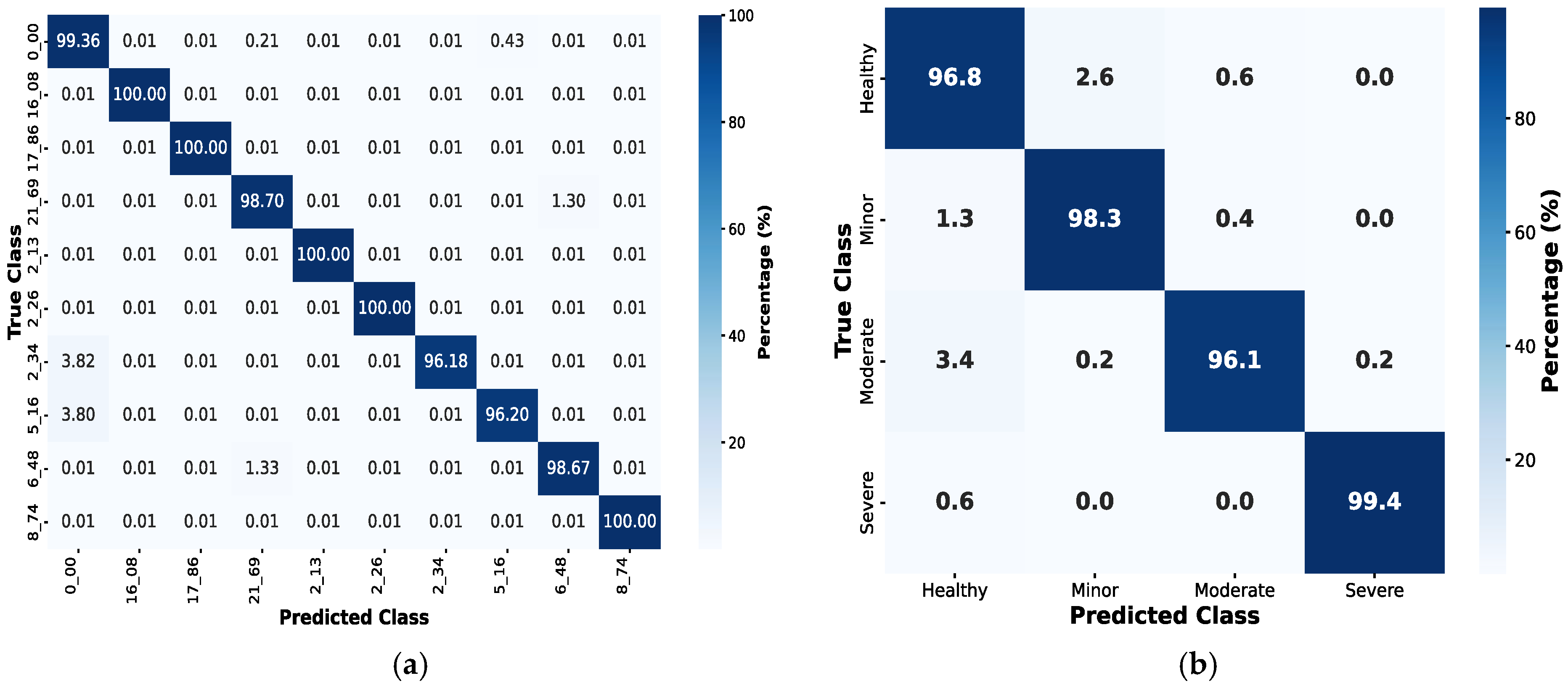
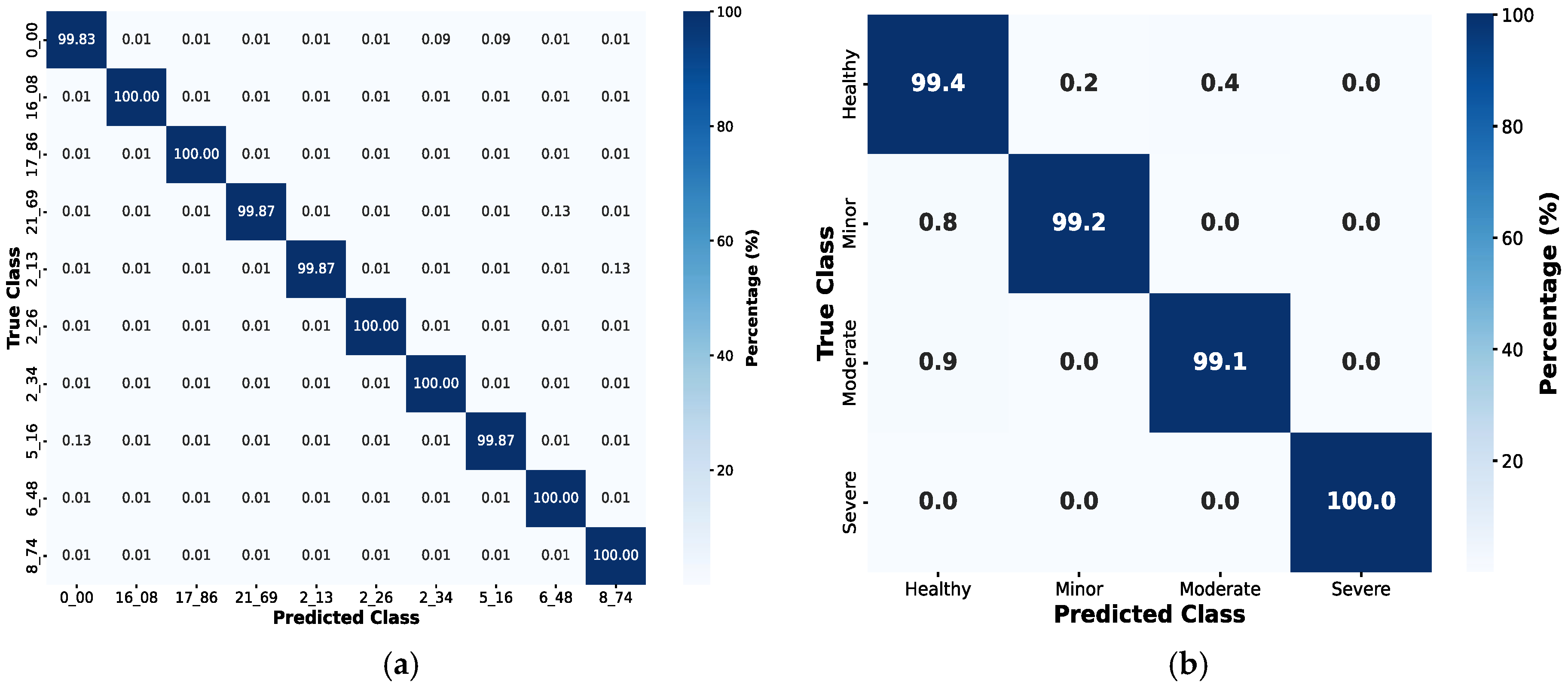
The comparative evaluation of the training models is highlighted using a confusion matrix, showing the accuracy of each model (shown in Figure 7a, Figure 8a, Figure 9a and Figure 10a), while the categorization into different situations depending on the severity of the fault presented in Figure 7b, Figure 8b, Figure 9b and Figure 10b). The SVM achieved reliable results in clearly separable datasets, proving its robustness and computational efficiency. The Random Forest showed excellent generalization capability and noise tolerance, offering a strong balance between accuracy and model simplicity.
The CNN, leveraging its ability for automatic feature extraction, achieved high accuracy in complex nonlinear patterns, highlighting the advantages of deep learning methods in fault diagnosis. Finally, XGBoost outperformed all other models, achieving the highest overall accuracy (>99%), thus representing the most effective approach for PMSM fault detection. Overall, the findings confirm that machine learning techniques can be effectively utilized for accurate, fast, and automated fault diagnosis, enhancing system reliability and optimizing electric motor performance.
In addition, strong diagonal dominance is observed across all models, with classification accuracies exceeding 96% for all fault severity levels. Misclassifications are mainly limited to adjacent categories (e.g., mild–moderate), indicating natural overlap between transitional fault states. The XGBoost model achieves the best overall performance, with nearly perfect diagonal accuracy (99–100%), followed by CNN, RF, and SVM.
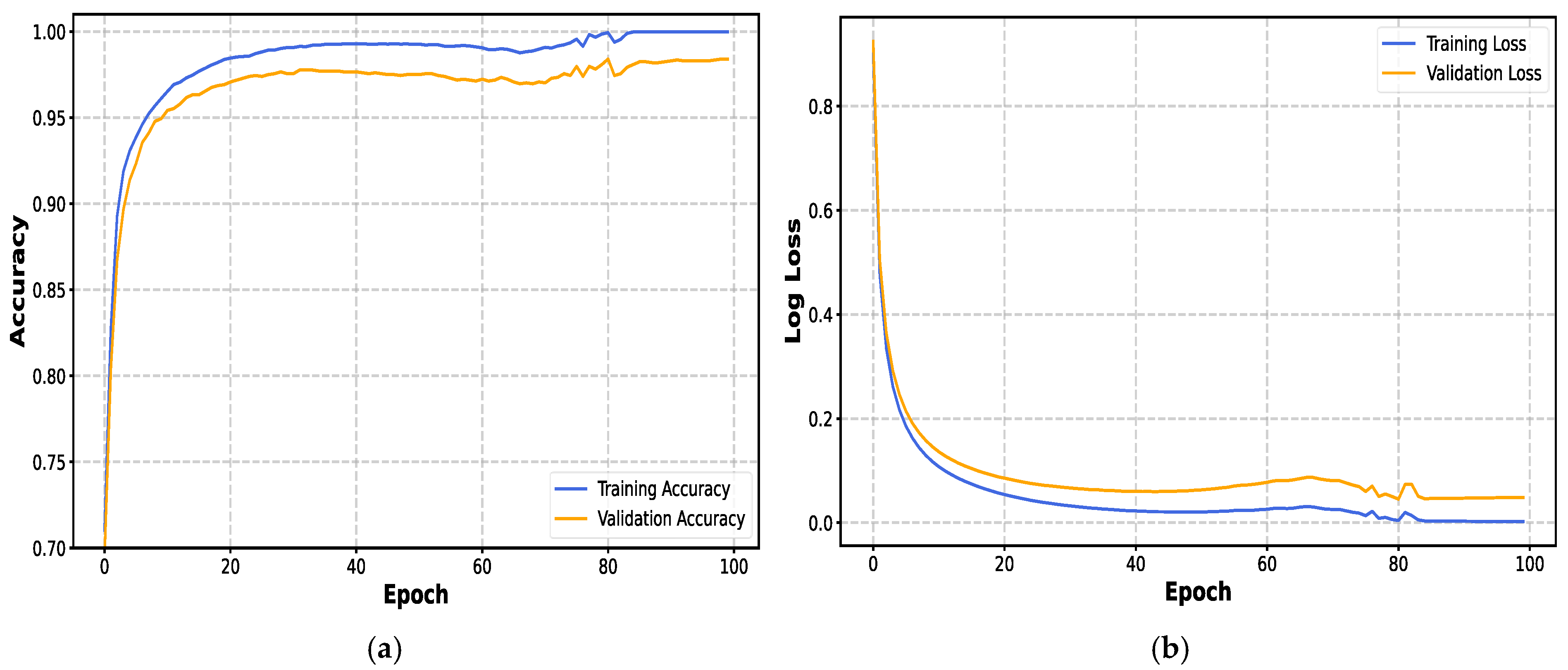
The training and validation curves in Figure 11a,b demonstrate that the CNN model achieved rapid convergence and high classification performance. Both accuracy metrics increased sharply during the initial epoch and stabilized after approximately 40 epochs, reaching around 99% for training and 98% for validation. Similarly, the training and validation loss decreased consistently and converged to low values, indicating efficient learning and stable optimization. The small gap between training and validation accuracy suggests that the model generalizes well to unseen data, with no signs of overfitting. Overall, the CNN model exhibits strong learning capability, stability, and robustness in fault classification tasks.
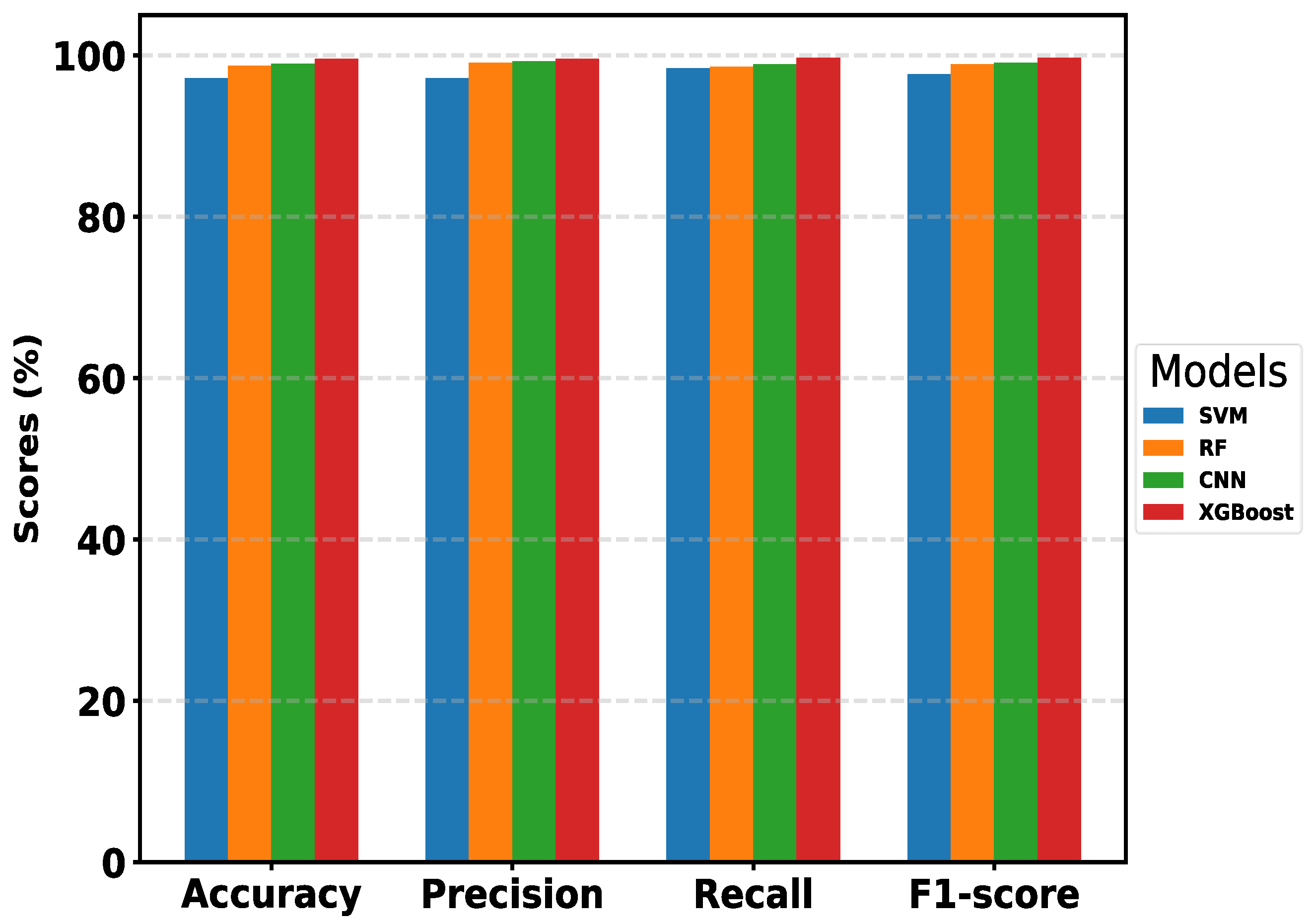
A comparative investigation of the efficiency of the models examined is presented in Figure 12. All models demonstrate exceptionally high performance, with scores exceeding 97% across all metrics, indicating that the proposed fault diagnosis approach is highly effective. Among them, XGBoost achieves the highest overall accuracy and consistency, approaching nearly 100% in all evaluation metrics in this study, making it the most reliable classifier for the PMSM fault detection task. The CNN model follows closely, showing comparable performance, highlighting the strength of deep learning methods in capturing complex feature relationships. Meanwhile, RF and SVM also exhibit strong and stable results, with only marginally lower performance compared to XGBoost. Table 8 illustrates the main advantages of this study compared to other similar methodologies that have been developed in the literature overview.
In this table, a comparative analysis of various fault diagnosis methodologies is presented. While most of the methods exhibit high accuracy, ranging from 79.48% to 100%, the proposed method stands out for its significantly lower computational cost, despite achieving comparable accuracy to the other approaches. Unlike the deep learning models like the one proposed in [22], which rely on complex data fusion with ConvLSTM regulation, or the hybrid models in [32] that combine SVM and CNN, the proposed method utilizes a gain-enhanced fusion approach along with machine learning classifiers. This design provides excellent sensitivity through signal correlation, while minimizing computational demands. Additionally, the decision tree model in [33] and the various classifiers in [34], such as SVM and KNN, require substantial computational resources due to their more complex structures and the multi-phase PMSM diagnosis processes. Therefore, the proposed method offers an effective trade-off between high accuracy (97–100%) and low computational cost, making it a more efficient option for real-time or resource-limited applications.
To comprehensively assess the computational performance and real-time feasibility of the proposed methodology, we performed a benchmarking analysis comparing the execution times of various machine learning algorithms used in our study with those from the recent work by Mao et al. [35]. This study presents a VMD-BiTCN-Transformer parallel network for early-stage fault diagnosis in Permanent Magnet Synchronous Motors (PMSMs), using the same publicly available experimental setup that we adopted for our work. The experimental setup used by both studies involves vibration and current signals collected from PMSMs under various fault conditions, ensuring the validity and comparability of the results.
The computational performance of our models is summarized in Table 9, which presents the mean inference time per sample, 95th percentile inference time, and model file size for the different classifiers used in our methodology.
As shown in the table, SVM (RBF + SMOTE) achieved the lowest inference time of 0.73 ms/sample, followed by XGBoost (SMOTE) at 1.48 ms/sample, with CNN exhibiting a moderate time of 4.50 ms/sample, and Random Forest (RF + SMOTE) having the highest time at 30.00 ms/sample. These results highlight the efficiency of SVM and XGBoost for real-time applications, while also showing that CNN, despite being slower, is still competitive compared to the serial models in Mao et al.’s work. In comparison, in their study the VMD-BiTCN-Transformer parallel model achieves a mean inference time of 5.38 ms/sample, with a 95th percentile of 24.53 ms/sample, and a training time of 1114 s. This parallel model, although effective with an accuracy of 99.42%, is slower than our SVM and XGBoost models. Additionally, the VMD-BiTCN-Transformer serial model takes significantly longer to train (3518 s) and performs with slightly higher accuracy (0.9874), but its training time is 3.16 times longer than the parallel model, highlighting the efficiency of our approach in terms of training speed.
Furthermore, they demonstrate that their parallel model outperforms serial models like VMD-CNN-BiGRU-Transformer and VMD-GRU-Transformer by achieving better accuracy and F1-score while maintaining reasonable training times. However, these models still require significantly more time compared to our SVM and XGBoost, which makes our methodology more suitable for real-time applications with high accuracy and low computational cost. Our results also compare favorably to more traditional deep learning models like VMD-CNN-BiGRU-Transformer, which has a training time of 1841 s and a slightly lower accuracy of 0.9829, as well as other models such as Informer-BiLSTM with lower diagnostic accuracy and a training time of 750 s.
The proposed methodology is clearly more efficient, offering a better trade-off between accuracy and computational cost compared to the deep learning-based models presented in the literature. Our approach achieves high diagnostic accuracy (ranging from 97% to 100%) with significantly lower inference times, making it more suitable for real-time or resource-constrained environments. This is a critical advantage, as many industrial applications, such as fault diagnosis in PMSMs, demand both high performance and low latency for effective operation. This makes our methodology particularly well-suited for real-time deployment in industrial settings, where low computational cost and fast decision-making are crucial.

5. Discussion

The main innovation of this work concerns the proposed Gain-Enhanced Correlation Fusion (GECF) approach, which establishes a strong and dynamic relationship between electrical (current) and mechanical (vibration) signals for fault diagnosis in PMSMs. Unlike conventional methods that analyze each signal domain independently, the proposed fusion mechanism amplifies the weak cross-correlation between the two domains through an adaptive gain transformation. This enhancement effectively strengthens hidden fault patterns and improves the sensitivity to early-stage inter-turn short-circuit faults, even under variable load conditions.
In the context of this study, the obtained results can be related to recent research focusing on predictive maintenance and condition monitoring of PMSMs in real-world applications, such as elevator systems. As highlighted [36], the integration of machine learning techniques and multimodal data acquisition (e.g., current, vibration, and temperature) under noisy and dynamic conditions can significantly enhance diagnostic accuracy and system reliability. The proposed gain-enhanced correlation approach of this work can be seen as complementary to such multimodal models, offering a more lightweight and computationally efficient framework for early fault detection. Therefore, the presented methodology could serve as a foundation for future integration into intelligent monitoring systems, where methods such as Positive-Unlabeled Learning or Reinforcement Learning could further improve predictive capabilities. Some possible future extensions of the proposed technique are as follows:
  • Integration of additional sensors: Future research could incorporate temperature or acoustic emission sensors to enable multimodal fault detection under varying operational conditions.
  • Deep learning and transfer learning approaches: Applying attention-based CNN or transfer learning models could enhance early fault identification while reducing data dependency.
  • Adaptive cooperative gain: Introducing an adaptive gain mechanism that dynamically adjusts according to noise levels or load variations could further stabilize fault detection.
  • Real-time embedded implementation: Deploying the proposed method on embedded/edge platforms (e.g., FPGA or Raspberry Pi) would validate its suitability for real-time industrial use.
  • Predictive and reinforcement learning integration: Combining the current model with PU-learning or reinforcement learning can enable predictive maintenance and estimation of Remaining Useful Life (RUL).
  • Secure IoT-based communication: Future systems should ensure encrypted and interference-free data transmission, enabling reliable cloud-based monitoring in smart factories [37].
While the proposed methodology achieves high diagnostic accuracy, its performance remains inherently dependent on the quality of the vibration and current measurements. The method has been validated only on laboratory-based PMSMs with controlled fault severities, steady-state conditions, which may not fully reflect the variability found in real industrial settings. The performance of the methodology under real industrial noise, temperature fluctuations, and long-term degradation effects has not yet been assessed, and this remains a limitation of the current study. Additionally, cooperative gain relies on linear correlation, which may not capture the full complexity of the interactions between electrical and mechanical signals in the system. Therefore, future work should explore adaptive gain mechanisms that can handle both linear and nonlinear correlations, enabling more accurate fault detection across diverse conditions.
It is important to test the methodology under a broader range of operating conditions, including variable speed operation, dynamic load profiles, and temperature variations. The inclusion of these factors would provide a more comprehensive validation of the method and demonstrate its robustness in real-world industrial environments. Moreover, in industrial environments, power supply variations can significantly affect the performance of electric motors and their diagnostic systems. These variations include fluctuations in voltage, the presence of harmonics, and other forms of electrical noise, which can distort the signals from vibration and current sensors. As a result, the accurate detection of faults, particularly in the early stages, may be compromised. While the work of Rezazadeh et al. [38] provides a valuable framework for rotor fault diagnosis, it primarily focuses on addressing temperature variations using synthetic data, which does not fully capture the challenges of real-world operational conditions, such as variable speeds and load fluctuations. The insights from [38] have been referenced to underscore the importance of environmental factors, which must be considered when adapting fault detection methodologies to industrial environments. However, for our methodology, we are specifically focused on real-time applications where the power supply and environmental factors are critical to fault detection performance. By considering similar variabilities in our experimental setup, we can extend the applicability of our proposed methodology to more dynamic and complex industrial scenarios. Future work will explore integrating adaptive gain mechanisms to account for both linear and nonlinear correlations between vibration and current signals, particularly under these complex operating conditions.

6. Conclusions

This study presented a novel methodology for the detection and classification of inter-turn and inter-coil short-circuit faults in Permanent Magnet Synchronous Motors (PMSMs) by combining vibration and current signal analysis through a gain-enhanced correlation fusion approach. The proposed method effectively strengthens the weak correlation between electrical and mechanical indicators, enabling more accurate detection of early-stage faults under varying load conditions.
The integration of advanced feature extraction in both time and frequency domains, together with cooperative gain transformation, provided a comprehensive representation of the motor’s operational behavior. Experimental results demonstrated that the proposed approach significantly improves diagnostic accuracy, achieving up to 99.6% accuracy in fault classification.
Among the evaluated algorithms, XGBoost achieved the highest performance across all evaluation metrics, closely followed by CNN, confirming the effectiveness of deep learning and ensemble techniques for reliable and robust fault diagnosis. The SVM and Random Forest models also showed strong and consistent results, emphasizing the general reliability of machine learning-based diagnostic frameworks.
Overall, the proposed methodology offers a computationally efficient and scalable solution suitable for real-time industrial applications. Future research will focus on extending the approach to other types of motor faults, optimizing the fusion process using adaptive gain mechanisms, and implementing the proposed model in embedded monitoring systems for online fault detection.

Author Contributions

Conceptualization, V.I.V.; methodology, V.I.V., T.S.K., K.K., D.E.E. and S.D.V.; software, V.I.V.; validation, V.I.V., T.S.K., K.K., D.E.E. and S.D.V.; formal analysis, V.I.V.; investigation, V.I.V., T.S.K., K.K., D.E.E. and S.D.V.; data curation, V.I.V. and T.S.K.; writing—original draft preparation, V.I.V., T.S.K., K.K., D.E.E. and S.D.V.; writing—review and editing, K.K., D.E.E. and S.D.V.; visualization, V.I.V., T.S.K., K.K., D.E.E. and S.D.V.; supervision, T.S.K. All authors have read and agreed to the published version of the manuscript.

Funding

This research received no external funding.

Data Availability Statement

Data are contained within the article and in [24]: https://doi.org/10.17632/rgn5brrgrn.5.

Conflicts of Interest

The authors declare no conflicts of interest.

Abbreviations

The following abbreviations are used in this manuscript:
PMSMPermanent Magnet Synchronous Motor
FFTFast Fourier Transform
STFTShort-Time Fourier Transform
RMSRoot Mean Square
PCCPearson Correlation Coefficient
GECFGain-Enhanced Correlation Fusion
CWTContinuous Wavelet Transform
FPSMFlux Switching Permanent Magnet
MLMachine Learning
SVMSupport Vector Machine
RFRandom Forest
DNNDeep Neural Network
CNNConvolution Neural Network
XGBoostExtreme Gradient Boosting
ITSCInter Turn Short Circuit
LSTMLong Short-Term Memory
MCSAMotor Current Signal Analysis
t-SNEt-distributed Stochastic Neighbor Embedding
RULRemain Useful Life
FPGAField-Programmable Gate Array

References

  1. He, T.; Zhu, Z.; Eastham, F.; Wang, Y.; Bin, H.; Wu, D.; Gong, L.; Chen, J. Permanent Magnet Machines for High-Speed Applications. World Electr. Veh. J. 2022, 13, 18. [Google Scholar] [CrossRef]
  2. Sergakis, A.; Salinas, M.; Gkiolekas, N.; Gyftakis, K.N. A Review of Condition Monitoring of Permanent Magnet Synchronous Machines: Techniques, Challenges and Future Directions. Energies 2025, 18, 1177. [Google Scholar] [CrossRef]
  3. Vlachou, V.I.; Karakatsanis, T.S.; Efstathiou, D.E. Recent Advances of Artificial Intelligence Methods in PMSM Condition Monitoring and Fault Diagnosis in Elevator Systems. Appl. Syst. Innov. 2025, 8, 154. [Google Scholar] [CrossRef]
  4. Kudelina, K.; Vaimann, T.; Asad, B.; Rassolkin, A.; Kallaste, A.; Demidova, G. Trends and Challenges in Intelligent Condition Monitoring of Electrical Machines Using Machine Learning. Appl. Sci. 2021, 11, 2761. [Google Scholar] [CrossRef]
  5. Kumar, A.; Wylomanska, A.; Zimroz, R.; Xiang, J.; Antoni, J. Critical challenges and advances in vibration signal processing for non-stationary condition monitoring. Advan. Eng. Infor. 2025, 65, 103290. [Google Scholar] [CrossRef]
  6. Mazzolleti, M.A.; Gentile, F.R.; Donolo, P.D.; Bossio, G.R. Online detection of interturn short-circuit fault in induction motor based on 5th harmonic current tracking using Vold-Kalman filter. Int. J. Elect. Comp. Eng. 2023, 13, 3593–3605. [Google Scholar] [CrossRef]
  7. Li, H.; Zhu, Z.Q.; Azar, Z.; Clark, R.; Wu, Z. Fault Detection of Permanent Magnet Synchronous Machines: An Overview. Energies 2025, 18, 534. [Google Scholar] [CrossRef]
  8. Niu, G.; Dong, X.; Chen, Y. Motor Fault Diagnostics Based on Current Signatures: A Review. IEEE Trans. Instr. Mes. 2023, 72, 3520919. [Google Scholar] [CrossRef]
  9. Zhang, Z.; Yin, Z.; Yuan, D.; Yuan, M. Fault Diagnosis of Inter-turn Short Circuit of Permanent Magnet Synchronous Motor Based on Voltage Residual Vector. In Proceedings of the 2022 IEEE International Power Electronics and Application Conference and Exposition (PEAC), Guangzhou, China, 4–7 November 2022; pp. 617–621. [Google Scholar] [CrossRef]
  10. Liu, M.K.; Tran, M.Q.; Weng, P.Y. Fusion of Vibration and Current Signatures for the Fault Diagnosis of Induction Machines. Shock Vib. 2019, 2019, 7176482. [Google Scholar] [CrossRef]
  11. Kudelina, K.; Asad, B.; Vaimann, T.; Rassolkin, A.; Kallaste, A.; Khang, H.V. Methods of Condition Monitoring and Fault Detection for Electrical Machines. Energies 2021, 14, 7459. [Google Scholar] [CrossRef]
  12. Pietrzak, P.; Wolkiewicz, M. Machine Learning-Based Stator Current Data-Driven PMSM Stator Winding Fault Diagnosis. Sensors 2022, 22, 9668. [Google Scholar] [CrossRef]
  13. Jiang, Y.; Ji, B.; Zhang, J.; Yan, J.; Li, W. An Overview of Diagnosis Methods of Stator Winding Inter-Turn Short Faults in Permanent-Magnet Synchronous Motors for Electric Vehicles. World Electr. Veh. J. 2024, 15, 165. [Google Scholar] [CrossRef]
  14. Zhang, B.; Li, H.; Kong, W.; Fu, M.; Ma, J. Early-Stage Fault Diagnosis of Motor Bearing Based on Kurtosis Weighting and Fusion of Current–Vibration Signals. Sensors 2024, 24, 3373. [Google Scholar] [CrossRef] [PubMed]
  15. Fang, R.; Liu, Z.; Peng, C.; Yang, Y.; Zhang, S. Fault diagnosis of inter-turn short circuit in turbogenerator rotor windings based on vibration-current signal fusion. Energy Rep. 2023, 9, 316–323. [Google Scholar] [CrossRef]
  16. Wang, M.; Lai, W.; Zhang, H.; Liu, Y.; Song, Q. Intelligent Fault Diagnosis of Inter-Turn Short Circuit Faults in PMSMs for Agricultural Machinery Based on Data Fusion and Bayesian Optimization. Agriculture 2024, 14, 2139. [Google Scholar] [CrossRef]
  17. Siddique, M.F.; Saleem, F.; Umar, M.; Kim, C.H.; Kim, J.-M. A Hybrid Deep Learning Approach for Bearing Fault Diagnosis Using Continuous Wavelet Transform and Attention-Enhanced Spatiotemporal Feature Extraction. Sensors 2025, 25, 2712. [Google Scholar] [CrossRef]
  18. Bagri, I.; Tahiry, K.; Hraiba, A.; Touil, A.; Mousrij, A. Vibration Signal Analysis for Intelligent Rotating Machinery Diagnosis and Prognosis: A Comprehensive Systematic Literature Review. Vibration 2024, 7, 1013–1062. [Google Scholar] [CrossRef]
  19. Hasan Ebrahimi, S.; Choux, M.; Huynh, V.K. Real-Time Detection of Incipient Inter-Turn Short Circuit and Sensor Faults in Permanent Magnet Synchronous Motor Drives Based on Generalized Likelihood Ratio Test and Structural Analysis. Sensors 2022, 22, 3407. [Google Scholar] [CrossRef]
  20. Zsuga, Á.; Dineva, A. Early Detection of ITSC Faults in PMSMs Using Transformer Model and Transient Time-Frequency Features. Energies 2025, 18, 4048. [Google Scholar] [CrossRef]
  21. Liang, H.; Chen, Y.; Liang, S.; Wang, C. Fault Detection of Stator Inter-Turn Short-Circuit in PMSM on Stator Current and Vibration Signal. Appl. Sci. 2018, 8, 1677. [Google Scholar] [CrossRef]
  22. Belgacem, A.M.; Hadef, M.; Ali, E.; Elsayed, S.K.; Paramasivam, P.; Ghoneim, S.S.M. Fault Diagnosis of inter-turn short circuits in PMSM based on deep regulated neural network. IET Electr. Power Appl. 2024, 18, 1991–2007. [Google Scholar] [CrossRef]
  23. Romdhane, M.; Naoui, M.; Mansouri, A. PMSM Inter-Turn Short Circuit Fault Detection Using the Fuzzy-Extended Kalman Filter in Electric Vehicles. Electronics 2023, 12, 3758. [Google Scholar] [CrossRef]
  24. Jung, W.; Yun, S.-H.; Lim, Y.-S.; Cheong, S.; Park, Y.-H. Vibration and Current Dataset of Three-Phase Permanent Magnet Synchronous Motors with Stator Faults. Data Brief 2023, 47, 108952. [Google Scholar] [CrossRef]
  25. Huang, Z.; Song, X.; Liao, Z.; Jia, B. Bearing Fault Feature Enhancement and Diagnosis Based on Savitzky–Golay Filtering Gramian Angular Field. IEEE Access 2024, 12, 87991–88005. [Google Scholar] [CrossRef]
  26. Jia, B.; Liang, G.; Huang, Z.; Song, X.; Liao, Z. Rotating Machinery Structural Faults Feature Enhancement and Diagnosis Based on Multi-Sensor Information Fusion. Machines 2025, 13, 553. [Google Scholar] [CrossRef]
  27. Wang, T.; Wang, J.; Guan, W.; Liu, C.; Chen, Y.; Chen, Z. Data-Driven Based Hybrid Predictive Model for the PMSM Drive System. In Proceedings of the 2023 IEEE International Conference on Predictive Control of Electrical Drives and Power Electronics (PRECEDE), Wuhan, China, 16–19 June 2023; pp. 1–6. [Google Scholar] [CrossRef]
  28. Ferri, G.G.B.; Tominaga, R.N.; Avila, S.L.; Machado, R.M.; Salles, M.B.C.; Carmo, B.S. Improvements in Stacking Deep Learning Models for Current and Vibration Signature Analysis in Rotating Machines. In Proceedings of the 2025 IEEE International Electric Machines & Drives Conference (IEMDC), Houston, TX, USA, 18–21 May 2025; pp. 1–6. [Google Scholar] [CrossRef]
  29. Bacha, A.; El Idrissi, R.; Janati Idrissi, K.; Lmai, F. Comprehensive dataset for fault detection and diagnosis in inverter-driven permanent magnet synchronous motor systems. Data Brief 2025, 58, 111286. [Google Scholar] [CrossRef] [PubMed]
  30. Tang, M.; Liang, L.; Zheng, H.; Chen, J.; Chen, D. Anomaly Detection of Permanent Magnet Synchronous Motor Based on Improved DWT-CNN Multi-Current Fusion. Sensors 2024, 24, 2553. [Google Scholar] [CrossRef]
  31. Ren, P.; Zhu, N.; Peng, D.; Ren, L.; Wang, H. Deep Adaptive Wavelet Autoencoder with Mutually Independent Empirical Cumulative Distribution for Unsupervised Motor Anomaly Detection. Eng. Appl. Artif. Intell. 2025, 162, 112446. [Google Scholar] [CrossRef]
  32. Shih, K.J.; Hsieh, M.F.; Chen, B.J.; Huang, S.F. Machine Learning for Inter-Turn Short-Circuit Fault Diagnosis in Permanent Magnet Synchronous Motors. IEEE Trans. Mag. 2022, 58, 8204307. [Google Scholar] [CrossRef]
  33. Cardenas-Cornejo, J.J.; Ibarra-Manzano, M.A.; Gonzalez-Parada, A.; Castro-Sanchez, R.; Almanza-Ojeba, D.L. Classification of inter-turn short-circuit faults in induction motors based on quaternion analysis. Measurement 2023, 222, 113680. [Google Scholar] [CrossRef]
  34. Femia, A.; Sala, G.; Vancini, L.; Rizzoli, G.; Mengoni, M.; Zarri, L. A Machine-Learning-Based Interturn Short-Circuit Diagnosis for Multi-Three-Phase Brushless Motors. IEEE J. Emer. Sel. Top. Ind. Electr. 2023, 4, 855–865. [Google Scholar] [CrossRef]
  35. Mao, H.; Wu, Q.; Feng, X.; Lin, Q. Research on early-stage stator fault diagnosis method for permanent magnet synchronous motors based on VMD decomposition and BiTCN-transformer parallel network. Eng. Res. Express 2025, 7, 045439. [Google Scholar] [CrossRef]
  36. Vlachou, V.I.; Karakatsanis, T.S.; Efstathiou, D.E.; Vlachou, E.I.; Vologiannidis, S.D.; Balaska, V.E.; Gasteratos, A.C. Condition Monitoring and Fault Prediction in PMSM Drives Using Machine Learning for Elevator Applications. Machines 2025, 13, 549. [Google Scholar] [CrossRef]
  37. Vlachou, E.I.; Vlachou, V.I.; Efstathiou, D.E.; Karakatsanis, T.S. Overview of IoT Security Challenges and Sensors Specifications in PMSM for Elevator Applications. Machines 2024, 12, 839. [Google Scholar] [CrossRef]
  38. Rezazadeh, N.; De Luca, A.; Perfetto, D.; Lamanna, G.; Annaz, F.; De Oliveira, M. Domain-Adaptive Graph Attention Semi-Supervised Network for Temperature-Resilient SHM of Composite Plates. Sensors 2025, 25, 6847. [Google Scholar] [CrossRef]
Figure 1. Flowchart of the proposed methodology for fault detection ITSC.
Machines 14 00134 g001
Figure 2. Boxplot of the mean RMS current across different fault conditions.
Machines 14 00134 g002
Figure 3. Correlation heatmap between current and vibration features.
Machines 14 00134 g003
Figure 4. Visualization of the extracted features using: (a) PCA; (b) t-SNE.
Machines 14 00134 g004
Figure 5. Variation in the Pearson correlation under different load levels: (a) 1000 W; (b) 1500 W; (c) 3000 W.
Machines 14 00134 g005
Figure 6. Comparison of class distribution before and after the application of SMOTE.
Machines 14 00134 g006
Figure 7. Confusion matrix using SVM: (a) multi-class fault classification; (b) grouped fault severity classification.
Machines 14 00134 g007
Figure 8. Confusion matrix using RF: (a) multi-class fault classification; (b) grouped fault severity classification.
Machines 14 00134 g008
Figure 9. Confusion matrix using CNN: (a) multi-class fault classification; (b) grouped fault severity classification.
Machines 14 00134 g009
Figure 10. Confusion matrix using XGBoost: (a) multi-class fault classification; (b) grouped fault severity classification.
Machines 14 00134 g010
Figure 11. CNN model performance: (a) Accuracy curves; (b) Loss curves.
Machines 14 00134 g011
Figure 12. Performance metrics comparison machine learning algorithms.
Machines 14 00134 g012
Table 1. Nominal electrical and mechanical parameters of PMSMs used in the experimental setup.
ParametersSymbolPMSM IPMSM IIPMSM III
Rated power P o u t 1 kW1.5 kw3 kW
Input voltage (AC)V380 V380 V380 V
Frequencyf60 Hz60 Hz60 Hz
Number of phasesPh333
Number of Polep444
Nominal current I n 1.6 A2.4 A4.8 A
Rated speed n s 3000 rpm3000 rpm3000 rpm
Rated torque T n 3.18 Nm4.77 Nm9.55 Nm
Magnetic flux densityB400 mT350 mT300 mT
Rotor inertiaJ2.07 kgm27.48 kgm214.34 kgm2
Inter-turn resistance valueRit0.1385 Ohm0.0958 Ohm0.1087 Ohm
Table 2. Current signals (Raw) before filtering.
ParametersPeak (A)Rms (A)SkewnessKurtosis
1000_Normal1.150.430.073−1.33
1000_2% ITSC6.570.560.297.58
1000_6% ITSC1.450.46−0.044−1.03
1000_21% ITSC1.500.480.097−1.19
1500_Normal9.031.380.015−0.63
1500_2% ITSC8.981.340.0750.36
1500_8% ITSC9.721.740.057−0.43
1500_16% ITSC9.192.25−0.016−1.25
3000_Normal7.251.45−0.070−1.08
3000_2% ITSC6.181.520.036−1.26
3000_5% ITSC9.541.520.003−0.16
3000_17% ITSC9.592.920.014−1.33
Table 3. Current signals after filtering.
ParametersPeak (A)Rms (A)SkewnessKurtosis
1000_Normal0.730.420.077−1.52
1000_2% ITSC1.050.50−0.047−1.46
1000_6% ITSC0.900.45−0.048−1.38
1000_21% ITSC0.950.460.10−1.39
1500_Normal2.271.33−0.009−1.48
1500_2% ITSC2.351.27−0.009−1.44
1500_8% ITSC2.841.67−0.008−1.48
1500_16% ITSC3.702.20−0.005−1.50
3000_Normal2.431.40−0.065−1.48
3000_2% ITSC2.381.480.029−1.47
3000_5% ITSC2.821.45−0.057−1.44
3000_17% ITSC4.752.880.023−1.45
Table 4. Vibration signals (Raw) before filtering.
ParametersPeak (g)Rms (g)SkewnessKurtosis
1000_Normal1.770.32−0.100.23
1000_2% ITSC0.0850.0360.37−1.02
1000_6% ITSC2.280.470.0280.87
1000_21% ITSC1.771.67−0.061−0.31
1500_Normal1.350.48−0.010−0.60
1500_2% ITSC1.270.500.001−0.87
1500_8% ITSC0.0860.0360.37−1.01
1500_16% ITSC1.210.420.024−0.74
3000_Normal1.090.37−0.048−0.70
3000_2% ITSC0.0830.0360.39−0.98
3000_5% ITSC1.000.35−0.05−0.81
3000_17% ITSC0.760.22−0.40−0.21
Table 5. Vibration signals after filtering.
ParametersPeak (g)Rms (g)SkewnessKurtosis
1000_Normal0.340.12−0.450.26
1000_2% ITSC0.0840.0330.41−0.58
1000_6% ITSC0.340.089−0.780.92
1000_21% ITSC0.300.30−0.58−0.13
1500_Normal0.0770.020−0.27−0.12
1500_2% ITSC0.0940.018−0.091−0.093
1500_8% ITSC0.0830.0330.41−0.57
1500_16% ITSC0.0830.024−0.22−0.31
3000_Normal0.0940.0310.19−0.26
3000_2% ITSC0.0820.0330.44−0.51
3000_5% ITSC0.100.0290.18−0.47
3000_17% ITSC0.270.110.11−1.20
Table 6. Hyperparameter specifications and optimization strategy for each classifier.
ModelHyperparameterValues TestedOptimization Strategy
SVMKernel
C
Gamma
RBF
[0.1, 1, 10]
[0.01, 0.1, 1]
Grid search with 5-fold CV
Random Forestn estimators
max depth
[50, 100, 200]
[None, 10, 20, 30]
Random search with 5-fold CV
CNNNumber of Layers
Neurons per Layer
Learning rate
Batch size
[3, 4, 5]
[64, 128, 256]
[0.001, 0.01, 0.1]
[16, 32, 64]
Random search with 5-fold CV
XGBoostLearning rate
n estimators
max depth
Subsample
[0.01, 0.1, 0.3]
[50, 100, 200]
[3, 6, 10]
[0.8, 1.0]
Grid search with 5-fold CV
Table 7. Model evaluation results with k-fold cross-validation and statistical significance testing.
ModelAccuracyPrecisionRecallF1-ScoreConfidence
Interval (95%)
McNemar p-Value
SVMRFCNNXGBoost
SVM97.2%0.9720.9840.977[91.0%, 93.2%]-0.0010.0230.008
RF98.7%0.9910.9860.989[90.0%, 92.5%]0.001-0.0350.012
CNN99.0%0.9930.9890.991[90.3%, 92.8%]0.0230.035-0.014
XGBoost99.6%0.9960.9970.997[91.2%, 93.6%]0.0080.0120.014-
Table 8. Fault diagnosis methodologies: A comparative analysis.
MethodSignalsClassifierAccuracyComput. CostHighlights
ProposedCurrent + VibrationGain-Enhanced Fusion + ML Classifiers97–100%LowImproved sensitivity via signal
correlation, low computational cost
[22]Current + VibrationDeep Regulated Neural Network 91–97%HighData fusion with ConvLSTM regulation for high accuracy
[32]Current d-q axisSVM + CNN98–99.7%Medium
High
Hybrid model, early ITSC detection with limited data
[33]CurrentDecision tree79.48–99.9%LowQuaternion analysis, multi-class ITSC classification
[34]Voltage + FEASVM, KNN, MLP, XGBoost, GNB96.2–99%HighMulti-phase PMSM diagnosis, FEM-based dataset, SVM most robust
Table 9. Model performance benchmarking. Execution time and file size for each classifier.
ModelFile Size (MB)Mean ms/Samplep95 ms/Sample
SVM (RBF) + SMOTE2.20630.7263391.153855
RF + SMOTE30.568330.00447842.729025
CNN + SMOTE6.25324.5023126.253210
XGBoost + SMOTE4.70171.4806212.496020
Disclaimer/Publisher’s Note: The statements, opinions and data contained in all publications are solely those of the individual author(s) and contributor(s) and not of MDPI and/or the editor(s). MDPI and/or the editor(s) disclaim responsibility for any injury to people or property resulting from any ideas, methods, instructions or products referred to in the content.