Article

Nonlinear Disturbance Observer-Based Adaptive Anti-Lock Braking Control of Electro-Hydraulic Brake Systems with Unknown Tire–Road-Friction Coefficient


School of Electrical and Electronics Engineering, Chung-Ang University, 84 Heukseok-Ro, Seoul 06974, Republic of Korea
*
Author to whom correspondence should be addressed.
Machines 2026, 14(1), 123; https://doi.org/10.3390/machines14010123
Submission received: 31 December 2025 / Revised: 19 January 2026 / Accepted: 19 January 2026 / Published: 21 January 2026
(This article belongs to the Section Automation and Control Systems)

Abstract

This paper addresses a recursive adaptive anti-lock braking (AB) control design problem for electro-hydraulic brake (EHB) systems subject to unknown tire–road-friction coefficients and disturbances. Compared with the relevant literature, the primary contributions are (i) the development of a novel nonlinear AB model integrated with a bond-graph-based EHB (BGEHB) system, and (ii) the proposal of an adaptive neural AB control approach incorporating a nonlinear disturbance observer (NDO). The AB and BGEHB models are unified into a single nonlinear braking model, with the wheel speed as the system output and the duty ratios of the BGEHB inlet and outlet valves as control inputs. To maintain an optimal slip ratio during braking, we design the NDO-based adaptive AB controller to regulate the wheel speed in a recursive manner. The designed controller incorporates a delay-compensation term to address the time-delay characteristics of the hydraulic system, employs a neural-network function approximator in the NDO and controller to compensate for the unknown tire–road-friction coefficient, and applies NDOs to compensate for disturbances due to the vehicle motion and BGEHB dynamics. The stability of the proposed control scheme is established via the Lyapunov theory, and a simulation comparison is presented to demonstrate the effectiveness of the proposed design approach.

1. Introduction

The electro-hydraulic brake (EHB) system is an advanced brake-by-wire technology that replaces conventional mechanical connections with electronically controlled hydraulic actuation, enabling fast and precise brake pressure modulation for high-performance safety functions. Prior studies have focused on converting the braking input into accurate wheel-cylinder pressure [1], leading to the development of various architectures, such as integrated EHB [2] and e-Booster systems [3], and the adoption of control strategies, including sliding mode [4], dynamic surface [5], and model predictive control [6]. To account for the damping and inertia effects of the caliper and the capacitive effect of the hydraulic fluid, a bond-graph-based EHB (BGEHB) model that realizes brake pressure modulation solely via inlet and outlet valve control was proposed in [7]. However, most existing works have addressed only normal braking conditions and rarely investigated EHB integration with anti-lock braking (AB) systems in realistic emergency scenarios, where rapid pressure modulation, nonlinear hydraulic dynamics, and uncertain tire–road-friction coefficients significantly affect braking performance. Furthermore, disturbances due to vehicle motion and EHB dynamics, combined with the challenge of ensuring robust control under varying road conditions, have achieved limited progress in this area.
The AB system is a crucial safety feature to prevent wheel lock-up during emergency braking, allowing the driver to maintain steering control and vehicle stability. The primary objective of AB control is to regulate the slip ratio, defined as the ratio between vehicle speed and wheel circumferential speed, to an optimal value that maximizes braking force under varied road conditions. Contemporary nonlinear control approaches offer robust adaptive strategies that can handle complex, uncertain dynamic systems [8,9,10,11]. In particular, observer-based methods have increasingly been employed to estimate and compensate for external disturbances, enhancing control robustness [12,13,14]. Several AB control strategies have been proposed, including sliding mode control [15,16], sliding mode proportional–integral control [17], and model predictive control [18]. Although effective in theory, these approaches typically require precise knowledge of the tire–road-friction coefficient, which is challenging to measure in practice. In the context of transport safety, tire–road interaction constitutes a fundamental aspect of safety systems because the achievable braking force and stability margin are constrained due to tire-contact characteristics. Moreover, variations in tire-related parameters (e.g., vertical load, inflation pressure, and structural stiffness) can directly alter the effective contact condition and friction utilization, influencing the braking efficiency and vehicle stability. Accordingly, recent studies have demonstrated that detailed tire modeling and road–surface interaction analyses are associated with transport safety and accident prevention [19]. Approximation methods for the unknown friction coefficient have been investigated to address these uncertainties [20]. Various approximation-based AB control strategies employing neural networks (NNs) and fuzzy logic systems have been introduced in [21,22,23,24,25,26,27], and disturbance-observer-based sliding-mode controllers have been developed to improve the slip-ratio accuracy under uncertainty [28]. Despite these advances, existing studies have predominantly neglected the dynamic properties of brake-pressure modulation. In practical applications, AB control performance is substantially influenced by brake actuation dynamics, yet most studies have treated the pressure-modulation process as static or ideal. An AB control scheme that incorporates electro-mechanical brake dynamics has been proposed to partially address this issue [29]. Moreover, EHB and AB systems are typically studied in isolation [30,31], neglecting their coupling in real vehicles. To the best of our knowledge, no recursive AB control frameworks have been developed for a unified nonlinear model that integrates EHB and AB systems. Formulating a novel nonlinear AB model embedded in the BGEHB system that accounts for disturbances from vehicle motion and EHB dynamics poses a considerable challenge in recursive controller design. Addressing these challenges is critical to bridging the gap between theoretical AB control methods and their realistic implementation in advanced brake-by-wire systems.
Based on these observations, this study addresses a recursive adaptive control design problem for unified AB-BGEHB systems with unknown tire–road-friction coefficients and disturbances. To this end, we propose a nonlinear disturbance observer (NDO)-based adaptive AB control strategy that integrates hydraulic-delay compensation and an NN approximator. The NN is employed to estimate and compensate for the unknown tire–road-friction coefficient, while the NDO suppresses disturbances due to vehicle motion and BGEHB dynamics in real time. The primary contributions of this study are as follows:
(i) 
In contrast to the existing AB and EHB control approaches [1,2,3,4,5,6,7,8,9,10,11,12,13,14,15,16,17,18,19,20,21,22,23,24,25,26,27,28,29,30,31], this paper develops a unified nonlinear dynamic model of the AB-BGEHB system in strict-feedback form with a time delay. The model employs the wheel speed as the system output and the duty ratios of the inlet and outlet valves of the BGEHB as the control input. Unlike the hierarchical AB-EHB modeling strategy [31], which requires the linearization of the brake dynamics to derive the braking torque, the proposed model retains the nonlinearities of the EHB system to represent the practical braking torque more accurately.
(ii) 
We design a recursive adaptive AB controller that incorporates an NDO, NN, and a time-delay compensation mechanism. The NN-based approximator addresses the unknown tire–road-friction coefficient in the adaptive NDO and controller, and the NDO compensates for disturbances caused by vehicle motion and BGEHB hydraulic dynamics. The closed-loop stability of the proposed scheme is established via Lyapunov theory. A simulation comparison is presented to demonstrate the effectiveness and robustness of the proposed design.
The remainder of this paper is organized as follows. Section 2 formulates the mathematical model of the integrated AB-BGEHB system. Section 3 presents the proposed adaptive AB control design, which combines an NN, NDO, and time-delay compensation, followed by a Lyapunov-based stability analysis of the closed-loop system. Then, Section 4 provides the simulation results to validate the proposed method. Finally, Section 5 concludes this work with critical findings.

2. Preliminaries

2.1. Modeling of AB Dynamics

The AB dynamics during braking are commonly represented by a quarter-car vehicle model [32], which provides a simplified yet effective representation of the wheel–road interaction under braking conditions. The model consists of two coupled state equations: one governing the rotational wheel dynamics and the other capturing the longitudinal dynamics of the vehicle body, as shown in Figure 1.
The rotational and longitudinal dynamics of the wheel can be described as
J ω ˙ = μ ( λ ) F z Φ T b + d 1 ( t )
m v ˙ = μ ( λ ) F z ,
where J is the wheel moment of inertia, ω denotes the angular velocity, Φ is the effective wheel radius, T b is the braking torque, and d 1 ( t ) represents unmodeled torques such as rolling resistance and braking torque fluctuations. The parameter m is the equivalent mass of the quarter-car model, v is the longitudinal vehicle velocity, and F z is the vertical tire load, given by F z = m g with gravitational acceleration g. The slip ratio during braking is defined as λ = ( v ω Φ ) / v . Since the braking process ensures ω Φ v , the slip ratio is bounded in 0 λ 1 .
The tire–road-friction coefficient μ ( λ ) is modeled using Pacejka’s magic formula [33]:
μ ( λ ) = D sin C arctan B λ E B λ arctan ( B λ )
where B, C, D, and E denote the stiffness factor, shape factor, peak value, and curvature factor, respectively, which vary with road conditions.

2.2. Modeling of BGEHB Dynamics

The dynamics of the BGEHB system are defined as follows [7]:
V ˙ f = C d 1 A 1 D v 1 2 ρ ( p 0 V f C f ) C d 2 A 2 D v 2 2 ρ V f C f A m c P c + d 2 ( t ) P ˙ c = A V f C f R d m c P c k e X c X ˙ c = P c m c p w ( t ) = V f ( t T ) C f ,
where p 0 is the supply pressure, ρ is the brake fluid density, and C f denotes its volumetric compliance. The inlet and outlet valves are characterized by the maximum flow coefficients C d 1 and C d 2 , along with the maximum orifice areas A 1 and A 2 . Their opening levels are regulated via the duty ratios D v 1 , D v 2 [ 0 , 1 ] , which change during the pressure build-up, holding, and release phases. The piston has an effective cross-sectional area, A, and the caliper dynamics are defined by the momentum P c , mass m c , displacement X c , damping coefficient R d , and stiffness k e . The disturbance term d 2 ( t ) represents the unmodeled effects, such as hydraulic hysteresis, parameter uncertainties, and the wear of components. Finally, the wheel cylinder pressure p w is expressed as the chamber pressure subject to a pure time delay, T, accounting for the lag induced via the hydraulic process.
Assumption 1 
([28,34]). Disturbances d 1 and d 2 and their time derivative are unknown and bounded.
Remark 1. 
Disturbances d 1 and d 2 represent the lumped disturbances of the system. Specifically, d 1 serves as a lumped disturbance representing the unmodeled driving torques, such as rolling resistance, and external disturbances acting on the wheel. In addition, d 2 captures lumped disturbances from parameter uncertainties due to thermal effects or component wear and the hysteresis characteristics of the hydraulic system. Assumption 1, which states that disturbances d 1 and d 2 are bounded, is a fundamental requirement for maintaining the stability of the control system. The wheel disturbance d 1 is physically limited to less than 5–10% of the maximum available braking torque. Similarly, the hydraulic disturbance d 2 is realistically bounded within 10–15% of the dynamic capacity of the nominal hydraulic system.

2.3. Radial Basis Function Neural Network

Let f ( ψ ) be an unknown continuous function defined over a compact domain, Ω ψ . With the utilization of the universal approximation capability of radial-basis-function neural networks (RBFNNs), f ( ψ ) can be approximated as
f ( ψ ) = θ R ( ψ ) + ϵ ( ψ )
where ψ Ω ψ denotes the network input, θ R M is the ideal weight vector satisfying θ θ ¯ for some constant, θ ¯ > 0 , M N denotes the number of nodes, R ( ψ ) R M is the vector of Gaussian basis functions with R ( ψ ) R ¯ for some R ¯ > 0 , and ϵ ( ψ ) is the approximation error. Here, ϵ ( ψ ) and its time derivative are bounded.

3. NDO-Based Adaptive AB Control for Unified AB-BGEHB Systems

3.1. Unified State-Space Model of AB-BGEHB Systems and Control Objective

To facilitate controller synthesis, we derive a unified state-space model by integrating the AB wheel dynamics with the BGEHB hydraulics. We exploit the fact that the EHB wheel-cylinder pressure directly determines the braking torque necessary for the AB subsystem. The braking torque produced via the wheel-cylinder pressure p w is modeled as follows:
T b = k p p w
where k p > 0 is the gain relating the wheel-cylinder pressure to the brake torque.
Let the state and input variables be defined as x 1 = ω , x 2 = V f / C f , x 3 = P c , x 4 = X c , and let the control inputs be denoted as u 1 = 1 D v 1 and u 2 = D v 2 . Since the hydraulic compliance induces a delay from fluid volume to caliper pressure, p w ( t ) is defined as p w ( t ) = x 2 ( t T ( t ) ) , where T ( t ) 0 represents the time-varying delay due to temperature-dependent fluid viscosity changes. Then, the unified AB-BGEHB model using (1) and (3) is represented as
x ˙ 1 = f 1 ( x 1 ) + g 1 x 2 ( t T ) + d 1 ( t ) x ˙ 2 = f 2 ( x 3 ) + g 2 ( x 2 ) ( 1 u 1 ) g 3 ( x 2 ) u 2 + d 2 ( t ) x ˙ 3 = f 3 ( x 2 , x 3 , x 4 ) x ˙ 4 = f 4 ( x 3 )
where f 1 ( x 1 ) = 1 J μ ( λ ( x 1 ) ) F z Φ , f 2 ( x 3 ) = A m c C f x 3 , f 3 ( x 2 , x 3 , x 4 ) = A x 2 R d m c x 3 k e x 4 , f 4 ( x 3 ) = 1 m c x 3 , g 1 = k p J , g 2 ( x 2 ) = C d 1 A 1 C f 2 ρ ( p 0 x 2 ) , and g 3 ( x 2 ) = C d 2 A 2 C f 2 x 2 ρ .
The objective of the paper is to design NDO-based adaptive valve commands, u 1 , u 2 [ 0 , 1 ] , to ensure that the wheel angular velocity x 1 = ω tracks a desired optimal profile, ω opt ( t ) , despite the unknown friction map μ ( · ) and disturbances d 1 and d 2 .
Remark 2. 
The proposed unified model (6) is structurally distinct from the hierarchical architecture in [31] and is more suitable for AB control. Instead of relying on a separate EHB controller to track a desired torque, the proposed approach enables direct wheel speed regulation via the valve inputs. This unified recursive design avoids the linearization and torque-interface simplifications of the existing hierarchical approach [31], allowing a more immediate and tightly coupled response to the wheel slip, which is vital in emergency braking scenarios.

3.2. NDO-Based Adaptive AB Control Design

This section details the design of the NDO-based adaptive AB controller for the system (6). The desired wheel angular velocity ω o p t is provided via the desired slip ratio λ o p t and the current vehicle velocity v as follows:
ω opt = 1 λ opt Φ v
where the desired slip ratio λ opt represents a constant determined by the road conditions.
Remark 3. 
This study focuses on robustness against external disturbances and adaptive compensation for the tire–road-friction coefficient; therefore, the estimation of λ opt is not explicitly addressed. However, since online estimation algorithms for λ opt have been investigated in the literature [35], the proposed controller has the potential to be integrated with such methods.
In the EHB system, the time delay T of the hydraulic pressure response is a known parameter, enabling the design of a specific term to compensate for the state delay. Thus, the following compensator is introduced:
ζ ˙ = n 1 tanh ( ζ ) + g 1 ( x 2 ( t T ) x 2 ) n 2 sech 2 ( ζ )
where n 1 , n 2 > 0 are design constants.
For the dynamic surface design method, the error surfaces z 1 and z 2 , and the boundary error e 1 are defined as follows:
z 1 = x 1 ω opt n 2 tanh ( ζ )
z 2 = x 2 α ¯ 1
e 1 = α ¯ 1 α 1 ,
where α 1 represents the virtual control law, and the filtered signal α ¯ 1 is derived via the low-pass filter given by α ¯ ˙ 1 = ( α 1 α ¯ 1 ) / τ with α ¯ 1 ( 0 ) = α 1 ( 0 ) .
The error dynamics using (6)–(8) are expressed as
z ˙ 1 = f 1 ( x 1 ) + μ ( λ ) F z ( 1 λ opt ) m Φ + g 1 x 2 + d 1 + n 1 tanh ( ζ )
z ˙ 2 = f 2 ( x 3 ) + g 2 ( x 2 ) ( 1 u 1 ) g 3 ( x 2 ) u 2 + d 2 α ¯ ˙ ,
where ω ˙ opt = 1 λ opt Φ ( μ F z m ) is used.
The RBFNN is employed to approximate the model uncertainties, including the unknown friction coefficient μ , as follows:
f 1 ( x 1 ) + μ ( λ ( x 1 ) ) F z ( 1 λ opt ) m Φ = θ R ( x 1 ) + ϵ .
With the use of (14), the error dynamics are represented as
z ˙ 1 = θ R ( x 1 ) + g 1 x 2 + γ 1 D 1 + n 1 tanh ( ζ ) z ˙ 2 = f 2 ( x 3 ) + g 2 ( x 2 ) ( 1 u 1 ) g 3 ( x 2 ) u 2
+ γ 2 D 2 α 1 α ¯ 1 τ ,
where γ 1 > 0 and γ 2 > 0 are design constants, and D 1 = ( d 1 + ϵ ) / γ 1 and D 2 = d 2 / γ 2 are disturbance terms to be estimated by NDO.
Step 1: Consider the first Lyapunov function, V 1 = z 1 2 / 2 + θ ˜ θ ˜ / ( 2 η ) + D ˜ 1 2 / ( 2 ς 1 ) , where η and ς 1 are positive constants, θ ˜ = θ θ ^ , and D ˜ 1 = D 1 D ^ 1 . Here, θ ^ and D ^ 1 are estimates of θ and D 1 , respectively.
With the use of (10) and (15), the time derivative of V 1 is obtained as
V ˙ 1 = z 1 ( θ R ( x 1 ) + g 1 z 2 + g 1 α 1 + g 1 e 1 + γ 1 D 1 + n 1 tanh ( ζ ) ) 1 η θ ˜ θ ^ ˙ + 1 ς 1 D ˜ 1 ( D ˙ 1 D ^ ˙ 1 ) .
The virtual control law α 1 is designed as
α 1 = 1 g 1 ( k 1 z 1 + θ ^ R ( x 1 ) + γ 1 D ^ 1 + n 1 tanh ( ζ ) ) ,
where k 1 > 0 is a design constant, and D ^ 1 is provided via the following NDO:
D ^ 1 = r ^ 1 + ς 1 z 1
r ^ ˙ 1 = ς 1 ( θ ^ R ( x 1 ) + g 1 x 2 + γ 1 D ^ 1 + n 1 tanh ( ζ ) ) ,
and the adaptive law for θ ^ is given by
θ ^ ˙ = η ( R ( x 1 ) z 1 c θ ^ )
with constants η > 0 and c > 0 .
Remark 4. 
The delay compensator (8) is designed to compensate for the delayed state x 2 ( t T ) in the control design. The adjustment term proportional to tanh ( ζ ) ensures gradual compensation, while the second term involving x 2 ( t T ) corrects discrepancies caused by the delayed hydraulic response. The sech 2 ( ζ ) term is incorporated to cancel the derivative of tanh ( ζ ) during the design. The virtual controller (18) functions as an internal command that indirectly regulates the wheel-braking torque so that the angular wheel velocity tracks the desired reference. This term is crucial to the recursive backstepping procedure because it stabilizes the upper subsystem (i.e., the wheel dynamics) and guides the design of the valve inputs (i.e., u 1 and u 2 ) in the following steps.
Substituting (18)–(21) into (17) yields
V ˙ 1 = z 1 ( k 1 z 1 + θ ˜ R ( x 1 ) + γ 1 D ˜ 1 + g 1 z 2 + g 1 e 1 ) θ ˜ ( R ( x 1 ) z 1 c θ ^ ) + 1 ς 1 D ˜ 1 ( D ˙ 1 ς 1 ( θ ˜ R ( x 1 ) + γ 1 D ˜ 1 ) ) = k 1 z 1 2 + γ 1 z 1 D ˜ 1 + c θ ˜ θ ^ + 1 ς 1 D ˜ 1 D ˙ 1 γ 1 D ˜ 1 2 D ˜ 1 θ ˜ R ( x 1 ) + g 1 z 1 z 2 + g 1 z 1 e 1 .
Step 2: Consider the second Lyapunov function, V 2 = z 2 2 / 2 + D ˜ 2 2 / ( 2 ς 2 ) , where D ˜ 2 = D 2 D ^ 2 ; D ^ 2 is an estimate of D 2 , and ς 2 is a positive constant.
From (16), the time derivative of V 2 is given by
V ˙ 2 = z 2 f 2 ( x 3 ) + u t + γ 2 D 2 α 1 α ¯ 1 τ + 1 ς 2 D ˜ 2 ( D ˙ 2 D ^ ˙ 2 ) ,
where u t = g 2 ( x 2 ) ( 1 u 1 ) g 3 ( x 2 ) u 2 . The total input u t is designed as
u t = k 2 z 2 f 2 ( x 3 ) γ 2 D ^ 2 g 1 z 1 + α 1 α ¯ 1 τ ,
where k 2 > 0 is a constant, and D ^ 2 is obtained by the following NDO:
D ^ 2 = r ^ 2 + ς 2 z 2
r ^ ˙ 2 = ς 2 ( f 2 ( x 3 ) + u t + γ 2 D ^ 2 α ¯ ˙ 1 ) .
Substituting (24)–(26) into (23), we have
V ˙ 2 = k 2 z 2 2 + γ 2 z 2 D ˜ 2 g 1 z 1 z 2 + 1 ς 2 D ˜ 2 D ˙ 2 γ 2 D ˜ 2 2 .
The control inputs u 1 and u 2 correspond to the inlet and outlet valves, respectively. To achieve coordinated control, the inlet valve u 1 is activated to increase the brake pressure, whereas the outlet valve u 2 is activated to decrease it. This logic is implemented by defining u 1 and u 2 based on the total control input u t , as follows:
u 1 = 1 u t g 2 ( x 2 ) , u 2 = 0 ; i f z 2 < 0 u 2 = u t g 3 ( x 2 ) , u 1 = 1 ; i f z 2 > 0 u 1 = 1 , u 2 = 0 ; i f z 2 = 0 .
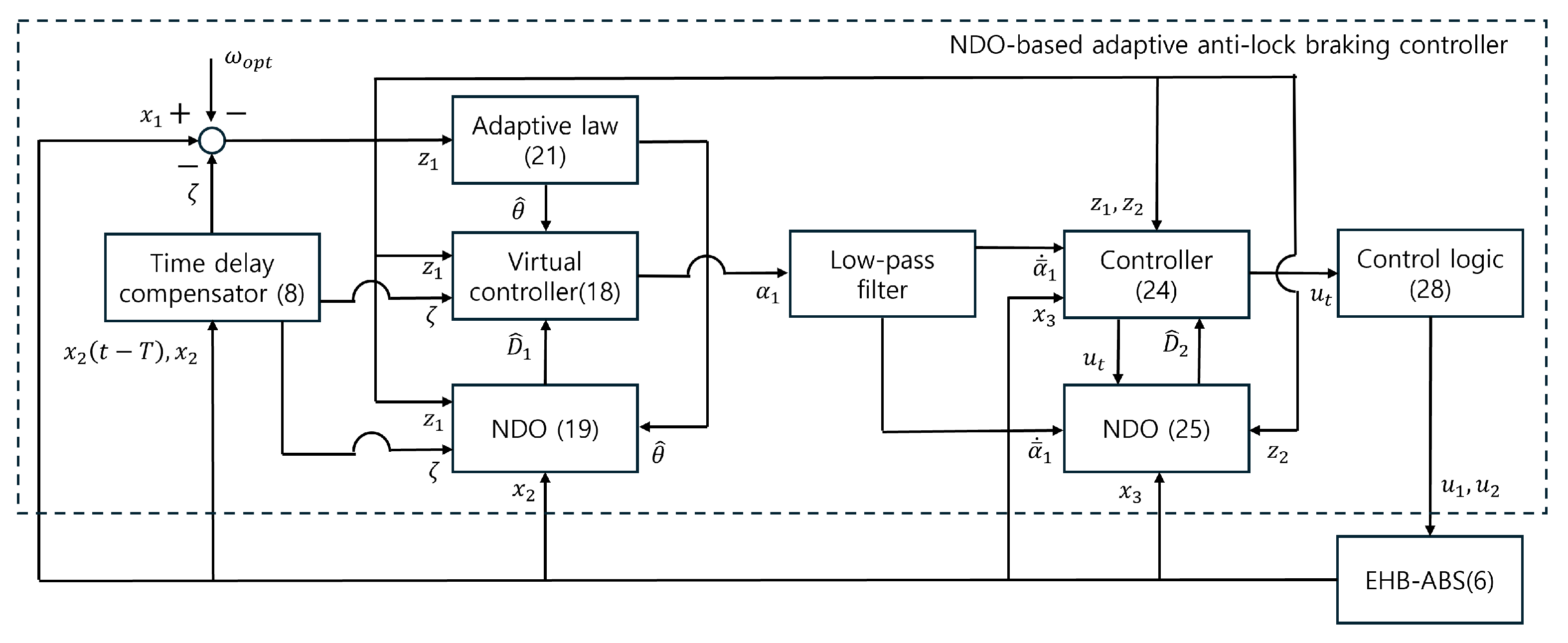
The block diagram of the proposed NDO-based adaptive AB control system is given in Figure 2. Table 1 summarizes the key variables used in the control design.
Remark 5. 
A potential singularity may occur if g 2 ( x 2 ) or g 3 ( x 2 ) becomes zero. This concern, however, can be avoided in the proposed controller. The term g 2 ( x 2 ) involves p 0 x 2 , which cannot vanish because the wheel cylinder pressure x 2 always remains lower than the source pressure p 0 during operation. Likewise, g 3 ( x 2 ) depends on x 2 , which is strictly positive in the operating range. Therefore, the proposed control allocation is free of singularities.
Remark 6. 
Compared with the BGEHB controller in [7], this study develops a unified AB-BGEHB model that accounts for internal disturbances in the BGEHB system. In addition, an NDO-based adaptive AB control strategy is proposed in the presence of unknown tire–road-friction coefficients.

3.3. Stability Analysis

For the stability analysis, the comprehensive Lyapunov function candidate is defined as V = V 1 + V 2 + e 1 2 / 2 .
Theorem 1. 
Consider the closed-loop system formed by the unified AB-BGEHB systems (6), time delay compensator (8), NDOs (19), (20), (25) and (26), and adaptive law (21). Given the bounded initial conditions, such that V ( 0 ) Ψ with some constant Ψ > 0 , all closed-loop signals are semiglobally, uniformly, and ultimately bounded.
Proof. 
Based on (22) and (27), the time derivative of V is represented as
V ˙ = k 1 z 1 2 k 2 z 2 2 + γ 1 z 1 D ˜ 1 + γ 2 z 2 D ˜ 2 + c θ ˜ θ ^ γ 1 D ˜ 1 2 γ 2 D ˜ 2 2 + 1 ς 1 D ˜ 1 D ˙ 1 + 1 ς 2 D ˜ 2 D ˙ 2 D ˜ 1 θ ˜ R ( x 1 ) e 1 2 τ + e 1 Γ ,
where Γ = α ˙ 1 + g 1 z 1 .
Due to the boundedness of d ˙ i and ϵ ˙ , there exists a positive constant, D ¯ i , such that | D ˙ i | D ¯ i , where i = 1 , 2 . Let us define the compact sets Λ 1 = { z 1 2 + z 2 2 + θ ˜ θ ˜ / η + D ˜ 1 2 / ς 1 + D ˜ 2 2 / ς 2 2 ϱ } and Λ 2 = { ω o p t 2 + ω ˙ o p t 2 ω ¯ } . | Γ | < Γ ¯ is ensured on Λ 1 × Λ 2 , where Γ ¯ is a constant. Using Young’s inequality, we obtain
γ i z i D ˜ i γ i z i 2 2 + γ i D ˜ i 2 2
c θ ˜ ( θ θ ˜ ) c θ ˜ 2 2 + c θ ¯ 2 2
1 ς i D ˜ i D ˙ i D ˜ i 2 2 ς i + D ¯ i 2 2 ς i
D ˜ 1 θ ˜ R ( x 1 ) D ˜ 1 2 2 + R ¯ 2 θ ˜ 2 2
e 1 Γ e 1 2 2 + Γ ¯ 2 2 ,
where i = 1 , 2 .
Substituting these inequalities into (29) yields
V ˙ k 1 γ 1 2 z 1 2 k 2 γ 2 2 z 2 2 1 2 ( c R ¯ 2 ) θ ˜ 2 γ 1 1 2 ς 2 D ˜ 1 2 γ 2 1 2 ς 2 D ˜ 2 2 1 τ 1 2 e 1 2 + c θ ¯ 2 2 + D ¯ 1 2 2 ς 1 + D ¯ 2 2 2 ς 2 + Γ ¯ 2 2 .
Through the selection of the design parameters as k i = γ i / 2 + k i * , i = 1 , 2 , c = R ¯ + c * , γ i = 1 / ( 2 ς i ) + γ i * , i = 1 , 2 , and 1 / τ = 1 / 2 + τ * , inequality (35) becomes V ˙ Ξ 1 V + Ξ 2 , where i = 1 , 2 , Ξ 1 = min { 2 k 1 * , 2 k 2 * , c * , 2 γ 1 * , 2 γ 2 * , 2 τ * } , and Ξ 2 = c θ ¯ 2 / 2 + D ¯ 1 2 / ( 2 ς 1 ) + D ¯ 2 2 / ( 2 ς 2 ) + Γ ¯ 2 / 2 . When Ξ 1 > Ξ 2 / ϱ , it follows that V ˙ < 0 on V = ϱ . Hence, the error signals z i , θ ˜ , D ˜ i , and e 1 ( i = 1 , 2 ) are all bounded. Since ω opt and tanh ( ζ ) are also bounded signals, x 1 is bounded as well. Moreover, the boundedness of θ and D 1 guarantees that their estimates, θ ^ and D ^ 1 , remain bounded. This further ensures the boundedness of α 1 and α ¯ 1 , which in turn implies that x 2 is also bounded. Therefore, the set { V ϱ } is invariant, and all signals in the closed-loop system are semiglobally, uniformly, and ultimately bounded.
By integrating the differential inequality V ˙ Ξ 1 V + Ξ 2 , we obtain the following solution for V ( t ) :
V ( t ) V ( 0 ) Ξ 2 Ξ 1 e Ξ 1 t + Ξ 2 Ξ 1 .
Therefore, V ( t ) max { V ( 0 ) , Ξ 2 / Ξ 1 } is ensured.
From (36), the ultimate bounds of the error signals are obtained as follows:
| z i | 2 Ξ 2 Ξ 1 , | D ˜ i | 2 ς i Ξ 2 Ξ 1 , θ ˜ 2 η Ξ 2 Ξ 1 , | e 1 | 2 Ξ 2 Ξ 1
where i = 1 , 2 . These inequalities explicitly show that all error signals converge to a compact set around the origin. It is important to note that the size of these ultimate bounds can be systematically adjusted by decreasing Ξ 1 (i.e., by selecting the design parameters).
Then, we check the stability of the system’s internal dynamics. The internal dynamics are represented as the states that are not directly involved in the output tracking, namely x 3 and x 4 , as follows:
x ˙ 3 = A x 2 R d m c x 3 k e x 4 x ˙ 4 = 1 m c x 3 .
From the boundedness of all signals in the closed-loop system, the input x 2 is bounded. With the bounded input x 2 , the dynamics can be written in the following state-space form with the state vector x i n n e r = [ x 3 , x 4 ] :
x ˙ i n n e r = x ˙ 3 x ˙ 4 = H x 3 x 4 + A 0 x 2
where H = R d m c k e 1 m c 0 . Owing to R d > 0 , m c > 0 , and k e > 0 , the matrix H is a Hurwitz matrix. Therefore, the internal dynamics are stable, and the internal states x 3 and x 4 remain bounded. □
Remark 7. 
The selection of the controller gains is guided by the Lyapunov stability analysis, which establishes that the system states are uniformly ultimately bounded. (36) reveals the ultimate bound V ( t ) is determined by the ratio of Π 2 to Π 1 . Thus, a smaller bound can be realized by selecting larger control and adaptation gains k 1 , k 2 , c , γ 1 , γ 2 to increase the magnitude of Π 1 or by selecting larger observer gains ς 1 , ς 2 to decrease the magnitude of Π 2 . A larger adaptive gain, η, and observer gains, ς 1 and ς 2 , improve the adaptation speed of the NN and NDO, respectively, but this can also increase the sensitivity of the model to disturbances and model uncertainties.
Remark 8. 
The proposed NDO-based adaptive AB controller is suitable for real-time implementation. The online computations consist of low-order NDO-based controller updates for the unified AB-BGEHB model with the fourth-order dynamics and an RBFNN function approximator with a small number of nodes, M, where the Gaussian centers/width are fixed, and only the weights are updated online. Thus, the per-update computational load is dominated by the RBFNN evaluation and weight adaptation and scales linearly with M (i.e., O ( M ) ), while the remaining controller computations add only a small constant overhead. Since the controller is formulated in continuous time, practical ECU implementation can be achieved via standard digital realization (e.g., fixed-step discretization). Accordingly, the computational and memory requirements remain modest.

4. Simulation

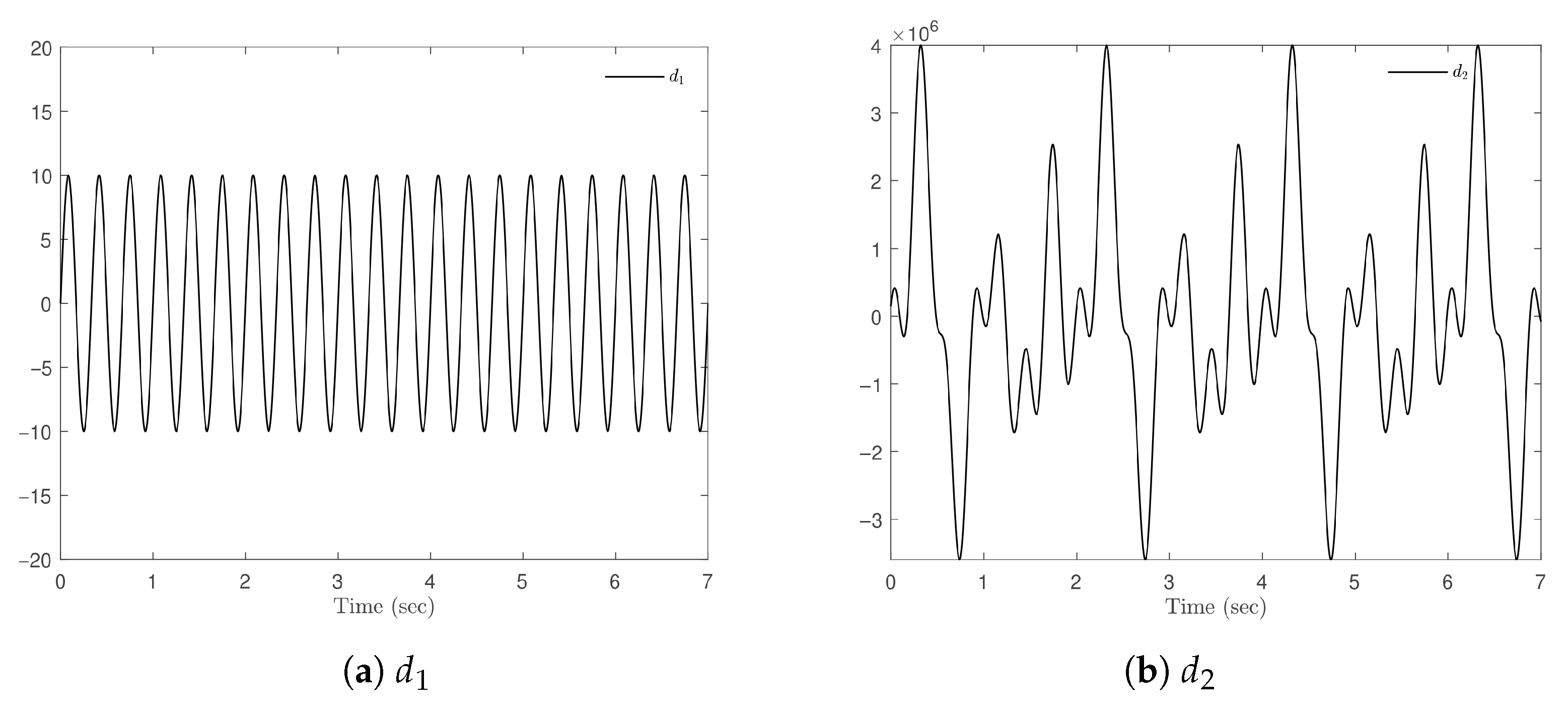
In this section, simulation results are provided to validate the theoretical properties of the proposed method. To demonstrate its effectiveness, the proposed controller is compared with the baseline approaches presented in [16,31]. The method in [16] is adopted as a benchmark for nonlinear control under time-delay conditions. Although this approach utilizes a sliding-mode controller without the EHB structure, it addresses the input delay, facilitating a valid comparison of the delay-compensation capabilities. In addition, the baseline linear–quadratic regulator approach is presented in [31]. The method in [31] was applied to an EHB–ABS model formulated as a hierarchical structure, in which the high-level slip-ratio dynamics were coupled with the low-level EHB pressure dynamics. The baseline controller relies on a linearized representation of this hierarchical model and assumes that the tire–road-friction coefficient is precisely known. In contrast, the proposed adaptive scheme is developed to handle the nonlinearities of the coupled system and accounts for parameter uncertainties. The physical parameters of the unified model are summarized in Table 2. The controller gains are set to k 1 = 110 , k 2 = 80 , γ 1 = 3 , γ 2 = 1 , ς 1 = 2 , ς 2 = 5 , η = 600 , c = 0.001 , n 1 = 70 , n 2 = 70 , and τ = 0.0001 . The disturbances are defined as d 1 = 10 sin ( 6 π t ) and a composite sinusoidal signal, d 2 , as shown in Figure 3. To ensure a fair comparison, the proposed controller and baseline are subjected to these disturbances. The RBFNN utilizes five nodes initialized with zero weights. The Gaussian centers are spaced evenly across [−1, 1] without input normalization, and the width parameter is set to 0.707. The initial state variables are set to x 1 ( 0 ) = 134.2 , x 2 ( 0 ) = 0.01 , and x 3 ( 0 ) = x 4 ( 0 ) = 0 .
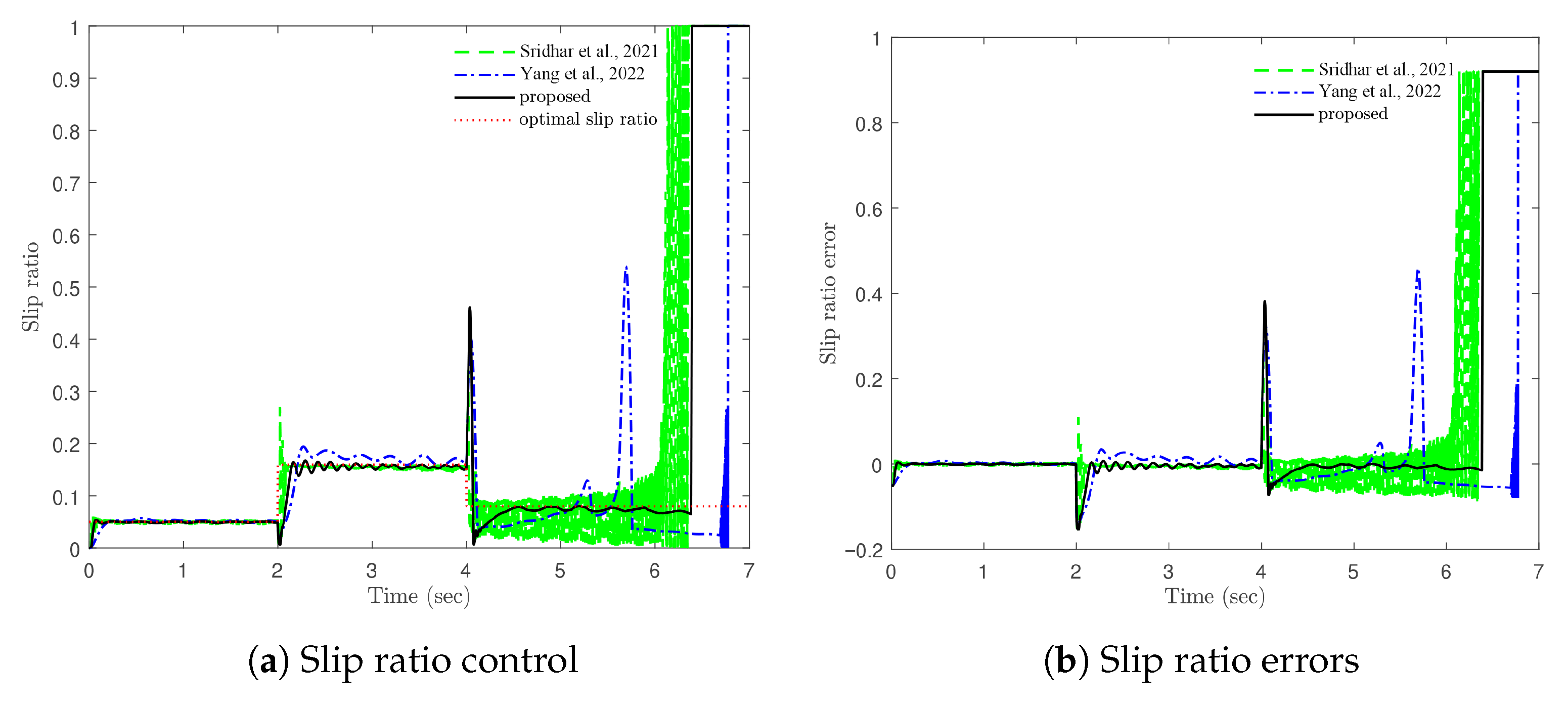
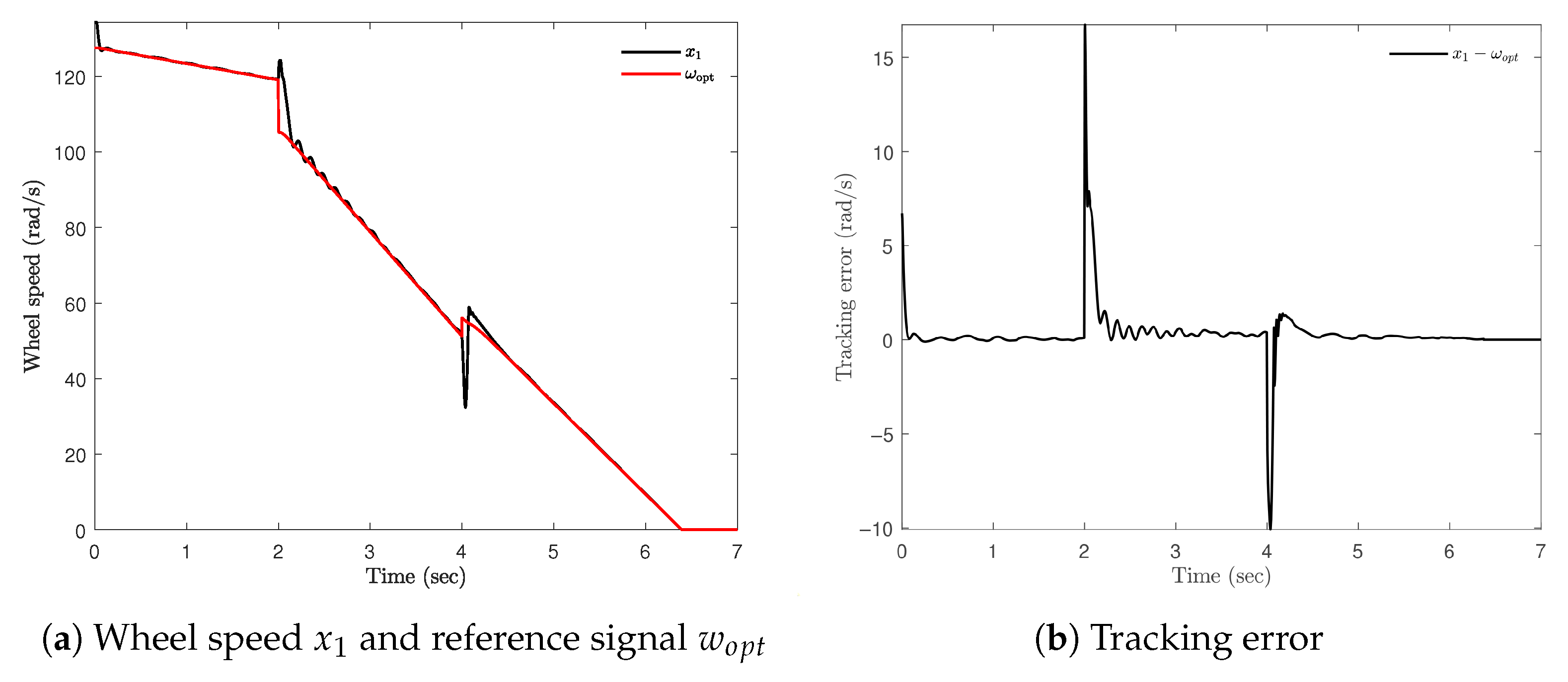
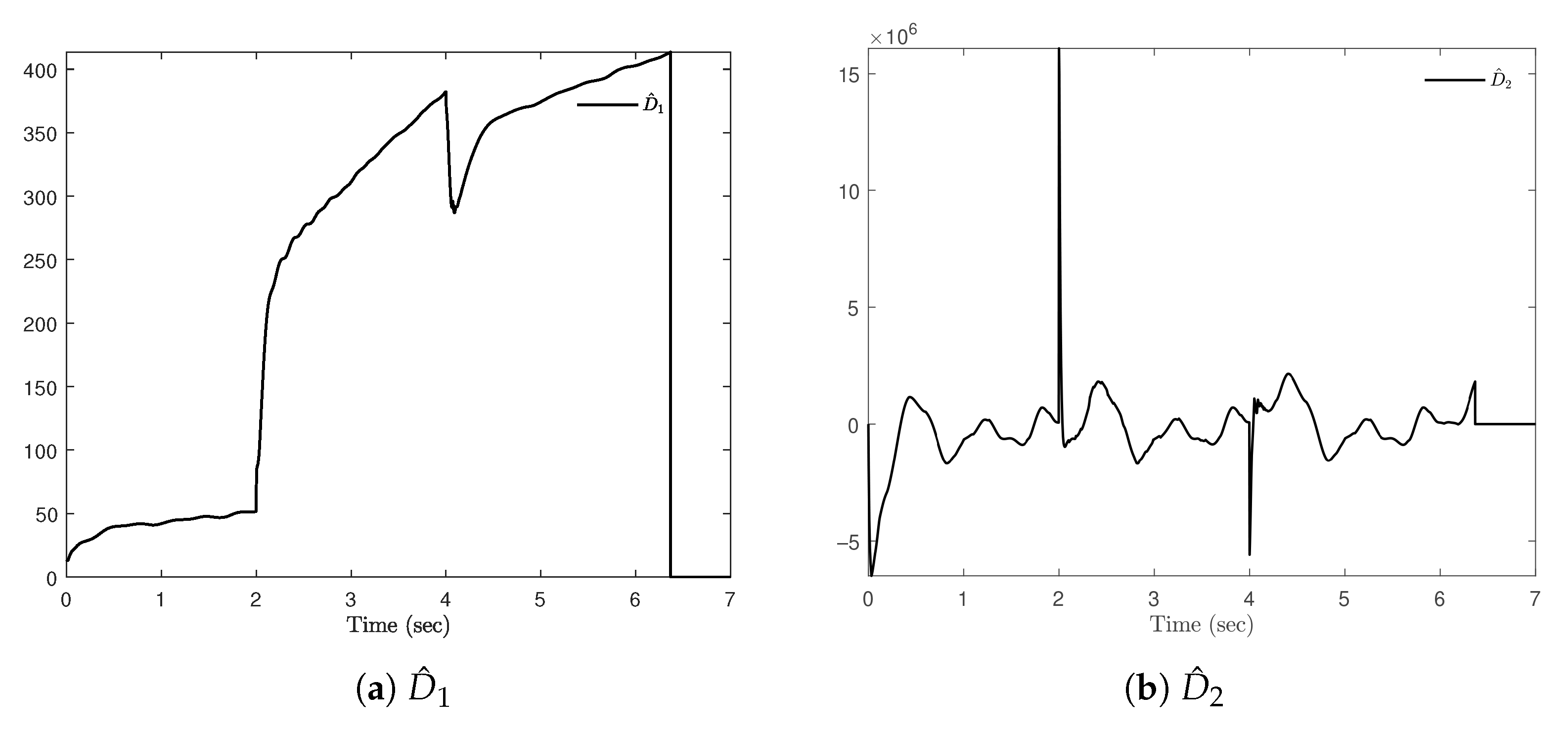
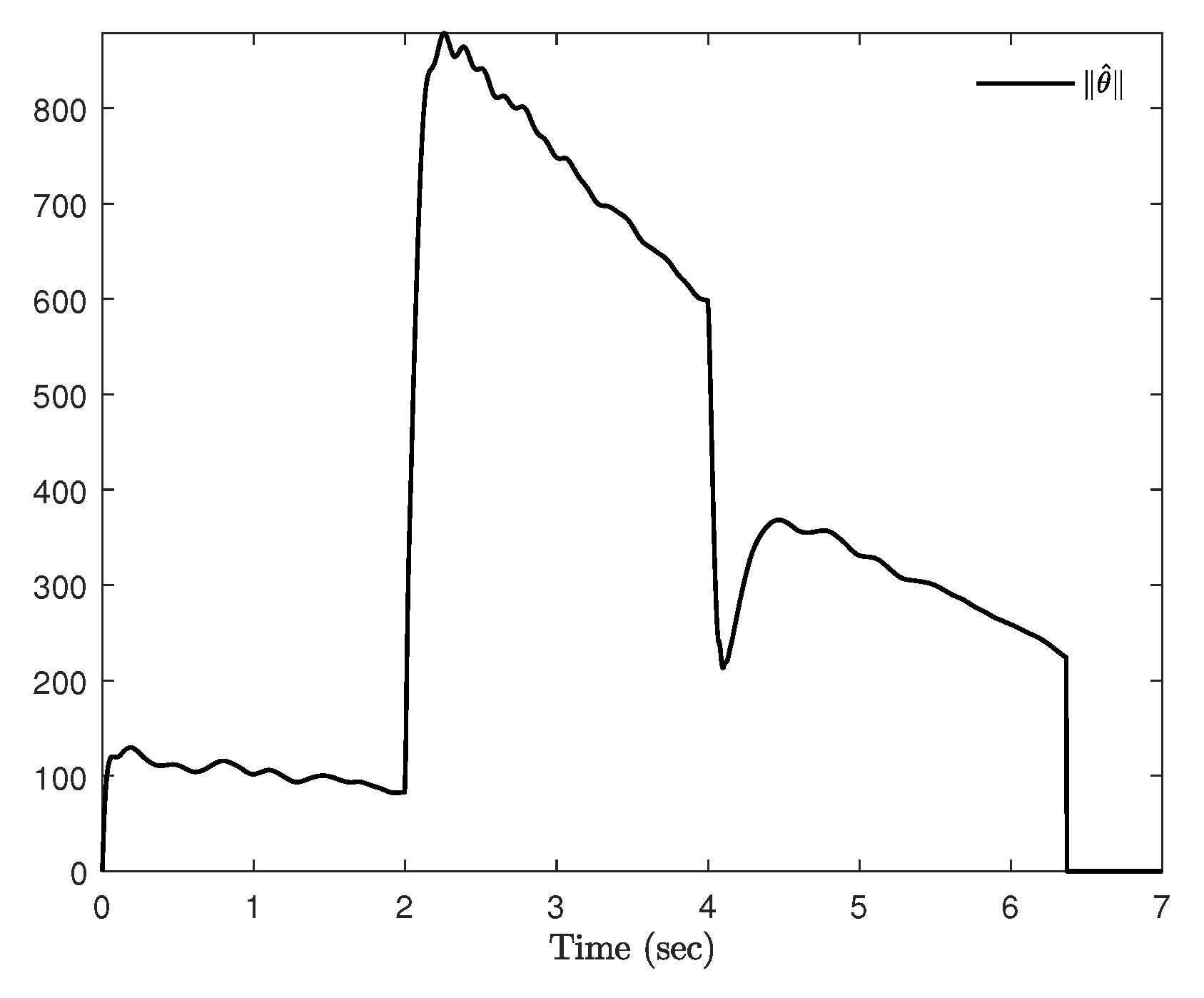
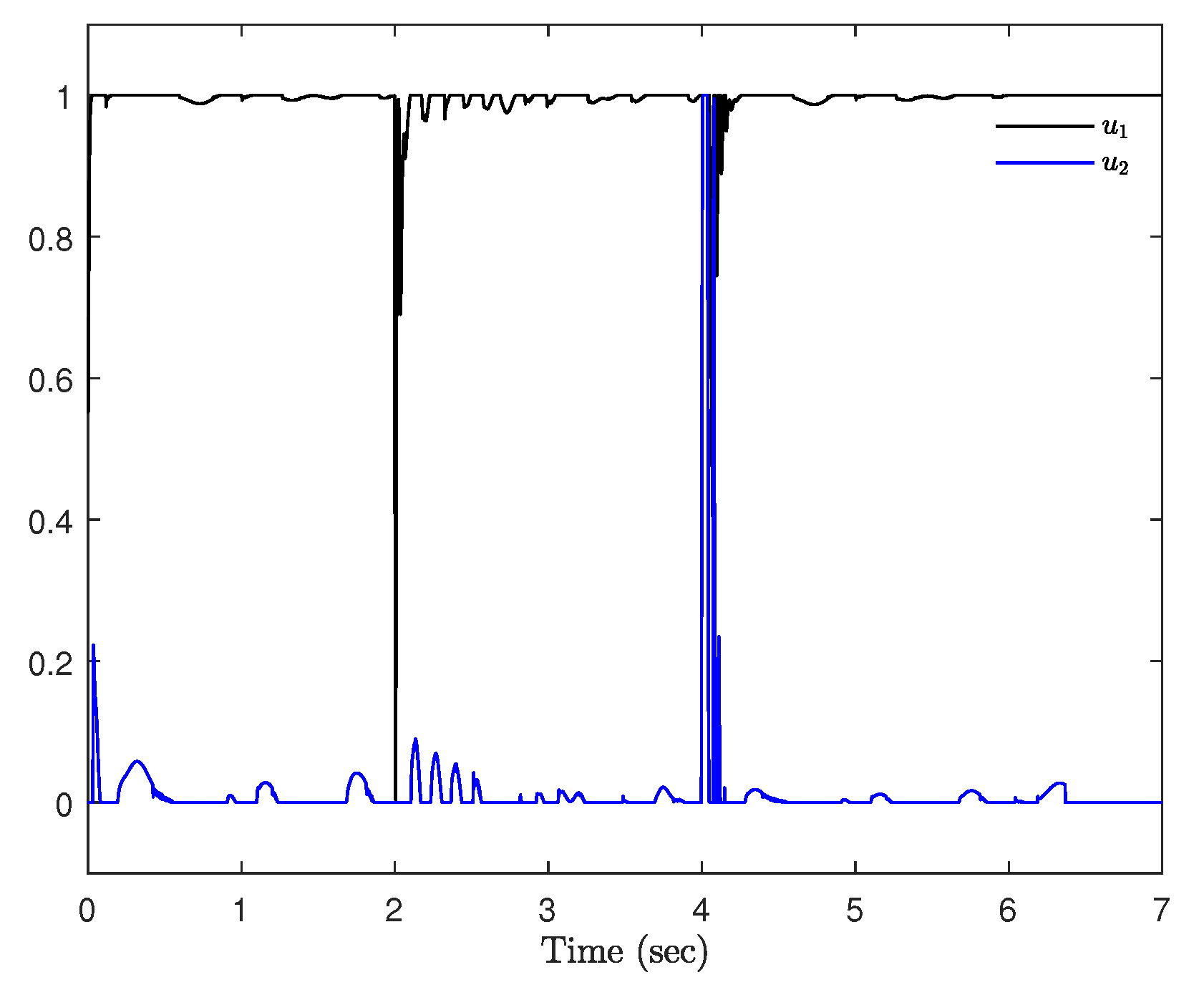
The simulation is conducted to verify that the proposed control scheme can achieve effective wheel-speed tracking in the presence of varying road-friction coefficients and external disturbances. The scenario considers time-varying road conditions, where the surface changes sequentially from snow ( 0 s t < 2 s ) to dry asphalt ( 2 s t < 4 s ) and, finally, to wet asphalt ( t 4 s ), with the corresponding Pacejka coefficients listed in Table 3. Figure 4 illustrates the wheel-speed-tracking performance of the proposed approach. Although transient degradations occur at the instants of surface change, the controller rapidly recovers due to its real-time compensation capability. For comparison with both previous methods, the wheel-speed-tracking result is converted into the slip-ratio control result through the dynamic relation λ = ( v ω Φ ) / v . The slip-ratio control performance is shown in Figure 5. Compared with the previous methods, the proposed control scheme demonstrates superior tracking performance, particularly in the low-speed wet asphalt region after 4 s. Specifically, the proposed controller proves to be more robust against chattering than the sliding-mode control used in [16]. Additionally, when the road surface changes from dry to wet asphalt at 4 s, transient deviations are induced via the pressure modulation lag of the hydraulic system; nevertheless, the proposed approach enables a faster recovery of tracking performance compared to the technique in [31], owing to its NDO and NN mechanism. The mean absolute errors (MAEs) are compared in Table 4. The results indicate that the proposed scheme reduces the tracking error by 68.0% and 61.2% compared to the methods in [16] and [31], respectively. The adaptive responses of the NDO and NN weights to changes in road conditions and disturbances are presented in Figure 6 and Figure 7, respectively. Finally, Figure 8 depicts the duty ratios of the BGEHB inlet and outlet valves, which are modulated to generate the required brake-pressure variations for effective control.

5. Conclusions

In this paper, a recursive, adaptive AB control strategy has been presented for unified AB-BGEHB systems subject to unknown tire–road-friction coefficients and disturbances. By designing a nonlinear AB-BGEHB dynamic model in strict-feedback form, the proposed framework has enabled an accurate representation of the braking torque while preserving the nonlinearities of the hydraulic system. The adaptive controller has achieved robust wheel-speed regulation and optimal slip-ratio tracking under practical braking conditions by incorporating an NDO, an NN approximator, and a delay-compensation mechanism. The NDO has effectively compensated for disturbances due to vehicle motion and BGEHB dynamics, while the NN has estimated and compensated for the unknown tire–road-friction coefficient. The stability of the closed-loop system has been confirmed using Lyapunov analysis. The simulation results have demonstrated that the proposed control design has enhanced robustness and braking performance compared with the existing approaches. As future research directions, we recommend extending the proposed NDO-based adaptive AB framework to EHB systems with unknown nonlinear parameters by incorporating NN-based approximation for the uncertain EHB nonlinearities, with a particular emphasis on singularity-free learning and the control of the unknown input-gain functions g 2 and g 3 . In addition, the proposed approach can be further developed within a prescribed performance control framework [36,37] to guarantee transient performance.

Author Contributions

Conceptualization, S.G.K. and S.J.Y.; methodology, S.G.K.; software, S.G.K.; validation, S.G.K.; formal analysis, S.G.K.; investigation, S.G.K.; resources, S.J.Y.; data curation, S.G.K.; writing—original draft preparation, S.G.K.; writing—review and editing, S.J.Y.; visualization, S.G.K.; supervision, S.J.Y.; project administration, S.J.Y.; funding acquisition, S.J.Y. All authors have read and agreed to the published version of the manuscript.

Funding

This research was supported by the Chung-Ang University Research Scholarship Grants in 2025 and the National Research Foundation of Korea (NRF) grant funded by the Korean government (RS-2024-00334939).

Data Availability Statement

The raw data supporting the conclusions of this article will be made available by the authors upon request.

Conflicts of Interest

The authors declare no conflicts of interest.

References

  1. Chen, Z.; Liu, Z.; Huang, C.; Wang, X.; Li, L.; Fang, Y. A nonlinear wheel cylinder pressure controller based on CESO for integrated braking system. IEEE Trans. Veh. Technol. 2024, 73, 9839–9848. [Google Scholar] [CrossRef]
  2. Zhao, J.; Du, J.; Zhu, B.; Chen, Z. Adaptive dual-loop pressure control for an integrated electro-hydraulic brake system considering uncertain nonlinear characteristics. IEEE Trans. Transp. Electrific. 2024, 10, 9428–9440. [Google Scholar] [CrossRef]
  3. Zhao, J.; Chen, Z.; Zhu, B.; Wu, J. Precise active brake-pressure control for a novel electro-booster brake system. IEEE Trans. Ind. Electron. 2020, 67, 4774–4784. [Google Scholar] [CrossRef]
  4. Wang, H.; Wu, S.; Wang, Q. Global sliding mode control for nonlinear vehicle antilock braking system. IEEE Access 2021, 9, 40349–40359. [Google Scholar] [CrossRef]
  5. Guo, Q.; Liu, Y.; Jiang, D.; Wang, Q.; Xiong, W.; Liu, J.; Li, X. Prescribed performance constraint regulation of electrohydraulic control based on backstepping with dynamic surface. Appl. Sci. 2018, 8, 76. [Google Scholar] [CrossRef]
  6. Shi, Q.; He, L. A model predictive control approach for electro-hydraulic braking by wire. IEEE Trans. Ind. Informat. 2023, 19, 1380–1388. [Google Scholar] [CrossRef]
  7. Zhao, J.; Song, D.; Zhu, B.; Chen, Z.; Sun, Y. Nonlinear backstepping control of electro-hydraulic brake system based on bond graph model. IEEE Access 2020, 8, 19100–19112. [Google Scholar] [CrossRef]
  8. Min, H.; Xu, S.; Fei, S.; Yu, X. Observer-based NN control for nonlinear systems with full-state constraints and external disturbances. IEEE Trans. Neural Netw. Learn. Syst. 2022, 33, 4322–4331. [Google Scholar] [CrossRef]
  9. He, N.; Ma, K.; Li, H.; Fan, Z. Adaptive input reconstruction based resilient MPC against deception attacks. IEEE Trans. Ind. Electron. 2025, 72, 938–948. [Google Scholar] [CrossRef]
  10. Xu, Z.; He, N.; Du, J.; Cheng, F. Distributed MPC with composite event-triggering mechanisms for nonlinear multi-agent systems. Nonlinear Dyn. 2025, 113, 5571–5590. [Google Scholar] [CrossRef]
  11. Amirkhani, A.; Shirzadeh, M.; Heydari, J. Automotive electric power steering control with robust observer based neuroadaptive type-2 radial basis function methodology. IEEE Open J. Veh. Technol. 2024, 5, 592–605. [Google Scholar] [CrossRef]
  12. Zhang, J.; Zhao, X.; Zheng, G.; Zhu, F.; Dinh, T.N. On distributed prescribed-time unknown input observers. IEEE Trans. Autom. Control 2025, 70, 4743–4750. [Google Scholar] [CrossRef]
  13. Yang, X.; Zhang, X.; Cao, J.; Liu, H. Observer-based adaptive fuzzy fractional backstepping consensus control of uncertain multiagent systems via event-triggered scheme. IEEE Trans. Fuzzy Syst. 2024, 32, 3953–3967. [Google Scholar] [CrossRef]
  14. Zhang, Y.; Xu, Y.; Zhou, J.; Zhou, Y.; Mahfoud, J. Vibration control of AMB-rotor system under nase motions based on disturbance observer. IEEE/ASME Trans. Mechatron. 2025, 30, 5398–5407. [Google Scholar] [CrossRef]
  15. Fan, X.; Chen, M.; Zhu, S.; He, S. Design of ABS sliding mode control system for in-wheel motor vehicle based on road identification. Proc. Inst. Mech. Eng. Part D J. Automob. Eng. 2024, 239, 2741–2752. [Google Scholar] [CrossRef]
  16. Sridhar, N.; Devika, K.B.; Subramanian, S.C.; Vivekanandan, G.; Sivaram, S. Antilock brake algorithm for heavy commercial road vehicles with delay compensation and chattering mitigation. Veh. Syst. Dyn. 2021, 59, 524–546. [Google Scholar] [CrossRef]
  17. Savitski, D.; Schleinin, D.; Ivanov, V.; Augsburg, K. Robust continuous wheel slip control with reference adaptation. IEEE Trans. Ind. Informat. 2018, 14, 4212–4223. [Google Scholar] [CrossRef]
  18. Tavolo, G.; So, K.M.; Tavernini, D.; Perlo, P.; Sorniotti, A. On antilock braking systems with road preview through nonlinear model predictive control. IEEE Trans. Ind. Electron. 2024, 71, 9436–9448. [Google Scholar] [CrossRef]
  19. Karpenko, M.; Prentkovskis, O.; Skačkauskas, P. Numerical Simulation of Vehicle Tyre under Various Load Conditions and Its Effect on Road Traffic Safety. Promet Traffic Transp. 2024, 36, 1–11. [Google Scholar] [CrossRef]
  20. Vošahlík, D.; Hanis, T. Real-time estimation of the optimal longitudinal slip ratio for attaining the maximum traction force. Control Eng. Pract. 2024, 145, 105876. [Google Scholar] [CrossRef]
  21. Mirzaeinejad, H. Robust predictive control of wheel slip in antilock braking systems based on radial basis function neural network. Appl. Soft Comput. 2018, 70, 318–329. [Google Scholar] [CrossRef]
  22. Fernandez, J.P.; Vargas, M.A.; Garcia, J.M.V.; Carrillo, J.A.C.; Aguilar, J.J.C. Coevolutionary optimization of a fuzzy logic controller for antilock braking systems under changing road conditions. IEEE Trans. Veh. Technol. 2021, 70, 1255–1268. [Google Scholar] [CrossRef]
  23. El-bakkouri, J.; Ouadi, H.; Saad, A. Adaptive neuro fuzzy inference system based controller for electric vehicle’s hybrid ABS braking. IFAC-PapersOnLine 2022, 55, 371–376. [Google Scholar] [CrossRef]
  24. Kanungo, A.; Kumar, P.; Gupta, V.; Salim; Saxena, N.K. A design an optimized fuzzy adaptive proportional-integral-derivative controller for anti-lock braking systems. Eng. Appl. Artif. Intell. 2024, 133, 108556. [Google Scholar] [CrossRef]
  25. Amirkhani, A.; Shirzadeh, M.; Molaie, M. An indirect type-2 fuzzy neural network optimized by the grasshopper algorithm for vehicle ABS controller. IEEE Access 2022, 10, 58736–58751. [Google Scholar] [CrossRef]
  26. Shirzadeh, M.; Amirkhani, A. COVID-based controller: Enhancing automotive safety with a neuroadaptive beta-function optimization for anti-lock braking systems. Eng. Sci. Technol. Int. J. 2024, 56, 101764. [Google Scholar] [CrossRef]
  27. Amirkhani, A.; Molaie, M. Fuzzy controllers of antilock braking system: A review. Int. J. Fuzzy Syst. 2023, 25, 222–244. [Google Scholar] [CrossRef]
  28. Phadke, S.B.; Shendge, P.D.; Wanaskar, V.S. Control of antilock braking systems using disturbance observer with a novel nonlinear sliding surface. IEEE Trans. Ind. Electron. 2020, 67, 6815–6823. [Google Scholar] [CrossRef]
  29. Lv, L.; Zhao, W.; Zhou, J.; Wang, C.; Zhou, X. Interval type-2 T-S fuzzy robust anti-lock braking control for electro-mechanical braking system considering road uncertainty and input delay. IEEE Trans. Intell. Transp. Syst. 2025, 26, 7006–7020. [Google Scholar] [CrossRef]
  30. Tan, Z.H.; Chen, Z.F.; Guo, X.F.; Pei, S.H. Development of integrated electro-hydraulic braking system and its ABS application. Int. J. Precis. Eng. Manuf. 2016, 17, 337–346. [Google Scholar] [CrossRef]
  31. Yang, F.; Chen, X.; Guo, D.; Hu, M.; Liao, Z.; Fu, Z.; Gong, Q. Electric-hydraulic compound control anti-lock braking system. Int. J. Automot. Technol. 2022, 23, 1593–1608. [Google Scholar] [CrossRef]
  32. Zhang, J.; Sun, W.; Jing, H. Nonlinear robust control of antilock braking systems assisted by active suspensions for automobile. IEEE Trans. Control Syst. Technol. 2019, 27, 1352–1359. [Google Scholar] [CrossRef]
  33. Maia, I.D.C.D. Modeling and control of anti-lock braking systems considering different representations for tire-road interaction. In Proceedings of the 23rd International Conference on System Theory, Control and Computing (ICSTCC), Sinaia, Romania, 9–11 October 2019; pp. 344–349. [Google Scholar]
  34. Han, W.; Xiong, L.; Yu, Z. Braking pressure control in electro-hydraulic brake system based on pressure estimation with nonlinearities and uncertainties. Mech. Syst. Signal Process. 2019, 131, 703–727. [Google Scholar] [CrossRef]
  35. Chen, L.; He, Y.; Ma, T.; Zhong, S. Online estimation and control method of optimal slip ratio for vehicle with an electric power-assisted brake system. IEEE Access 2024, 12, 176961–176981. [Google Scholar] [CrossRef]
  36. Sun, C.; Chen, S.; Deng, Z. Sliding mode control of electro-hydraulic servo based on neural network adaptive observer. Electron. Res. Arch. 2025, 33, 6700–6719. [Google Scholar] [CrossRef]
  37. Yang, X.; Deng, W.; Yao, J. Neural adaptive dynamic surface asymptotic tracking control of hydraulic manipulators with guaranteed transient performance. IEEE Trans. Neural Netw. Learn. Syst. 2023, 34, 7339–7349. [Google Scholar] [CrossRef] [PubMed]
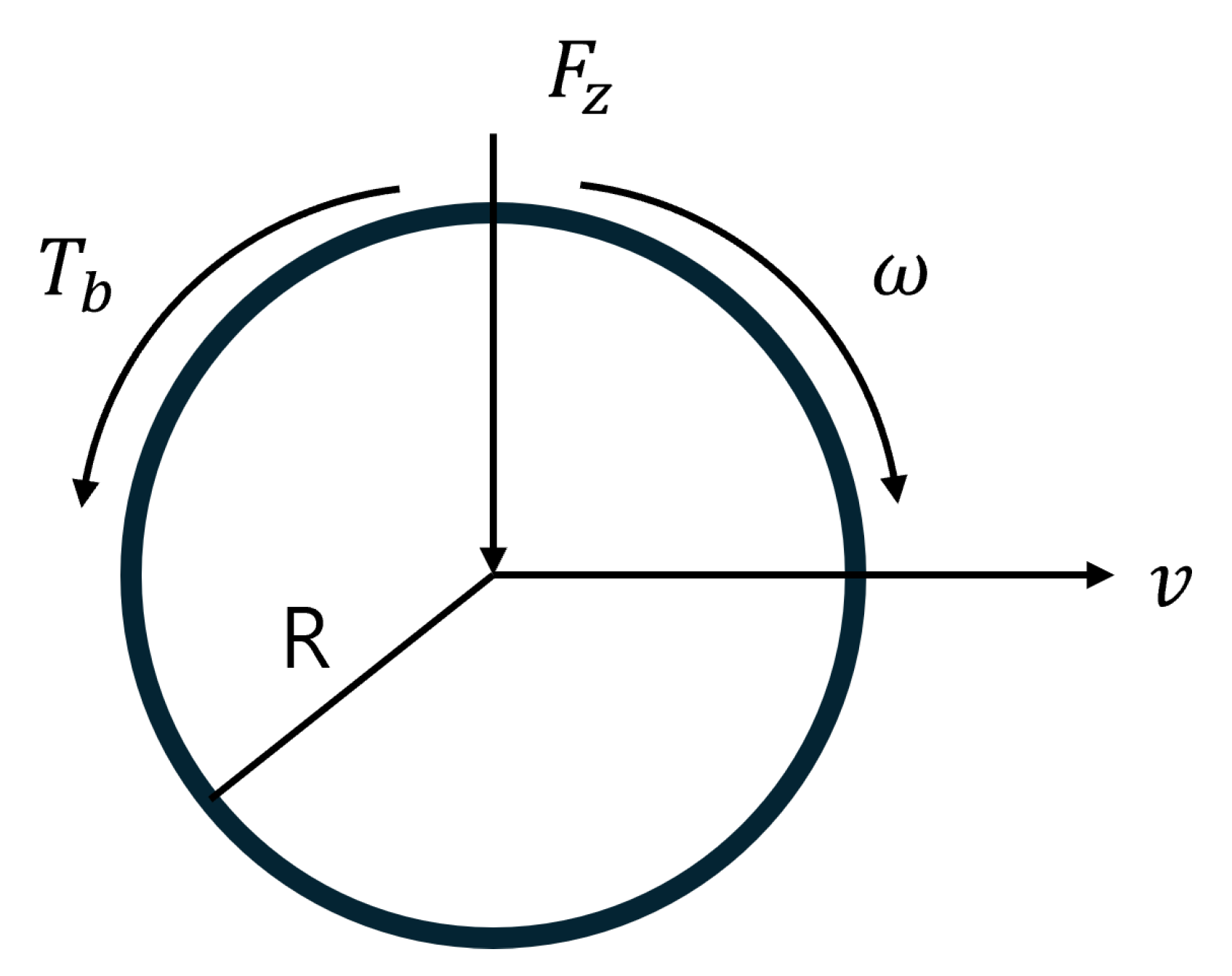
Figure 1. Quarter-car tire model.
Machines 14 00123 g001
Figure 2. Block diagram of the proposed NDO-based adaptive AB control system.
Machines 14 00123 g002
Figure 3. Disturbance d 2 .
Machines 14 00123 g003
Figure 4. Wheel-speed-tracking results of the proposed approach.
Machines 14 00123 g004
Figure 5. Comparison of tracking results [16,31].
Machines 14 00123 g005
Figure 6. Estimated disturbances of the proposed approach.
Machines 14 00123 g006
Figure 7. Adaptive estimate θ ^ of the proposed approach.
Machines 14 00123 g007
Figure 8. Control inputs u 1 and u 2 of the proposed approach.
Machines 14 00123 g008
Table 1. List of symbols and abbreviations.
Symbol/AbbreviationDescription
z 1 , z 2 Tracking errors
e 1 Filter boundary error
α 1 Virtual control law
α ¯ 1 Filtered virtual control signal
ζ Delay compensation state
θ ^ Estimated NN weights
D ^ 1 , D ^ 2 Estimated lumped disturbances
u 1 , u 2 Control inputs (inlet/outlet valves)
ABAnti-lock braking
EHBElectro-hydraulic brake
BGEHBBond-graph-based EHB
NDONonlinear disturbance observer
NNNeural network
RBFNNRadial-basis-function neural network
Table 2. Model parameters [7,32].
DefinitionSymbolValueUnit
Wheel’s moment of inertiaJ 0.6 kg· m 2
Effective wheel radius Φ 0.3 m
Equivalent mass of quarter-car modelm400kg
Braking torque coefficient k p 3 × 10 4 N·m/Pa
Maximum flow coefficient of inlet valve C d 1 0.7
Maximum flow coefficient of outlet valve C d 2 0.7
Cross-sectional area at maximum opening of inlet valve A 1 8 × 10 7 m 2
Cross-sectional area at maximum opening of outlet valve A 2 8 × 10 7 m 2
Volumetric compliance effect of brake fluid C f 3.4 × 10 13 m 5 / N
Density of brake fluid ρ 850kg/ m 3
Piston areaA 1.963 × 10 3 m 2
Caliper mass m c 0.75 kg
Elastic coefficient of elastic element in brake k e 3.37 × 10 7 N/m
Damping coefficient of damping element in brake R d 10 , 000 N/(m/s)
Maximum pressure of master cylinder p 0 1.5 × 10 7 Pa
Hydraulic time delayT 0.02 + 0.005 sin ( 0.5 t ) s
Table 3. Pacejka coefficients [33].
Road ConditionBCDE λ opt
Snow520.31.00.05
Wet asphalt122.30.8210.08
Dry asphalt101.910.970.16
Table 4. MAE of slip ratio.
Proposed[16][31]
Slip ratio error0.01120.03500.0289
Disclaimer/Publisher’s Note: The statements, opinions and data contained in all publications are solely those of the individual author(s) and contributor(s) and not of MDPI and/or the editor(s). MDPI and/or the editor(s) disclaim responsibility for any injury to people or property resulting from any ideas, methods, instructions or products referred to in the content.