Article

Brushless Wound-Field Synchronous Machine Topology with Excellent Rotor Flux Regulation Freedom

1
Department of Electronic Engineering, Balochistan University of Information, Technology, Engineering and Management Sciences, Quetta 87300, Pakistan
2
Department of Mechanical Engineering, Ghulam Ishaq Khan Institute, Topi, Swabi 23640, Pakistan
3
Department of Electrical Engineering Technology, Benazir Bhutto Shaheed University of Technology and Skill Development, Khairpur Mirs 66020, Pakistan
4
Electrical Engineering Department, King Fahd University of Petroleum and Minerals, Dhahran 34464, Saudi Arabia
5
Department of Electrical Engineering, KTH Royal Institute of Technology, 10044 Stockholm, Sweden
*
Author to whom correspondence should be addressed.
Machines 2026, 14(1), 110; https://doi.org/10.3390/machines14010110 (registering DOI)
Submission received: 21 November 2025 / Revised: 9 January 2026 / Accepted: 12 January 2026 / Published: 17 January 2026
(This article belongs to the Section Electrical Machines and Drives)

Abstract

This paper presents a nine-switch inverter for brushless operation of wound-field synchronous machines with excellent rotor flux regulation freedom. The manufacturing cost of permanent magnet machines is high due to the instability of rare-earth magnet prices in the global market. Moreover, conventional wound-field synchronous machines (WFSMs) have problems with their rotor brushes and slip-ring assembly, wherein the assembly starts to malfunction in the long run. Furthermore, recently, some brushless WFSM topologies have been investigated to eliminate the problems associated with rotor brushes and slip rings, but they have either a high cost due to a double-inverter, or low flux regulation freedom due to a single inverter (−id). The proposed nine-switch topology achieves a low cost by using a single inverter with nine switches and excellent flux control through three variables (−id, iq, and if), making it highly suitable for wide-speed applications. In the proposed topology, the machine’s armature winding is divided into two sets of coils: ABC and XYZ. A 12-slot and 8-pole machine stator is wound with armature winding coils ABC and XYZ, creating six terminals for injecting currents and two neutrals from each ABC and XYZ coil set. The current to the ABC and XYZ coils is supplied by a nine-switch inverter. The inverter is specially designed to supply rated currents to the ABC winding coils and half of the rated current to the XYZ winding coils. The number of turns of the ABC and XYZ winding coils are kept the same so they produce the same winding function. However, the current in the XYZ winding coils is half compared to that of the ABC winding coils, which creates an asymmetrical airgap magnetomotive force (MMF). The asymmetrical airgap MMF contains two working harmonics, i.e., fundamental MMF for torque production and an additional sub-harmonic MMF component for rotor field brushless excitation. The rotor field is controlled by the difference in current of the two armature winding coils: ABC and XYZ. The proposed topology is validated through theoretical analysis and finite element simulations of electromagnetic and flux regulation. A 2D finite-element analysis is performed to verify the idea. The proposed topology is capable of establishing a 9.15 A dc current in the rotor field winding coil, which consequently generates a torque of 7.8 N·m with a 20.30% torque ripple. Rotor field flux regulation was analyzed from the stator ABC and XYZ coils current ratio ζ. The ratio ζ is analyzed as 2 to 1.3; subsequently, the inducted field currents were 9.15 A dc to 4.8 A dc, respectively.

1. Introduction

Permanent magnet machines (PMMs) are expensive to manufacture due to fluctuating rare-earth permanent magnet (PM) cost [1]. Additionally, the application of permanent magnet machines (PMMs) is limited by their low flux-weakening capability, susceptibility to demagnetization from faulty currents, and low efficiency at low speeds. Alternatively, an induction machine (IM) is a preferred choice, with its low manufacturing cost, inherent line-start mechanism, robust structure for hazardous environments, etc. [2]. However, it has a low starting torque, low efficiency at low loading, low torque per volume density, low power factor, etc. [3]. Some of these problems are addressed in switched reluctance machines (SRMs) and synchronous reluctance machines (SynRMs), which have high efficiency due to the elimination of copper losses in their rotors; they have extremely high achievable speeds, since the main source of heat in this type of machine is the stator, which can be easily cooled. However, the PM-less alternatives lack flux controllability and have scaling problems. This issue is addressed by employing wound-field synchronous machines (WFSMs) which have a dedicated flux source on the rotor [4,5,6,7]. In this case, a dc or excitation current is supplied through the brushes and slip-ring assembly to the rotor field winding coil and rotor flux is generated. The advantage of WFSMs is their ability to adjust the excitation current without drawing reactive power. This ability helps the WFSM to adjust the power factor and torque even when the inverter voltage source is unable to do so, unlike PM machines which have a constant source of excitation, creating problems in designs for traction applications. The efficiency of WFSMs is marginally less than PM machines because of the additional losses in the field winding of WFSMs. However, WFSMs can adjust the field excitation, which allows the WFSM to have an extra degree of freedom to optimize the efficiency of the WFSM above and below the rated load conditions using three control variables: direct-axis current (id), quadrature-axis current (iq), and field current (if) [8,9,10]. The flexible control with three variables makes WFSMs more suitable for numerous applications, such as traction, power generation, industrial tools, etc. On the other hand, the disadvantages of WFSMs are the malfunction of the brushes and slip ring in the long run, excitation loss of the rotor, rotor copper loss, and increased cost due to the additional field exciter. To eliminate the disadvantages associated with a conventional WFSMs, several brushless topologies have been proposed in the literature.
Dual-inverter topologies have been widely adopted in synchronous machine drive systems to enable independent and flexible control of multiple winding sets or excitation channels. Typically implemented using two conventional three-phase voltage source inverters supplied from a common or split dc link, dual-inverter configurations provide full voltage utilization, decoupled modulation, and a high control bandwidth. In the literature, such topologies have been applied to brushless excitation of synchronous machines, dual-stator and open-end winding structures, and harmonic current injection schemes aimed at torque ripple reduction and efficiency enhancement. Several studies have reported improved torque quality and reduced current harmonics when dual inverters are used for simultaneous fundamental and harmonic excitation, highlighting their effectiveness as a benchmark solution for high-performance synchronous machine drives [11,12,13,14,15].
However, dual-inverter systems offer superior modulation freedom and simpler control implementation at the expense of increased hardware complexity, switching losses, and cost, compared with reduced-switch alternatives.
Therefore, the nine-switch inverter (NSI) topology has been extensively investigated as a reduced-switch alternative to conventional dual three-phase voltage source inverters for synchronous machine drive systems. By sharing one inverter leg between two three-phase outputs, the NSI reduces the number of power switches, gate drivers, and associated losses while maintaining independent control capability for multiple AC ports. Various modulation strategies, including space-vector and carrier-based PWM schemes, have been proposed to address inherent constraints of the NSI, such as limited voltage utilization and coupling between output phases. Furthermore, comparative analyses have shown that, despite a slight reduction in voltage margin, the NSI can achieve performance comparable to conventional dual-inverter systems in terms of torque control, harmonic distortion, and efficiency, making it an attractive solution for cost- and space-constrained synchronous machine drives [12,13,14,15,16,17,18].
In the context of synchronous machines, prior studies have demonstrated the suitability of NSI configurations for applications such as brushless excitation, dual-stator windings, and multi-port power conversion, where both fundamental and auxiliary harmonic currents are required.
The brushless topologies [7,19,20,21,22,23] given in Figure 1a replaced the brushes, slip rings, and exciter assembly found in conventional WFSMs. Normally, in brushless (BL)-WFSM topologies, the power is transferred from the stator side to excite the rotor field by an additional harmonic excitation technique (see Figure 1b). In Figure 1b, the nine-switch inverter topology shows nine IGBT switches S1~S9 and the stator of the machine is wound with two sets of armature windings, namely ABC and XYZ. On the rotor side, H is harmonic winding, F is field winding, and D is the bridge rectifier. In the harmonic excitation technique, several orders of MMF harmonics are generated and utilized for rotor field excitation, namely fifth, third, and sub-harmonics [19,20,21,22,23]. The main problem with the available BL-WFSM topologies is that they are either dual-inverter topologies, which increases the cost, or single-inverter topologies with a low flux regulation capability due to an uncontrollable inducted rotor field current [24,25,26,27,28,29,30].
This paper proposes the utilization of a nine-switch inverter topology which not only realizes the brushless operation of a WFSM, but also has excellent rotor flux regulation freedom. Table 1 shows a comparison of the advantages of the proposed nine-switch topology in terms of various parameters with the conventional PM and wound-field excitation brushless synchronous machines. This paper discusses the operation principles of a nine-switch inverter topology, generating desired currents from the inverter topology. A 12-slot and 8-pole BL-WFSM is then simulated through a 2D finite-element method by applying the currents with the nine-switch inverter. The rotor flux regulation freedom is also analyzed through 2D FE analysis.

2. Proposed Nine-Switch Inverter Topology and Working Principle

The nine-switch inverter can produce dual three-phase voltage sets, namely A, B, C, and X, Y, Z. These three-phase voltage sets can be of different amplitudes and can be phase-shifted between each other.
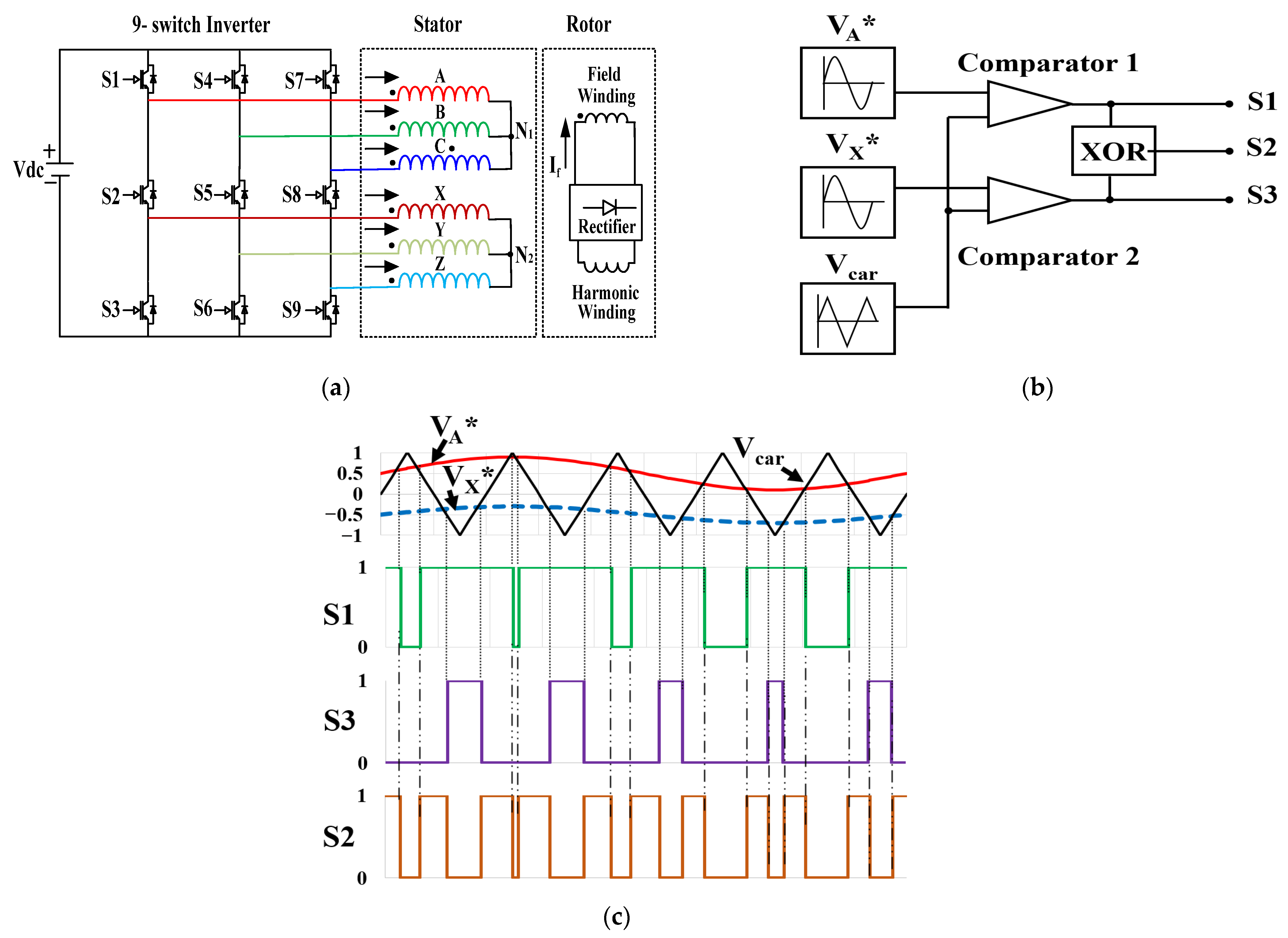
The nine-switch inverter circuit used in the BL-WFSM is shown in Figure 2a, where S1–S9 are IGBT switches, N1 and N2 are the two neutral points for the two stator winding sets, and If is the inducted field current. The circuit consists of three legs. The switches S1, S4, and S7 control output A, B, and C and switches S3, S6, and S9 control output X, Y, and Z, respectively. The switches S2, S5, and S8 are common for A, B, C, and X, Y, Z. This can be represented as two three-phase inverters merging, one on top of the other. In this case, the currents in coils A, B, and C are in phase with the corresponding coils X, Y, and Z, respectively, calculated as
I a I b I c I x I y I z = I 1 sin ω t I 1 sin ( ω t 2 π 3 ) I 1 sin ( ω t + 2 π 3 ) I 2 sin ω t I 2 sin ( ω t 2 π 3 ) I 2 sin ( ω t + 2 π 3 )
where I1 and I2 are the peak current values in the windings ABC and XYZ, respectively. In this work, we used sine pulse width modulation (SPWM) for the nine-switch inverter. The block diagram of the modulation circuit for the first leg is shown in Figure 2b. In this figure, two normalized voltage reference signals, VA* and Vx*, with an offset of 0.5 and −0.5, respectively, are compared with the triangle carrier signals (Vcar) through two comparators. The triangle carrier wave typically has a frequency several times larger than the reference signals. The outputs of comparators 1 and 2 are the signals for switches S1 and S3, respectively. The logic operation exclusive OR (XOR) between the outputs of the comparators gives gating signals for the middle switch S2.
The generation of gating signals with modulation logic is shown in Figure 2c, the solid line represents the reference for phase A, while the dashed line is for phase X. As we can see, when the reference VA* ≤ Vcar, switch S1 is on, and vice versa. In the modulation logic, the gating signals of S3 are generated similarly. The switch S3 should be turned on when both of the outputs of S1 and S2 have different values. The logic operation XOR, which can be written as
z = x _ y + x y _
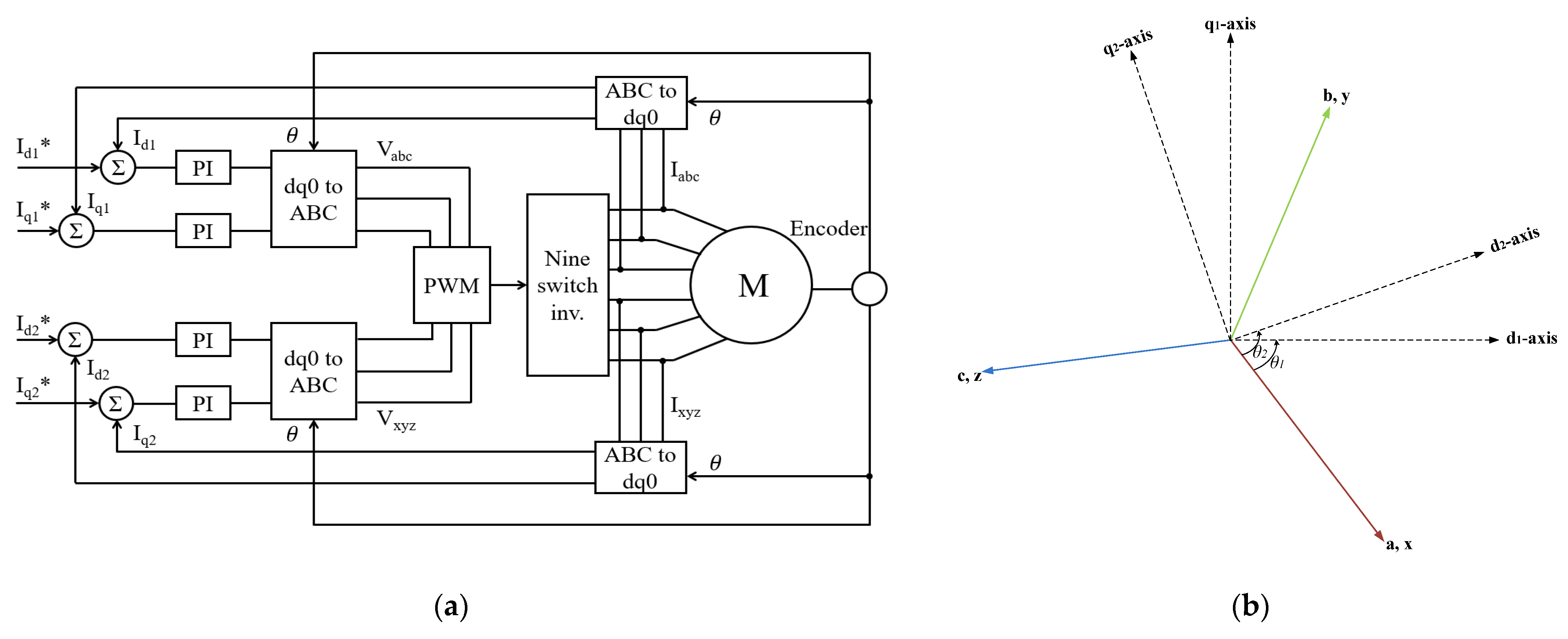
Satisfies this condition. In this equation, z is the output signal, x and y are the operands, and the line above the operand stands for logical inversion. The reference signals for the SPWM were produced by the PI current controller in a dual synchronous reference frame. The control method of the unbalanced dual three-phase synchronous machine was presented in [24,25]. However, because the detailed analysis of this method is beyond the scope of our paper, we will only briefly explain the underlying principle. To determine the control and state vectors, the dual three-phase quantities are transformed into the dq0 reference frame, as illustrated in Figure 3b, with the help of transformation matrix T. Therefore, the currents in the dq reference frame will be
I d 1 I q 1 I d 2 I q 2 = T . I a I b I c I x I y I z ;   T = 2 3 cos θ 1 sin θ 1 cos ( θ 1 2 π 3 ) sin ( θ 1 2 π 3 ) cos ( θ 1 + 2 π 3 ) sin ( θ 1 + 2 π 3 ) cos θ 2 sin θ 2 cos ( θ 2 2 π 3 ) sin ( θ 2 2 π 3 ) cos ( θ 2 + 2 π 3 ) sin ( θ 2 + 2 π 3 ) T
where θ1 is the angle of the d1-axis with respect to the stator ABC frame a-axis and θ2 is the angle of the d1-axis with respect to the stator XYZ frame x-axis. Therefore, the voltage in the dual dq reference frame will be
V d 2 V q 2 V d 1 V q 1 = R s I d 2 I q 2 I d 1 I q 1 + L d 0 L d d 0 0 L q 0 L q q L d d 0 L d 0 0 L q q 0 L q d d t I d 2 I q 2 I d 1 I q 1 + ω 0 L q 0 L q q L d 0 L d d 0 0 L q q 0 L q L d d 0 L d 0   I d 2 I q 2 I d 1 I q 1 + 0 1 0 1 ω ψ
where Rs is the stator resistance; Vd2, Vq2, Vd1, and Vq1 are the voltages in the first and second dq0 reference frame, respectively; similar notation is used for the currents; Ld and Lq are the self-inductances of the d- and q-axes, respectively; Ldd and Lqq are the mutual inductances between the d1- and d2-axis, and q1- and q2-axis; ω is the angular frequency; ψ is the magnet flux.
Denoting the feed-forward as
V f d 2 V f q 2 V f d 1 V f q 1 = 0 0 L d d 0 0 0 0 L q q L d d 0 0 0 0 L q q 0 0 d d t I d 2 I q 2 I d 1 I q 1 + ω 0 L q 0 L q q L d 0 L d d 0 0 L q q 0 L q L d d 0 L d 0   I d 2 I q 2 I d 1 I q 1 + 0 1 0 1 ω ψ
We can decouple the voltage equations as follows
V d 2 V f d 2 V q 2 V f q 2 V d 1 V f d 1 V q 1 V f q 1 = R s I d 2 I q 2 I d 1 I q 1 + L d 0 0 0 0 L q 0 0 0 0 L d 0 0 0 0 L q d d t I d 2 I q 2 I d 1 I q 1
Thus, the control of the machine was simplified. The block diagram of the current controller is shown in Figure 3a; the basic configuration of the current controller is given in [26,27,28,29,30]. In the proposed configuration, we can see that the implementation of decoupling feed-forward terms simplifies the control to two parallel independent dq0 frames. The machine currents Iabc are transformed into Idq1 and the currents Ixyz are transformed into Idq2. The error between the referenced values and actual values is regulated by the PI gains and their outputs are then subtracted from the feed-forward terms. Next, the Vdq1 and Vdq2 voltages are transformed back to the abc coordinate frame. The Vabc and Vxyz are normalized and modulated, and the gating signals are fed to the inverter.

3. Machine Configuration and Working Principle

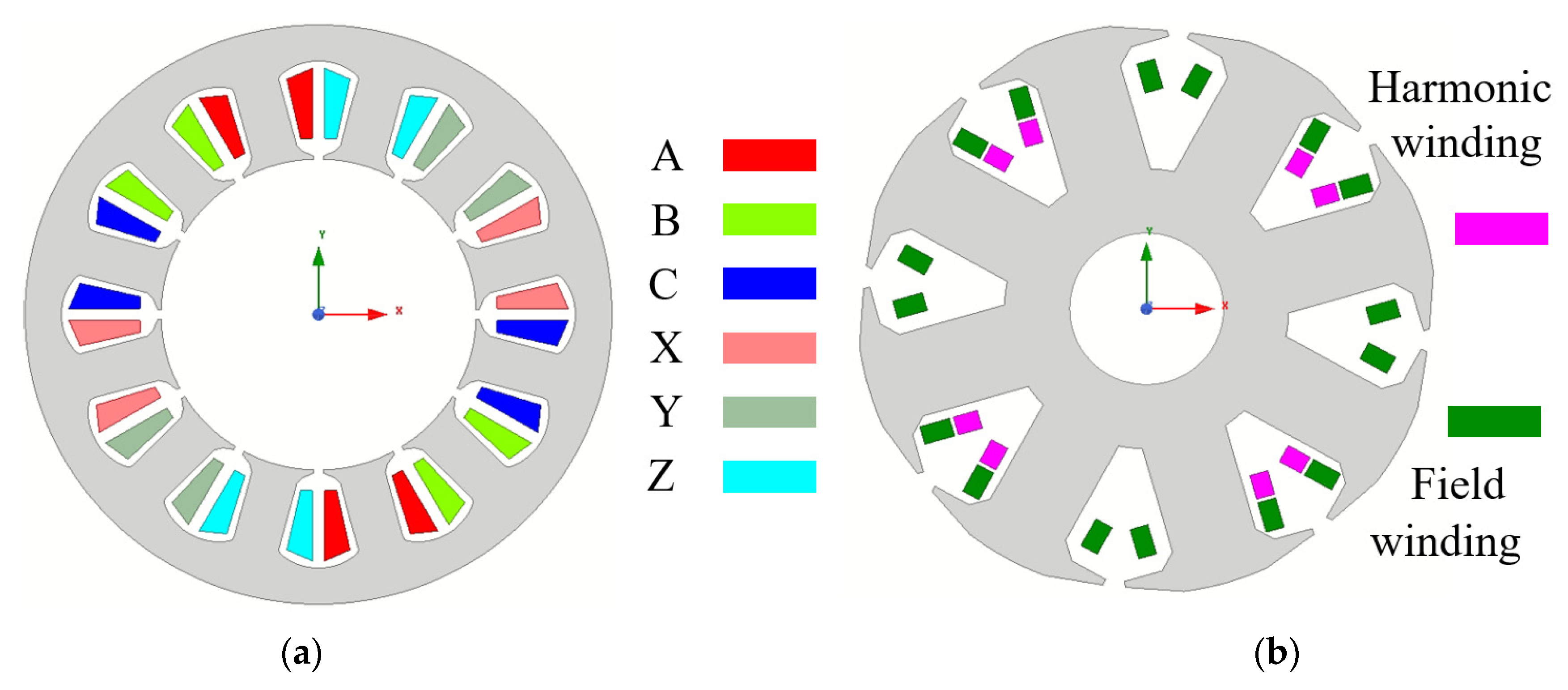
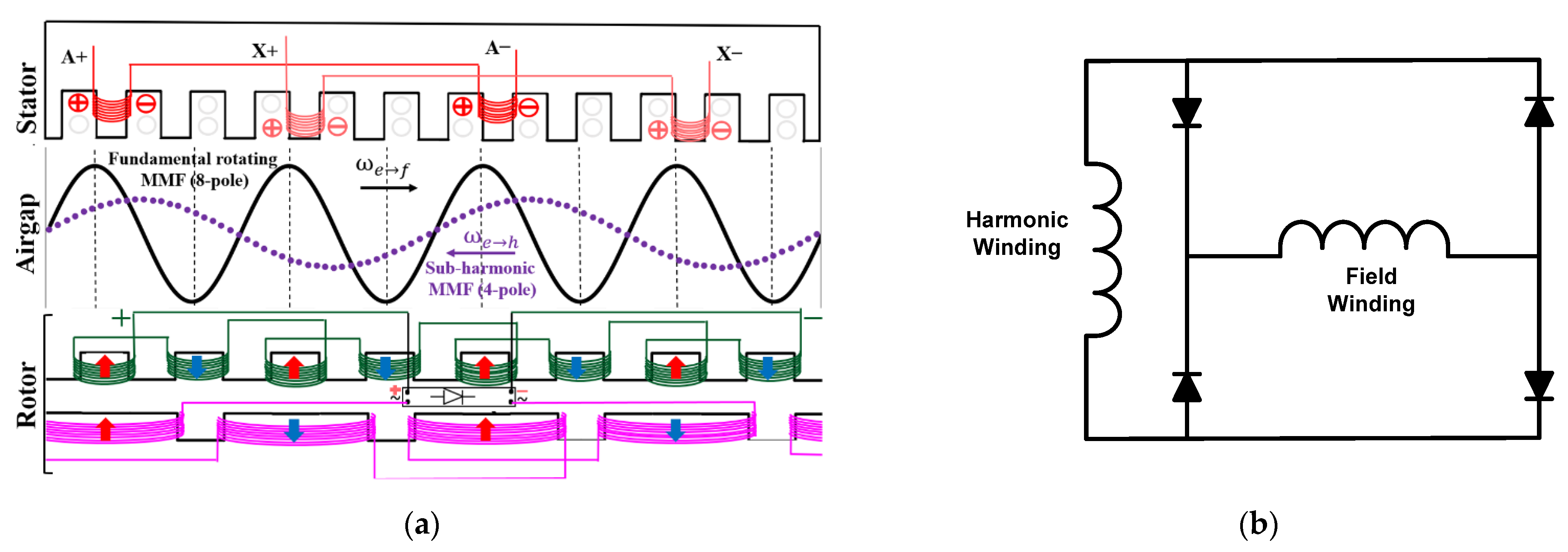
The nine-switch inverter with the BL-WFSM winding configuration is shown in Figure 2a, where the connection of the machine coils with the nine-switch inverter is shown. As the rotor does not have brushes or a slip ring assembly, two windings are mounted on the rotor: an eight-pole field winding and an additional four-pole harmonic winding. An eight-pole and twelve-slot WFSM, as shown in Figure 4, is analyzed with the proposed nine-switch inverter topology for brushless operation. The detailed design parameters are given in Table 2. The block diagram of the BL-WFSM with its winding configuration is shown in Figure 5a, where the rotor and stator winding configuration of the BL-WFSM is shown linearly. In the figure: on the stator, the red line represents the Phase A and X coils, while on the rotor, the green line denotes the 8-pole field winding, and the pink line indicates the 4-pole harmonic winding. Similarly in the air gap, the black sinusoidal waveform depicts the positive-sequence fundamental 8-pole rotating MMF, whereas the purple dotted waveform represents the negative-sequence sub-harmonic 4-pole MMF. The rotor does not have a source of its own; therefore, to excite the rotor field winding, an additional four-pole harmonic winding is placed on the rotor and a single-phase diode rectifier connects them, as shown in Figure 5b. The rotor harmonic winding induces a four-pole sub-harmonic MMF, generated due to the difference in the currents of winding coils ABC and XYZ; the induced alternating current was rectified using a rotary diode bridge rectifier, which establishes a stable dc in the rotor field winding [9]. The working principle of the BL-WFSM with the setup proposed in this work is the same as that shown in Figure 1, where the additional sub-harmonic is produced due to the difference in the stator coil currents. The additional sub-harmonic, which is a four-pole MMF, induces voltages in the four-pole rotor harmonic winding. Since the speed of the four-pole sub-harmonic MMF is different from the rotor four-pole harmonic winding speed, an induction process occurs. Once the induction starts in the rotor harmonic winding, a rotary diode rectifier mounted on the rotor periphery rectifies the voltages and a dc is established in the rotor field winding. Consequently, an eight-pole rotor field is generated, which interacts with the eight-pole stator fundamental MMF harmonic and torque is produced.
With the diode forward voltage VD being constant for the semiconductor material used, the voltage across the field winding can be calculated as
V f = V h ( p e a k ) 2 V D
V h ( p e a k ) = 2 V h ( R M S )
where Vh(RMS) is the rms value of the voltage across the harmonic winding and it can be calculated from the instantaneous harmonic winding voltage which is given as
V h = K . ω λ s u b
where K is the sub-harmonic coupling factor and λ s u b is the flux linkage of the harmonic winding with the sub-harmonic airgap magnetic field.

4. Fe-Based 2D Model Performance Analysis

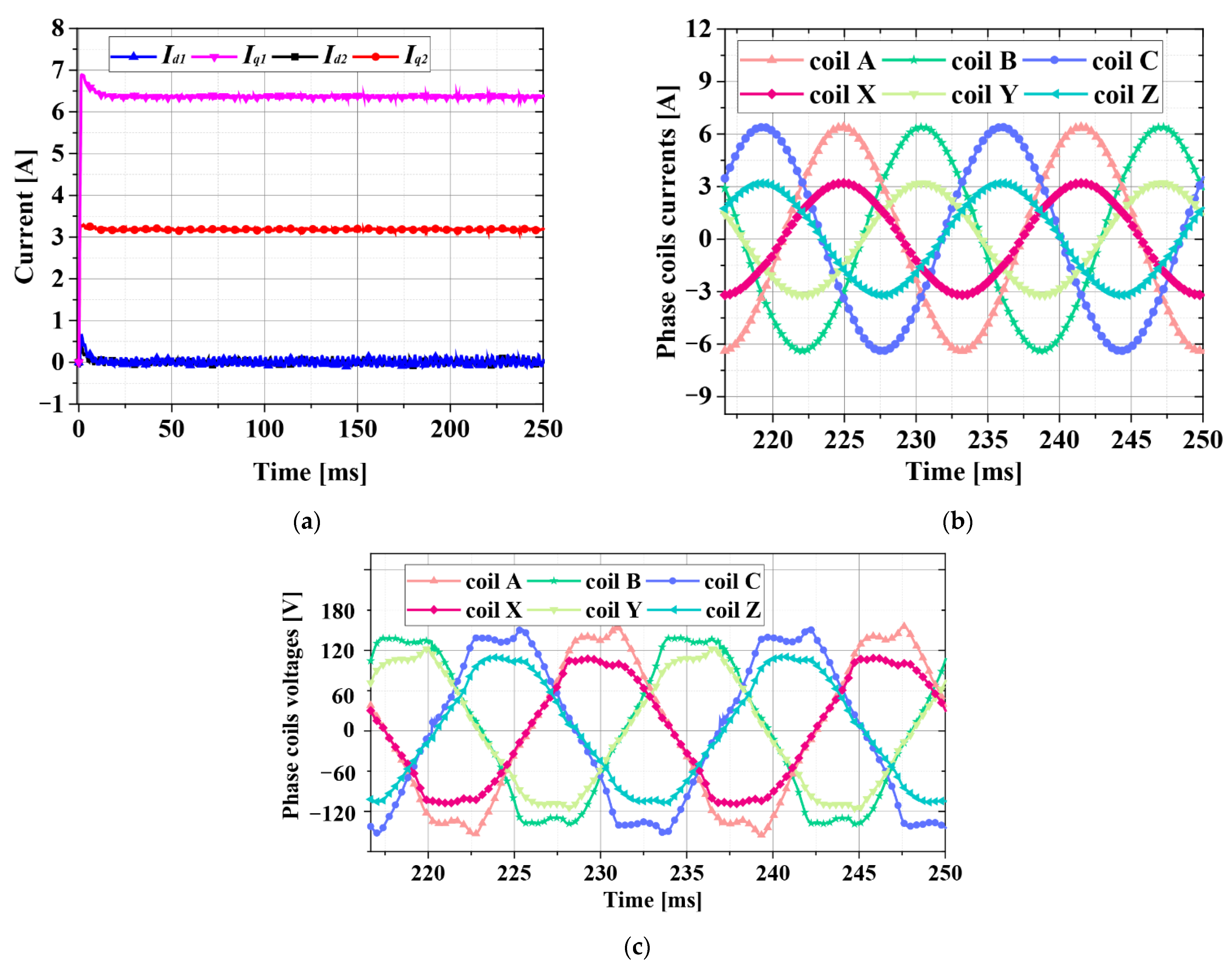
In the previous section the topology and working principles of both a nine-switch inverter and an eight-pole and twelve-slot BL-WFSM were explained. This section describes a co-simulation, wherein a nine-switch inverter was designed in Ansys Simplorer v2018.0 with 2D model of a BL-WFSM in Ansys Maxwell v19.0.0 for FE analysis to verify the operation principles of the nine-switch inverter with the BL-WFSM. The inverter id and iq synchronous frame currents for both channels are shown in Figure 6a, where it is shown that the inverter supplied rated currents to the ABC machine stator coils and half of the rated current to the XYZ machine stator coils. The corresponding FE-based currents of coils ABC and XYZ are also shown in a more natural frame of reference Figure 6b. In load conditions, the FE-based balanced phase voltages of the stator coils are depicted in Figure 6c.
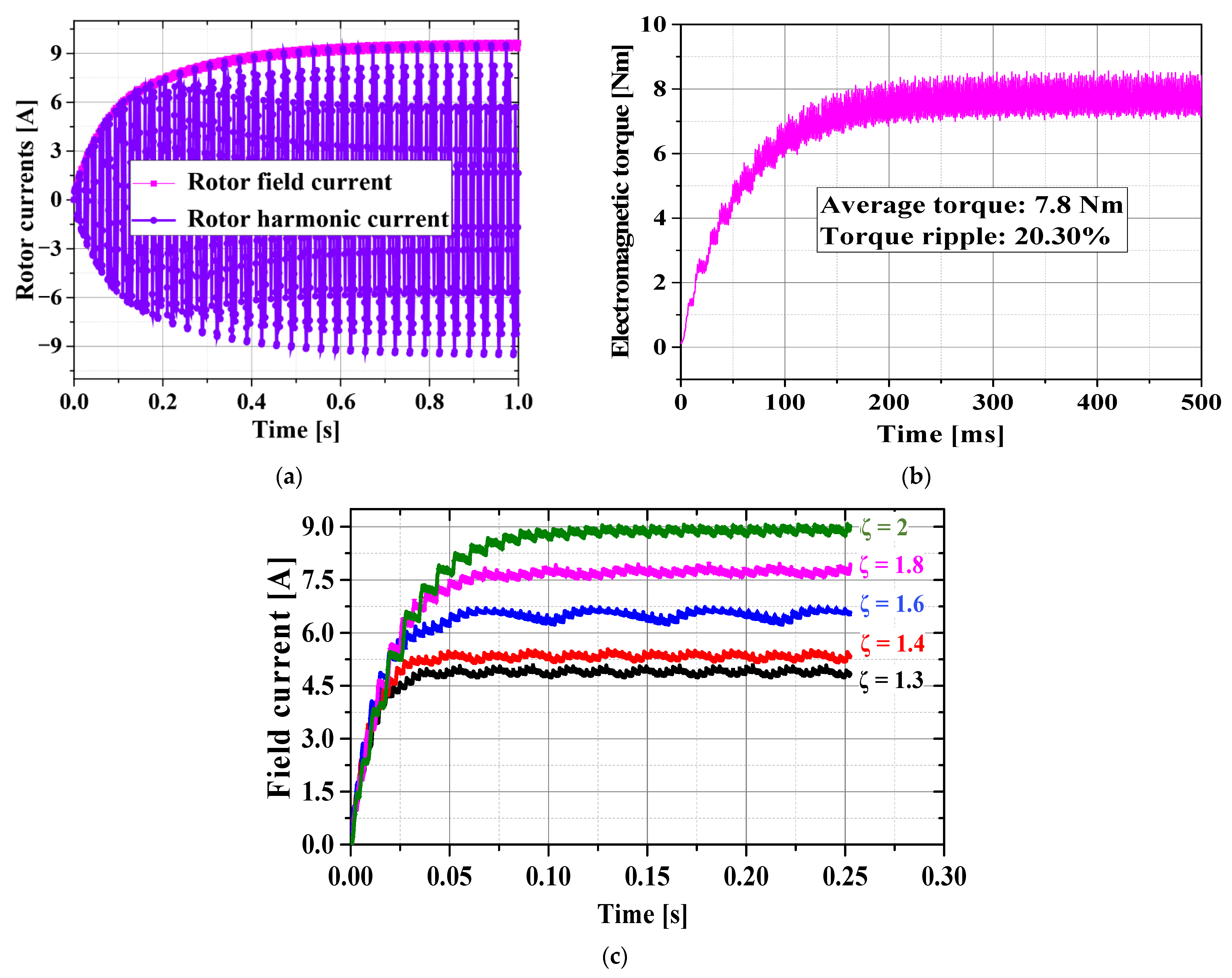
The machine model given in Figure 4 was supplied with nine-switch inverter currents at a rated speed. As per the inverter and machine topologies and their working principles, the current difference between the ABC and XYZ coils produced an additional four-pole sub-harmonic MMF in the airgap alongside an eight-pole fundamental MMF (see Figure 5a). The sub-harmonic MMF induced current in the rotor harmonic winding. The induced rotor harmonic winding current is shown in Figure 7a; a 5.1 A rms current was established in the rotor harmonic winding. The induced alternating current was rectified by a rotary diode bridge rectifier (see the rotor in Figure 2a and Figure 5a). The output of the rectifier produced dc which was supplied to the rotor field winding and an eight-pole rotor flux was produced. The rotor field winding formed a 9.15 A dc in the steady-state region as shown in Figure 7a. The eight-pole rotor flux interacted with the eight-pole fundamental stator MMF and torque was produced. The electromagnetic torque profile closely follows the rotor field winding current profile. The electromagnetic torque is shown in Figure 7b, where in the steady-state region the torque was 7.8 Nm with a torque ripple of 20.30%.
For rotor flux regulation, the rotor field current was controlled by the stator ABC and XYZ coils’ current ratio ζ. Different values of ζ were used and the rotor field winding current variation was observed, as shown in Figure 7c. Starting from ζ = 2, which is a rated condition, the induced rotor field winding current was 9.15 A dc at 900 rpm. When the ratio decreased to 1.8, the induced rotor field current decreased to 7.85 A dc. Similarly, when the ratio ζ was decreased to 1.6, 1.4, and 1.3, the corresponding induced rotor field winding currents were 6.53 A dc, 5.23 A dc, and 4.8 A dc, respectively, at the rated speed of 900 rpm. The variation in the rotor field winding currents at a rated speed with the variation in ratio ζ clearly showed the excellent rotor flux regulation freedom in the proposed work. This flux regulation freedom was absent in the single-inverter BL-WFSM topologies, whereas, in dual-inverter BL-WFSMs, the additional inverter/switches and additional dc source increases the cost of the system. So, considering cost and rotor flux regulation freedom, the nine-switch inverter topology is a better option.

5. Discussion of Practical Implementations

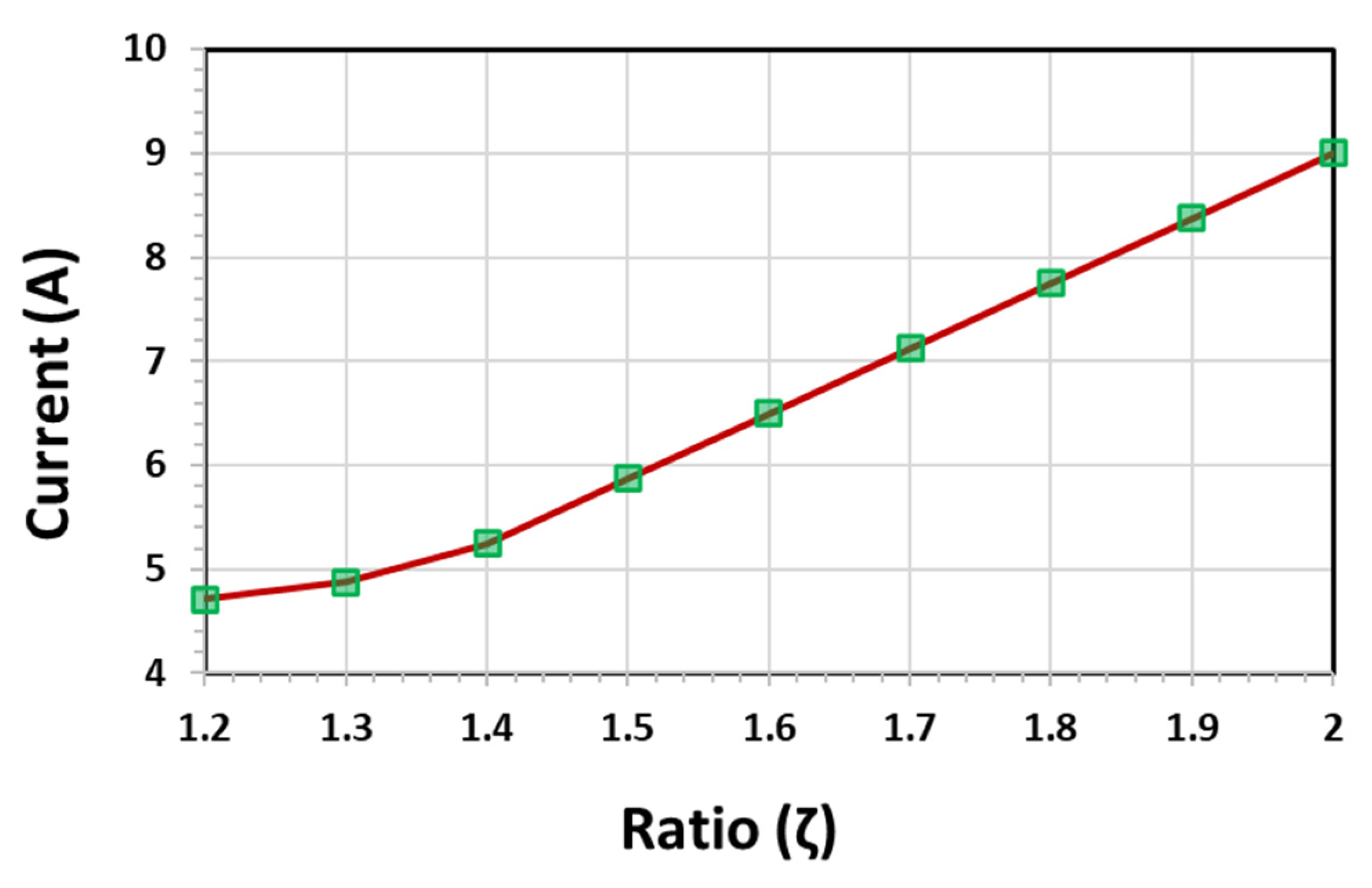
It can be observed from Figure 8 that as the ratio of the two armature currents decreases beyond a certain point, the induced field current does not decrease accordingly. This can be seen as a non-linear behavior of field current generation.
The variation in the current ratio ζ directly affects electromagnetic torque through the corresponding change in rotor field current, as shown in Figure 7. In addition, the induced voltage in the harmonic winding follows the sub-harmonic MMF magnitude, which is governed by the same ζ ratio. A detailed quantitative loss and efficiency analysis is beyond the scope of this work and will be addressed in future studies focusing on machine design optimization.
From a practical perspective, the implementation of harmonic injection using reduced-switch inverter topologies, such as the nine-switch inverter, introduces several challenges that must be carefully addressed. One important aspect is control performance under nonlinear operating conditions, including magnetic saturation, inverter dead-time effects, and switching nonidealities. These non-linearities can distort the injected harmonic currents and deteriorate the intended MMF sub-harmonic profile, particularly at high load or during transient operation. Advanced current control strategies and compensation techniques are therefore required to maintain stable and accurate excitation in practical drive systems.
The quality of the generated MMF sub-harmonic is also strongly influenced by machine parameters such as slot geometry, stator winding distribution, and magnetic material characteristics. Variations in leakage inductance, mutual coupling, and saturation levels can lead to deviations between the commanded and actual harmonic MMF components. As reported in the literature, these effects may reduce the effectiveness of torque ripple suppression or excitation control, highlighting the importance of accurate parameter identification and machine-specific design optimization when implementing harmonic injection schemes.
In addition, the use of a nine-switch inverter raises potential electromagnetic compatibility (EMC) concerns due to the shared inverter legs and increased switching interactions between the two three-phase outputs. Coupled switching transitions can result in higher common-mode voltages and current ripple, which may exacerbate conducted and radiated emissions. Appropriate PWM design, switching frequency selection, and the use of passive or active filtering techniques are therefore essential to ensure compliance with EMC requirements while preserving the benefits of reduced switch count.

6. Conclusions

In this paper, a nine-switch inverter topology was proposed for BL-WFSM operation with excellent flux regulation capability by controlling the sub-harmonic component using inverter PWM-modulated signals. Contrary to existing brushless WFSM topology, the proposed work reduced cost by utilizing nine switches instead of twelve switches, a 25% reduction of the switch count, and utilizing a single dc source instead of two dc sources. On the operation side, the proposed topology was able to regulate the rotor field with more freedom by controlling the machine stator current ratio (ζ) between the ABC and XYZ coils. Based on the stator ABC and XYZ coil current ratio ζ, field regulation was demonstrated as follows: changing ζ from 2 to 1.3 decreased the induced rotor field current from 9.15 A dc to 4.8 A dc. This validates the suggested nine-switch topology’s capacity to effectively regulate rotor flux in brushless WFSMs. The proposed topology combined with 12-slot concentrated armature winding offers high core utilization with self-excited brushless operation for wound-field synchronous machines. Additionally, sub-harmonic flux generation reduces core loss due to low-frequency power transfer. The brushless WFSM’s suggested topology produced 7.8 N·m. of torque with a 20.30% torque ripple. A detailed comparative analysis of torque ripples with other brushless and conventional topologies will be considered in future work. This study has presented the basic concept of using a nine-switch inverter topology for the operation of a brushless WFSM. As a result, additional research might be conducted with machine design optimization in mind for better torque characteristics. The proposed concept, offering low cost, robustness, and rotor flux regulation freedom, can be applied to electric and hybrid vehicles, aerospace starter–generators, renewable energy systems, industrial drives, and marine propulsion, where a wide speed range, high efficiency, and brushless reliability are essential.

Author Contributions

Conceptualization, M.A., A.A. and A.U.R.; data curation, A.N., G.J.S., M.A.A. and M.R.S.; formal analysis, A.U.R., M.A. and M.A.A.; investigation, A.U.R., A.N., G.J.S. and M.A.A.; methodology, M.A., G.J.S. and A.N.; software, A.A., M.R.S., M.A. and M.A.A.; supervision, M.R.S., A.A. and A.U.R.; writing—original draft preparation, M.A., A.U.R. and A.A.; writing—review and editing, M.R.S., G.J.S. and A.N. All authors have read and agreed to the published version of the manuscript.

Funding

This research received no external funding.

Data Availability Statement

The data will be made available upon request.

Conflicts of Interest

The authors declare no conflicts of interest.

Abbreviations

The following abbreviations are used in this manuscript:
PMPermanent magnet
SRMSwitched reluctance machine
IMInduction machine
WFSMWound-field synchronous motor
BL-WFSMBrushless wound-field synchronous motor
MMFMagnetomotive force
SPWMSine pulse width modulation
RMSRoot mean square
NSINine-switch inverter
EMCElectromagnetic compatibility

References

  1. Du, Z.S.; Lipo, T.A. Cost-Effective High Torque Density Bi-Magnet Machines Utilizing Rare Earth and Ferrite Permanent Magnets. IEEE Trans. Energy Convers. 2020, 35, 1577–1584. [Google Scholar] [CrossRef]
  2. Baiju, M.R.; Mohapatra, K.K.; Kanchan, R.S.; Gopakumar, K. A Dual Two-Level Inverter Scheme With Common Mode Voltage Elimination for an Induction Motor Drive. IEEE Trans. Power Electron. 2004, 19, 794–805. [Google Scholar] [CrossRef]
  3. Dmitrievskii, V.; Prakht, V.; Valeev, E.; Paramonov, A.; Kazakbaev, V.; Anuchin, A. Comparative Study of Induction and Wound Rotor Synchronous Motors for the Traction Drive of a Mining Dump Truck Operating in Wide Constant Power Speed Range. IEEE Access 2023, 11, 68395–68409. [Google Scholar] [CrossRef]
  4. Bianchi, N.; Carlet, P.G.; Cinti, L.; Ortombina, L. A Review about Flux-Weakening Operating Limits and Control Techniques for Synchronous Motor Drives. Energies 2022, 15, 1930. [Google Scholar] [CrossRef]
  5. Dorrell, D.G. Are wound-rotor synchronous motors suitable for use in high efficiency torque-dense automotive drives? In Proceedings of the IECON 2012—38th Annual Conference on IEEE Industrial Electronics Society, Montreal, QC, Canada, 25–28 October 2012; pp. 4880–4885. [Google Scholar] [CrossRef]
  6. Lipo, T.A.; Du, Z.S. Synchronous motor drives-a forgotten option. In Proceedings of the 2015 Intl Aegean Conference on Electrical Machines & Power Electronics (ACEMP), 2015 Intl Conference on Optimization of Electrical & Electronic Equipment (OPTIM) & 2015 Intl Symposium on Advanced Electromechanical Motion Systems (ELECTROMOTION), Side, Turkey, 2–4 September 2015; pp. 1–5. [Google Scholar] [CrossRef]
  7. Ayub, M.; Hussain, A.; Jawad, G.; Kwon, B.-I. Brushless operation of a wound-field synchronous machine using a novel winding scheme. IEEE Trans. Magn. 2019, 55, 1–4. [Google Scholar] [CrossRef]
  8. Bian, W.; Zhang, Z.; Li, L.; Jin, C.; Li, J.; Guo, F. An Approximate Three-Phase AC Excitation Method With Parallel Capacitors for Aircraft Wound Rotor Synchronous Starter/Generator. IEEE Trans. Transp. Electrif. 2025, 11, 5497–5508. [Google Scholar] [CrossRef]
  9. Nguyen, M.D.; Hoang, D.T.; Kim, S.M.; Jung, W.S.; Shin, K.H.; Kim, Y.J.; Choi, J.Y. Nonlinear Modeling and Analysis Considering Coupling Stator Flux of Wound-Rotor Synchronous Motors. In Proceedings of the 2024 International Conference on Electrical Machines (ICEM), Torino, Italy, 1–4 September 2024; IEEE: New York, NY, USA, 2024; pp. 1–7. [Google Scholar] [CrossRef]
  10. Seyedi, S.M.; Talebi, D.; Toliyat, H.A. A PM-Free Brushless Synchronous Machine With a Novel Compensated Wound-Field Excited by Modulated Rotating Magnetic Flux. IEEE Trans. Energy Convers. 2024, 39, 2068–2080. [Google Scholar] [CrossRef]
  11. Su, Z.; Sun, X.; Lei, G.; Yao, M. Model-Free Predictive Current Control for Dual Three-Phase PMSM Drives With an Optimal Modulation Pattern. IEEE Trans. Ind. Electron. 2024, 71, 10140–10149. [Google Scholar] [CrossRef]
  12. Pires, V.F.; Cordeiro, A.; Foito, D.; Pires, A.J.; Silva, J.F.A.; Chen, H. Multilevel Inverter Based on a Dual Two-Level Nine-Switch Converter for a Dual Three-Phase or Six-Phase Motor Drive System. IEEE Access 2025, 13, 37263–37277. [Google Scholar] [CrossRef]
  13. Shen, J.; Wang, X.; Xiao, D.; Wang, Z.; Mao, Y.; He, M. Online Switching Strategy Between Dual Three-Phase PMSM and Open-Winding PMSM. IEEE Trans. Transp. Electrif. 2024, 10, 1519–1529. [Google Scholar] [CrossRef]
  14. Sirewal, G.J.; Choi, G. Analysis and Design of a Self-Excitation Scheme for an Open-end Armature Winding Wound-Rotor Synchronous Machine. In Proceedings of the 2024 IEEE Energy Conversion Congress and Exposition (ECCE), Phoenix, AZ, USA, 20–24 October 2024; pp. 5846–5851. [Google Scholar] [CrossRef]
  15. Arif, A.; Arif, F.; Abbas, Z.; Sirewal, G.J.; Saleem, M.; Ali, Q.; Ullah, M. Analysis and Design of a Brushless WRSM with Harmonic Excitation Based on Electromagnetic Induction Power Transfer Optimization. Magnetism 2025, 5, 26. [Google Scholar] [CrossRef]
  16. Abdel-Moneim, M.G.; Abdel-Azim, W.E.; Abdel-Khalik, A.S.; Hamad, M.S.; Ahmed, S. Model Predictive Current Control of Nine-Switch Inverter-Fed Six-Phase Induction Motor Drives Under Healthy and Fault Scenarios. IEEE Trans. Transp. Electrif. 2024, 10, 10125–10135. [Google Scholar] [CrossRef]
  17. Li, M.; Deng, W. Model Predictive Torque Control of a Two-Motor Drive with Nine Switch Inverter Supply. In Proceedings of the 2024 5th International Conference on Smart Grid and Energy Engineering (SGEE), Nanchang, China, 22–24 November 2024; pp. 5–9. [Google Scholar] [CrossRef]
  18. An, Y.; Qiu, Z.; Li, J.; Cao, R. Study of Optimized SVPWM for Nine-Switch Inverter of Bearingless Motor Based on Reducing Switching Losses. In Proceedings of the 2024 4th International Conference on Electrical Engineering and Control Science (IC2ECS), Nanjing, China, 27–29 December 2024; pp. 662–668. [Google Scholar] [CrossRef]
  19. Inoue, K.; Yamashita, H.; Nakamae, E.; Fujikawa, T. A brushless self-exciting three-phase synchronous generator utilizing the 5th-space harmonic component of magneto motive force through armature currents. IEEE Trans. Energy Convers. 1992, 7, 517–524. [Google Scholar] [CrossRef]
  20. Ali, Q.; Lipo, T.A.; Kwon, B.-I. Design and Analysis of a Novel Brushless Wound Rotor Synchronous Machine. IEEE Trans. Magn. 2015, 51, 8109804. [Google Scholar] [CrossRef]
  21. Jawad, G.; Ali, Q.; Lipo, T.A.; Kwon, B.-I. Novel Brushless Wound Rotor Synchronous Machine With Zero-Sequence Third-Harmonic Field Excitation. IEEE Trans. Magn. 2016, 52, 8106104. [Google Scholar] [CrossRef]
  22. Chung, J.; Hofmann, H. Brushless Self-Excited Synchronous Field-Winding Machine With Five- and Higher-Phase Design Using Independently Controlled Spatial Harmonics. IEEE Trans. Energy Convers. 2024, 39, 533–543. [Google Scholar] [CrossRef]
  23. Bukhari, S.S.; Ali, Q.; Doval-Gandoy, J.; Ro, J.-S. High-Efficient Brushless Wound Rotor Synchronous Machine Topology Based on Sub-Harmonic Field-Excitation Technique. Energies 2021, 14, 4427. [Google Scholar] [CrossRef]
  24. Hu, S.; Liang, Z.; Zhang, W.; He, X. Research on the Integration of Hybrid Energy Storage System and Dual Three-Phase PMSM Drive in EV. IEEE Trans. Ind. Electron. 2018, 65, 6602–6611. [Google Scholar] [CrossRef]
  25. Prakht, V.; Dmitrievskii, V.; Kazakbaev, V.; Paramonov, A.; Goman, V. Traction Synchronous Machine with Rotor Field Winding and Two-Phase Harmonic Field Exciter. World Electr. Veh. J. 2025, 16, 25. [Google Scholar] [CrossRef]
  26. Hadiouche, D.; Baghli, L.; Rezzoug, A. Space-vector PWM techniques for dual three-phase AC machine: Analysis, performance evaluation, and DSP implementation. IEEE Trans. Ind. Appl. 2006, 42, 1112–1122. [Google Scholar] [CrossRef]
  27. Sirewal, G.J.; Kim, E.; Choi, G. Dual Inverter Controlled Third Harmonic Current Injection Scheme for an Open-End Winding Brushless Wound Rotor Synchronous Machine. In Proceedings of the 2024 27th International Conference on Electrical Machines and Systems (ICEMS), Fukuoka, Japan, 26–29 November 2024; pp. 3374–3380. [Google Scholar] [CrossRef]
  28. Mohammed, D.M.; Hassan, R.F.; Yasin, N.M.; Alruwaili, M.; Ibrahim, M.A. A Comparative Study of Direct Power Control Strategies for STATCOM Using Three-Level and Five-Level Diode-Clamped Inverters. Energies 2025, 18, 3582. [Google Scholar] [CrossRef]
  29. Shieh, J.-J.; Hwu, K.-I.; Li, Y.-Y. Analysis and Modeling of a Single-Power-Source T-Type 7-Level Single-Phase DC-AC Inverter with Voltage Gain of 3. Energies 2022, 15, 7894. [Google Scholar] [CrossRef]
  30. Ali, A.I.M.; Takeshita, T.; Sayed, M.A. Three-Phase PWM Inverter for Isolated Grid-Connected Renewable Energy Applications. Energies 2021, 14, 3701. [Google Scholar] [CrossRef]
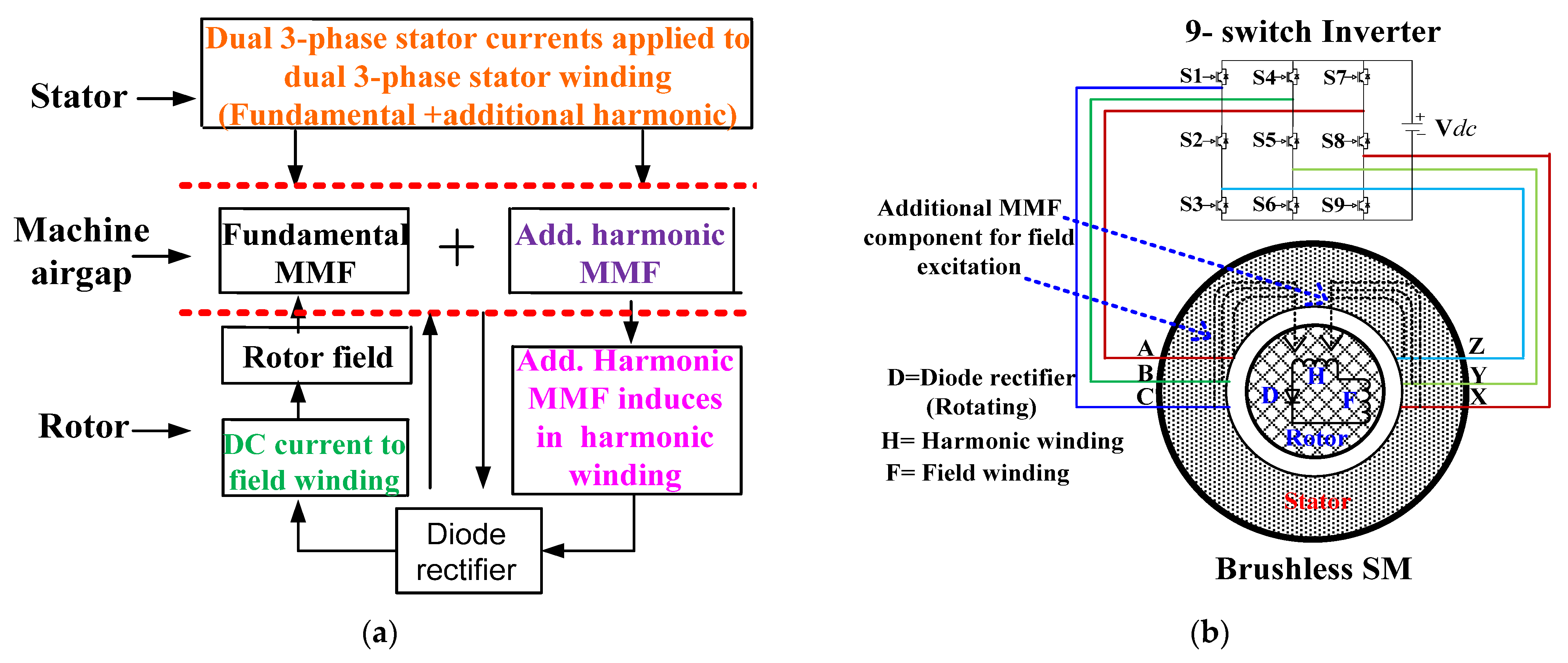
Figure 1. General block diagram of harmonically excited BL-WFSM topology (a) flow diagram (b) schematic representation of the brushless WFSM integrated with an inverter.
Machines 14 00110 g001
Figure 2. Topology of the nine-switch inverter and its modulation logic. (a) nine-switch topology with a BL-WFSM; (b) block diagram of SPWM for the nine-switch topology’s first leg; (c) modulation logic with gating signal generation.
Machines 14 00110 g002
Figure 3. (a) Block diagram of the current control architecture; (b) angular displacement representation in the q–d reference frame.
Machines 14 00110 g003
Figure 4. Brushless WFSM configuration. (a) Stator assembly; (b) rotor assembly.
Machines 14 00110 g004
Figure 5. (a) Block diagram of the brushless WFSM with its winding configuration; (b) rotor winding connections integrated with a diode rectifier.
Machines 14 00110 g005
Figure 6. Inverter and brushless WFSM stator currents and voltages. (a) Inverter reference currents id and iq. (b) Phase currents of stator coils ABC and coils XYZ (c) Phase voltages of stator coils ABC and coils XYZ.
Machines 14 00110 g006
Figure 7. Finite-element-based performance analysis. (a) Rotor current profiles; (b) electromagnetic torque characteristics; (c) variation in induced field current with respect to ratio ζ.
Machines 14 00110 g007
Figure 8. Variation in field current with respect to ratio ζ as non-linear function.
Machines 14 00110 g008
Table 1. Comparison of the proposed topology with conventional brushless synchronous machines.
ParametersPMSM [1]Brushed WRSM [5]Dual-Inverter Brushless WRSM [20]Single-Inverter Brushless WRSM [7]Nine-Switch Inverter Brushless WRSM
CostHighestHigher (Exciter)HighLowestLow
Mechanical RobustnessGoodWorst (Brushed)BetterBetterBetter
DemagnetizationVulnerableInvulnerable
(PM-less)
Invulnerable (PM-less)Invulnerable (PM-less)Invulnerable (PM-less)
Power DensityHighLess than PMSMLess than Con. WFSMLess than Con. WFSMLess than Con. WFSM
Flux RegulationLow (−id)High (id) and (if)Higher (−id), (iq), and (if)Low (−id) and (iq)Higher (−id), (iq), and (if)
Rotor Flux at rpm = 0RatedControllable, (if)ZeroZeroZero
Additional ExciterNoYesNoNoNo
Minimum Number of Switches661289
Switching LossesLowLowHighMediumMedium
Table 2. Design parameters of the machine.
ParametersUnitValue
Rated powerW746
Rated speedrpm900
Rated currentArms4.5
Stator outer diametermm177
Stator inner diametermm95
Airgap lengthmm0.5
Stack lengthmm80
No. of poles-8
Stator slots-12
Harmonic winding poles-8
Turns/stator slots-40
Field turns-100
Harmonic winding turns-8
Disclaimer/Publisher’s Note: The statements, opinions and data contained in all publications are solely those of the individual author(s) and contributor(s) and not of MDPI and/or the editor(s). MDPI and/or the editor(s) disclaim responsibility for any injury to people or property resulting from any ideas, methods, instructions or products referred to in the content.