Digital Twin Approaches for Gear NVH Optimization: A Literature Review of Modeling, Data Integration, and Validation Gaps



Abstract
1. Introduction
2. Background and Definitions
2.1. Digital Twin Concepts and Standards in Manufacturing
2.2. Gear NVH Fundamentals: Transmission Error and Tonal Orders
2.3. Multibody Dynamics, FE/BEM and Hybrid Modeling of Gear Trains
2.4. NVH Data Acquisition and IoT Integration
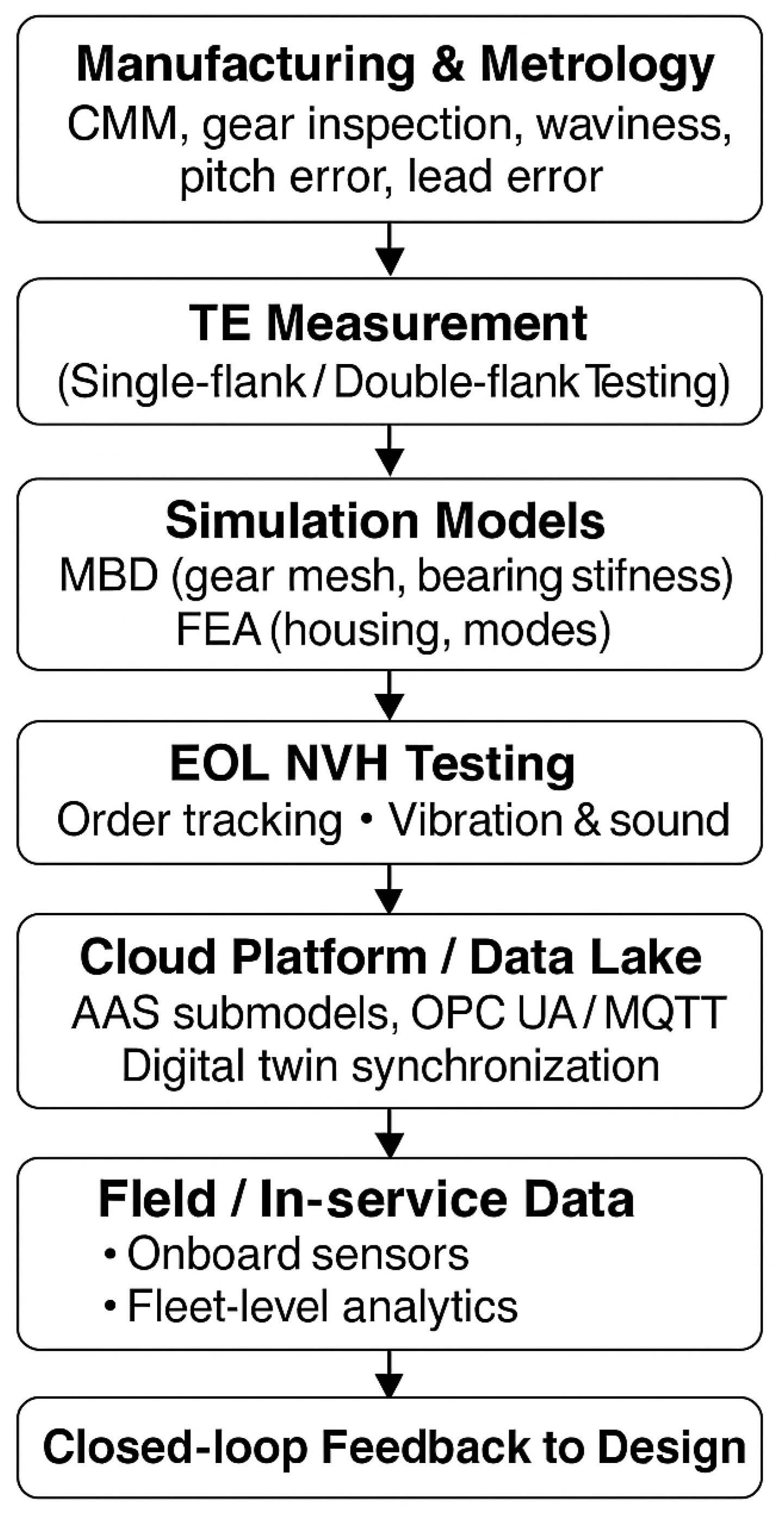
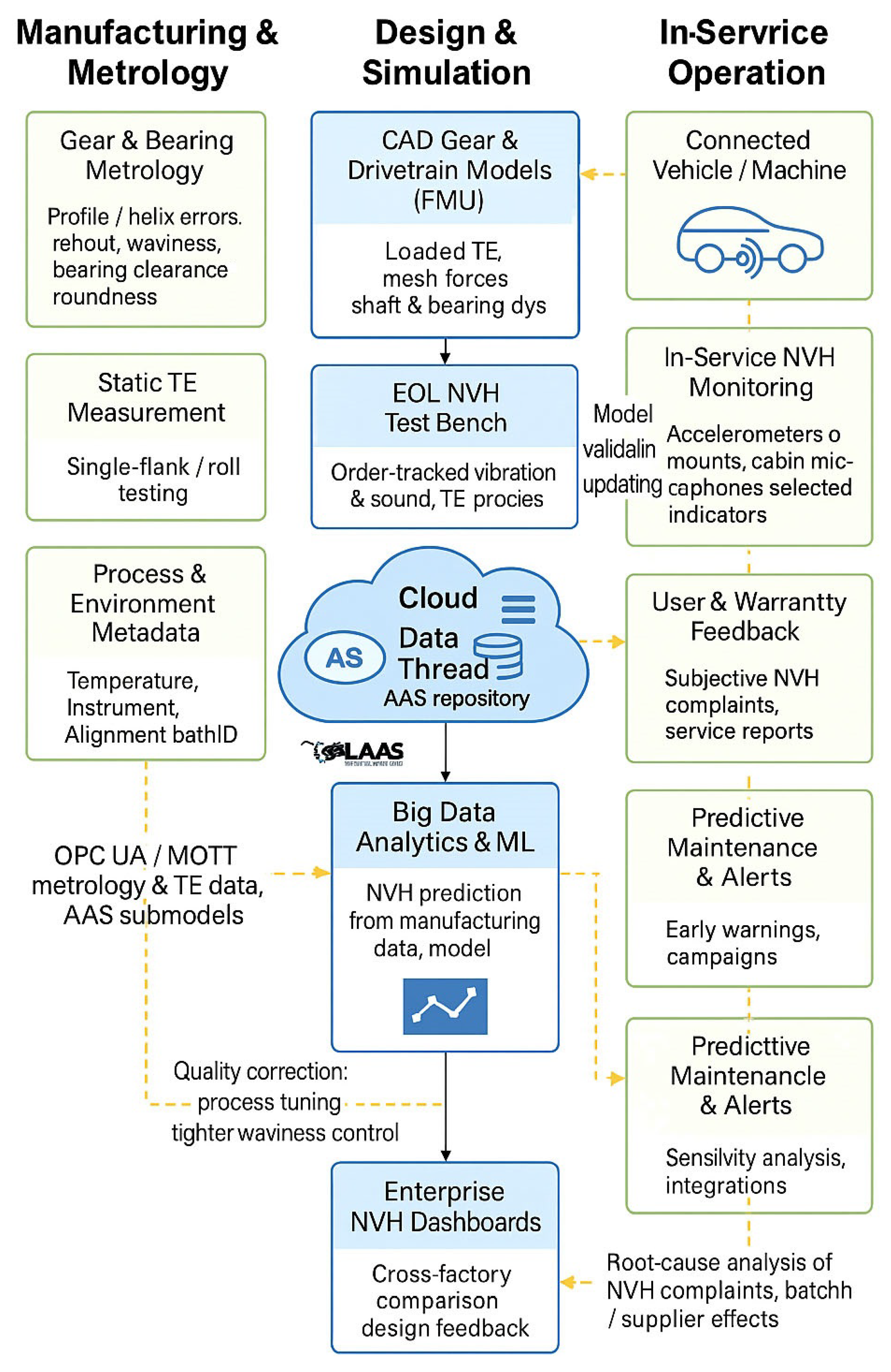
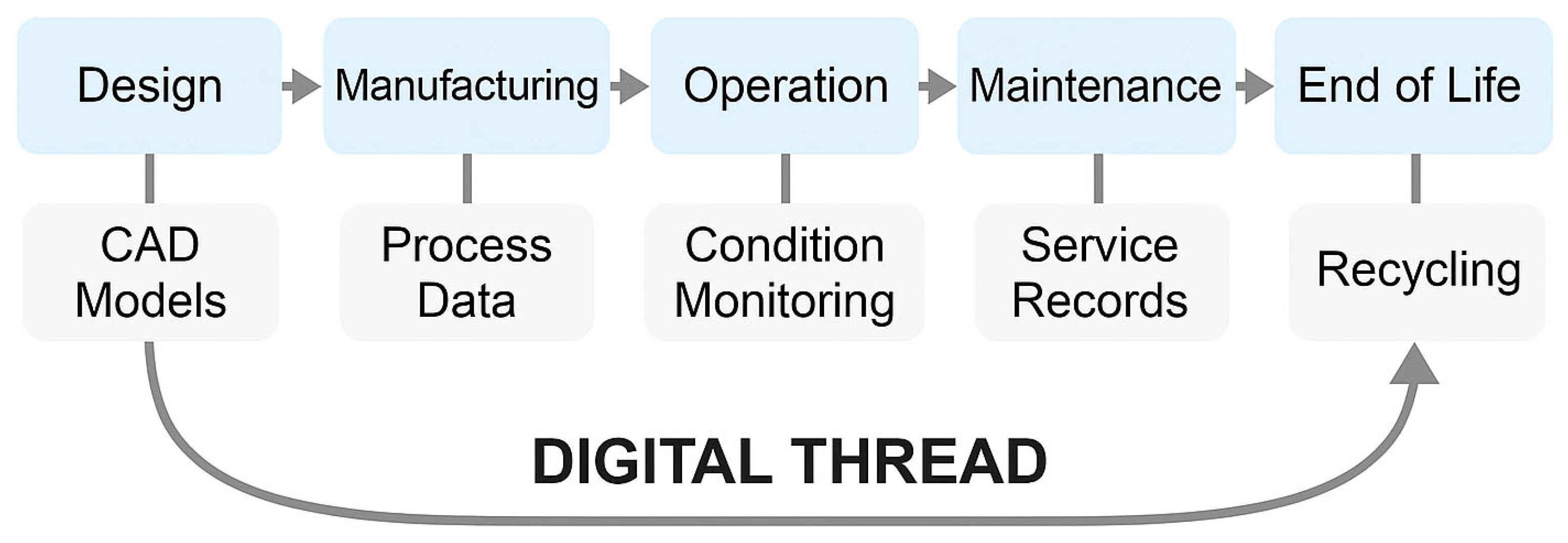
- Manufacturing and Metrology Data: Modern gear production can provide detailed information on each gear’s geometry and quality. For example, 3D surface topography scans or single-flank roll-test results give profile error, lead error, pitch variations, and even waviness spectra for each gear [7]. These data could populate a “digital thread” from manufacturing to simulation [24]. Indeed, integrating measured micro-geometry into NVH simulation has been demonstrated: Romax Technology reported techniques to incorporate measured gear flank waviness into their NVH models [7]. Standards like ISO 1328 define [30] tolerance classes for gear deviations, but do not directly quantify expected noise. There is ongoing research into extending such standards or developing new ones to include acoustic performance indices. Additionally, process logs might indicate residual stresses or distortions that influence NVH; however, these are seldom used in current models.
- End-of-Line (EOL) Testing: Many transmission manufacturers perform EOL noise tests on gearboxes. This can involve running the gearbox on a test rig with microphones and accelerometers to detect anomalies (commonly known as noise grading or “gearbox whisper” tests) [7]. New EOL equipment integrates quality measurements: for instance, Gleason’s GRSL combines double-flank roll testing with laser scanning of the teeth, providing 100% inspection of TE and surface deviations in one machine. The data from such tests—essentially a short-run vibration spectrum and precise geometry—could be extremely valuable for a DT. If fed back into the design model, they allow last-minute model correction and also build a database for correlating manufacturing variables with NVH outcomes [29].
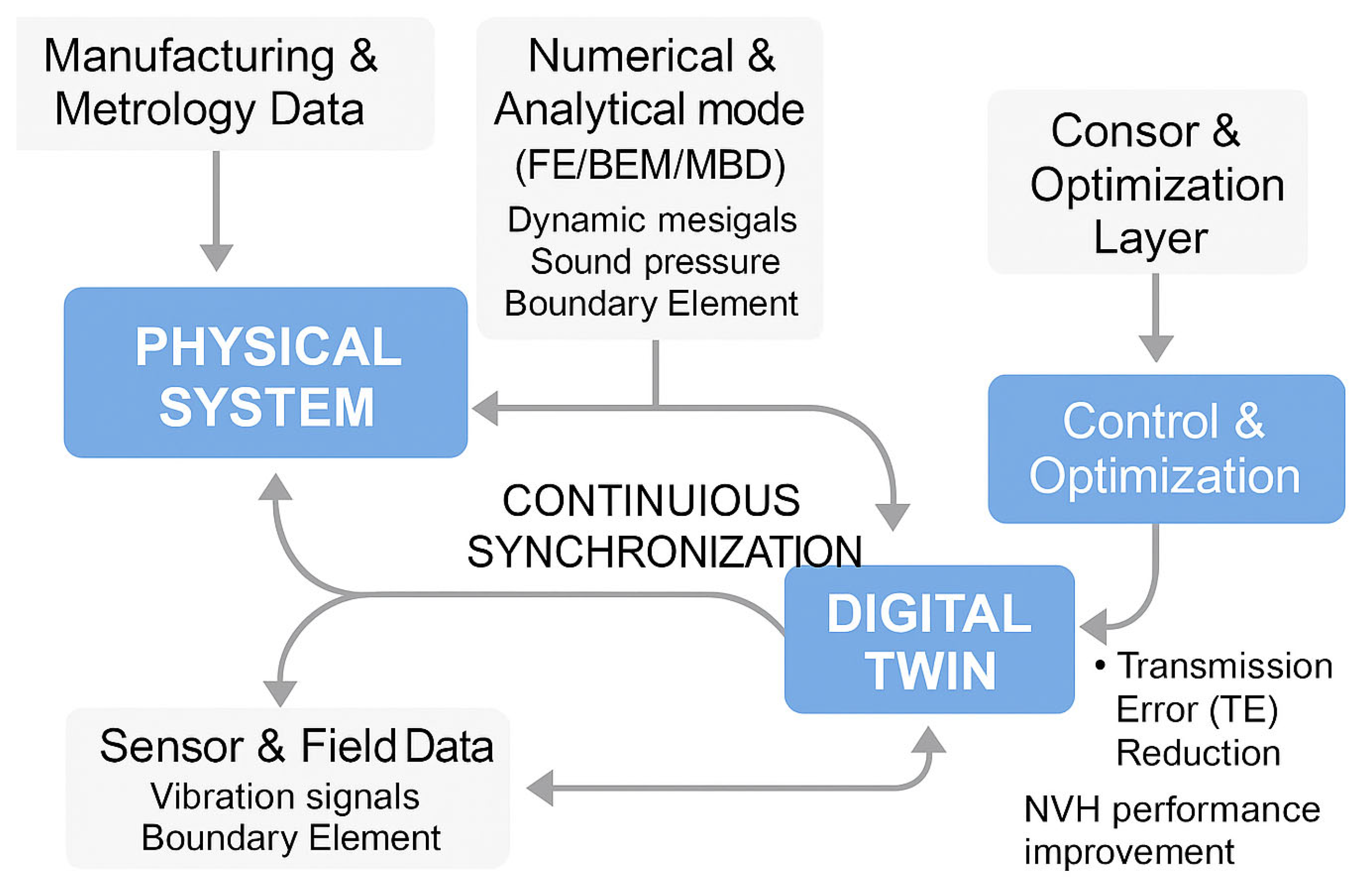
- Operational Sensors (IoT): In service, a running gearbox (especially in test fleets or prototype vehicles) may be instrumented with accelerometers, sound sensors, or torque/strain sensors. With the IIoT paradigm, these sensor streams can be sent via telemetry (e.g., telemetry units in test cars) or logged for later analysis. Cloud-based DT platforms (such as those by Siemens, GE, etc.) use protocols like OPC UA or MQTT to stream data securely to a cloud where the twin resides. For example, Hexagon’s cloud-based gearbox twin project uploads vehicle telematics from fleet vehicles to run simulations that predict fatigue life [24]; a similar approach could apply for NVH, uploading speed and load profiles and perhaps cabin noise measurements, to predict if a gearbox will develop a whine under certain driving patterns.
- NVH-Specific Measurements: Some advanced techniques measure NVH-related properties directly. Torsional vibration can be measured with optical encoders or laser torsion meters, yielding TE time histories in operation. Acoustic cameras or arrays can map noise sources on a running gearbox to identify dominant radiation spots. Order tracking with tachometer signals helps isolate gear orders from other noise sources in a vehicle test. These measured datasets are crucial for validating the DT’s predictions (e.g., comparing an order tracking plot from the twin vs. one from a physical test [7]. A gap, however, is that such rich data are not consistently stored or formatted to be reusable for modeling—often they are used ad hoc in troubleshooting.
3. Methods of the Literature Review
4. State-of-the-Art in Gear NVH Digital Twins
4.1. NVH Measurements and Gear Data for Twins
- Transmission Error (TE) Testing: Single-flank testing is a standard method to measure TE under light load by running a gear against a master gear with encoders. Modern TE testers can output TE as a function of rotation angle, which can be converted to an order spectrum. Such spectra show the base mesh frequency and any sidebands (ghost orders). Some research test setups also measure TE under load to capture load-dependent mesh stiffness variation. TE data is invaluable for validating simulation models of the mesh; e.g., a study by He et al. (2014) combined analytical and FEA methods to compute TE and compared against measured TE, finding good correlation in lower orders but discrepancies at higher frequencies [31].
- Noise and Vibration Measurements: Gear whine is often evaluated by measuring sound pressure levels (SPL) near the gearbox or in the vehicle cabin. In laboratory setups, structure-borne noise can be assessed by accelerometers on the gearbox housing or nearby structures [7]. For example, a common end-of-line quality check is to have an accelerometer on a gearbox fixture while running gears at a specific RPM, then perform an FFT to identify tonal peaks [7]. A recent Gear Solutions article noted that increased use of accelerometers and even microphones in production testing is enabling the collection of baseline noise data for every gearbox [24]. Airborne noise testing may involve acoustic chambers or intensity probes; one challenge is that drivetrain noise in vehicles can be low in amplitude, requiring quiet environments or engine-off coastdown tests to measure.
- Optical Metrology and Waviness Detection: As introduced earlier, surface waviness on gear teeth is a subtle but important factor for NVH. Traditional gear inspection machines (CMMs, profile form testers) could not easily characterize waviness. New optical scanning methods (like laser deflectometry or 3D scanning) can capture the full surface topology of gear teeth. One 2023 patent by Klingelnberg (Gorgels and Finkeldey) describes an optical measuring system integrated with a rolling test to detect periodic surface deviations and correlate them with noise. This indicates an industry trend to directly link measured geometry to expected noise (creating what is essentially a DT element—the physical measurement feeding a noise prediction algorithm). Companies like Gleason have published white papers on laser-based waviness analysis for noise prediction, and standards bodies are discussing adding waviness parameters to gear standards. The availability of such high-resolution geometry data is a new opportunity—one study created a “digital twin of the gear” including its as-made micro-geometry and showed that incorporating actual measured topography into simulation changed the predicted vibration spectrum to better match tests [7].
- Torque and Load Sensors: To drive a digital twin (DT), accurate knowledge of the input excitation is vital. In test benches, torque transducers and rotational encoders record the driving torque and speed, which can then be used as boundary conditions for simulation. In vehicles, CAN-bus signals or inverter data often provide these inputs—especially in electric vehicles, where the motor controller can estimate instantaneous torque [32]. Advanced setups sometimes employ strain gauges or fiber-optic sensors mounted directly on shafts to capture dynamic torque fluctuations [33,34]. However, the complexity of signal transmission, sensor calibration, and thermal drift correction often limits their widespread use in production environments [35,36]. Nevertheless, incorporating measured torque time histories into NVH models greatly improves the accuracy of transient predictions, especially for phenomena such as gear rattle, load reversals, and shift clunk [37]. Future DT frameworks may further exploit telemetric torque data from in situ sensors to enable real-time correlation between measured loads and predicted acoustic responses [38].
- Operational Field Data: As DT concepts mature, operational field data is becoming increasingly central. In the wind energy sector, for example, DT systems rely on continuous vibration, temperature, and oil-quality monitoring from embedded sensors, with these data streams processed in cloud-based platforms to support gearbox condition monitoring and predictive maintenance [39,40]. In the automotive industry, continuous NVH monitoring in customer vehicles is not yet standard—mainly due to cost and the non-safety-critical nature of acoustic comfort—but fleet tests and durability prototypes are increasingly equipped with high-resolution NVH data acquisition systems [41]. Data collected during such campaigns is used both for correlation and model refinement of vehicle NVH digital twins. Recent work demonstrates that NVH data pipelines can be integrated into centralized cloud infrastructures, improving accessibility for design and validation teams. A few pioneering efforts have attempted to build full-vehicle NVH digital twins. For example, Tonelli et al. (2024) demonstrated a real-vehicle digital twin that continuously updates a multibody dynamics (MBD) model based on measured vibration data from an EV fleet [42]. Similarly, Prokop et al. [43] showed how experimentally measured gearbox vibration data could refine simplified NVH models for improved correlation [43].
- These examples illustrate that the identified gaps have quantifiable industrial impact, both in EV NVH development cycles and in high-volume gearbox production.
4.2. Simulation and Modeling Techniques for NVH Twins
- Analytical and Lumped-Parameter Models: These include the classic torsional models and their extensions. The classical 6-DOF gear model is attractive for DT applications because it runs in real time, but—as Habbouche et al. [8] note—it cannot capture complex interactions or high-frequency effects [8]. More detailed models (e.g., 21- or 34-DOF) include bearing stiffness, shaft bending, housing flexibility, and mesh-stiffness variation from TE, offering much better prediction of gear-whine frequencies and amplitudes. Nevertheless, it uses linear assumptions (like constant damping) and neglects some nonlinear effects; therefore, its precision is moderate. The 34-DOF or higher models start approaching FE detail (including nonlinear bearings, localized fault simulation), making them suitable for detailed studies but heavy for routine twin operation. A DT might employ a hierarchical approach: use a simple model for continuous monitoring and a complex model offline for detailed analysis when needed. This concept of hierarchical twins (a fast twin and a slow twin) has been floated in the literature as a way to balance real-time needs with accuracy [8].
- Finite Element Models: Full 3D FE models of gearboxes capture modes of the housing, detailed tooth contact mechanics, etc. In NVH simulation practices, often a reduced FEM (modal model of housing) is coupled with a gear contact model. For example, one might derive a modal model of the gearbox casing (hundreds of modes up to, say, 5 kHz) and couple it to a lumped model of the gear pair via constraint modes at bearing interfaces [10]. This approach, a form of component mode synthesis, is implemented in tools like Romax NVH or Ansys. It yields a good prediction of resonance peaks and radiated noise when combined with acoustic BEM. Its drawback for DT: the models are large and usually require off-line precomputation; updating them in real time with new data is not straightforward. If a twin had to account for, e.g., a cracked rib in the housing discovered in inspection, updating an FE model is possible but not trivial. Reduced-order models (ROMs) such as response surface models or condensed matrices are one solution. Another approach is parametric FE models, where certain parameters (like material properties or boundary conditions) can be adjusted on the fly—some research exists on parametric modal analysis (for instance, to simulate how adding stiffness or mass changes frequencies, possibly relevant for updating a twin with retrofits).
- Multibody/Flexible-body Co-simulation: Modern MBD software (SIMPACK, MSC Adams, Simcenter 3D Motion, etc.) allows incorporating flexible bodies (from FE) and advanced gear contact models. The Simcenter 3D Motion “Transmission Builder”, for example, can include detailed gear mesh models with micro-geometry and calculate TE and forces, and these can be fed into acoustics solvers [10]. While such high-end simulations are mostly offline tools, Simcenter has started integrating them into a DT environment by coupling with test data in its Testlab software. Their Virtual Prototype Assembly (VPA) method can assemble measured FRFs of components (like a measured mounting stiffness) with simulated FRFs, essentially mixing test and simulation to create a hybrid model (which they refer to as the DT of the vehicle). This approach is State-of-the-Art in the sense of combining domains, but it is still largely a simulation/test correlation tool rather than a continuously updating twin [10].
- Surrogate and Data-Driven Models: On the emerging front, data-driven models for NVH are being explored. For example, machine-learning models have been trained to predict gear noise levels or spectra from design parameters. In one case, Sun et al. (2024) used support vector regression (SVR) to predict vehicle body sound insulation performance—not a gear case, but indicative of ML predicting acoustic metrics [44]. In gear context, Horváth [29] used Random Forest and XGBoost to predict which manufactured gears would be noisy, based on features like surface finish parameters [29]. These models achieved >90% classification accuracy in identifying noisy vs. quiet units in a production line, effectively serving as a “virtual noise sensor” in the production process. Such surrogates can be extremely fast (millisecond predictions) and thus suitable for real-time twin updates or inline quality control. However, their accuracy is bound by training data. If a twin encounters a scenario outside the ML model’s trained envelope (e.g., a new type of gear or an unusual wear pattern), predictions may be off. A hybrid approach keeps a physics model in the loop as a safeguard.
- Prognostics and Health Models: Another facet of simulation in DT is remaining useful life and fault modeling, often falling under predictive maintenance. While not NVH optimization per se, these models simulate fault progression (e.g., spalling, pitting on gear teeth) and their vibrational signatures. The wind turbine industry has many such models; e.g., Moghadam et al. (2021) developed a DT that uses a physics-based model of a floating wind turbine drivetrain and updates it with online condition monitoring data [11]. They could detect imbalance and misalignment by comparing the model-predicted vibration with the measured one. For automotive NVH twins, analogous health models could track if a gear’s noise is increasing over time, possibly indicating wear or lubrication issues. This crosses into maintenance, but in an EV where quiet operation is expected, detecting a rise in noise early is valuable.
4.3. Data Integration and Platforms
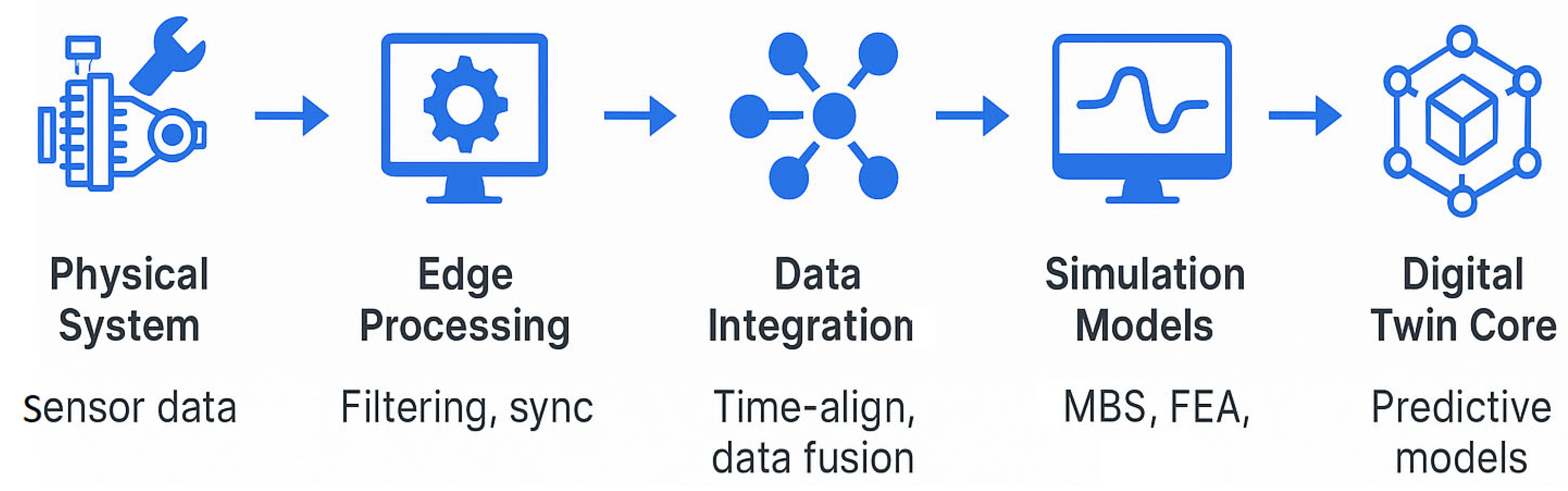
- IIoT Platforms and Middleware: Many DT implementations leverage IoT platforms that handle data ingestion, processing, and user interface. Examples include Siemens MindSphere, GE Predix, PTC ThingWorx, etc. These platforms provide connectors to machines (via OPC UA, MQTT, etc.) and typically allow building analytics or simulation applications on top. In the NVH context, Siemens offers Simcenter Testlab integrated with MindSphere for remote monitoring of test data and feeding it to simulations [10]. Similarly, if one were to implement a gear NVH twin, an IoT hub could stream, say, gearbox vibration data from an EV fleet to a cloud, where a simulation (perhaps an FMU exported model) runs to predict noise or diagnose issues.
- Co-Simulation Frameworks: Functional Mock-up Interface (FMI) was mentioned; tools that support FMI can orchestrate co-simulations. For instance, a drivetrain model FMU could be fed with real motor torque data in a co-sim engine to simulate NVH in real time. Some research testbeds have used such setups to create “hardware-in-the-loop” simulations—essentially a form of DT where part of the system is real, and part is virtual. An example is a Ford project (2017) that co-simulated a multibody drivetrain model with a real engine on a dyno using FMI, to evaluate NVH and drivability concurrently [47]. The co-simulation ensured the engine and virtual transmission interacted realistically. This points towards future DT use in powertrain test cells, where part of the system could be replaced by its twin to expand testing capabilities.
- Data Models and Interoperability: A key challenge is ensuring interoperability between software and data formats. Some standards exist—ISO 10303 for gear geometry [48] and ISO 13336 for flank-form data [49]—but dynamic NVH data still relies on loosely defined formats such as ASAM ODS or CSV. As a result, most integration is custom: one OEM, for example, linked its gear metrology database to simulations via a Python API (Python v.3.9) that automatically inserts measured deviations into each DT instance. Reliable test–simulation merging also requires aligned reference frames and timestamps; consistent templates, coordinate systems, and naming conventions—as emphasized in the Simcenter workflow (Siemens Digital Industries Software, Simcenter Testlab v.2023.1)—are essential for robust DT data integration [10].
- Feedback Loops and Control: Beyond just one-way monitoring, advanced DTs implement control feedback. For NVH, an example might be an active control system using the twin’s prediction. Consider an active noise cancellation (ANC) wherein the twin predicts that a gear whine tone will exceed a threshold in the next second based on current operating conditions; hence, it triggers a countermeasure (maybe adjusting motor torque slightly to shift the frequency or activating a noise canceling signal through speakers). While such an application is quite advanced and not reported in the literature yet, the building blocks exist: fast predictions (via surrogate model) and integration with control systems (via vehicle CAN or similar). In industrial machines, there are instances of DTs used for dynamic tolerance adjustment—Rajkumar et al. (2025) describe an AI-DT architecture where measured deviations trigger adjustments in the machining process in real time [50]. Translating that to NVH, one could imagine in manufacturing, if a gear’s measured waviness predicts noise issues, the twin could recommend re-grinding or pairing that gear with a better mate in assembly.
- User Interface and Visualization: NVH engineers typically use waterfall plots, Campbell diagrams, and color maps to visualize noise and vibration. DT dashboards must convey such information intuitively. Some tools provide “auralization”—synthesizing the predicted sound, such that engineers can literally listen to the twin. This is already performed with NVH simulators, where you can listen to how a car would sound with different components. Integrating that into a DT means if the twin’s parameters update (say a gear wear increases whine by 5 dB), a product engineer could immediately hear the effect. This can significantly aid decision-making (sound quality is hard to judge by numbers alone). HEAD Acoustics, in a white paper, described an “NVH Simulator: A path to the DT”, highlighting how virtual acoustic prototypes can be combined with physical measurements to allow subjective evaluation early. This shows State-of-the-Art tools moving toward immersive DT experiences [51].
4.4. Hybrid Physics–ML and Emerging Approaches
- Physics-Informed Machine Learning (PIML): In PIML, the ML model is trained or constrained using physical laws. An example relevant to gear NVH is using simulated data (from many runs of a physics model with varied parameters) to train an ML model, but also enforcing known physics in the model structure. Liu et al. [52] conducted a systematic review of DT components and highlighted PIML as a key to maintaining twin fidelity [52]. In gear applications, one could use a limited set of expensive FEA acoustic simulations to train a neural network that predicts noise spectra from input parameters (module, teeth number, misalignments, etc.), ensuring the network respects symmetry and scaling laws known from physics. There is also research on neural nets that take vibration signal inputs and output diagnostic classification, with a physical model in parallel that generates synthetic signals for training.
- Reduced-Order Models and Surrogates: Surrogate modeling is a well-trod approach in NVH for optimization. Techniques like response surface methodology or polynomial chaos expansions have been used to create algebraic models of NVH metrics as functions of design variables. The new twist is using them in an updating loop. For instance, if a surrogate is embedded in a twin to predict TE given current temperature and load, it can be continuously corrected by bias factors derived from any measured TE. An applied example: Kobayashi and Alam (2024) created an explainable AI model for predicting remaining useful life in a DT, focusing on making it trustworthy for engineers [53]. This reflects the need in industry to have ML models whose outputs can be explained in physical terms (e.g., “Noise increased because surface roughness exceeded X, as per the model”).
- Federated and Transfer Learning: These approaches are emerging as promising approaches for intelligent diagnostics in scenarios where data is scarce or distributed across multiple sites. In gear NVH analysis, for example, imagine multiple factories each manufacturing similar gears: a federated learning (FL) scheme could train a global NVH prediction model without requiring any factory to share its raw data, thereby preserving privacy and proprietary information [45]. Combining FL with transfer learning (TL) enables the adaptation of global models trained on one machine, component, or product to new gearboxes with limited local data [46]. These approaches have already proven effective in cross-device fault diagnosis, enabling collaboration between separate facilities and even different equipment types without compromising data confidentiality [54]. In NVH and acoustic applications, transfer learning allows deep models trained on one signal type—such as vibration—to be adapted for another, like airborne acoustic data, improving the model’s versatility across sensor modalities. Although not yet widespread in gear NVH, these methods are expected to become increasingly relevant as digital twins and data-driven gear diagnostics expand across distributed manufacturing ecosystems [55].
- Edge Computing for Twins: A challenge for real-time twins is latency in sending data to the cloud and back. Some propose performing more at the “edge” (on a local device or test rig). For NVH, an edge device could run a simplified model or inference of an ML model on an FPGA or local PC, such that immediate feedback is possible. Habbouche et al. (2025) discuss deploying “compressed DT models near the monitoring stations” to improve real-time detection on wind turbines [8]. In automotive testing, one could similarly run a twin on a high-performance laptop connected to the test vehicle, rather than relying on cloud processing.
- Integration of Diverse Data (Multimodal): NVH does not exist in a vacuum; operating conditions, environmental data (temperature affects noise via lubrication viscosity, etc.), and even subjective feedback could be incorporated. Some cutting-edge approaches attempt to fuse different data types. For instance, one might combine vibration signals with high-speed camera footage of the gear mesh (it is possible with stroboscopic methods) to directly correlate tooth deflection patterns with noise. While no production system does this yet, research like You et al. (2024) used an intelligent fusion of sound and vibration signals via an AI model for bearing fault diagnosis [56]. Extending to gear NVH, combining airborne and structure-borne sensors through AI could yield more robust detection of emerging noise issues than either alone.
- Standards and Frameworks with AI: On the standards front, the ISO 23247 [57] series formally defines a reference architecture for digital twins in manufacturing and explicitly accommodates AI-enabled analytics and interoperability [58]. The upcoming ISO 23247-4 component is expected to further specify guidelines for analytics within twin systems. Recent reviews have emphasized how AI-driven predictive maintenance frameworks rely on digital twins for continuous learning and fault prediction, yet still face barriers such as poor data quality, sparse fault labels, and the need for lifecycle model retraining [59]. Together, these developments indicate a growing convergence between AI standards and digital twin frameworks, highlighting the need for standardized architectures that support adaptive and intelligent twin evolution.
4.5. The Role of the Digital Thread in Gear Twin Architectures
4.6. Bearing Dynamics and Their Influence on Gear NVH
4.7. Industry 5.0 Digital Twin Extensions
4.8. AI-Enhanced Digital Twins and the Evolution Toward Industry 5.0
5. Identified Research Gaps
5.1. Modeling Gaps in NVH Digital Twins
5.2. Data Integration Gaps
5.3. Validation and Metrics Gaps
5.4. Application and Sustainability Gaps
6. Research Gap Map
7. Future Directions and Recommendations
7.1. Advancing Modeling Fidelity and Speed
7.2. Building Robust Data Pipelines and Feedback Loops
7.3. Establishing Validation Protocols and Metrics
7.4. Enhancing Application and Sustainability Outcomes
7.5. Cost–Benefit and Sustainability Aspects
- Cross-functional collaboration between simulation, testing, and manufacturing teams.
- Skilled personnel in NVH modeling and data analytics.
- Robust IT infrastructure supporting IoT, cloud, and edge computing.
- Strong management support to embed the digital twin into formal development processes.
7.6. Practical Roadmap for Implementing NVH-Focused Digital Twins
- Short-Term (6–12 months)
- Mid-Term (1–3 years).
- Long-Term (3–5 years).
- Challenges and Strategies.
8. Conclusions
- Digital twins hold great promise for gear NVH by enabling continuous model refinement through data feedback and reducing reliance on physical prototypes. Initial implementations (in fault monitoring or targeted studies) demonstrate the potential for predictive noise and vibration management. However, fully operational NVH twins that drive design and control decisions in real time are still rare.
- Several technical gaps must be addressed to build effective NVH twins. High-fidelity gear models need to be made computationally efficient for real-time use (perhaps via reduced-order modeling or hybrid ML approaches). Data from manufacturing (e.g., real tooth surface measurements) and field operations are not yet routinely integrated into simulation models, leading to disconnects between predicted and actual NVH. Crucially, standardized methods to validate and trust digital twin predictions are lacking—currently, no consensus exists on how to quantify a twin’s accuracy or when it can substitute for a physical test.
- A research “gap map” was presented (Table 2), clustering the gaps into Modeling, Data, Validation, and Application categories. This map, supported by ~70 recent references, highlights impacts such as missed feedback loops, insufficient multi-physics representation, lack of NVH twin metrics, and unproven ROI of twins. These gaps mean that today’s gear NVH twins, where they exist, often function as advisory tools rather than authoritative sources for decisions.
- We proposed actionable future directions to bridge each gap (Section 7). These include developing multi-fidelity and physics-informed ML models to balance speed and accuracy, establishing digital threads that feed manufacturing and test data back into models, and creating validation protocols for NVH predictions. We also emphasize human and process factors: building engineer trust through transparency and gradually phasing twins into workflows, as well as quantifying the benefits in terms of cost, time, and sustainability to justify adoption. Table 3 summarizes these recommendations aligned with each gap.
- It is also noteworthy that the NVH digital twin efforts are fully aligned with broader industry trends in sustainability. EV drivetrains, with their heightened sensitivity to gear whine, are a prime application for these techniques—and indeed, many cited studies and projects focus on EV transmission noise. By enabling virtual optimization and reducing prototypes, DTs can help cut development time and material waste, supporting companies’ environmental goals. However, care must be taken to also incorporate considerations of sound quality and human perception into the twin framework to ensure that improvements in simulations translate to real subjective improvements.
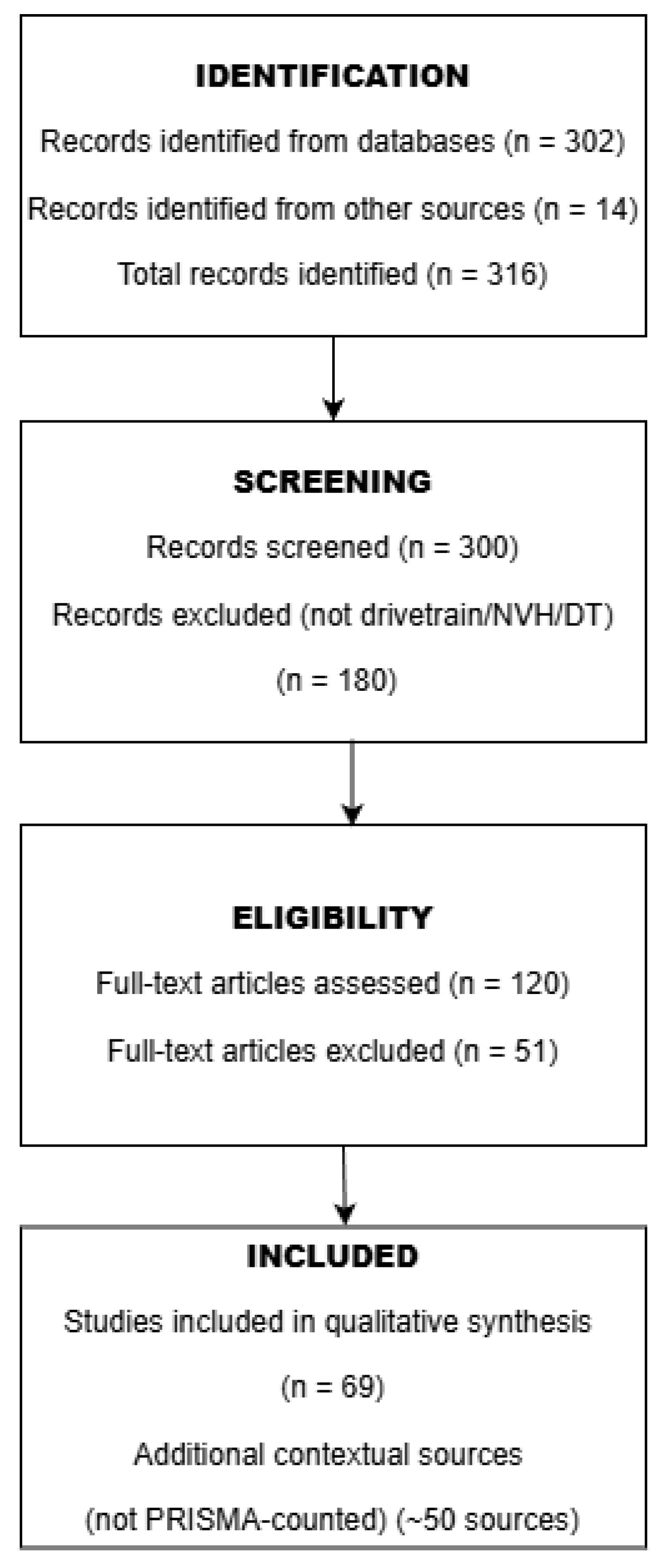
- Limitations of this review: While we strove for comprehensive coverage, the field of DTs is rapidly evolving. Some very recent industrial advances may not yet be documented in the literature. We focused on the 2016–2025 period; foundational works before 2015 were included sparingly. The review emphasized tonal gear noise; less has been said about transient or shock noise– those phenomena have their own modeling challenges and could be a subject of future twin research. Additionally, we concentrated on ground vehicle drivetrains; similar principles apply to other gear systems (wind turbines, helicopters), and cross-pollination of ideas between sectors was noted. It should also be noted that some of the identified gaps—such as the absence of standard metrics—reflect the state of the open literature; proprietary industrial methods may exist but are simply not published.
Author Contributions
Funding
Data Availability Statement
Conflicts of Interest
Abbreviations
| AAS | Asset Administration Shell |
| AI | Artificial Intelligence |
| ASAM | Association for Standardization of Automation and Measuring Systems |
| BEM | Boundary Element Method |
| CAD | Computer-Aided Design |
| CAE | Computer-Aided Engineering |
| CAM | Computer-Aided Manufacturing |
| CMM | Coordinate Measuring Machine |
| CPS | Cyber-Physical Systems |
| DT | Digital Twin |
| DTI | Digital Twin Instance |
| DTL | Digital Thread Lifecycle |
| DTP | Digital Twin Prototype |
| EOL | End-of-Line |
| FE | Finite Element |
| FEA | Finite Element Analysis |
| FFT | Fast Fourier Transform |
| FL | Federated Learning |
| FMU | Functional Mock-up Unit |
| FMI | Functional Mock-up Interface |
| FRF | Frequency Response Function |
| FPGA | Field-Programmable Gate Array |
| GPU | Graphics Processing Unit |
| H-AAS | Human Asset Administration Shell |
| HCDT | Human-Centric Digital Twin |
| HDT | Human Digital Twin |
| IDTA | Industrial Digital Twin Association |
| IIoT | Industrial Internet of Things |
| ISO | International Organization for Standardization |
| LSTM | Long Short-Term Memory |
| MBD | Multibody Dynamics |
| MDF | Measurement Data Format |
| ML | Machine Learning |
| MQTT | Message Queuing Telemetry Transport |
| NVH | Noise, Vibration, and Harshness |
| OPC UA | Open Platform Communications Unified Architecture |
| QIF | Quality Information Framework |
| PIML | Physics-Informed Machine Learning |
| RMS | Root Mean Square |
| ROI | Return on Investment |
| SAE | Society of Automotive Engineers |
| SPL | Sound Pressure Level |
| SVR | Support Vector Regression |
| TE | Transmission Error |
| TL | Transfer Learning |
| VDI | VDI—Verein Deutscher Ingenieure (Association of German Engineers) |
References
- Horváth, K.; Zelei, A. Simulating Noise, Vibration, and Harshness Advances in Electric Vehicle Powertrains: Strategies and Challenges. World Electr. Veh. J. 2024, 15, 367. [Google Scholar] [CrossRef]
- Cheerla, G.; Pulugundla, K.C.; Kolla, K.D.; Sathyanarayana, P. Solving Whine Noise in Electric Vehicles: A Comprehensive Study Using Experimental and Multiphysics Techniques; SAE Technical Paper Series; SAE International: Warrendale, PA, USA, 2024. [Google Scholar] [CrossRef]
- Palermo, A.; Britte, L.; Janssens, K.; Mundo, D.; Desmet, W. The measurement of Gear Transmission Error as an NVH indicator: Theoretical discussion and industrial application via low-cost digital encoders to an all-electric vehicle gearbox. Mech. Syst. Signal Process. 2018, 110, 368–389. [Google Scholar] [CrossRef]
- Dai, L.; Liu, Y.; Jia, Y.; Zhou, W.; Zhang, A. Research on gear whine evaluation method based on transmission error sensitivity. J. Phys. Conf. Ser. 2024, 2827, 012024. [Google Scholar] [CrossRef]
- Mughal, H.; Sivayogan, G.; Dolatabadi, N.; Rahmani, R. An efficient analytical approach to assess root cause of nonlinear electric vehicle gear whine. Nonlinear Dyn. 2022, 110, 3167–3186. [Google Scholar] [CrossRef]
- Shi, Z.; Liu, S.; Yue, H.; Wu, X. Noise analysis and optimization of the gear transmission system for two-speed automatic transmission of pure electric vehicles. Mech. Sci. 2023, 14, 333–345. [Google Scholar] [CrossRef]
- Horvath, K.; Feszty, D. Surface Waviness of EV Gears and NVH Effects—A Comprehensive Review. World Electr. Veh. J. 2025, 16, 540. [Google Scholar] [CrossRef]
- Habbouche, H.; Amirat, Y.; Benbouzid, M. Leveraging Digital Twins and AI for Enhanced Gearbox Condition Monitoring in Wind Turbines: A Review. Appl. Sci. 2025, 15, 5725. [Google Scholar] [CrossRef]
- Cho, Y.; Noh, S.D. Design and Implementation of Digital Twin Factory Synchronized in Real-Time Using MQTT. Machines 2024, 12, 759. [Google Scholar] [CrossRef]
- Siemens Digital Industries Software. Digital Twins—Successfully combining simulation and Test. Simcenter Blog. Available online: https://blogs.sw.siemens.com/simcenter/digital-twins-simulation-and-test/ (accessed on 7 November 2023).
- Moghadam, F.K.; Rebouças, G.F.d.S.; Nejad, A.R. Digital twin modeling for predictive maintenance of gearboxes in floating offshore wind turbine drivetrains. Forsch. Ingenieurwesen 2021, 85, 273–286. [Google Scholar] [CrossRef]
- Zhu, D.; Li, Z.; Hu, N. Multi-Body Dynamics Modeling and Analysis of Planetary Gearbox Combination Failure Based on Digital Twin. Appl. Sci. 2022, 12, 12290. [Google Scholar] [CrossRef]
- Hartmann, D.; Auweraer, H. The Executable Digital Twin: Merging the digital and the physics worlds. arXiv 2022, arXiv:abs/2210.17402. [Google Scholar] [CrossRef]
- Desai, A.; Navaneeth, N.; Adhikari, S.; Chakraborty, S. Enhanced multi-fidelity modelling for digital twin and uncertainty quantification. arXiv 2023, arXiv:abs/2306.14430. [Google Scholar] [CrossRef]
- Liu, H.; Xia, M.; Williams, D.; Sun, J.; Yan, H. Digital Twin-Driven Machine Condition Monitoring: A Literature Review. J. Sens. 2022, 2022, 1–13. [Google Scholar] [CrossRef]
- Tang, Y.; Dehaghani, M.; Wang, G. Capturing Lifecycle System Degradation in Digital Twin Model Updating. arXiv 2025, arXiv:abs/2503.08953. [Google Scholar] [CrossRef]
- Fushimi, T.; Tagami, D.; Yamamoto, K.; Ochiai, Y. A digital twin approach for experimental acoustic hologram optimization. Commun. Eng. 2024, 3, 12. [Google Scholar] [CrossRef]
- Araghi, S.; Liu, Z.; Sarkar, A.; Louge, T.; Karray, M. Digital Twin’s Anatomy: A Cross-Sector Framework with Healthcare Validation. IEEE Access 2025, 13, 21306–21334. [Google Scholar] [CrossRef]
- Romero, D.; Wuest, T.; Harik, R.; Thoben, K. Towards a Cyber-Physical PLM Environment: The Role of Digital Product Models, Intelligent Products, Digital Twins, Product Avatars and Digital Shadows. IFAC-PapersOnLine 2020, 53, 10911–10916. [Google Scholar] [CrossRef]
- Barbie, A.; Hasselbring, W. From Digital Twins to Digital Twin Prototypes: Concepts, Formalization, and Applications. IEEE Access 2024, 12, 75337–75365. [Google Scholar] [CrossRef]
- Sepasgozar, S. Differentiating Digital Twin from Digital Shadow: Elucidating a Paradigm Shift to Expedite a Smart, Sustainable Built Environment. Buildings 2021, 11, 151. [Google Scholar] [CrossRef]
- Pronost, G.; Mayer, F.; Camargo, M.; Dupont, L. Digital Twins along the product lifecycle: A systematic literature review of applications in manufacturing. Digit. Twin 2023, 3, 3. [Google Scholar] [CrossRef]
- Ghorbani, Z.; Messner, J. A categorical approach for defining digital twins in the AECO industry. J. Inf. Technol. Constr. 2024, 29, 198–218. [Google Scholar] [CrossRef]
- Gear Solutions Magazine. Use of Gear Reliability Data in a Cloud-Based Gearbox Digital Twin Using Telematics Data. Gear Solutions: Your Resource to the Gear Industry. Available online: https://gearsolutions.com/features/use-of-gear-reliability-data-in-a-cloud-based-gearbox-digital-twin-using-telematics-data/ (accessed on 15 March 2022).
- Zhang, H.; Li, Y.; Zhang, S.; Song, L.; Tao, F. Artificial Intelligence-Enhanced Digital Twin Systems Engineering Towards the Industrial Metaverse in the Era of Industry 5.0. Chin. J. Mech. Eng. 2025, 38, 40. [Google Scholar] [CrossRef]
- SAE International. Multibody Dynamics Cosimulation for Vehicle NVH Response Predictions; Technical Paper 2017-01-1054; SAE Mobilus: Warrendale, PA, USA, 2017; Available online: https://saemobilus.sae.org/articles/multibody-dynamics-cosimulation-vehicle-nvh-response-predictions-2017-01-1054 (accessed on 1 March 2025).
- Design News. Balancing Efficiency and Comfort in a Ford. Design News. Available online: https://www.designnews.com/industry/balancing-efficiency-and-comfort-in-a-ford (accessed on 2 February 2023).
- OPC Foundation; Digital Twin Consortium. Digital Twin Consortium and OPC Foundation Announce Liaison Agreement. 2021. Available online: https://opcfoundation.org/news/press-releases/digital-twin-consortium-and-opc-foundation-announce-liaison-agreement/ (accessed on 11 November 2025).
- Horváth, K. Data-Driven Predictive Modeling for Investigating the Impact of Gear Manufacturing Parameters on Noise Levels in Electric Vehicle Drivetrains. World Electr. Veh. J. 2025, 16, 426. [Google Scholar] [CrossRef]
- ISO 1328-1:2013; Cylindrical Gears—ISO System of Flank Tolerance Classification—Part 1: Definitions and Allowable Values of Deviations Relevant to Flanks of Gear Teeth. International Organization for Standardization (ISO): Geneva, Switzerland, 2013.
- He, Z.; Lin, T.; Song, J.; Wang, Z.; Que, H. Analytical and computational method of structure-borne noise and shock resistance of gear system. J. Meas. Eng. 2014, 2, 215–224. [Google Scholar]
- Popa, L.; Berdich, A.; Groza, B. CarTwin—Development of a Digital Twin for a Real-World In-Vehicle CAN Network. Appl. Sci. 2022, 13, 445. [Google Scholar] [CrossRef]
- Zhang, J.; Lv, C.; Li, Z. Investigation of High-Speed Dynamic Transmission Error Testing Using Gear Strain. Machines 2023, 11, 956. [Google Scholar] [CrossRef]
- Gutierrez Santiago, U.; Fernández Sisón, A.; Polinder, H.; van Wingerden, J.-W. Input torque measurements for wind turbine gearboxes using fiber-optic strain sensors. Wind Energy Sci. 2022, 7, 505–521. [Google Scholar] [CrossRef]
- Niedworok, A. Dynamic torque measurement of drive transmission in vehicles being in motion using strain gauges measurement technique and wireless data transmission. In Proceedings of the 2014 16th European Conference on Power Electronics and Applications, Lappeenranta, Finland, 26–28 August 2014; pp. 1–8. [Google Scholar] [CrossRef]
- Manshin, Y.; Manshina, Y.; Geue, M. About the dynamic error of strain gauge torque measuring devices. J. Phys. Conf. Ser. 2021, 2131, 052041. [Google Scholar] [CrossRef]
- Bai, J.; Wu, X.; Gao, F.; Li, H. Analysis of Powertrain Loading Dynamic Characteristics and the Effects on Fatigue Damage. Appl. Sci. 2017, 7, 1027. [Google Scholar] [CrossRef]
- Voronin, S.; Loginov, B.; Gasiyarova, O.; Evdokimov, S.; Karandaev, A.; Khramshin, V. Telemetry System to Monitor Elastic Torque on Rolling Stand Spindles. J. Manuf. Mater. Process. 2024, 8, 85. [Google Scholar] [CrossRef]
- Stadtmann, F.; Rasheed, A.; Kvamsdal, T.; Johannessen, K.A.; San, O.; Kölle, K.; Tande, J.O.; Barstad, I.; Benhamou, A.; Brathaug, T.; et al. Digital twins in wind energy: Emerging technologies and industry-informed future directions. IEEE Access 2023, 11, 110762–110795. [Google Scholar] [CrossRef]
- Peeters, C.; Verstraeten, T.; Nowé, A.; Daems, P.; Helsen, J. Advanced vibration signal processing using edge computing to monitor wind turbine drivetrains. In Proceedings of the ASME 2nd International Offshore Wind Technical Conference, St. Julian’s, Malta, 3–6 November 2019. [Google Scholar] [CrossRef]
- Souksavanh, V.; Liu, Y. NVH data analytics and its application in vehicle rating. In Proceedings of the 2020 IEEE 7th International Conference on Industrial Engineering and Applications (ICIEA), Online, 16–21 April 2020; pp. 287–292. [Google Scholar] [CrossRef]
- Tonelli, R.; Buckert, S.; Patrucco, A.; Bragado Perez, B.; Gutierrez, J.; Sanchez, A. Electric vehicle ride and vibrations analysis: Full electric vehicle MBD model development for NVH studies. SAE Int. J. Adv. Curr. Pract. Mobil. 2024, 7, 1024–1034. [Google Scholar] [CrossRef]
- Prokop, A.; Řehák, K.; Zubík, M.; Novotný, P. Experimental validation of the gearbox NVH parameters. J. Middle Eur. Constr. Des. Cars 2015, 13, 16–21. [Google Scholar] [CrossRef]
- Sun, P.; Huang, J.; Zhang, L.; Liu, Y. Multi-objective prediction of the sound-insulation performance of a vehicle body system using multiple kernel learning–support vector regression. Electronics 2024, 13, 538. [Google Scholar] [CrossRef]
- Yan, Z.; Sun, J.; Zhang, Y.; Liu, L.; Gao, Z.; Chang, Y. Federated Transfer Learning Strategy: A Novel Cross-Device Fault Diagnosis Method Based on Repaired Data. Sensors 2023, 23, 7302. [Google Scholar] [CrossRef]
- Shen, J.; Yang, S.; Zhao, C.; Ren, X.; Zhao, P.; Yang, Y.; Han, Q.; Wu, S. FedLED: Label-Free Equipment Fault Diagnosis with Vertical Federated Transfer Learning. IEEE Trans. Instrum. Meas. 2024, 73, 3509910. [Google Scholar] [CrossRef]
- Tielkes, T.; Thiel, R.; Kiencke, U. Balancing driveability, NVH, and fuel consumption on automotive powertrains using an integrated optimization approach. Int. J. Engine Res. 2017, 19, 326–336. [Google Scholar] [CrossRef]
- ISO 10303-1:1994; Industrial Automation Systems and Integration—Product Data Representation and Exchange—Part 1: Overview and Fundamental Principles. International Organization for Standardization (ISO): Geneva, Switzerland, 1994.
- ISO 13336:1998; Mechanical Vibration and Shock—Characterization of the Dynamic Mechanical Properties of Visco-Elastic Materials. International Organization for Standardization (ISO): Geneva, Switzerland, 1998.
- Rajkumar, S.; Singh, R.; Kumar, P.; Gupta, A. Predictive maintenance algorithms, artificial intelligence, digital twin. Mathematics 2025, 13, 981. [Google Scholar] [CrossRef]
- HEAD Acoustics GmbH. NVH Simulator: A Path to the Digital Twin. HEAD Acoustics. Available online: https://www.head-acoustics.com/news-events/press-releases/press-details/show/nvh-simulator-a-path-to-the-digital-twin (accessed on 14 September 2022).
- Liu, C.; Tang, D.; Wang, Z. AR-driven industrial metaverse for the auxiliary maintenance of machine tools in IoT-enabled manufacturing workshop. In Proceedings of the 2023 IEEE 19th International Conference on Automation Science and Engineering (CASE), Auckland, New Zealand, 26–30 August 2023; IEEE: New York, NY, USA, 2023; pp. 1–6. [Google Scholar]
- Kobayashi, K.; Alam, S.B. Explainable, interpretable and trustworthy AI for an intelligent digital twin: A case study on remaining useful life. Eng. Appl. Artif. Intell. 2024, 129, 107620. [Google Scholar] [CrossRef]
- Yang, W.; Yu, G. Federated Multi-Model Transfer Learning-Based Fault Diagnosis with Peer-to-Peer Network for Wind Turbine Cluster. Machines 2022, 10, 972. [Google Scholar] [CrossRef]
- Bhuiyan, R.; Uddin, J. Deep Transfer Learning Models for Industrial Fault Diagnosis Using Vibration and Acoustic Sensors Data: A Review. Vibration 2023, 6, 218–238. [Google Scholar] [CrossRef]
- You, K.; Lian, Z.; Gu, Y. A performance-interpretable intelligent fusion of sound and vibration signals for bearing fault diagnosis via dynamic CAME. Nonlinear Dyn. 2024, 112, 20903–20940. [Google Scholar] [CrossRef]
- ISO 23247-4:2024; Automation Systems and Integration—Digital Twin Framework for Manufacturing—Part 4: Information Exchange. International Organization for Standardization (ISO): Geneva, Switzerland, 2024.
- Shao, G.; Frechette, S.; Srinivasan, V. An Analysis of the New ISO 23247 Series of Standards on Digital Twin Framework for Manufacturing, Proceedings of the ASME International Manufacturing Science and Engineering Conference, New Brunswick, NJ, USA, 12–16 June 2023; ASME: New York, NY, USA, 2023; Volume 2: Manufacturing Systems, pp. 1–8. [Google Scholar] [CrossRef]
- Chen, C.; Fu, H.; Zheng, Y.; Tao, F.; Liu, Y. The advance of digital twin for predictive maintenance: The role and function of machine learning. J. Manuf. Syst. 2023, 71, 699–714. [Google Scholar] [CrossRef]
- Xu, Z.; Yu, W.; Xu, H.; Li, J. Dynamic modeling of spur gear system considering the coupling effect between bearing deflection and gear mesh stiffness. Proc. Inst. Mech. Eng. Part C J. Mech. Eng. Sci. 2024, 238, 6725–6737. [Google Scholar] [CrossRef]
- Chen, Y. Time-varying dynamic analysis for a helical gear pair system with three-dimensional motion due to bearing deformation. Adv. Mech. Eng. 2014, 12, 918128. [Google Scholar] [CrossRef]
- Bai, H.; Song, C.; Zhu, C.; Wang, Y.; Ou, Z. Dynamic modeling and analysis of helical gear-shaft-bearing coupled system. J. Theor. Appl. Mech. 2020, 58, 743–756. [Google Scholar] [CrossRef]
- Jin-Li, X.; Lei, W.; Wenxin, L. Influence of Bearing Stiffness on the Nonlinear Dynamics of a Shaft-Final Drive System. Shock Vib. 2016, 2016, 1–14. [Google Scholar] [CrossRef]
- Liu, X.; Liu, D.; Hu, X. Influence of the Bearing Thermal Deformation on Nonlinear Dynamic Characteristics of an Electric Drive Helical Gear System. Sensors 2021, 21, 309. [Google Scholar] [CrossRef]
- Huang, H.; Fu, S.; Luo, S. Analysis of the Influence of Transmission Housing Elasticity on the Vibration Characteristics of Gear Shafting under Coupling Effect. Shock Vib. 2021, 2021, 1–17. [Google Scholar] [CrossRef]
- Wang, S.; Xieeryazidan, A.; Zhang, X.; Zhou, J. An Improved Computational Method for Vibration Response and Radiation Noise Analysis of Two-Stage Gearbox. IEEE Access 2020, 8, 85973–85988. [Google Scholar] [CrossRef]
- Ren, Y.; Chang, S.; Liu, G.; Wu, L.; Lim, T. Impedance Synthesis Based Vibration Analysis of Geared Transmission System. Shock Vib. 2017, 2017, 1–14. [Google Scholar] [CrossRef]
- Feng, K. Effect of Shaft and Bearing Flexibility on Dynamic Behavior of Helical Gears: Modeling and Experimental Comparisons. J. Adv. Mech. Des. Syst. Manuf. 2012, 6, 1190–1205. [Google Scholar] [CrossRef]
- Lacey, S.J. An Overview of Bearing Vibration Analysis; Schaeffler Group: Troy, MI, USA; Available online: https://www.schaeffler.com/remotemedien/media/_shared_media/08_media_library/01_publications/schaeffler_2/technicalpaper_1/download_1/vibration_analysis_en_en.pdf (accessed on 1 December 2025).
- Li, S.; Xu, Y.; Pang, R.; Liu, J. An Influence Analysis of the Bearing Waviness on the Vibrations of a Flexible Gear. Machines 2025, 13, 661. [Google Scholar] [CrossRef]
- Donnelly, D.J.; Pumps & Systems. Avoid Common Causes of Bearing Failure. July 2015. Available online: https://www.pumpsandsystems.com/avoid-common-causes-bearing-failure (accessed on 1 December 2025).
- FunctionBay GmbH. Case Study: Gearbox NVH Analysis Using an Engineering Approach. Available online: https://www.functionbay.org/nvh-engineering (accessed on 1 December 2025).
- Barata, J.; Kayser, I. How will the digital twin shape the future of industry 5.0? Technovation 2024, 134, 103025. [Google Scholar] [CrossRef]
- Bucci, I.; Fani, V.; Bandinelli, R. Towards Human-Centric Manufacturing: Exploring the Role of Human Digital Twins in Industry 5.0. Sustainability 2024, 17, 129. [Google Scholar] [CrossRef]
- Merchán-Cruz, E.; Gabelaia, I.; Savrasovs, M.; Hansen, M.; Soe, S.; Rodríguez-Cañizo, R.; Aragón-Camarasa, G. Trust by Design: An Ethical Framework for Collaborative Intelligence Systems in Industry 5.0. Electronics 2025, 14, 1952. [Google Scholar] [CrossRef]
- Peruzzini, M.; Prati, E.; Pellicciari, M. A framework to design smart manufacturing systems for Industry 5.0 based on the human-automation symbiosis. Int. J. Comput. Integr. Manuf. 2023, 37, 1426–1443. [Google Scholar] [CrossRef]
- Villani, V.; Picone, M.; Mamei, M.; Sabattini, L. A Digital Twin Driven Human-Centric Ecosystem for Industry 5.0. IEEE Trans. Autom. Sci. Eng. 2025, 22, 11291–11303. [Google Scholar] [CrossRef]
- Gaffinet, B.; Ali, J.; Naudet, Y.; Panetto, H. Human Digital Twins: A systematic literature review and concept disambiguation for industry 5.0. Comput. Ind. 2025, 166, 104230. [Google Scholar] [CrossRef]
- He, Q.; Li, L.; Li, D.; Peng, T.; Zhang, X.; Cai, Y.; Zhang, X.; Tang, R. From Digital Human Modeling to Human Digital Twin: Framework and Perspectives in Human Factors. Chin. J. Mech. Eng. 2024, 37, 9. [Google Scholar] [CrossRef]
- Grego, G.; Nenna, F.; Gamberini, L. Enhancing Human-Machine Interactions: A Novel Framework for AR-Based Digital Twin Systems in Industrial Environments. In Proceedings of the 17th International Conference on PErvasive Technologies Related to Assistive Environments, Crete, Greece, 26–28 June 2024. [Google Scholar] [CrossRef]
- Asad, U.; Khan, M.; Khalid, A.; Lughmani, W. Human-Centric Digital Twins in Industry: A Comprehensive Review of Enabling Technologies and Implementation Strategies. Sensors 2023, 23, 3938. [Google Scholar] [CrossRef] [PubMed]
- Davila-Gonzalez, S.; Martín, S. Human Digital Twin in Industry 5.0: A Holistic Approach to Worker Safety and Well-Being through Advanced AI and Emotional Analytics. Sensors 2024, 24, 655. [Google Scholar] [CrossRef] [PubMed]
- Mandischer, N.; Atanasyan, A.; Schluse, M.; Roßmann, J.; Mikelsons, L. Perspectives-Observer-Transparency—A Novel Paradigm for Modelling the Human in Human-To-Anything Interaction Based on a Structured Review of the Human Digital Twin. In Proceedings of the 2024 IEEE International Conference on Systems, Man, and Cybernetics (SMC), Kuching, Malaysia, 6–10 October 2024; pp. 215–222. [Google Scholar] [CrossRef]
- Bitencourt, J.; Osho, J.; Wooley, A.; Harris, G. Do you trust digital twins? A framework to support the development of trusted digital twins through verification and validation. Int. J. Prod. Res. 2025, 63, 1–21. [Google Scholar] [CrossRef]
- Cutrona, V.; Bonomi, N.; Montini, E.; Ruppert, T.; Delinavelli, G.; Pedrazzoli, P. Extending factory digital Twins through human characterisation in Asset Administration Shell. Int. J. Comput. Integr. Manuf. 2023, 37, 1214–1231. [Google Scholar] [CrossRef]
- Fraga-Lamas, P.; Barros, D.; Lopes, S.; Fernández-Caramés, T. Mist and Edge Computing Cyber-Physical Human-Centered Systems for Industry 5.0: A Cost-Effective IoT Thermal Imaging Safety System. Sensors 2022, 22, 8500. [Google Scholar] [CrossRef]
- Salis, A.; Marguglio, A.; De Luca, G.; Gusmeroli, S.; Razzetti, S. An Edge-Cloud based Reference Architecture to support cognitive solutions in the Process Industry. arXiv 2022, arXiv:abs/2202.06622. [Google Scholar] [CrossRef]
- Yao, X.; Ma, N.; Zhang, J.; Wang, K.; Yang, E.; Faccio, M. Enhancing wisdom manufacturing as industrial metaverse for industry and society 5.0. J. Intell. Manuf. 2022, 35, 235–255. [Google Scholar] [CrossRef]
- Awouda, A.; Traini, E.; Bruno, G.; Chiabert, P. IoT-Based Framework for Digital Twins in the Industry 5.0 Era. Sensors 2024, 24, 594. [Google Scholar] [CrossRef]
- Kamdjou, H.; Baudry, D.; Havard, V.; Ouchani, S. Resource-Constrained EXtended Reality Operated with Digital Twin in Industrial Internet of Things. IEEE Open J. Commun. Soc. 2024, 5, 928–950. [Google Scholar] [CrossRef]
- Yurtay, Y. Carbon Footprint Management with Industry 4.0 Technologies and Erp Systems in Sustainable Manufacturing. Appl. Sci. 2025, 15, 480. [Google Scholar] [CrossRef]
- Pajpach, M.; Pribiš, R.; Drahoš, P.; Kučera, E.; Haffner, O. Design of an Educational-development Platform for Digital Twins using the Interoperability of the OPC UA Standard and Industry 4.0 Components. In Proceedings of the 2023 3rd International Conference on Electrical, Computer, Communications and Mechatronics Engineering (ICECCME), Tenerife, Spain, 19–21 July 2023; pp. 1–6. [Google Scholar] [CrossRef]
- Volz, F.; Sutschet, G.; Stojanović, L.; Usländer, T. On the Role of Digital Twins in Data Spaces. Sensors 2023, 23, 7601. [Google Scholar] [CrossRef] [PubMed]
- Meier, D.; Vogl, J.; Kohnhäuser, F.; Beyerer, J. Secure Provisioning of OPC UA Applications Using the Asset Administration Shell. In Proceedings of the 2022 IEEE 17th Conference on Industrial Electronics and Applications (ICIEA), Chengdu, China, 16–19 December 2022; pp. 144–149. [Google Scholar] [CrossRef]
- Juhlin, P.; Othen, R.; Zehnpfund, A.; Song, C.; Schlake, J.; Schmeiser, A.; Kratzer, K.; Sejdija, J.; Kayser, P. Open Reference Architecture for Sustainable Papermaking based on Industrial Interoperability Standards and Cloud-Native Technologies. In Proceedings of the 2024 IEEE 29th International Conference on Emerging Technologies and Factory Automation (ETFA), Padova, Italy, 10–13 September 2024; pp. 1–4. [Google Scholar] [CrossRef]
- Massaro, A. Electronic Artificial Intelligence and Digital Twins in Industry 5.0: A Systematic Review and Perspectives. Machines 2025, 13, 755. [Google Scholar] [CrossRef]
- Fedak, S.; Skorenkyy, Y.; Dautaj, M.; Zolotyy, R.; Kramar, O. Digital Twins for Optimization of Industry 5.0 Smart Manufacturing Facilities. In Proceedings of the ITTAP’2023—CEUR Workshop Proceedings, Ternopil, Ukraine, 22–24 November 2023; Volume 3628, pp. 1–8. [Google Scholar]
- Isaza Domínguez, L.G. Digital Twins in Industry 5.0—A Systematic Literature Review. Eur. Public Soc. Innov. Rev. 2024, 9, 1–21. [Google Scholar] [CrossRef]
- Elder, J.T. Method of Gear Noise Reduction. Publication No. WO 2019200261A1. Available online: https://patents.google.com/patent/WO2019200261A1/en (accessed on 17 October 2019).
- Tang, J.; Guo, H.; Wan, H. Cylindrical gear transmission errors influenced by temperature based on thermal network. Metrol. Meas. Syst. 2024, 31, 3–21. [Google Scholar] [CrossRef]
- European Commission. H2020 ECO-Drive Project: System-Level NVH Optimization for Sustainable Electric Drivetrains, 2020–2024; Grant Agreement No. 858018; European Commission: Brussels, Belgium, 2020. [Google Scholar]
- Siemens Digital Industries Software. Revolutionizing EV Drivetrain Design: Addressing NVH and Design Complexity. Simcenter Blog. Available online: https://blogs.sw.siemens.com/simcenter/revolutionizing-ev-drivetrain-design-addressing-nvh-and-design-complexity/ (accessed on 10 August 2023).
- Stefanone, A.; Rossoni, M.; Colombo, G. A Framework for Digital Twin Development in Manufacturing, Proceedings of the ASME 2024 International Mechanical Engineering Congress and Exposition, Portland, OR, USA, 17–21 November 2024; ASME: New York, NY, USA, 2024; Volume 1: Acoustics, Vibration, and Phononics; Advanced Design and Information Technologies. [Google Scholar] [CrossRef]
- Tripathy, A.; Chevuri, R.; Tran, T.; Acharya, S.; Deventer, J.; Paniagua, C.; Delsing, J. Digital Twin-based Condition Monitoring with Distributed Data Mapping of OPC UA and ISO 10303 STEP Standard. In Proceedings of the 4th Eclipse Security, AI, Architecture and Modelling Conference on Data Space, Mainz, Germany, 22 October 2024. [Google Scholar] [CrossRef]
- De Kooning, J.; Stockman, K.; De Maeyer, J.; Jarquin-Laguna, A.; Vandevelde, L. Digital Twins for Wind Energy Conversion Systems: A Literature Review of Potential Modelling Techniques Focused on Model Fidelity and Computational Load. Processes 2021, 9, 2224. [Google Scholar] [CrossRef]
- Gear Technology. Delivering on the Promises of Digital Twins and Big Data. Available online: https://www.geartechnology.com/delivering-on-the-promises-of-digital-twins-and-big-data (accessed on 11 November 2025).
- Jerman, A.; Bach, M.P.; Aleksić, A. Transformation towards smart factory system: Examining new job profiles and competencies. Syst. Res. Behav. Sci. 2020, 37, 388–402. [Google Scholar] [CrossRef]
- Lugaresi, G.; Matta, A. Automated manufacturing system discovery and digital twin generation. J. Manuf. Syst. 2021, 59, 51–66. [Google Scholar] [CrossRef]
- Kabir, M.; Ravi, B.; Ray, S. Digital Twin Technologies for Vehicular Prototyping: A Survey. IEEE Open J. Intell. Transp. Syst. 2025, 6, 503–521. [Google Scholar] [CrossRef]
- Goloshchapova, L.; Markova, S.; Galyaviyev, A. Development and evaluation of digital twins’ effectiveness in industrial economy. Ekon. I Upr. Probl. Resheniya 2025, 158, 184–194. [Google Scholar] [CrossRef]
- Banyai, K.; Kovács, L. Identification of influence of digital twin technologies on production systems: A return on investment-based approach. East. Eur. J. Enterp. Technol. 2023, 4, 66–78. [Google Scholar] [CrossRef]
- Rjabtšikov, V.; Rassõlkin, A.; Kudelina, K.; Kallaste, A.; Vaimann, T. Review of Electric Vehicle Testing Procedures for Digital Twin Development: A Comprehensive Analysis. Energies 2023, 16, 6952. [Google Scholar] [CrossRef]
- Resman, M.; Herakovič, N.; Debevec, M. Integrating Digital Twin Technology to Achieve Higher Operational Efficiency and Sustainability in Manufacturing Systems. Systems 2025, 13, 180. [Google Scholar] [CrossRef]
- Ba, L.; Tangour, F.; Abbassi, E.; Absi, R. Analysis of Digital Twin Applications in Energy Efficiency: A Systematic Review. Sustainability 2025, 17, 3650. [Google Scholar] [CrossRef]
- Yakovenko, Y.; Shaptala, R. Study of digital twins as the driving force of digital transformation and achieving the goals of sustainable development. Technol. Audit. Prod. Reserv. 2024, 2, 11–20. [Google Scholar] [CrossRef]
- Pater, J.; Stadnicka, D. Towards Digital Twins Development and Implementation to Support Sustainability—Systematic Literature Review. Manag. Prod. Eng. Rev. 2021, 12, 63–73. [Google Scholar] [CrossRef]





| Modeling Approach | Time/Frequency Domain and Scope | Real-Time Feasibility | Scalability (Model Size) | Validation Status (NVH) | References |
|---|---|---|---|---|---|
| Simple MBD (6-DOF, etc.) | Time-domain; gearpair torsion + 1D vib | Yes (ms time steps) | High (few DOF, low compute) | Qualitatively validated; misses HF details | [7,8] |
| Advanced MBD (≥21-DOF) | Time-domain; includes bearings, shafts | Borderline (depends on DOF) | Moderate (simplified flex) | Good for <2 kHz; some validation vs. tests | [7,29] |
| Flexible MBD (FE components) | Modal freq-domain + time integration | No (requires model reduction) | Low (hundreds of modes) | High fidelity; validated for modal behavior, not always for noise amplitude | [8,10] |
| FE Structural + BEM Acoustic | Frequency-domain; full 3D radiation | No (minutes/hours solve) | Low (thousands of nodes) | Accurate SPL prediction when inputs are correct; needs test correlation | [25,43,44] |
| Hybrid Physics-ML | Either domain; ML augmenting physics | Yes (ML is fast) | High (ML scales with data) | Early studies show good predictive accuracy, but limited scenarios have been validated | [11,12,13] |
| Pure ML Surrogates | Trained on past sims/tests (any domain) | Yes (very fast inference) | High (once trained) | Requires extensive validation; risk of extrapolation error | [31,32,33] |
| Prognostic/fault models | Time/freq; special cases (damage, etc.) | Varies (some real-time capable) | Moderate (per fault mode) | Validated for fault frequencies; such is less for noise loudness | [45,46] |
| Category | Gap Description | Impact/Why It Matters | Representative References |
|---|---|---|---|
| Modeling (M) | M1. Real-time vs. Fidelity Trade-off: High-fidelity NVH models are too slow; fast models lack accuracy. | Limits the twin’s ability to predict NVH accurately in real time, reducing trust in twin outputs. | [7,8] |
| M2. Manufacturing Variability in Models: Twin models rarely incorporate actual gear deviations, surface finish, etc. | Twin may mis-predict noise if as-built differences (waviness, misalignments) significantly affect NVH (common in practice). | [7] | |
| M3. Multi-physics Coupling Lacking: Thermal, lubrication, and motor dynamics are not integrated into NVH models. | Missed phenomena (e.g., noise changes with temperature, or EM torque ripple) could lead to wrong predictions under certain conditions. | No explicit ref (inferred from multiple sources, e.g., [29] on factors beyond geometry) | |
| M4. System-Level Modeling: NVH twins usually focus on one gearbox, not full vehicle or multi-component interactions. | Unable to capture NVH issues arising from system interactions (e.g., gear noise amplified by vehicle body modes). Suboptimal holistic optimization. | [7,10] (implying need for system-level approach) | |
| Data Integration (D) | D1. Broken Feedback Loops: Manufacturing and test data not fed back to update models (one-way flow only). | Twin does not evolve or correct itself with new data—leads to divergence from reality over time; missed continuous improvement. | [7,25] |
| D2. Lack of Standard Data Formats: Different stages (design, CAE, test, IoT) use incompatible data schemas; no standard NVH twin data model. | High integration effort, risk of errors; hampers collaboration and tool interoperability—each twin implementation is bespoke. | [9] (OPC UA widely adopted, but there is a need for a schema) | |
| D3. Limited Use of Field Data in Design: Operational NVH data (from fleet/field) seldom loops to influence design or calibration. | Loss of valuable insights—designs might not address certain in-service NVH issues discovered later, or be overly conservative. | [8] (DTs not yet used for design feedback) | |
| D4. Data Security and Ownership Issues: Concerns over sharing sensitive manufacturing/test data on digital platforms. | Companies hesitant to fully integrate data, leading to partial twins; potential data silos persist due to IP/security risks. | Mentioned in the context of industrial DT challenges (e.g., DTC reports) | |
| Validation and Metrics (V) | V1. No Standard Twin Validation Metrics: No agreed criteria (error bounds, correlation indices, etc.) to validate NVH twin accuracy. | Difficult to compare methods or certify a twin for use; reduced confidence and no clear targets for improvement. | [7] |
| V2. Sparse Experimental Validation: Many proposed twins or models lack thorough validation against physical test data, especially under varied conditions. | Unproven reliability—risk that twins work only for demo cases. Industry adoption slowed by lack of evidence on generality/accuracy. | [7] (notes limited validation in the literature); [8] (calls for more experimental studies) | |
| V3. Ignoring Sound Quality Metrics: Twins validated on engineering metrics (dB, TE) but not on human perceptual metrics (tonality, annoyance). | Twin might meet numeric targets, but still result in customer-noticeable noise issues (tonal whine). Could misprioritize fixes. | Implied in [8] (importance of linking to comfort), HEAD acoustics whitepaper | |
| V4. Validation of Hybrid Models: Hard to validate ML-driven parts of twin beyond the dataset; lack methods to ensure ML does not unpredictably fail. | Limits trust in AI-enhanced twins. Without explainability and robust validation, engineers may not rely on twin recommendations. | [29] (need for interpretable, trustworthy AI in DT) | |
| V5. Operational Validation: Twin not validated in a real operational environment (e.g., in-vehicle), only in the lab. | Twin might not account for factors present in the field (mounting flexibility, background noise). Performance in real use remains unknown. | No specific ref; general industry practice gap | |
| Application and Sustainability (A) | A1. Unquantified Benefits: Lack of data on time/cost/prototype reduction achieved via NVH twins. | Management unsure of ROI—hesitant to invest. Sustainability claims remain qualitative, slowing corporate buy-in for twin initiatives. | [29] (claims benefits, but no quantification) |
| A2. Underutilization in Active Control/Optimization: DTs mostly used for monitoring/analysis, not yet for real-time control or automated design optimization loops in NVH. | Missing opportunity for DTs to directly reduce NVH (e.g., adaptive noise control, on-the-fly tuning) or to speed up design via automated twin-driven optimization. | Emerging concept, e.g., predictive maintenance vs. predictive control gap | |
| A3. Human Trust and Adoption: Engineers and decision-makers may be skeptical of twin outputs, especially if counterintuitive or from “black-box” models. | Risk of DT not actually being used, or always overridden by physical tests “just in case,” negating benefits. A cultural/educational gap could stall implementation. | [8] (DT as Industry 5.0 enabler requires trust/human integration) | |
| A4. Skills and Workflow Integration: Implementing NVH DT needs cross-domain skills (IT, data science, CAE); current workflows are siloed. | Slower development and deployment of DTs; potential errors when domain knowledge is not integrated (e.g., data scientists vs. NVH experts). Need training and possibly new roles/tools. | Discussed in Industry 4.0 workforce context, e.g., Jerman et al. 2020 on competencies [107] | |
| A5. Standards/Regulations Acceptance: No official guidelines to use DT results for certification (noise regulations, etc.). | Even if the twin is accurate, companies cannot replace certain physical tests due to regulatory mandates. Slows full utilization of DT. | Implied by the existence of strict test standards—no alternative methods defined yet |
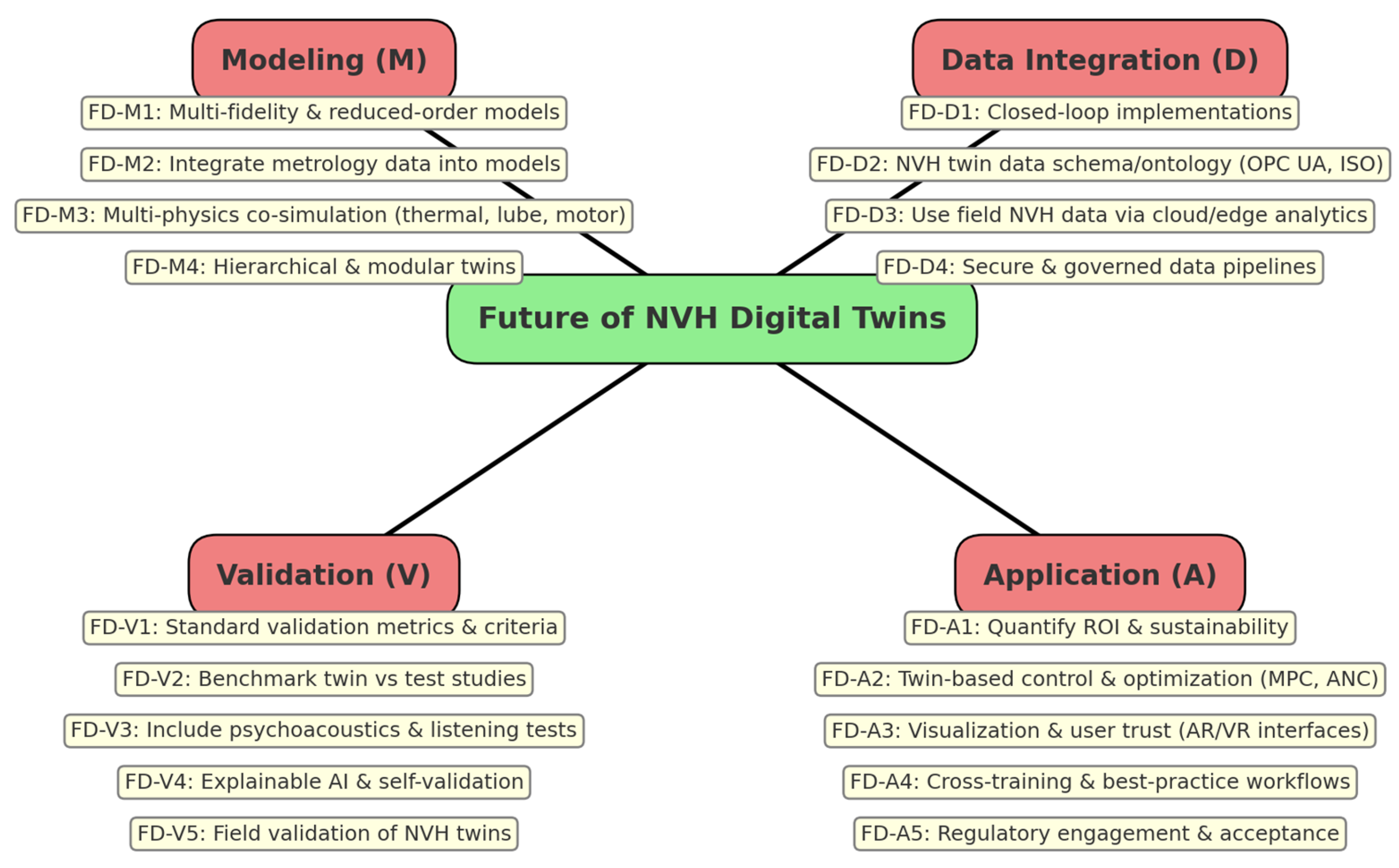
| Gap Category | Key Gaps (From Section 5) | Future Directions (FD) to Address Them |
|---|---|---|
| Modeling (M) | M1: Fidelity vs. speed trade-off | FD-M1: Multi-fidelity and reduced-order models; hybrid physics-ML surrogates for fast yet accurate predictions. |
| M2: Manufacturing variability | FD-M2: Directly integrate metrology data into models; digital thread from QA to simulation. | |
| M3: Multi-physics uncoupled | FD-M3: Co-simulate thermal/lube with structural; parametric models linking temperature and NVH; include motor dynamics. | |
| M4: Lack a system-level model | FD-M4: Hierarchical twins, modular FMU-based assembly of full vehicle NVH; distributed twin architecture. | |
| Data (D) | D1: No closed feedback loop | FD-D1: Pilot closed-loop implementations; Bayesian model updating with each new data input. |
| D2: No standard data format | FD-D2: Develop NVH twin data schema/ontology; OPC UA companion specs; push for standardization via SAE/ISO. | |
| D3: Field data not used | FD-D3: Utilize cloud/edge to collect field NVH data; analytics to feed twin; transfer learning for new scenarios. | |
| D4: Data sharing concerns | FD-D4: Secure data pipelines (encryption, access control); use synthetic or anonymized data to protect IP; establish data governance policies for twins. | |
| Validation (V) | V1: No std metrics | FD-V1: Propose validation metrics and protocols (error criteria, test matrix) via NAFEMS/SAE; set acceptance criteria. |
| V2: Little experimental validation | FD-V2: Conduct comprehensive twin vs. test studies on benchmark gear systems; share results (perhaps in open challenges). | |
| V3: Lacking sound quality val. | FD-V3: Include psychoacoustic metrics in validation; do listening tests of twin predictions vs. real; calibrate twin to subjective scales. | |
| V4: ML part not verifiable | FD-V4: Use explainable AI for twin (sensitivity analysis, feature importance); develop self-validation alerts when twin extrapolates; ensure physical constraints in ML. | |
| V5: Not validated in the field | FD-V5: Perform in situ validation and refine twin; implement online validation (twin tracks and flags when reality deviates). | |
| Application (A) | A1: Benefits not quantified | FD-A1: Publish case studies with ROI and sustainability metrics (prototypes saved, emissions cut); share success stories widely. |
| A2: Twin not used in control/opti | FD-A2: Integrate twin with active control (MPC, ANC); use twin for automated design optimization loops; demonstrate predictive control reducing NVH. | |
| A3: Low trust in twin outputs | FD-A3: Invest in user-friendly interfaces, AR/VR visualization of twin results; gradual twin adoption strategies; involve end-users in twin development to build trust. | |
| A4: Skills gap and workflow | FD-A4: Cross-train engineers in data science and vice versa; develop high-level twin-building tools requiring less coding; establish best-practice workflows. | |
| A5: Regulatory acceptance | FD-A5: Engage standards/regulatory bodies to allow simulation evidence; provide guidelines for twin validation in a regulatory context; maybe start with component-level noise regulations. |
Disclaimer/Publisher’s Note: The statements, opinions and data contained in all publications are solely those of the individual author(s) and contributor(s) and not of MDPI and/or the editor(s). MDPI and/or the editor(s) disclaim responsibility for any injury to people or property resulting from any ideas, methods, instructions or products referred to in the content. |
© 2025 by the authors. Licensee MDPI, Basel, Switzerland. This article is an open access article distributed under the terms and conditions of the Creative Commons Attribution (CC BY) license (https://creativecommons.org/licenses/by/4.0/).
Share and Cite
Horvath, K.; Zelei, A. Digital Twin Approaches for Gear NVH Optimization: A Literature Review of Modeling, Data Integration, and Validation Gaps. Machines 2025, 13, 1141. https://doi.org/10.3390/machines13121141
Horvath K, Zelei A. Digital Twin Approaches for Gear NVH Optimization: A Literature Review of Modeling, Data Integration, and Validation Gaps. Machines. 2025; 13(12):1141. https://doi.org/10.3390/machines13121141
Chicago/Turabian StyleHorvath, Krisztian, and Ambrus Zelei. 2025. "Digital Twin Approaches for Gear NVH Optimization: A Literature Review of Modeling, Data Integration, and Validation Gaps" Machines 13, no. 12: 1141. https://doi.org/10.3390/machines13121141
APA StyleHorvath, K., & Zelei, A. (2025). Digital Twin Approaches for Gear NVH Optimization: A Literature Review of Modeling, Data Integration, and Validation Gaps. Machines, 13(12), 1141. https://doi.org/10.3390/machines13121141