1. Introduction
Geometry occupies a central position in the description of physical theory. In most theoretical frameworks, however, geometry is assumed rather than explained (Darrigol [
1], Brown [
2], Atiyah [
3], Atiyah et al. [
4]). Physical entities are taken to exist within a given spatial or geometric arena, and dynamical laws are formulated relative to that background structure. This assumption is so pervasive that the possibility of deriving geometry from more primitive ingredients is rarely explored outside specific contexts such as quantum gravity (Meschini et al. [
5]).
This situation connects with a broader philosophical question concerning the explanatory relation between geometry and dynamics in physical theory (Acuña and Read [
6]). One may ask whether geometric structure should be regarded as a primitive background that constrains the possible dynamical laws governing a system or whether the direction of explanation runs in the opposite direction, with geometric structure arising as a consequence of the dynamical organization of the system. This problem has been discussed most extensively in the foundations of spacetime physics (Brown [
2], Brown and Pooley [
7]), where it appears as the so–called geometry–dynamics debate (Acuña and Read [
6], Read [
8], Norton [
9]). In that context, philosophers and physicists ask whether the geometrical structure of spacetime explains the form of the dynamical laws governing matter or whether spacetime geometry merely codifies the symmetries exhibited by the underlying dynamical laws. Although traditionally formulated in the setting of spacetime theories, the underlying issue is more general: it concerns the explanatory priority between geometric structure and dynamical law in the description of physical systems.
In a general context, discrete relational structures (Derin and Baytaş [
10]) have become the natural language for describing complex systems (Estrada [
11]) across many scientific domains. Systems as diverse as molecular interaction networks, neural circuits, ecological webs, transportation systems, social structures, and technological infrastructure are routinely represented as graphs in which vertices represent entities and edges encode interactions among them (Estrada [
12], Albert and Barabási [
13], Newman [
14]). In this sense, graphs provide a general framework for representing systems whose organization is determined primarily by patterns of relations rather than by intrinsic properties of isolated components (Parrochia [
15]).
The ubiquity of such representations suggests that relational network structures capture something fundamental about the organization of complex systems. For example, Dipert (Dipert [
16]) proposed the idea that the world, itself, may be understood as a vast relational structure that can be modeled graph-theoretically, with entities individuated through their structural relations within a global network. In a different scientific context, similar ideas appear in approaches to quantum gravity in which the fundamental structure of spacetime is described by discrete networks (Lombard [
17]), such as the spin networks of loop quantum gravity (Norton [
18]). These developments suggest that relational graph structures may provide a natural conceptual bridge between the study of complex systems and deeper questions concerning the structural organization of physical reality (Rovelli [
19], Smolin [
20]).
The present work investigates a different possibility. We consider whether geometric structure can arise directly from relational dynamics. More precisely, we ask whether a system specified only by entities, relations among those entities, and a dynamical law governing their evolution can generate a well-defined metric geometry as a structural consequence of its dynamics. To explore this question, we examine the framework of Graph Dynamical Geometrization (GDG). Although the generalized mathematical foundations of GDG have been published only recently (Estrada [
21]), its components were previously published in the physico-mathematical literature (Estrada [
22,
23], Estrada et al. [
24,
25], Estrada and Hatano [
26], Estrada [
27], Estrada et al. [
28], Estrada [
29,
30], Lella and Estrada [
31], Pereda and Estrada [
32]). In this approach, a system is represented by a graph encoding relational structure, together with a dynamical rule acting on that structure. The dynamics define a self-adjoint operator whose spectral evolution generates a kernel. From this kernel, one can construct a metric that is mathematically guaranteed to be a squared Euclidean distance matrix. As a consequence, the relational system admits a canonical embedding in a Euclidean space whose geometry is entirely determined by the underlying dynamics.
The resulting geometry is not imposed externally but follows from the spectral properties of the dynamical operator, raising the question of its ontological status. This perspective naturally connects the GDG construction with contemporary debates on structural realism (Ladyman [
33]). Structural realist approaches maintain that the objective content of scientific theories lies not primarily in the intrinsic nature of objects but in the relations and structures that theories reveal. The GDG framework provides a concrete mathematical setting in which such ideas can be examined. In particular, it suggests a form of
relational–dynamical structural realism in which the fundamental ontology consists of entities connected by relations and governed by a dynamical law, while geometric structure emerges from the spectral organization of those dynamics.
Although structural realism has often been discussed in the context of spacetime physics (Dorato [
34], Lam [
35]), the present work operates in a different domain. The geometry studied here does not represent the geometry of the physical universe but an induced metric structure arising within discrete relational systems. In this sense, the present framework extends structural realist reasoning to complex dynamical networks, where geometry emerges from interactions rather than serving as a primitive background.
Therefore, the goal of this paper is twofold. First, we present the GDG construction and show how Euclidean geometry arises from relational dynamics on graphs. Second, we analyze the philosophical implications of this mechanism and argue that it supports a form of relational–dynamical structural realism.
The broader significance of this investigation lies in the possibility that geometry may, in general, be understood as an emergent structural expression of dynamical relations. The framework developed here provides a classical realization of such a mechanism based on diffusion-like dynamics represented by symmetric operators acting on undirected weighted graphs. This restriction is not merely technical but reflects the physical interpretation of diffusion itself, which describes the spreading of concentration gradients without intrinsic directionality. When interactions possess preferred directions, advective transport mechanisms generally become relevant, and the corresponding operators are no longer symmetric.
Nevertheless, the GDG construction is not intrinsically restricted to this setting. Extensions based on Hermitian operators associated with directed relational systems, such as magnetic Laplacians and related constructions, naturally preserve the spectral framework underlying GDG while incorporating directional information into the dynamics. Therefore, the present work develops the mechanism in its classical diffusion setting, while extensions to directed, quantum, and wave-like dynamics will be explored in the subsequent part(s) of this saga.
2. Graph Dynamical Geometrization (GDG)
We now turn to the central mathematical construction developed in Estrada [
21], which we interpret not merely as a geometric tool but as a candidate realization of a dynamics–geometry correspondence in discrete relational systems. The current paper is written in a self-contained way such that the reader is not obliged to constantly consult the previous mathematical results.
While the mathematical construction developed in the remainder of this section follows the diffusion-based GDG formalism introduced in Estrada [
21], the objectives of the present article are substantially different. Rather than extending the mathematical machinery itself, our aim is to investigate its conceptual, ontological, and philosophical implications. In particular, we develop the notion of relational–dynamical structural realism, analyze the status of induced geometry within contemporary forms of structural realism, and examine the broader principle according to which geometry may emerge whenever relational dynamics admit a spectral articulation. The present contribution should therefore be understood primarily as an interpretative reconstruction and conceptual synthesis of the GDG framework rather than as a further technical development of its mathematical formalism.
The guiding ontological thesis underlying GDG is simple:
| Relations and their dynamics are fundamental. Geometry is emergent. |
The primitive structure is a relational system encoded by a graph, together with a dynamical rule defined on it. From these two ingredients, an operator arises. From the spectral dynamics of this operator, a geometry is generated.
Let
be a finite simple graph with
vertices (Estrada [
12]). The graph encodes relational structure: vertices represent entities, and edges represent relations between them. Given a graph, together with a specified dynamical law, one obtains a real symmetric operator, i.e.,
acting on functions (
). Functions on
V are identified with vectors in the Hilbert space, i.e.,
equipped with the standard inner product:
Thus,
Q acts as a bounded self-adjoint operator on the finite-dimensional Hilbert space (
). The structural relation may therefore be written as
The operator is not ontologically primitive. It is the algebraic representation of graph-structured dynamics in Hilbert space. Typical examples are detailed in (Estrada [
21]). However, the only structural assumption required here for GDG is symmetry, i.e.,
which guarantees the existence of an orthonormal spectral decomposition:
As we have remarked before, the present work restricts attention to symmetric operators associated with diffusion-like processes satisfying detailed balance. Directed, asymmetric, or non-normal dynamics generally require more general operator frameworks and may involve transport or advective components, in addition to diffusion. Nevertheless, the GDG construction, itself, is not intrinsically restricted to symmetric operators, and extensions based on Hermitian representations of directed systems, such as magnetic Laplacians and related constructions, constitute natural directions for future developments.
In a very general context in which we can frame both normal (Masuda et al. [
36]) and anomalous sub- and super-diffusion (Sokolov and Klafter [
37], Metzler and Klafter [
38]), we consider the generalized diffusion equation (Diaz-Diaz and Estrada [
39]), i.e.,
where
denotes a time derivative that may be the standard temporal derivative (
) or a fractional derivative (
) with
(Metzler et al. [
40]). Its solution is
In the diffusive case, the propagator can be expressed as the matrix Mittag–Leffler function applied to
Q (Mainardi [
41]) as
such that
Using the spectral decomposition, we obtain
Although the previous equation is written in terms of the exact spectral decomposition of
Q, the GDG construction is not intrinsically tied to full eigendecomposition of the operator. For large, sparse systems, propagators in the form of
can be approximated efficiently using Krylov subspace methods, Lanczos iterations, Chebyshev polynomial expansions, graph-filtering techniques, and local heat-kernel approximations Saad [
42], Benzi and Simunec [
43]. These approaches avoid the
computational complexity associated with complete spectral decomposition and typically scale approximately linearly with the number of edges in sparse networks. Consequently, the application of GDG to massive relational systems, including connectomes, social networks, and communication infrastructure, appears computationally feasible using existing large-scale diffusion and graph signal-processing techniques.
Let us now state the following result.
Lemma 1. Let Q be a real, symmetric, positive, semidefinite operator. Then, for every and , the kernel expressed asis symmetric, positive, and definite. Moreover, for , the scalar function () is completely monotone on and admits the following representation:where is the Mainardi density. Consequently,in the sense of Bochner integration. If, in addition, , then Proof. Since
Q is real, symmetric, and positive semidefinite, it admits an orthonormal spectral decomposition, i.e.,
with
for all
j. Hence,
where
For
, the Mittag–Leffler function (
) is completely monotone on
. According to Bernstein’s theorem, it can be represented as a mixture of exponentials, i.e.,
where
is a probability density on
Schilling et al. [
44], Gorenflo et al. [
45], Mainardi [
46], Mainardi et al. [
47]. Taking
yields
Functional calculus then yields
Since
is symmetric, positive, and definite for every
and
is non-negative, the integral is symmetric, positive, and definite. Equivalently, all eigenvalues of
are
so
is positive and definite.
For
, the statement reduces to the standard heat kernel, i.e.,
whose eigenvalues are
, and the same conclusion follows.
Finally, if
, then
for all
. Therefore,
This proves the result. □
Consequently, defines a positive–definite kernel on V. As we will see later in this work, this fact is foundational: positivity guarantees that a Euclidean metric structure can be induced.
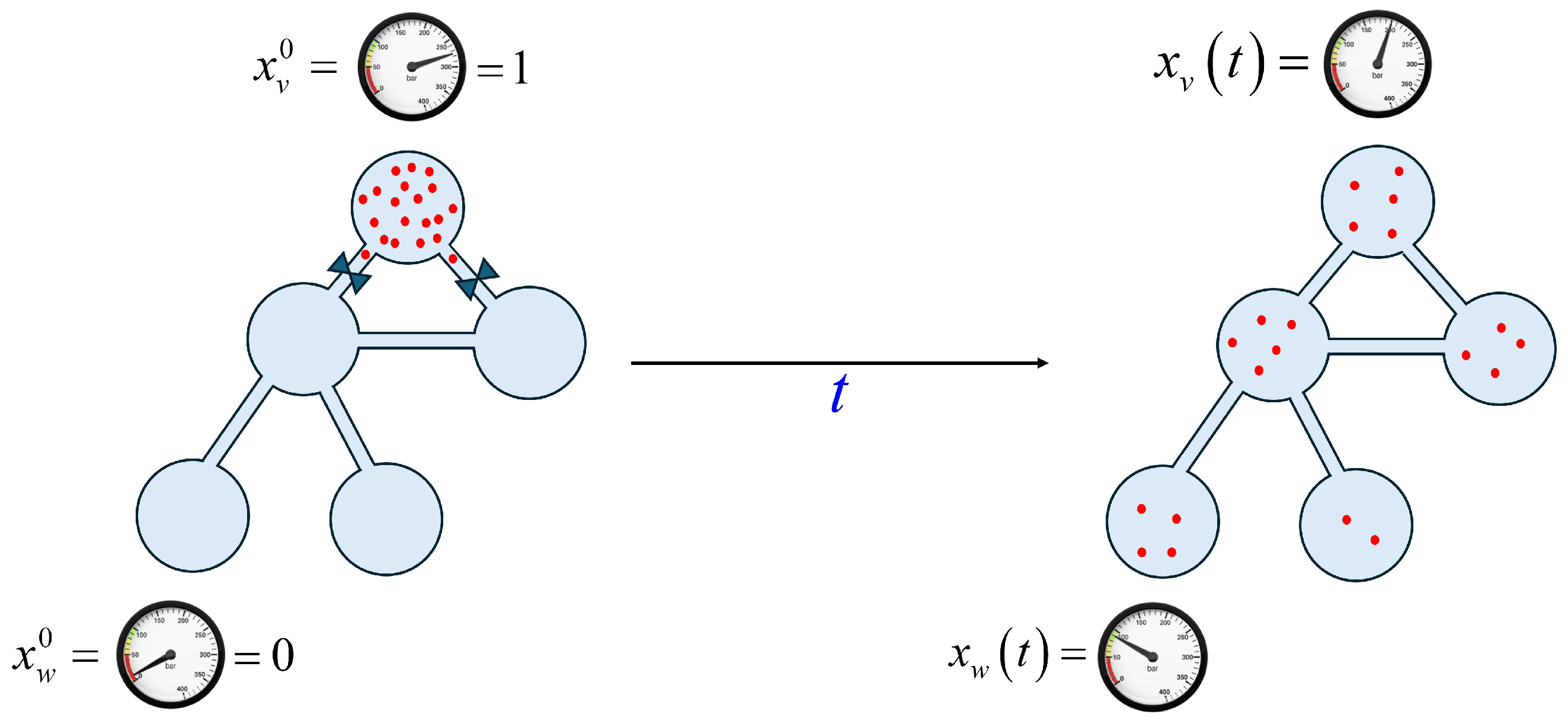
Let us consider a case in which we allocate a “mass” or “concentration” at vertex
v by setting
, where
denotes the canonical basis of
, as illustrated in the left panel of
Figure 1. If, at time
, we want to know how much mass or concentration has flowed between vertices
v and
w (see the right part of
Figure 1), we have to calculate the difference between the mass remaining at vertex
v at time
t, i.e.,
, and the mass transferred to
w, i.e.,
—that is,
.
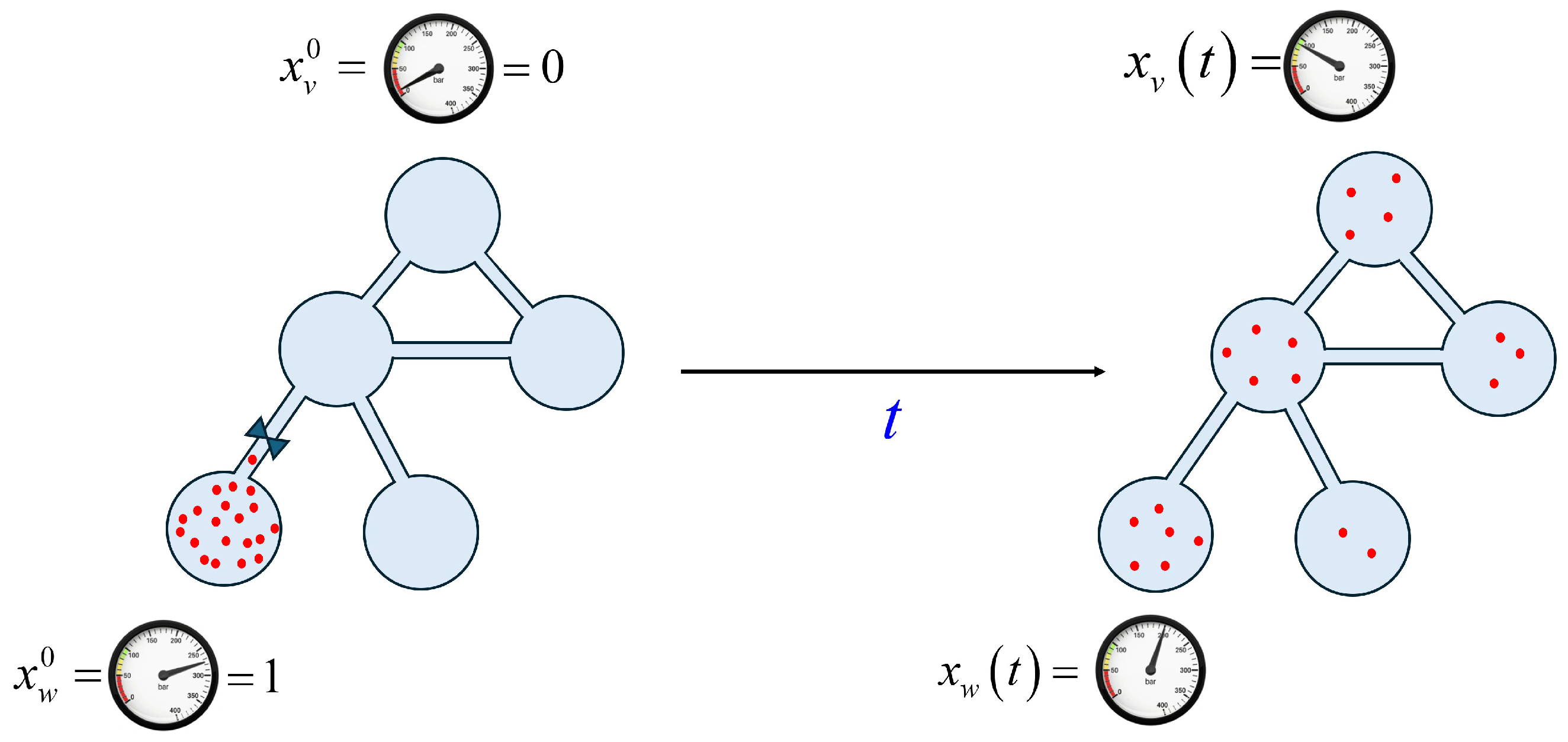
Let us now turn to the reverse flow. In this case, we initially place all concentration at vertex
w, and after a time (
), we obtain
, as illustrated in
Figure 2. Following analogous reasoning, we have
and
, where we use
to indicate that the process was initialized by setting
such that
. Therefore, the total flow is
.
Let us call
the symmetric flow–resistance metric, i.e.,
or, equivalently,
We previously proved the following mathematical result.
Theorem 1. For every and , the matrix () is a squared Euclidean distance matrix.
Proof. Since
is symmetric, positive, and definite, there exists a matrix (
) such that (Schoenberg [
48])
Then,
where
denotes the
v-th column of
. □
Thus, diffusion does not merely transport mass: it induces a Euclidean geometry on the vertex set.
To interpret this geometrically, consider the standard diffusion evolution:
At the initial moment (
), we have
. Each vertex is dynamically indistinguishable from itself and perfectly distinguishable from all others:
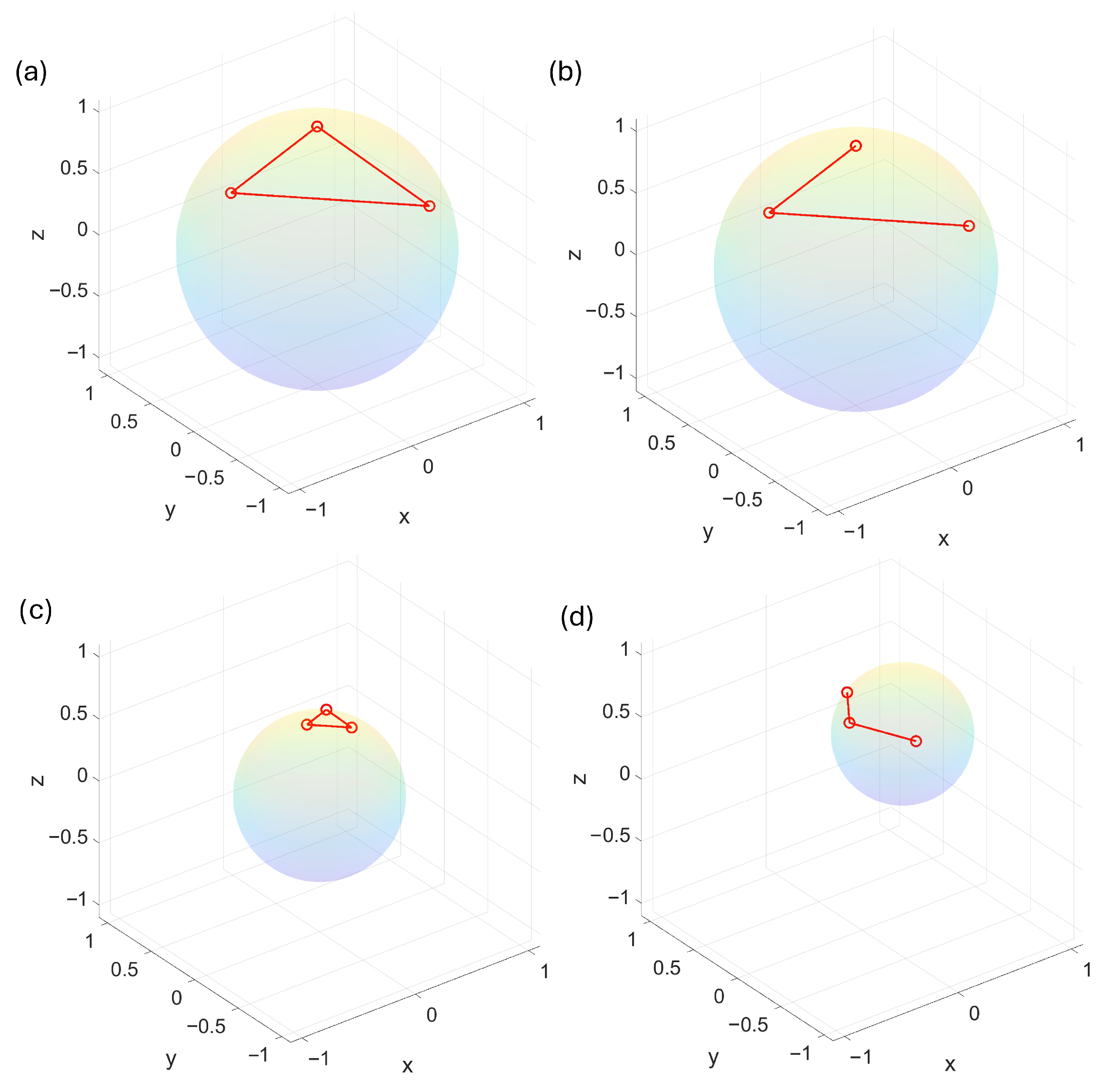
This is observed in
Figure 3a,b, where we illustrate the three-dimensional embedding of a triangle and wedge graphs into the Euclidean space emerging from a diffusion process taking place.
All vertices occupy orthogonal directions in ; no functional organization is present beyond discrete identity.
As time evolves, diffusion propagates influence across edges. Each vertex acquires a dynamical fingerprint (Coifman and Lafon [
49]), i.e.,
describing how a unit impulse at vertex
i spreads through the network. Vertices occupying similar relational positions begin to exhibit similar fingerprints, while others differentiate according to their structural roles. Therefore, dynamics transform the relational skeleton into a graded structure of dynamical similarity. This is, again, observed in
Figure 3c,d, where we display the embedding of the three-cycle (triangle) and three-path (wedge) casesgenerated by the diffusion at
.
The induced Euclidean embedding can be written explicitly in spectral form. Let
denote the eigenvectors of
Q (Chung [
50]). Furthermore, we define
Each eigenmode contributes independently. Modes associated with large eigenvalues decay rapidly, while those corresponding to small eigenvalues dominate the long time structure. Geometry therefore appears as spectrally filtered dynamics in Hilbert space.
At this point, it is worth mentioning a conceptual connection between the GDG framework and the spectral approach to geometry developed by Connes in noncommutative geometry Connes [
51]. In that framework, a geometric space is characterized not primarily by a manifold or coordinate system but by a spectral triple
consisting of an involutive algebra (
), a Hilbert space (
H), and a self-adjoint operator (
D). Remarkably, the metric structure of the space can be recovered from the spectral properties of
D so that geometric notions such as distance may be expressed purely in operator-theoretic terms. In this sense, Connes’ program demonstrates that geometry can be encoded spectrally rather than assumed as a primitive background structure. Closely related ideas appear in spectral geometry, where heat kernels associated with elliptic operators encode geometric invariants of the underlying space through their spectral expansion (Berline et al. [
52]).
The GDG construction exhibits a closely related structural principle. Here, the dynamical operator (Q) associated with relational dynamics on the graph plays a role analogous to the spectral operator in noncommutative geometry. The induced metric () arises entirely from the spectral evolution of this operator through the propagator (). Therefore, in both frameworks, geometric relations derive from spectral data. The conceptual difference, however, lies in the role of dynamics. In noncommutative geometry, the operator (D) encodes the geometry itself, whereas in GDG, the operator represents the dynamical law acting on a relational system. Geometry does not merely admit a spectral description; it is generated through dynamical evolution. In this sense, GDG may be interpreted as a dynamical realization of the broader spectral insight that geometric structure can arise from operator-theoretic relations rather than from an independently given spatial manifold.
Thus, the GDG construction may be summarized as follows. For a graph () endowed with a symmetric diffusion generator (Q), the kernel expressed as induces a squared Euclidean distance matrix, i.e., where is the dynamical fingerprint of vertex i. Hence, there exists an embedding, i.e., such that
The embedding coordinates are not imposed externally; they are entailed by the dynamical law. The Euclidean space arises as the canonical carrier of relational influence distances. In this sense, GDG transforms a discrete relational skeleton into a continuous Euclidean geometry of functional organization.
The graph itself has no intrinsic Euclidean dimension. However, the dynamical system evolves in an n-dimensional state space. The induced geometry at time t has a dimension equal to the rank of or, equivalently, the number of dynamically significant eigenmodes. As time increases, high-frequency modes decay, and the effective dimension decreases. Therefore, a dimension measures functional complexity rather than spatial extension. |
A structural result established in [
21] shows that for every
, the embedded configuration (
) lies on a sphere in
whose radius (
) strictly decreases with time and satisfies
This contraction reflects the progressive decay of spectral modes. In the limit of
,
and all vertices collapse to a single point.
Family defines a geometric flow in which local connectivity dominates at short times and global equilibration collapses the geometry at long times.
The construction establishes a precise correspondence:
The following proposition summarizes the central mathematical result of the present work and provides the formal basis for the philosophical discussion developed in the following sections.
Proposition 1 (Emergence of Geometry from Relational Dynamics)
. Let define a symmetric operator (Q), and let denote the corresponding propagator. Then, for every , the induced flow-resistance matrix, i.e.,is a squared Euclidean distance matrix. Consequently, the relational system admits a canonical Euclidean embedding whose metric structure is uniquely determined by the underlying relational dynamics. Thus, geometry is not assumed a priori but emerges as a mathematical consequence of the spectral evolution of the dynamical operator. This construction may also be viewed in light of the general question discussed in the geometry–dynamics debate. In many traditional formulations of physical theory, geometry is introduced as a kinematic background relative to which dynamical laws are formulated. In the present framework, the situation is reversed. The relational system is specified only by entities, relations, and a dynamical law acting on those relations. The geometric structure arises only after the spectral evolution of the associated operator is considered.
3. Relational–Dynamical Structural Realism
The GDG construction forces a philosophical question. Once it has been established that
is a squared Euclidean distance matrix for every
, the existence of an embedding, i.e.,
satisfying
is no longer a modeling choice. It follows as a mathematical consequence of the relational dynamics encoded in
.
Because the geometry is entailed by the dynamics of relations, the unavoidable philosophical question is the following: What is the ontological status of this induced geometry?
The mathematical result admits three natural interpretations. The first is
instrumentalism (Duhem [
53], van Fraassen [
54], Laudan [
55]). According to this view, the Euclidean embedding is merely a visualization device. The coordinates (
) are computational tools for representing diffusion patterns, and the
metric functions only as a convenient summary statistic. Nothing geometrical is taken to correspond to an element of reality.
A second interpretation is what we call
relational–dynamical structural realism (Ladyman [
33], Worrall [
56], Ladyman and Ross [
57], French [
58]). According to this view, the metric relations encoded in
are objectively real, while the coordinate representation is not. The Euclidean space (
) serves only as a representational carrier for these relations. The Euclidean embedding therefore functions as a representational carrier of relational information rather than as an independent ontological arena (Suárez [
59], Frigg and Nguyen [
60]). What is ontologically significant is the relational structure generated by the dynamics.
A third interpretation is
substantival realism (Earman [
61], Nerlich [
62], Maudlin [
63]). According to this view, the Euclidean space in which the embedding resides is, itself, fundamental. The vertices of the graph would then be literally located in a pre-existing spatial manifold that exists independently of the relational structure and the dynamical law governing the system.
The GDG framework does not support this interpretation. In GDG, the primitive ingredients are a relational structure, together with a dynamical law defined on it. Geometry is not assumed at this level; it appears only after the relational dynamics generate the propagator and the associated metric relations. For this reason, the induced Euclidean space cannot be regarded as a fundamental container in which the graph is embedded. Rejecting substantival realism, however, does not imply that the emerging geometry is merely a mental construct or a convenient visualization. Once generated, the metric structure corresponds to objective relational properties of the system and can, in principle, be reconstructed from measurable dynamical quantities such as diffusion responses encoded in the kernel. The Euclidean geometry therefore exists physically as an emergent structure determined by the dynamics, but it does not exist independently of the relational processes that produce it.
This perspective naturally leads to what we call relational–dynamical structural realism. On the basis of this view, the fundamental ontology consists of entities connected by relations and governed by a dynamical law. Geometric structure arises as the invariant relational organization generated by those dynamics.
The mathematical origin of this geometry makes the point explicit. Let the symmetric operator representing the dynamics admit the following spectral decomposition:
The associated propagator takes the form of
Substituting this expression into the definition of the flow–resistance metric yields the following spectral representation:
Although the operator (Q) appears in Hilbert-space form, it is not ontologically primitive; it represents the dynamics defined on the relational structure of the graph. Once the dynamics aer fixed, however, the induced metric is uniquely determined.
Proposition 2 (Relational–Spectral Determination)
. For a fixed the metric is uniquely determined by the specturm and eigenvectors () of the operator representing the dynamics on G.
One might still argue that the embedding, itself, is merely a coordinate construction. However, squared Euclidean distance matrices satisfy intrinsic constraints that do not depend on any coordinate representation. The matrix is symmetric, conditionally negative, and semidefinite; has rank of, at most, ; and belongs to the cone of spherical Euclidean distance matrices characterized by Schoenberg. These properties are intrinsic to the relational structure generated by the dynamics.
The metric depends exclusively on spectral data generated by the dynamics and remains invariant under changes in coordinates, supporting an interpretation according to which relational structure, rather than embedding coordinates, carries ontological significance.
Thus, the GDG framework suggests a minimal ontology consisting of a finite set of entities (V), a relational structure (E), and a dynamical law defined on . From these ingredients, an operator (Q) arises as a representation of the dynamics. From Q, a propagator () emerges, and from this propagator, the metric relations () arise.
In the GDG approach, no ambient space is presupposed. Distances arise from dynamical interaction, angles arise from induced inner products, and higher-order geometric relations arise from spectral interaction. In this respect, GDG refines the traditional relationalist picture. Classical relationalism treats spatial relations as primitive. GDG, instead, shows how spatial relations can be generated from non-spatial relational dynamics.
However, although the embedding lies in
, this Euclidean space is not fundamental. Different orthogonal transformations produce distinct coordinate realizations with identical metric relations, i.e.,
Only the relational distances remain invariant. The Euclidean carrier space is therefore representational, while the invariant metric relations are ontologically significant. In closing, the ontological hierarchy implied by GDG may therefore be summarized as follows:
Ontology: ;
Representation: Q acting on ;
Emergent geometry: the family of metrics ();
Embedding: .
Toward Relational–Dynamical Realism
We are now in a position to articulate the broader philosophical program that emerges from the preceding analysis. The preceding analysis suggests a broader principle extending beyond the specific GDG construction. This observation motivates the following general principle.
| General Structural Principle: Geometry can arise as the emergent relational structure generated by the spectral properties of dynamical evolution. |
From this principle, we formulate the central philosophical proposal of this work.
| Relational–Dynamical Realism: The fundamental ontology of a physical system consists of entities related by structure and governed by a dynamical law. Geometric structure—including metric relations and curvature-like invariants—emerges from the spectral organization of those dynamics. |
The proposal rests on four interconnected ideas. First, the primitive structure of a system consists of entities connected by relations, together with the dynamical law governing their evolution. Second, relational dynamics admit a spectral articulation through an operator whose eigenvalues and eigenvectors encode invariant dynamical structure. Third, time evolution acts on these modes as a filtering mechanism, selectively amplifying or suppressing different spectral components. Finally, geometric structure emerges from this filtering process through the metric relations induced by the propagator.
Hilbert space and operators provide the natural mathematical language for describing this mechanism, but in the classical setting considered here, they are representational rather than ontologically fundamental. Geometry may therefore be understood as the relational manifestation of spectral dynamics rather than as a primitive background structure. The resulting geometry carries dynamical information that is not directly accessible from local concentration profiles alone. Geometric observables such as the decay of
, angular correlations, and higher-order flow invariants can distinguish between normal, subdiffusive, and superdiffusive transport, even in finite graphs where classical trajectory-based diagnostics fail. The induced geometry therefore functions as a structural diagnostic of the underlying dynamics Estrada [
22], Coifman and Lafon [
49].
4. Structural Realism and the Status of Induced Geometry
The ontological question raised by the GDG construction may be understood within broader philosophical discussions concerning the role of geometry in physical theory and the status of structure in scientific ontology. As discussed in the geometry–dynamics debate, one may ask whether geometric structure should be regarded as a fundamental background constraining dynamical laws or whether geometry, itself, may arise from the organization of dynamical processes.
The GDG framework provides a mathematically explicit setting in which the latter possibility can be examined within relational dynamical systems while simultaneously situating the discussion within contemporary debates on structural realism Ladyman [
33], Lam [
35], Worrall [
56], Ladyman and Ross [
57], French [
58], de Harbe and Read [
64], Ketland [
65].The induced Euclidean geometry generated by the diffusion kernel therefore provides a concrete setting in which several forms of structural realism can be examined and compared.
In all interpretations discussed below, the induced metric is understood as arising from relational dynamics rather than from a primitive background geometry. It is important to clarify that the structural realist perspectives discussed here have most often been developed in the context of fundamental physics, particularly in debates concerning the ontological status of spacetime structure in general relativity or quantum gravity. The GDG framework operates in a different domain. Its object of study is not spacetime itself but a relational dynamical system defined on a discrete set of entities. The Euclidean geometry that appears in the construction does not represent the geometry of the physical universe but an induced metric structure generated by the spectral organization of relational dynamics.
For this reason, the role played by structural realism in GDG is methodological and structural rather than cosmological. The induced geometry provides an invariant relational description of the organization of interactions within a complex system. In this sense, GDG extends structural realist reasoning from the domain of fundamental spacetime physics to relational dynamical systems in which geometry emerges from interactions rather than serving as a primitive background structure.
A first relevant perspective is Worrall’s
epistemic structural realism (Worrall [
56], de Harbe and Read [
64]). According to this view, what science preserves across theory change is not the intrinsic nature of objects but the structure of relations between them. Metric relations may therefore remain epistemically secure, even when the underlying ontological carriers remain uncertain.
The GDG framework aligns naturally with this perspective. The invariant content of the construction is not the coordinate embedding in but the metric relations encoded in the matrix . These relations are preserved under orthogonal transformations and depend entirely on the spectrum of the operator representing the dynamics. If theoretical revision were to replace one dynamical operator with another, what would change is precisely the relational geometry induced by its spectrum. From this standpoint, GDG provides a concrete realization of structural continuity: the physically accessible content of the system lies in invariant relational metrics generated by dynamics.
A stronger position is
ontic structural realism, as developed by Ladyman and Ross (Ladyman and Ross [
57]). In this view, relations themselves, rather than objects with intrinsic natures, constitute the fundamental ontology of physical reality. The GDG framework is compatible with a moderate form of this position. The primitive ingredients of the construction are relational, in the form of the graph structure, together with the dynamical law defined on that structure. The operator (
Q) represents these dynamics in Hilbert space, and the induced Euclidean geometry organizes the resulting relational dynamics into a metrically coherent structure.
Geometric invariants extracted from encode information about the diffusion regime, effective dimension, and universality class. The relational metric structure therefore carries explanatory weight. It is not merely a bookkeeping device but a structure through which dynamical law becomes intelligible. The GDG framework does not require elimination of vertices as relata, but it shifts ontological emphasis from the embedding space to the relational structure encoded by the dynamics.
Another structuralist perspective emphasizes the roles of symmetry and invariance. French (French [
58]) has argued that symmetry principles often reveal the genuine ontological commitments of physical theories. In the GDG framework, the induced geometry is defined only up to orthogonal transformations. All physically meaningful information resides in invariants of the metric structure (Noether [
66]). Coordinates therefore constitute surplus structure, while invariant metric relations represent the ontologically significant content. The fact that spectral decay rates and scaling exponents are encoded geometrically also reflects the structuralist insight that dynamical symmetries and invariants frequently reveal deeper features of physical systems than the apparent objects of the theory.
A fourth interpretive possibility situates GDG within a
neo-Kantian form of structural realism, as recently associated with Cassirer (Cassirer [
67]) and more recently articulated by Massimi (Massimi [
68]). On the basis of this view, mathematical structures do not primarily describe independently existing objects, nor do they eliminate them. Rather, they provide the conditions under which objective knowledge of unobservable processes becomes possible.
From this perspective, the induced Euclidean geometry should not be interpreted as a second space added to the ontology or as a simple visualization of diffusion. Instead, it plays a constitutive epistemic role by organizing dynamical data into invariant relational form and thereby making possible stable, law-like, and counterfactual-supporting claims about the system.
Within the GDG framework, the raw dynamical evolution is encoded in the propagator (). The induced metric () reorganizes this spectral information into a structured geometric form. Geometric invariants extracted from , such as decay exponents, angular coherence, or the effective dimension, allow one to classify diffusion regimes and identify universality classes, even in finite or heterogeneous graphs where classical diagnostics fail. On a neo-Kantian reading, the induced geometry functions as the structural framework through which the dynamical process becomes objectively intelligible.
4.1. A Clarification: Latent Geometries and Dynamically Induced Geometry
Graphs and networks can be embedded in a variety of geometric spaces. In recent years, hyperbolic embeddings, often developed within statistical physics, have been interpreted as revealing the “hidden geometry” underlying complex networks (Boguna et al. [
69]). This development invites a philosophical comparison with the geometry induced by the GDG framework.
In latent-space models, one typically postulates a target manifold, such as a hyperbolic space (), a torus, or a sphere, and assigns coordinates to vertices so that adjacency or connection probability becomes a simple function of geometric distance. The geometry is inferred by optimizing a likelihood or stress functional. In this approach, the geometric space is chosen as a modeling hypothesis, and properties such as dimension or curvature become parameters to be inferred from data. The coordinates of vertices are obtained through optimization procedures, and realism about the resulting geometry is usually justified by inference to the best explanation. The recovered geometry is then interpreted as explaining observed topological properties of the network, such as scale-free degree distributions, clustering, or hierarchical organization. In this sense, the geometry functions primarily as a generative explanation of why edges appear in the observed pattern.
The geometry arising in the GDG framework has a different status. It is not postulated, then fitted to data. Instead, it follows directly from the relational dynamics defined on the graph. Given a relational system
, one obtains an operator (
Q) describing the dynamics and the associated propagator (
). From this propagator, one defines the following metric:
For every , this matrix is a squared Euclidean distance matrix. The Euclidean nature of the geometry therefore follows directly from the spectral properties of the operator. No geometric class is chosen in advance, no parameters are fitted, and no optimization procedure is required. The geometry is uniquely determined, up to isometry, by the dynamical operator itself.
This difference reflects a deeper conceptual distinction. In latent-space models, the geometry is introduced as a hypothesis that explains network structure. In GDG, the geometry arises as a necessary consequence of the dynamical law. The induced metric does not primarily explain why edges exist; rather, it organizes the dynamical influence relations generated by the operator. Geometric invariants derived from encode properties such as the diffusion regime, scaling behavior, and effective dimension. The geometry therefore functions as a structural classifier of dynamical laws rather than as a generative explanation of network topology.
The distinction between these two approaches is structural rather than evaluative. Latent-space models may provide powerful explanations of network formation and organization. The GDG construction establishes a different type of geometric status. The metric represents the invariant relational form taken by operator dynamics.
From the standpoint of structural realism, the crucial difference lies in the source of geometric necessity. In latent-space models, geometry is introduced as an explanatory hypothesis about hidden structure. Unlike latent-space approaches, the metric structure follows uniquely from the operator dynamics. The induced Euclidean geometry is therefore not an optional representation of the graph. It is the metric structure through which the spectral organization of the operator becomes relationally manifest.
In this sense, the GDG framework supports realism about the induced metric structure without committing to geometry as a primitive substrate. Geometry is neither imposed nor freely chosen. It appears as the necessary structural expression of the underlying dynamical law.
4.2. On the Predictive Role of the Emerging Geometry
A crucial strengthening of the ontological picture arises from the predictive role of the induced geometry. The decay rates of geometric invariants such as encode scaling exponents that determine the walk dimension and the effective transport regime. Long-range operators, fractional dynamics, and conservative versus nonconservative diffusions imprint distinct geometric signatures on the embedding. In this way, the induced geometry carries dynamical information that is not directly visible in local concentration profiles. Geometric observables such as the decay of , angular correlations, and higher-order flow invariants allow one to determine the nature of the underlying diffusive process—distinguishing, for instance, between normal, subdiffusive, and superdiffusive transport—even in finite graphs where classical trajectory-based diagnostics fail. In finite or heterogeneous networks—where mean-square displacement and classical asymptotic diagnostics become unreliable—the induced geometry continues to reveal the dynamical regime governing the system. In this sense, geometry acts as a regime-detecting structural invariant of operator dynamics. It organizes spectral information into metric form and makes the dynamical law geometrically legible, even when that law includes temporal memory. Let us provide an example illustrating this predictive capacity of the emerging geometry.
An Experiment
Here, we present an example illustrating how the n-dimensional Euclidean functional space emerging from the pair contains information that is not directly accessible from the dynamical evolution itself.
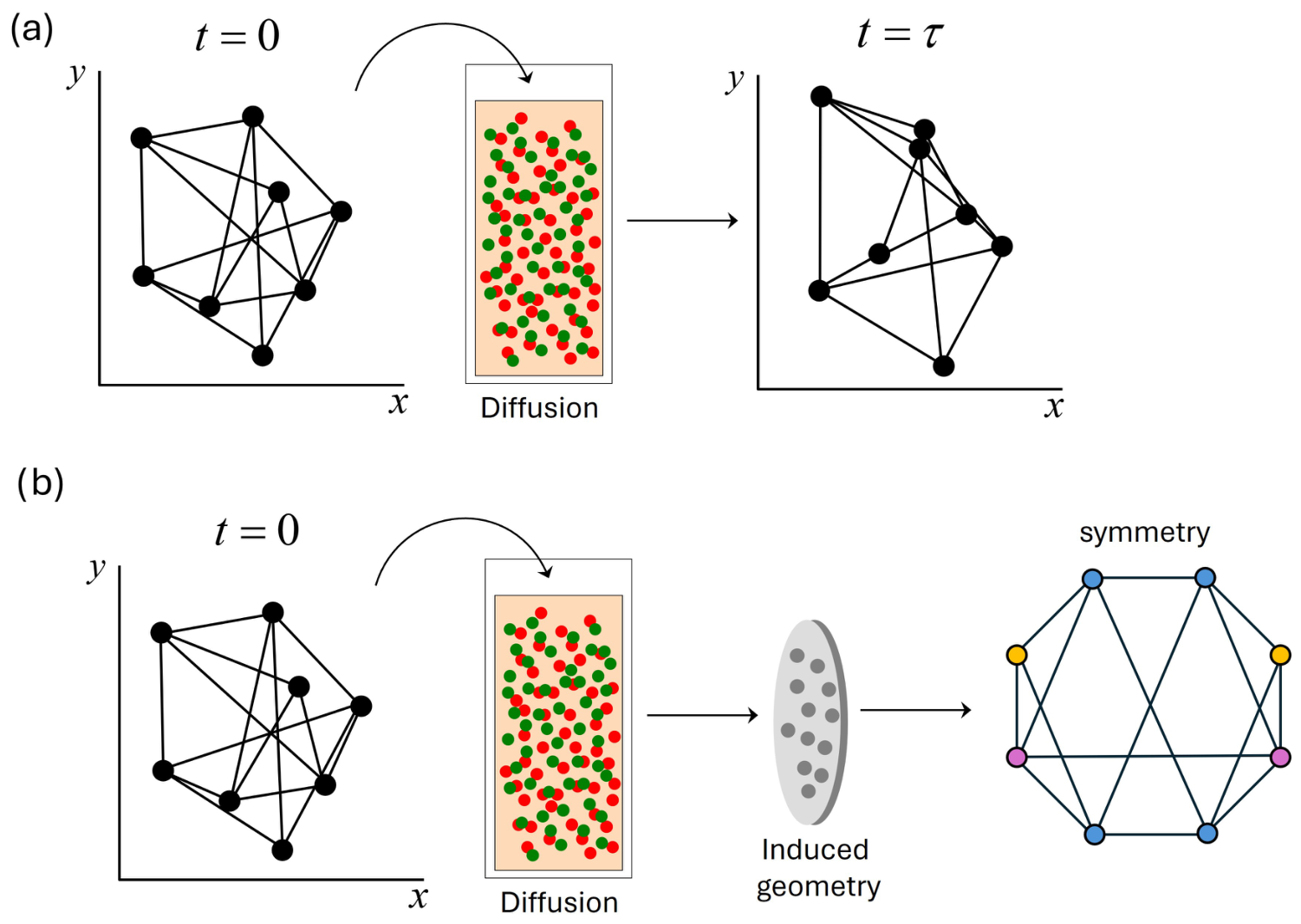
Consider a group of eight agents, for instance, autonomous robots, initially located at different positions in the
plane. The objective of the agents is to relocate to the midpoint of their initial positions, a task commonly known as a rendezvous process. Such a process can be modeled by diffusion dynamics on the graph representing the communication pattern among the agents. At each step of the protocol, every pair of connected agents adjusts its position according to a diffusive rule. Therefore, if the connectivity of the agents and the dynamical law are known, one can predict the position of every agent at any future time (
t). This situation is schematically illustrated in
Figure 4a.
Once the dynamics are fixed, the future positions of the agents depend only on the connectivity of the graph and on the initial configuration. A natural question then arises: Can we determine from this information whether the group of agents exhibits any intrinsic symmetry? In general, the answer is negative. Because the positions depend not only on the connectivity but also on the initial positions of the agents, there is no guarantee that the trajectory of the system will reveal any symmetry that may exist in the underlying graph.
For reproducibility, we specify the graph and the computational procedure used in the example. The graph has eight vertices and an unweighted adjacency matrix.
We use the combinatorial Laplacian of
, where
, and the heat kernel expressed as
with
. The initial state is chosen as
so that the state of the diffusion process at time
t is
From this vector, one constructs the state-based distance matrix as
The GDG squared distance matrix is computed from the same diffusion kernel as
The two matrices therefore use the same graph and the same diffusion kernel, but they encode different kinds of information: is obtained from one particular trajectory initialized at , whereas is obtained from the full kernel and represents the geometry of the dynamical process itself.
Formally, let
be an automorphism of the graph (
G). Such a symmetry can be represented algebraically by a permutation matrix (
J) defined through
. If the dynamical operator respects the symmetry of the graph, as occurs for the Laplacian operator, then
Consequently, the diffusion kernel inherits the same invariance, i.e.,
However, the choice of initial condition generally breaks graph symmetries. Even if
G possesses nontrivial automorphisms, the state-based matrix (
) will typically fail to satisfy
In contrast, the GDG distance matrix preserves the symmetries of the dynamical operator:
Thus, every automorphism of the graph appears as a symmetry of the GDG distance matrix.
The existence of such symmetries was detected computationally as follows. First, all permutations of the eight vertices were generated. For each permutation, the corresponding permutation matrix (
J) was constructed. A permutation was accepted as a graph automorphism when
For every automorphism found in this way, we then tested the invariance of the GDG matrix and of the state-based distance matrix by computing
and
This procedure makes the example fully reproducible: the graph, the dynamical operator, the diffusion time, the initial condition, the distance matrices, and the numerical symmetry criterion are all fixed explicitly.
For the graph shown in
Figure 4b, this procedure detects four nontrivial automorphisms satisfying
These automorphisms identify three groups of automorphically equivalent vertices, highlighted by color in
Figure 4b. In contrast, the same permutations do not preserve the state-based distance matrix generated from the single initial condition (
); for the nontrivial automorphisms, one obtains
The origin of this difference becomes particularly clear when one compares the functional profiles of automorphically equivalent vertices.
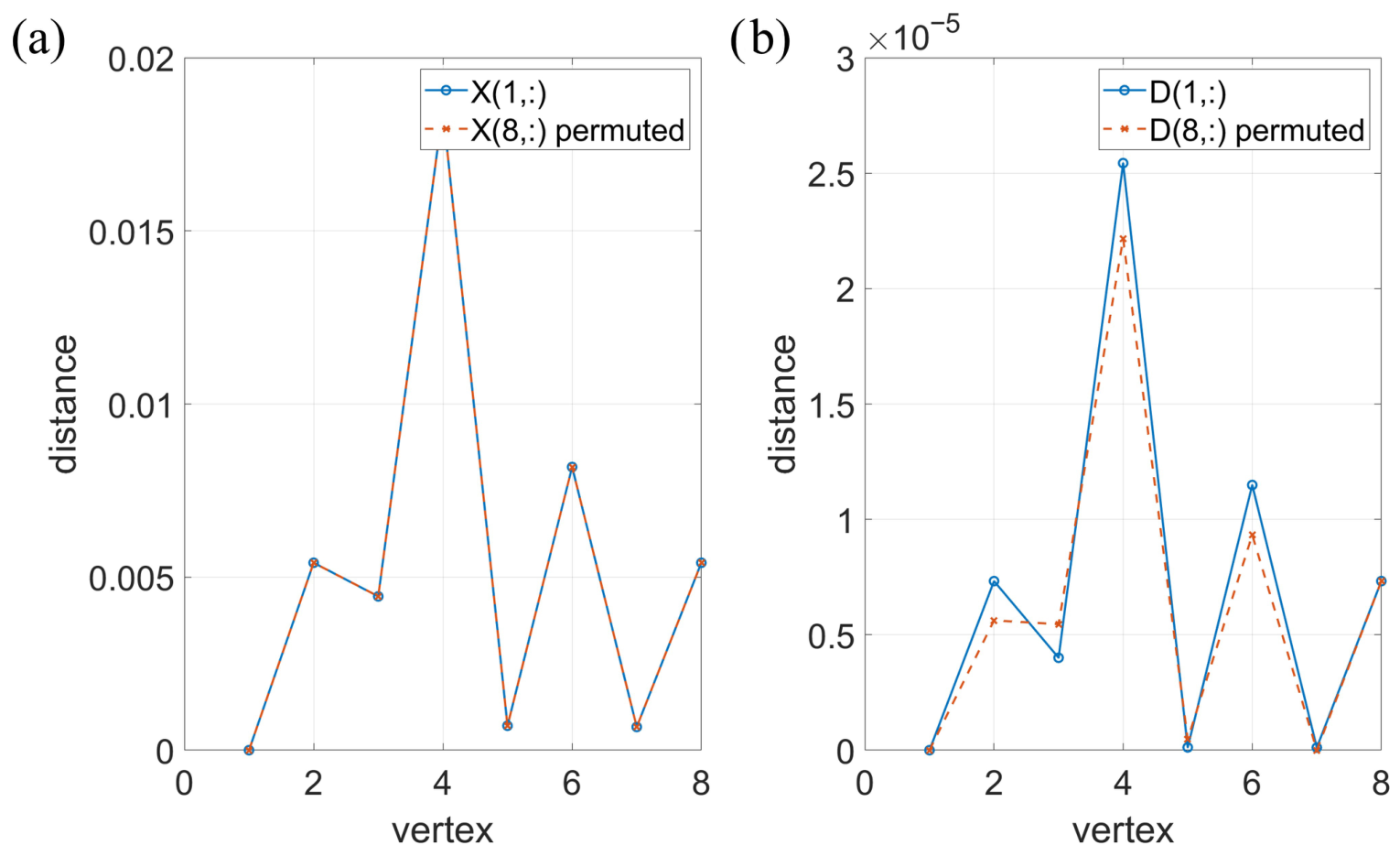
Figure 5 displays the rows of the GDG distance matrix corresponding to two vertices related by a nontrivial automorphism, after applying the appropriate permutation of labels. The two profiles (panel a) coincide almost perfectly, showing that the vertices occupy identical positions in the functional geometry and therefore play the same dynamical role in the network. In contrast, the corresponding rows of the state-based distance matrix (panel b) remain visibly different. The reason is that the state variables inherit the asymmetry introduced by the localized initial condition (
), whereas the GDG geometry depends on the full diffusion kernel and therefore retains the intrinsic symmetries of the relational structure itself.
Thus, the symmetry is not visible from the particular dynamical trajectory alone, although it is recovered from the functional geometry induced by GDG.
The significance of this result is conceptual as well as technical. The symmetry is latent in the relational dynamics, but it becomes visible only after the dynamics are reorganized through the GDG geometry. In this sense, the Euclidean embedding reveals a qualitative feature of the system—namely, its symmetry structure, which is not directly accessible from the raw state variables produced by a single diffusion experiment. Therefore the functional geometry does not merely represent the dynamics; it discloses structural properties of the system that emerge only at this higher relational level.
From a broader perspective, this experiment illustrates how new structural information can emerge when relational dynamics are organized geometrically. The symmetries detected in the GDG space correspond to equivalence classes of vertices that play identical functional roles in the network. Such relations are not properties of individual dynamical trajectories but of the relational organization of the system itself. In this sense, the induced geometry reveals aspects of the underlying structure that remain hidden at the level of the dynamical variables alone, supporting the view that, here, geometry functions as the relational manifestation of operator-governed structure.
4.3. Illustrative Application: Emergent Functional Geometry in the Macaque Visual Cortex
To illustrate the central ideas of GDG in a real relational system, we considered the well-known macaque visual cortex network, comprising 30 cortical regions connected by anatomical projections (see Sporns and Zwi [
70]). The vertices of the network represent cortical areas, and the edges represent inter-regional anatomical connectivity. Importantly, the GDG construction does not make use of the physical positions of these regions in order to generate the induced geometry. Anatomical coordinates are employed only afterwards for comparison purposes.
Using the graph Laplacian as the dynamical operator, the diffusion kernel (
for
) was used to construct the GDG metric (
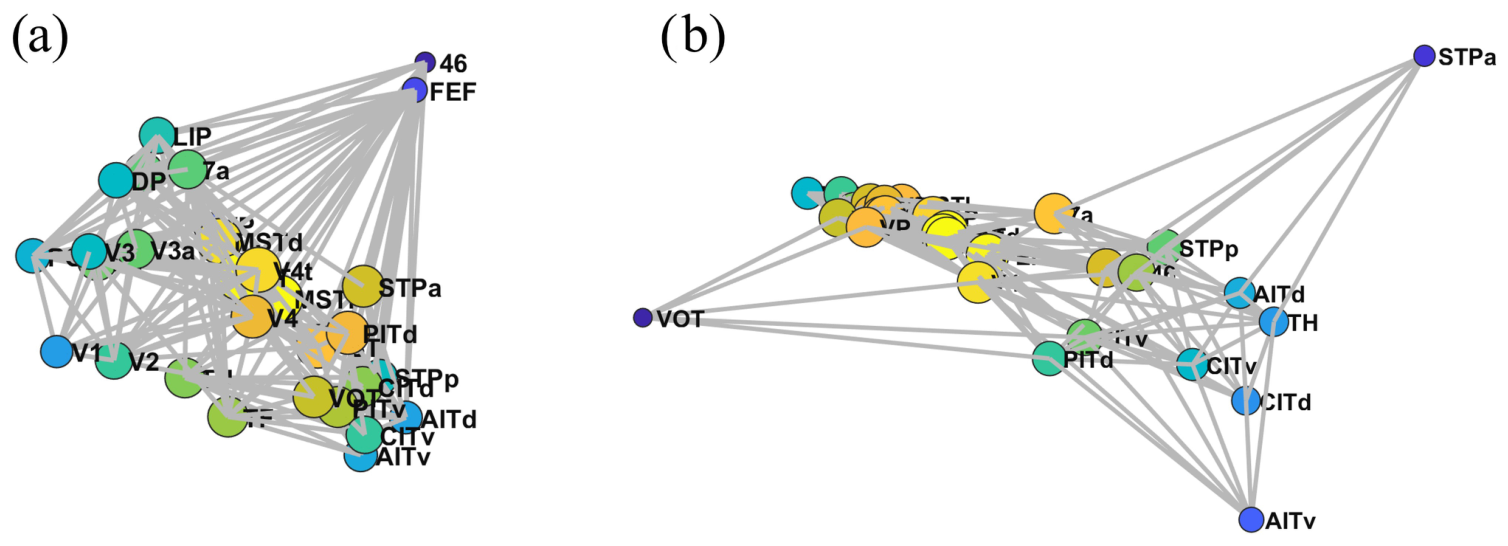
). A comparison between anatomical distances and GDG distances reveals a remarkable decoupling between physical location and dynamical organization. As an initial illustration, we display the two embeddings in
Figure 6. In panel (a), we illustrate the anatomical embedding, i.e., the position of each of the regions in the macaque brain. In panel (b), we use a multidimensional scaling (MDS) to reduce the 30-dimensional GDG coordinates to three-dimensional coordinates. In this case, every region occupies a position in the GDG space that depends on its dynamical accessibility from other cortical regions. Two regions become close in GDG space when perturbations initiated in those regions propagate through the network in a similar manner, irrespective of their anatomical proximity.
Regions that are anatomically adjacent may become widely separated in GDG space, whereas anatomically distant regions may become dynamically close. Therefore, the resulting geometry captures patterns of functional integration that are not directly visible in the anatomical arrangement of the cortex. To perform a quantitative analysis of the similarities and differences between the two embeddings, i.e., anatomical and GDG differences, we calculate the “closeness” centrality (
) of each vertex (
v) based on the corresponding distances of
where
is the corresponding distance between vertex
v and any other vertex in the network. The Spearman rank correlation between the two centrality indices is 0.0816, and the Kendall coefficient is 0.0345, both indicating a dramatic lack of rank correlation. The Pearson correlation coefficient is also negligible, at 0.0073.
This lack of rank correlation is manifested in several biologically significant examples. One of the most striking ones is provided by area VOT, a ventral-stream visual region associated with object processing. Although anatomically embedded within the ventral visual hierarchy, VOT appears as one of the most peripheral regions in GDG space, exhibiting large dynamical distances to many other cortical areas. In particular, VOT displays exceptionally large GDG distances to the anterior superior temporal polysensory area (STPa) and the TH area(parahippocampal cortex), despite the existence of relatively short anatomical pathways between these regions. This result suggests that VOT occupies a specialized dynamical niche within the cortical architecture. In GDG terms, activity initiated at VOT propagates through the network in a manner substantially different from activity initiated at most other regions.
Biologically, this behavior is consistent with the role of VOT as a highly specialized stage in the ventral visual pathway devoted to object representation. Rather than acting as a hub for multimodal integration, VOT participates in a relatively selective processing stream, and the GDG geometry reflects this functional segregation through its peripheral position in the induced metric space.
Conversely, several anatomically distant regions become surprisingly close in GDG space. One example is the pair of the posterior superior temporal polysensory area (STPp) and area 46 (a granular region of the lateral prefrontal cortex). STPp belongs to the superior temporal polysensory cortex and participates in higher-order sensory integration, whereas area 46 corresponds to the dorsolateral prefrontal cortex and plays a central role in executive function and working memory. Despite their anatomical separation, the GDG metric places these regions in close proximity, suggesting that they participate in highly integrated dynamical circuits supporting cognitive processing and the coordination of sensory information with executive control.
Another notable example is the pair of the TF area (an area of the parahippocampal cortex) and area 46. The TF area is strongly involved in memory-related processing and contextual representation, whereas area 46 is associated with planning and decision making. Their proximity in GDG space suggests that the underlying network dynamics naturally couple mnemonic and executive processes, reflecting the importance of memory-guided behavior in primate cognition.
The dorsal visual pathway provides a further example of the interpretability of the induced geometry. The FST (fundus of the superior temporal area) and MSTd (dorsal medial superior temporal area) areas, both involved in motion processing and visuospatial analysis, appear almost coincident in GDG space despite not being immediate anatomical neighbors. The induced geometry therefore recognizes the existence of a shared dynamical role within the motion-processing stream and organizes these regions according to their functional similarity rather than their physical location.
More generally, the GDG geometry appears to separate cortical regions according to their participation in information-processing streams rather than according to their anatomical positions. Visual regions associated with object recognition, motion processing, multimodal integration, memory, and executive control occupy distinct regions of the induced metric space that reflect their dynamical interactions with the rest of the cortex.
This example illustrates the central philosophical message of the present work. The anatomical geometry of the cortex is inherited from physical space and exists independently of cortical activity. The GDG geometry, in contrast, is not imposed externally and is not derived from spatial coordinates. It emerges solely from the interaction between relational structure and dynamics. The connectome provides the relations, the diffusion operator provides the dynamics, and geometry appears as a consequence of their spectral organization.
More generally, the example supports the structural principle proposed in this work: whenever a relational system admits a spectral articulation of its dynamics, an induced geometry may emerge that captures aspects of the organization of the system that are inaccessible to topology or physical embedding alone.
5. Spectral Operators and the Emergence of Geometry
We now compare the ontology underlying GDG with what has been called “Hilbert space fundamentalism” Carroll [
71] or, as Carroll, himself, prefers to describe it, “Mad-Dog Everettianism” Carroll and Singh [
72]. This comparison reveals a striking structural parallel, together with an important ontological distinction. In Carroll’s minimal quantum ontology, the fundamental description of reality consists of a Hilbert space (
), a self-adjoint Hamiltonian (
) acting on
, and a universal quantum state (
) evolving according to the Schrödinger equation. The spectral decomposition of
encodes invariant dynamical structure, while the quantum state and the dynamical law constitute the basic ingredients of the theory. Structures appearing in ordinary physical descriptions, including classical objects, subsystems, and even spacetime geometry, are not taken as primitive but are reconstructed from relations internal to Hilbert space, particularly from entanglement structure and the locality properties of the Hamiltonian.
Therefore, geometry does not belong to the fundamental ontology but emerges from the relational organization of the quantum state under its dynamical evolution.
In the GDG framework, the primitive ingredients are different. One begins with a relational structure (
), together with a dynamical rule defined on that structure. From
, one obtains a symmetric operator, i.e.,
acting on the Hilbert space of functions on the vertex set. The operator admits a spectral decomposition, and its dynamical propagator generates a positive definite kernel from which Euclidean geometry emerges.
In both frameworks, geometry arises from the spectral properties of a self-adjoint operator on a Hilbert space. Therefore, spectral theory provides the mathematical backbone of geometric emergence. Despite this formal similarity, the ontological commitments of the two frameworks differ. In Carroll’s proposal Carroll [
71], Hilbert space, itself, is ontologically primary. Reality is fundamentally a vector in
, and spacetime geometry is reconstructed from the relational structure of that space.
In GDG, the situation is reversed. Hilbert space is not fundamental but representational. The space expressed as arises naturally as the space of functions on a relational structure. The operator (Q) encodes the dynamics of that structure. Geometry emerges from spectral evolution, but the Hilbert space, itself, carries no independent ontological status.
Thus, the difference between the two approaches is not mathematical but metaphysical. Both frameworks exhibit the same structural mechanism—namely, the generation of geometry from spectral dynamics. The difference lies in the location of ontological primacy.
This comparison suggests a broader structural insight. Whenever relational dynamics can be encoded by a self-adjoint operator on a Hilbert space, the spectral properties of that operator govern the emergence of geometric structure. Hilbert space need not be fundamental in order to play this generative role. It may, instead, function as the natural mathematical arena in which relational dynamics become spectrally articulated.
In this sense, GDG provides a classical realization of a structural mechanism that, in Carroll’s program, operates at the quantum level. The convergence lies in spectral structure; the divergence lies in ontology.
6. Operator-Induced Geometry and Spectral Filtering
If GDG is to support relational–dynamical realism, it must show that geometric invariants arise directly from the dynamics encoded by the operator rather than being imposed as primitive geometric structure. In classical differential geometry, curvature is not merely a matter of distance; it measures how geodesics diverge and how volumes evolve. In GDG, where geometry is generated by a dynamical operator, curvature-like quantities must also arise from that operator.
Consider classical diffusion (
). The propagator admits the following short-time expansion (Rosenberg [
73]):
Substituting this expansion into the definition, i.e.,
shows that local geometric behavior is governed at leading order by
. The operator (
Q) controls first-order diffusion, while
determines how rapidly neighboring states separate under infinitesimal diffusion time. This leads naturally to curvature-like quantities derived entirely from the operator.
Global geometric behavior is controlled by the spectral structure of
Q. Let the eigenvalues satisfy
The squared radius of the spherical embedding can be written in spectral form. At large times, the dominant behavior is controlled by the second eigenvalue (
), i.e., the spectral gap. Therefore, the asymptotic contraction rate of the geometry satisfies
Thus, the spectral gap controls the rate at which the geometry collapses toward equilibrium. In Markov theory,
determines mixing time (Levin et al. [
74]), while in GDG, it determines the rate of geometric contraction. These results reveal a general structural fact: geometric invariants that, in classical geometry, would be regarded as primitive can be derived from the spectral properties of the dynamical operator.
A related phenomenon appears in the dynamical evolution of diffusion itself. In the eigenbasis of
Q, the propagator satisfies
High-frequency modes decay rapidly, while low-frequency modes persist. Therefore, diffusion acts as a spectral filter, progressively suppressing complex modes and leaving only the dominant large-scale components.
This mechanism is formally similar to quantum decoherence (Zurek [
75]). In open quantum systems, environmental interaction suppresses off-diagonal elements of the density matrix in a preferred basis. In both diffusion and decoherence, the underlying mechanism is spectral filtering generated by an operator.
However, the outcomes differ. Diffusion homogenizes states and causes geometric distinctions to vanish. Decoherence suppresses interference and stabilizes classical alternatives. Despite this difference, both phenomena illustrate a deeper structural principle: emergent structure arises through the selective suppression of spectral modes.
From this perspective, the operator does more than generate distances. Its spectrum determines curvature-like behavior, contraction rates, and the entire evolution of geometric structure across scales.
7. Emergence, Locality, and the Ontological Picture
From a broader philosophical perspective, these results bear directly on the longstanding question concerning the relation between geometry and dynamics in physical description Acuña and Read [
6], Read [
8], Norton [
9]. In many theoretical frameworks, geometry is introduced as a primitive structure within which dynamical processes unfold. The GDG framework illustrates an alternative possibility: metric relations arise as a consequence of the dynamical evolution of an underlying relational system rather than being specified a priori.
Within GDG, the fundamental level of description consists of a relational structure, together with a dynamical law acting on it. The operator representation of these dynamics generates, through its spectral evolution, a family of metric relations that organize the system geometrically. Therefore, the framework provides an explicit realization of dynamically generated geometry in a relational setting.
This perspective also clarifies the status of locality. When the underlying dynamics couple only adjacent vertices of the relational graph, the associated operator is sparse, and the short-time geometry reflects local adjacency relations. When long-range interactions are incorporated into the dynamics, however, the induced geometry naturally extends beyond immediate connectivity and captures nonlocal organization.
Geometric properties in GDG are therefore determined by the spectral structure of the operator governing the dynamics. Distances arise from the differential decay of modes, large-scale contraction is controlled by spectral gaps, and higher-order geometric properties reflect the organization of the spectrum across scales.
This picture reverses the explanatory priority assumed by traditional substantival conceptions of space. Rather than objects inhabiting a pre-existing geometric arena, geometric relations emerge from the dynamical organization of relations between entities.
The Euclidean embedding space () serves only as a representational carrier for these relations. Orthogonal transformations modify coordinates without altering the metric structure, indicating that the invariant content of the geometry resides in the relational organization itself rather than in any particular embedding.
In this sense, geometry is emergent in a precise structural sense Bedau [
76], Butterfield et al. [
77]: it is fully determined by the underlying relational dynamics while not belonging to the primitive level of description. Once generated, however, the induced geometry possesses objectivelyinvariant properties and evolves according to well-defined dynamical laws.
The resulting ontological picture is hierarchical. Relations and dynamics define the fundamental level of description, spectral structure organizes the modes of evolution, and geometry appears as the invariant relational organization generated by this process. Geometry is therefore not eliminated by the framework but explained as the structural manifestation of relational dynamics Barbour [
78].
8. Conclusions
The analysis developed in this work establishes a precise mechanism through which geometry can arise from relational dynamics. Starting from a relational structure encoded by a graph, together with a dynamical law acting on that structure, one obtains a self-adjoint operator whose spectral evolution generates a positive definite kernel. From this kernel, a squared Euclidean distance matrix emerges, along with a canonical embedding of the system into a Euclidean space. Therefore, geometry appears not as a primitive background but as a structural consequence of relational dynamics.
This result has both mathematical and philosophical significance. Mathematically, the GDG construction demonstrates that diffusion dynamics on graphs naturally induce a Euclidean metric structure whose properties are determined entirely by the spectral organization of the operator governing the dynamics. Geometric invariants such as distances, angles, effective dimensions, and contraction rates are therefore expressions of spectral structure. Geometry, in this sense, acts as a compressed representation of dynamical information, reorganizing the relational influence patterns generated by the operator into a coherent metric form.
Philosophically, this mechanism motivates the ontological position developed in this paper: relational–dynamical structural realism. According to this view, the fundamental level of description consists of entities connected by relations and governed by a dynamical law. The operator represents these dynamics in Hilbert space, and geometric structure emerges from the spectral organization of its evolution. The Euclidean space appearing in the embedding therefore does not constitute an independent container of objects but serves as a canonical representation of invariant relational metrics generated by the dynamics.
The GDG framework also clarifies the explanatory role of induced geometry. Geometric observables derived from the metric encode dynamical information that is not directly visible in local state variables. In particular, the temporal evolution of geometric invariants allows one to identify transport regimes, spectral scaling behavior, and symmetry structures of the underlying system. Geometry therefore functions as a structural diagnostic of relational dynamics, revealing collective properties that remain hidden at the level of individual trajectories.
More broadly, the GDG construction suggests a general structural principle: geometry may emerge whenever relational dynamics admit a spectral articulation. In such cases, the spectrum of the dynamical operator determines the geometric organization of the system through the filtering action of temporal evolution. The resulting geometry should therefore be understood not as a primitive feature of reality but as the relational form taken by spectral dynamics.
The present work provides a classical realization of this mechanism. Extensions to other dynamical settings remain an important direction for future research. In particular, quantum systems governed by unitary evolution offer a natural arena in which to investigate whether analogous operator-induced geometries arise from quantum dynamics. Exploring such extensions may help clarify the extent to which the emergence of geometry from relational dynamics represents a general structural phenomenon rather than a feature specific to diffusive processes.
In this sense, the GDG framework opens a broader research program. By showing that geometry can be generated from relational dynamics in discrete systems, it suggests that geometric structure, in general, may be understood as the emergent organizational form of dynamical relations. More broadly, the results presented here suggest that the traditional geometry–dynamics question may extend beyond spacetime physics to the general study of relational dynamical systems, where geometric structure can arise as an emergent organization of dynamical relations.