Article

Geometric Properties of New Subclasses of the (λ, q)-Fractional Differential Operator of Analytic Functions Associated with Euler Generating Function


by
Suha B. Al-Shaikh
Faculty of Computer Studies, Arab Open University, Riyadh 11681, Saudi Arabia
Axioms 2026, 15(7), 528; https://doi.org/10.3390/axioms15070528
Submission received: 12 May 2026 / Revised: 21 June 2026 / Accepted: 7 July 2026 / Published: 14 July 2026
(This article belongs to the Special Issue New Developments in Geometric Function Theory, 4th Edition)

Abstract

In this paper, we introduce and investigate a new subclass of analytic functions in the open unit disk by combining the ( λ , q ) -fractional differintegral operator with the Euler generating function through the technique of subordination. This class, denoted by K q , λ ( τ ) , unifies and extends several families of q-starlike and q-convex functions as special cases corresponding to particular choices of the parameter λ . For this class, coefficient estimates for the initial Taylor coefficients and a Fekete–Szegő inequality are established. Furthermore it is shown that the transformed function D q λ f is q-starlike in the unit disk under suitable assumptions on the parameters. In addition, first-order distortion estimates are obtained for the associated q-starlike and q-convex subclasses. Several consequences are derived for the special cases λ = 0 and λ = 1 , corresponding, respectively, to q-starlike and q-convex function classes. The classical limit q 1 is also investigated and establish a new connection between Euler generating functions, fractional q-operators, and subclasses of analytic and univalent functions.

1. Introduction

We consider the family A consisting of functions that are analytic in the unit disk D = { z C : | z | < 1 } and satisfy the standard normalization conditions f ( 0 ) = 0 and f ( 0 ) = 1 . Accordingly, any function f belonging to the class A admits a Taylor series expansion of the form
f ( z ) = z + n = 2 a n z n ,
which converges in D .
An analytic functions f 1 is subordinate to an analytic function f 2 in D , written as
f 1 ( z ) f 2 ( z ) , z D ,
if there exists a Schwarz function u, analytic in D , such that
u ( 0 ) = 0 , | u ( z ) | < 1 , z D ,
and
f 1 ( z ) = f 2 ( u ( z ) ) , z D .
The symbol S is reserved for the subclass of A whose members are univalent in D . Some important subclasses of S can be defined as follows.
Definition 1
(starlike functions of order α ). For 0 α < 1 . The class S * ( α ) consists of a functions f A satisfying the condition
z f ( z ) f ( z ) > α , z D .
Equivalently, f S * ( α ) iff
z f ( z ) f ( z ) 1 + ( 1 2 α ) z 1 z , z D .
Definition 2
(convex functions of order α ). For 0 α < 1 , the class C ( α ) of f A satisfying
1 + z f ( z ) f ( z ) > α , z D .
Equivalently, f C ( a ) iff
1 + z f ( z ) f ( z ) 1 + ( 1 2 α ) z 1 z , z D .
Remark 1.
For both of the above classes, setting α = 0 reduces them to the classical univalent subclasses:
i. 
For S * ( α ) , we have S * ( 0 ) = S * and S * is the standard class of starlike functions in D . In this case, the subordination condition reduces to
z f ( z ) f ( z ) 1 + z 1 z .
ii. 
For C ( α ) , we have C ( 0 ) = C , and C is the standard class of convex functions in D . The subordination condition becomes
z f ( z ) f ( z ) + 1 1 + z 1 z .
Thus, the choice α = 0 recovers the standard starlike and convex function classes from the more general order-α definitions.
Fractional calculus has appeared as a rapidly developing and influential area of study in both mathematics and physics, providing powerful and flexible tools for the modeling and analysis of complex phenomena. Several types of fractional derivatives have been introduced, including the Riemann–Liouville, Caputo, Hadamard, and fractional q-derivative operators, each offering distinct analytical advantages [1,2,3,4]. More recently, fractional calculus has been successfully incorporated into the theory of analytic functions (AFs) and univalent functions (UFs). By employing both classical and modern fractional operators, researchers have explored a wide range of geometric and analytic properties of function classes [5,6]. These investigations include the characterization of analytic functions, coefficient estimates and bounds [7], distortion inequalities describing geometric deformation under fractional operators [8], and convolution (Hadamard product) properties for various subclasses of univalent functions. A comprehensive treatment of these developments can be found in several monographs and research texts. Notably, Srivastava [9] introduced generalized fractional derivative and integral operators in the complex plane and demonstrated their effectiveness in the study of univalent functions and associated generalized hypergeometric functions. These pioneering contributions laid the foundation for a systematic connection between fractional calculus and geometric function theory.
Further motivation for this line of research was provided by Srivastava [10], which discussed the advantages of incorporating operators from the basic calculus (or q-) and the fractional q-calculus into the Geometric Function Theory (GFT). In this framework, the geometric properties of the analytic functions (AFs) were investigated using fractional q-differential operators constructed via the classical Jackson q-derivative and its fractional extensions of arbitrary order. In parallel, a rigorous and comprehensive account of quantum calculus and fractional quantum calculus, including their theoretical foundations and applications, has been presented in the monographs of Annaby and Mansour [11] and Miller and Ross [12]. These works provide essential background and analytical tools that continue to inspire further developments in fractional and q-fractional analysis.
Recent developments in geometric function theory have placed considerable emphasis on coefficient inequalities and Fekete–Szegö problems for various subclasses of UFs defined via fractional calculus operators. In particular, many studies have derived sharp or non-sharp bounds for the initial coefficients and the Fekete–Szegö functional | a 3 μ a 2 2 | , by employing subordination techniques. These investigations frequently make use of Caputo-type operators, Riemann–Liouville fractional derivatives, and q-calculus operators. Several authors have examined distinct subfamilies of the class A and investigated | a 2 | and | a 3 | (see, for example, [13,14,15,16,17]). Moreover, extensive attention has been devoted to | a 3 μ a 2 2 | within the GFT framework due to its significant background and theoretical importance. The origin of this functional can be traced to the pioneering work of Fekete and Szegö, and played a key role in the disproving of the Littlewood–Paley conjecture [18]. In recent years, numerous investigators have established Fekete–Szegö inequalities for a wide variety of function classes, reflecting the continuing and growing interest in this topic within the GFT, see [6,19,20,21,22,23]. Motivated by the aforementioned developments, we continue the study of the connections linking fractional q-calculus with GFT. The present study contributes to the ongoing exploration of fractional q-operators in the field of GFT by investigating new subclasses of AFs associated with Euler generating functions and ( λ , q ) -fractional differintegral operator. In GFT, a lot of attention has been given to the study of several new and known subclasses of AFs defined by means of quantum-calculus and fractional quantum-calculus. The theory of quantum-calculus originated with Jackson [24], who invented the notion of the q-difference operator. Building on this idea, Ismail et al. [25] proposed a class ( S * ) of q-starlike functions in D . Subsequent developments include the introduction of the Ruscheweyh q-difference operator by Kanas and Wiśnkowska [26], whose geometric properties were further examined in [27] via differential subordination. In later work, Mahmood and Sokoł [28] analyzed associated subclasses, concentrating on coefficient estimates and the classical Fekete–Szegő problem. In a different direction, Srivastava [29] introduced q-starlike functions associated with special functions, while further subclasses linked to the domain of lemniscate shape were studied in [30].
To facilitate the introduction of new subclasses of AFs, we first review the fundamental definitions and essential concepts of fractional q-calculus and q-calculus.
Definition 3
([31]). Let q be a real number with 0 < q < 1 . The q-analog of a number n is defined as
[ n ] q = 1 q n 1 q , n C .
For n N , this number admits the representation
[ n ] q = k = 0 n 1 q k = 1 + q + q 2 + + q n 1 ,
with
[ 0 ] q = 0 .
Definition 4
(see [32] (Chapter 6)). Let d C and n N 0 . The q-shifted factorial (also known as the q-Pochhammer symbol) is defined by
( d ; q ) n = k = 0 n 1 1 d q k , n N ,
and
( d ; q ) 0 = 1 .
The q-shifted factorial in the form of the q-Gamma function is
( q d ; q ) n = ( 1 q ) n Γ q ( d + n ) Γ q ( d ) , n N 0 ,
where Γ q ( d ) is defined for | q | < 1 as
Γ q ( d ) = ( 1 q ) 1 d ( q ; q ) ( q d ; q ) .
The infinite q-shifted factorial is given by
( d ; q ) = k = 0 1 d q k , | q | < 1 .
Similarly, we can write the following in terms of Γ q
Γ q ( d + 1 ) = [ d ] q Γ q ( d ) .
Jackson [33] proposed a q-difference operator applicable to AFs and UFs as
Definition 5
([33]). Let f A and 0 < q < 1 . The Jackson q-difference operator acting on f is given by
q f ( z ) = f ( q z ) f ( z ) z ( q 1 ) , z D , z 0
and
q f ( z ) = 1 + n = 1 [ n ] q a n z n 1 .
In particular,
q ( z n ) = [ n ] q z n 1 ,
and for a power series,
q n = 1 a n z n = n = 1 [ n ] q a n z n 1 ,
where [ n ] q denotes the q-number. Moreover,
lim q 1 q f ( z ) = f ( z ) .
The notion of a q-analog of the class of starlike functions was introduced by Ismail et al. [25] through the use of the operator q f ( z ) for 0 < q < 1 .
Definition 6
([34]). The fractional q-integral operator I q , z λ is given as
I q , z λ f ( z ) = 1 Γ q ( λ ) 0 z ( z t q ) λ 1 f ( t ) d q t ,
where the function f is required to be analytic in a simply connected complex domain that contains the origin. The function ( z t q ) λ 1 is interpreted in the sense q as
( z t q ) λ 1 = n = 0 1 q t z q n 1 q t z q λ + n 1 = z λ 1 F 0 1 q λ + 1 ; ; q , t q λ z .
The basic hypergeometric series F 0 1 is defined by
F 0 1 ( a ; ; q , z ) = 1 + n = 1 ( a ; q ) n ( q ; q ) n z n , | q | < 1 , | z | < 1 .
Definition 7
([32]). For 0 λ < 1 , the fractional q-derivative operator D q , z λ is investigated via the fractional q-integral by
D q , z λ f ( z ) = D q , z I q , z 1 λ f ( z ) = 1 Γ q ( 1 λ ) q 0 z ( z t q ) λ f ( t ) d q t .
Definition 8.
Let m be the least integer exceeding λ. The generalized fractional q-derivative of order λ is defined by
D q λ f ( z ) = D q m I q , z m λ f ( z ) .
As a consequence of the above definition, one obtains
D q λ z n = Γ q ( n + 1 ) Γ q ( n + 1 λ ) z n λ , 0 λ < 1 , n > 1 .

1.1. The ( λ , q ) -Fractional Differintegral Operator

Definition 9.
Let 0 < q < 1 and 0 λ < 1 . A linear operator
D q λ : A A
is introduced by
D q λ f ( z ) : = Γ q ( 2 λ ) Γ q ( 2 ) z λ D q λ f ( z ) .
For a function f A of the form (1), the operator D q λ admits the series expansion
D q λ f ( z ) = z + n = 2 Γ q ( 2 λ ) Γ q ( n + 1 ) Γ q ( 2 ) Γ q ( n + 1 λ ) a n z n .
For convenience, we denote
L n = Γ q ( 2 λ ) Γ q ( n + 1 ) Γ q ( 2 ) Γ q ( n + 1 λ ) , n 2 ,
so that
D q λ f ( z ) = z + n = 2 L n a n z n .
Note that
i.
lim λ 1 D q λ f ( z ) = D q f ( z ) = z q f ( z ) .
ii.
D q λ D q d f ( z ) = D q d D q λ f ( z ) = z + n = 2 Γ q ( 2 λ ) Γ q ( 2 d ) Γ q ( n + 1 ) 2 Γ q ( 2 ) Γ q ( n + 1 λ ) Γ q ( n + 1 d ) a n z n .
iii.
In the special case λ = 0 , the operator reduces to the form, and we obtain
D q D q λ f ( z ) D q λ f ( z ) = D q f ( z ) f ( z ) = z q f ( z ) f ( z ) .
For λ = 1 , applying the q-difference operator once more yields
D q D q λ f ( z ) D q λ f ( z ) = D q D q f ( z ) D q f ( z ) = 1 + q z q 2 f ( z ) q f ( z ) .
Under these assumptions 0 λ < 1 , 0 < q < 1 , the ( λ , q ) -fractional differintegral operator D q λ defined in Definition 9 is well-defined. Moreover, since
2 λ > 1 and n + 1 λ > 1 ( n 2 ) ,
the quantities
Γ q ( 2 λ ) and Γ q ( n + 1 λ )
are finite and nonzero. Consequently, the coefficients L n are well-defined for all n 2 .
Remark 2.
Throughout the paper, q is used for the Jackson q-derivative, D q for the normalized operator z q , and D q λ for the ( λ , q ) -fractional differintegral operator.

1.2. Euler Generating Function and Euler Polynomials

Recently, Srivastava et al. (see [35]) have studied coefficient estimates and the second Hankel determinant for subclasses of symmetric bi-starlike functions associated with Euler polynomials. The Euler generating function Φ ( τ , z ) is given in [35] and is defined by
Φ ( τ , z ) = 2 e τ z e z + 1 = 1 + n = 1 E n ( τ ) n ! z n , z D ,
where E n ( τ ) denotes the Euler polynomials. It is well known that Φ ( τ , z ) satisfies
Φ ( τ , z ) > 0 , z D .
The Euler polynomials E m ( τ ) satisfy the recursive relation
E m ( τ ) = k = 0 m m k E k 2 k τ 1 2 m k ,
where E k denotes the Euler numbers and 0 τ < 1 2 .
For convenience, the first few Euler polynomials are
E 0 ( τ ) = 1 ,
E 1 ( τ ) = τ 1 2 ,
E 2 ( τ ) = τ 2 τ ,
E 3 ( τ ) = τ 3 3 τ 2 2 + 1 4 ,
E 4 ( τ ) = τ 4 2 τ 3 + τ .
Motivated by recent studies on fractional q-calculus, Euler generating functions, and geometric function theory [35,36,37,38], we introduce a new subclass K q , λ ( τ ) of analytic functions defined via the ( λ , q ) -fractional differintegral operator, the Euler generating function, and the principle of subordination. This class unifies and extends several q-starlike and q-convex subclasses. For the proposed class, we establish coefficient estimates, a Fekete–Szegő inequality, and geometric properties of the associated transformed functions. We also discuss the special cases λ = 0 , λ = 1 , and the classical limit q 1 , thereby connecting the obtained results with existing results in geometric function theory. The following definition introduces the new subclass of analytic functions considered in this work.
Throughout this paper, we assume that
0 τ < 1 2 , 0 λ < 1 , 0 < q < 1 .
Definition 10.
A function f A belongs to the class K q , λ ( τ ) if
D q ( D q λ f ) ( z ) D q λ f ( z ) Φ ( τ , z ) , z D ,
where A denotes the class of normalized analytic functions in D .
Remark 3.
The class K q , λ ( τ ) is defined as a subclass of the standard class A of normalized univalent functions. Therefore, every function in K q , λ ( τ ) is univalent in D by definition.
Remark 4.
Using the properties of the ( λ , q ) -fractional differintegral operator, we have the following special cases:
i. 
For λ = 0 , we have
z q f ( z ) f ( z ) Φ ( τ , z ) , z D .
Thus, the class K q , 0 ( τ ) = S q * ( τ ) is a class of starlike functions of the Euler function.
ii. 
For λ = 1 , we have
D q ( D q f ) ( z ) D q f ( z ) = 1 + q z q 2 f ( z ) q f ( z ) Φ ( τ , z ) , z D .
Hence, class K q , 1 ( τ ) = C q ( τ ) corresponds to the subclass of q-convex functions, involving the second q-derivative and Euler functions.
Remark 5.
As q 1 , the q-operators satisfy
q f ( z ) f ( z ) , D q f ( z ) z f ( z ) , D q λ f ( z ) f ( λ ) ( z ) ,
where f ( λ ) ( z ) is the classical fractional derivative of order λ.
i. 
Case λ = 0 , q 1 : The subordination condition for K q , 0 ( τ ) becomes
z f ( z ) f ( z ) Φ ( τ , z ) , z D .
Thus, K 1 , 0 ( τ ) = S * ( τ ) corresponds to the class of starlike functions related to Euler generating function.
ii. 
Case λ = 1 , q 1 : For λ = 1 , the operator reduces to
1 + z f ( z ) f ( z ) Φ ( τ , z ) , z D .
Hence, K 1 , 1 ( τ ) = C ( τ ) corresponds to the classical subclass of convex functions for λ = 1 .
Proposition 1.
The class K q , λ ( τ ) is non-empty.
Proof. 
Let
f 0 ( z ) = z .
Since f 0 A , it suffices to verify the defining subordination condition of K q , λ ( τ ) .
By the definition of the ( λ , q ) -fractional differintegral operator,
D q λ f 0 ( z ) = z .
Applying the operator D q = z q , we obtain
D q ( D q λ f 0 ) ( z ) = D q ( z ) = z .
Therefore,
D q ( D q λ f 0 ) ( z ) D q λ f 0 ( z ) = 1 .
Since
Φ ( τ , 0 ) = 2 e 0 e 0 + 1 = 1 ,
we may choose the Schwarz function
ω ( z ) 0 , z D .
Then
1 = Φ ( τ , ω ( z ) ) , z D .
Hence
D q ( D q λ f 0 ) ( z ) D q λ f 0 ( z ) = Φ ( τ , ω ( z ) ) ,
which implies
D q ( D q λ f 0 ) ( z ) D q λ f 0 ( z ) Φ ( τ , z ) , z D .
Therefore,
f 0 K q , λ ( τ ) ,
and consequently the class K q , λ ( τ ) is non-empty. □
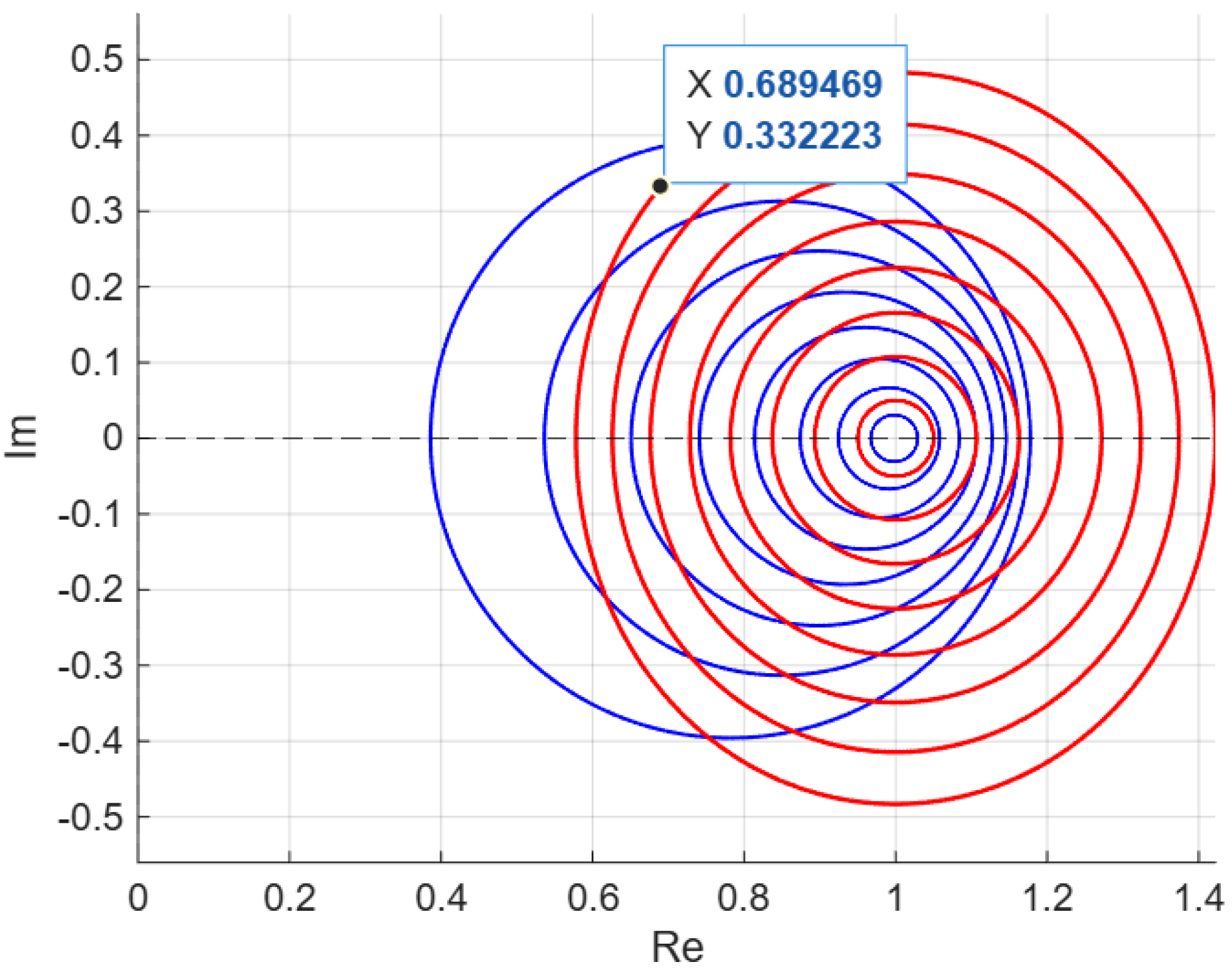
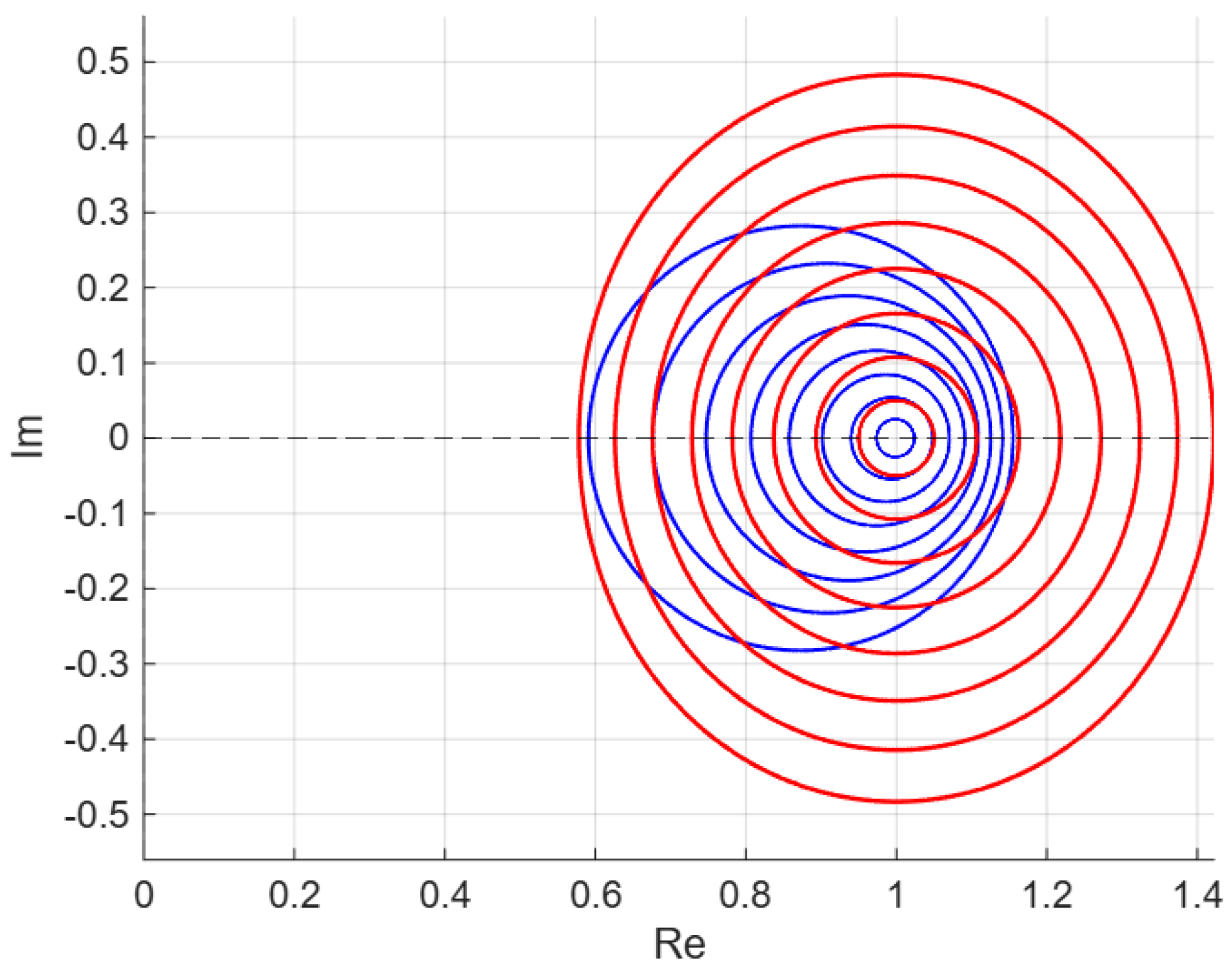
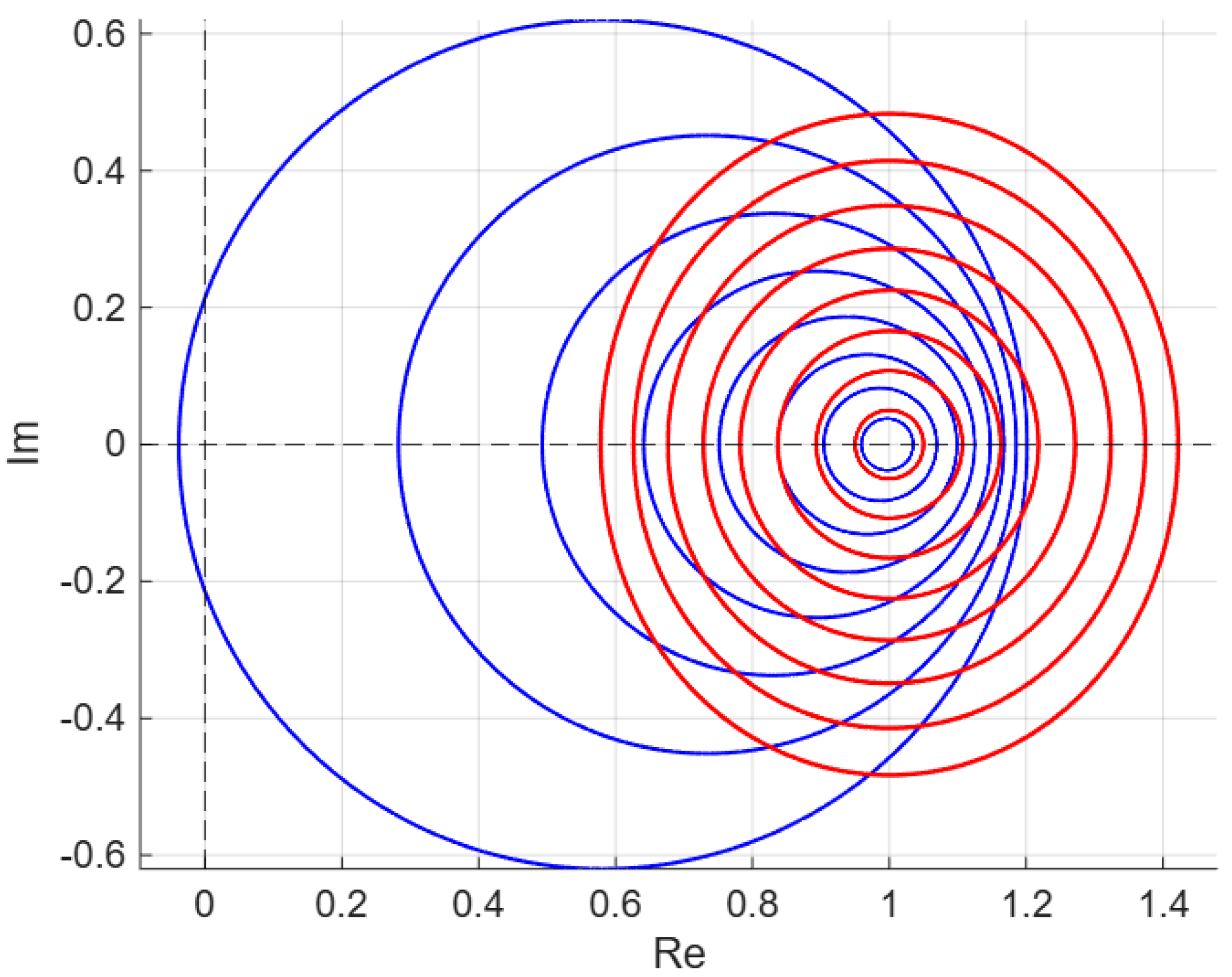
Figure 1, Figure 2 and Figure 3 are provided only to illustrate the geometric behavior and image domains of the considered functions. All assertions regarding inclusion in the class K q , λ ( τ ) and its associated subclasses follow from the analytical results established in the preceding theorems.

2. Set of Lemmas

Lemma 1
([39]). Let p ( z ) P , where
P = p ( z ) = 1 + n = 1 c n z n : p ( z ) > 0 , z D .
Then
| c n | 2 , n 1 .
Lemma 2
([40]). Let
p P
with
p ( z ) = 1 + c 1 z + c 2 z 2 + .
Then, for v C ,
c 2 v c 1 2 2 max { 1 , | 2 v 1 | } .
Lemma 3.
For each fixed 0 τ < 1 2 and m 1 , the Euler polynomial E m ( τ ) admits a representation in terms of lower-order Euler numbers via (10), and satisfies the growth estimate
| E m ( τ ) | C m 1 + | τ | m ,
where C m is a positive constant depending only on m.
Proof. 
From the recursive representation of Euler polynomials given in (10), we have
E m ( τ ) = k = 0 m m k E k 2 k τ 1 2 m k ,
where E k denotes the Euler numbers.
Applying the triangle inequality for complex numbers gives
| E m ( τ ) | k = 0 m m k | E k | 2 k τ 1 2 m k .
For all 0 τ < 1 2 ,
τ 1 2 | τ | + 1 2 C 1 + | τ | ,
where C > 0 is a constant. Hence,
τ 1 2 m k ( C ) m k 1 + | τ | m k ( C ) m 1 + | τ | m .
Substituting this into the previous sum, we obtain
| E m ( τ ) | k = 0 m m k | E k | 2 k ( C ) m 1 + | τ | m = C m 1 + | τ | m ,
where
C m : = ( C ) m k = 0 m m k | E k | 2 k > 0
depends only on m.
Thus, for all 0 τ < 1 2 ,
| E m ( τ ) | C m 1 + | τ | m .

3. Main Results

Coefficient Estimates for the Class K q , λ ( τ )

Theorem 1.
Let an analytic function f ( z ) of the form (1) be in the class K q , λ ( τ ) .
Then, the coefficients a 2 and a 3 satisfy
| a 2 | 2 τ 1 2 α q L 2 ,
and
| a 3 | 2 β q L 3 τ 1 2 + | τ 2 τ | + 2 τ 1 2 2 α q ,
where
α q = [ 2 ] q 1 , β q = [ 3 ] q 1 .
Proof. 
From Definition 9, we have
D q λ f ( z ) = z + n = 2 L n a n z n , L n = Γ q ( 2 λ ) Γ q ( n + 1 ) Γ q ( 2 ) Γ q ( n + 1 λ ) .
Applying D q to D q λ f ( z ) gives
D q ( D q λ f ) ( z ) = D q z + n = 2 L n a n z n = z + n = 2 [ n ] q L n a n z n .
Therefore
D q ( D q λ f ) ( z ) D q λ f ( z ) = z + n = 2 [ n ] q L n a n z n z + n = 2 L n a n z n .
Since f K q , λ ( τ ) , such that
D q ( D q λ f ) ( z ) D q λ f ( z ) = Φ ( τ , ω ( z ) ) .
The Euler generating function has the series expansion
Φ ( τ , z ) = 1 + τ 1 2 z + τ 2 τ 2 z 2 + .
Substituting ω ( z ) into Φ ( τ , z ) , we obtain
Φ ( τ , ω ( z ) ) = 1 + τ 1 2 c 1 z + τ 1 2 c 2 + τ 2 τ 2 c 1 2 z 2 + .
Similarly, expanding power series up to z 2 :
D q ( D q λ f ) ( z ) D q λ f ( z ) = 1 + α q A 2 z + β q A 3 α q A 2 2 z 2 + ,
where
A n = L n a n .
Comparing coefficients of like powers of z in (20) and (23), we obtain
α q L 2 a 2 = τ 1 2 c 1 ,
α q L 2 2 a 2 2 + β q L 3 a 3 = τ 1 2 c 2 + τ 2 τ 2 c 1 2 .
From (24) and using the Lemma 1, we arrive at
| a 2 | 2 | τ 1 2 | α q L 2 .
From (25), we have
β q L 3 a 3 = τ 1 2 c 2 + τ 2 τ 2 c 1 2 + 1 α q τ 1 2 2 c 1 2 .
Using the Lemma 1, we arrive at
| a 3 | 1 β q L 3 2 τ 1 2 + 2 | τ 2 τ | + 4 τ 1 2 2 α q .
Remark 6.
The coefficient estimates in Theorem 1 are obtained using the classical Carathéodory coefficient bound
| c n | 2 , n 1 .
Accordingly, no sharpness claim is made for these estimates.
Corollary 1.
Let f K q , λ ( τ ) . Then, as q 1 , the coefficient bounds reduce to
| a 2 | 2 τ 1 2 Γ ( 3 λ ) Γ ( 2 λ ) ,
| a 3 | Γ ( 4 λ ) 6 Γ ( 2 λ ) τ 1 2 + | τ 2 τ | + 2 τ 1 2 2 .
Corollary 2.
Let
f ( z ) S q * ( τ ) .
Then the coefficients a 2 and a 3 satisfy
| a 2 | 2 τ 1 2 α q ,
| a 3 | 2 β q τ 1 2 + | τ 2 τ | + 2 τ 1 2 2 α q
Corollary 3.
Let f ( z ) S * ( τ ) . Then the coefficients a 2 and a 3 satisfy
| a 2 | 2 τ 1 2 ,
| a 3 | τ 1 2 + | τ 2 τ | + 2 τ 1 2 2 .
Corollary 4.
Let
f ( z ) C q ( τ ) .
Then the coefficients a 2 and a 3 satisfy
| a 2 | 2 τ 1 2 q [ 2 ] q ,
| a 3 | 2 q [ 2 ] q [ 3 ] q τ 1 2 + | τ 2 τ | + 2 q τ 1 2 2 .
Corollary 5.
Let f ( z ) C ( τ ) . Then the coefficients a 2 and a 3 satisfy
| a 2 | τ 1 2 ,
| a 3 | 1 3 τ 1 2 + | τ 2 τ | + 2 τ 1 2 2 .
Theorem 2
(Fekete–Szegő Inequality). Let μ C and 0 τ < 1 2 . An analytic function f ( z ) K q , λ ( τ ) . Then
a 3 μ a 2 2 2 τ 1 2 β q L 3 max 1 , | 2 μ τ 1 2 β q L 3 α q 2 L 2 2 2 τ 1 2 α q τ 2 τ τ 1 2 1 | .
where
α q = [ 2 ] q 1 , β q = [ 3 ] q 1 .
Proof. 
Let f K q , λ ( τ ) . Then, there exists a Schwarz function
ω ( z ) = c 1 z + c 2 z 2 +
Such that
D q ( D q λ f ) ( z ) D q λ f ( z ) = Φ ( τ , ω ( z ) ) .
From (22) and (23) along with (26), we have
a 2 = τ 1 2 α q L 2 c 1
and
β q L 3 a 3 α q L 2 2 a 2 2 = τ 1 2 c 2 + τ 2 τ 2 c 1 2 .
Hence, from (27) and (28), we have
a 3 = α q L 2 2 a 2 2 + τ 1 2 c 2 + τ 2 τ 2 c 1 2 β q L 3 .
Therefore, from (27) and (29), we get
a 3 μ a 2 2 = α q L 2 2 μ β q L 3 a 2 2 + τ 1 2 c 2 + τ 2 τ 2 c 1 2 β q L 3 .
Taking the square of (27) and using (30), we get
a 3 μ a 2 2 = τ 1 2 β q L 3 c 2 μ ( τ 1 2 ) β 3 L 3 α q 2 L 2 2 ( τ 1 2 ) α q τ 2 τ 2 ( τ 1 2 c 1 2 .
Using the standard Schwarz Lemma 2, we obtain
a 3 μ a 2 2 2 τ 1 2 β q L 3 max 1 , | 2 μ τ 1 2 β q L 3 α q 2 L 2 2 2 τ 1 2 α q τ 2 τ τ 1 2 1 | .
This completes the proof. □
Corollary 6.
Let f ( z ) K q , λ ( τ ) . Then, in the classical limit q 1 , for any μ C ,
a 3 μ a 2 2 τ 1 2 Γ ( 4 λ ) 6 Γ ( 2 λ ) max 1 , | 12 μ τ 1 2 Γ ( 3 λ ) Γ ( 4 λ ) 2 τ 1 2 τ 2 τ τ 1 2 1 | .
Corollary 7.
Let
f ( z ) S q * ( τ ) .
Then, for any μ C ,
a 3 μ a 2 2 2 τ 1 2 β q max 1 , | 2 μ τ 1 2 β q α q 2 2 τ 1 2 α q τ 2 τ τ 1 2 1 | .
Corollary 8.
Let f ( z ) S * ( τ ) . Then, for any μ C ,
a 3 μ a 2 2 τ 1 2 max 1 , 4 μ τ 1 2 2 τ 1 2 τ 2 τ τ 1 2 1 .
Corollary 9
(Fekete–Szegő inequality for C q ( τ ) ). Let
f ( z ) C q ( τ ) .
Then, for any μ C ,
a 3 μ a 2 2 2 τ 1 2 q β q [ 2 ] q max 1 , | 2 μ τ 1 2 β q [ 2 ] q α q 2 2 τ 1 2 α q τ 2 τ τ 1 2 1 | .
Corollary 10
(Fekete–Szegő inequality for C q ( τ ) ). For q 1 . Let
f ( z ) C q ( τ ) .
Then, for any μ C ,
a 3 μ a 2 2 τ 1 2 2 max 1 , | 8 μ τ 1 2 2 τ 1 2 τ 2 τ τ 1 2 1 | .
Theorem 3
(q-starlikeness of the transformed function). Let
0 τ < 1 2 , 0 λ < 1 , 0 < q < 1 .
If
f K q , λ ( τ ) ,
then the function
F ( z ) = D q λ f ( z )
is q-starlike in D , that is,
D q F ( z ) F ( z ) > 0 , z D .
Proof. 
Since f K q , λ ( τ ) , we have
D q ( D q λ f ) ( z ) D q λ f ( z ) Φ ( τ , z ) , z D .
Put
F ( z ) = D q λ f ( z ) .
Then
D q F ( z ) F ( z ) Φ ( τ , z ) .
Now, let z = x + i y D . Since
Φ ( τ , z ) = 2 e τ z e z + 1 .
A direct calculation gives
Φ ( τ , z ) = 2 e τ x cos ( τ y ) + e x cos ( ( 1 τ ) y ) | e z + 1 | 2 .
Since z D , we have | y | < 1 . Moreover, for 0 τ < 1 2 ,
| τ y | < 1 2 , | ( 1 τ ) y | < 1 .
Hence
cos ( τ y ) > 0 , cos ( ( 1 τ ) y ) > 0 .
Therefore,
Φ ( τ , z ) > 0 , z D .
Thus, by subordination,
D q F ( z ) F ( z ) > 0 , z D .
Hence F = D q λ f is q-starlike in D . □
Theorem 4
(first-order distortion estimate for the q-starlike case). Let
f S q * ( τ ) , 0 τ < 1 2 .
Then
| q f ( z ) | 1 + 2 [ 2 ] q α q τ 1 2 r .
Proof. 
Let
f ( z ) = z + n = 2 a n z n .
Then
q f ( z ) = 1 + [ 2 ] q a 2 z + O ( z 2 ) , z 0 .
Hence, for | z | = r ,
| q f ( z ) | = 1 + [ 2 ] q a 2 z + O ( z 2 ) = 1 + O ( r ) .
Since f ( z ) S q * ( τ ) , thus by using the coefficient estimate
| a 2 | 2 τ 1 2 α q ,
we obtain the required result. This completes the proof. □
Theorem 5
(first-order distortion estimate for the class C q ( τ ) ). Let f C q ( τ ) , 0 τ < 1 2 . Then,
| q f ( z ) | 1 + τ 1 2 q α .
Proof. 
Let f ( z ) = z + n = 2 a n z n . Then
q f ( z ) = 1 + [ 2 ] q a 2 z + O ( z 2 ) , z 0 .
Hence, for r = | z | ,
| q f ( z ) | = 1 + [ 2 ] q a 2 z + O ( z 2 ) = 1 + O ( r ) .
Since f C q ( τ ) , so by using the coefficient estimate
| a 2 | τ 1 2 q α q [ 2 ] q ,
we obtain the required result. □

4. Conclusions and Future Directions

In this paper, we introduced and investigated a new subclass of analytic and univalent functions defined through the ( λ , q )-fractional differintegral operator and the Euler generating function via the principle of subordination. The newly defined class K q , λ ( τ ) provides a unified framework connecting the fractional q-calculus with geometric function theory. For this class, we derived coefficient estimates for the initial Taylor coefficients and established a Fekete–Szegő inequality. We further showed that the transformed function D q λ f is q-starlike in the unit disk under suitable assumptions on the parameters. In addition, first-order distortion estimates were obtained for the associated q-starlike and q-convex subclasses. Several consequences were discussed for the special cases λ = 0 and λ = 1 , which correspond, respectively, to q-starlike and q-convex function classes. The classical limit ( q 1 ) was also examined, demonstrating that the obtained results reduce to corresponding results from classical geometric function theory. Consequently, the proposed framework extends and complements existing studies on fractional q-operators, Euler generating functions, and subclasses of analytic and univalent functions, providing new connections between these areas.
Possible future investigations include the study of Hankel and Toeplitz determinants, higher-order coefficient functionals, differential subordinations and superordinations, inclusion relationships, and radius problems associated with the class K q , λ ( τ ) and its related subclasses.

Funding

This research received no external funding.

Data Availability Statement

No new data were created or analyzed in this study. Data sharing is not applicable to this article.

Acknowledgments

The author would like to thank the Arab Open University for supporting this work.

Conflicts of Interest

The author declares no conflicts of interest.

References

  1. Khan, A.; Al-shbeil, I.; Shatarah, A.; Alrayes, N.M.; Khan, S.; ul Haq, W. A new family of multivalent functions defined by certain forms of the quantum integral operator. Demonstr. Math. 2025, 58, 20250128. [Google Scholar] [CrossRef]
  2. Breaz, D.; Khan, S.; Tawfiq, F.M.O.; Tchier, F. Applications of fuzzy differential subordination to the subclass of analytic functions involving Riemann–Liouville fractional integral operator. Mathematics 2023, 11, 4975. [Google Scholar] [CrossRef]
  3. Orhan, H.; Cotîrlă, L.-I. Fekete–Szegö inequalities for some certain subclass of analytic functions defined with Ruscheweyh derivative operator. Axioms 2022, 11, 560. [Google Scholar] [CrossRef]
  4. Al-Sadi, S.; Ahmad, I.; Shah, S.G.A.; Hussain, S.; Noor, S. Fekete–Szegö type functionals associated with certain subclasses of bi-univalent functions. Heliyon 2024, 10, e28074. [Google Scholar] [CrossRef] [PubMed]
  5. Khan, S.; Malik, S.N.; Srivastava, H.M.; Al-Shbeil, I.; Xin, Q.; Tchier, F. Faber polynomial coefficient estimates for bi-close-to-convex functions defined by the q-fractional derivative. Axioms 2023, 12, 585. [Google Scholar] [CrossRef]
  6. Khan, M.F.; Khan, S.; Hussain, S.; Darus, M.; Matarneh, K. Certain new class of analytic functions defined by using a fractional derivative and Mittag–Leffler functions. Axioms 2022, 11, 655. [Google Scholar] [CrossRef]
  7. Darus, M.; Ibrahim, R.W. Radius estimates of a subclass of univalent functions. Math. Vesn. 2011, 63, 55–58. [Google Scholar]
  8. Bao, G.; Ling, Y.; Srivastava, H.M. Some distortion inequalities associated with fractional derivatives of analytic and univalent functions. J. Inequal. Pure Appl. Math. 2001, 2, 23. [Google Scholar]
  9. Srivastava, H.M. Univalent functions, fractional calculus, and associated generalized hypergeometric functions. In Univalent Functions, Fractional Calculus, and Their Applications; John Wiley & Sons: New York, NY, USA, 1989; pp. 329–354. [Google Scholar]
  10. Srivastava, H.M. Operators of basic (or q-) calculus and fractional q-calculus and their applications in geometric function theory. Iran. J. Sci. Technol. Trans. A Sci. 2020, 44, 327–344. [Google Scholar] [CrossRef]
  11. Annaby, M.H.; Mansour, Z.S. q-Fractional Calculus and Equations; Springer: Berlin/Heidelberg, Germany, 2012. [Google Scholar]
  12. Miller, K.S.; Ross, B. An Introduction to the Fractional Calculus and Fractional Differential Equations; Wiley: New York, NY, USA, 1993. [Google Scholar]
  13. Yousef, F.; Alroud, S.; Illafe, M. A comprehensive subclass of bi-univalent functions associated with Chebyshev polynomials of the second kind. Bol. Soc. Mat. Mex. 2020, 26, 329–339. [Google Scholar]
  14. Illafe, M.; Yousef, F.; Mohd, M.H.; Supramaniam, S. Initial coefficients estimates and Fekete-Szegö inequality problem for a general subclass of bi-univalent functions defined by subordination. Axioms 2023, 12, 235. [Google Scholar] [CrossRef]
  15. Sakar, F.M.; Wanas, A.K. Upper bounds for initial Taylor-Maclaurin coefficients of new families of bi-univalent functions. Int. J. Open Probl. Complex Anal. 2023, 15, 17–25. [Google Scholar] [CrossRef]
  16. Wanas, A.K.; Salagean, G.S.; Pall-Szabo, A. Coefficient bounds and Fekete–Szegö inequality for a certain family of holomorphic and bi-univalent functions defined by (m, n)-Lucas polynomials. Filomat 2023, 37, 1037–1044. [Google Scholar] [CrossRef]
  17. Almalki, Y.; Wanas, A.K.; Shaba, T.G.; Lupas, A.A.; Abdalla, M. Coefficient bounds and Fekete–Szegö inequalities for two families of bi-univalent functions related to Gegenbauer polynomials. Axioms 2023, 12, 10–18. [Google Scholar] [CrossRef]
  18. Fekete, M.; Szegö, G. Eine bemerkung uber ungerade schlichte funktionen. J. Lond. Math. Soc. 1933, 2, 85–89. [Google Scholar] [CrossRef]
  19. Srivastava, H.M.; Cho, N.E.; Alderremy, A.A.; Lupas, A.A.; Mahmoud, E.E.; Khan, S. Sharp inequalities for a class of novel convex functions associated with Gregory polynomials. J. Inequal. Appl. 2024, 2024, 140. [Google Scholar] [CrossRef]
  20. Khan, N.; Khan, S.; Xin, Q.; Tchier, F.; Malik, S.N.; Javed, U. Some applications of analytic functions associated with q-fractional operator. Mathematics 2023, 11, 930. [Google Scholar] [CrossRef]
  21. Shaba, T.G.; Araci, S.; Adebesin, B.O. Fekete–Szegö problem and second Hankel determinant for a subclass of bi-univalent functions associated with four leaf domain. Asia Pac. J. Math. 2023, 10, 21. [Google Scholar]
  22. Tang, H.; Murugusundaramoorthy, G.; Li, S.H.; Ma, L.N. Fekete–Szegö and Hankel inequalities for certain class of analytic functions related to the sine function. AIMS Math. 2022, 7, 6365–6380. [Google Scholar] [CrossRef]
  23. Srivastava, H.M.; Shaba, T.G.; Murugusundaramoorthy, G.; Wanas, A.K.; Oros, G.I. The Fekete–Szegö functional and the Hankel determinant for a certain class of analytic functions involving the Hohlov operator. AIMS Math. 2023, 8, 340–360. [Google Scholar] [CrossRef]
  24. Jackson, F.H. On q-functions and a certain difference operator. Earth Environ. Sci. Trans. R. Soc. Edinb. 1909, 46, 253–281. [Google Scholar] [CrossRef]
  25. Ismail, M.E.H.; Merkes, E.; Styer, D. A generalization of starlike functions. Complex Var. Theory Appl. 1990, 14, 77–84. [Google Scholar] [CrossRef]
  26. Kanas, S.; Răducanu, D. Some class of analytic functions related to conic domains. Math. Slovaca 2014, 64, 1183–1196. [Google Scholar] [CrossRef]
  27. Aldweby, H.; Darus, M. Some subordination results on q-analogue of Ruscheweyh differential operator. Abstr. Appl. Anal. 2014, 2014, 958563. [Google Scholar] [CrossRef]
  28. Mahmood, S.; Sokół, J. New subclass of analytic functions in conical domain associated with ruscheweyh q-differential operator. Results Math. 2017, 71, 1345–1357. [Google Scholar]
  29. Srivastava, H.M.; Khan, B.; Khan, N.; Ahmad, Q.Z. Coefficient inequalities for q-starlike functions associated with the Janowski functions. Hokkaido Math. J. 2019, 48, 407–425. [Google Scholar] [CrossRef]
  30. Khan, N.; Shafiq, M.; Darus, M.; Khan, B.; Ahmad, Q.Z. Upper bound of the third Hankel determinant for a subclass of q-starlike functions associated with lemniscate of Bernoulli. J. Math. Inequal. 2020, 14, 51–63. [Google Scholar]
  31. Gasper, G.; Rahman, M. Basic Hypergeometric Series, 2nd ed.; Encyclopedia of Mathematics and Its Applications; Cambridge University Press: Cambridge, UK, 2004; Volume 96. [Google Scholar]
  32. Srivastava, H.M.; Choi, J. Zeta and q-Zeta Functions and Associated Series and Integrals; Elsevier Science Publishers: Amsterdam, The Netherlands; London, UK; New York, NY, USA, 2012. [Google Scholar]
  33. Jackson, F.H. On q-definite integrals. Q. J. Pure Appl. Math. 1910, 41, 193–203. [Google Scholar]
  34. Purohit, S.D.; Raina, R.K. Certain subclasses of analytic functions associated with fractional q-calculus operators. Math. Scand. 2011, 109, 55–70. [Google Scholar] [CrossRef]
  35. Srivastava, H.M.; Shaba, T.G.; Ibrahim, M.; Tchier, F.; Khan, B. Coefficient bounds and second Hankel determinant for a subclass of symmetric bi-starlike functions involving Euler polynomials. Bull. Sci. Math. 2024, 192, 103405. [Google Scholar] [CrossRef]
  36. Deniz, E. Sharp coefficient bounds for starlike functions associated with generalized telephone numbers. Bull. Malays. Math. Sci. Soc. 2021, 44, 1525–1542. [Google Scholar]
  37. Swarup, C. Sharp coefficient bounds for a new subclass of q-starlike functions associated with q-analogue of the hyperbolic tangent function. Symmetry 2023, 15, 763. [Google Scholar] [CrossRef]
  38. Gavris, E. Coefficient bounds and Fekete-Szego problem for some classes of analytic functions defined by using a fractional operator. Afr. Mat. 2025, 36, 96. [Google Scholar]
  39. Pommerenke, C. Univalent Functions. In Studia Mathematica Mathematische Lehrbucher; Vandenhoeck and Ruprecht: Gottingen, Germany, 1975. [Google Scholar]
  40. Libera, R.J.; Złotkiewicz, E.J. Coefficient bounds for the inverse of a function with derivative in P . Proc. Am. Math. Soc. 1983, 87, 251–257. [Google Scholar] [CrossRef]
Figure 1. Illustration of R ( z ) = D q ( D q λ f 1 ) ( z ) D q λ f 1 ( z ) for f 1 ( z ) = z + 0.5 z 2 , q = 0.5 , λ = 0.5 , a 2 = 0.5 , and τ = 0.25 . Blue points represent the values of R ( z ) for z D , while red semi-transparent points represent the image of the Euler generating function Φ ( τ , z ) .
Axioms 15 00528 g001
Figure 2. Illustration of the image of R ( z ) = D q ( D q λ f 1 ) ( z ) D q λ f 1 ( z ) for f 1 ( z ) = z + 0.5 z 2 , q = 0.5 , λ = 0 , a 2 = 0.5 , and τ = 0.25 .
Axioms 15 00528 g002
Figure 3. Illustration of the image of R ( z ) = D q ( D q λ f 1 ) ( z ) D q λ f 1 ( z ) for f 1 ( z ) = z + 0.5 z 2 , q = 0.5 , λ = 1 , a 2 = 0.5 , and τ = 0.25 . Blue points represent the values of R ( z ) for z D , while red semi-transparent points represent the image of the Euler generating function Φ ( τ , z ) .
Axioms 15 00528 g003
Disclaimer/Publisher’s Note: The statements, opinions and data contained in all publications are solely those of the individual author(s) and contributor(s) and not of MDPI and/or the editor(s). MDPI and/or the editor(s) disclaim responsibility for any injury to people or property resulting from any ideas, methods, instructions or products referred to in the content.