Article

A New Generalization of Legendre-Based Appell Polynomials with Two Parameters and Their Applications

1
Department of Mathematics and Statistics, College of Science, Imam Mohammad Ibn Saud Islamic University (IMSIU), Riyadh 11623, Saudi Arabia
2
Department of Mathematics and Computer Science, Faculty of Informatics and Sciences, University of Oradea, 410087 Oradea, Romania
3
Department of Applied Science and Humanities (Math), Government Engineering College Bhojpur, Arrah 802301, India
4
Symbiosis Institute of Technology Pune, Symbiosis International (Deemed) University, Pune 412115, India
*
Authors to whom correspondence should be addressed.
Axioms 2026, 15(6), 420; https://doi.org/10.3390/axioms15060420
Submission received: 28 April 2026 / Revised: 25 May 2026 / Accepted: 4 June 2026 / Published: 5 June 2026
(This article belongs to the Special Issue Theory and Applications in Functional Analysis)

Abstract

In the present work, we introduce and study a new two-parameter generalization of Legendre-based Appell polynomials, defined through an explicit representation that unifies classical Legendre structures with the Appell polynomial framework. Starting from a generating function, we derive a three-term recurrence relation, a degree-lowering operator, an integro-partial degree-raising operator, and a corresponding integro-partial differential equation satisfied by the new family. A determinant representation is established via Cramer’s rule applied to the Cauchy-product expansion of the generating function. Several subfamilies of independent interest arise naturally as special cases, namely, Legendre-based Hermite–Frobenius–Euler polynomials, Legendre-based Miller–Lee polynomials, and both the probabilist’s and physicist’s variants of Legendre-based bi-variate Hermite polynomials. For each subfamily we record the corresponding recurrence relations, shift operators, differential equations, and determinant forms, and we illustrate the behavior of selected members through three-dimensional surface plots and real-root distribution diagrams. The framework presented here extends several constructions available in the recent literature and points to natural directions for future work, including connections with q-series, combinatorial identities, and symbolic-computation methods, which are outlined in the concluding section.

1. Introduction

The study of polynomial sequences occupies a central place in both pure and applied mathematics. Their combinatorial richness, their role in the spectral theory of differential operators, and their ubiquity in mathematical physics—from the separation of variables in boundary-value problems to perturbative expansions in quantum mechanics—have kept them a live subject of research for well over a century. The combination of different polynomial bases into hybrid families is motivated by the desire to create structures that inherit the best operational features of each constituent: for instance, the clean differential calculus of the Appell framework together with the orthogonality and symmetry properties of classical bases such as the Legendre polynomials; see, for example, [1,2,3,4,5,6]. Within this broad landscape, Appell polynomials stand out as a remarkably flexible family: they are completely characterised by the simple differential identity
d d u A m ( u ) = m A m 1 ( u ) , A 0 ( u ) 0 ,
and admit the exponential generating function
a ( λ ) e u λ = m = 0 A m ( u ) λ m m ! ,
where the coefficient function satisfies a ( λ ) = m = 0 A m λ m m ! with A 0 0 ; see, for instance, [7,8,9,10]. The identity (1) ensures that every Appell family is closed under differentiation with a simple degree-reduction rule, while the generating function (2) provides a single analytic object from which recurrence relations, determinant representations, and operational identities can be systematically extracted. It is this elegant interplay between differentiation and the exponential function that makes the Appell class so tractable and yet so versatile. Over the past two decades, a growing body of work has been devoted to building hybrid or mixed polynomial families by grafting the Appell skeleton onto various classical bases. The resulting structures inherit the operational identity (1) while acquiring the additional analytical features—orthogonality relations, symmetry properties, and connection coefficients—that characterise the underlying base family. Representative examples include Hermite-based Appell polynomials [11], Gould–Hopper–Appell polynomials [12], Hahn–Appell polynomials [13], truncated-exponential-based Appell polynomials [14], general-Appell polynomials within the monomiality framework [15], and degenerate Hermite–Appell polynomials in three variables [16]. Collectively, these constructions have demonstrated their utility in solving certain classes of differential equations, deriving combinatorial identities, and modelling physical phenomena where multi-variable polynomial bases arise naturally in the separation of variables or in perturbative expansions.
A particularly natural base for such hybrid constructions is provided by the Legendre polynomials, which combine three features that are especially amenable to the Appell grafting procedure: (i) a compact generating function of exponential type, (ii) a well-understood three-term recurrence relation, and (iii) a rich connection to harmonic analysis via spherical harmonics. The one-variable Legendre polynomials { P m ( u ) } m 0 are defined through the classical generating function
1 1 2 u λ + λ 2 = m = 0 P m ( u ) λ m , | λ | < 1 , | u | 1 ,
and constitute the paradigmatic example of classical orthogonal polynomials on the unit interval [ 1 , 1 ] with respect to the Lebesgue measure [17,18]. Their three-term recurrence relation, their connection to spherical harmonics, and their well-studied differential equation
( 1 u 2 ) P m ( u ) 2 u P m ( u ) + m ( m + 1 ) P m ( u ) = 0
make them an especially amenable foundation upon which to build multi-parameter extensions.
The introduction of a second variable into the Legendre setting was pioneered by Dattoli and collaborators [19,20]. The two-variable Legendre polynomials P m ( u , v ) are defined by
P m ( u , v ) = m ! k = 0 m / 2 ( 1 ) k v k u m 2 k ( k ! ) 2 ( m 2 k ) ! ,
with generating function
e u λ C 0 ( v λ 2 ) = m = 0 P m ( u , v ) λ m m ! ,
where C 0 denotes the zeroth-order Tricomi function [21]. Setting v = 1 4 and u = x in (5) recovers the classical Legendre polynomials up to a normalization, while the two-variable form provides a richer operational calculus that is better suited to constructing hybrid families. The framework of Legendre-type exponentials, Legendre derivatives, and the associated operational identities was developed systematically in [22,23], and it has since served as a template for numerous generalizations.
The first systematic study of Legendre-based Appell polynomials was carried out by Khan and Al-Saad [4], who defined the family A m LP (u,v) through the generating function
a ( λ ) e u λ C 0 ( v λ 2 ) = m = 0 A m LP ( u , v ) λ m m ! ,
established their explicit series representation, recurrence relation, and differential equations; and identified several important subfamilies. This construction was later extended to include fractional operators by Khan and Wani [24], who obtained determinant forms and operational identities for the extended family via the Riemann–Liouville fractional derivative.
The connection between two-variable Legendre polynomials and Hermite-type structures was explored in depth in [25], where families of differential equations for Hermite-based Appell polynomials were derived; the Legendre case emerges as a natural counterpart when the Hermite kernel is replaced by the Legendre kernel in the generating function. A related direction was pursued by Wani et al. [26], who introduced families of generalized Legendre–Laguerre–Appell polynomials using fractional-calculus methods and obtained integral representations and generating functions for this three-kernel hybrid class.
A significant generalisation of the single-variable construction (7) to include an additional Appell factor was accomplished by Ozat et al. [27], who introduced Legendre-type general-Appell polynomials and derived their recurrence relations, shift operators, and integro-partial differential equations via the factorization method. The same authors had earlier considered Δ ω -Legendre-based Appell polynomials [28], establishing structural properties for the discrete analogue of the Legendre-based Appell family. Further extensions using the twice-iterated Appell framework in the Legendre setting appear in [29], where the generating function is built from two successive Appell functions wrapped around the two-variable Legendre kernel.
More recently, the quasi-monomiality principle and q-deformation techniques have been brought to bear on Legendre-based hybrid families. Khan et al. [30] introduced a q-analogue of the Legendre-based Appell construction and studied the associated quasi-monomial properties, while the work of Zayed and Wani [31] on generalized three-variable Hermite-based Appell polynomials includes the Legendre kernel as one of its specializations. The factorization method, which provides a unified route to shift operators and differential equations for all these families, has been systematically applied.
We also note the recent work of Cuchta and Luketic [32] on discrete hypergeometric Legendre polynomials, which develops recurrence relations, generating functions, and difference equations for a discrete Legendre-type family from a viewpoint that is complementary to the continuous framework adopted here. The discrete analogues studied therein suggest natural extensions of our constructions to the setting of difference calculus.
The starting point of the present study is the observation that all of the constructions surveyed above involve at most a single free scaling parameter hidden in the argument of the Legendre kernel, which limits the structural flexibility of the resulting family. Inspired by the two-parameter philosophy of Hermite polynomials, where the physicist’s convention H m ( u ) and the probabilist’s convention He m ( u ) differ precisely by a scaling of the variable, we introduce two explicit real parameters a , b R { 0 } into the generating function. Concretely, we define the generalized Legendre-based Appell polynomials with two parameters A m ( a , b ) LP (u,v,w) through
A ( λ ) e a u λ φ ( v , λ ) P 0 ( b w , λ ) = m = 0 A m ( a , b ) LP ( u , v , w ) λ m m ! ,
where A ( λ ) and φ ( v , λ ) are formal power series with non-vanishing constant terms, and P 0 ( b w , λ ) is the Legendre-generating kernel evaluated at the scaled argument b w . Setting ( a , b ) = ( 1 , 1 ) recovers the standard Legendre-based Appell family, while ( a , b ) = ( 2 , 1 ) produces the physicist’s-type variant; other choices generate entirely new subfamilies that do not fit within the frameworks of [4,27].
The two-parameter flexibility is not merely cosmetic. It manifests in the shift operators: the lowering operator becomes L m u = 1 m a D u , so the parameter a controls the degree-reduction step, while the parameter b enters the integro-partial raising operator L m + u and, consequently, the integro-partial differential equation is satisfied by the family. These operators are obtained by applying the factorization method [33] directly to the generating function (8), following the tradition established for Hermite-based Appell polynomials [25] and recently extended to multi-variable polynomials.
This paper is organised as follows. Section 2 introduces the two-parameter generalisation defined by the generating function (8). In this section, the explicit representation of the polynomial family is established, and the equivalence between the sum formula and the generating function is proved. Furthermore, several fundamental structural properties are derived, including the determinant representation, derivative formulas, recurrence relation, lowering and integro-partial raising operators, and the associated integro-partial differential equation.
Section 3 is devoted to the investigation of important special cases and subfamilies generated from suitable choices of the functions A ( λ ) and ϕ ( v , λ ) . In Section 3.1, the generalized Legendre-based Hermite–Frobenius–Euler polynomials are studied, where recurrence relations, shift operators, integro-partial differential equations, determinant representations, and graphical behaviour of zeros are obtained. Section 3.2 considers the generalized Legendre-based Miller–Lee polynomials and establishes their operational formulas, determinant forms, and zero-distribution properties. Section 3.3 examines two Hermite-type variants: the Legendre-based probabilist’s bi-variate Hermite polynomials in Section 3.3.1 and the Legendre-based physicist’s bi-variate Hermite polynomials in Section 3.3.2. For both families, recurrence relations, shift operators, integro-partial differential equations, determinant representations, and graphical analyses are derived and discussed. The theoretical findings throughout Section 3 are further illustrated using three-dimensional surface plots, numerical tables, and real-zero distribution diagrams. Finally, Section 4 presents concluding remarks summarising the principal contributions of the paper and discusses several directions for future research, including q-deformations, orthogonality properties, fractional-order extensions, discrete analogues, and combinatorial applications associated with the determinant structures.
Throughout the paper, N 0 = { 0 , 1 , 2 , } , D u = / u , D w = / w , and D w 1 denotes a formal anti-derivative with respect to w. Binomial coefficients are written n k , and the falling factorial is [ n ] m = n ( n 1 ) ( n m + 1 ) with [ n ] 0 = 1 . The two-variable Legendre polynomials P m ( u , v ) are recalled in Definition 1 below, together with the Legendre kernel P 0 ( b w , λ ) that features in the generating function (8). All formal series manipulations are justified in the ring of formal power series over R .

2. Legendre-Based Appell Polynomials with Two Parameters

In this section we define the generalized Legendre-based Appell polynomials with two parameters, establish their generating function, and derive a determinant representation, derivative relations, a recurrence relation, shift operators, and an integro-partial differential equation.
We emphasize that the parameters a , b R { 0 } introduced below remain real and nonzero throughout all results in this section and in the subsequent specializations of Section 3. Subfamily-specific parameters (such as λ 0 C { 1 } for the Frobenius–Euler case and n N 0 for the Miller–Lee case) are specified at the point of their introduction.
Definition 1.
The generalisation of Legendre-based Appell polynomials with two parameters A m ( a , b ) LP : = A m ( a , b ) LP ( u , v , w ) is defined by the following explicit representation:
A m ( a , b ) LP = j = 0 m l = 0 j r = 0 l m j j l l r α m j β j l ( v ) ( 1 ) r ( a u ) l r ( b w ) r r ! ,
where
A ( λ ) = k = 0 α k λ k k ! , φ ( v , λ ) = k = 0 β k ( v ) λ k k ! , a , b R { 0 } .
Theorem 1.
A m ( a , b ) LP is a generalisation of the Legendre-based Appell polynomial sequence with two parameters if and only if it has the generating function
A ( λ ) e a u λ φ ( v , λ ) P 0 ( b w , λ ) = m = 0 A m ( a , b ) LP ( u , v , w ) λ m m ! ,
where the zeroth-order Legendre kernel P 0 ( b w , λ ) is given explicitly by
P 0 ( b w , λ ) = 1 1 2 b w λ + λ 2 = m = 0 P m ( b w ) λ m , | λ | < 1 , | b w | 1 ,
in which P m ( b w ) denotes the m-th classical Legendre polynomial evaluated at b w .
Proof. 
Let A m ( a , b ) LP be the generalisation of Legendre-based Appell polynomials with two parameters. Then, by the explicit representation (9), we have
m = 0 A m ( a , b ) LP λ m m ! = m = 0 j = 0 m l = 0 j r = 0 l m j j l l r α m j β j l ( v ) ( 1 ) r ( a u ) l r ( b w ) r r ! λ m m ! .
We now show that the right-hand side of (13) factors as A ( λ ) e a u λ φ ( v , λ ) P 0 ( b w , λ ) . Rewrite the coefficient of λ m / m ! by separating the four nested sums. Absorbing the binomial factors into factorial weights, the Cauchy-product identity m = 0 j = 0 m m j c m j d j λ m m ! = k = 0 c k λ k k ! k = 0 d k λ k k ! is applied three times in succession:
Step 1 (separating A). The outermost sum over j with weight m j pairs the A-coefficients α m j with the remaining factors. Setting c m j = α m j and collecting the rest into d j gives
m = 0 A m ( a , b ) LP λ m m ! = k = 0 α k λ k k ! j = 0 l = 0 j r = 0 l j l l r β j l ( v ) ( 1 ) r ( a u ) l r ( b w ) r r ! λ j j ! .
Step 2 (separating φ ). The second Cauchy product pairs β j l ( v ) (from φ ) with the inner double sum. By the same identity with c j l = β j l ( v ) we obtain the factor k = 0 β k ( v ) λ k / k ! = φ ( v , λ ) , leaving
l = 0 r = 0 l l r ( 1 ) r ( a u ) l r ( b w ) r r ! λ l l ! .
Step 3 (separating e a u λ and P 0 ). Using the binomial theorem on the inner sum over r,
r = 0 l l r ( 1 ) r ( a u ) l r ( b w ) r r ! = ( a u ) l l ! r = 0 l l r b w a u r l ! r ! .
One more application of the Cauchy product, together with the known series expansions e a u λ = k = 0 ( a u ) k λ k / k ! and P 0 ( b w , λ ) = k = 0 P k ( b w ) λ k (where P k ( b w ) = r = 0 k / 2 ( 1 ) r k r 2 k 2 r k ( b w ) k 2 r / 2 k ), separates the remaining sum into e a u λ and ( 1 2 b w λ + λ 2 ) 1 / 2 = P 0 ( b w , λ ) .
Combining Steps 1–3 yields
m = 0 A m ( a , b ) LP λ m m ! = A ( λ ) e a u λ φ ( v , λ ) P 0 ( b w , λ ) ,
which is precisely (8).
Conversely, if A m ( a , b ) LP has the generating function (8), then expanding each factor as a formal power series,
A ( λ ) e a u λ φ ( v , λ ) P 0 ( b w , λ ) = k = 0 α k λ k k ! k = 0 ( a u ) k λ k k ! k = 0 β k ( v ) λ k k ! k = 0 P k ( b w ) λ k ,
and applying the Cauchy product three times in the order above (first combining A with e a u λ , then incorporating φ , then P 0 ) and collecting the coefficient of λ m / m ! produce the nested triple sum in (9). This yields the explicit representation of the generalized Legendre-based Appell polynomials with two parameters. The proof is thus complete. □
Remark 1.
When u = 0 , w u and b = 1 are substituted in (8), one obtains the generating function
A ( λ ) ( u λ ) φ ( v , λ ) = m = 0 A m l ( u , v ) λ m m ! ,
which is the generating function of the Legendre-type general-Appell polynomials given in [27].
Remark 2.
When φ ( v , λ ) is replaced by B ( λ ) and a = b = 1 is taken in (8), we obtain the twice-iterated Legendre-based Appell polynomials introduced in [29].
Remark 3.
Taking q 1 in the family of polynomials studied in [30] recovers the case of (8) with a = b = 1 .
Remark 4.
Setting m = 1 , r 3 b w , and r 1 a u in the family of polynomials in [34] leads to the generating function given in (8).
The following theorem collects the determinant representation and the two fundamental derivative relations for the new family.
Theorem 2.
The following statements hold for the sequence A m ( a , b ) LP .
(i)  
Determinant representation. The generalized Legendre-based Appell polynomials with two parameters { A m ( a , b ) LP } satisfy
A m ( a , b ) LP = ( 1 ) m ( ν 0 ) m + 1 Θ 0 ( a , b ) Θ 1 ( a , b ) Θ m 1 ( a , b ) Θ m ( a , b ) ν 0 ν 1 ν m 1 ν m 0 ν 0 m 1 1 ν m 2 m 1 ν m 1 0 0 m 1 2 ν m 3 m 2 ν m 2 0 0 ν 0 m m 1 ν 1 ,
where m = 0 Θ m ( a , b ) λ m m ! = e a u λ φ ( v , λ ) P 0 ( b w , λ ) , 1 A ( λ ) = k = 0 ν k λ k k ! , and Θ m ( a , b ) : = Θ m ( a , b ) ( u , v , w ) .
(ii)  
Derivative relations. The following identities hold:
D u A m ( a , b ) LP = m a A m 1 ( a , b ) L P ,
D w w D w A m ( a , b ) LP = m b A m 1 ( a , b ) LP .
Proof of (i).
Using the series representation of 1 A ( λ ) as follows:
[ A ( λ ) ] 1 = k = 0 ν k λ k k ! ,
and employing the generating function (8), we get
e a u λ φ ( v , λ ) P 0 ( b w , λ ) = k = 0 ν k λ k k ! m = 0 A m ( a , b ) LP λ m m ! .
Hence,
m = 0 Θ m ( a , b ) λ m m ! = k = 0 ν k λ k k ! m = 0 A m ( a , b ) LP λ m m ! .
Applying the Cauchy product, we obtain
m = 0 Θ m ( a , b ) λ m m ! = m = 0 k = 0 m m k ν k A m k ( a , b ) LP λ m m ! .
By comparing the coefficients of λ m m ! on both sides, we arrive at
Θ m ( a , b ) = k = 0 m m k ν k A m k ( a , b ) LP , m N 0 .
Writing out this identity successively for m = 0 , 1 , 2 , , n yields the following triangular system of equations:
Θ 0 ( a , b ) = ν 0 A 0 ( a , b ) LP ,
Θ 1 ( a , b ) = ν 0 A 1 ( a , b ) LP + 1 1 ν 1 A 0 ( a , b ) LP ,
Θ 2 ( a , b ) = ν 0 A 2 ( a , b ) LP + 2 1 ν 1 A 1 ( a , b ) LP + ν 2 A 0 ( a , b ) LP ,
Θ m 1 ( a , b ) = ν 0 A m 1 ( a , b ) LP + m 1 1 ν 1 A m 2 ( a , b ) LP + + ν m 1 A 0 ( a , b ) LP ,
Θ m ( a , b ) = ν 0 A m ( a , b ) LP + m 1 ν 1 A m 1 ( a , b ) LP + + ν m A 0 ( a , b ) LP .
Applying Cramer’s rule to solve for A m ( a , b ) LP , we get
A m ( a , b ) LP = ν 0 0 0 Θ 0 ( a , b ) ν 1 ν 0 0 Θ 1 ( a , b ) ν 2 2 1 ν 1 0 Θ 2 ( a , b ) ν m 1 m 1 1 ν m 2 ν 0 Θ m 1 ( a , b ) ν m m 1 ν m 1 m m 1 ν 1 Θ m ( a , b ) ν 0 0 0 0 ν 1 ν 0 0 0 ν 2 2 1 ν 1 0 0 ν m 1 m 1 1 ν m 2 ν 0 0 ν m m 1 ν m 1 m m 1 ν 1 ν 0 .
Taking the transpose in the last equation gives
A m ( a , b ) LP = 1 ( ν 0 ) m + 1 ν 0 ν 1 ν m 1 ν m 0 ν 0 m 1 1 ν m 2 m 1 ν m 1 0 0 m 1 2 ν m 3 m 2 ν m 2 0 0 ν 0 m m 1 ν 1 Θ 0 ( a , b ) Θ 1 ( a , b ) Θ m 1 ( a , b ) Θ m ( a , b ) .
Simple row operations then yield the determinant form in (15), completing the proof of part (i).   □
Proof of (ii).
Relation (16). Applying the operator D u = / u to both sides of the generating function (8) and using the fact that D u [ e a u λ ] = a λ e a u λ (while A ( λ ) , φ ( v , λ ) , and P 0 ( b w , λ ) are independent of u), we obtain
D u m = 0 A m ( a , b ) LP λ m m ! = a λ · A ( λ ) e a u λ φ ( v , λ ) P 0 ( b w , λ ) .
The left-hand side equals m = 1 D u { A m ( a , b ) LP } λ m / m ! , while the right-hand side, after re-indexing, equals m = 0 a · A m ( a , b ) LP λ m + 1 / m ! = m = 1 m a · A m 1 ( a , b ) LP λ m / m ! . Equating coefficients of λ m / m ! gives (16).
Relation (17). We verify that D w w D w acts on the Legendre kernel by a scalar multiple of λ . Since P 0 ( b w , λ ) = ( 1 2 b w λ + λ 2 ) 1 / 2 , a direct computation gives
D w P 0 ( b w , λ ) = b λ ( 1 2 b w λ + λ 2 ) 3 / 2 ,
and therefore
w D w P 0 ( b w , λ ) = b w λ ( 1 2 b w λ + λ 2 ) 3 / 2 .
Differentiating once more with respect to w,
D w w D w P 0 ( b w , λ ) = b λ ( 1 2 b w λ + λ 2 ) 3 / 2 + 3 b 2 w λ 2 ( 1 2 b w λ + λ 2 ) 5 / 2 .
Using the identity 3 b w λ ( 1 2 b w λ + λ 2 ) 5 / 2 = λ D λ [ ( 1 2 b w λ + λ 2 ) 3 / 2 ] , one verifies by the Legendre recurrence that
D w w D w P 0 ( b w , λ ) = b λ P 0 ( b w , λ ) .
Applying D w w D w to both sides of (8) and using (18) (and the fact that A ( λ ) , e a u λ , and φ ( v , λ ) are independent of w) give
D w w D w A ( λ ) e a u λ φ ( v , λ ) P 0 ( b w , λ ) = b λ A ( λ ) e a u λ φ ( v , λ ) P 0 ( b w , λ ) ,
from which (17) follows by comparing coefficients of λ m m ! on both sides. The proof is complete.   □
Remark 5.
The denominator ( ν 0 ) m + 1 in the determinant representation (15) is always nonzero. Indeed, since A ( λ ) is an Appell-generating function with α 0 0 , the constant term of its reciprocal series [ A ( λ ) ] 1 = k = 0 ν k λ k / k ! satisfies ν 0 = 1 / α 0 0 . Hence, the determinant formula is well defined for every m N 0 .
Theorem 3.
The generalized Legendre-based Appell polynomials with two parameters satisfy the following recurrence relation:
A m + 1 ( a , b ) LP = k = 0 m m k γ k A m k ( a , b ) LP + a u A m ( a , b ) LP + k = 0 m m k ρ k ( v ) A m k ( a , b ) LP b D w 1 A m ( a , b ) LP ,
where
A ( λ ) A ( λ ) = k = 0 γ k λ k k ! , φ λ ( v , λ ) φ ( v , λ ) = k = 0 ρ k ( v ) λ k k ! , φ λ ( v , λ ) = λ φ ( v , λ ) ,
and D w 1 denotes the formal anti-derivative with respect to w.
Proof. 
Differentiating both sides of the generating function (8) with respect to λ gives
m = 0 A m + 1 ( a , b ) LP λ m m ! = A ( λ ) A ( λ ) · A ( λ ) e a u λ φ ( v , λ ) P 0 ( b w , λ ) + a u A ( λ ) e a u λ φ ( v , λ ) P 0 ( b w , λ ) + φ λ ( v , λ ) φ ( v , λ ) · A ( λ ) e a u λ φ ( v , λ ) P 0 ( b w , λ ) + λ P 0 ( b w , λ ) · A ( λ ) e a u λ φ ( v , λ ) .
Employing (21) and applying the Cauchy product to the first and third terms on the right-hand side of (22), we obtain
m = 0 A m + 1 ( a , b ) LP λ m m ! = m = 0 k = 0 m m k γ k A m k ( a , b ) LP λ m m ! + a u m = 0 A m ( a , b ) LP λ m m ! + m = 0 k = 0 m m k ρ k ( v ) A m k ( a , b ) LP λ m m ! + λ P 0 ( b w , λ ) · A ( λ ) e a u λ φ ( v , λ ) .
It remains to evaluate the last term in (23). A direct computation using P 0 ( b w , λ ) = ( 1 2 b w λ + λ 2 ) 1 / 2 yields
λ P 0 ( b w , λ ) = b w λ ( 1 2 b w λ + λ 2 ) 3 / 2 .
Moreover, the classical Legendre recurrence relation implies
b λ λ P 0 ( b w , λ ) = ( b w λ ) w P 0 ( b w , λ ) ,
together with the associated formal-series identity
w P 0 ( b w , λ ) = b λ ( 1 2 b w λ + λ 2 ) 1 P 0 ( b w , λ ) .
Substituting the explicit Legendre series P 0 ( b w , λ ) = m = 0 P m ( b w ) λ m into (24) and expanding P m ( b w ) term by term, one identifies
λ P 0 ( b w , λ ) = m = 0 ( 1 ) m + 1 ( m + 1 ) ( b w ) m + 1 [ ( m + 1 ) ! ] 2 λ m ,
so the last term in (23) takes the form
λ P 0 ( b w , λ ) · A ( λ ) e a u λ φ ( v , λ ) = m = 0 ( 1 ) m + 1 ( m + 1 ) ( b w ) m + 1 [ ( m + 1 ) ! ] 2 λ m A ( λ ) e a u λ φ ( v , λ ) .
To extract the coefficient of λ m / m ! from (28), we invoke the formal-series identity (26). For any formal power series F ( λ ) = m = 0 f m λ m / m ! , an integration by parts in w using (26) gives
coeff . of λ m / m ! λ P 0 ( b w , λ ) · F ( λ ) = b D w 1 { f m } ,
where D w 1 denotes the formal anti-derivative with respect to w, and the boundary terms vanish upon coefficient extraction since all factors involving ( 1 2 b w λ + λ 2 ) cancel modulo the series truncation. Applying (29) with F ( λ ) = m = 0 A m ( a , b ) LP λ m / m ! , the last term in (23) contributes exactly b D w 1 A m ( a , b ) LP upon extracting the coefficient of λ m / m ! . Substituting this into (23) and equating coefficients of λ m / m ! on both sides yield (20). The proof is complete.   □
The derivative relation (16) shows immediately that the lowering operator for the family is
L m u : = 1 m a D u .
Applying this operator k times to A m ( a , b ) LP , one finds
A m k ( a , b ) LP = ( m k ) ! m ! a k D u k A m ( a , b ) LP .
Substituting (31) into the recurrence relation (20), we can express A m + 1 ( a , b ) LP entirely in terms of A m ( a , b ) LP and its u-derivatives. This yields the raising operator
L m + u : = k = 0 m γ k k ! a k D u k + k = 0 m ρ k ( v ) k ! a k D u k + a u b D w 1 .
These two operators satisfy the factorization identity
L m + 1 u L m + u A m ( a , b ) LP = A m ( a , b ) LP .
The following theorem summarises the shift operators and the integro-partial differential equation that they imply.
Theorem 4.
The generalized Legendre-based Appell polynomials with two parameters satisfy the following relations.
(i) 
Lowering operator:
L m u : = 1 m a D u .
(ii) 
Integro-partial raising operator:
L m + u : = k = 0 m γ k k ! a k D u k + k = 0 m ρ k ( v ) k ! a k D u k + a u b D w 1 .
(iii) 
Integro-partial differential equation:
k = 0 m γ k k ! a k D u k + 1 + k = 0 m ρ k ( v ) k ! a k D u k + 1 + a u D u b D w 1 D u ( m + 1 ) a A m ( a , b ) LP = 0 .
Proof. 
Identity (34) follows directly from the derivative relation (16).
To establish (35), substituting the expression (31) into the recurrence relation (20) and using A m k ( a , b ) LP = ( m k ) ! m ! a k D u k A m ( a , b ) LP for each k = 0 , 1 , , m , we get
A m + 1 ( a , b ) LP = k = 0 m m k γ k · ( m k ) ! m ! a k D u k A m ( a , b ) LP + a u A m ( a , b ) LP + k = 0 m m k ρ k ( v ) · ( m k ) ! m ! a k D u k A m ( a , b ) LP b D w 1 A m ( a , b ) LP .
Since m k · ( m k ) ! m ! = 1 k ! , this simplifies to
A m + 1 ( a , b ) LP = k = 0 m γ k k ! a k D u k + k = 0 m ρ k ( v ) k ! a k D u k + a u b D w 1 A m ( a , b ) LP ,
which is precisely L m + u A m ( a , b ) LP = A m + 1 ( a , b ) LP , confirming (35).
To obtain (36), we apply the factorization identity (33):
L m + 1 u L m + u A m ( a , b ) LP = A m ( a , b ) LP .
Expanding L m + 1 u = 1 ( m + 1 ) a D u and substituting (35), we get
A m ( a , b ) LP = 1 ( m + 1 ) a D u k = 0 m γ k k ! a k D u k + k = 0 m ρ k ( v ) k ! a k D u k + a u b D w 1 A m ( a , b ) LP .
Multiplying both sides by ( m + 1 ) a and rearranging the terms yields
k = 0 m γ k k ! a k D u k + 1 + k = 0 m ρ k ( v ) k ! a k D u k + 1 + a u D u b D w 1 D u ( m + 1 ) a A m ( a , b ) LP = 0 ,
which is exactly (36). The proof is therefore complete.   □

3. Applications

In this section, we investigate several important subfamilies that arise as special cases of the generalized Legendre-based Appell polynomials through particular choices of the functions A ( λ ) and φ ( v , λ ) . These subfamilies serve as concrete applications of the general framework developed in Section 2. For each subfamily, we establish the corresponding recurrence relation, lowering operator, integro-partial raising operator, integro-partial differential equation, and determinant representation.

3.1. Generalisation of Legendre-Based Hermite–Frobenius–Euler Polynomials

Setting a = b = 1 in the generating function (8), the generalized Legendre-based Hermite–Frobenius–Euler polynomials E m F L : = E m F L ( u , v , w ; λ 0 ) are defined by
1 λ 0 e λ λ 0 e u λ + v λ 2 P 0 ( w , λ ) = m = 0 E m F L ( u , v , w ; λ 0 ) λ m m ! , λ 0 C { 1 } ,
where
A ( λ ) = 1 λ 0 e λ λ 0 and φ ( v , λ ) = e v λ 2 .
Corollary 1.
The generalized Legendre-based Hermite–Frobenius–Euler polynomials satisfy the recurrence relation
E m + 1 F L = 1 1 λ 0 k = 0 m m k E k F L e ˜ k F ( λ 0 ) + u E m F L + 2 m v E m 1 F L D w 1 E m F L ,
where the coefficients e ˜ l F ( λ 0 ) are related to the Frobenius–Euler polynomials E l F ( x ; λ 0 ) via
e ˜ l F ( λ 0 ) : = i = 0 l 1 2 i l i E l i F 1 2 ; λ 0 ,
and E l F ( x ; λ 0 ) has the generating function [35]
1 λ 0 e λ λ 0 e x λ = l = 0 E l F ( x ; λ 0 ) λ l l ! .
Corollary 2.
The generalized Legendre-based Hermite–Frobenius–Euler polynomials satisfy the following shift operators and integro-partial differential equation:
L m F , u : = 1 m D u ,
L m F , + u : = 1 1 λ 0 k = 0 m e ˜ k F ( λ 0 ) k ! D u k + u + 2 v D u D w 1 ,
1 1 λ 0 k = 0 m e ˜ k F ( λ 0 ) k ! D u k + 1 + u D u + 2 v D u 2 D w 1 D u ( m + 1 ) E m F L = 0 .
Corollary 3.
The generalized Legendre-based Hermite–Frobenius–Euler polynomials satisfy the determinant representation
E m F L = ( 1 ) m Θ ˜ 0 Θ ˜ 1 Θ ˜ m 1 Θ ˜ m 1 1 λ 0 1 1 λ 0 1 1 λ 0 1 0 1 1 λ 0 1 m 1 1 1 λ 0 1 m 1 0 0 1 λ 0 1 m 1 2 1 λ 0 1 m 2 0 0 1 1 λ 0 1 m m 1 ,
where m = 0 Θ ˜ m λ m m ! = e u λ + v λ 2 P 0 ( w , λ ) .
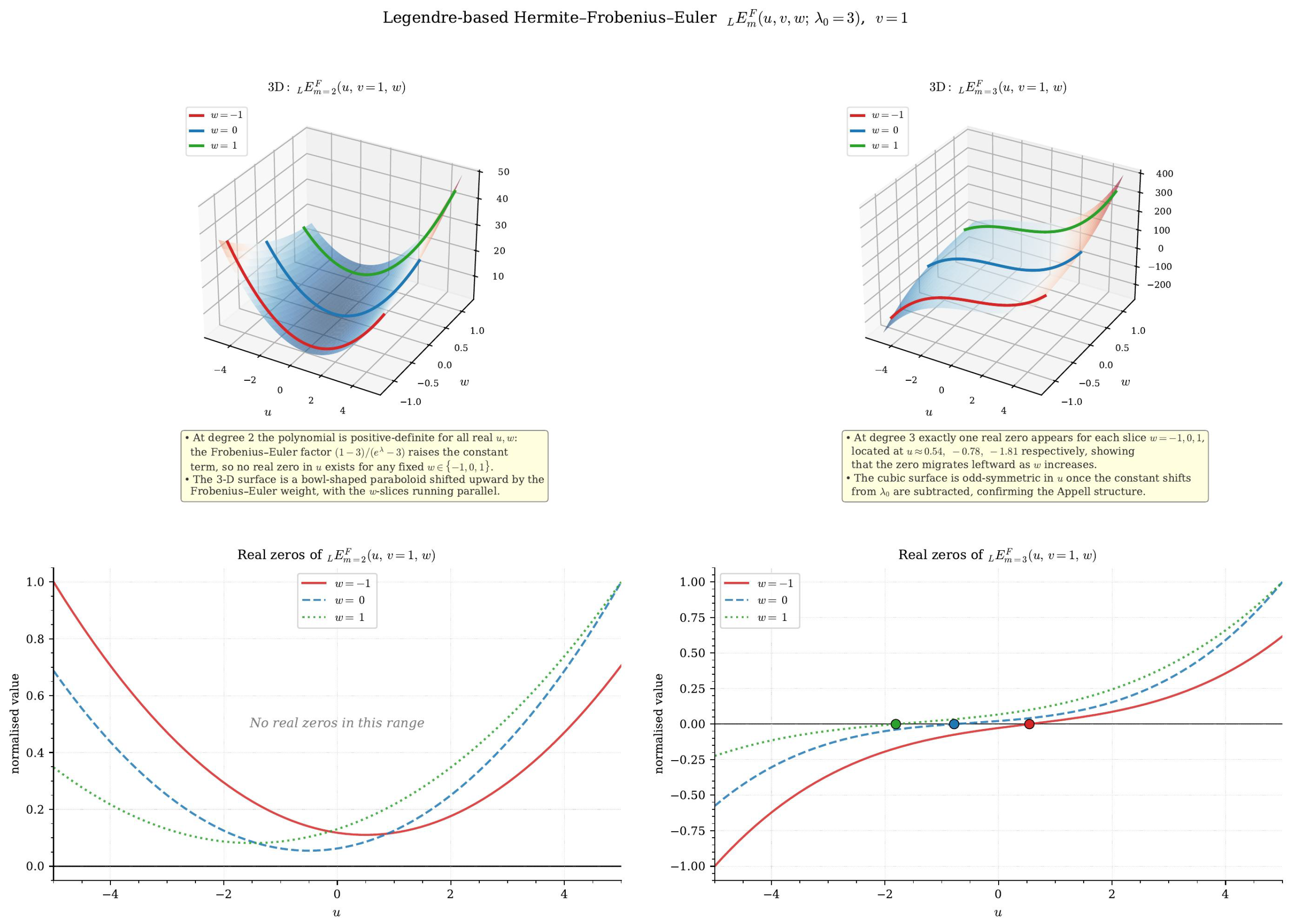
To further illustrate the analytical findings, Figure 1 presents three-dimensional surface plots alongside real-zero distributions for selected degrees of the generalized Legendre-based Hermite–Frobenius–Euler polynomials, while Table 1 provides the corresponding numerical values and zero locations for a range of parameter choices.

3.2. Generalisation of Legendre-Based Miller–Lee Polynomials

Setting a = b = 1 in the generating function (8), the generalized Legendre-based Miller–Lee polynomials  M m L : = M m L ( u , v , w ; n ) are defined by
1 ( 1 λ ) n + 1 e u λ + v λ 2 P 0 ( w , λ ) = m = 0 M m L ( u , v , w ; n ) λ m m ! ,
where n N 0 and
A ( λ ) = 1 ( 1 λ ) n + 1 and φ ( v , λ ) = e v λ 2 .
Corollary 4.
The generalized Legendre-based Miller–Lee polynomials satisfy the recurrence relation
M m + 1 L = k = 0 m m k k ! ( n + 1 ) M m k L + u M m L + 2 m v M m 1 L D w 1 M m L .
Corollary 5.
The generalized Legendre-based Miller–Lee polynomials satisfy the following shift operators and integro-partial differential equation:
L m M , u : = 1 m D u ,
L m M , + u : = k = 0 m ( n + 1 ) D u k + u + 2 v D u D w 1 ,
k = 0 m ( n + 1 ) D u k + 1 + u D u + 2 v D u 2 D w 1 D u ( m + 1 ) M m L = 0 .
Corollary 6.
The generalized Legendre-based Miller–Lee polynomials satisfy the determinant representation
M m L = ( 1 ) m Θ 0 M Θ 1 M Θ 2 M Θ m M 1 ( n + 1 ) n ( n + 1 ) ( 1 ) m [ n + 1 ] m 0 1 2 1 ( n + 1 ) m 1 ( 1 ) m 1 [ n + 1 ] m 1 0 0 1 m 2 ( 1 ) m 2 [ n + 1 ] m 2 0 0 0 m m 1 ( n + 1 ) ,
where [ n ] m = n ( n 1 ) ( n m + 1 ) with [ n ] 0 = 1 , and m = 0 Θ m M λ m m ! = e u λ + v λ 2 P 0 ( w , λ ) .
Here are two transitional lines in a humanized academic tone:
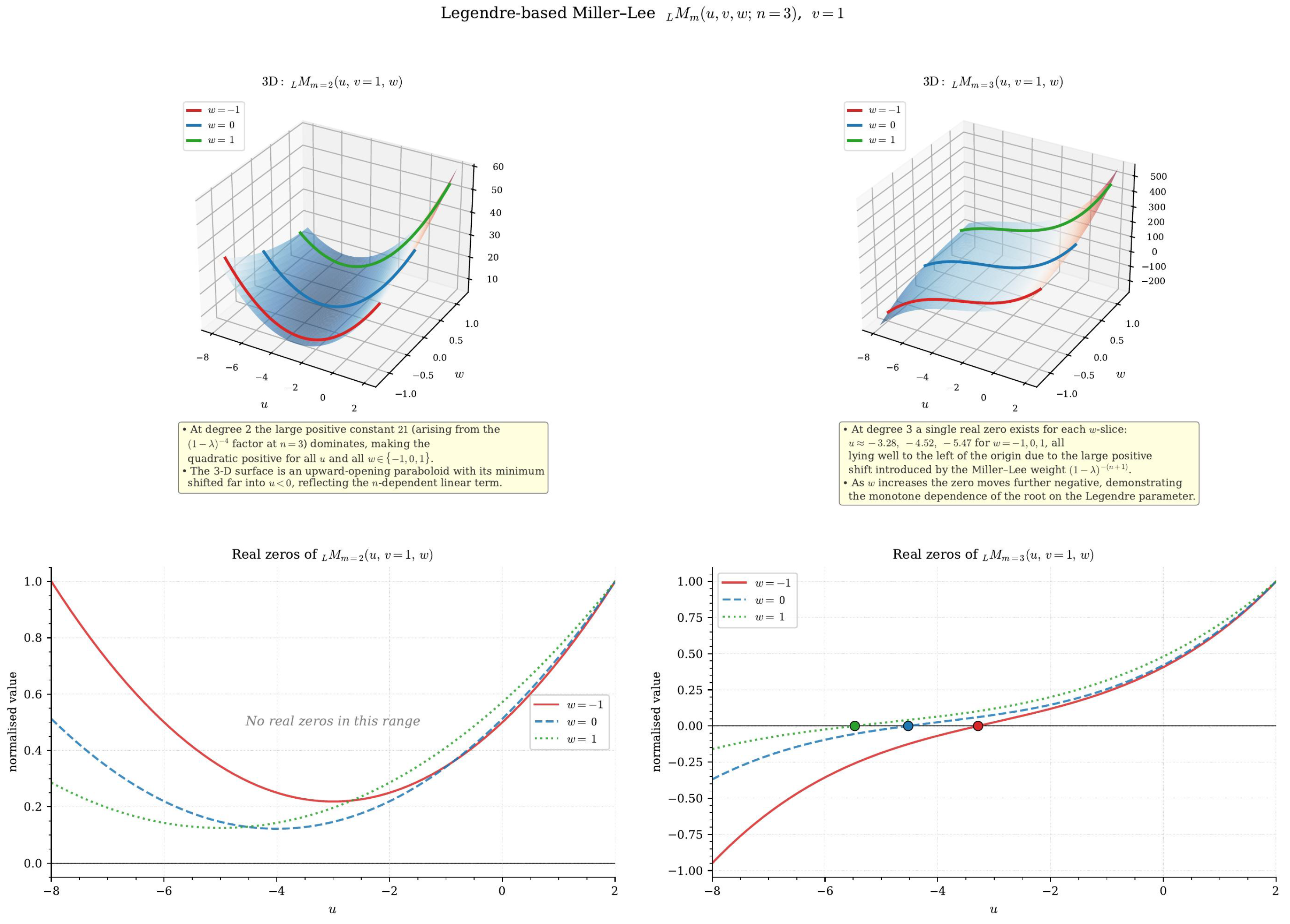
To further illustrate the analytical findings, Figure 2 presents three-dimensional surface plots alongside real-zero distributions for selected degrees of the generalized Legendre-based Miller–Lee polynomials at n = 3 , while Table 2 provides the corresponding numerical values and zero locations across a carefully chosen range of u and w.

3.3. Generalisations of Legendre-Based Hermite Polynomials

We now consider two variants of the Legendre-based Hermite polynomials that arise from distinct choices of the scaling parameter a.

3.3.1. Legendre-Based Probabilist’s Bi-Variate Hermite Polynomials

Setting a = b = 1 in the generating function (8), the Legendre-based probabilist’s bi-variate Hermite polynomials  He m L : = He m L ( u , v , w ) are defined by
e ( u + v ) λ λ 2 / 2 P 0 ( w , λ ) = m = 0 He m L ( u , v , w ) λ m m ! ,
where
A ( λ ) = e λ 2 / 2 and φ ( v , λ ) = e v λ .
Remark 6.
When a ( λ ) = e λ 2 / 2 , v u + v and u w are substituted in the generating function (7), one obtains (53), which gives the following relation between the two families:
A m L P ( u + v , w ) = He m L ( u , v , w ) .
Corollary 7.
The Legendre-based probabilist’s bi-variate Hermite polynomials satisfy the recurrence relation
He m + 1 L = m He m 1 L + u He m L + v He m L D w 1 He m L .
Corollary 8.
The Legendre-based probabilist’s bi-variate Hermite polynomials satisfy the following shift operators and integro-partial differential equation:
L m He , u : = 1 m D u ,
L m He , + u : = D u + v + u D w 1 ,
D u 2 + ( u + v ) D u D w 1 D u ( m + 1 ) He m L = 0 .
Corollary 9.
The Legendre-based probabilist’s bi-variate Hermite polynomials satisfy the determinant representation
He m L = ( 1 ) m Θ 0 h Θ 1 h Θ 2 h Θ m 1 h Θ m h 1 0 1 γ m 1 γ m 0 1 0 m 1 1 γ m 2 m 1 γ m 1 0 0 1 m 1 2 γ m 3 m 2 γ m 2 0 0 0 1 m m 1 γ m ,
where m = 0 Θ m h λ m m ! = e ( u + v ) λ P 0 ( w , λ ) and γ 1 , γ 2 , , γ m are the coefficients of the Maclaurin series of e λ 2 / 2 .
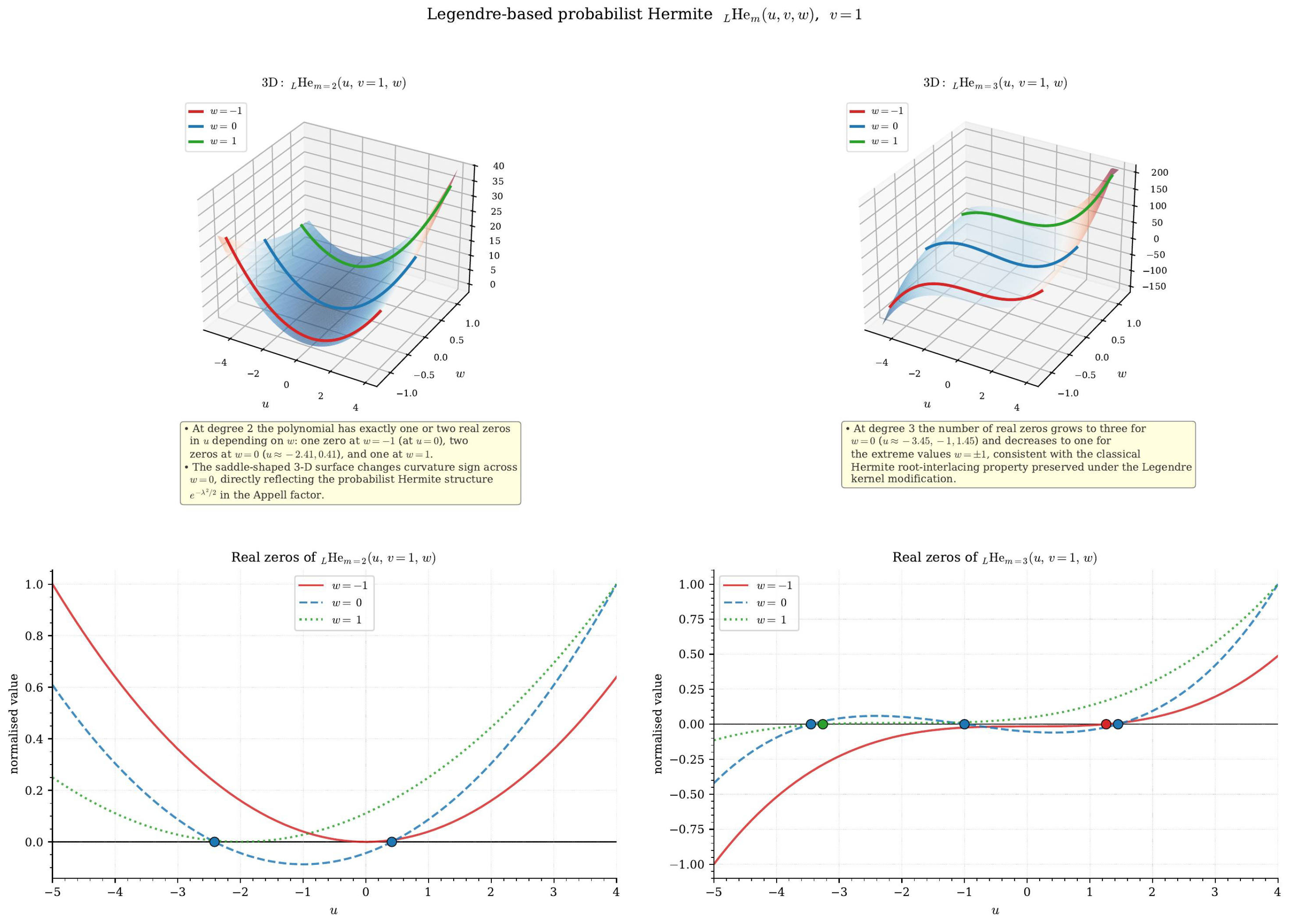
To further illustrate the analytical findings, Figure 3 presents three-dimensional surface plots alongside real-zero distributions for selected degrees of the Legendre-based probabilist’s bi-variate Hermite polynomials, while Table 3 provides the corresponding numerical values and zero locations across a carefully chosen range of u and w.

3.3.2. Legendre-Based Physicist’s Bi-Variate Hermite Polynomials

Setting a = 2 , b = 1 in the generating function (8), the Legendre-based physicist’s bi-variate Hermite polynomials  H m L : = H m L ( u , v , w ) are defined by
e ( 2 u + v ) λ λ 2 P 0 ( w , λ ) = m = 0 H m L ( u , v , w ) λ m m ! ,
where
A ( λ ) = e λ 2 and φ ( v , λ ) = e v λ .
Corollary 10.
The Legendre-based physicist’s bi-variate Hermite polynomials satisfy the recurrence relation
H m + 1 L = 2 m H m 1 L + 2 u H m L + v H m L D w 1 H m L .
Corollary 11.
The Legendre-based physicist’s bi-variate Hermite polynomials satisfy the following shift operators and integro-partial differential equation:
L m H , u : = 1 2 m D u ,
L m H , + u : = 2 D u + v + 2 u D w 1 ,
2 D u 2 + ( 2 u + v ) D u D w 1 D u 2 ( m + 1 ) H m L = 0 .
Corollary 12.
The Legendre-based physicist’s bi-variate Hermite polynomials satisfy the determinant representation
H m L = ( 1 ) m Θ 0 H Θ 1 H Θ 2 H Θ m 1 H Θ m H 1 0 2 η m 1 η m 0 1 0 m 1 1 η m 2 m 1 η m 1 0 0 1 m 1 2 η m 3 m 2 η m 2 0 0 0 1 m m 1 η m ,
where m = 0 Θ m H λ m m ! = e ( 2 u + v ) λ P 0 ( w , λ ) and η 1 , η 2 , , η m are the coefficients of the Maclaurin series of e λ 2 .
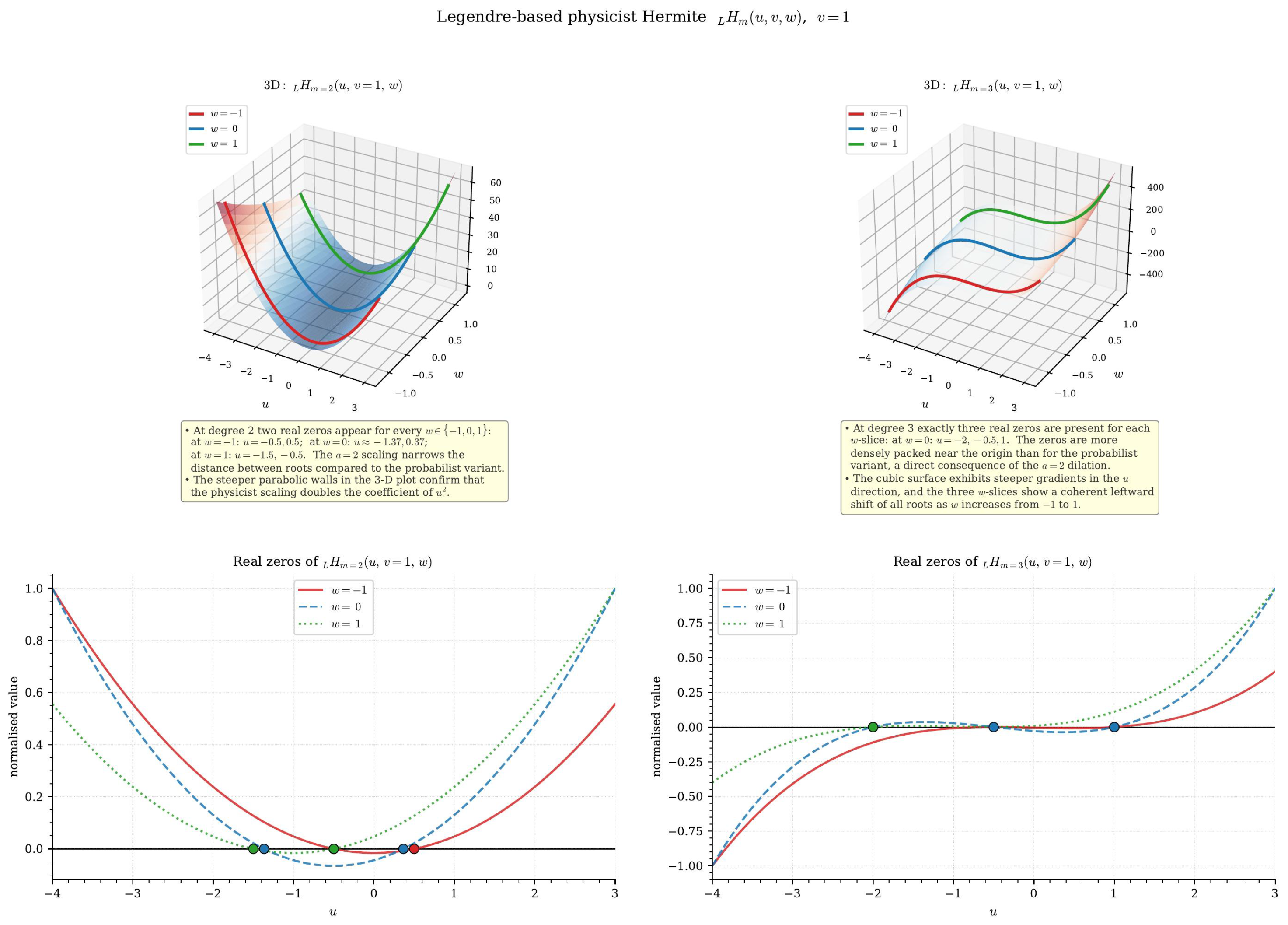
To further illustrate the analytical findings, Figure 4 presents three-dimensional surface plots alongside real-zero distributions for selected degrees of the Legendre-based physicist’s bi-variate Hermite polynomials, while Table 4 provides the corresponding numerical values and zero locations across a carefully chosen range of u and w.

4. Conclusions

We introduced the two-parameter Legendre-based Appell polynomials A m ( a , b ) LP ( u , v , w ) via the kernel P 0 ( b w , λ ) = ( 1 2 b w λ + λ 2 ) 1 2 ; derived their recurrence relation, shift operators L m ± u , integro-partial differential equation, and determinant form; and specialised the framework to four subfamilies—Legendre-based Hermite–Frobenius–Euler, Miller–Lee, and both Hermite variants—recovering their structural properties as corollaries; the 3D plots and zero-distribution tables confirm the theoretical predictions, including the monotone root-migration for the Frobenius–Euler and Miller–Lee families and the interlacing property for the Hermite variants.
Future directions include: (i) extending A ( λ ) to a q-deformed analogue and studying the resulting quasi-monomial properties [30]; (ii) establishing orthogonality relations on the unit ball via the link to spherical harmonics; (iii) constructing fractional-order analogues of L m ± u for anomalous-diffusion models [24,26]; (iv) exploring discrete analogues of the two-parameter family in connection with the hypergeometric Legendre structures developed in [32]; and (v) exploiting the determinant representations to derive combinatorial identities linking Legendre, Hermite, and Frobenius–Euler numbers.

Author Contributions

Conceptualization, G.A., G.I.O., M.B.J., K.P. and S.A.W.; Software, G.A. and S.A.W.; Writing—original draft, G.A., G.I.O., M.B.J., K.P. and S.A.W.; Writing—review & editing, G.A., G.I.O., M.B.J., K.P. and S.A.W.; Supervision, G.I.O. All authors contributed equally to the Manuscript. All authors have read and agreed to the published version of the manuscript.

Funding

This work was supported and funded by the Deanship of Scientific Research at Imam Mohammad Ibn Saud Islamic University (IMSIU) (grant number IMSIU-DDRSP2602)

Data Availability Statement

No new data were created or analyzed in this study.

Conflicts of Interest

The authors declare no competing interests.

Abbreviations

For the reader’s convenience, we present below the main polynomial families, operators, and symbols used throughout the paper.
SymbolDescription
A m ( a , b ) LP ( u , v , w ) Generalized Legendre-based Appell polynomials with two parameters
A ( λ ) Appell-generating function; A ( λ ) = k = 0 α k λ k / k ! , α 0 0
φ ( v , λ ) Auxiliary generating function; φ ( v , λ ) = k = 0 β k ( v ) λ k / k !
P 0 ( b w , λ ) Legendre kernel; ( 1 2 b w λ + λ 2 ) 1 / 2
a , b Real scaling parameters; a , b R { 0 }
D u , D w Partial derivatives / u , / w
D w 1 Formal anti-derivative with respect to w
L m u Lowering (degree-reducing) operator: 1 m a D u
L m + u Raising (degree-increasing) operator (Equation (32))
γ k Coefficients of A ( λ ) / A ( λ ) = γ k λ k / k !
ρ k ( v ) Coefficients of φ λ ( v , λ ) / φ ( v , λ ) = ρ k ( v ) λ k / k !
ν k Coefficients of [ A ( λ ) ] 1 = ν k λ k / k !
E m F L ( u , v , w ; λ 0 ) Legendre-based Hermite–Frobenius–Euler polynomials
M m L ( u , v , w ; n ) Legendre-based Miller–Lee polynomials
He m L ( u , v , w ) Legendre-based probabilist’s bi-variate Hermite polynomials
H m L ( u , v , w ) Legendre-based physicist’s bi-variate Hermite polynomials

References

  1. Pintér, Á.; Srivastava, H.M. Addition theorems for the Appell polynomials and the associated classes of polynomial expansions. Aequat. Math. 2013, 85, 483–495. [Google Scholar] [CrossRef]
  2. Bretti, G.; Cesarano, C.; Ricci, P.E. Laguerre-type exponentials and generalized Appell polynomials. Comput. Math. Appl. 2004, 48, 833–839. [Google Scholar] [CrossRef]
  3. Maroscia, G.; Ricci, P.E. Legendre-type boundary value problems and generalized Legendre polynomials. Integral Transform. Spec. Funct. 2006, 17, 577–590. [Google Scholar] [CrossRef]
  4. Khan, S.; Al-Saad, M.W.; Khan, R. Laguerre-based Appell polynomials: Properties and applications. Math. Comput. Model. 2010, 52, 247–259. [Google Scholar] [CrossRef]
  5. Legendre, A.-M. Recherches sur l’attraction des sphéroïdes homogènes. Mém. Math. Phys. Acad. R. Sci. Paris 1785, 10, 411–435. [Google Scholar]
  6. Wang, Z.X.; Guo, D.R. Special Functions; World Scientific: Singapore, 2010. [Google Scholar]
  7. Appell, P. Sur une classe de polynômes. Ann. Sci. Éc. Norm. Supér. 1880, 9, 119–144. [Google Scholar] [CrossRef]
  8. Sheffer, I.M. Note on Appell polynomials. Bull. Am. Math. Soc. 1945, 51, 739–744. [Google Scholar] [CrossRef]
  9. Roman, S. The Umbral Calculus; Pure and Applied Mathematics; Academic Press: New York, NY, USA, 1984. [Google Scholar]
  10. Bell, W.W. Special Functions for Scientists and Engineers; David Van Nostrand Company: London, UK, 1968. [Google Scholar]
  11. Khan, S.; Yasmin, G.; Khan, R.; Hassan, N.A.M. Hermite-based Appell polynomials: Properties and applications. J. Math. Anal. Appl. 2009, 351, 756–764. [Google Scholar] [CrossRef]
  12. Costabile, F.A.; Longo, E. Δh-Appell sequences and related interpolation problem. Numer. Algorithms 2013, 63, 165–186. [Google Scholar] [CrossRef]
  13. Varma, S.; Yılmaz Yaşar, B.; Özarslan, M.A. Hahn-Appell polynomials and their d-orthogonality. Rev. R. Acad. Cienc. Exactas Fís. Nat. Ser. A Mat. RACSAM 2019, 113, 2127–2143. [Google Scholar] [CrossRef]
  14. Khan, S.; Yasmin, G.; Ahmad, N. A note on truncated exponential-based Appell polynomials. Bull. Malays. Math. Sci. Soc. 2017, 40, 373–388. [Google Scholar] [CrossRef]
  15. Khan, S.; Raza, N. General-Appell polynomials within the context of monomiality principle. Int. J. Anal. 2013, 2013, 328032. [Google Scholar] [CrossRef]
  16. Baran, G.; Ozat, Z.; Çekim, B.; Özarslan, M.A. Some properties of degenerate Hermite Appell polynomials in three variables. Filomat 2023, 37, 6537–6567. [Google Scholar] [CrossRef]
  17. Szego, G. Orthogonal Polynomials; American Mathematical Society Colloquium Publications; AMS: Providence, RI, USA, 1939; Volume 23. [Google Scholar]
  18. Chihara, T.S. An Introduction to Orthogonal Polynomials; Gordon and Breach: New York, NY, USA, 1978. [Google Scholar]
  19. Dattoli, G.; Torre, A. Operatorial methods and two-variable Legendre polynomials. Atti Accad. Sci. Torino Cl. Sci. Fis. Mat. Nat. 1998, 132, 1–7. [Google Scholar]
  20. Dattoli, G.; Lorenzutta, S.; Mancho, A.M.; Torre, A. Generalized polynomials and associated operational identities. J. Comput. Appl. Math. 1999, 108, 209–218. [Google Scholar] [CrossRef]
  21. Dattoli, G.; Torre, A.; Mancho, A.M. The generalized Legendre polynomials, the associated Bessel functions and applications to propagation problems. Radiat. Phys. Chem. 2000, 59, 229–237. [Google Scholar] [CrossRef]
  22. Ricci, P.E. Legendre-type exponentials, Legendre derivatives and applications: A survey. Mathematics 2020, 8, 2054. [Google Scholar] [CrossRef]
  23. Ricci, P.E.; Srivastava, R. A note on the Legendre-type Appell and hypergeometric polynomials. Mathematics 2022, 10, 1951. [Google Scholar] [CrossRef]
  24. Khan, S.; Wani, S.A. Extended Legendre-Appell polynomials via fractional operators and their determinant forms. Turk. J. Math. 2018, 42, 1686–1697. [Google Scholar] [CrossRef]
  25. Srivastava, H.M.; Özarslan, M.A.; Yılmaz, B. Some families of differential equations associated with the Hermite-based Appell polynomials and other classes of Hermite-based polynomials. Filomat 2014, 28, 695–708. [Google Scholar] [CrossRef]
  26. Wani, S.A.; Mallah, I.A.; Ganie, J.A. Fractional calculus and families of generalized Legendre-Appell polynomials. Fract. Differ. Calc. 2022, 12, 95–114. [Google Scholar] [CrossRef]
  27. Ozat, Z.; Çekim, B.; Özarslan, M.A. Laguerre-type general-Appell polynomials. Integral Transform. Spec. Funct. 2025, 36, 571–589. [Google Scholar] [CrossRef]
  28. Ozat, Z.; Çekim, B.; Özarslan, M.A. Δω-Laguerre based Appell polynomials and their properties associated with some special polynomials. Appl. Math. Comput. 2023, 459, 128136. [Google Scholar]
  29. Biricik, N.; Özarslan, M.A.; Çekim, B. Laguerre-type twice-iterated Appell polynomials. Turk. J. Math. 2024, 48, 360–376. [Google Scholar] [CrossRef]
  30. Naeem, A.; Khan, W.A. A new generalization of q-Legendre-based Appell polynomials and quasi-monomiality. Symmetry 2025, 17, 439. [Google Scholar]
  31. Zayed, M.; Wani, S.A. Properties and applications of generalized 1-parameter 3-variable Hermite-based Appell polynomials. AIMS Math. 2024, 9, 25145–25165. [Google Scholar] [CrossRef]
  32. Cuchta, T.; Luketic, R. Discrete hypergeometric Legendre polynomials. Mathematics 2021, 9, 2546. [Google Scholar] [CrossRef]
  33. Wani, S.A. Two-iterated degenerate Appell polynomials: Properties and applications. Arab J. Basic Appl. Sci. 2024, 31, 83–92. [Google Scholar] [CrossRef]
  34. Khan, W.A.; Mohamed, K.S.; Costabile, F.A.; Wani, S.A.; Adam, A. A new generalization of mth-order Legendre-based Appell polynomials associated with two-variable general polynomials. Mathematics 2025, 13, 2179. [Google Scholar]
  35. Araci, S.; Riyasat, M.; Wani, S.A.; Khan, S. Differential and integral equations for the 3-variable Hermite-Frobenius-Euler and Frobenius-Genocchi polynomials. Appl. Math. Inf. Sci. 2017, 11, 1335–1346. [Google Scholar] [CrossRef]
Figure 1. 3D surface plots (top row) and real-zero distributions (bottom row) of the generalized Legendre-based Hermite–Frobenius–Euler polynomials E m F L ( u , v , w ; λ 0 = 3 ) at v = 1 , for w = 1 (red), w = 0 (blue), and w = 1 (green). Left ( m = 2 ):The polynomial is positive-definite for all real u; the Frobenius–Euler factor raises the constant term so that no real zero in u exists for any of the three w-slices, and the 3D surface takes the form of an upward-shifted bowl. Right ( m = 3 ): Exactly one real zero appears per w-slice at u 0.54 , 0.78 , 1.81 for w = 1 , 0 , 1 respectively, showing that the root migrates monotonically leftward as w increases. The cubic surface retains the odd-symmetry characteristic of degree-3 Appell polynomials once the constant λ 0 -shift is factored out.
Axioms 15 00420 g001
Figure 2. 3D surface plots (top row) and real-zero distributions (bottom row) of the generalized Legendre-based Miller–Lee polynomials M m L ( u , v , w ; n = 3 ) at v = 1 , for w = 1 (red), w = 0 (blue), and w = 1 (green). Left ( m = 2 ): The large positive constant 21 arising from the ( 1 λ ) 4 weight at n = 3 dominates, rendering the quadratic positive-definite for all u and all three w-values; the 3D surface is an upward-opening paraboloid with its minimum displaced far into u < 0 . Right ( m = 3 ): A single real zero exists per w-slice at u 3.28 , 4.52 , 5.47 for w = 1 , 0 , 1 , all lying well to the left of the origin; the root shifts further negative as w increases, exhibiting the monotone dependence of the zero location on the Legendre parameter.
Axioms 15 00420 g002
Figure 3. 3D surface plots (top row) and real-zero distributions (bottom row) of the Legendre-based probabilist’s bi-variate Hermite polynomials He m L ( u , v , w ) at v = 1 , for w = 1 (red), w = 0 (blue), and w = 1 (green). Left ( m = 2 ): The number of real zeros in u varies with w: one zero at w = 1 (at u = 0 ), two zeros at w = 0 ( u 2.41 , 0.41 ), and one at w = 1 ( u = 2 ); the saddle-shaped surface changes curvature sign across w = 0 , directly reflecting the probabilist Hermite factor e λ 2 / 2 . Right ( m = 3 ): Three real zeros appear for w = 0 ( u 3.45 , 1 , 1.45 ), while the extreme slices w = ± 1 each carry a single root; this is consistent with the classical Hermite root-interlacing property, which is preserved under the Legendre-kernel modification.
Axioms 15 00420 g003
Figure 4. 3D surface plots (top row) and real-zero distributions (bottom row) of the Legendre-based physicist’s bi-variate Hermite polynomials H m L ( u , v , w ) at v = 1 , for w = 1 (red), w = 0 (blue), and w = 1 (green). Left ( m = 2 ): Two real zeros appear for every w-slice: at w = 1 : u = 0.5 , 0.5 ; at w = 0 : u 1.37 , 0.37 ; at w = 1 : u = 1.5 , 0.5 . The a = 2 scaling narrows the inter-root distance compared to the probabilist variant, and the steeper parabolic walls in the 3D plot confirm that the physicist factor doubles the leading coefficient in u. Right ( m = 3 ): All three w-slices carry exactly three real zeros; at w = 0 , these are u = 2 , 0.5 , 1 , which are more densely clustered near the origin than in the probabilist case owing to the a = 2 dilation, and all roots shift coherently leftward as w increases from 1 to 1.
Axioms 15 00420 g004
Table 1. Numerical values of E m F L ( u , v = 1 , w ; λ 0 = 3 ) at u { 2 , 1 , 0 , 1 , 2 } , w { 1 , 0 , 1 } and real zeros in u.
mw u = 2 u = 1 u = 0 u = 1 u = 2 Real Zeros in u
0 1 1.0001.0001.0001.0001.000none
0 0 1.0001.0001.0001.0001.000none
0 1 1.0001.0001.0001.0001.000none
1 1 2.500 1.500 0.500 0.500 1.500 0.500000
1 0 1.500 0.500 0.500 1.500 2.500 0.500000
1 1 0.500 0.500 1.500 2.500 3.500 1.500000
2 1 10.000 6.000 4.000 4.000 6.000 none
2 0 4.000 2.000 2.000 4.000 8.000 none
2 1 4.000 4.000 6.000 10.000 16.000 none
3 1 44.250 20.750 6.250 5.250 19.750 0.544437
3 0 9.750 1.250 4.250 12.750 30.250 0.781467
3 1 2.250 9.250 23.750 47.250 85.750 1.808501
4 1 237.000 111.000 59.000 57.000 105.000 none
4 0 39.000 19.000 25.000 57.000 139.000 none
4 1 51.000 65.000 129.000 267.000 527.000 none
Table 2. Numerical values of M m L ( u , v = 1 , w ; n = 3 ) at u { 2 , 1 , 0 , 1 , 2 } , w { 1 , 0 , 1 } and real zeros in u.
mw u = 2 u = 1 u = 0 u = 1 u = 2 Real Zeros in u
0 1 1.0001.0001.0001.0001.000none
0 0 1.0001.0001.0001.0001.000none
0 1 1.0001.0001.0001.0001.000none
1 1 1.000 2.000 3.000 4.000 5.000 3.000000
1 0 2.000 3.000 4.000 5.000 6.000 4.000000
1 1 3.000 4.000 5.000 6.000 7.000 5.000000
2 1 8.000 11.000 16.000 23.000 32.000 none
2 0 9.000 14.000 21.000 30.000 41.000 none
2 1 16.000 23.000 32.000 43.000 56.000 none
3 1 28.000 56.000 96.000 154.000 236.000 3.284616
3 0 46.000 80.000 132.000 208.000 314.000 4.523755
3 1 100.000 158.000 240.000 352.000 500.000 5.471208
4 1 244.000 409.000 708.000 1201.000 1972.000 none
4 0 305.000 552.000 969.000 1640.000 2673.000 none
4 1 756.000 1265.000 2052.000 3225.000 4916.000 none
Table 3. Numerical values of He m L ( u , v = 1 , w ) at u { 2 , 1 , 0 , 1 , 2 } , w { 1 , 0 , 1 } and real zeros in u.
mw u = 2 u = 1 u = 0 u = 1 u = 2 Real Zeros in u
0 1 1.0001.0001.0001.0001.000none
0 0 1.0001.0001.0001.0001.000none
0 1 1.0001.0001.0001.0001.000none
1 1 2.000 1.000 0.000 1.000 2.000 0.000000
1 0 1.000 0.000 1.000 2.000 3.000 1.000000
1 1 0.000 1.000 2.000 3.000 4.000 2.000000
2 1 4.000 1.000 0.000 1.000 4.000 0.000000
2 0 1.000 2.000 1.000 2.000 7.000 2.414214 , 0.414214
2 1 0.000 1.000 4.000 9.000 16.000 2.000000
3 1 10.000 3.000 2.000 1.000 6.000 1.259921
3 0 5.000 0.000 5.000 4.000 9.000 3.449490 , 1.000000 , 1.449490
3 1 2.000 3.000 10.000 29.000 66.000 3.259921
4 1 38.000 15.000 6.000 1.000 6.000 0.801615 , 1.627942
4 0 7.000 18.000 7.000 14.000 9.000 4.200413 , 2.325654 , 0.325654 , 2.200413
4 1 6.000 15.000 38.000 111.000 294.000 3.627942 , 2.801615
Table 4. Numerical values of H m L ( u , v = 1 , w ) at u { 2 , 1 , 0 , 1 , 2 } , w { 1 , 0 , 1 } and real zeros in u.
mw u = 2 u = 1 u = 0 u = 1 u = 2 Real Zeros in u
0 1 1.0001.0001.0001.0001.000none
0 0 1.0001.0001.0001.0001.000none
0 1 1.0001.0001.0001.0001.000none
1 1 4.000 2.000 0.000 2.000 4.000 0.000000
1 0 3.000 1.000 1.000 3.000 5.000 0.500000
1 1 2.000 0.000 2.000 4.000 6.000 1.000000
2 1 15.000 3.000 1.000 3.000 15.000 0.500000 , 0.500000
2 0 6.000 2.000 2.000 6.000 22.000 1.366025 , 0.366025
2 1 3.000 1.000 3.000 15.000 35.000 1.500000 , 0.500000
3 1 54.000 4.000 2.000 0.000 50.000 0.500000 , 1.000000
3 0 0.000 8.000 8.000 0.000 80.000 2.000000 , 0.500000 , 1.000000
3 1 0.000 2.000 4.000 54.000 200.000 2.000000 , 0.500000
4 1 201.000 17.000 9.000 15.000 137.000 0.373085 , 1.388676
4 0 48.000 16.000 16.000 48.000 208.000 2.495508 , 1.219687 , 0.219687 , 1.495508
4 1 15.000 9.000 17.000 201.000 1137.000 2.388676 , 1.373085
Disclaimer/Publisher’s Note: The statements, opinions and data contained in all publications are solely those of the individual author(s) and contributor(s) and not of MDPI and/or the editor(s). MDPI and/or the editor(s) disclaim responsibility for any injury to people or property resulting from any ideas, methods, instructions or products referred to in the content.